Transitional Care
Interventions
To Prevent
Readmissions for
People With Heart
Failure
Comparative Effectiveness Review
Number 133
Comparative Effectiveness Review
Number 133
Transitional Care Interventions To Prevent
Readmissions for People With Heart Failure
Prepared for:
Agency for Healthcare Research and Quality U.S. Department of Health and Human Services 540 Gaither Road
Rockville, MD 20850 www.ahrq.gov
Contract No. 290-2012-00008-I
Prepared by:
Research Triangle Institute–University of North Carolina Evidence-based Practice Center Research Triangle Park, NC
Investigators: Cynthia Feltner, M.D., M.P.H. Christine D. Jones, M.D., M.S. Crystal W. Cené, M.D., M.P.H. Zhi-Jie Zheng, M.D., M.P.H., Ph.D. Carla A. Sueta, M.D., Ph.D. Emmanuel J.L. Coker-Schwimmer, M.P.H. Marina Arvanitis, M.D.
Kathleen N. Lohr, Ph.D., M.Phil., M.A. Jennifer Cook Middleton, Ph.D.
Daniel E. Jonas, M.D., M.P.H.
AHRQ Publication No. 14-EHC021-EF May 2014
This report is based on research conducted by the Research Triangle Institute–University of North Carolina Evidence-based Practice Center (EPC) under contract to the Agency for Healthcare Research and Quality (AHRQ), Rockville, MD (Contract No. 290-2012-00008-I). The findings and conclusions in this document are those of the authors, who are responsible for its contents; the findings and conclusions do not necessarily represent the views of AHRQ. Therefore, no statement in this report should be construed as an official position of AHRQ or of the U.S. Department of Health and Human Services.
The information in this report is intended to help health care decisionmakers—patients and clinicians, health system leaders, and policymakers, among others—make well informed decisions and thereby improve the quality of health care services. This report is not intended to be a substitute for the application of clinical judgment. Anyone who makes decisions concerning the provision of clinical care should consider this report in the same way as any medical
reference and in conjunction with all other pertinent information, i.e., in the context of available resources and circumstances presented by individual patients.
This report may be used, in whole or in part, as the basis for development of clinical practice guidelines and other quality enhancement tools, or as a basis for reimbursement and coverage policies. AHRQ or U.S. Department of Health and Human Services endorsement of such derivative products may not be stated or implied.
This report may periodically be assessed for the urgency to update. If an assessment is done, the resulting surveillance report describing the methodology and findings will be found on the
Effective Health Care Program Web site at www.effectivehealthcare.ahrq.gov. Search on the title of the report.
This document is in the public domain and may be used and reprinted without permission. Citation of the source is appreciated.
Persons using assistive technology may not be able to fully access information in this report. For assistance contact [email protected].
None of the investigators have any affiliations or financial involvement that conflicts with the material presented in this report.
Suggested citation: Feltner C, Jones CD, Cené CW, Zheng Z-J, Sueta CA, Coker-Schwimmer EJL, Arvanitis M, Lohr KN, Middleton JC, Jonas DE. Transitional Care Interventions To Prevent Readmissions for People With Heart Failure. Comparative Effectiveness Review No. 133. (Prepared by the Research Triangle Institute–University of North Carolina Evidence-based Practice Center under Contract No. 290-2012-00008-I). AHRQ Publication No. 14-EHC021-EF. Rockville, MD: Agency for Healthcare Research and Quality; May 2014.
www.effectivehealthcare.ahrq.gov/reports/final.cfm.
Preface
The Agency for Healthcare Research and Quality (AHRQ), through its Evidence-based Practice Centers (EPCs), sponsors the development of systematic reviews to assist public- and private-sector organizations in their efforts to improve the quality of health care in the United States. These reviews provide comprehensive, science-based information on common, costly medical conditions, and new health care technologies and strategies.
Systematic reviews are the building blocks underlying evidence-based practice; they focus attention on the strength and limits of evidence from research studies about the effectiveness and safety of a clinical intervention. In the context of developing recommendations for practice, systematic reviews can help clarify whether assertions about the value of the intervention are based on strong evidence from clinical studies. For more information about AHRQ EPC systematic reviews, see www.effectivehealthcare.ahrq.gov/reference/purpose.cfm.
AHRQ expects that these systematic reviews will be helpful to health plans, providers, purchasers, government programs, and the health care system as a whole. Transparency and stakeholder input are essential to the Effective Health Care Program. Please visit the Web site (www.effectivehealthcare.ahrq.gov) to see draft research questions and reports or to join an email list to learn about new program products and opportunities for input.
We welcome comments on this systematic review. They may be sent by mail to the Task Order Officer named below at: Agency for Healthcare Research and Quality, 540 Gaither Road, Rockville, MD 20850, or by email to [email protected].
Richard G. Kronick, Ph.D. Yen-pin Chiang, Ph.D.
Director Acting Director
Agency for Healthcare Research and Policy Center for Outcomes and Evidence
Agency for Healthcare Research and Quality
Stephanie Chang, M.D., M.P.H. Christine Chang, M.D., M.P.H.
Director, EPC Program Task Order Officer
Center for Outcomes and Evidence Center for Outcomes and Evidence
Agency for Healthcare Research and Quality Agency for Healthcare Research and Quality
Acknowledgments
The authors gratefully acknowledge the continuing support of our AHRQ Task Order Officer, Christine Chang, M.D., M.P.H., and our Associate Editor, Donna Dryden, Ph.D. We extend our appreciation to our Key Informants and members of our Technical Expert Panel (listed below), all of whom provided thoughtful advice and input during our research process. The investigators deeply appreciate the considerable support, commitment, and contributions of the EPC team staff at RTI International and the University of North Carolina at Chapel Hill. We express our gratitude to the following individuals for their contributions to this project: Carol Woodell, B.S.P.H., our Project Manager; Meera Viswanathan, Ph.D., Director of the RTI-UNC EPC; Timothy S. Carey, M.D., M.P.H., Director of the Cecil G. Sheps Center for Health
Services Research at UNC; Rachael Posey, M.S.L.S., our EPC Librarian; Ellen Shanahan, M.A., our research associate; Claire Baker and Cassandra Rowe, B.A., our Research Assistants; Laura Small, editor; and Loraine Monroe, our EPC Publications Specialist.
Key Informants
In designing the study questions, the EPC consulted several Key Informants who represent the end-users of research. The EPC sought the Key Informant input on the priority areas for research and synthesis. Key Informants are not involved in the analysis of the evidence or the writing of the report. Therefore, in the end, study questions, design, methodological approaches, and/or conclusions do not necessarily represent the views of individual Key Informants.
Key Informants must disclose any financial conflicts of interest greater than $10,000 and any other relevant business or professional conflicts of interest. Because of their role as end-users, individuals with potential conflicts may be retained. The TOO and the EPC work to balance, manage, or mitigate any conflicts of interest.
The list of Key Informants who participated in developing this report follows: Kenneth S. Fink, M.D., M.G.A., M.P.H.
Med-Quest Division, Hawaii State Medicaid
Kapolei, HI Jalal Ghali, M.D. Division of Cardiology
Mercer University School of Medicine Macon, GA
Mariell Jessup, M.D.
Professor of Medicine, University of Pennsylvania School of Medicine Medical Director,
Penn Heart and Vascular Center Philadelphia, PA
Carol Levine, M.A.
Families and Health Care Project United Hospital Fund
New York, NY
JoAnn Lindenfeld, M.D. Cardiac Transplant Program University of Colorado Aurora, CO
Timothy J. Wilt, M.D., M.P.H. Minneapolis VA Center for Chronic Disease Outcomes Research
University of Minnesota School of Medicine
Minneapolis, MN
Clyde W. Yancy, M.D., M.Sc., FACC, FAHA, M.A.C.P.
Division of Cardiology Northwestern University Chicago, IL
Judy Zerzan, M.D., M.P.H. Colorado Department of Health Care Policy and Financing Denver, CO
Technical Expert Panel
In designing the study questions and methodology at the outset of this report, the EPC consulted several technical and content experts. Broad expertise and perspectives were sought. Divergent and conflicted opinions are common and perceived as healthy scientific discourse that results in a thoughtful, relevant systematic review. Therefore, in the end, study questions, design, methodologic approaches, and/or conclusions do not necessarily represent the views of
individual technical and content experts.
Technical Experts must disclose any financial conflicts of interest greater than $10,000 and any other relevant business or professional conflicts of interest. Because of their unique clinical or content expertise, individuals with potential conflicts may be retained. The TOO and the EPC work to balance, manage, or mitigate any potential conflicts of interest identified.
The list of Technical Experts who participated in developing this report follows: Darren A. DeWalt, M.D., M.P.H.a
University of North Carolina at Chapel Hill School of Medicine Chapel Hill, NC
Paul A. Heidenreich, M.D., M.S., FACCa
Cardiovascular Research Institute Stanford University School of Medicine Palo Alto, CA Mariell Jessup, M.D.a Professor of Medicine, University of Pennsylvania School of Medicine Medical Director,
Penn Heart and Vascular Center Philadelphia, PA
Devan Kansagara, M.D., M.C.R., FACPa
Portland VA Evidence-based Synthesis Program
Oregon Health and Science University Portland, OR
Gowri Raman, M.D., M.S.a Assistant Professor of Medicine, Tufts University School of Medicine Scientific Staff, Center for Clinical Evidence Synthesis
Tufts Medical Center Boston, MA
Juliana Tiongson, M.P.H. Center for Medicare & Medicaid Innovation Baltimore, MD
Timothy J. Wilt, M.D., M.P.H.a Minneapolis VA Center for Chronic Disease Outcomes Research
University of Minnesota School of Medicine
Minneapolis, MN
Clyde W. Yancy, M.D., M.Sc., FACC, FAHA, M.A.C.P. Division of Cardiology Northwestern University Chicago, IL
a
Indicates Technical Expert Panel member also provided Peer Review commentary and feedback.
Peer Reviewers
Before publication of the final evidence report, EPCs sought input from independent Peer Reviewers without financial conflicts of interest. However, the conclusions and synthesis of the scientific literature presented in this report do not necessarily represent the views of individual reviewers.
Peer Reviewers must disclose any financial conflicts of interest greater than $10,000 and any other relevant business or professional conflicts of interest. Because of their unique clinical or content expertise, individuals with potential nonfinancial conflicts may be retained. The TOO and the EPC work to balance, manage, or mitigate any potential nonfinancial conflicts of interest identified.
The list of Peer Reviewers follows: Jalal Ghali, M.D.
Division of Cardiology
Mercer University School of Medicine Macon, GA
Joseph Lau, M.D.
Brown University Center for Evidence-based Medicine Providence, RI
Christopher O. Phillips, M.D., M.P.H., FACP
Director, Clinical Outcomes Research and Evaluation Associate Professor of Medicine and Epidemiology Department of General Internal Medicine
Morehouse School of Medicine Atlanta, GA
Ileana Piña, M.D., M.P.H.
Albert Einstein College of Medicine of Yeshiva University Montefiore Medical Center
Bronx, NY
Michael W. Rich, M.D.
Washington University in St. Louis School of Medicine St. Louis, MO
Barbara Riegel, D.N.Sc., R.N., FAAN, FAHA University of Pennsylvania School of Nursing Philadelphia, PA
Transitional Care Interventions To Prevent
Readmissions for People With Heart Failure
Structured Abstract
Objectives. To conduct a systematic review and meta-analysis of the efficacy, comparative effectiveness, and harms of transitional care interventions that aim to reduce readmissions and mortality for adults hospitalized with heart failure (HF). We also sought to describe the
components of interventions that showed efficacy.
Data sources. MEDLINE®, Cochrane Library, CINAHL®, ClinicalTrials.gov, and World Health Organization International Clinical Trials Registry Platform (January 1, 1990, to early May 2013).
Review methods. Two investigators independently selected, extracted data from, and rated risk of bias of relevant randomized controlled trials. We conducted meta-analyses using random-effects models to estimate pooled random-effects. We graded strength of evidence (SOE) based on established guidance.
Results. We included 47 trials. Most included patients with moderate to severe HF; mean ages of patients were in the 70s. Few trials reported 30-day readmission rates. A high-intensity home-visiting program reduced all-cause readmission and the composite endpoint (all-cause
readmission or death) at 30 days (low SOE). Over 3 to 6 months, home-visiting programs reduced all-cause readmission (high SOE), HF-specific readmission (moderate SOE), and the composite endpoint (moderate SOE). Multidisciplinary (MDS)-HF clinic interventions reduced all-cause readmission (high SOE). Structured telephone support (STS) interventions reduced HF-specific readmission (high SOE) but not all-cause readmissions (moderate SOE). Home-visiting programs, MDS-HF clinics, and STS interventions produced a mortality benefit (moderate SOE). Neither telemonitoring nor nurse-led clinic interventions reduced readmissions or mortality.
Components of interventions showing efficacy for reducing all-cause readmissions or mortality include: HF education, emphasizing self-care; HF pharmacotherapy, emphasizing promotion of adherence and evidence-based HF pharmacotherapy; and a streamlined mechanism to contact care delivery personnel (e.g., patient hotline). In general, categories of interventions that reduced all-cause readmissions or mortality were more likely to be of higher intensity, to be delivered face to face, and to be provided by MDS teams.
Conclusions. Home-visiting programs and MDS-HF clinic interventions reduced all-cause readmission and mortality; STS reduced HF-specific readmission and mortality but not all-cause readmission. These interventions should receive the greatest consideration by systems or
providers seeking to implement transitional care interventions for people with HF. We found no evidence assessing harms of transitional care interventions, such as increased caregiver burden.
Contents
Executive Summary ...ES-1
Introduction ...1
Background ... 1
Epidemiology of Heart Failure in the United States ... 1
Heart Failure and Preventable Readmissions... 1
Transitional Care for People With Heart Failure ... 2
Existing Guidelines and Current Practice ... 3
Existing Guidelines ... 3
Current Practice ... 3
Rationale for Evidence Review ... 3
Scope and Key Questions ...4
Analytic Framework ...5
Organization of This Report ...6
Methods ...7
Topic Refinement and Review Protocol ... 7
Literature Search Strategy... 7
Search Strategy ... 7
Inclusion and Exclusion Criteria ... 8
Study Selection ... 8
Data Extraction ... 10
Risk-of-Bias Assessment of Individual Studies ... 10
Categorization of Interventions... 11
Data Synthesis ... 12
Strength of the Body of Evidence ... 14
Applicability ... 15
Peer Review and Public Commentary ... 15
Results ...16
Literature Search and Screening ... 16
Characteristics of Included Studies ... 17
Home-Visiting Programs ... 17
Structured Telephone Support ... 21
Telemonitoring ... 23
Clinic-Based Interventions ... 26
Primarily Educational Interventions ... 28
Other Interventions ... 30
KQ 1. Transitional Care Interventions and Health Care Utilization Outcomes ... 31
Key Points: All-Cause Readmissions ... 31
Key Points: Heart Failure-Specific Readmissions ... 32
Key Points: Composite All-Cause Readmission or Death ... 32
Key Points: Emergency Room Visits, Acute Care Visits, Hospital Days ... 32
Key Points: Comparative Effectiveness ... 32
Detailed Synthesis: Transitional Care Interventions Compared With Usual Care ... 33
Detailed Synthesis: Comparative Effectiveness of Transitional Care Interventions ... 42
KQ 2: Transitional Care Interventions and Health and Social Outcomes ... 42
Key Points: Mortality ... 42
Key Points: Quality of Life and Function ... 43
Key Points: Caregiver and Self-Care Burden ... 43
Key Points: Comparative Effectiveness ... 43
Detailed Synthesis: Transitional Care Interventions Compared With Usual Care ... 43
Detailed Synthesis: Comparative Effectiveness of Transitional Care Interventions ... 49
KQ 3. Components of Effective Interventions ... 49
KQ 3a. Intervention Components ... 50
KQ 3b. Necessity of Particular Components in Effective Interventions ... 58
KQ 3c. Benefits of Particular Components in Multicomponent Interventions ... 58
KQ 4. Intensity, Delivery Personnel, Method of Communication ... 58
Key Points: Intensity ... 59
Key Points: Delivery Personnel ... 59
Key Points: Method of Communication ... 59
Detailed Synthesis ... 59
KQ 5. Subgroups ... 65
Key Points ... 65
Detailed Synthesis ... 65
Discussion...67
Key Findings and Strength of Evidence ... 67
Reducing Readmissions and Mortality ... 67
Utilization Outcomes ... 71
Quality of Life ... 71
Components of Effective Interventions ... 71
Intensity, Delivery Personnel, and Mode of Delivery ... 72
Findings in Relation to What Is Already Known ... 73
Applicability ... 74
Implications for Clinical and Policy Decisionmaking ... 75
Limitations of the Comparative Effectiveness Review Process ... 76
Limitations of the Evidence Base ... 77
Research Gaps ... 78
Conclusions ... 79
References ...81
Abbreviations and Acronyms ...88
Glossary of Terms ...91
Tables Table A. Categories and definitions of transitional care interventions ... ES-7 Table B. Summary of key findings and strength of evidence, by outcome and intervention category ... ES-11 Table C. Summary of key findings and strength of evidence for transitional care interventions: readmission rates and mortality ... ES-12 Table D. Evidence gaps for future research, by Key Question ... ES-19 Table 1. Inclusion/exclusion criteria for studies of transitional care interventions for patients hospitalized for heart failure ... 9
Table 2. Categories and definitions of transitional care interventions... 12
Table 3. Definitions of the grades of overall strength of evidence ... 14
Table 4. Characteristics of trials assessing home-visiting programs ... 17
Table 5. Characteristics of trials assessing structured telephone support ... 21
Table 6. Characteristics of trials assessing telemonitoring ... 24
Table 7. Characteristics of trials assessing outpatient clinic-based interventions ... 27
Table 8. Characteristics of trials assessing primarily educational interventions ... 29
Table 9. Characteristics of trials assessing other interventions ... 30
Table 10. Hospital days accumulated over 6 months: Home visiting versus usual care ... 41
Table 11. Quality of life or function measures used in the included trials ... 46
Table 12. Results of quality of life and function: Home visiting versus usual care ... 46
Table 13. Results of quality of life and function: Structured telephone care versus usual care ... 48
Table 14. KQ 3—Components of effective interventions: All-cause readmissions or composite (all-cause readmission or death) outcome ... 51
Table 15. KQ 3—Components of effective interventions: Mortality ... 55
Table 16. Intensity, delivery personnel, and method of communication in trials assessing home-visiting programs compared with usual care ... 60
Table 17. Intensity, delivery personnel, and method of communication in trials assessing structured telephone support compared with usual care ... 61
Table 18. Intensity, delivery personnel, and method of communication in trials assessing telemonitoring compared with usual care ... 62
Table 19. Intensity, delivery personnel, and method of communication in trials assessing primarily educational interventions compared with usual care ... 63
Table 20. Summary of key findings and strength of evidence, by intervention category and outcome ... 68
Table 21. Summary of key findings and strength of evidence for transitional care interventions: Readmission, composite endpoint, and mortality ... 68
Table 22. Evidence gaps for future research, by Key Question... 78
Figures Figure A. Analytic framework for transitional care interventions to prevent readmissions in people with heart failure ... ES-4 Figure B. Disposition of articles about transitional care interventions for patients hospitalized for heart failure ... ES-10 Figure 1. Analytic framework for transitional care interventions to prevent readmissions in people with heart failure ... 6
Figure 2. Disposition of articles about transitional care interventions for patients hospitalized for heart failure ... 17
Figure 3. All-cause readmission for transitional care interventions compared with usual care, by intervention category and outcome timing: Meta-analysis and forest plot of individual trials .... 33
Figure 4. HF-specific readmission for transitional care interventions compared with usual care, by intervention category and outcome timing: Meta-analysis and forest plot of individual trials... 36
Figure 5. Composite all-cause readmission or death for transitional care interventions compared with usual care, by intervention category and outcome timing: Meta-analysis and forest plot of individual trials ... 38
Figure 6. Mortality among patients receiving transitional care interventions compared with usual care, by intervention category and outcome timing: Meta-analysis and forest plot of individual trials... 44
Appendixes
Appendix A. Literature Search Strategies
Appendix B. Studies Excluded After Full-Text Level Review Appendix C. Characteristics of Interventions
Appendix D. Risk of Bias Assessments for Included Studies Appendix E. Meta-Analysis and Forest Plots of Individual Trials
Appendix F. Meta-Analysis and Forest Plots of Individual Trials: Sensitivity Analyses Appendix G. Strength of Evidence Tables
Executive Summary
Background
Heart failure (HF) is a major public health problem and a leading cause of hospitalization and health care costs in the United States. It is the most common principal discharge diagnosis
among Medicare beneficiaries and the third highest for hospital reimbursements, according to 2005 data from the Centers for Medicare & Medicaid Services (CMS).1 Up to 25 percent of patients hospitalized with HF are readmitted within 30 days.2-5
In an effort to reduce the frequency of rehospitalization of Medicare patients, in October 2012 CMS began lowering reimbursements to hospitals with excessive risk-standardized readmission rates as part of the Hospital Readmissions Reduction Program authorized by the Affordable Care Act.6 This policy provides incentives for hospitals to develop effective transition programs to reduce readmission rates for people with HF.
In 2010, nearly 7 million Americans 18 years of age and older had an HF diagnosis; by 2030, an additional 3 million Americans will have the condition.7,8 The incidence of HF increases with age; it affects 1 of every 100 people 65 years of age and older.9 Coronary disease and
uncontrolled hypertension are the two highest population-attributable risks for HF.10 Survival after HF diagnosis has improved over time, as shown by data from the Framingham Heart Study.11,12 However, the death rate remains high: 50 percent of people diagnosed with HF die within 5 years after diagnosis.11,12 Among Medicare beneficiaries, more than 30 percent of patients with HF die within 1 year after hospitalization.13 National data show no evidence that readmission rates for HF patients have fallen during the past two decades, despite the
observation that HF hospitalizations in the United States have declined by almost 30 percent during the past decade. Readmission rates vary by both geographic location and insurance coverage.14,15
In 2007, the Medicare Payment Advisory Commission called for hospital-specific public reporting of readmission rates, identifying HF as a priority condition. The Commission stated that readmissions for HF were common, costly, and often preventable.16 An estimated 12.5 percent of readmissions for HF were potentially preventable.17
Readmissions following an index hospitalization for HF are related to various conditions. An analysis of Medicare claims data for 2007–09 reported that 35.2 percent of readmissions within 30 days were for HF; the remainder of readmissions were for diverse indications (e.g., renal disorders, pneumonia, arrhythmias, and septicemia or shock).5
The relationship between readmission rates and other important outcomes (e.g., mortality, emergency room [ER] visits) is unclear. Some data suggest that hospitals with the lowest mortality rates among patients with HF tend to have higher readmission rates.18 Some predict that interventions aimed at reducing readmissions may increase use of other health care services, such as ER observational visits.19
Transitional Care Interventions for People With Heart Failure
Interventions designed to prevent readmission among patients with HF are often referred to as “transitional care interventions.”20,21 Naylor and colleagues defined transitional care as “a broad range of time-limited services designed to ensure health care continuity, avoid preventable poor outcomes among at-risk populations, and promote the safe and timely transfer of patients from one level of care to another or from one type of setting to another” (p. 747).20 Transitional
care interventions overlap other forms of care (primary care, care coordination, discharge planning, disease management, and case management); however, they aim specifically to avoid poor clinical outcomes arising from uncoordinated care.22
No clear set of intervention components defines transitional care interventions. They tend to focus on the following: patient or caregiver education (including education on self-care—e.g., self-titrating diuretics), medication reconciliation, coordination with outpatient providers, arrangements for future care (e.g., home health, outpatient followup), and symptom monitoring or reinforcement of education during the transition (e.g., home visits, telephone support, or additional outpatient visits).
No clear consensus exists about when the transition period ends. Although evaluating 30-day readmissions is important for certain stakeholders (hospitals, payers, quality improvement organizations, health care providers), outcomes beyond this period are clinically important and may benefit from overall improvements in care. Outcomes far away from the index
hospitalization probably reflect the natural history of HF or an unrelated illness, whereas a higher proportion of earlier readmissions are thought to be preventable.
Existing Guidance
The 2013 American Heart Association/American College of Cardiology (AHA/ACC) Heart Failure guidelines addressed postdischarge HF interventions.23 These guidelines focus on the importance of optimizing HF pharmacotherapy before discharge, providing HF education before discharge (including education on self-care), and addressing barriers to care. Specifically, the following components were noted as reasonable postdischarge care options: a followup visit within 7 to 14 days of discharge, a telephone followup within 3 days of discharge, or both.24 The AHA/ACC guidelines also recommend initiating multidisciplinary (MDS)-HF disease
management programs for patients at high risk for readmission. The 2010 Heart Failure Society of America guidelines are similar; their guidance emphasizes particular components of discharge planning.25,26 No specific guidance is given on the optimal components of transitional care interventions aimed at preventing readmissions for patients with HF.
Several national performance measures pertain to the standard of care for hospital discharge of HF patients. The Joint Commission performance measures mandate that all patients with HF receive comprehensive written discharge instructions or other educational materials that address activity level, diet, discharge medications, followup appointment, weight monitoring, and planned actions to take should symptoms worsen.27 These measures are publicly reported by hospitals. In 2011, the ACC/AHA/AMA (American Medical Association) Performance Consortium added a documented postdischarge appointment to the list of recommended HF performance measures.28 Required documentation includes location, date, and time for a followup office visit or home health care visit.
Scope and Key Questions
An assessment of the efficacy, comparative effectiveness, and harms of transitional care interventions is needed to support evidence-based policy and clinical decisionmaking. Despite advances in the quality of acute and chronic HF disease management, gaps remain in knowledge about effective interventions to support the transition of care for patients with HF. To address these issues, we conducted a systematic review and meta-analysis of investigations of
transitional care interventions for adults with HF.
Our report focuses mainly on transitional care interventions that aim to reduce 30-day readmission and mortality rates for patients hospitalized with HF. We also include readmissions measured over 3 to 6 months because these are common, costly, and potentially preventable. We examine several related issues, including other health care use (e.g., ER visits), quality of life, and potential harms such as increased caregiver burden. We include these outcomes because they may provide information on the unintended consequences of interventions aimed at preventing readmissions. Specifically, we address the following five Key Questions (KQs):
KQ 1: Among adults who have been admitted for heart failure, do
transitional care interventions increase or decrease the following health
care utilization rates?
a. Readmission rates
b. Emergency room visits
c. Acute care visits
d. Hospital days (of subsequent readmissions)
KQ 2: Among adults who have been admitted for heart failure, do
transitional care interventions increase or decrease the following health and
social outcomes?
a. Mortality rate
b. Functional status
c. Quality of life
d. Caregiver burden
e. Self-care burden
KQ 3: This question has three parts:
a. What are the components of effective interventions?
b. Among effective interventions, are particular components necessary?
c. Among multicomponent interventions, do particular components add
benefit?
KQ 4: This question has three parts:
a. Does the effectiveness of interventions differ based on intensity (e.g.,
duration, frequency, or periodicity) of the interventions?
b. Does the effectiveness of interventions differ based on delivery
personnel (e.g., nurse, pharmacist)?
c. Does the effectiveness of interventions differ based on method of
communication (e.g., face-to-face, telephone, Internet)?
KQ 5: Do transitional care interventions differ in effectiveness or harms for
subgroups of patients based on age, sex, race, ethnicity, disease severity
(left ventricular ejection fraction or New York Heart Association
classification), coexisting conditions, or socioeconomic status?
Analytic Framework
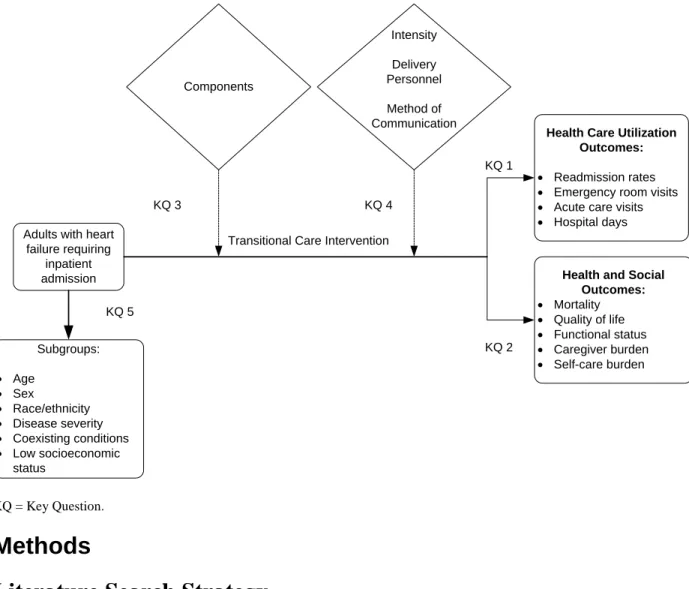
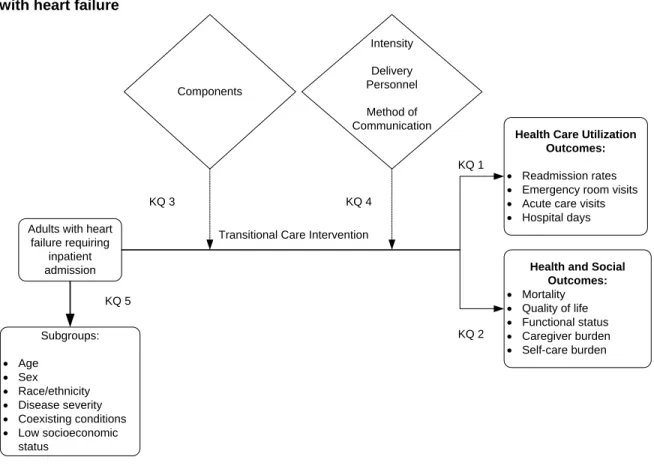
We developed an analytic framework to guide the systematic review process (Figure A).
Figure A. Analytic framework for transitional care interventions to prevent readmissions in people with heart failure
KQ = Key Question.
Methods
Literature Search Strategy
We searched MEDLINE®, the Cochrane Library, and the Cumulative Index to Nursing and Allied Health Literature (CINAHL)® for English-language and human-only studies published from July 1, 2007, to May 9, 2013, and used a previous Agency for Healthcare Research and Quality (AHRQ) Technology Assessment on a similar topic to identify randomized controlled trials (RCTs) published before July 1, 2007.29 We also searched the same electronic databases for relevant nonrandomized trials or prospective cohort studies from 1990 to May 5, 2013, that
Subgroups: • Age • Sex • Race/ethnicity • Disease severity • Coexisting conditions • Low socioeconomic status Components Intensity Delivery Personnel Method of Communication
Adults with heart failure requiring inpatient admission KQ 3 KQ 4 KQ 1 KQ 5
Transitional Care Intervention
Health Care Utilization Outcomes:
• Readmission rates
• Emergency room visits
• Acute care visits
• Hospital days
Health and Social Outcomes: • Mortality • Quality of life • Functional status • Caregiver burden • Self-care burden KQ 2 ES-4
measured caregiver or self-care burden. We updated the database searches through October 29, 2013, while the report was undergoing peer review. An experienced Evidence-based Practice Center (EPC) librarian conducted the searches and another EPC librarian peer-reviewed them.
We also manually searched reference lists of pertinent reviews, included trials, and
background articles on this topic to look for any relevant citations that our searches might have missed. We searched for unpublished studies relevant to this review using ClinicalTrials.gov and the World Health Organization’s International Clinical Trials Registry Platform. We updated these searches through February 5, 2014.
Eligibility Criteria
We developed inclusion and exclusion criteria with respect to populations, interventions, comparators, outcomes, timing, and setting (PICOTS) and study designs. Briefly, we included studies of adults with HF requiring inpatient admission that recruited subjects during or immediately following (i.e., within 1 week) the index hospitalization. We ultimately included one trial (after verification with trial investigators) that enrolled most participants during an inpatient admission but allowed enrollment up to 2 weeks following an inpatient admission.30
We required studies to compare a transitional care intervention aimed at reducing
readmissions with another transitional care intervention or with usual care (i.e., routine care or standard care, as defined by the primary studies). We required that transitional care interventions include one or more of the following components: education to patient, caregiver, or both
delivered predischarge, postdischarge, or both; discharge planning; appointment scheduling before discharge; increased planned or scheduled outpatient clinic visits (primary care, MDS-HF); home visits; telemonitoring (including remote clinical visits); telephone support; transition coach or case management; or interventions to increase provider continuity.
This review focuses on the primary outcomes of readmission rates and mortality.
Specifically, we included the following primary outcomes: all-cause readmission, HF-specific readmission, composite all-cause readmission or death, and all-cause mortality. We also
evaluated the following outcomes when studies assessing readmission rates or mortality reported them: ER visits, acute care visits, hospital days (of subsequent readmissions), quality of life, functional status, and caregiver or self-care burden. We required a length of followup of at least 30 days, and we included outcomes occurring no more than 6 months from the index
hospitalization. We included only studies that assessed interventions applicable to patients who were discharged to home (and not another health care facility).
RCTs were eligible for all KQs. For caregiver burden and self-care burden outcomes,
nonrandomized controlled trials or prospective cohort studies with an eligible comparison group were also eligible.
Study Selection
Two members of the research team independently reviewed each title and abstract (identified through searches) to determine eligibility. Studies marked for possible inclusion by either
reviewer and those that lacked adequate information to determine eligibility underwent a full-text review. Two members of the team independently reviewed each full-text article to determine eligibility. If the reviewers disagreed, they resolved conflicts by discussion and consensus or by consulting a senior member of the team.
Data Extraction
We designed and used structured data extraction forms to gather pertinent information from each article, including characteristics of study populations, settings, interventions, comparators, study designs, methods, and results. One investigator extracted the relevant data from each included article; a second member of the team reviewed all data abstractions for completeness and accuracy.
Risk-of-Bias Assessment of Individual Studies
To assess the risk of bias (internal validity) of studies, we used predefined criteria based on the AHRQ “Methods Guide for Effectiveness and Comparative Effectiveness Reviews”
(Methods Guide).31 We assessed selection bias, confounding, performance bias, detection bias, and attrition bias. We included questions about adequacy of randomization, allocation
concealment, similarity of groups at baseline, masking, attrition, use of intention-to-treat (ITT) analysis, methods of handling missing data, reliability and validity of outcome measures, and treatment fidelity. When assessing measurement bias related to readmission ascertainment, we considered whether studies had access to all potential readmission data as opposed to
readmissions collected only from a single institution’s database. We rated the studies as low, medium, high, or unclear risk of bias.31 Two independent reviewers assessed the risk of bias for each study. Disagreements between the two reviewers were resolved by discussion and
consensus or by consulting a third member of the team.
Categorization of Interventions
We grouped studies of similar interventions for our evidence synthesis. We categorized intervention types based primarily on the mode and environment of delivery (Table A). We believed that this method of categorization would best address the needs of multiple stakeholders who may be interested in interventions that could be implemented in specific health care settings. One investigator categorized the intervention, and a second team member reviewed the
categorization. Disagreements were resolved by consensus. Most of the studies included components delivered both during hospitalization and after discharge.
Table A. Categories and definitions of transitional care interventions
Category Definition
Home-visiting programs
Home visits by clinicians, such as nurses or pharmacists, who deliver education, reinforce self-care instructions, perform physical examinations, or provide other self-care (e.g., physical therapy, medication reconciliation). These interventions are often referred to as nurse case-management interventions, but they also can include home visits by a pharmacist or multidisciplinary team.
Structured telephone support
Monitoring, education, and/or self-care management (or various combinations) using simple telephone technology after discharge in a structured format (e.g., series of scheduled calls with a specific goal, structured questioning, or use of decision support software).
Telemonitoring Remote monitoring of physiological data (e.g., electrocardiogram, blood pressure, weight, pulse oximetry, respiratory rate) with digital, broadband, satellite, wireless, or Bluetooth transmission to a monitoring center, with or without remote clinical visits (e.g., video monitoring).
Outpatient clinic-based interventions
Services provided in one of several different types of outpatient clinics—multidisciplinary-HF, nurse-led HF, or primary care clinic. The clinic-based intervention can be managed by a nurse or other provider and may also offer unstructured telephone support (e.g., patient hotline) outside clinic hours.
Primarily educational interventions
Patient education (and self-care training) delivered before discharge or upon discharge by various delivery personnel or modes of delivery: in person, interactive CD-ROM, video education. Interventions in this category do not feature telemonitoring, home visiting, or structured telephone support. They are not delivered primarily through a clinic-based
intervention (described above). Followup telephone calls may occur to ascertain outcomes (e.g., readmission rates) but not to monitor patients’ physiological data.
Other Unique interventions or interventions that did not fit into any of the other categories (e.g., individual peer support for HF patients).
CD-ROM = compact disc read-only memory; HF = heart failure.
Data Synthesis
We conducted meta-analyses using random-effects models to estimate pooled effects. For binary outcomes, we calculated relative risks (RRs) and 95% confidence intervals (CIs). For continuous outcomes (e.g., scales of quality of life or functional status) measured with the same scale, we report the weighted mean difference between intervention and control subjects. When we combined multiple scales in one meta-analysis, we used the standardized mean difference, Cohen’s d. A Cohen’s d of zero means that the intervention and control groups have equivalent effects; a small effect size is 0.20, medium effect size is 0.50, and large effect size is 0.80.32 For readmission rates, we conducted meta-analyses of studies that reported the number of people readmitted in each group (and not the total number of readmissions per group). We stratified analyses for each intervention category by timing; specifically, we separated rates reported at 30 days from those beyond 30 days, including combining rates reported over 3 to 6 months. We did not include studies rated as high or unclear risk of bias in our main analyses, but we included them in sensitivity analyses for KQ 1 and KQ 2. We calculated the chi-squared statistic and the I2
statistic (the proportion of variation in study estimates attributable to heterogeneity) to assess statistical heterogeneity in effects between studies.33,34 When quantitative synthesis was not appropriate (e.g., because of clinical heterogeneity, insufficient numbers of similar studies, or insufficiency or variation in outcome reporting), we synthesized the data qualitatively.
In addition, we calculated the number needed to treat (NNT) for readmission and mortality outcomes. We derived the NNTs from the RRs and the median usual care event rates reported in included trials, using the methods described in the Cochrane Handbook.35
The aim of KQ 3 was to describe the components of effective interventions; KQ 3 is intended as a descriptive question to provide information about the interventions that work to providers, health systems, and others who may want to implement transitional care interventions. For KQ 3, we synthesized the evidence qualitatively by first extracting detailed information on intervention
components, content, and processes and then describing common components and combinations of components that were effective in reducing all-cause readmissions or mortality. KQ 3 asks primarily: “What are the components of effective interventions?” and “Are particular
components necessary?” We considered “necessary” to mean that a particular component (e.g., inpatient education) was included in every effective intervention but was not necessarily sufficient (i.e., the component could be included in some interventions that were not
efficacious).We defined effective interventions as: (1) intervention categories (defined in Table A, above) that reduced all-cause readmissions (from our meta-analyses for KQ 1) or the
composite endpoint; (2) intervention categories that reduced mortality in our meta-analyses; (3) individual trials in other categories that were efficacious for reducing all-cause readmissions, mortality, or the composite endpoint.
For KQ 4, we assessed whether the efficacy of interventions differed based on intensity, delivery personnel, and method of communication both across intervention categories and within categories of interventions. We conducted meta-analyses stratified by intensity, delivery
personnel, and method of communication within each intervention category when appropriate (e.g., when these factors varied).
Given the heterogeneity of included interventions, we were unable to develop a single measure of intensity to apply to all interventions. We categorized the intensity of each
intervention as low, medium, or high using the duration, frequency, and periodicity of patient contact. We also considered resource use as a dimension of intensity, such as the total number of intervention components. We reserved the low-intensity category for interventions that included one episode of patient contact or that required few resources (e.g., no additional components, such as time spent coordinating care).
We considered the majority of interventions to be medium or high intensity; most were multicomponent and included repeated patient contacts. For KQ 4, we included only studies rated as low or medium risk of bias.
Strength of the Body of Evidence
We graded the strength of evidence (SOE) to answer KQs using the guidance established for the EPC program.36 We graded the SOE for the following outcomes: all-cause readmissions, HF-specific readmissions, a composite endpoint (all-cause readmission or mortality), mortality, ER visits, length of hospital stay (for all-cause readmissions), quality of life, and functional status.
Developed to grade the overall strength of a body of evidence, the approach incorporates four key domains: risk of bias (including study design and aggregate quality), consistency, directness, and precision of the evidence.36 It also considers optional domains. Two reviewers assessed each domain for each key outcome and determined an overall SOE grade based on domain ratings. In the event of disagreements on the domain rating or overall grade, we resolved differences by discussion or by consulting a third investigator.
SOE grades are specified as high, moderate, low, or insufficient to convey the confidence we have that the effect estimates reported lie close to the true effect of an intervention. “Insufficient” indicates that evidence is unavailable, does not permit estimation of an effect, or does not permit us to draw a conclusion with at least a low level of confidence.
Applicability
We assessed applicability of the evidence following guidance from the Methods Guide.37 We used the PICOTS framework to explore factors that affect applicability.
Results
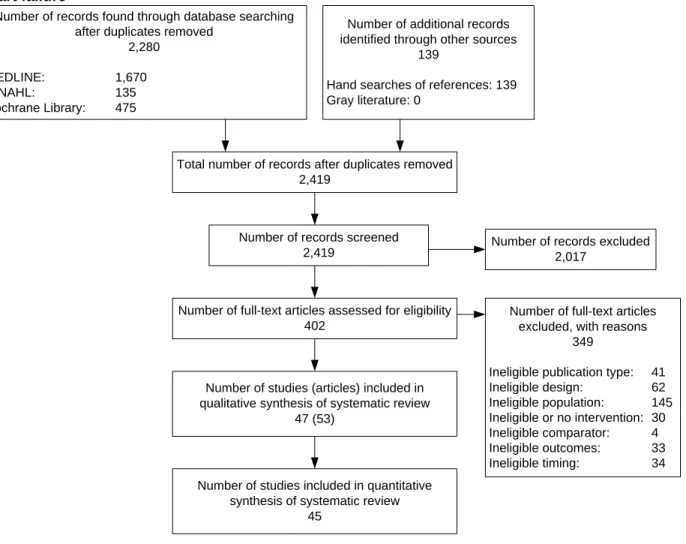
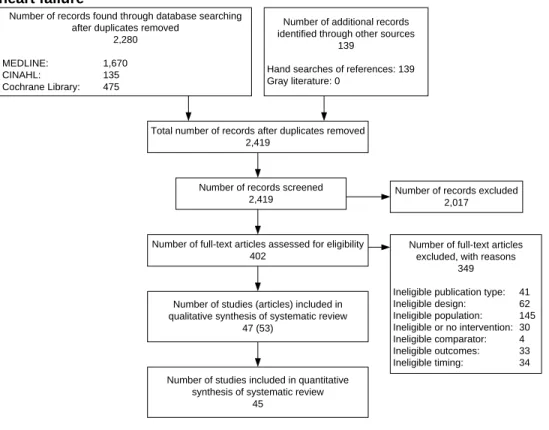
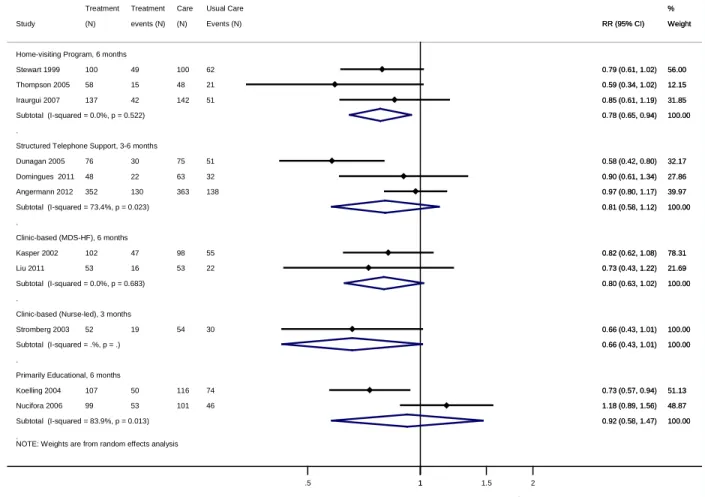
We included 53 published articles reporting on 47 studies; all were RCTs (Figure B). We grouped trials of similar interventions based primarily on the mode and environment of delivery (Table A): home-visiting programs (15 RCTs), structured telephone support (STS) (13 trials), telemonitoring (8 trials), outpatient clinic-based interventions (7 trials), and primarily educational interventions (4 trials). We also included two unique interventions in an “other” category; one featured “individual peer support” and one emphasized cognitive training for patients with coexisting mild cognitive impairment.
Most trials compared a transitional care intervention with usual care; only two trials (both rated high risk of bias) directly compared more than one transitional care intervention. Usual care was somewhat heterogeneous across trials and often not well described.
In general, trials included adults with moderate to severe HF. The mean age of subjects was generally in the 70s; very few trials enrolled patients who were, on average, younger or older. Across most included trials, the majority of patients were prescribed an angiotensin-converting enzyme inhibitor (ACEI) or angiotensin receptor blocker (ARB) (when information was
reported). However, the percentages of patients across trials who were prescribed beta-blockers at discharge varied widely. Included trials were conducted in a mix of settings, including academic medical centers, Department of Veterans Affairs (VA) hospital settings, and community hospitals.
Figure B. Disposition of articles about transitional care interventions for patients hospitalized for heart failure
Efficacy for Reducing Readmissions and Mortality
Table B summarizes our key findings by intervention category, main outcomes (readmission rates, mortality rate, or the composite of all-cause readmissions or death), and timing of measurement of outcomes (30 days, 3–6 months). It documents our results when data met the following three criteria: (1) sufficient evidence to grade the SOE and to draw a
conclusion that evidence either supports benefit (+) or does not (-); (2) insufficient (I) evidence to make a determination (e.g., only one trial reporting an outcome of interest); or (3) no included trials that reported an outcome (NR).
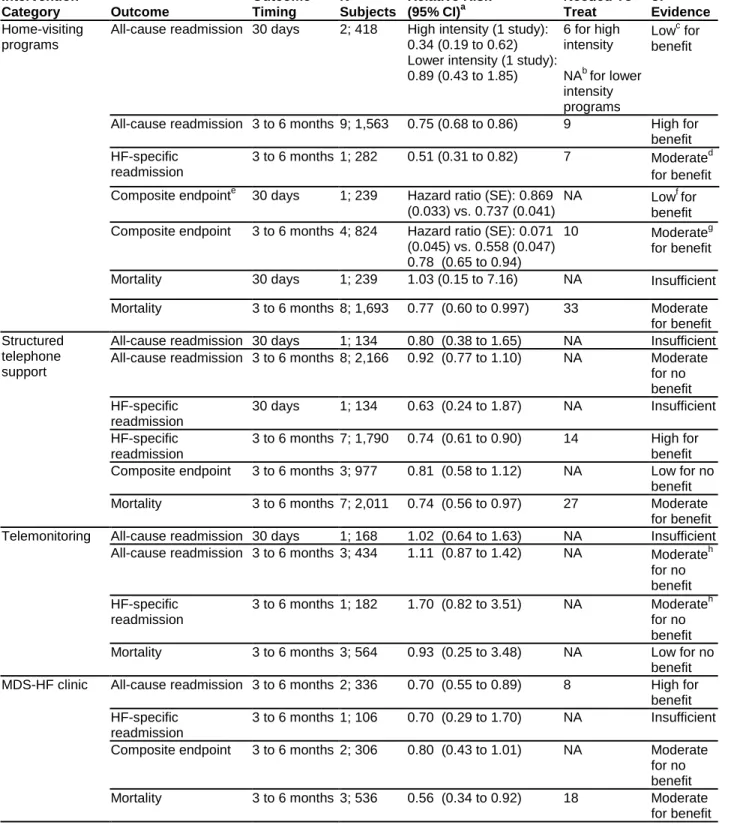
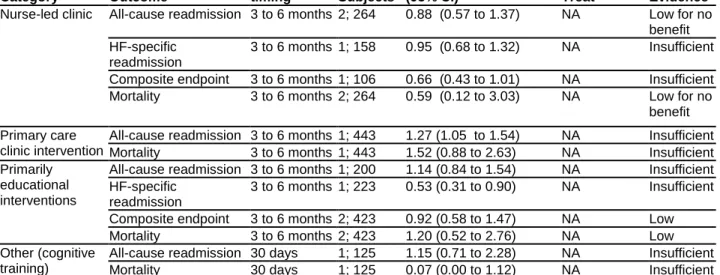
Table C presents more detailed results, including RRs and 95% CIs as well as NNTs (when applicable) for comparisons that included at least one trial reporting an outcome of interest.
Number of records found through database searching after duplicates removed
2,280
MEDLINE: 1,670
CINAHL: 135
Cochrane Library: 475
Number of additional records identified through other sources
139
Hand searches of references: 139 Gray literature: 0
Total number of records after duplicates removed 2,419
Number of records screened 2,419
Number of full-text articles assessed for eligibility 402
Number of studies (articles) included in qualitative synthesis of systematic review
47 (53)
Number of studies included in quantitative synthesis of systematic review
45
Number of records excluded 2,017
Number of full-text articles excluded, with reasons
349
Ineligible publication type: 41
Ineligible design: 62 Ineligible population: 145 Ineligible or no intervention: 30 Ineligible comparator: 4 Ineligible outcomes: 33 Ineligible timing: 34 ES-10
Table B. Summary of key findings and strength of evidence, by outcome and intervention category
Intervention Category All-Cause
Readmissions HF Readmissions Composite Endpoint Mortality 30 Days 3 to 6 Months 30 Days 3 to 6 Months 30 Days 3 to 6 Months 30 Days 3 to 6 Months Home-visiting programs + lowa + high NR + mod + low + mod I + Mod Structured telephone support I - mod I + high NR - low NR + Mod Telemonitoring I - mod NR - mod NR NR NR - Low MDS-HF clinic interventions NR + high NR I NR - mod NR + Mod Nurse-led clinic interventions NR - low NR I NR I NR - Low Primary care clinic
interventions NR I NR NR NR NR NR I Primarily educational interventions NR I NR I NR - low NR - Low Other interventions I NR NR NR NR NR I NR a
Two home-visiting programs reported all-cause readmission at 30 days. The intervention studied by Naylor and colleagues38 was of higher intensity and showed efficacy. The lower intensity intervention studied by Jaarsma and colleagues39 did not show efficacy at 30 days (low SOE). The “+” here refers to high intensity home-visiting programs.
Note: Low, mod, high, and I represent our strength-of-evidence grades: mod = moderate, I = insufficient; + indicates that we found benefit (i.e., statistically significant reduction in readmission rate or mortality compared with usual care), - indicates that we found no benefit (i.e., no statistically significant reduction in the outcome). HF = heart failure; MDS = multidisciplinary; NR = not reported (no trials in this category reported an eligible outcome at this timepoint).
Table C. Summary of key findings and strength of evidence for transitional care interventions: readmission rates and mortality
Intervention Category Outcome Outcome Timing N Trials; N Subjects Relative Risk (95% CI)a Numbers Needed To Treat Strength of Evidence Home-visiting programs
All-cause readmission 30 days 2; 418 High intensity (1 study): 0.34 (0.19 to 0.62) Lower intensity (1 study): 0.89 (0.43 to 1.85) 6 for high intensity NAb for lower intensity programs Lowc for benefit
All-cause readmission 3 to 6 months 9; 1,563 0.75 (0.68 to 0.86) 9 High for benefit HF-specific
readmission
3 to 6 months 1; 282 0.51 (0.31 to 0.82) 7 Moderated for benefit Composite endpointe 30 days 1; 239 Hazard ratio (SE): 0.869
(0.033) vs. 0.737 (0.041)
NA Lowf for
benefit Composite endpoint 3 to 6 months 4; 824 Hazard ratio (SE): 0.071
(0.045) vs. 0.558 (0.047) 0.78 (0.65 to 0.94)
10 Moderateg
for benefit
Mortality 30 days 1; 239 1.03 (0.15 to 7.16) NA Insufficient
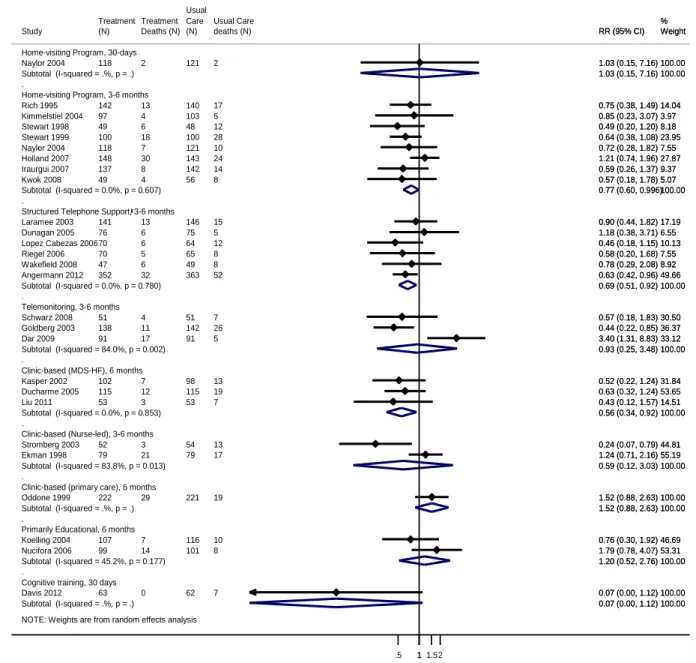
Mortality 3 to 6 months 8; 1,693 0.77 (0.60 to 0.997) 33 Moderate
for benefit Structured
telephone support
All-cause readmission 30 days 1; 134 0.80 (0.38 to 1.65) NA Insufficient All-cause readmission 3 to 6 months 8; 2,166 0.92 (0.77 to 1.10) NA Moderate
for no benefit HF-specific readmission 30 days 1; 134 0.63 (0.24 to 1.87) NA Insufficient HF-specific readmission
3 to 6 months 7; 1,790 0.74 (0.61 to 0.90) 14 High for benefit Composite endpoint 3 to 6 months 3; 977 0.81 (0.58 to 1.12) NA Low for no
benefit
Mortality 3 to 6 months 7; 2,011 0.74 (0.56 to 0.97) 27 Moderate
for benefit Telemonitoring All-cause readmission 30 days 1; 168 1.02 (0.64 to 1.63) NA Insufficient
All-cause readmission 3 to 6 months 3; 434 1.11 (0.87 to 1.42) NA Moderateh for no benefit HF-specific readmission 3 to 6 months 1; 182 1.70 (0.82 to 3.51) NA Moderateh for no benefit
Mortality 3 to 6 months 3; 564 0.93 (0.25 to 3.48) NA Low for no
benefit MDS-HF clinic All-cause readmission 3 to 6 months 2; 336 0.70 (0.55 to 0.89) 8 High for
benefit HF-specific
readmission
3 to 6 months 1; 106 0.70 (0.29 to 1.70) NA Insufficient Composite endpoint 3 to 6 months 2; 306 0.80 (0.43 to 1.01) NA Moderate
for no benefit
Mortality 3 to 6 months 3; 536 0.56 (0.34 to 0.92) 18 Moderate
for benefit
Table C. Summary of key findings and strength of evidence for transitional care interventions: Readmission rates and mortality (continued)
Intervention Category Outcome Outcome timing N Trials; N Subjects Relative Risk (95% CI)a Numbers Needed to Treat Strength of Evidence
Nurse-led clinic All-cause readmission 3 to 6 months 2; 264 0.88 (0.57 to 1.37) NA Low for no benefit HF-specific
readmission
3 to 6 months 1; 158 0.95 (0.68 to 1.32) NA Insufficient Composite endpoint 3 to 6 months 1; 106 0.66 (0.43 to 1.01) NA Insufficient
Mortality 3 to 6 months 2; 264 0.59 (0.12 to 3.03) NA Low for no
benefit Primary care
clinic intervention
All-cause readmission 3 to 6 months 1; 443 1.27 (1.05 to 1.54) NA Insufficient
Mortality 3 to 6 months 1; 443 1.52 (0.88 to 2.63) NA Insufficient
Primarily educational interventions
All-cause readmission 3 to 6 months 1; 200 1.14 (0.84 to 1.54) NA Insufficient HF-specific
readmission
3 to 6 months 1; 223 0.53 (0.31 to 0.90) NA Insufficient Composite endpoint 3 to 6 months 2; 423 0.92 (0.58 to 1.47) NA Low
Mortality 3 to 6 months 2; 423 1.20 (0.52 to 2.76) NA Low
Other (cognitive training)
All-cause readmission 30 days 1; 125 1.15 (0.71 to 2.28) NA Insufficient
Mortality 30 days 1; 125 0.07 (0.00 to 1.12) NA Insufficient
a
Entries in this column are RRs from our meta-analyses or RR calculations unless otherwise specified. RRs less than 1 favor interventions over controls.
b
NA entry for NNT indicates that the relative risk (95% CI) was not statistically significant, so we did not calculate an NNT. NA for hazard ratios indicates that we could not calculate an NNT with the data provided by the investigators
c
Two home-visiting programs reported all-cause readmission at 30 days; the higher intensity intervention showed efficacy but the lower intensity intervention did not. .
d
Although only 1 trial reported total number of people readmitted per group, we considered the findings consistent because 1 other trial reported on the number of readmissions per group and found a similar effect.
e
The composite endpoint comprises all-cause readmission or death. f
Although only a single trial reported the number of people alive and not readmitted at 30 days and 3 months, we considered the consistency of similar programs reducing 3-month readmission rates when grading the SOE for this intervention at 30 days. g Although evidence was limited to 1 trial, consistency for the 30-day outcome was unknown, and evidence was imprecise, we upgraded the SOE because this intervention category demonstrated no effect on mortality at 3 or 6 months, thus increasing our confidence in the results of this single trial.
h
Although only a single trial reported on the number of people readmitted, we considered this finding consistent given that 4 other telemonitoring trials reported the total number of readmissions per group (rather than the number of people readmitted); all-cause readmissions did not differ between people receiving telemonitoring and those receiving usual care at 30 days, 3 months, or 6 months.
CI = confidence level; MDS-HF = multidisciplinary heart failure; N = number; NA = not applicable; NNT = number needed to treat; RR = relative risk; SE = standard error; SOE = strength of evidence.
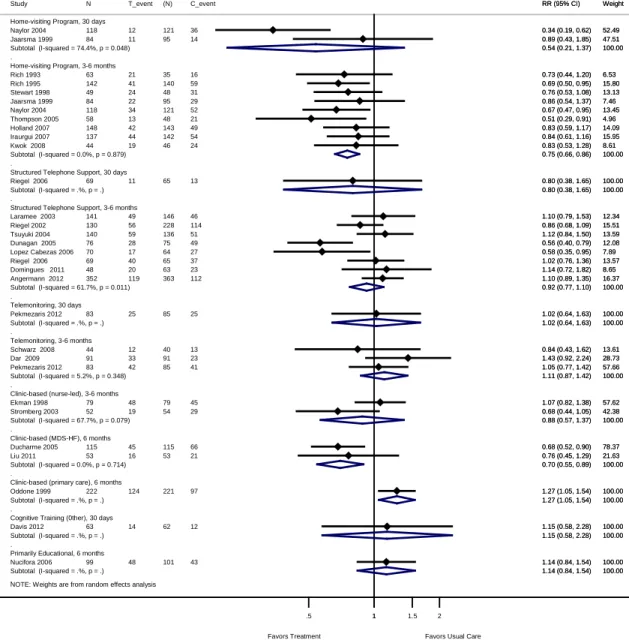
We found very little evidence on whether interventions reduce 30-day readmissions. Most trials reported rates over 3 to 6 months. A high-intensity home-visiting program reduced all-cause readmission and the composite endpoint (all-all-cause readmission or death) at 30 days (low SOE).38 Despite having only a single trial of home visiting that reported rates at 30 days, we took into consideration, when grading the SOE, that similar interventions in this category consistently reduced readmission rates over 3 to 6 months. Evidence was insufficient to determine whether
the following intervention types reduced 30-day all-cause readmissions (1 trial each, unknown consistency; none showed efficacy): STS, telemonitoring, and cognitive training. We found no eligible trials of other types of interventions that reported 30-day all-cause readmission rates.
For outcomes measured over 3 to 6 months, we found strong evidence of efficacy for
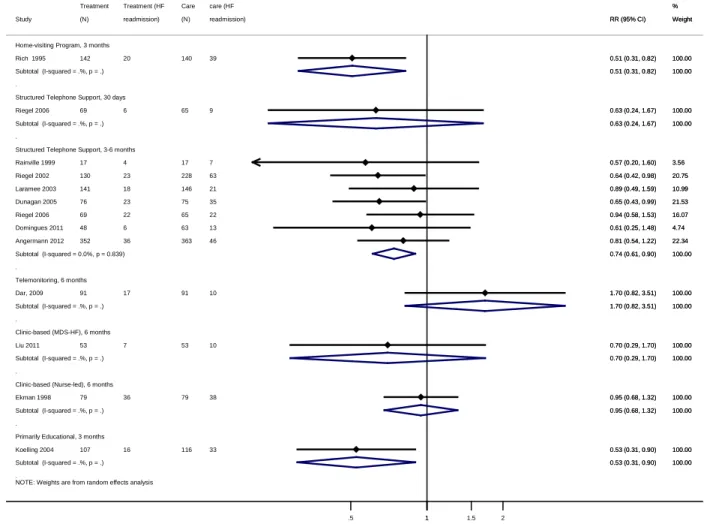
improving at least one of our primary outcomes for home-visiting programs, STS, and MDS-HF clinic interventions. Specifically, we found that home-visiting programs and MDS-HF clinic interventions reduced all-cause readmission rates (high SOE for both). Home-visiting programs also reduced HF-specific readmission rates and the composite endpoint (moderate SOE for both outcomes). STS reduced HF-specific readmission rates (high SOE) but not all-cause readmission (moderate SOE). Three interventions produced a mortality benefit (all moderate SOE): home-visiting programs, MDS-HF clinic interventions, and STS.
For all-cause readmission over 3 to 6 months, NNTs were 9 for home-visiting programs and 8 for MDS-HF clinic interventions (Table C). For example, an NNT of 9 signifies that nine people with HF would need to receive a home-visiting program following discharge (rather than usual care) to prevent one additional person from being readmitted over 3 to 6 months. For mortality, NNTs were 33, 27, and 18, respectively, for home-visiting programs, STS, and MDS-HF clinic interventions.
Our meta-analyses found that telemonitoring and primarily educational interventions were not efficacious for any primary outcomes. In addition, home-visiting programs were not
efficacious for reducing mortality at 30 days (low SOE). STS interventions were not efficacious for reducing all-cause readmissions (low SOE). Evidence was insufficient to determine the efficacy of the following interventions in reducing readmission rates: most primarily educational interventions, nurse-led HF clinic interventions, primary care clinic interventions, peer support interventions, and cognitive training interventions (for people with HF and coexisting mild cognitive impairment).
Some experts have cautioned that inappropriate focus on reduction of readmission rates could negatively affect patient care and perhaps increase mortality. We found no evidence of such an effect—i.e., no interventions that reduced readmission rates but increased mortality.
Other Utilization Outcomes
Few trials reported on ER visits or hospital days of subsequent readmissions; when these were reported, few trials reported measures in the same manner or at similar timepoints. No trial reported the number of acute outpatient (non-ER) visits.
We generally found insufficient evidence to determine whether transitional care interventions increased or decreased ER visits. The one exception was that STS interventions had no effect on the rate of ER visits over 3 to 6 months (low SOE).
Two intervention types significantly reduced the total number of all-cause hospital days (of subsequent readmissions) over 3 to 6 months: STS (moderate SOE) and home-visiting programs (low SOE). Evidence was generally insufficient to determine whether other transitional care interventions increased or decreased hospital days of subsequent readmissions.
Quality of Life
Few trials measured quality of life or function using the same measures at similar timepoints. We found that improvement in HF-specific quality of life (as measured by the Minnesota Living With Heart Failure questionnaire) was greater for home-visiting programs than usual care over 3 months (low SOE) but not at 6 months (low SOE). STS interventions did not improve
specific quality of life at 3 or 6 months. Evidence was insufficient to determine whether other intervention categories improved quality of life.
Components of Effective Interventions
The two categories of interventions that reduced all-cause readmissions and the composite outcome—namely, home-visiting programs and MDS-HF clinic interventions—are
multicomponent complex interventions. We found no single-component intervention that reduced all-cause readmissions. As a whole, these two categories of interventions shared the following components:
• HF education emphasizing self-care, recognition of symptoms, and weight monitoring.
• HF pharmacotherapy emphasizing patient education about medications, promotion of adherence to medication regimens, and promotion of evidence-based HF
pharmacotherapy before discharge, during followup, or both.
• Face-to-face contact following discharge via home-visiting personnel, MDS-HF clinic personnel, or both. In most cases, this contact occurred within 7 days of discharge.
• Streamlined mechanisms to contact care delivery personnel (clinic personnel or visiting nurses or pharmacists) outside of scheduled visits (e.g., patient hotline).
• Mechanisms for postdischarge medication adjustment. In most cases, home-visiting personnel either directly recommended medication adjustment or assisted with
coordination of care (e.g., with primary care provider or cardiologist) to facilitate timely medication adjustment based on a patient’s needs (rather than advising patients to call for help themselves).
Three categories of interventions reduced mortality rates over 3 to 6 months: home-visiting programs, STS, and MDS-HF clinic interventions. All are multicomponent complex
interventions. As a whole, these three categories of interventions shared the following components:
• HF education emphasizing self-care, recognition of symptoms, and weight monitoring.
• A series of scheduled structured visits (via telephone or clinic followup) that focused on reinforcing education and monitoring for HF symptoms.
• A mechanism to contact providers easily outside of scheduled visits (e.g., patient hotline). Separating out individual components from the overall categories (or “bundles”) of
interventions that showed efficacy was not possible.
Intensity, Delivery Personnel, and Mode of Delivery
In general, intervention categories that included higher intensity interventions (i.e., home-visiting programs, STS, MDS-HF clinic interventions) reduced all-cause readmissions or mortality, whereas categories with lower intensity interventions (i.e., primarily educational interventions, nurse-led HF clinic interventions) did not. Within most categories, evidence was insufficient to draw definitive conclusions about whether higher or lower intensity interventions were more or less efficacious in reducing all-cause readmissions or mortality. The one exception was home-visiting programs: a high-intensity program was efficacious in reducing all-cause
readmission at 30 days, whereas a low-intensity program was not. Subgroup analyses found no significant difference in efficacy based on intensity for home-visiting programs or STS over 3 to 6 months. Subgroup analyses were not possible for other categories of interventions because of either lack of variation or too few trials reporting outcomes at similar timepoints.
The two categories of interventions that reduced all-cause readmissions and mortality (home-visiting programs and MDS-HF clinic interventions) were more likely to include teams of providers delivering the intervention (e.g., home visits that a nurse and pharmacist conducted together) than interventions that did not show efficacy (e.g., telemonitoring, primarily
educational interventions). STS interventions (delivered primarily by nurses and pharmacists) were efficacious in reducing mortality but did not reduce all-cause readmissions. Within categories, evidence was insufficient to draw definitive conclusions about whether specific delivery personnel were more or less efficacious for reducing all-cause readmissions or mortality.
Across intervention categories, interventions were primarily delivered face to face or via technology (telephone, telemonitoring, video visits). The two categories of interventions
delivered primarily face to face (i.e., home-visiting programs and MDS-HF clinic interventions) reduced all-cause readmission. For these two categories, method of delivery did not vary within each category. STS reduced mortality; some of these interventions included a face-to-face component (e.g., predischarge educational intervention). In general, interventions primarily delivered remotely (i.e., telemonitoring, STS) did not reduce all-cause readmissions. Only STS interventions varied in the method of communication; our subgroup analyses for reduction in all-cause readmissions and mortality found no statistically significant difference by method of communication at any outcome timepoint.
Discussion
We found very little evidence on whether interventions reduced 30-day readmissions; most trials reported rates over 3 to 6 months. One home-visiting trial showed efficacy in reducing both 30-day all-cause readmission and the 30-day composite outcome.38 For improving all-cause readmission rates over 3 to 6 months, we found strong evidence of efficacy for home-visiting programs and MDS-HF clinic interventions. Three categories of interventions were efficacious in reducing mortality rates over 3 to 6 months (moderate SOE for each category): home-visiting programs, STS interventions, and MDS-HF clinic interventions.
The two categories of interventions that reduced all-cause readmissions and the composite outcome (home-visiting programs and MDS-clinic interventions) are multicomponent complex interventions. We could not separate out individual components from the overall bundle of interventions that showed efficacy; we found no single-component intervention that reduced all-cause readmissions. Few trials reported on whether transitional care interventions increased or decreased ER visits. Furthermore, few trials measured quality of life at the same timepoint with the same scale. No trial assessed whether transitional care interventions increased or decreased caregiver or self-care burden.
Whether certain interventions that reduce readmissions at 3 and 6 months would also be effective in reducing earlier readmissions remains uncertain. Data based on Medicare claims suggest that 35 percent of 30-day readmissions are for HF; the remainder are for diverse
indications (e.g., renal disorders, pneumonia, arrhythmias, and septicemia or shock).5 We found strong evidence for interventions that provided relatively frequent in-person monitoring
following discharge—specifically, home-visiting programs and MDS-HF clinic interventions.