APPROXIMATE FILTERING TECHNIQUES
HAZALILA BINTI KAMALUDIN
A thesis submitted in
fulfillment of the requirement for the award of the Doctor of Philosophy
Faculty of Computer Science and Information Technology Universiti Tun Hussein Onn Malaysia
AUGUST 2018
PTTA
PERPUS
TAKAAN
TUNKU
To my beloved family..
PTTA
PERPUS
TAKAAN
TUNKU
ACKNOWLEDGEMENT
All Praise belongs to ALLAH
A very special gratitude goes out to my supervisor, Assoc. Prof. Dr. Hairulnizam bin Mahdin and also Ministry of Higher Education (MOHE), MALAYSIA for helping and providing the funding for the work.
I am grateful to my family members and friends who have supported me along the way. Thanks for all your encouragement!
Hazalila Kamaludin
PTTA
PERPUS
TAKAAN
TUNKU
ABSTRACT
Radio Frequency Identification (RFID) is an emerging auto-identification technology that uses radio waves to identify and track physical objects without the line of sight. While delivering significant improvements in various aspects, such as, stock management and inventory accuracy, there are serious data management issues that affect RFID data quality in preparing reliable solutions. The raw read rate in real world RFID deployments is often in the 60-70% range and naturally unreliable because of redundant and false readings. The redundant readings result in unnecessary storage and affect the efficiency of data processing. Furthermore, false readings that focused on false positive readings generated by cloned tag could be mistakenly considered as valid and affects the final results and decisions. Therefore, two approaches to enhance the RFID data quality and reliability were proposed. A redundant reading filtering approach based on modified Bloom Filter is presented as the existing Bloom Filter based approaches are quite intricate. Meanwhile, even though tag cloning has been identified as one of the serious RFID security issue, it only received little attention in the literature. Therefore we developed a lightweight anti-cloning approach based on modified Count-Min sketch vector and tag reading frequency from e-pedigree in observing identical Electronic Product Code (EPC) of the low cost tag in local site and distributed region in supply chain. Experimental results showed, that the first proposed approach, Duplicate Filtering Hash (DFH) achieved the lowest false positive rate of 0.06% and the highest true positive rate of 89.94% as compared to other baseline approaches. DFH is 71.1% faster than d-Left Time Bloom Filter (DLTBF) while reducing amount of hashing and achieved 100% true negative rate. The second proposed approach, Managing Counterfeit Hash (MCH) performs fastest and 25.7% faster than baseline protocol (BASE) and achieved 99% detection accuracy while DeClone 64% and BASE 77%. Thus, this study successfully proposed approaches that can enhance the RFID data quality and reliability.
PTTA
PERPUS
TAKAAN
TUNKU
ABSTRAK
Pengenalpastian Frekuensi Radio (RFID) ialah teknologi pengenalpastian auto yang sedang berkembang yang menggunakan gelombang radio untuk mengenal pasti dan mengesan objek fizikal tanpa garis tampak. Walaupun ia menghasilkan penambahbaikan yang penting dalam pelbagai aspek, seperti pengurusan stok dan ketepatan inventori, terdapat isu pengurusan data yang serius yang menjejaskan kualiti data RFID dalam menyediakan penyelesaian yang boleh dipercayai. Kadar bacaan kasar dalam penggunaan sebenar RFID kebiasaannya pada lingkungan 60-70% dan secara semula jadinya tidak boleh dipercayai disebabkan oleh bacaan lewah dan bacaan salah. Bacaan lewah menyebabkan penstoran yang tidak diperlukan dan menjejaskan kecekapan pemprosesan data. Selain itu, bacaan salah yang memfokus pada bacaan positif salah yang dijana oleh tag klon boleh disalah anggap sebagai sah dan mempengaruhi hasil dan keputusan akhir. Oleh itu, dua pendekatan untuk meningkatkan kualiti dan kebolehpercayaan data RFID dicadangkan. Pendekatan penapisan bacaan lewah berdasarkan Kaedah Penapis Bloom yang diubahsuai dikemukakan kerana Kaedah berdasarkan Penapis Bloom yang sedia ada adalah agak kompleks. Sementara itu, walaupun pengklonan tag telah dikenal pasti sebagai salah satu isu keselamatan RFID yang serius, hanya sedikit penyelidikan dibuat mengenainya. Oleh itu, pendekatan anti pengklonanlightweightberdasarkan vektor lakaranCount-Minyang diubah suai dan kekerapan bacaan tag daripadae-pedigreetelah dibangunkan untuk mencerapElectronic Product Code (EPC) serupa tag kos rendah di tapak setempat dan kawasan agihan dalam rantaian bekalan. Keputusan eksperimen menunjukkan bahawa pendekatan pertama yang dicadangkan iaituDuplicate Filtering Hash (DFH)mencapai kadarfalse positiveterendah iaitu 0.06% dan kadartrue positivetertinggi iaitu 89.94% berbanding pendekatan-pendekatan lain. DFHadalah 71.1% lebih pantas berbandingd-Left Time Bloom Filter (DLTBF)walaupun mengurangkan bilangan fungsi cincang dalam Penapis Bloomyang diubahsuai dan mencapai 100% kadar true negative. Pendekatan kedua yang dicadangkan iaitu Managing Counterfeit Hash (MCH) adalah paling pantas
PTTA
PERPUS
TAKAAN
TUNKU
dan 25.7% lebih pantas daripada protokol asas(BASE)dan mencapai 99% ketepatan pengesanan berbandingDeClone64% danBASE77%. Oleh itu, kajian ini telah berjaya mengemukakan kaedah yang dapat meningkatkan kualiti dan kebolehpercayaan data RFID.
PTTA
PERPUS
TAKAAN
TUNKU
CONTENTS DECLARATION ii DEDICATION iii ACKNOWLEDGEMENT iv ABSTRACT v ABSTRAK vi CONTENTS viii
LIST OF TABLES xii
LIST OF FIGURES xiii
LIST OF ALGORITHMS xv
LIST OF SYMBOLS AND ABBREVIATIONS xvi
LIST OF PUBLICATIONS xvii
CHAPTER 1 INTRODUCTION 1 1.1 An overview 1 1.2 Research problems 3 1.3 Research objectives 6 1.4 Research motivation 7 1.5 Research scope 8 1.6 Research significance 9 1.7 Thesis organization 11
CHAPTER 2 LITERATURE REVIEW 13
2.1 Introduction 14
2.2 RFID systems 16
2.3 RFID system architecture 19
2.3.1 RFID hardware level 20
2.3.1.1 Tag 20
2.3.1.2 Reader 24
PTTA
PERPUS
TAKAAN
TUNKU
2.3.2 RFID middleware level 25
2.3.3 RFID application level 26
2.4 RFID data characteristic 27
2.4.1 Massive data 27
2.4.2 Sequence of data 28
2.4.3 Implicit semantic 28
2.4.4 Unreliable data 28
2.4.5 Inconsistent data 29
2.5 RFID reading classes 29
2.5.1 True positive 29
2.5.2 False positive 30
2.5.3 False negative 30
2.5.4 Redundant readings 30
2.6 Data stream 33
2.7 Processing streaming data 34
2.7.1 Approximate filtering of RFID data stream 35
2.7.1.1 Sampling (Windowing) 36 2.7.1.2 Sketch 42 2.7.2 Filtering approaches 47 2.7.2.1 Query processing 48 2.7.2.2 Bloom Filter 49 2.8 Cloned tag 55 2.8.1 System model 57
2.8.2 Cloned tag detection techniques 60
2.8.2.1 Track and trace 64
2.8.2.2 Identical EPC 65
2.9 Industry experiences in enhancing RFID data quality
and reliability 69
2.10 Chapter summary 71
CHAPTER 3 RESEARCH METHODOLOGY 73
3.1 Approximate filtering 73
3.2 Research process flow 74
3.3 Research procedure 75
3.3.1 Research procedure in Phase 1 -
Redun-dancy Filtering 79
3.3.1.1 Generate RFID data using
Pois-son distribution 80
PTTA
PERPUS
TAKAAN
TUNKU
3.3.1.2 Filter redundancy using DFH algorithm 83 3.3.1.3 Implementation of DFH algo-rithm 84 3.3.1.4 Comparative analysis of DFH algorithm 85
3.3.2 Research procedure in Phase 2 - Cloned Tag
Detection and Verification 86
3.3.2.1 Generate RFID data using
Bino-mial distribution 87
3.3.2.2 Detect and verify cloned tag using
MCH algorithm 91 3.3.2.3 Implementation of MCH algo-rithm 92 3.3.2.4 Comparative analysis of MCH algorithm 94 3.4 Experimental setup 94 3.5 Chapter summary 96
CHAPTER 4 FILTERING REDUNDANT DATA FROM RFID DATA
STREAM 97
4.1 Introduction 97
4.2 Problem definitions 98
4.3 Duplicate Filtering Hash (DFH) algorithm 100
4.4 Performance evaluation 103
4.4.1 False positive rate 103
4.4.2 Comparative analysis of false positive rate 104 4.4.3 Comparative analysis of execution time 105 4.4.4 Comparative analysis of true positive rate 106 4.4.5 Comparative analysis of true negative rate 107
4.5 Chapter summary 108
CHAPTER 5 CLONED TAG DETECTION AND VERIFICATION IN
DISTRIBUTED RFID SYSTEMS 110
5.1 Introduction 110
5.2 Cloned tag detection and verification 112
5.2.1 The proposed approach 112
5.2.2 Mapping tag reading to modified
Count-Min sketch 115
PTTA
PERPUS
TAKAAN
TUNKU
5.2.3 Managing Counterfeit Hash (MCH)
algo-rithm 117
5.3 Performance evaluation 123
5.3.1 Ideal bucket size in accordance to packing
density 123
5.3.2 Comparative analysis of execution time 124
5.3.3 Clone detection accuracy 126
5.4 Chapter summary 128
CHAPTER 6 CONCLUSION AND FUTURE DIRECTIONS 130
6.1 Conclusion 130
6.2 Future works 135
6.3 Chapter summary 137
REFERENCES 139 VITA
PTTA
PERPUS
TAKAAN
TUNKU
LIST OF TABLES
2.1 RFID frequency types and suitable applications (Eifeh, 2016) 18 2.2 Characteristic comparison of active, passive and semi-passive
RFID tag (Bright, 2015) 22
2.3 Advantages and disadvantages of RFID tags (Dua, 2014) 23 2.4 Advantages and disadvantages of collision handling scheme 47 2.5 Readings ontag1andtag2by two readersR1andR2 54 2.6 Parameters for RFID cloned tag detection in known RFID
systems 62
2.7 Parameters for RFID cloned tag detection in anonymous RFID
systems 63
2.8 Summary of approaches for improving quality and reliability
of RFID data 72
3.1 Data generation using differentµ 81
3.2 Notation of tags in each correlated reading cycle 82 3.3 Part of sample results generated using Poissrnd x =
poissrnd(1,10,10) 82
3.4 Example results of what tag and how many times the tag
appears in an epoch forx=poissrnd(1,10,10) 83 3.5 Part of sample results for tags read byReader1,Reader2and
Reader3withn= 10andp= 0.7 90
3.6 Part of sample results for tag readings with cloned tags 90
3.7 Parameters of simulation 95
4.1 RFID readings in an epoch 102
5.1 Print vector content 116
5.2 Clone check results at three readers 122
5.3 Tag reading in particularCMsketch with updated reading rate 123
5.4 Home bucket quantity for bucket size,bs= 10 124
PTTA
PERPUS
TAKAAN
TUNKU
LIST OF FIGURES
1.1 RFID research challenges 2
2.1 Content structure 13
2.2 Approaches for improving reliability of RFID data 14
2.3 Types of data redundancy in RFID 16
2.4 RFID system architecture 19
2.5 Electronic Product Code (EPC) 20
2.6 Multitier middleware architecture (Sweeney, 2010) 26 2.7 RFID enabled system at hypermarkets: monitoring static items
on shelves 32
2.8 Abstract reference architecture for a DSMS 34
2.9 Techniques for processing streaming data 35
2.10 Typical window variants illustrated for three consecutive states at time instantsτk, τk+1, τk+2. New data items are piling up on
top of previously arrived ones. Boxes depicted with the same fill style represent tuples with identical timestamps. (a) Count-based sliding windowof sizeN = 6. (b)Landmark window with lower bound fixed atτk. (c)Sliding time-based window
of temporal extent ω = 2and progression step β = 1. (d) Tumbling windowof temporal extentω = 2and progression
stepβ = 2(Patroumpas & Sellis, 2006) 38
2.11 Count-Min sketch 43
2.12 Difference between Bloom Filter and Count-Min sketch 43 2.13 Standard Bloom Filter (M = number of bits in the filter,k =
number of hash functions,n= number of elements) 50 2.14 The state of DLTBF before inserting a new element x and
three cases for insertion ofxinto DLTBF 53
2.15 The state of CBF based on readings in Table 2.5 55 2.16 Logical diagram of EPCglobal network architecture for track
and trace 58
2.17 Physical diagram of EPCglobal network architecture for track
and trace 59
2.18 DeClone achieves deterministic clone detection through a
hybrid design of slotted Aloha and tree traversal 67
PTTA
PERPUS
TAKAAN
TUNKU
2.19 BASE detects cloned tag when tag cardinalityNtag exceed ID
cardinalityNid 68
3.1 Research process flow 75
3.2 General research procedure 76
3.3 Data incompleteness issue and working example with sample
data input 78
3.4 Research procedure to filter redundant readings 79 3.5 Research procedure to detect and verify cloned tag 87 4.1 The state of DFH before and after insertion of tag readings 102 4.2 False positive rates of DFH with counter sizes cs = 5,000,
cs= 10,000andcs= 15,000 104
4.3 Comparison of FPR between Bloom Filter approaches 105 4.4 Comparison of execution times for filtering redundant readings 106 4.5 True positive rate comparison for filtering redundant readings 107 4.6 True negative rate comparison for filtering redundant readings 108 5.1 Mapping of base stream into modified Count-Min sketch 113 5.2 CM sketch visualization of initial, map and update reading
for three readers 117
5.3 Execution time of MCH with60%packing density and bucket
sizesbs= 10,bs= 20,bs= 30,bs= 40andbs= 50 125 5.4 Comparison of execution times for detecting cloned tags 126 5.5 Comparison of clone detection accuracy between DeClone and
BASE in varying number of cloned IDs 127
5.6 Comparison of clone detection accuracy between MCH,
DeClone and BASE in varying number of cloned IDs 128
PTTA
PERPUS
TAKAAN
TUNKU
LIST OF ALGORITHMS
1 Duplicate Filtering Hash (DFH) algorithm 101
2 Managing Counterfeit Hash (MCH) algorithm 120
PTTA
PERPUS
TAKAAN
TUNKU
LIST OF SYMBOLS AND ABBREVIATIONS
BASE – baseline protocol
BF – Bloom Filter
BFS – Breadth First Traversal
CBF – Count Bloom Filter
CCBF – Chain-Linked Counting Bloom Filter
CM – Count-Min
DCTD – Deterministic Cloned Tags Detection
DeClone – clone detection protocol using unreconciled collision for detection and verification
DFH – Duplicate Filtering Hash DLCBF – d-Left Counting Bloom Filter DLTBF – d-Left Time Bloom Filter
DTD – A Novel Double-Track Approach to Clone Detection for RFID-enabled Supply Chains
EPC – Electronic Product Code EPCIS – EPC Information Services
FPR – False Positive Rate
FNR – False Negative Rate
GREAT – anonymous clone detection protocol
IoT – Internet of Things
ID – Identification
MCH – Managing Counterfeit Hash
PDA – Personal Digital Assistant RFID – Radio Frequency Indentification
TBF – Time Bloom Filter
TDPS – Tag Data Processing and Synchronization TIBF – Time Interval Bloom Filter
TPR – True Positive Rate
TNR – True Negative Rate
PTTA
PERPUS
TAKAAN
TUNKU
LIST OF PUBLICATIONS Journals:
1. Kamaludin, H., Mahdin, H., & Abawajy, J. H. (2015). Filtering Redundant Data from RFID Data Streams. Journal of Sensors, 2016.
Impact Factor 1.182, Q3
2. Kamaludin, H., Mahdin, H., & Abawajy, J. H. (2018). Clone tag detection in distributed RFID systems. PloS One, 13(3), e0193951.
Impact Factor 2.806, Q1
PTTA
PERPUS
TAKAAN
TUNKU
INTRODUCTION 1.1 An overview
Radio Frequency Identification (RFID) is a communication technology that allows automatic and non-contact identification between electronic tag and reader, using radio waves. The ability of tracking and identifying tagged object without line of sight is a great advantage of RFID, as compared to barcode system. Moreover, RFID has been widely employed in the fields of object positioning, tracking and monitoring, besides emerging as a primary item-level identification, especially in the supply chain management. In 2016, approximately 73% of RFID usage was reported in a retail study (Kurt, 2016). It had shown a significant growth, as compared to 34% in year 2014. Part of the reason is because the technology is delivering significant results with large improvements in inventory accuracy. As the adoption of RFID is going to produce a lot of data, however, not all of the incoming RFID data is valuable. A number of drawbacks exist, especially in the area of data management that inspired this research.
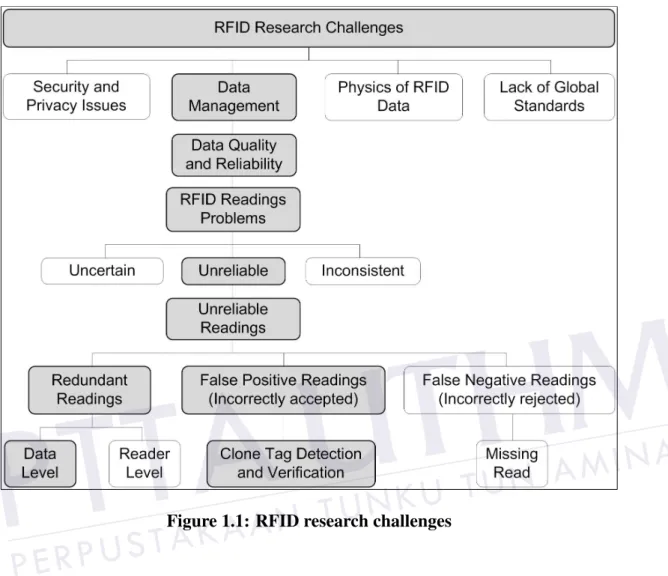
As depicted in Figure 1.1, security and privacy, data management, physical sciences of RFID and global standards have been highlighted as the clusters of RFID research challenges (Wuet al., 2013). In the data management issue specifically, RFID data quality plays an important roles and is crucial in preparing reliable solutions. One of the key indicators in data quality problems are data anomalies (Karkouch et al., 2016). The anomalies pertaining to RFID data quality are problems regarding redundancy, uncertainty, unreliable and inconsistent (Heet al., 2016; Liuet al., 2014; Ma et al., 2014; Qin et al., 2016; Wu et al., 2013). If the data is inaccurate, the
PTTA
PERPUS
TAKAAN
TUNKU
knowledge gained and any action taken based on it would probably be unreliable.
Figure 1.1: RFID research challenges
RFID data is produced in stream and it flows into the RFID system continuously. The stream of raw data collected by RFID readers may contain a lot of redundant and false readings. The redundant readings occur due to readers’capability to read data multiple times in a short interval. This situation is known as redundancy at the data level. Furthermore, in the real deployment, several RFID readers are installed to increase the reading capability. The resulting surge in redundant readers often causes duplicate detection and cross detection that produce a massive amount of redundant readings. This situation is known as redundancy at the reader level. These redundant readings are repeated readings that do not deliver new information to the system (Guoqionget al., 2017). It may consume a great deal of system resources while also reducing the system efficiency (Guoqionget al., 2017).
PTTA
PERPUS
TAKAAN
TUNKU
In another possible situation, the stream data may consist of false readings from cloned tags which enter the environment unpredictably and appear as correct readings. A cloned tag is a duplicated tag installed on counterfeit products which carries a legitimate product identifier EPC (Huanget al., 2017). Since readings from the cloned tag are false readings, their usage may lead to inaccurate decisions.
In this chapter, the research problems, objectives, motivation, scope, significance and organization of the thesis are discussed.
1.2 Research problems
Raw data collected by RFID readers are fundamentally unreliable (Heet al., 2016; Wang et al., 2014a; Xuet al., 2017), due to some factors: redundant reading, false positive reading and false negative reading. Nonetheless, redundant readings are inherent characteristics present in RFID technology (Guoqionget al., 2017; Heet al., 2016; Shen et al., 2017; Wanget al., 2014a; Wuet al., 2013). There are two sources of redundant readings, redundancy at the data level and redundancy at the reader level. Data level redundancy can be categorized as temporal redundancy while reader level redundancy can be categorized as spatial redundancy. These redundant and false readings must be filtered out so as to avoid the supply of incorrect information to the users’applications and the potential network congestion. This study focused on filtering redundancy at the data level, the type of redundancy more frequently taking place. Besides, the problem of false positive reading caused by cloned tag was also investigated. The following are two research issues addressed in this thesis.
(i) How to filter redundant readings efficiently?
Redundant readings are natural characteristics present in RFID technology and they are repeated readings which do not deliver new information to the system (Guoqiong et al., 2017; Heet al., 2016; Shenet al., 2017; Wanget al., 2014a; Wu et al., 2013). RFID generates a lot of redundant readings due to several factors: readers’overlapped regions in dense area, readers’multiple read cycles and multiple tags used on the same object to increase reading reliability.
PTTA
PERPUS
TAKAAN
TUNKU
In order to cover a larger area or a longer distance, multiple networked RFID readers are installed. However, this creates an overlapping reading vicinity, causing tags in the overlapped areas to be read by multiple readers (Bashiret al., 2011). For static tagged objects or motionless objects that remain in the reader vicinity for a long time (in multiple reading cycles), they are read by the reader multiple times (Guoqionget al., 2017). Redundant readings also may occur when multiple tags with the same EPC are attached to the same object to reduce missing rate and increase reliability (Fanet al., 2012; Mahdin & Abawajy, 2011; Bai et al., 2006).
Some of the techniques used in redundancy filtering include combinations of window scan, hash function, spatial redundancy filtering, temporal redundancy filtering and Bloom Filter. At present, the existing Bloom Filter based approaches (Lee & Chung, 2011; Mahdin & Abawajy, 2011; Wanget al., 2014c; Yongsheng & Zhijun, 2013) for filtering the redundant readings are quite intricate as they use multiple hash functions. Positively, using multiple hash functions helps spread the tag readings more evenly among slots allocated. However, when two or more hash functions used, we have to examine two or more slots every time we do a search. Besides, each lookup may slow down the execution time required. So that, this trade off would need to be considered carefully. Any significant reduction in the time required to perform a Bloom Filter operation translates to a significant speedup for many practical applications (Kirsch & Mitzenmacher, 2006). Therefore, a new approach, in the form of a modified Bloom Filter based approach, using integer array and a single hash function was proposed in this study. Anyway, both multiple or single hash function usage has their own trade off.
(ii) How to detect and verify cloned tag in distributed RFID systems?
Readings from cloned tags are false positive readings that are incorrectly considered as valid. If no early detection is performed, processing the invalid readings will produce unreliable and most probably incorrect results. Techniques used in cloned tag detection can be divided into track-and-trace approach and
PTTA
PERPUS
TAKAAN
TUNKU
identical EPC approach. Generally, some of the techniques in track-and-trace approach involve writing random numbers on tags, tag path verification using data save in tag memory, checking changes in tag ownership, pattern mining using event track records, pattern matching and business transaction information. On the other hand, identical EPC approaches mainly involve hash functions and hash collision.
Events generated by cloned tags are considered to appear in the traces of genuine product and they may cause abnormal events which can be detected as infrequent occurrences in the modelled supply chain process (Lehtonenet al., 2009a; Malekiet al., 2017b). In view of this scenario, examples of the infrequent occurrences could be exposed by tag reading frequency of the tagged object in the modelled supply chain. This study considered an attacker who would duplicate the EPC only when the genuine tag is ready. Therefore, the tag reading frequency of cloned tag is rationally lesser than the genuine tag, since the time duration, during which the cloned tag exists, is shorter than that of the genuine tag.
Even though imperfect tag reading frequency can lead to missing read or false negative readings, many data cleaning systems use temporal smoothing filter approach to handle this lost readings issue (Aggarwalet al., 2013). In that approach, a sliding window over the readers data stream interpolates for lost readings from each tag within the time window to provide more opportunities for each tag to be read within the smoothing window (Aggarwalet al., 2013). This technique determines the most effective window size and continuously changes it over the RFID stream. Furthermore, the experimental results presented in the studies by (Ilicet al., 2008) and (Lehtonenet al., 2009b) revealed that, a genuine product (attached with a genuine tag) is repeatedly read in a high rate because it is checked at least once at every stage of the supply chain. Anyway, cloned tags that appear before the corresponding genuine tags are manufactured or after they are consumed, were not considered in this study.
PTTA
PERPUS
TAKAAN
TUNKU
Currently, some of the existing approaches; (Choiet al., 2014, 2015) need the related supply chain structure and product flow information in order to work properly. This requirement can be obtained from e-pedigree, an electronic document that provides data on the history of a particular product besides the path and ownership of the product as it moves through the supply chain (Abed, 2016; Alfianet al., 2017; Choi & Jung, 2015). However, the incomplete e-pedigree (Choiet al., 2014, 2015) limited the cloned tag detection process since that the information obtained from the e-pedigree is insufficient. One possible reason for the incomplete e-pedigree is due to undesirable sharing of trade information between business partners involved.
Therefore, the question remains on the suitable lightweight method that can be used to do the clone detection and verification. In this study, we refer the lightweight method as designing solution that used fewer parts than the complete e-pedigree for verifying the suspicious tag. Our goal was to propose a cloned tag detection and verification method that could improve the shortcomings, in terms of reliance to the complete e-pedigree and manual inspection on the suspicious cloned tags detected.
1.3 Research objectives
The aim of this study was to obtain clean RFID data from the issues of redundant and false positive readings. The clean data would subsequently be forwarded to applications for further processing. The issue of false positive readings was examined by focusing on cloned tag detection and verification in a distributed environment. In order to achieve the research aim, three main research objectives were identified as follows:
1. to propose an approach to filter redundant readings
2. to propose an approach to detect and verify cloned tag in distributed RFID systems 3. to evaluate and perform comparative analysis of the performance of the developed redundancy filtering approach and cloned tag detection and verification approach with existing approaches
PTTA
PERPUS
TAKAAN
TUNKU
1.4 Research motivation
Auto identification without line of sight brings RFID as the tracking and monitoring technology in many fields, such as, supply chain management systems and transportation systems. Although improving inventory management and many other tasks with less human intervention, it brings out issues that tarnish RFID efficiency. While readers’ability to read the tagged object multiple times increases readability, however, it generates the issue of redundancy. Redundant readings are duplicate readings on the same tag EPC. Even though redundant reading is a natural characteristic in RFID; however, it causes issues to the RFID data management. These readings will consume system resources without giving any new information to the system.
In addition to wasting communication, processing and storage resources, redundant records may lead to wrong interpretation and decisions. The retail market adopter like Walmart will have massive scale of RFID data. For instance, the number of items on the shelves at the hypermarket is monitored by RFID reader. The items are static on the shelves throughout the day until they are picked up by customers. This situation creates redundant readings on the same static items. If not filtered and removed, the number of reading items could be more than the existing items and this may cause miscalculation of the stocks and delay the stocks order.
The presence of similar redundant records is unnecessary and as such, detection and elimination are required as part of the data cleaning process. Filtering these redundant readings is still significant since that the latest generation of a reader has the capability to read300tags per seconds (Stoppel, 2015). If all the tags are static, such as items on shelves at hypermarket, there will be1,080,000tuples in an hour and 25,920,000tuples a day. This massive number of records will flood the storage if not being manage appropriately. Moreover, the existence of these redundant readings will confuse the clone detection process; the subsequent issue that to be resolved. This is because, having more than one tag consuming identical EPC is a major indicator to the cloned tag. Therefore, these redundant readings need to be filtered out, before detecting the presence of cloned tag.
PTTA
PERPUS
TAKAAN
TUNKU
According to (Coustasseet al., 2010), the World Health Organization (WHO) has estimated that over 10% of all drugs in the supply chain worldwide of pharmaceutical industry are counterfeit. WHO also estimated that drugs purchased over the Internet are counterfeited in about 50% of cases. In some countries, the counterfeit drugs make up more than 30% of the drug supply. This counterfeit drug market is seriously affecting the global pharmaceutical industry. Unfortunately, the severity of the problem is difficult to accurately assess, since counterfeiting is hard to detect, investigate, and quantify. Therefore, by using RFID technology the industry expects to decrease the issues due to counterfeit drug market. However, the effort to combat the counterfeit drug using RFID tag requires the implementation of efficient cloned tag detection. In this study, the cloned tag is defined as duplicated tag installed on counterfeit products with identical EPC.
Today, RFID standard Class-One Generation-Two (C1G2) is a type of low cost tag that is most widely used in supply chain management for item-level identification (Suzanne, 2016; Huanget al., 2015). The aim of the low cost RFID tag is to keep the tag price as cheap as possible for a massive usage. While reducing the tag price, this type of passive tag has been identified as being prone to be cloned (Abawajy, 2009; Mirowski, 2013). The cloned tag issue is a serious threat to the RFID enabled applications, because it can endanger the safety and health of individuals, particularly in food, medical and pharmaceutical industries. Furthermore, cloning of RFID tags can lead to brand damage and financial losses. Therefore, it is crucial to perform detection on readings produced by these cloned tags and subsequently followed by a verification process to determine genuine tags and cloned tags from suspicious lots before taking any further action.
1.5 Research scope
Focusing on the data management issue, the scope of this study was on data quality and reliability of RFID readings obtained from passive tags widely used in supply chain management for the item level identification. In redundant reading issue, this study focused on filtering redundancy at the data level. Meanwhile, in false reading issue, this
PTTA
PERPUS
TAKAAN
TUNKU
Abawajy, J. (2009). Enhancing RFID tag resistance against cloning attack. InNetwork and System Security, 2009. NSS’09. Third International Conference on. IEEE. pp. 18–23.
Abed, A. M. (2016). Creating E-pedigree Kanban to secure customers chain using multi-agent image technique. Journal of Engineering and Computer Innovations, 4(1), 1–10.
Adrion, F., Hammer, N., R¨oßler, B., Jezierny, D., Kapun, A., & Gallmann, E. (2015). Development, function and test of a static test bench for UHF-RFID ear tags. Landtech.–Agric. Eng.,70, 46–66.
Aggarwal, C. C., Ashish, N., & Sheth, A. (2013). The Internet of Things: A Survey from the Data-Centric Perspective. In C. C. Aggarwal (Ed.)Managing and Mining Sensor Data, pp. 383–428. Boston, MA: Springer US.
Aggarwal, C. C., & Philip, S. Y. (2007). A survey of synopsis construction in data streams. InData Streams, pp. 169–207. Springer.
Alfian, G., Rhee, J., Ahn, H., Lee, J., Farooq, U., Ijaz, M. F., & Syaekhoni, M. A. (2017). Integration of RFID, wireless sensor networks, and data mining in an e-pedigree food traceability system. Journal of Food Engineering,212, 65–75. Alien, T. (2017). High Sensitivity EPCglobal Gen 2 RFID Tag IC. Retrieved August
3, 2018, from https://www.rfid-alliance.com/RFIDshop/ALC-380 Higgs-EC 2018-01-22.pdf.
Alzahrani, N., & Bulusu, N. (2016). Securing Pharmaceutical and High-Value Products against Tag Reapplication Attacks Using NFC Tags. In Smart Computing (SMARTCOMP), 2016 IEEE International Conference on. IEEE. pp. 1–6. Arasu, A., Babu, S., & Widom, J. (2006). The CQL continuous query language:
PTTA
PERPUS
TAKAAN
TUNKU
semantic foundations and query execution.The VLDB JournalThe International Journal on Very Large Data Bases,15(2), 121–142.
Bai, Y., Wang, F., & Liu, P. (2006). Efficiently Filtering RFID Data Streams. In CleanDB. Citeseer.
Baron, M. (2013). Probability and statistics for computer scientists. CRC Press. Bashir, A. K., Lim, S.-J., Hussain, C. S., & Park, M.-S. (2011). Energy efficient
in-network RFID data filtering scheme in wireless sensor networks. Sensors, 11(7), 7004–7021.
Bloom, B. H. (1970). Space/time trade-offs in hash coding with allowable errors. Communications of the ACM,13(7), 422–426.
Bono, S., Green, M., Stubblefield, A., Juels, A., Rubin, A. D., & Szydlo, M. (2005). Security Analysis of a Cryptographically-Enabled RFID Device. InUsenix Security, vol. 5. pp. 1–16.
Bonomi, F., Mitzenmacher, M., Panigrahy, R., Singh, S., & Varghese, G. (2006). An improved construction for counting bloom filters. InAlgorithms–ESA 2006, pp. 684–695. Springer.
Botan, I., Kossmann, D., Fischer, P. M., Kraska, T., Florescu, D., & Tamosevicius, R. (2007). Extending XQuery with window functions. InProceedings of the 33rd international conference on Very large data bases. VLDB Endowment. pp. 75–86.
Bright, A. T. (2015). The Different Types of RFID Systems. Retrieved November 16, 2017, from http://www.batlgroup.net/the-different-types-of-rfid-systems/. Bu, K., & Li, Y. (2017). Every step you take, I’ll be watching you: Practical
StepAuth-entication of RFID paths. IEEE Transactions on Information Forensics and Security.
Bu, K., Liu, X., Luo, J., Xiao, B., & Wei, G. (2013). Unreconciled collisions uncover cloning attacks in anonymous RFID systems. Information Forensics and Security, IEEE Transactions on,8(3), 429–439.
Bu, K., Liu, X., & Xiao, B. (2012). Fast cloned-tag identification protocols for large-scale RFID systems. InQuality of Service (IWQoS), 2012 IEEE 20th
PTTA
PERPUS
TAKAAN
TUNKU
International Workshop on. IEEE. pp. 1–4.
Bu, K., Xu, M., Liu, X., Luo, J., Zhang, S., & Weng, M. (2015). Deterministic Detection of Cloning Attacks for Anonymous RFID Systems. IEEE Transactions on Industrial Informatics,11(6), 1–1.
Castro, L., & Wamba, S. F. (2007). An inside look at RFID technology. Journal of Technology Management & Innovation,2(1), 128–141.
Catarinucci, L., Colella, R., & Tarricone, L. (2012). Design, development, and performance evaluation of a compact and long-range passive UHF RFID tag. Microwave and Optical Technology Letters,54(5), 1335–1339.
Chen, J., & Chen, P. (2014). Sequential Pattern Mining for Uncertain Data Streams using Sequential Sketch. Journal of Networks,9(2), 252–258.
Chen, J., Miyaj, A., Sato, H., & Su, C. (2015). Improved Lightweight Pseudo-Random Number Generators for the Low-Cost RFID Tags. InTrustcom/BigDataSE/ISPA, 2015 IEEE, vol. 1. IEEE. pp. 17–24.
Choi, S., Yang, B., Cheung, H., & Yang, Y. (2015). RFID tag data processing in manufacturing for track-and-trace anti-counterfeiting. Computers in Industry, 68, 148–161.
Choi, S. H., Cheung, H. H., Yang, B., & Yang, Y. X. (2014). Item-level RFID for retail business improvement. In RFID Technology Integration for Business Performance Improvement, IGI Global, Hershey, Pennsylvania, USA, pp. 1–26. Choi, Y.-J., & Jung, S.-Y. (2015). A Study on Drug Traceability in Pharmaceutical Supply Chain. Journal of the Korea Society of Computer and Information, 20(2), 197–208.
Consult, R. (2015). RFID Education. Retrieved August 1, 2018, from https://www.consultrfid.com/rfid-education.
Cormode, G. (2009). Count-min sketch. InEncyclopedia of Database Systems, pp. 511–516. Springer.
Cormode, G., & Muthukrishnan, S. (2005). An improved data stream summary: the count-min sketch and its applications. Journal of Algorithms,55(1), 58–75. Coustasse, A., Arvidson, C., & Rutsohn, P. (2010). Pharmaceutical counterfeiting and
PTTA
PERPUS
TAKAAN
TUNKU
the RFID technology intervention. Journal of hospital marketing & public relations,20(2), 100–115.
Deng, F., & Rafiei, D. (2006). Approximately detecting duplicates for streaming data using stable bloom filters. InProceedings of the 2006 ACM SIGMOD international conference on Management of data. ACM. pp. 25–36.
Dua, A. (2014). Active RFID vs. Passive RFID. Retrieved November 16, 2017, from http://rfid4u.com/rfid-basics-resources/how-to-select-a-correct-rfid-tag-passive-vs-active/.
Dua, A. (2015a). How to Select a Correct RFID Tag - Active RFID versus passive RFID. Retrieved August 1, 2018, from https://rfid4u.com/rfid-basics-resources/how-to-select-a-correct-rfid-tag-passive-vs-active/.
Dua, A. (2015b). Reader/Interrogator Reader/Writer. Retrieved August 1, 2018, from https://rfid4u.com/glossary/readerinterrogator-readerwriter/.
Eifeh, S. (2016). Choosing the right RFID technology for smarter cards and tags - asmag.com. Retrieved November 16, 2017, from https://www.asmag.com/showpost/21459.aspx.
Fabrlzlo, P. (2004). Nokia 5140 RFID Reader — Mobile Magazine. Retrieved March 7, 2017, from https://www.mobilemag.com/2004/03/16/nokia-5140-rfid-reader/. Fan, H., Wu, Q., & Lin, Y. (2012). Behavior-based cleaning for unreliable RFID data
sets. Sensors,12(8), 10196–10207.
Fan, Z., Shen, F., Shen, J., & Ran, L. (2010). Improving Read Ranges and Read Rates for Passive RFID Systems. InRFID SYSTEMS, p. 365.
Farash, M. S., Nawaz, O., Mahmood, K., Chaudhry, S. A., & Khan, M. K. (2016). A Provably Secure RFID Authentication Protocol Based on Elliptic Curve for Healthcare Environments. Journal of Medical Systems,40(7), 165.
Folk, M. J., Riccardi, G., & Zoellick, B. (1997). File Structures: An Object-Oriented Approach with C++. Boston, MA, USA: Addison-Wesley Longman Publishing Co., Inc., 3rd ed.
Forbes, C., Evans, M., Hastings, N., & Peacock, B. (2011). Statistical distributions. John Wiley & Sons.
PTTA
PERPUS
TAKAAN
TUNKU
Frequentz, I. C. (2014). ePedigree Overview. Retrieved April 20, 2017, from http://frequentz.com/infocenter/iris/3.2/ePedigree Overview.htm.
Garofalakis, M. (2008). A Quick Introduction to Data Stream
Algorithmics. Retrieved September 1, 2018, from
https://people.eecs.berkeley.edu/˜brewer/cs262/Minos-StreamingData2.pdf. Garofalakis, M., Gehrke, J., & Rastogi, R. (2016). Data Stream Management:
Processing High-Speed Data Streams. Springer.
Gavrilova, M., Rokne, J., Gavrilov, D., & Vinogradov, O. (2002). Optimization techniques in an event-driven simulation of a Shaker Ball Mill. InInternational Conference on Computational Science. Springer. pp. 115–124.
Gaylene, M. (2016). Seven RFID Organizations Support Open-Source Low-Level Reader Protocol Software Development. Retrieved August 7, 2018, from https://www.impinj.com/about-us/news-room/press-releases/seven-rfid- organizations-support-open-source-low-level-reader-protocol-software-development/.
Goyal, A., Jagarlamudi, J., Daum´e III, H., & Venkatasubramanian, S. (2010). Sketching techniques for large scale NLP. In Proceedings of the NAACL HLT 2010 Sixth Web as Corpus Workshop. Association for Computational Linguistics. pp. 17–25.
GS1, E. (2017a). EPCglobal — GS1. Retrieved October 5, 2017, from https://www.gs1.org/epcglobal.
GS1, P. (2007). Pedigree Ratified Standard. Retrieved September 5, 2016, from http://www.gs1.org/sites/default/files/docs/epc/pedigree 1 0-standard-20070105.pdf.
GS1, S. (2017b). Application Level Events (ALE) Standard — GS1. Retrieved October 5, 2017, from https://www.gs1.org/standards/epc-rfid/ale.
Gu, Y., Gao, B., & Wang, J. (2014). Method of reduction the redundant reader based on RFID reader communication protocol. Advanced Science and Technology Letters,79(1), 124–128.
Guoqiong, L., Jun, Z., Ni, H., Xiaomei, H., Zhiwei, H., Changxuan, W., & Xiping, L.
PTTA
PERPUS
TAKAAN
TUNKU
(2017). Approximately Filtering Redundant Data for Uncertain RFID Data Streams. InMobile Data Management (MDM), 2017 18th IEEE International Conference on. IEEE. pp. 56–61.
Halamka, J., Juels, A., Stubblefield, A., & Westhues, J. (2006). The security implications of VeriChip cloning. Journal of the American Medical Informatics Association, 13(6), 601–607.
Hamza, H. S., Maher, M., Alaa, S., Khattab, A., Ismail, H., & Hosny, K. (2015). Middleware Architectures for RFID Systems: A Survey. ICSNC 2015, p. 152. He, X. U., Jie, D., Peng, L. I., & Wei, L. I. (2016). A Review on Data Cleaning Technology for RFID Network. InInternational Conference on P2P, Parallel, Grid, Cloud and Internet Computing. Springer. pp. 373–382.
Horvath, A. (2012). MurMurHash3, an ultra fast hash algorithm
for C# / .NET. Retrieved August 1, 2018, from
http://blog.teamleadnet.com/2012/08/murmurhash3-ultra-fast-hash-algorithm.html.
Howell, J. W., Gunda, S., V-anpasi, V-stgreg, Mikepope-ms, Kiwhit, Tysonn, Minhe-msft, & Blackmist (2017). Introduction to Stream Analytics Window functions — Microsoft Docs. Retrieved December 8, 2017, from https://docs.microsoft.com/en-us/azure/stream-analytics/stream-analytics-window-functions.
Huang, J., Li, X., Xing, C.-C., Wang, W., Hua, K., & Guo, S. (2017). DTD: A novel double-track approach to clone detection for RFID-enabled supply chains. IEEE Transactions on Emerging Topics in Computing,5(1), 134–140.
Huang, J., Li, X., Xing, C.-C. C., Wang, W., Hua, K., & Guo, S. (2015). DTD: A Novel Double-Track Approach to Clone Detection for RFID-enabled Supply Chains. IEEE Transactions on Emerging Topics in Computing,6750(c), 1–1.
Huang, Y., Xu, Y., Qi, S., Fang, X., & Yin, X. (2016). Recent Patents on RFID-Based Logistics Management Systems. Recent Patents on Mechanical Engineering, 9(1), 26–36.
Ikonomovska, E., & Zelke, M. (2013). Algorithmic techniques for processing data
PTTA
PERPUS
TAKAAN
TUNKU
streams. InDagstuhl Follow-Ups, vol. 5. Schloss Dagstuhl-Leibniz-Zentrum fuer Informatik.
Ilic, A., Lehtonen, M., Michahelles, F., & Fleisch, E. (2008). Synchronized Secrets Approach for RFID-enabled Anti-Counterfeiting. InDemo at Internet of Things Conference.
Jeffery, S. R., Berkeley, U. C., Franklin, M. J., Garofalakis, M., & Franklin, M. J. (2006). Adaptive cleaning for RFID data streams. InProceedings of the 32nd international conference on Very large data bases. VLDB Endowment. pp. 163–174.
Juels, A. (2005). Strengthening EPC tags against cloning. InProceedings of the 4th ACM workshop on Wireless security. ACM. pp. 67–76.
Kaneiwa, K., & Kudo, Y. (2011). A sequential pattern mining algorithm using rough set theory. International Journal of Approximate Reasoning,52(6), 881–893. Karkouch, A., Mousannif, H., Al Moatassime, H., & Noel, T. (2016). Data quality in
internet of things: A state-of-the-art survey. Journal of Network and Computer Applications,73, 57–81.
Kirsch, A., & Mitzenmacher, M. (2006). Less hashing, same performance: Building a better bloom filter. InLecture Notes in Computer Science (including subseries Lecture Notes in Artificial Intelligence and Lecture Notes in Bioinformatics), vol. 4168 LNCS. Zurich, Switzerland. pp. 456–467.
Kurt, S. (2016). RFID in Retail Study 2016. Retrieved November 7, 2017, from http://www.kurtsalmon.com/en-us/Retail/vertical-insight/1628/Kurt-Salmon-RFID-in-Retail-Study-2016.
Landon, C. N. (2013). FNV Hash. Retrieved August 1, 2018, from http://www.isthe.com/chongo/tech/comp/fnv/.
Lee, C.-H., & Chung, C.-W. (2011). An approximate duplicate elimination in RFID data streams. Data & Knowledge Engineering,70(12), 1070–1087.
Lehtonen, M., Michahelles, F., & Fleisch, E. (2009a). How to detect cloned tags in a reliable way from incomplete RFID traces. InRFID, 2009 IEEE International Conference on. IEEE. pp. 257–264.
PTTA
PERPUS
TAKAAN
TUNKU
Lehtonen, M., Ostojic, D., Ilic, A., & Michahelles, F. (2009b). Securing RFID systems by detecting tag cloning. InInternational Conference on Pervasive Computing. Springer. pp. 291–308.
Li, L., Liu, T., Rong, X., Chen, J., & Xu, X. (2012). An improved RFID data cleaning algorithm based on sliding window. InInternet of Things, pp. 262–268. Springer.
Liao, G., Wu, R., Di, G., Shen, Z., & Wan, C. (2016). Approximate filtering of redundant RFID data streams in mobile environment/Aproksimativno filtriranje redundantnih RFID nizova podataka u mobilnom okruzenju. Tehnicki Vjesnik-Technical Gazette,23(2), 415–424.
Liu, L.-L., Yuan, Z.-L., Liu, X.-W., Chen, C., & Wang, K.-S. (2014). RFID unreliable data filtering by integrating adaptive sliding window and Euclidean distance. Advances in Manufacturing,2(2), 121–129.
Liu, X., Xiao, B., Li, K., Liu, A. X., Wu, J., Xie, X., & Qi, H. (2016). RFID Estimation with Blocker Tags. IEEE/ACM Transactions on Networking.
Luo, T., Wang, Z., Cheng, F., Zhang, X., & Wang, X. (2014). Designing a New Bloom Filter-based Index for Distributed Data Management.Journal of Computational Information Systems,10(2), 727–737.
Ma, J., Sheng, Q. Z., Xie, D., Chuah, J. M., & Qin, Y. (2014). Efficiently managing uncertain data in RFID sensor networks. World Wide Web, pp. 1–26.
Mahdin, H., & Abawajy, J. (2009). An approach to filtering RFID data streams. In 2009 10th International Symposium on Pervasive Systems, Algorithms, and Networks. IEEE. pp. 742–746.
Mahdin, H., & Abawajy, J. (2010). An approach to filtering duplicate RFID data streams. In International Conference on U-and E-Service, Science and Technology. Springer. pp. 125–133.
Mahdin, H., & Abawajy, J. (2011). An Approach for Removing Redundant Data from RFID Data Streams. Sensors,11(10), 9863–9877.
Mahdin, H., Fudzee, M., Farhan, M., & Kasim, S. (2015). Redundant Readers Elimination in Dense Radio Frequency Identification Network. Sensor Letters,
PTTA
PERPUS
TAKAAN
TUNKU
13(11), 992–997.
Maleki, H., Rahaeimehr, R., Jin, C., & van Dijk, M. (2017a). New clone-detection approach for RFID-based supply chains. InHardware Oriented Security and Trust (HOST), 2017 IEEE International Symposium on. IEEE. pp. 122–127. Maleki, H., Rahaeimehr, R., & van Dijk, M. (2017b). SoK: RFID-based Clone Detection
Mechanisms for Supply Chains. In Proceedings of the 2017 Workshop on Attacks and Solutions in Hardware Security. ACM. pp. 33–41.
Margaret, R. (2005). What is lightweight? - Definition from WhatIs.com. Retrieved July 30, 2018, from https://whatis.techtarget.com/definition/lightweight.
Mark, R. (2011). How Many Tags Can Be Read By an RFID
Reader at One Time? Retrieved June 29, 2016, from http://www.rfidjournal.com/blogs/experts/entry?8958.
Massawe, L. V., Kinyua, J. D. M., & Vermaak, H. (2012). Reducing False Negative Reads in RFID Data Streams Using an Adaptive Sliding-Window Approach. Sensors,12(4), 4187–4212.
Metwally, A., Agrawal, D., & El Abbadi, A. (2005). Duplicate detection in click streams. InProceedings of the 14th international conference on World Wide Web. ACM. pp. 12–21.
Michael, K. (2007). Nokia 6131 With RFID For Tap-And-Go Payment — Mobile Magazine. Retrieved March 7, 2017, from https://www.mobilemag.com/2007/11/23/nokia-6131-with-rfid-for-tap-and-go-payment/.
Mill, B. (2017). Bloom Filters by Example. Retrieved November 27, 2017, from http://llimllib.github.io/bloomfilter-tutorial/.
Mirowski, L. (2013). Exposing clone RFID tags at the reader. In Trust, Security and Privacy in Computing and Communications (TrustCom), 2013 12th IEEE International Conference on. IEEE. pp. 1669–1674.
Patroumpas, K., & Sellis, T. (2006). Window specification over data streams. Current Trends in Database Technology–EDBT 2006, pp. 445–464.
Peng, X., Zheng, L., & Liao, T. (2017). R2CEDM: A Rete-Based RFID Complex Event
PTTA
PERPUS
TAKAAN
TUNKU
Detection Method. InInternational Conference on Data Mining and Big Data. Springer. pp. 137–147.
Pramod, S., & Vyas, O. P. (2012). Data stream mining: A review on windowing approach. Global Journal of Computer Science and Technology Software & Data Engineering,12(11), 26–30.
Qiao, Y., Chen, S., & Li, T. (2013). Introduction. InRFID as an Infrastructure, pp. 1–8. Springer.
Qin, Y., Sheng, Q. Z., Falkner, N. J. G., Dustdar, S., Wang, H., & Vasilakos, A. V. (2016). When things matter: A survey on data-centric internet of things. Journal of Network and Computer Applications,64, 137–153.
Ray, B. R., Abawajy, J., Chowdhury, M., & Alelaiwi, A. A. (2017). Universal and secure object ownership transfer protocol for the Internet of Things. Future Generation Computer Systems, pp. –.
Ray, B. R., Chowdhury, M. U., & Abawajy, J. H. (2016). Secure Object Tracking Protocol for the Internet of Things. IEEE Internet of Things Journal, 3(4), 544–553.
Rivetti, N., Busnel, Y., & Most´efaoui, A. (2015). Efficiently summarizing data streams over sliding windows. InNetwork Computing and Applications (NCA), 2015 IEEE 14th International Symposium on. IEEE. pp. 151–158.
Ronald, Q. (2007). E-Pedigree’s Evolution - 2007-03-05 - Page 1 - RFID Journal. Retrieved April 20, 2017, from http://www.rfidjournal.com/articles/view?3109. Rothenberg, C. E., Macapuna, C. A. B., Verdi, F. L., & Magalhaes, M. F. (2010). The deletable Bloom filter: a new member of the Bloom family. IEEE Communications Letters,14(6).
Rusu, F., & Dobra, A. (2007). Pseudo-random number generation for sketch-based estimations. ACM Transactions on Database Systems (TODS),32(2), 11. Sarac, A., Absi, N., & Dauzere-Peres, S. (2015). Impacts of RFID technologies on
supply chains: a simulation study of a three-level supply chain subject to shrinkage and delivery errors. European Journal of Industrial Engineering, 9(1), 27–52.
PTTA
PERPUS
TAKAAN
TUNKU
Shen, W., Wu, H., Xu, H., & Li, P. (2017). A New Middleware Architecture for RFID Data Management. InInternational Conference on Emerging Internetworking, Data & Web Technologies. Springer. pp. 212–221.
Soldatos, J., Kefalakis, N., & Drakakis, M. (2013). Introduction to RFID Middleware. Tech. rep., Athens Information Technology.
Sorensen, H., Bogomolova, S., Anderson, K., Trinh, G., Sharp, A., Kennedy, R., Page, B., & Wright, M. (2017). Fundamental patterns of in-store shopper behavior. Journal of Retailing and Consumer Services,37, 182–194.
Stephane, P. (2012). The Truth About RFID Read Rates - 2012-05-07 - Page 1 - RFID Journal. Retrieved January 7, 2018, from http://www.rfidjournal.com/articles/view?9475/.
Stoppel, G. (2015). How fast is fast UHF RFID? Retrieved November 19, 2017, from http://www.harting.co.uk/blog/detail/article/how-fast-is-fast-uhf-rfid-002937/.
Suzanne, S. (2015). Low Frequency RFID and Animal Identification - RFID Insider. Retrieved August 1, 2018, from https://blog.atlasrfidstore.com/low-frequency-rfid-and-animal-identification.
Suzanne, S. (2016). Active RFID vs. Passive RFID: What’s the Difference? Retrieved August 1, 2018, from https://blog.atlasrfidstore.com/active-rfid-vs-passive-rfid. Sweeney, P. J. (2010). RFID for Dummies. John Wiley & Sons.
Tan, X., Dong, M., Wu, C., Ota, K., Wang, J., & Engels, D. (2016). An Energy-Efficient ECC Processor of UHF RFID Tag for Banknote Anti-Counterfeiting. IEEE Access.
Tang, L., Cao, H., Zheng, L., & Huang, N. (2015). Value-driven uncertainty-aware data processing for an RFID-enabled mixed-model assembly line. International Journal of Production Economics,165, 273–281.
Tanjent (2008). MurmurHash, final version. Retrieved August 1, 2018, from https://tanjent.livejournal.com/756623.html.
Theaker, C. J., & Brookes, G. R. (1983). Buffering Techniques, pp. 36–41. London: Macmillan Education UK.
PTTA
PERPUS
TAKAAN
TUNKU
Wang, L., Xu, L. D., Bi, Z., & Xu, Y. (2014a). Data cleaning for RFID and WSN integration. IEEE Transactions on Industrial Informatics,10(1), 408–418. Wang, L., Xu, L. D., Bi, Z., Xu, Y., Member, S., Bi, Z., & Xu, Y. (2014b). Data cleaning
for RFID and WSN integration. IEEE Transactions on Industrial Informatics, 10(1), 408–418.
Wang, X., Ji, Y., & Zhao, B. (2014c). An approximate duplicate-elimination in RFID data streams based on d-left time bloom filter. InLecture Notes in Computer Science (including subseries Lecture Notes in Artificial Intelligence and Lecture Notes in Bioinformatics), vol. 8709 LNCS. Changsha, China. pp. 413–424. Wang, X., & Shen, H. (2010). Approximately detecting duplicates for probabilistic
data streams over sliding windows. InParallel Architectures, Algorithms and Programming (PAAP), 2010 Third International Symposium on. IEEE. pp. 263–268.
Wu, Y., Sheng, Q. Z., & Zeadally, S. (2013). RFID: opportunities and challenges. In Next-Generation Wireless Technologies, pp. 105–129. Springer.
Xie, L., Yin, Y., Vasilakos, A. V., & Lu, S. (2014). Managing RFID Data: Challenges, Opportunities and Solutions.
Xu, H., Shen, W., Li, P., Sgandurra, D., & Wang, R. (2017). VSMURF: A Novel Sliding Window Cleaning Algorithm for RFID Networks. Journal of Sensors,2017. Yao, X., Zhou, X., & Ma, J. (2015). Object event visibility for anti-counterfeiting in
RFID-enabled product supply chains. InScience and Information Conference (SAI), 2015. IEEE. pp. 141–150.
Yimin, G., Shundong, L., Jiawei, D., & Sufang, Z. (2016). Deterministic cloned tag detection protocol for anonymous radio-frequency identification systems. Information Security, IET,10(1), 28–32.
Yongsheng, H. A. O., & Zhijun, G. E. (2013). Redundancy Removal Approach for Integrated RFID Readers with Counting Bloom Filter. Journal of Computational Information Systems,9(5), 1917–1924.
Yoon, M. (2010). Aging bloom filter with two active buffers for dynamic sets. IEEE Transactions on Knowledge and Data Engineering,22(1), 134–138.
PTTA
PERPUS
TAKAAN
TUNKU
Zanetti, D., Capkun, S., & Juels, A. (2013). Tailing RFID Tags for Clone Detection. In Network and Distributed System Security Symposium (NDSS).
Zhang, X., Lan, C., & Perrig, A. (2012). Secure and Scalable Fault Localization under Dynamic Traffic Patterns. InSecurity and Privacy (SP), 2012 IEEE Symposium on. IEEE. pp. 317–331.