Human Motion Analysis for Efficient
Action Recognition
Dissertation
zur
Erlangung des Doktorgrades (Dr. rer. nat.)
der
Mathematisch-Naturwissenschaftlichen Fakultät
der
Rheinischen Friedrich-Wilhelms-Universität Bonn
vorgelegt von
Abdalrahman Eweiwi
aus
Hebron, Palestine
1. Gutachter: Prof. Dr. Christian Bauckhage 2. Gutachter: Prof. Dr. Jürgen Gall
Tag der Promotion: 14.04.2015 Erscheinungsjahr: 2015
Abstract
Automatic understanding of human actions is at the core of several application domains, such as content-based indexing, human-computer interaction, surveillance, and sports video analysis. The recent advances in digital platforms and the exponential growth of video and image data have brought an urgent quest for intelligent frameworks to automatically analyze human motion and predict their corresponding action based on visual data and sensor signals.
This thesis presents a collection of methods that targets human action recognition using different action modalities. The first method uses the appearance modality and classifies human actions based on heterogeneous global- and local-based features of scene and human-body appearances. The second method harnesses 2D and 3D articulated human poses and analyizes the body motion using a discriminative combination of the parts’ velocities, loc-ations, and correlations histograms for action recognition. The third method presents an optimal scheme for combining the probabilistic predictions from different action modalities by solving a constrained quadratic optimization problem.
In addition to the action classification task, we present a study that compares the utility of different pose variants in motion analysis for human action recognition. In particular, we compare the recognition performance when 2D and 3D poses are used. Finally, we demon-strate the efficiency of our pose-based method for action recognition in spotting and seg-menting motion gestures in real time from a continuous stream of an input video for the recognition of the Italian sign gesture language.
Acknowledgments
First and foremost, I would like to express my deep gratitude for my supervisor, Prof. Chris-tian Bauckhage, for his warm encouragement, patience, and immense knowledge, which he gladly shared during my PhD studies. His direct supervision and thoughtful guidance helped me during my research and helped this work reach its current form. I want also to express my deep gratitude to my co-advisor, Prof. Juergan Gall, for the insightful discussions, support, and invaluable guidance during my research.
I would like to acknowledge the financial support of the German Research Foundation (DFG), through the project of "automatic activity recognition in large image databases". I should also mention the invaluable academic and technical support from Bonn-Aachen Inter-national Center for Information Technology (BIT), Fraunhofer IAIS, and the University of Bonn.
I extend my gratitude to my colleagues and friends, especially, Muhammed Shahzad Cheema, for his helpful discussions and research collaborations during the last 3 years. I am also grateful to the former and current NetMedia group members in Fraunhofer IAIS, especially, Dr. Christian Thurau, for his invaluable contributions during my research. In addition, I do greatly appreciate all the support I have had from my friends and family, es-pecially, Hani Salah and Mahmoud Eweiwi who helped with proofreading of this thesis and gave me many comments that certainly improved the presentation and the structure of this thesis.
Finally, I owe special thanks to my parents Khalid and Hala for their unconditional support and love, to my wife for her patience and support during my studies in Germany, and to my son Kareem and my daughter Leen for being the cutest kids in the world. Having you around helped me overcome all the critical moments during this period.
Contents
List of Figures xi
List of Tables xv
1 Introduction 1
1.1 Problem Statement . . . 4
1.2 Human Action Representation . . . 5
1.2.1 Action Appearance . . . 5
1.2.2 Action Depth Field . . . 6
1.2.3 Action Poses . . . 6
1.3 Contributions . . . 8
1.4 Related Publications . . . 10
2 Related Work 11 2.1 Preface . . . 11
2.1.1 Action Recognition Using High-level Representation . . . 12
2.1.2 Action Recognition Using Low-level Representation . . . 14
2.1.3 Action Recognition: A Multimodal Approach . . . 19
2.2 Human Actions Datasets . . . 20
2.2.1 Low-level Representation Benchmarks . . . 20
2.2.2 High-level Representation Benchmarks . . . 24
2.3 Summary . . . 30
3 Appearance-based Human Action Recognition 33 3.1 Preface . . . 33
3.3.1 Data Factorization UsingNMF . . . 36
3.3.2 JNMF for Multiview Learning . . . 38
3.3.3 Discriminative Analysis Using JNMF (DA-JNMF) . . . 39
3.4 Action Appearance Features . . . 41
3.4.1 HOG Feature Templates . . . 41
3.4.2 Local Action Features . . . 41
3.5 Evaluation . . . 43
3.5.1 Datasets . . . 43
3.5.2 Results . . . 43
3.6 Summary . . . 46
4 Discriminative Pose-based Framework for Human Action Recognition 47 4.1 Preface . . . 47
4.2 Introduction . . . 48
4.3 High-level Pose Representation . . . 50
4.3.1 Joint Features . . . 51
4.3.2 Learning Discriminative Action Features . . . 54
4.3.3 Classification . . . 57
4.4 Datasets and Experiments . . . 58
4.4.1 MSR-Action3D . . . 58
4.4.2 3D Action Pairs Dataset . . . 62
4.4.3 MSRDailyActivity . . . 63
4.4.4 TUM Kitchen Dataset . . . 64
4.5 Summary . . . 70
5 Evaluating Pose-based Variants for Action Recognition 71 5.1 Preface . . . 71
5.2 Introduction . . . 72
5.3 Theoretical Review: Partial Least Squares (PLS) . . . 73
5.3.1 The PLS Algorithm . . . 74
5.3.2 The Kernel PLS Algorithm . . . 76
5.4 2D vs. 3D Pose Variants for Action Recognition . . . 78
5.4.1 2D Poses for Action Recognition . . . 79
5.4.2 3D Pose Mapping for Robust Action Recognition . . . 80
5.5 Rich Pose-based Representation . . . 82
5.5.1 Joint Orientation in 3D Space . . . 83
5.5.2 Experimental Details . . . 84
5.6 Summary . . . 88
6 Optimal Late Fusion for Robust Action Recognition 89 6.1 Preface . . . 89
6.2 Introduction . . . 90
6.3 Related Work . . . 91
6.4 Late Fusion: Baseline Approaches . . . 93
6.4.1 Product Rule . . . 93
6.4.2 Sum Rule . . . 94
6.4.3 Bayesian Inference Rule . . . 95
6.5 Late Fusion by Quadratic Programming . . . 95
6.5.1 Regularization and Normalization . . . 98
6.6 Datasets and Feature Descriptors . . . 99
6.6.1 HMDB Video Dataset . . . 99
6.6.2 PPMI and Web Actions Datasets . . . 100
6.7 Experimental Results . . . 101
6.7.1 Recognition Performance . . . 102
6.7.2 Distribution and Impact of Fusion Weights . . . 103
6.8 Summary . . . 104
7 Conclusions and Future Work 107 7.1 Summary of Thesis Achievements . . . 107
7.2 Future Work . . . 109
List of Figures
1.1 Action recognition and motion tracking applications: (a) A clip from the
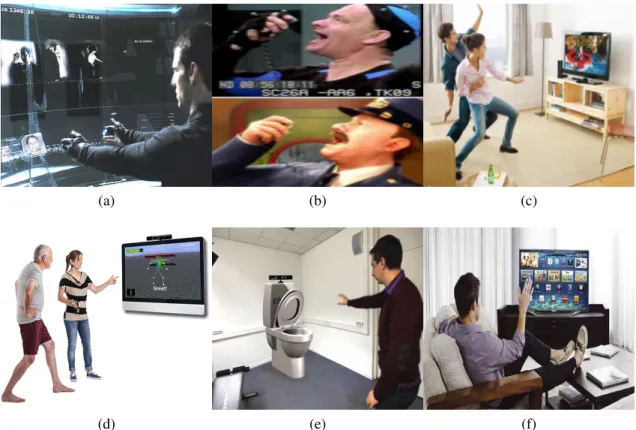
Minority Reportmovie which features a “Pre-Crime” police unit that predict crimes before they are committed. The police use a gesture-based interface designed for the film by an MIT media lab team. (b) Tom Hanksequipped with motion capture markers to animate the character in the movie: Polar Express. (c) Kinect game illustration showing motion and action recogni-tion for entertainment applicarecogni-tions. (d) An applicarecogni-tion of human acrecogni-tion and gesture recognition for elder care and health control. (e)+(f) Applications of automatic gesture recognition for indoor and public environments. . . 2 1.2 Typical depth sensors for capturing depth fields: (a) ToF sensor, (b) ToF
amplitude image, (c) Color coded depth image, (d) 3D point cloud, (e)Kinect
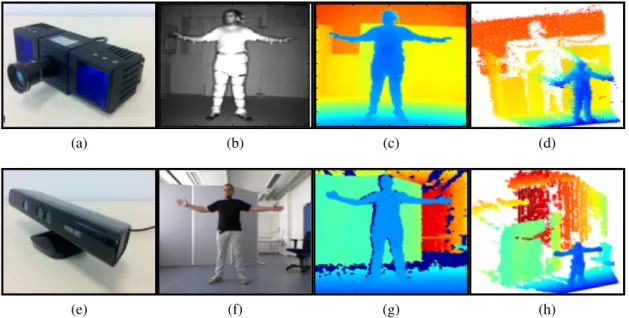
sensor, (f) Kinect RGB image, (g) Color coded depth image, (h) 3D point cloud reconstructed from theKinectdepth image. . . 7 1.3 Action examples with moving light displays (MLD) attached to the body’s
joints . . . 8
2.1 Different action views of human: (a) appearance, (b) depth field, (c) silhou-ettes, and (d) pose representations . . . 12 2.2 Exemplar features extracted from skeleton-based representation using (a)
joints trajectories (Sheikh, Sheikh and Shah, 2005) and (b) trajectory sim-ilarity matrix (Junejo et al., 2008) . . . 14 2.3 Exemplar features extracted from silhouettes-based representation as (a)
space-time objects (Blank et al., 2005) and (b) action-sketches (Yilmaz and Shah, 2005) . . . 15
2.5 Examples of different human action images taken from the Web-action (first row) and the Willow (second row) datasets . . . 23 2.6 Approaches for capturing abstract human body representations (i.e. body
pose) using (a) depth data from the Kinect sensor and (b) special motion capture setup . . . 25 2.7 Human body-pose exemplar frames for the TUM dataset (left) and the 3D
Action Pairsdataset (right). . . 26 2.8 ChaLearngesture exemplars for 20 different classes from Italian sign language 29
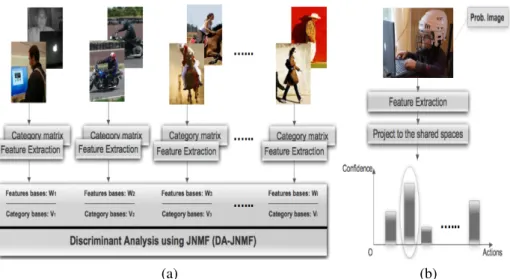
3.1 General diagram of DA-JNMF classification for (a) training on ground truth data and (b) testing on new samples . . . 40 3.2 Examples of human action images from the Willow action dataset (first row),
and theWeb-actionsdataset (second row) . . . 44 3.3 Classification accuracy for different number of bases K using theHOGand
SPM features and (JNMF) compared to our proposed approach with SPM
features (DA-JNMF(DA-JNMF/SPM),HOGfeatures (DA-JNMF/HOG) and their fused results (DA-JNMF/Final) on the (a)Willow dataset, and the (b)
Web-actionsdataset . . . 45 3.4 Confusion matrices of our classification framework for the (a)Willow
data-set, and the (b)Web-actionsdataset. . . 46
4.1 Overview of our pose-based framework for human action recognition. . . 50 4.2 Illustration of the locations feature fl, velocities feature fv, and the normals
feature fn for a single joint j. For each framek or frame pair (k,k+1), the vectorsljk,vjk, andnjkare converted into spherical coordinates and added to a histogram as shown in Figure 4.1. . . 51 4.3 Recognition accuracy for different feature quantizations for length r,
azi-muth α, and zenith φ. The plots show the accuracy when the number of bins changes. There are several configurations that give a good performance. Among them we use 5, 18, and 9 as the number of bins for length, azimuth, and zenith, respectively. . . 54
4.4 Examples of joint’s trajectories for the hammering (first row) and (draw X) actions from MSR-Action3Ddataset (Wanqing, Zhengyou and Zicheng, 2010b). Relevant action’s trajectories of left hand, left wrist, and left elbow are marked inblue, while other inconclusive trajectories are marked inred. Notice that both vary significantly across different actions and actors posing more challenges in representing human action. . . 55
4.5 The first seven discriminative projections of joint’s features extracted using PLS from MSR-Action3D (first row), DailyActivity datasets (second row), 3D actions pairs dataset (third row) and TUM dataset (fourth row). Notice that only few part combinations inMSR-Action3Ddataset are relevant where other joints like the hips are irrelevant for human actions. While in TUM, mostly the upper parts joints features are important as the actions of this dataset correspond to the daily human actions performed in a kitchen. Red and blue colors signify negative and positive weights respectively, while the size of the joint signifies its weight. . . 59
4.6 Recognition accuracies for different numbers of eigenvectors and various feature combinations for (a) MSR-Action3D and (b) 3D Action Pairs data-sets. . . 60
4.7 Recognition accuracies for different numbers of eigenvectors and various feature combinations for MSRDailyActivityMSRDailyActivityandTUM Kit-chendataset . . . 61
4.8 Performance evaluation on MSR-Action3D dataset: (a) impact of soft bin-ning, (b) comparison of 2D-LDA and PLS, and (c) comparison of KPLS and SVM classifiers . . . 65
4.9 Confusion matrices forMSR-Action3Dobtained (a) without a temporal pyr-amid, and (b) with a temporal pyramid. . . 66
4.10 Confusion matrices for3D Action Pairsobtained (a) without a temporal pyr-amid, and (b) with a temporal pyramid. . . 67
4.11 Confusion matrices for MSR-DailyActivity obtained (a) without a temporal pyramid, and (b) with a temporal pyramid. . . 68
ground-truth annotations and the y-axis shows classification accuracy. (b) Confusion matrix of the unsegmented video sequence of the TUM Kitchen
dataset (best viewed in colors) . . . 69
5.1 A schematic diagram that describes the PLS algorithm. The PLS algorithm discovers relations between two blocks of data by defining (non) linear outer relations between the input and the latent space, and inner relations between the variables in the latent space of the two blocks of data. . . 74 5.2 An overview of the classification approach using PLS, where the query sample
is assigned to the class with the maximum regression score in the indicator vectorYt. . . 78 5.3 The residual error for each frame of a reconstructed 3D pose sequence when
5, 20, 50, 100, 200 poses per class are used to train the KPLS regression model. . . 81 5.4 3D pose representation with local joints orientation coordinates provided
us-ing the pose estimation algorithm accompanied with theKinectsensor . . . . 84 5.5 Performance evaluation of a two-class problem using theJaccard Index. As,n
andBs,ndenote the ground truth and prediction labels of samplesfor each ac-tion respectively. The meanJaccard Indexis estimated byJmean =
Js,walk+Js,f ight
2
which equals Jmean =0.59 . . . 85 5.6 Illustration of prediction confidence obtained from our classification
frame-work for a sample video sequence that contains arbitrary Italian gestures. Figure (a) presents the prediction confidence obtained when joints orienta-tion features are not used while (b) presents the predicorienta-tion confidence when joints orientation is used in our classification framework. . . 86
6.1 Class-wise accuracies of different individual and ensemble classifiers for: (a) theWeb-actions, and (b) thePPMI7action image datasets . . . 102 6.2 Class-wise accuracies of different individual and ensemble classifiers for the
HMDB video dataset . . . 102 6.3 The models weights of each action for theWeb-actionsdataset. . . 104
List of Tables
2.1 Human action recognition benchmarks and their key characteristics: number of actions, number of samples, type of samples (I: Images,SV: Segmented videos, and UV: Unsegmented videos), year of release, and the available action modalities (A: Appearance,D: Depth,P: Pose, andSSilhouettes . . . 22 2.2 Example algorithms with their performance on Web-actions dataset . . . 22 2.3 Example algorithms with their performance for the Willow dataset . . . 23 2.4 Example algorithms with their performances for the HMDB51 dataset . . . . 24 2.5 Recognition accuracies reported for theMSR-Action3Ddataset. These
meth-ods use different action representations of poses (P) and depth fields (D). . . . 26 2.6 Exemplar recognition accuracy for the3D Action Pairs. These methods use
different action representations of poses (P) and depth fields (D) . . . 27 2.7 Exemplar recognition accuracies for the MSR-DailyActivity dataset. These
methods use different action modalities of poses (P) and depth fields (D). . . 27 2.8 Example algorithms with their performance for theTUMdataset . . . 30
3.1 Results on theWillowand theWeb-actionsdatasets . . . 45
4.1 Recognition accuracy forMSR-Action3Ddataset. The methods use different data modalities whereSdenotes skeleton data,Ddepth, andTPdenotes the use of a temporal pyramid. . . 62 4.2 Recognition accuracy for 3D Action Pairs. The methods use different data
modalities whereSdenotes skeleton data,Ddenotes depth, andTPdenotes the use of a temporal pyramid. . . 63
5.2 Recognition accuracy (%) for theTUMdataset. We compare a 2D appearance-based approach (Yao, Gall and Gool, 2012), 2D versions of our features, 3D features obtained by mapping the 2D pose to 3D, and 3D features computed from the provided 3D poses, which have been estimated using all the four camera views. . . 82
6.1 Recognition accuracies (%) of different approaches . . . 100 6.2 Example images from PPMI7 and the recognition results using individual
CHAPTER
1
Introduction
Understanding human actions is a remarkable human skill that they can easily perform on a daily basis. Humans constantly try to explain their surrounding environments and inter-pret behaviors to differentiate between ordinary or alarming activities for development and survival in life. In the machine age, much effort has been devoted towards understanding how the human visual system can effortlessly recognize motion and interpret its meaning to create intelligent machines. The first steps towards understanding human actions can be attributed to the analysis of human motion by Eadweard Muybridge (1830-1904), a Brit-ish photographer, who succeeded in breaking down human actions into distinct, observable body poses. It was not until 1975 when Johansson (1975) provided a psychological under-standing of human motion that explains the perception of biological motion by the human visual system. The advent of the computer then brought the quest for intelligent frameworks that can automatically analyze and predict human actions based on visual data and sensor signals. Many use cases appeared to address several challenges ranging from data manage-ment and indexing, through automatic-based surveillance systems, to novel approaches for human-computer interaction applications.
With the advances in digital platforms and the exponential growth of video and image data, interest towards automatic human action recognition became intensified as content-based indexing greatly simplifies the manageability of visual data. This advancement has led to greater efficiency in searches. In order to account for the speed of growth in such video data, it is worth noting some recent statistics. For instance,Facebookhas recently announced
(a) (b) (c)
(d) (e) (f)
Figure 1.1: Action recognition and motion tracking applications: (a) A clip from theMinority Report movie which features a “Pre-Crime” police unit that predict crimes before they are committed. The police use a gesture-based interface designed for the film by an MIT media lab team. (b)Tom Hanks equipped with motion capture markers to animate the character in the movie: Polar Express. (c) Kinectgame illustration showing motion and action recognition for entertainment applications. (d) An application of human action and gesture recognition for elder care and health control. (e)+(f) Applications of automatic gesture recognition for indoor and public environments.
that they operate one of the largest data warehouses storing more than 300 petabytes of data, the equivalent capacity of as much as 34,245 years of high-definition video. Furthermore, they have reported that more than 500 years worth ofYouTubevideos are watched every day onFacebook.YouTubehas also reported that more than 60 hours of video are uploaded every minute, or one hour of video is uploaded to YouTube every second1. The same trend goes forFlickr, where it has been reported in 2014 that it hosts more than five billion images with an average of 3,000 pictures being uploaded every minute2. Unfortunately, to this date, the
management and retrieval of such large-scale video or image archives are only possible at the cost of expensive manual annotation.
1https://www.youtube.com/yt/press/statistics.html
The interest in designing automatic human action recognition also goes beyond managing large amounts of data and spans several other fields. Industrial monitoring and surveillance systems using closed-circuit television (CCTV) cameras have been largely criticized for their limited role in detecting abnormal and criminal activities. For instance, in the city of London, it has been reported that more than one millionCCTV cameras have already been installed at a cost of approximately 200 million British pounds. However, despite the high cost, an internal report by the Metropolitan Police of London stated that the installedCCTV cameras have not been effective3. The report largely cites the manual analysis of video footage by
untrained officers to be the major drawback in detecting criminal activities using theCCTV
cameras.
Exertion game applications, especially for elderly care and health control, may benefit from action and gesture recognition in changing the conventional ways of playing video games for more engaging life experiences (see Figure 1.1). While typical gaming interfaces were based on keyboards, mouses or other haptic-based controllers, human actions and ges-tures are increasingly used as a direct input. Several approaches have been proposed to ad-vance human-machine interaction. The MicrosoftKinectfor example, has fostered research in many disciplines of computer vision and human-computer interactions by providing di-verse real-time action modalities of depth imagery, voice, RGB, and pose data at affordable price4.
These examples necessitate automatic action recognition frameworks that can robustly process, analyze, and respond in real-time, if needed, to such challenging scenarios. Unfor-tunately, despite the extensive research that has been conducted in the field of human action recognition over the past few years, efforts to interpret human actions in images or videos are still in their infancy due to the variation challenges of real-world footage. Variations can be caused by occlusion, viewpoint, scale, background clutter, as well as variation in subject’s size, appearance, speed and style of movement. This thesis focuses on methods to overcome these challenges, and proposes several approaches to achieve the construction of a robust, ef-ficient, and low-latency human-action recognition system to support real-time applications.
3
http://www.telegraph.co.uk/technology/10172298/One-surveillance-camera-for-every-11-people-in-Britain-says-CCTV-survey.html
1.1 Problem Statement
This dissertation focuses on the problem of human-action recognition with respect to differ-ent action modalities. While the action represdiffer-entation may be presdiffer-ented in differdiffer-ent modal-ities such as RGB, human pose or body silhouettes, the main goal is to provide an efficient real-time solution of the semantic labels of human actions and investigate the significance of accounting multiple action representations on performance. Therefore, we propose a set of methods that achieves these goals and overcomes some of the challenges in understanding human actions.
To provide an intuitive labeling scheme, action recognition frameworks should follow a natural language convention which uses the typical structure of the sentence: subject, verb, and object. Actions can be defined solely by the verb, for instance “walking” or “running”. They can also be used in conjunction with objects such as “playing football” or “drink-ing coffee”. Therefore, it is worth account“drink-ing for the difference between action terms that have been interchangeably used to refer to different constructs of human actions. A good taxonomy of human actions by Moeslunda, Hiltonb and Krüger (2006) presents them as a hierarchy that consists of: (i) action primitives and gestures, (ii) actions, and (iii) activities. Action primitives refer to the atomic entities that comprise an action, while actions refer to an ordered sequence of action primitives. Activities, on the other hand, are comprised of a higher level combination of actions that share some temporal relationships between the indi-vidual actions. For example, action primitives in the “play tennis” game may be comprised of “run forward”, “run backward”, “throw ball”, and “hit ball”, whereas the “tennis serve” action can be described as a set of action primitives that may consist of “throw ball” and “hit ball”. The activity of “playing tennis” stands for larger-scale events that usually depend on the context of the environment, objects, or interacting humans.
Thus, in this dissertation, we focus on automatic action recognition of different action con-structs using different action representations, and evaluate our proposed approaches based on several benchmarks. In most cases, these benchmarks use appearance, depth, and human pose representation and focus on the lower constructs of the action hierarchy: primitive ac-tions such as “reach” and “release” in theTUMdataset (Tenorth, Bandouch and Beetz, 2009) and actions such as “walking” and “running” in theWeb-actionsdataset (Ikizler, Cinbis and Sclaroff, 2009). However, some benchmarks may encompass more complex activities such as “cleaning sofa” in theMSR-DailyActivitydataset (Wang et al., 2012a).
1.2 Human Action Representation
1.2 Human Action Representation
The first step in human action recognition is to capture the action’s signal using a sensing device or some kind of input representation (modality) that portrays the action. A read-ily available modality of human actions is their appearance, which is often captured using consumer-like cameras and shared on the Internet. Alternative action representations, such as pose and depth field, also became common due to the recent technological advancements in sensing devices and computer vision algorithms. This section introduces various human action representations that are commonly used for action recognition, describes their advant-ages and disadvantadvant-ages, and explains their utility in solving the problem of human action recognition. In this context, we briefly describe the appearance modality (Section 1.2.1), the depth modality (Section 1.2.2), and the pose modality (Section 1.2.3). Note that throughout this thesis, the terms “representation” and “modality” are used interchangeably to refer to the format with which human actions are introduced to the action recognition framework.
1.2.1 Action Appearance
With the advent of digital cameras at the beginning of the twenty-first century, images and videos became a common medium to capture, communicate, and share special moments of our lives. This has led to an exponential growth in volumes of digital media repositories, triggering an urgent necessity of content-based analysis systems to organize and manage such large repositories. In the domain of human action recognition, the application environ-ment plays a decisive role in the design of appearance-based action recognition frameworks. Applications that can influence environmental parameters to a certain degree, such as sur-veillance, for example, can take certain restricting assumptions for fixed view and limited background clutter. These environments are often referred to as constrained environments. On the other hand, applications that do not have any conditions on the captured appearance modality are often referred to as unconstrained environments. This is the case for most available visual data in TV and cinema movies, sports broadcasts, music videos, or personal footage clips. In such environments, only very few assumptions can be made, such as that humans are fully visible and relatively well displayed in the captured video or image scene. In contrast to constraint environments, unconstrained environments present more challenges as they capture more realistic data and include wide variations in viewpoint, scale, and
back-ground clutter, as well as variations in subjects’ appearance, size, and abrupt movement.
1.2.2 Action Depth Field
Recent technological advances in sensory data have led to the development of several optical sensors that can acquire three-dimensional scans of a scene in real-time. Previously, obtain-ing such 3D representation was predominately achieved by carefully settobtain-ing up a multicamera environment where depth could be reconstructed via triangulations. Nowadays, the newly introduced sensors can easily provide depth information as a measurement of the distance from the camera sensor to the closest object’s surface. Two types of optical devices have appeared to obtain depth measurements: Time-of-Flight (ToF) and structured light sensors.
ToF sensors operate similarly to radar where the range image produced is similar to a radar image, except through the use of a light pulse. Cameras, based on the structured light prin-ciple, project a known infrared light pattern into the scene and capture the projected pattern using a regular infrared camera. In contrast to ToF, structured light sensors, such as the MicrosoftKinect sensors are simpler to construct and therefore, comparably less expensive thanToFsensors5. However, this is subject to change as the technology is rapidly advancing
toward designing affordable depth sensors based on both technologies6.
Despite the wide impact of depth sensors on various computer vision domains, current depth data is still limited, due to several reasons, including: noise, limited maximum-range, artifacts, and data resolution, which is comparably smaller to other optical cameras. For instance, currentToFcameras have a resolution of 200×200 pixels, while theKinectsensor captures 640×480 pixels. Moreover, depth sensors can reconstruct only the depth locations that are facing the sensors, i.e. no 3D points are generated at locations where the emitted sensor light can not reach. Therefore, the obtained depth representation is often referred to as 2.5D. Examples of typical depth sensors and their captured depth fields are shown in Figure 1.2.
1.2.3 Action Poses
Poses as an input modality of human motion have been widely used after the pioneering work of Johansson (1975). Johansson (1975) presented a visual interpretation of biological
5http://www.xbox.com/en-US/xbox360/accessories/kinect/KinectForXbox360
1.2 Human Action Representation
(a) (b) (c) (d)
(e) (f) (g) (h)
Figure 1.2: Typical depth sensors for capturing depth fields: (a)ToFsensor, (b)ToFamplitude image, (c) Color coded depth image, (d) 3D point cloud, (e)Kinectsensor, (f)KinectRGB image, (g) Color coded depth image, (h) 3D point cloud reconstructed from theKinectdepth image.
motion which shows that humans are able to interpret their motion solely from the motion of a few moving light displays (MLD) (see Figure 1.3). Various motion-capture approaches use this representation to obtain natural portrayals of human motion using optical tracking systems of markers that are attached to the limbs of the body. While motion-capture systems provide accurate measurements for the movements of the body joints’ locations in 3D, they have critical drawbacks that appear when considering realistic unconstrained environments. In such situations, attaching markers to body joints or wearing special suits is impractical for actors who are pursuing some type of daily activity. Recent motion-capture technolo-gies introduced systems that do not demand markers, however, at the cost of careful setup of the environments in terms of visibility and lighting conditions. Typically, these mark-erless motion-capture systems use multiple regular cameras which are arranged around a common area, and the silhouette of an actor is extracted for each camera view. The extracted silhouettes are employed to reconstruct and estimate the human pose. Unfortunately, these markerless systems demand ideal scene illumination and clear, textureless backgrounds in order to reliably extract body silhouettes.
The environmental restrictions of motion-capture systems motivated automatic-based pose estimation methods to identify and localize different parts of the body from the visual
appear-Figure 1.3: Action examples with moving light displays (MLD) attached to the body’s joints
ance of the human body. Comprehensive surveys on recent pose estimation techniques can be found in (Moeslunda, Hiltonb and Krüger, 2006; Sala et al., 2014). Unfortunately, these approaches are still limited in their performance capabilities as they are heavily challenged by the complexities of the high dimension of the search space and the large number of de-grees of freedom involved in estimating the body pose. Further complexities arise due to the variation of cluttered backgrounds, body parameters, and illumination changes in real world scenarios. An important milestone towards markerless pose-estimation was achieved after the release of the Kinect sensor, where current approaches on pose estimation from depth data obtain a reliable estimation of the human body pose. While providing a good estimation of the human body pose, approaches based on depth data still presume that the entire subject is mostly visible and facing theKinectsensor.
1.3 Contributions
Our research investigates the utility of different action modalities to achieve efficient and reli-able human action recognition. It presents novel algorithms and provides extensive empirical evaluation, providing state-of-the-art performance on several action recognition benchmarks. Below we give an overview of our contributions.
We explore the significance of the appearance representation for human action recognition and investigates the benifits of combining different appearance-based features. To this pur-pose, we present a novel supervised classification framework for action recognition that is based on non-negative matrix factorization (NMF). The presented classification framework is a multiclass framework that determines probability estimates of classes for the provided patterns. Therefore, it can efficiently integrate various estimates of different patterns in or-der to enhance the classification performance. Our research builds on the recent work on
1.3 Contributions
non-negative matrix factorization to multiview learning, where the primary dataset benefits from auxiliary information in obtaining shared and meaningful spaces. For discrimination, we use action labels in a supervised setup as an auxiliary source of information to learn the representative latent set of bases vectors. The evaluation considers an appearance-based ap-proach on two challenging image datasets of human action recognition. In the evaluation, we show how the proposed algorithm achieves competitive classification results. This work was published in (Eweiwi, Cheema and Bauckhage, 2013) and is presented in Chapter 3.
Despite the encouraging performance, the obtained recognition rates using the appearance features only are not ideal for real world application scenarios due the extreme inconsist-ency of the action appearances. Therefore, we investigate other action representations that can provide better invariance while preserving the distinctive features among semantically different actions. In Chapter 4, we propose a pose-based framework for action recognition that overcomes the varying challenges of appearance-based recognition frameworks. We also show that unlike most previous pose-based approaches, our training and testing time for human action recognition is fast and can meet the demands of real-time applications. Further, the proposed approach achieves state-of-the-art results on several action recognition benchmarks and can work for 2D or 3D pose-based action representations. This work was published in (Eweiwi et al., 2014) and is presented in Chapter 4.
Since most estimation methods for monocular views reconstruct only 2D poses, we com-pare 2D and 3D pose-based features for human action recognition. We further investigate the significance of reconciling the 2D poses and obtain their corresponding 3D poses for action recognition using a regression scheme. Our study concludes that learning a mapping from 2D poses to 3D poses to obtain view-invariant features can boost the performance significantly. Further, we evaluate the significance of joint orientation features and their role for large scale human action recognition. This work is detailed in Chapter 5 and provides an extension to the work published in (Eweiwi et al., 2014).
As human actions are not usually associated with only the pose representation, but rather on a synergy of representations that captures different action perspectives such as action mo-tion, scale, and scene appearance, we present a novel late-fusion framework that combines several classification results of different action modalities. Our approach is based on formu-lating and solving a constrained quadratic optimization problem that determines the optimal fusion weights of classifiers based on their operating modality. In contrast to the previously proposed late fusion approaches, our approach puts constraints on the semantics of mixture
coefficients, such that they represent the posterior of every participating classifier for each class. Experiments on a number of established benchmark action datasets show that the presented approach improves on baseline late-fusion approaches and improves on state-of-the-art results. This work is detailed in Chapter 6 and published in (Cheema, Eweiwi and Bauckhage, 2014).
1.4 Related Publications
The following list presents the publications and the contributions made and presented in this dissertation:
[1] A. Eweiwi, S. Cheema, C. Thurau, C. Bauckhage, “Temporal key poses for human action recognition”, ICCV-WORKSHOPS, 2011.
[2] A. Eweiwi, S. Cheema, C. Bauckhage, “Discriminative joint non-negative matrix fac-torization for human action classification”, GCPR, 2013.
[3] A. Eweiwi, S. Cheema, C. Bauckhage, “Action Recognition in Still Images by Learning Spatial Interest Regions from Videos”, Pattern Recognition Letters 37, 2014.
[4] A. Eweiwi, S. Cheema, C. Bauckhage, J. Gall, “Efficient Pose-based Action Recogni-tion”, ACCV, 2014.
[5] S. Cheema, A. Eweiwi, C. Bauckhage, “Action recognition by learning discriminative key poses”, ICCV-WORKSHOPS, 2011.
[6] S. Cheema, A. Eweiwi, C. Bauckhage, “Gait Recognition by Learning Distributed Key Poses”, ICIP, 2012.
[7] S. Cheema, A. Eweiwi, C. Bauckhage, “Who is Doing What? Simultaneous Recogni-tion of AcRecogni-tions and Actors”, ICIP, 2012.
[8] S. Cheema, A. Eweiwi, C. Bauckhage, “Human Activity Recognition by Separating Style and Content”, Pattern Recognition Letters 34, 2013.
[9] S. Cheema, A. Eweiwi, C. Bauckhag, “A Stochastic Late Fusion Approch to Human Action Recognition”, GCPR, 2014.
CHAPTER
2
Related Work
2.1 Preface
Human action recognition has attracted much attention in the past decade and remains an active research topic in computer vision. The challenge in computer vision, simply stated, is to be able to efficiently and robustly classify human actions. Efficiency denotes the capab-ility of the system in obtaining accurate and fast performance for human action recognition. Robustness refers to the capacity of the system in maintaining its efficiency under unpre-cedented situations. As noted in (Campbell and Bobick, 1995), the representation of the performed actions often determines the key characteristics of the designed algorithm (i.e. efficiency, robustness, and applicability extents). Ideally, the representation should be in-variant towards variations in different actors’ styles, views, and backgrounds. Meanwhile, it should preserve the distinctive features among semantically different actions. Following this intuition, we describe the human action recognition challenge from a representation per-spective. First, we briefly review current approaches to action recognition, with an emphasis on their used representations (see Figure 2.1). Then, we review the research frontiers on this problem and present exemplar approaches based on the adopted representation. Finally, we elaborate on the advantages and disadvantages of using each representation for delivering efficient and robust human action recognition solutions. From this standpoint, we roughly categorize the proposed methods for human action recognition into two categories based on their corresponding representation:
(a) (b) (c) (d)
Figure 2.1: Different action views of human: (a) appearance, (b) depth field, (c) silhouettes, and (d) pose representations
• Action recognition using high-level representations:
High-level representation of human actions presents the human body pose as a col-lection of interconnected body parts and joints in a deformable configuration model. These models are offten called body poses or stick-figures. (see Figure 2.1(d)).
• Action recognition using low-level representations:
Low-level representation of human actions presents its visual appearance as an ordered set of pixels of different intensity values for each channel. These channels may corres-pond to the visual appearance of the action using colored pixels (i.e. RGB), or depth image with pixel intensities that capture the distance of the projected light ray from the real world to the sensor, or body silhouettes where each pixel indicates if it is part of the human body or not.
In the following sections, we elaborate further on both approaches and describe some of the recent research made based on these action representations.
2.1.1 Action Recognition Using High-level Representation
Earlier attempts for human action recognition relied on simple human representations called stick-figure models (Johansson, 1975). The stick-figure model is based on a pose structure, where line segments are connected by the body joints to form a hierarchical structure. Ob-taining such representation assumes accurate measurements of the body’s joints; thus, it often requires special setups and tools. The influence of the psychological studies of hu-man perception of motion (Johansson, 1975) motivated several researchers to account for
2.1 Preface
this representation in automatic human action recognition. For instance, the approaches in (Campbell and Bobick, 1995; Bissacco et al., 2001; Ali, Basharat and Shah, 2007) use dif-ferent phase space features extracted from joint trajectories for actions and gaits recognition. Others (Yacoob and Black, 1998; Rao, Yilmaz and Shah, 2002; Junejo et al., 2008) rely on different similarity measures for tracking and matching body joints’ trajectories. Para-meswaran and Chellappa (2003) propose an invariant feature set for human motion analysis and action recognition using five plenary points of human body joints. Vasilescu and Sethi (2001) pose the human action classification as a model-based object recognition problem using a generalized cylindrical representation called action cylinders. Sheikh, Sheikh and Shah (2005) identify three sources of variability within a performed action and propose to alleviate them through a linear combination model in a joint spatio-temporal space. These approaches, however, demand an expensive and time-consuming setup to operate in order to generate accurate measurements of body joints’ locations; therefore, their applicability to real-world environments is limited.
With the recent advances in both depth sensors and automatic human pose estimation al-gorithms, interest has been rekindled in high-level representations for action and behavior analysis (Ye et al., 2013). Despite their noisy estimations in monocular (Yang and Ramanan, 2011), depth sensors (Shotton et al., 2013), or multiview (Yao, Gall and Gool, 2012) setups, several recent studies (Tran, Kakadiaris and Shah, 2011; Jhuang et al., 2013; Wang, Wang and Yuille, 2013; Wang et al., 2012b; Yao, Gall and Gool, 2012) strongly point to the util-ity of the pose representation in obtaining superior performance as opposed to low-level features (Section 2.1.2). For example, Tran, Kakadiaris and Shah (2011) utilize polar co-ordinates of joints in a sparse reconstruction framework to classify human actions in real-istic video datasets. Their evaluation clarifies the implication of accurate pose estimation on action recognition and identifies the potentials of current state-of-the-art pose estimation in obtaining excellent recognition performances. Similar observations are reported in (Yao, Gall and Gool, 2012; Jhuang et al., 2013) for larger and more complex datasets. In particular, Jhuang et al. (2013) show that in some scenarios, high-level features extracted using current state-of-the-art pose estimation algorithms (Yang and Ramanan, 2011) outperform best low-level features based ondense trajectories(Wang et al., 2011a). These observations motivated researchers to further examine the potentials of high-level features under conventional and newly proposed challenges in videos and depth sensor data. For instance, Wang et al. (2012a) propose learning sets of most distinctive joints through mining. While Zanfir, Leordeanu and
(a) (b)
Figure 2.2: Exemplar features extracted from skeleton-based representation using (a) joints trajector-ies (Sheikh, Sheikh and Shah, 2005) and (b) trajectory similarity matrix (Junejo et al., 2008)
Sminchisescu (2013) weight poses of actions based on a mutual information criteria, Wang, Wang and Yuille (2013) mine the most occurring temporal and spatial structures.
2.1.2 Action Recognition Using Low-level Representation
Due the practical challenges in obtaining high-level pose representation, research in human action recognition has slowly deviated towards low-level representations of human actions. Two major factors have led towards such a transition. The first is the progress made on low-level features for object detection/recognition. The second is the limited performance of automatic pose estimation algorithms at that time and the high expanses of motion capture setups in obtaining high-level representations. Therefore, alternative low-level action repres-entations were proposed such as body pose silhouettes, action appearances, and depth fields of the action scene. Next, we list exemplar approaches based on each representation and point out the advantages and disadvantages of each representation in action recognition.
Silhouettes-based Approaches
Human body silhouettes were frequently used for human action recognition, especially in the environments where they can be reliably and efficiently captured using background sub-traction techniques. A popular work that advocated using this representation was made by Bobick and Davis (2001) where motion and shape cues are combined to create two distinctive action templates called Motion History Images (MHI) and Motion Energy Images (MEI). An extension towards view invariance was proposed in (Weinland, Ronfard and Boyer, 2006) by modeling the human action as 3D template volumes called Motion History Volumes (MHV). Other successful uses of silhouettes were presented in (Thurau and Hlavac, 2007; Thurau et
2.1 Preface
(a) (b)
Figure 2.3: Exemplar features extracted from silhouettes-based representation as (a) space-time ob-jects (Blank et al., 2005) and (b) action-sketches (Yilmaz and Shah, 2005)
al., 2011; Eweiwi et al., 2011) where they modeled the temporal sequence of human action as a histogram of key poses. These key poses are representative body poses which result from clustering a pool of diverse human body poses. Another histogram-based approach was used by Ikizler, Cinbis and Sclaroff (2009) where they encoded human silhouettes using a histogram of oriented rectangular blocks that span the body pose. Object recognition ap-proaches were also adapted for action recognition through the work of (Yilmaz and Shah, 2005; Gorelick et al., 2007). Their approaches model human actions as spatio-temporal ob-jects that are matched to test samples using a predefined similarity measure. Despite the success made using silhouettes-based approaches, the proposed methods are still bound with the (constrained) environments where silhouettes can be obtained reliably. Moreover, these approaches are still heavily impeded by noise that results from scene-occlusion or inaccurate extraction of the human pose. Therefore, the emphasis of using silhouettes for action recog-nition has decayed in favor of other representations, such as depth- and appearance-based representations that we describe next.
Appearance-based Approaches
The significant progress made in object and human detection using appearance-based repres-entation (i.e. RGB) promoted several adaptations of motion and visual appearance cues in modeling human actions. Roughly, one can categorize the adopted approaches on modeling human action appearances into:
• Global template-based modelsbecame popular after the introduction of efficient ob-ject and human descriptors, for example, theHistogram of Oriented Image Gradients
(HOG) descriptor that was presented in (Dalal and Triggs, 2005). In this line, an auto-matic approach for mining human actions from web images using a variant of the (HOG) descriptors is used in (Ikizler, Cinbis and Sclaroff, 2009). Thurau and Hla-vac (2008) apply Non-negative Matrix Factorization (NMF) on the HOG features of pose appearances to learn a set of body-pose primitives. Classification is performed on top of a histogram of pose primitives using Kullback-Leibler (KL) divergence. Efros et al. (2003) use the optical flow fields in constructing global templates of hu-man actions where classification is performed for videos on each frame individually. Motion template features were also used to discriminate among actions, either by en-coding the foreground trajectories (Wu, Oreifej and Shah, 2011) or using the optical flow fields (Sadanand and Corso, 2012). In general, global based modeling of human actions works well in delivering the general structure of the human action. But it be-comes vulnerable as the variations among actions gets smaller. Moreover, global-based approaches can be severely affected by various impeding factors such as body-parts oc-clusion, view variations, and background clutter.
• Part-based modelsalso present convenient methods for dealing with human action re-cognition. These methods became popular after their success in many human and object detection challenges (e.g., PASCAL visual object recognition challenge1). Felzenszwalb et al. (2010) describe a deformable model for human detection that was used to achieve state-of-the-art performance in action recognition on several benchmarks. Bourdev and Malik (2009) model the human appearance using a set of part-based appearance tem-plates called poselets which capture similar pose configurations. Maji, Bourdev and Malik (2011) utilize poselets to identify human poses, as well as actions in still im-ages. Sun and Savarese (2011) propose an articulated part-based model for human pose estimation and detection that adopts a hierarchical (coarse-to-fine poselet-like) representation. Yang, Wang and Mori (2010) exploit poselets as a coarse representa-tion of the human pose and treat them as latent variables for acrepresenta-tion recognirepresenta-tion. The pose-appearance view was also used in (Yao and Fei-Fei, 2012) through a 2.5D repres-entation that considers both pose and appearance information of the body parts. Despite their recent success on different action recognition challenges, it is still questionable if these methods can make use of the favorable statistics of today’s large-scale datasets as the construction of suitable poseletsoften requires extensive human intervention and
2.1 Preface
manual labeling in the training phase.
• Bag-of-Features (BOF)models had been widely used for human action recognition, especially, after the introduction of interest points in video sequences (Laptev, 2005; Willems, Tuytelaars and Gool, 2008). TheBOFmodel originated from document and text analysis research in (Salton and McGill, 1986) where documents are represented as a set of orderless words sampled from a language dictionary. The same analogy was used for image and video analysis by constructing a dictionary of visual words to sim-plify the image or video representation. Briefly, in action recognition, theBOF model starts with extracting spatio or spatio-temporal features in the vicinity of random-(Gall et al., 2011), key- (Laptev, 2005; Willems, Tuytelaars and Gool, 2008), dense-points (Sharma, Jurie and Schmid, 2012; Deltaire, Laptev and Sivic, 2010). Then, a dictionary of visual words is constructed using a clustering scheme. The final histo-gram representation is obtained by encoding and pooling the local features into their corresponding bins. One of the earliest implementations ofBOFfor action recognition in videos was proposed in (Laptev et al., 2008), where spatio-temporal key-points are used to extract local features of human actions. Later experiments adopted a dense-based feature extraction (Reddy and Shah, 2013; Kuehne et al., 2011) which showed better performance in detecting and recognizing human actions.
Recent work on BOF model addresses limitations of the disordered representation of
BOF model and low-level features (Kovashka and Grauman, 2010). Some methods propose a mid-level representation that conveys more semantics about the actions by encoding spatial and temporal relationships among low-level features. Others (Gilbert, Illingworth and Bowden, 2011; Liu et al., 2012) employ data mining to build high-level compound features from noisy and over-complete sets of low-level spatio-temporal fea-tures. Song, Goncalves and Perona (2003) use a triangular lattice of grouped point features to encode spatial layouts. The authors of (Coates and Ng, 2011; Malinowski and Fritz, 2013; Sharma, Jurie and Schmid, 2012) propose weighting schemes of local features while pooling them in a way that regards the classification task at hand. Unfor-tunately, these approaches provided limited enhancements over their low-level counter-parts as they lack semantic meaning, making the interpretation of their mid-level fea-tures difficult. Incorporating the semantics behind the visual appearance of the action appears to be a key-factor in obtaining better action models usingBOF. Therefore,
re-cent approaches (Matikainen, Hebert and Sukthankar, 2009; Wang, Wang and Yuille, 2013; Wang et al., 2011a) use semantic constructs like motion trajectories instead of key-points for sampling local action features. Jhuang et al. (2013) notice that encoding local appearance and motion features in the vicinity of motion trajectories boosts the performance ofBOFmodels. While Wang et al. (2013b) show that accurate estimation of action trajectories further enhances the performance of these models.
Despite encouraging results of the appearance-based representation for action recognition on several datasets, many factors greatly impede the progress in this domain. Among these are the heavy variations of the same action appearance across different view points, different subjects, different scales, and even different scenes. Moreover, low-level features of the appearance representation are often limited in their discriminative power for complex and realistic scenarios as they carry limited semantics of the represented actions.
Depth-based Approaches
Much effort has been devoted recently to developing features for action recognition on depth data due to the reliable, affordable, and rich representation depth fields provide for the hu-man actions. Some approaches that use the depth-based representation adopt appearance-based approaches by assuming the depth-field as an intensity image. These approaches used global-based (Yang et al., 2012) or part-based (OhnBar and Trivedi, 2013) templates to cap-ture action depth characteristics. Other recent approaches follow more delicate methods by mining discriminative depth-based occupancy patterns that are randomly distributed over the body’s depth field (Wang et al., 2012c) or only around the body’s joints (Wang et al., 2012b). Histogram-based approaches were also used in this domain. For example, Li, Zhang and Liu (2012) represent each depth frame as a bag of 3D points on the human silhouette and employ HMM to model the temporal dynamics. Oreifej and Liu (2013) build histogram-based fea-tures based on the normals extracted from the 4D spatio-temporal space of the human body (i.e. XYZ+T). Despite the current limitations of maximum captured depth of current depth sensors (e.g., Kinect andTime-of-Flight), the representation still presents a unique view of human action that is beneficial, especially for indoor applications of human action recogni-tion systems.
2.1 Preface
2.1.3 Action Recognition: A Multimodal Approach
In the previous sections, we have introduced several action views of high-level (e.g., body poses) and low-level representations (e.g., appearance and depth fields). Noticeably, each view is characterized by several limitations which prohibit obtaining robust action recogni-tion systems. Therefore, the recent trend for acrecogni-tion recognirecogni-tion targets fusing several comple-mentary action representations to cope with different action aspects such as motion, scene, pose, and context. Two approaches commonly are used to achieve fusion. The first is early fusion which combines different representations on the feature level. For instance, methods in (Deltaire, Laptev and Sivic, 2010; Rohrbach et al., 2012; Wang et al., 2011b) combine a variety of heterogeneous representations by simply concatenating feature descriptors. This, however, may undermine the discriminative potential of each individual representation for particular classes. To overcome this limitation, Wang et al. (2012a) follow a principled ap-proach to combine a set of mined action features called actionlets using Multiple Kernel Learning (MKL) (Bach, Lanckriet and Jordan, 2004), which assigns different linear or non-linear weights to the feature kernels in order to obtain better similarity measures. A recent evaluation Gehler and Nowozin (2009) show that the simple kernel averaging, a much faster method, can achieve similar results as MKL.
The second approach is late fusion, often called classifier-level fusion. This approach has certain key advantages over other fusion schemes. Firstly, late fusion is generally fast and scalable, especially as the trained system grows to adapt new features. In this case, classifier level fusion requires only the retraining of the fusion part in contrast to feature level fusion where the whole system needs to be retrained. Secondly, it abstracts away details of the underlying classifiers, giving the freedom of selecting arbitrary classification models that best suit a given feature. Baseline approaches for classifier level fusion such as the sum-rule or the SVM-rule (Kittler et al., 1998) have been extensively evaluated for several application (Kittler et al., 1998; Xu, Krzyzak and Suen, 1992). These baselines assume that individual classifier outputs are normalized to an estimate of posterior probabilities so that they can be combined homogeneously (Jain, Duin and Mao, 2000). For instance, Eweiwi, Cheema and Bauckhage (2013) combine the estimated confidences rates of different models trained using actions’ pose appearances and scene appearances. While Yao et al. (2011a) combine the confidence estimates of models trained on different pose and appearance features. In summary, both late and early fusion of action features for different representations have
shown significant improvements on human action recognition. Therefore, recent approaches focus on the design of better fusion schemes, other than baseline techniques, that adhere the individual advantages of each action representation allowing for better human action recognition systems (Liu et al., 2013a; Ye, Liu and Chang, 2012).
2.2 Human Actions Datasets
The technological advancement in terms of memory, processing speed, and sensory data has opened new application domains and provided appealing tools for analyzing diverse, com-plex, and large amounts of visual data. As the demand for automatic analysis of visual me-dia became mandatory for wide application domains (e.g. video indexing human-computer interaction, and surveillance), researchers proposed several benchmarks that have had an increasing complexity throughout the last few years. These datasets consider different as-sumptions of human actions according to the anticipated application domains of the designed algorithms. Among these assumptions are the scale of the recognition problem, its working environment (i.e. constrained or unconstrained), and the representations of human actions (i.e. RGB, RGB-D, silhouettes, motion capture, and skeleton-based representations).
We divide these benchmarks into two categories based on whether they comprise high-level action representation (i.e. human poses depicted by body skeletons) or low-high-level action representations (i.e. appearance- and depth-based). Table 2.1 lists the action datasets we used in this dissertation and their main characteristics.
2.2.1 Low-level Representation Benchmarks
Low-level representation depicts the visual appearance of human actions as an ordered set of pixels with different intensity values of different channels. These channels may either correspond to the visual appearance of the action depicted by colored pixels (i.e. RGB), or the depth field through pixels whose intensities correspond to the distance of the projected light ray from the real world to the sensor, or silhouettes where each pixel indicates if it corresponds to a human body or not.
2.2 Human Actions Datasets
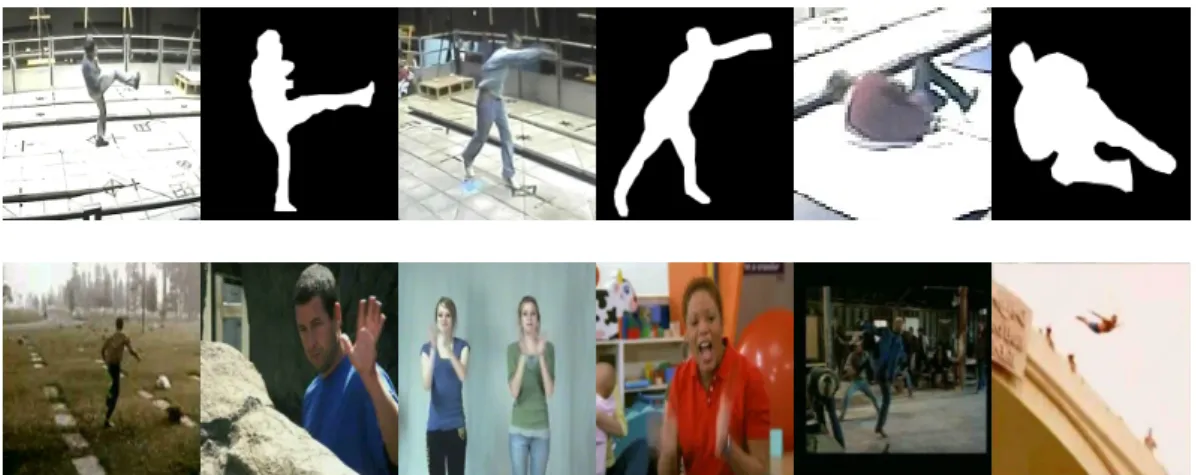
Figure 2.4: Exemplar frames for the MuHVAi human action dataset (first row) with their silhouettes and for the HMDB dataset (second row)
Multi-view Human Action Video (MuHAVi) Dataset
The MuHAVi dataset is a video dataset of two different representations: human silhouettes and RGB data. Silhouette-based representations have been widely used for action recognition in constrained environments. It became popular as it suits particular applications (e.g., sur-veillance) where reliable human silhouette extraction is possible. The dataset was presented by Singh, Velastin and Ragheb (2010) and considers human actions in a constrained environ-ment. It provides multi-view data of actions of different actors with CCTV-like views (i.e. at an angle and some distance from the observed person). The data consists of 136 samples of 14 primitive actions, performed by two actors, and is observed from two different views. The actions in the data set can be reorganized into eight classes where similar actions constitute a single class. Figure 2.4 shows example frames of this dataset for different human actions in the RGB and the silhouette representations.
Web-actions Dataset
The exponential growth in unconstrained human action videos exposed the potential limit-ation of silhouette-based representlimit-ations. These representlimit-ations are usually intractable for images and unconstrained action videos because of the absence of reliable silhouette extrac-tion methods. As such, several datasets were proposed to recognize human acextrac-tions based only on their visual appearance (i.e. RGB data). The Web-actions dataset is among these datasets that targets action recognition from images gathered for the web. It was presented
Table 2.1: Human action recognition benchmarks and their key characteristics: number of actions, number of samples, type of samples (I: Images, SV: Segmented videos, and UV: Unsegmented videos), year of release, and the available action modalities (A: Appearance, D: Depth, P: Pose, andSSilhouettes
Dataset Actions Samples Type Modality Year
MuHAVI(Singh, Velastin and Ragheb, 2010) 14 136 SV S 2010 Web-Actions(Ikizler, Cinbis and Sclaroff, 2009) 5 2458 I A 2009 Willow(Deltaire, Laptev and Sivic, 2010) 7 911 I A 2010
HMDB51(Kuehne et al., 2011) 51 6766 SV A 2011
MSR-Action3D2 20 576 SV A+D+P 2011
MSR-DailyActivity 16 320 SV A+D+P 2011
3D-Action-Pairs(Oreifej and Liu, 2013) 12 352 SV A+D+P 2013 TUM(Tenorth, Bandouch and Beetz, 2009) 10 20 UV A+P 2009
ChaLearnGestures3 20 630 UV A+D+P+S 2014 Table 2.2: Example algorithms with their performance on Web-actions dataset
Method Accuracy(%) Year
(Ikizler, Cinbis and Sclaroff, 2009) 56.54 2009
(Yang, Wang and Mori, 2010) 61.07 2010
(Eweiwi, Cheema and Bauckhage, 2013) 64.05 2013
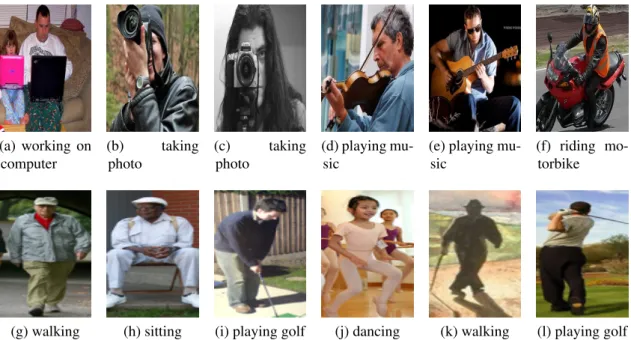
by Ikizler, Cinbis and Sclaroff (2009) and contains images downloaded from the Internet using the keywords of human actions. The human body is then extracted using a state-of-the-art human detector and post-processed to align the extracted human bounding boxes with respect to their head position. The resulting dataset consists of five different actions: “dancing”, “playing golf”, “sitting”, “running”, and “walking” and contains a total of 2,458 images. Examples from this dataset are shown in Figure 2.5. Pictures in this dataset are characterized by the visibility of human body parts. However, it represents a challenge as the body appearance shows wide pose variations, especially for the “dancing” and “playing golf” actions. Exemplar approaches and their reported results on this dataset are reported in Table 2.2.
Willow Dataset
Advances in social media have revolutionized not only the amount of personal pictures we share on the web, but also provided a diverse view and quality of human visual
appear-2.2 Human Actions Datasets
Figure 2.5: Examples of different human action images taken from the Web-action (first row) and the Willow (second row) datasets
Table 2.3: Example algorithms with their performance for the Willow dataset
Method mAP(%) Year
(Deltaire, Laptev and Sivic, 2010) 62.14 2010
(Eweiwi, Cheema and Bauckhage, 2013) 61.57 2013
(Sharma, Jurie and Schmid, 2012) 65.9 2012
(Delaitre, Sivic and Laptev, 2011) 64.1 2011
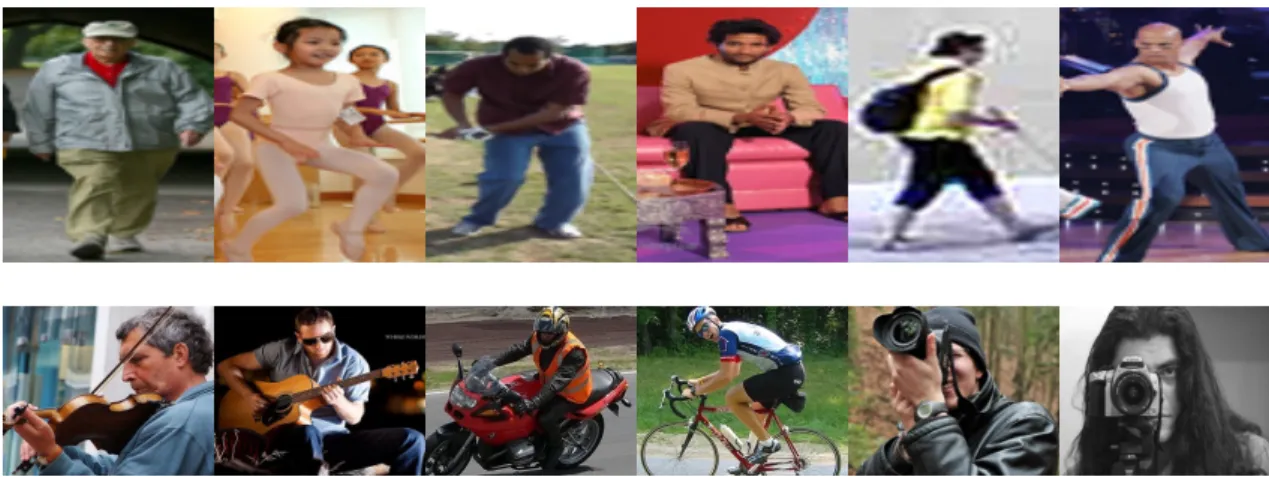
ances. The willow dataset4 proposed by Deltaire, Laptev and Sivic (2010) addresses these challenges by introducing a human action dataset of consumer-like photos that stand for a wide range of variations in view, scene, scale and quality of the visual appearance for people. This dataset consists of 911 images distributed over seven different actions: “interacting with computer”, “taking photo”, “playing music”, “riding bike”, “riding horse”, “walking”, and “running”. Some images were taken from thePascal 2007 VOC Challengeand the rest were collected fromFlickrby querying on keywords such as “running people” or “playing piano”. Images that do not clearly depict the action of interest were manually removed. A common observation between the obtained results on theWeb-actions(see Table 2.2) and theWillow
datasets (see Table 2.3) is the relatively low performance of the proposed approaches for hu-man action recognition as compared to other datasets that comprise further motion-, depth-, or pose-based representation. This points out to the greater challenges of solving the human action recognition using appearance in images as compared to RGB-videos or other action modalities.
Table 2.4: Example algorithms with their performances for the HMDB51 dataset
Method Accuracy (%) Year
Dense Trajectory(Wang et al., 2013b) 46.6 2013 ActionBank(Sadanand and Corso, 2012) 26.6 2012 MIP(Gross et al., 2012) 29.2 2012 C2(Kuehne et al., 2011) 23.0 2011 HOG/HOF(Kuehne et al., 2011) 20.0 2011
Large Human Motion Database (HMDB51)
As billions of videos are shared and viewed on the Internet everyday, new frontiers emerged in computer vision to arrange such gigantic growth of media. In contrast to earlier bench-marks for action recognition, HMDB51 addresses the large scale evolution in media and is considered one of the largest and most challenging benchmarks for action recognition. It comes with 51 distinct action categories each contains at least 101 samples for a total of 6,766 action samples. Each sample clip is validated by at least two human observers and con-tains additional meta information (i.e. view-point, indicator of camera motion, quality, and the number of actors involved) to provide more flexible experiments for evaluation. Several algorithms were evaluated in this dataset; Table 2.4 shows the state-of-the-art performance achieved in this dataset. Noticeably, the HMDB51 dataset is one of the most challenging benchmarks for action recognition where the best performance of only 46.6% was reported by Wang et al. (2013b) in 2013 using an improveddense trajectoryfeatures.
2.2.2 High-level Representation Benchmarks
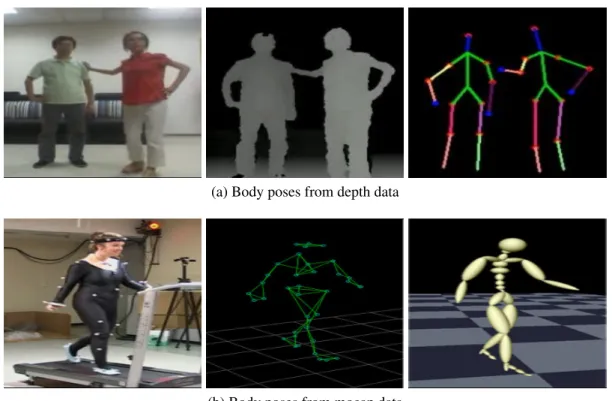
High-level representation of human actions abstracts away most information that is irrelevant to the human body. The representation focuses on modeling the human body and presenting it as a collection of interconnected body parts and joints in a deformable configuration model. Human actions in this depiction can be defined as a collective articulation of the body’s joints and parts that uniquely determine the action. This representation is widely adopted in com-puter graphics, movie production, and animation using motion capture data. Obtaining such representation usually requires special setups that are often time consuming and costly. Fig-ure 2.8a depicts an example of its setup and application for generating high quality computer animations. Recently, with the advent of new sensors (e.g., Kinect and time-of-flight), ro-bust algorithms were developed to reliably estimate the human pose in a low-cost monocular
2.2 Human Actions Datasets
(a) Body poses from depth data
(b) Body poses from mocap data
Figure 2.6: Approaches for capturing abstract human body representations (i.e. body pose) using (a) depth data from theKinectsensor and (b) special motion capture setup
view setup (Figure 2.7b). As a result, researchers presented several challenges that provide not only low-level representations (e.g. RGB-D), but also high-level representations (i.e. body poses) of human actions. In the following sections, we present these datasets and the reported state-of-the-art results on each.
MSR-Action3D Dataset
TheMSR-Action3Ddataset is an action dataset captured with an RGB-D camera and desig-nated for gaming-like interactions. The selected actions reasonably cover the various artic-ulation of arms, legs, torso and their combinations. Additionally, if an action is performed by a single arm or leg, the subjects were advised to use their right arm or leg. The sub-jects were facing the camera during the performance. The dataset consists of 567 temporally segmented action sequences and contains 20 actions; each performed 2-3 times by 10 differ-ent subjects. The actions are: “high-arm-wave”, “horizontal-arm-wave”, “hammer”, “hand-catch”, “forward-punch”, “high-throw”, “draw-x”, “draw-tick”, “draw-circle”, “hand-clap”, “two-hand-wave”, “side-boxing”, “bend”, “forward-kick”, “side-kick”, “jogging”,
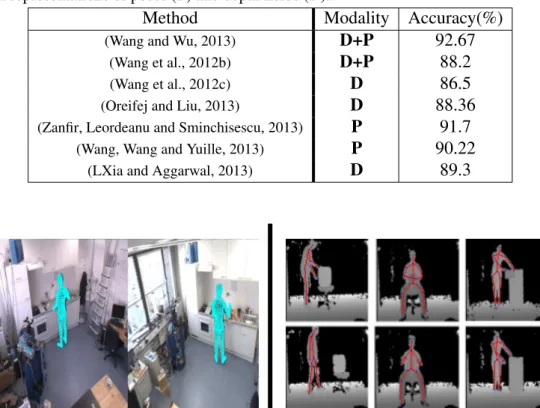
“tennis-Table 2.5: Recognition accuracies reported for theMSR-Action3Ddataset. These methods use differ-ent action represdiffer-entations of poses (P) and depth fields (D).
Method Modality Accuracy(%)
(Wang and Wu, 2013) D+P 92.67
(Wang et al., 2012b) D+P 88.2
(Wang et al., 2012c) D 86.5
(Oreifej and Liu, 2013) D 88.36
(Zanfir, Leordeanu and Sminchisescu, 2013) P 91.7
(Wang, Wang and Yuille, 2013) P 90.22
(LXia and Aggarwal, 2013) D 89.3
Figure 2.7: Human body-pose exemplar frames for the TUMdataset (left) and the3D Action Pairs dataset (right).
swing”, “tennis-serve”, “golf-swing”, “pick-up”, and “throw”. Table 2.5 shows example methods and their reported results using different action representations. Both depth- and pose-based features perform relatively well on this dataset which signify their importance. However, the best results on this dataset (Wang and Wu, 2013) were reported when both depth- and pose-based representations results are combined. This demonstrates the neces-sity of accounting different action representations in order to achieve better performances in action recognition.
3D Actions Pairs Dataset
This dataset emphasizes particular scenarios where motion and shape cues are highly correl-ated. It is comprised of six pairs of actions, such that within each pair, the motion and the shape cues are similar, but their temporal correlations vary. Therefore, this dataset is useful to investigate how well the action features capture the prominent cues jointly in the action