Karthikeyan Bhargavan Universityof Pennsylvania [email protected] SatishChandra BellLaboratories [email protected] PeterJ. McCann Bell Laboratories [email protected] CarlA. Gunter Universityof Pennsylvania [email protected] Abstract
We consider the problem of monitoring an interactive
de-vice, suchas animplementation of anetworkprotocol, in
orderto check whether its execution is consistent with its
specication. Atrstglance,itappearsthatamonitorcould
simplyfollowtheinput-outputtraceofthedeviceandcheck
itagainstthespecication. However,ifthemonitorisable
toobserveinputsandoutputsonlyfromavantagepoint
ex-ternaltothe device|asis typicallythecase|theproblem
becomes surprisingly diÆcult. Thisis because eventsmay
bebuered,andevenlost,betweenthemonitorandthe
de-vice,inwhichcase,evenforacorrectlyrunningdevice,the
traceobservedatthemonitorcouldbeinconsistentwiththe
specication.
Inthispaper,weformulatetheproblemofexternal
monitor-ingasalanguagerecognitionproblem. Givenaspecication
thataccepts acertain languageofinput-outputsequences,
wedeneanotherlanguagethatcorrespondstoinput-output
sequencesobservableexternally. Wealsogiveanalgorithm
to check membership of a string in the derived language.
Itturnsoutthatwithoutanyassumptionsonthe
specica-tion,this algorithm may takeunboundedtime and space.
Toaddressthisproblem, wedene aseries ofpropertiesof
device specications or protocols that canbe exploited to
constructeÆcientlanguagerecognizersatthemonitor. We
characterizethesepropertiesandprovidecomplexitybounds
formonitoringineachcase.
Toillustrateourmethodology,wedescribepropertiesofthe
InternetTransmissionControlProtocol(TCP),andidentify
featuresoftheprotocolthatmakeitchallengingtomonitor
eÆciently.
1 Introduction
Computernetworkingprotocolshavealwaysbeenappealing
candidates for applications of automata theory. Not only
are protocols commonly specied as nite-stateautomata,
much of the current technology of implementing and
ver-ifying protocols relies on application of automata theory.
ExamplesincludeSpin/Promela[5],Verisoft[4 ],Esterel[1 ],
etc.
Weconsidertheproblemofmonitoringtheexecutionof
net-workprotocols. Suppose agivenpiece ofcomputer
equip-mentclaimstoimplementacertainnetworkprotocolthrough
oneofitscommunicationinterfaces. Weseektointroducea
passivemonitoroutsidethisinterfacethatcanwatchallthe
bitstravelingtoandfromthedeviceundertest,andcheck
themforsomeproperties. Suchamonitorcouldgive
impor-tantinformationabouttheproperrunningoftheprotocol.
Monitoring is complementary both to the implementation
andtothevericationofnetworkprotocols.
Apassivemonitorwouldessentiallymimictheactionsthat
thedeviceisexpectedtotakeinresponsetotheinputthatit
receives,exceptitwouldnotactuallyputanyoutputonthe
wire. Rather,itwouldpickuptheoutputgeneratedbythe
deviceundertest,andcomparetheoutputthatitcomputed
against theoutput itsniedfrom the wire. Inthis role, a
passivemonitorisalanguagerecognizer,wherethelanguage
thatitunderstandsisthe input-outputbehavior ofagiven
networkingprotocol.
Passivemonitorscanobservemanyusefulpropertiesof
real-world protocols. We give examples of such properties for
the InternetprotocolTCP inSection6. Sucha capability
canplay ausefulroleintestingnewimplementations, and
alsoinguardingagainstnetworkintrusionandothersecurity
violations.
Severalcomplications hamperourabilityto construct
pas-sive monitors accurately and eÆciently in the real world.
Themostimportant complicationisthedelityof
observa-tion of traÆc by the monitor. In general, our monitor is
notlocated exactlyatthedevice, inthesensethat itdoes
notsynchronouslyobserveinput andoutputactionsof the
automatoninsidethedevice. Therefore,themonitormight
failtoobservecertainpacketsthatthedevicesees,ormight
see certain packets that the device fails to see. Also,
be-causeofbuersattheinputandoutputportsofthedevice,
the monitor might observe a sequence of events in a
dif-ferent orderthanthe device. Anothercomplicationis that
of under-specicationof protocols. For example, theTCP
specicationallowscertainleewayastohowoftenareceiver
mustgenerateanacknowledgmenttoadatapacket. Because
of thesecomplications,theinput-outputlanguagethat the
monitormustrecognizecouldbesignicantlydierentfrom
thelanguagethatagivendeviceprocesses,orclaimsto
monitoringasalanguagerecognitionproblem,while
incor-poratingthesereal-worldcomplicationstotheextent
possi-ble. Furthermore,thealgorithmswepresentaresuitablefor
on-linemonitoringofprotocolexecution,thatis,wedonot
collecttraces andanalyzethemseparately. Thus, speedof
monitoringisalsoanimportantconcern.Mostpriorworkin
networkmonitoringeitherperformso-linemonitoring[11 ],
ordeals withreal-worldproblemsinad hoc ways[12 ]. We
believeanautomata-theoreticapproachhelpsusachieve
ro-bustalgorithmsandalsoletsusunderstandthekindof
prop-ertiesthatwecanorcannotmonitoreÆciently.
In the general case, we could perform on-line monitoring
using an expensive brute-force search algorithm, which is
essentiallyanineÆcient\parser"forthe\realworld"version
ofthelanguage. Insomecases,thereisnotevenanyapriori
upperboundontheamountofspacethisprocessmaytake.
However, for many kinds of properties that we may wish
tocheck,itispossibletocreatefasterlanguagerecognizers.
Inthis paper, wealso give asystematicexploration ofthe
spaceofpropertiesthatletsusconstructeÆcient monitors.
Wedrawananalogytotheproblemonconstructingparsers
for the syntax of programming languages. In general, a
particular syntaxcould be acontext-freegrammar.
How-ever, parsers for generalcontext-freegrammarsare
expen-sive: theymay take O(n 3
) time in the size of the input.
Thus, most real syntax specications require restrictions
on the grammar, such as the language should be LL(k),
LALR(1), etc. For grammars that obey suchrestrictions,
fastparsers canbe constructed. Wehavedened an
anal-ogous range of languages for monitoring. If the language
of the protocol obeyscertain properties, eÆcient
monitor-ing programs canbe created. These language
characteris-ticscouldbeusedduringthespecicationprocess,toselect
propertiesthatcanbeeasilymonitoredatrun-time,oreven
duringtheprotocoldesignphase,ifthedesignerisespecially
concernedthataprotocolbeamenabletoeÆcient
monitor-ingasmightbethecasewithcriticalsecurityprotocols.
Thecontributionsofourworkare thefollowing:
We deneautomatasuitablefor networkmonitoring,
taking into account real-world complications such as
bueringandpacketloss.
Weclassifypropertiesofnetworkprotocolsthatletus
constructeÆcientmonitors,andalsopointoutcasesin
whichmonitoringwouldnecessarily beanintractable
problem.
Foranimportantreal-worldprotocol,TCP,weidentify
properties that canbeeÆcientlymonitoredbasedon
thetheorythatwedevelop.
Therestofthepaperisorganizedasfollows: inSection2,we
giveadescriptionofthekindsofmismatchesthatcanbe
ex-pectedbetweenatracecollectedbyamonitorandthetrace
actuallyseenbyadeviceundertest. InSection3we
char-acterizethesedierencesformally,andinSection4,wegive
a brute-force approach to checking whether a given trace
collected at a monitor could have resulted from a correct
execution. Weproceed inSection5to give special
proper-tiesof specications that, whensatised, allow us to
con-structmoreeÆcienton-linepropertymonitors. InSection6
we show howour techniques could be appliedto
monitor-ingreal propertiesof TCP.Finally inSection7we discuss
connectionstorelatedworkandconclude.
Inthecontextofmonitoring,thetermdelityrefersto the
closenesswithwhichthesequenceofinputandoutputevents
seenbythedeviceundertestmatchesthesequenceofevents
observedby themonitor. Theextentof indelity is
deter-minedbytheperformanceofthemonitoranditsplacement
inthenetwork. Aperfectdelitymonitor,onethatsees
ex-actlytheinputsandoutputsofthedeviceundertest,canbe
obtainedbyinstrumentingtheprotocolstackonthedevice
itself. Suchamonitorisdepictedas M1inFigure1. Such
a co-located monitorobservesinput and outputactions of
thedevicesynchronouslywiththedevice|itencountersno
delityproblems.Suchmonitorsarehardtodeploybecause
oftheneedtoputnewsoftwareonthemonitoredsystem.
An alternative is to place the monitor somewhere in the
networkandobserveinputsandoutputsastheypassacross
the network links. While there are many possible points
at which a monitor could be placed (see Figure 1), a
co-networkedmonitorandabottleneckmonitorareparticularly
useful, as they are able to observe all traÆc between the
device and the remotehost. A co-networked monitor sits
outsidethedeviceonthephysicalnetworktowhichits
net-workinterfacecard(NIC)isattached,whereasabottleneck
monitorsitsoutsidetheNICof thegatewayofalocalarea
network. Ofthetwo,aco-networkedmonitorcanenjoy
bet-ter delity, as thereis nonetworkelement between it and
thedevice.
Wehaveconductedinitialexperimentstodeterminethe
ex-tent and nature of indelities for co-networked monitors.
Our experiment consistedof taking a PC (400 MHz
Pen-tium II) running Linux and using it to monitor input to
another similar Linux PC over 100 Mbps Ethernet. The
monitoracceptedtraÆcoanEthernethubthatwe
intro-ducedbetweenthedeviceandtherestofthenetwork. Our
experimentsshowthat withproperoperatingsystem
engi-neering,a co-networkedmonitorcouldeasily keepup with
inter-packetarrivaltimeofabout 20microseconds,
assum-ing noexpensivecomputationis performedperpacket. At
thesespeeds,it isfeasibleto monitortypicalTCP/IP
pro-tocoltraÆc over100 Mbps Ethernet,without themonitor
droppinganypackets. Moreover,thisisachievedusingonly
stockhardware(desktopPC'sandanEthernethub 1
);extra
hardwaresupportcouldhandleheavierloads. Consequently,
wecanassumetheexistenceofaco-networkedmonitorthat
doesnotdroppacketsforthiskindofhostandnetwork.
Theprimarydelitychallengesariseindealingwith
buer-ingonthedeviceitself. IfaprotocolS isbeing runbythe
device, thenthe goal of the monitorM is to determine if
S isproperlyimplemented. However,thismustbedoneby
observingbehavioronthenetwork,andthereareinputand
outputbuersbetweenthedeviceandthenetwork. The
sit-uationisdepictedinFigure2. Theinputandoutputbuers
may over-ll and cause packet losses between the device
and the network, thus introducing indelities between the
eventsobservedat the device, and theco-networked
mon-itor M. Notethat the over-llmay becaused by packets
fromsomeotherprotocolthatthedeviceisengagedin;the
monitormayneverevenlookat thesepackets. Our
experi-mentsshowedthat underheavynetworkloadsthiskindof
indelitywasquitepossible forinputbuers. However,the
1
In this sense it is not exactly co-networked asdened above,
butweassume thishubrepeatsalltraÆctoallports. Atruly
Other
Autonomous
Domains
Local
Host
(DUT)
Autonomous Domains
Hosts
Network Elements
Remote
Host
M2
M3
M4
M1
Local Domain
Co−Located
Co−Networked
Bottleneck
ISP
M6
M5
A
G
Figure1: MonitorPlacement: MonitorM1isco-locatedwiththedeviceundertest(DUT);itisunfeasibletodeploywithout
modifying DUTsoftware. Monitor M2 is co-networked and monitorM4 is at a bottleneck location. Monitor M3 will not
observetraÆcpassingthroughnetworkelementA. M5islocatedatanInternetserviceprovider(ISP),andM6islocatedin
anotherserviceprovider'snetwork. Because theInternetProtocolmaydrop,duplicate,or re-orderdatagrams,M5 andM6
canexperiencesignicantindelities.
S
M
S
M
d
d
c
NIC
Device Under Test (DUT)
Input Buffer
Output Buffer
NIC
Device Under Test (DUT)
Input Buffer
Output Buffer
e
c e
b
a
Figure2: Buers inthe DUT.M may observeinputsand
outputsinadierentorderthanS. Thesecondgureshows
onepossibleexecutionsequenceattheDUT.
kernelwill ordinarily throttlethe protocolimplementation
toavoidlossinoutputbuerssowewillassumeinthispaper
thatoutputsarenotlostatadevice'soutputbuer.
Asidefrominputbuerloss,themajorindelitybetweenthe
deviceandaco-networkedmonitorM arisesfromdierent
perceptions of packet arrival and dispatch caused by the
inputandoutputbuering. Wedescribethisphenomenain
somedetailinthenextsection. Toseetheissuebriey,note
thatitisimpossibleforMtotellinFigure2whetheroutput
dofS wascreatedbythedevicebeforeor afterthedevice
observed a or b, or even whether b was droppedbefore it
reachedS.
3 Model
Weassumethatthedeviceundertestisadeterministicand
reactive automaton, following a specication S. At each
step, eitherit consumesan input, or produces anoutput.
Outputsmaybeproducedinreactiontoinputs,orin
reac-tiontoeventssuchastimerexpirations,thatarenotvisible
to the outside. Ourmodel of S is similar to a
determin-istic I/O Automaton[9 ]; it is a machine with a (possibly
innite)state space carryingout parameterized input and
outputactions.
Letusdenoteinputofasymbolabythetokeniaandoutput
of asymbolaby thetoken oa. S recognizes certain nite
sequences of tokens, for example, ia ib od. Call the set of
suchnitesequencesLS.
Weintroduceaco-networkedmonitorM(S;m;n)withinput
andoutputbuersbetweenitandthedeviceundertest. The
systemnowcontainsthreecomponents:S;I,whichisan
in-putbuerofsizem;andO,whichisanoutputbuerofsize
n. Forconvenience,wewillnormallyabbreviateM(S;m;n)
toM.
Weintroducefournewtokens. iq
a
correspondstoenqueing
ofaninputsymbolainqueueI. idacorrespondstodeletion
ofafromheadofI andsimultaneousinputintodevice. oda
corresponds to output of a from device and simultaneous
enqueuing into O. Finally, oq
a
correspondsto outputof a
from the head of queueO. Note that M getsto see only
tokensiqandoq . Wealsoassumethatobservationofiq
a at
themonitorissimultaneouswithenqueingofaintoI,and
observationof oq
a
at themonitorissimultaneouswiththe
dequeingofafromO.
An execution of this system can be represented by a
se-quenceofsuchtokens. Considerthesequence
iq a iq b iq c idaid b od d iq e oq d
This sequencerepresents the following events: a, b, and c
gotenqueuedintheinputqueueI;thedeviceinputafrom
thequeueandthenproducedoutputd,whichwent onthe
outputqueueO;anothersymbolecameintoI;and,nally,
dleftO. Themonitorseesthesequence
iq a iq b iq c iq e oq d
and we will dene the language recognized by the
moni-torintermssuchsequences. Werstintroduceanotionof
admissibleexecution sequences underthebuering
restric-tions. We are interestedinthe admissible executionsthat
areallowedbyS.
Denition1(Admissibility) !,astringofiq,oq,idand
odtokens,issaidtobeanadmissibleexecutionsequencewith
respect toM(S;m;n),ifthefollowingare true:
FIFOInput: thesequenceofidtokensin!isthesameas
thesequenceof iqtokens,
FIFOOutput: thesequenceofoqtokens in! isthesame
asthesequence ofod tokens,
Causality: the k'th id tokencan onlyoccur afterthe k'th
iqtoken,andthek'thoqtokencanonlyoccurafterthe
k'thodtoken,
InputBuerLimit: in anyprex of !,the numberof iq
tokens minusthenumberofidtokens mustnot exceed
m,and
OutputBuerLimit: inany prex of !, the number of
odtokens minusthenumberofoqtokens mustnot
ex-ceedn.
Nowwehaveawayofdeningthelanguagerecognizedby
M. Essentially,astring belongstoLM,ifthereissome
ad-missiblesequence!whoseiq/oqprojectionis,andwhose
id/odprojectionbelongstoLS. ForeachstringsinLS,we
canconstruct several that mustbe in LM. Let us rst
constructanadmissible sequencewhoseid/odprojectionis
s. We take eachinput tokeni
a
ins and split it into two
consecutivetokensiq
a andid
a
. Wespliteachoutputtoken
o
a
intotwoconsecutivetokensod
a andoq
a
. Clearly,thisis
anadmissiblesequence(nobueringiscarriedout). Butwe
couldalsogenerateothersequencesoftokenscorresponding
to this execution. We can move eachiq token backwards,
skipping overanynumberof tokens, as long as we donot
violate relative orders of iq events, and we do not violate
inputbueringlimits. Likewise,wecanmoveeachoqtoken
forward, as long as we donot violate relative orders of oq
events,andwedonotviolateoutputbueringlimits.Every
suchsequence!yieldsastring inthelanguagerecognized
byM (LM),simplybyerasingouttheidandodtokens.
Example. ConsiderthefollowingstringinS:
ia i b oc i d oe i f ig
Wecanarriveatthefollowingadmissiblesequence(labeled
A). Weshallnormallyignoreparticular symbolsa,b,etc.,
and instead label the various tokens by order of their
ap-pearance inthe string, using the notationid k for the k'th occurrenceofid. A:iq 1 id 1 iq 2 id 2 od 1 oq 1 iq 3 id 3 od 2 oq 2 iq 4 id 4 iq 5 id 5
Now,letusallowaninputbuerof threeelementsand an
output buer of two elements. Here are some additional
admissiblestrings: B:iq 1 iq 2 id 1 id 2 od 1 oq 1 iq 3 id 3 od 2 oq 2 iq 4 id 4 iq 5 id 5 C:iq iq iq id id od oq id od oq iq id iq id D:iq 1 iq 2 iq 3 id 1 id 2 od 1 id 3 od 2 oq 1 oq 2 iq 4 id 4 iq 5 id 5 E:iq 1 iq 2 iq 3 id 1 id 2 od 1 iq 4 iq 5 id 3 od 2 oq 1 oq 2 id 4 id 5
The following string is not admissible because the input
queuecannotaccommodateiq
4 . F :iq 1 iq 2 iq 3 iq 4 id 1 id 2 od 1 iq 5 id 3 od 2 oq 1 oq 2 id 4 id 5
Foreachadmissiblestringgivenabove(A-E),wecanarrive
atastringinL
M
byerasingtheidandodtokens,asshown
below. Noteachadmissible stringgivesa uniquestringin
L
M
. Also, some non-admissible execution sequences can
yieldthesamestringinL
M
,asanadmissiblesequence(e.g.
E andF). A;B:iq 1 iq 2 oq 1 iq 3 oq 2 iq 4 iq 5 C ;D:iq 1 iq 2 iq 3 oq 1 oq 2 iq 4 iq 5 E;F :iq 1 iq 2 iq 3 iq 4 iq 5 oq 1 oq 2
3.1 EliminatingOutputBuering
Inthis section, wegive aconstructionthat letsus assume
that the monitor M does not need to consider anoutput
buer, by suitably adjusting the size of the input buer.
Thissimplicationisusefulinreasoningaboutpropertiesof
protocolsthatpermiteÆcientmonitoring.
Theorem 1 L M(S;m;n) L M(S;m+c U n;0) , where cU is a
constant dependent on S: cU is the maximum number of
input symbols withoutan intervening output symbolinany
string inLS.
We claim that a monitor similar to M, but that has an
associated input buer of size m+cUn and no output
buer,canadmit all theobservablebehaviorsofM. That
is,if asequenceoftokens observedbyM canbederived
constructively for M usingthe procedure describedin the
previous section froma strings 2 LS, then canalso be
derivedconstructively for this newmonitorfromthe same
s. WedenotethisnewmonitorM(S;m+c
U
n;0)byM 0
.
Inthemonitoringprocess,wewillmakeuseofaconsequence
ofthistheoremthat 2=L
M 0
) 2=LM. Byconstruction
of LM, 2= LM implies that the device is not following
S. Thus, by inferring 2= L
M 0
, M 0
can infer that a
cer-taininput-outputsequenceit|orM|observesisdenitely
inconsistentwithS.
Sketch of Proof. The theorem doesnot triviallyhold,
be-cause a stringinLM may bea result ofoutput buering,
whereasthereisnooutputbuerinM 0
.
First assume that every input to S generates an output
(c
U
= 1). Let 2 L
M
. By construction, is a result
oferasingidandodtokensfromsomeadmissibleexecution
! with respectto M. ! contains a uniqueexecution s in
LS. Wenowshowatransformationon!thatmakesit
ad-missiblewithrespecttoM 0
,whilestillcontainingthesame
s(id/odprojection)andthesame (iq/oqprojection)init.
Then, 2 L
M 0
, because we can obtain from s by rst
constructing the transformed !, which is admissible with
respecttoM 0
,andthenerasingidandodtokensfromit.
We performthe following transformation on !. We start
od , the k'th occurrence of od, if od is not immediately
followedbyoq k
,wemoveitforwardsomenumberofstepsto
makeitso. Indoingthis,wemightskipoverotheriqandoq
tokens. Anyidtokensinbetweenod k andoq k aremovedin orderafteroq k
. Noodtokenscanoccurinbetweenbecause
they must have already been moved to their appropriate
positions. Byskipping overall theintermediateoq tokens,
we reduce the output buering requirement to zero. For
every iqtoken that some id token skipsover, we increase
theinputbueringrequirementbyone. Wearguethatthe
maximumincreaseinthe inputbueringrequirement isn,
thesizeoftheoutputbuerO.
Considerthe largest numberofiqtokensbetween od k
and
oq k
. Supposethatatthepositionaftertheod k
,therearep
elementsinthe inputbuer. There isatleastoneelement
intheoutputbuer (thecontent of od k
). Therstm p
iqtokenslluptheinputbuer. Everyiqtokenafterthese
mustbeprecededbysomeidtoken,whichproducesanod.
Therefore,n 1suchiqtokenswillcausetheoutputbuer
tobelledup. Onemoreidandiqcanalsoappear|inthat
order|forwhomthe outputhasnotyetbeenproduced by
thedevice. No moreiq'sareallowedbeforeoq k
. Afterthe
last suchiq,the numberof iqtokensminus thenumberof
idtokenscanbeatmost(m p+n)+p,sincewepushed
all theintermediateid tokensout. This willbeadmissible
inamonitorwithinputbuersizem+n.
Ingeneral,Sneednotexpectanoutputforeveryinput;the
above transformation no longer works. However, suppose
it is given that S cannotaccept any morethan cU inputs
beforeitmustseeanoutput. IfwesupplyM 0
withaninput
buerofsizem+cUn,thetheoremstillholds. Toseethis,
we need to modify our previous counting argument, as to
howmanyiqtokensmightoccurbetweenod k
andoq k
. The
rstm piqtokenslluptheinputbuer. Thenextc
U n
iq'smustbeprecededbyc
U
nid's,thatproducen 1od's
llinguptheoutputbuer. Nomoreiq'sarepossible.
Example. Letm=2andn=2. Considerthe following!,
wherecU=2. ThisstringisadmissiblewithrespecttoM.
iq 1 iq 2 od 1 id 1 iq 3 id 2 iq 4 od 2 id 3 iq 5 id 4 iq 6 oq 1 oq 2
Aftermovingtheodtokens,wearriveatthefollowing
trans-formed!. Notethat therelativeordering ofid, od tokens
must be maintained, otherwise we change the underlying
inputtoS. iq 1 iq 2 iq 3 iq 4 iq 5 iq 6 od 1 oq 1 id 1 id 2 od 2 oq 2 id 3 id 4
Thistransformationincreasesthemaximuminputbuering
requirementto 6,whichisadmissible toM 0
,whichhasan
inputbuerofsize6(2+22).
3.2 Dealing withLoss
Wenowintroduceintothismodelthepossibilityoflosinga
packetbetweentheco-locatedmonitorandthedevice,i.e.,
the monitor observes some input packets that the device
does not. The model is as follows: we assume that the
outputfromtheinputqueueI couldeitherbeabsorbedby
alossunitL,nevertobeseenagain,orgoesintothedevice
as before. We use token il to denote the loss event that
consumestheheadoftheinputqueue.
Example. Considerthefollowingsequence:
iq a ilaiq b iq c id b od d ilcoq d
Inthissequence,Sexecutesthefollowing string:
i
b o
d
Whereas,themonitorobservesthefollowing tokens:
iq a iq b iq c oq d
Inputsaandcarelostinthelossunit.
NotethattheMtoM 0
conversionoftheprevioussubsection
wouldneedtoknowaboutthemaximumeectivenumberof
inputsseenbythemonitorbeforeanoutputappears. This
implies that we must impose a limit on the number of il
tokens that canappear ina sequencewithoutanid token.
If therecan be onlylessthan c
L
iltokens betweentwo id
tokens,thenM 0
needsaninputbuerofsizem+c
L c
U n
tobeabletoeliminatethesizenoutputbuer.
Corollary 1 If S cannot accept more that c
U
id tokens
withoutaninterveningodtoken,andtheremustbelessthan
cLiltokens betweentwoidtokens,then,
L M(S;m;n) L M(S;m+c U c L n;0)
Fortheremainderofthepaper,weassumeamonitorofthe
formM 0
,appropriatelyparameterizedwiththevaluesofm,
n, c
U and c
L
. Furthermore,we shalluse B torefer to the
inputbueringrequirement(m+c
U c
L
n). Theadmissible
strings!maynowalsocontainiltokens(inadditiontoiq,
id, od and oq), and their placement will follow conditions
mentionedhere. Wemodify the denitionof admissibility
to take iltokens into account: the FIFO input, causality,
and input buer limit clauses are updated appropriately,
treatingiltokensjustlikeidtokens. Inaddition,wehavean
InputLossLimitcondition:inanyprexof!,thenumberof
consecutiveil'swithoutaninterveningidtokenislessthan
cL.
Corollary 2 Considerastring admissibletoM 0
. Ignoring
any intervening id or il tokens, the maximum number of
iq tokens without an intervening od oq pair is bounded by
B+cUcL.
ThecorollaryholdsbecausecUcL idandiqpairscan
ap-pear inadditionto B iq's,withoutincreasingthe eective
buering requirement. (Anotherid mustforceanod.) The
importanceofthiscorollary willbecomeapparentinthe
al-gorithmspresentedinSection5.
4 AlgorithmforCo-networkedMonitoring
Ingeneral,wewouldliketocheckthatagivendeviceunder
testisaproperimplementationofaspecicationS,givena
tracecollected fromaco-networkedpassive monitor. That
is,givenatrace ofiqandoqeventsobservedatamonitor
thatisseparatedfromthedevicebyalossunit(L),input(I)
andoutputbuer(O)asspeciedinSection3,wewouldlike
todetermine whetherthedevice isbehavinginaccordance
with S. The device is not incorrect as long as 2 L
M 0:
wecanexhibitasequence!whichisderivedfrom bythe
additionofid,il,andodeventsandwhichisconsistentwith
thefollowingsetofconditions:
!isadmissiblewithrespecttoM 0
(denoted[!]
id,od
) isconsistent withthespecication
ofS.
AssumewehaveafunctiongthatchecksS onasequence
ofidand odtokens andtells uswhetherthe sequenceis in
LS;gcouldbeuseddirectlyas aco-locatedmonitorforS.
Wewritethequerytogintheform2g.Weassumethatg
isasafety property: itisprex-closed,andcanbechecked
over nitetraces. Our problem is to construct a function
F(g;),thatgivenatraceofiqandoqeventscollectedbya
co-networkedmonitorandafunctiong,tellsuswhetherthe
tracecorrespondstosomeproperexecutionwithrespectto
S. Anon-deterministicalgorithmforF isstraight-forward.
Given a , guess a sequence ! admissible with respect to
M 0 ,suchthat[!] iq,oq =. If[!] id,od satisesg, isOK.
Otherwise,reportfailure.
A naive determinization of the above algorithm is
brute-forcesearch:simplyconstructallpossible!'sfrom,
check-ing each admissible! againstg,until amatchisfound or
all possibilities are exhausted. Additionally,wewould like
F to be computableon-line, meaning thatit should make
onlyonepassoverthe input. Wegivesuchabrute-force
breadth-rst-searchalgorithm inFigure3. We callthis
al-gorithmBF(g;).
DataType. isasetofpairs(admissiblestring,string
ofinputsymbols). Initially,=f(;)g
Event Handlers. Onreceiving
iq x : 1. 8(!;b)2: delete(!;b)from; check-add(!::iq x ;b::iq x )to.
2. iterateuntilnomoreadditionsto:
8(!;iq y ::b)2: check-add(!::id y ;b)to; check-add(!::il y ;b)to oq x : 1. 8(!;b)2: delete(!;b)from; check-add(!::od x ::oq x ;b)to.
2. iterateuntilnomoreadditionsto:
8(!;iq y ::b)2: check-add(!::id y ;b)to; check-add(!::il y ;b)to
where check-addadds(!;b)toifandonlyif:
jbj<B,and
[!]
id,od 2g
inany prex of !, the numberof consecutive
il'swithoutaninterveningidtokenislessthan
c
L .
If = after executing eitherevent handler, ag
anerror.
Figure3: Brute-Force MonitoringAlgorithm
strings!that satisfythefollowing:
C1 [!] iq;oq =. C2 [!] id;od 2g.
C3 !isadmissible(withrespecttoM 0
).
TherearetwosourcesofineÆcienciesinBF(g;). First,we
mightmaintainalargenumberofplausiblesequences.
Sec-ond, we needto examinethe suitability of eachcandidate
extensionofeachsequencewithrespecttotheabstract
spec-ication. Ifthereisnoadditionalinformationaboutg,then
thereisnoboundontheamountofcomputationrequiredat
eachevent. SupposethatN
iq
inputandNoqoutputevents
have taken place. Thenthe amount of workdone at each
eventisessentiallythesizeofatthatpoint. Thesizeof
isexponentialinN
iq +N
oq
,evenintheabsenceofloss. To
seethis,noticethatthenumberofplacementsofmatching
idtokensrelativetoasequenceofiqtokensisitself
exponen-tialinN
iq
;possibilityofloss factorsinanotherN
iq binary
choicesbetweenidandil. Therefore,evenintheabsenceof
loss, the computation that needs to be performed at each
eventgrowswiththenumberofeventsthathaveoccurred.
Foraneectiveonlineprocedure,wemustarriveatamore
eÆcient monitor process that bounds this per-event
com-putation. Weshallexploitproperties ofgthat allowus to
achievethisoptimization.
5 PropertyBasedOptimization
The algorithm given in Figure 3 exhibits space and time
complexitythatisexponentialinthenumberofinputsand
outputs in the trace. Clearly, for a long trace , the
al-gorithmwillquicklybecomeintractable. However,some
as-sumptionsallowustoprunelargesectionsofthebrute-force
search. Inthefollowingsubsections, weexamineproperties
ofg,andassumptionsontheinput-outputtracesthatallow
eectiveonlinemonitoring.
Anotable featurethatiscommontomany(butnotall)of
the algorithms presented in this section is that they
sim-ply buer iq tokens as they appear, and take interesting
actiononlywhenoqtokensareobserved.Thisisincontrast
to the brute-force algorithm, in which aniteration is
per-formed after eachiq event to consume the pending buer
inall possibleways. If this iteration is notperformed, up
toB+cUcLiqtokensmustbebueredbetweenoutputs
intheworstcase, followingCorollary 2. However,afteran
output,themaximumnumberof buerediqtokenscannot
bemorethanB.
5.1 NoLoss
Each of the following sub-sections describes a class of g's
that canbeeectively monitoredifweassume thereis no
loss betweenthemonitorand thedevice,i.e. cL=1. This
isanassumptionofthenetworkbehavior,whichwhentrue,
allowsustouseveryeÆcientalgorithmsformonitoring.
5.1.1 P1: CountingProperties
Averybasickindofpropertyis asimpleconstraintonthe
betweenc
min andc
max
inputswithoutplacinganyadditional
constraintsontheallowedsequences,thengsatises:
8;;odx;ody:2g ^ (=_endsinsomeod)
^hasonlyid's::
od y 2g () c min jjc max
Thatis,astringisingifandonlyifitisconstructedfrom
anotherstringthatisalsoing,whichisitselfemptyorends
inanoutputevent,byaddingbetweenc
min andc
max input
events.
Analgorithmforcheckingsuchg'sinthepresenceofbuers
isshowninFigure4. Thisalgorithmmaintainstwointegers,
Constants. c
max ;c
min
areintegers.
DataType. buf
min andbuf max areintegers. e isaboolean. Initially,buf min =buf max =0ande=false.
Event Handlers. Onreceiving
iq x : buf max =buf max +1,buf min =buf min +1 if(buf min >B+c max )thene=true elsebuf max =min(buf max ;B+cmax) oq x : if(buf max <c min ) thene=true elsebuf max =min(B;buf max c min ); buf min =max(0;buf min c max )
Ifeistrueafterexecutingeithereventhandler,ag
anerror.
Figure4:AlgorithmforcheckingP1
buf
min andbuf
max
,representingtheminimumandmaximum
numberof inputs that are currentlybuered between the
monitorandthedeviceundertest. Ifbuf
min
evergrowstoo
large,itindicatesthattheparticulariq;oq stringseensofar
couldnotbeavalidexecutionwithoutadditional buering
betweenthe monitorand thedevice. Thatis,toofew
out-puts have been seen to account for all the inputsseen so
far. Similarly,ifbuf
max
everbecomestoosmall,itindicates
thattheparticulariq;oq stringseensofarcouldnotreect
avalidexecutionbecauseevenifeachoutputhasconsumed
the minimum numberof inputs, there have not been
suf-cient inputs to account for every outputgiven that each
outputmustconsumeat leastcmin inputs. Ineachcase an
errorageisset.
Toprovethecorrectness ofthisalgorithm,wecandoa
re-duction from the brute-force algorithm of Figure 3 to the
oneinFigure4.Thereductionproceedsbydeninga
map-ping between the two state spacesand showing that it is
maintainedwheneachalgorithmtakesastepinresponseto
thesameevent. Theproofisgivenintheappendix;weomit
proofsoftheremainingproperties.
5.1.2 P2: IndependentInputsandOutputs
If g checks a composition of two independent properties,
one of the input trace and the other of the output trace,
Formally,wesaythat:
([!] id 2g^[!] od 2g),[!] id,od 2g
Forexample,supposewewanttocheckthataslongasthere
isnolossandalldataisacked,theTCPsenderweare
mon-itoringwillkeeppumpingoutnewdata. Firstwecheckthat
everyoutputdata segment hasasequencenumberstrictly
greaterthanthatofthelastoutput.However,thisneedsto
betrueonlyaslongas alldataisackedbythereceiver. So
inconjunction,weneedtocheckthateveryinputackhasa
sequencenumberstrictlygreaterthanthatofthe last
out-put.Aslongasbothofthesearetrue,thesenderisbehaving
correctly. If thesecond property fails, ourassumptionhas
beenviolated,andthesenderisassumedcorrectbydefault.
ThemonitoringalgorithmforP2simplyneedstocheckthat
thesequenceofidxeventscorrespondingtotheiq
x
events,as
wellasthesequenceofodxeventscorrespondingtotheoq
x
events,isacceptableaccording tog. Inaddition,ifwewish
to monitor more complexproperties, theycan be checked
independently, since P2does notplaceany restrictionson
therelativeorderings ofod'sandid's. Theprocedurefeeds
onetokentogateveryeventandneedstomaintainnostate
extraneoustog. ThealgorithmisasshowninFigure5.
Data Type. !iisastringofid's.
!oisastringofod 's.
eisaboolean.
Initially,!i=!o=ande=false.
EventHandlers. Onreceiving
iq x : ! i =! i ::id x ; if! i 62gthene=true; oq x : ! o =! o ::od x ; if! o 62gthene=true;
Ifeistrueafterexecutingeithereventhandler,ag
anerror.
Figure5: AlgorithmforcheckingP2
5.1.3 P3: PeriodicOutputs
Supposethespecicationrequires thatthedeviceproduces
anoutputexactlyeveryP inputs,wecanhaveaneÆcient
algorithm to parseatrace; nootherassumptions ongare
required. Theconditioncanbegivenasfollows:
8;:consistsonlyofinputs^jj>0^
(=_endsinsomeod)::
(ody 2g))jj=P
Many protocols have a periodic output behavior. For
in-stance,ICMPechoprotocolhasanoutputperiod(P)of1:
everyinputmustberespondedtobyanoutput.SomeTCP
implementationsmaintainaP of2. P3canbethoughtofa
restrictedcountingproperty(cmin=cmax=P)in
seen by the monitor, it feedsexactly P buered inputsto
g,andthenchecksthattheoutputisenabledatthispoint.
ThealgorithmisasshowninFigure6.
Constants. P is the number of inputs consumed by g
beforeeachoutput.
DataType. !isastringofid'sandod 's.
bisastringofiq's.
e isaboolean.
Initially,!=b=ande=false.
Event Handlers. Onreceiving
iq x : b=b::iq x ; ifjbj>B+P thene=true; oq x : ifjbj<P thene=true; else 1. iterateP times:
deletetherstelementiq
y fromb; !=!::id y ; 2. !=!::odx; if!62gthene=true;
Ifeistrueafterexecutingeithereventhandler,ag
anerror.
Figure6:AlgorithmforcheckingP3
5.1.4 P4: DeterministicPlacementofOutputs
Suppose ghasthe propertythat theplacement ofoutputs
inasequenceofinputshasnoleeway: thereisexactly one
positionatwhicheachoutputcouldbeplacedsuchthatthe
resultingstringis ing. Formally, thedeterministic output
placementpropertycanbegivenasfollows:
8;:consistsonlyofinputs ^jj>0::
od
k
2g) od
k 62g
Inpractice, weonlyneedthat od
k
62gfor jj<B. A
propertyinP4ischeckedbymaintainingabuerof
uncon-sumedinputs. Ongettinganoutput,wefeedinputsfromthe
buertoguntiltherstpointwheretheoutputisenabled,
andthenwefeedtheoutputtog. Thisworks, becauseP4
guaranteesthattheoutputcouldnotoccur afteranyother
input in the future. This algorithm maintains buer b of
inputsof size (B+cU). At each output we feed the rst
jbj Binputstog,followedbyatmostB strings(oflength
atmostB).
Ingeneral,nite-statemachinesdonotsatisfyP4. However,
somedo,and specicinstancesof otherkindsof automata
(PDAetc.) couldsatisfyP4too. Forexample,thefollowing
grammarobeysP4: G! G!GG G!HoSTOP H!iA H!i LPAREN Hi RPAREN
Sometimes,thereisarangeofpositions inabueredinput
streamwhere onecould reasonably placeanoutput.
Con-sider the following two restrictions: the range ofpositions
overwhichtheoutputisenablediscontiguous,inthesense
thattheinputisenabledateverypointintheinputstream
betweentherst andlast positions itisenabled. Also, we
require that the output commute with each of the inputs
inthis contiguouswindow, suchthat if theoutput is
con-sumedandthentheinput,wearriveat astatewhichis
in-distinguishablefromconsumingtheinputrstandthenthe
output. Thesetwoconditionsareembodiedinthefollowing
formula:
8;:consistsonlyofinputs::
(odx2g)^(odx 2g)) (8Æ1;Æ2:Æ1 Æ2=:: (odxgÆ1 odx Æ2)) where g (8:2g()2g)
Anexampleof suchaspecication isTCP owcontrol. If
aTCPackodx isallowedjustbeforedatasegmentid k
and
just after id k+p
, then it must be allowed at all points in
between,since none ofthemmatter to the ack. Moreover,
the receiver'swindow isthe same whether this ack occurs
before or after any of these data segmentsin the window
id k
:::id k+p
.
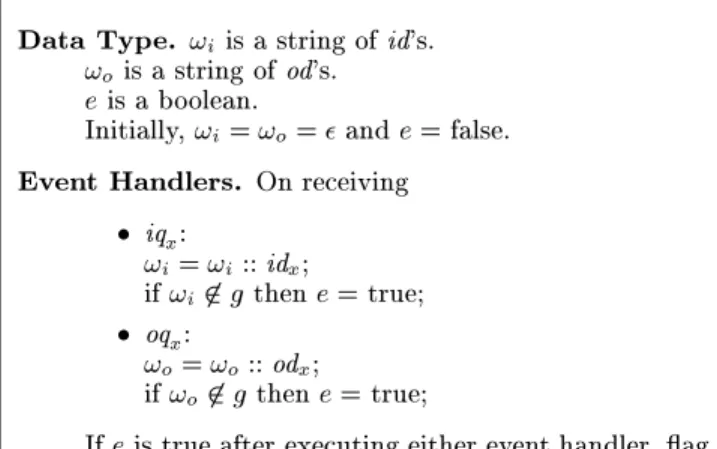
ForginP5,wecanworkwithacreditscheme. Wealways
placeoutputat therstplaceitis enabled,butremember
the credit we get for notplacing it at a laterplace. If at
some point inthe future, the buer overows because we
consumed too few inputs, we can then use up this credit,
i.e. eatupthatmanyinputtokens.
ThealgorithmforP5(Figure7)maintainsabuerofinputs
ofsize (B+cU),and oneintegerindicatingthecredit: the
range of positions where the last output could have taken
place. Ateachoutputwefeedthe rstjbj B inputstog,
followedbyatmostB strings(oflengthatmostB).
5.1.6 P6: Output-checkpointedAutomata
Wesaythatgisanoutput-checkpointedautomatonif,
start-ing fromastate,for eachoutputodx,thereisat mostone
next state that g can be in. In terms of strings, if two
stringsandareequivalentwithrespecttog,andifthey
areconcatenatedwithdierentstringsofinputsfollowedby
thesameoutputod
x
,thenthetwostringsendinginod
x are
stillequivalentwithrespecttog. Formally,
8;:
(g ))
(8odx;Æ1;Æ2:Æ1;Æ2consistonlyofinputs::
((Æ 1 od x 2g)^( Æ 2 od x 2g))) (Æ 1 od x g Æ 2 od x ))
Aninstance ofP6isaprotocolinwhicheachoutputgives
completeinformationaboutthestateinwhichitisenabled.
For example,some transportlayerprotocols haveanotion
of selective acknowledgments (sack's) where datareceivers
send informationabout alldata received upto thatpoint.
DataType. !;! 0
arestrings.
b;b 0
arestringsofinputs.
creditisaninteger.
e isaboolean.
Initially,!=b=,credit=0ande=false.
Event Handlers. Onreceiving
iq x : b=b::iq x ;
if(jbj>(B+cU)^credit>0)then
deletetherstelementiq
y ofb; !=!::id y ; credit=credit 1; if(jbj>(B+c U
)^credit=0)thene=true;
oq
x :
1. repeatuntil
((jbjB)^(!::odx2g_b=)):
deletetherstelementiq
y ofb; !=!::id y ; 2. ifb6=then b 0 =b;
deletetherstelementiq
y ofb 0 ; ! 0 =!::idy; credit=0; repeatuntil! 0 ::odx62gorb 0 =: credit=credit+1;
deletetherstelementiq
y ofb 0 ; ! 0 =! 0 ::idy; 3. !=!::od x ; if!62gthene=true;
Ifeistrueafterexecutingeithereventhandler,ag
anerror.
Figure7:AlgorithmforcheckingP5
hashappened,thestateatthereceiveriscompletelyknown
tous. Sowe cancarry outouranalysis outputto output,
forgettingeverythingthatoccurredbeforethelastoutput.
ThealgorithmformonitoringP6maintainsjustone
admis-sible string ! because after an output occurs, all strings
allowedbygmustbeequivalent;wejustneedtokeeponeof
them,andwekeeptheonewiththerstpossibleplacement
ofthatoutput. Inaddition,wemaintainabuerbofinputs
ofsize (B+c
U
), andB bits indicatingpositionsat which
thelastoutputcouldalsohavehappened.
Ateachoutput,weneedtoconcatenateeverysub-stringof
bueredinputs,startingfromthesepositions,to!andcheck
iftheoutputisallowed afterthisstring. Theremaybeup
toB 2
suchinputstrings(oflengthatmost(B+cU))that
needtobechecked. Thisgivesusaboundfortheper-event
computation,polynomialinthelengthofthebuers.
5.1.7 P7: FiniteStateMachines
Ifgisknowntobeanitestatemachinewithasetofstates
,thenthereisaboundtowhichthebrute-forcesearchset
cangrow. Supposeg=(; ;Æ;s0;Err),whereconsists
ofall id,odsymbols, isthenitesetofstates,Æisthe
de-0
isthesetoferrorstates. Each(!;b)incanberepresented
as(s;b)wheres=Æ
(s
0
;!). Now,bmustcontainsome
suf-xof theiq elementsin!,oflengthat mostB. However,
every!inmustcontainthesamesub-sequenceofiq'sand
oq's. Therefore,everyb inmustbe asuÆxof the same
B-elementstring. Thisgivesusaboundofj jB elements
for. Thismeansthatwemayhavetofeeduptoj jB 2
elementsto gat eachoutput. Theboundispolynomialin
thenumberofstatesandthesize ofthebuers. Moreover,
it givesusaway ofexecutingthe generalbrute-force
algo-rithmwithaneÆcientrepresentationofthestring!asthe
states. ThealgorithmisasshowninFigure8. Noticethat,
becauseweperformaniterationafteraniqevent,asinthe
brute-forcealgorithm,wecapthebueringrequirementby
B.
Constants. g=(; ;Æ;s0;Err ).
Data Type. isasetofpairs(state,listofinput
sym-bols). Initially,=f(s
0 ;[])g
EventHandlers. Onreceiving
iq x : 1. 8(s;b)2: delete(s;b)from; check-add(s;b::iq x )to.
2. iterateuntilnomoreadditionsto:
8(s;[iq y ::b])2: check-add(Æ(s;id y );b)to; oq x : 1. 8(s;b)2: delete(s;b)from; check-add(Æ(s;od x );b)to.
2. iterateuntilnomoreadditionsto:
8(s;[iq
y
::b])2:
check-add(Æ(s;idy);b)to;
wherecheck-addadds(s;b)toifandonlyif:
bobeysthebueringconstraints(jbj<B),and
sisnotanerrorstateofg(s62Err).
If = after executing eithereventhandler, ag
anerror.
Figure8: Algorithmfor checkingP7
5.2 Dealingwith Loss
Allowingloss ofinput eventsbetweenthe monitorand the
deviceintroducesadditional complexity tooursearch
algo-rithm. However,asbefore,wecanderiveeÆcientalgorithms
for someclassesofg. Ineachofthefollowing sub-sections,
wedescribe apropertyofgthatallowsustomonitorit
ef-fectivelyeveninthe presenceofloss. Wewill seethat the
classes of g that wereeÆciently monitorable withoutloss,
Asmentionedbefore,propertiesbasedsolelyonthenumber
ofinputs and outputsconsumed are often used to
charac-terizeprotocols. Forsuchg, monitoringinthepresenceof
loss is very similar to the loss-less case. Suppose that we
knowthatnomorethanc
L
inputscanbelostinsuccession.
Theninordertocheckthateachoutputmustconsume
be-tweenc
min andc
max
inputs,wefollowthesameprocedureof
maintainingbuf
max andbuf
min
,exceptthatweallowbuf
max andbuf min togrowuptom+c max c L (n+1)duringiq
processing. Weleavetheoq processingunchanged. Thereis
clearlyaconstantamountofworktobedoneateachevent.
5.2.2 P2o: IndependentOutputProperties
Propertiesabouttheoutputstreamcanbecheckedevenin
the presence of loss because by assumption outputs never
getlost. Thecheckingproceduresimplyinvolvescheckingg
againstthetraceseenatM. Nobueringisneeded.
AnexampleofaP2opropertyisoutputmonotonicity: every
outputcontains asequencenumberthat is strictlygreater
thanthatof thelast output. Thisjustinvolvesstoring an
outputand comparingit withthe nextone. We feed gat
mostonetokenateveryoutput.
5.2.3 P8: Insert-closedCommutativeOutputs
Wedescribea classofmonitorable properties that are
im-pervioustothepresenceofinputloss. Essentially,ifastring
endinginodxisacceptable,soisthestringwithanarbitrary
stringofinputsÆ insertedbeforeodx. Moreover,odx
com-muteswith every input inÆ. In eect, this saysthat ifg
enablesodx at the endofthe string, it remainsenabled
forever, anditcanbeplaced atany pointafterwiththe
sameeect. (8;odx:odx2g) ((8id y :id y od x 2g)^ (8Æ 1 ;Æ 2
consistingonlyofinputs:
od x Æ 1 Æ 2 g Æ 1 od x Æ 2 )))
NotethatP8isreallyaspecialcaseofP5. Thefactthat
out-putsonceenabledareenabledforeverimpliesthe
contiguously-enabledproperty,inadditiontowhichwealreadyhave
com-mutativity ofoutputs. Aninstance ofP8is acontainment
property onoutputs. For example, a property could state
thateveryoutputcontainsaeldbytes-receivedthatis less
thanthesumofthesizesofinputsreceived.
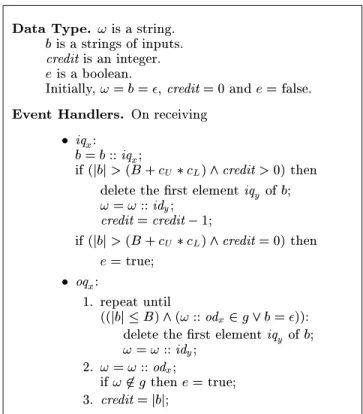
The algorithm for checkingP8 is simple. Always assume
thatnoinputshavebeenlostandplacetheoutputafterthe
rst input where it is enabled. To keep track of the
suc-ceedingpositionswheretheoutputcouldhaveoccurred,we
maintain a credit as in the algorithm for P5. Suppose in
reality, someof the inputsbetweentwooutputs werelost,
thenwehavegeneratedastringthathassomeextrainputs
insertedbetweentheseoutputs. However, P8tells us that
insertingtheseinputsstillkeepsthestringing. Next,
sup-pose that an output that we placed after aninput id k
in
theinputstream,didnotinrealityoccuruntilid k+p
. Here
again,P8assuresusthattheoutputcommuteswiththe
in-puts id k ;id k+1 :::;id k+p
. Finally, note that the string we
constructisanadmissiblestring: oneinwhichnolosses
oc-cur. Therefore,aslongasthisstringbelongstog,wemust
gorithmfeedsgwithatmost(B+c
U c
L
)inputtokensat
eachoutput.
Data Type. !isastring.
bisastringsofinputs.
creditisaninteger.
eisaboolean.
Initially,!=b=,credit=0ande=false.
EventHandlers. Onreceiving
iq x : b=b::iq x ; if(jbj>(B+c U c L )^credit>0)then
deletetherstelementiq
y ofb; !=!::id y ; credit=credit 1; if(jbj>(B+cUcL)^credit=0)then e=true; oq x : 1. repeatuntil ((jbjB)^(!::odx2g_b=)):
deletetherstelementiq
y ofb; !=!::id y ; 2. !=!::odx; if!62gthene=true; 3. credit=jbj;
Ifeistrueafterexecutingeithereventhandler,ag
anerror.
Figure9: Algorithmfor checkingP8
5.2.4 FiniteStateMachines(P7revisited)
If g is an FSM, we can bound the amount of state that
we need in order to model loss in the brute-force search
strategy. Infact, theboundonisexactlythesameasin
theabsenceof loss. There canbe atmostj jB elements
in. Asbefore, thisboundmeansthat we caneectively
execute the brute forcealgorithm to monitor g. However,
inthis case we have to consider all 2 B
lossy substrings of
thebuerateachevent. Therefore,wemayneedtofeedas
manyasj jB 2
2 B 1
tokenstogateachevent.
5.2.5 P9: DeterministicStatelessTransducers
Letusassumethatalltheinputsthatthemonitorseeswill
be distinct. Thisrestriction forbidsthe environment from
producingduplicate inputsfor thelifetimeof themonitor.
Underthisassumption,wecandescribeagthatspeciesa
statelesstransducingbehavior. Supposethatanoutputody
canoccurafteraninputidx. Then,ineverystringallowed
bygthatcontainsody,itmustoccurimmediatelyafteridx.
Moreover,anystringendinginanidxodypairisequivalent
to thestringidx ody. Thismeansthatgis stateless: all it
8;idx;ody:2g)
(idx odygidxody)^
(idx ody2g)
(8idz6=idx:idz ody62g)^
(ody62g)
Theconditionthat eachinputis distinctisaratherstrong
one. Inpractice,whatweneedtoimposeisthatnoinputis
repeatedwithinaspaceof(B+cUcL)iqtokens,whichis
themaximumnumberof inputsthatthe monitorneedsto
analyzeatatime.
Anexample of P9 is the specication of theICMP (ping)
protocol. Inapingsession, allinputs(ICMPRequests)are
uniquebecausetheyhavemonotonicallyincreasingsequence
numbers. Givenan ICMPReply,we canmap it uniquely
toanICMPRequestonthebasis ofthesequencenumber.
Moreover, once we have mapped the Reply to a request,
thereisnothingthatweneedtorememberaboutthe
anal-ysisuptothatpoint.
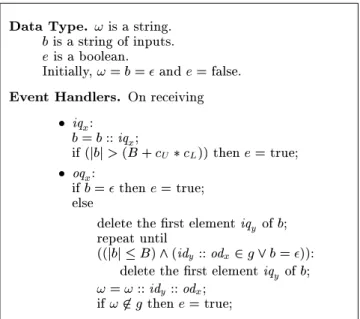
P9 canbe checkedeÆciently even inthe presence of loss.
Essentially,eachoutputodypointstoatmostoneinputidx
that triggered it and we do not need to check any other
input. Ifidxisnotinthebuer,andodycannotoccur
with-outaninput, thenthereis anerror, otherwise, everything
upto idx canbedroppedfrom thebuer. Thisalgorithm
feedsgatmost(B+cUcL)elementsateveryoutput. The
algorithmisasshowninFigure10.
DataType. !isastring.
bisastringofinputs.
e isaboolean.
Initially,!=b=ande=false.
Event Handlers. Onreceiving
iq x : b=b::iq x ; if(jbj>(B+c U c L ))thene=true; oq x : ifb=thene=true; else
deletetherstelementiq
y ofb;
repeatuntil
((jbjB)^(idy::odx2g_b=)):
deletetherstelementiq
y ofb;
!=!::idy::odx;
if!62gthene=true;
Ifeistrueafterexecutingeithereventhandler,ag
anerror.
Figure10: Algorithmfor checkingP9
5.2.6 P10: Output-checkpointedStatefulTransducers
In P9, the statelessness assumption allowed us to forget
about the history of the monitoring, once an output had
beenplacedintheinputstream. Wecangeneralizethis
no-tion,by takinga hint fromoutput-checkpointed automata
(P6). Insteadofsayingthatthestate ofgafterconsuming
y x
id
y od
x
,wesaythatstartingfromastate,ifod
x
isallowed
aftersomeinputsthenthereisauniquestatethatgcanbe
inafterconsumingod
x .
As before, all inputsin mustbe distinct. Formally, g is
expressed as a conjunction of P6 with a generalization of
P9: 8;: ( g )) (8od x ;Æ 1 ;Æ 2 :Æ 1 ;Æ 2
consistonlyofinputs::
((Æ 1 od x 2g)^( Æ 2 od x 2g))) (Æ 1 od x g Æ 2 od x ))^ 8;id x ;od y ;Æ 1 ;Æ 2 :Æ 1 ;Æ 2
consistonlyofinputs::
(Æ 1 id x od y 2g))
(8idz 6=idx:Æ2idz ody62g)^
(ody62g)
Anexampleofsuchagisaprotocolinwhichtherearetwo
kinds of inputs: data inputs containing integers and
ack-request inputs that contain unique magic numbers. The
protocolissupposedtosendanoutputwhenitreceivesan
ack-request, andthe outputcontainsthe magic numberof
therequestandasumofallinputsseensincethelastoutput.
Clearly, everyoutputhasauniqueinput (theack-request)
afterwhichitcanoccur. Moreover,itcontainsinformation
that is compatibleonlywithsome sub-sequencesofinputs
sincethelastoutput.
TheP6partofP10allowsustojustmaintainonestate
af-tereachoutput. Moreover,theP9parttellsusthatwecan
uniquelyplacetheoutputintheinputstream. In
conjunc-tion,thisgivesusasimplealgorithm forcheckingP10. At
eachoutput,weplaceitinthesequenceofbueredinputs
as inP9. Once we have found aposition, wemustsearch
for a lossysub-sequence of theinputsbeforethat position
that makesthe stringacceptable to g. If boththese tests
succeed,wecanproceedwithasinglenextstateandasingle
buertomonitortherestofthestring.
Thealgorithm maintainsainput buerbofsize(B+cU
cL). Thenateachoutput,wemayneedtocheckgagainst
2 (B+c U c L )
input sequences. Themaximumnumberof
to-kenstobefedtogis(B+c U c L )2 (B+c U c L ) 1 .
5.2.7 Output-checkpointedAutomata (P6revisited)
P6 can be handled inthe presence of loss by doing some
further exploration of buer strings. However, no
explo-ration ofg's statespace needs tobedone. Wemaintaina
set of positions in the buer where the last output could
havehappened. Thenfor thenextoutput,weneedtond
all sub-sequencesstartingfrom thesepositions thatenable
theoutput.Weareguaranteedthatallthesesub-sequences
will endinthesame state,so we will justneedto
remem-ber the positions where we can place the output and the
common nextstate. If there is no position where we can
place the output,there isan error. This algorithm would
requireustocheckamaximumof2 (B+c U c L ) inputstrings
against g at each output, where (B+cUcL) is the size
of the input buer. We may have to feed a maximum of
(B+cUcL)2 (B+c U c L ) 1 tokenstog.
Inthissection,wedescribetherelationshipsbetweenallthe
classesofgthatwehavediscussedinthissection. InTable1,
wesummarizethecomplexitiesofthealgorithmsdescribed
forthevariouspropertyclasses. Weassumethatghasbeen
written ina way that allows us to feed it input and
out-puttokensonebyone, andit will takeaconstant amount
oftimetoanalyzeeachtoken. Thenthecomplexityofthe
monitoringisthenumberoftokensthatneedtobefedtog
atanystep. Notethatmostofthecomplexitiesareinterms
ofthesize ofthebuerB. ThevalueofB isdependenton
thesizesofthe input(m)andoutput(n)buers, protocol
entitieslikethemaximumnumberofinputsallowedbetween
twooutputs(cU),andenvironmentalentitieslikethe
max-imumnumberofinputsthatcanbelost insuccession(cL),
betweenthe monitorand thesystem. Wedenethebuer
size inthe absence of loss as B =m+cUn, and inthe
presenceoflossasB=m+cUcLn.
Table 1: MonitoringComplexitiesforPropertyClassesofg
Property Withoutloss Withloss
All Unbounded Unbounded
P7 B 2 B 2 2 B P6 B 3 B2 B P5 B 2 Unbounded P4 B 2 Unbounded P8 B 2 B 2 P3 P Unbounded P10 B B2 B P9 B B P2 1 Unbounded P2o 1 1 P1 1(justcount) 1
AsTable 1shows, most ofthe propertiesdescribedinthis
sectionbelongtodierentcomplexityclassesformonitoring.
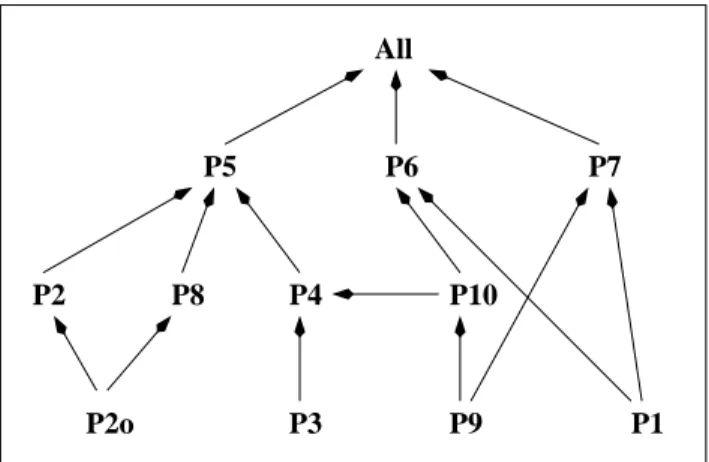
Many oftheproperties areinfactinclusionsof eachother.
TheinclusionrelationshipsareasshowninFigure11.
How-ever,thereare someotherinteresting relationshipsaswell.
Ingoingfromtheno-losstothelossycase,propertiesP3,P4
and P5 becomevery ineÆcient to monitor. Therefore, we
needtopicknersubsetsofP5: P8,P9 andP10,thatwill
stilllendthemselvestoeÆcient monitoringinthe presence
ofloss. ThesesubsetscollapsetosimilarcomplexitiesasP3,
P4andP5intheno-losscase.
Properties P5, P6, and P7 are three orthogonal ways of
reigningintheunboundedsizeofinthebrute-forcesearch.
Itis possibletocombine someofthesepropertiesto arrive
ataproperty thatrelatestoareal-worldprotocol. For
ex-ample,wecombineP6and P7inthenextsection toarrive
at a TCP property. It may also be possible to combine
oneof moreoftheseproperties withsomeprotocol-specic
knowledge toreduce thesizeof. Therefore,ifaprotocol
property thatonewishes tomonitordoesnotfallinoneof
P5,P6,orP7,itdoesnotimmediatelyruleoutaneÆcient
procedure,contrarytowhatseemstobethecasebylooking
atFigure11(\All"category). Whetherthereareother
use-fulprotocol-independent properties that are orthogonal to
thethreeabove,isanopenquestion,onewehopetoaddress
infuturework.
P5
P6
P7
P2
P8
P4
P10
P3
P2o
P9
P1
All
Figure11: RelationshipsbetweenPropertiesofg. Anarrow
frompropertyQtopropertyRmeansthatQimpliesR.
6 Monitoring TCP
We now show how to use the techniques described in the
previous sections inorderto monitorTCP [15]
implemen-tations. Forreasonsofspace,weconsideronlythe
receiver-sidebehavior.
TCPimplementsa\slidingwindow"protocoltoimplement
reliable,in-orderdelivery. Totransferalargebuerofdata,
aTCPsenderbreaksitintosmallxed-sizedsegmentsand
sends each numbered segment in aseparate message.
Ini-tially,thesenderassumesthatthe receiverisreadyfor the
rst segment, and that the receiver can accept a certain
count of segments inits \window". It may send some of
thesesegmentsoutonthenetworktothereceiver. The
re-ceiveracknowledges(acks)thesemessages,withasequence
numberof thesegmentimmediately afterthe contiguously
receivedpartofthebuer. Thus,ifsegments1,2,4,and5
havebeenreceived,wheresegment3wasdelayedorlostin
transit,TCPreceivermaygenerateacks2,3,3,and3. The
senderformsajudgmentofwhichsegments(e.g. 3)gotlost
in transit, and resends them. If the receiver now receives
segment3,itgeneratesanackwithsequencenumber6,
be-causesegments1-5havebeenallreceived. Occasionally,the
receiveralso gives an indication of newly available
capac-ityinitswindow,oncesomeprexoftheearliercontiguous
packetsareconsumedbythereceivingapplication.
TheTCPspecicationprescribesthesequencenumberthat
mustbe containedinanack, basedonthestate ofthe
re-ceiverwindowasdescribedabove. It,however,allowsa
lee-way that receivers may generateanack at leasteverytwo
messages,soanimplementationmaydecidetonotackevery
singlemessage.
Typically,wemaywishtomonitorTCPpropertiessuchas
thefollowing:
1. Theimplementationisgenerating anack for at least
everyothermessageitreceives.
2. Acksequencenumbersarenon-decreasing.
3. Acksalwaysacknowledgeexactlythecontiguously
entailsdierentcomplexitiesinthemonitoringprocess.
Con-sider data segments as input symbols and acks as output
symbols.
TCPproperty1describesagthatisacounting
prop-erty, g 2 P1, with cmin = 1 and cmax = 2. This
propertyis easytomonitorbothinthepresenceand
absenceofloss.
TCP property 2 describes a g in which inputs and
outputs areindependent. Sinceg2P2o, eveninthe
presenceofloss thispropertyis easyto check.
More-over, property2canbe checkedindependentlyofthe
otherproperties.
TCP property 3describes ag that falls inclass P5.
Intheabsenceoflossbetweenthemonitoranddevice,
wecancheckthiseÆcientlyusingthealgorithmin
Fig-ure7. Interestingly,wecaneÆcientlycheckproperty1
inconjunctionwithproperty3,becausethealgorithms
for P1andP5 compose well. Bothdenerangesover
whichthe last outputcould havetakenplace, the
al-gorithmfor the conjunctionsimplymaintains the
in-tersectionfor theseranges.
Thealgorithmdescribedabovedoesnotworkifthere
islossbetweenthemonitoranddevice. However,
prop-erty3canalsobeexpressedasthecompositionofan
output-checkpointedproperty (P6)and a nitestate
property (P7). In order to see this, note that the
TCP monitor's state couldbeseen as a tripleof the
form(unacked-data,contig-recd,recv-window),where
unacked-data is the numberof unacknowledged data
packetssincethelastack,contig-recdisthelargest
se-quencenumberinthecontiguouslyreceiveddata,and
recv-windowisthedatathathasbeenreceivedinthe
windowbutismissingsomesegments. Here
(unacked-data,contig-recd) is output-checkpointed: when you
see anack for sequencenumbers+1, unacked-data
mustbe 0, andcontig-recdmustbe s. Onthe other
hand, the recv-window is nite-state, and its state
space can beas large as 2 W 1
,where W isthe
win-dow size. So to monitor property 3 (together with
property1)wecancomposethealgorithmsforP6and
P7. Thecomplexityofsuchanalgorithmisthesum
ofthecomplexitiesofthetwoalgorithmsas shownin
Table 1,whichisessentiallythecomplexityoftheP7
part(2 W B 2 2 B ).
7 Conclusionsand RelatedWork
Thispaperis mostclosely related toworkonpassive
test-ing[7 ]. Theyalsouseon-linemonitoringtotestprotocol
im-plementations,butdonotaddresstheproblemsofindelity
oftraces. Toour knowledgethispaperis therstattempt
tocreateanabstractmodeloftheindelitiesthatcanarise
whenmonitoringaremotedeviceundertest,andtoformally
specifyconditionsunderwhicheÆcientcorrectness-checking
algorithmscanbedeployed.
Paxson[13 ]givesagoodempirical overviewofsourcesand
manifestations ofindelity,with afocus onwide-area
net-works. Our workconcentratesonindelity inalocal-area
networksettingandisamoreformaltreatment.
Mostoftheotherliteraturedevotedtonetworkmonitoring
istargetedtowardnetworksecurityconcerns. Paxson'sBro
examplesofpracticalmonitoringtoolsthatmustdealwith
remotemonitoringoftrustedanduntrusteddevices. These
tools oer high performance and customizability with the
addition of new specication scripts, but such scripts are
developedinanad-hocmannerandmusttakeindelityinto
accountbyhand.
Testing of reactive systems from abstract specications is
alsoanareaofactiveresearch. Bhargavanetal.[3 ]givean
overviewofnetworking-relatedanalysistechniques. Formal
specicationandautomaticvericationhavealsobeenused
in the context of telecommunications systems [6 , 4 ]. Our
work diers from these in that we are not attempting to
generatetestcasesbutrathertomonitorthecorrectnessof
animplementationduringdeployment. O'Malleyetal.[10 ]
discuss the creation of property checking automata from
a graphical specication notation. Event specications [8]
have beenused for run-timeproperty verication,and the
Verisimtool[2] applies this workto properties of network
protocols. However,allofthesesystemsassumeaco-located
styleof specication|thatis,theyassume thatthe device
undertestcanbedirectlyinstrumentedandpropertiescan
be checkedina synchronousmanner. If the device under
testcannotbedirectlyinstrumentedthenthespecications
used must be transformed to take the resulting indelity
intoaccount. Thispaperhasbeenasystematicexploration
ofsuchtransformations.
References
[1] G.BerryandG.Gonthier. TheEsterelsynchronous
programminglanguage: Design,semantics,
implemen-tation. Science of Computer Programming, 19(2):87{
152, November1992.
[2] Karthikeyan Bhargavan, Carl A. Gunter, Moonjoo
Kim,InsupLee,DavorObradovic,OlegSokolsky,and
MaheshViswanathan. Verisim: Formalanalysisof
net-worksimulations,August2000. Toappearin:
Interna-tional SymposiumonSoftwareTestingandAnalysis.
[3] Karthikeyan Bhargavan, Carl A. Gunter, and Davor
Obradovic. A taxonomy of logical network analysis
techniques. Technical Report MS-CIS-00-14,
Univer-sityofPennsylvania,2000.
[4] Patrice Godefroid. Model checking for programming
languages using VeriSoft. In Proceedings of the 24th
ACM Symposiumon Principles of Programming
Lan-guages,pages174{186,January1997.
[5] Gerard J. Holzmann. Designand Validation of
Com-puter Protocols. PrenticeHall,1991.
[6] L. J. Jagadeesan, A. Porter, C. Puchol, J. C.
Ram-ming,andL.G.Votta. Specication-basedtestingof
re-activesoftware: Toolsandexperiments.InProceedings
of theInternationalConference onSoftware
Engineer-ing,May1997.
[7] D. Lee, K. Sabnani, A. Netravali, B. Sugla, and
A. John. Passive testing and itsapplications to
net-workmanagement. InProceedingsof theInternational
Conference onNetworkProtocols,1997.
[8] I. Lee, S. Kannan, M. Kim, O. Sokolsky, and
onParallelandDistributed Processing Techniquesand
Applications,1999.
[9] NancyA.LynchandMarkR.Tuttle. Anintroduction
to input/output automata. CWI Quaterly, 2(3):219{
246,1989.
[10] T.O.O'Malley, D.J.Richardson, andL.K.Dillon.
Ef-cientspecication-basedtestoracles. InSecond
Cali-forniaSoftwareSymposium(CSS'96),April1996.
[11] V. Paxson. Automated packettrace analysis of TCP
implementations. Computer Communication Review,
27(4),October1997.
[12] V.Paxson.Bro:Asystemfordetectingnetwork
intrud-ersinreal-time. Computer Networks,31(23-24):2435{
2463,December1999.
[13] V. Paxson. End-to-end internet packet dynamics.
IEEE/ACM Transactions on Networking, 7(3):277{
292,June1999.
[14] M.J.Ranum,K.Landeld,M.Stolarchuk,
M.Sienkiewicz,A.Lambeth,andE.Wall.
Implement-ingageneralizedtoolfor networkmonitoring. In
Pro-ceedings ofthe Eleventh Systems Administration
Con-ference (LISAXI),pages1{8,1997.
[15] W. Richard Stevens. TCP/IP Illustrated, Volume
1: The Protocols. Addison-Wesley, Reading,
Mas-sachusetts,1994.
Appendix: Prooffor P1
Denition2(iqtail) Letiqtail(!)equalthesequenceofiq
elementsin!thatarepriortothelastoqelementbutwhich
were notconsumedbefore theoq,thatis,whichdonot have
acorresponding id element before the oq, plusalliq'sthat
appear after the last oq element, regardless of whether the
corresponding id is in !. If ! does not contain any oq's,
theniqtail (!)isjustthesequence ofiq'sin!.
Denition3(idtail) Letidtail (!)equalthesequenceofid
elementsin!thatappearafterthelastodelement. If!does
not contain any od's, thenidtail (!) isjust thesequence of
id'sin!.
StateSpace Mapping. Themappingisgivenbythe
fol-lowinginductivehypothesis:
:e=)(8i::buf min ibuf max () (9(!;b)2::jiqtail (!)j=i)) ^ e()=
Base Case. Initially,containsonlyoneelement,which
has azero length !and azero lengthb. The initial
con-ditionsforbuf
max ,buf
min
,andeare all consistentwiththe
statespace mapping.
Inductive Step. Considertheinput actionsineach
algo-rithmcorrespondingto iqevents. InFigure 3,this action
deleteseachmemberofandaddsanewmemberwiththe
iqactionaddedtoboth!andb,as longas!isadmissible
anditsprojection[!]
id,od
ising.InFigure4,aninputevent
min max
tion,andthenadjustsbuf
max
ifnecessary.Weneedtoshow
thatthestatespace mappingstillholds. First,notethatif
any(!;b)2hasan!suchthatjiqtail (!)j>=B+c
max ,it
willbedeletedfrombecausetheresultofaddingtheiqto
!willbeinadmissibleaccordingtoM 0
,whichrecallisequal
toM(S;m+cn;0). Inthiscasec=c
max
andB=m+cn.
!willbeinadmissiblebecauseatmostc
max
id'scanappear
afterthelast od;oq bywayofpropertyP1. Theremaining
B iq's ll up the buerand adding onemore causes it to
overow,removingtheresultingstringfromconsideration.
Ifbuf
min
>=B+c
max
beforetheinputaction,this implies
(by the inductive hypothesis) that every (!;b) 2 has a
iqtail (!)whosesizeisatleastB+c
max
.Whentheiqevent
is added, all will be deleted and will be empty. This
corresponds to setting e to true inFigure 4. If buf
min <
B+cmax beforetheinputaction,thenthereisatleastone
(!;b)2suchthatjiqtail (!)j=iforeveryibetweenbuf
min
and buf
max
. Each will be removed and replaced with an
(!;b)pairwithexactlyoneiqeventaddedtoeachof!and
b, except for thosethat becomeinadmissible with respect
toM 0
. Thiscorrespondsexactlytobuf
min andbuf
max being
incrementedbyone, andbuf
max
being cappedatB+cmax
inFigure4. Theiteration step2inFigure3 hasnoeect
on the mapping because it only adds id events to ! and
doesnotmodifyiqtail (!). Note,however,thatthisiteration
guarantees that every pattern of idtail (!) such that 0
jidtail (!)j min(c
max ;buf
max
) will be generated. This is
because each element of the iqtail(!) will be converted to
an id and check-added to . Those with morethan c
max
id'swillbediscarded,sincetheyarenoting,butallothers
willbeacceptedduetopropertyP1. Thelongestiqtailhas
lengthbuf
max
,leadingtotheupperbound.
Next, considerthe outputactions ineachalgorithm
corre-sponding to the oq events. In Figure 3, this action rst
deleteseveryelementof,replacingeachwithonethathas
the od;oq event pair added. Thenthe same iteration
dis-cussed previouslyis repeated. Note that if any (!;b) has
anidtail (!)<c
min
,itwill bedeletedbecause theresultof
addingtheodwillnotbeing,accordingtoP1. InFigure4,
if buf
max
< cmin, then all idtail (!) musthave length less
thancmin, because idtail (!) <iqtail(!)< buf
max
. thus
becomesemptyaftertherststep. Thiscorrespondsto
set-tinge totrueinFigure4. Otherwise, Figure4decrements
buf
max
bycmin,butcapsbuf
max
at B because eventhough
iqtailcangrowlargerthanB,thenewiqtailwillbeatmost
B because itconsistsof onlythe un-consumediqeventsin
!, of which there can be at most B. The algorithm also
decrementsbuf
min
bycmax,settingittozero ifitgoes
neg-ative. Thiscorrespondstothe factthatpairs (!;b)will be
deletedfromiftheyviolatethec
min andc
max
limitsgiven
by g, whichmeans that the new minimum and maximum
valuesofiqtail (!)willbegivenwhenthemaximumnumber
of inputs are consumed from the minimum previous iqtail
andthemaximumnumberofinputsareconsumedfromthe
maximumpreviousiqtail. These consumptionsarejustied
because we have a guarantee that everypattern idtail (!),
suchthat0jidtail (!)jmin(cmax;buf
max
),willhavebeen