Steganography using Lossless Reversible Data
Hiding on Encrypted Image
Muthurajan. K. T Nirmalkumar.S
Department of Information Technology Department of Information Technology Christian College of Engineering & Technology
Oddanchatram
Christian College of Engineering & Technology Oddanchatram
Veerapandi.M Yesudoss.J
Department of Information Technology Department of Information Technology Christian College of Engineering & Technology
Oddanchatram
Christian College of Engineering & Technology Oddanchatram
Arul Anand.R
Department of Information Technology
Christian College of Engineering & Technology, Oddanchatram
Abstract
Steganography is the art of hiding data in a seemingly innocuous cover medium. For example – any sensitive data can be hidden inside a digital image. Steganography provides better security than cryptography because cryptography hides the contents of the message but not the existence of the message. So no one apart from the authorized sender and receiver will be aware of the existence of the secret data. Steganographic messages are often first encrypted by some traditional means and then a cover image is modified in some way to contain the encrypted message. The detection of steganographically encoded packages is called steganalysis. In this paper, we propose three efficient Steganography techniques that are used for hiding secret messages. They are LSB based Steganography, Steganography using the last two significant bits and Steganography using diagonal pixels of the image. Symmetric and asymmetric key cryptography has been used to encrypt the message. Here we use two fish symmetric technique for encryption process.
Keywords:Data embedding, Reversible, Steganography, Texture Synthesis, Cryptography
________________________________________________________________________________________________________
I. INTRODUCTION
In this technique has been used mean square error (MSE) Its h help to Reversible data hiding (RDH) has the capability to erase the distortion introduced by embedding step after cover restoration. It is an important property that can be applied to many scenarios, such as medical imagery, military imagery and law for entices Least significant bit (LSB) technique has been proposed HLSB technique where the secret information is embedded in the LSB of the cover frame. Hash function is used to select the position of insertion error required in original image. The proposed technique is compared with existing LSB based secret message and the results are found to be encouraging. The proposed technique is compared with existing LSB based secret message and the results are found to be encouraging. Level of information increased and LSB maintain the separate key. We can easily clear the secret image, so we can get in original image.
II. NEED
In upcoming days people send and receive process are more securely by the steganography for data transferring .Through this technology user can easily send and receive information in more secure manner so that easy way sending and receiving the information. In future it useful for the people for security purpose. The data embedding only affects the LSB, a decryption with the encryption key can result in an image similar to the original version. When using both of the encryption and data-hiding keys, the embedded additional data can be successfully extracted and the original image can be perfectly recovered by exploiting the spatial correlation in natural image.
III. EXISTING SYSTEM
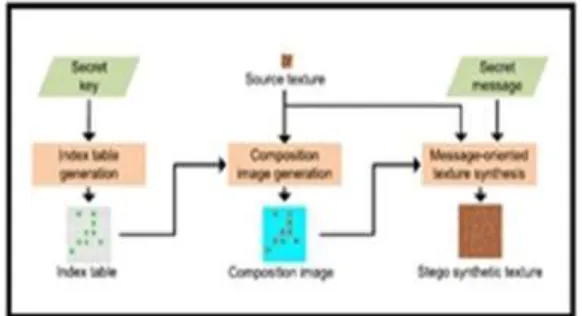
Encryption Process
Fig. 1:
Index Table Generation Process
Fig. 2:
Decryption Process
Fig. 3:
IV. PROPOSED SYSTEM
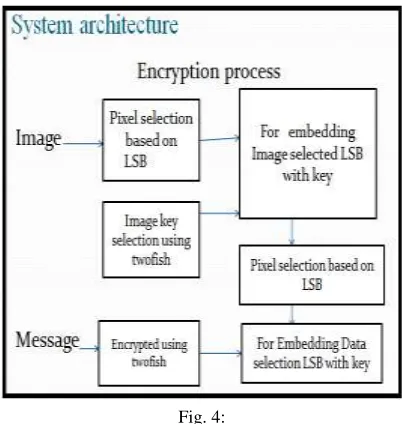
Encryption Process
Fig. 4:
Image Encryption
In this module, to construct the encrypted image, the first stage can be divided into three steps: Image Partition
Self-Reversible Embedding
At the beginning, image partition step divides original image into two parts and then, the LSBs of are reversibly embedded into with a standard RDH algorithm so that LSBs of can be used for accommodating messages at last, encrypt the rearranged image to generate its final version.
Image Partition
The operator here for reserving room before encryption is a standard RDH technique, so the goal of image partition.
Self-Reversible Embedding
The goal of self-reversible embedding is to embed the LSB-planes of into by employing traditional RDH algorithms. We simplify the method in to demonstrate the process of self-embedding.
V. DATA HIDING ENCRYPTION IMAGE
In this module, a content owner encrypts the original image using a two fish algorithm with an encryption key .After producing the encrypted image, the content owner hands over it to a data hider (e.g., a database manager) and the data hider can embed some auxiliary data into the encrypted image by lossless vacating some room according to a data hiding key .Then a receiver, maybe the content owner himself or an authorized third party can extract the embedded data with the data hiding key and further recover the original image from the encrypted version according to the encryption key.
VI. TWOFISH ENCRYPTION PROCESS
Maybe one of the algorithm’s most interesting features, which enables different implementations to improve the relative performance of the algorithm, is that it allows several levels of performance tradeoffs on encryption speed key setup hardware gate count, memory use. It was selected as the best algorithm in this final, it is nevertheless one of the most advanced and secure symmetric block ciphers in use today, and can be always considered as a very good alternative to AES. Accept any key length up to 256 bits
Two fish Algorithm
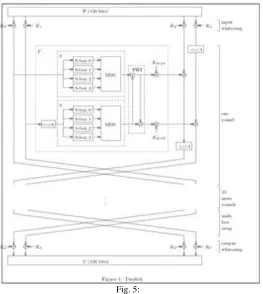
Computer security expert Bruce Schneier is the mastermind behind Blowfish and its successor Two fish. Keys used in this algorithm may be up to 256 bits in length and as a symmetric technique, only one key is needed.
Twofish Process
Fig. 5:
VII. LSB EMBEDDING PROCESS
The message is embedded into the LSB position of each pixel. Suppose our original pixel has bits: (r7 r6 r5 r4 r3 r2 r1 r0, g7 g6 g5 g4 g3 g2 g1 g0, b7 b6 b5 b4 b3 b2 b1 b0) In addition, our encrypted character (bytes) has some bits: (c7 c6 c5 c4 c3 c2 c1 c0). Then we can place the character bits in the least significant of selected pixel, next character bits in the next lowest pixel, and so on. (r7 r6 r5 r4 r3 r2 r1 c2, g7 g6 g5 g4 g3 g2 g1 c1, b7 b6 b5 b4 b3 b2 b1 c0). If we take an example of pixel (225,107,100) represented in binary form (11100001, 01101011, 01100100) into which to embed message character “a” having bit 01100001(ASCII value 97), then we can obtain New pixel as (224, 106,101) represented in binary form (11100000, 01101010, 01100101).
Fig. 6:
VIII. DATA EMBEDDING
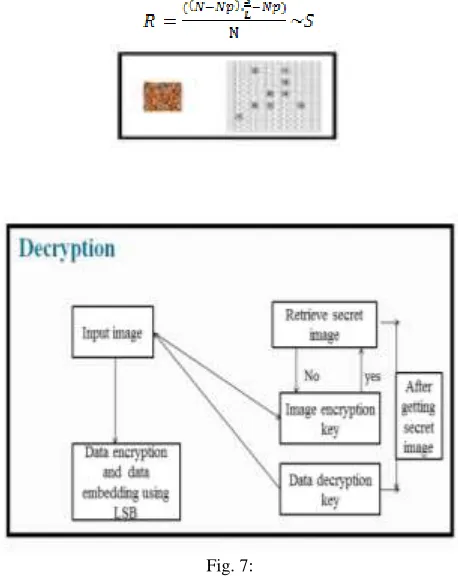
Decryption Process
Fig. 7:
IX. DATA EXTRACTION AND IMAGE RECOVERY
In this module, Extracting Data from Encrypted Images to manage and update personal information of images which are encrypted for protecting clients’ privacy, an inferior database manager may only get access to the data hiding key and have to manipulate data in encrypted domain. When the database manager gets the data hiding key, he can decrypt and extract the additional data by directly reading the decrypted version. When requesting for updating information of encrypted images, the database manager, then, updates information through LSB replacement and encrypts updated information according to the data hiding key all over again. As the whole process is entirely operated on encrypted domain, it avoids the leakage of original content.
X. DATA EXTRACTION AND IMAGE RESTORATION
In this module, after generating the marked decrypted image, the content owner can further extract the data and recover original image.
XI. DERIVING PSNR VALUE AND MSE VALUE IN THE IMAGE
Peak Signal-To-Noise Ratio (PSNR)
The term peak signal-to-noise ratio (PSNR) is an expression for the ratio between the maximum possible value (power) of a signal and the power of distorting noise that affects the quality of its representation. Because many signals have a very wide dynamic range, (ratio between the largest and smallest possible values of a changeable quantity) the PSNR is usually expressed in terms of the logarithmic decibel scale.
PSNR and MSE Calculation
MSE = (1/(m*n))*sum(sum((f-g).^2)) PSNR =20*log (max (max(f)))/((MSE)^0.5)
XII. CONCLUSION
to increase the embedding capacities. If the receiver has only the data-hiding key, he can extract the additional data though he does not know the image content. If he has only the encryption key, he can decrypt the received data to obtain an image similar to the original one, but cannot extract the embedded additional data .If he receiver has both the data-hiding key and the encryption key, he can extract the additional data and recover the original image without any error .Increases the security level of hidden information. We can easily clear the secret image, so we can get in original image.
REFERENCES
[1] Fridrich, M. Goljan, Lossless data embedding for all image formats, in: SPIE Proceedings of Photonics West, Electronic Imaging, Security and Watermarking of Multimedia Contents,
[2] M. Celik, G. Sharma, A. Tekalp, E. Saber, Lossless generalized-LSB data embedding, IEEE Transactions on Image Processing.
[3] D.M. Thodi, J.J. Rodriguez, Expansion embedding techniques for reversible watermarking, IEEE Transactions on Image Processing
[4] Z. Ni, Y. Shi, N. Ansari, S. Wei, Reversible data hiding, IEEE Transactions on Circuits and Systems for Video Technology
[5] Z. Wang, A. C. Bovik, H. R. Sheikh, and E. P. Simoncelli, “Imagequality assessment: From error visibility to structural similarity,” IEEE Trans. Image
Process., vol. 13, no. 4, pp. 600–612, Apr. 2004
[6] Y. Guo, G. Zhao, Z. Zhou, and M. Pietikäinen, “Video texture synthesis with multi-frame LBP-TOP and diffeomorphic growth model,” IEEE Trans. Image
Process., vol. 22, no. 10, pp. 3879–3891, Oct. 2013.
[7] L.-Y. Wei and M. Levoy, “Fast texture synthesis using tree-structured vector quantization,” in Proc. 27th Annu. Conf. Comput. Graph. Interact. Techn., 2000,
pp. 479–488.
[8] A. A. Efros and T. K. Leung, “Texture synthesis by non-parametric sampling,” in Proc. 7th IEEE Int. Conf. Comput. Vis., Sep. 1999, pp. 1033–1038.
[9] C. Han, E. Risser, R. Ramamoorthi, and E. Grinspun, “Multiscale texture synthesis,” ACM Trans. Graph., vol. 27, no. 3, 2008, Art. ID 51.
[10] H. Otori and S. Kuriyama, “Data-embeddable texture synthesis,” in Proc. 8th Int. Symp. Smart Graph., Kyoto, Japan, 2007, pp. 146–157.
[11] H. Otori and S. Kuriyama, “Texture synthesis for mobile data communications,” IEEE Comput. Graph. Appl., vol. 29, no. 6, pp. 74–81, Nov./Dec. 2009.
[12] M. F. Cohen, J. Shade, S. Hiller, and O. Deussen, “Wang tiles for image and texture generation,” ACM Trans. Graph., vol. 22, no. 3, pp. 287–294, 2003.
[13] K. Xu et al., “Feature-aligned shape texturing,” ACM Trans. Graph., vol. 28, no. 5, 2009, Art. ID 108.
[14] L. Liang, C. Liu, Y.-Q. Xu, B. Guo, and H.-Y. Shum, “Real-time texture synthesis by patch-based sampling,” ACM Trans. Graph., vol. 20, no. 3, pp. 127–
150, 2001.
[15] A. A. Efros and W. T. Freeman, “Image quilting for texture synthesis and transfer,” in Proc. 28th Annu. Conf. Comput. Graph. Interact. Techn., 2001, pp.
341–346.
[16] Z. Ni, Y.-Q. Shi, N. Ansari, and W. Su, “Reversible data hiding,” IEEE Trans. Circuits Syst. Video Technol., vol. 16, no. 3, pp. 354–362, Mar. 2006.
[17] X. Li, B. Li, B. Yang, and T. Zeng, “General framework to histogramshifting- based reversible data hiding,” IEEE Trans. Image Process., vol. 22, no. 6, pp.
2181–2191, Jun. 2013.
[18] J. L. Rodgers and W. A. Nicewander, “Thirteen ways to look at the correlation coefficient,” Amer. Statist., vol. 42, no. 1, pp. 59–66, 1988.
[19] Z. Wang, A. C. Bovik, H. R. Sheikh, and E. P. Simoncelli, “Image quality assessment: From error visibility to structural similarity,” IEEE Trans. Image
Process., vol. 13, no. 4, pp. 600–612, Apr. 2004.
[20] F. A. P. Petitcolas, R. J. Anderson, and M. G. Kuhn, “Information hiding survey,” Proc. IEEE, vol. 87, no. 7, pp. 1062–1078, Jul. 1999.
[21] Y.-M. Cheng and C.-M. Wang, “A high-capacity steganographic approach for 3D polygonal meshes,” Vis. Comput., vol. 22, nos. 9–11, pp. 845–855, 2006.
[22] X. Zhang, “Separable reversible data hiding in encrypted image,” IEEE Trans. Inf. Forensics Security, vol. 7, no. 2, pp. 826–832, Apr. 2012.
[23] R. B. Wolfgang and E. J. Delp, “A watermarking technique for digital imagery: Further studies,” in Proc. IEEE Int. Conf. Imaging, Systems, and Technology,
Las Vegas, NV, June 30–July 3, 1997, pp. 279–287.
[24] F. Hartung and B. Girod, “Watermarking of uncompressed and compressed video,” Signal Processing, vol. 66, no. 3, pp. 283–301, May 1998.
[25] A. Herrigel, J. J. K. O’Ruanaidh, H. Petersen, S. Pereira, and T. Pun, “Secure copyright protection techniques for digital images,” in Information Hiding:
Second Int. Workshop (Lecture Notes in Computer Science), vol. 1525, D. Aucsmith, Ed. Berlin, Germany: Springer-Verlag, 1998, pp. 169–190.
[26] M. D. Swanson, B. Zu, and A. H. Tewfik, “Robust data
[27] hiding for images,” in Proc. IEEE 7th Digital Signal Processing Workshop (DSP 96), Loen, Norway, Sept. 1996, pp. 37–40.
[28] G. C. Langelaar, J. C. A. van der Lubbe, and R. L. Lagendijk “Robust labeling methods for copy protection of images,” in Storage and Retrieval for Image
and Video Database V, vol. 3022, I. K. Sethin and R. C. Jain, Eds. San Jose, CA: IS&T and SPIE, pp. 298–309. [29]
[30] J. Zhao and E. Koch, “Embedding robust labels into images for copyright protection,” in Int. Congr. Intellectual Property Rights for Specialised Information,
Knowledge and New Technologies, Vienna, Austria, Aug. 1995.
[31] G. Schott, Schola Steganographica: In Classes Octo Distributa (Whipple Collection). Cambridge, U.K.: Cambridge Univ., 1680.
[32] J. Reeds, “Solved: The ciphers in book III of Trithemius’ steganographia,” Cryptologia, vol. XXII, no. 4, pp. 291–317, Oct. 1998.
[33] D. Kahn, The Codebreakers—The Story of Secret Writing. New York: Scribner, 1996.
[34] A. Kerckhoffs, “La cryptographie militaire,” J. Sciences Militaires,
[35] vol. 9, pp. 5–38, Jan. 1883.
[36] R. J. Anderson, “Liability and computer security: Nine principles,” in Computer Security—3rd Europ. Symp. Research in Computer Security (ESORICS’94)
(Lecture Notes in Computer Science), vol. 875, D. Gollmann, Ed. Berlin, Germany: Springer-Verlag, pp. 231–245.
[37] J. Baltruˇsaitis, “Anamorphoses ou thaumaturgus opticus,” in Les Perspectives D´eprav´ees. Paris, France: Flammarion, 1984, pp. 5 and 15–19.
[38] A. Seckel, “Your mind’s eye: Illusions & paradoxes of the visual system,” presented at National Science Week, Univ. Cambridge, Cambridge, U.K., Mar.
1998. [Online]. Available WWW: http://www.illusionworks.com/.
[39] Herodotus, The Histories. London, U.K.: J. M. Dent & Sons, M1992, ch. 5 and 7.
[40] B. Newman, Secrets of German Espionage. London, U.K.:Robert Hale, 1940.
[41] WitnesSoft and ScarLet security software. (1997, Apr.). Aliroo home page. [Online]. Available WWW: http://www.aliroo.com/.
[42] J. C. Murphy, D. Dubbel, and R. Benson, “Technology approaches to currency security,” in Optical Security and Counterfeit Deterrence Techniques II, vol.
3314, R. L. van Renesse, Ed.. San Jose, CA: IS&T and SPIE, 1998, pp. 21–28.
[43] G. W. W. Stevens, Microphotography—Photography and Photofabrication at Extreme Resolutions. London, U.K.: Chapman & Hall, 1968.
[44] D. Brewster, “Microscope,” in Encyclopædia Britannica or the Dictionary of Arts, Sciences, and General Literature, vol. XIV, 8th ed. Edinburgh, U.K.:
Britannica, 1857, pp. 801–802.
[45] G. Tissandier, Les Merveilles de la Photographie. Paris, France: Librairie Hachette & Cie, 1874, ch. 6, pp. 233–248.
[46] J. Hayhurst. (1970). The pigeon post into Paris 1870–1871. [Online]. Available WWW: http://www.windowlink.com/jdhayhurst/pigeon/pigeon.html.
[47] J. E. Hoover, “The enemy’s masterpiece of espionage,” The Reader’s Dig., vol. 48, pp. 49–53, May 1946.
[48] J. F. Delaigle, C. De Vleeschouwer, and B. Macq, “Watermarking algorithm based on a human visual model,” Signal Processing, vol. 66, no. 3, pp. 319–335,
[49] L. Boney, A. H. Tewfik, and K. N. Hamdy, “Digital watermarks for audio signals,” in Proc. 1996 IEEE Int. Conf. Multimedia Computing and Systems, Hiroshima, Japan, June 17–23, 1996, pp. 473–480.
[50] F. Goffin, J.-F. Delaigle, C. D. Vleeschouwer, B. Macq, and J.-J. Quisquater, “A low cost perceptive digital picture watermarking thin and R. C. Jain, Eds.
San
[51] Jose, CA: IS&T and SPIE, 1997, pp. 264–277.
[52] N. Jayant, J. Johnston, and R. Safranek, “Signal compression based on models of human perception,” Proc. IEEE, vol. 81, pp. 1385–1422, Oct. 1993.
[53] B. C. J. Moore, An Introduction to the Psychology of Hearing, 3rd ed. London, U.K.: Academic, 1989.
[54] Information Technology—Generic Coding of Moving Pictures and Associated Audio Information—Part 3: Audio., British Standard, BSI, implementation of