INTERFACE INCLUSION PROBLEMS IN LAMINATED MEDIUM
Bogdan Rogowski Marcin Pawlik
Department of Mechanics of Materials, Technical University of Łódź e-mail: [email protected]
A moduli perturbation method is used to construct the solution for the contact stiffness in the inclusion problem of a composite laminate un-der a state of torsional deformation. The inclusion is consiun-dered to be embedded at the interface of the laminate. The following solutions ha-ve been obtained: (i) the exact solution for the inclusion in a medium consisting of two layers and two half- spaces, (ii) a first-order accurate solution for a layered medium consisting of (n+m) constituents, (iii) an approximative solution for a physically inhomogeneous medium as the limiting case of the layered medium.
Key words: anisotropy, layered media, inclusion, perturbation method, torsion interface
1. Introduction
The stress analysis of laminated fiber-reinforced composite materials has been a subject of increasing importance due to the expanded use of such ma-terials in diverse modern engineering applications. This analysis is not easy because composite laminates very often contain interlaminar inclusions, cracks or delaminations, which has been observed as a common and unavoidable oc-currence in many practical situations. It is well known that studies of the inc-lusions problems for a bonded multiphase medium require special physical and analytical considerations that are not encountered in those corresponding to their homogeneous counterpars. In the multiphase system, the solution arises not only from a geometric discontinuity but also from the material disconti-nuity. The plane inclusion problem for two isotropic planes solved by means of singular integral equations methods was considered by Grilickiˇı and Sulim
(1975). Some inclusion problems and a comprehensive list of references up to the year 1982 are presented in the book by Aleksandrov and Michitarian (1983). Jevtushenko et al. (1995) presented some plane contact problems for a layered medium with an interface inclusion in the framework of the homo-genisation theory. The problem of an interface inclusion between dissimilar orthotropic half-spaces was considered by Rogowski (1993).
In this paper, the problem of an interface inclusion in a layered composite or in a physically nonhomogeneous medium is considered in the framework of the modulus perturbation approach. This method was applied by Gao (1991), Fan ey al. (1992) to the solution to some fracture and inhomogeneity pro-blems, respectively. The analysis differs from the previous studies in a number of aspects. First, by using the modulus perturbation approach a closed-form solution for the torsional contact stiffness of a composite which consists of two dissimilar layers and two dissimilar half-spaces is obtained. This solution has also an advantage over the previous analyses by simplicity and analytical form of the results. Further, we show that the perturbation analysis actually provides the first-order accuracy solution to the contact stiffness of an elasti-cally nonhomogeneous medium with arbitrary, piecewise constant (layered) or continuously varying elastic moduli in the depthwise direction.
2. Reference state
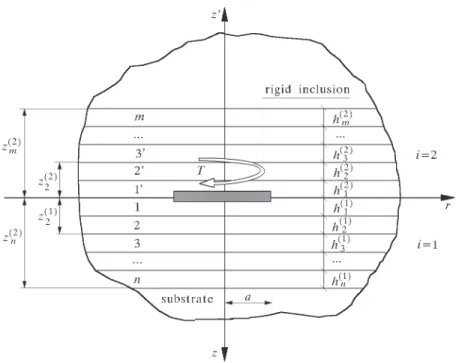
We use cylindrical coordinates and denote them by (r, ϑ, z). Consider an N-layered composite laminate containing an interfacial rigid circular thin inclusion of the radius a located between the two layers and twisted by a small angle ϕby means of the torque T applied to the disc. The inclusion may represent the resinous or cementing material, which is used to transfer the anchoring loads to the geological medium, for instance.
As the reference state we choose the solution to the two-phase counterpart problem obtained by Rogowski (1993). If the circumferential axisymmetric displacement of the rigid disc is
ν(r,0) =ϕ0r r¬a (2.1) then the contact stresses are
σzϑ0(r,0) = 4 πϕ0(−1) iµ i r √ a2−r2 r < a (−1) iz ¬0 (2.2)
and the rigid rotation ϕ0 of the disc is given by
ϕ0 = 3T 16(µ1+µ2)a3
(2.3) In equations (2.2) and (2.3) µiis the average shear modulus of the orthotropic
material, i.e. µi =√GriGzi, Gri and Gziare the material shear moduli, and
i = 1,2 refers to bodies 1 and 2, respectively. The stress σzϑ0(r, z) and the
displacement ν0(r, z) inside the bimaterial medium are given by formulae (Rogowski, 1993) ν0(i)(ξi, ηi) = 2 πϕ0r π 2 −tan −1 ξi− ξi 1 +ξi2 (2.4) σ(zϑi)0(ξi, ηi) =− 4 πϕ0µi ηi ξ2 i +η2i s 1−η2 i 1 +ξ2 i
The two sets of the oblate spheroidal coordinates ξi, ηi) are related to the
cylindrical coordinates (r, z) by the equations
r2 =a2(1 +ξ2i)(1−ηi2) siz=aξiηi ξi0 −1¬ηi ¬1 (2.5) where si = p
Gri/Gzi is the measure of the orthotropy and si = 1 represents
an isotropic material. Solutions (2.1)-(2.4) correspond to the bimaterial infinite medium, which is chosen as the reference state or the 0th order solution.
3. Moduli perturbation analysis
3.1. Composite consisting of two dissimilar layers and two dissimilar half-spaces
Now the question is how the torque T and the rotation ϕwill be related with each other in the case of a layered medium. The exact answer to this question would require the exact solution. A review of the existing literature reveals that the exact analytical solution to this problem is not available. In this paper we obtain a closed-form solution to the problem without restrictions on the range of applicability, using the moduli perturbation analysis. Consider an interface inclusion in a system of two layers bonded to the inclusion and to two half-spaces. The range of convergence of the perturbation solution will
be without an restriction if we choose a bimaterial infinite medium with two average moduli corresponding to the upper and the lower film as the reference state, i.e. µi = (µ(fi) +µ(si))/2, where µ(fi) and µ(si) are the average shear
moduli of the ith film and of the ith substrate, respectively. Then introducing material parameter
κi =
µ(fi)−µ(si)
µ(1)f +µ(1)s +µ(2)f +µ(2)s
(3.1) we have κi ∈(−1,1). The parameter κi denotes the ratio of the change of the
average shear modulus of the ith layer (film) to the modulus of the reference bimaterial medium. Alternatively −κi denotes the ratio of the change of the
average shear modulus of the ith substrate to the modulus of the reference medium. During the transformation, the applied torque T is kept constant but the twist angle ϕand the strain energy are allowed to change. The energy conservation law requires that the extra work done by the torque T be equal to the energy change in the whole body. To the first-order accuracy in the moduli variations κi for 0 <|z| < hi and −κi for |z|> hi the equation of
the energy conservation reads 1 2T δϕ0 =− 1 2 2 X i=1 κi Z A(fi) σzϑ0(i) ν0(i) dAi+ Z A(si) σzϑ0(i) ν0(i)dAi (3.2)
where δϕ0 is the rotation change, σzϑ(i)0 and ν
(i)
0 are the known stresses and displacements for the reference bimaterial medium, and A(fi),A(si) denote the
boundary surfaces of the transforming regions. For the present of geometry A(fi) consists of the three horizontal planes: z = 0+ and z =h−1, z =−h−2 and A(si) consists of the two planes: z = h+ 1+ and z = −h+2. The area
integral on the plane z = 0 is equal T ϕ0. The right-hand side of Eq. (3.2) denotes the first order energy variation due to the moduli transformation. Eq. (3.2) reduces to the following expression for δϕ0/ϕ0
δϕ0 ϕ0 =− 2 X i=1 κi h 1 + 2π T ϕ0 ∞ Z 0 (σ(zϑ0i) ν0(i))z=±h±i r dr i (3.3)
Substituting Eq. (2.4)1 and (2.5) with µi = (µf(i)+µ(si))/2 and noticing that
siz is equal s(1)f for 0 < z ¬ h1 and s
(1)
s z+h1(s(1)f −s(1)s ) for z h1
i.e. ξ(1)0 =s(1)f h1/a, and alternatively ξ(2)0 =s (2)
and z = −h2, respectively, and then integrating we arrive at the following expression for δϕ0/ϕ0 δϕ0 ϕ0 =−κ1 h 2Is (1) f h1 a −1i−κ2 h 2Is (2) f h2 a −1i (3.4) where the integral I(ξ0(i), ξ0(i)=s(fi)hi/a, is found to be
1 + 2π T ϕ0 ∞ Z 0 (σzϑ(i) 0ν (i) 0 )z=±h± i r dr= = 1− 6 πξ (i) 0 ∞ Z ξ0(i) π 2 −tan −1 ξi− ξi 1 +ξ2i 1 ξi2 − (ξ0(i))2 ξ4i dξi = 2I(ξ( i) 0 )−1 (3.5) I(ξ(0i)) = 2 π tan −1 ξ0(i)+ξ (i) 0 π h 3 + 2(ξ0(i))2ln1 + (ξ (i) 0 )2 (ξ0(i))2 −2i ξ0(i)= s (i) f hi a
The first order approximation of ϕ, ϕ1 =ϕ0+δϕ0 is 0(κi), 1st order solution
ϕ1 =ϕ0 h 1−κ1 2I(ξ0(1))−1−κ2 2I(ξ0(2))−1i (3.6) The corresponding higher order solutions are obtained recursively from the previous solutions, so that ϕ2 =ϕ0+δϕ1, is 0(κ2i), 2nd order solution
ϕ2 = ϕ0 n 1−κ1 2I(ξ0(1))−1−κ2 2I(ξ0(2))−1+ (3.7) + hκ1 2I(ξ0(1))−1+κ2 2I(ξ0(2))−1i2
In general, one has 0(κn
i), nth order solution, n >1 ϕn=ϕ0 " 1 + n X k=1 (−1)khκ1 2I(ξ(1)0 )−1+κ2 2I(ξ0(2))−1ik # (3.8) It is seen that the sum converges to the exact solution as n→ ∞in the range of convergence, i.e. ϕ= lim n→∞ϕn=ϕ0 h 1 +κ1 2I(ξ0(1))−1+κ2 2I(ξ0(2))−1i −1 = (3.9) = 3T 16a3 h µ(1)s 1−I(ξ0(1))+µ(1)f I(ξ0(1)) +µ(2)s 1−I(ξ0(2))+µ(2)f I(ξ0(2))i −1
if κ1 2I(ξ(1)0 )−1+κ2 2I(ξ0(2))−1 <1 (3.10) The weighting functions I(ξ0(i)),ξ0(i) =s(fi)hi/a, vanish as hi →0 and
appro-ach unity as hi → ∞, and monotonically increase with ξ( i)
0 . The inequality in Eq. (3.10) is satisfied since |κ1+κ2|<1 and 2I(ξ0(i))−1∈(−1,1) for any values of the material and geometric parameters.
The perturbation solution for ϕin Eq. (3.9) perfectly matches the exact so-lution in both limiting bimaterial cases, i.e. as s(fi)hi/a→0 and s(fi)hi/a→ ∞,
corresponding to the cases of the bimaterial infinite medium, with the interfa-ce inclusion, made entirely of the half-spainterfa-ce materials or, alternatively, of two layers by transforming to the two half space regions |z| > hi, respectively.
It can be seen from Eqs (3.5) and (3.9) that the weighting functions I(ξ0(i)) and 1−I(ξ0(i)) give the ratios of the strain energy stored in the transforming regions of the films and of the substrata, respectively, to the total strain ener-gy stored in the reference bimaterial medium. The effective contact stiffness should have the form
µef f =µ(1)s
1−I(ξ0(1))+µ(1)f I(ξ(1)0 ) +µ(2)s
1−I(ξ(2)0 )+µ(2)f I(ξ0(2)) (3.11) Hence, it can be said that µef f is the average shear modulus weighted by the
strain energy density distribution.
3.2. Nonhomogeneous medium with piecewise constant moduli
The modulus perturbation approach provides a natural channel for exten-sion to more complicated problems. Using the previously presented analysis, it can be shown that the twist angle of the interface inclusion in the (n+m)th layer of the composite laminate can be obtained as
ϕ= T 16a3µ
ef f
(3.12) with the effective stiffness
µef f =µ(1)s h 1−Izns (1) n a i +µ(2)s h1−Izms (2) m a i + (3.13) + n X i=1 µ(1)i hIzis (1) i a −Izi−1s (1) i−1 a i + n X i=1 µ(2)i hI|zi|s (2) i a −I|zi−1|s (2) i−1 a i
Here I(·) is defined by Eq. (3.5), zi is the z coordinate of the interface
between the ith and (i+ 1)th layer (film), so that the layer thickness is given by hi =zi−zi−1,i= 1,2, ...n, with z0 = 0. A rigorous analysis of the error
bounds for the perturbation formula in Eq. (3.13) is not yet available. Hence, it is necessary to examine the following inequality
1 µ(1)s +µ(2)s nXn i=1 µ(1)i hIzis (1) i a −Izi−1s (1) i−1 a i + + n X i=1 µ(2)i hI|zi|s (2) i a −I|zi−1|s (2) i−1 a io − (3.14) − µ (1) s µ(1)s +µ(2)s Izns (1) n a − µ (2) s µ(1)s +µ(2)s I|zm|s (1) m a <1
3.3. Nonhomogeneous medium with continuously varying moduli
When the elastic modulus is a function of spatial coordinates then the problem becomes more complicated compared to the homogeneous case. It is noted that the perturbation solution can be obtained in that case under some restrictions. The solution to the problem of a rigid interface disc in the bimaterial nonhomogeneous medium with continuously varying moduli G(zi)(z), i = 1,2, and constant parameters s(i), G(ri)(z) = s2iG
(i)
z (z), can be
constructed by taking the limits as zi → zi−1 and |zi| → |zi−1| and n→ ∞
in Eq. (3.13). The effective contact stiffness has then the integral form µef f =s(1) ∞ Z 0 dI(s(1)z/a) dz G (1) z (z)dz+s(2) ∞ Z 0 dI(s(2)|z|/a) d|z| G (2) z (z)dz (3.15) where dI(s(1)z/a) dz = 3s(i) πa h 1 + 2(s (i))2z2 a2 lna 2+ (s(i))2z2 (s(i))2z2 −2i (3.16) When the elastic medium consists of two nonhomogeneous layers of the thickness h1 and h2 and the shear moduli G(1)zf(z) and G
(2) zf(z ′ ) with Grf(i)(z) = (sf(i))2G(i) zf(z), s (i)
f = const bonded to two homogeneous half-spaces
with the moduli G(1)zs, G(rsi) = (ss(i))2G(zsi) then the solution for the contact
µef f =µ(1)s h 1−Is (1) f h1 a i +µ(2)s h1−Is (2) f h1 a i + (3.17) +s(1)f h1 Z 0 dI(s(1)f z/a) dz G (1) zf(z)dz+s (2) f h2 Z 0 dI(s(2)f |z′ |/a) d|z′ | G (2) zf(z ′ )dz′
When a rigid inclusion is embedded in a nonhomogeneous infinite medium with the shear moduli Gz(z) and Gr(z) =s2Gz(z) then the contact stiffness
is given by the equation µef f = 3s2 πa ∞ Z −∞ h 1 + 2s 2z2 a2 ln1 + a 2 s2z2 −2iGz(z)dz (3.18)
The difficulty with the perturbation method is that in special cases the expres-sion for the contact stiffness given by Eqs (3.15) or (3.18) may reduce to diver-gent integrals. We expect that these formulae have similar ranges of validity as Eq. (3.13).
3.4. Two-constituent composites
Rogowski (1995) performed an integral equation analysis to study an axi-symmetric torsion interface inclusion, which appears between a boundary layer and dissimilar half-space (Fig. 2). In this analysis the solution of the first-order accuracy has the form of Eq. (3.12), where (in our notations)
µef f = (µ1+µ2) h 1− η(3) 3πξ3 0 + η(5) 5πξ5 0 +...i ξ0 = hs1 a (3.19) η(2m+ 1) = µ1 µ1+µ2 ∞ X n=1 µ1−µ2 µ1+µ2 n−1 1 n2m+1 In particular, if µ1 =µ2 then Eq. (3.19) yields
µef f = 2µ1 h 1− a 3 6πh3s3 1 + a 5 10πh5s5 1 +...i (3.20)
Solutions (3.18) and (3.19) are valid if hs1/a > 1. The moduli perturbation approach, see Eq. (3.11), gives
µef f =µ2+µ1I s1h
a
Fig. 1. Inclusions geometry, coordinates and notation
Fig. 3. Torsional stiffness of the rigid disc on a two-phase orthotropic half-space; Eq. (3.11) for µ(2)s = 0 =µ(2)f , µ (1) f =µf, µ(1)s =µs, ξ0(1)=ξ0=sfh/a or for µ1 =µ2 µef f =µ1 h 1 +Is1h a i (3.22) Equations (3.21) and (3.22) can be rewritten as follows
µef f = (µ1+µ2) n 1− µ1 µ1+µ2 h 1−Is1h a io (3.23) and for µ1=µ2 µef f = 2µ1 n 1− 1 2 h 1−Is1h a io (3.24) For a thick boundary layer (hs1/a) > 1 Eqs (3.23) and (3.19) or (3.24) and (3.20) give the results which differ less than one percent. Perturbation solutions (3.21), (3.22) are valid also for small values of hs1/a. For example, Eq. (3.21) yields µef f = µ2+ 0.0880µ1 for s1h/a= 0.01 µ2+ 0.4434µ1 for s1h/a= 0.10 µ2+ 0.9666µ1 for s1h/a= 1.00 (3.25)
If the inclusion is embedded at the finite distance h from the bimaterial interface of the infinite medium with the shear moduli µ1 and µ2 (in the material ”1”) then Eq. (3.11) yields
µef f =µ1 h 1 +Is1h a i +µ2 h 1−Is1h a i (3.26)
This equation yields µef f = 1.0880µ1+ 0.9120µ2 for s1h/a= 0.01 1.4434µ1+ 0.5566µ2 for s1h/a= 0.10 1.9666µ1+ 0.0334µ2 for s1h/a= 1.00 (3.27) 4. Concluding remarks
We have presented a modulus perturbation scheme for determining ela-stic contact stiffness distributed by inhomogeneities. Although finite element methods, see Laursen and Simo (1992) for instance, or boundary element me-thods, see e.g. Telles and Brebbia (1981), can handle these types of inhomoge-neity problems, the present perturbation procedure still shows its advantages by simplicity and analytical form of the results. The presented closed-form perturbation solution (3.11) may be applicable without any restrictions, i.e. for any combinations of the elastic constants of material constituents, while the first-order accurate solutions (3.13), (3.15), and (3.17) may be applied in a moderate range of material combinations of practical significance. The effec-tive elastic constants of the laminated medium are given by Achenbach (1975) and Christensen (1979). If we consider a laminated composite consisting of alternating plane parallel layers of two homogeneous isotropic materials, then Achenbach’s and Christensen’s results give
Gz =
G1G2
G2δ1+G1(1−δ1) Gr =G1δ1+G2(1−δ1)
where δ1 = h1/(h1 +h2) and where h1, h2 are the thicknesses and G1, G2 the shear moduli of the two elastic layers. Parallel to the above studies of elastic contact problems a homogenized model with microlocal parameters has also been developed to evaluate the effective stiffness of a layered body. The related works are given by Kaczyński and Matysiak (1988, 1992), Matysiak and Woźniak (1987).
From the solutions presented in this paper we conclude, that elastic proper-ties of the boundary layer influence strongly the effective stiffness of a layered body and the solution depends also on the ratio of the layer thickness to the radius of contact region. The formulae mentioned in the literature do not de-scribe these effects. By replacing the shear modulus with the effective shear modulus in equations (2.1), (2.2) and (2.3) we obtain the solution.
The mechanical torsion fields of a laminated orthotropic medium under and above the interface inclusion are given by:
— rotation ϕ= 3T 16(µ1ef f +µ2ef f)a3 (4.1) — displacement ν(i)(ξi, ηi) = ϕr h 1− 2 π tan−1ξi+ ξi 1 +ξ2 i i = (4.2) = ϕ z= 0± r¬a 2 πϕr sin−1 a r − a r s 1−a2 r2 z= 0± ra — stresses σzϑ(i)(ξi, ηi) = − 4 πϕµi ef f ηi ξ2i +η2i s 1−η2 i 1 +ξi2 = (4.3) = 4 π(−1) iϕµ i ef f r √ a2−r2 z= 0 ± r < a 0 z= 0± r > a σrϑ(i)(ξi, ηi) = − 4 πϕG (i) r r2 a2 ξi (1 +ξi2)2+ (ξ2 i +ηi2)2 = (4.4) = 0 z= 0± r < a −π4ϕG(ri) a 3 r2√r2−a2 z= 0 ± r > a
— stress concentration factors (i= 1,2)
L(zϑI)= 3T 4π√a5(−1) i µi ef f µ1ef f +µ2ef f z= 0± r→a− L(rϑI)=− 3T 4π√a5 G(ri) µ1ef f +µ2ef f z= 0± r→a+ (4.5)
In the above solutions µi ef f, i = 1,2, is the effective contact stiffness of
spheroidal coordinates associated with the material parameters si by Eq.
(2.5) are continuous at the interfaces since the plane z=zi,r 0 is given by
ξi ξ ′ i = sizi a ηi= ξ′ i ξi (4.6) The displacement ν and the stress σzϑ are continuous in the laminated
medium, but the stress σrϑ has jumps in the interfaces, which are given by
[[σ(rϑi)]] =−4 πϕ[G (i+1) r −G(ri)] r2 a2 ξ3 i (1 +ξi2)2+ (ξ4 i +ξ ′2 i ) ξi ξ ′ i = sizi a (4.7)
We observe that both stress components have square root singularities as r → a−
or r → a+, respectively. These singularities are presented by the stress concentration factors, see Eq. (4.5).
When the torsional forces are distributed along the circle (r=r′
,z=z′
) in the interior of the ith layer (zi−1 < z ¬ zi) then the rotation ϕ of the
rigid inclusion will be ϕ= 3T 16(µ1ef f +µ2ef f)a3 h 1− 2 π tan−1ξi+ ξi 1 +ξ2 i i (4.8) where ξ1, ηi, i = 1,2, ..., n are related to r = r′ and z = z′ and si, as
shows Eqs (2.5), and T is the resultant torque of the applied torsional forces. The similarity between formulae (4.2) and (4.8) result from Betti’s reciprocal theorem (compare the solution in the paper by Rogowski (1998)). If the upper layered half-space is also loaded in the same manner (symmetrically) then the rotation ϕ of the rigid inclusion will be
ϕ= 3T 16(µ1ef f +µ2ef f)a3 h 2−2 π tan−1ξi+ ξi 1 +ξ2 i +tan−1ξj+ ξj 1 +ξ2 j i (4.9) where ξj is associated with si, i= 1,2, ..., n, and ξj is associated with sj,
j= 1,2, ..., m.
References
1. Aleksandrov V.M., Michitarian S.M., 1983,Kontaktnye zadachi dla tiel s tonkimi pokrytyami i proslonkami, Nauka, Moskwa
2. Achenbach J.D., 1975,A Theory of Elasticity with Microstructure for Direc-tionally Reinforced Composites, Springer, Berlin
3. Christensen R.M., 1979, Mechanics of Composite Materials, Whiley, New York
4. Fan H., Keer L.M., Mura T., 1992, Inhomogeneity Problem Revisited via the Modulus Perturbation Approach, Int. J. Solids Structures, 29, 20, 2593-2594
5. Gao H., 1991, Fracture Analysis in Nonhomogeneous Material via a Moduli-Perturbation Approach,Int. J. Solids Structures,27, 20, 1663-1682
6. Grilickiˇı D.V., Sulim G.T., 1975, Pieriodicheskaya zadacha dla uprugoˇı plo-skosti s tonkostennymi vkluchenyami,Prikl. Matem. i Mekh.,39, 3, 520-529 7. Jevtushenko A.A., Kaczyński A., Matysiak S.J., 1995,
Napryazhen-noe sostoyanie sloistovo uprugovo kompozita s tonkim lineˇınym vklyucheniem, Prikl. Matem. i Mekh., 59, 4, 698-703
8. Kaczyński A., Matysiak S.J., 1988, Plane Contact Problems for a Periodic Two-Layered Elastic Composites,Ingenieur Archiv,58, 137-147
9. Kaczyński A., Matysiak S.J., 1992, Modelling of Mechanical Behaviour of Some Layered Soils, Bull. of the Int. Assoc. of Eng. Geology
10. Laursen T.A., Simo J.C., 1992, A Study of Mechanics of Microindentation Using Finite Elements,J. Mater. Res., 7, 618-626
11. Matysiak S.J., Woźniak C., 1987, Micromorphic Effects in a Modelling of Periodic Multilayered Elastic Composites, Int. J. Eng. Sci.,5, 549-559 12. Rogowski B., 1993, Internal Point Torque in a Two-Phase Material. Interface
Crack and Inclusion Problems, J. of Theoret. and Applied Mechanics, 31, 1, 105-119
13. Rogowski B., 1995, Interface Crack or Inclusion in a Two-Phase Half-Space Under Concentrated Torque,Zeszyty Naukowe PŁ, Ser. Budownictwo,46, 5-31 14. Rogowski B., 1998, A Statical Problem of Reissner-Sagoci Type of an Inter-nally Loaded Orthotropic Half-Space, The Archive of Mechanical Engineering (ABM),XLV, 3, 165-183
15. Telles J.C.F., Brebbia C.A., 1981, Boundary Element Solution for Half-Plane Problems,Int. J. Solids Structures,17, 12, 1149-1158
Zagadnienia międzypowierzchniowej inkluzji w ośrodkach warstwowych
Streszczenie
Za pomocą metody perturbacji modułów znaleziono rozwiązania określające kon-taktową sztywność w zagadnieniach inkluzji umieszczonej na powierzchni ”sklejenia” warstwowego kompozytu bedącego w stanie skrętnej deformacji. Otrzymano nastę-pujące rozwiązania: (i) dokładne rozwiązanie dla inkluzji w ośrodku składającym się z dwóch warstw i dwóch półprzestrzeni, (ii) rozwiązanie o dokładności pierwszego rzędu dla ośrodka (n+m)-warstwowego, (iii) przybliżone rozwiązanie dla ośrodka fizycznie niejednorodnego z modułami ścinania zmieniającymi się w sposób ciągły, otrzymane jako przejście graniczne w rozwiązaniu dla ośrodka warstwowego.