Software Support for the Classical, Contemporary and Future Project
Management
Jakov Crnkovic and Peter Ross School of Business
University at Albany, State University of New York Albany, New York, 12222
Sanjay Desai GE Corporate Fairfield, CT 06828
ABSTRACT
The volume and complexity of Project Management (PM) raises many questions for managers. What exactly are we managing? People? Performance? Efficiency? Effectiveness? Cost? Time? At what levels do projects become challenging and worthy of significant management attention? Can some projects be left on auto-pilot? Must others be managed more aggressively? What metrics are useful in Project Management? How can they be integrated with normal performance metrics in the organization? How can metrics be built into assessment programs that work? How can projects be monitored, re-planned to stay within the original budget and schedule deadlines? How good is the PM software support? Do we really need PM software packages or it should be the integral part of the company’s information system (IS)? Where is the knowledge about company’s previous projects and performance? Are we able to establish company or even industry wide standards for project management? Can we (or should we) move from the PMBOK® guidelines and use other approaches?
We discussing important questions in PM: software products, responsibilities for concurrently executing several projects (multi-projects) with multi objectives and multiple deadlines, introducing a need for initiation, design, execution, and control using a virtual project management and application of the organizational project maturity model.
Keywords: OPM, PMM, Virtual PM, Risk, Portfolio management.
1. INTRODUCTION
Historically, projects and project management were connected with engineering endeavors. Slowly other technical areas were influenced and it spilled into business and other areas. For example, designing a new model of a car, introducing a new advertising campaign, updating an ERP or CRM system, or integrating a newly acquired company all involve a sequence of activities, which are typically considered to be a project, and thus something, that has to be managed.
In business, project management originated in large development and manufacturing projects such as the development and construction of the Trident submarine or managing the annual ‘turnaround’ in oil refineries (the projects that represented the original applications of project management tools PERT and CPM). Project management then found a role in
marketing in the new product launch projects, and subsequently moved aggressively into the Information technology (IT) arena for the management of design and implementing of IS.
The best-known examples in the area of managing huge projects in the IS area are after big banks mergers or acquisitions (e.g. Chase, Fleet). Today, we see PM in accounting, finance and, importantly, in large human resources projects such as Hewlett-Packard’s attempt to boil out several billion dollars in savings from the merger with Compaq Computer, or what had happened after Oracle’s takeover of PeopleSoft. With these cases we would like to underline that PM could be applied at any level of decision making, from operational, all the way to the strategic. In addition to delivering projects on time and with accepted schedule and within budget, project teams and appropriate software solutions must cope with a change in today’s dynamic business environment. The pressure on teams is greater than it has ever been, and they must deliver with limited resources, manage budgets, control project flow, and execute and coordinate a myriad of project participants, often with many outside the firm, and therefore outside the team’s direct control. Project managers must do all of this while exercising personal and leadership skills to motivate team members to collaborate at the very high levels – which in many organizations are not ‘natural’ activities.
2. THE “MAGIC” QUADRANT OF PM SOFTWARE PRODUCTS
Software vendors are very aggressive with offering specialized packages for PM, as well as with adding possible PM options to existing enterprise solutions. The short list may include a great variety of products, like MS Project 2000-2003, Project Scheduler, Fast Track, ProjecTrak, Welcom, Artemis, Primavera...Primavera and Artemis are known as “high end” packages. All software giants (IBM, SAP, Oracle, Microsoft, CA), offer their PM products as a part of their total business IS/IT supports.
From the list of many Open-source software products there are several we would like to mention: PHProjekt (internet-based, focused to work in groups www.phprojekt.com), DotProject (www.dotproject.net), Project/Open (internet-based "Project-ERP", with an emphasis on project collaboration and financials, www.project-open.com).
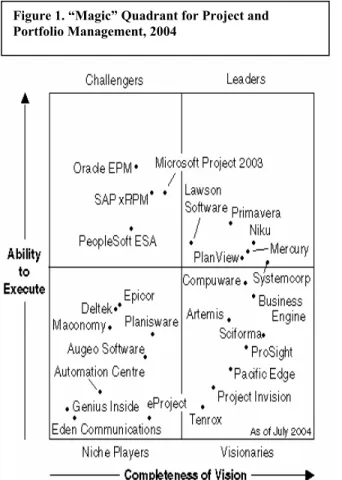
Also, there are proprietary (commercially offered) internet-based packages like Project.Net (www.project.net), eProject (www.eproject.com) or Projectplace (www.projectplace.com). Every year, Gartner Group is positioning products in a “magic” quadrant (leaders * visionaries) for project and portfolio management. More details about the construction of the graph, particularly about categories, selecting axis and positioning product venders can be found in the papers by the Gartner Group. Both papers are accessible with no charge via the Primavera Web site www.primavera.com. We are presenting Gartner’s results for two years: July 2004 is presented in Figure 1 and July 2006 in Figure 2.
Comparing figures “big players” have not significantly changed their positions, except big jump of CA (Clarity) in the leading position in 2006 (in 2004 it was under the name of Niku software), IBM and Compuware. Also, some companies did not make a cut in 2006. From the open-source category, only one (eProject) made a cut into the 2006 figure but not in the magic quadrant itself. A leader in HR software products, Lawson is not appearing in 2006.
The most significant aspects of PM approaches for many users are the extent of collaborative features for workflow, sharing resources and sharing standards, project knowledge management, document handling and related functionality, the range of platforms supported, and providing good discipline-specific features. Many vendors target multiple markets with
applications that share approximately 65 percent to 80 percent of core features as planning and scheduling, resource profiling and allocation, and time- and expense-capture. Often, additional features and functions may target a specific discipline, such as IT management. Let us envision any project. The first step is to prepare a project definition (or scope) and then to collect data about tasks, resources, predecessors and costs. This leads to the next big question:
Figure 1. “Magic” Quadrant for Project and Portfolio Management, 2004
Figure 2. Magic Quadrant for IT Project and Portfolio Management Applications, 2006
3. WHAT PM SOFTWARE PACKAGES CANNOT DO? No software can define the project scope and individual tasks, their duration and to sequence them, and portray deliverables, resources and costs.
After setting up goals and deliverables, one of the most complicated steps in schedulingis estimating taskdurations, which are sometimes with underlined stochastic time estimates and statistical distributions. For many projects (particularly in IT/IS area) placing predecessors is not a trivial problem since they might have feedback loops and/or conditional branching. Majority of PM packages will not be capable to deal with those issues, except for Graphical Evaluation & Review Technique (GERT). It is possible to run a simulation method, which is most likely created by consultants and/or IS personnel for each individual project or set of projects. Typically, project managers will need to coordinate gathering data about task durations and predecessors from the company and business environment (industry). This activity is closely connected to company’s knowledge management (KM) practice.
The next set of challenges is the cost management, with a request to assign them to individual tasks. Project manager must resolve those issues before using any software package.
All resources are limited and usually very sparse. More than just keeping project in resources limits, project manager must
balance resource loads or apply resource leveling. For long projects, an additional, complex activity for the project manager is managing the cash flow throughout the project life span, which can have an important influence on the overall costs, and therefore success of the project.
It is inevitable that all projects are to be managed with some uncertainty and a certain level of risk. According to PMBOK ®,
ther IT applications.
elp from the PM team) will
ibilities to shorten the project
es). The first step is usually to consider
managers can
February 2004) presented
on-JECT MANAGEMENT
The next step in developing PMO can be envisioned as Organizational Project Management (OPM). It can be defined as the application of knowledge, skills, tools, and techniques to risk management is the systematic process of identifying,
analyzing, and responding to project risk. It includes maximizing the probability and consequences of positive events and minimizing the probability and consequences of adverse events to project objectives. Risk management consists of risk planning, identification, qualitative and quantitative measurement, risk response planning and risk monitoring and control. Software packages (like MS Project) discuss the issue in the help menu leaving to the project manager to implement ideas and redesign a project. To be successful, the organization must be committed to addressing risk management throughout the project. One measure of the organizational commitment is its dedication to gathering high-quality data on project risks and their characteristics. One approach (based on [8] suggests to develop Risk Breakdown Structure (RBS) to classify risks by category. This would enable the project manager to easily identify those categories with multiple risks where each individual risk may have a low profile but the cumulative risk profiles may give this entire category a high profile requiring significant attention. The risk categories include (ibid.): Business impact, Clients needs, Clients characteristics, Deliverable size or capacity, Development environment, Legal and regulatory, Organizational, PM, Staff size and experience and Technology. To these we would add: Weather, Natural disaster, War, etc. recognizing that the probability of any occurring may be minimal (depending where the project is located, i.e. hurricane season in Florida).
Throughout the history of PM, the role of people has been critical, perhaps more so than with o
Organization’s KM and manager’s experience is necessary. The majority of research and IT support has been devoted to project scheduling and planning, with less on managing and controlling projects, and even less about project closing or abandonment. Clearly, this emphasis on technical aspects of PM leaves most of the real decision-making to managers who, for their tasks, are largely unsupported by software and models. It means that the critical role of a project manager is no only before the project planning and data entry, but also during the project execution. Sometimes, things go in the wrong direction and the project manager faces an enormous problem: how to stop the project or how to take it in a completely different direction. Inertia is difficult to overcome. Warning signs do exist, but interpreting them is often tricky. Here are some of the signs, excerpted from an excellent article titled “How To Kill An Enterprise Project” (CIO magazine, January 2002): Bad ‘gut feeling’ on the progress of the project, change in behavior of team members, rumors and ‘back-channel’ griping about the project, creeping or changing project scope, team members looking for other assignments, action suggestions from the team about terminating the project or taking a radically different direction. Important practical advice that follows from these warning signals: do a transparent analysis of the project to date, do it quickly, identify bottlenecks and problems areas, assess future risks and methods for handling it, talk to your vendor and contractors, and bring all involved parties to the discussion.
4. AND WHAT PM PACKAGES TYPICALLY SUPPORT When project manager (with a h
prepare majority of data mentioned (e.g. tasks, durations, predecessors, resources, costs) it is time to consider using software for PM to generate the “baseline” (or the “first iteration”) solution. Majority of software packages offer user-friendly data entry dialogs and good management of calendars (both, company and individual’s).
All contemporary PM packages underline that the project scheduling is just a first step in the holistic solution provided by them. The next steps deal with poss
time, and to manage costs and other resources. Typically, PM software products will manage reporting and costs tracking over time and by activities.
There are several approaches to shortening total project time, but all ideas start with consideration of the additional costs (for expediting activity tim
relatively inexpensive options like re-allocation and rescheduling. The consequence may be different sequences of critical activities (critical paths). Rescheduling is technical option to split (or group) activities to get better use of resources or to shorten project time. Project managers must estimate costs and consequences before choosing any of these approaches – and here we see the importance of human input for considerations that the software can only report, not determine. Probably, the best known practice to shorten project completion time, or to reduce uncertainty about the completion time, is ‘critical path crashing.’ This method is based on cost/time tradeoffs and should be applied after exhausting all judgmental options. Crashing can shorten project completion time by adding extra resources (costs). “Buffering” is another idea that is emerging to bridge the gap between classical PM software and needs for projects in the area of IS. Buffering should assure that activities would be completed on time, particularly when used software is not offering re-works and feedbacks.
Software will support these ideas based on project manager’s interventions. For example, PM software saves all improvements and updates of projects. This way,
use ideas like resource re-allocation, project “crashing”, cost and/or resource leveling to manage project realities, and keep track of project progress with updates related to the most recent decisions and their likely consequences, but majority of software products are not at the DSS level.
After applying PM software solutions in variety of areas and departments, there is a new quality: organizational PM or PM Office (PMO). Computerworld (in
line quiz to see if your project management office is on the right track by rating company’s PMO according to how well it performs in the following areas: (Figure 3.) “Quiz” is currently (September 2006) available at PM solutions website: http://www.pmsolutions.com and uses the Rating Scale: 3 - We've got it covered, 2 - It's OK, but could be better, 1 - Needs some serious improvement, and 0 - Couldn't be worse). Figure 3 is on the next page.
5. STANDARDIZATION AND ORGANIZATIONAL PRO
organizational and project activities to achieve the aims of
ough projects. an
organization thr
ecuting, Controlling and Closing. Processes to support OPM depend on three domains: Project Management, Program Management, and Portfolio Management. As described in the PMBOK® Guide each domain contains a set of processes, consistent with five process groups, Initiating, Planning, Ex
These five process groups are organized with the appropriate flow of information as shown in Figure 4. Some readers may feel uncomfortable by the centralized placement of Control, which is in most
Figure 3. Top 10 Critical Success Factors for a Project Management Office
1 The PMO has senior executive-level support
2 A superior process for selecting project managers and teams has been established
3 Project teams include participants from multiple business functions and disciplines
4 A high standard of truthfulness and integrity exists within the PMO
5 The PMO serves as an "ambassador," communicating with all internal and external stakeholders.
6 Training of project managers is competency-based (rather than purely academic).
7 Project management methodologies, tools and templates are standardized
8 A useful knowledge library of best practices is maintained as part of the PMO
9 The PMO is involved in all projects from start to finish The organization's project
PMO
terature placed at the bottom. T
pla ent is to emphasize the importance of controllin
10 portfolio is managed by the
PM li he main reason for this
cem g
processes, which in many approaches, are marginalized because
an be defined as a collection of
es to
tively and implies the nchmarks. Maturity also s improvement. In this
any
ces and competencies,
consistent, and correlate with
support the
identified Best Practices and
ject management maturity
OPM ca goals r
and pract trategy
and iv
knowledg ractices in
we would like to share that they are not fully automated.
If a project is described as a finite set of processes, interesting opportunities for managers emerge efined as
m eled pr lemen e
not be a part of projects, and individual projects that are not part Executing sing
. Programs can be d ultiple lev ojects, with some program e ts that ar of a program. A portfolio c
Controlling Figure 4. – Information Flow among PM Processes
projects and/or programs and other work processes grouped together to facilitate effective management of that work to meet strategic objectives. The projects or programs of the portfolio may not necessarily be interdependent or directly related.
These hierarchical definitions lead us to key activities that are essential to Portfolio Management from an OPM point of view: translating organizational strategies into specific initiatives or business cases that become the foundation for programs and projects, and providing, allocating and reallocating resourc programs, projects, and other activities.
Thus, a strategic plan initializes vision, mission and goals, while OPM returns results and performance.
Within the domain of Project Management, ‘maturity’ implies the ability to perform processes effec
existence of relevant best practices or be
assumes the existence of standards, process measures and metrics, controls, and ongoing proces
context, we are discussing Project Maturity Models (PMM). As we consider maturity and standardization, the processes in Figure 4 begin to have a new meaning. Each process progresses through stages of Standardization, Measurement, Control, and continuous Improvement. PMBOK’s OPM3 modelmeasures the level of PM maturity of the organization by comparing comp practice with industry best practices.
Best Practices in OPM3 include developing appropriate governance structures, standardization and integration of processes, performance metrics utilization, controlling and continuously improving processes, developing commitment to project management, PM resour
improving teamwork, and providing a foundation for a plan to achieve strategic goals.
Benefits to organizations, senior management, and those engaged in project management activities include:
Strengthen the link between strategic planning and execution, so project outcomes are predictable, reliable, and
organizational success
Identify the Best Practices which
implementation of organizational strategy through successful projects
Provide means to assess an organization’s maturity relative to a body of
Capabilities
Provide a basis from which organizations can make improvements in pro
Provide guidance and flexibility in applying the model to each organization’s unique set of needs
3 n provide a way to advance an organization’s strategic th ough the application of project management principles
ices. In other words, it bridges the gap between s
Initiating Planning Clo
ind idual projects by providing a comprehensive body of e regarding what constitutes Best P
organizational project management.
Authors of this paper applied OPM3 model in practice, using the OPM3 survey of 153 questions and appropriate software (distributed with the OPM3 book, see details in the list of literature). We are preparing to describe the whole process in details as a case study. In this paper
the stakeholders were extremely pleased with a study and that significant success was achieved. This may lead to building a PM office in the organization.
Apart from OPM3, many PM software vendors support the evaluation of organization’s PM maturity level. For example, on the Primavera web site, there is a Project Management Maturity Online Assessment Survey (based on PM Solutions' Project Management Maturity Model, www.pmsolutions.com) This tool helps to answer the following questions about your organization: how well does my organization manage projects,
have identified the essential best practices from OPM3 that will help advance your organizational maturity.
:
M3 best practices that are currently being used in
K Guide knowledge areas within the PMMM
effective project management
e your maturity advancement cts
6. LIM L PM APPROACHES
AND C GEMENT
When the n organization
reaches a ties
manually s that
the amount of time spent on PM using manual methods could be spent much more efficient elsewhere. Similar thinking could be
ap l
st
ra and at a time where customer-driven applications
approach
t data with other applications, particularly to
ile in
the
rning Parameters, what are the strengths and weaknesses of my organization, how
does my organization stand in comparison with others, and what can I do to improve the project management maturity of my organization?
At the PM Solutions’ web site, we learn that PM Solutions has completed an extensive review and analysis of PMI's Organizational Project Management Maturity Model (OPM3) and mapped it against our Project Management Maturity Model (PMMM). From our experience and in-depth research, we
We find that many organizations struggle with taking a collection of best practices and creating a tangible action plan to improve their performance. PM Solutions uses OPM3 in conjunction with our PMMM to help develop a structured maturity improvement plan for your organization. Quote from the web site www.pmsolutions.com is below
Through our PM Pathways program, we provide the framework and guidance you need to:
• Identify the most important OP
practice today
• Organize the essential OPM3 best practices by PMBO
• Assess your current level of organizational maturity
• Develop an
maturity improvement plan
• Deploy improvement plan initiatives • Measur
• Affect positive change in the execution of your proje
ITATIONS OF CLASSICA
ONTEMPORARY PROJECT MANA number or complexity of projects in a
certain level, it is time to stop tracking activi and to start using a computerized tool. It mean
plied for decision making about moving to the next logica ep – building a project management information system (PMIS).
The widespread use of isolated PM applications (with or without software support) has pushed project management out of the main stream of information systems development. Managers do not want more islands of information, particularly in the Internet e
are de rigueur. If the organization of a firm is flexible enough, project teams can accomplish goals at various levels (operation, tactical and even strategic), but they must be backed by strong IS/IT support. Having PM as a part of an integrated corporate Decision Support System (DSS) and strong negotiating capabilities will help to provide the best solution.
Some software vendors have sensed that having isolated package for PM is not a good enough solution for increasingly integrated, enterprise-based IS/IT. Moving towards a more integrated approach, Microsoft offers PM Server – a special application for a project-centered environment, but this
brings significant new challenges for managers. From allocating limited resources across projects to communicating among remote teams, organizations need an enterprise-wide project management solution. Microsoft Project Server is emerging as the preferred tool to meet these issues. Project Server will manage enterprise projects and portfolios throughout the enterprise, harmonize organizational processes, streamline communication and collaboration, and analyze and control critical performance factors in real-time throughout the organization.
Different software supports different methods for communicating and reporting project data, managing multiple projects and groups, and these features are an important element in choosing which one to use. Some applications support the exchange projec
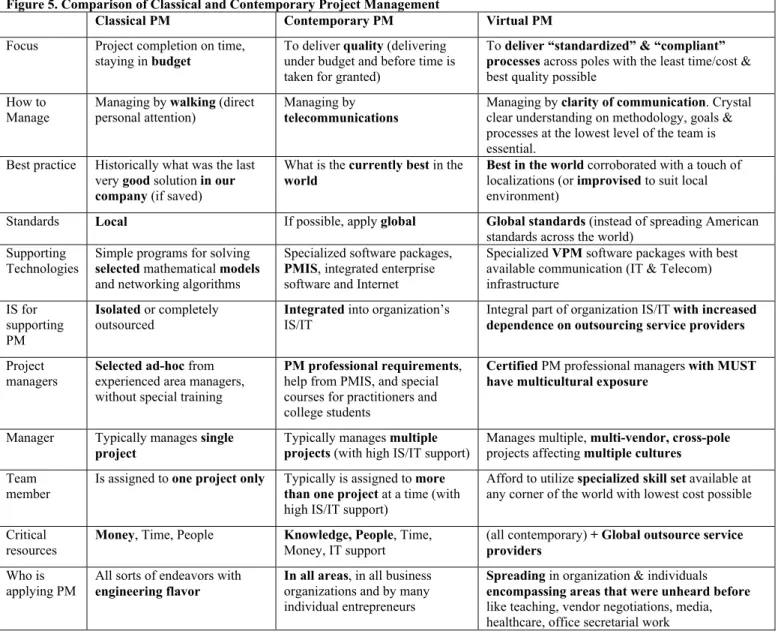
export PM data to ERP and other enterprise applications. Figure 5 summarizes big changes in the area of project management. It focuses on two arbitrary periods: classical and contemporary, keeping in mind that these boundaries differ from industry to industry. PM has had some elements of modernization quite a while ago in some industries, wh others contemporary PM ideas are not yet being considered. We are aware that some readers might have different opinions for some rubrics. If this table will trigger discussion among readers, we will have accomplished our goals. More about Virtual PM reader will find later in this text.
The most useful PMIS options will therefore include functions found in most PM packages like Project Graphs, Reports, Calendars, Schedules, Critical Path and Alternative Tasks & Schedules. In addition, PMIS should manage Skills Inventories, Multiple Projects, Early Wa
Materials Management and offer Internet Capabilities and convenient Communication options (for team members, managers and executives). A good PMIS should save money by reducing the need for project personnel and offer simple and effective presentation tools (graphics) for reporting. As it is required for other contemporary software packages, a PMIS must also fulfill requirements like scalability and seamless integration with other programs, towards the Enterprise PM.
Figure 5. Comparison of Classical and Contemporary Project Management
Classical PM Contemporary PM Virtual PM
Focus Project completion on time,
get To deliver quality (deliveringore time
staying in bud is To deliver “standardized” & “compliant” s poles with the least time/cost & ossible
under budget and bef taken for granted)
processes acros best quality p How to
Manage
t
t level of the team is Managing by walking (direc
personal attention)
Managing by telecommunications
Managing by clarity of communication. Crystal clear understanding on methodology, goals & processes at the lowes
essential. Best practice as the last
very good solution in our company (if saved)
est in the world
t)
Historically what w What is the currently b Best in the world corroborated with a touch of localizations (or improvised to suit local environmen
Standards Local If possible, apply global Global standards (instead of spreading America standards across the world)
n Supporting
es
olving mathematical models and networking algorithms
Specialized software packages, se software and Internet
M software packages with best Technologi
Simple programs for s
selected PMIS, integrated enterpri
Specialized VP
available communication (IT & Telecom) infrastructure IS for supporting PM d ders Isolated or completely outsourced
Integrated into organization’s IS/IT
Integral part of organization IS/IT with increase dependence on outsourcing service provi Project
managers Selected ad-hocexperienced area managers, from without special training
, om PMIS, and special courses for practitioners and PM professional requirements help fr
college students
Certified PM professional managers with MUST have multicultural exposure
Manager Typically manages single
project Typically manages projects (with high IS/IT support) multiple projects affecting Manages multiple, multiple culturesmulti-vendor,cross-pole Team
member
Is assigned to one project only
e Typically is assigned to more
than one project at a time (with high IS/IT support)
Afford to utilize specialized skill set available at any corner of the world with lowest cost possibl
Critical
resources Money, Time, People Knowledge, PeopleMoney, IT support , Time, (all contemporary) providers + Globaloutsourceservice Who is
applying PM
ith
eurs g, vendor negotiations, media, All sorts of endeavors w
engineeringflavor
In all areas, in all business organizations and by many individual entrepren
Spreading in organization & individuals encompassing areas that were unheard before like teachin
healthcare, office secretarial work PM teams are composed from people from differen
consultants, even stakeholders. In a modern company (not ecessary a virtual firm) a person could be a team member in
excerpts from statements found in the flash Company Web site oping Enterprise Project
I, and to cts and
asy communication for team leaders, project managers, crewmembers, resource managers, and executives. With a
client-rver platform, portfolio managers and senior project managers t department,
RO n
several projects at the same time. It causes serious organizational problems at the company’s level, like a need to eliminate vertical boundaries between departments (which may induce “turf” battles among department managers and project managers). PMIS should be able to give informational support for these efforts.
Portfolio and Process Management We will use few
presentation from the Primavera (www.primavera.com). When devel
Management (to be designed as a combination of project, process, and portfolio management, collaboration, resources and work order management), Primavera suggests five stages: Assessment and Overview, Cost Reduction, Shared Resources, Repeatable Success and Strategic Advantage. User needs include project management to prioritize projects, to maximize
their management and control. Enterprise project management should share a common data platform with enterprise systems such as ERP and should be Web- and browser- enabled to allow
eliminate unnecessary spending on proje
e se
could also use it. With remote accesses through the Web or company Intranet, it could also be used for communication with remote projects. Systemcorp (which was in October of 2004 acquired by IBM) is a leading designer of Project Portfolio Management (PPM) software that can provide organizations with a comprehensive view of IT projects across the enterprise. By adding PPM capabilities to the IBM Software Development Platform, and complementing it with the enterprise transformation expertise of IBM Global Services (IGS), IBM will help organizations manage their IT investments more effectively. IBM Rational Portfolio Manager is rated a leader in The Forrester Wave for 2006. According to [11]: “IBM’s acquisition of Systemcorp’s portfolio management office enabled it to introduce planning and tracking functionality to
complement its set of development tools. IBM’s Rational Portfolio Manager continues to evolve and shows promise. Tactical functionality remains developer-oriented. However, with the latest enhancements to portfolio management, Rational Portfolio Manager shows signs of expanding beyond its focus on the development team into a product that can bring value to IT management.”
The site: www-306.ibm.com/software/awdtools/portfolio/, (notice that it is IBM site), offers to a brief overview for the Rational PPM saying that this software will align portfolio investments with business goals, help in gaining real-time visibility to make rapid, well-informed decisions, implement IT governance processes with built-in models and workflows, increase collaboration between management and delivery teams,
ual project management: The End of
“Managing by walking around” and Virtual project
mana ridge
Energ 002.
CERA is a research pany for the energy
e confidence to implement this
, but with technology eroding the
ly ontradictory goals of "not reinventing the wheel" and ustomizing (contextualizing) the design for the specific
er
er dispersed and disparate teams, allowing
and document management since
, there are the how to operationalize best practices and automate portfolio
processes, monitor and control risks, issues and financials across portfolios, manage skills inventory and balance resource demands and gain a full circle view across IT and development projects. As a part of IBM’s Business Performance Management, PM is integrated into Activity Decision Flow Diagram with graphical capabilities and elements of group communication and managing the tasks. The software allows decision-makers to visualize and achieve the “desired balance of projects and people, tightly align portfolios with business goals and ensure the entire organization remains in sync with the strategic objectives.”
7. THE FUTURE OF PM: VIRTUAL PROJECT MANAGEMENT
Next, we turn to modern project management and its future. Our discussion is based upon two documents (and daily practice of one of authors): Virt
gement: A strategic Weapon? produced by Camb y Research Associates (CERA), Cambridge Mass., 2
and consulting com
sector. This research predicts that using a Virtual Project Management (VPM) and accompanying tools may reducetime for longer projects in half.
The concept of VPM is based on a new paradigm: The emerging virtual organization depends on a strong, trust-based relationship between operators and contractors. VPM will work if there is a trust between the various groups and transparency with regard to tracking costs, schedules, and key decisions. Such transparency can be provided by information technology systems and is one of the reasons operators have th
"trust, but verify" approach.
To actively collaborate at a distance requires a mind-set that is almost the antithesis of the old project management style. The type of person who did/does well in the historical model was technically proficient, proudly independent, and focused on working with the project team. In the past this behavior was desired because of the difficulties of collaboration at a distance. Independence is still a plus
barriers of time and distance, an increasing premium is being placed on the ability to break down problems in a way that can best be communicated through the medium at hand, and a willingness to aggressively seek out expertise and best practices wherever they reside (globally, not inside the company itself).
Drawing on our earlier discussion of maturity and standardization, we see the biggest source of tension within major project teams: the tug-of-war between standardization and customization. VPM helps to address this tension. Senior executives expect major project teams to balance the seeming c
c
characteristics of each new development. Teams are also expected to incorporate innovations as they appear. VPM sharpens this discussion because it creates the opportunity for firms to standardize major project elements more quickly through more consistent application of proven design themes. At the level of interpersonal relationships, VPM is aware of competing agendas of various players and possibilities of mismatching team structures, and offers tools for improvements in these areas.
VPM has several major “building blocks” making the list of major benefits for company when applying VPM: Remote Pe Assistance and Review; Automated Tracking, and Virtual Collaboration. Let’s review a few points about the virtual collaboration. Based on CERA documents, collaborative design applications and Web-based workspaces provide the capabilities that tie togeth
contributors to work together while apart. The fundamental premise is that work can now go to the appropriate experts and specialists, rather than bringing the individuals to the work. These tools also allow teams to be established faster, with less organizational disruption, and they can more easily access the wide array of inter- and intra-company best practice resources. More than that, collaborative applications provide a real-time, shared design environment where all project stakeholders can simultaneously work on the latest designs, knowledge management helps develop and maintain lessons-learned from previous experiences. Project managers are using databases and portals. The Web-based workspaces allow convenient, rapid access to project data, structured and unstructured documents, and application files. Real-time and asynchronous communication capabilities including e-mail, instant messaging and peer-to-peer applications will increasingly serve as a replacement to walking down the hall to chat with a colleague. If a project manger manages global projects, new technologies are bridging time and geography.
Specific VPM benefits include: Invoicing and fulfillment, procurement tracking, ability to continuously monitor budgets and integrated schedules and their impact on the full project schedule, budget and requirements for resources.
One of usual problems in classical enterprise project management is documentation
teams often use a variety of applications tasks. Using VPM, it is possible to enhance content management, including compliance documentation for regulatory reporting and project audits, and to provide a ready-made archive of accurate, retrievable data, information, and documents. In the cited articles
four comparisons of classical PM and VPM: effectiveness of design, managing the process, tracking status and documentation, and managing and allocating project resources. Please notice the last column in the Figure 4 to compare all three steps in Project Management.
8. CONCLUSIONS
We will conclude this paper with three contemporary challenges: managing multiple projects (and shared resources), review the project management maturity model and moving
wards virtual project management.
Managers who are currently executing several projects: mul objectives and multi
ir resources across various projects and successfully manage their portfolios. Those
the project office, management oversight, professional development, risk assessment, and streamlining processes. He
he best practices, company’s and global ssment, flexible resource allocation, and skills tracking to increase project value, organizational
[2] Cleland, D.I. and Ireland, L.R., Project management –
strategic design and McGraw Hill, New
York, NY, 2002
nal Project Management Maturity Model
uare, PA, 2000
anager - Global
ning In The PPM to
responsible for con ti-project (and multi
deadlines) management need better methods to manage the resources that are often shared across several projects (even shared by other project managers). They need tools, techniques and practical methods to allocate the
approaches will significantly vary among organizations. According to the literature ([10]), individual is responsible for as much as 75% of team goals. Among other topics, this text reveals methods of fast tracking projects without increasing costs or reducing scope; discusses ways to predict the effectiveness of project leaders when there is insufficient experience to evaluate future performance; considers skills that translate into higher income, improved career mobility, and greater peer recognition and respect; defines project specific methodologies, templates, and procedures that reassure customers; establishes a body of competencies and best practices that can be passed on through training and mentoring).
Project manager needs effective strategies for the implementation of efficient project management systems for increased levels of organizational project maturity, time and cost conservation, quality assurance, and project success— detailing areas critical to organizational improvement such as
needs techniques to build a culture of project management excellence and model for project management maturity and a tool to systematically and efficiently improve and measure company progress (some ideas we introduced earlier in the text with OPM3 standardization model, also, reader may wish to visit PMI web site).
After all discussion presented in the PM and IS/IT literature we are ready to conclude that there is a need for initiation, design, execution, and control using a virtual project management. This approach should use specialized (improved) software packages based on t
KM, better risk asse
efficiency, and productivity using teamwork and standards. It may be named a Virtual Project Office to support ideas of virtual management.
9. REFERENCES
[1] Anderson, D.R, Sweeney, D.J. and Williams, T.A., Quantitative Methods for Business, Thomson, Mason, OH, 2004 (chapter “Project Scheduling”)
implementation,
[3] Nicholas, J.M., Project Management for Business and Technology, PrenticeHall, Upper Saddle River, NJ, 2001.
[4] Olson, D.L., Information Systems Project Management, McGraw Hill, New York, NY, 2004
[5] Organizatio
(OPM3), published by the Project Management Institute, (www.pmi.com),Newton Square, PA, 2003
[6]PMBOK ® Guide, published by the Project Management Institute, (www.pmi.com), Newton Sq
[7] Project Manager Competency Development Framework,
published by the Project Management Institute, (www.pmi.com),Newton Square, PA, 2002
[8] Rad, P.F. and Levin, G., Metrics for Project Management, Management Concepts, Vienna, Virginia, 2006
[9] Schwalbe, K., Information technology project Management, Thomson, Boston, Ma, 2004
[10] Toney, F., The Superior Project M
Competency Standards and Best Practices, Marcel Dekker/Center for Business Practices, 2002)
[11] Visitacion, M., Symons, C., Hogan, L., and Sahalie, “A.: IBM Is Finally Focusing On Strategic Plan