Making communication happen: Interactive groups in the bilingual classroom
Borja Garrido Encuentro 21, 2012, ISSN 1989-0796, pp. 80-93 80
Making communication happen:
Interactive groups in the bilingual classroom
Borja Garrido
CEIP El Olivar
Abstract
One of the main challenges teachers face at Bilingual Primary schools is our students’ lack of communicative skills. The research presented here intents to prove that Interactive Groups work improves Primary Education students’ participation in learning activities in L2 classrooms. Furthermore, since Interactive Groups advocate for meaningful learning through interaction, we are helping our students to efficiently develop their communicative competence. Findings of the research suggest that Interactive Groups not only substantially increase students talking time and improve their attitudes towards the target language but they are also an egalitarian and dialogic tool that keeps all of our students’ expectations high.
Key words: Interactive Groups, bilingualism, high expectations, academic success
Resumen
Uno de los principales retos a los que nos enfrentamos los profesores y las profesoras de inglés en centros Bilingües de Educación Primaria, es la falta de destrezas comunicativas por parte de nuestro alumnado. El estudio que aquí se presenta defiende que el trabajo en el aula de lenguas por medio de Grupos Interactivos ayuda a mejorar su participación en las actividades del aula a lo largo de la etapa de Educación Primaria. Al basarse en el aprendizaje significativo a través de la interacción, estamos ayudando a nuestros estudiantes a desarrollar eficazmente su competencia comunicativa. Además de incrementar la participación y mejorar la actitud del estudiante hacia el aprendizaje de la lengua extranjera, los resultados de la investigación sugieren que los Grupos Interactivos son una herramienta que fomenta la igualdad y el diálogo entre todos los estudiantes.
Palabras clave: Grupos Interactivos, bilingüismo, altas expectativas, éxito educativo
1. Introduction
“Teachers who inspire realize there will always be rocks in the road ahead of us. They will be stumbling blocks or stepping stones; it all depends on how we use them.” Author Unknown
In what follows, I will attempt to establish how these rocks can be turned into stepping stones in order to meet our primary school students’ needs as well as face the challenges of the teaching profession. I will focus on an important and common challenge that primary school teachers of English face every day: students’ lack of effective oral communication skills. Despite the support given by both Spanish legislation and the Spanish curriculum in order to help students “acquire a basic communicative competence in at least one foreign language” (RD. 1513/2006: 31488. Author’s translation), the truth is that most students find it difficult to make themselves understood in a foreign language. There is a real need, therefore, to provide students with effective oral communication skills in English in the Spanish context. In Spain, this idea is underlined in the introduction of the Bilingual State Schools Syllabus: “the full incorporation of Spain into Europe demands better communicative skills in the different European languages” (Syllabus 2005:1). More precisely, one of the Bilingual Schools Program Objectives states: “Pupils should not only be able to
Making communication happen: Interactive groups in the bilingual classroom
Borja Garrido Encuentro 21, 2012, ISSN 1989-0796, pp. 80-93 81
recognize the different possible expressive styles in both languages, but should also acquire enough communicative competence in English to be able to interact naturally in everyday situations” (Bilingual School Program, 2009:2).
On the one hand, I am aware of both, the limited exposure language learners get from traditional foreign language classes, and the limitations of learning a foreign language in an artificial context. On the other hand, I consider it essential to provide students with real communication situations, meaningful practice of the four skills and plenty of opportunities to put everything they have learnt into practice.
In order to face all the challenges mentioned in the previous paragraphs, I have been using Interactive Groups1 for some years, but only now can I attest my findings using this teaching technique. In this article I
will describe part of my Action Research Project2 about how Interactive Groups can help us provide our
students with plenty of opportunities to communicate in a real and meaningful way, improve our students’ oral communication skills and, ultimately, help them develop a positive and motivating attitude towards the learning of a second language.
To organize, guide and direct the research I set up two research questions:
1. If I set up Interactive Groups in an English lesson for a group of students in their sixth year of Primary Education, in what ways, if any, will the development of their communication skills be affected? 2. How will the use of Interactive Groups affect the students’ attitude towards English?
2. Interactive Groups theoretical background
Interactive Groups are one of the Successful Educational Actions (SEAS3) included in Learning
Communities. So, with the aim to provide a complete and global definition of Interactive Groups it is essential to first describe the Learning Communities project, and consequently, part of the basic literature concerning Interactive Groups will be revisited.
2.1. Learning communities
The Centre of Research in Theories and Practices that Overcome Inequalities, CREA4 founded by Ramón
Flecha, studied and develop the concept of Learning Communities (Giner, 2010). In 1999, a group of university teachers, researchers and professionals from different disciplines (anthropology, biology, communication, economics, engineering, history, pedagogy, political sciences, psychology and sociology among others) decided to take part in CREA. At present, there are Learning Communities in Spain, Brazil and Chile. In particular, there are 95 schools that have been transformed into Learning Communities in Spain.
1Interactive Groups are small mixed groups inside the classroom where students are encouraged to cooperate with other under adult supervision; they must reach a consensus through dialogue to find the right answers or solution to the activi-ty.
2 Research framed within the Master Universitario en Enseñanza del Inglés,“Teaching through English in the Bilingual school.”
3Actions that produce academic success and lead to social cohesion, especially for social and cultural groups that have traditionally been marginalised.
Making communication happen: Interactive groups in the bilingual classroom
Borja Garrido Encuentro 21, 2012, ISSN 1989-0796, pp. 80-93 82
Flecha and Puigvert (2002:1) state that “Learning Communities is a transformation project of educational centers, which aims at overcoming school failure and conflicts”. The principles of Learning Communities can be summarized as follows:
1. Creationofopportunities. Regardless of a student’s cultural and social class, Learning Communities seek equal results for all. As Flecha (2000) suggests, the creation of opportunities is based on the theory of dialogic learning which evolved from the investigation and observation of how people learn through dialogic interactions, both outside and inside schools. Dialogic interactions are based on equality, and seek understanding through speakers appreciating the arguments provided to the dialogue regardless of their position of power.
2. Educational community involvement. All members of the educational community in general, and families in particular, are encouraged to get involved in the learning process of students. Learning is planned through egalitarian, critical and reflexive dialogue with all members (families, volunteers, professionals, students and teachers). Volunteers from the educational community can collaborate with teachers inside their classrooms and in other learning spaces in the school.
3. High expectations of all students. Learning Communities ought to maintain high expectations of all students, and goals are shared with all the members of the educational community.
4. Creation of phases. Those schools which decide to be a Learning Community go through different phases before starting. Following Flecha and Puigvert (2002:7), these phases are: “Sensitization, taking decisions, dream, election of priorities, and planning”. These phases can be resume as the process by which, first, all the members receive an intensive training, then, they dream and decide what kind of school they want and, according to that, select their priorities and plan their project.
In addition to these four principles, the Learning Communities project highly recommends the use of Successful Educational Actions, the main SEAs are: 1) Dialogic Literary Gatherings addressed to low academic instruction people: they read texts that are later commented on promoting an egalitarian dialogue to sharing knowledge; 2) Dialogic model of solving conflicts, which implies preventing conflicts through dialogue before these conflicts happen; 3) Tutored libraries, which are learning time extensions; and 4)
Interactive Groups. It is this Successful Education Action with which I am most interested in and which forms the centre of my investigations. A more detailed analysis follows..
2.2 Interactive Groups
Interactive Groups can be defined as: “Small and heterogeneous groups of students who work collaboratively on activities with the support of an adult, usually a community member, who promotes supportive interactions and dialogue in the group so that all the children learn the content knowledge.” (Racionero and Padrós, 2010: 155). These groups rotate, so that over time each group works on a different activity. As every group is supervised by an adult, students not only interact with other students but also with four or five different adults. Students should reach a consensus or agreement in order to provide a common solution to different challenges. In doing so, students successfully solve several activities suggested by the teacher by means of egalitarian dialogue. The classroom dynamics behind Interactive Groups result in two essential dialogic learning dimensions; on the one hand, there is an instrumental dimension and on the other, a dimension of solidarity.
Making communication happen: Interactive groups in the bilingual classroom
Borja Garrido Encuentro 21, 2012, ISSN 1989-0796, pp. 80-93 83
It is important that the teacher is familiar with his/her students, because he or she will have to create 4-5 groups, being the members of these groups as heterogeneous as possible. This composition can vary with the frequency established by the teacher. In other words, weak and strong students have to work together, and the more diverse they are the better (personality, learning style, background). The rationale is that the diversity will include several different view points that will generate “conflict of interests”. This conflict provides discussion, and this discussion, in turn, makes students eager to participate and defend their points of view through egalitarian dialogue (Flecha, 2000). With the help of the volunteer, who acts as a moderator, students must reach a consensus through a discussion within the limits of respect and education, that is, they do not fight and nobody misbehaves. Furthermore, mixing different levels and conditions means that weaker students benefit from the stronger ones, and stronger students gain from learning with the weaker ones .
Diversity amongst volunteers is also desirable because as Ramis and Kastrina (2010) insist “all adults, including those without a substantial academic background have many abilities that constitute a cultural intelligence, that is central in today’s diverse societies to help all children learn” (Racionero and Padrós, 2010:155 cited in Ramis and Krastina, 2010: 247). In order to help volunteers achieve their duty, some previous instructions have to be given before starting with the groups.The volunteer’s role is to make sure that everyone takes part, promoting dialogue among the students and preventing than only one student becoming the protagonist. They do not have to teach or give the solution, but rather guide and make sure that dialogue is in progress. The ideal scenario is that volunteers are parents because in turn this increases awareness of the school’s work and improves the relationship between parents and teachers, which has been proven to be essential to enhancing student learning. (Aubert et al. 2008).
When planning classroom activities for learners of a second language, two important aspects should be taken into account: Scaffolding5 and Zone of Proximal Development6. Scaffolding and Zone of Proximal
Development are closely related. Walqui (2006:163) points out: “Learning in the ZPD means that the learner is assisted (scaffold) by others to be able to achieve more than he or she would be able to achieve alone”. In fact it is only within ZPD when Scaffolding can occur. During Interactive Groups sessions, interaction and participation is much higher than in a regular class, as a consequence Scaffolding happens more frequently, giving students many more benefits.
Besides, according to Wood (1988: 96) “scaffolding is tutorial behaviour that is contingent, collaborative and interactive”. Interactive Groups meet all the requirements quoted by Wood since behaviour is contingent upon the actions and answers given, which depend on another’s answers or actions. It is collaborative because students have to reach a consensus through egalitarian dialogue in order to find an answer or solution to the activity. It is also interactive because there are several people mutually engaged in the same objective.
However, Collective Scaffolding is the most relevant term for what occurs during Interactive Groups sessions: “students working in groups can produce results that none of them could have been capable of producing on their own” (Donato 1994: 33-56). Besides, Walqui, (2006: 168) states:
5 As Bruner (1983: 60) suggests, “Scaffolding is a process of setting up the situation to make the child’s entry easy and successful and then gradually pulling back and handing the role to the child as he becomes skilled enough to manage it.”
6 In Vigotsky’s words (1978: 86): “the distance between the actual developmental level as determined by independent problem solving and the level of potential development as determined through problem solving under adult guidance or in cooperation with more capable peers”.
Making communication happen: Interactive groups in the bilingual classroom
Borja Garrido Encuentro 21, 2012, ISSN 1989-0796, pp. 80-93 84
When working together with equal learners, discovery and joint construction occur, when one learner discovers something new, the partner will experience the discovery too. When teaching a less accomplished peer, a learner needs to organize his or her thoughts and actions and achieve maximum quality of expression. Then the learner can internalize teaching and learning strategies, rely on inner resources and experiment and try new angles, in a self-directed way.
3. Interactive Groups process
In the following sections, I will describe first how to prepare the session, and afterwards, a clear description of the process itself will be provided.
3.1 Getting ready7
Initially we have to create and design suitable activities some days prior the session. In order to design effective activities I always consider the following: a) the topic we are dealing with; b) the degree of interaction and communicative component an activity has; and c) feedback from previous sessions. Although I try to meet the students’ needs when choosing activities, the fact that a technique used in a particular activity can be adapted to different structures and/or contents makes it easier for students to become autonomous.
After that, it is time to brief the volunteers, given that both volunteers and I need to prepare the classroom and have an opportunity to discuss the activities, it is important to decide which day of the week Interactive Groups will take place. In my particular case, I chose Tuesdays, because English is the first subject of the day and so it was possible for us to meet up 15 minutes before class begins. With the help of the volunteers or students, we rearrange desks and chairs creating four different spaces where the four different activities will take place. Students will work in these four different areas and on their corresponding activities during the session. Since students have become really involved in the process, they also volunteer to organize the classroom; thus, teacher and volunteers have more time for their meeting before class.
In our school, one volunteer works at the same table and manages the same activity for the whole session. It is important for the volunteer to know what his or her activity is about. During the meeting before the session the teacher reminds volunteers what they have to do8. Coordination between teacher and volunteers can be arranged freely depending on teacher and volunteer need and/or availability. However, it must be added that the teacher continues to be the person who is in control and who teaches. He or she is the one who explains how the activities work and helps students and volunteers if necessary. If volunteers or students have any questions or problems during the activity, any of the components of the group may ask the teacher for help.
In order to provide a better understanding of the process, the four activities used during this research will be described next. Owing to current needs at that moment, activities were designed around three axes: Grammar, the Circulatory System and Cambridge exams.
The first activity is called “the bomb”. This is a multipurpose and multitask activity where students have to answer diverse questions about a specific issue with or without the help of their classmates. We only need
7 These particular sessions cannot be viewed as a typical class since they are not only the result of my previous experi-ence but also of the theoretical and practical knowledge acquired while working on this Action Research Project. 8 See previous section role of the volunteers.
Making communication happen: Interactive groups in the bilingual classroom
Borja Garrido Encuentro 21, 2012, ISSN 1989-0796, pp. 80-93 85
some fake money, and two A4 white papers. The teacher has to divide one of the sheets of papers into 16 pieces. In each of those pieces he or she has to draw one symbol; there are 5 possible symbols in total, a heart, a happy face, a sad face, a bomb and a dollar. After that, the teacher has to divide the other sheet of paper into 16 pieces, cut them out, and write different instructions in every of the 16 resulting pieces. Finally we should think about the equivalence for any of the symbols. Here is my suggestion: a) Happy face = get an extra dollar; b) Sad face = loose a dollar; c) Dollar = get a dollar from another person; d) Heart = give a dollar to another person; and e) Bomb = can take away all of another player’s money. The Rules are fairly easy. First of all, the bank (volunteer) hands out ten notes to every student. Then by turns students have to pick a card and answer the corresponding prompt. If they do it correctly then they can take the card and see what is underneath it (reward). Students are not allowed to use Spanish, and if they do the volunteer will take one of his/her dollars. Every time that a student helps any of his/her classmates he/she will get an extra dollar from the bank. The Interactive part starts when a student does not know the answer for one of the boxes. Students are rewarded with an extra dollar every time they help a classmate so they are really eager to offer their help.
The second activity is called “wall dictation”. This is another flexible and easy- to-adapt activity. At this time, I focused on the English and Science prompts. In addition, students subconsciously worked on their spelling skills, and T.P.R was also involved. For this activity we just need to paste a text on the wall, we can design our own text or photocopy it from the text book. For this particular rotation, I designed my own text in order to satisfy my student’s needs and combine work on passive voice and circulatory system at the same time. You may also need small pieces of paper and pencils for the students to use. The activity goes like this. Students stand up in turns and run to the wall where the text is. They read a sentence and then go back to the group to dictate it to the rest of their group. Once students have copied the whole sentence, as a group, they have to correct all of their writing paying attention to spelling, punctuation, etc. The interaction starts when students correct their own sentences, and they discuss for instance if a certain word has one or two s.
The third activity is called “the debate”. This activity is specifically designed to work Cambridge texts and give them further practice in this matter. Students have to follow the instructions given on paper, and decide which advice corresponds to what poster. Taking turns, students give their answers. The interaction starts when they get different answers, at this point, they have to discuss and get a consensus about which is the right answer.
The fourth activity is called “password”. For this activity you need some post-its and the key words that students have seen along the topic. I also add some extra words to break with the routine or just to make the game funnier. You only need to write one word per post-it. To play this game students close their eyes, and then the volunteer puts the post-it on any of their foreheads. Students open their eyes, and now they can see the key word. By turns every student says something about the word. Once everyone has said something, the student with the post-it on his/her forehead can make a guess. If he or she says the key word everyone closes their eyes and the game starts again. The interaction is quite natural since students say short fragments or ideas and then little by little they add little chunks to the previous information. The group that guesses the most words will be the winner of the day; this is an extra source of motivation for students.
3.2. General description of an Interactive Groups session
During the first stage students arrive at the classroom, which has been set up earlier in the morning as explained above, and listen to the teacher’s instruction for the activities. Students should sit in their
Making communication happen: Interactive groups in the bilingual classroom
Borja Garrido Encuentro 21, 2012, ISSN 1989-0796, pp. 80-93 86
designated group at one of the four areas or activities. Every activity is numbered from one to four along with groups; therefore it is very easy for students to find their initial seat.
After that, in the second stage they have to listen carefully to the explanations given by the teacher; they can ask questions and are reminded of the importance of speaking English. Although volunteers can help with this aspect, the teacher can also walk around the classroom monitoring the process.
In the third stage, students decide, on their own, how to undertake the first activity. If students have understood the instructions, it will not be difficult for them to do this; in case they haven’t, the volunteer may help them. During the activities students have to participate as much as possible, help each other, discuss, etc. with the objective of reaching a consensus through dialogue and find an answer or a solution to the activity. When stage three is finished, the teacher takes the remaining time of the session into account and divides it by four (number of groups and activities). The average time devoted to every activity is about 12 minutes.
Stage four is devoted to doing the rest of activities which have been designed for the session. After those 12 minutes, the teacher counts to three and says “change ”, the students then stand up and move to the next activity. The teacher controls the time to make sure students rotate and for everyone to get a chance to work on every activity. By the end of the session all students will have done the same activities.
During the session, the teacher can walk around the classroom taking notes or even recording the session in order to obtain a more accurate view of the experience. Though some may think that Interactive Groups sound hectic or chaotic, in fact they usually run smoothly. Students are usually eager to participate and do not want to waste their time. Needless to say, a clear explanation and concise instructions before the session are a great help.
In the last stage students return the classroom furniture to its previous arrangement. While they do so, volunteers can give the teacher some feedback about the session. As it is not always easy to have subsequent meetings due to the general lack of time, it is interesting to have, among the volunteers, a teacher /assistant that works at the same school; they can act as a critical peer suggesting new ideas, possible changes or just giving an alternative perspective just after the session or at a later meeting.
4. Research context
At present, I work at a Comunidad de Madrid bilingual school situated in San Fernando de Henares, Madrid. El Olivar was founded in 1977 and renovated in 2005. This school has been in the CAM bilingual project since 2004, therefore El Olivar has been involved in the CAM bilingual program for eight years. El Olivar’s conversion to a bilingual school status increased the number of new students significantly, from two or three groups per course to four groups per course in some cases. Today there are 31 groups in total. The conversion to bilingualism also led teacher-student ratios to become in some cases as high as 28 students per teacher.
The group selected for my research is in its 6th year of primary education. This group is comprised of 25
students who have been involved in the bilingual project (learning English as a second language) for six years. I have worked with some of them for six years and with others just for two. Not only are they a mixed-ability class, but when using English, a big communicative gap exists among them due to their different
Making communication happen: Interactive groups in the bilingual classroom
Borja Garrido Encuentro 21, 2012, ISSN 1989-0796, pp. 80-93 87
backgrounds and learning experiences. In this way, we can find both very strong students and very weak students due to different personal circumstances (i.e. immigrants, special needs, timid, outcast students, etc.). Yet, on the whole, they get along with each other and a good atmosphere exists in our classes. The above mentioned gap, their diversity, and above all, the lack of communicative skills of some students, made this group ideal for Interactive Groups sessions.
5.
Research tools, data analysis and findings
In order to get reliable answers to the two questions formulated as a starting point of my research9,
different data collection methods have been used: a) a teaching journal; b) questionnaires for students, volunteers and teachers; c) interviews and d) registration and comparison of students’ participation in both regular sessions and Interactive Groups sessions with the aim to compare them.
Data was collected by means of a teaching journal with a focus on student participation and interaction. During this process I took notes during my regular classes, including two text-book led sessions per week, one Interactive Groups session per week, one session for external exam preparation and one session for grammar. I selected this method of data collection because “By writing a teaching journal (…) the reflections can thus be spread over a period of time and this allows teachers to observe patterns and trends that they may not ordinarily see.” (Farrel 2007:112). Furthermore, there is sometimes a gap between what we teachers believe, the things that we say about our teaching and what we actually do.
As part of my research, I have also decided to include my students’ opinion using a questionnaire related to our classes. I do believe their opinion should be taken into account tas students are the “beneficiaries” of our methodologies and techniques. Students’ opinions can enhance our perspective on the functioning of the classroom. I agree with Rudduck and McIntyre when they say that:
When pupils are asked to give their views on their own teachers' teaching, they generally take advantage of this opportunity by offering serious and constructive comments. Teachers generally find these comments quite reassuring because pupils' comments are usually rather positive, both praising their teachers for what they normally do and formulating many of their suggestions as requests that their teachers should more frequently do things that they currently do sometimes. But pupils also seem to be very honest (but still polite) in telling their teachers what they find unhelpful in their classroom practices. They make practical suggestions about how their teachers could modify their practices. (Rudduck and McIntyre, 2007: 83)
The questionnaire, designed with open-ended questions, yielded very useful feedback which was used to improve the sessions each week. The questions were: 1) What did you like the most about yesterday’s session? Why? 2) What didn’t you like at all? Why? 3) What is your favourite thing in our English lessons? Why? and 4) What is the worst thing about our English lessons? Why? These questions are general enough to encompass almost all the issues, even topics from the Interactive Groups. Volunteers were also given a questionnaire. Their responses provided further detail and an additional perspective on how the Interactive Groups had functioned.
Although this study uses mainly a qualitative analysis of data, a quantitative analysis was integrated whenever possible, that is why I also registered the number of times students participated in regular and
91. If I set up Interactive Groups in an English lesson for a group of students in their sixth year of Primary Education, in what ways, if any, will the development of their communication skills be affected?; 2. How will the use of Interactive Groups affect the students’ attitude towards English?
Making communication happen: Interactive groups in the bilingual classroom
Borja Garrido Encuentro 21, 2012, ISSN 1989-0796, pp. 80-93 88
Interactive Groups sessions. Thanks to this strategy, I was able to contrast the number of interactions during a regular session with the number of interactions during an Interactive Groups session.
In what follows, I will present a comprehensive summary of the results of my research. Since the aim of this Action Research Project is to test whether or not the development of 6th year students’ communicative
skills would be affected by the use of Interactive Groups, and whether or not the use of Interactive Groups would have a positive effect on students’ attitude towards English, I am including all the findings here. I will attempt to answer each research question individually.
5.1. Data analysis and findings related to research question 110
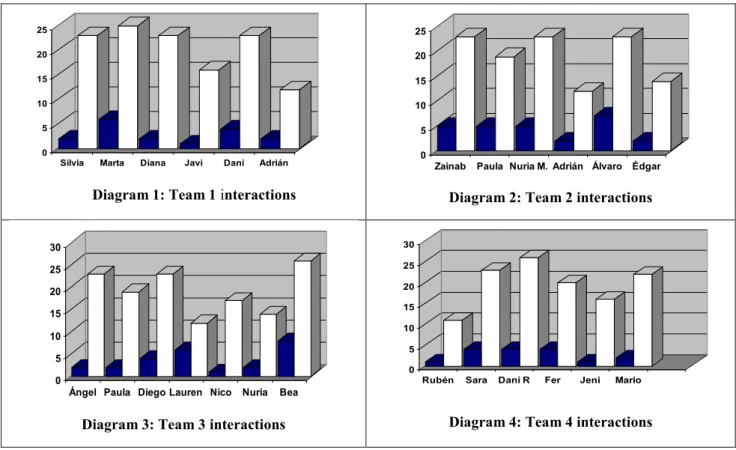
At the risk of making a sweeping generalization, the quantitative analysis of data suggests that Interactive Groups help students develop their communication skills in a second language as they increase their participation. To obtain these data, students’ participation on Interactive Groups sessions were contrasted with students’ participation in ordinary lessons (see diagrams below). For example, during Team 1session (diagram 1), 6 students took part 122 times in total, while during a regular class the same 6 students took part only 17 times in total. In blue we can see the number of times that each student spoke in a regular English lesson, and in white the number of times the same student spoke during an Interactive Groups session. 0 5 10 15 20 25
Silvia Marta Diana Javi Dani Adrián
Diagram 1: Team 1 interactions
0 5 10 15 20 25
Zainab Paula Nuria M. Adrián C.
Álvaro Édgar
Diagram 2: Team 2 interactions
Diagram 3: Team 3interactions
0 5 10 15 20 25 30
Rubén Sara Dani R Fer Jeni Mario
Diagram 4: Team 4 interactions
Interaction and participation are essential when learning a second language; As Aida Walqui (2006: 159) states regarding interaction and learning:
10 All the student’s names used on this research don’t correspond to their real names. The names that will appear in the following lines have been used just to help the reader understand the process and findings better.
0 5 10 15 20 25 30
Ángel Paula Diego Lauren Nico Nuria B.
Making communication happen: Interactive groups in the bilingual classroom
Borja Garrido Encuentro 21, 2012, ISSN 1989-0796, pp. 80-93 89
The primary place by which learning takes place is interaction, more specifically an engagement with other learners and teachers in joint activities that focus on matters of shared interest and that contain opportunities for learning.
During my research I became aware of the fact that if we plan activities in which our students are free to move or to chat to whomever they wish, we have to supervise the activity closely. In my regular classes I could hear some students speaking Spanish while I was talking about the teaching journal with the language assistants. If students feel that nobody is watching them they tend to speak Spanish. It is important that students are supervised for every activity, but especially when working in pairs and groups. This fact highlights the importance of the arrangement of Interactive Groups. Volunteers not only supervise the development of the activity, they also ensure that everyone speaks English in the group. In relation to the first question, it is obvious that if students work under close adult supervision, they will use English more often than if they work unsupervised. If students use English to interact, their communicative skills will improve in the long term as the more they speak English the better they become at using it.
Since Interactive Groups are based on personalized activities, we avoid the use of text books. Text book work reduces the amount of interactions. If we want our students to interact and participate when we are using text books, it is essential that students devote time in each lesson to share ideas and compare results. Unless we teachers provide an alternative way to work on text books, students’ participation in class will remain at a low level. As we can see in diagram 1, in a regular session, one of the students (Silvia) participated only twice whereas in an Interactive Groups session the same student participated 23 times. This issue is closely related not only to students’ participation but also to students’ motivation towards the subject and motivation in general as not being able to participate in interactions, whatever the reason can be, may produce student’s frustration.
Interactive Groups acknowledge as well the potentials gains of group work, and how carefully considered seating arrangements can influence students’ interactions and attitude. For instance students will participate more and exchange information if they are sitting in groups, even if the activity is not really interactive or communication focused. Sitting apart in traditional rows as they often do, doesn’t foster communication at all. Sitting in groups as in Interactive Groups sessions allows for communication to come about more naturally. We humans are social animals, sitting individually and not socializing with anyone is boring and frustrating. This is clearly connected with the social aspect of learning Vigotsky (1978) pointed out. Even more important is the fact that communicative interactions provide students with the right answers. For example, thanks to peer interactions and help, Javi (one of the weakest students in the class) wrote an accurate sentence combining simple past and past continuous: “My mum and I were watching television when the telephone rang.” This was remarkable since Javi (see diagram 1) displays evident difficulties in the second language learning process. He never wants to participate and English frustrates him. Thanks to his classmates and their respectful attitude towards his situation, he was able to write that sentence. The process was documented in the following transcription:
[S1 wrote] “My mum and I was watched television and the telephone ring”
The volunteer took his writing and showed it to the rest of the class, and then I asked students for “suggestions”.
S2:My mum and I is plural. S1: ah! Were watched.
V:No, Students , what do you think? S3: Continuous
Making communication happen: Interactive groups in the bilingual classroom
Borja Garrido Encuentro 21, 2012, ISSN 1989-0796, pp. 80-93 90
S1:were watched? S3: no.
S1 (thought for some seconds and couldn’t find the answer, and then someone spontaneously): S4: ING!
S1: ah!, Were watching.
T: O.k. Javi, do you remember that when two things happened in past, the one that lasts for longer is in past continuous “were watching” and the “interruption” is in past simple?
S1: My mum and I were watching television when the telephone rang
After this, his group clapped spontaneously. His facial expression at that moment appeared to reinforce the view that Interactive Groups technique can be highly effective. It is unlikely that this breakthrough could have been achieved in the traditional classroom organization. This is a clear example of how Interactive Groups dynamic communication can improve not only participation but also grammar accuracy. As the transcription above shows, this student, normally one of the weakest, was able to produce a sentence with a moderate grade of difficulty.
Furthermore, we can also state that Interactive Groups are effective tools for catering for diversity as individual rates of participation increased regardless of initial ability. The same student that participate only twice or three times in a regular lesson, participates more than fifteen times in an Interactive Groups session (i.e. Silvia). The case of Ruben, another struggling student is also notable. Despite the fact of being a class leader, he speaks very little English in class (he has got a very low level). He repeats constantly “Teacher I can’t speak English” (in Spanish of course), something that tremendously embarrasses him. However, as he feels more relaxed and confident thanks to his classmates’ support and help, during Interactive Groups sessions he is able to make sentences such as “In three years time, I will fly in the sky.
In the light of evidence then, it is possible to confirm that Interactive Groups help develop students’ oral communication skills. Work with Interactive Groups not only they foster and increase interactions and participation among students but also contribute to improve grammatical accuracy. Students’ talking time noticeably increases and the teacher-student ratio decreases. Finally, thanks to Interactive Groups we are catering for diversity and promoting aspects like cooperation and solidarity.
5.2 Data analysis and findings related to research question 2
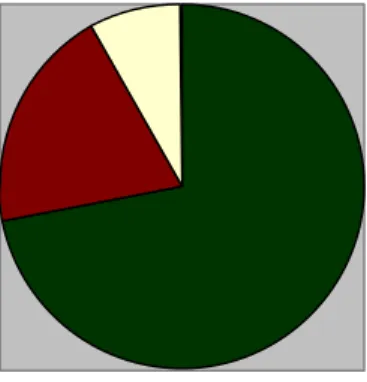
It can also be confirmed that the use of Interactive Groups affects students’ attitude towards learning English. According to the data obtained through the questionnaires, Interactive Groups had a positive effect on students’ attitude towards English. First, the most relevant finding is that 18 out of 25 students consider Interactive Groups as their favourite activity in the English classes.
Making communication happen: Interactive groups in the bilingual classroom
Borja Garrido Encuentro 21, 2012, ISSN 1989-0796, pp. 80-93 91
Interactive Groups (18) Computers (5)
Other (2)
Diagram 5: Number of students who prefer Interactive Groups sessions
Students’ association of English regarding participation, sharing ideas with their friends and having fun, clearly enhances their motivation. If we take into account that students spend a large part of their morning sitting on their chairs for most of their subjects, standing up, walking around the classroom, finding a classmate to talk to is something that will break their routine and, as a consequence, will make them eager to participate and do their best. If we promote activities where movement is involved students will enjoy more. Then, if students have fun and enjoy the class, their attitude towards the subject will necessarily be positive. When the topic is familiar and appealing to students you can see 25 hands in the air, but when the topic is not interesting, hardly anyone raises his/her hand. This important aspect should also be taken into account when designing the activities for the groups; just a simple photograph may change something boring into something appealing. According to the students’ comments, just by attaching a picture to the text provided for the wall dictation, makes students enjoy the activity much more.
Moreover, the student-centred nature of Interactive Groups allows students to feel empowered. This enhanced sense of control makes students more eager to participate in Interactive Groups sessions, and results in their showing a positive attitude towards the subject. Offering students the opportunity to explain activities or providing oral exercises in which students have to give their opinion, point of view, ideas etc., can be challenging but is always motivating. Due to their age, (11-12 years olds) being able to express themselves and to demonstrate their knowledge and ability to the rest of the group is a powerful motivator. Even if students don’t fully understand the teacher’s initial instructions (or don’t pay enough attention), this can be regarded as advantageous instead of a problem since this situation gives an additional opportunity to those students who understood the instructions to explain the activity to the whole group.
Finally, we should always bear in mind that silence is often a guise of frustration. Students usually love to talk about their lives, abilities, what they are going to do or have done at the weekend, etc. and when only a few students can participate, the rest show clear signs of disappointment. When students want to share their ideas with the rest of the class but you do not give them voice, they feel discouraged and it is easy to hear some complaints or see discontent on their faces. Interactive Groups offer any student the possibility to express himself/herself at any moment the activity carried out is in progress.
Making communication happen: Interactive groups in the bilingual classroom
Borja Garrido Encuentro 21, 2012, ISSN 1989-0796, pp. 80-93 92
6. Conclusion
The research has confirmed how Interactive Groups are a highly effective mode of classroom organisation and provide a solution to one of the most demanding challenges teachers of English in Bilingual Primary Schools face everyday: students’ lack of effective oral communication skills.
According to findings related to question 1, it is possible to say that Interactive Groups increase students’ participation, students’ talking time and boost meaningful interaction. As a result, Interactive Groups can accelerate second language learning and differs from other methodologies because it maintains high expectations for all of the students and strives for everyone’s success.
According to findings related to question 2, we can affirm that, due to its intrinsic characteristics, Interactive Groups have a positive effect on student’s attitude towards English. Interactive Groups are based on a student-centred methodology that gives voice to every student in the class and makes them eager to participate during the session.
To conclude, it can be stated that Interactive Groups offer new possibilities to teach foreign or second languages. Nevertheless there are many questions that still have to answered, for instance, can Interactive Groups be used to achieve better academic results? Are they an appropriate tool to help our students pass external exams such as P.E.T. or K.E.T.? Can other subjects like Science be taught through Interactive Groups? Nowadays bilingualism is wide spread all over the world and some new methodological options like Interactive Groups may come up as a response to the demands of bilingual classrooms.
References
Aubert, A., Flecha, A., García, C., Flecha, R., y Racionero, S. (2008). Aprendizaje dialógico en la sociedad de la información. Barcelona: Hipatia Editorial.
Aubert, A., Flecha, A., García, C., Flecha, R., y Racionero, S. (2008). Aprendizaje dialógico en la sociedad de la información. Barcelona: Hipatia Editorial.
Bilingual school programme Comunidad de Madrid (2009):
http://www.madrid.org/dat_este/novedades/historico/octubre2007/Programa%20_bilingue_0708_22_10_07.pdf Bruner, J. (1983). Child´s Talk. New York: Norton.
Cuenca, J. M. ª (1998). “Centro de EPA ‘La Verneda-Sant Martí’. Un pequeño milagro cotidiano”. Cuadernos de Pedagogía, nº 265, pp. 33-40
Donato, R. (1994). Collective scaffolding in second language learning. In J.P. Lantof and G. Appel (eds) Vygotskian Approaches to Second Language Research (pp33-56). Norwood, NJ: Ablex.
Farrell, T. (2007). Reflective Language Teaching. London: Continuum. Flecha, R. (2000). Sharing Words. Lanham, M.D: Rowman & Littlefield
Flecha, R.; Puigvert, L. (2002). Las comunidades de aprendizaje: una apuesta por la igualdad educativa. REXE Revista de estudios y experiencias en educación. Concepción, Chile: Facultad de Educación de la Universidad Católica de la Santísima Concepción, n. 1, v.1, pp. 11-20.
Flecha, R., Padrós, M. & Puigdellivol, I. (2003). Comunidades de aprendizaje: transformar la organización escolar al servicio de la comunidad. Organización y gestión educativa, nº 5, pp. 4-8. Praxis. Barcelona.
Giner, E. (2010). Las aportaciones de Jesús Gómez y Ramón Flecha a las teorías y prácticas dialógicas (1965-2006) nº 35 (volumen 13, 4) de diciembre 2010, de la Revista electrónica Interuniversitaria de Formación del Profesorado. Oliver, E., & Gatt, S. (2010). De los actos comunicativos de poder a los actos comunicativos dialógicos en las aulas
organizadas en grupos interactivos. Special Issue: Communicative acts for social inclusion, Signos, 43(2), 279-294. Racionero, S. & Padrós, M. (2010). The Dialogic Turn in Educational Psychology.Revista dePsicodidáctica,
Making communication happen: Interactive groups in the bilingual classroom
Borja Garrido Encuentro 21, 2012, ISSN 1989-0796, pp. 80-93 93
Ramis, M. & Krastina, L. (2010). Cultural Intelligence in the School. Revista de Psicodidáctica, 2010, 15(2), 239-252. Real Decreto 1513/2006, de 7 de diciembre por el que se establecen las enseñanzas mínimas de la educación primaria.
http://www.boe.es/aeboe/consultas/bases_datos/doc.php?id=BOE-A-2006-21409 Rogers, C.R. (1962). A source for creative thinking. New York: Scribner’s.
Rudduck, J. and Mc Intyre, D. (2007). Improving Learning Through Consulting Pupils (pp74-84) Abingdon: Routledge.
Sánchez Aroca, M. (1999). La Verneda Sant Martí: A school where people dare to dream. Harvard Educational Review, vol. 69, nº3. pp. 320-335. Cambridge: Harvard University.
Stake, R.E. (1998). Investigación con estudio de casos. Morata: Madrid. Syllabus de los colegios bilingües de la Comunidad de Madrid (2005).
http://www.educa.madrid.org/web/cp.machado.majadahonda/pdf/syllabus.pdf Vigotsky L.S. (1978). Mind in Society. Cambridge, MA: Harvard University Press.
Walqui, A. (2006). The International Journal of Bilingual Education and Bilingualism Vol. 9, nº 2 pp. 159-168 Wood D. J. (1988). How Children Think and Learn. Oxford: Blackwell.
Borja Garrido has worked at C.E.I.P. El Olivar since 2005. He has been involved in C.A.M. Bilingual Program for 8 years, teaching English and Science to very young students. Currently he is completing his PhD on Interactive Groups in the Bilingual Classroom. In his research he focuses on the benefits reported by Interactive Groups and Dialogic Learning.