DEVELOPING LITERACY TOOLS IN INDUSTRIAL ROBOTICS
Claudio Urrea, Manuel VegaDepartamento de Ingeniería Eléctrica, Universidad de Santiago de Chile, Santiago, Chile
ABSTRACT
Tools for acquiring “literacy in industrial robotics” by means of active, collaborative and interactive learning are developed and presented in this paper. It describes the design and implementation of new materials which, because of their great versatility, will serve as virtual didactic materials that are truly intuitive and simple to use due to their strong multimedia components. The development of this work will provide excellent learning tools for students from various careers, specialties, majors and levels of university studies. Those students will get to know the foundations of industrial robotics in general, various methodologies for making their mathematical representations and modelling, the main control systems, in addition to diverse topics related to the future applicability and perspectives of that discipline. That is why, among other resources, the new didactic material includes computer simulations whose general purpose is to serve for the practical analysis, validation and implementation of control schemes in industrial robots, 3D computer animations, and a variety of original experimental videos that include qualitative and practical aspects of control algorithms for industrial robots.
KEYWORDS
Conceive, Design, Implement, Industrial Robotics, Operate, Standard: 8
1. INTRODUCTION
Robotics is a science or branch of technology that studies the design and construction of machines capable of doing tasks performed by human beings or that require the use of intelligence. As a multidisciplinary science (automation, informatics, electronics, mechanics, physics, mathematics, etc.) it is continually subjected to new approaches and treatments, so it is a technical discipline present in different types of engineering that have different curriculum objectives.
The industrial robot that is known and used in our days did not arise as a consequence of the tendency or desire to reproduce living beings, but from the need to improve productivity, quality, safety and flexibility in manufacturing processes.
Until the 1980s the use of industrial robots was concentrated on repetitive tasks that did not require high precision. These were relatively simple tasks, such as machine maintenance, transfer of materials, painting, and welding. As time has gone by, industrial robots have become increasingly viable in applications that require greater precision and sensory sophistication, such as assembly tasks, for example. However, it is in the automotive industry where robots have been economically justified since the 1970s, and it continues to be the leading user. What is characteristic of industrial robots is their structure in the shape of a mechanical arm, and their adaptability in terms of different holders or tools.
At present, thanks to the incorporation of robotized systems, the development of industrial processes has caused a large increase in productivity, performance and product quality. However, insofar as technological advances allow a greater degree of automation, the
complexity of robotized systems also increases because of the greater number of components and therefore so does the ever increasing degree of professional training required by this discipline, which is reflected in the professional demands at the level of workers, technicians, design, simulation, implementation, etc. It is in this context that the teachers must care not only for the expected learning, identifying the students' styles and learning rhythms, but also for the way in which they get to learn them, which invariably demands the development of abilities, while promoting in parallel the values and attitudes toward the topics that are studied. Within this context, at present it is necessary to make a proposal like the one established in this paper, because even though it is true that there is a large number of study texts in robotics, like some of those included in the bibliographic references of this paper, unfortunately many of them are conceived to deliver very superficial or very deep contents, but in a very tedious manner due to the high analytical-mathematical complexity that the study of robotics implies, oriented at a universe of students who have already acquired a rather specialized language in the technical-scientific field, leaving aside and segregating students who require this kind of knowledge delivered in a simple and not encrypted manner, as usually is the case.
There are several companies that disclose issues related to robotics through the Internet, but unfortunately, as shown by the literature references cited in this paper, those companies are basically business-oriented and their objective by spreading robotics is only to sell their products. There is other work that promotes robotics through the Internet, aimed at organizing tournaments and competitions between some kinds of educational robots only as entertainment. It is not easy to find multimedia platforms beyond simple web pages that allow considering various levels for learning robotics, because in general these platforms deal only with rather specific issues of this discipline.
In view of this need that has been detected, the new didactic material that is currently being developed and implemented in a multimedia platform is not simply the accumulation of sentences, but it has its own organization, allowing the students to go deeper, thanks to its multimedia design, into the basic, intermediate and advanced knowledge levels. This diversity of knowledge levels is necessary because the students will require, as they advance in their university studies aimed at getting a professional degree, the vision of robotics from very diverse perspectives depending on the chosen specialty major. This is possible thanks to the design of hyperlinks, image galleries, footnotes, interactive images, 3D animations, and other multidimensional links that enrich the understanding and comprehension of the contents of the new didactic material under development; allowing great versatility and specificity in the acquisition of knowledge.
2. LITERACY IN INDUSTRIAL ROBOTICS
Going over the literature on teaching robotics in the classroom, international experience shows that the insertion of educational robotics in pedagogical practice by university research centers has started from "literacy in robotics", which has to do with knowledge of the basic concepts, to the more sophisticated uses referring to mathematical representations of machines, computer simulations of equipment, archetypes of robots, or basic models for assembly in industry, etc. That is why this paper presents the development of tools for active, collaborative and interactive learning of industrial robotics that allows going, in a personalized and intuitive manner, over various levels in the learning of this area of robotics.
3. METHODOLOGY
The methodology for the development of tools that will facilitate achieving “literacy in industrial robotics” by the students includes the design and implementation of new didactic
materials for active, collaborative, and interactive learning of industrial robotics in the field of industrial robotics, its present applications, and future perspectives. The following is therefore proposed:
To develop a new study text that will deliver knowledge and tools in a simple and intuitive manner.
To design and implement multimedia resources with original contents, using hyperlinks, 3D animations, etc., that enriches the understanding and comprehension of the contents of the new study text.
To acquire theoretical and practical tools that allow the students to distinguish among situations in which industrial robotics is applied.
To implement the newly created study material and the newly designed multimedia tools in a multimedia platform.
The methodology that describes a set of procedures for the development of tools that can facilitate acquiring “literacy in industrial robotics” is presented below.
3.1 Planning
Definition of the kind of study materials to be developed. Selection of the multimedia materials to be developed. Selection of the type of multimedia platform to be used. Consideration of scalability.
Definition of the design. 3.2 Production
Visual design and inclusion of the new information (new study text + multimedia material) that will be implemented.
Carrying out tests and validations of the implementation made. Positioning with respect to other works of this kind.
Applicability by the students. 3.3 Maintenance
Upgrading and improvement. Maintenance over time. Local and national positioning.
4. DEVELOPMENT STAGES OF THE WORK
Stage 1: Creation of a new study text in the area of industrial robotics that will include the following topics:
Description of industrial robots. Kinematics of manipulators. Dynamics of manipulators.
Planning and generation of trajectories. Control of industrial robots.
Stage 2: Design of: hyperlinks, image gallery, footnotes, interactive images, 3D animations, and multidimensional links that enrich the understanding and comprehension of the contents of the new study text.
Stage 3: From the new study text created in Stage 1 and from all the multimedia material developed in Stage 2, the process needed to implement these contributions takes place in this stage, uploading its contents to a multimedia platform.
Stage 4: Make tests and validations of the results of the implementations.
5. ADVANCES OF THE IMPLEMENTATIONS
According to the tool development methodology presented in section 3 of this paper, the advances of the implementations carried out to date are presented below.
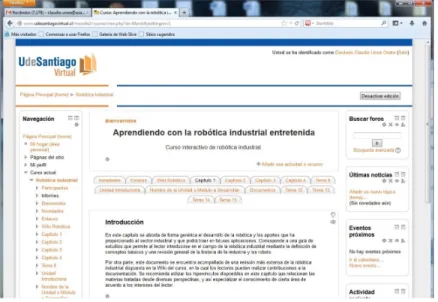
After the creation of a new study text that includes the topics of the industrial robotics area described in “Stage 1”, a multimedia work platform called “MOODLE 2.0” (Modular Object-Oriented Dynamic Learning Environment) was selected, corresponding to a web application of the virtual educational environment type, with free distribution, that helps educators to create online learning communities. The reason for choosing this multimedia platform is that its design is based on constructivist pedagogy, in which knowledge is constructed in the mind of the student instead of being transmitted without changes from books or through teaching, and on collaborative learning. The teacher that uses this multimedia platform creates a student-centered environment that helps the students build knowledge based on their own skills and knowledge -but considering the contributions delivered by the educator- instead of the teacher simply publishing and transmitting the information which he considers that the students must know. Another advantage of using this multimedia platform is that it allows group interaction and at the same time it allows private conversation between the students. This tool can be accessed at http://www.udesantiagovirtual.cl/moodle2/login/index.php, where the students registered in this course must enter their own “user name” and “password”. After entering, the student will see the following screen:
Figure 1. Entry screen to the learning tool.
As seen in Figure 1, the student can choose either links of academic interest, wikis on robotics (information relevant to the diversity of robotics, including history, technology, etc.), chapters with course contents, etc.
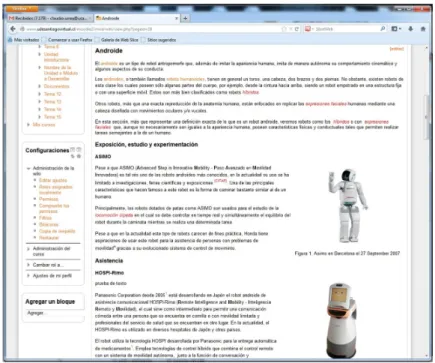
Once the student has selected to visit the course contents, if he chooses the first chapter the screen shown in Figure 2 will appear, where the information can be read directly from the screen or it can be downloaded in pdf format to be studied later. Every chapter has hyperlinks that will let him go more deeply into every stage of the study, but this will depend on the emphasis that it is desired to give to each topic within the vast range of knowledge considered in this tool for “literacy in industrial robotics”.
Figure 2. Screen: “The concept behind the term robotics”.
Figure 3 shows hyperlinks related to other robotics settings that allow the students to achieve learning beyond industrial robotics itself.
Following the methodology for the development of this tool, work is currently being done on: Complementing its visual design, i.e., hyperlinks, image gallery, footnotes, interactive
images, 3D animations, and multidimensional links that will enrich the understanding and comprehension of the contents of the newly implemented interactive study text.
Making tests and validations of the implementation. Positioning with respect to other works of this kind. Applicability by the students.
Once this production is ended, maintenance of this tool over time will be performed, considering upgrades and improvements according to suggestions that may be delivered by the users (students) themselves.
6. EXPECTED RESULTS
To have new interactive study materials that stimulate active, collaborative and interactive learning in the setting of industrial robotics, its present applications and future perspectives, in a simple, intuitive and non-encrypted manner, that will have a significant impact on the formative process of the students thanks to the acquisition of theoretical and practical tools that will allow them to distinguish among situations in which industrial robotics participates in national reality.
7. EXPECTED IMPACTS
Consolidation of a teaching-learning process related to the integral training approach of graduate and undergraduate students.
Increasing student retention rates thanks to the active, collaborative and interactive learning process.
Graduates with the best labor insertion.
Contributing to the continuous strengthening of the institutional activities of the Universidad de Santiago de Chile.
8. CONCLUSIONS
The teaching of robotics in classrooms, as presented in this paper is a pertinent and contemporary resource with didactic rather than technological purposes that allows following the road of pedagogical renewal. This, like any change, requires effort and dedication, and whose ultimate purpose is to improve the quality of education in the local and national settings, because it will be providing knowledge and developing the skills needed for performing well in the study of this discipline, facilitating the understanding of written matter and the comprehension of knowledge. A significant impact on professional, academic, and labor success and on the students' personal development is expected. In general, students can behave very early as young scientists and engineers if they are given the proper tools and they are allowed to apply basic principles of scientific research such as observing, testing, comparing and contrasting phenomena related to robotics, predict their operation, and record their individual and collaborative experience. That is why this paper offers an improvement of the institution's ability to generate effective learning in graduate and undergraduate students in the industrial robotics setting, considering all its transverse and multidisciplinary character.
BIBLIOGRAPHIC REFERENCES
Acuña, A. (2004). Robótica y aprendizaje por Diseño. EDUCACIÓN AÑO XLVIII- XLIX, 139-140, I-II. http://www.educoas.org/portal/bdigital/lae-ducacion/home.html
Alimisis, D. (2012). Robotics in Education & Education in Robotics: Shifting Focus from Technology to Pedagogy, In Proceedings of the 3rd international conference on Robotics in Education, RiE2012. September 2012, pp. 7-14. MatfyzPress, Czech Republic.
Angulo, J. M. (1985). Curso de Robótica, 2nd edition, Paraninfo, Madrid, Spain.
Angulo, J. M. (1996). Robótica Práctica: Tecnología y Aplicaciones, 4th edition, Paraninfo, Madrid, Spain.
Andeen, G. (1988). Robot Design Handbook, McGraw Hill, New York, USA.
Ángeles, J. (1997). Fundamentals of Robotics: Mechanical System, Theory, Methods and Algoritms, Springer, New York, USA.
Arratia, J. (1985). Introducción a la Robótica industrial, Instituto Profesional de Valdivia, Departamento de Electricidad, Valdivia, Chile.
Asada, H. (1986). Robot Analysis and Control, John Willey, New York, USA.
Asociación de Robótica Educativa Complubot (2014). Complubot, EducaMadrid, Madrid, Spain. http://complubot.educa.madrid.org/nosotros/nosotros_index.php?seccion=nosotros
Barrientos, A. (1997). Fundamentos de Robótica, 1st edition, McGraw Hill, Madrid, Spain. Brady, M. (1982). Robot Motion: Planning and Control, MIT Press, Cambridge, England.
CEAR (2014). Robótica Educativa, Centro de Estudios de Argumentación y Razonamiento, Universidad Diego Portales, Santiago, Chile.
http://www.cear.udp.cl/docencia/robotica-educativa/
Craig, J. (1988). Adaptive Control of Mechanical Manipulators, Addison-Wesley, New York, USA. Craig, J. (1989). Introduction to Robotics Mechanics and Control, Addison-Wesley, New York, USA. Critchlow, A. (1985). Introduction to Robotics, McMillan, New York, USA.
Engelberger, J. (1985). Los Robots Industriales en la Práctica, Deusto, Bilbao, Spain. Ferrada, P. (2014). Robótica Educativa,Universidad de Concepción, Concepción, Chile. http://www.roboticaeducativa.udec.cl/
Fu, K. (1988). Robótica: Control, Detección, Visión e Inteligencia, 1st edition, McGraw Hill, Madrid, Spain.
Fulle, J. (1991). Robotics: Introduction, Programming, and Projects, 3rd edition, Macmillan, New York, USA.
Gatica, N.; Ripoll, M. and Valdivia, J. (2005). La Robótica Educativa como Herramienta de Apoyo Pedagógico. Las TIC en el Aula, Madrid: Anaya, Spain.
Groover, M. (1989). Robótica industrial: Tecnología, Programación y Aplicaciones, McGraw Hill, Madrid, Spain.
Grupo SIRP (2014). Robótica el Descubierto, Licencia Creative Commons 3.0. Plantilla Picture Window. http://solorobotica.blogspot.com/p/proyectos-de-robotica-educativa.html
Harrison, D. (1986). Robots: Su Estudio con Ayuda del Ordenador, Anaya, Madrid, Spain. IRE (2014). Taller de Robótica Escolar, Interescolar de Robótica Educativa, Chile. http://www.interescolarderobotica.cl/
Kelly, R. (2005). Control of Robot Manipulators in Joint Space, 1st edition, Springer Verlag, London. Klafter, R. (1989). Robotic Engineering: An Integrated Approach, Engledwood Cliffs, New York, USA. McComb, G. (2001). The Robot Builder’s Bonanza, 2nd edition, McGraw Hill, New York, USA.
Merino, E. (2014). Robot educativo mOway, EDUTEKA, Portal Educativo gratuito de la Fundación Gabriel Piedrahita Uribe (FGPU), Cali, Colombia.
http://www.eduteka.org/moway.php
ivoox (2014). Robótica Educativa como herramienta para desarrollo de competencias, ivoox audioKiosko, Barcelona, Spain.
http://www.ivoox.com/robotica-educativa-como-herramienta-para-desarrollo-competencias-audios-mp3_rf_1635795_1.html
Minsky, M. (1985). Robotics, Ovni Press, Garden City, New York, USA.
Murray, R. (1994). A Mathematical Introduction to Robotic Manipulation, CRC Press, Boca Raton. National Aeronautics and Space Administration (2014). Educational Robotics Matrix, National Aeronautics and Space Administration (NASA), USA.
http://robotics.nasa.gov/edu/matrix.php
Nehmzow, U. (2000). Mobile Robotics: a Practical Introduction, Springer-Verlag, London.
Niku, S. (2001). Introduction to Robotics: Analysis, Systems, Applications, Prentice Hall, New Jersey, USA.
Pawson, R. (1986). El Libro del Robot, Gustavo Gili, Barcelona, Spain. PerúEduca (2014). Robótica Educativa, Ministerio de Educación, Peru. https://sites.google.com/site/roboticamed/
Pires, J. (2006). Welding Robots: Technology, System Issues and Applications, Springer Verlag, London.
Pires J. (2007). Industrial Robots Programming: Building Applications for the Factories of the Future, Springer Verlag, New York, USA.
Rentaría, A. (2000). Robótica industrial: Fundamentos y Aplicaciones, 1st edition, McGraw Hill, Madrid. Reyes, F. (2011). Robótica: Control de Robots Manipuladores, Marcombo, S.A. Alfaomega.
Robotero RO-BOTICA (2014). Robótica educativa para educadores y pedagogos, ROBOTEROS.com La Red Social de Robótica Personal, Barcelona, Spain.
http://roboteros.com/group/robotica-educativa-para-educadores-y-pedagogos Robótica Educativa de México S.A. (2014). Róbo-Ed, Escuelas Róbo-Ed, Mexico. http://roboticaeducativa.com.mx/
Sánchez, M. (2004). Ambientes de Aprendizaje con Robótica Pedagógica. Tecnologías de Información y Comunicaciones para la Enseñanza Básica y Media.
http://www.eduteka.org/RoboticaPedagogica.php
Sandler, B. (1999). Robotics: Designing the Mechanism for Automated Machinery, 2nd edition, Academic Press, San Diego, USA.
Schilling, R. (1990). Fundamentals of Robotics: Analysis and Control, Prentice-Hall, New York, USA. Schmitt, N. (1988). A Fondo: Robótica y Sistemas Automáticos, Anaya Multimedia, Madrid, Spain. Sharon, D. (1987). Robotics and Automated Manufacturing, 1st edition, Pitman Publishing, London. Silva, M. (1983). Inteligencia Artificial y Robótica Industrial, Zaragoza, Secretariado de Publicaciones, Universidad de Zaragoza, Spain.
Skowronski, J. (1989). Control Theory of Robotic Systems, World Scientific, Singapore.
Spong, M. (1993). Robot Control: Dynamics, Motion Planning, and Analysis, Institute of Electrical and Electronics Engineers, New York, USA.
Spong, M. (1989). Robot Dynamics and Control, John Wiley & Sons, New York, USA. Spong, M. (1989). Robot Modeling and Control, John Wiley & sons, New York, USA. RobotShop (2014). Robotics Education, RobotShop, USA, Canada & Europe. http://www.robotshop.com/en/robotics-education.html
Thomas, D. (1991). Planning and Control, M. Kaufmann Publishers, California, USA.
The Robotics Academy (2014). LEGO, the LEGO logo and MINDSTORMS, The National Robotics Engineering Center, Carnegie Mellon University, Pittsburgh, USA.
http://www.education.rec.ri.cmu.edu/
The Robotics Education & Competition Foundation (2014). Inspiring students, one robot at a time, The Robotics Education & Competition Foundation (REC), Rockwall, Texas, USA.
http://www.roboticseducation.org/
BIOGRAPHICAL INFORMATION
Claudio Urrea, Ph.D. is currently Professor at the Electrical Engineering Department, Universidad de Santiago de Chile, from 1998. He has developed and implemented a Robotics Laboratory, where intelligent robotic systems are development and investigated. He is currently Director of the Doctorate in Engineering Sciences, Major in Automation, at the Universidad de Santiago de Chile.
Manuel Vega, M.Sc. is a Senior Lecturer at the Electrical Engineering Department of the Universidad de Santiago de Chile. He got his Master Degree at Mc Gill University, Canada. His teaching interests include digital electronics, microcomputers and robots. He has been actively involved in the design and development of introduction to engineering courses. Corresponding author
Dr. Claudio Urrea
Universidad de Santiago de Chile Avenida Ecuador 3519
Estación Central, Santiago, Chile. 56-2-27183350
This work is licensed under a Creative Commons Attribution-NonCommercial-NoDerivs 3.0 Unported License.