FROM CORRUPTION TO INTEGRITY
-
THE GOVERNMENT ANTI-CORRUPTION
STRATEGY
FOR THE YEARS 2013 AND 2014
approved by
the Government Resolution No. 39 of 16
thJanuary 2013
as amended by
the Government Resolution No. 381 of 22
ndMay 2013
the Government Resolution No. 851 of 13
thNovember 2013
Office of the Government of the Czech Republic
The Government Anti-Corruption Department
Table of Contents
I. Government’s AntiCorruption Declaration ... 4
II. Corruption in the Czech Republic and its perception ... 5
1. Introduction ... 5
2. Defining corruption ... 7
3. Perception of corruption ... 9
-3.1. How serious issue is corruption in the eyes of the Czech people? ... - 9 -
3.2. International indexes comparing the general corruption rate of countries ... - 11 -
3.3. Concrete experience of citizens regarding corruption – “self -reports” ... - 14 -
3.4. Development trends of corruption in the Czech Republic ... - 15 -
3.5. Which part of the society is most affected by corruption according to the Czech respondents? ... - 16 -
3.6. Corruption climate ... - 20 -
3.7. Opinions about the Government’s Anti-Corruption Policy and desirable measures and solutions for corruption ... - 21 -
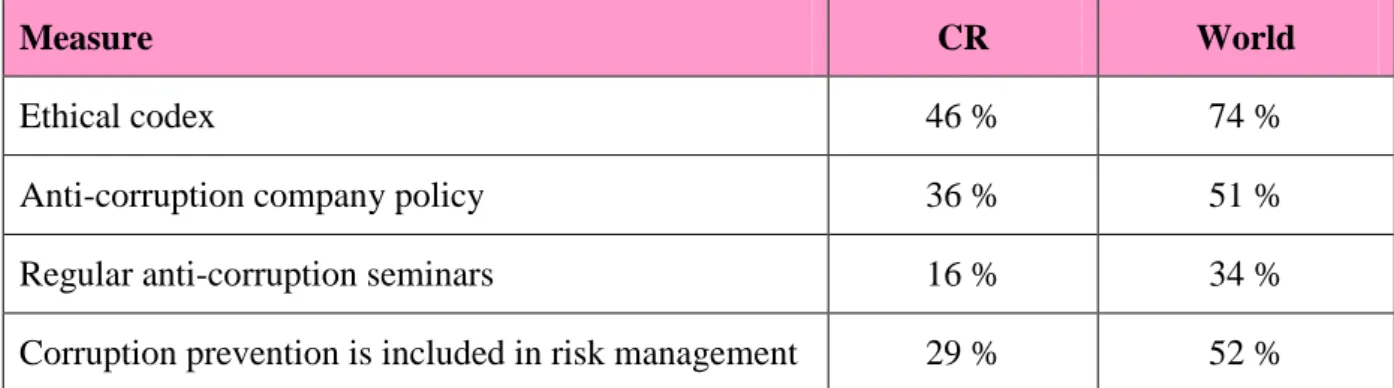
3.8. What is the willingness of Czech citizens to participate in anti-corruption activities? - 22 - 3.9. The business sector ... - 23 -
3.10. The conclusion of the chapter on the perception of corruption ... - 26 -
4. Qualitative analysis of the economic context of corruption ... 27
-4.1. Economic costs of corruption ... - 27 -
4.2. State and municipal companies ... - 29 -
4.3. Territorial self-government ... - 31 -
4.4. Organized crime and money laundering ... - 32 -
4.5. Public contracts ... - 33 -
4.6. Conclusion of the chapter on qualitative analysis of economic aspects of corruption - 35 - 5. Uncovering and investigating corruption ... 35
-5.1. Analysis of available statistics ... - 35 -
5.2. Using special tools of the Criminal Code ... - 40 -
5.3. Conclusions of analyses of court rulings ... - 41 -
5.4. Conclusion of the chapter on the uncovering and investigation of corruption .... - 45 -
III. Strategic directions ... 46
1. Results and outcomes of the analytical part ... 46
2. Fundamental directions of the AntiCorruption Strategy ... 47
-A) Professionalization of the state administration ... - 47 -
B) Administration of public resources ... - 48 -
C) Improving the anti-corruption tools in private sector ... - 49 -
D) Strengthening of the political system and improving the transparency of political parties ... - 50 -
E) Uncovering, investigation and prosecution of corruption ... - 51 -
F) Improving the anti-corruption climate in the Czech society ... - 52 -
G) Creating capacities for monitoring of corruption, formulation of the Anti-Corruption Strategy and its monitoring and coordination of individual steps. Strengthening of the resources for implementation of the Anti-Corruption Strategy. ... - 52 -
H) Improving the transparency of the public sector ... - 54 -
IV. List of Anticorruption Measures ... 55
-1.1. Public Servants Act ... - 55 -
1.2. Conflict of Interest Act ... - 57 -
1.3. Act on Free Access to Information ... - 61 -
1.4. Revealing end owners ... - 63 -
1.5. Protection of whistleblowers ... - 63 -
1.6. Financial control and audit ... - 65 -
1.7. State ownership policy ... - 66 -
1.8. Strategy and methodology of public procurement ... - 71 -
1.9. Act on Public Prosecutor´s Office ... - 72 -
1.10. Anti-corruption programme ... - 73 -
2. Public Administration ... 74
-2.1. Officials ... - 74 -
2.1.1.Human Resources in Public Administration ... 74
-2.2. Active Disclosure of Information... - 75 -
2.2.1.Open Data ... 75
-2.2.2.Disclosure of Contracts and Bids ... 76
-2.2.3.Transparent State Budget... 78
-2.2.4.Disclosure of Advisors and Advisory Bodies ... 79
-2.3. Increasing Transparency of the Legislative Process ... - 80 -
2.3.1.eCollection and eLegislation ... 80
-2.3.2.Disclosure of Every Stage of the Government’s Legislative Process ... 81
-2.4. Tasks from the Preceding Strategy ... - 82 -
2.4.1.Enforceability of the Supreme Audit Office Inspections ... 82
-2.4.2.Registry of Offences ... 82
-2.4.3.Disclosing Offers to Sell and Lease StateOwned Property ... 83
-2.4.4.Improving Efficiency of Measures to Prevent Corruption and Useless Bureaucracy in Immigration (Visa) Procedures ... 84
-3. Public Procurement ... 85
-3.1. Public Investments and Electronization of Public Procurement ... - 85 -
3.1.1.Analysis of Potential Establishment of an Office for Public Investments ... 85
-3.1.2.Strengthening Electronization of Public Procedures ... 85
-3.2. Small-Scale Public Contracts ... - 87 -
3.2.1.Methodology for the Awarding of SmallScale Public Contracts ... 87
-3.2.2.Awarding of Public Contracts Cofinanced from EU Funds ... 87
-4. Law Enforcement Authorities ... 89
-4.1. Amendments to Criminal Law Regulations ... - 89 -
4.1.1 Amendment to the Criminal Code ... 89
-4.2 Availability of Information on Ownership Structures of Legal Entities ... - 90 -
4.2.1 Providing Information on Ownership Structures of Legal Entities to Law Enforcement Authorities ... 90
-4.3 Tasks from the Preceding Strategy ... - 90 -
4.3.1 Reliability Tests ... 90
-4.3.2 Bank Secrecy ... 91
-4.3.3 Tax Secrecy ... 93
-4.3.4 Management of the Seized Assets... 94
-4.3.5 Removal of Assets... 95
-5. Education ... 97
-5.1 Education of the Young ... - 97 -
5.1.1 Education of Children and Pupils in Schools and Educational Facilities .... 97
5.2.1 Rules for Education of Employees of Public Administration Authorities ... 99
-5.2.2 Education in the Form of eLearning ... 99
-5.3 Education of Law Enforcement Authorities ... - 100 -
5.3.1 Joint Education of Law Enforcement Authorities ... 100
-5.3.2 Education of Policemen ... 101
-5.4 Education of Customs Servants ... - 102 -
5.4.1 Education of Members and Employees of the Customs Administration of the Czech Republic ... 102
-5.5 Education of the Prison Service Staff ... - 102 -
5.5.1 Education of Members and Employees of the Prison Service of the Czech Republic ... 102
-6. Other ... 104
-6.1 Institutional Provisioning for the Fight with Corruption ... - 104 -
6.1.1 Analysis of Options to Establish AntiCorruption Agency ... 104
-6.1.2 Analysis of Options to Appoint Information Commissioner ... 105
-6.2 Internal Anti-Corruption Programs ... - 106 -
6.2.1 Departmental Internal AntiCorruption Programs... 106
-6.3 Transport Development ... - 107 -
6.3.1 Strategy of Transport Infrastructure Development ... 107
-6.4 Tasks from the Preceding Strategy ... - 108 -
6.4.1 Availability of Information on the Fight with Corruption ... 108
-6.4.2 Prevent Manipulation of Counsels Designation ... 108
-6.4.3 Supervision over Distrainment Activities ... 109
-6.4.4 Eliminate Manipulation with Notarial Documents ... 109
-6.4.5 Supervision over Courts ... 110 -6.4.6 Reinforcement of Protection of the Public Interest in Administrative Judiciary ... -
-I. Government’s Anti-Corruption Declaration
VISION:
FROM CORRUPTION TO INTEGRITY
The Government hereby presents its Anti-Corruption Strategy for the years 2013 and 2014 (hereinafter only “Strategy”), which follows the Government’s Anti-Corruption Strategy for the years 2011 and 2012. The mentioned documents are a result of the Government Resolution No. 283 of 4th August 2010, the Coalition Agreement on the Formation of a Coalition of Budgetary Accountability, the Rule of Law and the Fight Against Corruption as well as other documents containing bases for formulating the anti-corruption measures. The Government understands that effective Anti-Corruption Policy must be comprehensive and long-term oriented. A change in the corruption situation in the Czech Republic will not be caused by a simple implementation of a new law or personal measure. The Anti-Corruption Policy must go through the standard process of public policy execution, which lies in formulating targets and measures, their fulfilment, monitoring, evaluation and refinement. The Government also understands that having a professional and open public administration is necessary to adopt conceptual, systematically interconnected, solutions. Those must be implemented so that in the end, they will not be contra-productive and will lead to general satisfaction of the majority of the Czech population with public service and its credibility. Transparency of the public administration is a long-term goal and to achieve it is necessary to have a close cooperation and targeted dialogue across the whole political spectrum, expert public and civil society.
Therefore, the Government sets its main goal to focus on ensuring transparency, professionalization and stability of the public administration. It is also necessary to remove pro-corruption factors in the private sphere. Along with the mentioned areas, the Government is focusing on improving the efficiency and independence of the law enforcement authorities. The Government believes that each significant project aiming at a particular goal, which the Strategy undoubtedly is, needs to have personal, material and financial support. The Government’s priority is not to create brand new institutions and adopt special laws; although without independent institutional background, it is not possible to reach the goals in a way the public expects. However, the proposed measures might not be efficient enough. Despite the continuing economic crisis and the Government budget cuts, it is desirable to allocate funds from the state budget to increase the transparency of the public administration, since the allocated funds will certainly render a good return on investment by eliminating corruption in the public sector, improvement of the status of the law enforcement authorities and result in the improvement of the social climate, credibility of the Czech Republic for foreign investors and the improvement of the standard of living for the citizens of the Czech Republic.
It follows from the above mentioned that the goal of the Strategy is to improve the enforceability of law, improvement of the efficiency and the functioning of the public service and elimination of the corruption potential in the public administration. To achieve that, it is necessary to gradually adopt anti-corruption measures constructed so that they will not cause substantial doubts about their efficiency and that their implementation will reduce the corruption climate in the Czech Republic.
II. Corruption in the Czech Republic and its perception
1. Introduction
The scale and nature of corruption in the Czech Republic are not systematically and long-term empirically monitored. Nevertheless, the accurate targeting of the Anti-Corruption Policy requires accurate information about the scale and nature of corruption and the “modus operandi” of a typical corruption activity. If such information are not available, the discussion about the Anti-Corruption Policy measures is based more on media reality, personal experience and images of its actors rather than being based on statistics and precise information.
Today, there is a lot of different material enabling us to roughly identify the scale of the corruption problem in the Czech Republic, the typology and prevalence of corruption activities and the anti-corruption potential in the society. On the other hand, the existing empirical and other analytical documents do not enable us to unambiguously describe
a “map” of corruption and it’s the trends of its development. This is true specifically for police and judicial statistics, which provide information about the activities of these bodies, but do not reflect the rate of corruption in the Czech Republic and its development.
The absence of credible data about corruption sometimes leads to conclusions that corruption is not widespread in the Czech Republic and that it is only a fringe phenomenon related to individuals without any systematic nature or corruption being an artificial bubble created by the media. Or maybe corruption is exaggerated and the Czech Republic is being portrayed as one of the most corrupt states of the world. Academic research of this phenomenon is therefore an important tool against various clichés connected to this issue. That enables us to aim the Anti-Corruption Policy and its tools at the heart of the problem, not just scratching the surface.
The available empirical sources and the qualitative analysis help us to answer the following questions:
How serious is the social perception of corruption in the Czech Republic?
(The answer to this question will help us to prioritize the tasks of the Anti-Corruption Policy)
What is the scope of corruption in the Czech Republic compared to other countries in international indexes?
(The answer will show how the Czech Republic is perceived by foreign investors and what is the standing of the Czech Republic among comparable countries in Central Europe)
What is the real experience of respondents with accepting or offering bribes?
(The answer will show which part of the population gives or receives bribes on a regular or semi-regular basis)
(The answer will show that it is possible to find clear development trends in the perception of corruption in the Czech Republic and will open the question of evaluating the efficiency of the Anti-Corruption Policy)
Which sectors of the society are, in the opinion of the respondents, strongly infested with corruption?
(The answer will hint at the corruption burden of individual sectors and will show necessary aims of the Anti-Corruption Policy)
What is the corruption climate in the Czech Republic? I.e. what is the willingness of the respondents to resort to corruption as a solution for their needs or problems? (The answer will show to what extent is the corruption viewed as a necessary part of life and a necessary evil or to what extent it is considered a vice, which the people wish to minimize)
What are the opinions on the Government’s Anti-Corruption Policy?
(The answer will provide feedback to how the people perceive the efficiency of the Anti-Corruption Policy)
How are the respondents willing to participate in the anti-corruption effort?
(The answer will show us the level of active public support which the Government may count on)
What is the anti-corruption potential of the private sector?
(The answer will show how corruption is affecting the private sector and how is the private sector prepared and willing to participate in combating corruption)
What are the economic consequences of corruption in the Czech Republic? (The answer will roughly show the economic costs of corruption)
How successful and efficient is the investigation of corruption?
(The answer will show us what are the corruption prosecution possibilities and its manifestations in the Czech Republic, what tools are available and how are they used) It is necessary to point out that the real corruption rate and its virtual media picture are quantities affecting each other and which affect the psychology of individual actors of corruptive relations. Conviction that a bribe is necessary to ensure some results affects the decisions of an individual, who then more often considers the bribe as an effective tool to achieve his/hers goal. On the other hand a strong, visible and credible Anti-Corruption
Policy reduces the willingness of individuals to use bribes as means to achieve their goals and strengthens their anti-corruption mind-set.
It follows from the above that even if the real corruption rate was significantly lower than what the general belief and media picture suggests, a robust Anti-Corruption Policy has its meaning, as it battles the strengthening of corruption climate in society.
2. Defining corruption
The term corruption covers social phenomena which differ in their nature. There are different forms of bribes (money, payment in kind, reciprocal service, social advantages), sizes of bribes (from several hundred CZK to hundreds of millions), numbers of interested persons (from two to dozens), variable difficulty (from primitive handover of the bribe to elaborate cash flows) and the duration of the processes (from one-time corruption to long-term organized activity). Aside from bribery, the main forms of corruption are nepotism and clientelism.
There is a number of approaches to the classification of corruption forms. For example the GfK agency uses for the purpose of their surveys a classification into 4 types:
Banal corruption: petty corruption of a common person, which includes e.g. various gifts, non-taxed payments to craftsmen etc.
Municipal corruption: corrupt activities of public administration workers at the local level;
Large individual corruption: corrupt behaviour of high state clerks, politicians and people from the private sphere;
Large institutional corruption: corrupt activities, which is done by individual in favour of institutions (political parties).
A more simple and perhaps more accurate classification is the one that separates petty corruption of common clerks, police servants and public service providers, i.e. “the common life” corruption and “big corruption”, connected to stealing and abusing of public funds, benefits from privatization etc.1
Differences in the individual corruption types are shown in the following summary (table 1).
Table 1: Overview of differences in various corruption types
Characteristic Petty corruption based on bribery
Organized corruption and systematic abuse if public resources
Relationship of the briber and the bribed
Situational character Systematic, prepared, long-term
Amount of resources Small, usually cash Large resources
1
Dančák, B., Hloušek, V., Šimíček, V. Korupce. Projevy a potírání v České republice a v Evropské unii. Brno: 2006, p. 13.
related to corruption
Financial transfers Cash handover Funds go through
a sophisticated complex of channels or it can also be a barter
Discoverability by common monitoring tools
Easily traceable Unlawful behaviour is difficult
to trace or to qualify, sometimes the behaviour is not sanctioned by law at all
Level of organization and secrecy
No networks, relatively low level of secrecy
A network is necessary for execution of the plan
Investigation Use of operative tools is efficient, investigation is simple, the issue lies in the number of cases
Very difficult, necessary cooperation of various bodies, often possible to prosecute only a part of the organized
corruption
Source: Transparency International – Czech Republic 2012, own sources
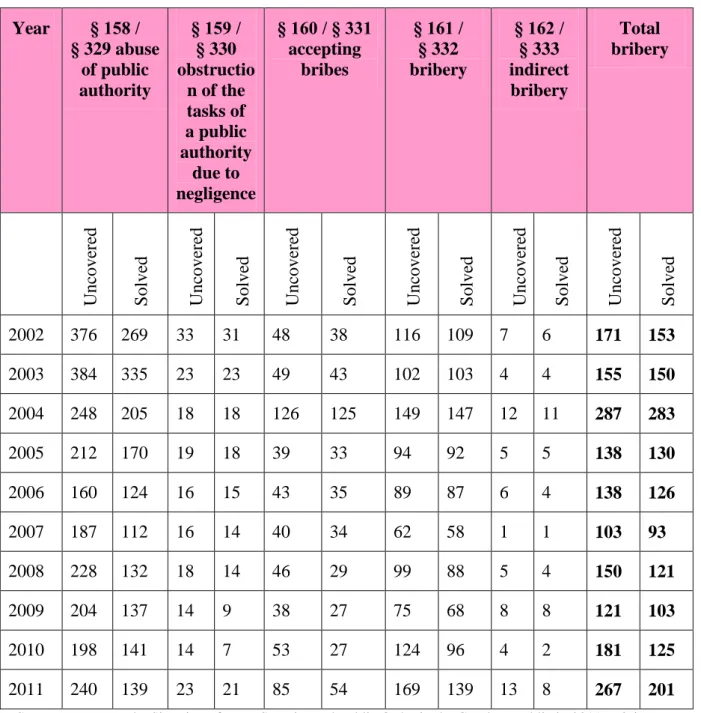
It is sometimes difficult to subsume the real behaviour under the definition of corrupt behaviour used in the Criminal Code. For the use in police statistics the corrupt activities include particularly: accepting a bribe (§ 331), bribery (§ 332), indirect bribery (§ 333), intrigue in bankruptcy proceedings (§ 226), breach of rules of the economic competition [§ 248 section 1 letter e)], arranging advantages when issuing a public contract, during a public tender and public auction (§ 256 par. 1, 3), intrigue when issuing a public contract and during a public tender [§ 257 par. 1 letter b) a c)]2
, or intrigue during a public auction [§ 258 par. 1 letter b) a c)]. Due to the fact that the new Criminal Code came into effect rather recently (§ 2 of the Criminal Code), it is always necessary to consider similar criminal acts according to the Criminal Act No. 140/1961 Coll.
It is also possible to add to these criminal acts, which have a character of corruption activity in certain special situations, criminal acts of breaching obligations during administration of somebody else’s property (§ 220 and § 221) and abuse of information and status in a trade relationship (§ 255).3
The Government’s Anti-Corruption Strategy for the years 2011 and 2012, apart from accepting a bribe, bribery and indirect bribery, also listed criminal acts closely related to corruption, namely the abuse of the public authority (§ 329) and obstruction of the tasks of a public authority due to negligence (§330).
Conclusion:
From the point of view of social harmfulness, it is possible to describe corruption as a shift from the pursuit of public interest and abuse of public resources in order to achieve individual or group interests; as abuse of someone’s own status for
2 See the order of the Director of the Department for Uncovering Corruption and Financial Crimes No. 10 of 18th January 2011.
enrichment or enrichment of someone else in the private sphere. The motive is to gain unjust advantage for the person itself or someone else, who is not entitled to it.
Similarly to other areas of public policies the Anti-Corruption Policy must also be based on a thorough knowledge of the phenomenon, which it tries to suppress. The knowledge of the rate, character and forms of corruption in the Czech Republic enables to appropriately aim the Anti-Corruption Policy. There is a number of empirical data at our disposal, especially about the perception of corruption committed by the citizens, which allow to formulate certain conclusions for the Anti-Corruption Policy. Despite the fact that the perception of corruption is necessarily subjective, it acts as a real social power and must be reflected in the Anti-Corruption Policy.
Corruption is a complex social phenomenon with a wide variety of individual manifestation. There are two main groups of corruption manifestation: petty random corruption and systematic abuse of public resources. Corruption is a wide phenomenon even regarding its criminal law definition.
The Anti-Corruption Policy must reflect the complex nature of corruption as a social phenomenon and cannot one-sidedly accentuate its individual aspects, especially if they would only reflect the subjective ideas of its authors. Especially, it cannot be narrowed down only to the criminal act of bribery.
3. Perception of corruption
3.1. How serious issue is corruption in the eyes of the Czech people?
Corruption in the Czech Republic has recently been a subject of various surveys. In general, it is possible to state that the Czech people consider corruption to be one of the most significant social issues. This fact follows from the annual survey by the Public Opinion Centre of the Sociological Institute of the Academy of Sciences, which researches the opinions of the public about the urgency of solutions to certain social issues.
Table 2: The most urgent areas of public life that need to be addressed
2010 2011 2012
The most
urgent issue Unemployment 79 % + 17 %
4 Healthcare 79 % + 16 % Corruption 80 % + 15 %
2nd issue Corruption 68 % + 22 % Corruption 74 % + 20 % Unemployment 74 % + 21 %
3rd issue Social securities 66 % + 22 % Unemployment 72 % + 21 % Stat of public
finances 70 % + 23 % Source: CVVM5, own sources
4 The first value shows the percentage of respondents, who rated the problem as “very urgent”, the second value shows the answer “quite urgent”.
5 Surveys from individual years (2010 – 2012) available at:
http://cvvm.soc.cas.cz/media/com_form2content/documents/c1/a3739/f3/101015s_pops100301.pdf,
http://cvvm.soc.cas.cz/media/com_form2content/documents/c1/a3838/f3/101116s_po110310.pdf,
It follows from the contents of the table that corruption remained among the most urgent issues of the Czech Republic and the public perceives its solution as a priority. Moreover more and more people consider corruption an issue that demands urgent solution. In 2010 this was 90 % of all respondents, in 2011 94 % and in 2012 as many as 95 % respondents. Corruption thus became the most pressing issue in the Czech Republic. It is therefore no surprise that in a “reverse” survey, which mapped satisfaction with individual areas of public life, corruption ended in the last place. In 2012, 92 % of respondents stated their dissatisfaction with the corruption rate in the country, only 1 % was satisfied. Compared to the previous years this is the worst result despite corruption appearing regularly among the lowest positions.6
Not only are the Czech citizens dissatisfied with corruption and demand swift solutions, but they also perceive it as ubiquitous. The survey conducted by the Centre for Public Opinion (hereinafter only “CVVM”) of April 20127
recorded the highest percentage of people convinced that corruption is widespread so far. Almost three quarters of the population (74 %) believe that almost all public actors are participating in corruption. This also represents an increase compared to previous years, when the values were 65 % (2010) and 68 % (2011). The attitude of citizens is to a degree parallel to the negative opinions about corruption of the majority of the EU citizens; however in the Czech Republic these values are above the EU average. According to the Eurobarometer survey on corruption of 20128 90 % of Czech citizens consider corruption a serious issue while the European average is 74 %. According to the Czechs corruption is present at all levels of administration, i.e. in local (87 %), regional (92 %) and national (95 %) authorities.
The STEM agency also conducted several surveys on this issue in recent years, always with the same high and alarming results. In 2011 93 % of respondents answered “yes” to the question “Do you think that corruption of politicians is a serious problem in our country?”9
Moreover 83 % of citizens believe that the majority of state clerks are corruptible and 77 % view the corruption of state clerks and politicians in the Czech Republic as worse than in the Western Europe. Similarly, the more recent surveys on corruption and problems in the Czech Republic from 2012 show that 90 %10 or 85 %11 of respondents consider corruption to be one of the biggest problems of this country.
There are not many surveys that would focus on the opinions about corruption of individual population groups. The exception is the survey done by the Human in Need organization and the Millward Brown agency12, conducted in 2012 among young people, which places corruption among the main problems of the Czech Republic, namely in the third place (behind the coexistence with the Roma minority and political representation). It is interesting that contrary to a similar survey from 2009, there has been a significant shift to the worse in the area of corruption, concerning it being perceived as one of the main problems of the Czech Republic. 6 http://cvvm.soc.cas.cz/media/com_form2content/documents/c1/a6865/f3/ps120709.pdf. 7http://cvvm.soc.cas.cz/media/com_form2content/documents/c1/a6798/f3/po120405.pdf. 8http://ec.europa.eu/ceskarepublika/news/120216_eurobarometr_cs.htm. 9 http://www.stem.cz/clanek/2240. 10http://www.stem.cz/clanek/2312. 11http://www.stem.cz/clanek/2400. 12 http://www.jedensvetnaskolach.cz/download/pdf/jsnspdfs_520.pdf.
The survey by Ernst & Young from 2012, which mapped the opinions of managers, showed that 80 % of respondents consider corruption to be a widespread phenomenon, which again contrasts with the worldwide average, where only 39 % respondents consider corruption to be a widespread phenomenon.13
Conclusion:
It is clear from the previously mentioned data that corruption is a problem considered by many people to be a serious one. Corruption regularly appears in the top places of surveys on the major problems of our country and therefore, it is a priority for the people. Corruption gradually reached the top place in the list of the most serious problems of the country. This shows a certain amount of scepticism regarding whether corruption is a priority for the Government and whether the declared fight against corruption yields results.
Therefore, the fight against corruption must be our real political priority with all organizational and budgetary consequences. As has been said already, regardless of whether the perception of corruption by respondents reflects the real problem adequately, the opinions of the citizens have a real influence on the social and political life and the state and its political representation must adequately react to that.
3.2. International indexes comparing the general corruption rate of countries
The index showing the general corruption rate in various countries represents a value, which can indicate the country’s standing in international comparisons. If the index is monitored long-term with a similar methodology, it can also show the development curve of the phenomenon in the country. The value of the index itself is secondary to some extent. In the case of international surveys and indexes, the position of the country among other comparable countries has a bigger information value. Referential countries for the Czech Republic are particularly Slovakia, Hungary and Poland. Comparison with other countries, especially non-European ones, is of limited significance. However, it shows how the Czech Republic is perceived by foreigners, especially investors.
The index attempting to measure the corruption rate is the Corruption Perception Index, CPI, which has been calculated for many years by Transparency International. The CPI index observes the perception of corruption; it is therefore a survey of subjective opinions about corruption. In the period 1995 – 2011 the corruption rate in the country was measured on a scale from 0 to 10 points, where 0 means the maximum corruption rate and 10 means zero corruption. In 2012 Transparency International changed its methodology – it started using a more simple approach, which is more easily applicable, comprehensible and better suited to record changes in the perception of the corruption rate during time. This was enabled by a higher number and higher quality of available source surveys monitoring the perception of corruption in various countries. Due to the difference in new methodology, the scale has been changed as well to 1 – 100. A list of evaluated countries is created based on the results. The perception of corruption can be influenced by the real corruption rate as well as varying sensitivity to certain corruption manifestations. E.g. the same “gifts” can be viewed as corruption in some states and not in others. Another factor can be the public discussion
13
Global Fraud Survey 2012.The report uses results of the survey on frauds and corruption with focus on the Czech Republic, Prague, 23rd May 2012, with the kind permission of Ernst & Young.
about corruption: in countries where such a discussion is absent, people may view corruption as an unpleasant necessity. The listed factors may significantly influence the changes in perception of corruption between European and non-European countries. Despite that, we consider the situation particularly in Central Europe to be so homogenous that the index has a comparative information value.
In 2011 the Czech Republic achieved a value of 4.4 points in the CPI index and ranked together with Namibia and Saudi Arabia on the 57th – 59th place out of 183 countries.14 This ranking puts the Czech Republic behind Poland (5.5) and Hungary (4.6) and above Latvia (4.2), Slovakia (4.0), Italy (3.9) or Greece (3.4). In 2012 it achieved 49 points and ranked together with Latvia, Malaysia and Turkey on 54th – 57th place of 176 monitored countries.15 Poland ranked 41st (58), Hungary 46th (55), Slovakia 62nd (46), Italy 72nd (42) and Greece 94th (36).
Interpretation:
Presented results are bad compared to the group of advanced countries, among which the Czech Republic strives to belong16 as well as in relation to other post-communist countries of Central Europe. The development trend shows that the situation is deteriorating, as will be shown later. The lagging behind Hungary and Poland is sufficiently long-term, and in the case, too robust to be excused by a methodological mistake or a random deviation.
Another international project, which offers international comparison via an index, is the
Global Integrity project. Within the Global Integrity project, the Czech Republic was evaluated only once in 2010.17 The survey ranks it as average (it achieved 74 points on a scale 1-100). This average value conceals significant differences between individual areas of evaluation. The legislative framework has been ranked as relatively strong (84), while the implementation area was ranked as weak (64).
Hungary achieved 73 points in the same year, whereas its legislative framework achieved 83 points and implementation 62 points. Poland received 80 points, its legislative framework achieved 86 points and implementation 71 points. Germany received 78 points, its legislative framework achieved 78 points and implementation 76 points.
Interpretation:
It shows that the Global Integrity index, although constructed completely differently to the CPI, brings similar results, i.e. the Czech Republic is comparable to Hungary and is lagging behind Poland. It also shows that the main difference between CR and Germany is particularly the big difference between the legislative framework and its implementation.
Efficient implementation therefore seems to be more important than the existence of the legal framework itself, no matter how elaborate it may be, which is also proven by the results of the National Integrity Study by Transparency International.18
14http://www.transparency.cz/index-cpi-2011/. 15
http://www.transparency.cz/hodnoceni-ceske-republiky-indexu-vnimani-korupce-cpi-2012-od/. 16 It belongs to the 34 most advanced economies of the world, as it is a member of the OECD. 17http://www.globalintegrity.org/report/Czech-Republic/2010.
18
National Integrity Study by Transparency International–Czech Republic, Prague 2011 (http://www.transparency.cz/doc/TIC_Studie_narodni_integrity_www.pdf).
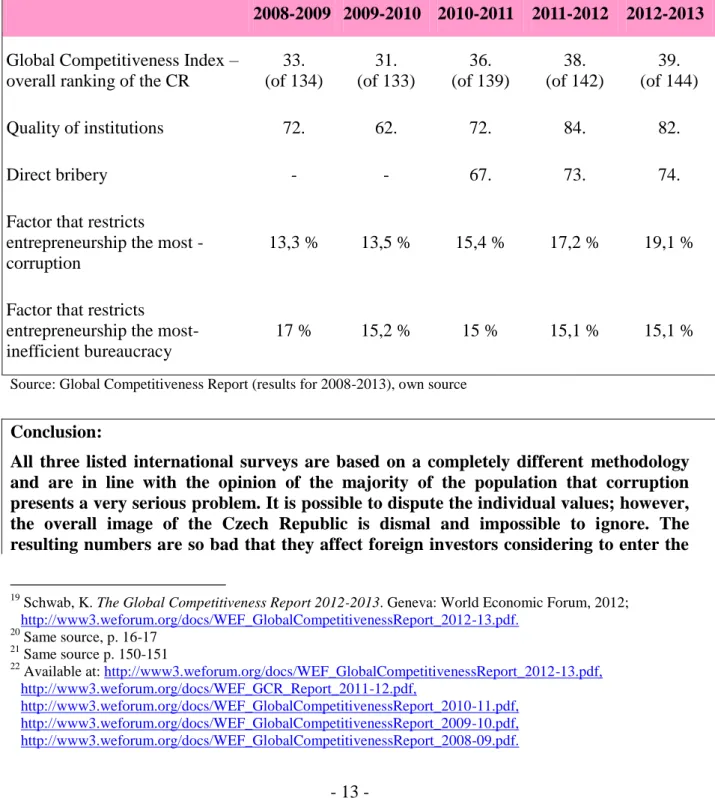
The third most important international survey is the so-called Global Competitiveness Report issued by the World Economic Forum.19 This study evaluates countries by several criteria. While CR ranked quite well in the overall ranking of competitiveness for 2012-2013 (39th place from 144 countries), it ranked 74th in direct bribery and 82nd in the quality of government institutions. In international comparison of this criterion it means that CR is behind India (70th) or Ethiopia (74th), but is above Italy (97th), Slovakia (104th) or Greece (111th).20 As for factors with the most negative influence on entrepreneurship, most respondents listed corruption in the first place (19.1 %), followed by inefficient government bureaucracy (15.1 %).21 In many criteria the Czech Republic ranks very low, the development in recent years is shown in the following table.
Table 3: Competitiveness of the Czech Republic according to individual criteria – development in recent years22
2008-2009 2009-2010 2010-2011 2011-2012 2012-2013
Global Competitiveness Index – overall ranking of the CR
33. (of 134) 31. (of 133) 36. (of 139) 38. (of 142) 39. (of 144) Quality of institutions 72. 62. 72. 84. 82. Direct bribery - - 67. 73. 74.
Factor that restricts
entrepreneurship the most -corruption
13,3 % 13,5 % 15,4 % 17,2 % 19,1 %
Factor that restricts
entrepreneurship the most- inefficient bureaucracy
17 % 15,2 % 15 % 15,1 % 15,1 %
Source: Global Competitiveness Report (results for 2008-2013), own source
Conclusion:
All three listed international surveys are based on a completely different methodology and are in line with the opinion of the majority of the population that corruption presents a very serious problem. It is possible to dispute the individual values; however, the overall image of the Czech Republic is dismal and impossible to ignore. The resulting numbers are so bad that they affect foreign investors considering to enter the
19 Schwab, K. The Global Competitiveness Report 2012-2013. Geneva: World Economic Forum, 2012;
http://www3.weforum.org/docs/WEF_GlobalCompetitivenessReport_2012-13.pdf.
20 Same source, p. 16-17 21 Same source p. 150-151 22
Available at: http://www3.weforum.org/docs/WEF_GlobalCompetitivenessReport_2012-13.pdf, http://www3.weforum.org/docs/WEF_GCR_Report_2011-12.pdf,
http://www3.weforum.org/docs/WEF_GlobalCompetitivenessReport_2010-11.pdf, http://www3.weforum.org/docs/WEF_GlobalCompetitivenessReport_2009-10.pdf, http://www3.weforum.org/docs/WEF_GlobalCompetitivenessReport_2008-09.pdf.
Czech market. Efficient fight against corruption is also a priority regarding the economic development and international competitiveness.23
3.3. Concrete experience of citizens regarding corruption – “self -reports”
Surveys, which pose a direct question whether the respondent experienced corruption, i.e. if he took or gave a bribe, are very rare. However, they are the only ones that reflect the real content of corruption. It is necessary to point out, however, that in their form they cover only petty corruption, which the respondents are willing to admit. It is hard to imagine that someone, who is involved in systematic stealing, money laundering and organized crime, would answer “yes”.
One of the few surveys that investigate the real scope of bribery was the survey conducted for Mladá Fronta Dnes by the Median agency in 2011.24
To the question “Have you faced corruption in the last five years?”, i.e. “Did someone asked a bribe from you or someone close to you?” 63.2 % respondents answered “no”, 20.5 % “yes” and 16.3 % did not answer.
In the Eurobarometer survey25 from 2012, when they were asked, 61 % of respondents answered that they do not experience corruption in their daily life.
According to the GfK survey from 2008 48 % of people gave a bribe in the last 12 months with 13 % claiming that repeatedly.26
For a comparison: in Austria the number of respondents, who answered positively in the GfK survey was about 7 %.
In the case of corruption connected to providing public services, the real numbers are even lower. This observation is also proven by the data from the Global Corruption Barometer survey from 2010. Only 14 % of Czech respondents stated that they had to provide a bribe in the last 12 months to obtain one of the nine public services (education, healthcare, tax authorities, registers, justice…).27
Conclusion:
The percentage of respondents, who directly experienced corruption (i.e. they provided a bribe or they were asked to do so or they received a bribe), is high, but does not reflect how significant problem the respondents consider corruption to be. Even though we might take into account the respondent’s fear to admit corruption, the numbers are relatively small. High perception of corruption as a serious social problem can be down to the fact that corruption was a significant part of the pre-election fight in 2010 and may thus reflect a number of serious corruption cases, which were recently discovered and publicized. However, even this media reality cannot fully explain the difference between the strong perception of corruption’s significance and the limited number
23 Mejstřík, M. and others. Framework Competitiveness Strategy.Prague: Office of the Government, Government’s National Economic Council (NERV), 2011, p. 61.
24
Source: http://zpravy.idnes.cz/sazebnik-uplatku-za-ridicak-25-tisic-stavebni-povoleni-za-milion-pwi-/domaci.asp?c=A101026_074045_domaci_bar.
25http://ec.europa.eu/ceskarepublika/news/120216_eurobarometr_cs.htm 26
Corruption Climate, GfK survey results, October 2009, not published
of respondents, who gave or received bribes. The explanation probably lies in the form of corruption in the Czech Republic, which concentrates more on “large” corruption related to the abuse of public resources, from public contracts to grants, and not on the petty corruption of clerks related to public services. This conclusion is further evidenced by the data listed below.
3.4. Development trends of corruption in the Czech Republic
There is de facto no survey, which would provide data comparable anachronously. The only exception is the CPI index, which is calculated since 1995, uses comparable methodology and includes the Czech Republic since 1996.
The CPI index is not constructed based on year-on-year comparisons, however the development of the Czech Republic’s evaluation has some information value (see picture 1).
Picture 1: Development of the Czech Republic’s evaluation in the CPI index in the period 1997-2011
Source: Transparency International, own sources
Interpretation:
The above listed results cannot be interpreted unambiguously. The chart shows the real subjective sentiments of the respondents given also by the scope of the public discussion about the issue of corruption. The deterioration in perception of corruption in the years 1997 -2002 can be put down to the ongoing privatization and the growing belief that it has been largely complemented by corruption.
The turning point in the trend and the start of improvement of the situation can be explained by two processes, which took place at that time. One of them was the final phase of pre-accession talks to admit the Czech Republic into the EU, which was accompanied by a large-scale adoption of European legislation and an overall implementation of a modern legislative framework. Also during this period the first Anti-Corruption Policy of the Government was created (first Anti-Corruption Strategy was adopted in 1999). The turning point towards the deteriorating trajectory, which occurred in years 2007 and 2008, is probably related to the elections result in 2006.
Conclusion:
There are three distinct phases in the development of the perception of corruption in the Czech Republic. The first is the deteriorating situation in the nineties. In that period corruption was not a topic and there was no Anti-Corruption Policy. At the same time the mass privatization took place together with the reallocation of large volume of public resources. In both cases these are probably determining reasons for the deteriorating corruption situation. At the beginning of the 21st century there were intensive legislative changes related to the accession to the EU and the influx of resources to strengthen “good governance” and the rule of law. Also since 1999 there has been a Governmental Anti-Corruption Policy in place, which bore some fruit despite its half-measures and criticized aspects. The interpretation of the third phase, i.e. the deterioration of the situation after 2007, is the most difficult one. Most probably, it is the utter formality and not taking any actions to fulfil the Anti-Corruption Strategy from 2006.28 Another important factor could be the information about possible corrupt activities related to the highest political levels, to which there was no adequate reaction.
3.5. Which part of the society is most affected by corruption according to the Czech respondents?
The most corrupted environments, in the eyes of the people, are regularly politics, authorities, police and justice.
In the GfK survey about the corruption climate in the Czech Republic from 200929, regarding the occurrence of corruption, the first place went to political parties (22 % of respondents considered them the most corrupt area). This result was a bit of a surprise, it was the first time the political parties were at the top of the ranking and surpassed authorities (17 %), which topped these rankings since the start of these surveys, i.e. since 1998. The people also viewed ministries (14 %) and the government (10 %) as the most corrupted areas. The areas that were the least connected to corruption were education, customs, non-profit sector and banks.30
Table 4: Areas with most widespread bribery – ranking of institutions
year 1998 year 2001 year 2002 year 2003 year 2006 year 2009
1. public services
authorities authorities authorities authorities political parties
2. courts courts healthcare healthcare police authorities
3. healthcare police police police government ministries
4. police healthcare courts courts political parties government
5. services ministries customs customs ministries courts
28
National Integrity Study. Prague: Transparency International –Czech Republic, 2011, p. 36. 29 Corruption climate, GfK survey results, October 2009, not published, also available at:
http://www.gfk.cz/imperia/md/content/gfkpraha/press/2010/100406_nejzkorumpovanejsi_jsou_politicke_stran y.pdf.
6. education customs ministries ministries private sphere private sphere
7. hospitality banks education education courts police
8. military military banks banks healthcare healthcare
9. education military military customs military
10. education education 11. military customs 12. Non-profit sector Non-profit sector 13. banks banks
Source: GfK, own sources
Very similar results can be found in the CVVM survey “Opinion about the spread and rate of corruption of public actors and institutions”.31
According to this survey, almost three quarters of the inhabitants (74 %) believe that all or the majority of the public actors are participating in corruption. It is therefore clear that in the eyes of the public, all sectors are significantly affected. Similarly, the results of the Eurobarometer survey about corruption spoke about corruption spread over authorities at all levels – local, regional and national.32
It is possible to differentiate between areas which are more problematic than others. However, if we return to the CVVM survey, it is interesting to focus on one fact. In this survey the institutions were awarded grades 1-5, where 1 means non-existent corruption and 5 high corruption. In general it is possible to state, that grades 1 and 2 were used very rarely, which in itself speaks volumes about the corruption rate and the people’s opinions. As for concrete institutions, the political parties retained the worst results as more than 4/5 of citizens believe they are the most corrupt sphere (81 %), followed in the second place by ministries and central authorities (69 %), which also supports the already mentioned results. Contrary to the GfK survey (also due to a different methodology and categories) the third place went to building authorities (53 %) and relatively high in the fourth place was healthcare. Unlike GfK CVVM includes political parties in this kind of surveys for a longer period and it is possible to state that they rank first in the corruption list since 2001. Similarly the ministries and central authorities rank second regularly.33
The survey conducted by the SANEP agency in 201134 has again a slightly different categorization, but similar results. According to it 33.2 % of respondents believe that corruption is present in all government institutions. Therefore, respondents do not differentiate between the most problematic areas, but lose confidence in all governmental institutions. As for differentiation, 15.4 % respondents considered the government to be the most corrupt area, 11.2 % ministerial clerks and 10.5 % judges. Other corrupt institutions with 5 % or less respondents were the Parliament, municipal authorities, the Prime Minister, police
31http://cvvm.soc.cas.cz/media/com_form2content/documents/c1/a6798/f3/po120405.pdf. 32http://ec.europa.eu/ceskarepublika/news/120216_eurobarometr_cs.htm.
33
http://cvvm.soc.cas.cz/media/com_form2content/documents/c1/a6798/f3/po120405.pdf. 34 SANEP, 2011. Available at: http://www.protext.cz/zprava.php?id=14060.
and regional authorities. The institutions that had the best results in this ranking were the Constitutional Court and the Senate (maximum of 1 % respondents connects them with corruption).
Also the survey done by Ipsos Tambor35, focusing on the spread of corruption in individual areas showed that people are convinced that the most corrupt are the political parties, authorities and ministries. An interesting result was the opinion of people whether the actors of corruption acts support each other and cooperate: 92 % respondents answered “yes”. This result deserves attention also due to the connection with the Eurobarometer survey36, in which the percentage of Czech people, who indicated that corruption is often tied to organized crime, was the highest in all Europe (CR in this regard surpassed even states like Italy). According to the already cited survey Global Corruption Barometer37 the respondents believe that the most corrupt institution in the country are the political parties, graded 3.8 on a scale of 1 (best) to 5 (worst). The Parliament achieved similar results (3.7) as well as the public administration clerks (3.6). The best results were achieved by religious institutions (2.6) and the media (2.8).
A more detailed analysis in the mentioned Global Integrity Survey shows which society segments decrease the overall acceptable resulting integrity index. These areas are public administration and its professionalism. In this area, the Czech Republic received the lowest score; in the “safeguard against conflict of interest” it received only 44 points out of 100.38
Particularly remarkable in the Global Competitiveness Report is the subindex “public trust in politicians”, where the Czech Republic ranked 139th out of 144. Other negatively valued aspects are clientelism in governmental clerks’ decisions (123rd
), transparency of the governmental policy (98th) or waste of public resources (119th). The look at the ranking of the Czech Republic among other countries in recent years shows a rather negative development in these areas, whereas in categories such as public trust in politicians, clientelism and waste of public resources means the worst recent years results for the Czech Republic in 2012-2013.39 35http://www.ipsos.cz/sites/default/files/TZ_Exkluzivni%20vyzkum%20Ipsos%20Tambor%20pro%20Zlatou %20korunu_20110613.pdf 36http://ec.europa.eu/ceskarepublika/news/120216_eurobarometr_cs.htm. 37http://www.transparency.org/policy_research/surveys_indices/gcb/2010/in_detail. 38http://www.globalintegrity.org/report/Czech-Republic/2010/scorecard. 39
Available at:http://www3.weforum.org/docs/WEF_GlobalCompetitivenessReport_2012-13.pdf, http://www3.weforum.org/docs/WEF_GCR_Report_2011-12.pdf,
http://www3.weforum.org/docs/WEF_GlobalCompetitivenessReport_2010-11.pdf, http://www3.weforum.org/docs/WEF_GlobalCompetitivenessReport_2009-10.pdf, http://www3.weforum.org/docs/WEF_GlobalCompetitivenessReport_2008-09.pdf.
Table 5: Czech Republic’s results in the Global Competitiveness Report – development of selected criteria in recent years
2008 - 2009 2009 - 2010 2010 - 2011 2011 - 2012 2012 - 2013
public trust in politicians 117. 115. 121. 134. 139.
clientelism in governmental clerks’
decisions 110. 104. 107. 123. 123.
transparency of the governmental
policy 104. 103. 102. 96. 98.
waste of public resources 106. 87. 95. 117. 119.
Source: Global Competitiveness Report (results from 2008-2013), own presentation
Conclusion:
All listed surveys confirm the conclusion that the core of the corruption problem in the Czech Republic lies in the area of functioning of political parties and the overall functioning of state authorities. The public administration as a place making decisions about the use of public resources seems to be the area most affected by corruption and at the same time as the weakest link in the anti-corruption effort. On the other hand the surveys show that corruption of individual clerks and other employees of the public sector related to providing public services is not among the most corrupted areas that much. Almost non-present among the areas affected by corruption is education and healthcare also does not seem to be highly affected by corruption, at least according to the results of the surveys. This differentiates the Czech Republic from countries with a high rate of corruption, such as Ukraine or Russia. This also supports the conclusions of previous chapters that the problem in the Czech Republic is not petty corruption, but systemic corruption, an organized abuse of public resources with direct connection to the political structures. It is possible to state that corruption in the Czech Republic approaches a phase, which literature describes as “State capture”.40
40
The term “state capture” is defined by the World Bank as activities of individuals, groups and companies both from the private and public spheres, which aim to influence the creation of laws, regulations, decisions and other governmental processes to their own benefit as a result of illegal and non-transparent commissions to public officials… due to informal, non-transparent and preferential access channels. This happens also through unclear alliances between political and trade interests of public officials…” (according to Dančák, V., Hloušek, V., Šimíček, V. Korupce. Projevy a potírání v České republice a v Evropské unii. Brno: 2006, p. 15)
3.6. Corruption climate
The corruption climate41, i.e. “a set of collective ideas, norms and cultural models, which make the abuse of authority and bribery natural and excusable behaviour for the inhabitants of the given state”, has been researched relatively thoroughly, whereas one of the largest surveys comes from the GfK agency.42 The term corruption climate contains two elements. Firstly, it shows to what extent the corrupt behaviour is considered natural and how often people have the inclination to solve problems with bribery. It also shows the rate of tolerance to such behaviour among people.
The GfK surveys deal with two categories: rate of acceptance of corruption norms and the rate in which they are respected. The surveys are conducted regularly, which makes it possible to monitor the development of individual values in time.
In 1998 85 % of the respondents considered bribery immoral, in 2009 it was only 74 %. This means that the number of respondents, who shun corrupt behaviour, is decreasing steadily. The aforementioned facts bare relation to the fact that almost one third of respondents (30 %) is of the opinion that who can take bribes and does not do it, harms himself and his family. This group is growing relatively fast recently, between 2006 and 2009 their number increased by 9 %. Also as many as 63 % of Czech people agree with the statement that “everybody can be corrupted”. As for the acceptance of corruption norms, it can be summarized that the acceptance rate is growing significantly among the people. The majority still considers corruption to be immoral and is not willing to agree with the given “rules of the game”. The already mentioned general deterioration of the corruption situation in the Czech Republic after 2006 is confirmed here as well.
Unfortunately there is no improvement in the area of respecting corruption laws either. On the contrary, the results of the last available survey (2009) are the worst since 1998, i.e. since the start of the surveys (41 % is willing to respect corruption norms). Another evidence of the strengthening of the corruption climate is the increasing tolerance of corruption acts. Half of the people agree that if there is no other option, a person shouldn’t be afraid to bribe (this value increased from 39 % in 2006 to 50 % in 2009). Another result, which confirms the high tolerance of corrupt behaviour, is the fact that people do not even view some forms of corruption as corruption. It is usually the case of the so-called petty corruption (e.g. patient leaving the doctor’s office gives him a bottle of expensive alcohol etc.). People are becoming more tolerant towards corrupt behaviour in this area as well.
Sadly it is possible to continue in this list of facts. 63 % of Czech citizens consider corruption a natural part of their lives. Almost half of them (48 %) are convinced that the things that are still functional in the state apparatus wouldn’t be without bribes. As for corruption in public contracts, even more people have a negative attitude – 65 % respondents agree with the statement, that without bribes no company is able to receive a state or municipal contract. The results in all three cases are the worst since the start of the surveys.
Conclusion:
The listed surveys are hard to interpret. It may be concluded that a high percentage of people see corruption as a necessary evil. Moreover, it seems that particularly
41
This sub-chapter uses results of the GfK Survey: Corruption Climate, October 2009, not published 42 GfK Survey: Corruption Climate, October 2009, not published
between 2006 and 2009 the number of people, who accept corruption or who resigned to deny corruption, has increased significantly. However, as mentioned in the previous text, the majority of the population views corruption as a significant problem demanding solution. The key cause of this conflict can be identified as absence of positive role models, absence of strong proponents of the anti-corruption ethos and a lack of faith that the political representation could become such proponent.
No matter how the Anti-Corruption Policy is primarily an issue of setting the system, the real effort of the political representation (or at least its part) in the fight against corruption, is an important condition of success.
The strengthening of the feeling of opposition to corruption is also closely connected to the efficiency of repressive bodies. To strengthen the anti-corruption attitudes, it is necessary to have clear examples confirming that corruption does not pay nor it is rewarded.
3.7. Opinions about the Government’s Anti-Corruption Policy and desirable measures and solutions for corruption
Assessing the efficiency of the Government’s anti-corruption measures is closely related to the respondents’ opinions about what measures are efficient and desirable against corruption and which should be implemented. It is these questions that were a part of the already mentioned survey conducted by Ipsos Tambor.43 At the general level respondents mostly agree with vigorous methods of combating corruption (e.g. execution of property, wiretapping, protection of key witnesses or agents provocateurs).44 Concrete steps or changes, which should contribute to the restriction of corruption in the Czech Republic, are, according to the people, the following. The fight against corruption will be best supported by systemic changes, especially by a fundamental reform of the state administration (29 %). This value can be taken into context with the previously presented information regarding the most affected areas, where the authorities, ministries and institutions ranked in top positions. Also important for combating corruption are harsher punishments for corruption (27 %) and the peoples’ morality (17 %). Even though political parties are viewed as a corrupt environment, not many people believe that higher transparency of political parties’ funding may be a significant anti-corruption tool (4 %). As for other measures, which the people consider important for restriction of corruption, it is possible to mention criminal liability for wrong decisions during administration of public property (83 % of people believe that the fight against corruption is just a likeable political claim) and transparency during the issue of public contracts.
What is worth mentioning is that if there are signals about the political representation really willing to combat corruption, the pessimism of the people would quickly disappear. Another survey, also by GfK45, shows that citizens are waiting for a signal from the Government that it is ready to face corruption. In autumn 2009, when the scepticism regarding the anti-corruption zeal of politicians grew, 47 % of respondents believed that the anti-corruption will
43
http://www.ipsos.cz/sites/default/files/TZ_Exkluzivni%20vyzkum%20Ipsos%20Tambor%20pro%20Zlatou% 20korunu_20110613.pdf.
44 The age group of 55-65 is a strong proponent of these methods, while the young generation (18-24) is for softer measures.
continue to grow and only 4 % believed that the situation will improve. The pessimism of respondents grew by a high 11 % since 2006.46 In 2010 the fight against corruption has become an important topic during the Parliamentary elections. The people reacted to this election programme positively and with expectation. The survey in July 2010 (i.e. shortly after the elections) reported a sharp increase in optimism. A total of 46 % respondents believed that the political representation is willing to combat corruption and 33 % respondents were convinced the Government will succeed in implementing efficient anti-corruption measures and restricting corruption.
Conclusion:
Important conclusion is that the distrust of respondents towards the Government’s Anti-Corruption Policy is not a permanent trait and attitude, but that they are sensitive towards signals, which come from the political sphere. The surveys also clearly showed that citizens are interested in real results, i.e. the restriction of corruption and systematic abuse of public resources. They are not interested in administratively reported successes, such as adopted laws or percentage of “ticked” points of the Anti-Corruption Strategy. At the same time it is no surprise the respondents have simplified ideas about corruption and its suppression. That may be demonstrated by the public demand for harsher punishments which cannot help exceeding the goal when the whole system of investigation is not working and if the courts do not issue harsh punishments.47 The analysis of the public opinion must therefore be complemented by surveys among experts.
The listed surveys also confirm the key role of the state administration as a source of corruption and also a tool for its restriction. They also showed the inner conflicts of the respondent’s opinions and the unclear relationship between the problem and its solution. Regarding this point of view, the information value of these surveys is questionable.
3.8. What is the willingness of Czech citizens to participate in anti-corruption activities?
As has been already outlined, tolerance and respect of corruption laws is closely connected to the concrete actions of people, be it a bribery or a concrete action against corruption, e.g. in the form of reporting it. The fight against corruption and personal activity in the Czech Republic is determined by a specific attitude of people. There is a widespread opinion that the fight against corruption is the responsibility of the state and not the people. This opinion remains unchanged in the long term (see GfK surveys from 1998-2009)48 and is shared by 82 % of the Czech population.
Anti-corruption activities can be divided into collective activities, e.g. demonstrations, and active resistance of individuals. There is a higher willingness to participate in a collective resistance – ca. one third of the Czech citizens would participate (32 %). However, the vast majority of the people is not willing to demonstrate civil engagement and would not stand up against corruption (61 %). These numbers remain practically unchanged during the years
46 In 2006 the Parliamentary elections took place and the left-centrist coalition has been replaced by a right-centrist coalition.
47
See chapter II./5 (Investigation of corruption)