37
Journal of Education and Vocational Research (ISSN 2221-2590) Vol. 6, No. 3, pp. 37-45, September 2015
The Effectiveness of Summative Assessment in Work-Based Learning Practice Abdool Qaiyum Mohabuth, Syed Munir Ahmad
University of Mauritius, Reduit, Mauritius University of Peshawar, Peshawar, Pakistan
Abstract: Summative assessment aims at providing measurement of student's understanding. It is argued that summative assessment is used for reporting and reviewing, besides providing an overall judgment of achievement. While summative assessment is a well defined process for learning that takes place in the classroom environment, its application within the Work-based Learning (WBL) practice environment is still being structured. This paper discusses the effectiveness of summative assessment in WBL practice from a mixed-method research study involving both quantitative and qualitative analysis. A survey questionnaire was designed for exploring the perceptions of mentors and students about summative assessment in WBL practice. The questionnaire was administered to the University of Mauritius students and mentors who supervised students for their WBL practice at the respective placement settings. Some students were also interviewed to capture their views and experiences about the application of summative assessment in WBL practice. Semi-structured interviews were also conducted with three experienced mentors who have assessed students on WBL practice. Findings reveal that most students had positive experiences about their summative assessments in WBL practice. They felt comfortable and confident to be assessed by their mentors in their placement settings and wished that the effort and time that they devoted to their learning be recognized and valued. Mentors also confirmed that summative assessment is a valid and reliable strategy in WBL practice, enabling them to better monitor and coach students to achieve the expected learning outcomes.
Keywords: Practice, Judgment, Summative Assessment, Knowledge, Skills, Workplace 1. Introduction
Summative assessment is used to determine what students know and do not know at a particular point of time. It is an accountability measure that is generally used as part of the grading process. The key is to think of summative assessment as a means to gauge, at a particular point in time, student learning relative to content standards. Summative assessment helps in evaluating aspects of the learning process and at the same time it helps in evaluating the effectiveness of programs allowing alignment of curriculum. However, summative assessment has often been criticized as it usually come far down in the learning process and does not provide opportunities for students to adjust their learning. The application of summative assessment in WBL practice is not a straight forward task. Indeed, Cameron-Jones & O’Hara (1994). Admitted that there are difficulties associated with the assessment of work experience. It needs to be evidence-based and requires commitment from both students and mentors. Students have to put up the necessary effort in acquiring the knowledge, skills and attitudes that the WBL practice sets out to provide. Mentors need to be patient and coach the students well so that learning may be assessed at the end of the training.
The learning environment in a practice setting is relatively different from that of a classroom, involving a number of factors which influence student’s learning. It is characterized by contextual reasoning and involves manipulation of tools and mental activities rather than memory recall which renders the task of summative assessment very complex. WBL has been practiced decades ago with no formal assessment. But since the experience obtained through WBL practice is highly valued nowadays, many Universities are giving due consideration for assessing the learning that students experienced at the work place. However, the task is complex due to the fact that students acquire and experience learning differently at their own pace even if it is at similar practice setting or with the same mentor. This adds up to the complexity in defining a proper structure for assessing the students. Establishing summative assessment at practice settings as a formal
38
process is seen to be very challenging. The factors that need to be present to measure the level of success and proficiency at the end of the learning practice need to be identified. The assessment procedures need to be backed up with ‘solid’ evidence (Coll et al., 2002). There is a need also to investigate how far and in what ways summative assessment is beneficial to students. Dalrymple et al. (2014) rightly said that with the increasing prevalence of WBL programs in higher education, there is a demonstrable need to evolve new pedagogic models to support facilitators and participants in conceptualizing and developing practice.
2. Literature review
It is important to understand how WBL practice differs from classroom learning before applying summative assessment. Traditionally the concept of learning has been associated with formal classroom education, whereas its use in the context of work is a relatively new phenomenon. Interest in WBL practice has been receiving more attention since the beginning of the 1990s, and currently research in this area is both wide-ranging and interdisciplinary. The reason for this expansion is the unprecedented change in employment sectors requiring graduates to be fit for purpose and practice at the time of graduating from universities. Hager (2004) emphasizes the need to develop WBL practice with measurable learning outcomes that produces tacit knowledge. One of the main differences between learning in the formal educational system and learning in practice is that the former is based on formal, intentionally planned educational activities, while the latter is mostly informal in nature (Eraut, 2004b; Marsick & Watkins, 1990). Informal workplace learning is unplanned and implicit, often collaborative and highly contextualized, and the learning outcomes unpredictable, whereas school learning is often formal, planned, largely explicit, focused on individual learning, and the outcomes are often predictable (Hager, 1998). Eames and Cates (2011) argue that exposing students to the workplace provides an easier transition from classroom learning to workplace learning. The ability to learn in real-life settings provides an opportunity for experiential learning (Kolb, 1984). Eraut (2004a) has identified six types of knowledge, which can arguably be developed during WBL practice. These include, situational knowledge (including learning how to read real-life situations), knowledge of people, knowledge of practice, conceptual knowledge, process knowledge (including the specific techniques employed by the placement student) and control knowledge (encompassing skills such as self-management, time management and problem-solving skills).
As Hardern (1995) stated, such knowledge is job specific and differs from the knowledge acquired at schools. Work placement provides a vehicle for the transformation of knowledge through its use in a real-life setting (Ashworth & Saxton, 1990). Nonetheless, assessment can make its way in WBL practice. Since students devote a majority of their time and effort to the acquisitions of knowledge and skills in the workplace and the achievement through WBL practice is highly valued, summative assessment in practice work settings needs to be given more importance. Many universities have developed distinct assessment criteria for WBL practice; have identified generic skills that students need to acquire in any practice settings and devised portfolio and e-portfolio for students for demonstrating evidence of learning outcomes achieved at their practice settings. Thus assessment processes have an impact on the learner’s willingness, desire, and capacity to learn (Harlen & Deakin-Crick, 2002). A major concern of universities implementing summative assessment in WBL practice is the quality and validity of the student experience, an area that is not yet fully understood from an and ragogical perspective (Nixon et al., 2006). Moreland (2005) suggests that for a high-quality learning experience certain conditions need to be put in place. These include all stakeholders understanding and supporting the process; induction and briefing of all stakeholders prior to the experience (Greenbank, 2002; Foster & Stephenson, 1998; Brennan and Little, 1996); accreditation of the program for ensuring that the experience is taken seriously; formative and summative assessment used to support the process. Foster & Stephenson (1998) also emphasized the significance of effective learning networks, which include the principal actors of the student, the employer and the tutor. The quality of student experience and effectiveness of the learning space that emerges from WBL practice may be significantly impacted by the level of support offered by the employer (Brennan and Little, 1996). Hodges et al. (2014) assert on their side that student performance is influenced not only by their own efforts, skills and abilities, but also by the quality of mentoring and support they receive. The issue of mentoring variability needs to be acknowledged and addressed when student performance outcomes are part of the summative assessment. Mehrens & Lehmann (2011) rightly said that summative assessment is generally criterion-referenced, where the student’s performance or competence is assessed against some specified behavioral domain, standard or criteria.
39
3. MethodologyA mixed-method research design guided the study. For gathering quantitative data, two questionnaires were developed; one was destined to mentors for obtaining information about summative assessment of their students that were under their mentorship. The second set was designed for undergraduate students of four Faculties who undertook WBL practice. The mentor’s questionnaire contained three separate sections of Likert scaled questions (rating scale 1-5, 1: strongly disagree – 5: strongly agree.). The first section included questions about the criteria in making the summative assessment, the second section included questions relating to the validity and reliability of the assessment and the third section had questions relating to the impact of applying summative assessment in the work place. The student’s questionnaire contained three separate sections with section one based on the importance of having summative assessment in WBL practice and the section two included questions about measuring the impact of summative assessment and the last section had open-ended questions allowing students to provide views about their competence in WBL practice. The mentor’s questionnaire was administered to 75 mentors and the students’ one was administered to 120 undergraduate students with 30 students from each of the four Faculties of (1) Faculty of Law & Management (FLM), (2) Faculty of Science (FOS) and (3) Faculty of Social Studies & Humanities (FSSH) and (4) Faculty of Engineering (FOE). For qualitative data to gain a better insight into summative evaluations in WBL practice, a semi-structured interview schedules were prepared for gathering data from the participants. The first one involved four students, one from each of the four faculties and the second one involved three mentors.
4. Data Analysis and Discussion
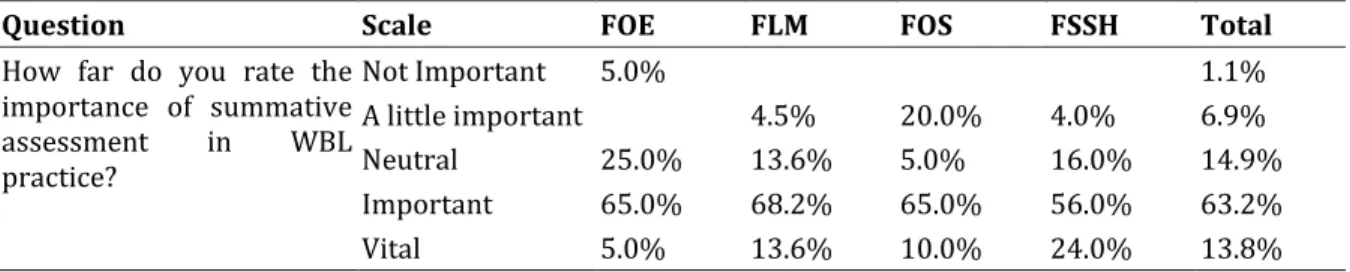
Reality as experienced by the students and the mentors has an important additional value. It is therefore crucial to take into account their perceptions after both groups have gone through the process. Table 1 below indicates the results compiled after data collection. The quantitative data were analyzed using SPSS version 21. Table I shows the result generated from the student’s questionnaire as regards to the importance of having summative assessment in the practice. Only 1.1% of the students found that summative assessment has no importance in WBL practice, while 77% classified it as important and vital with more than 70% from each faculty.
Table 1: Importance of summative assessment in WBL practice (students)
Question Scale FOE FLM FOS FSSH Total
How far do you rate the importance of summative assessment in WBL practice? Not Important 5.0% 1.1% A little important 4.5% 20.0% 4.0% 6.9% Neutral 25.0% 13.6% 5.0% 16.0% 14.9% Important 65.0% 68.2% 65.0% 56.0% 63.2% Vital 5.0% 13.6% 10.0% 24.0% 13.8%
As regards to the mentors, only 5.3% find that summative assessment is not important while 89.5% rated it as important and vital as illustrated in Table 2. It is to be noted also that experienced mentors value more summative assessment as compared to young mentors.
Table 2: Importance of summative assessment in WBL practice (mentors)
Question Scale 0-1yr above
1-2yrs above 2-4yrs above 4-5yrs more 5yrs than Total
How far do you rate the importance of summative assessment in WBL practice? Not Important 33.3% 5.3% A little important 20.0% 5.3% Important 33.3% 66.7% 66.7% 80.0% 60.0% 63.2% Vital 66.7% 33.3% 20.0% 20.0% 26.3%
40
The order of importance of the different criteria used for assessing students was rated by mentors. This was analyzed through factor analysis. The means and standard deviation of the different criteria under analysis is illustrated in Table 3.
Table 3: Means and Standard deviation of criteria behind summative assessment Criteria
The level of importance of Mean Std. Deviation Criteria The level of importance of Mean Std. Deviation
learning outcomes evidences
in portfolio 4.47 1.264 achievement before formative assessment of students 4.37 0.955 assessment guidelines
prepared by academics 3.63 1.212 achievement of students after formative assessment 4.11 1.049 assessment forms prepared by
University 4.26 1.240 attendance & punctuality of students 3.89 1.100 CD documentation manual 4.79 0.918 attitude of students during
training 3.79 1.316 mentor's preparatory program 4.05 1.311 behavior of students during
training 3.74 1.284 advices provided to students 3.89 1.487 motivating students during
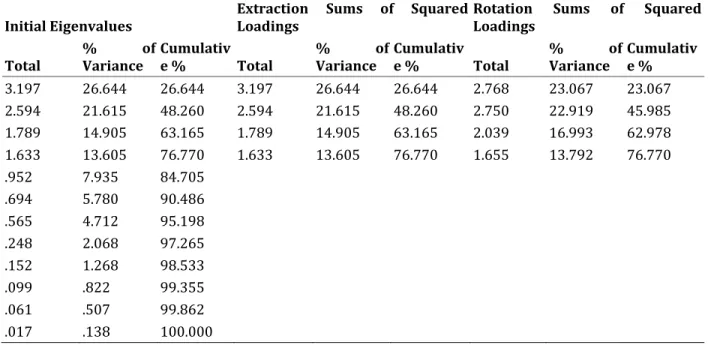
training 4.21 1.228 Applying factor analysis indicates that that all questions related to the criteria for having summative assessment correlate fairly well. Factor extraction reveals that there are four factors that are found to have Eigen values > 1 which account for the total variance as illustrated under Table 4. Rotation is considered to optimize the factor structure thereby equalizing the importance of the four factors. Based on the rotated component matrix which is obtained after 5 iterations as illustrated in Table 5, the content of questions that load on the 1st factor is labeled as ‘effort of students during WBL practice’, the 2nd factor is classified as
‘documentation for summative assessment’, the 3rd factor is labeled as ‘seriousness of students on WBL
practice’, while the last factor is classified as ‘demonstration of achievement’. Factor analysis allows us to reach the conclusion that for having summative assessment in WBL practice we need to take into account: (1) materials supplied to facilitate the assessment;(2) effort made by students; (3) seriousness of students while on training and (4) achievement demonstrated by learners.
Table 4: Total Variance Explained
Initial Eigenvalues Extraction Sums of Squared Loadings Rotation Sums of Squared Loadings Total % Variance of Cumulative % Total Variance % of Cumulative % Total % Variance of Cumulative %
3.197 26.644 26.644 3.197 26.644 26.644 2.768 23.067 23.067 2.594 21.615 48.260 2.594 21.615 48.260 2.750 22.919 45.985 1.789 14.905 63.165 1.789 14.905 63.165 2.039 16.993 62.978 1.633 13.605 76.770 1.633 13.605 76.770 1.655 13.792 76.770 .952 7.935 84.705 .694 5.780 90.486 .565 4.712 95.198 .248 2.068 97.265 .152 1.268 98.533 .099 .822 99.355 .061 .507 99.862
41
Table 4: Total Variance ExplainedInitial Eigenvalues Extraction Sums of Squared Loadings Rotation Sums of Squared Loadings Total % Variance of Cumulative % Total Variance % of Cumulative % Total % Variance of Cumulative %
3.197 26.644 26.644 3.197 26.644 26.644 2.768 23.067 23.067 2.594 21.615 48.260 2.594 21.615 48.260 2.750 22.919 45.985 1.789 14.905 63.165 1.789 14.905 63.165 2.039 16.993 62.978 1.633 13.605 76.770 1.633 13.605 76.770 1.655 13.792 76.770 .952 7.935 84.705 .694 5.780 90.486 .565 4.712 95.198 .248 2.068 97.265 .152 1.268 98.533 .099 .822 99.355 .061 .507 99.862 .017 .138 100.000
Table 5: Rotated Component Matrixa
Component
The level of importance of: 1 2 3 4 learning outcomes evidences in portfolio .721 assessment guidelines prepared by academics .847
assessment forms prepared by University .826 CD documentation manual .815 mentor's preparatory program .903
advices provided to students .726 achievement of students before formative assessment .854
achievement of students after formative assessment .943
attendance & punctuality of students .430 .622
attitude of students during training .632 .536 behavior of students during training .767 .447
motivating students during training .860
Investigation was also carried out on the contribution brought forward by the implementation of summative assessment in WBL practice. Hypotheses were tested as to whether there are differences among the students from the four Faculties and the mentors on the impact summative assessment made in practice. Shapiro-Wilk test was performed and the data is found not to be normal. The independent variables were therefore tested by using Kruskal Wallis which is a non-parametric test.
42
Table 6: Results Analysis - students and mentorsSummative Assessment Groups Mean SD Median Kruskal Wallis Test
Makes students do the necessary effort
for learning at the workplace. FOE FLM 3.67 4.00 0.970 0.725 4 4 Asymp Sig = 0.739 FOS 3.80 0.894 4
FSSH 3.92 0.954 4 Mentors 3.85 0.875 4 Allows students to develop seriousness
in skills acquisition. FOE FLM 4.06 4.25 0.938 0.786 4 4 Asymp Sig = 0.313 FOS 3.75 0.910 4
FSSH 4.12 0.781 4 Mentors 4.01 0.896 4 Enables students to behave properly
during the placement. FOE FLM 3.78 4.25 0.943 0.786 4 4 Asymp Sig = 0.130 FOS 3.65 0.988 4
FSSH 4.12 0.600 4 Mentors 3.94 0.840 4 Creates competition among students
for obtaining better marks. FOE FLM 3.44 3.00 1.040 0.918 4 3 Asymp Sig = 0.430 FOS 3.20 1.056 3
FSSH 3.12 1.394 3 Mentors 3.14 1.139 4 Prevents students from absenting
themselves for the placement. FOE FLM 3.72 3.80 1.227 1.105 4 4 Asymp Sig = 0.995 FOS 3.80 1.105 4
FSSH 3.76 1.128 4 Mentors 3.75 1.102 4 makes students show respect to
mentors FOE FLM 3.89 3.90 1.023 1.119 4 4 Asymp Sig = 0.996 FOS 3.80 1.240 4
FSSH 3.80 1.225 4 Mentors 3.82 1.126 4
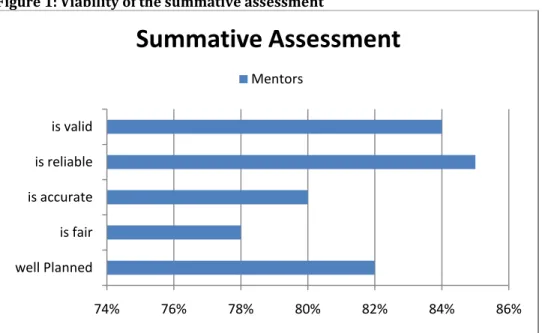
The results depicted in Table 6 shows that the mean and median values among the five groups for each of the items relating to the impact of summative assessment in WBL practice were found to be very similar. The results revealed that there is consistency among the groups and the mentors concerning the factors identified above (p > 0.05 at 5% significance level). The evidence suggests that FLM, FOS, FOE, FSSH students and Mentors shared similar views and agreed with the positive impact of summative assessment on WBL practice. Furthermore, investigation was also carried out on the viability of the assessment. Figure 1 shows the views obtained from the mentors which illustrate that 85% mentors agree that summative assessment in the practice can be performed with consistency. 84% found that the assessment measures what it is supposed to, while 80% agrees that the competencies can be assessed with precision. 78% of the mentors rated the assessment as being fair i.e. it measures what students have learned.
43
Figure 1: Viability of the summative assessmentThe following hypothesis was tested:
Ho: There is no difference in the viability of the summative assessment as perceived by mentors from public
sector to those of the private sector
H1: There is a difference in the viability of the summative assessment as perceived by mentors from public
sector to those of the private sector
As the data was found not to be normally distributed, Mann-Whitney test was used to test the hypothesis and an index named SAI was created to measure the summative indicators.
Ho: µpublic = µprivate
H1: µpublic ≠ µprivate
Where µpublic = median value of SAI for the public sector mentors and µprivate = median value of SAI for mentors
from the private sector
Table 7 shows that the mean ranks for the private sector is higher than that of the public sector. Higher mean ranks are associated with more positive opinions towards the viability of summative assessment in the practice.
Table 7: Ranks of SAI by sector
Work setting N Mean Rank Sum of Ranks
SAI Public Org 29 28.03 813.00 Private Org 34 35.38 1203.00 Total 63
Result of the Mann Whitney test reveals Z = -1.610 with p = 0.107 > 5%. This indicates that there is no significant difference in the opinion between public sector mentors and private sector ones at 5% significance level. This confirmed that mentors applied summative assessment with much rigour irrespective of the type of work setting.
In addition, the interviews carried out for qualitative analysis allowed the respondents to share their opinions about the application of summative assessments in WBL practice. Mentors were also questioned about the time they took to perform summative assessment as well as on the ways they conducted the assessment. The validity and reliability of the assessment made were also discussed with them. Their views about the
74% 76% 78% 80% 82% 84% 86% well Planned is fair is accurate is reliable is valid
Summative Assessment
Mentors44
existence of summative assessment were also gathered. Students on the other side were questioned as to whether summative assessment influenced their learning at practice settings. Their views about the impact of assessment in WBL practice were also gathered. All the four students confirmed that summative assessment made them do the necessary effort for learning at the workplace. They highlighted that the assessment activity had a positive impact on their learning, facilitating the acquisition of knowledge and skills. 75% of the students stated that without summative assessment they would not have taken the placement seriously and would not have been that active at the practice setting. All four students considered the summative marks obtained from WBL practice as the reward for the effort they had put forward during the training. The student from FOE emphasized that “the summative assessment validates the skills I developed during WBL practice and create more confidence in me for performing such tasks repeatedly and with dexterity”. Interview sessions with the mentors confirmed that students were more serious during the training due to the fact they knew they would be assessed at the end of the training. All the mentors highlighted that the tools and materials provided prior to assessing students in the practice greatly helped them in making a concise summative assessment for each student. They stressed on the importance of the assessment criteria set by the University. They did not foresee any problem as regards to the reliability and validity of the assessment and they all agreed that same standard could be maintained despite students might be at different work settings. However, the mentors confessed that it was quite time consuming to perform the assessment especially when they have over five students under their mentorship.
5. Conclusion
This study demonstrates the effectiveness of summative assessment in WBL practice. The findings have shown that summative assessment facilitates the acquisition of knowledge and skills in WBL practice. It helps in engaging both students and mentors in the learning process. In contrast, using grades as rewards for classroom learning is seen to decrease students’ motivation and may even harm further learning. However, this is found not to be the case for WBL practice. Students make the necessary effort and develop seriousness in learning at practice settings, while mentors are able to monitor more closely their students. It has been found that tools and necessary documentation must be provided to ensure reliability in the assessment made. Summative assessment in practice should be given similar consideration as is presently the case in the classroom environment. WBL practice with assessment adds more value to the knowledge obtained. Based on the outcome of this study, it can be deduced that summative assessment can definitely make its way in WBL practice through the establishment of a well-defined structure.
References
Ashworth, P. & Saxton, J. (1990). On Competence. Journal of Further and Higher Education, 14(2), 3-25. Brennan, J. & Little, B. (1996). A Review of Work Based Learning in Higher Education Sheffield. Department
for Education and Employment. Sheffield.
Cameron-Jones, M. & O’Hara, P. (1994). What employers want to read about new teachers? Journal of
Education for Teaching, 20(2), 203-214.
Coll, R. K., Taylor, N. & Grainger, S. (2002). Assessment of work based learning: Some lessons from the teaching profession. Asia-Pacific Journal of Cooperative Education, 3(1), 5-12.
Dalrymple, R., Kemp, C. & Smith, P. (2014) Characterizing work-based learning as a triadic learning Endeavour. Journal of Further and Higher Education, 38(1), 75-89.
Eames, C. & Cates, C. (2011). Theories of learning in cooperative education and work-integrated learning. In R. K. Coll & K.E. Zegwaard (Eds.). International handbook for cooperative education and work-integrated learning: International perspectives of Theory, Research and Practice 2nd Ed, 37‐47. Lowell, MA: World Association for Cooperative Education.
Eraut, M. (2004a). Transfer of knowledge between education and workplace settings. In H. Rainbird, A. Fuller, & A. Munro (Eds.). Workplace learning in context.201–221. London: Routledge.
Eraut, M. (2004b). Informal learning in the workplace. Studies in Continuing Education, 26(2), 173–247. Foster, E. & Stephenson, J. (1998). Work based learning in Universities in the UK: a review of current practice
and trends. Higher Education Research and Development, 12(2), 155-70.
Greenbank, P. (2002). Undergraduate work experience: an alternative approach using micro businesses.
45
Hager, P. (1998). Understanding workplace learning: General perspectives. In D. Boud (Ed.). Current issues and new agendas in workplace learning. 31–46. Springfield, VA: NCVER.
Hager, P. (2004). The conceptualization and measurement of learning at work. In H. Rainbird, A. Fuller, & A. Munro (Eds.). Workplace learning in context242–258. London: Routledge.
Hardern, G. (1995). The development of standards of competence in accounting. Accounting Education, 4, 17-28.
Harlen, W. & Crick, R. D. (2002). A systematic review of the impact of summative assessment and tests on students’ motivation for learning (EPPI-Centre Review). In Research Evidence in Education Library, Issue 1. London: Evidence for Policy and Practice Information and Co-ordinating Centre. Social Science Research Unit. Institute of Education.
Hodges, D., Eames, C. & Coll, R. K. (2014). Theoretical perspectives on assessment in cooperative education placements. Asia-Pacific Journal of Cooperative Education, 15(3), 189-207
Kolb, D. A. (1984). Experiential learning. Experience as the source of learning and development. Englewood Cliffs, NJ: Prentice Hall.
Marsick, V. J. & Watkins, K. E. (1990). Informal and incidental learning in the workplace. London: Routledge. Moreland, N. (2005). Work Related Learning in Higher Education, Learning and Employability Series Two.
HEA, York.
Mehrens, W. & Lehmann, I. J. (2011). Measurement and evaluation in education and psychology (4th edn.). Belmont, CA: Wadsworth/Thomson Learning.
Nixon, I., Smith, K., Stafford, R. & Camm, S. (2006). Work Based Learning: Illuminating the Higher Education Landscape. Final Report, July, Higher Education Academy, HEAYork.