National Louis University
Digital Commons@NLU
Dissertations
12-2017
One Size Doesn't Fit All: Implementation of
Differentiated Instruction
Janet D. Butler
Follow this and additional works at:https://digitalcommons.nl.edu/diss
Part of theCurriculum and Instruction Commons, and theEducational Leadership Commons
This Dissertation - Public Access is brought to you for free and open access by Digital Commons@NLU. It has been accepted for inclusion in Dissertations by an authorized administrator of Digital Commons@NLU. For more information, please [email protected].
Recommended Citation
Butler, Janet D., "One Size Doesn't Fit All: Implementation of Differentiated Instruction" (2017).Dissertations. 254. https://digitalcommons.nl.edu/diss/254
ONE SIZE DOESN’T FIT ALL: IMPLEMENTATION OF DIFFERENTIATED INSTRUCTION-A CHANGE LEADERSHIP PLAN
JANET D BUTLER
Educational Leadership Doctoral Program
Submitted in partial fulfillment of the requirements of Doctor of Education
In the Foster G McCaw Graduate School
National College of Education National Louis University
3
Copyright by Janet D Butler, 2017 All Rights Reserved
5 ABSTRACT
ONE SIZE DOESN’T FIT ALL: IMPLEMENTATION OF DIFFERENTIATED INSTRUCTION-A CHANGE LEADERSHIP PLAN
Differentiated instruction is an approach to teaching in which educators actively plan for students' differences so that all students’ academic needs are met. It is also a process of ensuring that what a student learns, how he or she learns it, and how the student demonstrates what he or she has learned is a match for that student's readiness level, interests, and preferred mode of learning (Tomlinson, 2008). In a differentiated classroom, teachers divide their time, resources, and efforts to effectively teach students who have various backgrounds, readiness and skill levels, and interests. In other words, no two students within the classroom environment have identical abilities, experiences, belief, and or identical needs. However, all students are expected to achieve successful outcomes from the skills and concepts taught daily.Teachers can
differentiate in four ways: 1) through content, 2) process, 3) product, and 4) learning environment based on the individual learner (Tomlinson, 2000).
Thus, this change leadership plan proposed to develop a plan that will enhance the delivery of reading instruction for students in fourth grade through the process of differentiated instruction. The researcher wanted to find out if an implementation of differentiated instruction would change the teaching practices that would ultimately change students' academic outcomes.
Finally, the findings of this research indicated that changes were needed if teachers genuinely want to meet the needs of all learners. Teachers can no longer teach "the lesson" and hope that everyone gets it (Gregory and Chapman, 2007) - hence one size doesn’t fit all.
6
ACKNOWLEDGEMENT
It is with a humble submission that I would like to acknowledge all those who participated in the data portion of this dissertation. Thanks for allowing me to conduct the survey, have pre and post-conferences and allowing me to observe your reading instruction within your classrooms as well as observing your teaching practices. You rock! I would also like to acknowledge the following people: Ms. Grace Scott, for your unconditional friendship; Mr. Robert Johnson, for pushing me when I needed the push; to my educational cohort- NLU 6- we were all in this together, and we did Wisconsin Proud! To all my colleagues and friends who supported me throughout this process. Special thanks to Dr. Amy Van Duren who encouraged me to apply for the doctoral program at NLU. To my family, my Church family, and Mr. James Lewis for always sending me encouraging thoughts- without your support during my writer’s blocks this road would have been sufficiently delayed; to my best friend, Jacquelyn Reed-you already know- your unconditional love and friendship means more than words could ever express.
My Sincere thanks go to my awesome Chair, Dr. Karen Tardrew, without her leadership and guidance I would not have made it through this journey-you are definitely in my top ten of favorite people. I would be amidst not to thank Dr. Geri Chesner for participating as the Second Chair and to Dr. James Fitzpatrick who worked with me on my internship hours and for
7
DEDICATION
This dissertation is dedicated to all Children and Adults whose lives I touched in the educational arena. This dissertation is also dedicated to my parents: Mr. Charles and Mrs. Johnnie Butler the two of you have instilled many values within me as well as high beliefs that I can do anything if I only believe I can!- I love you both beyond this universe.
8 TABLE OF CONTENTS ABSTRACT………... 7 ACKNOWLEDGEMENTS………...… 8 DEDICATION……… 9 List of Tables………...… 13 List of Figures……….……….…… 14
SECTION ONE: INTRODUCTION... 15
Purpose………. 15
Rational……….………. 17
Goals……… . 18
Demographics………. 19
SECTION TWO: ASSESSING THE 4 Cs……….………... 21
Context………..…. 21
Conditions………..… 21
Culture……….………..… 22
Competencies……… 22
SECTION THREE: RESEARCH METHODOLOGY……….…… 24
Research Design……….………. 24
Participants………..……… 24
Data Collection Techniques………..……… 25
Data Analysis Techniques……….……… 26
Questionnaire……….……… 27
Conferencing………..………. 28
9
SECTION FOUR: RELEVANT LITERATURE……….……….. 31
Introduction………..……..… 31
Content………..………. 33
Process………. 34
Products………. 34
Summary……….……. 38
SECTION FIVE: DATA ANALYSIS AND INTERPRETATION………. 39
Differentiated Instruction vs. Modification……… 39
Participants Survey Results……… 40
Pre-Conference Session………. 42
Post-Conference Session……… 43
Summary of Findings……… 45
SECTION SIX: A VISION OF SUCCESS (TO-BE)………..…….… 46
TO-Be Context………. 46
TO-BE Culture……… 47
TO-BE Condition……… 47
TO-BE Competencies……… 48
SECTION SEVEN: STRATEGIES AND ACTION………..……… 49
REFERENCES……… 52
APPENDICES………..….… 54
Appendix A- AS-IS Analysis 4 Cs ……….…… 54
Appendix B- TO-BE Analysis 4 Cs……… 55
10
Appendix D- Participants Survey/Questionnaire……… 57 Appendix E- Conference Form (Pre)………..… 58 Appendix F- Conference Form (Post)……… 59 Appendix G- Participants Lesson Plan Template before Differentiate Instruction… 60 Appendix H- Participants Lessons Plan Template reflecting differentiate Instruction. 62
11
LIST OF TABLES
Table Page
1 Survey/Questionnaire Results……….. 40
2 Observation with Implementation of the 5 Stages of
12
LIST OF FIGURES
Figures Page
1 Participants (F and G) Lesson Plan Template……… 27
2 Pre- Conference Form……… 28
3 Post Conference Form……….. 29
4 Observation Form……… 30
5 Learning Cycle and Decision Factors used in Planning and Implementing Differentiated Instruction……….. 33
6 Week 1- Instructional Reading Block……… 42
13
One Size Doesn’t Fit All: Implementation of Differentiated Instruction
SECTION ONE: INTRODUCTION Purpose
In today's complex educational arena change is necessary if school districts across America goals are to close the academic achievement gap amongst all students. Change is defined as making something or someone different and replacing a current situation with something else (Merriam-Webster, 2015). Nevertheless, changes within school systems can either improve or damage that system.
Differentiated instruction is an instructional theory that allows teachers to face this challenge by taking diverse student factors into account when planning and delivering
instruction. Based on this theory, teachers can structure learning environments that address the variety of learning styles, interests, and abilities found within a classroom (Tomlinson, 2000). In other words, no two students within the classroom environment have identical abilities, experiences, belief, and or identical needs. However, all students are expected to achieve successful outcomes from the skills and concepts taught daily. Thus, this is where teachers are faced with the greatest challenge of meeting the needs of all students hence, the reason for differentiated instruction.
There is a belief that students learn best when they can make connections between curriculum and their diverse experiences and interests ultimately push students slightly beyond the point where they can work independently with little assistance from the teacher. This belief allows teachers to provide instruction for all learners within the classroom environment.
14
Teachers can then use differentiated instruction strategies to meet the needs of the student's ability, interest, and learning preferences.
In a Midwest state, schools are faced with obstacles of meeting Adequate Yearly Progress (AYP) as outlined by the State’s Student Assessment System. The Federal “No Child Left Behind Act (NCLB)” required all states to test all students in reading and mathematics in grades 3 through 8 and once in high school (grade 10). Students' performances on these assessments are reported in proficiency categories and used for accountability determination at the school, district and state levels.
The NCLB requires all districts and schools receiving Title I funds to meet state "adequate yearly progress" (AYP) goals for their total student populations and specified demographic subgroups, including major ethnic/racial groups, economically disadvantaged students, limited English proficient (LEP) students, and students with disabilities. If these schools fail to meet AYP goals for two or more years, they are classified as schools "in need of improvement" and face the consequences as outlined below (U.S. Department of Education. 2010).
NCLB requires states to align tests with state academic standards and begin testing students on an annual basis in reading and math in grades 3 through 8 and at least once during grades 10 through 12 by the 2005-2006 school year. Also, it requires the National Assessment of Educational Progress (NAEP) reading and mathematics tests to be administered to a sample of fourth and eighth graders in each state every other year to make cross-state comparisons. NCLB also mandates school districts to hire teachers designated as "highly qualified" to teach core academic subjects in Title I programs. Finally, states must issue annual report cards for schools and districts (greatschools.org 2001).
15
In an Urban School District, the state Department of Public Education (DPI) placed a sanction on the district to correct the low performance of students' academic progress in grades 4, 8, and 10 (NCLB grades). Therefore, it is important to ask the question-what are educators doing to help provide instruction to assure students' academic needs are met to meet AYP? Thus, stakeholders within the educational arena must ask these vital questions:
What instructional practices are needed to assist with closing the achievement
gap?
Is Differentiated Instruction the key to closing the achievement gap?
How will differentiated instruction affect the classroom environment?
Therefore, it is imperative that educators in all grade-levels evaluate their instructional practices as well as begin to develop creative lessons that will meet the needs of all students. After looking at program evaluation in dissertation one (Closing the Achievement Gap: Will the Implementation of Differentiate Instruction Meet the Academic Needs of all Students?), I realized that there is a significant need to change the way teachers deliver instruction to their students.
Rationale
After completing research on the program evaluation of an Urban School District in the Midwest as it relates to the delivery of reading instruction for students in grade 4, I found it necessary to develop a need for change in the way teachers were delivering instruction to all students as they taught reading instruction. From the research of the program evaluation, the data indicated most teachers did not differentiate instruction but modified instruction to fit the needs of students who were not performing at grade-level expectation. Thus, the concept of “one size fits all" became a reality for the need to change the way reading instruction should be delivered to students in 4th grade. The data showed in the program evaluation that teachers specifically in
16
grades four were not creating differentiated lessons to meet the needs of all students. When asked "what do you do for your struggling students?” most replied: "we modify lessons to meet the child's need." Thus, is the rationale of why a change is needed. Often time teachers deliver instruction based on the teacher's edition/manual as it is printed. Although, the teacher's edition /manual offers detail lessons to meet the needs of students who are above grade level; at/on grade-level; and/or below grade-level, teachers usually plan lessons that are not differentiated but modified. Nevertheless, reading lessons were planned, and teachers taught the lessons with students who display mixed-ability range in reading all the same content.
Thus this leads to the need for change. If we are to see an increase in students' academic progress, we need to do something different. Therefore, the contingent is if we want to see academic growth we must take the attitude "one size doesn't fit all." Therefore, this change plan proposal is to develop a plan that will enhance the delivery of reading instruction for the Urban School District in the Midwest. Their literacy program known as Comprehensive Literacy Plan (CLP) must change- in order for the achievement gap to close. Teachers must differentiate instruction for all students rather than assume that a modified lesson has met the needs of all students within the reading framework.
Goals
It is my goal to introduce a plan that will enhance the delivery of instruction of the CLP by including the implementation of differentiated instruction to meet the needs of every student. The intended outcome is for schools to utilize the plan where they will begin seeing an increase students’ data in the area of reading on formative and summative assessment once
17
more aware of “best practice” techniques in the area of teaching reading with multi-reading levels.
Demographics
The Urban School District in the Midwest is the largest district in the state. It serves approximately 80,000 students in more than 160 schools. However, for this research, I will work with two (2) fourth-grade teachers from School X where I currently serve as the School Support Teacher (This is a teacher-leader position ). To obtain a better understanding of our school delivery of reading instruction I will also observe reading in grades 1, 2, 3 and 5 for data purpose only. School X demographic consist of 95% African-American children. There are currently 40 4th graders, 25 students without a disability (SWOD) and 15 students with a disability (SWD). The data will include assessment results (formative and Summative) from reading instruction, sample reading lesson plans, as well as the school's current context, culture, conditions, and competencies as illustrated by Wagner's 4 C's and I, will outline the intended desired outcomes by using the 4 C's approach.
Finally, to help with closing the achievement gap, I believe teachers need to have
strategies on how to implement differentiated lesson so that students are afforded the opportunity to have successful outcomes on assessment. Part of my change process would be to work with others in identifying optional solutions that start with what are needed and exploring new strategies on differentiating reading lessons in order to meet the needs of all students within the classroom environment. The change would also include common planning time for the pilot teachers in order to have both classrooms having the same structure of lesson planning and
18
making sure delivery of instruction is implemented in order to assess outcomes from using differentiate instruction strategies.
19
SECTION TWO: ASSESSING THE 4 Cs
Focusing on the ongoing improvement of instruction must be the central aim of any educational improvement effort. It is our "theory of change" that students' achievement will not improve unless and until we create schools and districts where all educators are learning how to significantly improve their skills as teachers and as instructional leaders (Wagner, 2006). Thus, is the rationale of why Wagner's 4C's (Context; Conditions; Cultural; and Competencies) concepts are necessary for change to occur.
As we look at changes in teaching and learning, we must outline our expectation of what types of outcomes we would like to see in academic achievement. Wagner illustrates how each component plays a vital role for change to exist. When looking at my current school, I observed the delivery of instruction in reading. The CLP model is taught in a whole-small-whole concept. It consists of five literacy stations (Vocabulary; Word Work/Phonics; Independent Reading; Independent Writing; and Media/Technology) plus a teacher-led group. The teacher-led group and the work that is placed in the literacy stations are usually the same and modified for students who are reading below grade-level standard. Thus, let's look at four areas separately beginning with the AS-IS.
AS-IS
Our current Context I observed teachers teaching reading (District required materials and format). In about 50% of the classrooms, I visited I noticed most teachers delivered instruction the same for all students (no differentiated lessons). About 90 % of our classrooms have multi-level reading multi-levels and low reading scores. Conditions in our building are as following: Insufficient planning (lessons) to meet the need of all students within their perspective reading groups as well as insufficient professional development on how to implement differentiated
20
instruction. When looking at our current Culture, we are faced with high mobility of students transferring in and out of our school; lack of understanding between differentiated instruction versus modifying lesson for students who are below-grade level expectation. In order to have change, I needed to also look at the level of Competencies that our staff contributes to the learning environment. Our current status in the area of competencies is: we have minimal teacher knowledge on how to plan lessons that will meet the needs of all students within their classrooms (specifically in the area of reading). The understanding of interpreting their reading data (what is the data telling them); and insufficient knowledge from administrators oh how to help teachers effectively implement differentiated instruction within the CLP.
Wagner mentions the process should include thinking systemically which is merely relating the parts to make whole, thus, looking at the "As Is"- current state of our literacy plan (CLP) and the implementation of the delivery of instruction. He further mentions that to approach thinking systematically, we must think about the challenges and goals as we propose change for teaching and learning. Therefore, as I look at the attributes of my "As Is," I know it is necessary to create a roadmap of what is "To Be" of my proposed change plan.
TO-BE
In a perfect world, educators will have a classroom where every child is on grade-level. Every child is eager to learn, and teaching and learning will exist daily. However, we do not live in a perfect world and classrooms across America are faced with multi-level reading groups, thus, the need for change in delivery of instruction. The idea of change for my proposal is to continue with the 4 Cs (TO-BE). Looking, at the Context, the plan is to have teachers excited about changing their current development of lesson plans to include differentiated lesson for all learners; to increase overall reading scores for all students, and to implement differentiated
21
instruction within the CLP. The Culture will also look different in the change plan. Teachers would use reading screeners to help develop their lessons (models from Understanding by Design –Wiggins, G & McTighe, J. (2005) looking specifically at the backward design); have a clear understanding on the difference between modified lessons versus differentiated lessons, and continue to use the CLP model with fidelity. The new change that will occur in our Conditions
would include Frequent professional development on differentiated instruction. Allotted time embedded into grade-level meetings to plan lessons that will meet the need of all students (possible team –teaching) and make sure classroom activities/assignment reflect students' needs (teaching same concepts but work is different based on needs). Finally, change would bring on
Competencies that would allow teachers to take ownership of the work they do. Teachers would have more knowledge on how to differentiate lessons; they would have a clear understanding of how to interpret the results from formative and summative assessments (understanding of what the data is stating and how to use that information to meet the needs of their students); and administrators will have a better understanding as well as more knowledge to help support teachers with the implementation of differentiated instruction.
Overall, the desired outcome is to have all students succeed in the area of reading. It is to have schools meet their Annual Yearly Progress as well as move from being a school who has met few expectations to a school who has met and/or exceeding expectation according to the state’s report card.
22
SECTION THREE: METHODOLOGY Research Design Overview
In this change program plan, I help teachers understand that by implementing
differentiated instruction students will be able to take ownership in their learning as well as feel a level of success on formative and summative assessments. Therefore, I will use journal articles, related professional literature, ERIC, and Pro-Quest that relate to differentiated instruction and ways it can be implemented in every classroom. I will also collect data from classroom
observations, student assessments data in reading as well as conduct a pre and post conference with the two educators who teaches 4th grade. Thus, the methodology will consist of qualitative
data. Written surveys will be completed by eight teachers from School X with the primary focus on the two teachers who teaches 4th-grade reading instruction.
Participants
The primary participants will come from teachers in grade 4 (2--teachers) who teaches reading instruction. In order to expedite time, I will use the teachers that I work with at my School X. This will allow sufficient time to collect data that can become very instrumental in seeing change happen. Although the primary participants will come from teachers in grade 4, I will also have teachers in grades 1(2-teachers), 2 (2-teachers), 3 teacher), and grade 5 (1-teacher) participate by completing the survey/questionnaire and allow me to conduct two observations of their reading block. Therefore, I will survey a total of 8 teachers but conduct observations and interviews with the two fourth grade teachers only for eight weeks. Then the participants will incorporate differentiated strategies and practices for eight additional weeks in order to see if changes occurred within their practice as well as changes within students'
23
academic progress (Data will be based on students' performance using STAR Reading Progress Monitoring).
The participants are aware that their participation is on a voluntarily and the data would be used to qualify the rationale for implementation of differentiated instruction within their perspective classrooms. The participants will participate in a professional development session on how to implement differentiated instruction within their instructional reading block as well as participate in a session that will share my result from the surveys, observations, and from their experiences of implementation of the change plan. Also, the participants gave sample copies of their lesson plans where he/she planned for differentiated instruction versus planning for whole group instruction that did not indicate differentiation for all learners within their classrooms. The desired outcome from this change plan is the participants will be able to implement changes in their teaching practice by implementing differentiated instruction within the reading instruction block and ultimately see academic growth from the students that they serve.
Data Collection Techniques
Data collection focused on implementation of the usage of differentiated instruction from the participants with fidelity. Also, I will use samples lesson plans from teachers who developed lessons that outline learning in a whole class approach as well as lesson plans samples that indicate differentiated reading instruction.
School X used a variety of lesson plan template. However, figure 1 is a lesson plan template from Participants F, and G. Reading instruction is taught for 90 minutes. The lesson plan indicates the whole-small-whole concept that is outlined by the CLP, and it includes small groups and literacy stations:
24 Figure 1- Participants F and G Lesson Plan Template
Whole Group Instruction (Beginning of the Lesson) Common State Standards:
Literacy Stations
Learning Intention: Success Criteria:
Vocabulary
Independent Reading (Use level readers-based on Lexile levels)
Independent Writing Word work/Phonics Media/Technology Whole Group: (Closure)
Participants F and G both explained that the plan is filled out and groups are assigned by grouping students based on the results from Star Assessment data.
The surveys will be coded based on the survey questions in the category of preparation and understanding of differentiated instruction. I would look forcommon theme where the participants can use to help them begin implementation of differentiated instruction.
Data Analysis
In order to have valid research, a researcher must identify the type of methodology he/she will use. In this study, I used Qualitative methodology. Qualitative research relies on data collection methods such as observation, interviewing, review of documents and other artifacts, focus group interviews, and questionnaires or surveys (Creswell, 2008; Marshall & Rossman,
25
2009). Thus, I will use questionnaires and/or interviews, as well as observations to qualify my results.
Questionnaire:
A Questionnaire (using a predetermined range of questions) was used for the survey. The results in frequencies were tabulated and summarized. The questions used were mainly
developed based on planning and preparation as designed by the evaluation tool used in District X (Danielson Framework for Teaching) and based on the evaluation of the usage of
differentiated instruction(Danielson, 2013).
The questionnaires were used to allow for neutral position. The questionnaires consist of the following format:
Teachers
Think about your preparation for teaching all students. Do you agree or disagree? For each statement, please check the appropriate box.
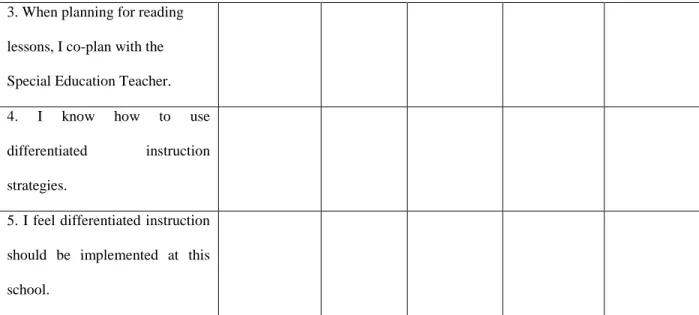
Questions A Strongly Agree B Agree C Neutral (Neither agree/Nor disagree) D Strongly Disagree E Disagree
1. I create lessons that include differentiated instruction for all students (including my SPED students) within my classroom. 2. I group my student’s accord to their ability levels.
26 3. When planning for reading
lessons, I co-plan with the Special Education Teacher. 4. I know how to use differentiated instruction strategies.
5. I feel differentiated instruction should be implemented at this school.
Conferencing
Pre and Post Conferences were conducted in person by asking probing questions that related to the survey. During the conference portion of the study (pre and post) the participants and I were in a quiet relaxing environment. A conferencing tool was used for both the pre and post conference, and the participants received a copy of our conversation for additions and/or corrections if needed.
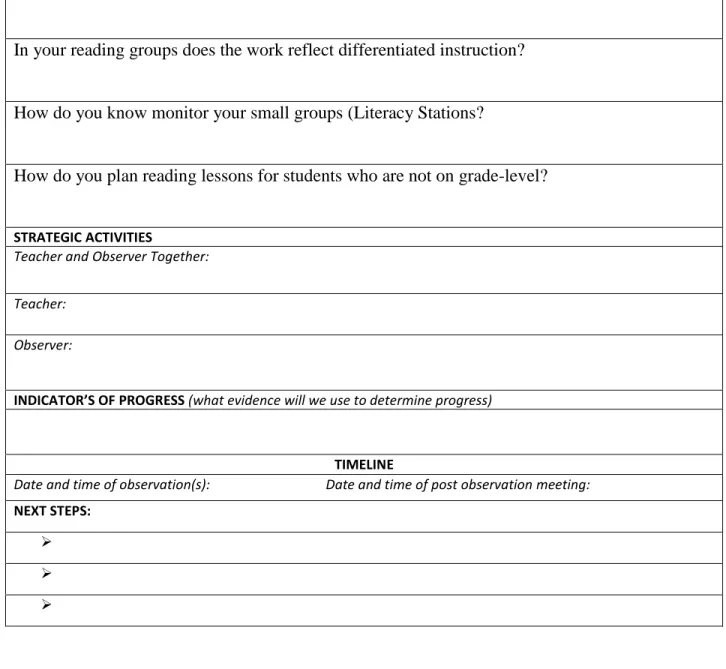
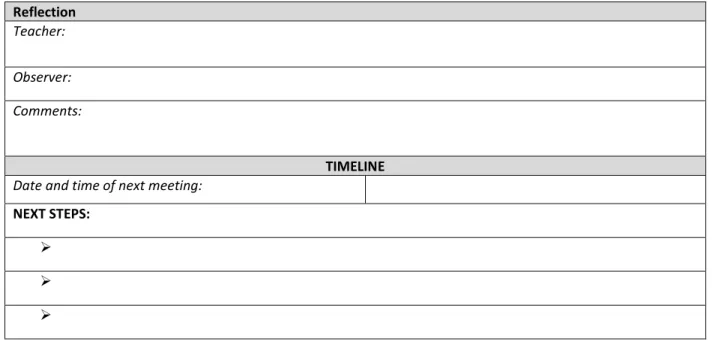
Participants ‘names were not written on the conference sheet just the letter that was used to identify to distinguish between the two fourth grade teachers and the others that participated in the observation portion of the research. Figure 2 indicates a copy of the Pre-conference tool that was used and Figure 3 indicates the Post-Conference tool used.
Figure 2- Pre-Conference Form
Pre-Conference Form
Teacher: Observer:
School: Date:
Pre-Conference Questions
27
In your reading groups does the work reflect differentiated instruction?
How do you know monitor your small groups (Literacy Stations?
How do you plan reading lessons for students who are not on grade-level?
STRATEGIC ACTIVITIES
Teacher and Observer Together: Teacher:
Observer:
INDICATOR’S OF PROGRESS (what evidence will we use to determine progress)
TIMELINE
Date and time of observation(s): Date and time of post observation meeting: NEXT STEPS:
Figure 3- Post Conference Form
Post-Conference
Teacher: Observer:
School: Date:
Observation/Evidence
28 Reflection Teacher: Observer: Comments: TIMELINE Date and time of next meeting:
NEXT STEPS:
Observation
I conducted classroom observations for eight weeks with each teacher to observe their teaching patterns. The observations were conducted three times a week. During the first eight weeks, I only observed the relationship between teacher- students. I focused on what activities took place during the instructional reading block, i.e., what was the teacher doing –what was the students doing; did the teachers use the lesson plan template as their guide for reading; looking for evidence of differentiated instruction. I used the observation tool to record my finds. After each observation, I left a copy of the observation feedback form and then met for a post-conference conversation. Figure 4 is the observation form I used for each observation: Figure 4: The Observation form
Observation/Evidence
Indicators of Progress Observed
29 NEXT STEPS:
SECTION FOUR: RELEVANT LITERATURE
Introduction
Identifying what literature and research report about differentiating instruction is critical to understanding how to make it happen in classrooms (Gibson & Hasbrouck, 2008; Marzano, Marzano, & Pickering, 2003). Numerous publications are available that describe the
characteristics of differentiating instruction or suggest curricula and activities that can be
modified to address student variance (Evertson & Harris, 1999; Marzano, Marzano, & Pickering, 2003; Rothstein-Fisch & Trumbull, 2008; Tomlinson & Eidson, 2003). Thus, resources are critical for the support of differentiated instruction. As I read various literature, there is plenty of resources that can be used for teachers and administrators who desire to understand the concept of differentiating instruction, as well as resources available for forming a plan of action.
In an article by Dr. Vicki Gibson, states that “teaching differently to address student variance is possible, but it requires changes in practice, which involves changing the behavior of teaching.” She future states: “in order to know where to begin the process of implementing changes in instructional delivery, teachers and administrators need to evaluate the following:
• How is instruction currently being delivered in classrooms: using whole-class lecture or a combination of whole-class and small-group lessons?
30
• What is taught and whether pacing and curricula are appropriate to address student needs (i.e., instructional and program effectiveness—the quality of the teaching and curricula)?
• What professional development training has been provided to prepare teachers for differentiating instruction, including how to observe patterns of error and use data to inform practice, grouping for instruction, and aligning curricula to needs?
• What professional development will be required to improve instructional effectiveness and sustain change (Gibson, 2008)?
Throughout the article, it points out valuable insight on issues that needed to be addressed in order for differentiating instruction to take place. For example, there are sequential questions that need to be asked:
How teachers are supposed to get everything done and differentiate instruction to
increase students' academic achievement?
What guides are used to scale back lessons?
Is there scientific research that provides procedural models for differentiating instruction?
Mainly, the article points out ways that differentiated instruction can be implemented. According to Universal Design for Learning (UDL), differentiate instruction is to recognize students’ varying background knowledge, readiness, language, preferences in learning and interests, and to react responsively.
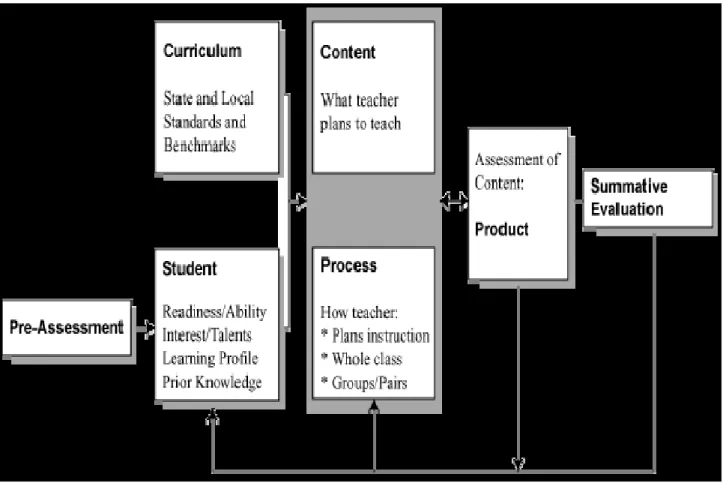
Differentiated instruction is a process to teaching and learning for students of differing abilities in the same class. The intent of differentiating instruction is to maximize each student’s growth and individual success by meeting each student where he or she is, and assisting in the learning process (Hall, Strangman, & Meyer, 2001). The following chart indicates the learning cycle and decision factors used in planning and implementation of Differentiated Instruction:
31
Figure 5 Learning Cycle and Decision Factors Used in Planning and Implementing Differentiated Instruction (Hall, Strangman, & Meyer, 2001)
Hall, Strangman, & Meyer, 2001 According to the authors of differentiated instruction, several vital elements guide
differentiation in the education environment. Tomlinson (2001) identifies three elements of the curriculum that can be differentiated: Content, Process, and Products (these can be found on Figure 5). According to the proponents of differentiation, some principles and guidelines are rooted in years of educational theory and research. Some of the guidelines are:
Content
Several elements and materials are used to support instructional content. This includes
32
Align tasks and objectives to learning goals. Designers of differentiated instruction view
the alignment of tasks with instructional goals and objectives are essential. Goals are most frequently assessed by many state-level; high stakes tests, and frequently administered standardized measures.
Instruction is concept-focused and principle-driven. The instructional concepts should be
broad-based, not focused on minute details or unlimited facts. Teachers must focus on the concepts, principles, and skills that students should learn. The content of instruction should address the same concepts with all students, but the degree of complexity should be adjusted to suit diverse learners.
Process
Flexible grouping is consistently used. Strategies for flexible grouping are essential.
Learners are expected to interact and work together as they develop knowledge of new content. Teachers may conduct whole-class introductory discussions of big content ideas followed by small group or paired work.
Classroom management benefits students and teachers. To effectively operate a
classroom using differentiated instruction, teachers must carefully select organization and instructional delivery strategies.
Products
Initial and on-going assessment of student readiness and growth are essential.
Meaningful pre-assessment naturally leads to functional and successful differentiation. Incorporating pre and on-going assessment informs teachers so that they can better provide a menu of approaches, choices, and scaffolds for the varying needs, interests, and abilities that exist in classrooms of diverse students. Assessments may be formal or
33
informal, including interviews, surveys, performance assessments, and more formal evaluation procedures.
Students are active and responsible explorers. Teacher’s respect that each task put before
the learner will be interesting, engaging, and accessible to essential understanding and skills. Each child should feel challenged most of the time.
Vary expectations and requirements for student responses. Items to which students
respond may be differentiated so that different students can demonstrate or express their knowledge and understanding in different ways. A well-designed student product allows various means of expression and alternative procedures and offers varying degrees of difficulty, types of evaluation, and scoring.
For example, differentiated instruction adopts the concept of “readiness.” That is, the difficulty of skills taught should be slightly in advance of the child’s current level of mastery. This is grounded in the work of Lev Vygotsky (1978), and the zone of proximal development (ZPD), the range at which learning takes place. The classroom research by Fisher et al., (1980), strongly supports the ZPD concept. The researchers found that in classrooms where individuals were performing at a level of about 80% accuracy, students learned more and felt better about themselves and the subject area under study (Fisher, 1980 in Tomlinson, 2000).
According to Gibson & Hasbrouck, 2009; and Marzano, et al., 2001, there are five steps for establishing routines and implementing differentiating instruction to occur within classrooms:
1. Establishing the environment
This step involves organizing the physical environment. Classroom furniture is arranged
34
often called the teaching table, even though the group may not always officially meet and work at a table.
Need for workstations or designated areas where students gather and work
collaboratively. Usually, teachers create 2–4 work areas for small group/partner guided practice activities.
A third work area appears on the Rotation Chart as Worktable. Teachers use the term
worktable to denote when students are expected to work independently, either at their desks or table spaces or in another area designated explicitly in the classroom.
2. Using data to inform practice
This step involves using data to inform teaching. Teachers initially examine evidence
(assessment data, work samples, student observations) and identify specific instructional strengths and areas for improvement. Then, using data, teachers develop an instructional purpose of achieving standards-based goals and assign small group memberships. Student memberships may be homogenous (grouped by similar skill) for explicit, teacher-led instruction or heterogeneous (mixed skill groupings) for small group practice.
Groups are often changing. Data is continuously used to inform teaching and making
instructional adjustments for grouping and differentiating instructional practices.
3. Managing resources
This is an essential step for implementing efficient and effective instruction to ensure
high-quality learning experiences occur daily. Efficient time management is essential; therefore, teachers develop daily schedules that clearly identify when small group and whole class activities will occur. These tools assist teachers with managing time and student participation during instructional periods:
35
o A flexible Daily Schedule that ensures specific time periods are assigned to small group instruction that occurs daily when possible.
o A Job Chart that delegates classroom responsibilities to students who help with monitoring workstations and distributing materials, thus allowing more time for teachers to focus on instruction.
o A Rotation Chart that clearly communicates student performance expectations by illustrating group memberships and how participation in instruction and practice activities will occur.
4. Creating routines and procedures
Teachers must create routines and procedures that facilitate small group management and
ensure efficient transitions between activities. Since multiple activities happen simultaneously, routines and procedures are necessary to maintain an efficient yet flexible pace. The rotation chart and daily schedule establish an order for student participation in instructional activities. The job chart is used to delegate responsibilities for cleanup and checking student work during transitions. Students work as monitors to check work areas and student assignments.
Teaching and modeling expectations for students will encourage compliance and help
establish new habits for efficient classroom participation and collaboration
5. Providing high-quality teaching and practice
Improving the quality and quantity of instruction provided in whole class or small group
instruction is the purpose of differentiating instruction. However, improving instruction comes after managing the classroom and student behaviors. Once classroom routines are operating efficiently, teachers can focus and teach differently using small group lessons.
36 Summary
Overall, differentiating instruction means merely to teach differently, and to make conscious changes that happen within classrooms that will often depart from traditional habits and
practices. It is vital to establishing routines and procedures for organizing resources (classroom space, time and materials or activities) in order for implementation to take place. It is also necessary for all stakeholders, administrators, and teachers, to take ownership of the changes as well as clearly identifying and articulating how the change process will occur and support will be provided. Thus, differentiating instruction and practice will ensure teaching and learning are purposeful and productive at any grade level — therefore, changes can begin!
37
SECTION FIVE: DATA ANALYSIS & INTERPRETATION
The primary purpose of this study was to create and develop a cohort of teachers to implement strategies and practices that would incorporate differentiated instruction. As I spent hours on researching strategies used to implement differentiated instruction, I began to work with teachers (specifically with two teachers from School X) to help them set up their classrooms to reflect differentiated instructional practices.
Differentiated Instruction vs. Modification
Before implementation of a differentiated classroom can take place, teachers must understand the difference between differentiating instruction and modification of instruction. As outlined previously Differentiated Instruction provides students with different ways of accessing grade-level standards (Provost, 2014). The content, learning process, and products in a
differentiated classroom are all aligned to the student performance standards expressed in the core curriculum (Tomlinson, 2008). Standards are held constant, in a differentiated classroom and the ways in which the students address the standards are allowed to vary.
Modification Instruction is merely replacing the prescribed curricular content, teaching methodology, and/or student performance standards with alternatives that have been determined to be more appropriate for the student based on an identified disability. Because modifications change what students will learn and be expected to do, an explicit rationale for the modifications must be developed by a team of educators, and the changes themselves must be agreed to by the parent and/or student 18 years or older (Provost, 2014).
In the study, through the process of observation, I also noted times when both participants modified lessons for students with disabilities (SWD). For example, in Participant F classroom
38
there were seven students with a disability (Learning, Speech, and/or Other Health Imparity-(OHI)). The participant stated that they give those seven students complete half of the questions and/or activities based on individualizing educational learning plan (IEP). In Participant G classroom there are eight students with a disability, and the Special Education Teacher modifies those students' lessons and/or give different type of skill activities (the students are pull-out during the reading block). Another example that was observed during the observation stage was Participant F grouped three SWD with 3 students who did not have an IEP into one group and modified the lessons by using a computer-based program to help with comprehension while the remaining groups read from the textbook. Participant G used the same format but only with their low-level students (The SWD was pull-outs during the reading block).
The intent was to use strategies taught during the instructional reading block. Thus, data were collected through the forms of a questionnaire, pre-and post-conferencing, and
observations. However, before, I started the conferencing and observation process, I conducted a professional development session with the participants. During this session information on how to implement differentiated instruction (information citing from my literature review) was shared with the participants and together we begin to develop strategies on how to create an
environment that establishes routines for implementation.
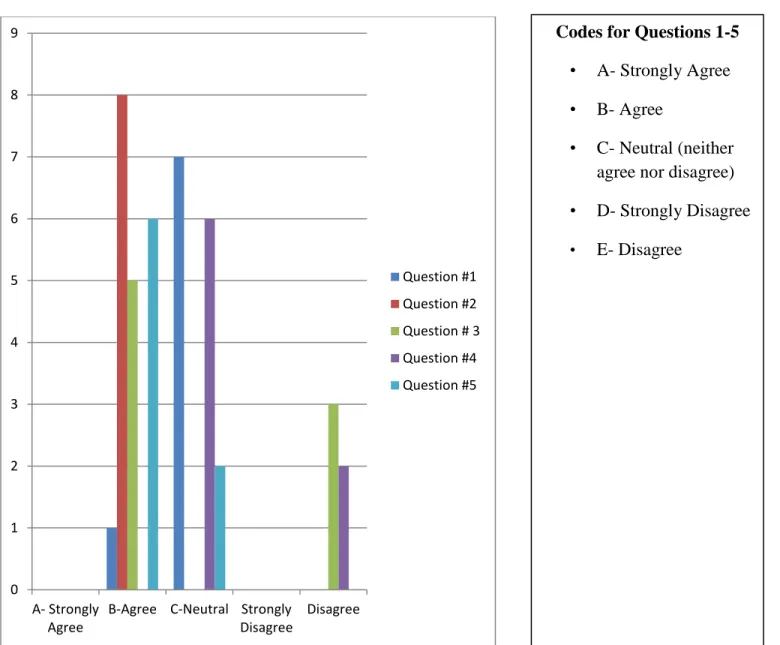
Thus, my findings will outline the results of the questionnaire, conferencing, and observations as well as outline the interpretation of the results. While coding and finding common theme throughout the research, I noticed the surveys/interviews, and observations shared some similarities between the participants within this study. For example, teachers in grades 1, 3, 4 and 5 were all neutral on question 1 (I create lessons that include differentiated instruction for all students (including my SPED students) within my classroom) and all selected
39
that they agreed on question 2 (I group my student’s accord to their ability levels). Question 2 is typically how most teachers group their students. Question 3, 4 and 5 indicated a mixture of agreed, neutral or strongly disagreed. I found it interesting that none of the participants strongly agreed to any of the questions. The table below indicates the survey results:
Table 1- Teachers' Questionnaire Results
As I analyzed the data to obtain a better understanding as well as to draw a more appropriate conclusion about the qualitative surveys, interviews, and observation I can analyze my findings. During the observation period, I observed a total of 8 teachers (2-teachers grade 1;
0 1 2 3 4 5 6 7 8 9 A- Strongly Agree
B-Agree C-Neutral Strongly Disagree Disagree Question #1 Question #2 Question # 3 Question #4 Question #5
Codes for Questions 1-5 • A- Strongly Agree
• B- Agree
• C- Neutral (neither agree nor disagree) • D- Strongly Disagree
40
2-teachers grade 2; 1 teacher-grade 3; 2-teachers grade 4; 1-teacher grade 5).The observations were conducted for eight weeks with the teachers from 4th grade. However, I conducted
observations with teachers from grades 1, 2, 3, and 5 for 2 two weeks in order to obtain a sense of understanding of how reading instruction is delivery at School X and to obtain data that I could compare with the two fourth grade participants.
During the study four pre-conference and four post-conference sessions were held. Within these sessions, participants were invited to share dialogue about their practices (See forms in Appendix E and F). The following conversation is an example of what took place during the first pre-conference and first post-conference sessions:
Researcher in the Pre-Conference Session:
Participant F: I had music playing and light snacks available for the pre-conference session, I invited Participant A to partake in a snack, did a “checking in” activity (On a scale of 1-10 how is your day going? We made small talk asking about family (an effort to build trust). I then thanked the participant for participating in the coaching cycle. I asked if Participant F had any questions about the process before we began completing the form. Participant F came into the conference a little frustrated and appeared not to want to do the conference at the scheduled time. We talked about the issue, they were having (students not working well in their literacy stations) and
proceeded with the conversation of filling out the form. As the form was being filled out, we discussed their process of planning lessons. Participant F stated that when planning lesson, they strictly used the teacher's edition for ideas for reading. The teacher's edition offers suggestions for readers who are on-level; advance; or below reading level. Thus, the Participant used the suggestions from the textbook to create reading lessons.
41
Participant F also started modeling the expectation they wanted to take place in the literacy stations.
Participant G: The same set-up (music, snacks, a quiet relax setting) was afforded to Participant G. Participant G was excited to participate in the study; they described the process in which they developed lesson plans for their reading group. Participant G stated that they create lessons based on suggestions from the reading textbook. It was stated; that for the most part, lessons are modified for students with disabilities, and the Special Education Resource Teacher works with small groups within the classroom setting. We created a lesson plan in reading and discussed one strategy that I would observe during the observation session.
Researcher in the Post-Conference Session:
Participant F: I had music playing and light snacks available for the post-conference session, I invited Participant A to partake in a snack, did a “checking in” activity (On a scale of 1-10 how is your day going? We discussed what was observed in during the reading block. During the reading block, students were engaged during the 20 minutes teacher-led activity. However, when the rotation began for the small groups (literacy stations), the transition did not flow as the teacher expected. Students appeared to be confused on what rotation they should go. I asked probing questions to help the participant to develop transiting techniques for the next time observation would take place.
Participant G:I had music playing and light snacks available for the
post-conference session, I invited Participant A to partake in a snack, did a “checking in” activity (On a scale of 1-10 how is your day going? We discussed what was observed in
42
during the reading block. During the reading block, it was shared that students were engaged in both the teacher-led group and small group literacy stations. However, activities in the literacy stations were all on the same skill level. Thus, no differentiated were seen in the activities. We discussed what we wanted to observe in the next steps.
Within the observation period, I observed all participants the first two weeks of the study in order to get an understanding of how reading instruction was taught from their perspective- reading block. I use the observation form during the first two weeks of the observation (three days a week) to check to see if the participants were following the Comprehensive Literacy Plan (CLP) as outlined by the district. My specific task was to observe the participants using the CLP format. The CLP plan outlines reading instruction should be taught for 90 minutes in a whole-small-whole format, which includes literacy stations (Vocabulary, word work/Phonics, technology, independent reading, independent writing, and a teacher-led group).
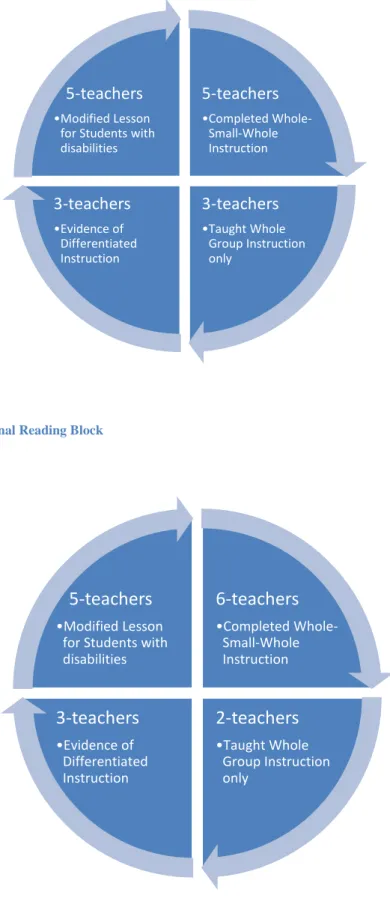
The CLP also should include evidence of differentiated instruction in both the lesson plan and reflect in the various literacy stations. Upon completing the first two weeks of observation, my findings indicated that some participants (3) followed the plan with fidelity (both weeks 1 & 2) whereas the remaining participants (5) made some efforts to follow the plan. The figures below indicate the results for the first two weeks of the study:
43
Figure 6: Week 1 Instruction Reading Block
Figure 7: Week 2 Instructional Reading Block
5-teachers •Completed Whole-Small-Whole Instruction 3-teachers •Taught Whole Group Instruction only 3-teachers •Evidence of Differentiated Instruction 5-teachers •Modified Lesson
for Students with disabilities 6-teachers •Completed Whole-Small-Whole Instruction 2-teachers •Taught Whole Group Instruction only 3-teachers •Evidence of Differentiated Instruction 5-teachers •Modified Lesson for Students with disabilities
44
Upon completing the first two weeks with participants from grades 1, 2, 3, and 5, I began week three working with the two fourth grade participants. I met with the two participants to discuss the literature that I read for this study as it pertains to differentiated instruction. We focused on Tomlinson (2001) three elements of curriculum specifically: content; process; and products. We also explored Gibson & Hasbrouck, 2009; and Marzano, et al., 2001 five steps (environment, data, resources, routines, and procedures, as well as high-quality teaching and practice) for establishing routines for implementation of differentiated instruction to take place within their reading block. For the remaining weeks, the observations consist of the observing the two participants utilizing information shared from literature review.
The participants and begin implementing the steps as discussed within the literature review. The table below indicates the results of implementation stages of differentiated instruction:
45
Table 2: Observation with Implementation of the five stages of Differentiated Instruction
The table indicates the weeks and changes that occurred during the study in the five steps for implementation. By completing the observation for eight weeks, the data indicates if teachers follow the five steps for establishing routines and procedures for the implementation of
differentiated instruction with fidelity, school will begin seeing an increase in students’ academic Week 3 Week 4 Week 5 Week 6 Week 7 Week 8 0 0.2 0.4 0.6 0.8 1 1.2 1.4 1.6 1.8 2 Week 3 Week 4 Week 5 Week 6 Week 7 Week 8
46
performance. The data also indicates the participants’ willingness to change their practices (see table 2).
Summary of Findings
Participant F and G both indicated they were beginning to see a difference in their classroom environment. Both participants change their classroom set-up to reflect work stations; an area for teacher-led groups and created visible rotation charts so that the students become an active participant in the learning environment. The data also indicated that both participants F and G begin to understand their data and use the information to drive their instruction. They created a mixed skilled group based on the results of their STAR Assessment and classroom assessment (formative and summative). They shared the data with the Special Education Resource teacher and began lesson planning together.
Both participants became aware of managing their time by listing rotation and job charts as well as being consisted of routines and procedures. They understood routines and procedures are critical to the implementation of differentiated instruction as well as moving toward teaching high-quality lessons that will meet the needs of all learners (hence one size doesn’t fit all).
47
SECTION SIX: A VISION OF SUCCESS (TO BE)
In creating a successful vision for change, we must first recognize the need for change and then create a system that focused on improvement in all areas of academic achievement. Wagner proposes that schools and school districts must develop a shared vision and define and/or create a new framework for effective teaching (Wagner, 2006). He further outlined that in order for the framework to take place teaching and learning must go hand-and-hand. He refers to this process as the New 3R’s- rigor of the lesson, relevance for the students’ lives, and respect
for teacher-student relationships (Wagner, 2006).
Thus, in order to be an active change agent, there must be a plan of action to bring about the change. Wagner mentions the process should include thinking systemically which is merely relating the parts to make whole, thus, looking at the "As Is"- current state of our literacy plan (CLP) and the implementation of the delivery of instruction. He further mentions that to approach thinking systematically, we must think about the challenges and goals as we propose change for teaching and learning. Therefore, as I look at the attributes of my "As Is," I know it is necessary to create a roadmap of what is "To Be" of this proposed change plan. In figure 3- "To Be" it outlines the results of my change plan.
TO-BE Context
The desired outcome for context is teachers will differentiate their reading lessons for all learners as they continue to use the district's Comprehensive Literacy Plan (CLP) with fidelity that will include differentiated instruction strategies and practices. By doing this, the outcome would be increased reading scores from both formative and summative reading assessments as well as give students an opportunity to become an active participant in their learning process. In
48
addition to creating an instructional framework for implementation of differentiated instructions, teachers will begin to serve all students and meet their academic needs indeed.
To Be-Culture
For change to occur, the culture must change. Leaders and teachers must provide time and commitment to the change. The acceptance of changing the way reading instruction is delivered by providing the necessary support through the format of professional development so that all teachers have a clear understanding of the difference between differentiated instructions versus modification of skilled lessons.
School leaders must also be in support of the culture change as teachers are learning how to implement the steps and routines for the implementation to take place within their
instructional reading block. Therefore, I envision the “To-Be” culture a culture of "I am (delivery of instruction changed). Therefore we are (students' academic needs are met) thus, teaching and learning have been changed!
To Be- Condition
Conditions to change can be positive or negative if we as a school allow them to be. My hope is if we change the conditions we can improve our students’ academic success. By allotting embedded grade-level and/or grade band collaborative planning time teachers will be able to plan lessons that will benefit all learners within their perspective classrooms as well as those of their grade-level partners. Thus, we will see the desired outcomes of the CLP as it was designed (differentiated instruction utilized within the literacy work stations and reflected in teachers’ lesson plans).
49
The core competencies of this plan are for teachers to increase their knowledge on the important meeting the need of all learners as well as understand how to use their students' data to help guide reading practices for successful outcomes. If the school administrators take the lead in supporting their staff to move toward change, then we will see an overall, increase in school's reading scores. It is vital that teachers begin to embrace change by creating lessons that truly meets the needs of all students.
Teachers will have a strong understanding of the reading content and a keen understanding of how to use differentiated instruction strategies. In order to produce the intended outcome of this plan is to have staff participate in extensive professional development sessions that focus on differentiated instruction (routines and procedures).
Overall, my vision for success is to implement differentiated instruction within the instructional reading block and then infuse it throughout the K-12 curriculum. It is my hope and desires to be able to dive more rooted in the possibilities of transforming teaching and learning beyond the 21st century way of teaching.
50
SECTION SEVEN: STRATEGIES AND ACTIONS FOR CHANGE
For many years the concept of teaching reading instruction has been to group students according to their reading ability and for the most part, teach the whole group with the hopes that students would get "something" from the skills taught regardless if they are on level or not. Therefore, a change must come in the way reading instruction is delivered. As Wagner stated:
Most of us in the profession of education never have been part of a system or community of practice dedicated to continuous improvement (Wagner, 2006).
Teaching and instructional leadership in many schools are often mediocre, and often times does not move toward improving student achievement.
Many have witnessed in most reading class where the common practice is to give all students the same type of work with disregards to students with disabilities (SWD). Usually, those
students will receive a form of modified work, i.e., Students without a disability will complete all work whereas the SWD will receive half or less than the SWOD for the work assignments. Many of our students fall through the cracks because of this type of delivery.
Nevertheless, many teachers have an excuse for their actions, i.e., the special education teacher will meet their learning needs. Thus, the implementation of the following strategies are recommended for action to improve the delivery of reading instruction by utilizing differentiated instruction routines and procedures that will ultimately change teaching practices and improve students’ academic achievement:
Strategies Actions
Strategy1: Classroom Environment Change the physical set-up of the
classroom for the reading block
Rearrange the workspace to include literacy stations and teacher-led instruction space, i.e., circular table
51
Create small groups for instruction (mixed grouping based on STAR Assessment Data )
Create workstations- Rotation charts
Strategy 2: Use Data to Inform Teaching Practice
Teachers review assessment data; work samples; and student observation during the teacher-led instruction (small group)
Develop an instructional purpose of achieving Standard base goals (Rubric)
Adjust groups as needed (based on new data information) at least every nine weeks
Strategy 3: Manage Resources Create a flexible daily schedule that
indicates specific times and
assignments for small groups (literacy stations)
Create a job chart- giving students an opportunity to become leaders within the classroom (during literacy stations)
Create a rotation chart and make sure the chart is clearly articulated with step-by-step procedures on what should take place in the various literacy stations.
Strategy 4: Routines and Procedures Create routines and procedures that
will facilitate management of the literacy stations and to ensure
adequate transition take place between rotations of activities.
Model expectation of routines and procedures until students know precisely what to do in the reading block about 2-weeks)
Make sure work placed in the workstations reflect differentiated lessons for all learners
Strategy 5: High-Quality Teaching and Practices
Continue to follow the layout for the CLP (Whole-Small-Whole)Instruction
Journal reflection of the
implementation of differentiated instruction
52 Sustainability
Efforts to sustain this study of the implementation of differentiated instruction, the participants (F and G) agreed to train other colleagues on the strategies and practices they used within their reading block as well as agreed to help other teachers, set-up their classrooms to reflect a differentiated classroom. They also agreed to incorporate a differentiated classroom into their math block beginning the next school year (2018-2019). The idea is to create a trainer-to-trainer model until all staff are trained and begin to implement differentiated instruction within their instructional reading block with fidelity.
Conclusion
Finally, educators must understand change is not an easy task to master. However, educators must also understand we cannot continue to deliver instruction in a modification format for students who are not reading on grade-level and/or for students with disabilities if we are going to improve teaching and learning. We must be willing to shift our delivery of
instruction in order to strive towards closing the achievement gap. Once this shift happens, we will begin seeing schools within the district move from meeting few expectations on the State Report Card to schools that are meeting and/or exceed expectations. Thus, the delivery of reading instruction will have move from one size doesn’t fit all –to- differentiated instruction will meet the needs of all learners.
53
REFERENCES
Anderson, K. (2007). Tips for teaching: Differentiating instruction to include all students.
Preventing School Failure, (51)3,49-54. 10.1017/S0033291710000371
Armstrong, T. (2009). Multiple intelligences in the classroom, 3rd edition. Alexandria, VA: Association for Supervision and Curriculum Development.
ASCD. (2011). ASCD: Learn. Teach. Lead. Retrieved from
http://www.ascd.org/research-a-topic/brain-based-learning-resources.aspx
Baumgartner, T., Lipowski, M. B., & Rush, C. (2003). Increasing reading achievement of primary and middle school students through differentiated instruction (Master's research). Available from Education Resources Information Center (ERIC No. ED479203).
CAST. UDL Toolkits: Planning for All Learners (PAL). (n.d.). Retrieved August 19,
2003, from http://www.cast.org/teachingeverystudent/toolkits/tk_introduction.cfm?tk_id=21 Danielson, C. (2013). Framework for Teaching Evaluation Instrument. The Danielson Group Dolan, R. P., & Hall, T. E., (2001). Universal Design for Learning: Implications for Large Scale Assessment. IDA Perspectives, 27(4), 22-25.
Ellis, E. S. and Worthington, L. A., (1994). Research synthesis on effective teaching principles and the design of quality tools for educators. University of Oregon: Technical Report No. 5 National Center to Improve the Tools of Educators.
Hall, T. (2002). Differentiated instruction [Online]. Wakefield, MA: CAST. Available:www.cast.org/publications/ncac/ncac_diffinstruc.html
Lawrence-Brown, D. (2004). Differentiated instruction: Inclusive strategies for standards-based learning that benefit the whole class. American Secondary Education 32(3), 34.
Meyer, A., & Rose, D. H., (1998). Learning to read in the computer age. Cambridge, MA: Brookline Books.
McQuarrie, L., McRae, P., & Stack-Cutler, H. (2008). Differentiated instruction provincial research review. Edmonton: Alberta Initiative for School Improvement
Oaksford, L. & Jones, L., (2001). Differentiated instruction abstract. Tallahassee, FL: Leon County Schools.