EVIDENCE-BASED PRACTICE IN NURTURE GROUPS: USING A REALISTIC EVALUATION FRAMEWORK TO EXPLORE FACTORS AFFECTING PRACTICE
AND SUGGEST FUTURE TRAINING DIRECTIONS
by
Oonagh M Davies
Volume 1 of a thesis submitted to The University of Birmingham
toward the degree of Doctorate in Applied
Educational and Child Psychology
The School of Education The University of Birmingham July 2011
University of Birmingham Research Archive
e-theses repositoryThis unpublished thesis/dissertation is copyright of the author and/or third parties. The intellectual property rights of the author or third parties in respect of this work are as defined by The Copyright Designs and Patents Act 1988 or as modified by any successor legislation.
Any use made of information contained in this thesis/dissertation must be in accordance with that legislation and must be properly acknowledged. Further distribution or reproduction in any format is prohibited without the permission of the copyright holder.
ii
ABSTRACT
Nurture Groups (NGs) are a focused intervention in mainstream schools, which strive to compensate for missed nurturing experiences in the early years through provision of small-group teaching in a home-like environment. This study is fundamentally concerned with understanding how social programmes like NGs work, and draws on Pawson and Tilley’s (1997) ‘Realistic Evaluation’ to provide a methodological and epistemological framework for this inquiry.
Staff practice crucially affects NGs, yet this remains a relatively poorly investigated domain. Within a ‘Realistic Evaluation’ framework, working collaboratively with NG practitioners as co-researchers, their perspectives on factors which influence practice and support staff development are explored. Pertinent context, mechanism and outcome configurations relating to NGs, staff role and effective training are abstracted.
A realist synthesis of the literature and scrutiny of research findings using qualitative data analysis, revealed practitioners’ perspectives on key mechanisms and contexts influencing practice at the community, family, whole school, mainstream class and NG levels, enabling positive outcomes for children attending NGs, and their families.
iii
The findings highlight the complexity of this compensatory psycho-educational initiative. If positive outcomes for children are to be realised and appropriately evaluated, it is important to understand the underpinning causal mechanisms and influential contextual factors, with a contingent need for appropriately designed studies. Furthermore, as traditional assumptions regarding the mechanisms central to the effectiveness of this small group intervention could be at risk of ‘internalising deficit’, through the established emphasis on compensation for poor early attachment (Boxall, 2002), it is important that factors at Bronfenbrenner’s (2005) micro-, meso-, exo- and macrosytemic levels continue to be considered.
Key contexts, mechanisms and outcomes within training and NG staff development were also identified. There was consensus that training models which involve greater opportunities for peer supervision and learning are more likely to facilitate successful practice, and ensure that learning derived from training and good practice are embedded.
iv
v
ACKNOWLEDGEMENTS
My sincere gratitude goes to Sue Morris, for her indefatigable support and advice, and fuelling my passion for research.
Thank you to my Coalshire1 colleagues; in particular Tom and Anne, for their
commissioning of and interest in the research, and all the Nurture Group staff who gave their valuable time to participate and share their views.
Special thanks to my wonderful new husband Huw, and my parents for their support, patience and encouragement.
vi
CONTENTS
CHAPTER 1: INTRODUCTION ... 1
1.1 Rationale for the study ... 1
1.2 Aims of the study ... 4
1.3 Researcher identity ... 5
1.4 Research questions... 6
1.5 Research context ... 7
1.6 Methodological approach ... 7
1.7 Structure of the study ... 8
CHAPTER 2: REALISTIC EVALUATION AND EVIDENCE-BASED POLICY ... 12
2.1 Introduction ... 12
2.2 Realistic Evaluation ... 13
2.2.1 Weaknesses in experimental evaluation ... 13
2.2.2 Generative causation ... 14
2.2.3 Contexts, Mechanisms and Outcomes ... 16
2.3 The nature of evidence ... 18
2.4 Evidence-based policy ... 20
2.5 Systematic Reviews (SRs) ... 22
2.5.1 The broader debate surrounding different research methods ... 23
2.5.2Studies involve complex interventions with multiple outcomes ... 24
2.5.3Concern there is no room for theory ... 26
2.5.4 Alternatives to systematic reviews (SRs)... 28
2.6Realist syntheses ... 29
2.7 Realistic Evaluation and Education ... 30
CHAPTER 3: COMPENSATORY EDUCATION, SMALL GROUP THERAPEUTIC INTERVENTIONS AND NURTURE GROUPS ... 32
3.1 Aims and objectives ... 32
3.2 Search strategy/methodology... 32
3.3 Compensatory education ... 34
3.3.1 Head Start (HS) ... 34
3.3.2 Sure Start ... 38
vii
Programme Theory for compensatory education initiatives: ... 43
3.4 Small Group Therapeutic Interventions (SGTIs) ... 43
Programme Theory for SGTIs: ... 48
3.5 Nurture Groups (NGs) ... 50
3.5.1 Policy context for SEBD ... 50
3.5.2 Background, features and rationale of NGs ... 53
3.5.3Critique of the evidence-base ... 56
3.5.3i Key NG studies ... 57
3.5.3ii Disentangling the contribution of contexts and mechanisms on the impact of NGs .... 64
3.5.3iii The Boxall Profile ... 65
3.5.3iv Assumptions and criticisms of NGs ... 67
3.5.3v Control group comparison ... 70
3.5.3vi Subjectivity and bias ... 71
3.5.3vii Differential impact ... 72
3.5.4 Implications for the present study ... 73
3.5.5Conclusions ... 76
Programme Theory for NGs: ... 77
CHAPTER 4: EFFECTIVE TEACHING AND TRAINING ... 78
4.1 Introduction ... 78
4.2 Effective teaching... 78
4.2.1Changing conceptualisations of effective teaching ... 78
4.2.2 Current frameworks for characterising effective teachers ... 81
4.3.1 Group size effects ... 86
4.3.2 Other contextual factors ... 87
4.4 Conclusions ... 89
Programme Theory for effective teaching...89
CHAPTER 5: REALISTIC EVALUATION: HYPOTHESES, METHODOLOGY, METHODS AND STUDY DESIGN ... 90
5.1 Introduction ... 90
5.2 Aims, hypotheses and research questions ... 91
5.3 Conceptualisation and design of the empirical study ... 94
5.3.1 Realist evaluation cycle ... 94
viii
5.4 Epistemology and Methodology ... 99
5.5Methods ... 104
5.5.1 Ethical considerations ... 104
5.5.2 Sample ... 105
5.5.3 Instruments ... 109
5.5.3i Interviews ... 110
5.5.3ii Group realist interview (GRI) ... 112
5.5.4 Reliability and validity ... 115
5.5.4i Realist synthesis ... 116
5.5.4ii Interviews: individual and group ... 117
5.5.5 Analysis of the data ... 119
5.5.5i Realist synthesis ... 119
5.5.5ii Individual interviews ... 119
5.5.5iii Generation of Data Outcome Patterns and the group realist interview ... 119
CHAPTER 6: RESULTS AND DISCUSSION ... 123
6.1 Introduction ... 123
6.2 Research Question E: What do practitioners consider are the key attributes, skills and experience effective NG practitioners should have? ... 124
6.3 Research Question F: What community/family, whole school, mainstream classroom, and NG level factors (contexts and mechanisms) do practitioners consider support or hinder their practice and the outcomes of NGs? ... 129
6.3.1 Support for NG practitioners... 130
6.3.2 Collaborative working ... 131
6.3.3 Parents Matter...133
6.3.4 Small group size and alternative curriculum ... 137
6.3.5 ‘Filling the gaps’ ... 139
6.4 Research Question G: With regard to NGs and staff practice, what contexts and mechanisms do NG practitioners consider most powerful in influencing outcomes? ... 141
6.5Refined programme specification for NGs and staff practice ... 148
6.6 Research Question H: What aspects (contexts and mechanisms) of training/CPD do NG practitioners consider would support their own and others’ professional development most effectively? ... 151
6.7 Research Question I: With regard to staff development, what contexts and mechanisms do NG practitioners consider most powerful in influencing outcomes? ... 154
ix
CHAPTER 7: CONCLUSIONS AND RECOMMENDATIONS.. ... 158
7.1 Development of the programme theories... 158
7.2 Critique of methodology ... 159
7.3 Research findings and the challenge of complexity ... 162
7.4 Implications for future training ... 166
7.5 Future Research ... 168
7.6 Implications for EP practice ... 169
REFERENCES ... 171 APPENDICES
Appendix I Summary of the Head Start Impact Study by the National Forum on Early Childhood Policy and Programs (NFECPP)
Appendix II Summary of findings from the National Evaluation of Sure Start (NESS) (DfE, 2010a): The impact of Sure Start Local Programmes (SSLPs) on five year olds and their families
Appendix III Summary of findings from NESS (DfE, 2010b): The quality of group childcare settings used by 3-4 year old children in SSLP areas and the relationship with child outcomes
Appendix IV A typical day in a Nurture Group (Bishop, 2008)
Appendix V Examples of contexts, mechanisms and outcomes extracted from key Nurture Group studies
Appendix VI Details of Hay/McBer’s (2000) identified ‘Teaching Skills’ and ‘Professional Characteristics’
Appendix VII Contexts, mechanisms and outcomes generated from the High Reliability Schools Project (2011) and Training Development Agency (TDA) literature regarding Continued Professional Development and training for teachers
Appendix VIII Application for Ethical Review: comprehensive account of the study’s ethical considerations
Appendix IX Letter and consent form for the individual interview
Appendix X Consent form for the group realist interview
Appendix XI Interview schedule (annotated to show question design rationale)
Appendix XII Transcribed and annotated interview exemplar to show data analysis process
Appendix XIII Collated community/family, whole school, mainstream class and Nurture Group level Contexts, Mechanisms and Outcomes from the interviews and realist synthesis
x Appendix XIV Collated Contexts, Mechanisms and Outcomes from the interviews
and realist synthesis which relate to training and Continued Professional Development of Nurture Group practitioners
Appendix XV Group Realist Interview schedule and PowerPoint slides
Appendix XVI Group Realist Interview transcribed exemplar
Appendix XVII Means of collated community/family, whole school, mainstream class and Nurture Group level Contexts, Mechanisms and Outcomes
Appendix XVIII Means of collated Contexts, Mechanisms and Outcomes which
relate to training and Continued Professional Development (CPD) of Nurture Group practitioners
Appendix XIX Data Outcome Patterns: community/family level Contexts, Mechanisms and Outcomes
Appendix XX Data Outcome Patterns: whole school level Contexts, Mechanisms and Outcomes
Appendix XXI Data Outcome Patterns: mainstream class level Contexts, Mechanisms and Outcomes
Appendix XXII Data Outcome Patterns: Training and CPD
Appendix XXIII Results from group card-sort activities (photographs)
Appendix XXIV Results from group card-sort activities (data display): NG related
data
Appendix XXV Results from group card-sort activities (data display): Training for practitioners
xi
TABLES AND FIGURES CHAPTER 1: INTRODDUCTION
Table 1.1: Research Questions ... 6
CHAPTER 2: REALISTIC EVALUATION AND EVIDENCE-BASED POLICY Figure 2.1: Models of causation ... 15
Figure 2.2: ‘Generative Causation’ - A diagrammatic representation of Pawson and Tilley’s formula...17
Figure 2.3 The intervention as the product of its context ... 25
Table 2.1: A typology of evaluation models ... 27
CHAPTER 3: COMPENSATORY EDCUATION, SMALL GROUP THERAPEUTIC INTERVENTIONS AND NURTURE GROUPS Figure 3.1: Influences on NG placement ... 69
Table 3.1: Search Strategy ... 33
Table 3.2: Key small group therapeutic intervention studies ... 45
Table 3.3: Contexts and Mechanisms abstracted from Humphrey et al’s study of the implementation of SEAL small group intervention ... 49
Table 3.4: Policy context for pupils with social, emotional and behavioural difficulties... 52
Table 3.5: Reliability and validity of the Boxall Profile... 66
Table 3.6: Limitations of NG research ... 74
CHAPTER 4: EFFECTIVE TEACHING AND TRAINING Figure 4.1: Hay/McBer’s (2000) model of the measures of teacher effectiveness...82
Table 4.1. The main factors associated with effective teachers examined by successive phases of research into teacher effectiveness...79
xii
CHAPTER 5: REALISTIC EVALUATION: HYPOTHESES, METHODOLOGY, METHODS AND STUDY DESIGN
Figure 5.1: Research design ... 93
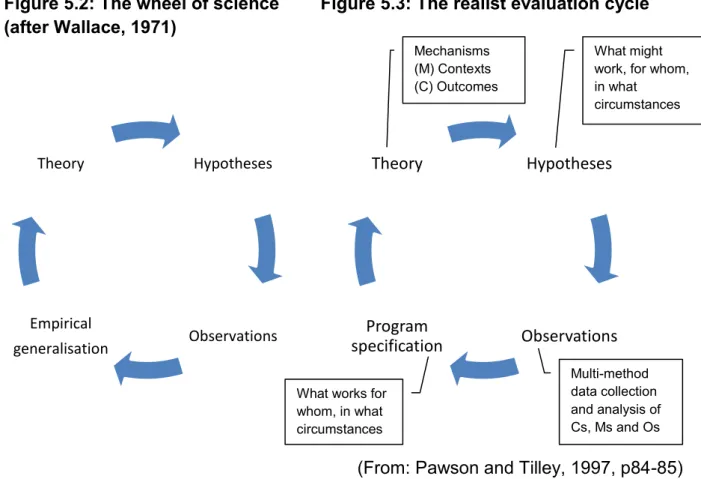
Figure 5.2: The wheel of science (after Wallace, 1971) ... 95
Figure 5.3: The realist evaluation cycle ... 95
Figure 5.4: The elements of realist cumulation ... 98
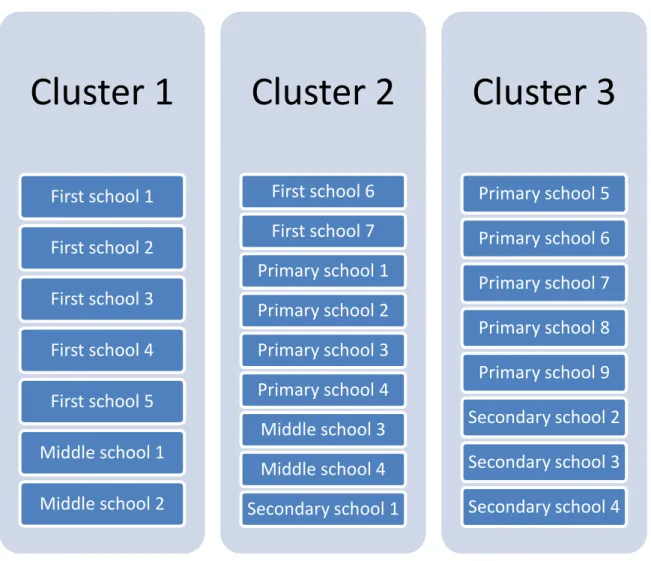
Figure 5.5: Nurture groups in Coalshire ... 106
Figure 5.6 Available study sample ... 108
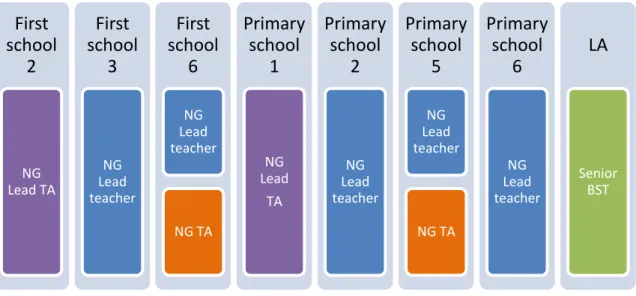
Figure 5.7: Final study sample ... 109
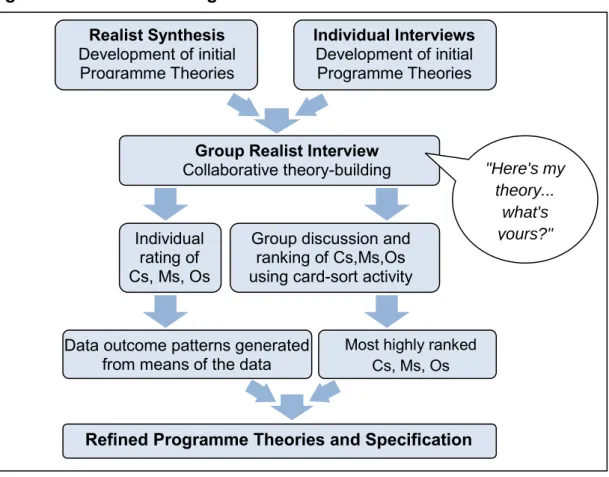
Figure 5.8 Group realist interview structure...113
Figure 5.9: Group realist interview...114
Figure 5.10 Process for abstraction and synthesis of interview Cs, Ms and Os...120
Table 5.1: Reserach Questions ... 93
Table 5.2: A scheme for analysing assumptions about the nature of social science...100
Table 5.3: A comparison of conceptions of social reality...102
CHAPTER 6: RESULTS AND DISCUSSION Table 6.1: Research Questions E-I ... 123
Table 6.2: Collated interview responses in response to question: ‘what would be the key attributes/skills/experience you’d be looking for in NG staff?’ ... 125
Table 6.3: Data Outcome Patterns: Cs, Ms, Os considered to be most ‘essential’ by participants ... 143
Table 6.4: Refined Programme Specification for Nurture Groups ... 149
Table 6.5: Themes from the data relating to training and CPD ... 152
xiii
ACRONYMS
AT Attachment Theory
BERA British Educational Research Association
BMI Body Mass Index
BP Boxall Profile
C Context
CMOC Context-Mechanism-Outcome Configuration EBD Emotional and Behavioural Difficulties EBP Evidence-Based Policy
EP Educational Psychologist FSW Family Support Worker GRI Group Realist Interview HRS High Reliability Schools
HS Head Start
KS Key Stage
LA Local Authority
M Mechanism
MS Mainstream
NESS National Evaluation of Sure Start NG/NGs Nurture Group/Nurture Groups NGN Nurture Group Network
O Outcome
RCT Randomised Controlled Trial RE Realistic Evaluation
RS Realist Synthesis
SEAL Social and Emotional Aspects of Learning SEBD Social, Emotional and Behavioural Difficulties SGTI Small Group Therapeutic Intervention
xiv
SS Sure Start
SSCC Sure Start Children’s Centres SSLP Sure Start Local Programme
TA Teaching Assistant
1
CHAPTER 1: INTRODUCTION
In my second and third year of the Applied Educational and Child Psychology Doctoral Programme at the University of Birmingham, I have been employed by a Midlands Local Authority (LA), ‘Coalshire’, as a Trainee Educational Psychologist (TEP). This volume of work represents the first volume of a two part thesis, and reports a small-scale, original empirical study commissioned by Coalshire LA, which considers factors influencing effective staff practice in Nurture Groups, using Realistic Evaluation methodology.
1.1 Rationale for the study
Nurture Groups (NGs) were selected as an area of research for four key reasons: Firstly, prior to my training as an Educational Psychologist (EP), I was a secondary school teacher interested in children conceptualised as having Social, Emotional and Behavioural Difficulties (SEBD). After three years as a Science teacher, as part of my Masters in Psychology of Education research, I investigated Secondary School teachers’ perspectives on Attachment Theory, and learned of NGs for the first time. In my fourth year of teaching in a small mainstream high school, managing a unit for pupils excluded from mainstream lessons, I tried to re-establish the unit from a ‘sin bin’, using a NG approach. My interest in NGs has persisted, and as a TEP I have been involved in supporting the establishment and continuing development of two NGs, concurrently formulating a more critical perspective regarding their use.
2
Secondly, my employing LA influenced my choice of NGs as a research domain, as the present study was commissioned by a Senior Educational Psychologist, a member of the LA Nurture Group Steering Committee, with responsibility for Nurture Group (NG) provision and development in the LA. The impetus was his interest in how to focus future training for NG staff effectively. He wanted to know what level of knowledge and understanding they needed to ensure best outcomes for children in their care, and whether knowledge of theories such as Attachment Theory (Bowlby, 1980 and 1988), could be considered pivotal to good practice. This superordinate, donated research aim formed the basis for exploration, within the current study of ‘what influences successful or effective NG staff practice’?
Thirdly, since a more critical perspective on research had been fostered throughout my studies, I was surprised by the nature of the ‘evidence’ on which major educational policy decisions are based. For example, the significance of the Clackmannanshire study (Johnston and Watson, 2005) on literacy policy in England should not be underestimated. It provided critical evidence for the Government’s review of the National Literacy Strategy(Education and Skills Committee, 2005, p23), the Rose review recommendation that, “all English children be taught to read using systematic synthetic phonics, taught discretely as the prime approach in learning to read” (Ellis, 2007, p281) and the ensuing ‘Letters and Sounds’ programme (DfES, 2007). Highly publicised and influential, the claims made from the Clackmannanshire study (although not necessarily made by the authors) were highly contentious, given that some aspects of the study had been “challenged” for not being “undertaken rigorously enough” (DfES, 2006a, p61), with insufficient trials to support generalisable
3
claims (Torgerson et al, 2006), and the fact that three months prior to the Rose
Report’s (2006) publication, another DfES review (this time a meta-analysis of 20 international Randomised Controlled Trials2 (RCTs), including the Clackmannanshire study), reporting on reading, stated that: “no statistically significant difference in effectiveness was found between synthetic phonics instruction and analytic phonics instruction” (Torgerson et al, 2006, p8). It seemed surprising that a study conducted in
eight schools, with a sample of only 304 children, and one geographical area in Scotland, could have such a powerful effect on English educational policy.
This controversy highlighted the need for evaluation which is “theory-based” (Sanderson, 2002), has a focus on process as well as outcomes (Pawson and Tilley,
1997) and which can account more carefully for why, where/when and how desirable
results occur.
Finally, and related to the above point, despite their widespread use there remains “very little formal evaluation” of many of the effects of NGs (Reynolds et al, 2009).
Arguably, one variable most likely to affect the success of NGs is staff practice, yet this remains a poorly investigated domain. The purpose of my research is to investigate the broad question ‘what influences successful or effective NG staff practice’? Moreover, an issue dividing educational researchers is whether studies should focus on producing knowledge about educational practices and institutions or on improving their practice (Hammersely, 2007). This research strives to avoid this
2 RCTs compare participants with a control, and base ‘success’ of an intervention on statistical comparison of the
4
dichotomy by using the methodology of Realistic Evaluation to produce both knowledge and theory regarding NGs, and aims indirectly to improve practice, by informing training for existing and future NG staff.
1.2 Aims of the study
The study aims to use a ‘Realistic Evaluation’ (RE) framework to consider what factors at the levels of community, family, whole school, mainstream classroom, and NG, impact on practice and affect outcomes for children attending NGs. Despite an emerging evidence base arguing for NG effectiveness, little has been done to try to tease out the varying effects and potential interaction between different variables pertaining to NGs and ‘why’ they work, if indeed they do. Whilst a limited number of studies has used a control group comparison when evaluating NGs (Gerrard, 2006; Reynolds et al, 2009; Sanders, 2007; Scott and Lee, 2009), such studies have not
shown whether the identified improved outcomes are ‘associated specifically with NGs or with other factors e.g. smaller class sizes’ (Howell, 2009); nor have they considered how NGs compare to other small group therapeutic interventions, and thus identify NGs’ distinctive contribution.
Numerous studies on effective schools have indicated classroom-level practice as more influential than school-level, with regard to students’ performance (e.g. Kyriakides, 2002); consequently the current study is weighted towards a consideration of NG-level factors. By identifying and exploring the potential interaction of some of the key factors affecting NG success, and by investigating
5
what training/Continuing Professional Development (CPD) opportunities are likely to prove most effective in promoting good practice, I hoped to make an original contribution to knowledge and theory development in targeted, small-group
psycho-educational interventions, such as NGs.
1.3 Researcher identity
My identity as a TEP, and my previous teaching experience, gave momentum to the study, affecting its direction and its underlying epistemological position. An additional influence on my epistemological assumptions has been my undergraduate studies in Biological Sciences. My initiation into research involved use of traditional scientific, experimental methodology to research phenomena in animal behaviour. With an indoctrination into RCTs as the ‘gold standard’, on becoming a social scientist, I initially wrestled with the suggestion that information garnered via non-experimental, more qualitative methodology could be ‘valid’, yet ‘controlling’ the complex interplay of many variables operating simultaneously in a social system was surely impossible. Arguably, Realistic Evaluation (RE), a process model concerned with understanding how social programmes work (Pawson and Tilley, 1997), addresses such quandaries, embracing rather than controlling the innumerable variables inherent in social programmes.
I align myself with a critical realist epistemology, believing there to be an objective world, independent of human perception or conception of it (Runes, 1942). I take a ‘realistic’, but ‘critical’ stance, which acknowledges the difficulties in affirming reality
6
objectively, because as humans, our presence as researchers will always influence (directly or indirectly) what we seek to measure (Runes,1942).
1.4 Research questions
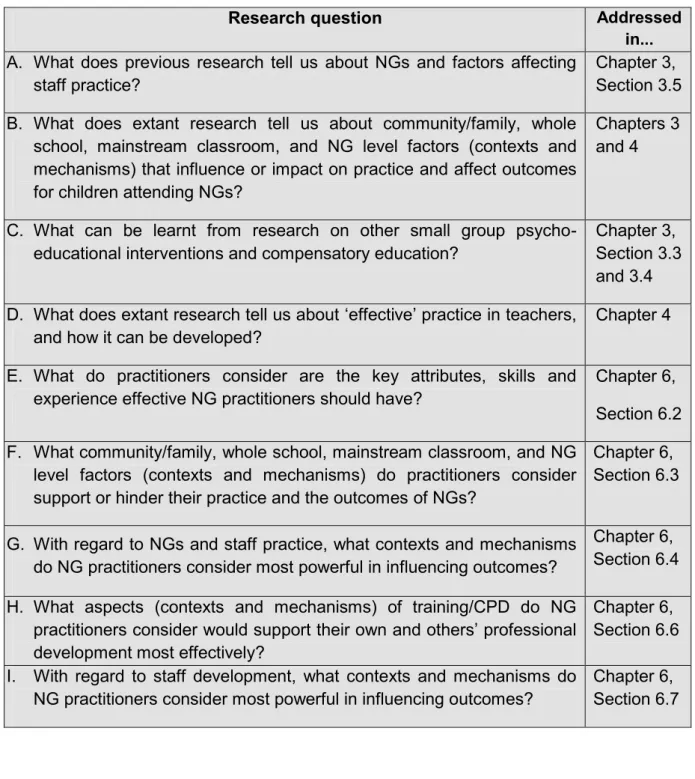
Key research questions are shown in Table 1.1 below: Table 1.1: Research Questions
Research question Addressed
in... A. What does previous research tell us about NGs and factors affecting
staff practice?
Chapter 3, Section 3.5 B. What does extant research tell us about community/family, whole
school, mainstream classroom, and NG level factors (contexts and mechanisms) that influence or impact on practice and affect outcomes for children attending NGs?
Chapters 3 and 4
C. What can be learnt from research on other small group psycho-educational interventions and compensatory education?
Chapter 3, Section 3.3 and 3.4 D. What does extant research tell us about ‘effective’ practice in teachers,
and how it can be developed?
Chapter 4 E. What do practitioners consider are the key attributes, skills and
experience effective NG practitioners should have?
Chapter 6, Section 6.2 F. What community/family, whole school, mainstream classroom, and NG
level factors (contexts and mechanisms) do practitioners consider support or hinder their practice and the outcomes of NGs?
Chapter 6, Section 6.3
G. With regard to NGs and staff practice, what contexts and mechanisms do NG practitioners consider most powerful in influencing outcomes?
Chapter 6, Section 6.4 H. What aspects (contexts and mechanisms) of training/CPD do NG
practitioners consider would support their own and others’ professional development most effectively?
Chapter 6, Section 6.6 I. With regard to staff development, what contexts and mechanisms do
NG practitioners consider most powerful in influencing outcomes?
Chapter 6, Section 6.7
7
1.5 Research context
NGs have been operational in Coalshire since 2003, following their introduction by a Coalshire EP and Behaviour Support Teacher (BST), aware of the NG model, and keen to promote it locally. NGs were introduced in response to a perceived ‘gap’ in provision within mainstream schools, for some of Coalshire’s emotionally and developmentally most vulnerable children. At the time of the present study, Coalshire had 16 established or newly established NGs in primary or first schools, four NGs in middle schools, and four more newly established NGs in secondary settings. Due to the limited sample size available for study, and greater structural and conceptual variation of NGs in secondary settings, alongside an, at best, embryonic evidence-base for NGs catering for this older age group, this research was focused on primary or first schools. As RE aims to test and refine theory that has informed programme development, and the evidence-base for NGs is not particularly extensive, a focus on the more established Key Stage 1 and 2 NGs was viewed as desirable. The present study aimed to inform future directions for training and NGs in Coalshire.
1.6 Methodological approach
Realistic Evaluation (RE), with its foundation in realist epistemology, was selected for both its theoretical orientation and methodological structure (which facilitates pluralism and flexibility with method choice) (Pawson and Tilley, 1997). By using the framework of RE, programme efficacy, individual responses and context are all considered. Indeed, RE’s purpose is explanatory, and central to its remit is the question of: ‘what works, for whom, in what circumstances?’ (p86). RE provides a
8
structure for evaluating social programmes, identifying which outcomes (Os) result from change-inducing mechanisms (Ms) operating within unique contexts (Cs) (Pawson and Tilley, 1997; Sheppard, 2009). Critically with RE, mechanisms are not ‘variables’ but an “account of the make-up, behaviour and interrelationships of those processes which are responsible” for regularities or outcomes (Pawson and Tilley, 1997, p68):
“A mechanism is thus a theory – a theory which spells out the potential of human resources and reasoning”.
Pawson and Tilley’s (1997) RE was originally utilised and developed for programme evaluation in criminology. It is, however, emerging as a framework of choice for many educational researchers (Thistleton, 2008; Sheppard, 2009; Soni, 2010; Thornbery, 2010), although less has been published in peer-reviewed journals (Timmins and Miller, 2007). As with Sheppard (2009), I adopt an RE approach, as NG interventions, like all such initiatives, involve “the actions of people, and are embedded in social systems”; thus NGs are shaped by the actions of individuals and the contexts within which they are set (p8). Theory development, rather than generalisation was the goal of this research, to help illuminate what aspects of NGs ‘work, for whom and in what circumstances’. A further, practical purpose was to inform future training directions for NG staff in Coalshire, and perhaps more broadly, through sharing this research with colleagues from the national Nurture Group Network (NGN).
1.7 Structure of the study
9
‘Realistic Evaluation’ (RE) to provide a methodological and epistemological framework for this inquiry. For reviewing research on complex social interventions, Pawson et al (2004) advocate the use of ‘Realist Synthesis’: as an alternative to
more traditional systematic reviews of the evidence-base, where a “highly specified and intentionally inflexible methodology” is followed, to assure high reliability (p v). In contrast, realist syntheses follow a “more heterogeneous and iterative process...less amenable to prescription” but still “equally rigorous”, to provide an “explanatory analysis” of how and why programmes “work (or don’t work) in particular contexts or settings” (p iv-v). Realist syntheses are underpinned by the understanding that programmes do not just ‘have effects’, they are ‘theories’; thus the literature review is
essentially theory-synthesis (Pawson et al, 2004). The use of a realist synthesis has
implications for how the literature is both approached and used. Consequently, to facilitate navigation of the literature review chapters, I present and describe RE and its bedfellow ‘Realist Synthesis’ in Chapter 2.
In Chapter 3 I present a realist synthesis of the literature on compensatory education, small-group therapeutic interventions and NGs, to provide background and rationale for the research, and to address Research Questions A-C (see Table 1.1). Previous studies regarding compensatory education, other small group therapeutic interventions, and NGs are analysed, in order to extract pertinent contexts (Cs), mechanisms (Ms) and outcomes (Os), generate CMO configurations (CMOCs), and develop ‘Programme Theories’. Theories are framed as propositions about “how mechanisms are fired in contexts to produce outcomes” (Pawson and Tilley, 1997, p85).
10
In Chapter 4 a further realist synthesis of the literature regarding effective teaching, training and Continued Professional Development (CPD) is carried out, to meet the same end of programme theory development, and to address Research Question D (Table 1.1).
Realist investigation not only relies on “broad hypotheses culled from the background literature” but also incorporates “the ‘folk wisdom’ of practitioners” (Pawson and Tilley, 1997, p107).
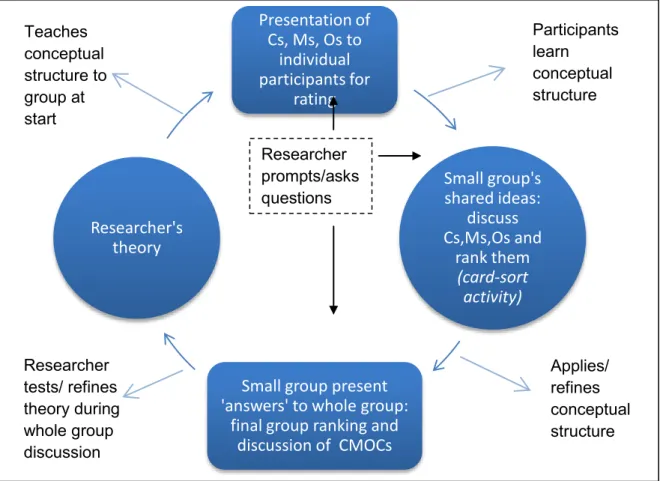
Following Pawson and Tilley (1997), further theory development was derived from a qualitative investigation, where NG staff were individually interviewed to elicit realistic theories on programme mechanisms and contexts. ‘Folk theories’ generated from interviews, and programme theories extracted from the literature review were ‘taught’ to participants at a group interview, using the format of a ‘Realist Interview’ (Pawson and Tilley, 1997).
Chapter 5 describes my hypotheses, methodology and study design. Methods, ethical considerations and data analysis are presented, and challenges to reliability and validity discussed.
In Chapter 6 I present findings in relation to Research Questions E-I (Table 1.1). The Programme Theories which have been refined in light of findings from the empirical study are presented, and used to formulate and present an initial ‘Programme Specification’ for NGs and one for training NG practitioners (after Timmins and Miller,
11
2007).
Finally, in Chapter 7 I provide a critique of the methodology, and examine the initial Programme Theories to account for factors which are likely to influence and foster successful NG staff practice. I reflect upon this study and how findings could inform NG practice and focus future training for NG staff locally and perhaps more widely, and discuss the implications for future research and EP practice.
12
CHAPTER 2: REALISTIC EVALUATION AND EVIDENCE-BASED POLICY
2.1 Introduction
Evaluation research has grown in importance over recent decades (Pawson and Tilley, 1997). In the late 1990s Pawson and Tilley (1997) proposed ‘Realistic Evaluation’ (RE) as a ‘new evaluation paradigm’, with foundations in ‘scientific realist
philosophy’ and ‘commitment to the idea that programmes deal with real problems’ not just social constructions. Over recent years the nomenclature has changed to
‘Realist Evaluation’ (Pawson and Tilley, 2004), but the principles have been maintained, with an emerging evidence-base for the effectiveness of this approach across many disciplines (Kazi, 2003; Byng et al, 2005; Tolson et al, 2005; Wilson and
McCormack, 2006; Timmins and Miller, 2007; Greenhalgh et al, 2009).
This chapter introduces RE, and discusses how it can support the development of evidence-based practice and policy in education. In order that the literature review can be appropriately navigated, as a ‘Realist Synthesis’ has been carried out (described in Sections 1.7 and 2.6), an overview of RE is given in the following sections. Additionally, prior to discussing NGs and their historical and theoretical background, it is important to position NGs within what I consider the wider narrative and context of this thesis: that is, the discourse of compensatory education and the contentious concept of evidence-based policy.
13
2.2 Realistic Evaluation
2.2.1 Weaknesses in experimental evaluation
“It is not enough to indentify that any intervention can be effective. Effectiveness may be quite context-dependent”
(Davies et al, 2000, p50).
Much evaluation research develops social theory using experimentation. Pawson and Tilley challenge this traditional view of ‘experimentation’ which “prevails in orthodox evaluation circles” (Tilley, 2000, p2). They highlight a weakness of experimental evaluation in “understanding the explanatory import of the social context in which a program operates” (Pawson and Tilley, 1997, p47), arguing evaluation research is far too ‘method-driven’, with everything “apportioned as an ‘input’ or ‘output’, so that the program itself becomes a ‘variable’” (Pawson and Tilley, 1997, p51). With this view of evaluation, they argue, vital factors and causal agents are likely to be missed, dismissed or misunderstood. For example, rather than a strength, the use of unreal ‘composite’ groups in quasi-experimental research could be a significant weakness;
“...since particular communities and their culture and values obviously exert a profound and real influence... [we need to understand]...what it is about given communities which will facilitate the effectiveness of a program... by its very logic, experimental evaluation either ignores these underlying processes, or treats them incorrectly as inputs, outputs or confounding variables, or deals with them in a post hoc and thus arbitrary fashion”.
(Pawson and Tilley, 1997, p52-54)
RE differs from more traditional experimental evaluation in a number of ways (Pawson and Tilley, 1997):
recognition that crucial data can be lost or ignored by the process of controlling ‘variables’, as in experimental evaluation;
14
a focus on process, not just outputs (‘why/how does it work?’, not just ‘does it work?’); and
recognition of the important influence social contexts can have on programmes.
Arguably, experimental evaluation, with an underlying positivist epistemology, fails to embrace the inherent complexity of social programmes, or provide valuable explanatory information. Furthermore, experimental evaluation views causation as ‘external’:
“Cause simply describes constant conjunctions between events. The action of billiard balls is archetypally describable in these terms. We can observe regularity of cause and effect as one ball collides with another and forces it to move. The generative conception of causation, built into the scientific realist philosophy, sees the matter of causation 'internally'. Cause describes the transformative potential of phenomena”.
(Pawson and Tilley, 1994, p293).
2.2.2 Generative causation
There are differences between the basic features of social mechanisms and mechanisms used in natural science explanations (Pawson and Tilley, 1997). Sheppard (2009, p48; after Robson, 2002) describes how “mechanisms are essentially ‘reason explanations’ in social sciences compared with ‘mechanistic explanations’ in the natural sciences”. Pawson and Tilley (1997) assert that by ‘calling on different layers of reality in social explanations’, a generative conception of
causality is employed, where instead of identifying ‘variables or correlates which associate one with the other’, there is an attempt to ‘explain how the association itself
comes about’: “The generative mechanisms thus actually constitute the regularity; they are the regularity” (p67).
15
The differences between generative and successionist views of causation are
depicted in Figure 2.1.
Figure 2.1: Models of causation
Successionist Generative (a) X Y Z (b) X Y Z (d) X Y (c) X Y
(From: Pawson and Tilley, 1997, p68)
Pawson and Tilley (1997) argue when realists challenge “the constant conjunction view of one event producing another” (model ‘a’), “they are not attempting to bring further ‘intervening’ variables into the picture” (p68), nor postulating that a further unforeseen event brings about the “relationship between the original variables”
(model ‘b’), nor that “the original relationship is ‘indirect’ working through an intervening variable” (model ‘c’); rather, the mechanism “is responsible for the relationship itself” (model ‘d’) (p68).
A generative view of causation recognises the complexity of social programmes, and how they involve a “continual round of interactions and opportunities and decisions”
16
mechanism + context = outcome
the volition of participants is not ignored, or viewed as ‘noise’ or a ‘confounding variable’ (Pawson and Tilley, 1997). Rather there is recognition that a subject’s choice will “frame the extent and nature of change” (p38). Sheppard (2009) summarises how “mechanisms are the choices (influenced by their reasoning) and capacities (influenced by their resources and approaches) individuals are able to summon up in a particular context” (p48; after Pawson and Tilley, 1997). Contexts are the ideal conditions under which these mechanisms can be fired, in order to promote the intended outcomes. Thus causation in the social world is conceptualised with Pawson and Tilley’s (1997) “basic realist formula” (pgXV):
2.2.3 Contexts, Mechanisms and Outcomes Pawson and Tilley (1997) contend:
“Programmes work (have successful ‘outcomes’) only in so far as they introduce the appropriate ideas and opportunities (‘mechanisms’) to groups in the appropriate social and cultural conditions (‘contexts’)” (p58).
Their proposition is that “causal outcomes follow from mechanisms acting in contexts” and that this is the “axiomatic base upon which all realist explanation builds” (p58). They base their premise on the generative rather than successionist view of causation (Harré, 1972) (described in Section 2.2.2; illustrated in Figure 2.2 below):
17
Figure 2.2: ‘Generative Causation’ - A diagrammatic representation of Pawson and Tilley’s formula
(From: Pawson and Tilley, 1997, p58) Pawson and Tilley (1997, p58) use an analogy of gunpowder to demonstrate their point. Gunpowder does not always ignite in the presence of a flame e.g. if it is damp, or there is insufficient powder. If we want a spark to cause an explosion (the outcome), then we are dependent not only on the chemical composition of the substance which allows the reaction (the mechanism) but also the physical conditions which allow the mechanism to come into operation (the context). Thus the “internal potential of a system or substance” needs the right conditions in order to be activated (p57).
To conclude, Pawson and Tilley’s (1997) RE provides a framework for the evaluation of social programmes, where outcomes (Os) are triggered by mechanisms (Ms)
acting in specific contexts (Cs). This paradigm’s explanatory focus is highlighted by is causal only if...
Outcome
... its outcome is triggered by a mechanism acting in a context
…..its outcome is triggered by a mechanism acting in context An action
Mechanism Context
18
the central purpose of RE: theory development regarding “what works for whom, in what circumstances and in what respects, and how?” (Pawson and Tilley, 2004, p2).
Pawson and Tilley (2004) highlight “it is not programmes that work, but rather the resources they offer, to enable their subjects to make them work” (p5). Crucially, programs are not ‘undifferentiated wholes’, but rather fire ‘multiple mechanisms’
“having different effects on different subjects in different situations, and so produce multiple outcomes” (Pawson and Tilley, 1997, p217). Pawson and Tilley (1997)
contend programmes should only be described as ‘successful’ if it can be demonstrated “what it is (M) about the program which works, for whom, in what conditions (C)” (p72).
2.3 The nature of evidence
In social sciences the debate on the nature and value of different types of evidence continues, often polarising opinion. What exactly is meant by ‘evidence’? We use ‘evidence’ everyday, whether intuitively or through our observations, but it is a question of what evidence we use to make decisions and the nature of this evidence
that is usually challenged (Thomas, 2004). Thomas (2004) argues the “importance of evidence in shaping and enhancing practice” is undeniable; the issue “is not the significance of evidence, but its nature – and its value contingent on that nature” (p1). Furthermore, all evidence is interpreted in a social context:
“There is...similarity in the ways in which the legal and the scientific communities approach the notion of evidence. In each, the ultimate determination of the value of the evidence will rest on the judgement of peers – those peers being twelve ordinary people in the case of the jury, and an expert scientific community (who will replicate, convene, confer, ‘peer-review’ and judge) in the case of science”
19
Consequently, the ‘objectivity’ of ‘scientific’ evidence can itself be questioned, because of the “social and interpretative context of evidence” (Thomas, 2004, p7).
Various narratives surround what comprises ‘strong’ evidence, generally focusing on scientific evidence as ‘right’, despite its numerous potential pitfalls (Pring and Thomas, 2004). RE differs from more positivist, experimental approaches which generally utilise RCTs. For clinical trials, Shekelle et al (2000) use standard criteria to
rank categories of evidence and evaluate the strength of practice implications. ‘Evidence from meta-analysis of RCTs’ is seen as the highest category of evidence; implications for practice are thought to be strengthened if supported by such an evidence-base (Shekelle et al, 2000). However, Pawson and Tilley (1997) contend
useful information can be lost when statistical analyses are undertaken.
The individuality of participants’ responses and qualitative information which would ensue are not considered in RCTs. Yet this information could have strongly influenced why a programme has or has not worked. As Goldstein (2006, p8) contends, such subtleties “may be among the most interesting aspects of the data”. Indeed RCTs, the “‘gold standard’ of applied statistical work”, do not “necessarily tell us anything about causal mechanisms”, nor are they necessary to “draw causal conclusions” (Goldstein, 2006, p2). Furthermore, ‘hard’ scientific evidence may meet the strongest criteria for reliability, but cannot provide a ‘truth’ in which we can be certain:
20 “Certainly within the social sciences there increasingly appears to be an acceptance that the social world and social reality, at least, might not be readily characterised by universally applicable and transcendent laws such as the naïve realism of positivism proposes and that although the world may exist physically independently of people, truth and meaning cannot”
(Moore, 2005, p106).
2.4 Evidence-based policy
The quest for evidence-based policy (EBP) is rife with hidden and overt challenge, danger and complexity. Some of its greatest proponents even argue “there is no such thing as evidence-based policy”; instead ‘evidence-informed policy’, ‘evidence au fait
policy’, ‘evidence enlightened policy’ nay ‘The Best We Can Do By Way of
Evidence-Based Policy’, are all offered as more accurate designations (Pawson, 2006, pviii).
Amidst a changing ideological and political landscape, the rallying cries for EBP have reverberated, and are now seen in the rhetoric of successive governments: Certainly, it is clear in the Modernising government White Paper (Cabinet Office, 1999, Section
2.6):
“Government should regard policy as a continuous, learning process, not as a series of one-off initiatives. We will improve our use of evidence and research so that we understand better the problems we are trying to address. We will make more use of pilot schemes to encourage innovations and test whether they work”.
The gauntlet has been thrown down to policy makers and the research community alike:
“This [New Labour] government expects more of policy makers. More new ideas, more willingness to question inherited ways of doing things, better use of evidence and research in policy making and better focus on policies that will deliver long term goals”
21 “Social science research evidence is central to development and evaluation of policy…We need to be able to rely on social science and social scientists to tell us what works and why and what types of policy initiatives are likely to be most effective”
(Blunkett, 2000; cited in BERA, 2000, p21).
Finding out ‘what works’ has become part of successive governments’ agendas, and apparent in a number of policy documents is an intent to use evidence in guiding policy making (Boaz et al, 2002). However, governmental moves to embrace and
utilise ‘evidence’ in policy decisions has raised some questions as to whether this was a genuine commitment or simply rhetoric and a means to support policies to which government was already committed (Thomas, 2004).
Despite governmental calls, there is resistance in the ranks. Some policy makers argue that although “robust research findings must not be ignored”, they cannot wait for outcomes of long-term research studies; instead decisions are based on the best sources available at the time (DfES, 2006a, p15). In addition to concerns over the length of time research takes, timing is also important. For example, Pawson (2006) explains the failure of evaluation research to inform significantly or successfully the policy process, has been due to timing; such research usually “occurs after programme design and implementation” (p8). Systematic reviews, which should provide an exhaustive synthesis of the available evidence-base, were offered as a solution to this problem, as policy-makers could direct reviewers to examine the evidence “before the leap into policy and practice” (Pawson, 2006, p8). Crucially, Pawson (2006) highlights that “systematic review is not intended to displace evaluation research, for the former provides most of the evidence-base for the latter”, rather it should “act as the conduit from the evidence to the policy – no more and no
22 less” (p12). However, as noted in Section 2.5, systematic reviews (SRs) are themselves not without their limitations.
Part of the problem is that the concepts of ‘evidence-base’ and ‘policy’ are from different worlds. The ‘evidence-base’ comes from a culture where scientific thinking and methodology reign, where researchers must provide evidence to support their assertions, where research is theoretical and often abstract, where collating evidence takes a long time, and where there is much debate about the relative value of different forms of evidence (Lamb, 2010). In contrast, policy makers operate in a paradigm where the media or Minister’s views dominate, where a clear explanation of the world is needed, where time frames are short to medium-term, and where evidence is something that should fit the question being asked, or be adapted so it fits (Lamb, 2010). Pawson (2006) highlights this chasm between evidence and policy, and whether this gulf can be bridged, remains to be seen. Pawson (2006) eloquently summarises the relationship;
“Evidence-based policy is much like all trysts, in which hope springs eternal and often outweighs expectancy, and for which the future is uncertain as we wait to know whether the partnership will flower or pass as an infatuation” (p1).
2.5 Systematic Reviews (SRs)
Over recent decades, methodologists and policy makers have become preoccupied with accumulating research findings “into a robust body of knowledge” (Davies et al,
2000, p7). Pivotal to this preoccupation has been the development of secondary research techniques, which utilise the findings of primary research (Davies et al,
23
studies relevant to a given evaluation question, and then methodological quality is assessed and synthesised (Davies et al, 2000). SRs differ from their counterparts
(literature reviews, scoping studies, briefing papers, rapid reviews), by their tighter protocol, and ‘agreed standards’ (Boaz et al, 2002). SRs are heralded as a means of
passing on the collective wisdom from research derived from previous initiatives, and in this way have “grabbed the methodological mantle of evidence-based policy”
(Pawson, 2006, p11). The use of SRs is not without controversy. Boaz et al (2002)
highlight three reasons for scepticism, explored in the following sections.
2.5.1 The broader debate surrounding different research methods
There is disparity in the relative weight afforded to different research methodologies, diversity of research approaches, and the nature of the evidence-base, depending on the policy area under consideration (Boaz et al, 2002). For example, in healthcare,
the evidence-base focuses on “obtaining high quality evidence through experimentation”; with the championing of both RCTs, and the systematic examination of research (Boaz et al, 2002, p2). In contrast, in school education, SRs
are comparatively rare, and much educational research is considered ‘less than robust’ (Davies et al, 2000). Paradigm wars have raged with “the epithet ‘positivism’ attached to any quantitative work”, claims that ‘eclectic methods compete rather than complement’, poor understanding of statistical terms (e.g. randomisation), and analysis of large datasets occurring but with relatively little true experimentation (Davies et al, 2000).
24
In healthcare, certainly when it comes to clinical protocols, and despite a growing interest in qualitative methods to give a complementary view (Davies et al, 2000), the
methodological landscape is pretty flat and homogenous. On the contrary, in education, the terrain is rugged and heterogeneous, and paradigm wars are likely to rage on. Nevertheless, a sea change appeared to have been heralded when in 2000, the Department for Children, Schools and Families (DCSF) funded the Centre for Evidence Informed Policy and Practice in Education (EPPI-Centre). The EPPI-Centre conducts SRs of research evidence, criticising more traditional literature reviews for their narrow scrutiny of the evidence-base, and for taking the claims of researchers at face value (EPPI-Centre, 2011). Four clear features of EPPI-centre SRs are identified:
a. explicit and transparent methods are used;
b. a standard set of stages is followed;
c. It is accountable, replicable and updateable; and
d. there is a requirement of user involvement to ensure reports are relevant and useful.
(EPPI-Centre, 2011)
2.5.2 Studies involve complex interventions with multiple outcomes
Criticisms of SRs include their use with ‘complex interventions with multiple outcomes’ (Boaz et al, 2002). SRs are not designed to value and synthesise crucial
qualitative data (e.g. participants’ views) and contextual data (Boaz et al, 2002); thus
they can fail to capture the inherent complexity of the social world. Realist research synthesis “cuts through complexity by focusing on the ‘theories’ that underlie social interventions” (Pawson et al, 2004 p1), continuously attending to contextual factors.
25
With RE, contextual data are paramount. Pawson et al (2004) argue that when
evaluating social programmes, three contextual factors should be considered;
“interpersonal relationships, institutions, and infrastructures through which and in which the intervention is delivered” (piii). Following Sheppard (2009), I have used
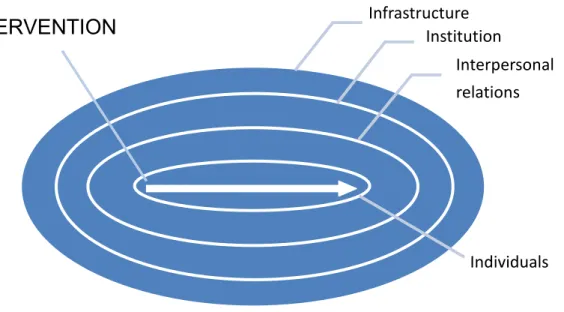
Pawson et al’s (2004) description of significant contextual factors (illustrated in Figure
2.3 below):
o individual capacities (e.g. interest, attitudes, capability, credibility, beliefs and skills of key stakeholders);
o group factors and interpersonal relationships (e.g. lines of communication, management, administrative support, professional contracts);
o organisational factors/institutional setting (e.g. organisational culture, charter and ethos of the school, clear and supportive leadership from senior managers); and
o wider infra-structural and welfare system (e.g. political support, funding resources, influential lobbies, legal system).
Figure 2.3: The intervention as the product of its context
(Source: Pawson et al, 2004, p8)
Pawson et al (2004) explain how these contextual layers influence programme
efficacy and “represent the single greatest challenge to evidence-based policy” as
Infrastructure Institution Interpersonal relations Individuals
INTERVENTION
26
generating “transferable lessons about interventions will always be difficult because they are never embedded in the same structures” (p8).
2.5.3 Concern there is no room for theory
The role for theory in SRs is limited, yet many social interventions are “guided by a theory of change” (Boaz et al, 2002, p8). Approaches like Connell and Kubisch’s
(1998) ‘Theories of Change’, and Pawson and Tilley’s (1997) ‘Realistic Evaluation’, have highlighted how change processes can mediate the impact of an intervention (Boaz et al, 2002). Theory development is central to RE.
Hansen (2005) describes the various typologies of evaluation models, shown in Table 2.1 below. The focus of programme theory models, like RE, is “assessing the validity of the programme theory” which underpins the organisation or intervention (Hansen, 2005, p450). RE uses ‘empirical observation’ to analyse the causal relations between Cs, Ms, and Os (Hansen, 2005). Where traditional results-based models focus only on outcomes and evaluating results, a programme theory model like RE, “opens up the underlying black box of the programme theory, uncovers mechanisms and raises the focus to a cluster of interventions or to an organizational field” (Hansen, 2005, p450), thus focusing on ‘families of mechanisms’ and producing
27
Table 2.1: A typology of evaluation models
Evaluation Models Questions Criteria for Evaluation
Result models
a. Goal-attainment model b. Effects model
1. To what degree has the goal(s) been realised?
2. Which effects can be uncovered?
a) Derived from goal(s)
b) Open, all consequences should be uncovered
Explanatory process model Is the level of activity satisfactory? Are there
implementation problems? Performance is analysed from idea to decision and implementation and to the reaction of the addressees
System model How has performance functioned as a whole? Realised input, process, structure and outcome assessed either in relation to objectives in same dimensions or comparatively Economic model a. Cost-efficiency b. Cost-effectiveness c. Cost-benefit a. Is productivity satisfactory? b. Is effectiveness satisfactory? c. Is utility satisfactory?
a. Output measured in relation to expenses b. Effect measured in relation to expenses c. Utility measured in relation to expenses
Actor model
a. Client-orientated model b. Stakeholder model c. Peer review model
a. Are clients satisfied? b. Are stakeholders satisfied? c. Is professional quality in order?
a. Formulated by clients b. Formulated by stakeholders c. Formulated by peers
Programme theory model (theory-based evaluation)
What works for whom in what context? Is it possible to ascertain errors in programme theory?
Programme theory is reconstructed and assessed via empirical analysis
28
2.5.4 Alternatives to systematic reviews (SRs)
SRs are certainly an important weapon in our arsenal against irrationality, but Pawson (2006) highlights the need to “temper ambition with caution, lest the ‘synthesizing society’ turns out to be the latest false dawn of rationality” (p12). Being mindful of the policy context and practitioner climate into which evidence is emitted is crucial; recommendations from SRs “can never match the complexity of the policy systems that will host them” (Pawson, 2006, p13). Additionally, SRs paint a cumulative picture of the evidence. The “foundational, meta-analytic models of systematic review use arithmetic methods to pool outcome evidence” (Pawson, 2006, p13), meaning the evidence from qualitative sources is effectively ignored (as discussed in Sections 2.3 and 2.5.2). Furthermore, traditional SRs follow highly specified and intentionally inflexible methodologies, aiming to assure high reliability, and in their ‘hierarchy of evidence’ RCTs are king (Pawson et al, 2004). As discussed in Section 2.3, the use
of RCTs in testing complex interventions is flawed, as matched ‘treatment’ and ‘control’ groups are elusive, and RCTs are “explicitly constructed to wash out the vital explanatory ingredients” (Pawson et al, 2004, p22). In this way SRs risk ‘throwing the
baby out with the bath water’.
Boaz et al (2002) do offer suggestions for how SR methodology can be
strengthened: for example, involving users in defining problems and questions, developing methods which encompass a broader range of types of research in reviews (including studies with mixed methods), developing methods for reviewing complex issues, interventions and outcomes, and finally, making SRs more accessible and relevant to more than just the needs of policy makers (p10). Arguably,
29
Pawson’s (2001) ‘Realist Synthesis’, a form of realist review, which tackles and
addresses some of the criticisms of SRs, offers a more valid framework for reviewing and evaluating research which can be used to inform policy. In the following sections, realist synthesis is described further, and its relevance for this study demonstrated.
2.6 Realist syntheses
Realistic Evaluation provides a structure for interpreting the literature (as discussed in Section 1.7), in the form of realist syntheses, which differ from SRs by lacking deference to traditional hierarchies of reliability and have a more flexible methodology, using a ‘heterogeneous and iterative process’ (Pawson et al, 2004). A
realist perspective considers all studies to be inherently porous. Consequently studies are not discarded simply for failing to fulfil strict, positivist criteria. A realist synthesis does not just describe studies, but attempts to abstract from the literature Context-Mechanism-Outcome Configurations (CMOCs). Identification of CMOCs helps form ‘Programme Theories’ which can then be subjected to testing (my own Programme Theories are presented at the end of Sections 3.3, 3.4, 3.5 and 4.4). Despite numerous strengths, realist review does have notable limitations (Pawson et al, 2004), which are discussed in Chapter 7.
Pawson’s (2006) commitment to EBP is clear, and his conceptualisation of evidence-based policy demands “dispassionate, independent and objective evidence to evaluate policy options” (p7). Such research would differ from emancipatory or participatory research, where exploration is motivated by partisanship or focused on
30
utilisation and local issues. Pawson (2006) makes it clear that to be “both partisan and researcher is a bit like having one’s cake and eating it” (p6). My personal experience of NGs, and current practice supporting NG staff, puts me at risk of partisanship. To temper this, a critical stance and reflexivity are needed.
RE also distances itself from punditry, political alignment or an over-reliance on the pollster’s power (Pawson, 2006). Instead EBP is “based on the brave assumption that the truth will out” (Pawson, 2006, p7). The nature of ‘truth’, however, is as contentious as ‘evidence’. I am aware no study can uncover the whole ‘truth’ regarding effective practice in NGs, but hope this study will contribute to building and subsequent testing of theories regarding NGs and staff practice.
2.7 Realistic Evaluation and Education
In Timmins and Miller’s (2007, p9) re-examination of two studies from an RE perspective, they suggest RE as a potential framework to “assess innovation in education” whilst also promoting collaborative work from researchers and practitioners. Such a framework offers support in providing practitioners with an evidence-base: an ever-increasing demand (Timmins and Miller, 2007) (as argued in Section 2.4). Additionally, it facilitates both the gathering of relevant information and the likely success of any repetitions of successful programmes – recognising evidence from these is likely to be highly context-related (Timmins and Miller, 2007).
“Any innovation will depend, for its success or failure, on a range of factors; for example, the relationships between the people involved or the characteristics of the setting in which it is implemented”
31
Using an RE framework ensures both individual responses and context are reflected upon.
In conclusion, this study adopted an RE approach to explore links between NG staff practice (M) and positive change for children in NGs (O), and to identify those factors (C) that support or hinder effective practice at the NG level. Mechanisms and contexts affecting NG practice at other levels (e.g. community/family, whole school, and mainstream class) were also considered. An additional inquiry was carried out into what training/CPD for NG staff (M) is desirable for promoting effective NG staff practice (O), and what facilitative contextual factors for such training (C) would comprise.
NGs are a type of compensatory educational intervention. In the next chapter, a realist synthesis of evidence surrounding compensatory initiatives is developed, to highlight the superordinate context within which NGs operate. The evidence-base regarding other small group therapeutic interventions and NGs is then examined. Context, Mechanism, Outcome Configurations (CMOCs) from the literature are abstracted, as part of the realist synthesis, and Programme Theories are presented.
32
CHAPTER 3: COMPENSATORY EDUCATION, SMALL GROUP THERAPEUTIC INTERVENTIONS AND NURTURE GROUPS
3.1 Aims and objectives
This review aims to provide historical background to Nurture Groups (NGs) and consider critically existing research regarding this small group therapeutic intervention (SGTI). Setting the wider context for NGs, first the broader issue of compensatory education is discussed, and then other SGTIs are considered. Using the framework of RE (introduced in Chapter 2 and discussed further in Chapters 5 and 6), applicable ‘Contexts’, ‘Mechanisms’ and ‘Outcomes’ are identified from the literature on compensatory education, SGTIs, and NGs. Initial Programme Theories are abstracted, presented at the end of Sections 3.3.3, 3.4, 3.5.4 and 4.4, tested against practitioner theories derived from the empirical study described in Chapter 5, and then refined and further developed in Chapters 6 and 7.
3.2 Search strategy/methodology
Table 3.1 shows the databases that were searched, search terms used, and the references produced. The search was carried out in June 2010, in January 2011, and again in July 2011, in order to ensure all contemporary publications within the target domain were identified and considered. From the references below, germane abstracts were read, and sources selected for their particular relevance to this inquiry. The University Library Catalogue and electronic library (‘ebrary’) were also searched for relevant texts books.