Hieke Keuning
850412924
17 June 2014
Strategy-based feedback for
imperative programming exercises
Strategy-based feedback for
imperative programming exercises
INSTITUTE Open Universiteit The Netherlands
Faculty of Management, Science and Technology Master Computer Science
STUDENT Hieke Keuning (850412924) SUPERVISOR dr. Bastiaan Heeren CHAIRMAN prof. dr. Johan Jeuring PRESENTATION DATE 17 June 2014
C
ONTENTS
Summary ... 1
1 Introduction ... 2
1.1 Learning programming ... 2
1.2 The Ideas project ... 5
1.3 Problem statement and outline ... 5
2 Interactive domain-specific exercise assistants ... 7
2.1 Domain reasoners ... 8 2.1.1 Strategies ... 8 2.1.2 Feedback ... 9 2.1.3 Views ... 11 2.2 Ask-Elle ... 11 2.2.1 Refinement rules ... 12 2.2.2 Strategies ... 12 2.2.3 Normalisation ... 13 2.2.4 Feedback services ... 13 2.2.5 Results ... 14 3 Programming tutors ... 15
3.1 Classification and definitions ... 15
3.1.1 Focus ... 16
3.2 Programming tutors before 2000 ... 17
3.3 Recent programming tutors ... 20
3.4 Program assessment tools ... 27
3.5 Conclusion ... 29
4 Research design ... 30
4.1 Research questions ... 30
4.2 Requirements and scope ... 30
4.3 Validation ... 31
5 A domain reasoner for imperative programming ... 32
5.1 Representation of imperative programs ... 33
5.2 Strategies for imperative programming ... 37
5.2.1 Rules ... 38
5.2.2 Generating strategies ... 40
5.3 Recognising solutions ... 46
5.3.1 Similarity ... 46
5.3.2 Equivalence ... 53
5.4.1 Diagnosis ... 54 5.4.2 Hints ... 58 5.4.3 Adapting feedback ... 59 6 Validation ... 63 6.1 Testing ... 63 6.2 Tutoring sessions... 63 6.2.1 PHP tutoring session ... 63
6.2.2 Java tutoring session ... 66
6.3 Analysing student programs ... 69
6.3.1 PHP exercise analysis ... 69
6.3.2 Java exercise analysis ... 70
6.4 Conclusion ... 77
7 Conclusion ... 78
7.1 Answers to research questions ... 78
7.2 Contributions ... 79
7.3 Discussion and relation to similar work ... 80
7.4 Future work ... 80
S
UMMARY
Ever since programming courses were introduced in schools and universities there has been active research into intelligent tutors that support students in learning programming. The recent emergence of large online courses andthe limited availability of instructors increase the need for automated tools. Designing a program is considered a difficult task. An important factor in learning is feedback, to inform a student how he or she is doing and where to go next. However, the actual programming process is often neglected in teaching methods. Our literature study on programming tutors shows that many tutors can only deal with finished programs and are not able to help the student in building the program step by step. Tutors are often limited to a single solution strategy for solving a programming problem and are difficult to adjust by instructors.
We have found that the existing Ask-Elle tutor for functional programming distinguishes itself by offering hints and feedback along the way towards a solution and is based on instructor-annotated model solutions. Ask-Elle uses the Interactive domain-specific exercise assistants (Ideas) framework to offer exercises and feedback services. The feedback the framework generates is based on
strategies, which are sequences of steps for solving a problem.
In this thesis we report on our research into generating adaptable feedback to guide a student step by step towards a solution for an introductory programming problem that can be solved by multiple strategies for imperative programming. We have developed a prototype of a programming tutor using the Ideas framework.
We have designed an abstract syntax for simple imperative programs that includes a selection of basic imperative language constructs, such as loops, branching statements and variable assignments. We have developed a strategy generator that derives a programming strategy from a set of model solutions. The strategy describes the steps to arrive at one of these models. Steps can expand a program with new statements or gradually refine a particular expression. We incorporate alternative paths in the strategy for both the order of steps and some allowed variants of language constructs. To recognise even more variation, such as different variable names and expression forms, we perform a number of transformations on the program. We use the Ask-Elle feedback services for providing hints and diagnoses based on the strategy, while making some adjustments and additions to enable the services for a different programming paradigm. An evaluator has been created to inspect the output of a program. We have also implemented facilities for instructors to annotate a model solution to further control the feedback.
We demonstrate the capabilities of the prototype in a number of tutoring sessions in which is shown that our feedback leads the student to a correct solution. Student programs were collected during programming courses for first-year IT-students to establish to what extent we can recognise their solutions. We have found that we can recognise between 33% and 75% of the solutions that are similar to a model. Our suggestions for further research include expanding the programming strategy and improving feedback messages.
1
I
NTRODUCTION
Learning how to program is becoming increasingly important. Students learn programming in universities and colleges to become skilled software engineers. Many people, both young and old, teach themselves programming as a hobby or a new career path. Some high schools offer programming classes in their curricula.
Over the last few years many different initiatives have been advocating the importance of providing people with the opportunity to learn how to code. Computer programming education is being promoted actively. The underlying justification is both idealistic (‘it teaches you how to think’) but also stems from the shortage of software engineers currently and in the near future. Whatever the underlying reasons are, how easy is it for anyone to learn how to program and how can students be supported in their learning process?
This thesis describes our research on generating feedback for students doing programming exercises in a tutoring environment. In this chapter we look at the context of learning programming and the related difficulties. We also introduce the Ideas project that is of importance to our research. We formulate a problem statement and provide an outline of the remaining chapters in which we elaborate on our research.
1.1
L
EARNING PROGRAMMING
A small study examining the emotional state of students learning to program for the first time
showed that after engaged (23%) the major emotions were confusion (22%), frustration (14%) and boredom (12%) (Bosch, Mello, & Mills, 2013). Dehnadi & Bornat report on the high failure rate of introductory programming courses (Dehnadi & Bornat, 2006), although Bennedsen and Caspersen (Bennedsen & Caspersen, 2007) are more careful about this claim. Another study (McCracken, Almstrum, & Diaz, 2001) shows that even after their first programming courses students do not know how to program. Therefore, students need all the help they can get to acquire the necessary skills to become successful in the field of computer science, a field that constantly asks for highly educated people.
Difficulties. In an international survey from 2005 (Lahtinen, Ala-Mutka, & Järvinen, 2005) on the difficulties of novices learning to program, in which over 500 students and teachers were questioned, the following issues were considered most difficult:
Understanding how to design a program to solve a certain task. Dividing functionality into procedures.
Finding bugs in one’s own programs.
These findings are consistent with previous studies (Robins, Rountree, & Rountree, 2003; Soloway & Spohrer, 1989) that emphasise the importance of program design and applying the right programming constructs.
Teaching the actual programming process is considered important (Bennedsen & Caspersen, 2008). The programming process consists of a number of elements, among which the incremental development of a program by taking small steps and testing along the way. Another aspect is the refactoring of programs to improve their quality. Bennedsen and Caspersen note that traditional teaching methods such as textbooks and slide presentations do not cover this process. The authors propose process recordings as a way to teach the programming process but also state a long-term objective of programming education: ‘… that students learn strategies, principles, and techniques to
support the process of inventing suitable solution structures for a given programming problem.’
At the same time learning has become more individual and is being done online more frequently. The traditional role of the teacher is changing. Teachers have limited time to spend on their students. In online courses, teachers do not even interact with their students in real life. A recent trend in education is the Massive Open Online Course, or MOOC.1 These large-scale courses are often offered by renowned universities and can be done entirely through the internet. These developments depend heavily on digital tools to support the learning process.
Feedback. In the book ‘Visible learning’ by John Hattie (Hattie, 2008) more than 800 meta-studies on
what is effective in education are analysed and summarised. Feedback has a very prominent position in the results. In a frequently cited article by Hattie and Timperley (Hattie & Timperley, 2007) the authors stress that the powerful influence of feedback on the learning process can either be positive or negative. A model is proposed to clarify how feedback can be put into practice in the best way. The findings are mainly about feedback from actual human beings, but because we want to closely mimic this in intelligent tutoring systems, several conclusions are of interest to our research. According to the model, the three questions that effective feedback should answer are:
Where am I going? (feed up) How am I going? (feed back) Where to next? (feed forward)
These questions help learners to understand where they are right now and what has to be done to improve or finish a given task. The authors also claim that feedback is more effective when ‘it builds on
changes from previous trials’. If these characteristics can be implemented in automated feedback systems, it will provide the student with a useful alternative to a human teacher.
Programming languages. There are many different programming languages and multiple programming paradigms. Imperative programming is defined as the stepwise execution of commands manipulating a program state. Its counterpart, declarative programming, is seen in the functional and logic programming paradigms. Functional programming revolves around the evaluation of mathematical functions, where the function is a first class value avoiding a program state. Another popular paradigm is object-oriented programming in which communicating objects, in which data fields and methods are encapsulated, are central.
There is no simple way to determine which programming paradigm is used the most or is most popular. A number of initiatives try to provide some insight into language popularity. In total eleven
1 Pappano, L. (2012). The Year of the MOOC. The New York Times. Retrieved July 03, 2013, from http://www.nytimes.com/2012/11/04/education/edlife/massive-open-online-courses-are-multiplying-at-a-rapid-pace.html
languages appear in the top ten of the TIOBE Programming Community Index for April 20142 and the PYPL PopularitY of Programming Language index in May 20143 that were almost all there a year ago as well. All languages are based on the imperative paradigm, although most languages support other paradigms as well. It is therefore useful to focus our research on imperative programming.
Program variation. A major difficulty in creating automated tools for learning programming is the great diversity in possible solutions. As an example, a simple programming problem is given: calculate and print the sum of all odd positive numbers under 100. This problem can be solved in multiple ways using constructs of an imperative programming language, for example:
// option 1 int sum1 = 0; for (int i = 1; i < 100; i = i + 2) { sum1 = sum1 + i; } print(sum1); // option 2 int sum2 = 0;
for (int i = 1; i < 100; i++) { if (i % 2 == 1) { sum2 = sum2 + i; } } print(sum2); // option 3 print(pow(100/2, 2));
We can also think of many variants for any of these solutions, for example:
// variant 1 int counter = 1; int sum1 = 0; while (counter <= 100) { sum1 += counter; counter += 2; } print(sum1); // variant 2 int x = 100 / 2; int sum2 = x * x; print(sum2);
2 http://www.tiobe.com/index.php/content/paperinfo/tpci/index.html, retrieved May 04, 2014
// variant 3 print(2500);
In this small example we can already see many syntactic differences, such as: Using a while loop instead of a for loop.
Using a compound assignment operator (counter += 2) instead writing out the full assignment (counter = counter + 2).
Using a different name for a variable.
We can also identify a minor semantic difference in variant 1: looping until the counter is at least 101 instead of 100. The result is still a correct program. Also, if we swap two independent statements, do we get a different solution? Another issue is performing a calculation in steps instead of in a single assignment and even only printing the expected end result. Are these different solutions or simply variants of the same solution?
1.2
T
HE
I
DEAS PROJECT
In 2003 a group from the faculty of Computer Science of the Open Universiteit Nederland and the department of Information and Computing Sciences of Utrecht University started research on software technology for e-learning. This resulted in the Ideas project (Interactive domain-specific exercise assistants), in which domain reasoners are being developed that provide automated feedback while doing exercises in a learning
environment.4 Tutors have been developed for a number of different domains, such as mathematics and functional programming. The focus is on acquiring procedural skills such as solving equations and finding the solution to a programming problem. The Ideas project provides a framework that supports the stepwise solving of problems. These problems can often be solved with multiple solution strategies. Strategies can be specified using a strategy language to represent the various approaches to tackle the problem.
1.3
P
ROBLEM STATEMENT AND OUTLINE
Several important issues were highlighted in the previous sections, such as the difficulty of learning programming, the importance of feedback in the learning process and the absence of a human instructor, demanding an automated tutor that can adopt the task of providing feedback. We also know that students have a lot of difficulty with the design of programs and the actual programming process. In this thesis a research project is described that contributes to reducing this problem: we want to find out how to provide automated feedback for students solving an imperative programming problem. The Ideas project provides us with a software framework that serves as a basis for developing tutoring systems.
We provide an overview of the chapters of this thesis:
Chapter 2 Interactive domain-specific exercise assistants . We describe the Ideas framework that can be used to build tutors that help students solving exercises based on a solution strategy. We specifically focus on the tutor for functional programming that was developed using Ideas.
Chapter 3 Programming tutors. A literature study has been conducted on related work on tutors for programming. In this chapter we describe our findings and identify shortcomings in the field that we might respond to.
Chapter 4 Research design. In this chapter we propose our research based on the problem statement and conclusions from the literature research. We define several research questions, a corresponding method and validation questions.
Chapter 5 A domain reasoner for imperative programming . This chapter describes in detail the technical implementation of the tutor prototype. Knowledge of functional programming is required to fully understand the code fragments.
Chapter 6 Validation. We describe the capabilities of our prototype with respect to the validation questions by providing tutoring scenarios and analysing actual student data.
Chapter 7 Conclusion. We conclude with a chapter that summarises our contribution to the research on programming tutors. We also discuss the results, the outstanding issues and propose areas for further research.
2
I
NTERACTIVE DOMAIN
-
SPECIFIC EXERCISE ASSISTANTS
Interactive exercise assistants assist students in doing exercises on their own without the help of an instructor. The Ideas framework provides features to build these exercise assistants to help students to solve problems incrementally in various domains (Heeren & Jeuring, 2009b). Many skills, such as programming or mathematics, are acquired by learning strategies to solve exercises. These strategies help students to progress step by step and finally arrive at an approved solution. Students receive feedback on their progress and hints to move forward.
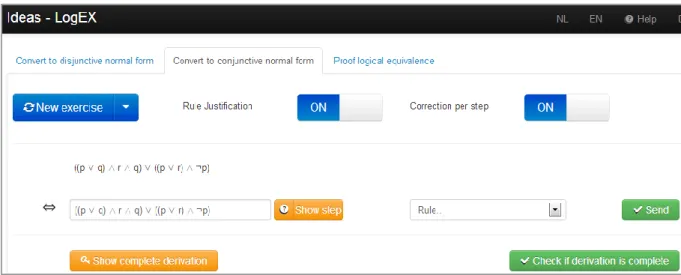
The Ideas framework is used for a number of different domains and their corresponding exercises: bringing a proposition in CNF (shown in Figure 2), orthogonalizing a set of vectors, relation algebra exercises and solving equations. To help students learn functional programming in Haskell, the tutor Ask-Elle has been created (Gerdes, Jeuring, & Heeren, 2012). The domains for which the Ideas framework is suitable are in general well-structured and their related problems can be solved in a procedural way. A well-structured domain has a formal and static body of knowledge that is only applicable in its own context, whereas ill-structured domains are more complex and variable with very specific contexts that are difficult to predict in advance (Spiro, Coulson, Feltovich, & Anderson, 1988).
FIGURE 2 A LOGIC TUTOR
The framework generates several different kinds of feedback (Heeren, Jeuring, & Gerdes, 2010): A check if the student has performed a valid step. The student can either be warned that he or
she deviates from the proposed strategy or be forced to undo the last step.
An indication of how close the student is to a solution, possibly by showing a progress bar or a minimum number of steps.
A possible next step can be presented to the student by showing a hint or even providing the exact rule to apply.
A check if the student has successfully completed the exercise. Showing the complete solution.
The levels of feedback the Ideas framework provides are based on the theory of VanLehn (Vanlehn, 2006) and Anderson (J. R. Anderson, 1993). Syntax errors or incorrectly applying some rule can also be detected by the system, but the main focus of the Ideas framework is to guide the student in selecting the right steps and progressing towards the solution.
Section 2.1 of this chapter describes domain reasoners, the software that provides feedback facilities based on strategies for a specific domain. The section is based on several publications on using strategies for exercise assistants (Heeren & Jeuring, 2009b), (Heeren et al., 2010), (Heeren & Jeuring, 2009a), (Gerdes, Heeren, & Jeuring, 2010). Section 2.2 focuses on the implementation of a functional programming tutor using the Ideas framework and is mainly based on two publications (Gerdes, Jeuring, et al., 2012; Jeuring, Gerdes, & Heeren, 2012).
2.1
D
OMAIN REASONERS
To create an exercise assistant based on the Ideas framework, both a user interface and a domain reasoner should be created for a specific domain. A domain reasoner provides facilities to do exercises in the chosen domain and to generate personalised feedback and guidance. A domain reasoner can be built for a specific domain by implementing a number of components. The components should be built in the functional programming language Haskell using the Ideas software package.5 The functionality of the domain reasoner is provided through stateless web services and can be used by any intelligent tutoring system.
2.1.1
STRATEGIES
The domain reasoners built on the framework are based on strategies. To specify strategies, we first need to establish the domain and a set of rules that apply to this domain. The domain can be described by a grammar for its abstract syntax and requires an accompanying parser to process submitted work. An example is the domain of propositional logic that comprises expressions consisting of variables and logic operators. An environment is maintained to store additional information, implemented as a set of key/value pairs.
Rules are transformations on the data type of the domain, such as refining or rewriting a student submission. An example in the logic domain is to rewrite the expression p q as p q using the rule of material implication. It is important to take into account the granularity of the rewrite steps. In some domains the student has to take each step explicitly, in other domains multiple simplifications can be done implicitly while solving the exercise step-by-step. Rules can be marked as either major or
minor. Major rules are the main rules the student may apply and can be used as hints. Minor rules are generally more administrative.
Strategies are then used to describe the step-by-step solution to a problem. A strategy includes the possible steps, rewrite or refinement rules, together with the order in which the steps can be taken. For example, we can specify several strategies to solve the problem of simplifying a logical expression as much as possible. A strategy can be described using an EDSL, an embedded domain-specific language. The strategy description consists of a context-free grammar (CFG) and a part that is not context-free. The non-context-free part is implemented using a programming language and provides additional functionality.
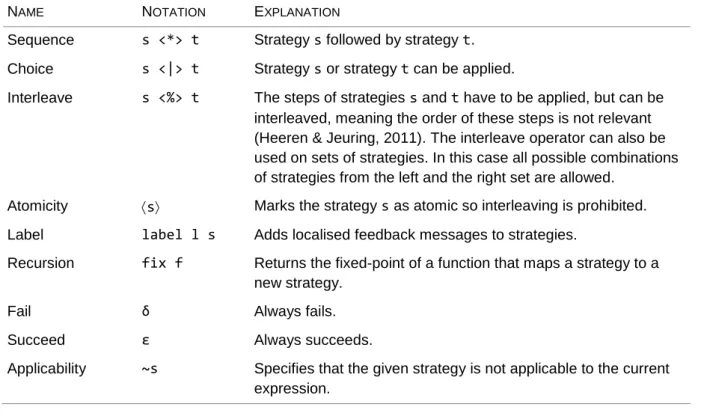
Strategy combinators are used to compose more complex strategies. The atomic part in the CFG is a rule. An overview of combinators and operators for rules is given in Table 1. There are also a number of derived combinators based on the basic combinators, such as many, many1, option, try, repeat
and
(left-biased choice) and a set of traversal combinators.
NAME NOTATION EXPLANATION
Sequence s <*> t Strategy s followed by strategy t. Choice s <|> t Strategy s or strategy t can be applied.
Interleave s <%> t The steps of strategies s and t have to be applied, but can be interleaved, meaning the order of these steps is not relevant (Heeren & Jeuring, 2011). The interleave operator can also be used on sets of strategies. In this case all possible combinations of strategies from the left and the right set are allowed.
Atomicity s Marks the strategy s as atomic so interleaving is prohibited. Label label l s Adds localised feedback messages to strategies.
Recursion fix f Returns the fixed-point of a function that maps a strategy to a new strategy.
Fail δ Always fails.
Succeed ε Always succeeds.
Applicability ~s Specifies that the given strategy is not applicable to the current expression.
TABLE 1 STRATEGY COMBINATORS AND OPERATORS
2.1.2
FEEDBACK
To use strategies for the actual generation of feedback, an exercise should be specified. Exercises in the Ideas framework encompass all aspects related to a problem and the solving of that problem. The components of an exercise are:
Meta data (identification code and description).
A rule set, consisting of valid rules as well as buggy rules that identify common errors. A strategy to solve the problem.
An equivalence relation and a similarity relation, possibly defined as views (see Section 2.1.3). The similarity relation is more tolerant than equivalence and used to detect correct but insignificant steps.
Predicates to check if a starting expression is suitable (pre-condition) and to detect solved expressions (post-condition).
A parser that detects syntax errors and, if necessary, a pretty-printer. Optionally, a randomised expression generator.
A rule ordering function.
The domain reasoner consists of a set of exercises and a number of services to support the student doing the exercises. We summarise some of the feedback services in Table 2.
SERVICE EXPLANATION
EMPTY Check if the language of a strategy contains the empty sentence or a sentence consisting of minor rules.
FIRSTS Splits a strategy into its first rule or applicability check together with the remaining strategy.
STEP The application of a rewrite rule.
RUN Applying the rules specified in a strategy to a term. The result is a (list of) solution(s) to the problem.
TRACE An extension of run that shows the intermediate steps. DIAGNOSE Diagnoses an expression submitted by a student.
TABLE 2 STRATEGY SERVICES
The language that can be generated by the strategy grammar is a set of sequences of rules. These sentences can be compared with (partial) student solutions to see if they are on the right track. The student solution should be a prefix of a sentence or a complete sentence. The Ideas framework uses its own strategy recogniser because existing parsers are not entirely suited to the problem of recognising the application of rewrite rules, the detection of errors therein and the ability to provide informative feedback. Rule ordering is used to make a choice between multiple applicable rules so the provided feedback is deterministic.
In Table 3 the different types of diagnoses returned by the DIAGNOSE service are described. The input to this service is the submitted term and the previous state. A state is the product of an environment, an expression in focus (a zipper) and a strategy and is used to capture (intermediate) results. Apart from the type of the diagnosis, additional information is returned such as a possible new state, the rule that was applied and a boolean indicating if the student has finished the exercise. There is no new state when the diagnosis is either ‘buggy’ or ‘not equivalent’.
DIAGNOSIS EXPLANATION
Buggy The submitted term is not equivalent to the previous term because a buggy rule was applied.
Not equivalent The submitted term is not equivalent to the previous term through an unknown mistake.
Wrong rule A chosen rule is applied incorrectly.
Expected The submitted term is expected by the strategy.
Similar The submitted term is very similar to the previous submission. Detour A rule is (correctly) applied but does not follow the strategy.
Correct Although the submitted term is equivalent to the previous, an unknown step is taken. Unknown Not used.
2.1.3
VIEWS
Comparing the canonical forms of two expressions can determine if they are equivalent. A canonical form, or normal form, is a standard way of presenting an expression. A view defines a canonical form and consists of two functions:
A match function that attempts to map an expression to a canonical form. An example is to return an expression with a plus at top-level. As an example, 1 – 2 will be transformed into 1 + -2. A match function usually converts an expression into a different type, such as a tuple of operands (1, -2) for the given example.
A build function that maps a canonical form to an expression. A corresponding build function for the previous example might be transforming the tuple (1, -2) into the expression 1 - 2. Performing a match operation followed by a build operation results in the canonical form of an expression. Views can also be composed of other views by using arrow-combinators (Paterson, 2003) such as >>> for a sequence of views and *** for a parallel composition of views.
Besides equivalence checking, views are used in several ways: As a rewrite rule.
To check if a term has a canonical form.
To limit the set of necessary rewrite rules because the number of cases that occur greatly decreases.
2.2
A
SK
-E
LLE
The interactive tutor Ask-Elle supports students in doing simple exercises to learn the functional programming language Haskell. The tutor is targeted at students in their first year of computer science. The tutor has the following features:
Providing hints at each step.
Providing feedback on the progress. Providing solutions.
Recognizing common errors.
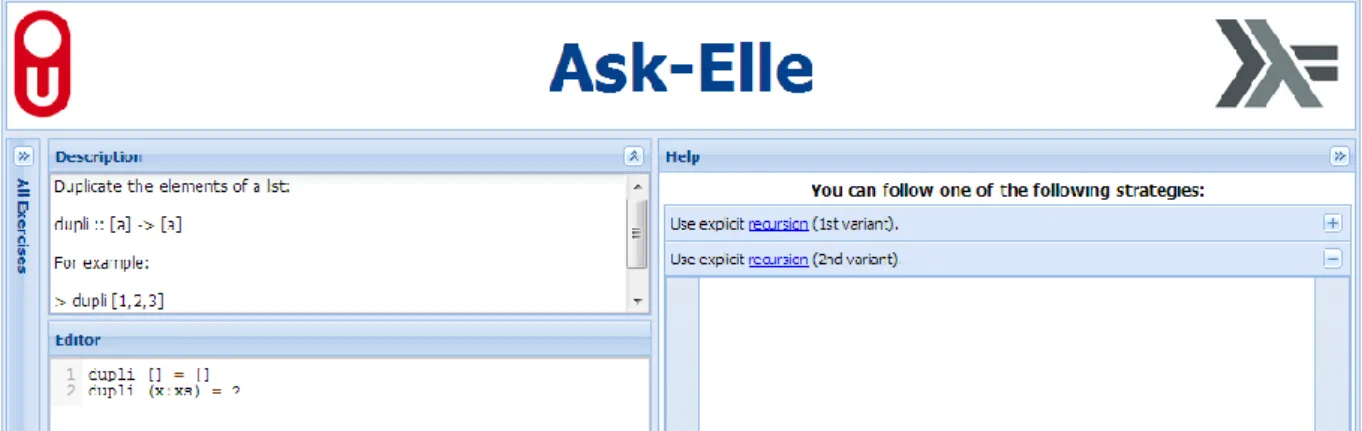
The tutor can be accessed online through a web application6, as shown in Figure 3. The tutor is easy to use by students and easy to customise by instructors. The student can select an exercise and solve it step-by-step. Unfinished parts of the solution can be indicated by a ●-sign. Instructors can add their own programming exercises to the tutor, together with a set of model solutions.
The Ask-Elle tutor distinguishes itself from other tutors with the following characteristics: The tutor handles incomplete programs.
Performing multiple steps at once is recognised by the tutor.
Feedback is calculated automatically and is based on model solutions. Correctness is determined by equivalence to a model solution.
FIGURE 3 A SCREENSHOT OF ASK-ELLE IN ACTION
A domain reasoner for the functional programming domain has been implemented for this tutor. A Haskell compiler is used to provide syntax error and type error messages. In this section the components of the domain reasoner are described together with the deviations and extensions to the existing Ideas framework.
2.2.1
REFINEMENT RULES
The rules used in the functional programming domain are refinement rules, instead of the rewrite rules that are used for mathematical domains. Refinement rules are used to make a program more complete instead of transforming a program into a semantic equivalent when applying rewrite rules. By applying refinement rules, holes in an expression can be replaced by new expressions. Refinement rules refine expressions, declarations, function bindings, alternatives and patterns. Examples of rules are introducing a variable or introducing an if-then-else construct. These new expressions can also contain holes, for example if ● then ● else ●. Refinement rules are atomic and cannot be divided into smaller rules. The available rules cover all available language constructs in the abstract syntax. Rules can be defined as minor if they should be performed together with another refinement rule. Rules are always applied at a specific hole location in the student program. Holes are therefore tagged with a unique identifier so rules can be matched with a location identifier.
2.2.2
STRATEGIES
The tutor considers the step-by-step, top-down application of refinement rules as the strategy to solve functional programming exercises. Strategies can be used to secure the order in which rules are applied. For example, some refinement rules can only be performed after another refinement rule. The strategy for solving a programming problem is automatically derived from the set of model solutions provided by the instructor. The strategy combines the multiple strategies from different solutions into one strategy. This strategy is used to provide feedback. A strategy can be quite strict, which could be a disadvantage. On the other hand, the student is guided towards a solution that is preferred by an instructor.
Both partial and complete programs are converted into a canonical form so equivalent variants can be taken into account. A program is correct if it follows a strategy. Two programs are similar if their canonical forms match syntactically. If a program does not follow a known strategy, the program is considered equivalent to the solution if it passes a number of tests. A modified version of the QuickCheck library (Claessen & Hughes, 2000) that is able to handle partial programs is used to check a number of properties about the program. This is not entirely reliable because checking program equivalence is undecidable and the testing might not identify all faults in the program.
The instructor can specify feedback messages by annotating the model solutions. Information regarding the exercise as a whole can be provided as meta-data in a configuration file. Textual
feedback is specified in feedback scripts that are automatically generated and can be adjusted by the instructor. Refinement rules and library functions have an accompanying feedback message.
Feedback can be adapted by the instructor in a number of ways: Providing a general description of the model solution.
Specifying alternative code to a prelude (the standard Haskell library) function, so more possible solutions will be accepted by the tutor.
Enforcing the use of specific constructs in the solution. Adding localised feedback messages.
A strategy is derived by matching the language constructs in the AST with the available refinement rules. The interleave (<%>) combinator is used to allow variation in the order of refining certain expressions. Feedback annotations, such as an ALTERNATIVE, are included at the right locations. If library functions are encountered, the corresponding definition will also be included in the strategy, except when a MUSTUSE-annotation is provided by the instructor.
As an example we show an annotated model solution for reversing a list of elements:
{-# DESC Use the prelude function foldl. #-} reverse =
{-# FEEDBACK foldl takes an operator and a base value as argument. #-} (foldl {-# FEEDBACK Use flip and (:). #-} (flip (:)) [])
The strategy derived from this model solution is (omitting feedback labels):
patBind
<*> pVar "reverse" <*> app
<*> var "foldl"
<*> ( (paren <*> app <*> var "flip" <*> infixApp <*> con "(:)" ) <%> con "[]"
)
2.2.3
NORMALISATION
To recognise programs that are equivalent but syntactically different, programs are converted to a canonical form. The program transformations are independent from the strategy for the exercise. The following transformations, based on the lambda-calculus, are performed:
Inlining: replacing a call to a user-defined function by its body, dead-code elimination and constant argument removal.
Desugaring: removing syntactic sugar from programs. α-renaming: assigning a new name to all variables. β-reduction: function application.
η-reduction: replacing a function with the form \x -> f x by f.
2.2.4
FEEDBACK SERVICES
SERVICE EXPLANATION
DEEPDIAGNOSE Recognises multiple steps instead of just a single next step. TASKDESCRIPTION Returns feedback messages for all active labels.
TABLE 4 ADDITIONAL SERVICES
Each time a student asks for a hint, the partial program the student was working on will be submitted and normalised. All refinement rules that follow the exercise strategy are applied to the previous state. This may result in multiple programs that will all be normalised and compared to the normalised student program. For the DEEPDIAGNOSE service a top-down parallel recogniser is used that is able to work with programs that have the same first step (a left factor in the generated strategy). In the state, information is added on which strategies are still possible, instead of having to choose one when the student has only completed the overlapping part.
A challenge for the strategy recogniser is to recognise multiple steps at once. If a program contains many holes that may be filled in any order, the number of correct next steps greatly increases. The AST is searched depth-first attempting to reduce search time based on the location where the student most likely proceeds. The tree can be further pruned by reducing the number of interleave options because the order is irrelevant when recognising multiple steps.
Strategies can also be used for assessing complete Haskell programs so the instructor does not have to grade them by hand (Gerdes, Jeuring, & Heeren, 2010). This is a different approach from most assessment tools that use testing to check student solutions. The advantage of using strategies is that the design is assessed and not only the outcome. It can also be proven that a student solution is equivalent to a model solution written by an instructor, whereas proving that a program is correct based on test results is in general impossible.
2.2.5
R
ESULTSIn 2011 an experiment with around 100 students using Ask-Elle was performed. The emphasis of this experiment was on the findings of the students, who were moderately enthusiastic. The main focus of the criticism was that not all correct solutions were recognised and that proof for an incorrect solution was absent. In an experiment with Ask-Elle as an assessment tool, 89% of the correct programs were recognised and no incorrect programs were marked as correct (Gerdes, Jeuring, et al., 2010). A total of over 90 programs were assessed with only four model solutions.
Several options for further research have been proposed (Gerdes, 2012). Some are focused on the area of usability and the didactic results. Technological improvements focus on supporting the full Haskell standard and adding new program transformations. Research on new functionality includes offering other types of exercises, supporting larger programs, providing better error information and developing a tutor for other programming languages and paradigms.
3
P
ROGRAMMING TUTORS
Ever since learning programming was introduced in schools and universities, many tools have been developed to support students in learning how to program. A literature study has been conducted to provide an overview of the evolution of programming tutors that automatically provide feedback to its users. The characteristics and features of the tutors are identified and compared to those of the Ideas tutors. We describe the classification of tools and problems in Section 3.1, together with some relevant definitions. In Section 3.2 some classic and influential tutors from the 20th century are examined. Section 3.3 focuses on modern tutors. In Section 3.4 we take a closer look at program assessment tools. Assessment tools are related to the diagnosis of student programs and are therefore of interest to the development of programming tutors. We conclude in Section 3.5 by summarising the most striking observations.
3.1
C
LASSIFICATION AND DEFINITIONS
Tools and environments that help students learning to program come in many forms. There are a large number of different classifications of programming tools (Deek & McHugh, 1998; Gomez-Albarran, 2005; Guzdial, 2004; Pausch & Kelleher, 2005). In 1998 Deek and McHugh (Deek & McHugh, 1998) recognised intelligent tutoring systems (ITS) as well as intelligent programming environments as two of the four major groups. In 2005 Gómez-Albarrán (Gomez-Albarran, 2005) proposed a different classification. The author did not include ITSs as a distinct category because of the observation that newer tools focus less on providing intelligent tutoring. Intelligent systems reappear in a survey of literature on the teaching of introductory programming from 2007 (Pears, Seidman, Malmi, & Mannila, 2007), in which the following categories for tools that support teaching programming are used:
Visualization tools.
Automated assessment tools.
Programming environments for novices, divided into programming support tools and Microworlds.
Other, including intelligent tutoring systems.
An intelligent tutoring system is a learning system that provides automated feedback or instruction to the user of the system (Nwana, 1990). The interaction with the system should be comparable to interaction with an actual teacher. Research on ITSs involves the domains of computer science, cognitive psychology and education. ITSs generally consist of four different components: the expert knowledge module (domain), the student model module, the tutoring module and the user interface. To correctly analyse student programs, the following functionality should be provided by an ITS (Vanneste, 1994):
Handle variation in syntax. Recognise different algorithms. Recognise errors in implementations. Analyse program efficiency.
Acknowledge if the system is unable to deal with a program, and direct the student to a teacher.
Generate feedback the student can understand.
Pillay (Pillay, 2003) distinguishes two major functions in ITSs. The first group of tutors helps a student in writing a program for a certain problem. The second group of tutors focuses more on debugging and error diagnosis. A commonly used term is intention-based diagnosis (L. Johnson, 1986), which
identifies errors through attempting to understand what the student was trying to achieve and how he or she wanted to achieve that, instead of just reporting on what is wrong.
In addition to the classification of tools, a classification based on the nature of a problem can also be made. Le et al. (N.-T. Le, Loll, & Pinkwart, 2013) propose a classification of educational problems based on their degree of ill-definedness. This classification is based on three properties of solution spaces: alternative solution strategies, implementation variability and solution verifiability. In programming, there are both well-defined and ill-defined problems. Moreover, programming problems in each category can be devised, as shown in Table 5.
CLASS DEFINITION BY LE ET AL. EXAMPLE PROGRAMMING PROBLEM 1 One solution strategy, one implementation. Choose the right operators to calculate
degrees Celsius to Fahrenheit:
int f = c ? 1.8 ? 32;
2 One solution strategy, alternative implementation variants.
Write a recursive function that calculates the factorial of a number n.
3 A known number of typical solution strategies. Write a function that calculates the factorial of a number n.
4 A great variability of possible solution strategies while the correctness of any given specific solution can be verified automatically.
Write an application that can convert between multiple temperature scales.
5 Multiple solution strategies, and solution correctness cannot be verified automatically.
Write a platform computer game.
TABLE 5 PROBLEM CLASSIFICATION WITH EXAMPLES
Class 1 problems are usually addressed by CAI-systems (computer aided instruction) that only have to mark the student’s solution as correct or incorrect. Model-tracing and constraint-based modelling techniques are usually applied for class 2 problems. Model-tracing focuses on the process and uses rules to model the steps a student may take to solve a problem (Kodaganallur, Weitz, & Rosenthal, 2005). Constraint-based modelling, on the other hand, focuses on the product: it models constraints as conditions that must be met in the end result. Tutors based on constraint-based modelling are not interested in how to arrive at the end result. Class 3 problems are strategy-based. Systems for class 4 are rare and mainly use data-mining techniques. Class 5 problems lean on heuristic techniques. The authors observe that solutions for class 3 and 4 are the least developed although they are of great importance for learning and developing problem-solving skills.
The main objective for this classification is twofold: it provides guidance for developers of educational systems but it also proposes a common language to specify problems in order to gain more insight into the capabilities of an educational system. The Ask-Elle programming tutor can be categorised in class 3.
3.1.1
FOCUS
Considering the classification from Section 3.1, the following categories are of interest for this research on programming tutors:
Automated assessment tools. Intelligent tutoring systems.
The tutors based on the Ideas framework, and in particular the functional programming tutor, distinguish themselves by the following characteristics (Gerdes, Jeuring, et al., 2012):
Dealing with incomplete programs.
The recognition of multiple steps in a student program. Automated calculation of feedback based on model solutions. Correctness determined by equivalence to a model solution.
We examine several programming tutors considering the features mentioned above, the criteria by (Vanneste, 1994) and the classification by Le et al (N.-T. Le et al., 2013). For this research we are mostly interested in the knowledge model and the tutoring module of an ITS, and not the student module and the user interface. The tutors and tools should be able to deal with class 2 or class 3 programming problems.
3.2
P
ROGRAMMING TUTORS BEFORE
2000
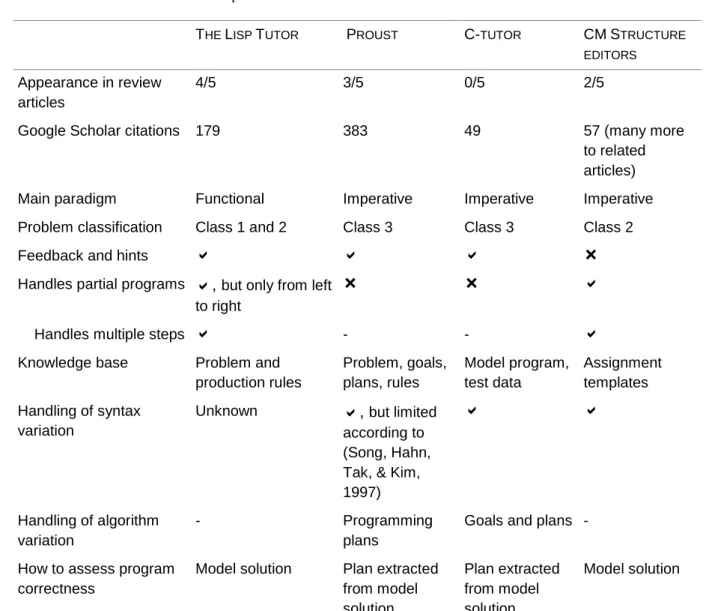
The tutors described in this section have been selected based on five publications that categorise and review learning tools for programming (Deek & McHugh, 1998; Gomez-Albarran, 2005; Guzdial, 2004; Pausch & Kelleher, 2005; Pillay, 2003), the frequency a certain tool appears in these publications and the number of citations. Table 6 provides an overview of the features of the tutors that are discussed.
THE LISP TUTOR PROUST C-TUTOR CM STRUCTURE EDITORS Appearance in review
articles
4/5 3/5 0/5 2/5
Google Scholar citations 179 383 49 57 (many more to related articles) Main paradigm Functional Imperative Imperative Imperative Problem classification Class 1 and 2 Class 3 Class 3 Class 2
Feedback and hints
Handles partial programs
,
but only from left to right
Handles multiple steps
- -
Knowledge base Problem and production rules Problem, goals, plans, rules Model program, test data Assignment templates Handling of syntax variation
Unknown
,
but limited according to (Song, Hahn, Tak, & Kim, 1997)
Handling of algorithm variation - Programming plansGoals and plans -
How to assess program correctness
Model solution Plan extracted from model solution Plan extracted from model solution Model solution
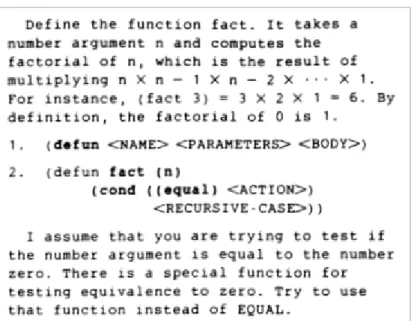
The Lisp Tutor. The Lisp Tutor was developed in the 1980s at Carnegie-Mellon University using techniques from artificial intelligence and cognitive psychology (J. Anderson & Skwarecki, 1986). By observing how students program, the developers created simulation models that can be used to guide the student during programming. These models were implemented using production systems that set goals and subgoals. The system uses model tracing to keep track of the students’ actions.
A student working with the tutor can solve a problem step-by-step by filling in a coding template and answering questions about the problem. The possible next steps students can take can be calculated from the rules in the production system. The production system also contains buggy rules so the tutor can respond to students doing something wrong.
FIGURE 4 A FRAGMENT OF THE LISP TUTOR IN ACTION
The approach was successful because using the tutor led to better results than learning to program Lisp without it. Nevertheless a number of improvements were discussed for future development. A known issue is the top-down, left-to-right programming style that is enforced which causes the tutor to be inflexible and restrictive. The interaction is also limited and adding new exercises is laborious.
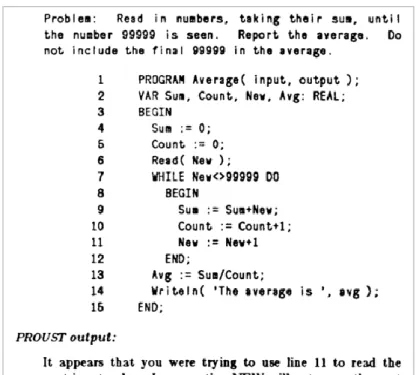
PROUST. PROUST is a programming tutor for learning Pascal (W. Johnson & Soloway, 1985). The tutor analyses complete programs that solve a certain problem and returns an explanation of the discovered bugs using programming plans. A programming plan is ‘a procedure or strategy for realising intentions in code’ and is decomposed into a number of goals, as illustrated in Figure 5. One programming problem may have different goal decompositions. PROUST tries to recognise these plans, including erroneous plans, in the code submitted. Transformation rules are used to detect variations in implementation.
FIGURE 6 RESPONSE BY PROUST TO A BUGGY PROGRAM
Looking at the results, the number of correctly analysed programs seems to be satisfactory (72% of 206 student solutions were completely analysed and 22% partially), although in (Gomez-Albarran, 2005) it is noted that the system has problems with analysing programs with increased complexity. Adding a new exercise and the corresponding goals, plans and rules requires substantial work.
C-tutor. The C-Tutor is an ITS for beginners learning programming in C (Song et al., 1997). The system consists of a learning environment and a program analyser and is based on intention-based diagnosis. The program analyser includes a reverse engineering system and a didactic system. The reverse engineering system generates the problem description, the intention, based on a model program provided by an instructor. The problem description contains a hierarchy of programming goals and plans. The student submits a solution, which is then converted into a canonical form. The didactic system generates feedback on the solution using both dynamic and static analysis. The system runs test cases provided by the instructor, tries to match the student program to the plans extracted from the model solution (similar to the approach in PROUST) and reports the bugs to the student.
The C-tutor is successful in the recognition and analysis of student programs: 93% of 240 programs were successfully analysed. Using both static and dynamic analysis is a strong point of the tutor, besides the easy addition of new exercises. However, the tutor is unable to guide a student through the programming process step-by-step.
Carnegie Mellon Structure Editors. Carnegie Mellon University developed three generations of novice programming environments, GNOME, MacGnome (Genies) and ACSE for Pascal and other languages, starting from the 1980s (Miller, Pane, Meter, & Vorthmann, 1994). The development focused on educational concepts such as procedural abstraction, data abstraction and reasoning about programs. The programming environments are structure editors, in which the student builds up an abstract syntax tree while creating a program. Parts of the tree that have not been realised yet are
indicated by a textual placeholder. In this way all constructed programs are syntactically correct because the tree can only be elaborated with legal operations.
The tools were successful and widely used for many years, although there was some criticism and room for improvement. The technology was unable to adapt itself quickly to new languages. Criticism came from computer scientists who were bothered by the lack of focus on program correctness. The tools do not really provide feedback on the progress of a student, neither are they able to help a student to solve a programming problem in multiple ways.
3.3
R
ECENT PROGRAMMING TUTORS
In this section a number of interesting and relevant tutors are discussed that were developed more recently. Table 7 provides an overview of their features.
JITS J-LATTE PROLOG
TUTOR PYTHON TUTOR DATA-DRIVEN PYTHON TUTOR Main paradigm Imperative Imperative Logic Imperative Imperative Problem
classification
Class 3 Class 2 Class 3 Class 2 Class 3
Feedback and hints
, inprogress Handles partial programs
, only on a high level
, but with large deltas (save/compile points) Handles multiple steps -
-
Knowledge base A problem, the required output and a program skeleton Formal problem specification Model solutions Model solution and error model Student data Handling of syntax variation
Handling of algorithm variation
How to assess program correctnessOutput Constraints Model solution
Model solution
Student solutions
JITS. Around 2003 a prototype of the Java Intelligent Tutoring System (JITS) was designed for students in their first programming course at college or university level (Sykes & Franek, 2003). The tutor focuses on a subset of the Java programming language (variables, operators and looping structures) and incorporates findings from artificial intelligence and cognitive science. Students can practise with programming exercises and ask for hints. The prototype version of JITS provides two types of functionality:
A-type functionality. When a programming exercise has a straightforward solution, the system calculates a transformation string from the student’s submission to the solution provided by the lecturer. A transformation string contains symbols that indicate which changes have to be made to transform the source into the target string. The system tries to implement the changes from the transformation string in a stepwise fashion through interaction with the student.
B-type functionality. In this case there are multiple solutions and the lecturer only provides the problem description and the desired results. An intent recognition scanner-parser algorithm is used to determine the intention of the student. The student’s code is analysed step-by-step and applies transformation sequences to produce tokens the parser can recognise, using a symbol table and a list of reserved words and keywords.
FIGURE 7 THE TUTORING PROCESS IN THE JITS PROTOTYPE
JITS continued to be developed and tested resulting into an updated version (Sykes, 2005). In this version instructors can no longer upload solutions, only the expected output. The system uses the Java Error Correction Algorithm (JECA) that evolved from the algorithm used for b-type functionality. Besides trying to autocorrect the student’s solution it generates a number of permuted parse trees in order to find out what the student was trying to do.
The further development of JITS also involved constructing an engaging, complete and accessible learning environment. An authoring tool for lecturers was added to submit new exercises by specifying the problem statement and description, required output and a code template. Considerable attention was also given to hint generation. A hint-object in JECA consists of information on the location of the problem, a proposed solution, the confidence of this solution and the type of hint (keyword replacement, grammatical hint, logic error et cetera). The data in the hint-object is used to generate a hint message for the student.
JITS was tested in multiple qualitative studies with positive results from students and professors. JITS is easy to use for both students and instructors. However, hints are more directed at the syntax level and do not help the student in approaching a problem. Because the system only knows the required output, hints cannot be given on the strategy level.
FIGURE 8 A FRAGMENT OF THE USER INTERFACE OF JITS
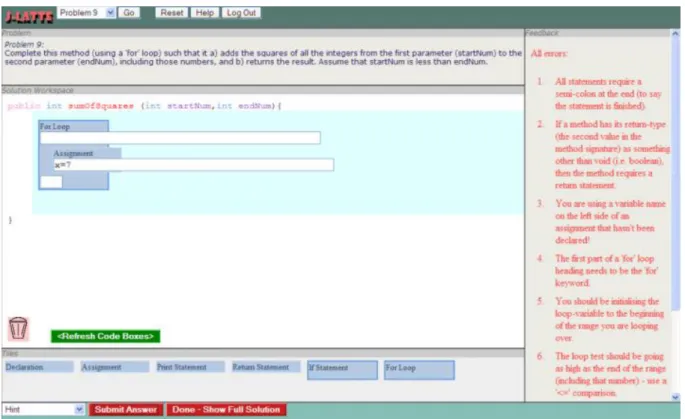
J-Latte. J-LATTE, the Java Language Acquisition Tile Tutoring Environment, is a Java tutor from 2009 (Holland, Mitrovic, & Martin, 2009). The tutor presents the student with simple programming exercises that can be solved with a subset of the Java programming language. The problem can be solved in two modes that can both be seen in Figure 9:
Concept mode. Concepts are programming artefacts defined at a higher level, such as declaration, return statement and for loop. The student can select predefined concepts from the user interface and combine them to create the structure of the solution.
FIGURE 9 THE INTERFACE OF J-LATTE
J-LATTE uses constraints to represent domain knowledge. These constraints describe features of the solution that can either be syntactic, semantic or style-related. Semantic constraints compare a proposed solution to the formal specification of the problem, for example:
(sum-of-function-over-a-range :range (:from (method-arg :name "startNum") :to (method-arg :name "endNum")) :function square)
This specification states that the ‘sum-of-function-over-a-range’ pattern should be used, which could be any kind of loop, it specifies the lower and upper limit of the range and requires the presence of a square-function.
Feedback can be requested by the student at any time during the exercise. The system indicates whether the provided solution is correct or incorrect and also presents error messages related to the first or all constraints that are violated, with some hints on how to solve the errors. Using constraints does not force the student to follow a predetermined path in programming.
An experiment with students using the tutor showed promising results, although the number of participants was too low to draw any valid conclusions. J-LATTE supports the tackling of a problem in chunks by choosing building blocks and refining them step-by-step, but the feedback is not focused on following a particular solution strategy.
Prolog Tutor. The Prolog Tutor is a tutor that guides programming and performs error analysis for writing programs in the declarative, logic programming language Prolog (Hong, 2004). The underlying technique categorises Prolog programs that have the same programming technique or code pattern. These categorisations can be used for recognising and generating code. For each class of programs a set of grammar rules is determined (see Figure 10) and knowledge about the technique and coding is stored in frames.
FIGURE 10 SOME PROLOG PROGRAMMING TECHNIQUE GRAMMAR RULES
Prolog programs can be parsed using these grammar rules. There can even be a hierarchy of programming techniques so the tutor can operate on different levels of abstraction. The instructor has to provide all possible solutions to an exercise. Differences in the order of clauses or predicates can be ignored by the system by applying certain rules.
A student working with exercises in the tutor can get help in two ways:
Guided programming. The right programming technique is offered by providing a template the student can fill in. First, the template at the highest level of abstraction is offered. If the student asks for more help, a more detailed or specialised template can be given, as shown in Figure 11. The students might be asked to choose a specific technique if there are multiple approaches.
Error analysis. If the system recognises that a student is using the correct programming technique, the tutor can detect if this technique is used in the right or wrong way and provides a detailed error message. Errors are treated one by one until the student solves them all. This is done by comparing the parsed student program to the parsed solution.
FIGURE 11 THE RESPONSE OF THE PROLOG TUTOR TO A STUDENT ASKING FOR HELP
The tutor was tested with over a hundred solutions to one programming problem. Overall the tutor performed well, 98% of the correct programs and 95% of the incorrect programs were correctly diagnosed. The recognition of multiple solution strategies and the top-down approach of solving a problem are similar to the strategies for solving a problem in the Ask-Elle tutor.
Python tutor. The work of Singh et al. focuses on generating feedback for solutions to introductory programming problems in a large subset of Python (Singh, Gulwani, & Solar-Lezama, 2013). Feedback is provided after a complete solution is submitted and consists of the location of the error, the problematic expression and the modification, as shown in Figure 12.
FIGURE 12 GENERATED FEEDBACK FOR AN ERRONEOUS SOLUTION
As input to the system, the instructor has to write a reference implementation and an error model using an error model language the authors designed. The error model consists of a set of correction rules that solve the mistake a student might make together with appropriate feedback messages in natural language. All possible programs based on these rules applied to the solution of the student are then searched to find the one that most closely matches the reference solution. This is done by translating the program with the correction rules into a Sketch program. Sketch is a software synthesis tool that can complete a partial code implementation so it behaves like a given specification. The Sketch synthesiser finds the solution and feedback is generated based on the applied correction rules.
The tool was tested on thousands of student solutions and was able to provide useful feedback on at least 64% of the incorrect solutions. Ten seconds on average were needed to calculate the feedback. A limitation of the tool is its inability to deal with student programs that have large conceptual errors. The tool also cannot deal with structural requirements such as enforcing students to use recursion in their solution.
Data-driven tutors. A different approach is the generation of feedback based on student data from the past. Jin et al. (Jin, Barnes, & Stamper, 2012) use linkage graphs to represent correct student solutions. A linkage graph is an acyclic graph consisting of nodes representing states and directed edges representing the order of the statements. The student can ask for a hint while doing an exercise. A linkage graph is then created and the closest match with an existing graph will be used to provide feedback on the next step or the correction of an erroneous step. Multiple existing student solutions should be available with the risk that a specific alternative to solve the exercise might not be recognised. There is also work to be done on the format of the feedback messages.
Rivers and Koedinger propose a method for generating feedback by a data-driven approach focusing on class 3 problems, applying it to Python programming (Rivers & Koedinger, 2013). It is based on the conception that a large collection of student programs should give valuable information on possible solutions and common errors. Graphs are used to represent all possible paths to a solution, which the authors call solution spaces, in which the edges are steps and the nodes solutions states. Equivalent solution states are recognised by transforming programs into a canonical form. The canonical form is achieved by first creating an abstract syntax tree from a program, renaming all variables and
attempting all known normalizing transformations. The best next step is calculated from this graph, by considering possible correct solutions strategies that are close to the current solution state the student is in and by considering frequently visited states by other students. Feedback is then calculated based on the differences between the current and the next state.
An advantage of a data-driven approach is that the instructor does not have to provide much input. A disadvantage is that there might be unusual solution strategies in the data set that a teacher would normally not encourage.
Other tutors. Another tutoring system was created at the University of Split (Dadic, Stankov, & Rosic, 2008). A component of this system teaches program design skills. The instructor provides a model solution that will be stored in a tree structure consisting of goals and plans. If the student program does not match the model solution, the system will give an error message and will provide help on how to proceed on multiple levels. The analysis of students programs is based on artificial intelligence techniques, although the exact details of the implementation are unclear.
The programming tutor developed by Weragama et al. focuses on the teaching of web programming in PHP (Weragama & Reye, 2013). The tutor is still being improved. The solution to an exercise is defined using a set of predicates describing a goal, a number of constraints and conditions. If all predicates can be recognised in the student program, it is considered correct, if not, feedback is provided. The tutor is not focused on providing feedback during programming.
In a tutor for Prolog programming (N. Le & Menzel, 2008) constraints are used to describe the solution space of programming problems, considering ill-defined programming exercises. Constraints can either refer to a specific problem or can be general Prolog constraints. Feedback is generated based on constraints that are not met by the student solution.
Jurado et al. (Jurado, Redondo, & Ortega, 2012) have developed a system that gives feedback based on software metrics and test cases. The structure of the solution is checked by the fuzzy evaluation of a number of metrics, such as lines of code and cyclomatic complexity. The correctness of the solution is checked by running several test cases. The provided feedback is then based on the test case or metric that deviates from the results of the model solution.
M-PLAT, Multi-Programming Language Adaptive Tutor (Nunez, Fernandez, & Carretero, 2010), focuses on providing exercises that are suitable for the student, solution checking, documentation and collecting statistics on student performance in one environment. Solution checking is done by the expert module that uses black box testing and white box testing. The system provides output in the form of error messages.
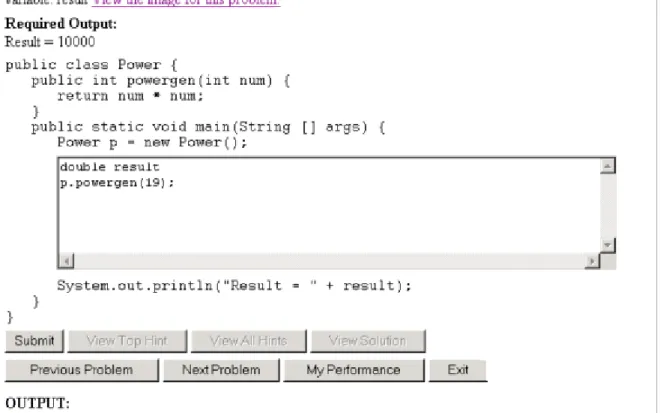
Commercial and online tutors. Beyond the scientific world quite a number of online programming tutors have emerged recently, such as Code School7, Codeacademy8 and Khan Academy9. Commercial parties also provide tutors, such as My Programming Lab10 from educational publishing company Pearson. We do not know the technology behind these solutions and are only able to look at what they offer. Many free online tutors focus on absolute beginners and have a restricted set of exercises. Hints are often more general (Figure 13) or a template of the wanted solution that should be
7 https://www.codeschool.com 8 http://www.codecademy.com 9 https://www.khanacademy.org 10 http://www.pearsonmylabandmastering.com/northamerica/myprogramminglab
filled in (Figure 14). Hints from My Programming Lab (Figure 15) can be very cryptic when only submitting a small part of a solution.
FIGURE 13 CODEACADEMY HINT
FIGURE 14 KHAN ACADEMY HINT
FIGURE 15 MY PROGRAMMING LAB FEEDBACK
3.4
P
ROGRAM ASSESSMENT TOOLS
An essential and both challenging aspect of programming tutors is the automatic assessment of student programs. A tutor should be able to determine if a candidate solution is either correct or incorrect accompanied by a list of semantic errors in the latter case. Semantic variations of a solution should be recognised and marked as correct.
In a fairly recent review of automatic assessment tools for programming developed from 2006 to 2010 (Ihantola, Ahoniemi, Karavirta, & Seppälä, 2010) two categories are identified. The first category is the use of industrial testing tools and the second ‘various specialised solutions’, subdivided into the traditional and widely used comparing of output, scripting and experimental approaches. The authors state that a very large number of tools are available, often with similar features and they plead for combining effort and disclosing implementation details.
The assessment tools that are based on test execution only are unable to consider the actual solution strategy making it impossible to locate and diagnose errors. Another approach is to assess programs