Evaluating Recommender Systems
for Technology Enhanced Learning:
A Quantitative Survey
Mojisola Erdt, Alejandro Fern
andez, and Christoph Rensing,
Member, IEEE
Abstract—The increasing number of publications on recommender systems for Technology Enhanced Learning (TEL) evidence a growing interest in their development and deployment. In order to support learning, recommender systems for TEL need to consider specific requirements, which differ from the requirements for recommender systems in other domains like e-commerce. Consequently, these particular requirements motivate the incorporation of specific goals and methods in the evaluation process for TEL recommender systems. In this article, the diverse evaluation methods that have been applied to evaluate TEL recommender systems are
investigated. A total of 235 articles are selected from major conferences, workshops, journals, and books where relevant work have been published between 2000 and 2014. These articles are quantitatively analysed and classified according to the following criteria: type of evaluation methodology, subject of evaluation, and effects measured by the evaluation. Results from the survey suggest that there is a growing awareness in the research community of the necessity for more elaborate evaluations. At the same time, there is still substantial potential for further improvements. This survey highlights trends and discusses strengths and shortcomings of the evaluation of TEL recommender systems thus far, thereby aiming to stimulate researchers to contemplate novel evaluation approaches.
Index Terms—Recommender systems, evaluation, survey, technology enhanced learning
Ç
1
INTRODUCTION
R
ECOMMENDERsystems play an increasingly significant
role in Technology Enhanced Learning (TEL). With this
growing importance comes a corresponding need to
per-form comprehensive evaluations. Often, methods applied
to evaluate recommender systems in other domains such as
e-commerce are reused in TEL [1]. Recommender systems
for TEL have unique requirements as their goal is to support
the learning process [1], [2]. Therefore, the adequate
evalua-tion of recommender systems for TEL demands specific
methods. As a result, there is a need to investigate these
par-ticular requirements for TEL recommender systems and
how they can best be evaluated. Manouselis et al. [1] notice
the similarity of recommender systems for TEL with
Adap-tive Educational Hypermedia
systems. They conclude that the
evaluation requirements for these systems can be adopted
to the evaluation of TEL recommender systems,
complimen-tary to recommender specific aspects.
A discussion of evaluation methods can be found in [3]
and in [4]. The evaluation of TEL recommender systems has
been considered as one variable of analysis in two surveys:
[5] and [6]. Both show that in many cases, research works
do not fulfill expectations for a valuable evaluation. This
survey offers a representative and detailed quantitative
analysis of research on TEL recommender systems, focusing
specifically on their evaluation. In Section 2, the TEL specific
requirements for recommender systems are analysed. In
Section 3, the evaluation goals and evaluation
methodolo-gies for evaluating TEL recommender systems are
pre-sented, as well as the challenges facing the evaluation of
TEL recommender systems. In Section 4, the approach used
for the literature survey is described and the classification
criteria are introduced. Results from the survey are
summa-rized in Section 5. Finally, this paper concludes in Section 6
with an overall discussion of the trends analysed in the
survey and an outlook on future challenges facing the
evaluation of TEL recommender systems.
2
REQUIREMENTS OF
RECOMMENDER
SYSTEMS FOR
TEL
Due to the ever increasing amount of information found on
the web, it becomes more and more difficult for learners to
find suitable items to satisfy a particular need.
Recom-mender systems aim to reduce this burden of information
overload by predicting relevant items of interest to a user. A
recommender system is basically made up of a
recommen-dation engine that creates a recommenrecommen-dation list of items,
sorted by their relevance to a particular information need.
In order to provide personalized recommendations, which
are recommendations tailored to a certain person, the user’s
context and the user’s profile (e.g. user preferences,
transac-tion history, demographics) need to be considered when
generating recommendations. There are different kinds of
recommender systems. The main types can be classified as:
M. Erdt and C. Rensing are with the Multimedia Communications Lab,KOM, Technische Universitat Darmstadt, Germany.€
E-mail: {mojisola.erdt, christoph.rensing}@kom.tu-darmstadt.de.
A. Fernandez is with LiFiA, faculty of Informatics, UNLP and CiC, La Plata, Argentina. E-mail: [email protected]. Manuscript received 31 July 2014; revised 29 Apr. 2015; accepted 17 May 2015. Date of publication 1 June 2015; date of current version 11 Dec. 2015. For information on obtaining reprints of this article, please send e-mail to: [email protected], and reference the Digital Object Identifier below.
Digital Object Identifier no. 10.1109/TLT.2015.2438867
1939-1382ß2015 IEEE. Personal use is permitted, but republication/redistribution requires IEEE permission. See http://www.ieee.org/publications_standards/publications/rights/index.html for more information.
content-based, collaborative filtering, knowledge-based,
and hybrid recommender systems [7]. Collaborative
filtering approaches use community data such as feedback,
ratings, tags or clicks from other users to make
recommen-dations. Content-based approaches make recommendations
using content features to identify similar items or determine
the similarity between items and the user’s profile.
Knowl-edge-based approaches utilize knowledge bases and
knowl-edge models (e.g. ontologies) to generate recommendations.
Hybrids combine several of these approaches thereby
exploiting their advantages and avoiding their limitations.
A comprehensive survey of the state-of-the-art
recom-mender systems can be found in [8].
2.1
Recommender Systems for TEL
Technology enhanced learning is a broad field ranging
from formal to informal learning, from classroom to
work-place and mobile learning, and covers almost all topics in
our everyday lives. As technology is used in different
learning scenarios, so also have recommender systems
been used to support different learning scenarios. The
main aim of recommender systems in TEL can be
summa-rized as supporting learners during their learning process
in order to accomplish their learning goals [9], [10]. A
recent survey of TEL recommender systems can be found
in [9] and an overview of research trends and applications
of recommender systems for TEL in [11]. Additionally, a
survey of context-aware TEL recommender systems can be
found in [5].
Recommender Systems for TEL recommend a wide
vari-ety of items such as learning objects, learning resources on
the Web, software, foreign language lessons, test items,
lec-ture notes, or complete courses [2]. The recommender
sys-tems identified in this survey make very diverse
recommendations, including learning resources, fellow
peers, and more TEL specific items such as learning
sequen-ces, advice to teachers or grade predictions. These findings
are not surprising and confirm those reported in related
work [9].
2.2
Requirements of TEL Recommender Systems
Personalized recommender systems are applicable to a TEL
scenario as their characteristics can be mapped to
corre-sponding principles in the learning sciences that are needed
to facilitate learning [2]. These particularities lead to new
requirements for recommender systems for TEL as
com-pared to other domains [1].
The first requirement is to reflect the individual learners
needs. These needs depend on different characteristics
of the learner. A very important aspect is the individual
knowledge or competence level [2], [12]. An item
recom-mended at a certain point in time could be too easy or too
difficult to a learner depending on the learner’s level of
abil-ity [13]. For example, an expert needs different
recommen-dations than a novice. One aspect which should be taken
into account is, that knowledge levels change over time [2].
Learners never reach a final knowledge level or competency
state, but instead move on to attain the next level of
knowl-edge or competency [10], [12]. Other aspects to be
consid-ered are the changing interests or learning activities of a
learner. In addition, there are more or less stable
characteris-tics, such as learning styles, which should also be taken
into account [2].
The second requirement is based on pedagogical
theo-ries. Learners should be confronted and challenged with
unexpected content as this would encourage the learner to
learn through discovery and exploration. Recommending
items that are different to those a learner already knows
could stimulate critical thinking and counter confirmation
biases [2]. Recommender systems for TEL should thus
rec-ommend novel [3], diverse and serendipitous learning
resources [2]. For example by providing
preference-incon-sistent recommendations [14].
It therefore becomes increasingly important to evaluate
recommender systems with respect to these particularities
and requirements.
3
EVALUATING
RECOMMENDER
SYSTEMS
FOR
TEL
Evaluation experiments are conducted in order to assess
how well a recommender system fits specified requirements
(such as those mentioned in Section 2). These requirements
thus lead to the evaluation goals or the effects to be
mea-sured by the experiment.
3.1
Evaluation Goals
The goal of an evaluation is to measure a certain property or
effect of the recommender system. In [15], Shani and
Guna-wardana present a selection of several properties from
different domain areas that could be measured by an
evalu-ation. Also in [12], Drachsler et al. introduce several
param-eters and differentiate between technical and educational
parameters. Inspired by these properties and the
require-ments discussed in Section 2, in the following, we present
three broad categories of evaluation goals for TEL
recom-mender systems.
3.1.1
Measuring Recommender System Performance
System performance evaluation goals aim to measure the
performance of the recommender system or recommender
algorithm from a technical point of view, such as the
pre-diction accuracy, the recall and coverage of the algorithm
and the relevance of the recommendations [15]. Another
technical measure is the execution time or prediction
speed of a recommender algorithm in generating
recom-mendations [12].
3.1.2
Measuring User-Centric Effects
User-centric evaluation goals aim to measure the general
perception of the recommender system by the user. This
includes the user’s preference for or satisfaction with a
tem, the user’s trust in the recommendations from the
sys-tem, the user’s perceived novelty, diversity and serendipity
of the recommendations [15]. Other user-centric properties
are for example user experience and expectations [16], user
satisfaction [16] and the perceived usefulness of
explana-tions of recommendaexplana-tions [17]. Another aspect is how
well a recommender system supports the user in achieving
a specific task or goal [3].
3.1.3
Measuring Effects on Learning
Educational measures or learner-specific evaluation goals
aim to measure specific properties related to learning, thereby
encompassing the TEL requirements from Section 2.1 and
supplementing the properties presented in [15]. This is in
accordance to [6], [12], where effects on learning are also
dif-ferentiated from the recommender algorithm’s performance.
One of such goals is to measure the learning performance of
the learner. This comprises measuring the learner’s
individ-ual knowledge or expertise level on a particular topic and
comparing the learner’s learning achievements and scores in
tests. Learning effectiveness is another goal with the aim to
measure the number of visited, studied or completed items
during a learning phase. A further goal is measuring the
learner’s achievement efficiency, which indicates the time
needed by a learner to reach a learning goal [12]. Another
goal is measuring how the system affects the learning
motiva-tion of the learner [18].
3.2
Evaluation Methodologies
The methodologies for the evaluation of TEL recommender
systems can be classified into three types according to [3]
and [15]: offline experiments, user studies and real life
test-ing. Each evaluation methodology has its advantages and
disadvantages [19], [20] and may be better suited to
evalu-ate certain goals than others.
3.2.1
Offline Experiments
Offline experiments (also called
dataset driven evaluation
[21])
use datasets consisting of user interactions to evaluate
rec-ommender systems. Two kinds of datasets are often used:
(i) Natural or historical datasets consisting of historical
interaction data of real users in a real system over a period
of time. Explicit user ratings can be collected or implicit
user feedback extracted from user log data. (ii) Synthetic
datasets are artificially constructed datasets usually used to
test how recommender algorithms perform in constructed
scenarios and under specified conditions. Parameters such
as the distribution of user properties, the size or rating
sparsity [7] can be pre-defined in order to create datasets
fulfilling certain criteria. Offline experiments simulate the
recommendation process where items are given to a user
and the user acts on this by giving feedback like tagging,
rating or buying the item [15]. Thereby, a subset of the
user’s interactions in the dataset are hidden or withheld
and the recommender system has the task to predict these
hidden interactions. The recommender system is evaluated
according to how good it can predict these hidden
interac-tions. Such a simulation can be conducted using
cross-vali-dation [22] or time-stamps [15]. For cross-valicross-vali-dation, the
given dataset is split into two parts: the training set which is
used to train the recommender algorithm or to generate the
recommendation results and the test set used to validate the
performance of the recommender algorithm [22]. In datasets
where time-stamps are available, time can be used to
simu-late how recommendations could have been made at the
time the system was running. This is done for example, by
starting at the earliest time-stamp in the dataset and
stepping through in temporal order, thereby hiding the
user’s future interactions which the recommender system
attempts to predict [15]. A detailed list of TEL datasets can
be found in [21] and in [23], as well as a survey of
linked-data linked-datasets, available social linked-data and linked-data formats in [24].
3.2.2
User Studies
A user study is a scientific method used to find out how a
recommender system influences a user’s experience,
per-ception and interactions with a system [25]. User studies are
typically performed in the human sciences [26]. User
stud-ies cover a wide range of evaluation questions [15], however
these are very subjective judgements. A user experiment is
usually executed by asking users to perform some tasks in a
controlled environment for a short period of time. The
inter-action behaviour of the users with the recommender system
is observed and recorded. For example, the time taken to
complete a task or the quality of the results of a task. Users
are often asked questions before, during and/ or after the
experiment. Such questions, often prepared as a
question-naire or asked in an interview, help to capture aspects that
cannot be directly observed otherwise, such as how the user
feels about using the system or taking part in the
experi-ment. Participants in a user study should generally be
unbi-ased users of the system and need to be selected randomly
from a representative population sample [15]. The sample
size should be large enough to achieve statistically
signifi-cant results [25].
3.2.3
Real Life Testing
In real life testing, also known as online evaluation [15], real
users use the system under normal conditions over a long
period of time [3]. This might be as a field study where a
large community of users is observed while using the
sys-tem under realistic conditions or as a pilot study where a
system is deployed in its real life setting. With real life
test-ing, most user-centric goals can be effectively evaluated
such as measuring user experience or user satisfaction [19].
3.3
Challenges of Evaluating Recommender
Systems for TEL
The evaluation of TEL recommender systems faces several
challenges as reported in [3]. Thus there is an increasing
need to review the evaluation of TEL recommender systems
in order to discuss new ways forward. These challenges
motivate this survey.
3.3.1
Availability and Limitations of TEL Datasets
In contrast to the other evaluation methodologies, offline
experiments are fast and require a low effort to conduct.
They are usually executed in several hours depending on
the size of the dataset and speed of the algorithm. Offline
experiments are however limited to the historical
interac-tions recorded in the datasets. Items in the dataset that were
not
interacted
with in the history of a learner are considered
not interesting nor relevant to the learner, this however
might not be true [16]. Furthermore, offline experiments are
limited by the fact that TEL datasets fulfilling all necessary
requirements for the evaluation of a specific type of
recom-mender algorithm are not always available e.g. for
evaluat-ing multi-criteria recommender systems [27]. Synthetic
datasets can be used in the initial development phases
(when no real data yet exists) to help decide on certain
choices or settings or tuning models [19]. The evaluation
results however need to be verified with real data later
on [28].
3.3.2
Necessity for User-Centric Evaluation for TEL
User-centric evaluation focuses on the perceptions of the
user and not on the technical performance of the
recom-mender system. User-centric measures such as usability or
user satisfaction are best evaluated by asking the users
them-selves [16]. Although some attempts have been made to
mea-sure such effects in offline experiments, measuring effects
like the user’s trust in a system is just not possible with an
off-line experiment [15]. Measuring effects on learning are also
typically done using user-centric evaluation [6]. Therefore
and in particular for TEL, user-centric evaluations are crucial
but they unfortunately remain expensive to conduct.
3.3.3
Limited Availability of Participants
for User Studies
Finding a sufficient number of willing participants for user
studies is a challenge. User studies usually require several
days to conduct as it is not always possible to get all
partici-pants to take part in the study on the same day. Additionally,
there may be constraints on the availability of resources (e.g.
rooms, PCs or licenses). For user studies, if several variations
of an experiment need to be evaluated, then the participants
have to be shared out across the different treatment
condi-tions, thus further reducing the number of participants per
variation. If the same participants should evaluate several
variations, then other issues arise, such as user bias as the
participants gain more knowledge about the system [15].
3.3.4
Limitations of Real Life Testing
Real life testing is particularly challenging for TEL and
requires a lot of effort as real learners need to use a mature
system earnestly for a long period of time under real
condi-tions. Deploying and maintaining a system in a real life
set-ting is expensive as it requires sufficient resources such as
enough computational capacity, adequate user support or
even user training. For real life testing, it is nearly
imble to have many variations of a system evaluated. A
possi-bility to still accomplish this, is to switch algorithms or user
interfaces during testing. This however limits the amount of
time available to test a single variation of the system [15].
Additionally, real life testing has the same problem as user
studies but even amplified, as the participants over time get
to know the system and any changes would be noticed and
eventually affect the evaluation results [16]. Moreover, there
is a high risk to real life testing as users are easily frustrated
and could abort the evaluation when the system’s
perfor-mance is lower than expected [15].
3.3.5
Comparability of Evaluation Results
Unlike in other domains, there are no standard datasets nor
standard evaluation procedures for evaluating TEL
recom-mender systems [12]. This limits the comparison of
evalua-tion results between TEL recommender systems. Evaluaevalua-tion
frameworks exist to support offline experiments on datasets,
for example for the evaluation of folksonomy-based
recom-mender systems [29] or for the simulation of multi-criteria
recommender systems [30], but these solutions have very
narrow usage scenarios. Several user evaluation frameworks
have been proposed to guide the design and execution of
user experiments to evaluate recommender systems [17],
[31], [32], however once again, due to the high cost of
con-ducting user studies in TEL, these frameworks have not been
extensively implemented nor comprehensively adapted to
fit TEL requirements. Recently, this open challenge has been
addressed and a user centred evaluation approach has been
proposed and explored extensively [6], [33].
4
AN
ANALYSIS OF
LITERATURE ON
EVALUATION
OF
RECOMMENDER
SYSTEMS FOR
TEL
In several surveys, amongst other aspects, the evaluation of
TEL recommender systems has been repeatedly
investi-gated. In [3], 42 TEL recommender systems were reviewed
in respect to how they were evaluated, reporting on the
sta-tus of the system, the evaluator focus and the evaluation
roles. Similarly in [6], 59 TEL recommender systems were
reviewed stating what the evaluation focus was and what
the evaluation roles were. These surveys however did not
aim to give an overview of how the evaluation of TEL
rec-ommender systems has evolved over the years. Neither
were further details reported regarding the particular
evalu-ation method applied, the exact number of participants in
the experiments, nor the effects measured. Furthermore, in
[5] only context-aware recommender systems were
consid-ered. A qualitative analysis of the existing systems was
car-ried out and only 13 systems were categorized regarding
the effects measured by the evaluation.
In contrast, in this survey, a total of 235 publications have
been systematically selected as being relevant to
recom-mender systems in TEL and a quantitative analysis of the
results of the survey is presented in detail in tables or
visual-ized as plots. Thereby, a visual analysis of the trends
detect-able regarding the evaluation of TEL recommender systems
between 2000 and 2014 is given. The process of the selection
of the 235 publications and the classification criteria used in
this survey are explained in the following sections.
4.1
Selection of Publications Reviewed in Survey
In this survey, an analysis was conducted of recommender
systems related literature published in relevant conferences,
workshops, journals and books having a clear focus on
edu-cational technology. Overall, publications in the time-frame
between January 2000 and December 2014 were considered.
However, some venues came into existence later than 2000
and some existed only for a limited number of years.
There-fore depending on the venue, the time-frame considered
varies. Not all venues had relevant publications for each
year and the special issues or specialized workshops only
took place in certain years, thus the number of publications
per year varies as well. Three journals were analysed,
namely Elsevier Computer & Education
1(2000-2014),
1. http://www.journals.elsevier.com/computers-and-education, retrieved 20.05.2015Journal of Computer Assisted Learning-JCAL
2(2000-2014)
and IEEE Transactions on Learning Technologies-TLT
3(2008-2014). In addition, several special issues were
included: Social Information Retrieval for Technology
Enhanced Learning in the Journal of Digital Information
(2009),
4Special Issue on Recommender Systems to Support
the Dynamics of Virtual Learning Communities in
Interna-tional Journal of Web Based Communities (2012),
5Special
Issue on Recommender systems for and in social and online
learning environments in Expert Systems (2013),
6as well as
two books: Educational Recommender Systems and
Tech-nologies: Practices and Challenges (2012)
7and
Recom-mender Systems for Technology Enhanced Learning:
Research Trends and Applications (2014).
8Furthermore, three series of conferences were investigated;
two in the educational technology area, namely IEEE
Interna-tional Conference on Advanced Learning
Technologies-ICALT
9(2001-2014), and European Conference on
Technol-ogy Enhanced Learning-EC-TEL
10(2006-2014); as well as one
leading conference on recommender systems, namely ACM
Conference on Recommender Systems-RecSys
11(2007-2014).
A series of specialized workshops were also analysed:
Work-shop on Recommender Systems for Technology Enhanced
Learning-RecSysTEL
12(2010-2012) and Workshop on Social
Information Retrieval for Technology Enhanced Learning
Exchange-SIRTEL (2007-2008).
13Finally, a selection of
publi-cations (not yet covered by the aforementioned venues) were
included from an existing survey [6] that gives a brief
over-view of the evaluation of 59 TEL recommender systems.
The selection process for these publications was carried
out iteratively. First, a full-text search was conducted to
iden-tify potentially relevant publications using the search terms:
suggest
,
recommend
,
recommender
,
recommendation
. For the
ACM RecSys conference, which is not a dedicated conference
for TEL but rather for recommender systems in general, the
search terms used were instead:
learn
,
student
,
education
,
TEL
.
Second, the publication titles, keywords and abstracts were
perused and candidate publications selected. The
classifica-tion for the survey was then done manually by reading
through the selected publications, thereby focusing on their
evaluation. Overall, it was more difficult identifying relevant
publications in earlier years as research in TEL recommender
systems was not yet fully established and the terms
recommender system
or
recommendation
were not yet widely
used. As a result, fewer publications were found in earlier
years and even no publication could be identified in 2001.
4.2
Classification Criteria for Survey
Since the requirements of recommender systems are
mani-fold, it is a complex task to evaluate them and many
proper-ties have to be taken into account. Besides the performance
of the recommender algorithms, the users’ perspective also
has to be considered [17]. As the goal of this survey is to
highlight trends and shortcomings in the evaluation of
rec-ommender systems for TEL, a multidimensional
classifica-tion of the 235 publicaclassifica-tions selected has been performed. In
general, according to Shani and Gunawardana [15], the
evaluation of recommender systems can be distinguished by
the experimental settings (how is the evaluation conducted?)
and the evaluated system’s properties (what is evaluated?).
Thus in this survey, the focus is also placed on these two
crite-ria. Furthermore, the subject of the evaluation is also
consid-ered, since it has an impact on the suitability of the
experimental setting. For user studies and real life testing,
additional information collected and considered in the
analy-sis were the number of participants in the experiments and
the length of the evaluation period, where applicable. In
addi-tion, for user studies, the data collection method applied is
also analyzed. In contrast to the criteria used in this survey,
Santos et al. [6] use three criteria based on a previous survey
in [1] to classify the evaluation of recommender systems: who
took part in the evaluation (end users, system designers,
sim-ulated learners), what the evaluation focus was (algorithm or
system), and in the case of an evaluation of the system, they
further distinguish between usability, the user’s perception of
the recommendations and learning performance.
There exist many specific aspects which could be
ana-lyzed in such a survey, for example whether specialized
methods like layered evaluation is used or whether all
lev-els of Kirkpatrick’s evaluation model are regarded in the
evaluation, as suggested in [3]. Since the focus of this survey
is however a quantitative analysis over time, and only a few
of the 235 publications report using sophisticated evaluation
methods, additional criteria have not been investigated. The
selected publications were reviewed and classified
accord-ing to the followaccord-ing classification criteria.
4.2.1
Type of Evaluation Methodology
The types of evaluation methodologies applied for the
evaluation of the recommender system as described in
Section 3, are classified into these four categories:
Offline
Experiment
,
User Study
,
Real Life Testing
and
No Evaluation
.
These categories ref eys such as in [3] and in [6].
4.2.2
Subject of Evaluation
The evaluation was designed for and applied to either
evaluating the entire recommender system or only the
recommender algorithm:
Recommender algorithm.
Only the recommender
algo-rithm is evaluated. That is, the evaluation focuses
only on how well the underlying algorithm predicts
or ranks recommendations.
2. http://onlinelibrary.wiley.com/journal/10.1111/(ISSN)1365-2729, retrieved 20.05.2015 3. http://www.computer.org/web/tlt, retrieved 20.05.2015 4. https://journals.tdl.org/jodi/index.php/jodi/issue/view/66, re-trieved 20.05.2015 5. http://www.inderscience.com/info/inarticletoc.php? jcode=ijwbc&year=2012&vol=8&issue=3, retrieved 20.05.2015 6. http://onlinelibrary.wiley.com/doi/10.1111/exsy.v32.2/issuetoc, retrieved 20.05.2015 7. http://www.igi-global.com/book/educational-recommender-systems-technologies/55284, retrieved 20.05.2015 8. http://www.springer.com/gp/book/9781493905294, retrieved 20.05.2015 9. http://ask4research.info/icalt/2015, retrieved 20.05.2015 10. http://www.ec-tel.eu, retrieved 20.05.2015 11. http://recsys.acm.org, retrieved 20.05.2015 12. http://adenu.ia.uned.es/workshops/recsystel2012, retrieved 20. 05.2015 13. http://ceur-ws.org/Vol-307, http://ceur-ws.org/Vol-382, http:// ceur-ws.org/Vol-535, retrieved 20.05.2015Recommender system.
Here the focus of the evaluation
is on the entire recommender system, including
aspects such as the user interface or the system
usage, usually as part of a larger learning platform.
The recommender algorithm is then not usually
explicitly evaluated.
These two categories reflect those used in former surveys,
called evaluation focus in [3] and evaluator focus in [6].
4.2.3
Effects Measured by Evaluation
For the classification performed in this survey, the effects
measured by the evaluations have been pooled into the
three categories introduced in Section 3, since in many
publications detailed reports about the individual effects
measured are lacking.
Performance of Recommender System:
Accuracy.
This covers a varied number of effects, all
with the general aim of measuring the performance
of the recommender system. This includes the
pre-diction accuracy or relevance of the
recommenda-tions made, as well as the error rate, recall and
coverage of the recommender system.
Prediction speed.
The execution time or perceived
response time of a recommender system in
generat-ing recommendations is measured. This can also be
measured as the user’s perceived response time of
the recommender system at runtime.
User-Centric Effects:
User satisfaction.
The usability of the system, the
learner’s satisfaction with the system and the
learner’s perceived usefulness of the
recommenda-tions are measured.
Task support.
This comprises different means of
sup-port for the current tasks of the learner. Commonly
the perceived helpfulness or level of guidance
pro-vided by the recommender system are measured.
Effects on Learning:
Learning performance.
This comprises mainly the
per-ceived effectiveness of learning using the
recom-mender system. Improvements in the learning
achievement of the learner are usually measured
and the increase in speed with which a learner
exe-cutes a learning activity.
Learning motivation.
The improvement in the level of
motivation or engagement of the learner is measured.
Correlations.
The correlations between the user
activi-ties and measured effects on learning are
investi-gated. Generally, the co-occurrences and correlations
between different activities found in the collected
dataset are analyzed, for example between the usage
logs of a learner and the performance of the learner
in an examination.
In the last category,
Other
, all other effects such as emotion,
novelty, variety and diversity which are very rarely measured
are covered.
5
RESULTS OF
SURVEY
The 235 selected publications were categorised according to
the classification criteria explained in Section 4. The results
of the survey are presented and discussed in the following
sections.
5.1
Type of Evaluation Methodology
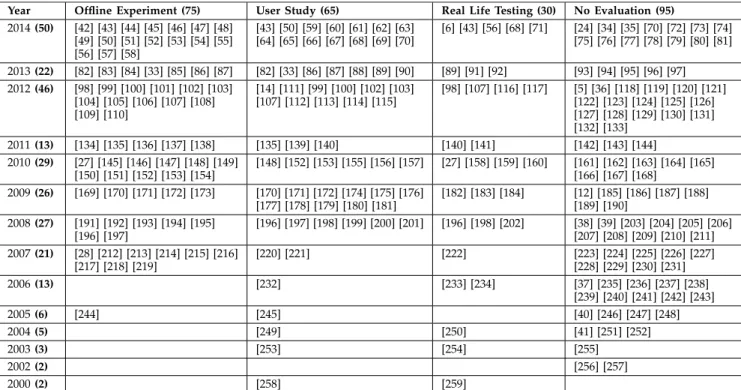
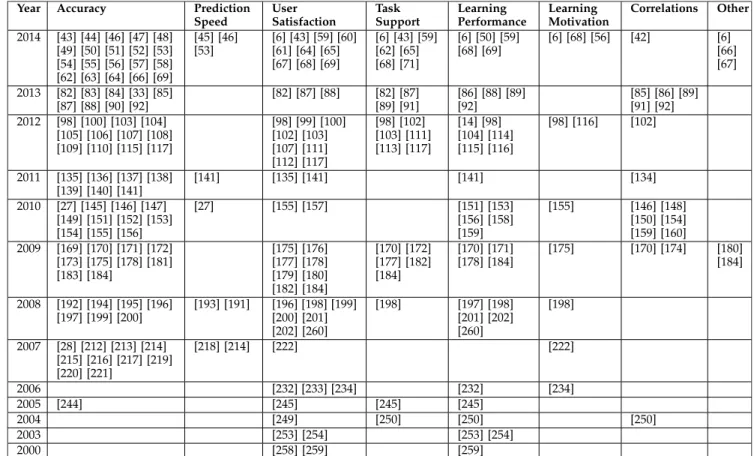
Table 1 gives an overview of the 235 publications classified
according to type of evaluation methodology: offline
TABLE 1
experiments (75 publications—whereby 68 were performed
on historical datasets and seven on synthetic datasets), user
studies (65), real life testing (30), or as having no evaluation
(95). Some short papers did propose evaluation scenarios
but then referred to future work for evaluation results, e.g.
[34], [35], [36], [37]. Functional testing of prototypes, as
per-formed e.g. in [38], [39], [40] and [41] were not considered
as an evaluation of the recommender system.
Some publications covered several evaluation methods,
for example, an offline experiment and a complementary
user study in [82]. Here the results from an offline
experi-ment evaluating the accuracy of the recommender
algo-rithm are compared with the user satisfaction evaluated in a
user study. The findings confirm the claim [17] that for
rec-ommender systems, the high accuracy measured by metrics
such as precision and recall in offline experiments, does not
correlate to a high quality in user experience. This is also an
argument in favor of making the distinction between
evalu-ating just the algorithm or the entire recommender system.
Another example can be found in [135], where the accuracy
of an algorithm is first evaluated in an offline experiment
and then two user studies follow to evaluate the user
percep-tion and usability of the recommender system. Some
evalua-tions have real life tests followed by user studies or offline
experiments. For example, a real life test is conducted in
[140] to measure the performance of the recommender
sys-tem and to generate a dataset, with a subsequent user study
with experts to validate the recommendations. In [27], a real
life pilot test was run over eight weeks in order to evaluate
the teacher’s perceived usefulness and quality of the learning
resources recommended as well as to collect a multi-attribute
dataset for an offline evaluation. Other evaluations conduct a
user study and afterwards analyse the data collected, e.g. in
[170], two user studies are complemented with a log data
analysis, and similarly in [86] and [148] the usage logs
col-lected in a small preliminary user experiment are afterwards
analysed in an offline experiment.
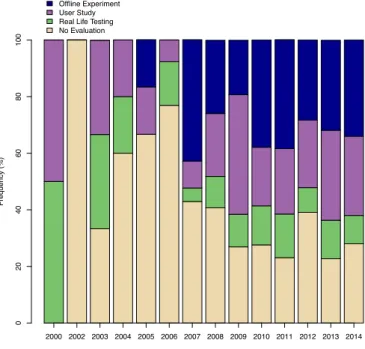
The survey shows that the evaluation of TEL
recom-mender systems has become increasingly important over
the years. Excluding the years 2000-2005, with a very low
number of publications, the number of publications without
an evaluation has decreased substantially, from 77 percent
in 2006 to 28 percent in 2014. Fig. 1 shows the percentage
distribution of evaluation methods over the years. It is also
interesting to note that the distribution of the different
eval-uation methods has remained relatively stable over the last
six years with an average of 32 percent offline experiments,
28 percent user studies, 12 percent real life testing, and
28 percent with no evaluation reported.
5.1.1
Offline Experiments
The survey revealed that the number of offline experiments
remained steady over the years since 2007. Most
experi-ments were executed on historical datasets, for example on
MERLOT
14[44], [46], [108], [146], or MACE
15[54], [83], [85],
[134] and Ariadne
16[101]. Historical TEL datasets that fulfill
all requirements for an evaluation are however hard to find
[27]. An early solution to this problem was to create
syn-thetic datasets and use these for evaluating TEL
recom-mender systems as in [28], [51], [109], [150], [194], [214],
[216] and proposed in [208]. Since then, attempts have been
made to generate datasets for TEL, for example in [27]
where a dataset is generated from a real life testing
evalua-tion. Several offline experiments compared evaluation
results to a baseline [49], [54], [56], [58], [83], [106], [147],
[171], [212].
5.1.2
User Studies
Table 2 gives an overview of methods reported as having
been applied in user studies. Questionnaires were used
most often. Some studies involved experts, either by giving
them questionnaires [139] or by interviewing them [67].
Some did not ask the participants direct questions but rather
observed their interaction with the system [67], [89]. Others
measured the learner’s knowledge before and after an
experiment with pre- and post-tests [88]. Fig. 2 shows the
distribution of the number of participants in user studies
over the years. Each dot depicts a single user study. Only 41
user studies (in 30 publications) reported the actual number
of participants. When several user studies are reported in
one publication, the individual number of participants per
experiment is shown, e.g. in [14] two user studies are
per-formed, one with 121 and the other with 89 participants;
and in [253] three studies with 15, 63 and 375 participants.
The number of participants ranged between 2 to 375. On
average 53 participants took part in a single user study. The
median however is 25 as only a few studies had a lot of
par-ticipants, e.g. 158 in [249]; 159 and 314 in [66]; and 375 in
[253]. The mode is 24 in four user studies.
5.1.3
Real Life Testing
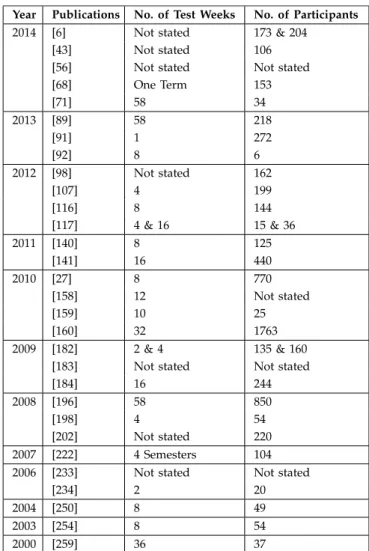
According to the publications surveyed, real life testing
often takes place using a prototype implementation of the
Fig. 1. Evaluation methodologies (percentages per year).14. http://www.merlot.org, retrieved 20.05.2015 15. http://www.mace-project.eu, retrieved 20.05.2015 16. http://www.ariadne-eu.org, retrieved 20.05.2015
recommender system, sometimes as part of a project
deliv-erable [158], [183]. Publications having a real life testing
evaluation are shown in Table 3.
In three publications more than one real life testing
sce-nario was performed [6], [117], [182]. In most real life tests,
the whole recommender system was evaluated implicitly
including the recommender algorithm. The testing periods
lasted about 17 weeks on average and the number of
partici-pants were on average higher than for user studies, the
highest count being 1,763 participants over a 32 week period
[160] and the lowest six employees who used the system
over an eight week period [92]. Some publications stated
specific evaluation goals and reported concrete evaluation
results such as in [141], whilst in others, the reports on
real-life evaluations were very vague, no concrete evaluation
results were stated, neither the number of participants, nor
the duration of the testing were mentioned [56], [183], [233].
5.2
Subject of Evaluation
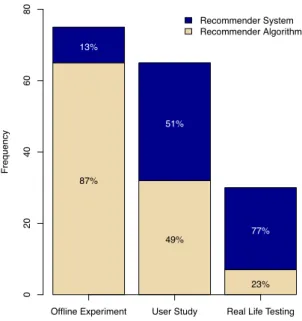
A distribution of the subject of evaluation across evaluation
methodologies is shown in Fig. 3 and over the years in
Table 4. As expected, offline experiments are mainly used to
evaluate the recommender algorithm (87 percent). This
seems to be obvious since in offline experiments, different
algorithms or parameters of algorithms can be examined
comparatively with a low amount of effort. Contrary to this,
in real life testing, the recommender system is normally the
focus of the evaluation (77 percent). Interestingly, in user
studies, it seems the evaluation focus is nearly as often on
the recommender algorithm (49 percent) as it is on the
rec-ommender system (51 percent). In some publications, for
example in [64], [92], [107], [140], [141], [155] and [212], it
was explicitly mentioned that the recommender algorithm
was evaluated separately in addition to the overall
TABLE 2
Methods Applied in User Studies
Fig. 2. Number of participants in user studies per year.
TABLE 3
evaluation of the recommender system usually as two
dis-tinct phases of the evaluation. In [107] a multi-staged
evalu-ation
was
conducted
where
all
three
evaluation
methodologies were covered. In the first stage, an offline
experiment (a cross-validation) was executed to measure
the accuracy (precision and recall) of the recommender
algorithm. In the second stage, a user study (an expert
ques-tionnaire) was conducted with four experts evaluating the
recommendations with regards to pedagogical aspects. The
third stage was a real life testing to evaluate the user
satis-faction with the system, here explicit feedback and click
behaviour were monitored and log files analysed.
5.3
Effects Measured by Evaluation
An overview of the effects measured by the evaluations in
the survey are shown in Table 5. One can see that accuracy
and user satisfaction are the most common effects measured
followed by learning performance, task support,
correla-tions, learning motivation, prediction speed and other
rarely measured effects. Fig. 4 shows that in recent years the
different types of effects measured have increased and
become more varied. Accuracy is measured steadily often
from 2007 to 2014, matching the number of offline
experi-ments conducted in these years in Fig. 1. The two
user-cen-tric effects, user satisfaction and task support, are measured
steadily often over the years. The effects on learning,
learn-ing performance and learnlearn-ing motivation, are investigated
increasingly often over the years, but only to a relatively
small extent compared to the other effects measured such as
accuracy. This is certainly due to the corresponding
com-plexity of user studies and especially real life testing.
Fig. 5 shows the effects measured across the evaluation
methodologies. User studies and real life testing cover
nearly all effects measured. For example, a user study in
[64] is performed to measure the accuracy of the
recom-mender algorithm as well as the usability of the whole
rec-ommender system. In contrast, offline experiments are
mainly used to measure accuracy and prediction speed, but,
surprisingly also learning performance. For example, in
[151], where a student’s performance is measured by a
binary state (0 if the student was not able to perform the
task correctly and 1 otherwise) and in [104] where the time
estimates for the learner to complete a task is taken as an
indication of learning performance. Some publications
report multiple effects being measured by different
evalua-tion methodologies. For example, in [153], the data collected
in a user study, where the learning performance of the
par-ticipants are measured with pre- and post-tests, is used later
to assess the algorithm’s accuracy, thereby utilizing so
called
good learners’ ratings
.
In the following, representative examples from the
sur-vey are given, describing how and with which tools and
metrics the various effects were measured.
Accuracy.
Metrics used to measure accuracy were for
example, precision, recall and f-measure in [82] and
[83]; Mean Average Error (MAE) in [27] and [83];
and Root-mean-square-error (RMSE) in [136] and
[151]. In user studies, for example in [64] and [65],
the perceived relevance of the recommendations
was measured by asking the users to rate the
recom-mendations received. As measuring the accuracy of
a recommender algorithm is not easily decoupled
from the impact of the usability of the system as a
whole, a usability test was performed as well in [64].
Prediction speed.
The prediction speed of the
recom-mender algorithm was measured in [27], [141]
and [191].
User satisfaction.
The user’s satisfaction with the
sys-tem was measured in [178] and [200], as well as the
user’s perceived usefulness of the recommendations
TABLE 4
Subject of Evaluation
in [201]. The benefits of the system with respect to
learning and enjoyment were measured in [177],
and the ease of use for both students and teachers in
[88]. Evaluation tools used were: the Technology
Acceptance Model (TAM) [261] in [88]; the System
Usability Scale (SUS) [262] in [6] and [64]; the
Gen-eral Interest Structure Test (AIST) [263] in [180];
interviews in [178]; observations in [179] and [200];
recording participants’ interactions and collecting
think aloud protocols in [5].
Task support.
Learners were supported in
achiev-ing their current learnachiev-ing goals in [170] and
[177], as well as to accomplish their learning or
TABLE 5
Effects Measured
authoring tasks in [5]. The effectiveness and
appli-cability of the recommendations in supporting
learning tasks were also measured in [82]. The
impact of recommendations on learners were
ana-lysed by observing the learner’s interactions via
system logs in [6].
Learning performance.
The perceived effectiveness
of learning using the recommender system was
measured in [232]. The learner’s achievements and
scores in tests were measured in [6], [86] and [88].
It was also measured if students using a
recom-mender system achieve better results than students
receiving random or no recommendations in [156].
The learner’s reading frequency per post, the
learner’s replying and posting frequency were
mea-sured in [116], as well as the frequency with which a
learning activity was executed in [170]. Tools used
were: pre-knowledge and post-tests in [6], [156] and
[232], assignment grades in [86], and usage log
analysis in [6], [86] and [170]. Learning styles
were measured in [201] and [232], and using the
Felder-Soloman Index of Learning Styles (ILS)
questionnaire [264] in [141]. Knowledge levels were
measured using self- and peer-assessments and
applying Knowledge Indicating Events (KIE) in [92].
Learning motivation.
was measured using a learning
motivation questionnaire, e.g. Motivated Strategies
for Learning Questionnaire (MSLQ) [18] in [155] and
the learner’s engagement in terms of their connection
behaviour in [6].
Correlations.
were measured for example between the
rank position of a learning goal and the frequency
with which a learning activity was executed in [170].
Metrics used were for example: Pearson correlation
in [85] and Kendall’s Tau correlation in [146].
Other.
Very few other effects were measured. The
novelty and diversity of learning resources
recom-mended were measured with a crowdsourcing
experiment in [66], the variety of learning paths in
[184], creativity and competence preferences in [180],
and emotions in [6] and [67].
6
DISCUSSION AND
CONCLUSION
From the results of the survey, the evaluation of TEL
recom-mender systems viewed as early as 2000 up till 2014, has
undergone various changes. The number of publications
reporting on TEL recommender systems has increased, as
well as those reporting on their evaluations. The different
effects measured have become more numerous and diverse.
The type of evaluation methodology applied has also
evolved over time to a mixture of all three types identified in
this survey. These findings suggest that there is a growing
awareness of the necessity for elaborate evaluations in the
research community. At the same time, there is substantial
potential for further improvements. Selected indicators from
the survey show this. About 42 percent of the publications
surveyed had no evaluation. The number of participants in
user studies has remained rather low over the years.
Learn-ing related measures are insufficiently considered in most of
the evaluations. On a qualitative level, it has to be mentioned
that from those publications having an evaluation, only few
stated a clear evaluation focus. The evaluation goals were
not always clearly defined and the scope of the evaluations
were often much too wide. The form in which evaluation
goals, methods and results are reported in TEL research
pub-lications needs to be improved.
Regarding evaluation methodologies, on the one hand,
offline experiments that are fast and easy to conduct, are
limited by the fact that TEL datasets fulfilling all necessary
requirements are not always available. The dataTEL
initia-tive extensively looked into issues regarding collecting
shar-able datasets for TEL and proposed some guidelines on how
best to accomplish this [265]. A framework for analysing
TEL datasets has been proposed, existing TEL datasets have
been identified and analysed in detail [3], [23] and even
applied to effectively evaluate and compare several
recom-mender systems [21]. Additionally, a survey of linked data
and social data as a source of datasets for evaluating TEL
recommender systems has been investigated [24].
Remain-ing open challenges are privacy, quality and legal issues
surrounding this type of data, as well as the issues of
inter-operability and integration of data across different systems
with no common schema and vocabularies [24]. Recently,
MOOCs (Massive Open Online Courses)
[266] have become
very popular and have been used to provide a source of
his-torical datasets for offline evaluations, for example from the
popular MOOC Coursera
17which provided a dataset used
to evaluate a question recommender for TEL [58]. A further
limitation of offline experiments is that a high prediction
accuracy does not always correlate with high user
satisfac-tion [16], [17], [82]. Presently, the most often measured
eval-uation criteria are precision and accuracy [3]. The survey
confirms this is also true for the evaluation of TEL
recom-mender systems. There are however many other important
user-centric properties that should be considered such as
novelty, diversity, privacy and serendipity [15], [16] as
explained in Section 2. However in the results of the survey,
these effects were rarely reported as being explicitly
evalu-ated. On the other hand, user studies that could measure
these user-centric properties face the challenges of high
exe-cution costs and having limited access to sufficient
partici-pants. From the survey, on average, about 50 participants
take part in a single user study and user studies are hardly
repeated in order to confirm results [15]. Therefore
alterna-tive approaches to evaluate recommender systems such as
crowdsourcing should be taken into consideration where
sufficient participants are recruited online via
crowdsourc-ing platforms [57], [66], [90], [267].
There is some evidence that there are still many
chal-lenges facing the evaluation of recommender systems for
TEL [5]. Evaluating recommender systems is a
compli-cated process and complex research questions need to be
broken down into smaller and more measurable
sub-questions. Approaches to do this exist such as using the
layered evaluation approach
[4], [268], [269] which
decom-poses a recommender system into its integral components
and each of these components is evaluated separately
applying appropriate evaluation methods and metrics. It
thereby provides developers and researchers with more
detailed evaluation results which could be used to
improve the recommender system [4]. The layered
evalu-ation approach has been applied to evaluate
recom-mender systems for TEL [4], [158]. Improvements can
however be made in the decomposition of the
recom-mender system into its individual components and by
defining practical guidelines to map which recommender
system component can be best evaluated with which
method and which metric. An overall result of the
evalua-tions of the different components needs also to be made
in order to be able to analyse the individual results and
make concrete trade-off decisions to benefit the system as
a whole [78]. The evaluation of recommender systems for
TEL should no longer be seen as a
summative
or final
assessment of the system, but should rather be integrated
already in the requirements, design and implementation
stages of their development aiming for a more
formative
type of evaluation [270]. The user should be placed in the
centre of the development process as proposed in [6],
where user centred design methods are applied along the
entire e-learning life cycle including both the design and
evaluation of recommender systems for TEL.
There is also the need to standardise the evaluation
pro-cess in order to be able to compare the evaluation results
between TEL recommender systems. An evaluation
frame-work for comparing TEL tools and systems in data
competi-tions has been developed [271]. Although the framework
does not specifically focus on recommender systems, it gives
a good insight into the specific issues and evaluation criteria
to be considered when evaluating TEL systems in general.
These could be applied to the domain of TEL recommender
systems. Finally, the evaluation of TEL recommender
sys-tems needs to be a joint effort between computer scientists
and experts from other domains like pedagogics and
psy-chology [6]. The evaluation of TEL recommender systems
needs to focus more on the impact of the recommendations
during learning. As yet, little is known about the way
learn-ers perceive and react to recommendations [2]. Therefore,
more real life testing of TEL recommender systems over a
longer period of time is needed, where the effect of the
recommender system on learners, their acceptance and
usage of the recommendations can be measured [3]. As
shown in [6], MOOCs provide an opportunity for conducting
real life testing of TEL recommender systems with a large
number of learners and over a long period of time.
REFERENCES
[1] N. Manouselis, H. Drachsler, R. Vuorikari, H. Hummel, and R. Koper, “Recommender systems in technology enhanced learning,” in Recommender Systems Handbook. New York, NY, USA: Springer, 2011, ch. 12, pp. 387–415.
[2] J. Buder and C. Schwind, “Learning with personalized recom-mender systems: A psychological view,”Comput. Human Behav-ior, vol. 28, no. 1, pp. 207–216, 2012.
[3] N. Manouselis, H. Drachsler, K. Verbert, and E. Duval, Recom-mender Systems for Learning. New York, NY, USA: Springer, 2013. [4] N. Manouselis, C. Karagiannidis, and D. G. Sampson, “Layered
evaluation in recommender systems: A retrospective asses-sment,”J. e-Learn. Knowl. Society, vol. 10, no. 1, pp. 11–31, 2014. [5] K. Verbert, N. Manouselis, X. Ochoa, M. Wolpers, H. Drachsler, I.
Bosnic, and E. Duval, “Context-Aware recommender systems for learning: A survey and future challenges,” IEEE Trans. Learn. Technol., vol. 5, no. 4, pp. 318–335, Oct.-Dec. 2012.
[6] O. C. Santos, J. G. Boticario, and D. Perez-Marın, “Extending Web-based educational systems with personalised support through user centred designed recommendations along the e-learning life cycle,”Sci. Comput. Programm., vol. 88, pp. 92–109, Aug. 2014.
[7] D. Jannach, M. Zanker, A. Felfernig, and G. Friedrich, Recom-mender Systems: An Introduction. Cambridge, U.K.: Cambridge Univ. Press, 2010.
[8] G. Adomavicius and A. Tuzhilin, “Toward the next generation of recommender systems: A survey of the state-of-the-art and possi-ble extensions,” IEEE Trans. Knowl. Data Eng., vol. 17, no. 6, pp. 734–749, Jun. 2005.
[9] H. Drachsler, K. Verbert, O. Santos, and N. Manouselis, “Panorama of recommender systems to support learning,” in
Recommender Systems Handbook, 2nd ed. New York, NY, USA: Springer, 2015.
[10] G. McCalla, “The ecological approach to the design of e-learning environments: Purpose-based capture and use of information about learners,” J. Interactive Media Edu., vol. 2004, no. 1, pp. Art–3, 2004.
[11] N. Manouselis, H. Drachsler, K. Verbert, and O. C. Santos,
Recommender Systems for Technology Enhanced Learning: Research Trends and Applications. New York, NY, USA: Springer, 2014. [12] H. Drachsler, H. Hummel, and R. Koper, “Identifying the goal, user
model and conditions of recommender systems for formal and informal learning,”J. Digit. Inform., vol. 10, no. 2, pp. 4–24, 2009. [13] L. S. Vygotsky,Mind in Society. Cambridge, MA, USA: Harvard
Univ. Press, 1978.
[14] C. Schwind, J. Buder, U. Cress, and F. W. Hesse, “Preference-inconsistent recommendations: An effective approach for reduc-ing confirmation bias and stimulatreduc-ing divergent thinkreduc-ing?”
Comput. Edu., vol. 58, no. 2, pp. 787–796, 2012.
[15] G. Shani and A. Gunawardana, “Evaluating recommendation systems,” in Recommender Systems Handbook. New York, NY, USA: Springer, 2011, ch. 8, pp. 257–297.
[16] S. M. McNee, J. Riedl, and J. A. Konstan, “Being accurate is not enough: how accuracy metrics have hurt recommender sys-tems,” inProc. Extended Abstracts Human Factors Comput. Syst., 2006, pp. 1097–1101.
[17] P. Pu, L. Chen, and R. Hu, “A user-centric evaluation framework for recommender systems,” inProc. 5th ACM Conf. Recommender Syst., 2011, pp. 157–164.
[18] P. R. Pintrich and E. V. De Groot, “Motivational and self-regu-lated learning components of classroom academic performance,”
J. Edu. Psychol., vol. 82, no. 1, p. 33, 1990.
[19] J. L. Herlocker, J. A. Konstan, L. G. Terveen, and J. T. Riedl, “Evaluating collaborative filtering recommender systems,”ACM Trans. Inform. Syst., vol. 22, no. 1, pp. 5–53, 2004.
[20] S. Baluja, R. Seth, D. Sivakumar, Y. Jing, J. Yagnik, S. Kumar, D. Ravichandran, and M. Aly, “Video suggestion and discovery for youtube: taking random walks through the view graph,” inProc. 17th Int. Conf. World Wide Web, 2008, pp. 895–904.
[21] K. Verbert, H. Drachsler, N. Manouselis, M. Wolpers, R. Vuorikari, and E. Duval, “Dataset-driven research for improving recommender systems for learning,” inProc. 1st Int. Conf. Learn. Analytics Knowl., 2011, pp. 44–53.
[22] P. Refaeilzadeh, L. Tang, and H. Liu, “Cross-validation,” in Ency-clopedia of Database Systems. New York, NY, USA: Springer, 2009, pp. 532–538.
[23] K. Verbert, N. Manouselis, H. Drachsler, and E. Duval, “Dataset-driven research to support learning and knowledge analytics,” inEdu. Technol. Soc., vol. 15, no. 3, pp. 133–148, 2012.
[24] S. Dietze, H. Drachsler, and D. Giordano, “A survey on linked data and the social web as facilitators for tel recommender sys-tems,” in Recommender Systems for Technology Enhanced Learning. New York, NY, USA: Springer, 2014, pp. 47–75. [25] B. P. Knijnenburg, “Conducting user experiments in
recom-mender systems,” in Proc. 6th ACM Conf. Recommender Syst., 2012, pp. 3–4.
[26] M. Gollwitzer and R. S. J€ager,Evaluation Kompakt, 2nd ed., ser. Beltz Kompakt. Beltz GmbH, Julius, 2009.
[27] N. Manouselis, R. Vuorikari, and F. V. Assche, “Collaborative rec-ommendation of e-learning resources: An experimental inves-tigation,”J. Comput. Assisted Learn., vol. 26, no. 4, pp. 227–242, 2010. [28] N. Manouselis and C. Costopoulou, “Experimental analysis of design choices in multiattribute utility collaborative filtering,”