THESIS FOR THE DEGREE OF LICENTIATE OF ENGINEERING MACHINE AND VEHICLE SYSTEMS GRADUATE SCHOOL
Modelling driver behaviour in run-off-road crashes:
Applications in safety system development and safety benefit
estimation
DANIEL NILSSON
Department of Mechanics and Maritime Sciences CHALMERS UNIVERSITY OF TECHNOLOGY
Modelling driver behaviour in run-off-road crashes: Applications in safety system development and safety benefit estimation
DANIEL NILSSON
© DANIEL NILSSON, 2017
THESIS FOR LICENTIATE OF ENGINEERING no 2017:12 Department of Mechanics and Maritime Sciences
Vehicle Safety Division
Chalmers University of Technology SE-412 96 Gothenburg, Sweden Telephone + 46 (0)31-772 1000
Chalmers Reproservice Gothenburg, Sweden 2017
I
And there is no map, and a compass wouldn’t help at all
III
Modelling driver behaviour in run-off-road crashes:
Applications in safety system development and safety benefit estimation DANIEL NILSSON
Department of Mechanics and Maritime Sciences Vehicle Safety Division
Chalmers University of Technology
Abstract
Run-off-road crashes have been identified as a major concern for automobile safety and several advanced driver assistance systems (ADASs) targeting run-off-road crashes are on the market today. Assessment of ADASs require relevant test scenarios and valid computational models of driver behaviour. Therefore, the objectives of this thesis has been: (A) define run-off-road test scenarios, and (B) identify a conceptual framework suitable for modelling relevant behavioural mechanisms for crash causation.
Cluster analysis was applied to run-off-road crashes from representative in-depth crash data from the German GIDAS database. Nine different clusters were identified, forming a basis for test scenarios. The two largest clusters included crashes relevant for current lane support ADASs (i.e. drift during daytime/night-time), while other clusters suggested that drivers may need support in judging the physical limits of the vehicle (e.g. on snowy rural roads). However, a need for more detailed driver behaviour data was identified. Indeed, naturalistic data, which include more information about driver behaviour in critical situations, may help the definition of test scenarios by linking them to the behavioural mechanisms contributing to the crash causation.
This thesis also shows that modelling of driver behaviour may be supported by a framework based on new findings in contemporary neurocognitive science and, specifically, on predictive processing. This new framework improved the interpretation of the clusters and facilitated the formulation of plausible behavioural mechanisms leading to run-off-road crashes.
Keywords: run-off-road crashes; advanced driver assistance systems; driver behaviour; predictive processing; effectiveness assessment; cluster analysis
V
Acknowledgements
First and foremost, I would like to express my gratitude towards my supervisors (both current and former) for their valuable support and contributions: to Marco, for structure and direction; to Trent, for visions and perspectives; to Johan, for knowledge and the value of theory; and to all of them, for persistence and forbearance. I am also grateful for the presence of Gustav and Ola, upon whose shoulders I stand.
I would also like to thank my wonderful colleagues at Volvo Cars: all of 91440, for valuable feedback and Friday afternoons; Magda, for constantly reminding me about the excitement in our work; Malin, for your support and structure; and the rest of you, for whenever you were there when needed. Neither last, nor least, I am forever thankful for my fellow colleagues at SAFER; I cannot mention you all, but I will mention Christian-Nils and Alberto, for sharing the experience. And Morgan.
And to a few, for spiritual support. To my family, for being there. Whenever. Wherever. To my parents; forgive when I forget. To my wonderful sister and my brother, the eternal sunshine. To those who catch me when I fall. Och till dig, Moa. För att du fanns där, även när du inte fanns här.
The research work was carried out jointly at the Accident Prevention group at the Division of Vehicle Safety, Department of Mechanics and Maritime Sciences, Chalmers University of Technology, and at the Active Safety Analysis and Verification group, Volvo Cars Safety Centre, Volvo Car Group. The work was conducted at SAFER within the QUADRÆ project, sponsored by FFI/Vinnova (grant number 2015-04863).
VI
Table of Contents
Abstract ... III Acknowledgements ... V 1 Background ... 1 1.1 Effectiveness assessment during development and evaluation of run-off-road crash countermeasures using virtual simulation ... 2 1.2 Virtual simulation for safety benefit estimation requires relevant test scenarios ... 4 1.3 The state and intended role of the driver influences the effectiveness of run-off-road crash countermeasures ... 5 1.4 Virtual simulation requires computational models of driver behaviour representative of targeted test scenarios ... 7 1.5 There is a need for more specific explanations of driver behaviour in run-off-road crashes ... 8 2 Objectives ... 10 3 Defining test scenarios relevant for development and evaluation of ADASs targeting run-off-road crashes ... 13
3.1 Beyond our best understanding of conflict situations ... 13 3.2 Cluster analysis provides a data-driven approach to defining test scenarios ... 14 3.3 Care should be taken when selecting cluster analysis method .... 16 4 A conceptual framework for automobile driving and the predictive processing account of lateral control... 19
4.1 Active inference: infer the state of the world through predicted sensory stimuli, and act to realise predictions ... 19 4.2 A predictive processing account of lateral control in automobile driving ... 21
4.2.1 Satisficing control as an optimising strategy ... 22 4.2.2 Gaze target selection should minimise overall uncertainties about predictions ... 23 4.2.3 False certainty in the perception-action cycle dictates driver behaviour in rare events... 23
VII
4.3 Summary ... 24
5 Summary of papers ... 25
Paper I. Definition of run-off-road crash clusters—for safety benefit estimation and driver assistance development ... 26
Paper II. Great expectations: a predictive processing account of automobile driving ... 28
Introduction ... 28
6 Discussion ... 31
6.1 Test scenarios based on cluster analysis: exploratory but limited and purpose-specific ... 31
6.2 The use of a conceptual framework in analysis of crash data and for explanations of driver behaviour ... 32
6.3 Implications for development and effectiveness assessment of ADASs targeting run-off-road crashes ... 34
7 Conclusions ... 37
8 Future work ... 39
1
1
Background
Safe mobility—to move unharmed between the current position and a desired destination—is at the very core of human activities. Yet, 6 million crashes involving light vehicles were reported by the police during 2003—in the US alone. These crashes consisted mainly of rear-end crashes (29%), run-off-road crashes (22%), and lane-change crashes (9%) (Najm & Smith, 2007). While exact definitions of crash types vary within the literature, it is clear that run-off-road crashes—where the vehicle inadvertently departs from the roadway and collides with an off-road object, rolls over or otherwise suffers a breakdown—pose a serious societal challenge. In a study of four US crash databases, it was found that single-vehicle crashes with a road departure involved 10 percent of the occupants, but accounted for 31 percent of the fatalities. Together with single vehicle crashes with control loss (with an unknown fraction leading to a road departure), these two crash types accounted for 42 percent of fatalities (Kusano & Gabler, 2014). In a study of insurance claims for crashes in Germany, 29 percent of all insurance claims for crashes concerned crashes resulting from a lane departure. Out of these, 22 percent (6.3% of total insurance claims) were due to a road departure (Kuehn, Hummel, & Bende, 2009). Also in Sweden, crashes resulting from lane departures are of high importance, accounting for 49 out of 154 car occupant fatalities in 2010 (Strandroth, 2015). Regardless of the exact definition, effective countermeasures addressing run-off-road crashes should be devised, evaluated, and deployed.
In the context of automobile development, countermeasures that try to avoid collisions or reduce severity of impacts by actuating vehicle systems preemptively are typically referred to as active safety (Eskandarian, 2012, p. 9), or synonymously as advanced driver assistance systems (ADASs) (Winner, 2016). Over the last decades, there has been a clear increase both in prevalence and in capabilities of active safety technologies. In particular, there has been an increase in ADASs that uses a multitude of sensors in order to detect potential threats and urgent conflict situations. This is done using e.g. camera-based computer vision, LIDAR, and RADAR systems, that enables environmental mapping and vehicle positioning (Lundquist, Schön, & Gustafsson, 2012), or sensors measuring current vehicular states such as steering wheel angle or wheel slip (Mörbe, 2016). An ever-growing subset of ADASs are designed to address run-off-road crashes by supporting the driver in the monitoring and control aspects of lane keeping and to initiate
2
warnings or interventions in order to resolve the situation before it evolves into a crash. These systems can be classified as lane support systems (LSS). LSS currently include lane departure warning (LDW) systems, and lane keeping assist (LKA) systems (Euro NCAP, 2015). In addition, emerging countermeasures include always-on emergency LKA (ELK) systems that target drift events towards road edge or into oncoming or overtaking traffic (Euro NCAP, 2017). LDW systems support the driver’s monitoring task by issuing a warning when the vehicle is about to depart from the lane, relying on the driver to initiate corrective steering manoeuvres in order to avoid a road departure. LKA systems, on the other hand, support the driver in the control part of the lane keeping task by providing lateral control interventions (automatic heading corrections) when an imminent lane departure is detected (Bartels, Rohlfs, Hamel, Saust, & Klauske, 2016). Warning strategies for LDW may include tactile (e.g. vibrations in steering wheel or seat), auditory (e.g. beep sound or rumble strip imitation), and/or visual (e.g. heads-up display lights) modalities (Gayko, 2012). The most commonly used actuation strategy for the LKA functionality has been a system-generated steering wheel torque, either in a loose fashion engaging close to lane markings or road edge, or in a lane-centring manner (Gayko, 2012), but other actuation strategies for steering assist are possible, for example using single-sided braking or torque vectoring (Bartels et al., 2016, p. 1224; Dang et al., 2012). Recently, more advanced features have also emerged on the market that, when active, continuously detects the forward roadway and automatically tries to position the vehicle within the lane by proactive steering interventions1. It is clear is that there are many different
run-off-road countermeasure strategies that are based on supporting the driver in the driving task. For ongoing and future work to improve traffic safety, it is important to understand the effectiveness of these systems, and what crash-relevant situations current and future systems are able to address, as well as the situations that remain to be addressed by future systems.
1.1
Effectiveness assessment during development and evaluation of
run-off-road crash countermeasures using virtual simulation
Naturally, the degree to which ADASs are able to prevent road departures is a topic of high interest, both to vehicle manufacturers (wanting to improve their systems), to rating organisations (wanting to recommend specific1 For example Volvo’s Pilot Assist, Mercedes-Benz’s Active Steering Assist,
3
cars/systems to customers concerned with safety), and to policy makers (wanting to know if a system should be made a legal requirement in new cars). The answer to this question can be estimated in early stages of development or deployment, without having to resort to retrospective analysis, by the use of prospective effectiveness methods. Methods for prospective effectiveness assessment aim to evaluate future and current systems, prior to market introduction, and are typically quantified in terms of the estimated safety benefit. The safety benefit is generally defined as the reduction in fatalities or injuries—for a given market penetration of an ADAS—as compared to a baseline where no system is present (Alvarez et al., 2017).
In the P.E.A.R.S. (Prospective Effectiveness Assessment for Road Safety) initiative, data on methodological approaches to prospective safety benefit estimation have been gathered from over 30 (mainly European) organisations—ranging from car manufacturers and insurance companies to research institutes and universities—in an effort to harmonise prospective effectiveness assessments among different stakeholders (Alvarez et al., 2017; Page et al., 2015). Virtual simulation was chosen as the basis for a harmonised general approach to effectiveness assessment and safety benefit estimation within the initiative (Page et al., 2015, p. 7). Virtual simulation has emerged as a promising method for safety benefit estimation, capable of evaluating system effectiveness in a large number of cases, while offering flexibility, reproducibility, and experimental control (Alvarez et al., 2017, p. 3). It constitutes a model-based approach that typically takes the form of counterfactual simulations—sometimes referred to as “what if”-simulations— that try to answer the question: could a (specific) crash have been avoided or mitigated, had the vehicle been equipped with a specific ADAS? (Alvarez et al., 2017; Bärgman, Boda, & Dozza, 2017; Bärgman, Lisovskaja, Victor, Flannagan, & Dozza, 2015; McLaughlin, Hankey, & Dingus, 2008; Scanlon, Kusano, Sherony, & Gabler, 2015). By simulating the same situation both with and without an ADAS, the results can be compared and the impact of the system can be assessed. Safety benefit estimation thus consists of simulating a target crash population—the baseline situations, consisting of either specific real-world crashes or synthesised crashes—in a counterfactual manner to assess the effectiveness of the ADAS in that crash population (Alvarez et al., 2017). However, the validity of a safety benefit estimation based on virtual simulation depends on the extent to which the input data is representative for the real-world crash scenarios, and the validity of the
4
models used in the simulation process. In particular, Bärgman et al. (2017) showed how safety benefits for ADAS strongly depend on the driver model used in the counterfactual simulation and the potential of naturalistic data to support such simulations both in terms of test scenarios and to develop accurate driver models.
1.2
Virtual simulation for safety benefit estimation requires relevant
test scenarios
While virtual simulation for ADAS evaluation can be done for multiple purposes, simulations are most commonly done with the objective to estimate the safety benefit of the system, based on comparisons between results from simulation conditions with and without the system (Alvarez et al., 2017; Markkula, 2015). However, as indicated above, a mapping is required between the simulated baseline situations and the targeted real-world crash situations in order to assure validity between the simulation results and the potential real-world safety benefit. This issue is typically addressed by basing the baseline situations on test scenarios that are representative of, or has a known relation to, a relevant real-world crash population of interest (Alvarez et al., 2017; Page et al., 2015). In addition, computational and analytical efforts can be saved by defining the test scenarios in a way that ensures that the system has some sort of impact in the simulated situations (Page et al., 2015, p. 4). Within the P.E.A.R.S. initiative, three2 general strategies to obtain baseline situations (or reference
situations) for simulation were identified, hierarchically categorised by the involvement of simulation in the scenario generation process (Alvarez et al., 2017):
1. At the first level, baseline situations are generated by directly selecting reconstructed crashes from crash databases.
2. At the second level, baseline situations are generated through simulation, for example by using marginal distributions from real-world crashes to generate synthetic scenarios through Monte-Carlo simulations.
3. At the third level, a large number of situations—based on processes and contributing factors identified in real-world crashes—are simulated in a Monte-Carlo fashion, in order to generate a small(er)
2 The zeroth level is excluded here, as it only consists of a crude effectiveness
assessment of the system based on expert assessments of the test scenarios, and no simulation is used.
5
number of crashes. Baseline situations are then based on these crashes, rather than on (statistical representations of) real-world crashes directly, as in the previous methods.
At all three levels, the initial step—before the baseline situations are established—is to identify the relevant set of test scenarios through analysis of crash databases. While the P.E.A.R.S. initiative identified the urgent need for sound input data “in terms of quality, representativeness, scalability, and real-world relevance” (Page et al., 2015, p. 4) in order to identify a relevant basis for test scenarios, a process for test scenario identification has not been thoroughly outlined. A relevant question for anyone who would like to enable safety benefit estimation of ADASs using virtual simulation is then: how should run-off-road test scenarios be defined to ensure relevance? The term relevance should be understood both in terms of relevance to real-world crash populations, (representativeness), and in terms of relevance for ADAS development and evaluation.
1.3
The state and intended role of the driver influences the
effectiveness of run-off-road crash countermeasures
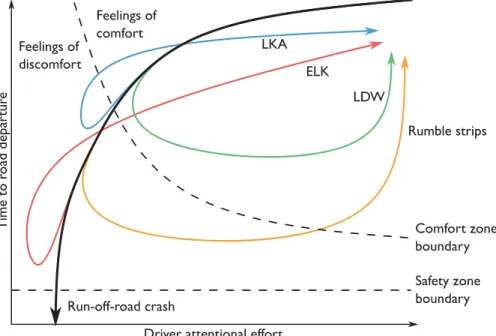
Notably, the effectiveness of a system is not only a function of the system itself, but of the cooperative effort of the vehicle (including the ADAS) and the driver—together referred to as the joint driver-vehicle system (JDVS) (Engström & Hollnagel, 2007). This cooperative effort can be conceptualised as the situational control exerted by the JDVS. Situational control is defined as the JDVS’s ability to manipulate its trajectory within a driver, vehicle, and environment (DVE) state space (Ljung Aust & Engström, 2011). In the vast majority of run-off-road crashes, the critical reason for the crash is attributed to the driver (Kusano & Gabler, 2014; Liu & Ye, 2011; Pomerleau et al., 1999, pp. 7–8). Hence, situational control would be described in a space where one or several parameters are influenced by the behaviours of the driver, such as choice of speed or level of attentional effort. To exemplify, insufficient attentional effort on behalf of the driver decreases the monitoring performance of the driver, which reduces the situational control of the JDVS and eventually results in an imminent road departure. This can be visualised as a JDVS trajectory in the DVE space (Figure 1). Figure 1 also visualises how different run-off-road crash countermeasures are, conceptually, intended to enhance the level of situational control available to the JDVS so that the crash can be avoided or mitigated. LDW and rumble strips are visualised as providing an increase in the driver’s attentional effort, followed by driver-initiated corrective steering manoeuvres to reduce the urgency of the
6
situation. LKA and ELK, on the other hand, are intended to induce a corrective yaw rate of the vehicle, which can be visualised as a reduction in the urgency of the situation followed by an increase in driver attentional effort. LKA activate when the vehicle is approaching the lane markings, while ELK activate in relation to the road edge. Thus, their corresponding trajectories will start to deviate from a run-off-road crash trajectory at a different time to road departure. It should be noted that despite their analogous relation, ELK is an always-on approach whereas LKA can be turned off, and LDW is typically available on all roads with visible lane markings whereas rumble strips are only present on certain roads.
Figure 1: A run-off-road crash, visualised as a JDVS trajectory in the DVE space at a conceptual level. Decreased driver attentional effort leads to an imminent road departure.
The intended effect of LDW and rumble strips is visualised as an increase in driver attentional effort, followed by corrective steering manoeuvres, whereas the intended effect of
LKA and ELK (road-edge LKA) is visualised as a decrease in urgency (longer time to road departure).
However, it is important to capture the cooperative effort of the JDVS during ADAS effectiveness assessment beyond the conceptual stage. This can be exemplified by considering that one common implementation of LKA functionality is the use of steering wheel torque actuators. However, several studies have reported that the steering wheel adjustment resulting from a
7
steering wheel torque intervention depends heavily on the (neuromuscular) response from the driver, as well as the implementation of the haptic intervention (Abbink, Cleij, Mulder, & Van Paassen, 2012; Benderius, 2014; Navarro, Mars, & Young, 2011; Petermeijer, Abbink, & de Winter, 2014). Thus, the intended role of LKA/ELK, as visualised in Figure 1, may not automatically hold true for all implementations of such systems.
To summarise, ADASs targeting run-off-road crashes can be described in terms of the cooperative effort of the JDVS, where the (re-)actions of the driver to a warning or intervention will, to a varying degree, determine the outcome of a system intervention in a given conflict situation. Therefore, it is important to acknowledge that the effectiveness of an ADAS depends on the state of the driver, the driver’s response to, and intended role in relation to, the ADAS (i.e. how the shared control is distributed), as well as the actions of the driver.
1.4
Virtual simulation requires computational models of driver
behaviour representative of targeted test scenarios
Since the effectiveness of an ADAS depends on the actions of the driver, a representation of the interactions between the JDVS and the DVE states is required for successful effectiveness assessment (Markkula, 2015). In their proposed framework for evaluation of active safety functionality, Ljung Aust and Engström (2011) conceptualises this interaction in terms of satisficing3
control on behalf of the driver, in relation to a goal state in the DVE space (see Figure 1). This description suggests that drivers will adapt to changing circumstances by controlling the vehicle in order to stay within a comfort zone, and maintain a satisfying and sufficient distance (in DVE space) to situations that may induce feelings of discomfort (Summala, 2007), rather than to optimally reach the goal state (such as always being in the centre of the lane). However, the model of driver behaviour presented in Ljung Aust and Engström’s framework is an example of a conceptual model, and even if such a qualitative description can support understanding of mechanisms and causal factors, it is insufficient for formative evaluation of ADASs based on virtual simulation. This is a topic discussed in more depth by Markkula (2015), where it is noted that virtual simulations require a more quantitative account of driver behaviour that, mathematically, describes the JDVSs effort to navigate the DVE space. Markkula further states that such quantitative driver behaviour models should, at least, be able to describe relevant aspects
8
of driver control in the designated target scenario—both with and without the ADAS. Such models typically take the form of a statistical model, such as a distribution of reaction times, or of a process model that, in a closed-loop manner, describe a reaction based on observed quantities. Many quantitative process models exists, capturing various aspects of driver lateral control (Gordon & Magnuski, 2006; Markkula, Boer, Romano, & Merat, 2017; Najm & Smith, 2004; Salvucci & Gray, 2004; Weir & McRuer, 1970). However, it has been shown that the outcome of counterfactual simulations is sensitive to small variations in the design of the driver behaviour model (e.g. Bärgman et al., 2017), so careful model selection is crucial in the evaluation procedure. Depending on the test scenario, existing models may therefore prove insufficient or unable to capture relevant aspects, requiring development of additional models. Specifically, they may not have been validated for crash-relevant situations. Therefore, it is important to understand what aspects that has to be described in various run-off-road situations, and how these aspects should be modelled.
In reference to the development of driver behaviour models, Carsten notes that “the variety of models of the driving task is almost as numerous as the number of authors who have contributed the models” (Carsten, 2007, p. 105). This is an observation that appears to hold true for computational models of driver control in critical situations as well (see e.g. Markkula, Benderius, Wolff, & Wahde, 2012). Harmonisation in the development of (computational) driver behaviour models is therefore desired, to create synergies and enable knowledge transfer. This can be obtained through the use a unifying conceptual framework that enables identification of relevant aspects, and supports the process of developing models of these aspects. Such a framework can preferably be adopted from contemporary neuroscience, cognitive science, or psychology—in order to increase generalisability and reusability of models (Markkula, Benderius, Wolff, & Wahde, 2012, p. 1137).
1.5
There is a need for more specific explanations of driver
behaviour in run-off-road crashes
In the above sections, some of the requirements for virtual simulation-based effectiveness assessment of ADASs targeting run-off-road crashes have been described. Specifically, focus was put on the need for representative and relevant run-off-road test scenarios, and the need for quantitative, computational models of driver behaviour with validity in the selected target situations. These two aspects have in common that they stress the need for more specific explanations of driver behaviour in run-off-road situations;
9
relevant test scenarios rely on an account of driver behaviour in the target crash population, and computational models should quantify such specific driver behaviours in virtual simulations of these test scenarios. However, in order to reach specific explanations, there is a need for detailed, relevant, and reliable data able to represent behaviours exhibited in real-world situations. Notably, no data set is currently able to satisfy all of these conditions, meaning that each set of data has to be analysed and used in a way that best exploits their corresponding strengths. Large national crash databases are able to ensure representativeness and could be used to describe relevant target populations, while data from naturalistic driving studies (NDSs) or field operational tests (FOTs) are able provide sufficient detail to support the development of driver behaviour models.
10
2
Objectives
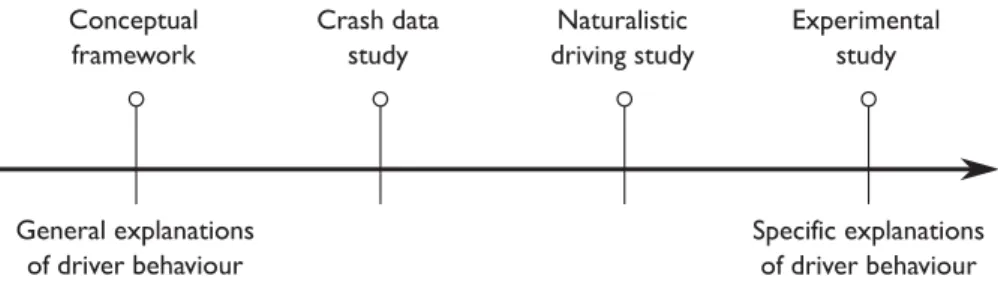
The overall aim of this PhD work (of which this licentiate thesis is a part) is to progress the development of driver behaviour models, from general explanations of driver behaviour to quantitative explanations of specific behaviours in safety critical situations potentially leading to run-off-road crashes (see Figure 2). Conceptual models of driver behaviour can support general understanding of processes or mechanisms in automobile driving, but they tell us less about the specific behaviours exhibited in real-world crash situations. To form hypotheses about specific explanations, analyses of driver behaviour in more detailed and specific situations should be done. However, an increase in detail and specificity is often coupled with scarcity and a decrease in the representativeness of the data. It is therefore important to connect the use of representative, but low-detail crash data, with the use of naturalistic driving study data, and the collection of experimental data with higher levels of detail and experimental control. Once more specific explanations of driver behaviour are obtained, modelling efforts will be able to inform development and evaluation of ADASs—such as LDW and LKA/ELK—by supporting virtual simulation of ADASs and enabling safety benefit analysis.
The following five objectives have been set to ensure meeting the overall aim. 1. Define a basis for test scenarios for run-off-road crashes—based
on analysis of in-depth cases from crash databases—that can inform the design of ADASs to prevent these crashes.
2. Identify a conceptual framework suitable for describing human behaviour, and apply it to modelling of the behavioural mechanisms that lead to run-off-road crashes.
3. Identify and describe the behavioural mechanisms leading to run-off-road crashes from naturalistic data.
4. Develop driver models of the behavioural mechanisms leading to run-off-road crashes, to support virtual simulation and validation of ADASs.
5. Implement the driver models in a virtual simulation environment to evaluate ADASs.
The first two objectives have been achieved for this licentiate thesis; while all five objectives are intended to be achieved for the PhD thesis.
11
Figure 2: Development and evaluation of ADAS progresses as explanations of driver behaviour becomes more specific. The research work covered in this thesis supports progression of our explanations of driver behaviour in run-off-road situations, from general towards specific, by presenting a unifying conceptual framework of driver behaviour, and by
using real-world crash data to define behaviourally relevant run-off-road test scenarios for ADASs.
13
3
Defining test scenarios relevant for development and
evaluation of ADASs targeting run-off-road crashes
An explicit objective of this thesis work is to define a basis for test scenarios for run-off-road crashes, in a way that can inform the design of ADASs to prevent these crashes. Previously, test scenarios for effectiveness assessment and safety benefit estimation have, to a large extent, used a top-down (or rule-based) approach to analysis and target situation selection from crash databases, based on categorisation of crashes according to a set of conflict situations (e.g. Najm, Koopmann, Boyle, & Smith, 2002). This chapter introduces the work covered in Paper I, wherein categorisation of crashes instead was done using the statistical method of cluster analysis. First, a brief argument will be given as to why it may be of interest to go beyond a pre-defined categorisation of crashes, followed by an argument for the use of cluster analysis. Last, some important considerations when using cluster analysis for test scenario definition will be presented.
3.1
Beyond our best understanding of conflict situations
In several previous efforts to define run-off-road test scenarios, the starting point has been to define a set of conflict situations that describe, at high levels of abstraction, the events preceding the crash. Two examples of such high-level descriptions—obtained from the pre-crash scenario typology proposed by Najm, Smith, and Yanagisawa (2007)—are “road edge departure without prior vehicle manoeuvre” and “control loss with prior vehicle action”. The next step has then been to subdivide the crashes in a crash database according to the chosen conflict situation typology, and derive test scenarios using the distribution of pre-crash factors, e.g. vehicle manoeuvres, speed, or number of lanes. This general approach has previously been applied to define run-off-road test scenarios (Najm et al., 2002). Similarly, run-off-road crashes were categorised according to so-called driving scenarios in the ACAT project (Gordon et al., 2010), where the driving scenarios were obtained through analysis of causal factors and crash sequences found in crash data. For the simulations in the ACAT project, various data sets (including crash databases and in-depth crash studies) were sampled for the given driving scenario, in order to obtain specific values for required parameters (Gordon et al., 2010, Chapter 4). While Najm et al. (2002) and Gordon et al. (2010) generate their baseline situations at levels 2 and 3 (as described in Chapter 1.2), it is also possible to use the selected crashes directly, corresponding to level 1 (Alvarez et al., 2017). This was done by Kusano, Gabler, and Gorman (2014), who estimated the safety benefit of
14
LDW based on crashes from the National Automotive Sampling Systems, Crashworthiness Data Systems (NASS/CDS) database, where the crashes were selected according to previously defined pre-crash scenarios (Kusano & Gabler, 2013).
One issue with the top-down approach is that crashes are divided according to the predefined conflict situations, forcing that structure upon the data and implicitly claiming that it is the most reasonable way to divide the data. In this process, similarities and patterns existing in the data may be disregarded. To exemplify, crashes triggered by driver fatigue and sleepiness may result both in drift-off-the-road events and in loss-of-control events, potentially classifying them as belonging to different conflict situations. Still, both crashes may have been avoided using the same countermeasure strategy (e.g. a driver state monitoring system with a warning). In some sense, the predefined conflict situations are based on the currently best understanding about the structures in the data, and if a certain pattern is not already accounted for in the existing conflict situations, it will be ignored. Specifically, as in the example with fatigue-related crashes above, structures relevant for ADAS development or crash mechanism analysis may be overlooked. Therefore, alternative approaches should be examined, based on the requirements imposed by desired properties of test scenarios. Desired properties of a test scenario could include relevance for system development and evaluation, namely that the crashes represented by a test scenario should—to the largest extent possible—be addressed by a specific countermeasure, and be defined in parameters available to a system. Test scenarios should also be based on a minimal number of assumptions about how the underlying data is best categorised. This speaks for the use of a statistical method that is data-driven and exploratory, while still allowing some level of control over the relation between input and desired output. One potential approach is to use cluster analysis, which is an objective statistical method that can support researchers in identifying structures and segmenting of crashes according to their relative similarities (Depaire, Wets, & Vanhoof, 2008).
3.2
Cluster analysis provides a data-driven approach to defining test
scenarios
The cluster analysis approach used in Paper I can be described as bottom-up or data-driven, and is part of a family of methods that finds clusters in data according to homogeneity, similarity, or relationship between observations, in some statistical sense. Due to the objective statistical nature,
15
(unsupervised) cluster analysis has previously been used in crash data analysis, but only to a limited extent for defining test scenarios. Cluster analysis as a method for crash data analysis has been used, for example, to find “hotspots”, where geographical distances between crashes have been used to identified areas with elevated crash rates (Anderson, 2009; Bíl, Andrášik, & Janoška, 2013; Kim & Yamashita, 2007). It has also been used as a way to improve understanding of patterns in road traffic crashes, and for identification of relevant pre-crash factors, for a large number of purposes (Berg, Gregersen, & Laflamme, 2004; De Oña, López, Mujalli, & Calvo, 2013; Depaire, Wets, & Vanhoof, 2008; Kaplan & Prato, 2013; Nowakowska, 2012; Sasidharan, Wu, & Menendez, 2015; Theofilatos & Efthymiou, 2012; Weiss, Kaplan, & Prato, 2016). Cluster analysis thus provides a general method able to support specific purposes. For the explicit purpose of defining test scenarios, cluster analysis of in-depth crash data has been used on a smaller scale. For example, cluster analysis was applied to the STATS19-OTS database in order to establish test scenarios for autonomous emergency braking in car-to-pedestrian situations (Lenard, Badea-Romero, & Danton, 2014). By basing the cluster analysis on representative real-world crash data, the cluster solutions will automatically carry relevance for, and be representative of, the real-world crash population upon which the analysis was carried out, which is a desirable property of test scenarios.
There are other arguments suggesting that cluster analysis could be a suitable method for defining test scenarios. Cluster analysis is essentially an exploratory method, meaning that it does not focus on testing existing hypotheses, but rather enables identification of structures in the data (regardless of the analysist’s previous knowledge of these structures). This can be used to facilitate formulation of hypotheses regarding causes for the observed features in the results. As such, cluster analysis is a method that is driven by the underlying structures in the data, and that makes minimal assumptions about the nature of the data.This means that, by using cluster analysis, it may be possible to capture patterns in the crashes that can facilitate our understanding of their causal mechanisms. The argument for cluster analysis as a method to define run-off-road test scenarios is thus an idea is that crashes that have a similar set of pre-crash factors may also share similar causal structures. Furthermore, by basing the cluster analysis on a set of variables that represent properties important for ADAS development (e.g. within the limitations of sensors), the results will be coupled to system relevance.
16
In summary, the argument is that an approach based on cluster analysis may be better, compared to previously used top-down approaches, at capturing structures created by similar causation factors and crash mechanisms. This property is of elevated importance if the test scenarios should support development of effective countermeasures (e.g. conceptualised in terms of situational control), and also provide a better understanding of the driver’s role in the crash, for it to be modelled properly. In addition, cluster analysis encompasses means to, simultaneously, maintain relevance for ADAS development.
3.3
Care should be taken when selecting cluster analysis method
As explained in the previous section, an exploratory, unsupervised cluster analysis method would be well suited for the purpose of defining test scenarios. Furthermore, the method should provide some way to determine the number of clusters, as the total number of clusters in a set of crashes is not known beforehand. For this purpose, hierarchical agglomerative clustering offers a suitable alternative (Kaufman & Rousseeuw, 2005, Chapter 5). In hierarchical agglomerative clustering, each observation (crash) is initially considered a separate cluster. In the next step, the two clusters that are—in some sense—closest to one another are merged. Distance, in this case, could be any suitable measure of (dis-)similarity, such as Euclidean distance or Manhattan distance. Proximity between clusters is decided by an agglomeration (linkage) criterion. Since a test scenario is supposed to be representative of a distinct set of crashes, an agglomeration criterion that yields high within-cluster similarity is preferable. For that purpose, complete linkage4 provides a good alternative, as it tends to create relatively compact
clusters with high within-cluster similarity (Kaufman & Rousseeuw, 2005, p. 227). The agglomeration step is then repeated until all crashes has been merged into one cluster, creating a cluster hierarchy (Kaufman & Rousseeuw, 2005, Chapter 3). The final step is then to determine the number of clusters from the cluster hierarchy by examining how a clustering criterion changes at each merging step (Kaufman & Rousseeuw, 2005, p. 208). The hierarchical merging is often visualised as a tree structure, going from individual clusters to a single cluster. Hence, the last step consists of using a statistical measure
4 Complete linkage is also known as furthest neighbour, as the dissimilarity
between the most remote observations of two clusters is used as the between-cluster dissimilarity measure.
17
that describes the most likely number of clusters present in the data to decide where to cut the hierarchical tree structure.
When performing cluster analysis, selection of variables to include in the analysis should be done with care. First of all, variable selection has strong influence on the outcome of the cluster analysis (Milligan & Cooper, 1987; Punj & Stewart, 1983). Using run-off-road crashes as an example, the results are highly likely to be different depending on whether the analysis uses information on road surface conditions or not, as sufficient road friction is essential for maintaining lateral control. Likewise, one needs to select variables that reflect the purpose of the analysis. In the case of ADAS development and evaluation, variables should be chosen that carry relevance for system specification (Conquest, Spyridakis, Haselkorn, & Barfield, 1993; Lenard et al., 2014). Consequently, analysis of crash severity and injury levels would require a different set of variables (De Oña et al., 2013; De Oña, Mujalli, & Calvo, 2011). For example, personal characteristics of the driver, such as gender, age and weight, could be important for injury mechanism analysis, but may be less interesting for ADAS development. In the context of ADAS development, for age and gender to be parameters available to the system, installation of sophisticated sensory equipment not currently available in vehicles would be required, which would likely not provide a cost-efficient strategy.
Furthermore, police reported crashes and in-depth case studies both suffer from the fact that different variables have different reliability. For example, each crash is often ascribed a cause, which is typically the result of a subjective assessment process, while other parameters such as the road width can be determined by objective measures. In the arguments for cluster analysis presented above, the idea is presented that a similar set of pre-crash factors may imply similarities in causal structures. Therefore, one promising approach is to exclude the (relatively) unreliable variables in which crash causation is attributed from the cluster analysis, and use them as a means to evaluate the soundness and usefulness of the resulting cluster solution. In addition, cluster analysis provides a unique opportunity to compare different cluster solutions, based on changes in agglomeration criterion or input variables. Thus, it is possible to, for example, iteratively include or exclude variables and evaluate the usefulness of the resulting cluster solutions.
18
To summarise, cluster analysis as a method enables definition of test scenarios from identified structures in the data, obtained using a multi-variate measure of crash similarity in an objective and scalable manner. This has the benefit of allowing researchers to specify a set of parameters with relevance to the current objective, without having to put limitations on the potential outcomes beforehand. The method can also be seen as exploratory, in that it allows for variations in how the clustering is done (e.g. inclusion/exclusion of parameters) in order to iteratively produce and interpret results to maximise the usefulness of the obtained solution. The usefulness can, for example, be evaluated using attributed causes for the crash, if such variables are purposefully excluded from the cluster analysis itself.
19
4
A conceptual framework for automobile driving and
the predictive processing account of lateral control
Throughout the history of traffic safety research, the role of the driver has attracted a great deal of attention (Evans & Schwing, 1985). By adopting theories developed in a number of fields, such as psychology, cognitive science, and human factors, researchers have been trying to understand how humans carry out the driving task and, perhaps more urgently, the safety aspects of driver behaviour. This chapter will deal with the theoretical background to the contents of Paper II, in which the neurocognitive framework often labelled as predictive processing is applied to automobile driving. This work covered in Paper II was carried out in order to identify and establish a conceptual framework able to support and unify explanations of driver behaviour, and to harmonise the development of driver behaviour models. Furthermore, a conceptual framework can support generalisation of specific explanations by putting findings in a larger context. In Section 4.1 below, a brief summary will be given to explain key concepts of the predictive processing framework. In Section 4.2, an expansion beyond what is covered in Paper II will be provided, where the aim is to elaborate on how the predictive processing account can be used to understand lateral control in automobile driving.
4.1
Active inference: infer the state of the world through predicted
sensory stimuli, and act to realise predictions
Predictive processing can be seen as an umbrella term, capturing a range of models for the human brain functions (Clark, 2013). The brain is viewed as a statistical entity that tries to infer the state of the world, in a Bayesian fashion, in order to predict its own sensory input by tapping into regularities in the environment. By maintaining a hierarchical generative model that describes the relation between causal structures in the world and the resulting sensory stimuli, the brain can predict its sensory stimuli by inferring the state of the world (Friston, 2010). If the actual sensory stimuli agree with the predicted sensory stimuli, it can be seen as confirmation that the external state that causes the sensory state was correctly inferred. If there is a disagreement between the actual and the predicted sensory state, the brain typically tries to cancel out or minimise this prediction error in two ways: either by updating the predictions given the sensory stimuli, or by taking actions that will align the sensory stimuli with the predicted stimuli. This prediction error minimisation is the core mechanism of the predictive processing account.
20
Perception, in this sense, is the process of minimising prediction errors by updating one’s beliefs about the world, while action is seen as manipulation of external states in order to bring about the predicted sensory state. Or, as Clark puts it: “you treat the desired (goal) state as observed and perform Bayesian inference to find the actions that get you there.” (Clark, 2013, p. 6). It is noteworthy that actions themselves are explained using the same description, namely that motor control strive to fulfil predictions about proprioceptive sensations (Friston, Daunizeau, Kilner, & Kiebel, 2010). What the predictive processing account hence brings is a new take on the classical notion of perception and action, in which they are unified under the label of so-called active inference. That is, perception and action can be seen as manifestations of the same thing—they are the means by which prediction errors are minimised. Specifically, action is the consequence of unexpected sensory stimuli.
One important aspect of the predictive processing account is the hierarchical nature of the generative model. Persistent prediction errors at a lower level will propagate upwards to generate prediction errors at higher levels, and new predictions will be sent downwards (formally, this can be thought of as a new priors) (Friston, Shiner, et al., 2012). This is a process similar to the concept of predictive coding of visual information in the visual cortex, as proposed by Rao and Ballard (1999). As predictions are generated at all levels of the hierarchy, it is the overall prediction error that should be minimised. This process is weighted by the reliability of the predictions, namely by their precision (inverse variance), in a process similar to that ascribed to attention or biased competition (Friston, 2010, pp. 132–133).
The most comprehensive formal treatments of the predictive processing account is likely provided by Karl Friston and colleagues. They propose the free energy formulation, which is a Bayesian description of the brain functions, working under the assumption that brain activity strive to minimise the variational free energy (Friston et al., 2010; Friston, Kilner, & Harrison, 2006). The contents of the formal treatment will not be discussed in depth within this thesis, but interested readers are encouraged to explore published texts, providing accounts of e.g. visual processes and perception (Friston, Adams, Perrinet, & Breakspear, 2012), motor control (Adams, Shipp, & Friston, 2013; Friston, 2011), and active inference and learning (Friston, FitzGerald, Rigoli, Schwartenbeck, & Pezzulo, 2017).
21
In summary, the predictive processing account describes the brain as a statistical entity that tries to predict its sensory states based on its beliefs about the relation between causes and sensations—formed by the statistical regularities in the environment. If predicted and actual sensory stimuli is in disagreement, the brain either updates its beliefs based on the prediction error (perception), or tries to bring about the predicted state (action), in order to minimise the overall prediction error.
4.2
A predictive processing account of lateral control in automobile
driving
To exemplify the predictive processing account, let us imagine a driver travelling on a curvy road. Under the assumption that the driver’s generative model is properly tuned, it will provide meaningful predictions of the state of the visual stimuli when the future path coincides with the desired trajectory. At the lower level of the hierarchy, this prediction is compared to the actual visual stimuli. While the detailed content of the prediction is not known, it could, for example, encode a stationary state of near and far points, as in the two-level model of steering proposed by Salvucci and Gray (2004). If a prediction error exists, that is, if there is a deviation from the predicted state in the actual stimuli—such as a movement of the far point—the driver will seek out actions believed to realise or fulfil the predicted state. That is, by taking corrective steering actions, the driver will stabilise the far point and bring about the predicted sensory stimuli.
In order for this process to be successful, so that the driver can stay on the road, the brain has to model the relationship between visual stimuli from the forward roadway (sensory states) and the corresponding required steering manoeuvres (active states)—phrased more strictly, the brain should model the way external states (the vehicle’s trajectory in the road environment) give rise to sensory states (optical flow patterns), as well as the way actions (steering corrections) affect the external states (a change of the vehicle’s trajectory). However, external states are not directly available to the brain, in a statistical sense, but have to be inferred from the agent’s internal, sensory, and active states (Friston, 2013). In the same way, the brain does not possess direct influence over external states per se, but may indirectly influence external states by changing its active states. If the active states influence the same external states that cause the current sensory states a dependency is created, which Friston describes as “a circular causality that is reminiscent of the action-perception cycle […] external states cause changes in internal states, via sensory states, while the internal states couple back to the external
22
states through active states—such that internal and external states cause each other in a reciprocal fashion” (Friston, 2013, p. 2). In other words, the driver should both be able to predict the visual stimuli that indicates following the road, and be able to predict the required steering manoeuvre in cases where the visual stimuli indicate the driver is not following the road ahead. However, given the nature of the predictive processing account, it is possible to find explanations to a number of phenomenon observed in relation to the driver’s ability to maintain and exert lateral control. Below, three examples will be given, namely the aspect of satisficing control, gaze target selection, and driver behaviour in relation to rare events.
4.2.1
Satisficing control as an optimising strategy
One implication of the variational free energy formulation of the predictive processing account is that the generative model will be maximising its accuracy, while at the same time minimising the model complexity (Friston, FitzGerald, Rigoli, Schwartenbeck, & Pezzulo, 2017). Implicitly, this means that causes and sensory effects can be understood as a few-to-many relationship (Trappenberg & Hollensen, 2013), and favours the use of simple models of the causal structures in the world that, at the same time, provides sufficiently good predictions about the sensory states (Pezzulo, 2014). To understand why this is important in relation to lateral control, it should be coupled with the notions that: (A) the brain makes (steering) decisions based on noisy accumulation of evidence that a steering manoeuvre is required, resulting in an inherent intermittency in control application (e.g. Gold & Shadlen, 2007; Markkula, Boer, Romano, & Merat, 2017) ; and (B) steering manoeuvres can be understood in terms of execution of motor primitives (Benderius & Markkula, 2014; Martínez-García, Zhang, & Gordon, 2016). Thus, feedback from a corrective manoeuvre is not instantaneous, as natural variability from the road environment and vehicular response has to be decoupled from the effect of the manoeuvre in the noisy evidence signal. This yields a level of uncertainty, or variability, in the monitoring and control task, meaning that the performance of the generative model is bound by the statistical regularities in its environment—no predictions can be made with any certainty in an environment that is inherently irregular. Furthermore, as noted above, error minimisation occurs in a precision-weighted manner for all predictions made by the generative model simultaneously, at all levels in its hierarchy. It may therefore be part of an overall optimisation strategy to adopt a simpler, but less precise, model for low-level lateral control, that may reduce the precision (and thus weighting) of deviations in lane centring without compromising the performance of higher level predictions (i.e. to
23
keep the vehicle on the road). This lends support to the notion that the lane keeping task, in itself, can be understood in terms of satisficing rather than optimising control (Summala, 2007).
4.2.2
Gaze target selection should minimise overall uncertainties about
predictions
The second aspect of lateral control where predictive processing presents intuitive explanations is the role of attention and visual target selection in automobile driving. Lane keeping is only one task among many in automobile driving that requires visual monitoring to generate and correct predictions, and competes with tasks such as monitoring of the speedometer or the rear-view mirrors. In addition, the driver may have higher motives, creating additional predictions about e.g. the state of the climate control or the location of a song in a playlist. Now, given that the lane-keeping task is considered satisficing, resolving the contradictions of multi-tasking through active inference will prioritise the tasks that—at any given time—produces the highest precision-weighted prediction errors (or, in some sense, features the highest uncertainties about the correctness of the predictions). Gaze target selection then corresponds to the driver’s beliefs on where visual sampling will result in the largest overall reduction in uncertainty (Friston, Adams, Perrinet, & Breakspear, 2012). Thus, if a driver predicts, with high certainty, that a road departure is not imminent, it will become more important to allocate visual attention in a way that reduces uncertainties for other tasks than the lane-keeping task. In other words, the more predictable a traffic environment is, the more likely it is that the driver will engage in “secondary” tasks. This notion finds support in studies of driver glance length patterns in naturalistic driving studies (Tivesten & Dozza, 2014).
4.2.3
False certainty in the perception-action cycle dictates driver
behaviour in rare events
As noted above, the perception-action cycle can be seen as driven by the brain’s ability to predict how actions influences external states, and how these external states in turn are predicted to cause future sensory states. The predictions, on the other hand, emerge from the brain’s beliefs about the world, which in turn are based on previously experienced regularities. In other words, the more frequent and reliable a situation is, the more likely it is that the brain will make correct predictions about current and future states, and how they are affected by specific actions. Conversely, if the brain encounters a situation that rarely occurs (such as imminent road departures), it is likely that the brain will be less capable to make correct and
high-24
precision predictions about the effects of a specific action. This would then especially hold true if the results of an action do not adhere to regularities exhibited in situations the driver more frequently experiences (such as low road surface friction). However, due to lack of experience, the brain runs the risk of having a false certainty about the rarely encountered situation, resulting in a failure to perceive the irregular external state (e.g. the generative model does not provide relevant predictions for sensory stimuli related to a reduction of road surface friction). In other words, when encountering rare situations, the brain’s beliefs about the state of the world will not necessarily account for the rare state, resulting in a false certainty that the perception-action cycle valid in regular situations is also valid for the irregular situation.
4.3
Summary
In Section 4.1 above, a brief introduction to the predictive processing framework was given, introducing the concept of active inference, through which perception and action can be understood as ways to reduce uncertainties about the current state of the world by minimising overall deviations from predicted sensory inputs. These concepts were then applied to automobile driving in Section 4.2, where focus was put on investigating concepts relevant to lane keeping and run-off-road crashes beyond what was covered in Paper II, bringing up concepts such as satisficing control, gaze target selection, and false certainties about causal structures.
25
5
Summary of papers
A summary of the two papers included in the thesis will be given in the next sections. Paper I deals with defining run-off-road test scenarios using cluster analysis of in-depth crash data. Paper II investigates how the (neuro-)cognitive framework of predictive processing can be applied to automobile driving.
Paper I
Nilsson, D., Lindman, M., Dozza, M., & Victor, T. (2017).
Definition of
run-off-road crash clusters—for safety benefit estimation and driver
assistance development.
Manuscript submitted for publication.
The study was designed by Nilsson, Lindman, Victor and Dozza. Nilsson carried out data reduction and statistical analyses. Nilsson authored the paper, with minor contributions from Victor. Essential feedback was provided by Lindman and Dozza.Paper II
Engström, J., Bärgman, J., Nilsson, D., Seppelt, B., Markkula, G.,
Piccinini, G. B., & Victor, T. (2017). Great expectations: a
predictive processing account of automobile driving.
Theoretical
Issues in Ergonomics Science
, (April), 1–39.
http://doi.org/10.1080/1463922X.2017.1306148
The paper was authored by Engström. Nilsson participated in the literature study, partook in discussions of the topic, and provided feedback on the text during workshop sessions and in personal communication in between sessions.
26
Paper I.
Definition of run-off-road crash clusters—for
safety benefit estimation and driver assistance
development
Introduction
To ensure adequate real-world crash prevention performance of ADASs, information on causal factors in real-world crashes should be included in test scenarios used in the design and evaluation of the ADAS. Previously, test scenarios for run-off-road crashes have been based on dividing real-world crashes according to a conflict situation typology, hence running the risk of disregarding underlying structures in the data.
Aim
The goal of this study was to create a basis for test scenarios for run-off-road crashes, by dividing real-world crashes based on a multi-variate similarity measure, rather than on the more top-down conflict situation typology classification.
Method
The study was performed by applying hierarchical, agglomerative cluster analysis to run-off-road crashes from the German In-Depth Accident Study database, collected during the years 2008-2014. The cluster analysis was based on a number of variables deemed relevant for characterising run-off-road crashes. In addition to analysing the distribution of these variables for each cluster, the distributions of attributed causes were also analysed.
Results
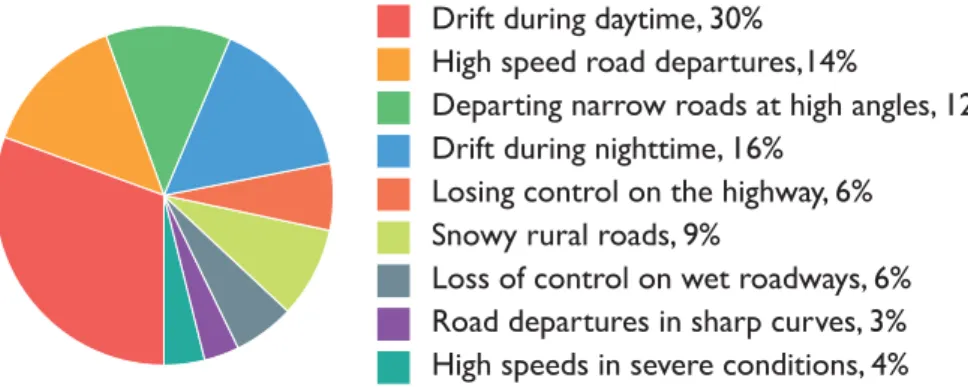
The cluster analysis yielded a solution with 13 clusters, out of which four had a very low number of crashes (1-3) and were considered clusters of outliers. The remaining nine clusters were found to consist of crashes characterised by: drift during daytime, drift during night, high speeds, high departure angles on narrow roads, highways, snowy roads, loss-of-control on wet roadways, sharp curves, and high speeds in severe road conditions (Figure 3).
27
Figure 3: Distribution of the run-off-road crashes among the nine clusters along with the identified characteristics of each cluster.
Discussion
Nine groups of road crashes were found, showing both that run-off-road crashes occur in different ways, but also that there are patterns to be found in the data. These patterns provides a basis for improved understanding of crash causation mechanisms. Cluster analysis was thus found to provide an exploratory and statistically sound tool relevant for dividing real-world crashes according to underlying structures in the data. Analysis of the obtained cluster solution provided valuable insights, specifically highlighting scenarios with relevance for the development of ADASs to prevent run-off-road crashes. The two largest clusters were considered targets for current lane support systems, including lane departure warnings and lane keeping assist. However, limitations in the data on driver behaviour from retrospective crash databases highlight a need for additional data to specify causation mechanisms in higher detail.
28
Paper II.
Great expectations: a predictive processing
account of automobile driving
Introduction
Recently, predictive processing has emerged as a promising framework for describing brain functions in terms of minimisation of prediction errors. Neural activity can be understood in terms of a hierarchical generative model that generates predictions of incoming sensory stimuli. Thus, the brain only needs to deal actively with errors between actual and predicted stimuli. The brain, then, tries to minimise any prediction errors, either by a change of predictions, or by taking actions that bring about the predicted state—a process referred to as active inference. In this process, prediction errors are weighted by their respective precision, where precision describes the certainty of the prediction. Precision weighting thus serves as a way of controlling behaviour and select the most relevant action, correcting errors in high precision predictions. Learning, in this context, is thought of as model tuning, where the generative model tries to capture regularities in the environment to better infer the hidden states of the worlds that causes observed sensory stimuli.
Aim
This study aimed to survey the predictive processing account of human brain functions in order to provide a unifying framework for understanding human behaviour in an automobile driving context, creating synergies in ongoing driver behaviour modelling efforts.
Method
The study was conducted as a collaborative literature survey, organised through a series of workshops, where relevant literature was discussed with a focus on implications for safety research and human factors in automobile driving.
Results
By applying predictive processing concepts to automobile driving, new perspectives were obtained for a number of driving phenomena, such as driver brake response, countersteering, and driver interaction with automated driving (AD) functions.
Responses to braking lead vehicles have previously been described as triggered by (accumulated) optical expansion on the retina (looming). The predictive processing account suggests that it may instead be a response to
29
unexpected looming, such that drivers may—in certain situations—predict the looming cues, thus inhibiting the brake response.
Similarly, a predictive processing approach suggests that it may be possible to cue drivers prior to autonomous steering interventions from ADASs, in order to inhibit countersteering behaviour.
Furthermore, the predictive processing account has important implications for the design of AD functionality. If the AD functionality exhibits timely and appropriate responses—providing consistent visual and vestibular cues to the driver—drivers will generate higher precision predictions, facilitating detection of functional limitations. However, high precision predictions and consistent AD responses may result in overreliance—where the driver’s trust in the AD functionality exceeds its capabilities, typically in rare events— while at the same time it may reduce the driver’s monitoring efforts.
Discussion
Predictive processing presents a potent framework, able to explain several elusive phenomena observed in automobile driving and provide guidance for future designs of ADASs and AD functionality. Rather than presenting a radical alternative to previous models and ideas in human factors, predictive processing could present a way to unify them, and further development and applications of these concepts are recommended.
31
6
Discussion
6.1
Test scenarios based on cluster analysis: exploratory but limited
and purpose-specific
The first objective of the thesis, presented in Chapter 0, was to obtain a basis for run-off-road test scenarios that can inform the development of ADAS. In Paper I, a method to achieve this was described, wherein cluster analysis was used to reveal structures in run-off-road crash data, enabling formulation of plausible hypotheses about crash causation mechanisms. By exploiting similarities in pre-crash parameters to segment crashes, cluster analysis presented a promising approach for definition of ADAS test scenarios, where the resulting clusters define sets of unique real-world crashes that are similar to one another and could potentially be addressed using the same countermeasure strategy.
The use of cluster analysis to define test scenarios should be seen in contrast to the approach where crashes instead are divided according to an a priori understanding of how crashes are best categorised (e.g. Najm, Smith, & Yanagisawa, 2007). Cluster analysis has the benefit of being an exploratory method, providing a bottom-up approach where less assumptions has to be made regarding the underlying structures in the data. As such, it enables identification of patterns in the data that may otherwise have been overlooked. However, this is a benefit that is not free of costs. In some previous efforts (e.g. Kusano & Gabler, 2013), a more specific procedure have been used to select crashes relevant for ADAS effectiveness assessment. By specifying requirements for the data beforehand, based on properties that are relevant to the specific ADAS under assessment, selection could be done in a top-down manner. This specificity in data selection is lost with cluster analysis. Instead, careful and iterative selection of clustering method and input variables—coupled with interpretation of obtained clusters—can be used to find sensible cluster solutions that are relevant for specific ADASs. However, doing so removes some of the generality of the process, making it more of a data-driven top-down process. Thus, a cluster solution obtained using parameters relevant to ADAS development and analysis of crash causation mechanisms is not necessarily relevant in categorisation of crashes for other purposes, such as injury mechanism analysis, making it more of a purpose-specific approach.
Although Paper I provides a solid foundation for test scenarios based on crash data, the overall goal in which this thesis plays a part—the progression