Coexistence of generalized synchronization and inverse
generalized synchronization between chaotic and
hyperchaotic systems
Ahlem Gasria, Adel Ouannasb, Kayode S. Ojoc, Viet-Thanh Phamd,1 a
Department of Mathematics, Constantine University, Constantine, Algeria [email protected]
bDepartment of Mathematics, University of Larbi Tebessi, Tebessa, 12002 Algeria [email protected]
c
Nonlinear Dynamic Group, Department of Physics, University of Lagos, Lagos, Nigeria [email protected]
d
Modeling Evolutionary Algorithms Simulation and Artificial Intelligence, Faculty of Electrical & Electronics Engineering, Ton Duc Thang University, Ho Chi Minh City, Vietnam
Received:December 3, 2017 / Revised:March 25, 2018 / Published online:June 15, 2018
Abstract. In this paper, we present new schemes to synchronize different dimensional chaotic and hyperchaotic systems. Based on coexistence of generalized synchronization (GS) and inverse generalized synchronization (IGS), a new type of hybrid chaos synchronization is constructed. Using Lyapunov stability theory and stability theory of linear continuous-time systems, some sufficient conditions are derived to prove the coexistence of generalized synchronization and inverse generalized synchronization between 3D master chaotic system and 4D slave hyperchaotic system. Finally, two numerical examples are illustrated with the aim to show the effectiveness of the approaches developed herein.
Keywords:hyperchaotic systems, generalized synchronization, inverse generalized synchroniza-tion, hybrid synchronizasynchroniza-tion, Lyapunov stability.
1
Introduction
The study of nonlinear behaviour, such as stability, control and synchronization of dynam-ical systems, has become an interdisciplinary research. As a result, several research works have been published on this subject by researchers of different disciplines [5, 6, 9, 34]. Due to the importance and interdisciplinary nature of nonlinear dynamical systems, its applications have been discovered in field studies like mathematics, physics, chemistry,
engineering, economics, neuroscience and many more [7,8,10,11,13,33,37]. In search of the stable, fast and robust synchronization methods, such as linear and nonlinear feedback controllers, active control, passive control, backstepping, sliding mode control and many more, have been developed [1–3, 12, 39, 41]. Similarly, several types of synchronization have been introduced [4, 14, 17–19, 24, 25, 40]. One of the most exciting synchronization types is thegeneralized synchronization(GS). This type of synchronization is character-ized by the existence of a functional relationshipφbetween the state Y(t)of the slave system and the stateX(t)of the master system, so thatY(t) =φ(X(t))after a transient time [32]. Different types of synchronization, such as complete synchronization, anti-synchronization, projective synchronization and function projective anti-synchronization, can be achieved from the generalized synchronization scheme depending on the choice ofφ. A variation is represented by theinverse generalized synchronization(IGS), where the synchronization condition becomesX(t) = ϕ(Y(t))after a transient time. However, since the type is still relatively new, IGS has been applied with successfully in continuous-time systems as well as discrete-continuous-time systems [27, 28]. Another interesting type of syn-chronization is the hybrid synchronization, where complete synchronization and anti-synchronization coexist. Faster and more secure digital communication could be achieved using the hybrid synchronization [38].
Recently, Ouannas et al. extended the concept of hybrid synchronization to achieve the coexistence of more than two types of synchronization between different dimensional chaotic (hyperchaotic) systems in discrete-time systems, integer-order differential sys-tems and fractional-order differential syssys-tems [15, 16, 20–22, 26, 29]. They also reported for the first time the coexistence of generalized synchronization (GS) and inverse gener-alized synchronization (IGS) for the fractional-order systems with different dimensions [23]. Meanwhile, to the best of our knowledge, the investigation of coexistence of GS and IGS for integer-order dynamical systems of different dimensions is not yet explored. The present research work focuses on coexistence of GS and IGS between chaotic and hyperchaotic systems.
Motivated by the importance of generalized synchronization and hybrid synchroniza-tion in enhancing security and fast informasynchroniza-tion transmission, new schemes of coexistence based on GS and IGS is developed for integer-order chaotic and hyperchaotic systems in this paper. The paper is organized as follow: Section 2 gives some definitions related to generalized and inverse generalized synchronization. Sections 3 and 4 give the basic mathematical background of the coexistence of generalized and inverse generalized syn-chronization in 3D and 4D, respectively. Section 5 presents some numerical examples, while Section 6 presents discussions. Section 7 concludes the paper.
2
Definitions GS and IGS
We consider the following master and slave systems:
˙ X(t) =F X(t) , (1) ˙ Y(t) =G Y(t) +U, (2)
whereX(t) = (xi(t))16i6n,Y(t) = (yi(t))16i6mare the states of the master system
and the slave system, respectively,F :Rn →Rn,G:Rm→RmandU= (ui)16i6mis
a vector controller.
Definition 1. The master systems (1) and the slave system (2) are in generalized syn-chronization if there exists a controllerU = (ui)16i6m and a differentiable function
φ:Rn→Rmsuch that lim t→+∞ e(t) = lim t→+∞ Y(t)−φ X(t) = 0.
Definition 2. The master systems (1) and the slave system (2) are in inverse generalized synchronization if there exists a controllerU = (ui)16i6mand a differentiable function
ϕ:Rm→Rnsuch that lim t→+∞ e(t) = lim t→+∞ X(t)−ϕ Y(t) = 0.
3
Coexistence of GS and IGS in 3D
3.1 Master–slave systems description
Here we assume that the master systems can be considered as
˙ xi(t) = 3 X j=1 aijxj(t) +fi X(t), i= 1,2,3, (3)
whereX(t) = (xi(t))16i63 is the state of the master system (3), (aij) ∈ R3×3,fi: R3→R,i= 1,2,3. Also, consider the slave system as
˙
yi(t) =gi Y(t)+ui, i= 1,2,3,4, (4)
whereY(t) = (yi(t))16i64 is the state of the slave system (4),gi:R4 → R, andui,
i= 1,2,3,4, are controllers.
3.2 Problem formulation
Definition 3. We say that GS and IGS coexist in the synchronization of the master system (3) and the slave system (4) if there exist controllers ui, i = 1,2,3,4, and
differentiable functionsφ1, φ2 : R3 → R,ϕ : R4 → Rsuch that the synchronization
errors e1(t) =y1(t)−φ1 X(t), e2(t) =x2(t)−ϕ Y(t), e3(t) =y3(t)−φ2 X(t) (5) satisfylimt→+∞kei(t)k= 0,i= 1,2,3.
3.3 Analytical results
The error system (5) can be derived as follows:
˙ e1(t) = ˙y1(t)− 3 X j=1 ∂φ1 ∂xj ˙ xj(t), ˙ e2(t) = ˙x2(t)− 4 X j=1 ∂ϕ ∂yj ˙ yj(t), ˙ e3(t) = ˙y3(t)− 3 X j=1 ∂φ2 ∂xj ˙ xj(t). (6)
Furthermore, the error system (6) can be written as
˙ e1(t) =u1+R1, e2˙ (t) =− 4 X j=1 ∂ϕ ∂yj uj+R2, e3˙ (t) =u3+R3, (7) where R1=g1 Y(t)− 3 X i=1 ∂φ1 ∂xi 3 X j=1 aijxj(t) +fi X(t) ! , R2= 3 X j=1 a2jxj(t) +f2 X(t) − 4 X j=1 ∂ϕ ∂yj gj Y(t) , R3=g3 Y(t)− 3 X i=1 ∂φ2 ∂xj 3 X j=1 aijxj(t) +fi X(t) ! .
To achieve synchronization between the master system (3) and the slave system (4), we assume that∂ϕ/∂y2 6= 0and the controllersui,i = 1,2,3,4, are constructed as
follows: u1= 3 X j=1 (a1j−c1j)ej(t)−R1, u2=− ∂ϕ ∂y1 ∂ϕ ∂y2 3 X j=1 (a1j−c1j)ej(t)−R1 ! − ∂ϕ1 ∂y2 3 X j=1 (a2j−c2j)ej(t)−R2 ! − ∂ϕ ∂y3 ∂ϕ ∂y2 3 X j=1 (a3j−c3j)ej(t)−R3 ! , u3= 3 X j=1 (a3j−c3j)ej(t)−R3, u4= 0, (8)
where(cij)3×3are control constants. By substituting the control law (8) into Eq. (7), the error system can be described as
˙ ei(t) = 3 X j=1 (aij−cij)ej(t), i= 1,2,3,
or in the compact form
˙
e(t) = (A−C)e(t), (9)
wheree(t) = (ei(t))16i63,A = (aij)3×3,C = (cij)3×3. Constructing the candidate
Lyapunov function in the formV(e(t)) =eT(t)e(t), we obtain
˙
V e(t)= ˙eT(t)e(t) +eT(t) ˙e(t)
=eT(t)(A−C)Te(t) +eT(t)(A−C)e(t) =eT(t)[(A−C)T+ (A−C)]e(t).
If the control matrixCis chosen such that(A−C)T+ (A−C)is a negative definite matrix, we getV˙(e(t))<0. Thus, from the Lyapunov stability theory the zero solution of the error system (9) is globally asymptotically stable, i.e,
lim t→∞ ei(t) = 0, i= 1,2,3.
Therefore, systems (3) and (4) are globally synchronized.
Theorem 1. There exists a suitable control matrixC= (cij)3×3to realize the coexistence of GS and IGS between the master system(3)and the slave system(4)under the control law(8).
4
Coexistence of IGS and GS 4D
4.1 Master–slave systems description
Now, the master system and the slave system can be described in the following forms:
˙ xi(t) =fi X(t), i= 1,2,3, (10) ˙ yi(t) = 4 X j=1 bijyj(t) +gi Y(t) +ui, i= 1,2,3,4, (11)
whereX(t) = (xi(t))16i63,Y(t) = (yi(t))16i64are the states of the master system and the slave system, respectively,fi : R3 → R,i = 1,2,3,(bij) ∈ R4×4,gi : R4 → R,
i= 1,2,3,4, are nonlinear functions, andui,i= 1,2,3,4, are controllers.
4.2 Problem formulation
Definition 4. We say that IGS and GS coexist in the synchronization of the master system (10) and the slave system (11) if there exist controllersui,i = 1,2,3,4, and
differentiable functionsχ1,χ2:R4→R, ψ1,ψ2:R3→Rsuch that the synchronization errors e1(t) =x1(t)−χ1 Y(t), e2(t) =y2(t)−ψ1 X(t), e3(t) =x3(t)−χ2 Y(t) , e4(t) =y4(t)−ψ2 X(t) (12) satisfylimt→+∞kei(t)k= 0,i= 1,2,3,4. 4.3 Analytical results
The error system (12) can be described as follows:
˙ e1(t) =− 4 X j=1 ∂χ1 ∂yj uj+T1, e˙2(t) =u2+T2, ˙ e3(t) =− 4 X j=1 ∂χ2 ∂yj uj+T3, e˙4(t) =u4+T4, (13) where T1=f1 X(t) − 4 X i=1 ∂χ1 ∂yi 4 X j=1 bijyj(t) +gi Y(t) ! , T2= 4 X j=1 b2jyj(t) +g2 Y(t) − 3 X j=1 ∂ψ1 ∂xj fj X(t) , T3=f3 X(t) − 4 X i=1 ∂χ2 ∂yi 4 X j=1 bijyj(t) +gi Y(t) ! , T4= 4 X j=1 b4jyj(t) +g4 Y(t) − 3 X j=1 ∂ψ2 ∂xj fj X(t) .
In this case, we assume that(∂χ1/∂y3)(∂χ2/∂y1)−(∂χ1/∂y1)(∂χ2/∂y3) 6= 0. Then the controllersui,i= 1,2,3,4, are designed as follows:
u1= 4 X i=1 αi 4 X j=1 (bij−lij)ej(t)−Ti ! , u2= 4 X j=1 (b2j−l2j)ej(t)−T2, u3= 4 X i=1 βi 4 X j=1 (bij−lij)ej(t)−Ti ! , u4= 4 X j=1 (b4j−l4j)ej(t)−T4. (14)
where(lij)4×4are control constants, and α1= ∂χ2 ∂y3 ∂χ1 ∂y3 ∂χ2 ∂y1 − ∂χ1 ∂y1 ∂χ2 ∂y3 , α2= ∂χ2 ∂y3 ∂χ1 ∂y2 − ∂χ1 ∂y3 ∂χ2 ∂y2 ∂χ1 ∂y3 ∂χ2 ∂y1 − ∂χ1 ∂y1 ∂χ2 ∂y3 , α3= − ∂χ1 ∂y3 ∂χ1 ∂y3 ∂χ2 ∂y1 − ∂χ1 ∂y1 ∂χ2 ∂y3 , α4= ∂χ2 ∂y3 ∂χ1 ∂y4 − ∂χ1 ∂y3 ∂χ2 ∂y4 ∂χ1 ∂y3 ∂χ2 ∂y1 − ∂χ1 ∂y1 ∂χ2 ∂y3 , β1= − ∂χ2 ∂y1 ∂χ1 ∂y3 ∂χ2 ∂y1 − ∂χ1 ∂y1 ∂χ2 ∂y3 , β2= ∂χ1 ∂y1 ∂χ2 ∂y2 − ∂χ1 ∂y2 ∂χ2 ∂y1 ∂χ1 ∂y3 ∂χ2 ∂y1 − ∂χ1 ∂y1 ∂χ2 ∂y3 , β3= ∂χ1 ∂y1 ∂χ1 ∂y3 ∂χ2 ∂y1 − ∂χ1 ∂y1 ∂χ2 ∂y3 β4= ∂χ1 ∂y1 ∂χ2 ∂y4 − ∂χ1 ∂y4 ∂χ2 ∂y1 ∂χ1 ∂y3 ∂χ2 ∂y1 − ∂χ1 ∂y1 ∂χ2 ∂y3 .
By using the control law (14), the error system (13) can be described as
˙ e(t) = 4 X j=1 (b1j−l1j)ej(t) or ˙ e(t) = (B−L)e(t), (15)
wheree(t) = (ei(t))16i64,B = (bij)4×4,L= (lij)4×4is a control constant matrix. In this case, the control matrixLis selected such that all eigenvalues ofB−Lhave negative real parts. Thus, by asymptotic stability of linear continuous-time systems, all solutions of error system (15) go to zero ast→ ∞. Therefore, systems (10) and (11) are globally synchronized.
Theorem 2. There exists a suitable control matrixL= (lij)4×4to realize the coexistence of IGS and GS between the master system(10)and the slave system(11)under the control law(14).
5
Numerical examples
Example 1. As the master system, we consider a new 3D chaotic system proposed by Pham et al. [30] ˙ x1=−ax3, ˙ x2=bx1x3−cx33, ˙ x3=x41+x 4 2−k−dx1x3. (16)
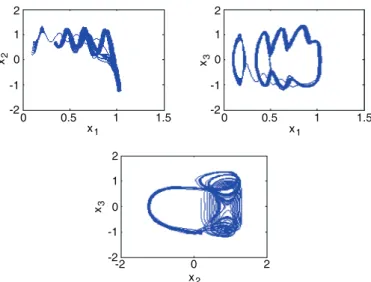
When the parameter values are taken asa = 0.1, b = 3, c = 2.2, d = 0.2 and k = 0.81, system (16) exhibits chaotic behavior with equilibria located on the rounded square loop as shown in Fig. 1.
0 0.5 1 1.5 0 0.5 1 1.5 -2 0 2 -2 -1 0 1 2 -2 -1 0 1 2 -2 -1 0 1 2 1 x 3 x 2 x 2 x x3 1 x
Figure 1.Chaotic attractors of the master system (16) in 2D.
As the slave system, we consider a novel 4D hyperchaotic system introduced by Vaidyanathan [35] ˙ y1=α(y2−y1) +y2y3+y4+u1, ˙ y2=−γy1y3+δy2+u2, ˙ y3=y1y2−β+u3, ˙ y4=−(y1+y2) +u4. (17)
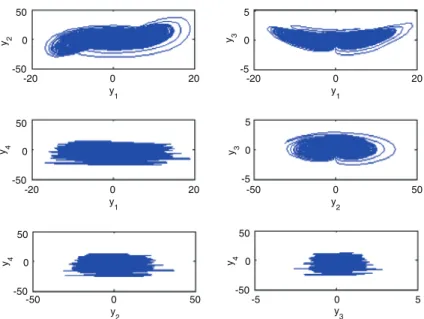
System (17) withu1 =u2 =u3 =u4 = 0exhibits a strange hyperchaotic attractor for the parameter valuesα= 60,β = 27,γ = 160,δ= 0.3and = 2.8. System (17) does not have any equilibrium points. Hence, system (17) has hidden attractors. When the initial conditions are taken as(y1(0), y2(0), y3(0), y4(0)) = (1.2,0.4,0.3,1.4), Fig. 2 shows the 3D projection of the novel hyperchaotic system.
According to Definition 3, the error system between the master system (16) and the slave system (17) is defined as
e1=y1−φ1(x1, x2, x3), e2=x2−ϕ(y1, y2, y3, y4), e3=y3−φ2(x1, x2, x3),
whereφ1(x1, x2, x3) = x1+x2+x3,ϕ(y1, y2, y3, y4) = y1+ 2y2+ 3y3+y42 and φ2(x1, x2, x3) =x1x2+x3. So,∂ϕ/∂y1= 1,∂ϕ/∂y2= 2and∂ϕ/∂y3= 3.
Using the notations presented in Section 3, the linear partAand nonlinear partf of the master system (16) are given as follows:
A= 0 0 −0.1 0 0 0 0 0 0 and f = 0 bx1x3−cx33 x4 1+x42−k−dx1x3 .
-20 0 20 -20 0 20 -20 0 20 -50 0 50 -50 0 50 -5 0 5 y1 y1 y1 y2 y2 y3 -50 0 50 -5 0 5 -50 0 50 -50 0 50 -5 0 5 -50 0 50 y2 y3 y3 y4 y4 y4
Figure 2.Chaotic attractors of the slave system (17) withu1=u2=u3=u4= 0in 2D.
Then the control matrixCis chosen as
C= 1 0 −0.1 0 2 0 0 0 3 .
Based on Eq. (8), the controllersu1,u2,u3andu4are designed as follows: u1=−e1−R1, u2= 1 2e1+ 1 2R1+ 1 2e2+ 1 2R2+ 9 2e3+ 3 2R3, u3=−3e3−R3, u4= 0, where R1=α(y2−y1) +y2y3+y4+ax3+ (d−b)x1x3+cx33−x41−x42+k, R2=bx1x3−cx33−(α+ 2δ)y2+αy1−y4+ 2γy1y3+ 3β−y2(3y1+y3) + 2y4(y1+y2), R3=y1y2−β+ax2x3−bx21x3+cx33−x41−x42+k+dx1x3.
It is easy to show that(A−C)T+ (A−C)is a negative definite matrix. Therefore, systems (16) and (17) are globally synchronized in 3D. The error system can be described as follows:
˙
0 5 10 15 20 25 30 35 40 0 5 10 15 20 25 30 35 40 0 5 10 15 20 25 30 35 40 -20 -500 -5 0 20 0 500 0 5 time time time e1 e2 e3
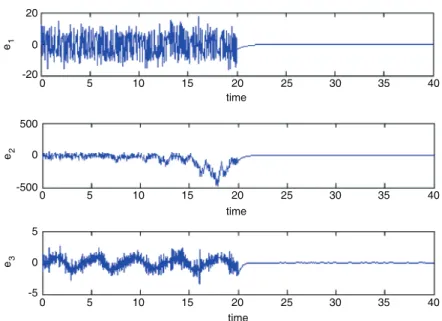
Figure 3.Time evolution of the synchronization errorse1, e2ande3between systems (16) and (17).
Figure 3 displays the time evolution of the errorse1,e2 ande3 between the master system (16) and the slave system (17).
Example 2. In this example, the master system is defined by the following new 3D system [31]: ˙ x1=x2, ˙ x2=−x1+x3x2, ˙ x3=−x1−ax1x2−bx1x3+c. (18)
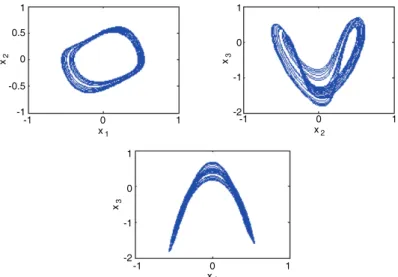
When(a, b, c) = (15,1,−0.001)and the initial conditions(x1(0), x2(0), x3(0)) = (0,0.5,0.5), system (18) exhibits a chaotic attractor with no equilibria as shown in Fig. 4.
The salve system is described by
˙ y1=α(y2−y1) +γy4+u1, ˙ y2=−y1y3−y2+γy4+u2, ˙ y3=y1y2−y3−β+u3, ˙ y4=−δ(y1+y2) +u4. (19)
System (19) exhibits a strange hyperchaotic attractor for the parameter valuesα= 4, β = 20, γ = 0.2 and δ = 0.5 [36]. System (19) does not have any equilibrium points. Hence, system has hidden attractors. When the initial conditions are taken as
(y1, y2, y3, y4) = (0.4,0.4,0.4,0.4), Fig. 5 shows the 3D projection of the novel hy-perchaotic system.
-1 0 1 -1 0 1 -1 0 1 -2 -1 0 1 -2 -1 0 1 -1 -0.5 0 1 0.5 x1 x2 x1 x2 x3 x3
Figure 4.Chaotic attractors of the master system (18) in 2D.
-10 0 10 -10 0 10 -10 0 10 -20 0 20 -20 0 20 -20 -10 0 10 y1 y1 y1 y2 y3 y2 y4 y4 y3 y4 y2 y3 -50 -20 -20 -20 20 20 20 -50 -50 50 50 50 0 0 0 0 0 0
Figure 5.Chaotic attractors of the master system (19) withu1=u2=u3=u4= 0in 2D.
According to Definition 4, the error system between the master system (18) and the slave system (19) is described by
e1=x1−χ1(y1, y2, y3, y4), e2=y2−ψ1(x1, x2, x3), e3=x3−χ2(y1, y2, y3, y4), e4=y4−ψ2(x1, x2, x3),
whereχ1(y1, y2, y3, y4) =y1+y3+y2y4,ψ1(x1, x2, x3) =x1+x2+x3,χ2(y1, y2, y3, y4) = (y13−y3+y2y4)/3andψ2(x1, x2, x3) =x1+x2x3. So,(∂χ1/∂y3(∂χ2/∂y1)−
(∂χ1/∂y1)(∂χ2/∂y3) =y12+ 1.
Based on the notations used in Section 4, the linear partBand nonlinear partgof the slave system (20) are given as follows:
B= −4 4 0 0.2 0 −1 0 0.2 0 0 −1 0 −0.5 −0.5 0 0 and g= 0 −y1y3 y1y2−β 0 .
Then the control matrixLis selected as
L= 0 4 0 0.2 0 0 0 0.2 0 0 0 0 −0.5 −0.5 0 3 .
According to Eq. (14), the controllersu1, u2, u3andu4are designed as follows:
u1= 1 y2 1+ 1 (4e1+T1) + 2y4(e2+T2) + (e3+T3) + 2y2(3e4+T4), u2=−e2−T2, u3= 4y 2 1 y2 1+ 1 (e1+T1) +y4(e2+T2)− 1 y2 1+ 1 (e3+T3) + 3y2(e4+T4), u4=−3e4−T4, where
T1=x2−α(y2−y1) +y4(−γ+y1y3+y2−γy4)−y1y2+y3+β
+δy2(y1+y2), T2=−y1y3−y2+γy4+x1(2 +bx3)−x2(1 +x3) +ax1x2−c, T3=−x1−ax1x2−bx1x3+c−y21 α(y2−y1) +γy4 −y4(−y1y3−y2+γy4) + (y1y2−y3−β)−y2 −δ(y1+y2) , T4=−δ(y1+y2)−x2 x23+c +x2x1(1 +ax2+bx3) +x1x3.
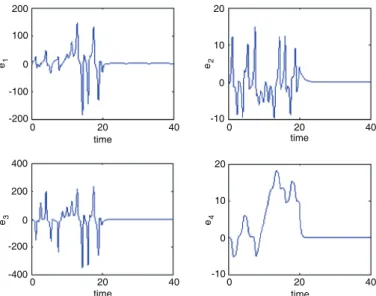
We can show that all eigenvalues ofB−Lhave negative real parts. Therefore, systems (18) and (19) are globally synchronized in 4D. The error system can be written as follows:
˙
e1=−4e1, e2˙ =−e2, e3˙ =−e3, e4˙ =−3e4,
0 20 40 0 20 40 0 20 40 -100 20 40 0 10 20 -400 -200 200 400 -10 0 10 20 0 -200 -100 100 200 0 e1 e2 e3 e4 time time time time
Figure 6.Time evolution of synchronization errorse1, e2, e3ande4between systems (18) and (19).
6
Discussion
The aim of this section is to highlight the novelty introduced by the present approach. First of all, it is worth analyzing the results achieved so far in the literature on the same topic. It is important to note that most relevant studies dedicated to the coexistence of synchronization types between two chaotic systems are related to discrete-time systems [15, 20, 26] and fractional-order systems [16, 22, 23, 29]. We would stress that the topic related to the coexistence of generalized synchronization (GS) and inverse generalized synchronization (IGS) between integer-order systems with different dimensions is almost unexplored. For example, in [23] the authors have presented a robust method, based on stability theory of linear fractional-order systems, to achieve the coexistence of GS and IGS for fractional-order systems only in dimension of the slave system. In our work, the coexistence of GS and IGS has been guaranteed in different dimension by using two approaches: stability theory of linear integer-order systems and Lyapunov stability method. Another schemes of coexistence for integer-order systems have been developed in [21]. However, the method in [21] can only be applied to systems with identical dimensions, and the coexistence of GS and IGS has been not analyzed. Our approach is more general than that in [21] since it can be applied to different systems in different dimensions (see Theorems 1 and 2, respectively), and the scheme of coexistence of GS and IGS can be considered as a generalization of many different schemes.
Based on previous considerations, it should be clear that the methods proposed herein provide a contribution to the topic related to the coexistence of some synchronization types since it guarantees the coexistence of two different generalized type of synchro-nization for nonidentical systems with different dimensions. This increased complexity related to both the number of synchronization types and the capability to synchronize
chaotic dynamics with hyperchaotic ones and provides a deeper insight into the synchro-nization phenomena between systems described by integer-order differential systems with different dimensions.
7
Conclusions and future works
In this paper, we have presented new approaches to study the coexistence of generalized synchronization (GS) and inverse generalized synchronization (IGS) between chaotic and hyperchaotic systems characterized by different dimensions. The approach, which can be applied to a wide class of chaotic/hyperchaotic systems with different dimensions, is based on two new theorems involving Lyapunov method and stability theory of linear sys-tems and holds for any differentiable scaling function making the tool a reliable approach to achieve general types of chaos synchronization. All the numerical examples reported through the paper have clearly highlighted the capability of the proposed approach in successfully achieving the coexistence of GS and IGS between chaotic and hyperchaotic systems in different dimensions.
As a concluding remark, we would like to highlight that the basic idea of the present paper, the combination of two different synchronization types in order to create a novel synchronization scheme, can be further generalized. This can be achieved by considering two different synchronization types as “building blocks” to obtain several new synchro-nization schemes using the technique developed in this paper. Consequently, the approach illustrated here can be considered as a “methodology” to create new synchronization schemes starting from two well-established synchronization types. Further developments and extended analysis related to the application of the proposed approach in chaotic communication devices and secure communication systems would be expected to be implemented. Also, new complex schemes of synchronization will be investigated in future works.
Acknowledgment. The authors acknowledge Prof. Guan Rong Chen, Department of Electronic Engineering, City University of Hong Kong for suggesting many helpful ref-erences.
References
1. A.T. Azar, Q. Zhu, Advances and Applications in Sliding Mode Control systems, Springer, Berlin, 2015.
2. P. Balasubramaniam, P. Muthukumar, Synchronization of chaotic systems using feedback controller: An application to Diffie–Hellman key exchange protocol and El Gamal public key cryptosystem,J. Egypt. Math. Soc.,22:365–372, 2014.
3. K. Ding, Q.-L. Han, Master–slave synchronization criteria for chaotic Hindmarsh–Rose neurons using linear feedback control,Complexity,21(5):319–327, 2015.
4. J.G. Dong, X. Xue, Finite-time synchronization of Kuramoto-type oscillators,Nonlinear Anal., Real. World Appl.,26:133–149, 2015.
5. Q. Gan, Exponential synchronization of generalized neural networks with mixed time varying delays and diffusion reaction via periodically intermittent control,Chaos,27:013113, 2017. 6. A.C. Luo, A theory for synchronization of dynamical systems,Commun. Nonlinear Sci. Numer.
Simul.,14(45):1901–1951, 2009.
7. V.S.G. Martins, A.C. Rodrigues, H.A. Cerdeira, B.S. Machado, Phase-lag synchronization analysis in complex systems with directed interrelations,Eur. Phys. J. Special Topics,225(1): 41–49, 2016.
8. A. Mishra, S. Saha, C. Hens, P.K. Roy, M. Bose, P. Louodop, H.A. Cerdeira, Coherent liberation to coherent rotational dynamics via chimera like states and clustering in a Josephson junction array,Phys. Rev. E,95(1):010201, 2017.
9. B. Naderi, H. Kheiri, Exponential synchronization of chaotic system and application in secure communication,Optik,127:2107–2412, 2016.
10. B.R.N. Nbendjo, H.G.E. Kadji, H.A. Cerdeira, Synchronization enhancement via an oscillatory bath in a network of self-excited cells,Pramana J. Phys.,84(2):257–272, 2015.
11. E.B.M. Ngouonkadi, H.B. Fotsin, P.L. Fotso, V.K. Tamba, H.A. Cerdeira, Bifurcations and multistability in the extended Hindmarsh–Rose neuronal oscillator, Chaos Solitons Fractals,
85:151–163, 2016.
12. K.S. Ojo, A.N. Njah, S.T. Ogunjo, Comparison of backstepping and modified active control in projective synchronization of chaos in an extended Bonhöffer–van der Pol oscillator,Pramana J. Phys.,80(5):825–835, 2013.
13. K.S. Ojo, S.T. Ogunjo, Synchronization of 4D Rabinovich hyperchaotic systems for secure communication,J. Niger. Assoc. Math. Phys.,21:35–40, 2012.
14. A. Ouannas, A new generalized-type of synchronization for discrete-time chaotic dynamical systems,J. Comput. Nonlinear Dyn.,10(6):061019, 2015.
15. A. Ouannas, Coexistence of various synchronization types in hyperchaotic maps, Nonlinear Dyn. Syst. Theory,16(3):312–321, 2016.
16. A. Ouannas, S. Abdelmalek, S. Bendoukha, Coexistence of some chaos synchronization types in fractional-order differential equations,Electron. J. Differ. Equ.,2017:128, 2017.
17. A. Ouannas, R. Abu-Saris, On matrix projective synchronization and inverse matrix projective synchronization for different and identical dimensional discrete-time chaotic systems,J. Chaos,
2016:4912520, 2016.
18. A. Ouannas, M.M. Al-sawalha, Onλ−φgeneralized synchronization of chaotic dynamical systems in continuous–time,Eur. Phys. J. Special Topics,225(1):187–196, 2016.
19. A. Ouannas, M.M. Al-sawalha, Synchronization between different dimensional chaotic systems using two scaling matrices,Optik,127:959–963, 2016.
20. A. Ouannas, A.T. Azar, R. Abu-Saris, A new type of hybrid synchronization between arbitrary hyperchaotic maps,Int. J. Mach. Learn. Cybern.,8(6):1887–1894, 2017.
21. A. Ouannas, A.T. Azar, V. Sundarapandian, New hybrid synchronization schemes based on coexistence of various types of synchronization between master-slave hyperchaotic systems, Int. J. Comput. Appl. Technol.,55(2):112–120, 2017.
22. A. Ouannas, A.T. Azar, S. Vaidyanathan, A new fractional hybrid chaos synchronization,Int. J. Model. Identif. Control,27(4):314–323, 2017.
23. A. Ouannas, A.T. Azar, S. Vaidyanathan, A robust method for new fractional hybrid chaos synchronization,Math. Methods Appl. Sci.,40(5):1804–1812, 2017.
24. A. Ouannas, A.T. Azar, T. Ziar, On inverse full state hybrid function projective synchronization for continuous-time chaotic dynamical systems with arbitrary dimensions, Differ. Equ. Dyn.
Syst., 2017,https://doi.org/10.1007/s12591-017-0362-x.
25. A. Ouannas, G. Grassi, Inverse full state hybrid projective synchronization for chaotic maps with different dimensions,Chin. Phys. B,25(9):090503, 2016.
26. A. Ouannas, G. Grassi, A new approach to study co-existence of some synchronization types between chaotic maps with different dimensions,Nonlinear Dyn.,86(2):1319–1328, 2016. 27. A. Ouannas, Z. Odibat, Generalized synchronization of different dimensional chaotic
dynam-ical systems in discrete-time,Nonlinear Dyn.,81(1):765–771, 2015.
28. A. Ouannas, Z. Odibat, On inverse generalized synchronization of continuous chaotic dynamical systems,Int. J. Appl. Comput. Math.,2:1–11, 2016.
29. A. Ouannas, X. Wang, V.-T. Pham, T. Ziar, Dynamic analysis of complex synchronization scheme between integer-order and fractional-order chaotic systems with different dimensions, Complexity,2017:4948392, 2017.
30. V.-T. Pham, S. Jafari, C. Volos, A. Giakoumis, S. Vaidyanathan, T. Kapitaniak, A chaotic system with equilibria located on the rounded square loop and its circuit implementation,IEEE Trans. Circuits Syst., II Express Briefs,63(9):878–882, 2016.
31. V.-T. Pham, C. Volos, S. Jafari, Z. Wei, X. Wang, Constructing a novel no-equilibrium chaotic system,Int. J. Bifurcation Chaos Appl. Sci. Eng.,24(5):1450073, 2014.
32. C.A. Pérez-Pinacho R. Martínez-Guerra, C.D. Cruz-Ancona, Generalized multi-synchroni-zation viewed as a multi-agent leader-following consensus problem, Appl. Math. Comput.,
282(4):226–236, 2016.
33. A.C. Rodrigues, H.A. Cerdeira, B.S. Machado, The influence of hubs in the structure of a neu-ronal network during an epileptic seizure,Eur. Phys. J. Special Topics,225(1):75–82, 2016. 34. L. Shi, H. Zhu, S. Zhong, Y. Zeng, J. Cheng, Synchronization of time varing complex networks
based on control,J. Comput. Appl. Math.,301:178–187, 2016.
35. S. Vaidyanathan, Analysis, control and synchronization of a novel 4-d hyperchaotic system with hidden attractors, in A.T. Azar, S. Vaidyanathan (Eds.),Advances in Chaos Theory and Intelligent Control, Springer, Berlin, 2015, pp. 529–552.
36. S. Vaidyanathan, A novel 4-d hyperchaotic thermal convection system and its adaptive control, in A.T. Azar, S. Vaidyanathan (Eds.), Advances in Chaos Theory and Intelligent Control, Springer, Berlin, 2015, pp. 75–100.
37. X. Wu, C. Zhu, H. Kan, An improved secure communication scheme based passive synchroni-zation of hyperchaotic complex nonlinear system,Appl. Math. Comput.,252:201–214, 2015. 38. Q. Xie, G. Chen, Hybrid synchronization and its application in information processing,Math.
Comput. Modelling,35:145–163, 2002.
39. L.X. Yang, W.S. He, X.J. Liu, Synchronization between a fractional-order system and an integer order system,Comput. Math. Appl.,62(12):4708–4716, 2011.
40. G. Zhang, Z. Liu, Z. Ma, Generalized synchronization of different dimensional chaotic dynamical systems,Chaos Solitons Fractals,32:773–779, 2007.
41. D. Zhu, C. Liu, B. Yan, Control and synchronization of a hyperchaotic system based on passive control,Chin. Phys. B,21(9):090509, 2012.