From attentional control to attentional spillover: A
skill-level investigation of attention, movement, and
performance outcomes
Sian L. Beilock
a, Rob Gray
b,⇑ aDepartment of Psychology, University of Chicago, United States
bSchool of Sport and Exercise Sciences, University of Birmingham, Edgbaston B15 2TT, UK
a r t i c l e
i n f o
Article history:
Available online 20 November 2012
PsycINFO classification:
2346
a b s t r a c t
Two experiments examined the impact of attention on the move-ment and putting accuracy of novice and experienced golfers. In Experiment 1, attentional control was manipulated via two differ-ent secondary tasks: (i) anextraneous conditionin which partici-pants judged the frequency of an auditory cue presented during their stroke and, (ii) askill-focused conditionin which participants judged whether the cue occurred closer to the starting or end point of the swing segment in which it was presented. For experts, putt-ing performance was least accurate in the skill-focused condition and when the cue was presented earlier. This decline in accuracy was associated with a significant reduction in the relationship between downswing amplitude and distance. Novices showed the opposite pattern. In Experiment 2, we manipulated attentional control indirectly by introducing the possibility that participants would stop their swing mid-stroke in response to an auditory cue, thus pushing participants to exert added control over step-by-step execution. Stop-trials were interleaved with normal putt-ing trials in which no instructions were given. Novices were better able to stop their putting stroke and putted more accurately on non-stop trials than experts. These findings are consistent with recent models of putting control.
Ó2012 Elsevier B.V. All rights reserved.
0167-9457/$ - see front matterÓ2012 Elsevier B.V. All rights reserved. http://dx.doi.org/10.1016/j.humov.2012.02.014
⇑Corresponding author. Tel.: +44 (0) 121 414 7239; fax: +44 (0) 121 414 4121.
E-mail address:[email protected](R. Gray).
Contents lists available atSciVerse ScienceDirect
Human Movement Science
j o u r n a l h o m e p a g e : w w w . e l s e v i e r . c o m / l o c a t e / h u m o v1. Introduction
What makes skilled athletes different from their novice counterparts? Although the answer to this question commonly revolves around skill-level differences in performance outcomes (e.g., the score of a round of golf or one’s baseball batting average), some researchers have argued that it is the under-lying cognitive control structures supporting performance that truly distinguish highly skilled individ-uals from their less skilled counterparts (Abernethy, Maxwell, Masters, van der Kamp, & Jackson, 2007). These control structures rely on particular forms of memory, vary in the demands they place on attention, and are thought to change as practice accumulates and skill proficiency increases. But, it is not just the cognitive demands of performance that distinguish novice individuals from those more skilled, movement patterns have been shown to vary as a function of skill level as well. For example, in golf, the downswing amplitude distinguishes between novice and expert golfers (Delay, Nougier, Orliaguet, & Coello, 1997). While expert golfers regulate their downswing amplitude to appropriately control club head force for different putting distances, novices do not show this ampli-tude-distance relation (see alsoSim & Kim, 2010).
Despite work examining skill-level differences in attentional control (e.g., Beilock, Bertenthal, McCoy, & Carr, 2004; Beilock, Carr, MacMahon, & Starkes, 2002)andmovement differences in novice and skilled perceptual-motor performance (Delay et al., 1997; Egret, Dujardin, Weber, & Chollet, 2004), relatively few studies have explored how the attentional demands of performance directly re-late to movement – and how this might differ as a function of skill level. Insight into this relation is important for developing a comprehensive understanding of what makes a novice performer different from his/her highly-skilled counterpart, and may also shed light on how to optimize skill learning and prevent skill breakdown (e.g., in pressure-filled high-stakes situations) once high-level performance has been achieved.
1.1. Expertise and attention
Theories of skill acquisition suggest that performance proceeds through identifiably different phases as learning progresses that are characterized by changes in the cognitive processes governing execution and changes in performance itself. Although a number of different frameworks have been proposed to capture these skill level differences, in general, novice performance is thought to be based on explicitly retrievable declarative knowledge that is held in working memory and consciously at-tended in real time (Anderson, 1983, 1993; Fitts & Po). As learning progresses, information is restruc-tured into ‘‘procedures’’ or ‘‘programs’’ (Brown & Carr, 1989; Keele, 1968). This new ‘‘proceduralized’’ skill representation does not mandate the same degree of attention and control that was necessary at lower levels of practice, and is supported by different neural structures than were active early in learn-ing (Milton, Solodkin, Hlustik, & Small, 2007).
The notion that different cognitive processes underlie various stages of skill development – with a trend toward increased proceduralization at higher levels of proficiency – carries implications for the types of attentional manipulations that may influence performance. For example,Beilock et al. (2002)
found that introducing a secondary task involving monitoring a stream of auditory tones hurt the putting performance of novice golfers but had no effect on experts. Conversely, introducing a second-ary task that required participants to monitor the position of the putter head improved novices’ putt-ing accuracy but hurt expert performance.
The finding that high-level skills are disrupted by attention directed toward processes that nor-mally run outside conscious awareness (Beilock & Carr, 2001; Beilock et al., 2002; Lewis & Linder, 1997; Masters, 1992;Masters, Polman, & Hammond, 1993) has also been reported for baseball batting (Castaneda & Gray, 2007; Gray, 2004), golf chip shots (Perkins-Ceccato, Passmore, & Lee, 2003), field hockey (Jackson, Ashford, & Norsworthy, 2006), and soccer (Beilock et al., 2002). Indeed, these nega-tive effects of enhanced attention can not only be seen in complex skills such as golf chipping and baseball batting, but in more basic skills we use every day. For example, it has been suggested that directing performers’ attention to their movements through ‘‘internal focus’’ feedback on a dynamic
balance task interferes with the automated control processes that usually control balance movements (Wulf & Prinz, 2001).
1.2. Attention and movement
Very few studies have explicitly manipulated performers’ attentional focus and measured the im-pact on movement patterns especially in the types of complex perceptual-motor skills mentioned above.Mullen and Hardy (2000)investigated the effects of attention on movement in golf putting for high and low skill golfers (as defined by a median split based on baseline putting data). Golfers ran-ged in handicap from 12-18. Three attentional groups were compared: a task-relevant group which repeated coaching instructions aloud as they performed each phase of the putting action, a task-irrelevant group which generated a random number every second as they putted, and a control group which putted normally. Range of motion (downswing plus follow-through) was significantly greater in the two task conditions compared to the control condition. There were also significant effects for downswing movement time (MT) and time to peak speed (TTPS). For downswing MT, times were shortest in the control condition and longest in the task-irrelevant condition. For TTPS, times were shortest in the control condition and longest in the task-relevant condition. There were no significant Skill LevelAttention Condition interactions. There were also no significant differences in accelera-tion profiles or multi-joint dynamics (i.e., cross correlaaccelera-tions between joints). However, it should be noted that the attentional manipulations did not produce significant changes in putting performance in this study. One limitation of this study is that it is difficult to compare the two experimental tasks in terms of attentional control because the task-relevant task both directed attention to movement and provided guidance on how to putt successfully while the task-irrelevant task presumably only shifted attention away from putting.
Studies that have investigated movement changes associated with performance in high-pressure or in high-anxiety situations may also provide some insight into the attention-movement relation. In well-learned perceptual-motor skills, high-pressure situations are thought to harm performance by prompting individuals to allocate explicit attention to proceduralized performance processes that are typically outside of working memory (e.g.,Baumeister, 1984; reviewed inBeilock & Gray, 2007). Therefore, kinematic changes associated with performance pressure may be related to changes in attentional control. Pijpers and colleagues (Pijpers, Oudejans, & Bakker, 2005; Pijpers, Oudejans, Holsheimer, & Bakker, 2003) investigated kinematic changes associated with anxiety in rock climbing. Anxiety was manipulated by having participants climb at two different heights on an indoor climbing wall. Consistent with a freezing of degrees of freedom theory (Bernstein, 1967) when climbing high on the wall participants exhibited movements that were more rigid and less-fluent as compared to climb-ers at the low level on the wall. Specifically, the cross-correlation between joint angles was signifi-cantly higher in the high-anxiety condition.
Gray (2004)measured the batting kinematics of skilled baseball players performing a simulated hitting task under baseline and pressure conditions (in which there were monetary incentives and so-cial pressures to perform well). Relative to baseline performance, baseball players had far fewer hits (by 32% on average) under pressure, i.e., they ‘‘choked’’. In terms of swing movements, batters also exhibited an increased amount of variability in the timing of the different stages of their swing under pressure as compared to baseline conditions. In particular, the standard deviation of the ratio of ‘‘wind-up’’ to ‘‘swing’’ phases (Welch, Banks, Cook, & Draovitch, 1995) was significantly increased un-der pressure. Similar increases in movement variability unun-der pressure have also been reported in weightlifting (Collins, Jones, Fairweather, Doolan, & Priestley, 2001). Why might movement variability increase under stress? InGray (2004), it was found that skilled batters were better able to monitor the direction their bat was moving under pressure as compared to baseline conditions – suggesting they were attending more to the step-by-step components of skill execution under high-pressure as com-pared to low-pressure conditions. If increased attention to well-learned execution creates the oppor-tunity to adjust the execution of one’s skill in a way one might not normally do, this could lead to increased movement variability.
In summary, previous research has provided only equivocal and/or indirect evidence for links be-tween the attentional focus adopted by a performer, movement patterns and performance outcomes
for complex motor actions. It is also not clear from previous studies whether this relationship is dependent on the performer’s level of expertise.Mullen and Hardy (2000)found an influence of atten-tion for some movement variables but there were no associated changes in performance in their study. Furthermore, the effects of attention on kinematics did not differ as a function of skill level as would be predicted by theories of skill acquisition (e.g.,Fitts & Posner, 1967). Since performance pressure is thought to cause a shift in the attentional focus (e.g.,Baumeister, 1984; Wulf & Prinz, 2001), one can infer that changes in kinematics resulting from pressure/anxiety manipulations are related to atten-tion, however, this is only indirect evidence. In the current work we set out to directly test the rela-tionship between attention and movement in golf putting and to investigate how this relarela-tionship varies as a function of expertise. Next we review research on motor control on golf putting and con-sider how attention may play a role in this action.
1.3. Motor control and attention in golf putting
It has recently been proposed that expert golf putting involves both open loop and closed loop phases (Coello, Delay, Nougier, & Orliaguet, 2000; Craig, Delay, Grealy, & Lee, 2000). Specifically, a gol-fer is thought to control the putting stroke by specifying the downswing amplitude (i.e., the distance between the club head and ball at the end of the backswing) of the stroke prior to initiation based on the spatial parameters such as the distance to the hole, speed and slope of the green. The golfer thus executes a pre-programmed, open-loop backswing. During the downswing the movement of the club is continuously adjusted in response to the value of the optical variable
s
departurewhere this variable isdefined as the optical angle between the current club head location and the location of the end of the swing (i.e., final follow-through position of the club head) divided by the rate of change of this angle. In other words, successful putting depends on continuously updating the movement of the club during the downswing and follow-through using visual feedback (though not necessarily an explicit process). The difference in control mode between the backswing and downswing phases of the golf putt sug-gests that their attentional demands may also be very different. In particular, it might be expected that attention to movement would interfere with the backswing (because it is pre-programmed) while not affecting the downswing (because it involves closed loop control).
The control model of putting proposed byDelay et al. (1997)describes highly skilled performance. For novices, it has been proposed that skill execution is based on a set of un-integrated stimulus-re-sponse relationships. These relationships involve declarative knowledge about the action that is held in working memory (e.g., ‘‘when I start my backswing I need to make sure my wrists are not bent’’, ‘‘when I begin my downswing I need to make sure the putter head is straight’’, etc.). Performance thus requires constant online monitoring and attention to skill execution (for all phases of the swing) so that each piece of declarative knowledge can be utilized at the appropriate time during the action. Be-cause these stimulus-response relationships are un-integrated, movements are highly variable and cannot be described by simple control laws. Consistent with this idea,Delay et al. (1997)reported that the relationship between downswing amplitude and distance was weaker in novices than experts. This description of novice control suggests that attention to movement should enhance all phases of the putting stroke (since they require attention) while attention to extraneous, external stimuli should interfere with both performance and movement.
1.4. Current work
In Experiment 1, novice and skilled golfers took an series of putts under two different secondary task conditions: (i) anextraneous conditionin which participants judged the frequency of an auditory cue presented during their stroke and, (ii) a skill-focused condition in which participants judged whether an auditory cue occurred closer to the starting or end point of a particular swing segment (e.g., backswing) in which it was presented. Both performance outcomes (i.e., putting accuracy) and movement variables were measured for expert and novice golfers. This experiment was designed to expand on the attention-movement findings ofMullen and Hardy (2000)by: (i) using more compara-ble secondary tasks, and (ii) comparing groups with a larger difference in skill level, namely true nov-ices and experienced golfers.Gray (2004)used similar attention conditions for baseball batting. In the
present study, we sought to extend this work to a different sport and different measures of movement. Experiment 1 was also designed to expand on this previous work by examining how the effect of the secondary task changes as a function of when the task stimulus is presented relative to the start of the movement. As described above, putting in experts is thought to involve distinct phases which utilize different control modes, therefore, it is likely that there would be large differences in the effect a sec-ondary task depending on its timing.
As discussed above, it has been reported that expert golfers primarily regulate the downswing amplitude (rather than movement time or club head speed) to appropriately control club head force for different distances, with differences in the downswing amplitude (as a function of hole distance) as the main kinematic variable that distinguishes novice and expert golfers (Delay et al., 1997). There-fore, our analysis focused on downswing amplitude (as defined as the distance the putter head trav-eled between the highest position of the club during the backswing and the highest position of club after contact with the ball), although we also analyzed other movement variables as described below. On the basis of previous research we sought to test the following hypotheses:
(i) For experts, putting accuracy would be significantly higher in the extraneous condition than in the skill-focus condition.
(ii) For experts, the relationship between downswing amplitude and putting distance would be sig-nificantly stronger in the extraneous condition as compared to the skill-focused condition. (iii) For experts, the effects of the skill-focus condition on putting accuracy and the DS
amplitude-distance relationship would be significantly larger when the task stimulus was presented in the pre-programmed part of the movement (i.e., the backswing) than in the continuously controlled phase of the movement (i.e., the downswing).
(iv) For novices, putting accuracy would be significantly higher in the skill-focus condition than in the extraneous condition.
(v) For novices, the relationship between DS amplitude and putting distance would not be signifi-cantly different in the two attention conditions.
(vi) For novices, putting accuracy and the DS amplitude-distance relationship would not be signif-icantly different for conditions in which the auditory cue was presented in the backswing versus when it was presented in the downswing.
In Experiment 2, we explored the attentional demands of skill execution and its relation to move-ment in a different way – specifically, by comparing the relative capability of novice and skilled golfers to stop their putt mid-stroke in response to an auditory cue. If highly-skilled performances are con-trolled by proceduralized processes that operate largely outside of attentional control in a way that novice performance is not, then skilled golfers may actually be worse than novices at stopping their swing mid-stroke. Moreover, as mentioned above, if attention to one instance of performance carries implications for another, then it may be that being told to stop one’s swing on certain putting trials may impact performance on other trials where this does not occur. Such a result would suggest that attentional control during a particular instance of performance not only impacts execution of a skill, but can spillover onto other performances as well.
In Experiment 2 we were also again interested in the effect the timing of the stop cue would have on movement. Previous research on simple motor actions (e.g., reaching) has shown that the ability to stop an action after it has been initiated is highly dependent on the stimulus onset asynchrony (SOA) between the start and stop signals; inhibition is less successful when the stop signal is presented later in the movement. This effect has been modeled as a race between independent stochastic processes responsible for producing and inhibiting the action (Logan, Cowan, & Davis, 1984).Gray (2009) re-cently extended this race model to explain inhibiting (‘‘checking’’) a swing in baseball batting. There-fore, on one hand, it might be expected that stopping a golf putt in mid-stroke may show a similar effect. Namely, the distance required to stop the putter movement would be longer when the stop sig-nal is presented later. On the other, the effect of SOA on stopping success may be determined by dif-ferences in modes of control for the different swing segments: experts may be more effective at stopping the putter when the signal is presented in the closed-loop downswing as opposed to the open-loop backswing. On the basis of previous research we sought to test the following hypotheses:
(i) The distance required to stop the putting stroke would be significantly shorter for novices than experts.
(ii) For experts, that ability to stop the putting stroke (as measured by stopping distance, described below) would be significantly better when the auditory cue was presented in the downswing in comparison to when it was presented in the backswing.
(iii) For experts, introducing the task of trying to stop the putting stroke on some trials would sig-nificantly impair performance for putts in which stopping was not required (relative to base-line) because it would effectively induce skill-focused attention.
(iv) For experts, the relationship between DS amplitude and putting distance for non-stop trials would be significantly weaker relative to baseline.
(v) For novices, the ability to stop the putting stroke would not be significantly different when the auditory cue was presented in the backswing versus the downswing.
(vi) For novices, introducing the task of trying to stop the putting stroke on some trials would sig-nificantly improve performance for putts in which stopping was not required (relative to baseline).
(vii) For novices, the relationship between downswing amplitude and putting distance would not be significantly different for non-stop trials versus baseline putting.
2. Experiment 1
As mentioned above, several studies have previously demonstrated that experienced golfers putt more accurately when given an extraneous secondary task (e.g., monitoring an auditory cue) as com-pared to a condition in which they are given a skill-focused secondary task (e.g., monitoring the move-ment of the club head). Novice golfers show the opposite pattern (Beilock et al., 2002). In Experiment 1 we set out to: (i) replicate this result, (ii) determine whether the effects of these secondary tasks de-pended on the swing segment in which the task stimulus was presented (i.e., backswing vs. down-swing) of a golf putt, and (iii) measure how these secondary tasks influence putter movements for skilled and novice golfers.
2.1. Methods 2.1.1. Participants
Participants were undergraduate students from Arizona State University. Novice golfers (n = 10) had no previous golf experience. Skilled golfers (n = 10) had a Professional Golf Association (PGA) handicap of <10 and, on average, 8.3 years of competitive golfing experience. All participants were naïve to the aims of the experiment and were paid an hourly rate for study participation. The study was approved by the Arizona State University Research Ethics Committee and all participants gave in-formed consent.
2.1.2. Apparatus
Putting was performed on a carpeted indoor green [1.22 (W)4.57 (L) m] using a standard all-wood golf putter (head weight 320 g) and ball. The putting task required participants to putt a golf ball as accurately as possible to a red square-shaped target (10.5 cm2) marked on the surface of the green,
on which the ball was supposed to stop. A target on the green surface, rather than a standard hole, was used in order to gain a continuous measure of putting error rather than a dichotomous ‘‘hit/miss’’ score. Previous research has demonstrated similar performance outcomes using either a target or a hole (Beilock & Carr, 2001). Moreover, given that the expert golfers used in the current work should have more experience putting to a regulation size hole than a target, while our novice golfers should not be experienced with either, using a target rather than a hole only works against finding skill-level differences in performance. Putts were made from four different distances: 1.22, 1.83, 2.44 and 3.05 m (4, 6, 8, and 10 feet) from the target. All participants followed a different random order of putting from the 4 starting locations.
The x/y/z location and angle of the putter head were recorded by mounting a Fastrak (Polhemus™) position tracker sensor weighing 10 g on the back side of the putter. The estimated static positional
precision of our tracking system (<0.2 mm) was derived from the standard deviation of 50 samples with the sensor at a constant position. The dynamic precision of the system (<1 mm) was estimated using the method described by (Tresilian & Lonergan, 2002). The recording rate was 120 Hz.
2.2. Procedure
Participants first took 40 putts (10 from each starting distance, performed in random order) under normal, single-task conditions. These trials allowed participants to become comfortable with the sen-sor mounted on the back of the putter as well as to familiarize themselves with our putting task. No secondary tasks were performed during these putts. Performance on the final 20 putts was also used a baseline for comparison with putting performance in the secondary task conditions as described below.
In order to facilitate the recording of putter movement, the experimenter first indicated the putting distance by verbally specifying a particular starting location to participants. Participants then placed the ball at the specified distance (marked with lines on the green) and aligned their body to initiate the putt. Participants next gave a verbal response to the experimenter to indicate when they were ready to execute the putting stroke. The experimenter then pressed a button to play the auditory start signal (an audio file of a person saying ‘‘go’’). Participants were instructed to initiate the putt as soon as pos-sible after they heard the start signal. Following each putt, the experimenter measured the radial dis-tance between the center of the target and the final position of the ball (in cm).
Position tracker data from these practice trials was used to measure the timing of the putting stroke for each participant. This timing information was later used to control stimulus presentation in the secondary tasks. For each putting stroke we determined the instant in time when the putter be-gan moving (STARTt), the instant time when the top of the backstroke was reached (BACKt), and the
instant in time when contact with the ball was made (CONTACTt). The time of contact was determined
via a microphone which recorded the sound made by putter-ball contact. We then calculated the mean values of these variables for each participant for each of the four putting distances.
The secondary tasks involved the presentation of auditory cues which were pure tones with either a high (500 Hz) or low (250 Hz) frequency chosen randomly on each trial. Cues were presented via standard PC speakers and had a duration of 150 ms. Position tracker data taken from the practice trials was used to present the cue at a random time during one of the following two segments of the par-ticipant’s swing: Backswing(interval between STARTt and BACKt) orDownswing(interval between
BACKtand CONTACTt). Consistent with previous research on putting kinematics (Delay et al., 1997),
we chose to segment the putting stroke into these two discrete movement phases.
2.3. Secondary task conditions
Participants were instructed that the primary task was always to putt as accurately as possible. Each participant completed 15 skill-focused practice trials and 15 extraneous practice trials. In each condition, 5 auditory cues occurred in the backswing segment, 5 in the downswing segment, and 5 were considered filler cues (occurring after ball contact had occurred), in a different random order for each participant. These latter filler tones were designed to ensure that participants could not deter-mine a priori where in the putting stroke the cues were likely to occur and were not analyzed.
In terms of the experimental trials of interest, each participant executed 72 putts (split into two blocks of 36 putts each) in the skill-focused condition and 72 putts (split into two blocks of 36 putts each) in the extraneous condition. The 72 trials in each condition were comprised of six repeats of the 12 possible combinations of putting distance and putting segment (i.e., 4 putting distances(2 putt-ing segments + 1 puttputt-ing filler segment)) in which the cue was presented. Participants were not re-quired to make secondary task judgments for filler tones cues therefore these trials were not analyzed. The above combinations were presented in a different random order for each participant. The order of the skill-focused and extraneous dual-task conditions was counterbalanced across participants.
2.3.1. Skill-focused condition
Participants were instructed to judge whether the cue occurred closer to the starting point or closer to the end point of the particular swing segment. For example, if the cue was presented during the Back-swingsegment, participants judged whether, at the instant in time the tone was presented, the putter was closer to its initial position or closer to the top of the backswing. Participants responded verbally by saying either ‘‘start’’ or ‘‘end.’’ Responses were recorded by experimenter. Participants were instructed to make this judgment as quickly as possible and to make their best guess regarding position if they were unsure. No feedback was given concerning the accuracy of participants’ judgments.
2.3.2. Extraneous condition
Participants were instructed to judge the frequency of the cue by saying either ‘‘high’’ or ‘‘low’’ as quickly as possible. Participants’ responses were recorded by the experimenter. No feedback was given about the accuracy of their judgment.
2.4. Data analysis 2.4.1. Putting accuracy
The mean distance from the target for each participant (averaged across the six repeats) were first submitted to a 2 (Dual-Task Condition: skill-focused, extraneous),2 (Swing Segment: backswing, downswing)4 (Putting Distance: 1.22, 1.83, 2.44 and 3.05 m)2 (Expertise: skilled golfers, novice golfers) mixed-factor ANOVA with the last factor between subjects. Post-hoc comparisons were made between comparable conditions for experts and novices usingt-tests with Bonferonni correction for type I error. The corrected alpha value was .005.
2.4.2. Putting movement patterns
As described above, our main dependent variable of interest for putter movement was the down-swing amplitude. Mean values of this variable were first submitted to a 2 (Dual-Task Condition: skill-focused, extraneous),2 (Dual-Task Swing Segment: backswing, downswing)4 (Putting Distance: 1.22, 1.83, 2.44 and 3.05 m)2 (Expertise: expert, novice) mixed-factor ANOVA. Post-hoc compari-sons were made between comparable conditions for experts and novices at the shortest and longest putting distances (1.22 and 3.05 m). A Bonferonni correction for type I error was used with a corrected alpha value of .005.
We also analyzed several other movement variables including initiation time (IT, i.e., the time elapsed between the ‘‘go’’ signal and STARTt), backswing MT (BMT), downswing MT (DMT),
down-swing velocity (DSV), time to peak speed (TTPS), and velocity at impact (VI) using 2x2x4x2 mixed-fac-tors ANOVAs. These particular variables were chosen because previous research has shown that they were the primary variables which distinguished novice and expert performance (Delay et al., 1997) and/or were significantly influenced by attention manipulations (Mullen & Hardy, 2000).
The Greenhouse-Geisser correction for sphericity was used for all ANOVAs and partial
g
2andCo-hen’sdwere used as measures of effect size. Unless otherwise stated the alpha level for all statistical tests was .05.
2.5. Results
2.5.1. Putting accuracy
Because a putting stroke is a motor action that has substantial trial-to-trial variation, there were some trials in which our use of the mean values of STARTt, BACKt, CONTACTtfor each participant
re-sulted in the secondary task tone not being presented in the designated swing segment. Using the po-sition tracker data we identified trials in which this occurred and removed these from the analyses below. Importantly, these removed trials only accounted for 9% of the data, and if included, would not have substantially changed the results in any way.
The mean distances from the hole for the different conditions and different groups are shown in
Fig. 1. As might be expected, the mixed factor ANOVA revealed a significant main effect of expertise,
(M= 12.8 cm,SE= 5.7 cm) than for novice (M= 24.7 cm,SE= 5.9 cm) golfers. Skilled golfers were bet-ter putbet-ters. There was also a significant main effect of putting distance, F(3, 54) = 21.3, p< .001,
g
2= 0.33. Mean distance from the target increased as putting distance increased. The main effectsof putting stroke segment and secondary task were not significant,Fs < 1,f’s < 0.3.
Importantly, as in previous work (Beilock et al., 2002), there was a significant Expertise Second-ary Task interaction,F(1, 18) = 10.3,p< .01,
g
2= 0.15. While skilled golfers’ putting performance wasless accurate in the skill-focused condition as compared to the extraneous condition, t(9) = 5.9,
p< .001,d= 0.92, novices showed the opposite pattern,t(9) = 16.8,p< .001,d= 0.76. Moreover, this ExpertiseDual-Task interaction was qualified by a significant ExpertiseSecondary TaskSwing Segment interaction,F(1, 18) = 7.2,p< .01,
g
2= 0.13. For expert golfers in the skill-focused condition,putting errors decreased as the auditory cue was presented later in the swing,t(9) = 7.8,p< .001,
d= 1.2. There was no effect of swing segment for the extraneous dual-task condition for skilled golfers. In contrast, for novices in the extraneous dual-task condition, putting errors decreased as the tone was presented later in the swing,t(9) = 4.3,p< .01,d= 0.91. There was no effect of swing segment for the skill-focused condition for novices. Post-hoc comparisons of comparable conditions for experts and novices revealed putting accuracy was significantly higher for experts than novices in the extrane-ous/backswing, t(18) = 24.1, p< .001, d= 2.1, extraneous/downswing, t(18) = 18.1, p< .001, d= 1.9, and skill/downswing,t(18) = 9.9,p< .001,d= 0.82 conditions while there was no significant difference between the skill/backswing conditions (p> .001, d= 0.4). No other interactions were significant. This includes the four-way interaction of Dual-Task ConditionSwing SegmentPutting Dis-tanceExpertise,F< 1,f’s < 0.2.
To further examine these significant Secondary TaskSwing Segment interactions we analyzed the data in terms of the stimulus onset asynchrony (SOA) of the auditory cue measured relative to the STARTt.Fig. 2plots the distance from the hole as a function of SOA for the two conditions in which
swing segment had a significant effect on performance: expert/skill-focused condition (A) and novice/ dual-task condition (B). As can be seen inFig. 2A, it appears that the effect of swing segment in the skill-focused task for experts was more strongly determined by the swing segment than the SOA. A multiple regression performed on these data revealed swing segment to be a significant predictor
Fig. 1.Mean putting accuracy as a function of expertise, secondary task, and swing segment in which the secondary task stimulus was presented. Bars are standard errors.
of putting error,t(478) = 24.6,p< .001,d= 2.7 while SOA was not significant (p> .1). The opposite pattern of results was found for novices in the dual-task condition: a multiple regression performed on the data shown in Fig. 2B revealed SOA to be a significant predictor of putting error,
t(478) = 14.1,p< .0001,d= 2.2, while swing segment was not significant (p> .1).
Also shown inFig. 1are mean putting errors for the final 20 putts of the baseline session. Baseline data were compared with data from the attention condition using a series of Bonferonni post-hoc
tests. For experts, the mean distance from the hole was significantly greater in the skill-focused sec-ondary task condition than in the baseline when the auditory cue was presented in the backswing,
t(9) = 9.9,p< .001,d= 1.7, but not when it was presented in the downswing (p> .01,d= 0.41). For the extraneous condition, there were no significant differences between the baseline and secondary task condition performance (p> .1,d< 0.5 for both). For novices, the mean distance from the hole was significantly smaller in the skill-focused secondary task condition than in the baseline both when the auditory cue was presented in the backswing,t(9) = 3.4,p< .01,d= 0.52, and the downswing,
t(9) = 3.2,p< .01,d= 0.46. For the extraneous condition, the mean distance to the hole was signifi-cantly larger when the auditory cue was presented in the backswing, t(9) = 5.4, p< .01,d= 0.69, but not when it was presented in the downswing (p> .05,d= 0.3).
2.5.2. Putting stroke movement patterns
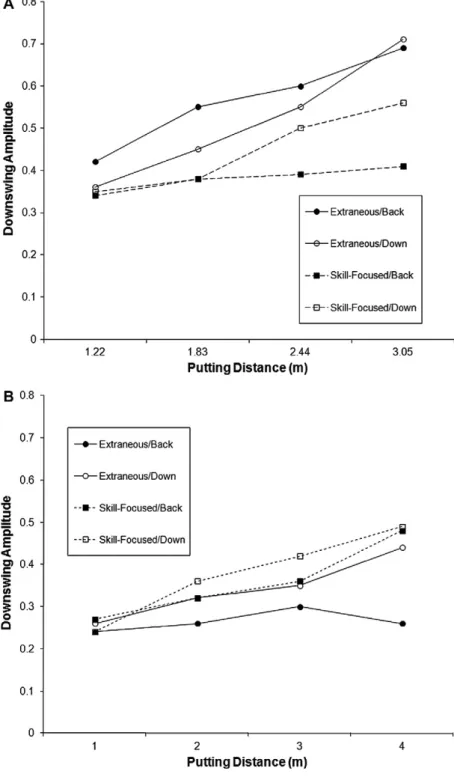
2.5.2.1. Downswing amplitude.The overall ANOVA for DS amplitude revealed a significant Exper-tiseSecondary TaskSwing SegmentDistance interaction,F(3, 54) = 12.6,p< .01,
g
2= 0.29 (see Fig. 3). To understand this interaction, we next looked at the relation between downswing amplitude and putting distance for novice and skilled golfers separately in the skill-focused and extraneous dual-task conditions. For experts, a 2 (Dual-Task Condition: skill-focused, extraneous),2 (Swing Segment: backswing, downswing)4 (Putting Distance: 1.22, 1.83, 2.44 and 3.05 m) ANOVA on downswing amplitude revealed a significant 3-way interaction, F(3, 54) = 7.2, p< .01,g
2= 0.18. As shown in Fig. 3A, DS amplitude increased as a function of distance more so in the extraneous condition than the skill-focused condition. Moreover, a Swing SegmentDistance ANOVA for the extraneous condi-tion revealed only a main effect of putting distance,F(3, 54) = 15.2,p< .001,g
2= 0.23. For both swing segments, DS amplitude increased as putting distance increased. In contrast, the same ANOVA in the skill-focused condition revealed a significant Swing SegmentDistance interaction,F(3, 54) = 5.5,
p< .01,
g
2= 0.13. As seen inFig. 3A, DS amplitude increased as distance increased, but only when the auditory cue occurred in the downswing.
Consistent with previous research (Delay et al., 1997), there was a weaker relationship between downswing amplitude and putting distance for novices. In addition, the effects of the two attention conditions were essentially opposite to that seen in the experts (Beilock et al., 2002). A 2 (Dual-Task Condition: skill-focused, extraneous),2 (Swing Segment: backswing, downswing)4 (Putting Dis-tance: 1.22, 1.83, 2.44 and 3.05 m) ANOVA on downswing amplitude revealed a significant 3-way inter-action,F(3, 54) = 4.8,p< .01,
g
2= 0.08. As seen inFig. 3B, for novices the DS amplitude increased as afunction of distance more so in the skill-focused condition than the extraneous condition. A Swing Seg-mentDistance ANOVA for the skill-focused condition revealed only a main effect of Putting Distance,
F(3, 54) = 3.1,p< .05,
g
2= 0.07. For both swing segments, downswing amplitude increased as puttingdistance increased. In contrast, the same ANOVA in the extraneous condition revealed a significant Swing SegmentDistance interaction,F(3, 54) = 2.9,p< .01,
g
2= 0.09. As seen inFig. 3B, DS amplitudeincreased as distance increased, but only when the auditory cue occurred in the downswing. Post-hoc comparisons between comparable conditions for experts and novices revealed that the DS amplitude was significantly greater for experts than novices in the following conditions: d = 1.22 m/ extraneous/backswing, t(18) = 8.2, p< .001, d= 0.73, d = 1.22m/extraneous/downswing, t(18) = 6.4,
p< .001,d= 0.61, d = 3.05m/extraneous/backswing, t(18) = 29.1,p< .001,d= 1.9, d = 3.05m/extrane-ous/downswing, t(18) = 23.1, p< .001, d= 1.6. None of the other comparisons were significant (pall > .05,d< 0.3).
2.5.2.2. Other movement variables. Mean values for the other movement variables analyzed in Experi-ment 1 are shown inTable 1for experts andTable 2for novices. The overall ANOVA for BMT revealed a significant ExpertiseSecondary TaskSwing SegmentDistance interaction,F(3, 54) = 3.7,p< .05,
g
2= 0.10. For both experts and novices there was a significant main effect of distance,F(3, 54) = 15.2, p< .01,g
2= 0.24. For experts, there was a significant main effect of condition,F(1, 18) = 7.2,p< .05,g
2= 0.22, and a significant ConditionSwing Segment interaction,F(1, 18) = 8.1,p< .05,
g
2= 0.15. As shown inFig. 4A this effect occurred because BMT was larger when the auditory cue for the skill-focused task was presented during the backswing than in the other conditions. None of the other effects were significant (pall >.1).
Fig. 3.The relationship between the downswing amplitude and putting distance as a function secondary task and swing segment in which the auditory cue was presented for experts (A) and novices (B).
The overall ANOVA for DMT revealed a significant ExpertiseSecondary TaskSwing Seg-mentDistance interaction,F(3, 54) = 3.2,p< .05,
g
2= 0.11. For experts, there was a significant main effect of condition,F(1, 18) = 5.3,p< .05,
g
2= 0.13, and a significant ConditionSwing Segment inter-action [F(1, 18) = 9.4,p< .05,
g
2= 0.19]. As shown in Fig. 4B this effect occurred because DMT wasshorter when the auditory cue for the skill-focused task was presented during the backswing than in the other conditions. For novices the main effect of attention condition was a significant,
F(1, 18) = 4.9,p< .05,
g
2= 0.12: as can be seen inFig. 4B DMT was shorter in the extraneous conditionthan in the skill-focused condition. None of the other effects were significant (pall >.1).
The overall ANOVA for TTPS revealed a significant ExpertiseSecondary TaskSwing Seg-mentDistance interaction,F(3, 54) = 5.1,p< .05,
g
2= 0.16. For experts, there was a significant maineffect of condition,F(1, 18) = 6.7,p< .05,
g
2= 0.14, and a significant ConditionSwing Segmentinter-action,F(1, 18) = 11.1,p< .05,
g
2= 0.21. As shown inFig. 4C, this effect occurred because TTPS wasshorter when the auditory cue for the skill-focused task was presented during the backswing than in the other conditions. None of the other effects were significant (pall >.1).
The overall ANOVA’s for DV and VI were not significant (pboth >.1).
2.5.3. Secondary task performance
The total number of response errors was calculated for the skill-focused and extraneous conditions in order to obtain an accuracy score for each condition. Participants’ judgments in the skill-focused task were determined to be correct or incorrect on each trial via the position tracker data. Specifically, for each stroke we used the position tracker data to calculate the time (relative to the onset of putter movement) at which the top of the backswing and ball contact occurred. We then used these values to determine if the auditory cue was presented closer to the beginning or end of each swing segment.
As shown inTables 3 and 4, secondary task accuracies were high across all conditions (M= 85.5%,
SE= 5.1). A 2 (Dual-Task Condition: skill-focused, extraneous),2 (Swing Segment: backswing, down-swing)4 (Putting Distance: 1.22, 1.83, 2.44 and 3.05 m)2 (Expertise: expert, novice) ANOVA on
Table 1
Mean values for other movement variables for experts in Experiment 1.
Distance (m) Skill-focused task Extraneous
Backswing Downswing Backswing Downswing
IT (s) 1.22 0.27 0.28 0.31 0.28 1.83 0.31 0.33 0.28 0.34 2.44 0.25 0.27 0.33 0.32 3.05 0.33 0.26 0.24 0.30 BMT (s) 1.22 0.50 0.40 0.41 0.40 1.83 0.59 0.49 0.44 0.47 2.44 0.62 0.53 0.50 0.53 3.05 0.66 0.55 0.53 0.52 DMT (s) 1.22 0.57 0.67 0.66 0.64 1.83 0.55 0.75 0.66 0.69 2.44 0.56 0.76 0.75 0.71 3.05 0.58 0.68 0.72 0.73 DSV (m/s) 1.22 0.61 0.65 0.71 0.69 1.83 0.77 0.77 0.83 0.75 2.44 0.93 0.98 1.01 0.88 3.05 1.12 1.21 1.19 1.07 TTPS (s) 1.22 0.26 0.33 0.35 0.29 1.83 0.28 0.37 0.31 0.35 2.44 0.25 0.35 0.39 0.32 3.05 0.30 0.36 0.34 0.37 VI (m/s) 1.22 0.91 0.87 0.91 0.94 1.83 1.42 1.32 1.12 1.32 2.44 1.56 1.77 1.71 1.55 3.05 1.92 2.01 2.02 1.97
secondary task accuracies revealed only significant main effect of secondary task, F(1, 18) = 12.4,
p< .01. Secondary task accuracy was significantly lower in the skill-focused (M= 77.7%,SE= 0.9%), than extraneous (M= 89.3%,SE= 0.9%) condition. This lack of difference across putting segment, putt distance, and especially expertise suggests that the putting results reported above are not due to trade-offs in performance with the secondary tasks (Tables 3 and 4).
2.6. Discussion
In Experiment 1 we predicted that putting accuracy and movement patterns would be significantly affected by manipulations designed to alter how golfers allocate attention during putting. Further-more, we predicted that the nature of the effects would depend on the type and timing of the second-ary task as well as the skill level of the golfer. As described in detail above, expert putting is thought to involve an open-loop backswing (where the downswing amplitude is preprogrammed based on the putting distance) followed by a closed-loop downswing (Coello et al., 2000; Craig et al., 2000). Based on this explanation of putting control we predicted the following for the expert golfers in Experiment 1. First, putting accuracy would be significantly higher in the extraneous condition as compared to the skill-focused condition (hypothesis i). Since attentional resources are not required during the back-swing (which is preprogrammed and not adjusted on the basis of feedback) nor are they needed to monitor the optical variable
s
departureduring the downswing (since the skill is well learned and hasbecome proceduralized) the addition of an extraneous secondary task would not be expected to harm performance.1Conversely, the attention to execution required in the skill-focused condition would be expected to harm performance by disrupting the pre-programmed backswing. Second, we predicted that
Table 2
Mean values for other movement variables for novices in Experiment 1.
Distance (m) Skill-focused Extraneous
Backswing Downswing Backswing Downswing
IT (s) 1.22 0.32 0.30 0.27 0.29 1.83 0.35 0.27 0.28 0.32 2.44 0.29 0.34 0.32 0.27 3.05 0.35 0.29 0.36 0.31 BMT (s) 1.22 0.47 0.46 0.43 0.47 1.83 0.49 0.51 0.45 0.55 2.44 0.59 0.59 0.56 0.53 3.05 0.61 0.62 0.57 0.56 DMT (s) 1.22 0.62 0.70 0.57 0.54 1.83 0.63 0.65 0.56 0.61 2.44 0.61 0.66 0.65 0.51 3.05 0.59 0.61 0.52 0.52 DSV (m/s) 1.22 0.66 0.59 0.64 0.70 1.83 0.73 0.75 0.81 0.85 2.44 0.96 0.93 1.02 1.01 3.05 1.11 1.17 1.22 1.26 TTPS (s) 1.22 0.33 0.31 0.25 0.23 1.83 0.26 0.28 0.28 0.30 2.44 0.31 0.26 0.26 0.22 3.05 0.30 0.31 0.24 0.28 VI (m/s) 1.22 0.93 0.92 0.81 0.95 1.83 1.32 1.62 1.42 1.22 2.44 1.67 1.99 1.85 1.54 3.05 1.88 2.07 2.00 1.87 1
It is important to distinguish between visual-control and attentional-control. Just because an action is continuously regulated on the basis of visual information does not mean that attention to the action is required nor does it mean that it is easier to consciously access the perceptual-motor processes during execution; for example, to make an explicit judgment about movement.
the relationship between downswing amplitude and putting distance would be significantly stronger in the extraneous condition as compared to the skill-focused condition because in the later case attention to execution would disrupt the motor program for the backswing (hypothesis ii). Finally, we predicted that the effects of the skill-focus condition on putting accuracy and movement would be significantly larger when the auditory cue was presented in the ballistic part of the movement (i.e., the backswing) than in the continuously controlled phase of the movement (i.e., the downswing) (hypothesis iii).
As can be seen inFigs. 1–3, the pattern of results obtained in Experiment 1 for experts are largely consistent with our hypotheses. Expert golfers in the present study putted more accurately in the extraneous condition as compared to the skill-focused condition and these putting differences were reflected by a stronger relation between DS amplitude and putting distance in the former as compared to the latter condition. There were also significant differences in the backswing and downswing MTs and TTPS. In all cases, for the condition in which experts had the worse putting performance (i.e., skill-focused task/backswing) the change in movement variables was in the direction of a less skilled per-former relative to conditions in which putting accuracy was higher: DMT decreased, BMT increased and TTPS occurred earlier. As discussed in detail byDelay et al. (1997), the effects for these other movement variables are consistent with the idea that golfers of different skill level control the DS amplitude differently. Finally, where in the swing segment (i.e., backswing or downswing) skilled golf-ers were prompted to attend to performance also impacted putting movements and accuracy. The ear-lier this occurred (i.e., in the backswing vs. downswing), the more harmed skilled golfers were. Analysis of this timing effect in terms of SOA (seeFig. 2) revealed that the swing segment in which the auditory cue was presented was a stronger predictor of performance than the SOA providing addi-tional support for the notion that the different segments involve distinct modes of control.
A very different pattern of results was expected for novice golfers. First, we predicted that for nov-ices putting accuracy would be significantly higher in the skill-focus condition than in the extraneous condition since novice control is thought to normally involve constant online monitoring (hypothesis iv). Second, we predicted the relationship between downswing amplitude and putting distance would not be significantly different in the two attention conditions (hypothesis v). The ability to program a DS amplitude that is appropriate for a given putting distance is presumably an aspect of the skill that is developed through extensive practice and we had no a priori reason to expect it would be altered by a shift in the location of the golfer’s focus of attention. Finally, we predicted that putting accuracy and movement patterns would not be significantly different for conditions in which the auditory cue was presented in the backswing versus when it was presented in the downswing (hypothesis vi). Since novice execution presumably involves the same type of control mode (continuous) throughout the entire movement we did not expect it to be differentially affected by the timing of the secondary task stimulus.
Table 3
Mean percent correct in the secondary task for experts in Experiment 1.
Distance (m) Skill-focused Extraneous
Backswing Downswing Backswing Downswing
1.22 83.6 75.5 93.5 92.7
1.83 84.5 77.3 90.3 94.2
2.44 82.1 73.2 89.8 88.7
3.05 80.5 74.2 92.4 90.4
Table 4
Mean percent correct in the secondary task for novices in Experiment 1.
Distance (m) Skill-focused task Extraneous
Backswing Downswing Backswing Downswing
1.22 82.1 79.2 86.5 88.7
1.83 78.2 77.5 86.7 87.4
2.44 79.6 80.1 84.2 89.2
The results from Experiment 1 were only partially consistent with these predictions for novice golf-ers. As expected, novice putting accuracy was worse when individuals were prompted to allocate attention away from execution (i.e., the extraneous condition) in comparison to situations in which individuals were prompted to attend to a component process of execution (i.e., skill-focused condi-tion). The DS amplitude-distance relationship did not show the predicted effects as downswing ampli-tude increased as a function of distance more so in the skill-focused condition than the extraneous condition. In other words, in the condition where putting accuracy was the highest novice movement patterns more closely resembled the typical pattern observed for experts. This finding suggests that skill level differences in the DS amplitude-distance relationship previously reported byDelay et al. (1997)may be at least partially due to differences in attentional allocation. There was also an unex-pected effect of the timing of the auditory cue for novices: both putting accuracy and the strength of the relationship between DS amplitude and putting distance were significantly greater when the cue was presented in the downswing compared to the backswing. Further analysis of this effect revealed that the SOA of the auditory cue was a stronger predictor of these effects than the swing segment in which it occurred (seeFig. 2). One possible explanation for this effect could be that execution errors made early in the putting stroke are likely to cause larger absolute performance errors as compared to those made near the point of contact. This is discussed in more detail below.
3. Experiment 2
The purpose of Experiment 2 was to compare the relative ability of novice and expert golfers to stop their putt mid-stroke. If novices attend more to execution, they may actually have more control over their putting stroke. Moreover, it may be that attention to one instance of performance impacts atten-tion to others. Thus, an addiatten-tional goal of this experiment was to address a quesatten-tion that has not been explored previously: Do manipulations which direct attention during skill execution (e.g., instructions, secondary tasks, feedback) have an impact on subsequent performance in which attention is not being manipulated and the performer is free to execute the action as they normally would? To test these ideas, novice and skilled golfers completed 100 putting trials. On 60 of these trials, no stop cue was pre-sented. On 20 trials, the cue was presented during the backswing and on 20 trials the cue was presented during the downswing. If attending to one instance of performance carries implications for another, then stopping on some trials may impact performance on others. Such a result would carry significant implications for players and coaches who want to maximize attention to performance in some situa-tions (e.g., to optimize kinematics during practice) but not others (e.g., game situasitua-tions) where optimal performance outcomes rather than optimal kinematics is the primary goal.
3.1. Methods 3.1.1. Participants
Participants were undergraduate students from Arizona State University. Novice golfers (n= 10) had no previous golf experience. Skilled golfers (n= 10) all had a Professional Golf Association (PGA) handicap of <10 and, on average, 9.2 years of competitive golfing experience. All participants were naïve to the aims of the experiment and were paid an hourly rate for study participation. The participants used in Experiment 2 were not the same as those used in Experiment 1. The study was approved by the Arizona State University Research Ethics Committee and all participants gave informed consent.
3.1.2. Apparatus
The apparatus used in Experiment 2 was the same as Experiment 1.
3.1.3. Procedure
The basic putting procedure for Experiment 2 was similar to that used in Experiment 1. Specifically, each putt began with the experimenter verbally indicating the putting distance to the participant. Participants then placed the ball at the specified distance (marked with lines on the green) and aligned
Fig. 4.Mean backswing movement times (A), downswing movement times (B) and time to peak speeds (C) as a function of attention condition and swing segment.
their body to initiate the putt. We did not measure or analyze body alignment. Participants next gave a verbal response to the experimenter to indicate when they were ready to execute the putting stroke at which time the experimenter pressed a button to play the auditory start signal (an audio file of a per-son saying ‘‘go’’).
On certain trials unbeknownst ahead of time to participants, an auditory cue (pure tone, fre-quency = 500 Hz, duration = 150 ms) was presented during the putting stroke. Using the position tracker technique utilized in Experiment 1, cues were presented at a random time in either the back-swing or downback-swing segment of the putting stroke. Participants were instructed that when they heard the tone, they should stop the movement of the putter as quickly as possible. They were further in-structed that: ‘‘they should keep the putter in the swing plane during the stopping action and that they should avoid moving the putter abruptly on another trajectory when attempting to stop the stroke’’ (e.g., lifting it straight up). For conditions in which no tone was presented participants were instructed to execute a normal putting stroke. As in Experiment 1, following each putt, the experi-menter measured the radial distance between the center of the target and the final position of the ball (in cm).
Each participant first completed two blocks of 30 baseline putts in which no stopping tone was pre-sented. As in Experiment 1, position tracker data from these practice trials was used to measure the timing of the putting stroke for each participant. This timing information was later used to control tone presentation. Each of the four putting distances were repeated 15 times in random order across these two blocks. Participants then practiced the stopping task (20 trials presented in a random order of which half consisted of the stopping tone).
Each participant then completed 4 blocks of 30 experimental putts with short breaks between blocks. These 120 experimental trials were comprised of 60 trials in which no cue was presented (15 repeats for each of the four distances), 20 trials in which the cue was presented during the back-swingsegment (5 repeats of each of the four distances), 20 trials in which the cue was presented dur-ing thedownswingsegment (5 repeats of each of the four distances), and 20 filler trials in which the cue was presented after ball contact (5 repeats of each of the four distances). As in Experiment 1, these latter filler trials were designed to ensure that participants were not anticipating where in the putting stroke swing tones would be presented. Participants were not required to attempt to stop the putting stroke on these trials therefore they were not analyzed. The order of presentation of these different trials was randomized across the experimental block and across participants.
3.1.4. Data analysis
3.1.4.1. Putting accuracy. The mean distance from the target for each participant (averaged across the 15 repeats) was first submitted to a 2 (Task: stop, baseline)4 (Putting Distance: 1.22, 1.83, 2.44 and 3.05 m)2 (Expertise: skilled, novice) mixed-factor ANOVA. Post-hoc comparisons were made be-tween comparable conditions for experts and novices usingt-tests with Bonferonni corrected for type I error. The corrected alpha value was .025.
3.1.4.2. Stopping distance.For trials in which an auditory cue was presented, we looked at the distance required to stop the putter. We did not look at putting accuracy in these trials because no actual con-tact was made with the ball. We calculated stopping time (defined as the time between the onset of the auditory cue and the time when zero club head velocity was reached) using the position tracker. Stopping distance was defined as the linear distance the club head traveled during this interval. Both stopping distance and stopping time were analyzed using 2 (Swing Segment: backswing, down-swing)4 (Putting Distance: 1.22, 1.83, 2.44 and 3.05)2 (Expertise: skilled, novice) mixed factor ANOVAs. Post-hoc comparisons were made between comparable conditions for experts and novices using Bonferonni correction for type I error with a corrected alpha value of .025.
3.1.4.3. Downswing amplitude.The mean downswing amplitude for each participant (averaged across the 15 repeats for each distance) was first submitted to a 2 (Task: stop, baseline)4 (Putting Dis-tance: 1.22, 1.83, 2.44 and 3.05 m)2 (Expertise: skilled, novice) mixed-factor ANOVA. Post-hoc com-parisons were made between comparable conditions for experts and novices using Bonferonni
correction for type I error with a corrected alpha value of .0125. These comparisons were again made only for the smallest and largest putting distances.
3.1.4.4. Other movement variables. The movement variables that demonstrated significant effects in Experiment 1 were also analyzed in Experiment 2. These variables were BMT, DMT and TTPS and were analyzed using 2 (Task: baseline, stop)4 (Putting Distance: 1.22, 1.83, 2.44 and 3.05 m)2 (Exper-tise: skilled, novice) mixed-factor ANOVAs.
The Greenhouse-Geisser correction for sphericity was used for all ANOVAs and partial
g
2andCo-hen’sdwere used as measures of effect size. Unless otherwise stated the alpha level for all statistical tests was .05.
3.2. Results
3.2.1. Putting accuracy
As in Experiment 1, we began by removing all data in which the tone was not presented in the des-ignated swing segment. These removed trials accounted for 7% of the data.
Our main putting performance analysis of interest centers around determining whether stopping the putting stroke on randomly-selected trials affected performance on the trials in which stopping was not required. To address this issue, we compared putting accuracy on the 60 trials in which no cue was presented (i.e., no stop trials) with the accuracy in the 60 single-task baseline trials conducted at the beginning of Experiment 2. It is important to note that the order of the baseline and no stop trials is not counterbalanced. This was done in order to get a measure of single-task putting perfor-mance before our experimental manipulation was introduced. Once individuals were informed that, on certain putting trails, they would be told to stop, obtaining a true measure of single-task perfor-mance would be difficult. Nonetheless, because everyone performed our task in the same order, it would be hard to explain any differences as a function of skill level in terms of task order.
Fig. 5shows putting accuracy for the no-stop trials and baseline putting accuracy for the skilled and novice golfers. There was a significant main effect of putting distance, F(3, 54) = 14.2, p< .001,
0 5 10 15 20 25 30
No-stop Baseline Stop Task Task
Mean distance from hole (cm)
Experts Novices
Fig. 5.Mean putting accuracy for the condition in which participants were required to stop their putting stroke on random trials (‘‘Stop Task’’) versus the condition where no stopping trials were interleaved (‘‘Baseline’’). Data for the Stop Task only include trials in which there was no stop signal. Bars are standard errors.
g
2= 0.34, with higher putting accuracy at shorter putting distances. There was also a significant maineffect of expertise in which skilled golfers were more accurate putters overall than novices,
F(1, 18) = 8.5, p< .01,
g
2= 0.21. This main effect, however, was qualified by a significantexper-tiseputting condition interaction,F(1, 18) = 5.6,p< .05,
g
2= 0.18. Putting performance for expertsdecreased when putts were interleaved with stopping trials (i.e., from the baseline to no-stop trials),
t(9) = -8.5,p< .001,d= 2.3. In contrast, for the novices, putting performance improved when putts
Fig. 6.A: Mean stopping distance (A) and time (B) as a function of expertise and the stroke segment in which the auditory cue was presented. Bars are standard errors.
were interleaved with the stop trials,t(9) = 3.56,p< .001,d= 0.82. No other main effects or interac-tions were significant. Post-hoc comparisons revealed that putting accuracy was significantly higher for experts both in no-stop baseline, t(18) = 31.3, p< .001, d= 3.6] and stop task conditions,
t(18) = 5.1,p< .05,d= 0.76.
3.2.2. Movement patterns
3.2.2.1. Stopping distance.Fig. 6A shows the mean stopping distance for skilled and novice golfers as a function of the swing segment in which the auditory cue was presented. There was a significant main effect of expertise. The mean stopping distance was smaller for novices (M= 9.8 cm,SE= 0.4 cm) than for skilled golfers, (M= 13.1 cm,SE= 0.5 cm),F(1, 18) = 9.3,p< .01,
g
2= 0.26. There was also asignif-icant main effect of distance,F(3, 54) = 8.2,p< .001,
g
2= 0.19. Mean stopping distance increased asputting distance increased. There was also a significant ExpertiseSwing Segment interaction,
F(2, 36) = 4.7,p< .05,
g
2= 0.13. For skilled golfers, the mean stopping distance increased as the stoptone was presented later in the swing,t(9) = 4.1,p< .01,d= 0.77. There was no significant effect of swing segment for novices,t(9) = 0.3,ns,d= 0.33. No other main effects or interactions were signifi-cant. Post-hoc comparisons revealed that mean stopping distance was significantly smaller for novices (as compared to experts) when the auditory cue was presented in the downswing, t(18) = 21.2,
p< .001,d= 2.1 but there was no significant difference when the cue was presented in the backswing (t(18) = 2.7,p> .05,d= 0.4).
As shown inFig. 7, we also analyzed the significant timing effect observed for experts in terms of the SOA of the auditory cue. A multiple regression performed on these data revealed SOA to be a sig-nificant predictor of stopping distance,t(358) = 10.5,p< .001,d= 3.1, while swing segment was not significant (p> .1,d= 0.41).
Similar results were obtained for stopping time (shown inFig. 6B). The mean stopping time was significantly smaller for novices,F(1, 18) = 4.2,p< .05,
g
2= 0.15. There was also a significant mainef-fect of distance,F(3, 54) = 11.3,p< .001,
g
2= 0.24. Mean stopping time increased as putting distanceincreased. There was also a significant expertiseswing segment interaction,F(2, 36) = 3.2,p< .05,
g
2= 0.14. For skilled golfers, the mean stopping time increased as the stop tone was presented laterin the swing,t(9) = 3.8,p< .05,d= 0.61. There was no significant effect of swing segment for novices,
t(9) = 1.2,ns,d= 0.22. No other main effects or interactions were significant. Post-hoc comparisons re-vealed that mean stopping time was significantly shorter for novices (as compared to experts) when the auditory cue was presented in the downswing,t(18) = 8.2,p< .01,d= 0.9, but there was no signif-icant difference when the cue was presented in the backswing (t(18) = 0.5,p> .01,d= 0.21).
3.2.2.2. Downswing amplitude.Fig. 8shows the DS amplitude-distance relationship for the baseline and stop tasks for experts and novices. The ANOVA performed on these data revealed a significant TaskDistanceSkill Level interaction:F(3, 54) = 3.7,p< .05,
g
2= 0.15. For experts, a 2 (Task:base-line, stop)4 (Distance) ANOVA revealed a significant TaskDistance interaction, F(3, 54) = 5.6,
p< .01,
g
2= 0.22. As can be seen inFig. 8, this occurred because the relationship between DSampli-tude and distance was stronger in the baseline task as compared to the stop task for experts. The TaskDistance interaction was not significant for novices. Post-hoc comparisons revealed that the DS amplitude was significant higher for experts than novices for the following conditions: d = 1.22 m, baseline, t(18) = 3.6, p< .01, d= 0.77, and d = 3.05 m, baseline, t(18) = 12.3, p< .001,
d= 1.9. None of the other comparisons were significant (pall >.05,d< 0.5).
3.2.2.3. Other movement variables. Mean values for the other movement variables analyzed are shown inTable 5. Only TTPS showed significant effects related to task condition. The overall ANOVA for TTPS revealed a significant TaskDistanceSkill Level interaction,F(3, 54) = 4.7,p< .05,
g
2= 0.18. Forex-perts, there was a significant main effect of condition,F(1, 18) = 7.2,p< .05,
g
2= 0.15. As can be seen in Table 5this effect occurred because TTPS was longer in the baseline task than in the stop task. None of the other effects were significant (pall >.1).3.3. Discussion
As was the case with Experiment 1, the results of Experiment 2 are mostly consistent with our predictions based on theories of perceptual-motor control in golf-putting. Since novice performance
involves attention to skill execution during all phases of the swing while expert performance does not, we would expect novices to be able to stop their putting stroke more quickly in response to an explicit auditory cue than experts (hypothesis i). To stop the putting stroke, the experts in our study presum-ably had to first direct their attention to the current position of the club leading to a greater stopping distance than the novices golfers that did not require this step. The results also supported our predic-tions that interleaving stopping trials with normal putts would decrease putting accuracy for experts (hypothesis iii) while increasing accuracy for novices (hypothesis vi). Since stopping the putting stroke presumably requires the golfer to pay attention to the movement of the putter, this task would be ex-pected to induce a skill-focused attentional focus which is known to have opposite effects on novice and expert performance (Beilock et al., 2002). What is unique about the present findings however, is the attentional effects in Experiment 2 of the present study were ‘‘offline’’. Whereas previous research (and Experiment 1 of the present study) has used ‘‘online’’ manipulations to directly shift attention on every trial (i.e., either through the use of secondary tasks or performance instructions), during the nor-mal putts in Experiment 2 of the present study we did not manipulate attention in any way. In this case the need for skill-focused attention to perform the stopping task on some trials ‘‘spilled-over’’ onto trials in which it was not required.
As predicted we found an effect of swing segment for experts in Experiment 2, however, the effect was opposite to our prediction (hypothesis ii). Specifically, experts were significantly better at stop-ping their putting stroke when the stop signal was presented during the backswing than when it was presented during the downswing. On the surface, this result is surprising since expert putting ap-pears to involve a pre-programmed, open-loop backswing and a continuously-controlled, closed-loop downswing. Intuitively, we might expect that it is easier to ‘‘break into’’ and stop a closed-loop action where movement is being regulated on the basis of feedback than an open-loop action that is encap-sulated and ‘‘running free’’. The dual-task results from Experiment 1 support this notion. However, in-stead of being a result of the mode of control, the swing segment effect found for experts in Experiment 2 appears to be due to the timing of the stop signal relative to the start of the putting stroke (i.e., SOA). As shown inFig. 7, SOA was a significant predictor of stopping distance while swing segment was not. The ability to suddenly stop a motor action has been investigated extensively using the stop-signal task (Lappin & Eriksen, 1966). This task is a variation of a simple reaction time (RT) measurement. On each trial the participant is presented with a go signal (e.g., a light turning on) and instructed to make a simple motor response (e.g., pressing a button, extending their arm) as quickly as possible when this go signal is detected. On some trials a stop signal (e.g., a brief auditory tone) is also presented and participants are instructed to inhibit the motor response when the stop signal is detected. One of the main findings of this line of research is that the probability of success-fully inhibiting the motor response is inversely proportional to the stimulus onset asynchrony (SOA) between the go and stop signals. This effect has been modeled as a race between independent
Table 5
Mean values for other movement variables in Experiment 2.
Distance (m) Experts Novices
Baseline Stop task Baseline Stop task
BMT (s) 1.22 0.44 0.43 0.55 0.62 1.83 0.46 0.52 0.60 0.64 2.44 0.50 0.57 0.67 0.71 3.05 0.55 0.61 0.70 0.72 DMT (s) 1.22 0.57 0.57 0.61 0.75 1.83 0.55 0.53 0.66 0.62 2.44 0.56 0.51 0.70 0.77 3.05 0.58 0.60 0.79 0.68 TTPS (s) 1.22 0.36 0.22 0.25 0.29 1.83 0.39 0.27 0.22 0.25 2.44 0.45 0.25 0.29 0.23 3.05 0.38 0.26 0.24 0.26