Calhoun: The NPS Institutional Archive
Reports and Technical Reports All Technical Reports Collection
2009-12-01
Integrating Electronic Reverse Auctions
into Defense Procurement: Exploratory
Research on Opportunities, Issues,
Processes, Risks and Cultural Implications
Coyne, Adam
Approved for public release, distribution is unlimited.
Prepared for: Naval Postgraduate School, Monterey, California 93943
NPS-CM-09-125
^`nrfpfqflk=oÉëÉ~êÅÜ=
péçåëçêÉÇ=oÉéçêí=pÉêáÉë=
=
Integrating Electronic Reverse Auctions into Defense Procurement: Exploratory Research on Opportunities, Issues,
Processes, Risks, and Cultural Implications 18 December 2009
by
Capt. Adam V. Coyne, USAF, and LTJG Michael J. Collins, USN
Advisors: Lt. Col. Timothy G. Hawkins, Military Assistant Professor, and
Bryan J. Hudgens, Lecturer
Graduate School of Business & Public Policy
The research presented in this report was supported by the Acquisition Chair of the Graduate School of Business & Public Policy at the Naval Postgraduate School.
To request Defense Acquisition Research or to become a research sponsor, please contact:
NPS Acquisition Research Program
Attn: James B. Greene, RADM, USN, (Ret) Acquisition Chair
Graduate School of Business and Public Policy Naval Postgraduate School
555 Dyer Road, Room 332 Monterey, CA 93943-5103 Tel: (831) 656-2092
Fax: (831) 656-2253
e-mail: [email protected]
Copies of the Acquisition Sponsored Research Reports may be printed from our website www.acquisitionresearch.org
= =
Abstract
This case study explores the first and only electronic reverse auction (e-RA) conducted by the United States Air Force (USAF) in Kuwait and addresses both theoretical gaps in e-RA knowledge and practitioner gaps within the Department of Defense (DoD). Qualitative research based on a single case study explored 1) cultural implications of conducting an e-RA in the Middle East and 2) procedures DoD contracting officers could follow to use e-RAs for stateside and contingency procurements—and expected savings from doing so. Findings suggest that Middle Eastern sellers with a cultural disposition to avoid risky technology-based acquisition participated in the USAF auction because they trusted the USAF more than buyers in the local market. Sellers also felt increased satisfaction with the e-RA even when they did not win because the process increased fairness, transparency and reduced the negative effects of wasta (i.e., using connections or influence) and the general Arab business climate of distrust, unfairness, and favoritism. Secondly, a detailed spend analysis of FY07–08 USAF spend data, extrapolated across the DoD, suggests the DoD is leaving billions of dollars on the table by not using e-RAs. Drawing on the results, implications for theory and practice are explicated. Finally, study limitations are disclosed, and opportunities for future research are identified.
Keywords: Electronic Reverse Auctions, e-RA, National Culture, Technology
=
Acknowledgments
We would like to thank the following:
Professor Hawkins for his contagious optimism and constant confidence in our pursuit of a first-rate project;
Monterey Consultants, Inc., for providing spend data essential for the construction of our spend analysis for the United States Air Force;
The staff at Sorcity.com for their open communication and insight into their business processes and knowledge into online reverse auctions;
FedBid, Inc., for openly sharing its company’s reverse auction products, customers, and philosophies;
CECOM for providing another look at what electronic reverse auctions are capable of achieving;
NAVICP personnel for providing valuable reverse auction data, which assisted in our efforts;
Interview participants and the Kuwaiti managers for allowing us to take away from their business schedules and for providing candid responses, which greatly aided the validity of our research;
DCMA for their outstanding logistics support while in Kuwait—without such support, this project would not have been possible;
The Department of Defense military and civilian contracting personnel who graciously shared their time and knowledge with us; and
Family and friends who kindheartedly inquired about our research and, at a minimum, pretended to enjoy our long-winded discussion on electronic reverse auctions.
=
About the Authors
Captain Adam V. Coyne currently serves as Chief, Strategic Sourcing
Operations Flight, HQ Air Force Materiel Command (AFMC/PKY), Wright-Patterson AFB, OH. His duty phone number is DSN: 787-5975 and e-mail is
[email protected]. Captain Coyne is a graduate of the Naval Postgraduate School of Business and Public Policy.
Lieutenant Junior Grade Michael Collins is currently deployed in support of Operation Iraqi Freedom. He currently serves as a Contract Specialist for the Joint Contracting Command- Iraq/Afghanistan (JCCI-I/A) and is a graduate of the Naval Postgraduate School of Business and Public Policy.
=
= = = NPS-AM-09-125
^`nrfpfqflk=oÉëÉ~êÅÜ=
péçåëçêÉÇ=êÉéçêí=pÉêáÉë=
=
Integrating Electronic Reverse Auctions into Defense Procurement: Exploratory Research on Opportunities, Issues,
Processes, Risks, and Cultural Implications 18 December 2009
by
Capt. Adam V. Coyne, USAF, and LTJG Michael J. Collins, USN
Advisors: Lt. Col. Timothy G. Hawkins, Military Assistant Professor, and
Bryan J. Hudgens, Lecturer
Graduate School of Business & Public Policy
Naval Postgraduate School
Disclaimer: The views represented in this report are those of the author and do not reflect the official policy position of the Navy, the Department of Defense, or the Federal Government.
= =
=
Table of Contents
List of Acronyms and Abbreviations ... xiii
I. Introduction ... 1
A. Background ... 1
B. How e-RAs Work and Why They Matter... 1
C. Federal Application of e-RAs ... 3
D. Purpose of Research... 4
E. Problem Statements AND Research Questions ... 6
F. Methodology ... 7
G. Theoretical Implications... 9
H. Management Implications... 10
I. Scope and Limitations ... 11
II. Literature Review ... 13
A. Introduction... 13
B. Auction Theory ... 13
C. Use and Appropriateness of e-RAs ... 15
D. National Culture... 18
E. Technology Adoption Model (TAM) ... 21
F. Relational Exchange... 24
G. DoD’s Use of e-RAs ... 25
III. Methodology... 35
A. Introduction and Overview... 35
B. Methods of Answering Research Questions... 37
D. Data Collection ... 41
E. Data Analysis ... 46
IV. Findings—National Culture ... 53
A. Introduction... 53
B. The Middle Eastern Business Climate... 56
C. How e-RA works within the Middle Eastern business climate ... 58
D. Antecedents for Supplier Use ... 73
E. Obtaining a Fair and Reasonable Price... 75
V. Findings—Application of e-RAs ... 83
A. Introduction and Overview... 83
B. Spend Analysis Results... 84
D. Spend Analysis Results for DoD and AFCENT ... 91
E. Identifying good e-RA Candidates (EAM Model) ... 94
F. Building a FAR-Compliant e-RA ... 101
G. Safe Guarding Against Protests ... 108
H. Integrating e-RAs into Full Trade-off Source Selections... 114
I. Overcoming Barriers to e-RA Use ... 117
J. Summary ... 120
VI. Conclusion and Recommendations ... 121
A. Introduction... 121
B. Answers to Research Questions ... 122
C. Theoretical Implications... 126
D. Managerial implications ... 128
=
F. Limitations of Research ... 134
G. Summary ... 135
List of References... 137
Appendix A. Top 50 FSC/PSC Categories ... 149
Appendix B. Sample Contingency: Instructions to Offerors ... 151
Appendix C. Sample Contingency: Evaluation Factors for Award... 155
Appendix D. CECOM Two-step Section L (Sample)... 159
Appendix E. E-RA QUESTIONNAIRE (Initial) ... 161
Appendix F. Initial Survey ... 169
Appendix G. WASTA Follow-up Survey/Questionnaire... 173
Appendix H. List of Data Attributes... 177
Appendix I. Cluster Chart ... 179
APPENDIX J. Frequency of Codes ... 181
Appendix K. SAP using Price-Only Model ... 185
Appendix L. SAP using Trade-Off ... 187
Appendix M. FAR Part 15 using LPTA ... 189
=
=
List of Acronyms and Abbreviations
AFCENT United States Air Forces Central
AFFARS Air Force Federal Acquisition Regulation Supplement
B2B Business-to-business B2C Business-to-consumer
CECOM United States Army Communications and Electronics Command
CO Contracting Officer
CONS Contracting Squadron CONUS Continental United States
CTT Commitment-trust Theory
DFAR Defense Federal Acquisition Regulations
DoD Department of Defense
DSCP Defense Supply Center Philadelphia
EAM e-RA Appropriateness Model
ECES Expeditionary Civil Engineering Squadron ECONS Expeditionary Contracting Squadron e-RA Electronic Reverse Auction
FAR Federal Acquisition Regulation
FY Fiscal Year
GAO Government Accountability Office (previously General Accounting Office)
IRB Institutional Review Board
MCI Monterey Consultants Incorporated
NAVICP Naval Inventory Control Point
OCONUS Outside the Continental United States OFPP Office of Federal Procurement Policy OMB Office of Management and Budget
PD Power Distance
PEOU Perceived Ease of Use
PU Perceived Usefulness
RFP Request for Proposal
SAF/AQC Secretary of the Air Force for Acquisition
TAM Technology Adoption Model
UA Uncertainty Avoidance
USAAVE United States Army Auction and Valuation Engine USAF United States Air Force
=
I. Introduction
A. BackgroundOver the past decade, the growth of information technology—specifically the internet—has fundamentally changed how consumers communicate and conduct business on a global scale (Friedman, 2005). Some historians believe the spread of e-commerce is comparable to innovation along the lines of the steam engine, telephone, and television (Turley, 2002). Moreover, while this shift to e-commerce continues to spread to undeveloped areas of the world, the impact of technology’s footprint remains unclear. What we do know is that e-commerce has changed and will continue to change business-to-business (B2B) and business-to-consumer (B2C) interactions fundamentally. Perhaps nowhere is this transformation more pronounced than in the manufacturing industry, where companies like General Electric have turned to innovative e-commerce strategies to reduce the cost of goods and services they procure (Trent & Monczka, 2003). One such strategy involves using online sourcing tools such as electronic reverse auctions (e-RA) to maximize supplier competition. Over the past decade, e-RAs have received both academic and practitioner attention.
B. How e-RAs Work and Why They Matter
Generally defined, an e-RA is “an online, real-time dynamic auction between a [single] buying organization and a group of suppliers who compete against each other to win the [buyer’s] business” (Beall et al., 2003, p. 8). E-RA essentially works “like eBay in reverse” (FedBid, 2009, January, p. 2), with multiple suppliers simultaneously bidding down the amount they will charge a buyer for providing a good or service. This differs from the traditional “forward” auction, like eBay, in which multiple buyers bid the price up until a winner is determined. E-RAs differ from traditional auctions because they allow “immediate bidder feedback and enable geographic and temporal conveniences” (Jap, 2002, p. 512). In layman’s terms, this means that e-RAs allow bidders the convenience
of placing orders over the internet from anywhere in the world, with added benefits of immediate feedback through real-time, transparent bidding. For a discussion on formats, types, and differences between e-RAs and theoretical auctions, see Jap (2002).
The business case for e-RAs is compelling. Studies show buyers can typically save 5%-40% (Tully, 2000)—with an average of 20% (Cohn, 2000)—on the cost of goods and services they procure by allowing multiple bids per offeror, versus the typical one-proposal (or limited exchanges) currently used in
government contracting. This mechanism creates significant savings because vendors are able to respond with successive downward bids until the lowest-cost vendor prevails. Other benefits include the reduction of award cycle-time by up to 40% (Beall et al., 2003), increased bidding transparency, and higher price
visibility (Kaufman & Carter, 2004; Schrader, Schrader & Eller, 2004; Smart & Harrison, 2002). Given these savings, it is no surprise that 31% of firms reported using e-RAs as one tool in their mix of strategic sourcing strategies1 (Amelinckx,
Muylle & Lievens, 2008), and the trend is growing (Sorcity, personal
communication, March 26, 2009; Hawkins, Gravier & Wittmann, forthcoming). The data in Table 1 indicates a recent growth trend in the e-RA industry.2
Table 1. 2009 e-RA Growth Trends
(Sorcity, personal communication, March 26, 2009)
CATEGORY CHANGE
Unsolicited Interest in E-bidding from Organizations Up 440% Change in Average e-RFQ Dollar Value Up 150% Solicited Interest in E-bidding from Organizations Up 20%
Change in Average Savings Achieved to 23% Up 5%
1
Data current as of 2006.
2
=
Some researchers, however, suggest e-RAs might damage the buyer-supplier relationship (Jap, 2002; 2003; 2007; Jap & Haruvy, 2008; Emiliani, 2004; Carter et al., 2004). This could include the erosion of trust through perceived opportunistic buying behavior (Smeltzer & Carr, 2002; Jap, 2002; 2003; Nair, 2005; Gattiker, Huang & Schwarz, 2006; Tassabehji, Taylor, Beach & Wood, 2006). Such erosion of trust may outweigh the monetary benefits associated with e-RAs and invite retaliatory pricing or poor supplier performance (Jap, 2002; Carter et al., 2004). These criticisms, to an extent, remain largely speculative because researchers who have studied relational impact have not found
supporting evidence that e-RAs negatively impact the buyer-supplier relationship (Jap & Haruvy, 2008). Other researchers point out that not all transactions are suitable, desirable, or efficient for establishing relational exchange (Kraljic, 1983; Smart & Harrison, 2002). Companies often employ a portfolio approach towards strategic sourcing in which companies adjust their procurement strategy based on the criticality of the item or service and its supply risk (e.g., availability of suppliers). Under Kraljic’s framework (1983), companies’ relational exchange becomes more important as the criticality of the item increases and the
availability of capable suppliers decreases. When the end item is of low value and when many capable suppliers are willing to compete, efficient, non-relational mechanisms are appropriate (Kraljic, 1983). Regardless of their stance on e-RAs, many academicians feel e-RAs are here to stay (Jap, 2002; Sashi & O’Leary, 2002; Schoenherr & Mabert, 2007).
C. Federal Application of e-RAs
In early 2000, the DoD took note of e-RA savings and conducted research and pilot programs to determine whether e-RAs conflict with the regulations and laws governing Federal acquisitions (SAF/AQC, 2001; Turley, 2002; Brown & Ray, 2007). Initial success prompted the Navy and Army to develop e-RA applications and policy in order to leverage industry for commercially available, low-dollar commodities. The Air Force, however, took a different approach in
2001 by 1) acknowledging e-RAs as a pricing tool and 2) decentralizing the USAF’s use of e-RA use as a judgment call by individual contracting officers (COs) in the field without providing training (SAF/AQC, 2001; Turley, 2002). As a result, United States Air Force (USAF) COs, already burdened by the operational tempo in Iraq and Afghanistan and downsizing (Commission, 2007), rarely used-RAs in procurements, while other Federal agencies more readily employed e-RAs, saving millions and exceeding socioeconomic goals (FedBid, 2009, January). One exception involves the USAF’s use of an e-RA to procure generators in Kuwait.
On March 17, 2008, members of a USAF expeditionary contracting unit (ECONS) stationed in Kuwait ventured into uncharted territory by being the first military unit to conduct an e-RA in the Middle East. Using a two-step, lowest-priced, technically acceptable (LPTA) source-selection methodology, local firms were first prequalified based on technical acceptability, then were invited to compete based on price during an e-RA to determine the winner. The result was a 19.9% savings, totaling $395,000. Subsequently, contracting personnel were praised by the media for their innovative approach (McCree, 2008)3
and by their military commanders in performance reports.
D. Purpose of Research
The purpose of this work is twofold. First, the research addresses a gap in the knowledge base centered on the cultural implications associated with e-RA usage (Jap, 2002) in the Middle East, specifically in Kuwait. This is an important area of e-RA research because “as business markets become more global, procurement strategies will also become more global” (Jap, 2002, p. 521). Furthermore, researchers point to the rapid diffusion of e-RA use through Europe, Asia, and Latin America as an important trend (Jap, 2002); e-RA
3
To our knowledge, a B2B e-RA has not been attempted yet, which indicates a void in both practitioner data and academic application to this region.
=
managers need to better understand sourcing across a variety of cultural
contexts (Jap, 2003). According to Jap (2003), each country brings its own set of unique (national) characteristics that affect how an event should be managed. Since an increasing rate of internet diffusion and Western influence is spreading across the Middle East, an e-RA held in Kuwait brings myriad cultural, political, technical, and economic implications to the table. Furthermore, the success of this event—given Kuwait’s high uncertainty avoidance (UA) and high power distance (PD)—suggests an innovative technology-based procurement (a risky venture) should not have been possible (Parboteeah, Parboteeah, Cullen & Basu, 2005). Yet for some reason, in this particular event, the Kuwaiti vendors overcame their natural aversion to risk and participated. Armed with insight from this study, more buying activities across the DoD may be able to reproduce the 19.9% savings obtained during the focal e-RA of this case study.
The second purpose of this study addresses a practical need centering on e-RA use within the DoD as a strategic sourcing tool. We use the USAF’s
application of an e-RA to procure generators as a case (i.e., the unit of analysis) to explore how the DoD can incorporate e-RAs into its increasing efforts to strategically source goods and services as a matter of policy, thereby (1) easing the learning curve for individual COs, (2) maximizing e-RA use where it is
appropriate and (3) saving substantial taxpayer dollars. In recent years, congressional and executive agencies criticized the DoD for failing to take a strategic approach to improve DoD acquisition (GAO, 2002). In 2003, the
General Accounting Office (GAO) called for high-level attention to transform the DoD’s acquisition of commercial goods and services. According to the report, the broad scope of this effort should reduce purchasing costs through a more
strategic approach using commercial best practices (GAO, 2003). The Office of Federal Procurement Policy (OFPP) also weighed in, citing e-RAs as an industry
best practice that maximizes competition and serves as a model to maximize the DoD’s return on investment (OFPP, 2008). This call for reform echoed earlier guidance from the Office of the Under Secretary of Defense, Acquisition,
Technology and Logistics (USD(AT&L)) (2006), to improve acquisition by instituting commercial best practices, the use of appropriate contracting techniques and approaches, and enhanced training in order to improve the effectiveness of DoD contract management (USD/AT&L, 2006). Given the
backdrop of business transformation and strategic sourcing, the memo suggests e-RA is one “commercial best practice” that can answer these calls for action (USD(AT&L), 2006, p.2). This research facilitates agencies meeting these calls for action by providing the following:
A Federal Acquisition Regulation(FAR)-compliant process explaining how to integrate e-RAs into source selections—both globally and domestically.
A spend analysis of USAF FY07-08 data that highlights potential savings from e-RA use—both domestically and globally.
A comprehensive model for contracting officers to use as a decision-making tool for developing an acquisition strategy.
E. Problem Statements and Research Questions
The internet is changing how companies and Federal entities source goods and services. Even with new e-commerce tools like e-RAs producing substantial price savings and process-efficiency improvements, a better
understanding of the long-term impact and ability of these e-commerce tools to deliver these savings in emerging markets is needed. This work centers on the following six research questions:
RQ1: What are the cultural implications of e-RA use in the Middle East?
RQ2: How should contracting officers identify and implement potential e-RA candidates? What process would they use?
RQ3: How can contracting officers identify and mitigate procurement risks specific to e-RAs?
RQ4: How can contracting officers identify and overcome structural barriers to effect successful e-RA implementation?
RQ5: What are the potential cost savings of using e-RAs domestically and in the Middle East?
=
RQ6: How do subcontractors in the Middle East perceive e-RAs, and what are the possible long-term repercussions for use?
F. Methodology
We chose to use several qualitative methods to investigate the research questions because of the diverse applied and theoretical elements of this research. Understanding and explaining the cultural phenomenon necessitated the development of grounded theory (Glaser & Strauss, 1967; Charmaz, 2006). Given only one known case of e-RA use in the Middle East, we blended the grounded theory method with Yin’s (2009) case study methodology. The remaining, more applied research questions were addressed using spend analysis (Pandit & Marmanis, 2008) and the case study method. The theoretical portion of our research addresses the knowledge gap surrounding research question number one: “What are the cultural implications of e-RA use in the Middle East?” According to Yin (2009), a qualitative, case-study methodology is appropriate when three conditions exist: (1) The research question is exploratory in nature and takes the form of a “what” question; (2) the researcher has no control over the behavioral events being researched (i.e., cannot manipulate behaviors then measure results as in a controlled experiment), and (3) the focus is on contemporary events (p. 8). Our research met all three of these criteria because first, the research question attempts to explain the cultural phenomenon of e-RAs using “what” terminology. Second, we had no influence over the
behavior of e-RA participants or the outcome of the event. And finally, an e-RA is a contemporary tool used in B2B transactions. Furthermore, case-study research is particularly useful when researchers need to provide insight and depth to a “unique phenomenon” (Ellram, 1996, p. 98; Yin, 2009). To our
knowledge, the USAF procurement for generators was unique because it was the only e-RA conducted in the Middle East by a DoD buying activity.
To add support to our claims of new knowledge surrounding national culture and e-RA use, we followed field-tested procedures for developing grounded theory (Glaser & Strauss, 1967; Corbin & Strauss, 1998; Charmaz,
2006). Theories explain why a certain phenomenon occurs. “Theory emphasizes the nature of causal relationships, identifying what comes first” (Sutton & Staw, 1995, p. 378). “Strong theory […] delves into underlying processes so as to understand the systematic reasons for a particular occurrence or nonoccurrence” (1995, p. 378). Simply stated, “a good theory explains, predicts, and delights” (1995, p. 378).
The case study and grounded-theory methodologies may use a
combination of direct and indirect observation, as well as interviews, to collect data (Glaser & Strauss, 1967; Ellram, 1996). Typical examples cited in
methodology literature include semi-structured interviews, structured surveys with scales, audio recordings, and content analysis of historical documents (Miles & Huberman, 1994). One of the strengths of case-study research is that
researchers can examine multiple sources of evidence as a “converging line of inquiry” to corroborate stories of participants, ultimately leading to more accurate findings (Yin, 2009, p. 116). Yin refers to this process as “triangulation from multiple sources of data,” such as observations, transcribed interviews, and archival data (e.g., e-mail correspondence, contractual documents, letters) (p. 116). Triangulation is particularly helpful when only a single case is used in order to maintain construct validity because researchers are limited to opposing
viewpoints (Yin, 2009). To address this, we collected interview data from the entire logistic chain involved in the e-RA. This included the e-RA service
provider, the USAF buyer, Kuwaiti sellers, a first-tier subcontractor, the end-user, and Air Force Central Command (AFCENT) leadership. Semi-structured, open-ended questions were developed and approved by the NPS Institutional Review Board (IRB) to ensure compliance with laws regarding the protection of human subjects.
To aid data analysis, we used a combination of open and axial coding to organize and understand qualitative, textual data collected during face-to-face interviews while “safeguarding against tunnel vision, bias, and self delusion”
=
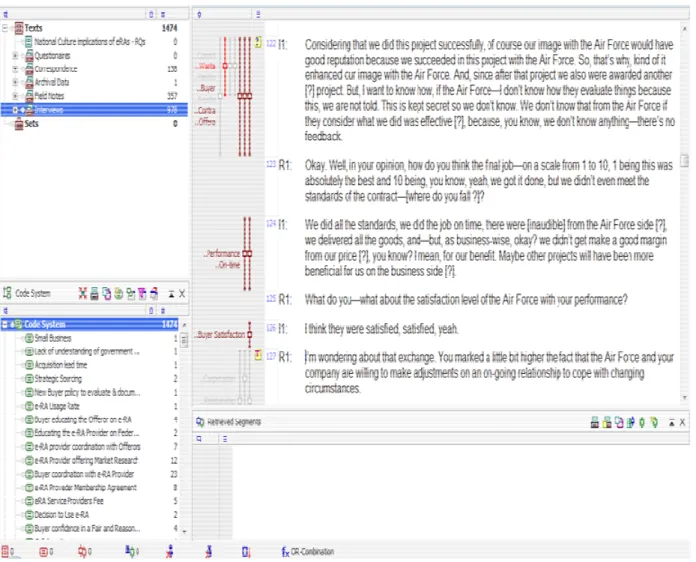
(Miles & Huberman, 1994, p. 56). The use of qualitative, data-analysis software is recommended by leading case-study researchers (Yin, 2009); therefore, we used MAXQDA version 2007 R200809-ENG. The MAXQDA software is a qualitative data analysis tool that enables researchers to combine all interview and archival data within one master file, then analyze the data with built-in coding and pattern-matching tools designed to help uncover causal relationships.
In addressing the applied research questions, we first reviewed relevant Federal rules, policy, history and guidance regarding source selection, strategic sourcing, and e-RAs in order to better understand the dynamics at play within the Federal Government. Next, we gathered and analyzed Air Force FY08 spend data and that of AFCENT in order to determine how much spend is appropriate for e-RA sourcing. Using commercial benchmarking and DoD spend data as a guide, we then estimated potential savings and created a FAR-compliant process for contracting officers to use both for simplified (i.e., FAR Part 13) and formal procurements (FAR Part 15). We also examined prescribed source-selection processes, industry best practices surrounding e-RA use, and bid protest decisions in order to address the applied research questions.
G. Theoretical Implications
Most of what we know about e-RAs comes from qualitative and
quantitative research based on transactions in the US, Europe, Asia, or Latin America (Jap, 2002). Therefore, we do not fully understand how e-RA adoption, use, and outcomes are affected by national culture in regions with high cultural differences from Western cultures such as the United States. Our goal is to provide insight into cultural implications of e-RA by refining e-RA and technology-adoption theories in (1) explaining idiosyncratic cultural differences and (2) facilitating wise decisions regarding e-RA application. Therefore, this study will advance the frontier of knowledge regarding the e-RA phenomenon. Ultimately, we enhance existing e-RA theory—specifically with respect to the effects of national culture on e-RA use.
H. Management Implications
As industry members and Federal agencies expand their sourcing efforts globally, success will likely depend on how well firms recognize, identify, and execute appropriate sourcing strategies. What works in one country may not work well in another due to cultural differences. For example, when exchange partners come from countries with a national culture that values group behavior (or collective behavior) and has a low risk tolerance, relationship-building is crucial (Elahee, Kirby & Nasif, 2002). Managers who fail to recognize these dynamics may raise levels of distrust and suspicion of opportunism, ultimately souring the buyer-supplier relationship.
From a practitioner’s perspective, in order to capitalize on potential savings and efficiencies, the DoD will need to create policy and guidance that supports the use of e-RA as part of both simplified and formal, negotiated procurements. Focus areas should include the following: (1) a pre-award process, (2) identification of e-RA service providers and their business models, (3) development of sample instructions to offerors and evaluation criteria provisions, (4) identification of e-RA-peculiar protest risks, and (5) hands-on training for contract specialists and contingency contracting officers.
The USAF and the DoD clearly need to provide leadership and training in order to maximize e-RA usage given appropriate circumstances. A failure to implement the reforms listed above will result in contract awards that continue to exceed true market prices for goods and services (a particularly acute problem in contingency operations, in which supporting market research, procurement lead time, and buyer competence are limited). Given that e-RA-derived prices
substantially beat those resulting from traditional procurement processes
(McCree, 2008), the fairness and reasonableness of non-e-RA-derived prices to the buyer must be called into question.
=
I. Scope and Limitations
The scope of this effort was limited to the breadth and substance of data available to the members of the Federal Government. Hence, commercial applications of e-RAs were not explored; therefore, the cultural considerations and practical guidance for use revealed by this research may be limited to governmental use of e-RAs. Furthermore, although every effort was taken not to advertise our military association, the suppliers we interviewed were aware of our status as military members and were, therefore, less likely to provide completely unguarded answers to our questions. To counter this conundrum, we interviewed multiple sources across a broad social, political, and economic spectrum. When possible, we also conducted face-to-face interviews to systematically observe non-verbal cues that otherwise would have gone unnoticed. Furthermore, because conclusions are derived from a single case, further research is needed to validate the findings across a spectrum of transactions of varying dollar values, goods and services, complexities, procurement risks, buyer-supplier
relationships, and balances of bargaining power.
Finally, we recognize that Kuwait is a melting pot of cultures; a Kuwaiti company representative who is a third-country national may not represent Kuwaiti national values. We addressed this problem by interviewing a cross-section of both Kuwaiti-owned and multi-national corporations and collected demographic information on participants (Table 5, Chapter III).
This work is organized in accordance with standard academic thesis structure but adds practitioner elements addressed in the research questions and objectives. The literature review covers relevant academic and practitioner
sources, to include DoD and Air Force procurement, legal, strategic sourcing, and contract management policy. Chapter V incorporates a practitioner guide and decision-making tools and includes a discussion of relevant military contracting issues facing contracting officers. Finally, Chapter VI provides answers to our research questions as well as the theoretical and managerial
implications of increased e-RA use in the DoD and Middle East. Areas for future research are identified, and limitations of our research are addressed. In the next chapter, we explore what is known about auction theory, e-RAs, national culture, and technology adoption and discuss the government rules and regulations surrounding Federal procurement.
=
II. Literature
Review
A. Introduction
This section provides background information pertinent to both the
academic and practitioner research questions listed in Chapter I. Accordingly, we have structured this section along those lines. We start with a discussion of auction theory and e-RA appropriateness, then move to a broader discussion of national culture, social norms, technology acceptance, and relational exchange— all relevant theories that are key to understanding the e-RA phenomenon.
Together, this spectrum allows us to see a holistic picture of the issues surrounding e-RA use both at home and abroad.
The second half of this chapter discuses the DoD’s use of e-RAs and includes the regulatory, structural, policy, training, and legal issues impacting the government’s policies toward e-RA use. We also include a review and discussion of GAO protests and USAF lessons learned in source selection that, together, help identify known issues and flag potential issues peculiar to e-RA use in Federal procurement. Finally, this section helps identify the gaps in practitioner knowledge and barriers to implementation within the DoD. We start with an overview of what e-RAs are and why they continue to receive attention.
B. Auction Theory
Reverse auctions have taken off because of internet connectivity, the availability of user-friendly e-RA software, their track record of substantial
savings, and their ability to “level the playing field” though real-time, open bidding events (Beall et al., 2003). In addition, while e-RAs are—by name and function— a type of auction, they differ from traditional forward auctions in a number of ways from both a practitioner’s and an economic theorist’s perspective (Jap, 2002).
The difference betweenforward auctions and reverse auctions is the relationship between buyers and sellers. In theory, an auction is defined as “a market institution with an explicit set of rules determining resource allocation and prices on the basis of bids from market participants” (Jap, 2002, p. 507). In a forward auction, multiple bidders (buyers) place consecutive bids for a good or service offered by a single seller. An example of an online forward auction is eBay, in which a bidder wins by placing the highest bid in a set amount of time. A reverse auction, in contrast, differs in that bidders (suppliers) compete to win a contract to provide a good or service to a single buyer—in this case, the
government. Since all participants can see each other’s bid in an online e-RA,4
fierce competition results in a downward bidding frenzy; suppliers lower their costs and profit margins in order to beat their competitor’s bid prices.
Auction types vary both in theory and practice. For an overview of the most common types found in economic literature (English/Japanese, Dutch, first-price sealed bid, second-first-price sealed bid, etc.), see Kaufman and Carter (2004), Milgrom (1989), McAfee and McMillan (1987), Kagel (1995) and Brown and Ray (2007). Unlike physical auctions, e-RAs are unique because they (1) allow bidding from geographically separate locations—a benefit referred to by Jap (2002, p. 512) as “geographic and temporal conveniences,” and (2) they provide immediate bidder feedback, all over the medium of the internet (Jap, 2002). This difference implies that traditional auction theories may not apply generally to e-RA and that more exploratory research is needed (Jap, 2002).
Some researchers limit the use of e-RAs to commodities and commodity-like items—suggesting that e-RAs are limited and should be used sparingly, if at all, due to their coercive nature and long-term relational impacts (Emiliani & Giampetro, 2007). Others, however, point to the supply complexity and criticality of the item or service itself and suggest using e-RAs for items whose supply
4
=
complexity is low (i.e., ample supply) and whose criticality (i.e., dollar value or importance to organizational performance) is either low or high, such as leverage spend (Beall et al., 2003). They also point out that some companies who used e-RAs initially for direct and indirect goods later expanded their use to professional services, capital goods, and even construction. Other empirical research of 146
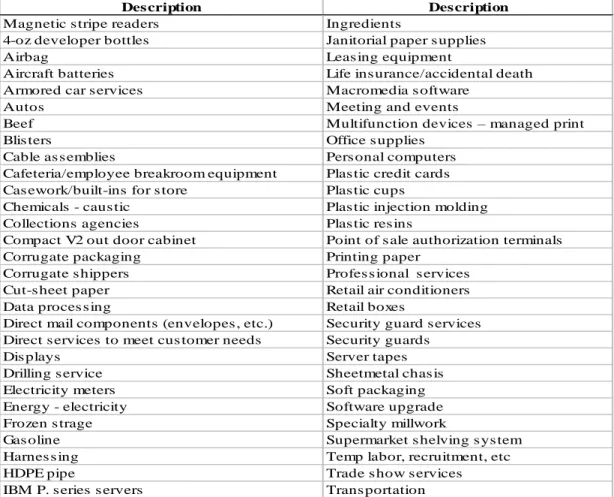
Fortune 500 firms’ use of e-RAs (Hawkins, Randall & Wittmann, 2009) showed a wide variety of goods and services sourced via e-RA (Table 2).
Table 2. Variety of Products and Services Procured with e-RAs
(Hawkins et al., forthcoming)
Des cription Des cription
Magnetic s tripe readers Ingredients
4-oz developer bottles Janitorial paper s upplies
Airbag Leas ing equipment
Aircraft batteries Life ins urance/accidental death
Armored car s ervices Macromedia s oftware
Autos Meeting and events
Beef Multifunction devices – managed print
Blis ters Office s upplies
Cable as s emblies Pers onal computers
Cafeteria/employee breakroom equipment Plas tic credit cards
Cas ework/built-ins for s tore Plas tic cups
Chemicals - caus tic Plas tic injection molding
Collections agencies Plas tic res ins
Compact V2 out door cabinet Point of s ale authorization terminals
Corrugate packaging Printing paper
Corrugate s hippers Profes s ional s ervices
Cut-s heet paper Retail air conditioners
Data proces s ing Retail boxes
Direct mail components (envelopes , etc.) Security guard s ervices Direct s ervices to meet cus tomer needs Security guards
Dis plays Server tapes
Drilling s ervice Sheetmetal chas is
Electricity meters Soft packaging
Energy - electricity Software upgrade
Frozen s trage Specialty millwork
Gas oline Supermarket s helving s ys tem
Harnes s ing Temp labor, recruitment, etc
HDPE pipe Trade s how s ervices
IBM P. s eries s ervers Trans portation
C. Use and Appropriateness of e-RAs
The appropriateness of e-RA use is defined as “the degree to which a sourcing professional views the use of an e-RA as a fit between the attributes of
the tool, the specific requirement being sourced, and the supply market”
(Hawkins et al., 2009, p. 56). Increasingly, both academicians and practitioners across a diverse section of international markets (to include the Federal
Government) have focused on RA appropriateness because not all studied e-RAs achieved desired results. Thus, by assessing e-RA appropriateness,
researchers can identify the contextual circumstances in which e-RA use is more likely to lead to success of the auction (increased total savings and procurement lead-time reduction) (Hawkins et al., 2009).
A review of 27 peer-reviewed publications on e-RAs identified 48 different antecedents (or motivational factors) for e-RA use (Hawkins et al., forthcoming). Through empirical testing, research has shown statistical significance in how procurement managers decide which requirements are appropriate for sourcing via e-RA. The antecedents were identified as follows (Hawkins et al., 2009):
• The specifiability of the requirement (meaning how concretely that requirement can be specified in writing for suppliers during the RFQ process),
• The expected level of competition, • Leadership influence, and
• A price-based selection criteria.
Regarding price-based selection criteria, other researchers point out that while price is an important factor in e-RA appropriateness, buyers who feel that non-price factors (e.g., delivery lead-time, quality, and warranty) are also
important can include non-price evaluation factors into what academicians refer to as a multi-attribute auction (Hawkins et al., 2009). The ability to use both price-only and multi-attribute evaluation strategies allows firms to use e-RA for three of four types of spend (Kraljic, 1983)—excluding strategic spend,in which the high value and high complexity of the requirement make partnerships and alliances more appropriate (Beall et al., 2003). The other three spend categories that are appropriate for e-RA use include non-critical (low spend, low criticality), leverage
=
(high spend, low criticality), and bottleneck (low spend, high complexity) (Kraljic, 1983). Beall et al. concluded that:
For a growing number of buying firms, e-RAs have found an
appropriate niche in their strategic sourcing toolkit, allowing them to efficiently source goods and services that are highly standardized, have sufficient spend volume, can be replicated by a reasonable number of qualified competitors, and have insignificant switching costs. In contrast, the research indicates that those suppliers of strategic items, where alliance-level supplier relationships are critical, are usually not subjected to e-RA sourcing. (2003, p. 60) Another reason for the recent interest in e-RA appropriateness is that academicians disagree on when RA use is appropriate and on how improper e-RA use may impact the buyer-seller relationship. The concern is whether short-term savings outweigh potential long-short-term consequences. Some view e-RAs as technology-assisted “power-based bargaining” techniques that create distrust and invite retaliatory pricing or fail to account for the total ownership cost
(Emiliani, 2004). Others fear long-term supplier-buyer relationship erosion (Jap, 2002; 2003; 2007; Jap & Haruvy, 2008) because regardless of design and execution, some suppliers feel buyers use the tool opportunistically (Jap, 2003) to squeeze supplier profit margins and overhead to a breaking point (Wagner & Schwab, 2004). Regardless of their stance, most researchers agree that e-RAs will remain as one tool in a strategic sourcing toolbox (Jap, 2002; Kaufman & Carter, 2004; Sashi & O’Leary, 2002) but disagree on how and to what extent e-RAs should be used. And while pro and con arguments are compelling, it is worth noting that very little empirical research finds evidence to support a causal link to relationship degradation (Jap, 2007).
Regardless, a well-planned and executed event that meets the criteria above can return costs savings of 5%-40% (Tully, 2000) and can reduce cycle-time up to 40% by eliminating cycle-time-consuming marketing efforts, cycle-time in
negotiations, and processing time for proposals (Beall et al., 2003; Smeltzer & Carr, 2002). This is important because, on average, manufacturing firms spend
55% of their revenue on goods and services (Monczka, Trent & Handfield, 2002). Double-digit, bottom-line cost savings suggest that a properly structured and executed e-RA may help a company gain a competitive advantage over
competitors who use traditional procurement strategies (Mabert & Skeels, 2002). Because of these savings and efficiencies, e-RAs have begun to replace
traditional procurements for some goods and services (See Appendix A).
D. National Culture
Academics disagree on the definition of national culture (Srite, 2000). In fact, Kroeber and Kluckhohn (1952) found over 150 different definitions during a classic study of culture. For the purpose of this study, we use a basic definition derived from Hofstede’s (1980) famous cross-cultural study because it is 1) relevant to the e-RA discussion, and 2) widely cited by academics (Srite, 2000). According to Hofstede, culture is “the programming of the mind which
distinguishes the members of one human group from another” (1980, p. 43). Culture is further broken down into four distinct dimensions:
individualism/collectivism, power distance, uncertainty avoidance, and masculinity/femininity (1980). Much of our research incorporates these dimensions; thus, a brief description of each is warranted.
Individualism/collectivism (IC) describes how individuals in a society define themselves (Hofstede, 1980). Kuwait scored low, with a score of 38 in individualism (Hofstede, 1980; At-Twaijri & Al-Muhaiza, 1996), suggesting that an individual’s ability to succeed on merit is less important than succeeding as a collective unit, team or group. It also means that individuals (or cultures) who value collectivism, value the relationship-building aspect of succeeding as a group (Elahee et al., 2002). One downside of this collective trait is that collective groups are trusting and empathetic to each other, but they will do whatever they can get away with to outsiders (Triandis & Vassiliou, 1972).
=
Power distance (PD) is “the extent that large differentials of power, and therefore inequity, are accepted in a culture” (Srite, 2000, p. 34) and can be due, in part, to birthright. In some cultures, men are entitled to more power than women. Kuwait’s score of 80 was high in this category, which implies that employees will follow a supervisor’s directive simply because he or she is the boss (Hofstede, 1980; At-Twaijri & Al-Muhaiza, 1996). As with collective
societies, relationship-building is also important because high-PD cultures often have higher rates of coercion and opportunism than countries with small PD (Elahee et al., 2002).
Uncertainty avoidance (UA) is defined as “the level of risk accepted by a culture, which can be gleaned by emphasis on rule obedience, ritual behavior, and labor mobility” (Srite, 2000). With a score of 68, Kuwait ranks relatively high in UA (Hofstede, 1980; At-Twaijri & Al-Muhaiza, 1996; Parboteeah et al., 2005), suggesting that Kuwaiti businessmen place a high value on formal rules to overcome risk. Since e-RA sourcing is new, uncertainty surrounds its use. Specifically, some studies point to both buyer and seller uncertainty about procedures, technology, identity protection, and process integrity—to include procedural fairness (Beall, 2003; Carter et al., 2004). Since Kuwait scores high in uncertainty avoidance, we would expect Kuwaiti businessman to reject e-RA adoption in favor of more traditional negotiations.
Masculinity/femininity (MF) “refers to culture differentiation on the basis of gender and activity” (Srite, 2000, p. 34). Kuwait scores in the middle of this category, with a score of 52 (Hofstede, 1980; At-Twaijri & Al-Muhaiza, 1996), suggesting that men and women are equally likely to share similar categories of employment (Srite, 2000). According to Srite, low-masculinity (high-femininity) cultures value a pleasant, non-threatening work environment.
In 1996, a second study of Gulf Coast countries was conducted to test (and update) Hoftede’s findings (At-Twaijri & Al-Muhaiza, 1996). A side-by-side comparison of scores (see Table 3) indicates that UA has increased significantly,
while PD, MF, and IC all decreased. Implications of these findings are discussed under Section E.
Table 3. Cross-cultural Comparison of National Culture Dimensions
(After At-Twaijri & Al-Muhaiza, 1996 ; Hofstede, 1980; 2009)
Dimension
Hofstede, 1980 (Arab World)
At-Twaijri & Al-Muhaiza, 1996 (Kuwait) Hofstede, 2009 (USA) UA 68 103 46 PD 80 51 40 IC 38 31 91 MF 53 43 62
Given the cultural distance between the US and Kuwait, one would expect to encounter difficulties implementing e-RAs where the buyer is from the former and the suppliers are from the latter. Some researchers believe that greater cultural difference increases opportunism from the trading partner (Lee, 1998), which, in turn, decreases the level of trust and relational exchange between partners (Jap, 2003; Morgan & Hunt, 1994). In research centering on
international negotiations, researchers found that managers who deal with high-PD and high-UA cultures need to pay attention to culture and engage in trust-building measures (Volkema, 1997; 1999) and build relationships (Volkema, 1997; 1999; Elahee et al., 2002).
The research cited above suggests that Arabs would choose not to participate in an e-RA, but—in at least in one case—they did. Clearly, more research is required, and academics agree that theoretical models are needed that include national culture variables to explain technology adoption
=
E. Technology Adoption Model (TAM)
Over the past 25 years, numerous models and theories have been widely used to study and explain technology adoption across a variety of different national cultures. Three of the most-cited theories include the Technology Adoption Model (TAM) (Davis, 1989), the Theory of Reasoned Action (TRA) (Ajzen & Fishbein, 1980), and the Theory of Planned Behavior (TPB) (Ajzen, 1991). Of the three, TAM is cited over 1,500 times by researchers because of its flexibility, reliability, and proven validity (McCoy, Galleta & King, 2007). We elected to use TAM for two reasons. First, TAM is an “adaption” of the TRA that focuses on information technology (IT) adoption to the user level (Davis, Bagozzi & Warshaw, 1989). Secondly, a growing number of researchers have already used TAM in conjunction with Hofstede’s dimensions to explore cross-cultural IT adoption. Figure 1 is a snapshot of this model and is followed by a discussion describing its central tenets and e-RA applicability.
Figure 1. Technology Adoption Model (TAM)
(Based on Davis et al., 1989)
TAM centers on two constructs: (1) perceived usefulness (PU) and (2) perceived ease of use (PEOU). Davis et al. (1989) define PU as “the prospective user’s subjective probability that using a specific application [like e-RA] will
increase his or her job performance within an organizational context” (p. 320). PEOU, on the other hand, is defined as “the degree to which the prospective user expects the target system to be free of effort” (Davis et al., 1989, p. 320). As depicted above, external variables affect both PU and PEOU. In turn, PEOU influences an individual’s expectation of implementation effort. Together, PU and PEOU affect an individual’s attitude toward technology adoption and, ultimately, his/her behavior and actual use (Ajzen & Fishbein, 1980). With e-RA use in the Middle East lagging the US, Europe, and Asia (Jap, 2003) and a current internet diffusion rate of 30% (Business Monitor International, 2008), we wonder just how feasible e-commerce is in the Middle East.
Over the years, a number of studies have incorporated elements of TAM and Hofstede’s national culture components to try to understand
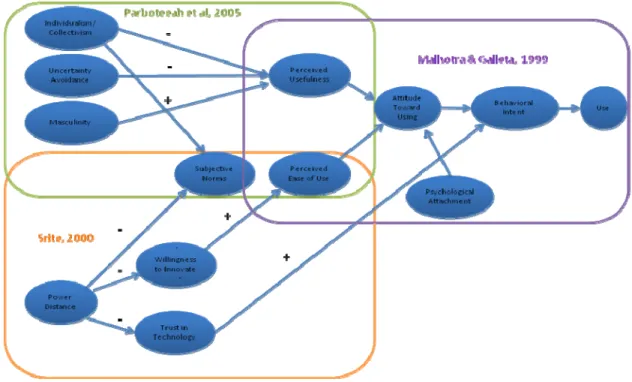
e-commerce/technology diffusion in the Middle East. A discussion of key study findings in three noteworthy studies is provided in Figure 2 and is presented visually for a clearer picture of the points of each model.
=
In 2000, in his empirical study of the influence of national culture on the acceptance and use of information technologies, Srite discovered that as PD increases, an individual’s willingness to innovate and trust in technology
decreases. Using the TAM framework, Srite also found that a high willingness to innovate increased PEOU and that a high trust in technology increased an individual’s behavioral intent to use technology. These findings suggest that nations with high PD will resist innovative technology because they do not trust it and because, intrinsically, they are not willing to innovate. However, Srite (2000) found a positive relationship between trust in technology and an individual’s behavioral intent to use technology. Finally, Srite found that high PD negatively impacted an individual’s subjective norms, which directly impacts how that individual perceives the usefulness of new technology.
Other studies illustrated in Figure 2 found that high UA scores decrease how individuals perceive the usefulness of technology (Parboteeah et al, 2005). Since Kuwait scored high in UA, we would expect suppliers to perceive e-RA as a risky venture and avoid it in favor of traditional procurement processes.
Parboteeah et al. (2005) also found that 1) countries with high individualism scores also were likely to not perceive innovative technology as useful, and (2) high masculinity scores increased PU. Since Kuwait scored low in individualism (31 points) and average in masculinity (43 points), we would expect Arab
suppliers not to view e-RA as useful.
In 1999, researchers again added an additional construct, psychological attachment, in order to try to explain how a person’s psychological connection to technology would affect his/her attitude towards use. Their results indicate a negative relationship between forced compliance and an individual’s attitude towards using technology. This suggests that forcing Kuwaitis into an e-RA could negatively impact their attitude towards participation in the future (Galleta & Malhotra, 1999). Taken one step further, a negative attitude could then discourage behavioral intent to use and prevent actual use.
F. Relational Exchange
In 1980, MacNeil introduced Relational Contract Theory (RCT), which highlights a need for relationship-building as a matter of contracting
methodology. At the center of his theory are 10 norms, which help define business contracts in terms of solidarity (trust), reciprocity, and cooperation (MacNeil, 1980). Berry (1983) expanded on RCT by introducing relationship marketing, which he defined as attracting, maintaining, and enhancing customer relationships.
In 1994, a new relational theory—the Commitment-trust Theory (CTT)— was introduced. This model placed “commitment” and “trust” as key mediator variables for relationship-building (Morgan & Hunt, 1994). Trust was defined as “when one party has confidence in an exchange partner’s reliability and integrity” and commitment as “an enduring desire to maintain a valued relationship”
(Morgan & Hunt, 1994, p. 23). The CTT acknowledges the role of power as a moderating factor, but its theorists claim that successful relationships hinge on the basic desire for businesses to reduce vulnerability by seeking out trustworthy partners (1994). Some academics argue that e-RAs deteriorate the level of trust between partners; such trust acts as a non-contractual governance mechanism against nefarious or opportunistic behavior (Jap & Haruvy, 2008). Opportunistic behavior, according to Jap (2003), is defined as “self-interest seeking with guile [...] and is synonymous with misrepresentation, cheating, and deception and subsumes a range of misbehavior, such as adverse selection, moral hazard, shirking, sub goal pursuit, agency costs, and free riding” (p. 98). According to Jap (2003), e-RA use results in the supplier’s perception of increased buyer
opportunism and, therefore, may poison the buyer-seller relationship (p. 105). Given the emphasis relationship marketing places on trust and
commitment, it is no wonder that e-RA research identifies the potential
deterioration of the buyer-seller relationship (due to the transactional nature of the e-RA) as a significant barrier to use (Beall et al., 2003; Carter et al., 2004;
=
Smeltzer & Carr, 2003; Jap, 2003; Emiliani, 2004; 2005). Some studies suggest that sellers automatically view a buyer’s decision to use an e-RA as
opportunistic, which leads to distrust and relationship deterioration (Jap, 2003; Emiliani, 2004; Carter & Stevens, 2007). If the supplier’s relationship orientation is long-term and if they expect commitment and trust, then use of an e-RA most certainly sends mixed messages to vendors.
Academics disagree on just how much e-RAs impact the buyer-seller relationship. Emiliani and Stec (2005) argue that e-RAs are incompatible with objectives of improving long-term aspects of trade. Emeliani and Stec also call for e-RA codes of conduct to stem opportunistic buyer behavior. E-RA
proponents disagree and suggest that close, collaborative relationships are not always needed—especially when there are a high number of competitors and the complexity of the product or service is low (Smart & Harrison, 2002).
Increasingly, academicians and practitioners see ways to find a middle ground through more complex multi-attribute auctions that allow buyers to evaluate non-price factors, such as delivery time and warranty (Talluri & Ragatz, 2004;
Hawkins et al., forthcoming). These auctions allow suppliers to offer a variety of possible bid combinations within a predetermined, acceptable range (Bichler & Kalagnanam, 2005).
G. DoD’s Use of e-RAs
1. History
Attracted by success in the commercial sector, in May 2000, the US Navy launched the first Federal e-RA with the assistance of a third-party, commercial e-RA provider. That same month, the Army’s Communication-electronics
Command (CECOM) launched two e-RA events of its own. The results were compelling. The Navy saved 28%, totaling $830,000, while CECOM netted savings of 20% and 50%, respectively (DAU, 2009).
In September 2000, the General Service Agency (GSA) launched an e-RA platform of its own called Buyers.gov. While only 212 events were held over the following three months, one buy saved $2.2 million on a procurement valued at $10 million (based on an independent government cost estimate) (Turley, 2002). Impressed, officials decided to cancel Buyers.gov in lieu of long-term e-RA service contracts to commercial providers.
Around this same time period, the Defense Supply Center–Columbus launched its own e-RA application called DIBBS to target acquisitions less than $25,000. Besides the typical 10%-15% (Cohn, 2000) cost savings, DSCC officials observed an 84% lead-time reduction—from 87 days to just 14 (Turley, 2002. By August 2000, DIBBS awards exceeded 4,500 contracts (Turley, 2002). Currently, both CECOM and the Navy offer e-RA services to their commands.
CECOM uses a web-based, self-service application called the US Army Auction and Valuation Engine, or USAAVE. The reverse auctioning tool
developed at CECOM provides three formats: simple, multiple-line item and best-value reverse auctions.
The simple format is most commonly used and allows the contractor to submit one contract price, with the lowest overall bid winning the award. Another technique, the multiple-line-item format allows for multiple awards based on the lowest price per line item (also known as cherry picking). The third format, and the least used, is the best-value format, in which non-price parameters are created and given a value and weight. According to the CECOM’s e-RA program management, their application, regardless of format, allows DoD buyers to save the 1%-3% service fee charged to the winning bidder by full-service providers. This service is now available to other DoD buyers for no fee through a
memorandum of understanding (M. Meinert, personal communication, July 14, 2009). Tutorials and information regarding the CECOM platform are available at CECOM’s website (https://abop.monmouth.army.mil/).
=
The Navy also offers a self-serve desktop application created and
maintained by Procuri of Atlanta. Like the Army, the Navy’s use of e-RA is limited to commercial commodities under FAR Part 13 procedures, but no regulations mandate use. Non-Navy members may use the software for a negotiated fee, and the auctioning application is managed by the Defense Supply Center, Philadelphia (DSCP).
In addition to these services, two companies who contributed to this project also provide full-service e-RA support. FedBid, Inc., provides full service e-RA capability for Federal agencies on a fee-for-service model in which the winning supplier pays FedBid’s fee. Awards cover 661 different Federal Product Codes (FSC) and Supply Service Codes (PSCs) (Appendix A), mostly covering simple, low-value commercial commodities and services (FedBid, 2009,
November). Sorcity, Inc., the e-RA service provider for the Air Force’s procurement of generators in Kuwait, also provides full-service support and specializes in deep commodity expertise across many business sectors and across global supply channels. Sorcity, Inc., can support complex procurements and also employs a business model in which the successful offeror pays Sorcity’s fee—typically between 0.5%-1.95% of the sale (Sorcity, personal communication, November 21, 2009).
Despite cost and cycle-time savings available from e-RAs, the DoD has failed to set uniform e-RA policy, goals, or metrics, despite pressure from executive and congressional leadership to reduce costs through strategic-sourcing commercial best practices (OMB, 2009; OFPP, 2008). This slow adoption/usage rate remains unexplained, but may be due to a lack of
leadership, a lack of training, a lack of e-RA awareness, structural barriers—such as a lack of or unknown access to e-RA service providers and their e-RA
software applications—and the DoD’s lack of accountability for minimizing total ownership costs (GAO, 2000).
2. Legality
E-RA use is not contrary to Federal procurement statute and public policy (SAF/AQC, 2001; Turley, 2002); however, contracting officers need to be aware of critical arguments. All Federal acquisitions are governed by the Federal
Acquisition Regulation(FAR), FAR supplements, statutes, and case law. In 1997, the FAR (Chapter 15–Negotiate Procurements) was re-written, and language forbidding auctions as a pricing tool were removed from FAR 15.602(e)(2). While the re-write did not specifically mention reverse auctions as an accepted
contracting method, language in section FAR 1.102(d) gave contracting officers more latitude to use emerging technology. It states:
The role of each member of the Acquisition Team is to exercise personal initiative and sound business judgment in providing the best value product or service to meet the customer’s needs. In exercising initiative,
government members of the Acquisition Team may assume if a specific strategy, practice, policy or procedure is in the best interests of the government and is not addressed in the FAR, nor prohibited by law
(statute or case law), Executive order or other regulation, that the strategy, practice, policy or procedure is a permissible exercise of authority.
(General Services Administration, 2005)
While this section certainly gives contracting officers broad discretion, military legal reviews point to FAR section 14 (sealed bidding) as a problematic area in regards to e-RAs. According to Turley, the current language regarding bids describes a one-bid-per-offeror format. Because e-RA involves multiple successive bids, an e-RA issued under sealed bidding rules could be considered illegal. For that reason, FedBid and the CECOM follow FAR 13 and FAR 15 rules for procurement (discussed below in Section D).
Other skeptics point to language in the Procurement Integrity Act (PIA), which “prohibits anyone acting on behalf of the government from knowingly
disclosing a contractor’s bid or proposal before the contract award” (Turley, 2002, p. 16). In order to address this issue, Army contracting officers and third-party e-RA providers require prospective bidders to enter a disclosure agreement as part of a pre-qualification process. And while this step seems prudent, case law
=
discussed below suggests that the contractor’s decision to participate is, in itself, an implied agreement to disclose information. Thus, according to case law, a written agreement might not actually be necessary in terms of protest mitigation (Brown & Ray, 2007).
In closing, while e-RA does not directly violate any Federal procurement regulations or statutes, critics raise valid concerns of which contracting officers need to be aware when contemplating e-RA use, if they are to mitigate the risk of a protest. One way to gauge relevant legal concerns is a historical review of protest literature.
3. Regulations
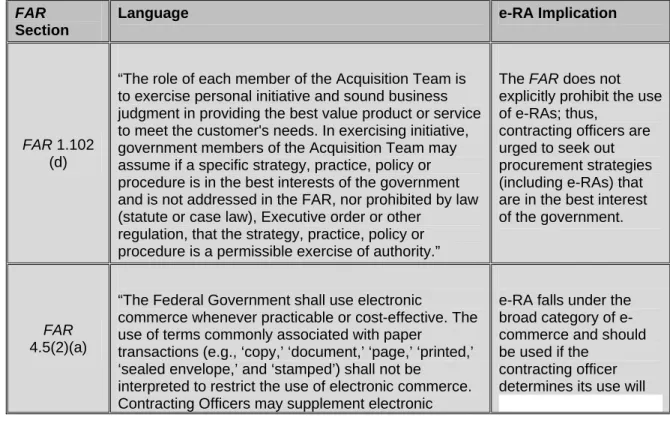
According to the Defense Acquisition University (2009), other significant
FAR changes also encourage e-RA use within the defense acquisition
framework. A summary of these sections and their implications are listed below in Table 4.
Table 4. FAR Rules with e-RA Implications
FAR
Section
Language e-RA Implication
FAR 1.102 (d)
“The role of each member of the Acquisition Team is to exercise personal initiative and sound business judgment in providing the best value product or service to meet the customer's needs. In exercising initiative, government members of the Acquisition Team may assume if a specific strategy, practice, policy or procedure is in the best interests of the government and is not addressed in the FAR, nor prohibited by law (statute or case law), Executive order or other
regulation, that the strategy, practice, policy or procedure is a permissible exercise of authority.”
The FAR does not explicitly prohibit the use of e-RAs; thus,
contracting officers are urged to seek out procurement strategies (including e-RAs) that are in the best interest of the government.
FAR 4.5(2)(a)
“The Federal Government shall use electronic
commerce whenever practicable or cost-effective. The use of terms commonly associated with paper
transactions (e.g., ‘copy,’ ‘document,’ ‘page,’ ‘printed,’ ‘sealed envelope,’ and ‘stamped’) shall not be
interpreted to restrict the use of electronic commerce. Contracting Officers may supplement electronic
e-RA falls under the broad category of e-commerce and should be used if the
contracting officer determines its use will
FAR
Section
Language e-RA Implication
transactions by using other media to meet the requirements of any contract action governed by the FAR.”
result in net savings.
FAR 15.002(b)
“Competitive acquisitions. When contracting in a competitive environment, the procedures of this part are intended to minimize the complexity of the solicitation, the evaluation, and the source selection decision, while maintaining a process designed to foster an impartial and comprehensive evaluation of offerors’ proposals, leading to selection of the proposal representing the best value to the government.”
1.) Simple and multi-attribute e-RAs provide transparent and objective evaluation criteria. COs award contracts quickly and maintain an electronic record of bids
maintained as part of the contract file. 2) E-RA minimizes complexity in price evaluation by allowing offerors to determine the lowest acceptable price in a minimal amount of time.
FAR 15.306(e)(3);
[The Contracting Officer shall not] “Reveal an offeror’s price without that offeror’s permission. However, the Contracting Officer may inform an offeror that its price is considered by the government to be too high, or too low, and reveal the results of the analysis supporting that conclusion. It is also permissible, at the
government’s discretion, to indicate to all offerors the cost or price that the government’s price analysis, market research, and other reviews have identified as reasonable”
1.) If not using rank-order bidding, offerors must willingly disclose their prices in an e-RA, and 2) the e-RA format must not disclose the offeror’s business name.
3.) e-RA minimizes complexity in price evaluation by allowing offerors to determine the lowest acceptable price in a minimal amount of time.
In February 2001, the Secretary of the Air Force/Acquisition and
Contracting (SAF/AQC) conducted a detailed analysis of e-RA use and found that 17 sections of the FAR (including those listed above) did not conflict with