Fingerprint Recognition System
Bhawna Negi 1 , Varun Sharma 21 2 Department of Electronics and Communication Engineering 1 Raj Kumar Goel Institute of Technology for Women, Ghaziabad (U.P.)
2 Jaypee institute Of Information And Technology, Noida (U.P.) 1 Email- [email protected]
Abstract- The popular Biometric used to authenticate a person is Fingerprint which is unique and permanent throughout a person’s life. A minutia matching is widely used for fingerprint recognition and can be classified as ridge ending and ridge bifurcation. In this paper we projected Fingerprint Recognition using Minutia Score Matching method (FRMSM). For Fingerprint thinning, the Block Filter is used, which scans the image at the boundary to preserves the quality of the image and extract the minutiae from the thinned image. The false matching ratio is better compared to the existing algorithm.
Keywords – Fingerprint Recognition, Binarization, Block Filter Method, Matching score and Minutia
I.INTRODUCTION
A. Biometric Recognition
It refers to the use of distinctive anatomical (e.g., fingerprints, face, iris) and behavioral (e.g., speech, gait, signature) characteristics, called biometric identifiers or traits or characteristics for automatically recognizing individuals. Biometrics is becoming an essential component of effective person identification solutions because biometric identifiers cannot be shared or misplaced, and they intrinsically represent the individual’s bodily identity [1]. No single biometric is expected to effectively meet the requirements of all the applications. Fingerprint recognition has a very good balance of all the properties. A number of biometric characteristics are being used in various applications as Universality, Uniqueness, Permanence, Measurability, Performance, Acceptability, and Circumvention [2]
(i) Fingerprint
A fingerprint is the feature pattern of a finger as shown in figure 1. It is believed with strong evidences that each fingerprint is unique. Each person has his own fingerprints with the permanent uniqueness. So fingerprints have being used for identification and forensic investigation for a long time. A fingerprint is composed of many ridges and furrows. These ridges and furrows present good similarities in each small local window, like parallelism and average width. The two most prominent local ridge characteristics, called minutiae, are 1) Ridge ending and 2) Ridge bifurcation.[3]. A good quality fingerprint contains 25 to 80 minutiae depending on sensor resolution and finger placement on the sensor. The false minutiae are the false ridge breaks due to insufficient amount of ink and cross-connections due to over inking. It is difficult to extract reliably minutia from poor quality fingerprint impressions arising from very dry fingers and fingers mutilated by scars, scratches due to accidents, injuries. The motivation behind the work is growing need to identify a person for security. The fingerprint is one of the popular biometric methods used to authenticate human being. The proposed fingerprint verification FRMSM provides reliable and better performance than the existing technique.
In this paper we used Fingerprint Recognition using Minutia Score Matching method with the help of MATLAB codes. Minutiae are extracted from the thinned image for both template and input image. Finally both the images are subjected to matching process and matching score is computed.
873 Fingerprint Recognition System
ISSN 2277-1956/V1N3-872-878
Figure1.Ridge and bifurcation of the finger print
(ii)Fingerprint recognition
The fingerprint recognition problem can be grouped into three sub-domains: fingerprint enrollment, verification and fingerprint identification. Verification is typically used for positive recognition, where the aim is to prevent multiple people from using the same identity. Fingerprint verification is to verify the authenticity of one person by his fingerprint. There is one-to-one comparison in this case. In the identification mode, the system recognizes an individual by searching the templates of all the users in the database for a match. Therefore, the system conducts a one to-many comparison to establish an individual’s identity [4].
Figure 2 Block diagram of FRMSM
(iii) Model
In this section the definitions and FRMSM model are discussed a. Definitions:
Termination : The location where a ridge comes to an end.
Bifurcation : The location where a ridge divides into two separate ridges.
Binarization : The process of converting the original grayscale image to a black-and white image. Thinning : The process of reducing the width of each ridge to one pixel
Termination Angle : The angle between the horizontal and the direction of the ridge.
Bifurcation Angle : The angle between the horizontal and the direction of the valley ending between the
bifurcations.
False Matching Ratio : It is the probability that the system will decide to allow access to an (FMR)
imposter is given in an equation (1)
FMR = False Matches / Im poster Attempts ---(1)
The imposter attempts are implemented by matching each input image with all the template images. False match was recorded for each imposter attempt when the matching score was greater than the established threshold. False
Non Matching Ratio (FNMR): It is the probability that the system denies access to an approved user
is given in an equation (2)
FNMR = FalseNonMatches / EnrolleAttempts ---(2)
Enrollee attempts are implemented by matching each input image with corresponding template image, hence it is one-to-one matching. A False Non-match was recorded when the matching score between an enrollee and its template was less than the established threshold.
Matching Score: it is used to calculate the matching score between the input and template data is given in an
equation (3)
Matching score = Matching Minutiae / Max(NT,NI ) ---(3)
Where, NT and NI represent the total number of minutiae in the template and input matrices respectively. By this definition, the matching score takes on a value between 0 and 1. Matching score of 1 and 0 indicates that data matches perfectly and data is completely mismatched respectively.
b. Model
Fingerprint Image: The input fingerprint image is the gray scale image of a person, which has intensity values ranging from 0 to 255. In a fingerprint image, the ridges appear as dark lines while the valleys are the light areas between the ridges. Minutiae points are the locations where a ridge becomes discontinuous. A ridge can either come to an end, which is called as termination or it can split into two ridges, which is called as bifurcation. The two minutiae types of terminations and bifurcations are of more interest for further processes compared to other features of a fingerprint image.
Binarization: The pre-processing of FRMSM uses Binarization to convert gray scale image into binary image by fixing the threshold value. The pixel values above and below the threshold are set to ‘1’ and ‘0’ respectively. An original image and the image after Binarization are shown in the Figure 2.
(A) (B)
Figure 3: (A) Original Fingerprint (B) Binarized image.
875 Fingerprint Recognition System
ISSN 2277-1956/V1N3-872-878
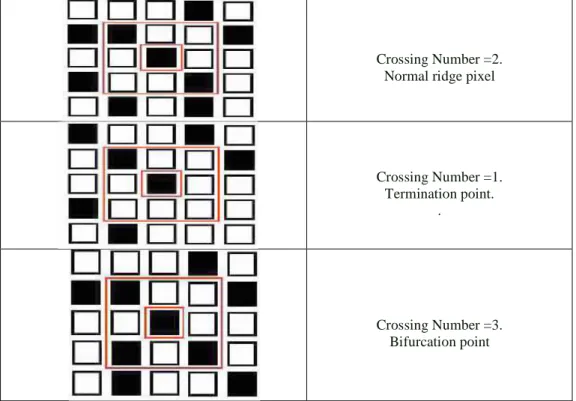
terminations which lie at the outer boundaries are not considered as minutiae points, and Crossing Number is used to
locate the minutiae points in fingerprint image. Crossing Number is defined as half of the sum of differences
between intensity values of two adjacent pixels. If crossing Number is 1, 2 and 3 or greater than 3 then minutiae points are classified as Termination, Normal ridge and Bifurcation respectively, is shown in figure 4.
Crossing Number =2. Normal ridge pixel
Crossing Number =1. Termination point. . Crossing Number =3. Bifurcation point
Figure 4: Crossing Number and Type of Minutiae.
To calculate the bifurcation angle, we use the advantage of the fact that termination and bifurcation are dual in nature. The termination in an image corresponds to the bifurcation in its negative image hence by applying the same set of rules to the negative image, we get the bifurcation angles.
Figure 5 shows the original image and the extracted minutiae points. Square shape shows the position of termination and diamond shape shows the position of bifurcation as in figure 5 (b)
(a) (b)
Minutiae Matching: To compare the input fingerprint data with the template data
For efficient matching process, the extracted data is stored in the matrix format. The data matrix is as follows. Number of rows: Number of minutiae points.
Number of columns: 4
Column 1: Row index of each minutia point. Column 2: Column index of each minutia point. Column 3: Orientation angle of each minutia point.
Column 4: Type of minutia. (A value of ‘1’ is assigned for termination, and ‘3’ is assigned for bifurcation). During the matching process, each input minutiae point is
template and input minutiae are selected as reference points for their respective data sets. The reference points
are used to convert the remaining data points to polar coordinates. The Equation (4) is template minutiae from row and column indices to polar coordinates.
=
Where, for a template image,
= radial distance of
minutiae.= radial angle of minutiae. =orientation angle of minutiae.
= row index and column index of reference points currently being
Similarly the input matrix data points are converted to polar coordinates using the Equation (5)
Rotate values (k, m) represents the difference be
the extracted data in all the columns of row
Problem definition: Given the test Fingerprint Image the 1. Pre-processing the test Fingerprint.
2. Extract the minutiae points.
3. Matching test Fingerprint with the database.
To compare the input fingerprint data with the template data Minutiae matching is used. For efficient matching process, the extracted data is stored in the matrix format. The data matrix is as follows. Number of rows: Number of minutiae points.
Column 1: Row index of each minutia point. : Column index of each minutia point. Column 3: Orientation angle of each minutia point.
Column 4: Type of minutia. (A value of ‘1’ is assigned for termination, and ‘3’ is assigned for bifurcation). During the matching process, each input minutiae point is compared with template minutiae point. In each case,
and input minutiae are selected as reference points for their respective data sets. The reference points are used to convert the remaining data points to polar coordinates. The Equation (4) is used to convert the template minutiae from row and column indices to polar coordinates.
=
---minutiae.
minutiae.
= row index and column index of reference points currently being considered. Similarly the input matrix data points are converted to polar coordinates using the Equation (5)
=
represents the difference between the orientation angles of Tk and Im
the extracted data in all the columns of row k and row m in the template and input matrices, respectively. II.PROPOSED ALGORITHM
Given the test Fingerprint Image the objectives are, processing the test Fingerprint.
with the database.
Minutiae matching is used. For efficient matching process, the extracted data is stored in the matrix format. The data matrix is as follows.
Column 4: Type of minutia. (A value of ‘1’ is assigned for termination, and ‘3’ is assigned for bifurcation). compared with template minutiae point. In each case,
and input minutiae are selected as reference points for their respective data sets. The reference points used to convert the
---(4)
considered. Similarly the input matrix data points are converted to polar coordinates using the Equation (5)
---(5)
Im. Tk and Im represent
877 Fingerprint Recognition System
ISSN 2277-1956/V1N3-872-878
Table -1 Algorithm of FRMSM
III.PERFORMANCE ANALYSIS AND RESULT
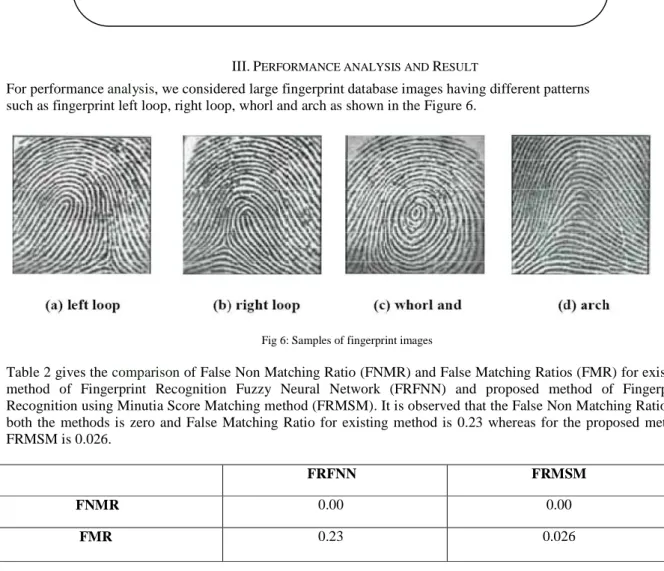
For performance analysis, we considered large fingerprint database images having different patterns such as fingerprint left loop, right loop, whorl and arch as shown in the Figure 6.
Fig 6: Samples of fingerprint images
Table 2 gives the comparison of False Non Matching Ratio (FNMR) and False Matching Ratios (FMR) for existing method of Fingerprint Recognition Fuzzy Neural Network (FRFNN) and proposed method of Fingerprint Recognition using Minutia Score Matching method (FRMSM). It is observed that the False Non Matching Ratio for both the methods is zero and False Matching Ratio for existing method is 0.23 whereas for the proposed method FRMSM is 0.026.
FRFNN FRMSM FNMR 0.00 0.00 FMR 0.23 0.026
IV.CONCLUSION
In this paper, we presented Fingerprint matching using FRMSM. The pre-processing the original fingerprint involves image binarization, ridge thinning, and noise removal. Fingerprint Recognition using Minutia Score
Input: Gray-scale Fingerprint image.
Output: Verified fingerprint image with matching score. 1. Fingerprint is binarized
2. Thinning on binarized image
3. Minutiae points are extracted. Data matrix is generated to get the position, orientation and type of minutiae.
4. Matching of test fingerprint with template
5. Matching score of two images is computed, if matching score is 1 images are matched and if it is 0 then they are mismatched.
Matching method is used for matching the minutia points. The proposed method FRMSM gives better FMR values compared to the existing method.
V.REFERENCE
[1] G.Sambasiva Rao, C. NagaRaju, L. S. S. Reddy and E. V. Prasad, “A Novel Fingerprints Identification System Based on the Edge
Detection”, International Journal of Computer Science and Network Security, vol. 8, pp. 394-397, (2008).
[2] Robert Hastings, “Ridge Enhancement in Fingerprint Images Using Oriented Diffusion”, IEEE Computer Society on Digital Image Computing Techniques and Applications, pp. 245-252, (2007).
[3] Jinwei Gu, Jie Zhou, and Chunyu Yang, “Fingerprint Recognition by Combining Global Structure and Local Cues”, IEEE Transactions on Image Processing, vol. 15, no. 7, pp. 1952 – 1964, (2006).
[4] V. Vijaya Kumari and N. Suriyanarayanan, “Performance Measure of Local Operators in Fingerprint Detection”, Academic Open Internet Journal, vol. 23, pp. 1-7, (2008).
[5] Raju Sonavane and B. S. Sawant, “Noisy Fingerprint Image Enhancement Technique for Image Analysis: A Structure Similarity Measure
Approach”, Journal of Computer Science and Network Security, vol. 7 no. 9, pp. 225-230, (2007).
[6] Eric P. Kukula, Christine R. Blomeke, Shimon K. Modi, and Tephen J. Elliott, “Effect of Human Interaction on Fingerprint Matching Performance, Image Quality, and Minutiae Count”, International Conference on Information Technology and Applications, pp. 771-776, (2008).
[7] M. R. Girgisa, A. A. Sewisyb and R. F. Mansourc, “Employing Generic Algorithms for Precise Fingerprint Matching Based on Line
Extraction”, Graphics, Vision and Image Procession Journal, vol. 7, pp. 51-59, (2007).
[8] Luping Ji, Zhang Yi, “Fingerprint Orientation field Estimation using Ridge Protection”, The Journal of the Pattern Recognition, vol. 41, pp. 1491-1503, (2008).
[9] Duresuoquian Miao, Qingshi Tang, and Wenjie Fu, “Fingerprint Minutiae Extraction Based on Principal Cures”, the Journal of the Pattern Recognition Letters, vol. 28, pp. 2184-2189, (2007).
[10] Alessandra Lumini, and Loris Nann, “Advanced Methods for Two-Class Pattern Recognition Problem Formulation for Minutiae-Based Fingerprint Verification”, the Journal of the Pattern Recognition Letters, vol. 29, pp. 142-148, (2008).
[11] Xifeng Tong, Songbo Liu, Jianhua Huang, and Xianglong Tang, “Local Relative Location Error Descriptior-Based Fingerprint Minutiae Matching”, the Journal of the Pattern Recognition Letters, vol. 29, pp. 286-294, (2008).
[12] L. Lam S W Lee, and C Y Suen, “Thinning Methodologies-A Comprehensive Survey”, IEEE Transactions on Pattern Analysis and Machine Intelligence, vol. 14, pp. 869-885, (1992).
[13] Mohamed. S. M and Nyongesa.H, “Automatic Fingerprint Classification System using Fuzzy Neural techniques”, IEEE International Conference on Artificial Neural Networks, vol. 1, pp. 358-362, (2002).
[14] Ching-Tang Hsieh and Chia-Shing –u, “Humanoid Fingerprint Recognition Based on Fuzzy Neural Network”, International Conference on Circuit, Systems, Signal and Telecommunications, pp. 85-90, (2007).
[15] Liu Wei, “Fingerprint Classification using Singularities Detection”, International Journal of Mathematics and Computers in Simulation, issue 2, vol. 2, pp. 158-162, (2008).
[16] Hartwing Fronthaler, Klaus kollreider, and Josef Bigun, “Local Features for Enhancement and Minutiae Extraction in Fingerprints”, IEEE Transactions on Image Processing, vol. 17, no, 3, pp. 354-363, (2008).
[17] Mana Tarjoman, and Shaghayegh Zarei, “Automatic Fingerprint Classification using Graph Theory”, Proceedings of World Academy of Science, Engineering and Technology, vol. 30, pp. 831-835, (2008).
[18] Bhupesh Gour, T. K. Bandopadhyaya and Sudhir Sharma, “Fingerprint Feature Extraction using Midpoint Ridge Contour Method and
Neural Network”, International Journal of Computer Science and Network Security, vol. 8, no, 7, pp. 99-109, (2008).
[19] Unsang Parh, Sharath Pankanti,and A. K. Jain, “Fingerprint Verification using SIFT Features”, SPIE Defense and Security Symposium, (2008).
[20] Manvjeet Kaur, Mukhwinder Singh, Akshay Girdhar, and Parvinder S. Sandhu, “Fingerprint Verification System using Minutiae Extraction Technique”, Proceedings of World Academy of Science, Engineering and Technology vol. 36, pp. 497-502, (2008).
[21] Haiping Lu, Xudong Jiang and Wei-Yun Yau, “Effective and Efficient Fingerprint Image Post processing”, International Conference on Control, Automation, Robotics and Vision, vol. 2, pp. 985-989, (2002).