Abstract – Real-life vehicle routing problems comprise of a number of complexities that are not considered by the classical models found in vehicle routing literature. I present, in this paper, a two-stage sweep-based heuristic to find good solutions to a real-life Vehicle Routing Problem (VRP). The problem I shall consider, will deal with some non-standard constraints beyond those normally associated with the classical VRP. Other than considering the capacity constraints for vehicles and the time windows for deliveries, I shall introduce four additional non-standard constraints: merging of customer orders, controlling the maximum number of drop points, matching orders to vehicle types, and controlling mixed-load permutations between goods. My algorithm has been successfully implemented in a Third-Party Logistics (3PL) managed distribution operations of dairy products with reasonably good results and response time.
Index Terms – Logistics, distribution, heuristic, sweep method, vehicle routing
I. INTRODUCTION
ehicle Routing Problems (VRP) are critical and well-known combinatorial optimization problems occurring in many transport logistics and distribution systems. VRP belongs to the class of NP-hard combinatorial optimization problems and although optimal solutions can be obtained using exact methods, the computation time required to solve the VRP to optimality is prohibitive. Since heuristic methods often produce near optimal solutions within a reasonable amount of computational time, most of the research has been focused on the design of heuristics and metaheuristics [1, 2]. Exact methods are only suitable for small-scale problems while heuristic methods are more often used to solve problems of realistic sizes, which could include all the constraints and features that are important in practice.
The advantage of heuristics is their ability to efficiently handle a large number of constraints and parameters. They generally produce relatively good quality solutions within modest computing time by limiting the exploration of search space. The heuristics for VRP can be classified into two main categories: classical heuristics, developed between 1960 and 1990, and metaheuristics, developed over the last two decades [3]. The most popular classical heuristics are the Savings and Sweep algorithms [4] while the most successful metaheuristics approach is the Tabu Search (TS) heuristics [5].
This paper discusses a set of non-standard constraints that W. L. Lee is with the School of Information Systems, Singapore Management University, 80 Stamford Road, Singapore 178902. (Phone: +65 6828 0937; fax: +65 6828 0919; e-mail: wllee@ smu.edu.sg)
.
were formulated in the process of solving a real-life VRP. In spite of the maturity of VRP research, these non-standard constraints are scarcely discussed in the literature to the best of my knowledge. I attribute this to the fact that most VRP research focuses on achieving an optimal solution and ignores the practical aspect of implementing them. My approach adopts the simple sweep-based heuristic for its simplicity in facilitating the addition of the non-standard constraints. The algorithm was implemented using Microsoft Excel with VBA and deployed at a 3PL service provider. The adapted sweep-based heuristic produces reasonably good results within a short computing time. In Section II, I present a brief Literature Review of VRP and some of the practical implementation issues and challenges. A description of the adapted sweep-based heuristic is illustrated in Section III. The non-standard constraints are discussed in Section IV and the results of the real-life runs are presented in Section V followed by the conclusion in Section VI.
II. LITERATURE REVIEW
Dantzig and Ramser [6] first introduced the vehicle routing problem in 1959 and it has since been the subject of extensive research due to its practical importance in distribution management. Researchers have spent a lot of time and effort studying this problem and developing different methods to solve it. The VRP involves the design of a set of minimum-cost vehicle routes, originating and terminating at a central depot, for a fleet of vehicles that service a set of customers with known demands [7]. Each customer is served exactly once and, all the customers must be assigned to vehicles without exceeding vehicle capacities [8]. Many extensions of the basic VRP have been studied in the last decade including time window constraints, multiple capacity constraints, a heterogeneous vehicle fleet, and multiple depots. Many authors use Solomon’s [8] proposed benchmark problem set for VRP with time windows for a computational study of heuristic algorithms.
Applications of VRP to solve real-life problems are increasingly popular in recent years. Moon et al. [9] extend the Vehicle Routing Problem with Time Windows (VRPTW) to take into account workers’ overtime and the options of outsourcing vehicles. Their research findings can be applied to 3PL companies for managing central distribution to local retailers. They develop a decision support system based on a hybrid model of Genetic Algorithm (GA) and Simulated Annealing (SA). Packing and transport processes in an organization are highly interdependent processes. Goods are to reach the customers
Real-Life Vehicle Routing with Non-Standard
Constraints
W. L. Lee
on time, arrive undamaged and in the right quantities ordered, and unloading the goods should be accomplished easily and in a time-saving manner. Gendreau et al. [10] consider a combination of VRP and three-dimensional Container Loading Problem (CLP) and solve it using the TS approach. Additional constraints frequently encountered in freight transportation may be the order of stacking fragile and non-fragile items and the stability of stacked boxes. These are also considered in their study. Similar work was undertaken by Bortfeldt and Homberger [11]. They presented a two-stage heuristic following a packing-first routing-second approach that dealt with both, the VRP and the CLP.
In a practical situation, it is difficult to accurately anticipate the travel or service times in advance. Haghani and Jung [12] use a GA technique to solve a dynamic VRP with time-dependent travel times. They address a pick-up and delivery problem with soft (relaxed) time-window constraints, a heterogeneous fleet of vehicles with different capacities, ad-hoc real-time requests, and real-time variations in travel time between customers (drop points). Agra et al. [13] also address a VRP with time-window constraints and uncertain travel times. The motivation of their work comes from maritime transportation, where travel and service times can vary drastically due to unforeseen events such as, bad weather, mechanical breakdowns, and port congestion. Li et al. [14] study a version of stochastic VRP, in which travel and service times are stochastic, and time-window constraints are associated with each customer. Hall [15] conducted a survey of the capabilities of commercially available vehicle routing software. His survey suggested that customers were looking for stability and distribution system expertise more than the latest algorithms, which has been the key focus of most VRP research.
Although many extensions of the basic VRP have been studied in the literature, I discovered through my literature survey (which may not be exhaustive) and experience in solving practical VRPs that there were some non-standard constraints that were seldom or never discussed in the literature. In this paper, I have adapted the sweep-based heuristic for its simplicity to facilitate the accommodation of non-standard constraints. The algorithm was developed using Microsoft Excel with VBA, running on a dual core processor laptop. The algorithm performed reasonably well in most cases although there was still room for further improvement.
III. DESCRIPTION OF THE ADAPTED SWEEP-BASED ALGORITHM
A. General approach to solving VRP
In general, there are several standard approaches to solving VRP [8, 16].
i. Cluster-first route-second approach divides the orders into several clusters and finds the most economic routes within each cluster to make the order deliveries. For example, consider the sweep method [4].
ii. Route-first cluster-second approach generates a vehicle route through all customers, and then, divides the route into several segments based on vehicle capacities. For
example, consider the space-filling curves algorithm [17].
iii. Savings and insertion approach assigns one vehicle to one order at first and then, merges the vehicles if the cost can be saved [4].
iv. Improvement and exchange approach uses a heuristic approach to search for a better solution iteratively. For example, consider the TS method [5].
v. Mathematical programming approach finds the optimal
solutions but usually for relatively smaller problems. For example, consider the branch and bound method and dynamic programming.
[image:2.595.315.528.251.588.2]vi. Simulation approach relies on the knowledge and experience of decision makers to revise the parameters of a computer model that mimics the real system.
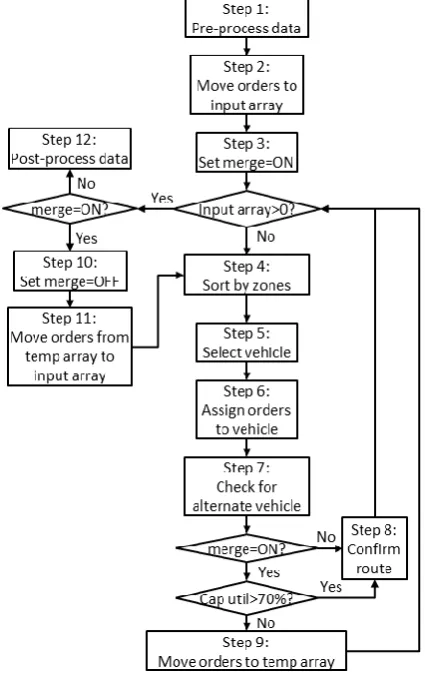
Figure 1: Two-stage adapted sweep-based algorithm
B. Two-stage sweep-based algorithm
The sweep-based approach forms the basis of my algorithm. The idea is to add non-served customers to the current route until the capacity of the vehicle is reached based on a two-stage search process. The algorithm consists of the following steps (see Figure 1):
Step 1: Pre-process data
Step 2: Move orders to input array
Data of customer orders is moved into an input array to prepare for route assignment.
Step 3: Set merge=ON
The algorithm performs a two-stage search process. In the first stage, multiple orders of the same customer are merged (when the merge order constraints is switched on) to keep the orders together during vehicle assignment. If the size of the merged order exceeds the capacity of the largest vehicle available, it will be considered an unsuccessful route. The entire order will be subsequently processed in the second stage where the merging of orders by customer constraints is relaxed.
Step 4: Sort by zone
Orders are clustered by geographical zones and only vehicles within their respective zones are considered for assignment.
Step 5: Select vehicle
Vehicle is prioritized by a cost function. In my case, larger vehicles are given a higher priority and thus, have a lower cost value than smaller vehicles. The algorithm will search for an unassigned vehicle that has the lowest cost.
Step 6: Assign orders to vehicle
The algorithm will search for orders that satisfy all the constraints. Different search methods have been used here, for instance, start with either a smaller order or a larger order, first. Proximity of customer’s location to the depot and to the next drop point is also taken into consideration in the search process.
Step 7: Check for alternate vehicle
Once a feasible route is found, the algorithm will evaluate if the capacity utilization of the selected vehicle can be further improved by assigning another vehicle for that route. If a new vehicle is found, it will replace the existing vehicle. Vehicle capacity utilization is a key performance measure.
Step 8: Confirm route
In stage one processing, the route will be considered successful if the capacity utilization of the vehicle exceeds 70%.
Step 9: Move orders to temp array
If the feasible route found in stage one processing fails to meet the 70% capacity utilization criterion, the route is considered unsuccessful and the orders in that route will be moved to a temporary array for re-processing in stage two where the merge order constraints is relaxed.
Step 10: Set merge=OFF
After having processed all the orders through stage one, the merge order constraints is relaxed in preparation for stage two processing. In stage two, large orders can be split up or combined to increase the capacity utilization of vehicles.
Step 11: Move orders from temp array to input array Rejected orders from stage one processing will be moved from the temporary array to the input array for stage two processing. Stage two processing will iterate through steps 4 to 9 until all the orders in the input array are exhausted. Step 12: Post-process data
Stage two processing will terminate when all the orders in the input array are exhausted. All successful routes from
both, stages one and two processing will be post-processed to a format suitable for downstream processes.
IV. NON STANDARD CONSTRAINTS
Despite the importance of VRP applications in logistic and supply chain management, there are very few practical implementations of VRP mentioned in the literature although different versions of this problem have been formulated to extend its applicability. Most researchers view VRP as an optimization problem and emphasize the development of complex algorithms that would outperform others. However, the complexity of real-life VRP goes beyond the standard capacitated or time-window constraints; there are other practical considerations that may counter the need to search for an optimal solution. In this paper, I will discuss four real-life, non-standard constraints and show their impact on the quality of VRP solutions.
A. Merge order constraints
It is not uncommon for a customer to place multiple orders on separate occasions that are scheduled for delivery on the same day. As these orders are captured separately (there are different order numbers for the deliveries), there is a possibility that they may be assigned to different delivery vehicles. The common approach to overcome this problem is to merge these orders into a single order before route planning and split them again afterwards. In practice, such pre-processing activity is usually undertaken manually which may be time consuming and tedious. In my approach, I consider multiple orders of the same customer as a single drop point. My algorithm adopts a two-stage process in searching for feasible solutions. In stage one, orders are grouped according to their customer thereby, forcing their assignment to the same vehicle wherever possible. In stage two, the merge order constraints are relaxed to allow for splitting and combining of different customer orders to increase the capacity utilization of vehicles. Even though the merge order constraints are relaxed in stage two, the algorithm ensures that orders from the same customer stay together as far as possible.
B. Maximum drop point constraints
which will break the maximum drop point constraint for customer B (which is 2). In short, the total number of drop points must not exceed the lowest maximum drop point constraints of orders assigned to the vehicle.
C. Order-vehicle type matching constraints
There are practical constraints on the type or size of vehicles entering certain restricted areas. For instance, heavy vehicles are not allowed to travel through central business districts during peak hour. Decisions regarding the types of vehicles used are also influenced by the weight and height restrictions of the customer’s loading and unloading bays. Such practical constraints are often ignored in classical VRP but remain key success factors for solving real-life VRP. In my approach, the orders will have a range of allowable vehicle types that may be associated with the customer. Vehicle type in this case is defined by the vehicle’s capacity (weight and volume). For example, a vehicle with a weight capacity of 0.5 ton and volume capacity of 5 m3 is represented as “0.5T3M.” Each order has a range of vehicle type assigned to it, for example “0.5T5M; 10T20M; 2.5T9M.” With this order-vehicle type matching constraints, we have increased the level of complexity of the VRP; the algorithm not only has to satisfy the vehicle capacity constraints, it also has to match vehicle types with orders and vehicles.
D. Mixed-load constraints
In practice, some goods are not to be mixed with other goods during delivery. A 3PL business operations often entails distribution of goods for competing brand owners who do not want their goods to be mixed with their competitor’s goods during delivery. One approach proposed by ILOG Dispatcher is to establish a disallow constraint. For instance, if good A is not to be mixed with good B, a disallow constraint will be defined between the pair of goods. This approach is manageable with some items, but when the number of items gets larger, the disallow constraints can quickly become unmanageable with an exponential increase in the number of conflicting pairs.
To overcome this limitation, I propose a simple two-label system to manage this complexity; a “group” label and a “tier” label. I term this: mixed-load constraints.
The three rules governing the group-tier concept,
i. Orders with the same group label but different tier label cannot be assigned to the same vehicle.
ii. Orders with different group labels but same tier label can be assigned to the same vehicle.
iii. Orders without any group or tier label can be assigned together with any other order.
[image:4.595.326.524.523.724.2]The following example illustrates the group-tier concept. Table I – Group-tier label
Order No Group Tier
100 A 1
101 B 1
102 A 2
103 C 1
104
With reference to Table I, orders 100, 101, 103, and 104 can be assigned to the same vehicle (rule “i” and “iii”). Another possible combination is orders 101, 102, 103, and 104. On the other hand, orders 100 and 102 cannot be assigned to the same vehicle because both orders have the same group label (rule “ii”).
V. COMPUTATIONAL RESULTS WITH REAL-LIFE DATA Some solutions for solving the VRP can be adapted to deal with additional constraints, but this is normally much easier for relatively simple heuristics, than for more sophisticated approach and optimization methods. Simple heuristics are much more flexible and this is especially important when being applied to solve a practical problem. In this paper, I describe a two-stage sweep-based heuristic to solve a real-life VRP with the usual capacity and time-window constraints, plus four additional non-standard constraints. My solution was successfully tested and implemented by a 3PL service provider for their distribution operations. Orders of different quantities were delivered to different customers (locations): supermarkets and convenience stores, daily. The key challenge faced by the 3PL was the long and tedious process of manually planning their daily delivery routes which changed every day.
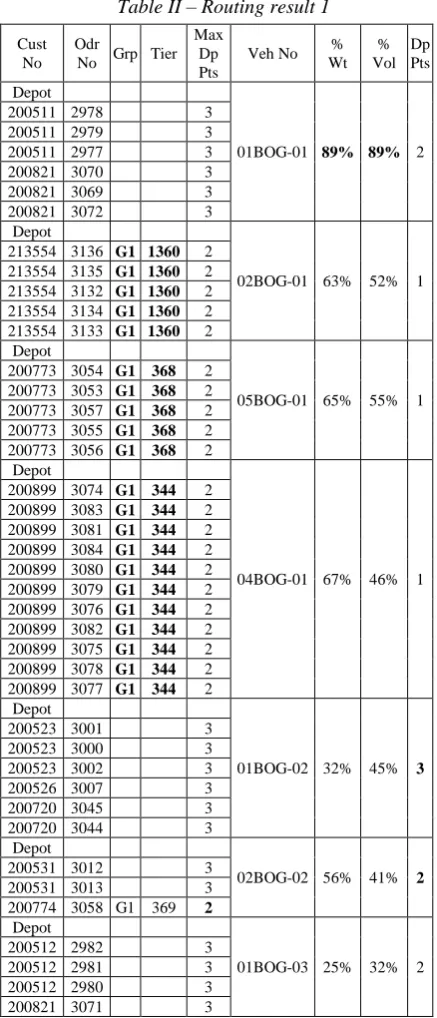
[image:4.595.106.233.702.781.2]I have selected several real-life routes generated by my algorithm to show the impact of the four non-standard constraints on the quality of the solution. The headers of the following Tables are; the customer number (Cust No), order number (Odr No), vehicle type (Veh Type), group-tier label (Grp and Tier), maximum number of allowable drop points (Max Dp Pts), vehicle number (Veh No), percentage utilization of vehicle’s capacity (%Wt and %Vol), and total number of drop points per vehicle (Dp Pts). The texts that are highlighted in bold represent the limiting constraints. A vehicle can be underutilized (capacity) but is limited by the total number of drop points. There can be more than one limiting constraints.
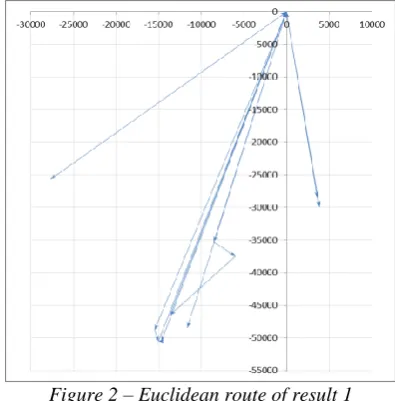
Figure 2 – Euclidean route of result 1
the lowest value in the Max Dp Pts column). The orders in these three vehicles belong to the same group but with different tier values thus preventing them from being assigned to the same vehicle based on the mixed-load constraints (see Section III). Vehicles 01BOG-02 and 02BOG-02 are also underutilized but they have reached the maximum number of drop points allowable (the limiting constraints in this case). Vehicle 01BOG-03 is underutilized and not limited by any of the non-standard constraints because these orders are the leftovers and the vehicle assigned is already the lowest capacity available. In Figure 2, a graphical plot of result 1 is shown in Euclidean distance.
Table II – Routing result 1
Cust No
Odr
No Grp Tier Max
Dp Pts
Veh No % Wt % Vol Dp Pts Depot
01BOG-01 89% 89% 2
200511 2978 3
200511 2979 3
200511 2977 3
200821 3070 3
200821 3069 3
200821 3072 3
Depot
02BOG-01 63% 52% 1 213554 3136 G1 1360 2
213554 3135 G1 1360 2 213554 3132 G1 1360 2 213554 3134 G1 1360 2 213554 3133 G1 1360 2
Depot
05BOG-01 65% 55% 1 200773 3054 G1 368 2
200773 3053 G1 368 2 200773 3057 G1 368 2 200773 3055 G1 368 2 200773 3056 G1 368 2
Depot
04BOG-01 67% 46% 1 200899 3074 G1 344 2
200899 3083 G1 344 2 200899 3081 G1 344 2 200899 3084 G1 344 2 200899 3080 G1 344 2 200899 3079 G1 344 2 200899 3076 G1 344 2 200899 3082 G1 344 2 200899 3075 G1 344 2 200899 3078 G1 344 2 200899 3077 G1 344 2
Depot
01BOG-02 32% 45% 3
200523 3001 3
200523 3000 3
200523 3002 3
200526 3007 3
200720 3045 3
200720 3044 3
Depot
02BOG-02 56% 41% 2
200531 3012 3
200531 3013 3
200774 3058 G1 369 2 Depot
01BOG-03 25% 32% 2
200512 2982 3
200512 2981 3
200512 2980 3
[image:5.595.60.279.220.730.2]200821 3071 3
Table III – Routing result 2
Cust No
Odr No
Veh
Type Grp Tier Max
Dp Pts
Veh No % Wt % Vol Dp Pts Depot 1.5T2.5
M 01TAN-01 71% 99% 1
200490 729 1
200490 728 1
200490 727 1
Depot
1.5T2.5
M 01TAN-02 36% 49% 1
214456 882 1
214456 881 1
Depot
1.5T2.5
M 01TAN-03 40% 83% 1
200723 800 1
200723 801 1
Depot
1.5T2.5
M 01TAN-04 21% 43% 1
200714 786 1
200714 787 1
Depot
1.5T2.5
M 01TAN-05 54% 63% 1
214532 887 1
214532 884 1
214532 885 1
214532 886 1
214532 888 1
Depot
20T40M 05TAN-01 79% 62% 1
214148 879 G1 1427 1
214148 880 G1 1427 1
Depot
20T40M 05TAN-02 74% 55% 1
214008 878 G1 1425 1
214008 873 G1 1425 1
214008 872 G1 1425 1
214008 874 G1 1425 1
214008 877 G1 1425 1
214008 876 G1 1425 1
214008 875 G1 1425 1
214008 871 G1 1425 1
Depot
3T6M 02TAN-01 91% 52% 1
200417 701 G1 274 2
Depot
1.5T2.5
M 01TAN-06 28% 59% 1
200719 794 1
200719 795 1
Depot
1.5T2.5
M 01TAN-07 16% 34% 1
200718 792 1
200718 793 1
Depot
20T40M 05TAN-03 56% 34% 2
200704 779 2
200704 780 2
202418 836 G1 491 3
Depot
20T40M 05TAN-04 54% 32% 1
202418 837 G1 491 3
202418 835 G1 491 3
Depot
20T40M 05TAN-05 52% 30% 1
202418 838 G1 491 3
Depot
1.5T2.5
M 01TAN-08 31% 54% 2
200717 790 2
200717 791 2
202494 847 G1 1197 2
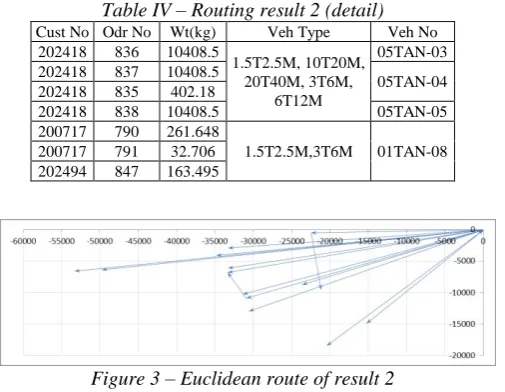
best option is to assign orders 837 and 835 together and order 836 is combined with another customer’s order. Order 838 is left alone because the vehicle type (20 ton) that it is eligible for is not amongst the vehicle types slotted for the remaining orders (790, 791, and 847). Further, vehicle 01TAN-08 (which carries 790, 791, and 847) has already reached its limiting constraints (maximum drop point constraints) and thus, is considered a successful route. In Figure 3, a graphical plot of result 2 is shown in Euclidean distance.
Table IV – Routing result 2 (detail)
Figure 3 – Euclidean route of result 2
VI. CONCLUSION
Real-life VRP presents a high degree of complexity mostly derived by the need to respect a variety of practical constraints that are not considered by the classical models of the vehicle routing literature. In this paper, I consider a VRP with standard constraints like heterogeneous vehicle fleets with different capacity and multiple time-window restrictions together with non-standard constraints like merge order constraints, maximum drop point constraints, order-vehicle matching constraints, and mixed-load constraints. I propose an adapted two-stage sweep-based algorithm together with local search heuristics. I investigated the performance of the implemented algorithm in a 3PL distribution operation. The results were reasonably good although the capacity utilization of some vehicles is lower than expected due to other limiting constraints. Moving forward, I am looking at applying the improvement and exchange method using the metaheuristic approach to improve the quality of the current solution.
REFERENCES
[1] V. Pillac, M. Gendreau, C. Gueret, A.L. Medaglia, “A review of dynamic routing problems”, European Journal of Operational Research, vol. 225, pp. 1-11, 2013.
[2] B. Eksioglu, A.V. Vural, A. Reisman, “The vehicle routing problem: A taxonomic review”, Computers & Industrial Engineering, Vol. 57, pp. 1472-1483, 2009.
[3] G. Laporte, M. Gengreau, J. Potvin, F. Semet, “Classical and modern heuristics for the vehicle routing problem”, International Transactions in Operational Research, Vol. 7, pp. 285-300, 2000. [4] B. Gillet , L. Miller, “A heuristic algorithm for the vehicle-dispatch
problem”, Operations Research, Vol. 22, pp. 340-349, 1974.
[5] M. Gendreau, A. Hertz, G. Laporte, “A tabu search heuristic for the vehicle routing problem”, Management Science, Vol. 40, pp. 1276-1290, 1994.
[6] G.B. Dantzig, J.H. Ramser, “The truck dispatching problem”,
Management Science, 6, pp. 80-91, 1959.
[7] M. Solomon, “Algorithms for the vehicle routing and scheduling problems with time windows constraints”, Operations Research, Vol. 35, 2, pp. 254-265, 1987.
[8] L. Bodin, B. Golden, A. Assad, M. Ball, “Routing and scheduling of vehicles and crews: The state of the art”, Computers & Operations Research, Vol. 10, pp. 63-211, 1983.
[9] I. Moon, J. Lee, J. Seong, “Vehicle routing problem with time windows considering overtime and outsourcing vehicles”, Expert Systems with Applications, Vol. 39, pp. 13202-13213, 2012. [10] M. Gendreau, M. Iori, C. Laporte, S. Martello, “ A tabu search
algorithm for a routing and container loading problem”,
Transportation Science, Vol. 40, 3, pp. 342-350, 2006.
[11] A. Bortfeldt, J. Homberger, “Packing first, routing second – a heuristic for the vehicle routing and loading problem”, Computers & Operations Research, Vol. 40, pp. 873-885, 2013.
[12] A. Haghani, S. Jung, “A dynamic vehicle routing problem with time-dependent travel times”, Computers & Operations Research, Vol. 32, pp. 2959-2986, 2005.
[13] A, Agra, M. Christiansen, R. Figueiredo, L.M. Hvattum, M. Poss, C. Requejo, “The robust vehicle routing problem with time windows”,
Computers & Operation Research, Vol. 40, pp. 856-866, 2013. [14] X. Li, P. Tian, S. Leung, “Vehicle routing problems with time
windows and stochastic travel and service times: Models and algorithm”, International Journal of Production Economics, Vol. 15, pp. 137-145, 2010.
[15] R. Hall, “On the road to recovery”, ORMS Today, Vol. 31, 3, pp. 40-49, 2004.
[16] M.L. Fisher, R. Jaikumar, “A generalized assignment heuristics for vehicle routing”, Networks, Vol. 11, 2, pp. 109-124, 1981.
[17] D. Bertsimas, M. Grigni, “On the space-filling curve heuristic for the Euclidean traveling salesman problem”, Operations Research Letters, pp. 241-244, 1989.
Cust No Odr No Wt(kg) Veh Type Veh No 202418 836 10408.5
1.5T2.5M, 10T20M, 20T40M, 3T6M,
6T12M
05TAN-03 202418 837 10408.5
05TAN-04 202418 835 402.18
202418 838 10408.5 05TAN-05
200717 790 261.648
1.5T2.5M,3T6M 01TAN-08 200717 791 32.706