Enzymes are natural mediators and catalysts for many important processes in soils. They take part in the formation and decomposition of humus, biological reduction of molecular nitrogen from the air, nitrifica-tion and denitrificanitrifica-tion (Dick 1992, Acosta-Martínez 2007, Kalembasa and Kuziemska 2011, Olszowska 2016, Błońska et al. 2017, Bhavya et al. 2018). Their activity is influenced, among others, by temperature, pH value, humus content, and inhibitors, which in-clude copper. According to Wang et al. (2009), the process of reducing the enzymatic activity of soil by copper occurs in several ways, including a direct inhibitory effect on the development of microorgan-isms, and the enzymes they produce, binding active protein groups of enzymes, forming complexes with substrates. The effect of this metal on soil enzymes may result from the penetration of Cu2+ ions into
the cells of microorganisms or their adsorption on the surface of cells (Fernández-Calvińo et al. 2010).
The enzymes most sensitive to elevated copper levels in soil include urease and dehydrogenases, whereas phosphatases (acid and alkaline) are classified as medium-sensitive enzymes (Wyszkowska et al. 2005, 2013, 2017, Angelovičová et al. 2014).
The aim of the study was to determine the impact of various doses of copper and the protective organic fertilisation with cattle manure, chicken manure and mushroom substrate on the activity of urease, dehydrogenases, and acid and alkaline phosphatase.
MATERIAL AND METHODS
The pot experiment was carried out in the vege- tation hall in 2014–2016. Pods with a capacity of 10 L were filled with 12 kg of soil Luvisols with the participation of the main granulometric fractions: sand 71%; silty 24%; clay 5%. The soil used in the study showed: pH in 1 mol/L KCl – 6.7; total nitrogen
The effect of different copper doses and organic fertilisation
on soil’s enzymatic activity
Beata Kuziemska, Andrzej Wysokiński*, Joanna Trębicka
Faculty of Agrobioengineering and Animal Husbandry, Siedlce University of Natural Sciences and Humanities, Siedlce, Poland
*Corresponding author: [email protected]
Citation: Kuziemska B., Wysokinski A., Trebicka J. (2020): The effect of different copper doses and organic fertilisation on soil’s enzymatic activity. Plant Soil Environ., 66: 93–98.
Abstract: A three-year pot experiment carried out in the vegetation hall in 2014–2016 included studying the enzy-matic activity of soil, into which various amounts of copper: (100, 200 and 300 mg Cu/kg soil) and organic materials (cattle manure, chicken manure, post-mushroom substrate) were introduced, used separately, at a soil-introduction dose of 2 g Corg/kg. Copper and organic materials were used once, only in the first year of the study, before sowing test plant orchard grass. In soil collected after the last (fourth) swath of grass in each year of the study, the activi-ty of urease, dehydrogenases, acid, and alkaline phosphatase was determined. Applications of copper to the soil, regardless of its dose, resulted in a decrease in urease, dehydrogenases and alkaline phosphatase and an increase in acid phosphatase activity. The inactivating effect of this metal on the activity of urease, dehydrogenases and alkaline phosphatase increased with the increase of its dose. Organic fertilisation generally increased the enzymatic activity of the analysed soil. In subsequent years of the study, urease and alkaline phosphatase activity decreased, while acid phosphatase activity increased. Dehydrogenase activity did not change significantly in subsequent years of the study.
Keywords: enzymes; micronutrient; microorganism; toxic element; heavy metal
content 1.48 g N/kg; carbon in organic compounds 16.10 g Corg/kg; available phosphorus 189 mg P/kg, available potassium 110 mg K/kg, total copper 12.93 mg Cu/kg.
The following factors were taken into account in the scheme of the experiment carried out in a completely random system, in triplicate: I – copper dose: control object – without copper (0) and 100, 200, and 300 mg Cu/kg soil. This element was introduced into the soil once, before sowing the test plant, in the first decade of May, in the year of the beginning of the research, in the form of an aqueous solution of CuSO4·5 H2O; II – organic fertilisation: control object – without the use of organic materials (CO) and cattle manure (CM), chicken manure (ChM) and mushroom substrate (MS) used separately, once, in the year of starting the research, two weeks before sowing the test plant at a dose of 2 g of carbon in organic compounds – Corg/kg soil. Selected properties of organic materials are given in Table 1. In each organic materials samples, the following were determined: dry matter (DM in 105 °C), organic carbon by Tiurin method, total nitrogen content by CHNS method (Autoanalyser CHN with detector IDC, Series II 2400, Perkin-Elmer, California, USA), and the content of P, K, C, Mg, S and Cu by the ICP-AES method (Optima 3200 RL, Perkin-Elmer, Waltham, USA) after dry mineralisation of samples at 500 °C. In soil in each year of the experiment were determined: pH value (potentiometrically in 1 mol/L KCl), organic carbon by Tiurin method, Cu avail-able for plants (by the ICP-AES method in extract 0.11 mol/L CH3COOH).
In each year of research, orchard grass (Dactylis glomerata L.), cv. Amera was grown on all sites; four swaths (regrowth) were collected, with thirty days apart. In soil collected after the fourth and last swath of grass, in each (1, 2 and 3) year of the experiment: urease activity was determined using the Hoffman and Teicher method (1961), dehydrogenase activity was measured using the method of Casida et al. (1964), acid and alkaline phosphatase activity was measured using the Tabatabai and Bremner method (1969).
The results of the experiments were analysed by ANOVA. The significance of sources of variation was checked with the Fisher-Snedecor test, and mean values were separated with the Tukey’s test at the significance level of P < 0.05. For these calculations, the Statistica 13 PL (StatSoft, Tulsa, USA) was used. In addition, Pearson’s linear correlation coefficient was calculated for some of the examined features.
RESULTS AND DISCUSSION
The conducted studies showed a significant impact of differential copper doses and the application of organic materials – cattle manure, litter from laying hens, and post-mushroom substrate on the activity of urease, dehydrogenases, as well as acid and alkaline phosphatase in the analysed soil (Tables 2–5).
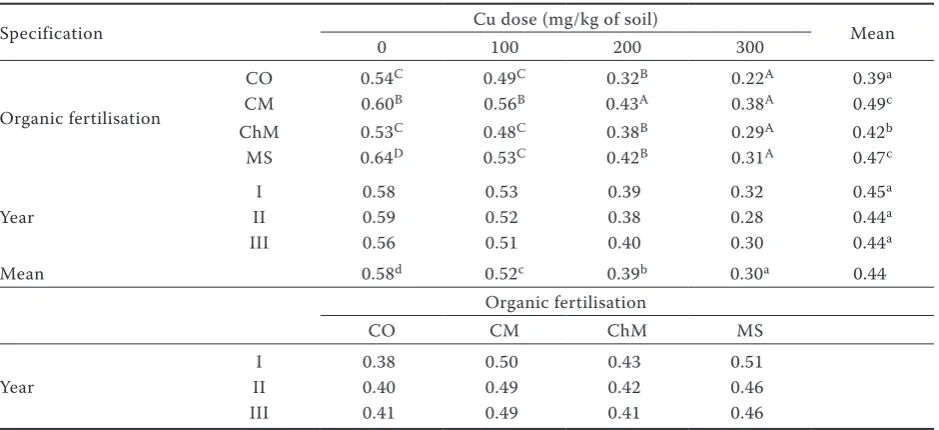
[image:2.595.62.532.679.756.2]All copper doses reduced urease and dehydrogenase activity. The inhibitory effect of this metal intensi-fied with the increase of its quantity in soil. Copper application at doses of 100, 200 and 300 mg Cu/kg re-sulted in a decrease in urease activity by 11.7, 44.5, and 55.8% (Table 2), while dehydrogenases by 10.3, 32.8 and 48.3% (Table 3), respectively in relation to the control object. Urease activity in soil fertilised with organic materials, regardless of their origin, was similar, but significantly higher compared to soil activity from the control object. The activity of this enzyme decreased in subsequent years of research. In the second and third years, it was 7.2% and 13.4% lower, respectively, than in the first year. All the organic materials used reduced the copper negative for dehydrogenase activity. Their activity determined in soil fertilised with cattle manure, mushroom substrate and chicken manure was 25.6, 20.5 and 7.7% higher, respectively than without their application. Interaction analysis indicated that the lowest copper dose (100 mg Cu/kg) used in com-bination with cattle manure and chicken manure did not significantly reduce dehydrogenase activity. Such protective effects of cattle manure and chicken manure were not obtained after using higher doses of copper (200 and 300 mg Cu/kg) and mushroom substrate after
Table 1. Chemical composition of organic materials used in a pot experiment
Organic material Dry matter (DM, %) Corg Ntotal C: N P K Ca Mg S (mg/kg DM)Cu
(g/kg DM) (g/kg DM)
all doses of Cu was applied. The conducted studies showed no changes in dehydrogenase activity in sub-sequent years of the experiment.
The soil in which various doses of copper were introduced had similar acid phosphatase activity, but significantly higher its activity compared to the
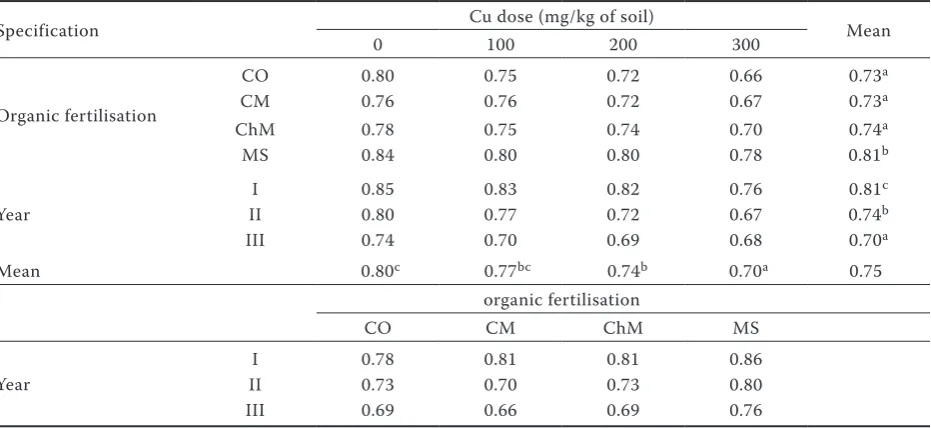
[image:3.595.65.535.113.326.2]control object (Table 4). The application of cattle manure and manure from laying hens increased the activity of this enzyme in relation to its activity in soil without organic fertilisation, while fertilisation with post-mushroom substrate did not significantly affect its activity. In the case of alkaline phosphatase,
Table 2. Urease activity in the soil – averages for investigated factors (mg NH4+/kg/1 h)
Specification Cu dose (mg/kg of soil) Mean
0 100 200 300
Organic fertilisation
CO 8.98 7.79 3.65 2.80 5.81a
CM 9.24 8.47 5.79 4.87 7.09b
ChM 9.25 8.22 5.78 4.62 6.97b
MS 9.73 8.38 5.40 4.14 6.91b
Year
I 9.84 8.87 5.72 4.32 7.19c
II 9.25 8.07 5.19 4.18 6.67b
III 8.82 7.70 4.57 3.83 6.23a
Mean 9.30d 8.21c 5.16b 4.11a 6.70
Organic fertilisation
CO CM ChM MS
Year
I 6.22 7.69 7.40 7.43
II 5.77 6.99 7.00 6.93
III 5.43 6.60 6.51 6.39
CO – control objects; CM – cattle manure; ChM – chicken manure; MS – mushrooms substrate. a,b,cMeans for investigated
factors with different letters (in the columns for organics fertilisation and ears but the row for cooper doses) are significantly different. All interactions (cooper dose/year, cooper dose/organic fertilisation and organic fertilisation/year) are not important
Table 3. Dehydrogenase activity in the soil – averages for investigated factors (mmol triphenyl formazan/kg soil/24 h)
Specification Cu dose (mg/kg of soil) Mean
0 100 200 300
Organic fertilisation
CO 0.54C 0.49C 0.32B 0.22A 0.39a
CM 0.60B 0.56B 0.43A 0.38A 0.49c
ChM 0.53C 0.48C 0.38B 0.29A 0.42b
MS 0.64D 0.53C 0.42B 0.31A 0.47c
Year
I 0.58 0.53 0.39 0.32 0.45a
II 0.59 0.52 0.38 0.28 0.44a
III 0.56 0.51 0.40 0.30 0.44a
Mean 0.58d 0.52c 0.39b 0.30a 0.44
Organic fertilisation
CO CM ChM MS
Year
I 0.38 0.50 0.43 0.51
II 0.40 0.49 0.42 0.46
III 0.41 0.49 0.41 0.46
CO – control objects; CM – cattle manure; ChM – chicken manure; MS – mushrooms substrate. A,B,C,DMeans for the
[image:3.595.64.534.500.715.2]only the doses of 200 and 300 mg Cu/kg soil reduced its activity (Table 5). The lowest dose of 100 mg Cu/kg soil did not significantly affect the activity of this enzyme. According to research conducted by Nowak et al. (2003), in small amounts, heavy
[image:4.595.67.530.113.327.2]metals can stimulate phosphatase activity, while in large quantities; they reduce the number of micro-organisms secreting this enzyme. No effects of cattle manure and chicken manure on alkaline phosphatase activity were found, whereas the introduction of
Table 4. Acid phosphatase activity in the soil – averages for investigated factors (mmol p-nitrophenol/kg soil/1 h)
Specification Cu dose (mg/kg of soil) Mean
0 100 200 300
Organic fertilisation
CO 0.45 0.48 0.49 0.46 0.47a
CM 0.48 0.53 0.53 0.51 0.51c
ChM 0.46 0.52 0.53 0.49 0.50bc
MS 0.45 0.46 0.48 0.51 0.48ab
Year
I 0.44 0.46 0.49 0.46 0.46a
II 0.46 0.51 0.51 0.49 0.49b
III 0.48 0.53 0.53 0.53 0.52c
Mean 0.46a 0.50b 0.51b 0.49b 0.49
Organic fertilisation
CO CM ChM MS
Year
I 0.44 0.49 0.47 0.45
II 0.46 0.51 0.51 0.48
III 0.51 0.54 0.52 0.50
CO – control objects; CM – cattle manure; ChM – chicken manure; MS – mushrooms substrate. a,b,cMeans for
investi-gated factors with different letters (in the columns for organics fertilisation and ears but the row for cooper doses) are significantly different. All interactions (cooper dose/year, cooper dose/organic fertilisation and organic fertilisation/ year) are not important
Table 5. Alkaline phosphatase activity in the soil – averages for investigated factors (mmol p-nitrophenol/kg soil/1 h)
Specification Cu dose (mg/kg of soil) Mean
0 100 200 300
Organic fertilisation
CO 0.80 0.75 0.72 0.66 0.73a
CM 0.76 0.76 0.72 0.67 0.73a
ChM 0.78 0.75 0.74 0.70 0.74a
MS 0.84 0.80 0.80 0.78 0.81b
Year
I 0.85 0.83 0.82 0.76 0.81c
II 0.80 0.77 0.72 0.67 0.74b
III 0.74 0.70 0.69 0.68 0.70a
Mean 0.80c 0.77bc 0.74b 0.70a 0.75
organic fertilisation
CO CM ChM MS
Year
I 0.78 0.81 0.81 0.86
II 0.73 0.70 0.73 0.80
III 0.69 0.66 0.69 0.76
CO – control objects; CM – cattle manure; ChM – chicken manure; MS – mushrooms substrate. a,b,cMeans for
[image:4.595.66.532.488.702.2]the post-mushroom substrate caused its increase. In subsequent years of research, acid phosphatase activity in the analysed soil increased, while alkaline phosphatase decreased.
Increasing doses of copper introduced into the soil increased the amount of this metal in forms available to plants (Table 6). All organic materials increased the organic carbon content in the soil, and reduced the amount of copper in the form available to plants. In subsequent years of research, the con-tent of organic carbon, available copper, and soil pH value was reduced.
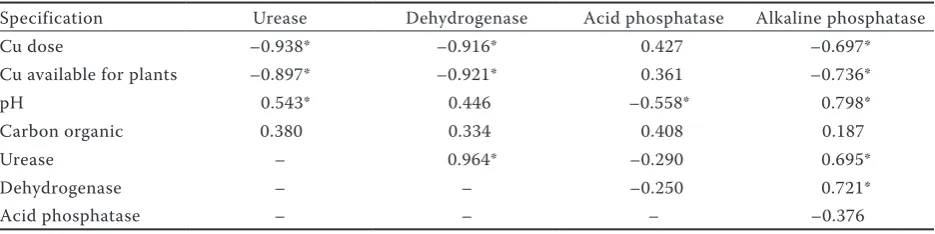
Correlation analysis confirmed the negative effect of increasing copper doses and its amount of available forms to plants on the activity of urease, dehydroge-nases, and alkaline phosphatase (Table 7).
The conducted study showed that the application of high doses of copper reduces the enzymatic activity of the soil, which indirectly reduces its fertility and capability, which is its measure according to Russel (2005). The negative effect of soil contamination with copper on its enzymatic activity is highlighted in stud-ies by Chaperon and Sauvé (2007), Wang et al. (2007), Fernandéz-Calvińo et al. (2010), Zhan and Sun (2014), Wyszkowska et al. (2017), and Li et al. (2018). The in-activating effect of this metal on the activity of urease, dehydrogenases and alkaline phosphatase increased
with the increase of its dose. This proves that copper gradually blocks active centres of enzymes, modifies their molecular structure and reduces the amount of soil microorganisms (Becker et al. 2006, Oliveira and Pampulha 2006). In the case of acid phosphatase, it was activated by copper, but its activity in soil fertilised with various doses of this metal was similar.
The effect of organic materials (cattle manure, chicken manure, and post-mushroom substrate) on the enzymat-ic activity of the studied soil was diverse but generally stimulating. This diversity could have been due to slightly different chemical composition, C : N ratio, which could differentiate their soil mineralisation rate. The activating effect of organic matter on the activity of soil enzymes was demonstrated by Chang et al. (2007) and Kotroczó et al. (2014). Cattle manure and chicken manure sig-nificantly limited the inactivating effect of 100 mg copper on dehydrogenase activity, which is associated with the activity of many enzyme systems commonly found in aerobic and anaerobic soil microorganisms. The organic substance introduced with them limited the mobility of copper as a result of the immobilisation process that occurs due to the mechanism of chemical complexation and sorption (Cuske and Karczewska 2016).
[image:5.595.64.530.127.200.2]In the summary of the conducted study, it should be stated that the application to copper soil reduced
Table 6. Soil’s pH value and content of organic carbon (g Corg/kg) and copper is available for plant form (mg Cuav/kg) – averages for investigated factors
Soil
parameter CO Organic fertilisationCM ChM MS 0 Cu dose (mg/kg of soil)100 200 300 I YearII III pH 6.66 6.52 6.72 6.76 6.76 6.69 6.63 6.57 6.73 6.66 6.60 Corg 15.8a 17.6b 17.1b 17.3b 16.9a 17.0a 16.8a 16.9a 17.4c 16.9b 16.5a
Cuav 134.6b 121.2a 113.5a 115.6a 0.8a 80.4b 146.7c 257.0d 136.9c 122.3b 104.5a
CO – control objects; CM – cattle manure; ChM – chicken manure; MS – mushrooms substrate. a,b,cMeans for
inves-tigated factors with different letters in the rows are significantly different
Table 7. Linear correlation coefficients between copper doses, soil’s pH and enzymatic activity in the soil
Specification Urease Dehydrogenase Acid phosphatase Alkaline phosphatase
Cu dose –0.938* –0.916* 0.427 –0.697*
Cu available for plants –0.897* –0.921* 0.361 –0.736*
pH 0.543* 0.446 –0.558* 0.798*
Carbon organic 0.380 0.334 0.408 0.187
Urease – 0.964* –0.290 0.695*
Dehydrogenase – – –0.250 0.721*
Acid phosphatase – – – –0.376
[image:5.595.64.532.627.744.2]the activity of urease, dehydrogenases, and alka-line phosphatase, and increased the activity of acid phosphatase. The inactivating effect of this metal on the activity of urease, dehydrogenases and alkaline phosphatase increased with the increase of its dose. Soil fertilised with cattle manure, chicken manure and mushroom substrate generally showed greater enzymatic activity compared to the control object, which indicates the possibility of their use for the recultivation of soils contaminated with copper, using the in situ method. Cattle manure had a particularly beneficial effect on this soil characteristic.
REFERENCES
Acosta-Martínez V., Cruz L., Sotomayor-Ramírez D., Pérez-Alegría L. (2007): Enzyme activities as affected by soil properties and land use in a tropical watershed. Applied Soil Ecology, 35: 35–45. Angelovičová L., Lodenius M., Tulisalo E., Fazekašová D. (2014):
Effect of heavy metals on soil enzyme activity at different field conditions in middle spis mining area (Slovakia). Bulletin of En-vironmental Contamination and Toxicology, 93: 670–675. Becker J.M., Parkin T., Nakatsu C.H., Wilbur J.D., Konopka A. (2006):
Bacterial activity, community structure, and centimeter-scale spatial heterogeneity in contaminated soil. Microbial Ecology, 51: 220–231. Bhavya V.P., Anil Kumar S., Kiran S.K., Alur A., Shivakumar K.M.,
Shivanna M. (2018): Effect of different cropping system on im-portant soil enzyme activity, organic carbon and microbial ac-tivity with different depth. International Journal of Current Microbiology and Applied Sciences, 7: 315–322.
Błońska E., Lasota J., Zwydak M. (2017): The relationship between soil properties, enzyme activity and land use. Forest Research Papers, 78: 39–44.
Casida L.E.Jr., Klein D.D.A., Santoro T. (1964): Soil dehydrogenase activity. Soil Sciences, 98: 371–376.
Chang E.H., Chung R.S., Tsai Y.H. (2007): Effect of different applica-tion rates of organic fertilizer on soil enzyme activity and microbial population. Soil Science and Plant Nutrition, 52: 132–140. Chaperon S., Sauvé S. (2007): Toxicity interaction of metals (Ag,
Cu, Hg, Zn) to urease and dehydrogenase activities in soils. Soil Biology and Biochemistry, 39: 2329–2338.
Cuske M., Karczewska A. (2016): Influence of organic matter on the solubility of heavy metals in contaminated soils – a review of literature. Environmental Engineering, 162: 39–59.
Dick R.P. (1992): A review: long-term effects of agricultural systems on soil biochemical and microbial parameters. Agriculture, Eco-systems and Environment, 40: 25–36.
Fernández-Calviño D., Martín A., Arias-Estévez M., Bååth E., Díaz-Raviña M. (2010): Microbial community structure of vineyard soils with different pH and copper content. Applied Soil Ecology, 46: 276–282.
Hoffman G., Teicher K. (1961): Einkolorimetrisches Verfahrenzur Bestimmung der Ureaseaktivitat in Boden. Zeit Pflanzenernaehr Dung Bodenkunde, 95: 55–63.
Kalembasa S., Kuziemska B. (2011): Effect of nickel contamination on soil enzymatic activity. Fresenius Environmental Bulletin, 20: 1724–1731.
Kotroczó Z., Veres Z., Fekete I., Krakomperger Z., Tóth J.A., Laj-tha K., Tóthmérész B. (2014): Soil enzyme activity in response to long-term organic matter manipulation. Soil Biology and Bio-chemistry, 70: 237–243.
Li Q., Hu Q.J., Zhang C.L., Jin Z.J. (2018): Effects of Pb, Cd, Zn, and Cu on soil enzyme activity and soil properties related to agri-cultural land-use practices in Karst area contaminated by Pb-Zn tailings. Polish Journal of Environmental Studies, 27: 2623–2632. Nowak J., Szymczak J., Słobodzian T. (2003): Am attempt to deter-mination of the 50% toxicity threshold for different heavy metals affecting the phosphatase activity. Advances of Agricultural Sci-ences Problem Issues, 492: 241–248.
Oliveira A., Pampulha M.E. (2006): Effects of long-term heavy metal contamination on soil microbial characteristics. Journal of Bioscience and Bioengineering, 102: 157–161.
Olszowska G. (2016): Soil enzymatic activity in artificially and naturally regenerated forests after wind damage in north-eastern Poland. Forest Research Papers, 77: 89–93.
Russel S. (2005): The significance of studies on enzymes in soil envi-ronment. Acta Agrophysica, Dissertations and Monographs, 3: 5–9. Tabatabai M.A., Bremner J.M. (1969): Use of p-nitrophenol phos-phate for assay of soil phosphatase activity. Soil Biology and Bio-chemistry, 1: 301–307.
Wang Y.P., Shi J.Y., Wang H., Lin Q., Chen X.C., Chen Y.X. (2007): The influence of soil heavy metals pollution on soil microbial bi-omass, enzyme activity, and community composition near a cop-per smelter. Ecotoxicology and Environmental Safety, 67: 75–81. Wang Q.Y., Zhou D.M., Cang L. (2009): Microbial and enzyme prop-erties of apple orchard soil as affected by long-term application of copper fungicide. Soil Biology and Biochemistry, 41: 1504–1509. Wyszkowska J., Borowik A., Kucharski M., Kucharski J. (2013):
Ef-fect of cadmium, copper and zinc on plants, soil microorganisms and soil enzymes. Journal of Elementology, 18: 769–796. Wyszkowska J., Boros-Lajszner E., Lajszner W., Kucharski J. (2017):
Reaction of soil enzymes and spring barley to copper chloride and copper sulphate. Environmental Earth Sciences, 76: 403. Wyszkowska J., Kucharski J., Lajszner W. (2005): Enzymatic
activi-ties in different soils contaminated with copper. Polish Journal of Environmental Studies, 14: 659–664.
Zhan J., Sun Q.Y. (2014): Development of microbial properties and enzyme activities in copper mine wasteland during natural res-toration. Catena, 116: 86–94.