Abstract— Mobile communication has become a major source for information exchange throughout the world. Year by year, we see lot of development in the world of mobile technology. All the mobile technologies which have been developed up to now have really improved our way of living. It has always been our aim to empower world community with top class internet capabilities, thereby designing a future-proof groundwork for new ideas as well as opportunities to build on, so as to start the revolution of communication. This paper gives an overview of mobile communication technologies developed so far and also throws some light on what can we expect from the future of mobile world.
Index Terms— CDMA, LTE, OFDM, TDMA, WiMAX, WMAN.
I. INTRODUCTION
Mobile communication deals with talking, text or sending data as well as image files through a wireless network, which is a technology in which the information is transmitted as well as received using microwaves. We have been continuously looking at the growing mobile technology which is driving mobile devices at a very fast speed. Gadgets supporting mobility have become very powerful and useful as well as very handy by being small in size. We see different uses of these devices everywhere, thereby making lives of all of us very easy and interesting also. Throughout the world, mobile devices availability is expanding rapidly with different features and technologies which are making our lives really better than before. It is only through this mode of communication that we are in touch with people we need to reach, it can be either work related or for some personal reasons. We are capable of sending important files anywhere in the world within a very short time thereby addressing business needs. Also we can get on spot approval for vital decisions, so as to enrich our lives. It is making communication possible for those who live in remote parts of the world. Loved ones living very far from each other have become close, no matter in which part of the world they live. Actually mobile communication has brought the world together, which is really an amazing situation. We saw as early as 1940s, the invention of mobile
Mr. Rajesh Yadav is Assistant Professor in Department of Computer Science and Engineering in School of Engineering and Technology at BML Munjal University, Gurgaon, India. He did his B.E. in Computer Science and Engineering from Maharishi Dayanand University, Rohtak, Haryana and M.Tech. in Computer Science from Guru Jambheshwar University of Science and Technology, Hisar, Haryana, India. He is presently pursuing PhD. in Computer Science from Mewar University, Rajasthan, India. His research area is Wireless Networks, Internet OF things and Mobile WiMAX. Email: [email protected]
phones when some engineers working at AT&T came with the development of cells for base stations of mobile phones. Mobile devices have come up with different faces, if we go into the history of mobile phones; we see that the first device was not an actual phone. They were actually two way radios, allowing users such as taxi drivers to communicate. Rather than using base stations with separate cells with signal passing between cells, the very first mobile phone network was based on a powerful base station allowing communication in a much wider area. Mobile phones started out coming in the market with Motorola introducing the first mobile phone on 3 April 1973. Generation of these phones were known as 0G mobile phones in which different technologies were used like push to talk, mobile telephone system, improved mobile telephone system etc.[1]. Martin Cooper, an employee of Motorola Company is considered as key player as he developed the first mobile phone. Before him, handsets were used in vehicles, but he came with the development of first truly portable mobile phone. History was created in April 1972 with first call made on a mobile phone. “G” refers to generation, related to next generation wireless technologies. We have gone through a very big change in the generation of mobile communication. Each of the generation is making us faster, secure as well as more reliable as compared to previous ones. It is hard to overcome this reliability factor [15]. We see smartphones as our companions today and we are dependent on these devices in large number of ways. Below we start with the generation 1G of mobile world, moving towards all the latest development that has been done up to 7.5G connectivity.
II. WIRELESS NETWORK GENERATIONS A. First Generation (1G)
It stands for first generation in which analog signal technology was basically the main source with circuit switching concept used in them. This mobile generation was based on voice and not for data. Spectrum was not used efficiently for them and roaming was also not possible for this generation. In year 1980, 1G was developed and North America became the first one to implement this technology as analog mobile phone system(AMPS) and it was continuously used till it got replaced by 2G[2][7].
B. Second Generation (2G)
Second generation systems came in late 1980s and were lastly used in year 1990. These systems were basically used for voice transmission using digital signal with speed up to
Challenges and Evolution of Next generation
Wireless Communication
64kbps. Data transfer for GPRS was charged according to megabytes of traffic, whereas communication was billed according to per minute connection. Short message service i.e. SMS was introduced in 2G systems which were not present in 1G whose main focus was on voice transmission only. In the time of this generation of mobile communication, lot of growth was seen in terms of both users as well as valued added services [2]. 2G phones came with the technology of GSM i.e. global system for mobile communication which makes use of digital modulation so as to improve quality of voice, but limited data services were offered by the networks. There had been continued improvement in transmission quality as well as coverage with growing demands in 2G. The concept of compression decompression algorithm was used in 2G networks for digital voice data multiplexing as well as compression.
C. Second Half Generation (2.5G)
It refers to second and half generation cellular wireless technology which is developed in between 2G and 3G. This technology describes the concept of General Packet Radio Services which provides data rates from 56Kbps to 115 Kbps. It has different uses like Wireless Application Protocol (WAP), Access Multimedia Messaging Services (AMMS) and services such as Email as well as World Wide Web Access.
D. Third Generation (3G)
Year 2000 saw the invention of third generation (3G) technology. This technology came with the advancement in terms of data transmission speed increased from 144Kbps-2Mbps. It is for use in multimedia cell phones, known as smart phones today in the world. The reason for upgrading the bandwidth as well as data transfer rate in 3G was basically to provide space for web based application, audio as well as video files. As compared to 2G, 3G offers very high speed which makes it possible to download 3 minute mp3 song in just 11 second. There are 3 cellular access technologies which work in 3G; these are CDMA 2000, WCDMA (UMTS) and TD-SCDMA which is proposed by china wireless telecommunication standards group [3]. 3G comes with the following features:
Video Streaming.
IPTV.
Video calls, video clips-news, music, sports.
Enhanced gaming, chat, location services.
High speed teleworking/VPN access.
Sales force automation.
Real-time financial information.
E. High Speed Download Packet Access (3.5G)
HSDPA is sometimes called 3.5G. This protocol is in the HSPA family and allows up to 14.4Mbits/s download and 5.8Mbits/s upload. This is almost what we expect to see in home wireless LAN.
F. Fourth Generation (4G)
Speed of 100 Mbps can be achieved through fourth generation of mobile technology. In addition to the features offered by 3G, 4G also provides services such as MMS, entertainment services, Digital television in High Definition mode. These are basically packet switched wireless systems with high throughput as well as wide coverage area. High
spectral efficiency and being cost effective are a part of 4G technology [14].Orthogonal Frequency Division Multiplexing (OFDM) along with Ultra-Wide Radio Band (UWB) and Millimeter wireless are used in 4G wireless systems. Frequency band is 2-8 GHz which allows worldwide roaming to access cell anywhere. Wireless mobile communications systems are uniquely identified by generation designations [10].
[image:2.595.307.543.447.559.2]WiMAX and LTE are renowned technologies being used with 4G network today [15]. Table I shows few differences between LTE and WiMAX.
TABLE I
COMPARISON BETWEEN WIMAX & LTE
Parameter WiMAX LTE
Standard body IEEE & WiMAX 3GPP
Peak data rate Dl:75Mbps UL:25Mbps Dl:100Mbps UL:50Mbps
Cell Radius 2-7 Km. 5 Km. Spectral efficiency
(bits/sec/hz) 3.75 5
Mobility 120 kmph 350 ph
G. Fifth Generation (5G)
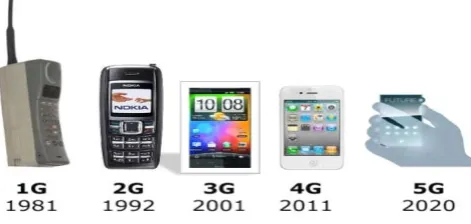
This technology is definitely the next most crucial mobile technology stage after 4G networks [6]. It can be called as the real wireless world because it is a complete wireless communication with no boundaries.5G is expected to be an intelligent innovation technology which will interconnect the whole world with no limits [19]. Now 5G is not a formally utilized term but new versions will give rise to system performance and in addition to this it will add latest features with new application domain [20]. Figure 1 shows evolution of 1G to 5G.
Figure 1 Evolution of 1G to 5G Technology
Features of 5G:
Multimedia Newspapers.
TV programs with clarity as good as HD TV.
Fast data transmission.
It will be the perfect real world wireless web i.e.
WWWW
with no more access limitations. Use of AI capable wearable devices [6].
One unified global standard.
Cognitive radio technology, also known as smart radio. 5G technology is providing large broadcasting of data in
gigabit which supporting almost 65,000 connections [4].
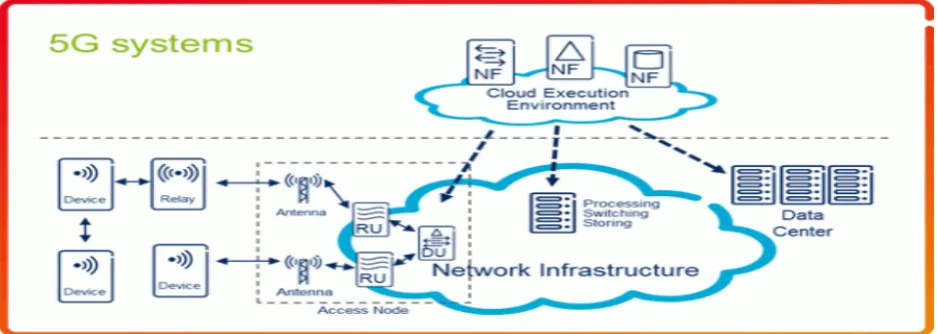
Figure 2 shows 5G network.5G- IU (5G Interfacing Unit) has an objective of creating the most powerful 5G system by having a common platform for all radio access technologies [8] [9].
IU (5G Interfacing Unit) has an objective of creating the most powerful 5G system by having a common platform for all radio access technologies [8] [9]. It will come up with benefits like low network establishment cost, less requirement for equipment, network efficiency will be improved, high performance and interoperability. Reason for the need of 5G will be like[16] low battery consumption, better coverage and high data rates, around 1Gbps data rate in mobility as well as being non harmful to human health.
H. Sixth Generation (6G)
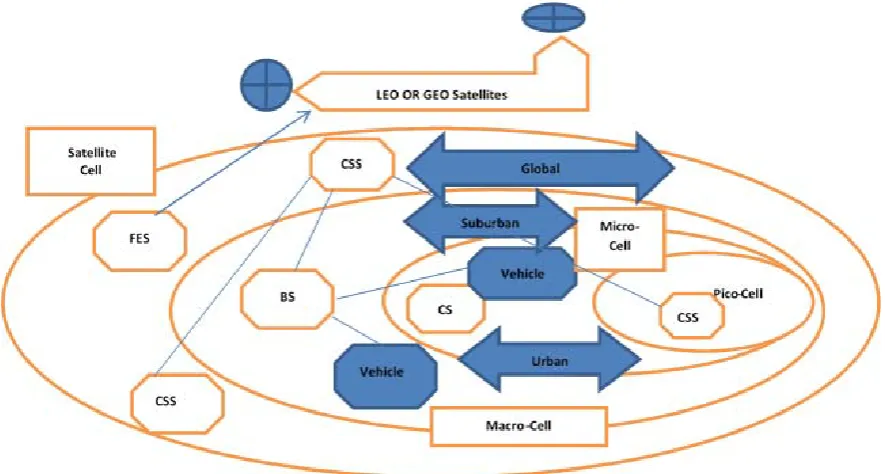
This generation will bring revolution in the world of technology by offering high speed internet access on air through wireless and mobile devices up to 11 Gbps. Although 6G will have 5G as its main backbone. Figure 3 shows 6G with Satellite Networks.
This technology will bring the use of Nano antennas specially designed to work at various locations. 6G will actually decorate the globe with fly sensors, which will send information to observer station placed at remote locations. In addition to this, any activity at specific areas will also be checked in order to find terrorist, intruders.6G will come up with following benefits [10]:
• Internet at ultra-fast access rate. • 10-11 Gbps data rates will be offered.
• Various applications will be seen in future in addition to home automation.
• Concept of smart homes, cities as well as villages. • Modification of defense applications using 6G. • Home based ATM systems.
For global coverage, 6G mobile system will merge 5G wireless mobile system and satellite networks like telecommunication satellite network, earth imaging satellite network and navigation satellite network. [13].
I. Seventh Generation (7G)
Most advanced generation will be seen in terms of 7G technology. It will be similar to 6G networks but it will add the concept of satellite functions for mobile communication. Different satellites will offer different functions like for voice as well as multimedia,
telecommunication satellite will function, GPS will be offered by navigational satellite and some additional information like weather update will be taken care by earth image satellite [17].We can see the dream come true for 7G with the definition of all standards and protocols. This may be possible with the next generation of 7G i.e. 7.5G [18].It will be important to see phone call costs and other services as major factors [11].
J. Extended Seventh Generation (7.5G)
We will be able to get very high peak download as well as upload data rates with 7.5G. For video broadcasting in high definition mode, space time block codes will be used. In just a second, we will be able to download five films of 20 GB size as well as 15 GB file upload also. Satellite network techniques will also be navigated through this, and through OFDM and FEC technology, we will see high speed communication. It can be made possible only by having high bandwidth with satellite cell sensitivity improvement along with its signal fidelity. 7.5G will make it possible for devices to communicate even when they are in the center of the sea [12].Table II shows a comparative study of different mobile technologies starting from 1G to 5G.
III. CONCLUSION
[image:3.595.64.533.599.766.2]In this paper, we analyzed that how different mobile wireless technologies varies with each other , but with these growing technologies, we are moving towards a wireless world with endless benefits. We can see that our world is fastly approaching to the wireless environment, with a great need for uninterrupted information access anytime and wherever it is required. As with the growing wireless technology, we see high bandwidth with less cost and better quality. With upcoming 5G technology after4G, we will reach to a real wireless world where there will be no limitations and 6G on the other hand aim to integrate 5G connectivity with satellite networks. 6G on the other hand may face handoff /roaming issue which in fact drives us to 7G mobile wireless networks whose ultimate aim is to acquire space roaming. And 7.5G on the other hand will bring some more changes to 7G, thereby giving benefits to mobile users. By looking at the growth of all these technologies with time, we are sure that wireless world of these technologies will bring tremendous change in our lives.
Figure 3. 6G with Satellite Networks
TABLE II
COMPARATIVE STUDY OF DIFFERENT MOBILE TECHNOLOGIES
.
Generation Deployment Standard Services Technology Switching Core
Network Bandwidth
1G 1970 - 1980 AMPS Only Voice Analog Circuit
switching PSTN 2kbps
2G 1980 -1990
GSM Digital voice,
Digital Circuit
switching PSTN 14-64kbps IS-95
JDC Short messaging
iDEN
2.5G 2000- 2003 GPRS
EDGE
Digital voice,
Short messaging GPRS
Packet switching
for data transfer PSTN 14-64kbps
3G 2000 UMTS
(WCDMA)
Integrated High quality audio, video and data.
Broad bandwidth/
Packet Packet
N/W 2Mbps
CDMA/IP Technology
3.5G 2006 – 2010 HSDPA/
High speed
voice/data/ HSPA Packet GSM 14.4 Mbps
1-3 Mbps
HSUPA video TDMA
4G 2010
LTE-TDD LTE-FDD Mobile WiMAX
Dynamic information access, wearable
devices.
WiMAX
All packet Internet 100mbps
LTE
5G 2020
IP broadband
LAN/W AN/PAN
& WWWW
Dynamic information access, wearable
devices with AI capabilities.
WWWW
[image:4.595.68.530.371.768.2]REFERENCES
[1] Amit Kumar, Yunfei Liu, Jyotsna Sengupta.Divya, “Evolution of Mobile Wireless Communication Networks: 1G to 4G”." International Journal of Electronics & Communication Technology IJECT Vol. 1, Issue 1, December 2010.
[2] Mudit Ratana Bhalla, Anand Vardhan Bhalla. "Generations of mobile wireless technology: A Survey”, International Journal of Computer Applications, Volume 5– No.4, August 2010.
[3] Neha Dumbre, Monali Patwa, Kajal Patwa. "5G Wireless TECHNOLOGIES-Still 4G auction not over, but time to start talking 5G”, International Journal of Science, Engineering and Technology Research (IJSETR) Volume 2, Issue 2, February 2013.
[4] 5G technology Available:
http://freewimaxinfo.com/5gtechnology.html.
[5] Mohammad Meraj ud in Mir, Sumit Kumar,“Evolution of Mobile Wireless Technology from 0G to 5G”, International Journal of Computer Science and Information Technologies, Vol. 6 (3) , 2015. [6] Asvin Gohil, Hardik Modi, Shobhit K Patel,”5G Technology of
Mobile Communication: A Survey”, 2013 International Conference on Intelligent Systems and Signal Processing (ISSP).
[7] Charu, Rajeev Gupta,”A Comparative Study of Various Generations in Mobile Technology”, International Journal of Engineering Trends and Technology (IJETT) – Volume 28 Number 7 - October 2015. [8] Adnan Majeed,”Comparative Studies of 3G, 4G & 5G Mobile
Network & Data Offloading Method a Survey”, IJRIT International Journal of Research in Information Technology, Volume 3, Issue 5, May 2015.
[9] Olumuyiwa Oludare Fagbohun,” Comparative studies on 3G, 4G and 5G wireless technology“, IOSR Journal of Electronics and Communication Engineering (IOSR-JECE), Volume 9, Issue 3, Ver. I May - Jun. 2014.
[10] Shrikant R Tripathi,Sushil Khaparde,“ Analysis and Survey on Past, Present and Future Generation in Mobile communication”, National Conference on Recent Trends in Computer Science and Information Technology, NCRTCSIT-2016.
[11] Jasmeen Gill and Shaminder Singh, “Future Prospects of Wireless Generations in Mobile Communication”, Asian Journal of Computer Science and Technology,Vol. 4 No. 2, 2015.
[12] T.Arun kumar, L. Kalaiselvi, “Latest Technology of Mobile Communication and Future Scope of 7.5 G”, International Journal of Engineering & Technology Research, Volume 2, Issue 4, July 2014. [13] R. Khutey,G. Rana, V. Devwangan, A. Tiwari, A.D.Dewamngan,
“Future of Wireless Technology 6G & 7G”, International Journal of Electrical and Electronics Research,Vol. 3, Issue 2,April-June 2015. [14] A.Vijay, M. Rawat, D.Yadav, “4G Networks in Cellular
Communication: A Survey”, International Journal of Innovations & Advancement in Computer Science (IJIACS), Vol. 4, Special Issue, March 2015.
[15] Aashna Vijay, Mamta Rawat, Deepa Yadav,”4G Networks in Cellular Communication: A Survey”, International Journal of Innovations & Advancement in Computer Science IJIACS, Volume 4, Special Issue, March 2015.
[16] G.Rana, S. Swarnkar, A. Jain, “5G-The Wonder of Wireless Network”, International Journal of Research (IJR), Vol.1, Issue.10, November 2014.
[17] Xichun Li, Abudulla Gani, Rosli Salleh, Omar Zakaria,”The Future of Mobile Wireless Communication Networks”, 2009 International Conference on Communication Software and Networks.
[18] M. Farooq. I. Ahmed, M. A. Usman, “Future Generations of Mobile Communication Networks”, Academy of Contemporary Research Journal, Vol. 2, Issue 1, 2013.
[19] Hamid Asmat, and Sultan Ullah,"The Impact of Existing and Future Mobile Technologies on Pakistan: A Survey”, International Journal of Future Computer and Communication, Vol. 4, No. 4, August 2015. [20] F. Boccardi et al., "Vodafone," Communications Magazine, Vol. 52,