Original Article
S100B ranks as a new marker of multiple traumas in
patients and may accelerate its development by
regulating endothelial cell dysfunction
Xingbo Dang*, Laishun Guan*, Wei Hu, Gongliang Du, Jun Li
Emergency Surgery, Shaanxi Provincial People’s Hospital, Xi’an 710068,China. *Equal contributors.
Received May 2, 2014; Accepted June 24, 2014; Epub June 15, 2014; Published July 1, 2014
Abstract: S100 calcium binding protein B (S100B) is recently known as the markers for inflammatory diseases. However, its roles and underlying mechanism on multiple-traumas remain unclearly. In this study, total 123 patients (87 male and 36 female) were enrolled and divided into two group: Injury severity score (ISS) ≥ 16 (n = 69); ISS < 16 (n = 54). ELISA assay confirmed that the circulating S100B levels in multi-trauma were obviously higher than that in healthy volunteers. Additionally, S100B concentrations was associated with injury severity as an obviously higher levels of S100B (2.18 μg/L) in severe trauma group (ISS ≥ 16) than 1.26 μg/L in moderate trauma group (ISS < 16). Furthermore, the average concentration of S100B was 2.91 μg/L (n = 14) in fatal patients and 2.21 μg/L in survivors, suggesting an obvious correlation between S100B and the severity degree of multi-injury. Further analy -sis confirmed an obvious correlation between S100B levels and sE-selectin, and Von willebrand factor (vWF), both of these are the marker of endothelial cell injury. After transfection with pcDNA3.1-S100B, human umbilical vein endothelial cells (HUVECs) cell apoptotic ratio was dramatically up-regulated, concomitant with the increase in IL-6 and IL-8 levels, suggesting that S100B might regulate the development of polytrauma by mediating endothelial cell dysfunction. Together, these results suggest a potential predictive value of S100B and its underlying mechanism in the pathological process of polytrauma. Therefore, this study will support the potential clinical aspect for the diag-nostic and treatment of polytrauma and its complications.
Keywords: Polytrauma, S100B, injury severity, endothelial cell dysfunction, inflammatory cytokine
Introduction
Traumatic injuries rank as the leading cause of
disability and are responsible for more than five
million life years lost per year [1]. Its serious complications remain the fourth major cause of
mortality after the first 24 hours post-injury in
the United States, such as severe sepsis,
sys-temic inflammatory response syndrome (SIRS),
and multiple organ dysfunction syndromes (MODS) [2, 3]. It has been reported that multi-ple trauma results in about 2.3 million hospital-izations and more than 156,000 American deaths each year.
Patients with multiple traumatic injuries often suffer from infection, organ failure and death, which have spurred on the development of
trauma-specific scoring systems. Currently,
physiological, anatomical, and clinical labora-tory analytic scoring systems (Acute Physiology
and Chronic Health Evaluation [APACHE], Injury Severity Score [ISS]) are commonly used to quantify the extent of multiple injury and to help predict clinical trajectories [4, 5]. However, these methods have had a modest success to evaluate outcome following multiple injuries.
Recently, some specific molecules have exhib -ited potential as agents for the development of an injury scoring system based on their expres-sion levels [6, 7]. However, controversy remains over which is the best predictive factor. Therefore, there is an urgent need to identify a new molecule that can effectively evaluate trau-ma outcome.
With advances in molecular medicine, the theo-ry of neutrophil-mediated tissue injutheo-ry has gained wide acceptance, and analysis of the
inflammatory markers has been undertaken to
assess patients who have sustained trauma
S100 calcium binding protein B (S100B) is a low-molecular-weight Ca2+-binding protein com-posed of two isomeric subunits [8, 9]. It has been reported that the up-regulated S100B
was confirmed in ischemia, suggesting a poten -tial function as a marker of the degree and severity of cellular injury in acute ischemic stroke [10]. A similar role of S100B is also dem-onstrated as a potential marker of brain trauma
[11-13]. Furthermore, recent investigations
suggest that higher S100B levels are detected in patients with Central Nervous System Infections and can be used as a potential mark-er to quantify central nmark-ervous system injury [14, 15]. Unfortunately, the role of S100B in assess-ing the degree of multiple traumas and its underlying mechanism remain unclearly. In this study, our aim was to investigate the changes of S100B concentrations in patients following multiple traumas. Moreover, the prog-nostic significance of S100B and underlying mechanism was also discussed.
Methods Patient selection
The 212 patients with multiple trauma were enrolled into the study on the day of admission to the emergency department from June 2010 and January 2012 in the Shaanxi Provincial People’s Hospital. The study was approved by
the Ethics Committee of Shaanxi Provincial People’s Hospital and accorded with the Helsinki Declaration. All patients met the
crite-ria (age > 18 and < 70 years). Exclusion critecrite-ria
were tumor, acute and chronic infectious dis-eases, urgent administration of major
intrave-nous volume resuscitation before the first
blood sample was obtained, any metabolic dis-order, injuries secondary to acute heart attack or stroke. Crystalloids (contained in Ringer lac-tate solution) and hydroxyethyl starch solution (HAES 200/0.5) were used as resuscitation
regimen. Finally, about 123 patients were cho
-sen to perform the subsequent research. For
control purposes, 26 normal volunteers were collected (average age 28.3 years). All of the patients gave written informed consent.
Trauma score
The abbreviated injury scale (AIS) was exam-ined after a trauma scan of CT. The severity of injury was assessed by the Injury Severity Score
(ISS) based on the final diagnosis of each patient. For ISS, it is the sum of squares of the
highest AIS grades in each of the three most severely injured body regions. To clarify the cor-relation between S100B concentrations and the severity of multiple traumas, patients were divided into two groups: values less than 16, which mean moderate injury; values greater than 16, which indicate the serious injury.
Collection of serum specimens
All experimental procedures were undertaken with approval from Shaanxi Provincial People’s Hospital. EDTA-anticoagulated whole blood samples were taken within 2 h and 24 h of inju-ry for each traumatized patient. Then, bloods were centrifuged at 1000 g for 10 min in a stor-age tube with a bullet cover and the resulting plasma was collected. All of the obtained sam-ples were split into aliquots and stored at 70°C until analysis.
Enzyme-linked immunosorbent assay (ELISA) assay
The serum levels of S100B, sE-selectin, and
von Willebrand factor (vWF) were measured by ELISA. Briefly, after coating with monoclonal antibody anti-S100B, 50 μl of sample plus 50 μl of barbital buffer (pH 8.6) was placed on
microtiter plates, followed by blocking with 1% bovine serum albumin. Then, horseradish per-Table 1. Characteristics of patients
Characteristics Number %
total 123 100
Median age 27.8 (18-70) Gender
male 87 70.7
female 36 29.3
Injury site
head 50 40.6
thorax 41 33.3
abdomen 38 30.1
spinal pelvis 8 6.5
other 12 9.8
Injury severity (ISS)
≥ 16 69 56.1
< 16 54 43.9
Shock 28 22.7
Sepsis 22 17.8
[image:2.612.91.288.81.323.2]oxidase-conjugated secondary antibody was added to incubation for 1 h. After washing, OPD (Sigma) was introduced as substrate and incu-bated for a further 30 min in the dark. The absorbance was measured at 492 nm on a microtiter plate reader.
Cell culture
Human umbilical vein endothelial cells
(HUVECs) were purchased from Clonetics (San
the transfection was performed using 8 µl of Lipofectamine 2000 (Invitrogen) and 15 µg pcDNA3.1-syntenin or pcDNA3.1 empty vector
in HUVECs. Forty-eight hours later, 400 µg/ml
of G418 was used to select the stable trans- fectants.
Real-time PCR
Total RNA from HUVECs was extracted using
[image:3.612.95.520.76.240.2]the RNAiso plus kit (Roche Diagnostics, Figure 1. Individual serum concentrations of S100B in patients with multiple traumas and health volunteers. Total 123 patients (87 male and 36 female) were aged from 18 to 70 years (median, 27.8 years). For control purposes, 26 normal volunteers were collected. A. The serum levels of S100B were analyzed by ELISA assay within 2 h follow-ing multi-traumas. B. The serum levels of S100B in various trauma types. *P < 0.05 versus control group.
Figure 2. S100B concentrations were related to the severity degree of multiple traumas. ISS scoring system was used to evaluate the severity degree of injury. Patients with multi-traumas were divided into two groups: severe injury (ISS ≥ 16; n = 69) and moderate trauma (ISS < 16; n = 54). ELISA was performed to detect the levels of S100B. *P < 0.05 versus con -trol group. #P < 0.05 versus severity injury groups (ISS ≥ 16).
Diego, CA). Cells were cultured in M199 medium including 10%
FBS, 5 mM L-glutamine, endo -thelial cell growth supplement,
and 0.25 μg/ml fungizone. All
cells were maintained at 37°C with 5% CO2. Cells from passag-es 4 to 6 were used for all experiments.
Construction of S100B recom-binant expression vectors and stable transfection
To obtain S100B expression vectors, the obtained S100B cDNA was digested with BamHI
and XhoI restriction enzymes,
[image:3.612.89.367.320.503.2]Mannheim, Germany), followed by the
reverse-transcribe to synthesize the first strand cDNA with the cDNA Synthesis Kit (Fermentas). Then,
the obtained cDNA was subjected to real-time
PCR with specific primers for S100B (sense,
5’-TGGACAATGATGGAGACGG-3’; anti-sense,
5’-ATTAGCTACAACACGGCTGG-3’) in 20 μl reac -tive system. The reaction conditions were per-formed as the instructions of SYBR Premix Ex TaqTM II Kit (Takara Bio Inc., Otsu, Japan).
β-actin was used as normalization. All samples
were performed in triplicate.
Western blotting
Following lysis with TRIzol, the total protein con
-centrations in HUVECs were measured with the
BCA assay (Pierce, Rockford, IL). Then, about
100 μl proteins were electrophoresed by
SDS-PAGE, followed by the transferred onto a
polyvi-nylidene difluoride (PVDF) membrane. After blocking with 5% nonfat dry milk, the PVDF
membrane was incubated prior with the anti-body against S100B to the subsequent HRP-conjugated secondary antibodies for 1 h. Then, the LumiGLo reagent (Pierce) was introduced to display the bound antibodies.
Cell apoptosis analysis by annexin V-propidium iodide (AV-PI) staining
To investigate the effect of S100B on cell
apop-tosis, AV-PI staining was performed. Briefly,
after transfected with pcDNA3.1-S100B, cells were harvested and washed three times with
PBS. Following centrifuging, cells were resus
-pended in 500 μl of binding buffer supplement
overnight. After transfection with S100B recom-binant vector, the concentrations of IL-6 and IL-8 in supernatants were measured using ELISA DuoSet Development systems according to the manufacturer’s instructions (R&D Sys- tems).
Statistical analysis
All data were analyzed using SPSS 11.0, and results were shown as mean ± SEM. A typical image from at least three similar experiments was presented. Statistical analysis was per-formed by an independent Student t-test. P < 0.05 was considered statistically significant.
Results
Patients’ characteristics
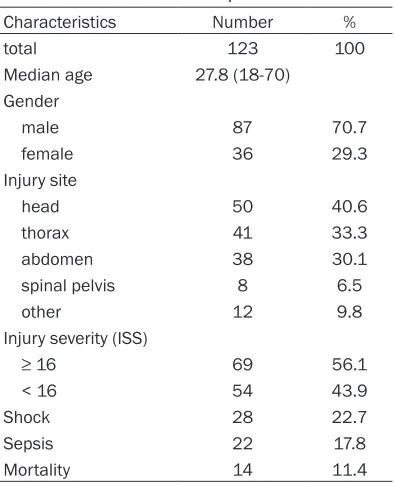
All the patients’ characteristics were summa-rized in Table 1. Total 123 patients (87 male and 36 female) were aged 18 to 70 years (median, 27.8 years). Sixty-nine patients had
severity injury (ISS ≥ 16), and head trauma was
the common injury site (32.5%). Twenty-eight patients occured shock. About 109 patients survived the trauma, and 14 patients died of
severe head injury (n = 9) or thoracic and abdominal injuries (n = 5) within 36 hours of
the unintentional injury.
High serum levels of S100B was detected in multi-trauma patients
[image:4.612.92.354.73.216.2]To assess the circulating S100B serum levels in multi-trauma and healthy volunteers, we per-formed ELISA assay. As shown in Figure 1A, a Figure 3. Higher serum levels of S100B were demonstrated in fatal
patients compared to survivors. Following hospital admission, approxi -mate 14 patients died of severe injury, and 109 patients survived the trauma. The serum levels of S100B between these two groups were assessed by ELISA assay. *P < 0.05.
with 5 μl FITC-conjugated annexin V in the dark. Ten minutes later, 5 μl of PI was introduced. The speci
-mens were then analyzed by flow
cytometry using the CellQuest software (BDIS). All results were exhibited as a percentage of total cells counted.
Analysis of inflammatory cyto-kines levels by ELISA
ELISA assay was used to assess
the function of S100B on inflam -matory cytokine levels of interleu-kin 6 (IL-6) and interleuinterleu-kin 8 (IL-8).
mean serum S100B levels of 0.52 ± 0.16 μg/L was detected in control group (n = 26). After
multiple traumas, the average serum S100B
concentration was 1.77 ± 0.12 μg/L at 2 h post multi-trauma, indicating that a significantly
higher serum concentration of S100B was observed in trauma patients than in health group. Additionally, we analyzed the serum lev-els of S100B in various trauma types, and the results indicated that a little higher concentra-tion of S100B was observed in head injury
patients than in others, but had no significant
statistically difference (P > 0.05) (Figure 1B).
S100B expression was associated with injury severity in trauma patients
Based on the high expression levels of S100B in trauma patients, the correlation between S100B and injury severity was further
dis-cussed. Following unintentional injury, mean
S100B concentrations in moderate trauma
patients (ISS < 16; n = 54) was 1.26 ± 0.24 μg/L at 24 h post multi-trauma, compared to 0.52 ± 0.16 μg/L in control groups (Figure 2). Moreover, an obviously higher level of S100B
was confirmed in severe trauma groups (ISS ≥ 16; n = 69), and the circulating S100B level was 2.18 μg/L. Taken together, these results
suggested that S100B could be used as a marker to assess injury severity in multiple trauma patients.
Elevated expression levels of S100B was con-firmed in fatal patients
To further assess the potential prognostic value of S100B in patients with multiple traumas, we discussed the expression levels of S100B in fatal and survival patients. About 14 patients died from severity injury, and the average
con-centration of S100B was 2.91 ± 0.33 μg/L
(Figure 3). However, the expression levels of
S100B in survivors (n = 109) were 2.21 ± 0.27 μg/L, suggesting that S100 levels were obvi -ously higher in fatal patients than those in survivors.
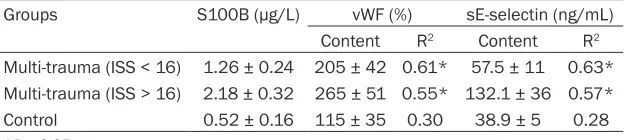
organ failure and subsequent death in patients with severe sepsis [16]. To further analyze the underlying mechanism, we investigated the correlation between S100B levels and endo-thelial cell dysfunction. As shown in Table 2,
the average mean of vWF, a marker for endo -thelial cell injury, was 205 ± 42% in moderate
trauma patients (ISS < 16; n = 54) after unin -tentional injury compared with control health patients. With the increased degree of injury,
higher levels of vWF were observed.
Consi-stently, the similar increase in endothelial cell
injury marker sE-selectin was also confirmed. Further correlation analysis indicated an obvi -ous positive correlation between S100B and
vWF, sE-selectin, suggesting that S100B might
accelerated the pathological process of multi-trauma by regulating endothelial cell dysfun- ction.
Overexpression S100B enhanced HUVEC cell apoptosis
It is known that endothelial cell dysfunction is characterized with cell death. To clarify the potential mechanism of S100B involved in the development of multi-trauma, the recombinant
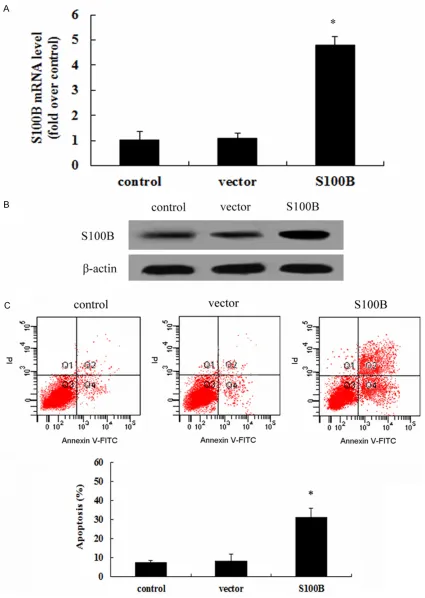
pcDNA3.1-S100B was transfected into HUVEC
and then a stable S100B overexpression clones were obtained. As shown in Figure 4A, an obvi-ous up-regulation of S100B mRNA was detect-ed after transfection with rS100B, concomitant with a similar increase in S100 protein levels (Figure 4B). Further analysis confirmed that
S100B overexpression dramatically enhanced
cell apoptosis. Quantified analysis indicated a
33.4% increase in cell apoptotic rate, com-pared with 8.6% in control groups (Figure 4C), implying a critical role of S100B in endothelial cell dysfunction.
Elevated S100B expression promoted inflam-matory cytokines secretion
To further explore the effect of S100B on
endo-thelial cell function, the pro-inflammatory cyto -Table 2. Correlation between serum levels of vWF, TF and S100B
Groups S100B (μg/L) vWF (%) sE-selectin (ng/mL) Content R2 Content R2
Multi-trauma (ISS < 16) 1.26 ± 0.24 205 ± 42 0.61* 57.5 ± 11 0.63* Multi-trauma (ISS > 16) 2.18 ± 0.32 265 ± 51 0.55* 132.1 ± 36 0.57* Control 0.52 ± 0.16 115 ± 35 0.30 38.9 ± 5 0.28
*P < 0.05.
Correlation between S100B levels and en-dothelial cell dysfunc-tion
Endothelial cells are believed to be involved
in various inflammatory
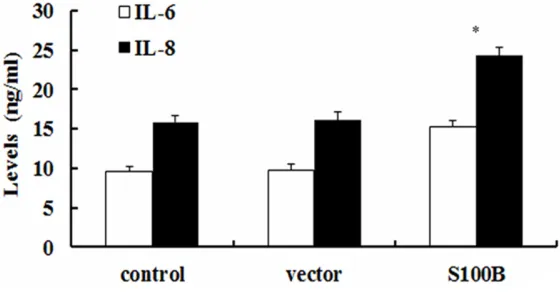
[image:5.612.91.403.85.155.2]kines of IL-6 and IL-8 was analyzed. Following
transfection with rS100B, the concentration of
IL-6 was 14.6 ng/ml and significant higher than
9.4 ng/ml in control groups (Figure 5). Consistently, S100B up-regulation also obvi-ously induced the increase of IL-8 levels, com-pared with control and vector-treated groups.
Together, these results might confirm an impor -tant function of S100B on
endothelial-mediat-ed pro-inflammatory response.
Discussion
Polytrauma is recognized to be life-threatening because of the high incidences and morbidity around the world [1]. As the fourth leading cause of death in the United States overall-fol-lowed heart disease, cancer and stroke, multi-trauma accounts for one in ten hospital dis-charges and one in six hospital days. Its serious complications commonly account for late fatali-ties after multiple injuries, such as organ
dys-function and systemic inflammatory response
[17-19]. Therefore, to explore an effective meth-od for assessing the outcome following multi-trauma has become clinically urgent.
Recently, several clinical studies have
[image:7.612.91.371.76.222.2]con-firmed that some cytokines levels are associ -ated with organ dysfunction, degree of injury, and fatality, which suggest a new approach to predict the outcome following multiple injuries [6, 7, 20]. S100 is a multi-genic family of small (~10 kDa) Ca2+-binding proteins, with a con-served calcium-binding motif termed the
injury indicator [10, 13, 26]. However, the roles of S100B in polytrauma remain unclear. In this study, we analyzed 123 multiple trauma patients with about one of third patients suf-fered from head injury. ISS scoring system exhibited that about 69 patients occurred severe injury. To explore the values of S100B as a predictor following multiple traumas, the serum levels of S100B were analyzed by ELISA. As expected, the expression levels of S100B in
multi-trauma were significantly higher than those in healthy volunteers. Furthermore, ISS analysis confirmed that the serum levels of
S100B were associated with the severity of multiple traumas because the higher serum levels of S100B were demonstrated in severity
injury (ISS ≥ 16) groups than ISS < 16 groups,
implying an important predictive value of
S100B following traumas. Further analysis indi -cated that the expression levels of S100B in
fatal patients were 2.91 μg/L, compared to 2.21 μg/L in survivors. Therefore, these results
suggested a pregnant predictive function of S100B when evaluating the severity degree of multi-traumas. However, its underlying mecha-nism is still unclear.
Endothelial cells are believed to be involved in
various inflammatory diseases and their injury
exert the important role during the develop-ment of the trauma-triggered sepsis, MODS and SIRS [16, 27, 28]. During this process, endothelial cells may undergo apoptosis or necrosis, and ultimately led to the dysfunction Figure 5. Elevated S100 expression promoted the pro-inflammatory cyto
-kine levels of IL-6 and IL-8. Following transfection with pcDNA3.1-S100B, the inflammatory cytokines of IL-6 and IL-8 levels were evaluated by ELISA assay. *P < 0.05.
EF-hand. S100 proteins are markers for inflammatory dis -eases. As one of the major member, S100B is expressed in various cells and has multi-ple local regulatory effects, including cell division, prolifer-ation, apoptosis, energy meta-
bolism, and inflammation
of endothelial and accelerate the pathological progress [16]. In this study, we further
con-firmed an obvious correlation between S100B levels and vWF and sE-selectin, both of these
are the marker of endothelial cell injury [29]. Therefore, these results indicated a correlation between S100B and endothelial cell dysfunc-tion. To further clarify this mechanism, we
con-structed S100B-elevated HUVEC cell models
and found that S100B overexpression
enhanced HUVEC cell apoptosis. It is believed
that endothelial cell apoptosis will accelerates
the pro-inflammatory, which is the major con -tributor for the development of polytrauma and its serious complication [16, 30]. Thus, the
effect of S100B on endothelial cell inflamma -tory response was further explored. IL-6 and
IL-8 are known to participate in the inflamma -tory cascade and rank as the reliable
prognos-tic marker of inflammatory-related diseases. In
this study, the elevated expression of S100B
increased the levels of pro-inflammatory cyto -kines of IL-6, as well as IL-8 levels. Together, these results suggest that S100B may regulate the pathological process by mediating endothe-lial cell dysfunction through enhancing cell
apoptosis and inflammatory response.
In conclusion, our research investigated for a potential predict role of S100B in polytrauma.
Furthermore, S100B was further confirmed to
be associated with endothelial cell dysfunction, which might relate with cell apoptosis and
sub-sequent enhanced inflammatory response.
Together, this study investigated the function of S100B on the pathological progression of mul-tiple traumas and the underlying mechanisms. Accordingly, this research will support a poten-tial aspect for the prediction and treatment of multiple traumas and its complications. Disclosure of conflict of interest
None.
Address correspondence to: Dr. Xingbo Dang, Emer- gency Surgery, Shaanxi Provincial People’s Hospital, Xi’an 710068, China. Tel: +86-2985253261; Fax: + 86-2981927099; E-mail: [email protected]
References
[1] Søreide K. Epidemiology of major trauma. Bri J Surg 2009; 96: 697-698.
[2] Leigh JP. Economic burden of occupational in-jury and illness in the United States. Milbank Quarterly 2011; 89: 728-772.
[3] Peek-Asa C, Zwerling C and Stallones L. Acute traumatic injuries in rural populations. J Inform 2004; 94: 1689-1693.
[4] Bouch DC and Thompson JP. Severity scoring systems in the critically ill. Continuing Educa-tion in Anaesthesia, Critical Care Pain 2008; 8: 181-185.
[5] Loh SA, Rockman CB, Chung C, Maldonado TS, Adelman MA, Cayne NS, Pachter HL and Mus-sa FF. Existing trauma and critical care scoring systems underestimate mortality among vas-cular trauma patients. J Vasc Surg 2011; 53: 359-366.
[6] Frink M, van Griensven M, Kobbe P, Brin T, Zeckey C, Vaske B, Krettek C, Hildebrand F. IL-6 predicts organ dysfunction and mortality in pa-tients with multiple injuries. Scand J Trauma Resusc Emerg Med 2009; 17: 49.
[7] Giamarellos-Bourboulis EJ, Kanellakopoulou K, Pelekanou A, Tsaganos T and Kotzampassi K. Kinetics of angiopoietin-2 in serum of multi-trauma patients: correlation with patient se-verity. Cytokine 2008; 44: 310-313.
[8] Piazza O, Leggiero E, De Benedictis G, Pastore L, Salvatore F, Tufano R and De Robertis E. S100B induces the release of pro-inflammato -ry cytokines in alveolar type I-like cells. Int J Im-munopathol Pharmacol 2012; 26: 383-391. [9] Steiner J, Schroeter M, Schiltz K, Bernstein H,
Müller U, Richter-Landsberg C, Müller W, Wal-ter M, Gos T and Bogerts B. Haloperidol and clozapine decrease S100B release from glial cells. Neuroscience 2010; 167: 1025-1031. [10] Beer C, Blacker D, Bynevelt M, Hankey GJ and
Puddey IB. Systemic markers of inflammation are independently associated with S100B con-centration: results of an observational study in subjects with acute ischaemic stroke. J Neuro-inflam 2010; 7: 71.
[11] Korfias S, Stranjalis G, Papadimitriou A, Psa -choulia C, Daskalakis G, Antsaklis A and Sakas D. Serum S-100B protein as a biochemical marker of brain injury: a review of current con-cepts. Curr Med Chem 2006; 13: 3719-3731. [12] Vos P, Jacobs B, Andriessen T, Lamers K, Borm
G, Beems T, Edwards M, Rosmalen C and Viss -ers J. GFAP and S100B are biomark-ers of trau -matic brain injury An observational cohort study. Neurology 2010; 75: 1786-1793. [13] Egea-Guerrero J, Revuelto-Rey J,
Murillo-Cabe-zas F, Muñoz-Sánchez M, Vilches-Arenas A, Sánchez-Linares P, Dominguez-Roldan J and Leon-Carrion J. Accuracy of the S100 β protein as a marker of brain damage in traumatic brain injury. Brain Inj 2012; 26: 76-82.
[15] Bloomfield SM, McKinney J, Smith L and Bris -man J. Reliability of S100B in predicting sever-ity of central nervous system injury. Neurocrit Care 2007; 6: 121-138.
[16] Aird WC. The role of the endothelium in severe sepsis and multiple organ dysfunction syn-drome. Blood 2003; 101: 3765-3777.
[17] Mommsen P, Andruszkow H, Frömke C, Zeckey C, Wagner U, Van Griensven M, Frink M, Krettek C and Hildebrand F. Effects of accidental hypo -thermia on posttraumatic complications and outcome in multiple trauma patients. Injury 2013; 44: 86-90.
[18] Giannoudis P, Harwood P and Pape H. Severe and multiple trauma in older patients; inci-dence and mortality. Injury 2009; 40: 362-367.
[19] Mica L, Vomela J, Keel M and Trentz O. The im -pact of body mass index on the development of systemic inflammatory response syndrome and sepsis in patients with polytrauma. Injury 2012; 45: 253-258.
[20] Mommsen P, Frink M, Pape H, van Griensven M, Probst C, Gaulke R, Krettek C and Hildeb-rand F. Elevated systemic IL-18 and neopterin levels are associated with posttraumatic com-plications among patients with multiple inju-ries: a prospective cohort study. Injury 2009; 40: 528-534.
[21] Foell D and Roth J. Proinflammatory S100 pro -teins in arthritis and autoimmune disease. Ar-thritis Rheum 2004; 50: 3762-3771.
[22] Riuzzi F, Sorci G and Donato R. S100B protein regulates myoblast proliferation and differen-tiation by activating FGFR1 in a bFGF-depen -dent manner. J Cell Sci 2011; 124: 2389-2400.
[23] Donato R, Cannon BR, Sorci G, Riuzzi F, Hsu K, J Weber D and L Geczy C. Functions of S100 proteins. Curr Mol Med 2013; 13: 24-57. [24] Mocellin S, Zavagno G and Nitti D. The
prog-nostic value of serum S100B in patients with cutaneous melanoma: A meta - analysis. Int J Cancer 2008; 123: 2370-2376.
[25] McIlroy M, McCartan D, Early S, Gaora PÓ, Pen-nington S, Hill AD and Young LS. Interaction of developmental transcription factor HOXC11 with steroid receptor coactivator SRC-1 medi-ates resistance to endocrine therapy in breast cancer. Cancer Res 2010; 70: 1585-1594. [26] Goyal A, Failla MD, Niyonkuru C, Amin K, Fabio
A, Berger RP and Wagner AK. S100b as a Prog-nostic Biomarker in Outcome Prediction for Patients with Severe Traumatic Brain Injury. J Neurotrauma 2013; 30: 946-957.
[27] Horio E, Kadomatsu T, Miyata K, Arai Y, Hoso-kawa K, Doi Y, Ninomiya T, Horiguchi H, Endo M and Tabata M. Role of Endothelial Cell–De-rived Angptl2 in vascular inflammation leading to endothelial dysfunction and atherosclerosis progression. Arterioscl Thromb Vasc Biol 2014; 34: 790-800.
[28] Reinhart K, Bayer O, Brunkhorst F and Meisner M. Markers of endothelial damage in organ dysfunction and sepsis. Crit Care Med 2002; 30: S302-S312.
[29] Schalkwijk C, Poland D, Van Dijk W, Kok A, Emeis J, Dräger A, Doni A, Van Hinsbergh V and Stehouwer C. Plasma concentration of C-reac-tive protein is increased in type I diabetic pa-tients without clinical macroangiopathy and correlates with markers of endothelial dysfunc-tion: evidence for chronic inflammation. Diabe -tologia 1999; 42: 351-357.