5889
DOCUMENTS AND IT RESOURCES AS ESSENTIAL
ELEMENT IN AWARENESS IT GOVERNANCE:
AN ANALYSIS OF STUDY
1UKY YUDATAMA, 2ACHMAD NIZAR HIDAYANTO, 3BOBBY A.A NAZIEF 123Faculty of Computer Science, University of Indonesia, Depok 16424, Indonesia
E-mail: 1[email protected], 2[email protected], 3[email protected]
ABSTRACT
This study aims to explore and provide recommendations on the priority scale of the elements in documents and IT resources related to the implementation of IT Governance. Excavation of this element is done through literature studies of articles related to IT Governance. In addition to exploring the elements contained in IT documents and resources, this research also looks for the most important sequence of elements, both on documents and on IT resources. Determination of priority scale is done through the survey by using pooling system which addressed to some respondents with criterion have credibility and quality that can be relied upon, so that answer given can be accounted its validity. The end result of this research is that it can give a real contribution especially in obtaining the important elements of IT documents and resources and give the order of priority scale as recommendation material to the stakeholders. IT documents and resources are crucial in the implementation of IT Governance, therefore it is necessary to raise a good awareness in the governance as well as strict supervision of all parties involved so that the implementation of IT Governance can achieve success according to organizational goals.
Keywords: Documents, IT Resources, Elements, Awareness, IT Governance
1. INTRODUCTION
Along with the development of information technology application of IT Governance has now become a basic requirement in an organization [1]. Change to this basic need is because it is considered to have an important role to uphold the survival of an organization [2], [3]. This survival implies that the organization is capable of developing or just the opposite. Implementation of good IT Governance can provide added value and benefits to the organization. Conversely, if the application is not done well, then the organization can experience a loss and even setbacks until it can ultimately experience a destruction [4], [5]. IT investment certainly requires a considerable amount of funds, it would be useless if it can not provide benefits and provide added value to the organization [6] - [9].
Most organizations want the implementation of IT Governance can deliver huge benefits and profits according to business objectives. But most of them can't yet understand deeply about IT Governance and the details [10]. This lack of understanding makes the activity becomes unfocused on the intended target and can't implement according to the prevailing standards, this is what often happens
in an organization. In addition to the lack of understanding, another thing that is not less important is the existence of a strong commitment, especially from top management to be consistent and fully support the implementation in IT Governance [11]. This strong consistency and full support have a huge influence, so it can provide the spirit and motivation for all parties involved. Therefore, a good understanding and strong commitment, these two things become the core and become a serious challenge for an organization in implementing IT Governance in order to achieve a success as what is expected.
5890 organizational capacity by boards, executive management, and IT management, to control the formulation and implementation of IT strategies, and ensure alignment between businesses. ISACA also defines IT Governance as a policy or procedural structure and set of processes aimed at ensuring conformity to IT implementation with support for achieving institutional goals, optimizing the benefits and opportunities offered by IT, controlling the use of IT resources and managing IT-related risk [10]. From the definitions conveyed by experts, contains the same keywords that are related to decision making and organizational goals to achieve alignment. Decision-making from management aims at controlling and determine the ultimate goal of implementing policies, plans and procedures and organizational structures designed to provide assurance at business objectives to be achieved and to prevent unwanted things from happening. Policies, plans and procedures are parts of documents that must be prepared and made in a structured and systematic way to be easily understood and can be used as directives or instructions to carry out an activity. With regard to organizational objectives for achieving alignment between IT and business can be successful, the organization must be able to identify resources to be used optimally. IT resources are very significant in the implementation of IT Governance. This significance has important and strategic, especially in its role to support a success. IT resources with good control and strict supervision will provide optimum benefits and results. Therefore, it requires an awareness of all parties involved, especially top management leaders to realize the importance of a document and IT resources, especially in the field of IT Governance [14], [15].
Several studies related to the success in implementing IT Governance have been conducted, among others; important factors influencing IT Governance awareness [4.7], structures, processes and mechanisms for achieving IT Governance success [9,11], critical success factors in implementing IT Governance [16,70], alignment between IT Objectives with Business and strategy [12, 13, 20]. This study differs from previous research, as it contributes to finding important elements as a support in the successful implementation of IT Governance relating to IT documents and resources, primarily starting from finding the types and kinds of documents and resources that need to be provided to serve as guidelines or direction in doing activities that have been neglected and never focused attention. Yet this is very important that can be used and applicable to
all parties, so that later in the implementation of IT Governance can run systematically, controlled and well documented so that it can run optimally so that organizational goals can be obtained in accordance with what is expected
From the above description, this research would like to dig deeper about documents and IT resources that need to be prepared related to IT Governance, so it has an important role to achieve success in its application. The excavation of these documents and IT resources will be done through the literature review of several articles related to IT Governance. In addition to exploring the elements contained in IT documents and resources, this research also wants to know the extent of the priority scale or the most important sequence of each element, both on documents and IT resources. To determine the priority scale, a survey conducted using a pooling system aimed at some respondents who have criteria with credibility and quality that can be accounted for the answer given. The results of this study can contribute significantly, especially in providing insight into the importance of IT documents and resources that contain important elements as well as recommending priority scale elements of IT documents and resources for to give input and consideration in control and supervision of the implementation of IT governance so that organizational goals can be achieved optimally.
5891 resources TI as a key element in governance awareness?
This research is very important because it can provide insight into the kinds of documents for the successful implementation of IT Governance that can be used as a guide for all parties involved, not only for top-level management but also for special operations personnel in the Information Technology. Each of these types of documents has roles and functions that are different from each other. The document is very helpful as a basis or reference for activities so as not to deviate from the goals of the organization so that later expected alignment between the objectives of IT and Business can be achieved well. In addition, IT resources also important to its existence, so it is necessary to be known and understood by all parties involved without exception. IT resources are the very significant element, therefore need to be utilized and managed optimally. There has been very little research on these two issues, namely with respect to IT documents and resources. Though these two things have a very big role in the successful implementation of IT Governance. Therefore, this research has a role that can be used to open the knowledge for science, especially in the field of IT Governance.
As discussed in the section above, this study differs from previous research, because it gives a real contribution that is discussing the important
elements of IT documents and resources for the successful implementation of IT Governance can be achieved in accordance with organizational goals. This element is used as a guide to performing activities to be directed, controlled and well documented. In addition, this research provides results and analysis of the priority sequence of each element that can be used as a reference in an organization that applies IT Governance in helping to take a policy concerning focus that is of concern.
2. STUDY OF LITERATURE
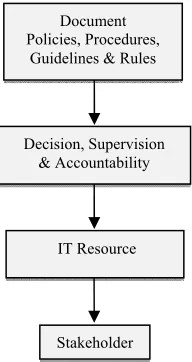
Today's IT governance is not a new thing anymore, because almost all organizations have known and even implemented it even though not all of the organizations in practice get satisfactory results. Successful achievement of optimal results in the practice of IT Governance is not necessarily easy to obtain, it is necessary a proper understanding of IT Governance, both defining and implementation. Many IT Governance experts define their own version which in principle is the same. A practical definition of IT Governance is a collection of policies, procedures, rules, and processes for alignment between IT and the business objectives of an organization can be achieved optimally through control and oversight mainly on IT resources and IT-related risks with involving all parties involved [14], [16] - [19]. IT Governance Activity is shown in Figure 1 below.
[image:3.612.255.351.473.654.2].
Figure 1. Activities in IT Governance.
From the definition of IT Governance above, there are some important points that must be considered include the policies, procedures, guidelines, and rules, where each has a different
understanding. The policy is a general plan that can be used as a handle in the implementation of an activity whereas the guidelines are instructions used to perform activities. To perform an activity order
Document Policies, Procedures,
Guidelines & Rules
Decision, Supervision & Accountability
IT Resource
5892 and systematic then required a clear procedure.
Guidelines that must be implemented and the nature of binding is usually called the rules.
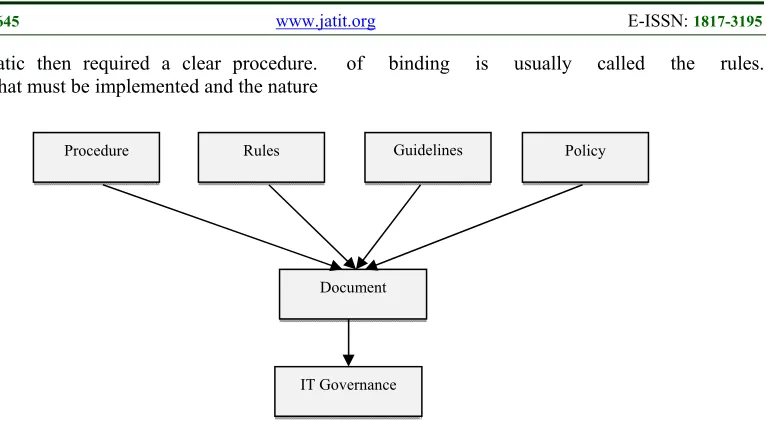
[image:4.612.140.523.68.281.2]Figure 2. Supporting documents in IT Governance
Based on the previous description of the definition of good IT Governance, a collection of policies, procedures, rules and processes for alignment between IT and the business objectives of an organization can be achieved optimally. From this definition there are 4 important things related to documents that must exist as a reference for all
parties involved (stakeholders) in the control and supervision of the implementation of IT Governance, so that later can run optimally. The four important things related to the document are: policy, guidelines, rules and procedures. Figure 2 shows important supporting documents in IT Governance.
Figure 3. IT resources for IT Governance Awareness.
In addition to the documents as a support in the implementation of IT Governance, there is something that is not less important that is IT resources, which has a major impact on the survival of an organization. IT resources are an asset that must be managed and properly monitored and strictly enforced because otherwise, can bring a ruin to the organization. The IT resources include data, applications, technology, infrastructure, facilities and human resources (people), all of which must be given serious attention to be utilized
optimally so that the organization can gain added value and profit according to the organization's objectives. Therefore awareness to manage and closely monitor is crucial in IT Governance, so IT resources are an important element in IT Governance awareness. Figure 3 shows the essential elements of IT resources that need special attention, so that awareness is required in the manage and oversight of the implementation of IT Governance.
Guidelines
Procedure Rules Policy
Document
IT Governance
Data Application Facilities People
IT Resource
[image:4.612.154.467.421.570.2]5893 Implementation of IT Governance in order to succeed optimally and in accordance with what is expected by the organization, then it is necessary preparation first. This preparation is intended to prepare the essentials needed before the implementation of IT Governance practices in an organization that usually begins with a measurement early to determine the extent of the level of readiness in order to know the shortcomings and weaknesses. The shortcomings and weaknesses that have been obtained from the results of the measurement of the level of readiness earlier, can be used as input material to make corrections and improvements.
Organizations that have implemented IT Governance, need to measure the maturity level. Measurement of this level of maturity should be done periodically and continuously, in order to know the extent to which the implementation of IT Governance can run and well controlled. With the measurement of such a way, the survival of an organization can be maintained and maintained properly, because it can know the development at any time and can immediately take a decision if there is something that is not in accordance with what is expected, thus most likely the goal of the organization can be achieved optimally.
3. RESEARCH METHODOLOGY
The method of research in this article is shown in Figure 4, while the details of the stages are as follows:
1. Study literature
This research begins with literature studies by looking for references related to IT Governance, especially about the core meaning of the IT Governance definition. References that have been found are then carefully understood and meticulous to be explored more deeply about the meaning contained either explicitly or implicitly, so that keywords are found from the meaning of IT
Governance. In addition to references relating to the definition of IT Governance, references relating to IT resources becoming an important element are also gaining special attention in this research. Readiness and maturity theory that can determine success in the application of IT Governance is also required to support and complement in this research.
2. Survey
The next step in the methodology of this research is to search the data by conducting a survey through pooling by involving a number of respondents to fill out a simple questionnaire that has been prepared beforehand. The questionnaire that has been made is then given to the respondent, to be filled out of some questions relating to the elements contained in the document and the elements of IT resources that can support in the implementation of IT Governance. Respondents were drawn from a number of people representing their organizations, academic and corporate organizations, with criteria of having a credible, post-graduate education level, and a good understanding of IT Governance.
3. Data analysis
After obtaining data from survey results that have been done, the data is then studied and processed. The questionnaire data of the respondents representing their organization is still raw and straightforward so that further processing is required. The final data processing result is the average of each important element, both document elements as well IT resources. To facilitate the reading of analytical funds, the final result of the data is then changed in the form of a graphics display. Important points obtained from the analysis then made conclusions.
4. Conclusions.
5894
Figure 4. Research Methodology
4. RESULTS AND ANALYSIS
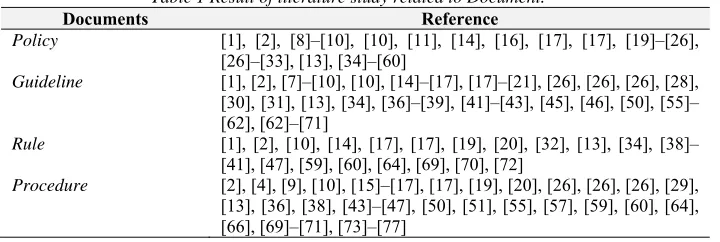
After studying the literature that begins by looking for relevant articles from several existing database such as: science direct, IEEE explorer, ACM library and Scopus. The process of searching articles by using keywords relating to IT
[image:6.612.132.492.419.540.2]Governance. The search results will get a number of articles that match what is expected. Articles that have been obtained then collected and examined carefully for searches related to supporting documents in IT Governance, in this case, words like: policies, guidelines, rules, and procedures, so that ultimately obtained as shown in table 1.
Table 1 Result of literature study related to Document.
Documents Reference
Policy [1], [2], [8]–[10], [10], [11], [14], [16], [17], [17], [19]–[26],
[26]–[33], [13], [34]–[60]
Guideline [1], [2], [7]–[10], [10], [14]–[17], [17]–[21], [26], [26], [26], [28],
[30], [31], [13], [34], [36]–[39], [41]–[43], [45], [46], [50], [55]– [62], [62]–[71]
Rule [1], [2], [10], [14], [17], [17], [19], [20], [32], [13], [34], [38]– [41], [47], [59], [60], [64], [69], [70], [72]
Procedure [2], [4], [9], [10], [15]–[17], [17], [19], [20], [26], [26], [26], [29], [13], [36], [38], [43]–[47], [50], [51], [55], [57], [59], [60], [64], [66], [69]–[71], [73]–[77]
The same has been done to get the literature related to the important elements contained in IT resources, the same way to get the literature on the document, which is preceded by searching relevant articles from some credible database such as Science Direct, IEEE Explorer, ACM Library and Scopus. The articles that have been acquired with the theme of IT Governance are then carefully collected and checked for words related to IT resources, ie words like data, human resources, applications, technology, facilities, and infrastructure, so at the end obtained as shown in table 2.
After doing the literature review, the next step is to make a questionnaire to be given to the respondent. Questions are made briefly and concisely, but do not reduce the quality of the goals to be achieved and facilitate the respondents in charging. As explained in the research methodology section, the criteria of the respondents have been determined both the quality and the quantity. The quality of respondents has been determined that the level of education equivalent to post-graduate and has experience working in the world of IT, so that academically and administratively reliable and no doubt the validity.
Survey (Polling)
Conclusion Data Analysis
5895
Table 2 The results of the iterative study of important elements in IT Resources
Documents Reference
Data [1], [2], [4], [5], [7], [8], [10], [10], [11], [11], [14]– [17], [19], [20], [20]–[23], [26], [26], [26]–[28], [28], [28], [29], [31], [33], [13], [35]–[41], [44], [45], [47], [50], [52], [53], [55], [58]–[60], [64], [66], [69], [69], [71], [74]–[82]
People [1], [5], [5], [8], [10], [11], [11], [14], [16], [17], [17], [19], [20], [22], [25], [30], [33], [40], [41], [46], [48], [49], [49], [50], [52], [55], [57]–[59], [68], [71], [74], [76], [83]
Application [2], [8]–[10], [14], [21], [26], [30], [38], [47], [50], [52], [53], [64], [66], [83], [84]
Technology [4], [10], [19], [25], [36], [37], [46], [62], [68], [85], [85], [85]–[90]
Facilities [37], [49], [57], [64], [68], [91]–[96]
[image:7.612.139.472.316.513.2]Infrastructure [10], [11], [16], [18], [26], [26], [27], [41], [44], [45], [51], [52], [55], [57], [64], [67], [68], [80], [82], [94]
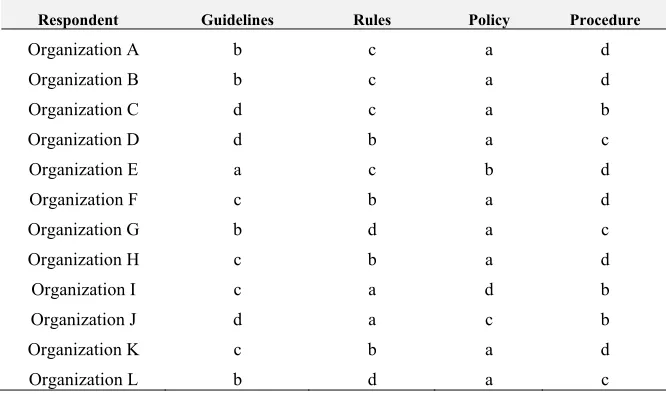
Table 3. Survey results of respondents priority order Document in IT Governance activities.
Respondent Guidelines Rules Policy Procedure
Organization A b c a d
Organization B b c a d
Organization C d c a b
Organization D d b a c
Organization E a c b d
Organization F c b a d
Organization G b d a c
Organization H c b a d
Organization I c a d b
Organization J d a c b
Organization K c b a d
Organization L b d a c
The content of the questionnaire that has been given to the respondent about supporting documents in IT Governance activities such as guidelines, rules, policies, and procedures, to be asked to fill by sorting starting from the most
5896
Table 4. Survey results of respondents priority order Documents that have been processed.
Respondent Guidelines Rules Policy Procedure
Organization A 3 2 4 1
Organization B 3 2 4 1
Organization C 1 2 4 3
Organization D 1 3 4 2
Organization E 4 2 3 1
Organization F 2 3 4 1
Organization G 3 1 4 2
Organization H 2 3 4 1
Organization I 2 4 1 3
Organization J 1 4 2 3
Organization K 2 3 4 1
Organization L 3 1 4 2
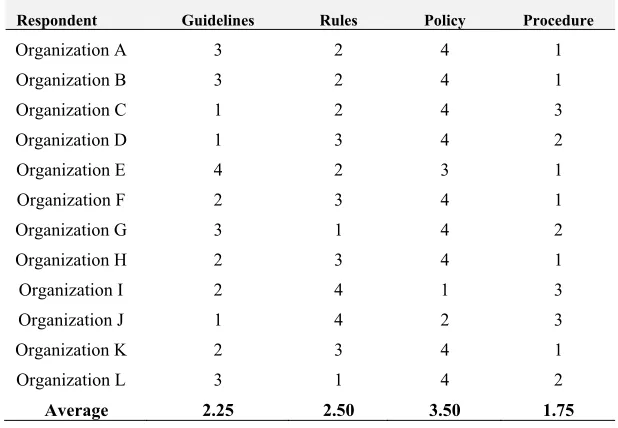
Average 2.25 2.50 3.50 1.75
Because the data obtained is still raw, can't know the results, it is necessary to be processed. Processing begins by interpreting letters into
numbers, eg a = 4, b = 3, c = 2 and d = 1. From the results of processing obtained results as shown in table 4.
Figure 5. Graph of survey results of respondents priority order Documents in IT Governance activities
Figure 5 shows the results of data processing from table 4 shown in the form of a bar graph with the intention to be easy to understand. From the graph shown, it seems clear that supporting documents in carrying out IT Governance activities, most respondents prefer policy as the most important document. It is possible that respondents assume that the policy has a very strategic role that can determine a success. The policy is considered as a basic reference for determining the direction in doing all activities. After the policy, the next
highest point is the rule which is then followed by the guidelines and the last is the procedure.
5897
Table 5. Survey results of respondents priority sequence of IT resources.
Respondent People Facilities Data Infrastructure Application Technology
Organization A f e a d b c
Organization B d c e f a b
Organization C a b e c f d
Organization D a f e b d c
Organization E a e d b c f
Organization F b d a c f e
Organization G a f b e d c
Organization H a d c b f e
Organization I a e d b f c
Organization J e f c a b d
Organization K e d f b c a
Organization L a d b c e f
Table 5 shows the data results of survey respondents on IT resources to be well managed and gained strict supervision from top management as well as from all stakeholders. Similar to surveys to search data on documents, respondents were asked to fill out and select a list of sequences of IT resource elements consisting of human resources, facilities, data, infrastructure, applications, and
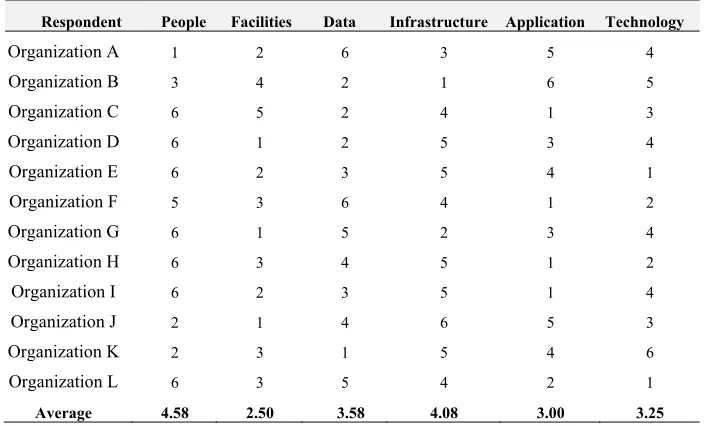
[image:9.612.130.482.438.651.2]technology. Respondents are asked to sort the elements that are considered more important. After obtaining the data, it is then processed by interpreting the values a = 6, b = 5, c = 4, d = 3, e = 2, d = 2, and f = 1. The final result of data processing is generated as shown in table 6 as follows.
Table 6. Survey results of IT resources from respondents who have been processed.
Respondent People Facilities Data Infrastructure Application Technology
Organization A 1 2 6 3 5 4
Organization B 3 4 2 1 6 5
Organization C 6 5 2 4 1 3
Organization D 6 1 2 5 3 4
Organization E 6 2 3 5 4 1
Organization F 5 3 6 4 1 2
Organization G 6 1 5 2 3 4
Organization H 6 3 4 5 1 2
Organization I 6 2 3 5 1 4
Organization J 2 1 4 6 5 3
Organization K 2 3 1 5 4 6
Organization L 6 3 5 4 2 1
Average 4.58 2.50 3.58 4.08 3.00 3.25
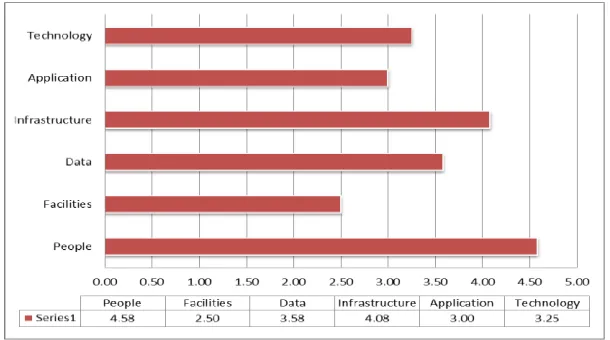
Figure 6 shows the results of data processing on IT resources. From these results, it can be seen that human resources (people) get a very high value when compared with IT resource the others. It is possible, the respondents assume that people have a
5898 the role of people himself. Therefore, it is advisable to provide and raise awareness to people so that other IT resources are not be noticed but can be used optimally in order to benefit the organization. The second position after the people is
[image:10.612.154.459.173.343.2]infrastructure, followed by data, then technology and application. For Facilities, it turns out to be the last priority chosen by respondents, this may be considered something that is only as a complement or as a support only.
Figure 6. Graph of survey results of respondents priority sequence on IT resources.
The final result of data processing from respondents in determining the order or priority scale on IT resources is good enough and logical. People play a major role that can affect all. Therefore, there is a need for caution in treating people. In addition to people, actually there are other IT resources that are also not less important is the infrastructure, if the infrastructure is good then it can support all activities that exist within an organization. To build an infrastructure is not easy, because it takes a plan and concepts are mature and also require time and cost are not small. From this description, the role of good management and strict supervision is very important and should be done.
5. DISCUSSION AND CONCLUSIONS
From the results of this study, obtained two important elements to consider in the implementation of IT Governance in order to achieve success, namely documents and IT resources. Where from each of these have kinds and types. Documents consist of guidelines, rules, policies, and procedures. As for the resources consist of: people, facilities, data, infrastructure, application, and technology. After survey through pooling involving several organizations, each has a priority order. Policies are a sequence of the document the first elements in IT Governance, while people the first element in the IT resources.
By considering the two important elements above, it is expected that the implementation of IT Governance can achieve success in accordance with what is expected.
5899
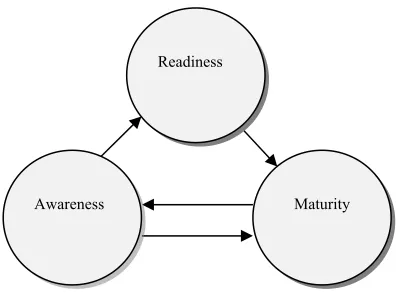
[image:11.612.203.405.121.268.2]Governance. The relationship between awareness, readiness, and maturity can be seen in figure 7.
Figure 7. The relationship between Awareness, Readiness, and Maturity in IT Governance.
From the results of this study, got 2 important things to note in the implementation of IT Governance in order to achieve a success, namely documents and IT resources. Where from each of these according to the survey results of respondents have the order or priority scale. Policy becomes the top priority on existing documents in IT Governance, whereas people become first in the IT resources element. Perhaps, this sort order differs depending on the survey results of the respondents. But at least this research has given a clear picture of the priority scale or sequence of each IT documents and resources related to the implementation of IT Governance. With attention to 2 important things above, it is expected that the implementation of IT Governance can achieve a success in accordance with what is expected.
6. IMPLICATIONS
IT governance is now a primary need for the organization, therefore to benefit from its application requires good management and strict supervision. Good management will be able to run optimally if there are documents that can be used as technical guidance and instructions in implementation, and focus on the intended target or desired. This document has its derivatives, among others, policies, rules guidelines and procedures, which are all very important and highly recommended to be made in order to implement IT Governance to be directed according to the organizational outline. A good document will provide an easy understanding for all parties, so as to reduce misperceptions in implementing an activity. In addition, the document is a means of administration that can be used as a medium to
record the traces of all activities at any time if needed can be traced back, especially for monitoring the development of the organization in the implementation of IT Governance.
IT resources have some important elements that are mandatory to be managed and monitored strictly so that the organization does not experience any harm. It takes a lot of money in the effort to procure IT resources, therefore the top management leaders and all parties involved must be aware of this, for it requires a good management awareness and also required strict supervision for the investment that has been issued can provide optimal benefits. Some elements have important positions compared to other elements, but each organization can make the priority scale of elements that are considered more important in accordance with the situation and conditions and needs of each organization.
The results of this study are expected to provide new insights for top-level management and all parties involved to know the importance of a document and IT resources that become an important element in the implementation of IT Governance, so as to increase the sense of awareness to manage well and carry out strict supervision in the hope that the implementation of IT Governance can achieve a success in accordance with organizational goals.
7. FUTURE RESEARCH
This research may still have many shortcomings, both in extracting the found elements and the pooling method used to obtain the results.
Awareness Maturity
5900 In the future, it is recommended to not only use polling but can be developed again with other methods such as interpretive structural model (ISM), structural equation model (SEM) with involving many respondents and many organizations, so as to complement and strengthen these findings. In addition, it needs to be developed and deepened in more detail, in relation to the contents of each of the elements mentioned above.
ACKNOWLEDGEMENTS
The author would like to thank the friends of Doctoral Program of the Computer Science University of Indonesia force 2016 for their support so that this research can be completed well and smoothly as expected. This research is a Thesis Grant for the doctoral student of University of Indonesia with number: 1562/UN2.R3.1/ PPM.00.01 / 2018, besides this research has too no conflict of interest with anyone and any group.
REFRENCES:
[1] H. Bin-abbas and S. Haj, “Assessment of IT governance in organizations : A simple integrated approach,” Computers in Human
Behavior 32 pp 261–267 Contents , 2014.
[2] P. E. Ndilula, “IT Governance as Requirements and Status of Implementation in Namibia Panduleni,” Mini-thesis Present. Partial fulfillment Requir. degree
Master Inf. Technol. Polytech. Namibia.,
no. April, 2008.
[3] R. Joslin and R. Müller, “The relationship between project governance and project success,” Int. J. Proj. Manag., vol. 34, no.
4, pp. 613–626, 2016.
[4] C. Aoun, S. Vatanasakdakul, and Y. Chen, “IT Governance Framework Adoption: Establishing Success Factors,” Gov. Sustain. Inf. Syst. Manag. Transf. Diffus. IT, pp. 239–248, 2011.
[5] U. Yudatama, A. N. Hidayanto, and B. A. A. Nazief, “Awareness and attitudes toward it governance: Empirical study,” J. Theor.
Appl. Inf. Technol., vol. 95, no. 12, pp.
2680–2687, 2017.
[6] C. R. Coombs, “When planned IS / IT project bene fi ts are not realized : a study of inhibitors and facilitators to bene fi ts realization,” Jpma, vol. 33, pp. 0–45, 2014.
[7] U. Yudatama, B. A. A. Nazief, A. N. Hidayanto, and M. Mishbah, “Factors Affecting Awareness and Attitude of IT
Governance Implementation in The Higher Education Institution : A Literature Review,” Proceeding - 2017 3rd International Conference on Science in
Information Technology: Theory and
Application of IT for Education, Industry and Society in Big Data Era, pp. 588–592, 2017.
[8] A. Buchwald, N. Urbach, and F. Ahlemann, “„ Understanding IT Governance Success and Its Impact : Results from an Interview Study “,Proceedings of the 21st European Conference on Information Systems (ECIS
2013) Utrecht, Niederlande Juni 5-8, 2013.
[9] W. Van Grembergen, S. De Haes, and E. Guldentops, “Structures, Processes and Relational Mechanisms for IT Governance,” IGI Glob., pp. 1–36, 2004.
[10] ISACA, “Implementing IT Governance,”
Technol. Manag., pp. 1–23, 2008.
[11] S. Ali and P. Green, “Effective information technology (IT) governance mechanisms: An IT outsourcing perspective,” Inf. Syst.
Front., vol. 14, no. 2, pp. 179–193, 2012.
[12] J. Weill, P., and Ross, “IT Governance: How Top Managers Manage IT Decision Rights for Superior Results.” Harvard
Business School Press., Boston, 2004.
[13] S. De Haes and W. Van Grembergen, “Exploring the relationship between IT governance practices and business/IT alignment through extreme case analysis in Belgian mid-to-large size financial enterprises,” J. Enterp. Inf. Manag., vol. 22,
no. 5, pp. 615–637, 2009.
[14] S. Ali, P. Green, and A. Robb, “Top Management IT Governance Knowledge : A Construct Development,” 22nd
Australas. Conf. Inf. Syst., p. 12, 2011.
[15] N. Al Qassimi and L. Rusu, “IT Governance in a Public Organization in a Developing Country: A Case Study of a Governmental Organization,” Procedia
Comput. Sci., vol. 64, pp. 450–456, 2015.
[16] Z. Alreemy, V. Chang, R. Walters, and G. Wills, “Critical success factors (CSFs) for information technology governance (ITG),”
Int. J. Inf. Manage., vol. 36, no. 6, pp. 907–
916, 2016.
[17] M. Safdar, G. Richards, and B. Raahemi, “A model of effective IT governance for collaborative networked organizations,”
Proceedings of the 12th International
Conference on e-Business (ICE-B-2015),
5901 [18] H. Heier, H. P. Borgman, and T. H.
Hofbauer, “Making the most of IT governance software: Understanding implementation processes,” Proc. Annu.
Hawaii Int. Conf. Syst. Sci., pp. 1–11, 2008.
[19] R. Valverde, M. Wolden, R. Valverde, and M. Talla, “The effectiveness of COBIT 5 Information Security Framework for reducing Cyber of Attacks The effectiveness COBIT Information for reducing Cyber Attacks on Supply Management System”, ScienceDirect, no.
May, pp. 1916–1922, 2015.
[20] T.-P. L. Shelly Ping-Ju Wu, Detmar W.Straub, “How Information Technology Governance Mechanisms and Strategic Alignment Influence Organizational Performance: Insights from a Matched Survey of Business and IT Managers,”
Manag. Inf. Syst. Q., vol. 39, no. 2, pp.
497–518, 2015.
[21] P. H. de S. Bermejo, A. O. Tonelli, A. L. Zambalde, P. A. dos Santos, and L. Zuppo, “Evaluating IT Governance Practices and Business and IT Outcomes: A quantitative Exploratory Study in Brazilian Companies,” Procedia Technol., vol. 16,
pp. 849–857, 2014.
[22] G. W. Plunkitt, “IT Governance Performance and Effectiveness,”
Reproduction, pp. 85–99, 2008.
[23] E. W. N. Bernroider and M. Ivanov, “IT project management control and the Control Objectives for IT and related Technology (CobiT) framework,” Int. J.
Proj. Manag., vol. 29, no. 3, pp. 325–336,
2011.
[24] A. M. Ghirana and V. P. Bresfelean, “Compliance Requirements for Dealing with Risks and Governance,” Procedia
Econ. Financ., vol. 3, no. 12, pp. 752–756,
2012.
[25] J. Coertze and R. Von Solms, “The board and CIO: The IT alignment challenge,” in
Proceedings of the Annual Hawaii International Conference on System
Sciences, 2014.
[26] G. Hardy, “Using IT governance and COBIT to deliver value with IT and respond to legal, regulatory and compliance challenges,” Inf. Secur. Tech. Rep., vol. 11,
no. 1, pp. 55–61, 2006.
[27] S. . Ali and P. . Green, “Effective information technology governance mechanisms in public sectors: An
Australian case,” PACIS 2006 - 10th Pacific Asia Conf. Inf. Syst. ICT Innov. Econ., no. September 2015, pp. 1070–1089,
2006.
[28] P. Henrique De Souza Bermejo, A. O. Tonelli, A. L. Zambalde, P. Aparecida, D. Santos, and L. Zuppo, “Evaluating IT governance practices and business and IT outcomes: A quantitative exploratory study in Brazilian companies,” Procedia
Technol., vol. 16, no. 16, pp. 849–857,
2014.
[29] P. Haghjoo, “Towards a Better Understanding of How Effective IT Governance Leads to Business Value : A Literature Review and Future Research Directions,” 23rd Australas. Conf. Inf. Syst.
3-5 Dec 2012, Geelong Eff., pp. 1–11, 2012.
[30] J. W. Merhout and D. Havelka, “Information Technology Auditing: A Value-Added IT Governance Partnership between IT Management and Audit.,”
Commun. Assoc. Inf. Syst., vol. 23, no.
Articel 26, pp. 463–482, 2008.
[31] S. Dash and S. K. Pani, “E-Governance Paradigm Using Cloud Infrastructure: Benefits and Challenges,” Procedia Comput. Sci., vol. 85, no. Cms, pp. 843– 855, 2016.
[32] D. A. P. Jale Samuwai, “A Model of Effective ITG Structure for Developing Economies,” 20th Am. Conf. Infromation Syst. AIS (Association Inf. Syst. Sa- vannah,
Georg. USA, 2014.
[33] C. . Ferguson, P. . Green, R. . Vaswani, and G. . Wu, “Determinants of Effective Information Technology Governance,” Int.
J. Audit., vol. 17, no. 1, pp. 75–99, 2013.
[34] S. C. B. Barbosa, “Performance Measurement Of Information Technology Governance In Brazilian Financial Institutions - ProQuest Central -
ProQuest,” vol. 11, no. 2, pp. 397–414,
2014.
[35] M. Othman, M. Nazir, A. Suliman, N. Habibah, and S. Sarah, “COBIT principles to govern flood management,”
International Journal of Disaster Risk
Reduction, vol. 9, pp. 212–223, 2014.
[36] C. H. Lee, J. H. Lee, J. S. Park, and K. Y. Jeong, “A study of the causal relationship between IT governance inhibitors and its success in Korea enterprises,” Proc. Annu.
5902 [37] M. Sallé, “IT Service Management and IT
Governance: Review, Comparative Analysis and their Impact on Utility Computing,” Hewlett-Packard Co., pp. 1–
26, 2004.
[38] R. Pereira and M. Mira, “A Literature Review : IT Governance Guidelines and Areas,” ICEGOV '12, October 22 - 25,
Albany, NY, United States, NY, USA, 2012.
[39] S. Ali, P. Green, and M. Parent, “The Role of a Culture of Compliance in Information Technology Governance,” Proc. GRCIS,
pp. 1–14, 2009.
[40] A. A. Study and S. Ali, “Effective Information Technology Governance Mechanisms :,” vol. 8, no. 1, 2006.
[41] Yap May Lin, N. H. Arshad, H. H. Wah, Y. Bee, M. Yusoff, and A. Mohamed, “IT Governance Awareness and Practices: an Insight from Malaysian Senior Management Perspective,” J. Bus. Syst.
Gov. Ethics, vol. 5, no. 1, pp. 43–57, Sep.
2010.
[42] G. Lerch, J. Luiz, A. Carlos, G. Maçada, and P. Cunha, “The impact of adopting IT governance on fi nancial performance : An empirical analysis among Brazilian fi rms,”
International Journal of Accounting
Information Systems, vol. 15, pp. 66–81,
2014.
[43] S. De Haes and W. Van Grembergen, “IT Governance and its Mechanisms,” Inf. Syst.
Control …, pp. 1–14, 2004.
[44] R. Baharuddin and B. Anom, “the Contribution of It Governance on Information System Implementation Success in Malaysian Government Agencies,” 2008.
[45] U. Yudatama and R. Sarno, “Priority Determination for Higher Education Strategic Planning Using Balanced Scorecard, FAHP and TOPSIS (Case study: XYZ University),” IOP Conf. Ser. Mater.
Sci. Eng., vol. 105, no. 1, 2016.
[46] L. V. Lapão, “Organizational Challenges and Barriers to Implementing IT Governance in a Hospital.,” Electron. J. Inf.
Syst. Eval., vol. 14, no. 1, pp. 37–45, 2011.
[47] M. F. I. Othman, T. Chan, E. Foo, K. J. Nelson, and G. T. Timbrell, “Barriers to Information Technology Governance Adoption : A Preliminary Empirical Investigation,” Proc. 15th Int. Bus. Inf.
Manag. Assoc. Conf., pp. 1771–1787, 2011.
[48] A. H. Altemimi and M. S. Zakaria, “Developing Factors for Effective IT Governance Mechanism”, Software
Engineering Conference, 2015.
[49] U. Yudatama, A. Setiawan, and A. Trismanto, “Alignment between Val IT and risk it for choosing a business strategy by fuzzy analytical hierarchy process and TOPSIS,” Adv. Sci. Lett., vol. 23, no. 3, pp.
2492–2494, 2017.
[50] The IIA, “(GTAG17) Auditing IT Governance”, The Institute of Internal
Auditor, 2012.
[51] Cognizant, “Maximizing Business Value Through Effective IT Governance,”
Cognizant 20-20 Insights, India, 2013.
[52] A. N. Shivashankarappa, L. Smalov, R. Dharmalingam, and N. Anbazhagan, “Implementing it governance using COBIT: A case study focusing on critical success factors,” World Congr. Internet Secur.
WorldCIS, pp. 144–149, 2012.
[53] I. S. Bianchi and R. D. Sousa, “IT Governance Mechanisms in Higher Education,” Procedia Comput. Sci., vol.
100, pp. 941–946, 2016.
[54] U. Yudatama, B. A. . Nazief, and A. N. Hidayanto, “Strategic Decisions in the Implementation of Information Technology Governance to Achieve Business and Information Technology Alignment Using Analytical Hierarchy Process,” Inf.
Technol. J., vol. 16, no. 2, pp. 51–61, 2017.
[55] Wil Ly Teo, A. A. Manaf, and Phyllis Lai Fong Choong, “Information Technology Governance: Applying the Theory of Planned Behaviour,” J. Organ. Manag.
Stud., vol. 2013, p. 15, 2013.
[56] Henderi, “Good IT Governance: Framework and Prototype for Higher Education,” pp. 1–15.
[57] R. A. Khther and M. Othman, “Cobit Framework as a Guideline of Effective it Governance in Higher Education: A Review,” Int. J. Inf. Technol. Converg. Serv., vol. 3, no. 1, pp. 21–29, Feb. 2013.
[58] S. Ali, P. Green, and A. Robb, “Measuring Top Management’s IT Governance Knowledge Absorptive Capacity,” J. Inf.
Syst., vol. 27, no. 1, pp. 137–155, 2012.
[59] N. Al Qassimi and L. Rusu, “IT Governance in a Public Organization in a Developing Country: A Case Study of a Governmental Organization,” Procedia
5903 450–456, 2015.
[60] M. S. Altemimi, Mohammed Alaa H, Zakaria, “IT Governance Landscape: Toward Understanding the Effective IT Governance Decision-Making,” Sch. Int. J.
Bus. Policy Gov. ISSN 2394-3351, vol. 2,
no. 11, p. 5, 2015.
[61] Henderi;Nuraeni;Junaidi, “IT Governance : a Strategic Alignment for Information,”
Csrid, vol. 2, no. 2, pp. 69–75, 2010.
[62] ISACA, “Implementing IT Governance,”
Technol. Manag., pp. 1–23, 2008.
[63] E. N. Nfuka, "IT Governance in Tanzanian Public Sector Organisations", Printed in
Sweden by US-AB, Stockholm, 2012.
[64] G. J. Selig, M. Partner, and G. P. S. Group, “IT Governance — An Integrated Framework and Roadmap : How to Plan , Deploy and Sustain for Competitive Advantage,” White paper CA ,March, 2006.
[65] Z. A. Hamid and H. Sulaiman, “COBIT Benchmarking Of System Development Governance For A Government Agency In Malaysia,” Journal of Theoretical and
Applied Information Technology Vol. 89,
No. 1, 2016.
[66] H. Heier, H. P. Borgman, and T. H. Hofbauer, “Making the most of IT governance software: Understanding implementation processes,” Proc. Annu.
Hawaii Int. Conf. Syst. Sci., pp. 1–11, 2008.
[67] Krauth.Stefan, “Strategic Alignment Model: Updating using theory and practice”
,Thesis Business Studies Programme
Strategy & Organization University of
Amsterdam, 2010.
[68] D. A. P. Jale Samuwai, “A Model of Effective ITG Structure for Developing Economies,” 20th Am. Conf. Infromation Syst. AIS (Association Inf. Syst. Sa- vannah, Georg. USA, 2014.
[69] F. R. Gordon, “Impact of information technology governance structures on strategic alignment,” Faculty Publications
and Presentations. Paper 27, 2014.
[70] U. Yudatama and B. A. A. Nazief, “Benefits and Barriers as a Critical Success Factor in the Implementation of IT Governance : Literature Review,”
International Conference on ICT For Smart
Society (ICISS), 2017.
[71] P. L. Bowen, M. Y. D. Cheung, and F. H. Rohde, “Enhancing IT governance practices: A model and case study of an organization’s efforts,” Int. J. Account. Inf.
Syst., vol. 8, no. 3, pp. 191–221, 2007.
[72] S. Ali, P. Green, and A. Robb," Information technology investment governance : What is it and does it matter ?,” Int. J. Account.
Inf. Syst., vol. 18, pp. 1–25, 2015.
[73] N. Ahmad, N. T. Amer, F. Qutaifan, and A. Alhilali, “Technology adoption model and a road map to successful implementation of ITIL,” J. Enterp. Inf. Manag., vol. 26, pp.
553–576, 2013.
[74] S. De Haes and W. Van Grembergen, “Analysing the Relationship Between IT Governance and Business/IT Alignment Maturity,” Itag Research Institute pp. 1–14,
,Belgium, 2006.
[75] K. Milne and A. Bowles, “How IT Governance Drives Improved Performance. IT Process Institute.,” IT Process Inst., pp.
1–18, 2009.
[76] S. De Haes and W. Van Grembergen, “IT Governance Structures, Processes and Relational Mechanisms: Achieving IT/Business Alignment in a Major Belgian Financial Group,” Proc. 38th Annu. Hawaii
Int. Conf. Syst. Sci., pp. 1–18, 2005.
[77] S. Yang, S. Zhang, and L. Kong, “Research on the cooperative decision of business application needs in IT governance,” Proc. 2012 IEEE 16th Int. Conf. Comput.
Support. Coop. Work Des. CSCWD 2012,
pp. 268–273, 2012.
[78] K. Knüppe and C. Knieper, “Environmental Science & Policy The governance of ecosystem services in river basins : An approach for structured data representation and analysis,” Journal Environmental
Science & Policy ,vol. 66, pp. 31–39, 2016.
[79] M. F. I. Othman, T. Chan, E. Foo, K. J. Nelson, and G. T. Timbrell, “Barriers to Information Technology Governance Adoption : A Preliminary Empirical Investigation,” Proc. 15th Int. Bus. Inf.
Manag. Assoc. Conf., pp. 1771–1787, 2011.
[80] C. Y. Han and C. Y. Ping, “The critical successful factors and strategic development path to IT governance,” 2011
Int. Conf. E-bus. E-Government
(ICEE)- Proc., pp. 8369–8372, 2011.
[81] U. Yudatama and R. Sarno, “Evaluation maturity index and risk management for it governance using Fuzzy AHP and Fuzzy TOPSIS (case Study Bank XYZ),” in 2015 International Seminar on Intelligent Technology and Its Applications, ISITIA
5904 [82] C. Paper et al., “Definition of a Model for
Measuring the Effectiveness of Information Technology Governance : a Study of the Moderator Effect of Organizational Culture Variables Definition of a Model for Measuring the Effectiveness of Information Technology Governance : a,” Conference
paper, 2015.
[83] C. Symons, “From IT Governance To Value Delivery,” p. 10, 2007.
[84] H. Heier, H. P. Borgman, and T. H. Hofbauer, “Making the most of IT governance software: Understanding implementation processes,” Proc. Annu.
Hawaii Int. Conf. Syst. Sci., pp. 1–11, 2008.
[85] A. Kuusk and J. Gao, “Factors for successfully integrating operational and information technologies,” Portl. Int. Conf.
Manag. Eng. Technol., vol. 2015–Septe, pp.
1513–1523, 2015.
[86] A. T. Kearney, “The 7 Habits of Highly Effective IT Governance,” Inc.Marketing &
Communications Chicago, Illinois 60606
U.S.A, 2008.
[87] Ernst & Young Llp, “Improving IT performance ; delivering business value”,
Published in the UK, 2006.
[88] E. Commission, “Guide to Cost Benefit Analysis of Investment Project”,
Directorate General Regional Policy Guide, 2008.
[89] L. Zhang, “Comparison of Classical Analytic Hierarchy Process ( Ahp ) Approach and Fuzzy Ahp Approach in Multiple-Criteria Decision Making for Commercial Vehicle Information Systems and Networks ( Cvisn ) Project,” 2010.
[90] L. A. Ika, A. Diallo, and D. Thuillier, “Critical success factors for World Bank projects: An empirical investigation,” Int. J.
Proj. Manag., vol. 30, no. 1, pp. 105–116,
2012.
[91] J. M. Denolf, J. H. Trienekens, P. M. N. Wognum, J. G. A. J. Van Der Vorst, and S. W. F. O. Omta, “Computers in Industry Towards a framework of critical success factors for implementing supply chain information systems,” Comput. Ind., vol.
68, pp. 16–26, 2015.
[92] S. Business and C. Development, “Business Case Development Framework Cost Benefit Analysis Guide,” no. April, 2016. [93] A. Da Veiga and J. H. P. Eloff, “An
Information security governance framework,” Inf. Syst. Manag., vol. 24, no.
4, pp. 361–372, 2007.
[94] D. F. D. Fan, “Analysis of critical success factors in IT project management,” Ind. Inf. Syst. (IIS), 2010 2nd Int. Conf., vol. 2, pp.
487–490, 2010.
[95] Z. Ahmad, M. Norhashim, O. T. Song, and L. T. Hui, “A typology of employees ’
Information Security Behaviour,” vol. 4, no.
c, pp. 3–6, 2016.
[96] M. Surat, N. A. G. Abdullah, M. M. Tahir, M. F. I. M. Nor, and N. Utaberta, “An Effective Teaching and Learning Approach for the Architectural Program with Reference to the Framework of Educational Psychology,” Procedia Social and
Behavioral Sciences 18 pp 227–234