Construct Algebra: Analytical Dialog M a n a g e m e n t
Alicia Abella and Allen L. Gorin
AT cT Labs Research
180 Park Ave. Bldg 103 Florham Park, NJ 07932
Abstract
In this paper we describe a systematic approach for creating a dialog management system based on a Construct Algebra, a collection o f relations and operations on a task representation. These relations and operations are analytical components for building higher level abstractions called dialog motivators. The dialog manager, con- sisting of a collection of dialog motivators, is entirely built using the Construct Algebra.
1
I N T R O D U C T I O N
The dialog manager described in this paper implements a novel approach to the problem of dialog management. There are three ma- jor contributions: the task knowledge repre- sentation, a Construct Algebra and a collec- tion of dialog motivators. The task knowl- edge representation exploits object-oriented paradigms. The dialog motivators provide the dialog manager with the dialog strate- gies that govern its behavior. The Construct Algebra provides the building blocks needed to create new dialog motivators and analyze them.
The first main component of this dialog manager is the task knowledge representa- tion. The task knowledge is encoded in ob- jects. These objects form an inheritance hi- erarchy that defines the relationships that exists among these objects. The dialog man- ager exploits this inheritance hierarchy in de- termining what queries to pose to the user. No explicit states and transitions need to be defined using this framework (Bennacef et al., 1996; Meng and et. al., 1996; Sadek et
al., 1996). A change to the dialog does not require a change to the dialog manager, but more simply, a change to the inheritance hi- erarchy.
The second main component of this dia- log manager is the collection of dialog mo- tivators. The dialog motivators determine what actions need to be taken (e.g. ask a confirmation question). The dialog motiva- tors are founded on a theoretical framework called a Construct Algebra. The Construct Algebra allows a designer to add new moti- vators in a principled way. Creating a new application requires defining the inheritance hierarchy and perhaps additional dialog mo- tivators not encompassed in the existing col- lection.
cantly different but they both use the same dialog manager.
2
T a s k R e p r e s e n t a t i o n
Information about the task is defined us- ing an object inheritance hierarchy. The in- heritance hierarchy defines the relationships that exist amongst the task knowledge. Ob- jects are defined to encode the hierarchy. This representation adheres to the princi- ples of object-oriented design as described in (Booch, 1994). Each of the objects has three partitions. The first partition contains the name of the object, the second contains a list of variables with associated values that are specific to the object, and the third par- tition contains any methods associated with the object. For simplicity of illustration we will not include any of the methods. Each of the objects inherits its methods from a higher level object called the Construct. The Construct's methods are the relations and operations that will be described in section 4. The result of the speech recognizer is sent to the spoken language understanding (SLU) module. The SLU module extracts the meaning of the user's utterance and pro- duces a list of possible objects with asso- ciated confidence scores that is interpreted by the dialog manager. The dialog manager then uses the inheritance hierarchy and an algorithm 1 fully described in (Abella and Gorin, 1997) to produce a set of semanti- cally consistent inputs to be used by the di- alog manager. The input is represented as a boolean expression of constructs extracted from the utterance. This input is then ma- nipulated by the dialog motivators to pro- duce an appropriate action, which most of- ten consists of playing a prompt to the user or generating a query to a database.
3
T h e C o n s t r u c t
A construct is the dialog knowledge representation
manager's general vehicle. The task
1An understanding of this algorithm is not nec- essary for the understanding of the work described in this paper.
DIAL FOR ME
:ORWARD NUMBER 5 5 5 - 1 2 3 4
I
BILLINGN U L L
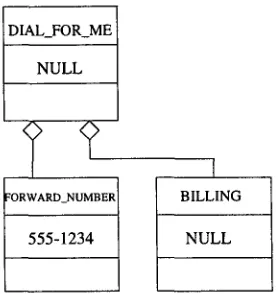
Figure 1: A construct example for HMIHY
knowledge is encoded as a hierarchy of con- structs. The construct itself is represented as a tree structure which allows for the build- ing of a containment hierarchy. It consists
of two parts, a head and a body. Figure 1
illustrates a construct example for HMIHY.
The DIAL_FOR_ME construct is the head
and it has two constructs for its body, FOR- WARD_NUMBER and BILLING. These two constructs represent the two pieces of in- formation necessary to complete a call. If a user calls requesting to place a call it is the DIAL_FOR_ME construct that is created with the generic BILLING construct and the FORWARD_NUMBER construct with its value set to empty. The dialog manager will then ask for the forward number and for the type of billing method. In figure 1 the dialog manager has received a response to the forward number request.
4
C o n s t r u c t A l g e b r a
The construct algebra defines a collection of elementary relations and operations on a set
of constructs. These relations and opera-
tions are then used to build the larger pro- cessing units that we call the dialog moti- vators. The set of dialog motivators defines the application. In this section we formally define these relations and operations.
4.1 T h e C o n s t r u c t
D e f i n i t i o n 1 Head
A head is an ordered pair <name, value>,
[image:2.612.365.504.75.222.2]fined names, N, and
value
belongs to some set of predefined values, V. A value may be NULL (not assigned a value).D e f i n i t i o n 2 Construct
A construct
is defined recursively as an or- dered pair<head, body>
wherebody
is a (pos- sibly empty) set of constructs.4.2 R e l a t i o n s
The Construct Algebra defines six relations
in the set of constructs. In each of the
definitions, Cl and c2 are constructs. Note that the symbols C and C, introduced here, should not be understood in their usual "subset" and "proper subset" interpretation but will be described in definitions 4 and 5.
D e f i n i t i o n 3 Equality
Two constructs are equal, denoted cl = c2
w h e n
head(c1) = head(c2)
andbody(c1)
= body(c2)Definition 3 requires that the heads of c1 and c2 be equal. Recall that the head of a construct is an ordered pair
<name, value>
which means that their names and values
must be equal. A value may be empty
(NULL) and by definition be equal to any other value. The equality of bodies means that a bijective mapping exists from the body of cl into the body of c2 such that elements associated with this mapping are equal.
D e f i n i t i o n 4 Restriction
Cl is a restriction of c2, denoted cl C c~, when
head(c1) = head(c2)
and( 3 f :
body(c1) --+ body(c2))(fis
1 to 1 A(Vbl • body(cl))(bl C_ f(bl))
Intuitively, cl can be obtained by "pruning" elements of c2. The second part of the def- inition, ( 3 f : ...) is what differentiates C from =. It is required that a mapping f be- tween the bodies of Cl and c2 exist with the following properties:
[ ~RSON
Cl
C
<
\
PERSON"",,,. ... ,
ADD ~ES s
[image:3.612.326.560.125.366.2]STREET
... . . -3H(}NE N U M B E I
c2
Figure 2: STREET and PHONE_NUMBER are "pruned" from c2 to obtain Cl.
• f is 1 to 1. In other words, different elements of the body of O, call t h e m hi, are associated with different elements of the body of c2, call t h e m b2
• The elements of the body of c1 are re- strictions of the elements of the body of c2. In other words, bl C_ b2, where bl are elements from the body of Cl and b2 are elements from the body of c2.
Figure 2 illustrates an example.
D e f i n i t i o n 5 Containment
cl is contained in c2, denoted Cl C c2, when
Cl C_ c2 or
(3b2 • body(c2))(Cl C
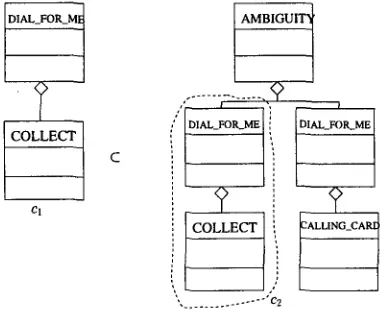
52)We assume that c1 C c2 either if Cl is a restriction of c2 or if Cl is contained in any element of the body of c2. Figure 3 gives an example. The AMBIGUITY construct represents the fact that the system is not sure whether the user has requested a COLLECT call or a CALLING_CARD call. This would trigger a clarifying question from the dialog manager.
?
el
C
AMBIGUIT I
' k . . . ""¢2
~'ALLING_CARD
CARD NUMBEI~ 8485417
Cl
BILLING
C2
Figure 4: cj ¢--->c2
Figure 3: cl C c2
D e f i n i t i o n 6 Generalization
c2 is a generalization of el, d e n o t e d c1~__.~c2,
w h e n
CALLING_CARD DIALFOR_ME
head(cl)c--+head(c2) and
( 3 f : body(c2) ~ body(c1))
(fis 1 to 1 A (Vba • body(c2)))(f(b2)~___b2)
T h e generalization of heads means t h a t t h e name of c2 is on t h e inheritance p a t h of cl and their values are equal. Intuitively, c2 is an ancestor of Cl or in object-oriented
C ~ .
t e r m s ~C 1 is-a, 2 Note t h e similarity of this relation to C. Figure 4 illustrates an
example. BILLING is a generalization of
C A L L I N G _ C A R D , or in other words CALL- ING_CARD is-a BILLING.
D e f i n i t i o n 7 S y m m e t r i c Generalization Cl is a s y m m e t r i c generalization of c2, de- n o t e d cl ~ c2, w h e n
C1¢--->C2 or c2¢---~Cl
This definition simply removes the direction- ality of __¢---~. In other words, either 'tE 1 iS-a C2"
?
CARD_NUMBER
8485417
BILLING
Cl c2
Figure 5: cl ¢--> c2
or ;;c2 is-a c1"
D e f i n i t i o n 8 C o n t a i n m e n t Generalization Cl is a c o n t a i n m e n t generalization of c2, de- n o t e d ci ¢---> c2, w h e n
[image:4.612.81.529.109.743.2] [image:4.612.94.284.126.283.2]4.3 O p e r a t i o n s
The Construct Algebra consists of two operations union, U and projection, \.
D e f i n i t i o n 9 Union (U)
We will define this operation in several steps. Each step is a progression towards a more general definition.
D e f i n i t i o n 9.1 Union of values (vl U v2)
V 1 U V 2 =
Vl, V l = v2 and vl # NULL
v2, Vl = v2 and Vl = NULL
not defined, Vl # v2
Recall that by definition, NULL is equal to any other value.
D e f i n i t i o n 9.2 Union of heads
We define
head(c1) U head(c2)
only in thecase c] ¢-~c2, which is all that is needed for a definition of U.
head(c
I)
U
head(c2) :
value(el) U vatue( ))
D e f i n i t i o n 9 . 3 (c, U c2)
If c1~_~_c2,
C 1 U C 2 =
( head( c
1) U head(c2),
u
• body( )} u
{ b l l b l • body(c 1) A
(Vb2 •
body(c2))(bl
#/(b2))})
In this definition the head of the resulting construct is the union of the heads of
the operands. The body of the resulting
construct consists of two parts. The first
part is a set of unions (denoted f(b2)
U
b2 in the definition above) where b2 spans the body of the second operand c2 and f is a mapping from Definition 6. Recall that the mapping f associates elements of thebody(c1)
with elements of thebody(c2)
suchthat
f(b2)~-+b2
forb2 • body(c2)
so theunion
f ( b j
U b2 is (recursively) defined in Definition 9.3. The second part of the body of the resulting construct consists of those elements bl of thebody(c1)
that no elementfrom the
body(c2)maps
into through themapping f . In other words, the second part of the body consists of those elements "left
CALLIN
¢
CARD-NUMB
1
NULL u
EXP|RATIO~ _ _ 299 /
Cl
_CARD
:ALLI~
1 CARD
NlYMB~,
1239834 =
c2
Figure 6: cl
U
c2 ifc1¢-.-~c2
LLINO_CARD
~
ARD_NUMBER1239834
EXPIRATIO1 ~ 299
behind" in the
body(cl)
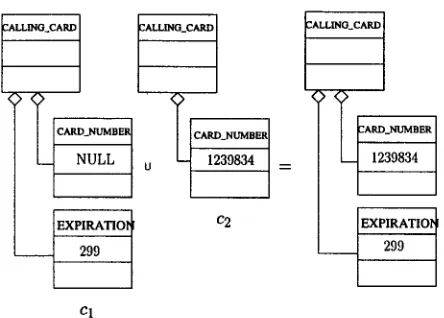
after the mappingf . Figure 6 illustrates an example. The
union operations results in a construct with the head CALLING_CARD and a body that contains both CARD_NUMBER and EXPIRATION. The CARD_NUMBER construct from Cl and c2 can be combined because the value of CARD__NUMBER from cl is NULL. The construct E X P I R A T I O N is added because it does not exist on the body of c2.
D e f i n i t i o n 9.4 Cl U c2
If C 1 ,-v C2,
ciUc2,
ci ~-+c2C 1 U ¢2 = C 2 U e l , C2 ~ C1
D e f i n i t i o n 9 . 5 cl U c2
If cl ~-+ c2,
C 1 U c 2 = C 1 U c 2 ,
(head(c2),
{el U
b~lb~
• body(c2)
A cl ~b2}U
{b2152 •
body(c2)
^ Cl
b £ ) ,
C1 ,"-' C2
C1 ~ C2
Figure 7 illustrates this union. The head of the resulting construct is the head of c2 which is DIAL_FOR_ME. The resulting construct no longer has BILLING but
[image:5.612.324.546.121.280.2]:ALLING CARD
EXPIRATION
AL
~ORWARD~NUMB FZ~
BILLING [
Cl C2
DIAL_FOR_ME
~LLING_CARD
ARD_NUMBEI
EXPIRATION !
Figure 7: Cl I.J C2 if cl ~ c2
rather CALLING_CARD since BILLING is a generalization of CALLING_CARD. In addition the resulting construct contains the construct FORWARD_NUMBER because it remains from DIAL_FOR_ME.
D e f i n i t i o n 9.6 Cl U e2 In the general case, C1 ~ C2 -~-
e l [,-J e2, c2 [..J Cl,
((REP, NULL), {cl, c2}),
C1 ~ C2 e2 ~ el Cl ~ C2 and C2 ~ Cl
In this definition R E P is a construct used to represent the union of those constructs that do not satisfy any of the aforementioned conditions. By definition R E P has a value of NULL and the body consists of the constructs Cl and e2.
D e f i n i t i o n 10 Projection (\)
CI\C 2 ~-.
((AMBIGUITY, NULL),
{hi U c2161 C c1 A bl ~- c2}) e2 ¢-+ cl
Cl C2 ~ el
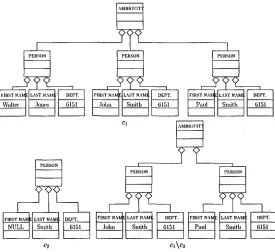
Figure 8 illustrates an example of an am- biguous construct and the result of the
FIRST NA]
C2 C1\C2
Figure 8: Projection operation example
projection operation. The construct is
A M B I G U I T Y because all the elements of its
body
have the value of 6151 for D E P T . In this example, c2 contains the construct LAST_NAME with the value of Smith. There are 2 constructs on the body of Cl that are in the relationb2
C Cl, in other words have value for LAST_NAME of Smith. Therefore the result is an A M B I G U I T Y construct with two elements on its body, both with the LAST_NAME value of Smith.5
Dialog Motivators
A dialog motivator determines what action the dialog manager needs to take in con-
ducting its dialog with a user. The di-
alog manager for HMIHY currently con-
sists of 5 dialog motivators. They are
dis-
ambiguation , confirmation, error handling
(recovery from misrecognition or misunder-
standing and silence),
missing information
and
context switching.
V P Q uses two addi- [image:6.612.315.590.122.374.2]co: Construct used for disambiguation, cQ E c
CA: User response
Dk(c, cigK) =
c, c ~ AMBIGUITY
Dk+l (c, CIDK), CA ~__~_ERROR
D k + l
(C,
CID g (.J CQ), c A • IDKC \ C A , C A ¢---} C
C A C A ~ C
Figure 9: Disambiguation Motivator
database querying.
The disambiguation motivator determines
when there is ambiguous semantic informa-
tion, like conflicting billing methods. Con-
firmation is used when the SLU returns a
result with low confidence. Error handling
takes on three forms. There is error recovery when the speech recognizer has likely misrec- ognized what the user has said (low confi- dence scores associated with the recognition results), when the user falls silent, and when the user says something the SLU does not
expect or does n o t handle. Missing infor-
mation determines what information to ask
about in order to complete a transaction.
Context switching is the ability of the sys-
t e m to realize when the user has changed his/her mind or realizes that it has mis- understood and allows the user to correct
it. The continuation motivator determines
when it is valid to offer the user the choice to query the system for additional information.
Database querying decides when the system
has acquired enough information to query a database for the requested information.
5.1 D i s a m b i g u a t i o n M o t i v a t o r
Figure 9 illustrate how the disambiguation motivator is created using the Construct Algebra. The disambiguation motivator is called with the current construct c and a set of constructs called CID g that represents information that the user does not know (IDK - "I Don't Know"), in other words, the user explicitly responds to a prompt with the phrase "I don't know" or its equivalent s.
2The phrases chosen are based on trials
Input: A sequence of semantic input from the SLU module in response to a prompt Output: Complete construct c (no need for further dialog)
Repeat
For all dialog motivators DMI if DMi applies to c
Perform action(DMi,c)
Apply Dialog Manager to get CA
Using Construct Algebra, combine c and CA into c U n t i l no motivator applies
Return c
Figure 10: Dialog Manager algorithm
The motivator runs through several checks on the construct c. The first is to check to see if in fact the motivator applies, or in other words if c is a restriction of AMBIGUITY. If it is not then the motivator simply return c without changing it. The second step is to check to see if the E R R O R construct is a
generalization of CA where CA represents the
user's response. The E R R O R construct rep- resents an error condition like silence or mis- recognition. If it is, then it goes on to next motivator because this motivator does not apply to error conditions. If CA equals the IDK construct then this means that the user did not know the answer to our query and we add the construct used for disambiguation,
cQ to the set of constructs ¢IDK. If however,
CA is in the containment generalization rela-
tion with c then the projection operation is applied and the result is returned. If CA is not in this relation then this indicates a con- text switch on the part of the user and the
disambiguation motivator returns CA as the
result.
All other motivators are constructed in a similar fashion. An application can use these motivators or create new ones that are ap- plication specific using the operations and relations of the Construct Algebra.
System" VPQ. What can I do for you?
User: I need the phone number for Klein.
System- I have more than 20 listings for Klein. Can you please say the first name?
User: William.
System" I have 2 listings for William Klein. Can you tell me the person's work location?
User: Bedminster
System" The phone number for William
Klein is 973 345 5432. Would you like more information?
User: No.
System" Thank you for using VPQ.
Figure 11: A sample dialog for V P Q
6
Dialog Manager
The input to the dialog manager is a collec- tion of semantic input generated by the SLU. Figure 10 illustrates the algorithm used by the dialog manager. The output is the com- plete construct c which no longer requires further dialog. The algorithm loops through all the dialog motivators determining which one needs to be applied to c. If it finds a mo- tivator that applies then it will perform the necessary action (e.g. play a prompt or do a database lookup). The algorithm repeats itself to obtain CA (the construct answer). In other words, the construct that results from the action is subject to the dialog motiva-
tors starting from the beginning. Once CA
has been found to be complete it is combined with c using Construct Algebra to produce a new construct. This new construct c also goes through the loop of dialog motivators and the procedure continues until no moti- vator applies and the algorithm returns the final construct c.
6.1 E x a m p l e
To illustrate how the dialog manager func- tions we will use an example from VPQ. Figure 11 illustrates a sample dialog with the system. The sequence of motivators for
VPQ
is error handling, confirmation, miss-ing information, database querying and dis-
ambiguation. The construct that is created
as a result of the user's initial utterance
is shown in figure 12. All the information needed to do a database lookup is found in the user's utterance, namely the piece of in- formation the user is seeking and the name of the person. Therefore the first motivator that applies is database querying. This moti- vator creates the database query and based
on the result creates the construct CA. The
construct CA is then searched by each of the
motivators beginning again with error han-
dling. The motivator that applies to CA is
the disambiguation motivator because there are more than 20 people in the database whose last name is pronounced Klein, in- cluding Klein, Cline and Kline. The dis-
ambiguation motivator searches through CA
to determine, based on preset parameters, which piece of information is most useful for the disambiguation process as well as which piece of information the user is likely to know, which is selected when the inheritance hierarchy is designed. For V P Q this includes asking about the first name and work loca- tion. In this example the dialog manager searches the database entries and determines that the most discriminating piece of infor- mation is the first name. Once the user re- sponds with the first name there are still 2 possible candidates and it asks for the next piece of information which is work location. Had the user not known the work location the system would have read out the phone number of both people since the total num- ber of matches is less than 3. If the num- ber of entries after disambiguation remains greater than 3 the system refers the user to a live operator during work hours.
7
Conclusion
In this paper we have described a novel ap-
proach to dialog management. The task
knowledge representation defined intuitively and without the need to define call flows in
the traditional finite-state approach. The
Figure 12: Sample construct for VPQ.
LECT, CREDIT etc.) and the inheritance
hierarchy. The Construct Algebra serves as
an analytical tool that allows the dialog mo-
tivators to be formally defined and analyzed
and provides an abstraction hierarchy that
hides the low-level details of the implemen-
tation and pieces together the dialog motiva-
tors. This same dialog manager is currently
being used by two very different applications
(HMIHY and VPQ).
A.L. Gorin, G. Riccardi, and J.H. Wright.
1997. How May I Help You?
Speech Com-
munciation.
Helen Meng and Senis Busayapongchai et.
al. 1996. Wheels: A conversational sys-
tem in the automobile classifieds domain.
International Conference on Spoken Lan-
guage Processing.
G. Riccardi and S. Bangalore. 1998. Au-
tomatic acquisision of phrase grammars
for stochastic language modeling. In
Proc.
ACL Workshop on Very Large Corpora,
Montreal.
M.D. Sadek, A. Ferrieux, A. Cozannet,
P. Bretier, F. Panaget, and J. Simonin.
1996. Effective Human-Computer Co-
operative Spoken Dialogue:
the AGS
Demonstrator.
International Conference
on Spoken Language Processing.
Jerry Wright, Allen L. Gorin, and Alicia
Abella. 1998. Spoken language under-
standing within dialogs using a graphical
model of task structure. In
Proc. ICSLP
Sydney.
R e f e r e n c e s
/
Alicia Abella and Allen L. Gorin. 1997.
Generating semantically consistent inputs
to a dialog manager. In
Proc. EuroSpeech
Rhodes, Greece.
A. Abella, M. K. Brown, and B. Buntschuh.
1996. Development principles for dialog-
based interfaces.
European Conference on
Artificial Intelligence.
S. Bennacef, L. Devillers, S. Rosset, and
L. Lamel.
1996. Dialog in the rail-
tel telephone-based system.
International
Conference on Spoken Language Process-
ing.
Grady Booch. 1994.
Object-Oriented Anal-
ysis and Design with Applications.
Ben-
jamin Cummings.
B. Buntschuh, C. Kamm, G. DiFabbrizio,
A. Abella, M. Mohri, S. Narayan, I. Zelj-
vokic, R.D. Sharp, J. Wright, S. Marcus,
J. Shaffer, R. Duncan, and J.G. Wilpon.
1998. VPQ: A spoken language interface
to large scale directory information. In
Proc. ICSLP Sydney.
[image:9.612.120.260.73.219.2]