The Contribution of Linguistic Features to Automatic Machine
Translation Evaluation
Enrique Amig´o1 Jes ´us Gim´enez2 Julio Gonzalo1 Felisa Verdejo1 1UNED, Madrid
{enrique,julio,felisa}@lsi.uned.es
2UPC, Barcelona
Abstract
A number of approaches to Automatic MT Evaluation based on deep linguistic knowledge have been suggested. How-ever, n-gram based metrics are still to-day the dominant approach. The main reason is that the advantages of employ-ing deeper lemploy-inguistic information have not been clarified yet. In this work, we pro-pose a novel approach for meta-evaluation of MT evaluation metrics, since correla-tion cofficient against human judges do not reveal details about the advantages and disadvantages of particular metrics. We then use this approach to investigate the benefits of introducing linguistic features into evaluation metrics. Overall, our ex-periments show that (i) both lexical and linguistic metrics present complementary advantages and (ii) combining both kinds of metrics yields the most robust meta-evaluation performance.
1 Introduction
Automatic evaluation methods based on similarity to human references have substantially accelerated the development cycle of many NLP tasks, such as Machine Translation, Automatic Summariza-tion, Sentence Compression and Language Gen-eration. These automatic evaluation metrics allow developers to optimize their systems without the need for expensive human assessments for each of their possible system configurations. However, estimating the system output quality according to its similarity to human references is not a trivial task. The main problem is that many NLP tasks are open/subjective; therefore, different humans may generate different outputs, all of them equally valid. Thus, language variability is an issue.
In order to tackle language variability in the
context of Machine Translation, a considerable ef-fort has also been made to include deeper linguis-tic information in automalinguis-tic evaluation metrics, both syntactic and semantic (see Section 2 for de-tails). However, the most commonly used metrics are still based onn-gram matching. The reason is that the advantages of employing higher linguistic processing levels have not been clarified yet.
The main goal of our work is to analyze to what extent deep linguistic features can contribute to the automatic evaluation of translation quality. For that purpose, we compare – using four different test beds – the performance of 16 n-gram based metrics, 48 linguistic metrics and one combined metric from the state of the art.
Analyzing the reliability of evaluation met-rics requires meta-evaluation criteria. In this re-spect, we identify important drawbacks of the standard meta-evaluation methods based on cor-relation with human judgements. In order to overcome these drawbacks, we then introduce six novel meta-evaluation criteria which represent dif-ferent metric reliability dimensions. Our analysis indicates that: (i) both lexical and linguistic met-rics have complementary advantages and different drawbacks; (ii) combining both kinds of metrics is a more effective and robust evaluation method across all meta-evaluation criteria.
In addition, we also perform a qualitative analy-sis of one hundred sentences that were incorrectly evaluated by state-of-the-art metrics. The analysis confirms that deep linguistic techniques are neces-sary to avoid the most common types of error.
Section 2 examines the state of the art Section 3 describes the test beds and metrics considered in our experiments. In Section 4 the correlation be-tween human assessors and metrics is computed, with a discussion of its drawbacks. In Section 5 different quality aspects of metrics are analysed. Conclusions are drawn in the last section.
2 Previous Work on Machine Translation Meta-Evaluation
Insofar as automatic evaluation metrics for ma-chine translation have been proposed, different meta-evaluation frameworks have been gradually introduced. For instance, Papineni et al. (2001) introduced the BLEU metric and evaluated its re-liability in terms of Pearson correlation with hu-man assessments for adequacy and fluency judge-ments. With the aim of overcoming some of the deficiencies of BLEU, Doddington (2002) intro-duced the NIST metric. Metric reliability was also estimated in terms of correlation with human assessments, but over different document sources and for a varying number of references and seg-ment sizes. Melamed et al. (2003) argued, at the time of introducing the GTM metric, that Pearson correlation coefficients can be affected by scale properties, and suggested, in order to avoid this effect, to use the non-parametric Spearman corre-lation coefficients instead.
Lin and Och (2004) experimented, unlike pre-vious works, with a wide set of metrics, including NIST, WER (Nießen et al., 2000), PER (Tillmann et al., 1997), and variants of ROUGE, BLEU and GTM. They computed both Pearson and Spearman correlation, obtaining similar results in both cases. In a different work, Banerjee and Lavie (2005) ar-gued that the measured reliability of metrics can be due to averaging effects but might not be robust across translations. In order to address this issue, they computed the translation-by-translation cor-relation with human judgements (i.e., corcor-relation at the segment level).
All that metrics were based on n-gram over-lap. But there is also extensive research fo-cused on including linguistic knowledge in met-rics (Owczarzak et al., 2006; Reeder et al., 2001; Liu and Gildea, 2005; Amig´o et al., 2006; Mehay and Brew, 2007; Gim´enez and M`arquez, 2007; Owczarzak et al., 2007; Popovic and Ney, 2007; Gim´enez and M`arquez, 2008b) among others. In all these cases, metrics were also evaluated by means of correlation with human judgements.
In a different research line, several authors have suggested approaching automatic evalua-tion through the combinaevalua-tion of individual metric scores. Among the most relevant let us cite re-search by Kulesza and Shieber (2004), Albrecht and Hwa (2007). But finding optimal metric combinations requires a meta-evaluation criterion.
Most approaches again rely on correlation with human judgements. However, some of them mea-sured the reliability of metric combinations in terms of their ability to discriminate between hu-man translations and automatic ones (human like-ness) (Amig´o et al., 2005). .
In this work, we present a novel approach to meta-evaluation which is distinguished by the use of additional easily interpretable meta-evaluation criteria oriented to measure different aspects of metric reliability. We then apply this approach to find out about the advantages and challenges of in-cluding linguistic features in meta-evaluation cri-teria.
3 Metrics and Test Beds
3.1 Metric Set
For our study, we have compiled a rich set of met-ric variants at three linguistic levels: lexical, syn-tactic, and semantic. In all cases, translation qual-ity is measured by comparing automatic transla-tions against a set of human references.
At the lexical level, we have included several standard metrics, based on different similarity as-sumptions: edit distance (WER, PER and TER), lexical precision (BLEU and NIST), lexical recall (ROUGE), and F-measure (GTMandMETEOR). At the syntactic level, we have used several families of metrics based on dependency parsing (DP) and constituency trees (CP). At the semantic level, we have included three different families which op-erate using named entities (NE), semantic roles (SR), and discourse representations (DR). A de-tailed description of these metrics can be found in (Gim´enez and M`arquez, 2007).
Finally, we have also considered ULC, which is a very simple approach to metric combina-tion based on the unnormalized arithmetic mean of metric scores, as described by Gim´enez and M`arquez (2008a). ULC considers a subset of met-rics which operate at several linguistic levels. This approach has proven very effective in recent eval-uation campaigns. Metric computation has been carried out using the IQMTFramework for Auto-matic MT Evaluation (Gim´enez, 2007)1. The sim-plicity of this approach (with no training of the metric weighting scheme) ensures that the poten-tial advantages detected in our experiments are not due to overfitting effects.
1
2004 2005
AE CE AE CE
#references 5 5 5 4
#systemsassessed 5 10 5+1 5
[image:3.595.79.283.63.133.2]#casesassessed 347 447 266 272
Table 1: NIST 2004/2005 MT Evaluation Cam-paigns. Test bed description
3.2 Test Beds
We use the test beds from the 2004 and 2005 NIST MT Evaluation Campaigns (Le and Przy-bocki, 2005)2. Both campaigns include two dif-ferent translations exercises: Arabic-to-English (‘AE’) and Chinese-to-English (‘CE’). Human as-sessments of adequacy and fluency, on a 1-5 scale, are available for a subset of sentences, each eval-uated by two different human judges. A brief nu-merical description of these test beds is available in Table 1. The corpus AE05 includes, apart from five automatic systems, one human-aided system that is only used in our last experiment.
4 Correlation with Human Judgements
4.1 Correlation at the Segment vs. System Levels
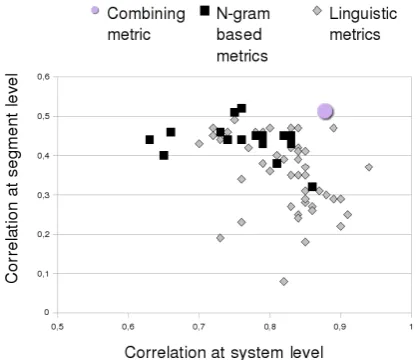
Let us first analyze the correlation with human judgements for linguistic vs. n-gram based met-rics. Figure 1 shows the correlation obtained by each automatic evaluation metric at system level (horizontal axis) versus segment level (vertical axis) in our test beds. Linguistic metrics are rep-resented by grey plots, and black plots represent metrics based onn-gram overlap.
The most remarkable aspect is that there exists a certain trade-off between correlation at segment versus system level. In fact, this graph produces a negative Pearson correlation coefficient between system and segment levels of 0.44. In other words, depending on how the correlation is computed, the relative predictive power of metrics can swap. Therefore, we need additional meta-evaluation cri-teria in order to clarify the behavior of linguistic metrics as compared to n-gram based metrics.
However, there are some exceptions. Some metrics achieve high correlation at both levels. The first one is ULC (the circle in the plot), which combines both kind of metrics in a heuristic way (see Section 3.1). The metric nearest to ULC is
2http://www.nist.gov/speech/tests/mt
Figure 1: Averaged Pearson correlation at system vs. segment level over all test beds.
DP-Or-?, which computes lexical overlapping but
on dependency relationships. These results are a first evidence of the advantages of combining met-rics at several linguistic processing levels.
4.2 Drawbacks of Correlation-based Meta-evaluation
Although correlation with human judgements is considered the standard meta-evaluation criterion, it presents serious drawbacks. With respect to correlation at system level, the main problem is that the relative performance of different metrics changes almost randomly between testbeds. One of the reasons is that the number of assessed sys-tems per testbed is usually low, and then correla-tion has a small number of samples to be estimated with. Usually, the correlation at system level is computed over no more than a few systems.
For instance, Table 2 shows the best 10 met-rics in CE05 according to their correlation with human judges at the system level, and then the ranking they obtain in the AE05 testbed. There are substantial swaps between both rankings. In-deed, the Pearson correlation of both ranks is only 0.26. This result supports the intuition in (Baner-jee and Lavie, 2005) that correlation at segment level is necessary to ensure the reliability of met-rics in different situations.
[image:3.595.312.522.66.246.2]Table 2: Metrics rankings according to correlation with human judgements using CE05 vs. AE05
Figure 2: Human judgements and scores of two hypothetical metrics with Pearson correlation 0.5
produced scores. Both hypothetical metrics A and B would achieve a 0.5 correlation. In the case of Metric A, a high score implies a high human assessed quality, but not the reverse. This is the tendency hypothesized by Culy and Riehemann (2003). In the case of Metric B, the high scored translations can achieve both low or high quality according to human judges but low scores ensure low quality. Therefore, the same Pearson coeffi-cient may hide very different behaviours. In this work, we tackle these drawbacks by defining more specific meta-evaluation criteria.
5 Alternatives to Correlation-based Meta-evaluation
We have seen that correlation with human judge-ments has serious limitations for metric evalua-tion. Therefore, we have focused on other aspects of metric reliability that have revealed differences between n-gram and linguistic based metrics:
1. Is the metric able to accurately reveal im-provements between two systems?
[image:4.595.312.535.67.232.2]2. Can we trust the metric when it says that a translation is very good or very bad?
Figure 3: SIP versus SIR
3. Are metrics able to identify good translations which are dissimilar from the models?
We now discuss each of these aspects sepa-rately.
5.1 Ability of metrics to Reveal System Improvements
We now investigate to what extent a significant system improvement according to the metric im-plies a significant improvement according to hu-man assessors, and viceversa. In other words: are the metrics able to detect any quality improve-ment? Is a metric score improvement a strong ev-idence of quality increase? Knowing that a metric has a 0.8 Pearson correlation at the system level or 0.5 at the segment level does not provide a direct answer to this question.
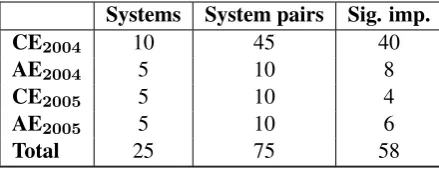
In order to tackle this issue, we compare met-rics versus human assessments in terms of pre-cision and recall over statistically significant im-provements within all system pairs in the test beds. First, Table 3 shows the amount of signif-icant improvements over human judgements ac-cording to the Wilcoxon statistical significant test (α ≤ 0.025). For instance, the testbed CE2004 consists of 10 systems, i.e. 45 system pairs; from these, in 40 cases (rightmost column) one of the systems significantly improves the other.
Now we would like to know, for every metric, if the pairs which are significantly different accord-ing to human judges are also the pairs which are significantly different according to the metric.
[image:4.595.76.291.264.351.2]Systems System pairs Sig. imp.
CE2004 10 45 40
AE2004 5 10 8
CE2005 5 10 4
AE2005 5 10 6
[image:5.595.72.292.62.147.2]Total 25 75 58
Table 3: System pairs with a significant difference according to human judgements (Wilcoxon test)
(precision) represents the reliability of improve-ments detected by metrics. SIR (recall) represents to what extent the metric is able to cover the sig-nificant improvements detected by humans. Let
Ihbe the set of significant improvements detected
by human assessors andImthe set detected by the
metricm. Then:
SIP= |Ih∩Im|
|Im|
SIR= |Ih∩Im|
|Ih|
Figure 3 shows the SIR and SIP values obtained for each metric. Linguistic metrics achieve higher precision values but at the cost of an important re-call decrease. Given that linguistic metrics require matching translation with references at additional linguistic levels, the significant improvements de-tected are more reliable (higher precision or SIP), but at the cost of recall over real significant im-provements (lower SIR).
This result supports the behaviour predicted in (Gim´enez and M`arquez, 2009). Although linguis-tic metrics were motivated by the idea of model-ing lmodel-inguistic variability, the practical effect is that current linguistic metrics introduce additional re-strictions (such as dependency tree overlap, for in-stance) for accepting automatic translations. Then they reward precision at the cost of recall in the evaluation process, and this explains the high cor-relation with human judgements at system level with respect to segment level.
Alln-gram based metrics achieve SIP and SIR values between 0.8 and 0.9. This result suggests thatn-gram based metrics are reasonably reliable for this purpose. Note that the combined met-ric, ULC (the circle in the figure), achieves re-sults comparable to n-gram based metrics with this test3. That is, combining linguistic and n -gram based metrics preserves the good behavior ofn-gram based metrics in this test.
3Notice that we just have 75 significant improvement samples, so small differences in SIP or SIR have no relevance
5.2 Reliability of High and Low Metric Scores
The issue tackled in this section is to what extent a very low or high score according to the metric is reliable for detecting extreme cases (very good or very bad translations). In particular, note that detecting wrong translations is crucial in order to analyze the system drawbacks.
In order to define an accuracy measure for the reliability of very low/high metric scores, it is nec-essary to define quality thresholds for both the human assessments and metric scales. Defining thresholds for manual scores is immediate (e.g., lower than 4/10). However, each automatic evalu-ation metric has its own scale properties. In order to solve scaling problems we will focus on equiva-lent rank positions: we associate the ithtranslation according to the metric ranking with the quality value manually assigned to the ith translation in the manual ranking.
Being Qh(t) and Qm(t) the human and
met-ric assessed quality for the translation t, and being rankh(t) and rankm(t) the rank of the translation taccording to humans and the metric, the normal-ized metric assessed quality is:
QNm(t) =Qh(t0)|(rankh(t0) =rankm(t))
In order to analyze the reliability of metrics when identifying wrong or high quality transla-tions, we look for contradictory results between the metric and the assessments. In other words, we look for metric errors in which the quality es-timated by the metric is low (QNm(t)≤3) but the
quality assigned by assessors is high (Qh(t) ≥5)
or viceversa (QNm(t)≥7andQh(t)≤4).
In order to check the robustness of these results, we computed the correlation of individual metric failures between test beds, obtaining 0.67 Pearson for the lowest correlated test bed pair (AE2004and CE2005) and 0.88 for the highest correlated pair (AE2004and CE2004).
Figure 4: Counter sample ratio for high vs low metric scored translations
5.2.1 Analysis of Evaluation Samples
In order to shed some light on the reasons for the automatic evaluation failures when assigning low scores, we have manually analyzed cases in which a metric score is low but the quality according to humans is high (QNm ≤ 3 andQh ≥ 7). We have studied 100 sentence evaluation cases from representatives of each metric family including: 1-PER, BLEU, DP-Or-?, GTM (e = 2), METEOR and ROUGEL. The evaluation cases have been ex-tracted from the four test beds. We have identified four main (non exclusive) failure causes:
Format issues, e.g. “US ” vs “United States”). Elements such as abbreviations, acronyms or num-bers which do not match the manual translation.
Pseudo-synonym terms, e.g. “USScheduledthe Release” vs. “US setto Release”). ) In most of these cases, synonymy can only be identified from the discourse context. Therefore, terminological resources (e.g., WordNet) are not enough to tackle this problem.
Non relevant information omissions, e.g. “Thank you” vs. “Thank you very much” or “dollar” vs. “US dollar”)). The translation system obviates some information which, in context, is not considered crucial by the human assessors. This effect is specially important in
short sentences.
Incorrect structures that change the meaning while maintaining the same idea (e.g., “Bush Praises NASA ’s Mars Mission” vs “Bush praises nasa of Mars mission” ).
Note that all of these kinds of failure - except formatting issues - require deep linguistic process-ing while n-gram overlap or even synonyms ex-tracted from a standard ontology are not enough to deal with them. This conclusion motivates the in-corporation of linguistic processing into automatic evaluation metrics.
5.3 Ability to Deal with Translations that are Dissimilar to References.
The results presented in Section 5.2 indicate that a high score in metrics tends to be highly related to truly good translations. This is due to the fact that a high word overlapping with human references is a reliable evidence of quality. However, in some cases the translations to be evaluated are not so similar to human references.
An example of this appears in the test bed NIST05AE which includes a human-aided sys-tem, LinearB (Callison-Burch, 2005). This system produces correct translations whose words do not necessarily overlap with references. On the other hand, a statistics based system tends to produce incorrect translations with a high level of lexical overlapping with the set of human references. This case was reported by Callison-Burch et al. (2006) and later studied by Gim´enez and M`arquez (2007). They found out that lexical metrics fail to pro-duce reliable evaluation scores. They favor sys-tems which share the expected reference sublan-guage (e.g., statistical) and penalize those which do not (e.g., LinearB).
We can find in our test bed many instances in which the statistical systems obtain a metric score similar to the assisted system while achieving a lower mark according to human assessors. For in-stance, for the following translations, ROUGEL assigns a slightly higher score to the output of a statistical system which contains a lot of grammat-ical and syntactgrammat-ical failures.
Human assisted system: The Chinese President made un-precedented criticism of the leaders of Hong Kong after political failings in the former British colony on Mon-day . Human assessment=8.5.
Figure 5: Maximum translation quality decreasing over similarly scored translation pairs.
In order to check the metric resistance to be cheated by translations with high lexical over-lapping, we estimate the quality decrease that we could cause if we optimized the human-aided translations according to the automatic metric. For this, we consider in each translation case c, the worse automatic translation t that equals or im-proves the human-aided translation th according to the automatic metricm. Formally the averaged quality decrease is:
Quality decrease(m) =
Avgc(maxt(Qh(th)−Qh(t)|Qm(th)≤Qm(t)))
Figure 5 illustrates the results obtained. All metrics are suitable to be cheated, assigning sim-ilar or higher scores to worse translations. How-ever, linguistic metrics are more resistant. In addi-tion, the combined metric ULC obtains the best re-sults, better than both linguistic andn-gram based metrics. Our conclusion is that including higher linguistic levels in metrics is relevant to prevent ungrammaticaln-gram matching to achieve simi-lar scores than grammatical constructions.
5.4 The Oracle System Test
In order to obtain additional evidence about the usefulness of combining evaluation metrics at dif-ferent processing levels, let us consider the follow-ing situation: given a set of reference translations we want to train a combined system that takes the most appropriate translation approach for each text segment. We consider the set of translations system presented in each competition as the trans-lation approaches pool. Then, the upper bound on the quality of the combined system is given by the
Metric OST maxOST 6.72
[image:7.595.77.293.64.203.2]ULC 5.79 ROUGEW 5.71 DP-Or-? 5.70 CP-Oc-? 5.70 NIST 5.70 randOST 5.20 minOST 3.67
Table 4: Metrics ranked according to the Oracle System Test
predictive power of the employed automatic eval-uation metric. This upper bound is obtained by se-lecting the highest scored translation taccording to a specific metricmfor each translation casec. The Oracle System Test (OST) consists of com-puting the averaged human assessed quality Qh of the selected translations according to human as-sessors across all cases. Formally:
OST(m) =Avgc(Qh(Argmaxt(Qm(t))|t∈c))
We use the sum of adequacy and fluency, both in a 1-5 scale, as a global quality measure. Thus, OST scores are in a 2-10 range. In summary, the OST represents the best combined system that could be trained according to a specific automatic evaluation metric.
Table 4 shows OST values obtained for the best metrics. In the table we have also included a ran-dom, a maximum (always pick the best transla-tion according to humans) and a minimum (al-ways pick the worse translation according to hu-man) OST for all 4. The most remarkable result in Table 4 is that metrics are closer to the random baseline than to the upperbound (maximum OST). This result confirms the idea that an improvement on metric reliability could contribute considerably to the systems optimization process. However, the key point is that the combined metric, ULC, im-proves all the others (5.79 vs. 5.71), indicating the importance of combiningn-gram and linguis-tic features.
6 Conclusions
Our experiments show that, on one hand, tradi-tional n-gram based metrics are more or equally
reliable for estimating the translation quality at the segment level, for predicting significant improve-ment between systems and for detecting poor and excellent translations.
On the other hand, linguistically motivated met-rics improve n-gram metmet-rics in two ways: (i) they achieve higher correlation with human judgements at system level and (ii) they are more resistant to reward poor translations with high word overlap-ping with references.
The underlying phenomenon is that, rather than managing the linguistics variability, linguis-tic based metrics introduce additional restrictions for assigning high scores. This effect decreases the recall over significant system improvements achieved by n-gram based metrics and does not solve the problem of detecting wrong translations. Linguistic metrics, however, are more difficult to cheat.
In general, the greatest pitfall of metrics is the low reliability of low metric values. Our qualita-tive analysis of evaluated sentences has shown that deeper linguistic techniques are necessary to over-come the important surface differences between acceptable automatic translations and human ref-erences.
But our key finding is that combining both kinds of metrics gives top performance according to ev-ery meta-evaluation criteria. In addition, our Com-bined System Test shows that, when training a combined translation system, using metrics at sev-eral linguistic processing levels improves substan-tially the use of individual metrics.
In summary, our results motivate: (i) work-ing on new lwork-inguistic metrics for overcomwork-ing the barrier of linguistic variability and (ii) perform-ing new metric combinperform-ing schemes based on lin-ear regression over human judgements (Kulesza and Shieber, 2004), training models over hu-man/machine discrimination (Albrecht and Hwa, 2007) or non parametric methods based on refer-ence to referrefer-ence distances (Amig´o et al., 2005).
Acknowledgments
This work has been partially supported by the Spanish Government, project INES/Text-Mess. We are indebted to the three ACL anonymous re-viewers which provided detailed suggestions to improve our work.
References
Joshua Albrecht and Rebecca Hwa. 2007. Regression for Sentence-Level MT Evaluation with Pseudo
Ref-erences. In Proceedings of the 45th Annual
Meet-ing of the Association for Computational LMeet-inguistics (ACL), pages 296–303.
Enrique Amig´o, Julio Gonzalo, Anselmo Pe nas, and Felisa Verdejo. 2005. QARLA: a Framework for
the Evaluation of Automatic Summarization. In
Proceedings of the 43rd Annual Meeting of the Asso-ciation for Computational Linguistics (ACL), pages 280–289.
Enrique Amig´o, Jes´us Gim´enez, Julio Gonzalo, and
Llu´ıs M`arquez. 2006. MT Evaluation:
Human-Like vs. Human Acceptable. In Proceedings of
the Joint 21st International Conference on Com-putational Linguistics and the 44th Annual Meet-ing of the Association for Computational LMeet-inguistics (COLING-ACL), pages 17–24.
Satanjeev Banerjee and Alon Lavie. 2005. METEOR: An Automatic Metric for MT Evaluation with
Im-proved Correlation with Human Judgments. In
Pro-ceedings of ACL Workshop on Intrinsic and Extrin-sic Evaluation Measures for MT and/or Summariza-tion.
Chris Callison-Burch, Miles Osborne, and Philipp Koehn. 2006. Re-evaluating the Role of BLEU in
Machine Translation Research. In Proceedings of
11th Conference of the European Chapter of the As-sociation for Computational Linguistics (EACL).
Chris Callison-Burch. 2005. Linear B system descrip-tion for the 2005 NIST MT evaluadescrip-tion exercise. In
Proceedings of the NIST 2005 Machine Translation Evaluation Workshop.
Christopher Culy and Susanne Z. Riehemann. 2003. The Limits of N-gram Translation Evaluation
Met-rics. InProceedings of MT-SUMMIT IX, pages 1–8.
George Doddington. 2002. Automatic Evaluation
of Machine Translation Quality Using N-gram
Co-Occurrence Statistics. InProceedings of the 2nd
In-ternational Conference on Human Language Tech-nology, pages 138–145.
Jes´us Gim´enez and Llu´ıs M`arquez. 2007. Linguis-tic Features for AutomaLinguis-tic Evaluation of
Heteroge-neous MT Systems. In Proceedings of the ACL
Workshop on Statistical Machine Translation, pages 256–264.
Jes´us Gim´enez and Llu´ıs M`arquez. 2008a. Hetero-geneous Automatic MT Evaluation Through
Non-Parametric Metric Combinations. InProceedings of
the Third International Joint Conference on Natural Language Processing (IJCNLP), pages 319–326.
Jes´us Gim´enez and Llu´ıs M`arquez. 2009. On the Ro-bustness of Syntactic and Semantic Features for
Au-tomatic MT Evaluation. InProceedings of the 4th
Workshop on Statistical Machine Translation (EACL 2009).
Jes´us Gim´enez. 2007. IQMT v 2.0. Technical Manual (LSI-07-29-R). Technical report, TALP Research
Center. LSI Department. http://www.lsi.
upc.edu/˜nlp/IQMT/IQMT.v2.1.pdf.
Alex Kulesza and Stuart M. Shieber. 2004. A learn-ing approach to improvlearn-ing sentence-level MT
evalu-ation. InProceedings of the 10th International
Con-ference on Theoretical and Methodological Issues in Machine Translation (TMI), pages 75–84.
Audrey Le and Mark Przybocki. 2005. NIST 2005
ma-chine translation evaluation official results. In
Offi-cial release of automatic evaluation scores for all submissions, August.
Chin-Yew Lin and Franz Josef Och. 2004. Automatic Evaluation of Machine Translation Quality Using Longest Common Subsequence and Skip-Bigram
Statics. In Proceedings of the 42nd Annual
Meet-ing of the Association for Computational LMeet-inguistics (ACL).
Ding Liu and Daniel Gildea. 2005. Syntactic Features
for Evaluation of Machine Translation. In
Proceed-ings of ACL Workshop on Intrinsic and Extrinsic Evaluation Measures for MT and/or Summarization, pages 25–32.
Dennis Mehay and Chris Brew. 2007. BLEUATRE: Flattening Syntactic Dependencies for MT
Evalu-ation. In Proceedings of the 11th Conference on
Theoretical and Methodological Issues in Machine Translation (TMI).
I. Dan Melamed, Ryan Green, and Joseph P. Turian.
2003. Precision and Recall of Machine
Transla-tion. InProceedings of the Joint Conference on
Hu-man Language Technology and the North American Chapter of the Association for Computational Lin-guistics (HLT-NAACL).
Sonja Nießen, Franz Josef Och, Gregor Leusch, and Hermann Ney. 2000. An Evaluation Tool for Ma-chine Translation: Fast Evaluation for MT Research. InProceedings of the 2nd International Conference on Language Resources and Evaluation (LREC).
Karolina Owczarzak, Declan Groves, Josef Van
Gen-abith, and Andy Way. 2006. Contextual
Bitext-Derived Paraphrases in Automatic MT Evaluation. In Proceedings of the 7th Conference of the As-sociation for Machine Translation in the Americas (AMTA), pages 148–155.
Karolina Owczarzak, Josef van Genabith, and Andy
Way. 2007. Labelled Dependencies in Machine
Translation Evaluation. InProceedings of the ACL
Workshop on Statistical Machine Translation, pages 104–111.
Kishore Papineni, Salim Roukos, Todd Ward, and Wei-Jing Zhu. 2001. Bleu: a method for automatic eval-uation of machine translation, RC22176. Technical report, IBM T.J. Watson Research Center.
Maja Popovic and Hermann Ney. 2007. Word Error Rates: Decomposition over POS classes and
Appli-cations for Error Analysis. In Proceedings of the
Second Workshop on Statistical Machine
Transla-tion, pages 48–55, Prague, Czech Republic, June.
Association for Computational Linguistics.
Florence Reeder, Keith Miller, Jennifer Doyon, and
John White. 2001. The Naming of Things and
the Confusion of Tongues: an MT Metric. In
Pro-ceedings of the Workshop on MT Evaluation ”Who did what to whom?” at Machine Translation Summit
VIII, pages 55–59.
Christoph Tillmann, Stefan Vogel, Hermann Ney, A. Zubiaga, and H. Sawaf. 1997. Accelerated DP
based Search for Statistical Translation. In