A D P based Search U s i n g M o n o t o n e
A l i g n m e n t s in S t a t i s t i c a l Translation
C. Tillmann, S. Vogel, H. Ney, A.
Z u b i a g a L e h r s t u h l f/Jr I n f o r m a , t i k V I , R W T H A a c h e nD - 5 2 0 5 6 A a c h e n , G e r m a n y
{t illmann, ney}©informatik, rwth-aachen, de
A b s t r a c t
In this paper, we describe a Dynamic Pro- g r a m m i n g (DP) based search algorithm for statistical translation and present ex- perimental results. The statistical trans- lation uses two sources of information: a translation model and a language mod- el. The language model used is a stan- dard bigram model. For the transla- tion lnodel, the alignment probabilities are made dependent on the differences in the alignment positions rather than on the absolute positions. Thus, the approach amounts to a first-order Hidden Markov model (HMM) as they are used successful- ly in speech recognition for the time align- ment problem. Under the assumption that the alignment is monotone with respect to the word order in both languages, an ef- ficient search strategy for translation can be formulated. The details of the search algorithm are described. Experiments on the EuTrans corpus produced a word error rate of 5.1(/~..
1 O v e r v i e w : T h e S t a t i s t i c a l A p p r o a c h t o T r a n s l a t i o n
The goal is the translation of a text given in some source language into a target language. We are given
o J
a source ('French') string fl =
fl...fj...f.l,
which is to be translated into a target ('English') stringc~ = el...ei...el.
Among all possible target strings, we will choose the one with the highest probability which is given by Bayes' decision rule (Brown e t al..1993):
,~
=argmax{P,'(e]~lfg~)}
= a r g m a x { P , ' ( e f ) .
Pr(.f/lef)}
Pr(e{)
is the language model of the target language. whereasPr(j'lale{)
is the string translation model.The argmax operation denotes the search problem. In this paper, we address
• the problem of introducing structures into the probabilistic dependencies in order to model the string translation probability
P r ( f ] [e~).
• the search procedure, i.e. an algorithm to per-form the argmax operation in an efficient way. • transformation steps for both the source and the target languages in order to improve the translation process.
The transformations are very much dependent on the language pair and the specific translation task and are therefore discussed in the context of the task description. We have to keep in mind that in the search procedure both the language and the transla- tion model are applied
after
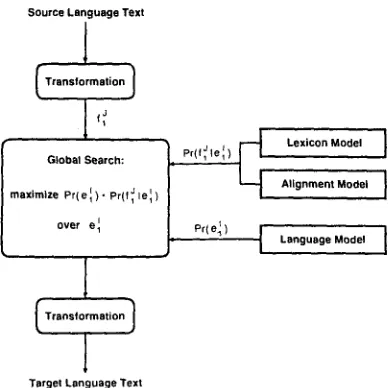
the text transformation steps. However, to keep the notation simple we will not make this explicit distinction in the subsequent exposition. The overall architecture of the statistical translation approach is summarized in Figure 1.2 A l i g m n e n t M o d e l s
A key issue in modeling the string translation prob- ability
P r ( f ( l e I)
is the question of how we define the correspondence between the words of the target sentence and the words of the source sentence. In typical cases, we can assume a sort of pairwise de- pendence by considering all word pairs(fj,ei)
for a given sentence pair [f(; el]. We further constrain this model by assigning each source word toexact-
ly one
target word. Models describing these types of dependencies are referred to asalignrnen.t models
(Brown e t al., 1993), (Dagan e t a ] . . 1993). (Kay &R6scheisen, 1993). (Fung & Church. 1994), (Vogel et al., 1996).
Source Language Text
1
I Transformation
1
¢~
Global Search:
j ~
Lexicon Modelmaximize Pr(el). pr(f~lell} I I AllgnmentModel
ovor
j. pc(e~) [ Language
M o d e l ,
[;....,!...,,on]
1
Target Language TextFigure I: Architecture of the translation approach based on Bayes decision rule.
probability distributions with (nearly) no specific as- snmptions. In contrast, for model-based probability distributions, we use the generic symbol p(.). 2.1 A l i g n m e n t w i t h H M M
When aligning the words in parallel texts (for Indo-European language pairs like Spanish-English, German-English, h a l i a n - G e r m a n .... ), we typically observe a strong localization effect.. Figure 2 illus- trates this effect, for the language pair Spanish-to- English. In m a n y cases, although not always, there is an even stronger restriction: the difference in the position index is smaller than 3 and the alignment. is essentially monotone. To be more precise, the sentences can be partitioned into a small number of segments, within each of which the alignment is monotone with respect to word order in both lan- gaages.
To describe these word-by-word alignments, we introduce the mapping j - - o j, which assigns a po- sition j (with source word .fj ) to the position i = aj (with target word ei). The concept of these align- ments is similar to the ones introduced by (Brown et al., 1993), but we will use another type of de- pendence in the probability distributions. Looking at. such alignments produced by a human expert, it, is evident t h a t the mathematical model should try to capture the strong dependence of aj on the pre- ceding alignment a j-1. Therefore the probability of alignment aj for position j should have a dependence on the previous alignment position O j_ l :
P((/j [(/j-1 )
A similar approach has been chosen by (Dagan et al., 1993) and (Vogel et al.. 1996). Thus the problem formulation is similar t.o that of/,he time alignment
problem in speech recognition, where the so-called Hidden Markov models have been successfully used for a long time (Jelinek. 1976). Using the same basic principles, we can rewrite the probability by intro- ducing the 'hidden" aligmnents a~ := a l...aj...aa for a sentence pair [f~; c/]:
P,,(s 'lcI
=J
~i' j=1
To avoid any confnsion with the term 'hidden'in comparison with speech recognition, we observe t h a t the model states as such (representing words) are not hidden but the actual alignments, i.e. the sequence of position index pairs (j. i = aj ).
So far there has been no basic restriction of the approach. We now assume a first-order dependence on the alignments aj only:
P r ( f j , a j l f ~ - l , a { - 1 . e { ) = p ( f j , ( / j l a j - l , e { ) = p ( a j l a j _ l ) . p ( f j l e a , ) ,
where, in addition, we have assumed that the lexicon probability p(fle) depends only on aj and not. on
a j _ 1 •
To reduce the number of alignment parameters, we assume that the HMM alignment probabilities p(i[i') depend only on the j u m p width (i - i'). The monotony condition can than be formulated as:
p ( i [ i ' ) = O for i ¢ i ' + O . i ' + l , i ' + 2 .
This monotony requirement limits the applicabili- ty of our approach. However, by performing simple word reorderings, it. is possible to approach this re- quirement (see Section 4.2). Additional countermea- sures will be discussed later. Figure 3 gives an illus- tration of the possible alignments for the monotone hidden Markov model. To draw the analogy with speech recognition, we have to identify the states (along the vertical axis) with the positions i of the target words ei and the time (along the horizont.al axis) with the positions j of the source words J). 2 . 2 T r a i n i n g
To train the alignment and the lexicon model, we use the m a x i m u m likelihood criterion in the so-called m a x i m u m approximation, i.e. the likelihood criteri- on covers only the most likely alignment rather than the set of all alignments:
J
P r ( . f ( l e I ) = ~ 1-i [P(aJlaJ-l'. I)" P(fJle°.i )]
"i'
j=iJ
-'= max1- ~ [p(ajla.o_~, I). p(.l)leo,)]
j [image:2.612.96.291.41.235.2]d a y s o
t w o o
f o r o
r o o m o
d o u b l e o
a o
i s o
m u c h
h o w I o
I . . . . L _ _ _ L _ _ _ L _ _ _ L . . .
c v u h d p d d
U a n a o a o '
' I a b b r s i
a e i i a a
n t e s
t a
o c
i
0 n
r o o m J , o
t h e J. o
i n Jo
c o l d [ , o
t o o I . o
i s I.
i t J. o
J . . .
e I h h d f
n a a a e r
b c m '
i e a i
t s o
a i
C a
i d
0 0
n
n i g h t
a
f o r
t v
a
a n d
s a f e
a
t e l e p h o n e l
a J
w i t h J
r o o m J
a I
b o o k e d I
h a v e
w e
0 0
0 0
0
0 0
0
o
I Io
I . . . . - - - - ' - - - . . .
t r u h c t c f y t p u n
e e n a o e a u
n s a b n 1 j e
e e i ' a r
m r t e t
o v a f e
s a c o
d i n
a ) o
0 n
e a n o
1 r a c
e a h
v e
i S
i
0 n
[image:3.612.105.465.102.551.2]o*"
Z
r.~
©
L5
iv,
< F~
I I I I [ I
1 2 3 4 5 6
S O U R C E P O S I T I O N
Figure 3: Illustrat ion of alignments for the n l o n o t o n e
HMM.
To find the optimal alignment, we use d y n a m i c p r o g r a m m i n g for which we have the following typical recursion formula:
Q(i, j ) = p ( f j ] e i ) m a x [p(ili') . Q ( i ' , j - 1)1
i '
Here. Q ( i . j ) is a sort of partial probability as in t.ime
alignment for speech recognit.ion (aelinek, 1976). As a result, the training procedure a m o u n t s to a se- quence of iterat.ions, each of which consists of two steps:
• posilion alignm~TH: Given the model parame-
t.ers, det.ermine the most likely position align- n-lent.
• parame*e-r e s l i m a l i o n : Given the position align-
ment. i.e. going along the alignment paths for all sentence pairs, perform m a x i m u m likelihood estimation of the model parameters; for model- free distributions, these estimates result in rel- a.tive fi'equencies.
T h e IBM model 1 (Brown et al., 1993) is used to find an initial estimate of the translation probabilities.
3 S e a r c h A l g o r i t h m f o r T r a n s l a t i o n
For the translation operat.ion, we use a bigram lan- guage model, which is given in terms of the con-
dit.ional probability of observing word ei given the
predecessor word e.i- 1:
p(~ilei-:)
Using the conditional probability of the b i g r a m lan- guage model, we have the overall search criterion in
the m a x i n m m approximation:
m a x p ( e i l e ; _ : ) l n a x l ' I [ p ( a j l a ~ - : ) P ( f J l e a , ) ] "
,,' t i = : ~i ~=:
Here and in the following, we omit a special treat- m e n t of the start and end conditions like j = 1 or j = J in order to simplify the presentation and avoid
confusing details. Having the above criterion in
mind, we try t.o associate the language model prob-
abilities with the aligmnents j ~ i - a j . T o this
purpose, we exploit the m o n o t o n y property of our alignment model which allows only transitions from
a j - i tO aj if the difference 6 = o j - a j - 1 is 0 , 1 , 2 .
We define a modified probability p~(el#) for the lan- guage model depending on the alignment difference t~. We consider each of the three cases 5 = 0, 1,2 separately:
• ~ = 0 (horizontal transition = alignment repe- tition): This case corresponds to a target word with two or more aligned source words and therefore requires ~ = # so t h a t there is no contribution fl'om the language model:
1 for e = e '
P~=°(ele') = 0 for e e e '
• 6 = 1 (forward transition = regular alignment.): This case is the regular one, and we can use directly the probability of the bigram language model:
p ~ = : ( e l e ' ) = p(ele')
• ~ = 2 (skip transition = non-aligned word): This case corresponds to skipping a word. i.e, there is a word in the target string with no aligned word in the source string. We have to find the highest probability of placing a non- aligned word e_- between a predecessor word e' and a successor word e. Thus we optimize the following product, over the non-aligned word g:
p~=~(eJe') = m a x b ~ ( e l g ) . p ( g I e ' ) ]
i
This maximization is done beforehand and the result is stored in a table.
Using this modified probability p~(ele'), we can
rewrite the overall search criterion: aT
l-I
)].
The problem now is to find the unknown m a p p i n g :
j - - (aj, ca.,)
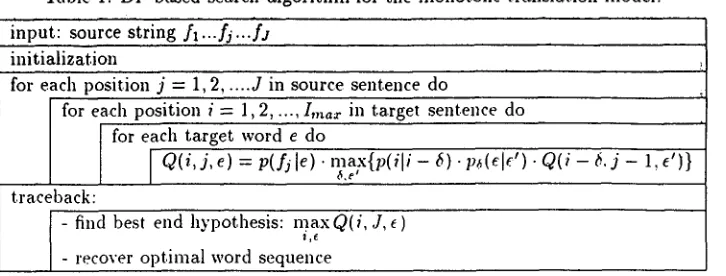
[image:4.612.83.300.47.278.2]Table h DP based search algorithm for the monotone translation model. !nput: source s t r i n g / l . . . f j . . . f J
initialization
for each position j = 1,2 ... d in source sel'ltence do
for each position i = 1,2,
...,/maz
in target sentence do for each target word e doV Q(i, j, e) = p(fj le)' ma;x{p(i[i - 6). p~(e[e'). Q(i - 6. j - 1, e')} 6,e
traceback:
- find best end hypothesis: m a x Q(i, J, e) - recover optimal word sequence
vertical axis. we have to allow all possible words e of the target vocabulary. Due to the monotony of our alignnaent model and the bigraln language mod- el. we have only first-order type dependencies such that the local probabilities (or costs when using the negative logarithms of the probabilities) depend on- I.q on the arcs (or transitions) in the lattice. Each possible index triple ( i . j . e ) defines a grid point in the lattice, and we have the following set of possi- ble transitions fi'om one grid point to another grid point :
~fi {0.1.2} : ( i - 6 . j - l . e ' ) - - ( i , j , e )
Each of these transitions is assigned a local proba- bility:
p(ili - 6). p,,(ele') . p(fj le)
Using this formulation of the search task, we can now use the method of dynamic p r o g r a m m i n g ( D P ) to find the best path through the lattice. To this purpose, we introduce the auxiliary quantity:
Q ( i . j . e ) : probability of the best. partial path which ends in the grid point (i, j, e).
Since we have only first-order dependencies in our model, it is easy to see that the auxiliary quantity nmst satisfy the following DP recursion equation: Q ( i . j . e ) = p ( f j l e ) .
max { p ( i l i - ~). maxp,,(ele'). Q ( i - 6, j - 1,e')}. To explicitly construct the unknown word sequence ~ . it is convenient to make use of so-called back- pointers which store for each grid point ( i . j , e ) the best predecessor grid point (Ney et al.. 1992).
The DP equation is evaluated recursively to find the best partial path to each grid point (i, j, e). The resuhing algorithm is depicted in Table 1. The com- plexity of the algorithm is J . I,,,.,. • E'-'. where E is the size of t.he target language vocabulary and I,,,,~. is the n~aximum leng{'h of the target sentence con- sidered. It is possible to reduce this COml)utational complexity by using so-called pruning methods (Ney et al.. 1992): due to space limitatiol~s, they are not discussed here.
4 E x p e r i m e n t a l R e s u l t s
4.1 T h e T a s k and t h e C o r p u s
The search algorithln proposed in this paper was tested on a subtask of the "'Traveler Task" (Vidal, 1997). The general domain of the task comprises typical situations a visitor to a foreign country is faced with. The chosen subtask corresponds to a sce- nario of the h u l n a n - t o - h u m a n communication situ- ations at the registration desk in a hotel (see Table 4).
The corpus was generated in a s e m i - a u t o m a t i c way. On the basis of examples from traveller book- lets, a prol)abilistic gralmnar for different language pairs has been constructed from which a large cor- pus of sentence pairs was generated. The vocabulary consisted of 692 Spanish and 518 English words (in- eluding punctuatioll marks). For the experiments, a trailfing corpus of 80,000 sentence pairs with 628,117 Spanish and 684.777 English words was used. In ad- dition, a test corpus with 2.730 sentence pairs differ- ent froln the training sentence pairs was construct- ed. This test corpus contained 28.642 Spanish a.nd 24.927 English words. For the English sentences, we used a bigram language model whose perplexity on the test corpus varied between 4.7 for the orig- inal text. and 3.5 when all transformation steps as described below had been applied.
Table 2: Effect of the transformation steps on the vocabulary sizes in both languages.
Transformation Step Spanish English
Original (with punctuation) 692 518
+ C.ategorization 416 227
+ 'por_~avor' 417
+ V~'ol'd Splkt.ing 374
+ Word Joining 237
[image:5.612.119.482.55.193.2]4 . 2 T e x t T l - a n s f o r m a t i o n s
The purpose of the text transformations is to make the two languages resenable each other as closely as possible with respect, to sentence length and word or- der. In addition, the size of both vocabularies is re- duced by exploiting evident regularities; e.g. proper names and numbers are replaced by category mark-
ers. We used different, preprocessing steps which
were applied consecutively:
• O r i g i n a l C o r p u s : Punctuation marks are
treated like regular words.
• C a t e g o r i z a t i o n : Some particular words or word groups are replaced by word categories. Seven non-overlapping categories are used: three categories for names (surnames, name and female names), two categories for numbers (reg- ular numbers and room numbers) and two cat- egories for date and time of day.
• 'D_'eatment o f ' p o t : f a v o r ' : The word ' p o t
: f a v o r ' is always moved to the end of the sentence and replaced by the one-word token
' p o t _ f a v o r ' .
• W o r d S p l i t t i n g : In Spanish, the personal pronouns (in subject case and in object, case) can be part of the inflected verb form. To coun- teract this phenomenon, we split the verb into
a verb part and pronoun part, such as 'darnos"
-- "dar _nos' and "pienso" - - '_yo pienso'.
• W o r d J o i n i n g : Phrases in the English lan-
guage such as "Would yogi m i n d doing . . . ' and
'1 would like you to do ..." are difficult to han-
dle by our alignment model. Therefore, we
apply some word joining, such as 'would yo~t
mi71d" - - 'wo~dd_yo',_mind" and ~would like ' - - "wotdd_like '.
• W o r d R e o r d e r i n g : This step is applied to the Spanish text to take into account, cases like the position of the adjective in noun-adjective phrases and the position of object, pronouns.
E.g. "habitacidT~ d o b h ' - - 'doble habitaci6~'.
By this reordering, our assumption about the monotony of the alignment model is more often satisfied.
The effect of these transformation steps on the sizes of both vocabularies is shown in Table 2. In addi- tion to all preprocessing steps, we removed the punc- t.uation marks before translation and resubstituted t.hena by rule into the target sentence.
4 . 3 T r a n s l a t i o n R e s u l t s
For each of the transformation steps described above, all probability models were trained anew, i.e,
the lexicon probabilities p ( f l e ) , the alignment prob-
abilities p ( i l i - 6) and the bigram language proba-
bilities p ( e l e ' ) . To produce the translated sentence
in normal language, the transformation steps in the target language were inverted.
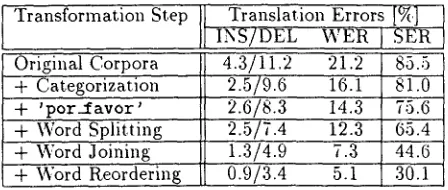
The translation results are summarized in Table 3. As an aut.omatic and easy-to-use measure of the translation errors, the Levenshtein distance between the automatic translation and the reference transla- tion was calculated. Errors are reported at the word level and at. the sentence level:
• word leveh insertions (INS). deletions (DEL), and total lmmber of word errors (\VER).
• sentence level: a sentence is counted as correct
only if it is identical to the reference sentence.
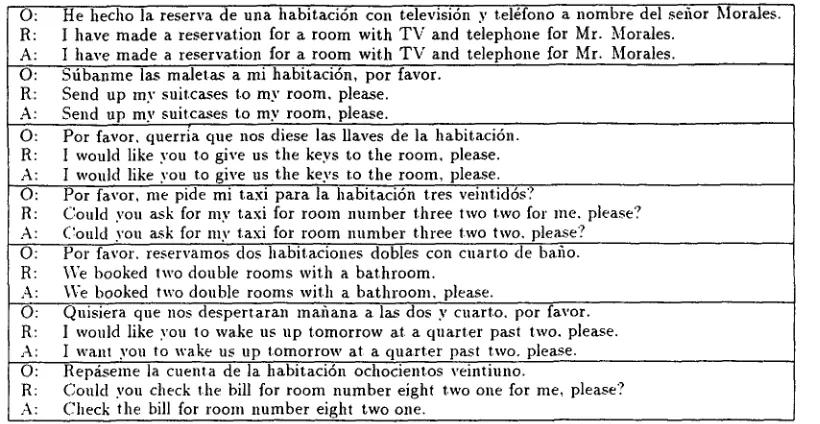
Admittedly, this is not a perfect measure. In par- ticular, the effect of word ordering is not taken into account appropriately. Actually, the figures for sen- tence error rate are overly pessimistic. Many sen- tences are acceptable and semantically correct trans- lations (see the example translations in Table 4),
Table 3: Word error rates (INS/DEL, WER) and sentence error rates (SER) for different transforma- tion steps.
Transformation Step
Original CorPora + Categorization
+ ' p o r 2 f a v o r '
+ Word Splitting
Translation Errors [~.]
423/11.2 21.2 85.5
2.5/§.6 16.1 81.0
2.6/8.3 14.3 75.6
2.5/7.4 12.3 65.4
i.3/4.9 44.6
+ Word Joining 7.3
+ Word Reordering 0.9/3.4 5.1 30.1
As can be seen in Table 3. the translation er- rors can be reduced systen~at.ically by applying all
transformation steps. The word error rate is re-
duced from 21.2{,} t.o 5.1{2~: the sentence error rate is reduced from 85.55~, to 30.1%. The two most ina- portant transformation steps are categorization and word joining. What is striking, is the large fi'action of deletion errors. These deletion errors are often
caused by the omission of word groups like 'for me
please "and "could you ". Table 4 shows some example
translations (for the best translation results). It can be seen that the semantic meaning of the sentence in the source language may be preserved even if there are three word errors according t.o our performance
criterion. To study the dependence on the amount
of training data, we also performed a training wit.la only 5 000 sentences out of the training corpus. For this training condition, the word error rate went up only slightly, namely from 5.15}. (for 80,000 training sentences) to 5.3% (for 5 000 training sentences).
To study the effect of the language model, we test- ed a zerogram, a unigram and a bigram language model using the standard set of 80 000 training sen-
[image:6.612.319.543.306.401.2]Table 4: E x a m p l e s from tile E u T r a n s task: O = original sentence, R = reference t r a n s l a t i o n . A = a u t o m a t i c t.ranslatiol~.
O: He hecho la reserva de una habitacidn con televisidn y t.el~fono a hombre del sefior Morales.
R: I have made a reservation for a room with TV and telephone for Mr. Morales.
A: I have made a reservation for a room with TV and telephone for Mr. Morales.
O: Sfibanme las maletas a mi habitacidn, pot favor.
R: Send up my suitcases to my room, please.
A: Send up my suitcases to my room, please.
O: Pot favor, querr{a qua nos diese las llaves de la habitacidn.
R: I would like you to give us the keys to the room, please.
A: I would like you to give us the keys to the room, please.
O: Pot favor, me pide mi taxi para la habitacidn tres veintidds?
R: Could you ask for nay taxi for room number three two two for me. please'?
A: Could you ask for my taxi for room number three two two. please?
O: Por favor, reservamos dos habitaciones dobles con euarto de bafio.
R: We booked two double rooms with a bathroom.
A: We booked two double rooms with a bathroom, please.
O: Quisiera qua nos despertaran mafiana a las dos y cuarto, pot favor.
R: l would like you to wake us up tomorrow at. a quarter past two. please.
A: I want you to wake us up tomorrow at a quarter past two. please.
O: Rep/seme la cuenta de la l~abitacidn ochocientos veintiuno.
R: Could .you check the bill for room number eight two one for me, please'?
A: Check the bill for room lmmber eight two one.
W E R decreases from 31.1c/c for the zerogram model to 5.1% for the b i g r a m model.
T h e results presented here can be compared with the results o b t a i n e d by the finite-state t r a n s d u c e r approach described in (Vidal, 1996: Vidal, 1997), where the same t r a i n i n g and test conditions were used. However the only preprocessing step was cat- egorization. In that work. a W E R of 7.1c)~. was ob- tained as opposed to 5.1(7c presented in this paper. For smaller a m o u n t s of t r a i n i n g data (say 5 000 sen- tence pairs), the DP based search seems to be even lnore superior.
Table 5: L a n g u a g e model perplexity ( P P ) , word er- ror rates ( I N S / D E L . W E R ) and sentence error rates (SER) for different language models.
Model
Language P P I N S / D E L T r a n s l a t i o n W E R Errors [S E R [%]
Zerogram 237.0 0.6/18.6 31.1 98.1
U n i g r a m 74.4 0.9/12.4 20.4 94.8
B i g r a m 4.1 0.9/3.4 5.1 30.1
4 . 4 E f f e c t o f t h e W o r d R e o r d e r i n g
In more general cases and
applications,
there willahvays be sentence pairs with word a l i g n m e n t s for which the m o n o t o n y c o n s t r a i n t is ]lot satisfied. How- ever even then, the n l o n o t o u y c o n s t r a i n t is satisfied
locally
for the lion's share of all word a l i g n m e n t s in such sentences. Therefore. we expect t.o extend the approach presented by the following methods:• more systelnatic approaches to local and global word reorderiugs that try to produce the s a m e word order in both languages.
• a multli-level approach t h a t allows a small (say
4) n u m b e r of
large
forward a n d backward t r a n -sitions. W i t h i n each level, the m o n o t o n e align- m e n t model can still be applied, a n d only when m o v i n g from one level to the next, we have to handle the p r o b l e m of different word orders.
To show the usefulness of global word reorder- ing. we changed the word order of some sentences by hand. Table 6 shows the effect of the global re- ordering for two sentences. In the first example, we changed the order of two groups of consecutive words a n d placed an a.dditional copy of the Spanish word
"euest, a'" into the source sentence. In the second
example, the personal p r o n o u n "'me" was placed at the end of the source sentence. In both cases, we o b t a i n e d a correct t r a n s l a t i o n .
5 C o n c l u s i o n
[image:7.612.96.506.72.284.2]Table 6: Effect of the global word reordering: O = original sentence, R = reference translation, A = automatic translation, O ' = original sentence reordered, A ' = aut, omatic translation after reordering.
O: C u £ n t o c u e s t a una habitacidn doble p a r a cinco noches incluyendo servicio de habitaciones ? R: How much does a double room including r o o m service cost for five nights ?
A: How much does a double room including r o o m service ?
O': Cu~into c u e s t a una habitacidn doble incluyendo servicio' de habitaciones cuesta para cinco noches ? A': How much does a double room hlcluding room service cost for five nights ?
O : . Expli'que _me la factura de la habitacidn tres dos cuatro. R: Explain the bill for room n u m b e r t h r e e two four for me. A: Explain the bill for room n u m b e r t h r e e two four. O': Explique la faclura de la habitaci6n tres dos c u a t r o .ane. A : Explain tile bill for rooln n u m b e r t h r e e two four for me.
ing word error rate was only 5.1V(. To mitigate the monotony constraint, we plan to reorder the words in the source sentences to produce the same word order in both languages.
A c k l m w l e d g e m e n t
This work has been supported partly by t.he Ger- m a n Federal Ministry of Education. Science. Re- search and Technology under the contract number 01 IV 601 A (Verbmobil) and by the European Com- munity under the ESPRIT project number 20268 (EuTrans).
R e f e r e n c e s
A. L. Berger. P. F. Brown. S. A. Della Pietra, V. J. Della Pietra. ,]. R. Gillett. J. D. Lafferty. R. L. Mercer. H. Printz. and L. Ures. 1994. "The Call- dide System for Machine Translation". In Proc. of ARPA Huma~ La,guage Technology Workshop.
pp. 152-157. Plainsboro. NJ. Morgan Kaufinann Publishers. San Mateo. CA, March.
P. F. Brown, V. J. Della Pietra. S. A. Della Pietra, and R. L. Mercer. 1993. "'The Mathematics of Statistical Machine Translation: Parameter Esti- mat.ion". Comp,fational Linguistics, Vol. 19, No. 2. pp. 263-311.
I. Dagan. K. W. Church. and W. A. Gale. 1993. "'Robust Bilingual Word Alignment for Machine Aided Translation". In Proc. of the Workshop on
I.<ry Large Corpora. pp. 1-8. Columbus, OH.
P. Fung. and K. W. Church. 1994. "'K-vec: A New Approach for Aligning Parallel Texts", In Proc. of lhe 15th In i. Conf. on ('ompulalim~al Linguistics,
pp. 10.(.)6-1102, Kyoto.
F..lelinek. 1.(.t76. "'Speech Recognition by Statistical Methods". Proc. of lhe IEEE. Vol. 64. pp. 532- 556. April.
M. Kay. and M. R6scheisen. 1993. "Text- Translation Alignlnent". Comp~talional Lin.gu~s-
lie.s. Vol. 19. No. 2. pp. 121-142.
H. Ney, D. Mergel, A. Noll, A. Paeseler. 1992. "Da- t.a Driven Search Organization for Continuons Speech Recognition". IEEE Trans. on Signal Pro-
cessing, Vol. SP-40. No. 2. pp. 272-281. February.
E. Vidal. 1996. "Final report of Esprit Research Project. 20268 (EuTrans): Example-Based Under- standing and Translation Systelns". Universidad Polit~cnica de Valencia, Instituto Tecnol6gio de Informgtica, October.
E. Vidal. 1997. "Finite-State Speech-to-Speech Translation". In Proc. of lhe Int. Co,,f. on Acous-
fits, Speech and Signal Processing. Munich. April.
S. Vogel, H. Ney, and C. Tillmmm. 1996. "HMM Based Word Alignment in Statistical Transla- tion". In Proc. of the 16~h Inf. Conf. on Com-
putational Linguistics. pp. 836-841. Copenhagen,
August.
D. Wu. 1996. "'A Polynomial-Time Algorithm for Statistical Machine Translation". In Proc. of the 34th Annual Conf. of the Associalio~ for Comp~l-
talional Linguistics, pp. 152-158. Santa Cruz, CA.