ANALYSIS OF COMPOST AND VERMICOMPOST PRODUCED BY THE EPIGEIC EARTHWORM,
EUDRILUS EUGENIAE
Girimalleshwar Bagari and *Pulikeshi M. Biradar
Department of Zoology,
ARTICLE INFO ABSTRACT
The present study was undertaken to analyse the quality of compost and vermicompost produced by the action of epigeic earthworm,
(LGW), Cotton Residue Waste (CRW), Ashoka Tree Waste (ATW), Parthenium Waste (PW) and Cattle Manure (CM) as standard food for earthworms. The physico
compost and vermicompost have been analysed by standard specified method of the earthworm,
nutrients. Results revealed that there is a wide variation in physico composts and vermicomposts. A sig
vermicompost than in the compost of all organic wastes may be due to usage of Carbon
building up of body of the worms during their growth. There is an increasing level of physico chemical parameters such as pH, EC, both macro nutrients (N, P, K, S, Ca and Mg) and micro nutrients (Cu, Zn, Fe and Mn) in vermicompost when compared to compost in all organic wastes. This may be because of more biodegradation process by the action of eart
degraded organic wastes by the action of saprophytic microorganisms present in the gut of earthworm,
E.eugeniae
Copyright©2017, Girimalleshwar Bagari and Pulikeshi M. Biradar.
which permits unrestricted use, distribution, and reproduction in any medium, provided the original work is properly cited.
INTRODUCTION
In recent few decades, dumping of huge quantity of organic wastes from different sources like domestic, agriculture and industrial wastes have caused serious environmental hazards and economic problems. Most of these wastes are either burnt or used for land filling (Fulekar, 2005). Burning of organic wastes contributes large amount of Carbon dioxide
the atmosphere that causes environmental pollution. This over all process tremendously leads to not only global warming but it also destroys the surface soil organic matter, vanish soil microbial population and affects the physico
properties of the soil (Livan and Thompson, 1997). Proper utilization of organic wastes can not only promote recycling of plant nutrients, it also improves soil health and environmental quality (Mishra et al., 1989; Bhardwaj, 1995).
searchers are looking for appropriate technology, which controls and manages properly to reduce the adverse effects of dumping of huge amount of organic wastes on soil environment. There have been numerous reports about the utilization of various organic residues such as Kitchen waste,
*Corresponding author: Pulikeshi M. Biradar,
Department of Zoology, Karnatak University, Dharwad
ISSN: 0975-833X
Article History:
Received 12th April, 2017 Received in revised form 09th May, 2017
Accepted 30th June, 2017 Published online 26th July, 2017
Citation: Girimalleshwar Bagari and Pulikeshi M. Biradar,
eugeniae out of different organic wastes”, International Journal of Current Research
Key words:
Compost, Vermicompost,
Physico-chemical parameters, Eudrilus eugeniae.
RESEARCH ARTICLE
ANALYSIS OF COMPOST AND VERMICOMPOST PRODUCED BY THE EPIGEIC EARTHWORM,
EUDRILUS EUGENIAE
OUT OF DIFFERENT ORGANIC WASTES
Girimalleshwar Bagari and *Pulikeshi M. Biradar
Department of Zoology, Karnatak University, Dharwad-580003
ABSTRACT
The present study was undertaken to analyse the quality of compost and vermicompost produced by the action of epigeic earthworm, E.eugeniae out of different organic wastes such as Lawn Grass (LGW), Cotton Residue Waste (CRW), Ashoka Tree Waste (ATW), Parthenium Waste (PW) and Cattle Manure (CM) as standard food for earthworms. The physico
compost and vermicompost have been analysed by standard specified method
of the earthworm, E. eugeniae in biodegradation of different organic wastes and recycling of plant nutrients. Results revealed that there is a wide variation in physico
composts and vermicomposts. A significant reduction in Organic Carbon (OC) have been observed in vermicompost than in the compost of all organic wastes may be due to usage of Carbon
building up of body of the worms during their growth. There is an increasing level of physico hemical parameters such as pH, EC, both macro nutrients (N, P, K, S, Ca and Mg) and micro nutrients (Cu, Zn, Fe and Mn) in vermicompost when compared to compost in all organic wastes. This may be because of more biodegradation process by the action of eart
degraded organic wastes by the action of saprophytic microorganisms present in the gut of earthworm,
E.eugeniae.
Girimalleshwar Bagari and Pulikeshi M. Biradar. This is an open access article distributed under the Creative Commons Att use, distribution, and reproduction in any medium, provided the original work is properly cited.
In recent few decades, dumping of huge quantity of organic wastes from different sources like domestic, agriculture and industrial wastes have caused serious environmental hazards and economic problems. Most of these wastes are either burnt nd filling (Fulekar, 2005). Burning of organic wastes contributes large amount of Carbon dioxide ( ) in the atmosphere that causes environmental pollution. This over all process tremendously leads to not only global warming but face soil organic matter, vanish soil microbial population and affects the physico-chemical properties of the soil (Livan and Thompson, 1997). Proper utilization of organic wastes can not only promote recycling of lth and environmental 1989; Bhardwaj, 1995). Now there searchers are looking for appropriate technology, which controls and manages properly to reduce the adverse effects of dumping of huge amount of organic wastes on soil nt. There have been numerous reports about the utilization of various organic residues such as Kitchen waste,
Department of Zoology, Karnatak University, Dharwad-580003
Road side weed wastes, Sewage sludge, Live stock wastes, Industrial and agricultural wastes by different epigeic and anecic earthworm species, which in turn convert them into valuable vermicompost in the form of bio fertilisers (Yousefi et al.,2003; Khalfi et al.,2005).
considered as a supplement to soil as it releases different plant nutrients slowly with significant reduction in the Organic Carbon (OC), thus improving physico
soil and synchronizing the requirement of plants Garg, 2003; Bharat, 2007). Doube
reported vermicompost has more beneficial impact on plants rather than on the health of soil.
was undertaken to analyse the physico
compost and vermicompost produced by the action of epigeic earthworm, E. eugeniae out of different organic wastes in a laboratory conditions.
MATERIALS AND METHODS
Composting and vermicomposting experimental
The compost (without worms) and vermicompost (with earthworm E.eugeniae) produced by a mixture of different individual organic wastes with cattle manure in the ratio of
International Journal of Current Research
Vol. 9, Issue, 07, pp.53875-53879, July, 2017
Girimalleshwar Bagari and Pulikeshi M. Biradar, 2017. “Analysis of compost and Vermicompost produced by the Epigeic earthworm, International Journal of Current Research, 9, (07), 53875-53879.
ANALYSIS OF COMPOST AND VERMICOMPOST PRODUCED BY THE EPIGEIC EARTHWORM,
OUT OF DIFFERENT ORGANIC WASTES
Girimalleshwar Bagari and *Pulikeshi M. Biradar
580003
The present study was undertaken to analyse the quality of compost and vermicompost produced by out of different organic wastes such as Lawn Grass Waste (LGW), Cotton Residue Waste (CRW), Ashoka Tree Waste (ATW), Parthenium Waste (PW) and Cattle Manure (CM) as standard food for earthworms. The physico-chemical parameters of both compost and vermicompost have been analysed by standard specified methods so as to check the role in biodegradation of different organic wastes and recycling of plant nutrients. Results revealed that there is a wide variation in physico-chemical parameters of both nificant reduction in Organic Carbon (OC) have been observed in vermicompost than in the compost of all organic wastes may be due to usage of Carbon (C) for the building up of body of the worms during their growth. There is an increasing level of
physico-hemical parameters such as pH, EC, both macro nutrients (N, P, K, S, Ca and Mg) and micro nutrients (Cu, Zn, Fe and Mn) in vermicompost when compared to compost in all organic wastes. This may be because of more biodegradation process by the action of earthworm and mineralization of degraded organic wastes by the action of saprophytic microorganisms present in the gut of earthworm,
the Creative Commons Attribution License, use, distribution, and reproduction in any medium, provided the original work is properly cited.
Road side weed wastes, Sewage sludge, Live stock wastes, Industrial and agricultural wastes by different epigeic and anecic earthworm species, which in turn convert them into valuable vermicompost in the form of bio fertilisers (Yousefi 2005). Vermicompost is necessarily considered as a supplement to soil as it releases different plant nutrients slowly with significant reduction in the Organic Carbon (OC), thus improving physico-chemical properties of equirement of plants (Kaushik and Garg, 2003; Bharat, 2007). Doube et al., (1994) have also reported vermicompost has more beneficial impact on plants rather than on the health of soil. Hence, a comparative study was undertaken to analyse the physico-chemical parameters of compost and vermicompost produced by the action of epigeic out of different organic wastes in a
MATERIALS AND METHODS
Composting and vermicomposting experimental design
worms) and vermicompost (with ) produced by a mixture of different individual organic wastes with cattle manure in the ratio of OF CURRENT RESEARCH
10:1 along with cattle manure alone (as standard food for earthworm) on dry weight basis. All experimental sets (both compost and vermicompost) were maintained with moisture content of about 70- 80% by daily sprinkling of water. All the experimental sets were terminated after 16 weeks by removing earthworms manually in vermicompost sets. Both compost and vermicompost produced by individual organic wastes were collected separately in polythene bags and were analysed for physico-chemical parameters to know the nutrient status.
Analysis of compost and vermicompost samples
The analysis of various physico-chemical parameters such as OC, N, P, K, S, Ca, Mg and Cu, Zn, Fe and Mn were carried with respect to produced compost (without worms) and vermicompost (with E.eugeniae). Physical analysis such as pH was estimated as per the procedure described by Chandrabose et al. (1988) and Electric Conductivity (mS/cm) was determined by Chandrabose et al. (1988). The Organic Carbon (OC) was estimated by procedure Walkley and Black Method (1934). Available Nitrogen (N) was determined by Singh and Pradhan, (1981). Available Phosphorus and Potassium were determined by Bray and Krutz, (1945) and Flame Photometer
respectively. The available Sulphur was determined through
the procedure given by Yasushi and Shinjiro (2010). Determination of exchangeable Calcium and Magnesium was done by Jackson, (1973). Determination of micro nutrients (Cu, Zn, Fe and Mn) have been analysed by Lindsay and Norvell (1978) through Atomic Absorption Spectroscopy (ASS).
RESULTS AND DISCUSSION
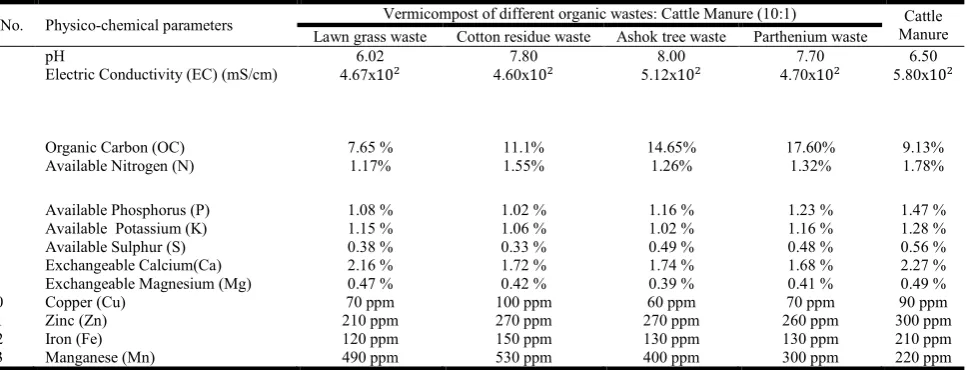
[image:2.595.45.551.435.581.2]The physico-chemical parameters of both compost and vermicompost were represented in the table 1 & 2 and graph 1-10 respectively. The presence of all parameters such as pH, EC, macro nutrients (N, P, K, S, Ca, and Mg) and micro nutrients (Fe, Cu, Zn and Mn) were in increasing order from compost > vermicompost produced out of different organic wastes, whereas, the percent Organic Carbon (OC) was declined in vermicompost than in compost. Both composting and vermicomposting processes have significantly modified the physical and chemical nature of the feed material provided. In the present study, the pH was recorded little lower the neutral in compost and it was towards alkaline in the vermicompost of all the waste foods (Table 1-2, Graph- 1), this might be due to the production of and organic acids by microbial metabolism during decomposition process (Albanell et al., 1988; Chan and Griffiths, 1988; Haimi and Hutha, 1986; Elvira et al., 1998). Similar results in pH shift towards alkaline after processing of cattle manure, fruit and vegetable wastes have been reported by Mitchell (1997) and Gunadi and Edwards (2003). Slow increase in Electric conductivity (EC) was also observed in vermicompost than in the compost of all the organic wastes (Table 1-2, Graph-2). The higher EC in worm casts may be due to increase in soluble salts, through biodegradation and mineralization process. Barker (1997) have also noticed higher pH values in vermicompost than in normal compost. This may be attributed to free availability of ions and minerals generated during ingestion and excretion by the earthworms in the vermicompost.
Table 1. Data of physico-chemical parameters of compost (without worms) produced out of mixture of different organic wastes and cattle manure
S.No. Physico-chemical parameters Compost of different organic wastes :Cattle Manure (10:1) Cattle
Manure Lawn grass waste Cotton residue waste Ashok tree waste Parthenium waste
1 pH 6.00 6.30 6.50 6.70 5.50
2 Electric Conductivity (EC) (mS/cm) 4.28x10 4.46x10 4.50x10 4.70x10 5.20x10
3 Organic Carbon (OC) 17.37 % 28.00 % 29.40 % 27.60 % 16.13 %
4 Available Nitrogen (N) 0.67% 0.70% 0.75% 0.68% 0.82%
5 Available Phosphorus (P) 0.77 % 0.81 % 0.62 % 0.73 % 0.97 %
6 Available Potassium (K) 0.72 % 0.62 % 0.74 % 0.76 % 0.89 %
7 Available Sulphur (S) 0.28 % 0.20 % 0.29 % 0.28 % 0.31 %
8 Exchangeable Calcium (Ca) 1.10 % 1.22 % 1.46 % 1.28 % 1.53 %
9 Exchangeable Magnesium (Mg) 0.26 % 0.20 % 0.18 % 0.16 % 0.28 %
10 Copper (Cu) 30 ppm 70 ppm 60 ppm 70 ppm 90 ppm
11 Zinc (Zn) 270 ppm 220 ppm 260 ppm 380 ppm 340 ppm
12 Iron (Fe) 180 ppm 120 ppm 170 ppm 190 ppm 210 ppm
13 Manganese (Mn) 370 ppm 220 ppm 260 ppm 380 ppm 340 ppm
Table 2. Data of physico-chemical parameters of vermicompost produced by the action of the epigeic earthworm, E.eugeniae out of
mixture different organic wastes and cattle manure
S.No. Physico-chemical parameters Vermicompost of different organic wastes: Cattle Manure (10:1) Cattle Manure Lawn grass waste Cotton residue waste Ashok tree waste Parthenium waste
1 pH 6.02 7.80 8.00 7.70 6.50
2 Electric Conductivity (EC) (mS/cm) 4.67x10 4.60x10 5.12x10 4.70x10 5.80x10
3 Organic Carbon (OC) 7.65 % 11.1% 14.65% 17.60% 9.13%
4 Available Nitrogen (N) 1.17% 1.55% 1.26% 1.32% 1.78%
5 Available Phosphorus (P) 1.08 % 1.02 % 1.16 % 1.23 % 1.47 %
6 Available Potassium (K) 1.15 % 1.06 % 1.02 % 1.16 % 1.28 %
7 Available Sulphur (S) 0.38 % 0.33 % 0.49 % 0.48 % 0.56 %
8 Exchangeable Calcium(Ca) 2.16 % 1.72 % 1.74 % 1.68 % 2.27 %
9 Exchangeable Magnesium (Mg) 0.47 % 0.42 % 0.39 % 0.41 % 0.49 %
10 Copper (Cu) 70 ppm 100 ppm 60 ppm 70 ppm 90 ppm
11 Zinc (Zn) 210 ppm 270 ppm 270 ppm 260 ppm 300 ppm
12 Iron (Fe) 120 ppm 150 ppm 130 ppm 130 ppm 210 ppm
[image:2.595.62.546.618.803.2]Graphs 1-10. Comparison of various physico-chemical parameters of compost and vermicompost produced out of different organic wastes
0 1 2 3 4 5 6 7 8 9
LGW CRW ATW PW CM
Compost Vermicompost
pH
0 2 4 6 8
LGW CRW ATW PW CM
ELECTRIC
CONDUCTIVITY
(mS/cm)
Compost Vermicompost
0 10 20 30 40
LGW CRW ATW PW CM
ORGANIC
CARBON (%)
Compost Vermicompost
0 0.5 1 1.5 2
NITROGEN (%)
Compost Vermicompost
0 0.5 1 1.5 2
LGW CRW ATW PW CM
PHOSPHORUS
(%)
Compost Vermicompost
0 0.5 1 1.5
LGW CRW ATW PW CM
POTASSIUM (%)
Compost Vermicompost
0 0.1 0.2 0.3 0.4 0.5 0.6
SULPHUR (%)
Compost Vermicompost
0 0.5 1 1.5 2 2.5
LGW CRW ATW PW CM
CALCIUM (%)
Compost Vermicompost
0 0.2 0.4 0.6
LGW CRW ATW PW CM
MAGNESIUM
(%)
Compost Vermicompost
0 100 200 300 400 500 600
Fe Zn Mn Cu Fe Zn Mn Cu
Compost Vermicompost
MICRONUTRIENTS (ppm)
The percent Organic Carbon (OC) drastically decreased in vermicompost as compared with the compost of all organic wastes may be attributed too much biodegradation and decomposition process by the microorganisms and utilization of organic carbon by earthworms for their body building during growth and development. Therefore, maximum OC was observed in compost rather than in the vermicompost (Table 1-2, Graph-3). According to Vial et al., (1987) loss of organic carbon in the biodegradation process might be responsible for enhancement of nitrogen content. The nitrogen (N) content was also increased drastically in vermicomposts than that of composts of different organic wastes (Table 1-2, Graph-4). Among vermicompost produced by the action of E.eugeniae, the N content was more in Cattle Manure followed by Cotton Residue Waste, Parthenium Waste, Ashok Tree Waste and it was least in Lawn Grass Waste. Kaushik and Garg (2004) were also observed increased nitrogen (N) in vermicomposts of textile mill sludge along with cattle dung and agricultural residues. The increase in nitrogen content of vermicompost was also reported by Tripathi and Bhardwaj, (2004),this may be due to accumulation of mucus, nitrogenous excretory substances, growth stimulating hormones and enzymes secreted by the earthworms. Atiyeh et al., (2000) have expressed earthworms make a great impact on nitrogen transformation by enhancing nitrogen mineralization so that mineral nitrogen may be retained in the form of nitrate. Syers et al., (1979) have also reported earthworm casts contains high concentrations of nitrate content. This is because earthworm gives shelter for microflora and also releases gut enzymes in their intestine, both are involved in biodegradation process (Piearce, 1978; Whiston and Seal, 1988; Kavian and Ghatnekar, 1991).
However, in the presence of earthworms, the biodegradation process increased drastically in vermicomposting when compared to the natural degradation (composting) of organic wastes by the saprophytic microorganisms. The nitrogen (N) content of compost and vermicompost is mainly dependent on the raw feed material provided and extent of biodegradation process by the action of earthworms (Crawford, 1983; Gaur and Singh, 1995). The lowering of C: N ratio and increase in the available plant nutrients in the vermicompost than in the compost have also reported (Fosgate and Babb,1972; Kale et al.,1982; Edwards,1998; Talashilkar et al.,1999) In the present analysis, available phosphorus (P) and potassium (K) contents were also more in the vermicomposts than in the composts (Table 1-2, Graph-5 & 6). Mansell et al., (1981) were noticed that plant litter was found to contain more available phosphorus (P) after ingestion by the earthworms. Increase in available phosphorous during vermicomposting is probably due to mineralization process and mobilization of phosphorus through bacterial and faecal phosphatase activity of earthworms (Edwards and Lofty, 1972). Available Sulphur (S), Calcium (Ca), and Magnesium (Mg) were also towards higher concentration in the vermicomposts compared to composts of different organic wastes (Table 1-2, Graph-7, 8 & 9). This may be related to the activity of microbial flora present in the gut of earthworms involved in the mineralization process. All the micronutrients Iron (Fe), Copper (Cu), Zinc (Zn) and Manganese (Mn)) were also observed somewhat more in the vermicomposts rather than in the composts of various organic wastes including cattle manure (Table 1-2, Graph-10) attributed to the degradation and mineralization process by the action of earthworm and microorganisms respectively.
Many workers have also reported higher content of available N, P, K and micronutrients in vermicompost than in the compost (Jambhekar, 1992; Delgado et al., 1995). Some of the researchers have also been reported that nutrients are found to be similar in both vermicompost and normal compost (Shinde et al., 1992; Talashilkar et al., 1999). As per NARI annual report, the soil enriched with vermicompost provides additional substances that are not found in soils with chemical fertilizers (Kale, 1998). The nutrient content of vermicompost and composts mainly depends on the raw materials used, the processed materials usually contains higher levels of most of the mineral elements, which are in available forms than that of parent material (Edwards and Bohlen, 1996).
Conclusion
The composts and vermicomposts produced out of different organic wastes have all the physico-chemical parameters necessary for the growth of plants and to maintain the fertility of soil. All parameters were slightly more in the vermicomposts produced by the action of epigeic earthworm, E.eugeniae than in the normal compost produced by the saprophytic microorganisms except Organic Carbon (OC). The production of the quality compost and vermicompost is primarily depends on the nature of raw organic wastes used in the experiment, then the multiplication and potentiality of the microorganisms and earthworm species in biodegradation and mineralization process and overall the presence of favourable environmental conditions.
Acknowledgement
The authors are thankful to authorities of Karnatak University, Dharwad for providing necessary facilities and UGC, New Delhi for financial assistance under SAP-DSA-I programme, UGC-BSR-RFSMS Fellowship (KU/Sch/RFSMS/2014-15/ 1304) and UGC-UPE (KU/Sch/UGC-UPE/2014-15/1904) to carry out research work on Vermitechnology at Department of Zoology, Karnatak University, Dharwad.
REFERENCES
Albanell, E., Plaixats, J., Cabrero, T. 1988. Chemical change during vermicomposting (Eisenia foetida) of sheep manure mixed with cotton industrial waste. Biology and fertility of Soils, 6(3): 266-269.
Atiyeh, R.M., Dominguez, J., Subler, .S. and Edwards, C.A. 2000. Changes in biochemical properties of cow manure during processing by earthworms (Eisenia Andrei) and the effects on seedling growth. Pedobiologia, 44: 709-724. Barker, A.V. 1997. Composition and uses of compost,
agricultural uses of by-products and wastes, ASC symposium series. American Chemical Society, 668(10): 140-162.
Bharat Lodha 2007 Effect on maturity and nutritional parameters during vermicomposting of municipal solid waste. International journal of Environmental Technology and Management, 7: 454-463.
Bray, R.H and Krutz, L.K. 1945. Determination of total organic and available forms of phosphorus in soil. Soil Science, 59: 39-45.
Chan, P.L.S and Griffiths, D.A. 1988. Chemical composting of pre-treated pig manure. Biological Waste, 24: 57-69. Chandrabose, M.S., Natrajan, S. and Selvakumari, G. 1988.
Methods of soil analysis.BookWorldPublications,pp.1-102. Crawford, J.H. 1983. Review of composting process.
Biochemical. 18: 14-15.
Delgado, M., Bigeriego, M., Walter, I. and Calbo, R. 1995. Use of the California red worm in sewage sludge transformation. Turrialba, 45: 33-41.
Doube, B.M., Davoren, C.W., Hindell, R., Long, N and Cass, A. 1994. Surface cast production by the earthworm Aporrectodea trapezoids and the influence of organic matter on cast structural stability. In : Soil biota : Management in sustainable cation, C.E. Pankhurst, B. M. Doube, W.S.R. Gupta and P.R. Grace, (Eds). A taxonomic system for South Africa. Mim. Agric.Nat.Res.Sth.Afr.No. 15.Dept.Agri.Dev., Pretoria.
Edwards, C.A. 1998. The use of earthworms in the breakdown and management of organic wastes. In: Earthworm Ecology, Edwards C.A., (Ed.), Lewis, Boca Raton, pp. 327-354.
Edwards, C.A. and Bohlen, P.J. 1996. Biology and Ecology of Earthworms (3rd Ed.), Chapman and Hall, London, U.K. Edwards, C.A. and Lofty, J.R. 1972. Biology of Earthworms.
Chapman and Hall, London, U.K.
Elvira, C., Sampedro, L., Benitez, E. and Nogales, R. 1998. Vermicomposting of sludge from paper mill and dairy industries with Eisenia Andrei: A pilot scale study. Bioresource Technology, 63:205-211.
Fosgate, O.T. and Babb, M.R. 1972. Biodegradation of animal waste by Lumbricuss terrestris. Journal of Dairy Science, 55: 870-872.
Fulekar, M.H. 2005. Environmental Biotechnology (5th edition) Oxford and IBH publisher, pp. 177-182.
Gaur, A.C. and Singh, G. 1995. Recycling of rural and urban waste through conventional and vermicomposting. In: Recycling of Crop, Animal, Human and Industrial waste in Agriculture, Tondon, H.L.S. (Ed.), Fertilizer Development and Consultation Organization, New Delhi, pp. 31-49. Gunadi, B. and Edwards, C.A. 2003. The effect of multiple
applications of different organic wastes on the growth, fecundity and survival of Eisenia foetida (Savigny) (Lumbricidae). Pedobiologia, 47(4): 321-330.
Haimi, J. and Hutha, V. 1986. Capacity of various organic residues to support adequate earthworm biomass in vermicomposting. Biology and Fertility of Soils, 2: 23-27. Jackson, M. L. 1973. Soil Chemical Analysis. Prentice Hall of
Englewood Cliffs, New Jersey, USA.
Jambhekar, H.A. 1992. Use of earthworm as a potential source to decompose organic wastes. National Seminar on Organic Farming, MPKV, Pune, pp. 52-53.
Kale, R. D. 1998. Earthworm-Cinderella of Organic Farming, Prism Books Pvt. Ltd.,Bangalore. pp. 87.
Kale, R. D., Bano, K. and Krishnamoorthy, R.V. 1982. Potential of Perionyx excavatus for utilization of organic wastes. Pedobiologia, 23: 419-425.
Kaushik, P. and Garg, V.K. 2003. Vermicomposting of mixed solid textile mill sludge and cow dung with epigeic earthworm, Eisenia fetida. Bioresource Technology, 90:311-316.
Kaushik, P. and Garg, V.K. 2004. Dynamics of biological and chemical parameters during vermicomposting of solid
textile mill sludge mixed with cow dung and agricultural residues, Bioresource Technology, 94: 203-209.
Kavian, M. F. and Ghatneker, S.D. 1991. Bio management of dairy effluents using culture of red earthworms (Lumbricus rubellus). Indian Journal of Environment Protection, 11: 680-682.
Khalfi, M., Ghanavi, Z, and Rezazade, S. 2005. Comparison of chemical quality of compost and vermicompost produced from sugar beet waste. 7th National Conference on Enivronmental Health. Shahrekurd University of Medical Science, Shahrekurd, Iran.
Lindsay, W.L. and Norvell, W.A. 1978. Development of a DTPA soil test for zinc, iron, manganese and copper. Soil Science Society of America Journal, 42: 421-428.
Livan, M.A and Thompson, W. 1997. NARI Annual Report. Mansell, G.P., Syers, J.K., Gregg, P.E.H. 1981. Plant
availability of phosphorous in dead herbage ingested by surface-casting earthworms. Soil Biology and Biochemistry, 13: 163-167.
Mishra, M.M., Kukreja, K., Kapoor, K.K. and Bangar, K.C. 1989. Organic recycling for plant nutrients. In: Soil microorganisms and crop growth, Somani, L.L., Bhandari, C.S. (Eds.). Divyajyoti Parkashan, Jodhpur, pp. 195-232. Mitchell, A. 1997. Production of Eisenia foetida and
vermicompost from feed lot cattle manure. Soil Biology and Biochemistry, 29: 763-766.
Piearce, T. G. 1978. Gut contents of some lumbricid worms. Pedobiologia, 18: 153-157.
Shinde, P.H., Nazirker, R.B., Kadam, S.K. and Khaire, V.M. 1992. Evaluation of vermicompost. National Seminar on Organic Farming, MPKV, Pune, pp. 54-55.
Singh, R. and Pradhan, K. 1981. Determination of nitrogen and protein by Khjeldhal method. In: Forage Evaluation Science. Pvt. Publishers Ltd., New Delhi, pp. 23.
Syers, J.K., Sharpley, A.N. and Keeney, D.R. 1979. Cycling of nitrogen by surface-casting earthworms in a pasture ecosystem. Soil Biology and Biochemistry, 11:181-185. Talashilkar, S.C., Bhangarath, P.P. and Mehta, V.B. 1999.
Changes in chemical properties during composting of organic residues as influenced by earthworm’s activity. Journal of The Indian Society of Soil Science, 47: 50-53. Tripathi, G. and Bhardwaj, P. 2004. Comparative studies on
biomass production life cycles and composting efficiency of Eisenia foetida (Savigny) and Lampito mauritii (Kinberg), Bioresource Technology, 92: 275-283.
Vial, M., Sayag, D. and Andre, L. 1987. Optimization of agricultural, industrial waste management through in-vessel composting. In: Compost: Production, Quality and use, De Bertoldi, M. (Ed.), Elsevier Applied Science, Essex, pp. 230-237.
Walkley, A. and Black, I.A. 1934. Chromic acid titration for determination of soil organic matter. Soil Science, 63: 251. Whiston, R.A. and Seal, K.J. 1988. The occurrence of
celluloses in the earthworm Eisenia foetida. Biology Wastes, 25: 239-242.
Yasushi, S. and Shinjiro, I. 2010. Method validation of redox titration for determination of sulphur content (as sulphur trioxide) in fertilizers of ferrous sulphate and its mixture materials, Research Report of Fertilizer, 3: 25-29.
Yousefi, Z, Zazouli, M.A., Asgharnia, H.A., Azizi, M, and Hedayati, S. 2003. Survey of compost production from domestic solid wastes by aerobic method and earthworm and effect of loading alternation. 6th National Congress of Environmental Health, Mazandaran, Iran. 22-24 October, 2003.