Head cabbage is one of the most important and most widely cultivated vegetables in the Czech Re-public. It occupies the second place, after onions, even though the acreage of cabbage has decreased in the last five year (Situační a výhledová zpráva … 2005). Cultivation of cabbage needs fertilizing by farmyard manures (Hlušek 1996), which are natural source of organic matter. Organic matter is known to improve soil fertility by changing its physical, chemical and biological character (Bunting 1965; Richter et al. 1994); vegetable production requires continuous applications of organic matter (Balík 1993; Richter 1997). However, a lot of farms special-ize in vegetable production these days and they have no animals, so traditional farmyard manure (FYM) is consequently in short supply. On the other hand, the farms specialized in rearing livestock have the opposite problem, namely, an abundance of manure which is difficult to dispose of. This surplus farmyard manure can be returned to the soil by processing it to make an organic fertilizer by aerobic fermentation and drying (Debosz et al. 2002). The aim of this study was to observe the effect of these alternative organic fertilizers on the nutritional value and yield of head cabbage.
MATERIAL AND METHODS
The two-year experiment took place at the Faculty of Horticulture of Mendel University of Agriculture and Forestry Brno, in Lednice in 2004 and 2005.
Treatments:
– conventional farmyard manure,
– Agro, an organic fertilizer made from poultry bedding and molasses, granulated (made by MeM B.V., Holland, and distributed in the Czech Repub-lic by AGRO CS, a. s.),
– Dvorecký agroferm, an organic fertilizer made from fermented and dried cow-dung, granulated (made by Agropodnik Dvorce, a. s., CR),
– Agormin, an organo-mineral fertilizer made from peat, with added basic macroelements (made by AGRO CS, a. s., CR),
– Zahradnický kompost (an organic fertilizer made from plant waste with added dolomitic calcite, made by AGRO CS, a. s., CR),
– conventional mineral fertilizer, – control (unfertilized).
Each treatment was replicated three times. The application rates were in accordance with the manufacturers’ guidelines; and in the case of FYM
Supported by the Ministry of Agriculture of the Czech Republic, Project No. QF 4195.
Effect of alternative organic fertilizers on the nutritional
value and yield of head cabbage
A. Zahradník, K. Petříková
Faculty of Horticulture, Mendel University of Agriculture and Forestry Brno, Lednice,
Czech Republic
ABSTRACT:Commercial brands of alternative, organic fertilizers were compared with conventional, mineral fertiliz-ers using head cabbage. There were six different treatments: conventional farmyard manure, Agro (made from poultry bedding and molasses), Dvorecký agroferm (granulated, made from dried, aerobically-fermented farmyard manure), Agormin (an organo-mineral fertilizer), compost manufactured from plant waste material, mineral fertilizer, and an unfertilized control. All the treatments were applied at rates providing approximately the same level of nutrients. After harvest, the levels of the minerals (K, Na, Ca, and Mg), ascorbic acid, nitrates and yield were measured. There were no significant differences between the treatments in levels of K, Na and Ca in case of organic fertilizers (farmyard manure, Agro, Agormin and compost). The unfertilized control had the highest levels of ascorbic acid; it was signifi-cantly higher than in case of farmyard manure which, in turn, had signifisignifi-cantly higher values than compost. Significant differences between the treatments were found in the levels of nitrates; the lowest in case of Dvorecký agroferm and in the control. The highest marketable yields were recorded with farmyard manure and Dvorecký agroferm, the latter being significantly higher than the control. This study shows that alternative, organic fertilizers (except compost) have similar qualities as farmyard manure.
as recommended by Malý et al. (1998) (Table 1). After doing soil analyses, the rates were adapted to a target yield of 50 t/ha, assuming that the rates of nutrients required to produce 1 ton of cabbage are as follows: 3.57 kg N, 0.57 kg P and 3.57 kg K. Correc-tions were made depending on the organic fertilizer, the preceding crop and the content of nutrients in the soil (Hlušek 1996). The varieties of head cabbage used were Pavlo F1 in 2004, and Trvalo F1 in 2005. Nutritional value was assessed by measuring the content of minerals, vitamin C and nitrates. The min-erals (potassium, sodium, calcium and magnesium) were determined by IONOSEP 900.1. Vitamin C was determined using HPLC chromatography. Nitrates were determined using ion selective electrodes. Har-vesting was done on 8. 9. 2004 and on 11. 10. 2005 and the heads were measured and classified as Grade I or II quality in accordance with local norms (ČSN 46 3113). All the results were processed by ANOVA and Tukey’s test using the statistical program Unistat 5.1 (Unistat USA).
RESULTS AND DISCUSSION
Nutrient content
Minerals
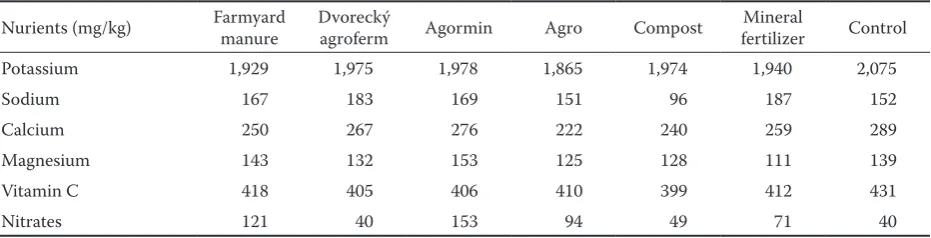
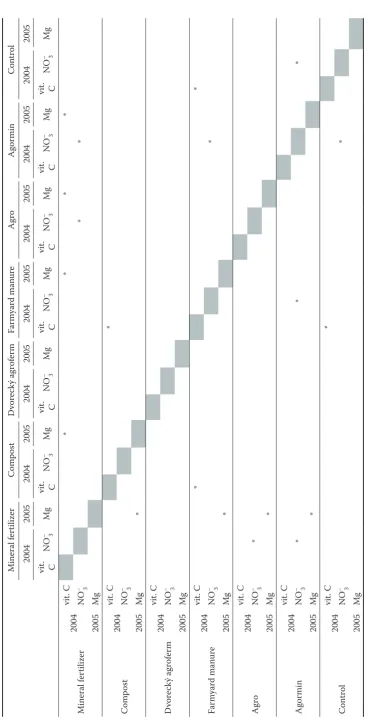
The average amount of minerals in cabbage heads for each treatment is shown in Table 2. The observed dif-ferences between the treatments in 2005, with the
ex-ception of magnesium, were not significant (Table 3.). Magnesium is important for human health mainly for skin, bones and enzyme production, and its levels were significantly higher when the organic fertilizers (FYM, Agormin, Agro and compost) were used (Ko-pec 1998). There were no significant differences ob-served between individual organic fertilizers, which is in agreement with previous studies on potatoes, where an increase in magnesium and sodium was re-corded comparing compost with a mineral fertilizer (Warman et al. 1998). The published results on the influence of organic fertilizers on levels of minerals differ. For example, Netherlands (1974) observed a higher level of potassium and calcium in potatoes and spinach after the application of organic fertiliz-ers (farmyard manure and compost); on the contrary, Toor at al. (2006) found no differences in calcium levels in cherries after using organic fertilizers.
Vitamin C
The highest average levels of vitamin C were ob-served in the unfertilized control (Table 3.), and were significantly higher than those of the FYM treatment in 2004. The latter were higher than the results of the compost treatment. Augustin (1975) in Seung et al. (2000), confirmed that higher doses of nitrogen reduce levels of vitamin C, as was previously stated by Netherlands (1996) and Lisiewska and Kmiecik (1996). Toor et al. (2006), Števlíková (1976), and Premuzic et al. (2004) showed an increase in vita-Table 1. Percentage of N, P, K and application rates of fertilizers
Fertilizer N P K Rate (t/ha)
Dvorecký agroferm 1.70 0.47 2.99 0.8–1.0
Agro 3.87 0.97 5.72 1.0
Agormin 1.14 0.21 3.55 2.5
Farmyard manure 0.97 0.61 1.04 55.0
[image:2.595.66.532.73.168.2]Compost 0.57 0.09 0.21 30.0
Table 2. Effect of fertilizers on the content of potassium, sodium, calcium, magnesium, vitamin C and nitrates. Average of the years 2004–2005
Nurients (mg/kg) Farmyard manure Dvorecký agroferm Agormin Agro Compost fertilizerMineral Control
Potassium 1,929 1,975 1,978 1,865 1,974 1,940 2,075
Sodium 167 183 169 151 96 187 152
Calcium 250 267 276 222 240 259 289
Magnesium 143 132 153 125 128 111 139
Vitamin C 418 405 406 410 399 412 431
[image:2.595.66.532.630.749.2]Ta
ble 3. Re
co gni ze d c onc lu sive diff er enc
es in t
he c
on
ten
t of n
utr
itional v
alue (2004–2005), 95% in
ter
val of sig
Ta
ble 4. Re
co gni ze d c onc lu sive diff er enc
es in y
ie
ld c
harac
ter
istic
s (2004–2005), 95% in
ter
val of sig
min C in response to organic fertilizers; however this was not confirmed in our experiment.
Nitrates
Nitrates are not desirable in the parts of vegetables to be consumed. The unfertilized control provided an average acceptable level of nitrates, with a value of 40 mg/kg (Table 3). A similarly low average value was observed in the variant with Dvorecký agroferm. The highest levels of nitrates were recorded in Agormin. This increase was statistically significant compared to the unfertilized control, mineral fertilizer and FYM in 2005. Providing that all the variants, except
for the control, had the same start dose of Nmin,
different final values of nitrates can be attributed to different mineralization level of nitrogen in each variant.
Classification of marketable yield
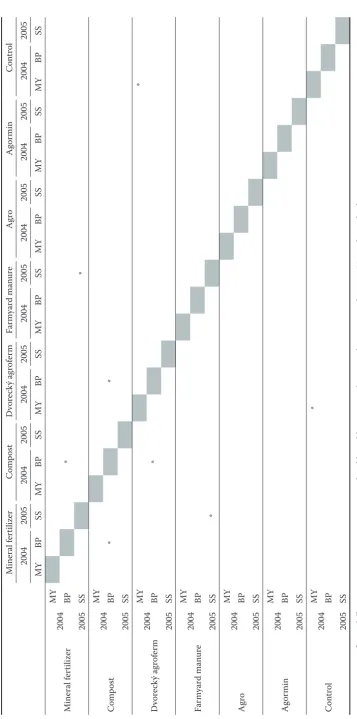
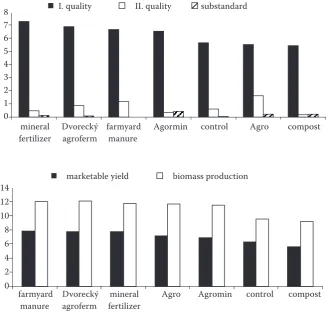
The highest marketable yield (quality grades I and II combined) was recorded with FYM and Dvorecký agroferm, the lowest with compost (Fig. 2), the latter being statistically significant (Table 4). The highest yield of grade I heads was recorded with mineral fer-tilizer, and the lowest with compost (Fig. 1), although the differences between the treatments were not significant. The total production of biomass
(mar-ketable yield + poor quality heads + the postharvest remains) is shown in Fig. 2. The highest biomass production was observed in the treatments with the highest marketable yield.
The lowest biomass production was recorded with compost, being significantly lower than Dvorecký agroferm and mineral fertilizer (Table 4). In pub-lished studies on the influence of different types of fertilizers on marketable yield, we often see that the highest marketable yield is obtained with mineral fer-tilizers and the lowest in unfertilized controls (Toor et al. 2006; Warman et al. 1997; Bunting 1965). It might be caused by the fact that these experiments were conducted on soils with high humus content, so that the treatments with mineral fertilizer provided faster mineralization of organic matter and a greater release of other nutrients. In our experiment the humus content was about 4% and it gave a high yield when mineral fertilizers were used. In both years the compost treatment variant gave low yields, possibly because the mineralization of nutrients was much slower than in case of the other treatments.
CONCLUSION
The organic fertilizers (farmyard manure, Agor-min, Agro and compost) increased levels of Mg in one year (2005), but did not affect the levels of
farmyard Dvorecký mineral Agro Agromin control compost
manure agroferm fertilizer 14
12 10 8 6 4 2 0
[image:5.595.65.400.59.372.2] marketable yield biomass production
Fig. 1. Influence of different
fertiliz-ers on quality (kg/m2); average of
2004 and 2005
Fig. 2. Influence of fertilizers on
marketable yield (kg/m2) and
bio-mass production (kg/m2); average
of 2004 and 2005 (marketable yield: grades I and II combined)
mineral Dvorecký farmyard Agormin control Agro compost
fertilizer agroferm manure
I. quality II. quality substandard
other minerals. The highest levels of vitamin C were recorded in the unfertilized control in 2004, being significantly higher than FYM. Nitrate levels were very low in all the treatments; the highest values were however recorded with Agormin in 2005, be-ing significantly higher than with mineral fertilizer, FYM and the unfertilized control. The average mar-ketable yield was 70 t/ha, and a statistically signifi-cant increase was observed in the case of Dvorecký agroferm. Total biomass production was higher with Dvorecký agroferm and with mineral fertilizer compared to compost. The use of alternative organic fertilizers, except for compost, had similar effects on all measured properties.
References
BALÍK J., 1993. Základy výživy rostlin. Praha, Institut výchovy a vzdělávání MZe ČR: 36.
BUNTING A.H., 1965. Effects of organic manures on soils and
crops. Proceedings of the Nutrition Society, 24: 29–38.
DEBOSZ K. et al., 2002. Evaluating effects of sewage sludge and household compost on soil physical, chemical and
microbiological properties. Applied Soil Ecology, 19:
237–248.
HLUŠEK J., 1996. Základy výživy a hnojení zeleniny a ovoc-ných kultur. Praha, Institut výchovy a vzdělávání MZe ČR: 48.
KOPEC K., 1998. Tabulky nutričních hodnot ovoce a zeleniny. Praha, Ústav zemědělských a potravinářských informací: 72.
LISIEWSKA Z., KMIECIK W., 1996. Effect of level of nitrogen fertilizer, processing conditions and period of storage for frozen broccoli and cauliflower on vitamin C retention.
Food Chemistry, 57: 267–270.
MALý I. et al., 1998. Polní zelinářství. Praha, Agrospoj: 196.
NETHERLANDS S., 1974. Nutritional value of crops as influ-enced by organic and inorganic fertilizer treatments. Plant
Foods for Human Nutrition, 23: 333–358.
NETHERLANDS S., 1996. Fertilizer effects on yield, mineral and amino acid composition, dietary fibre content and nutritive value of leeks. Plant Foods for Human Nutrition,
49: 163–174.
PREMUZIC Z. et al., 2004. Light supply and nitrogen fertiliza-tion for the producfertiliza-tion and quality of butterhead lettuce. Acta Horticulturae [online] accessible at: www.acthort. org/books/659/659 87.htm.
RICHTER R. et al., 1994. Výživa a hnojení rostlin. 1. vyd. Brno, Vysoká škola zemědělská: 177.
RICHTER R., 1997. Půdní úrodnost. Praha, Institut výchovy a vzdělávání MZe ČR: 36.
SEUNG K.L. et al., 2000. Preharvest and postharvest factors influencing vitamin C content of horticultural crops.
Post-harvest Biotechnology and Technology, 20: 207–220.
SITUAČNÍ a výhledová zpráva, zelenina, 2005. Praha, MZe ČR: 54.
ŠTEVLÍKOVÁ M., 1976. Vplyv hnojenia na akosť zeleninovej papriky. In: Zborník referátov prednesených na vedeckej konferencii. 1. vyd. Hurbanovo, ZP SVTS pri Výskumnej stanici zeleninárskej: 123–125.
TOOR R.K. et al., 2006. Influence of different types of ferti-lisers on the major antioxidant components of tomatoes.
Journal of Food Composition and Analysis, 19: 20–27.
WARMAN P.R. et al., 1997. Yield, vitamin and mineral con-tents of organically and conventionally grown carrots and
cabbage. Agriculture, Ecosystems and Environment, 61:
155–162.
WARMAN P.R. et al., 1998. Yield, vitamin and mineral con-tents of organically and conventionally grown potatoes and
sweet corn. Agriculture, Ecosystems and Environment, 68:
207–216.
Received for publication October 26, 2006 Accepted after corrections November 15, 2006
Vliv alternativních organických hnojiv na nutriční hodnotu a výnos
hlávkového zelí
Corresponding author:
Ing. Aleš Zahradník, Mendelova zemědělská a lesnická univerzita Brno, Zahradnická fakulta, Valtická 337, 691 44 Lednice, Česká republika
tel.: + 420 519 367 236, fax: + 420 519 367 222, e-mail: [email protected]
než varianta s kompostem. Průkazný rozdíl byl zjištěn i v obsahu dusičnanů, přičemž nejnižší hodnoty byly dosaženy u varianty s Dvoreckým agrofermem a u varianty s kompostem. U tržního výnosu byly zjištěny průkazné rozdíly mezi variantou s Dvoreckým agrofermem a kontrolní variantou, a to ve prospěch Dvoreckého agrofermu, který měl nejvyšší hodnotu tržního výnosu spolu s variantou, kdy byl aplikován chlévský hnůj. Tento experiment ukázal, že alternativní organická hnojiva mají podobné vlastnosti jako chlévský hnůj.