ORIGINAL ARTICLE
Identifying
fl
ares in rheumatoid
arthritis: reliability and construct
validation of the OMERACT RA Flare
Core Domain Set
Vivian P Bykerk,1,2Clifton O Bingham,3Ernest H Choy,4Daming Lin,2Rieke Alten,5 Robin Christensen,6Daniel E Furst,7,8Sarah Hewlett,9Amye Leong,10Lyn March,11 Thasia Woodworth,12Gilles Boire,13Boulos Haraoui,14Carol Hitchon,15
Shahin Jamal,16Edward C Keystone,2Janet Pope,17Diane Tin,18
J Carter Thorne,18Susan J Bartlett,3,19on behalf of the OMERACT RA Flare Group and CATCH Investigators
To cite:Bykerk VP, Bingham CO, Choy EH,et al. Identifying flares in
rheumatoid arthritis: reliability and construct validation of the OMERACT RA Flare Core Domain Set.RMD Open 2016;2:e000225.
doi:10.1136/rmdopen-2015-000225
▸ Prepublication history and additional material is available. To view please visit the journal (http://dx.doi.org/ 10.1136/rmdopen-2015-000225).
VPB and COB are co-primary authors.
Received 8 December 2015 Revised 21 April 2016 Accepted 22 April 2016
For numbered affiliations see end of article.
Correspondence to Dr Vivian P Bykerk; [email protected]
ABSTRACT
Objective:To evaluate the reliability of concurrent flare identification using 3 methods ( patient, rheumatologist and Disease Activity Score (DAS)28 criteria), and construct validity of candidate items representing the Outcome Measures in Rheumatology Clinical Trials (OMERACT) RA Flare Core Domain Set.
Methods:Candidate flare questions and legacy measures were administered at consecutive visits to Canadian Early Arthritis Cohort (CATCH) patients between November 2011 and November 2014. The American College of Rheumatology (ACR) core set indicators were recorded. Concordance to identify flares was assessed using the agreement coefficient. Construct validity of flare questions was examined: convergent (Spearman’s r); discriminant (mean differences between flaring/non-flaring patients); and consequential ( proportions with prior treatment reductions and intended therapeutic change postflare).
Results:The 849 patients were 75% female, 81% white, 42% were in remission/low disease activity (R/ LDA), and 16–32% were flaring at the second visit. Agreement of flare status was low–strong (κ’s 0.17– 0.88) and inversely related to RA disease activity level. Flare domains correlated highly (r’s≥0.70) with each other, patient global (r’s≥0.66) and corresponding measures (r’s 0.49–0.92); and moderately highly with MD and patient-reported joint counts (r’s 0.29–0.62). When MD/patients agreed the patient was flaring, mean flare domain between-group differences were 2.1–3.0; 36% had treatment reductions prior to flare, with escalation planned in 61%.
Conclusions:Flares are common in rheumatoid arthritis (RA) and are often preceded by treatment reductions. Patient/MD/DAS agreement of flare status is highest in patients worsening from R/LDA.
OMERACT RA flare questions can discriminate between patients with/without flare and have strong evidence of construct and consequential validity. Ongoing work will
identify optimal scoring and cut points to identify RA flares.
INTRODUCTION
People living with rheumatoid arthritis (RA) frequently experience transient increases in joint pain, swelling, and other symptoms such as stiffness and fatigue that indicate increased inflammation and worsening of their RA.1 2 These episodes vary widely in frequency, duration, and intensity. They can be severe and disabling.1 3 Patients and rheumatologists (MDs) often use the word
‘flare’ to describe such episodes. Flares are generally expected to be reversible, though elevated RA disease activity persists in some cases.
Flares become clinically relevant when they are of sufficient intensity and duration to suggest that current therapy may be inad-equate and a change in treatment may be required to optimise disease management.4 5 There is growing evidence of the importance
Key messages
▸ Flares are common in rheumatoid arthritis (RA) and are often preceded by treatment reductions.
▸ Patients and MDs generally agree when patients flare, especially when previously in remission/ low disease activity.
of identifying and addressing inflammatory flare epi-sodes as they may contribute substantially to worsening cardiovascular comorbidity, joint damage and other long-term outcomes.6 Although flares can occur unex-pectedly, the risk of flare increases when RA treatments are tapered or withdrawn.7In clinical trials, early identi-fication of clinically important RA worsening would signal the need for (re)initiation of therapy. In clinical practice, early identification and resolution of flares would reduce the risks associated with persistently active disease to improve long-term outcomes.
Thus, there is a need for criteria and tools that can be used to reliably identify and quantify RA flares that rep-resent clinically important worsening. Several methods have been proposed including a priori specified increases in disease activity scores (DASs),8 9but there is little consensus. We are unaware of any reports that evaluate the reliability offlare identification which repre-sents clinically important worsening by comparing differ-ent perspectives (eg, patidiffer-ents, treating rheumatologists, use of DAS worsening criteria). Similarly, a validated method to quantifyflares remains elusive.
We have previously described our pathway to create a consensus-based definition of RAflares and identify the domains essential to include in any measure offlare. In brief, the Outcome Measures in Rheumatology Clinical Trials (OMERACT) RA Flare Group defined RAflares as episodes of increased RA disease activity accompanied by worsening symptoms, functional impacts, and clinical indicators of sufficient magnitude and duration to place individuals at greater risk of joint damage and poorer outcomes when left untreated. Our foundational qualita-tive and quantitaqualita-tive work with patients, clinicians and other scientists identified essential domains that could be used to measure flare severity.4 10 At OMERACT 2012, our RA Flare Core Domain Set was ratified by 200
+ OMERACT attendees.11 The RA Flare Core Set
included the American College of Rheumatology (ACR) RA core set12 ( patient and physician assessment of disease, tender and swollen joints, acute-phase reactants, physical function, pain) and added fatigue, stiffness and participation. Exploration of self-management as a con-textual factor13 and other research domains (systemic features, coping, sleep and emotional distress) was also endorsed.
The next steps needed to create a reliable tool to measure RA flare are to (1) identify candidate items to measure each RAflare domain; (2) evaluate the reliabil-ity offlare identification from different perspectives; and (3) assess the construct validity of our candidate flare items assessing each flare domain.11 To identify items, we reviewed conceptual models and existing patient-reported outcomes (PROs)14 and collaborated with members from the International Classification of Function and Health framework.15 16 Here, we present initial evidence of the reliability of flare identification and the construct validity of the candidate OMERACT RAflare items.
METHODS Study participants
Data are from a subset of patients with RA seen over the first 2 years of follow-up in the Canadian Early Arthritis Cohort (CATCH) study, a prospective observational study of patients with early RA recruited at 19 centres across Canada initiated in January 2007.17 CATCH patients are followed every 3 months in year 1, and every 6 months in year 2 using a standardised protocol. Treatment generally follows Canadian guidelines for RA management.18 19 At each visit, patients complete vali-dated measures of RA symptoms and function, the treat-ing rheumatologist performs a physical examination to assess disease activity, and blood is drawn for analysis at local laboratories. Ethics boards at each centre approved the study, and written informed consent was obtained.
In November 2011, the candidate OMERACT flare questions were added to each visit. Here, we included all patients who met the 1987 ACR or 2010 ACR/European League Against Rheumatism (EULAR) criteria and had completedflare questions at≥2 visits through November 2014. Data from the two most recent visits 3 months apart were used; when not available, data from the two most recent visits 6 months apart were selected (desig-nated as V1 and V2).
Measures
Flare questions
Patients were asked whether their disease had worsened, remained the same or improved in the past week (7-point scale; much worse to much better) and if they were experiencing aflare of their RA (yes/no). Patients who classified themselves asflaring then rated the sever-ity (11-point Numerical Rating Scale (NRS)) and dur-ation (1–3, 4–7, 7–14 and >14 days) of their flare. All respondents then completed the candidate OMERACT RA Flare Core Domain Set items rating pain, physical function, fatigue, stiffness and participation over the past week due to RA using 11-point NRS (see online supplementary figure 1) and indicated tender and swollen joints on a 40-joint homunculus.20
Legacy PROs
Participants also completed the RAND-12,21Rheumatoid Arthritis Disease Activity Index (RADAI)22 and Work Productivity and Activity Impairment-Rheumatoid Arthritis (WPAI-RA) Questionnaire.23
RA Indicators
Classification of flare status reflecting clinically important worsening
Patient definition
Individuals who answered ‘yes’to the question ‘Are you having aflare of your RA at this time?’were classified as flaring.
MD definition
Physicians were asked:‘Do you think your patient is in a flare today?’ (0 not in flare; 10 severe flare). Receiver operating curves were examined to establish the cut point which best reflected endorsement of flare (see online supplementaryfigures 2A–C).
DAS28 definition
As compared with thefirst of selected paired visits (V1), DAS28 worsening at the second visit (V2; ≥1.2 or
≥0.6 units if DAS28 at V1 was≥3.2) was used to identify flares consistent with a definition used in recent studies.8 25 26
Statistical analysis
Distributions were examined, and descriptive statistics were calculated. As data were missing for MD flare and DAS28 measures on some individuals, we used t tests to compare sociodemographic and RA character-istics between groups with and without complete data.
Reliability
Concordance between patient, MD and DAS28 identifi -cation of flares at V2 was assessed using the agreement coefficient.27 We hypothesised there would be moder-ate–high agreement (using Cohen’s criteria)28 of flare status between patients, MDs and DAS28.
Construct validation
To examine convergent validity, we used Spearman’s cor-relation coefficient to estimate the degree to which scores fromflare domain questions correlated with each other,‘legacy’PROs measuring similar domains, and MD and patient-reported joint counts at V1. We hypothesised there would be moderate (r’s≥0.30) to high correlations (r’s≥0.50) between legacy PROs forflare questions asses-sing pain, function, participation, fatigue and stiffness; and weak (r’s≥0.10) to moderate correlations between pain and MD joint counts. We selected patients with good control of their RA at the V1 (ie, DAS28<3.2), and calculated the difference (95% CIs) in mean change scores at V2 inflare item scores, disease activity indicators and patient ratings of RA activity. We hypothesised that as compared with those not in flare at V2, flaring patients would have significantly higher scores onflare items and rate their RA as worse/much worse. Consequential valid-ity was examined by evaluating the proportion of patients with treatment reductions at V1 and rheumatologist intention to escalate therapy at V2. Analyses were per-formed using SAS V9.3 (SAS Institute); p values <0.05 were considered statistically significant and all tests were two sided.
RESULTS
These analyses include data from 849 patients (see figure 1). The sociodemographic and RA characteristics of patients included in these analyses were similar to those who had completed <2flare assessments (data not shown).
[image:3.595.104.548.500.747.2]As shown in table 1, patients were mostly female, white and 57% were in remission or low disease activity (LDA). At V2, MD flare ratings were available for 85% (718/849), and DAS28 scores were available for 61%
(515/849 – the remaining 39% had missing ESR). Groups that were missing MD flare ratings or DAS28 scores did not differ from those with these data available on sociodemographic or RA characteristics, suggesting data could be treated as missing at random (see online supplementary table S1 for additional characteristics).
Reliability: agreement of flare status
At the second visit, 201/849 (24%) of patients classified themselves as flaring; MDs rated 233/718 (32%) and DAS classified 84/515 (16%) as flaring. Agreement of flare status varied based on disease activity level at the second visit. In patients previously in remission, agree-ment was high (κ’s≥0.73) between patients and physi-cians and patients and DAS28 (table 2). For patients in LDA, agreement was moderate–strong between patients and physicians and patients and DAS (κ’s=0.44–0.63), but agreement was low for those in moderate–high disease activity (κ’s=0.17–0.35).
Construct validity of flare domains
At V2, OMERACT RAflare domain questions correlated highly with each other (r’s 0.70–0.90; see online supplementary table S2) and with patient global (r’s
0.66–0.88), and moderately with patient joint counts (r’s 0.39–0.62;table 3).
Convergent validity
Across the three flare definitions used, correlations of OMERACT RAflare domain questions with other PROs assessing similar constructs were high, with most >0.60 (see online supplementary table S2). Low–moderate cor-relations were observed between pain and MD/patient tender joint counts inflaring patients (r’s 0.29–0.48).
Known groups
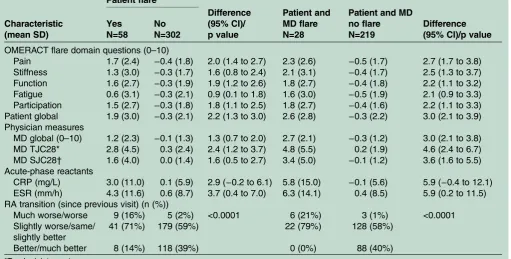
At V2, mean scores for flare questions, other PROs and RA clinical indicators were significantly higher in patients who self-identified as flaring (table 4). Differences between groups were highest when patients and MD rated the patient as flaring. Patients who self-identified as flaring or also were rated by their doctors as flaring were much more likely ( p<0.0001) to rate their RA as worse or much worse since the previous visit.
Consequential validity
[image:4.595.47.564.66.377.2]Similarly, patient flare severity ratings and change in DAS28 scores at V2 were highest when patients and MDs agreed the patient was flaring ( p’s=0.028 and <0.001,
Table 1 Characteristics of participants by flare status
Flare classification
Patient (n=849) MD (n=718) DAS28 (n=515)
Variable mean (SD) or n (%) unless otherwise stated
All (n=849)
Yes (n=201)
No (n=648)
Yes (n=233)
No (n=485)
Yes (n=84)
No (n=431)
Sociodemographic characteristics
Age (years) 54.3 (15.4) 53.7 (14.3) 54.4 (15.7) 54.9 (15.0) 53.6 (15.4) 55.0 (15.5) 54.7 (14.5) Female sex 635 (75%) 149 (74%) 486 (75%) 168 (72%) 365 (75%) 61 (73%) 308 (71%) White 690 (81%) 154 (77%) 536 (83%) 181 (78%) 385 (79%) 69 (82%) 357 (83%) Education≤high school 342 (40%) 95 (47%) 247 (38%) 104 (45%) 172 (35%) 32 (38%) 174 (40%) Currently smoking≤
2 years
140 (17%) 39 (20%) 101 (16%) 37 (16%) 81 (17%) 17 (20%) 60 (14%)
Duration in study (months; median IQR)
18 (15) 18 (15) 18 (15) 12 (18) 18 (12) 21 (12) 18 (15)
RA characteristics
DAS28 3.2 (1.6) 3.7 (1.7) 3.0 (1.5) 3.9 (1.7) 2.7 (1.4) 2.8 (1.2) 3.2 (1.7) Remission 277 (44%) 44 (30%) 233 (49%) 55 (30%) 182 (51%) 40 (48%) 199 (46%)
Low 83 (13%) 14 (10%) 69 (14%) 16 (9%) 59 (17%) 20 (24%) 49 (11%)
Moderate 182 (29%) 57 (39%) 125 (26%) 68 (37%) 91 (26%) 21 (25%) 120 (28%)
High 82 (13%) 30 (21%) 52 (11%) 44 (24%) 23 (6%) 3 (4%) 63 (15%)
MD tender joints (28) 3.2 (5.0) 4.9 (5.8) 2.7 (4.6) 5.4 (6.2) 2.2 (3.9) 2.1 (3.7) 3.7 (5.6) MD swollen joints (28) 2.2 (4.1) 3.2 (4.7) 1.9 (3.9) 4.1 (5.5) 1.2 (2.6) 1.5 (3.6) 2.7 (4.8) ESR (mm/h) 17.2 (17.4) 18.4 (18.1) 16.8 (17.2) 21.0 (20.0) 15.4 (16.1) 19.3 (20.6) 16.7 (16.7) CRP (mg/L) 6.5 (10.5) 8.3 (12.8) 6.0 (9.6) 8.6 (11.8) 5.3 (8.8) 7.7 (11.2) 6.1 (9.0) HAQ (0–3) 0.51 (0.60) 0.75 (0.67) 0.44 (0.55) 0.66 (0.63) 0.42 (0.56) 0.47 (0.59) 0.49 (0.60) MD global (10 cm VAS) 1.9 (2.5) 2.8 (2.9) 1.6 (2.3) 3.2 (2.9) 1.2 (1.9) 1.3 (1.8) 2.0 (2.6) Patient global (10 cm VAS) 3.4 (2.9) 4.6 (3.1) 3.0 (2.8) 4.2 (3.0) 2.9 (2.8) 2.7 (2.7) 3.4 (3.0) Pain (10 cm VAS) 3.2 (2.8) 4.3 (3.0) 2.8 (2.6) 4.0 (2.9) 2.7 (2.7) 2.8 (2.7) 3.2 (2.9) Sociodemographic characteristics are at enrolment; RA characteristics are at first of paired visits. At second visit, 718 patients had a second MD rating of flare and 515 had a DAS28-ESR at both visits; missing DAS28 values are due to missing ESR.
Table 2 Agreement of flare status between patient, MD and DAS28 worsening criteria by disease activity level
Patient Agreement
Flare classification (Visit 2) Flare status Yes No Observed Expected (%) AC1κ
MD flare classification (n=718)
All Yes 98 (58%) 135 (25%) 512 (71%) 59 0.52
No 71 (42%) 414 (75%)
Remission Yes 5 (23%) 39 (16%) 212 (79%) 78 0.73
No 17 (77%) 207 (84%)
Low disease activity Yes 8 (50%) 17 (29%) 49 (66%) 59 0.44
No 8 (50%) 41 (71%)
Moderate disease activity Yes 37 (69%) 40 (45%) 86 (60%) 49 0.21
No 17 (31%) 49 (55%)
High disease activity Yes 23 (79%) 11 (65%) 29 (63%) 56 0.35
No 6 (21%) 6 (35%)
DAS28 criterion flare classification (n=515)
All ≥1.2/0.6 36 (31%) 48 (12%) 388 (75%) 69 0.64
<1.2/0.6 79 (69%) 352 (88%)
Remission ≥1.2/0.6 0 (0%) 1 (0%) 232 (89%) 89 0.88
<1.2/0.6 27 (100%) 232 (100%)
Low disease activity ≥1.2/0.6 2 (13%) 7 (12%) 54 (73%) 72 0.63
<1.2/0.6 13 (87%) 52 (88%)
Moderate disease activity ≥1.2/0.6 21 (40%) 33 (36%) 80 (56%) 53 0.17 <1.2/0.6 31 (60%) 59 (64%)
High disease activity ≥1.2/0.6 13 (62%) 7 (44%) 22 (59%) 51 0.20
<1.2/0.6 8 (38%) 9 (56%) AC, agreement coefficient; DAS, Disease Activity Score.
Table 3 Relationship between items assessing OMERACT RA Flare domains and other measures by flare status*
Patient Physician DAS28†
Domains All Yes No Yes No Yes No
N Source 849 201 648 233 485 84 431
Pain
How much pain due to RA in past week HAQ 0.91 0.89 0.89 0.91 0.90 0.88 0.89
Today’s level of pain today RADAI 0.87 0.86 0.81 0.84 0.84 0.84 0.86
Pain past week – 0.92 0.91 0.88 0.92 0.89 0.93 0.91
Joint area pain severity (0–48) RADAI 0.71 0.55 0.67 0.58 0.70 0.44 0.72 Patient tender joint count (28) Patient 0.62 0.36 0.57 0.48 0.58 0.48 0.61
MD tender joint count (28) MD 0.49 0.29 0.42 0.36 0.42 0.36 0.46
Physical function
Disability score (0–3) HAQ 0.76 0.73 0.68 0.74 0.70 0.74 0.74
Physical function RAND-12 −0.65 −0.62 −0.58 −0.59 −0.64 −0.61 −0.68 Daily activities in past 7 days WPAI 0.77 0.67 0.74 0.75 0.76 0.69 0.77 Fatigue
Vitality (RAND-12) RAND-12 −0.63 −0.58 −0.59 −0.70 −0.59 −0.69 −0.65 Unusual fatigue/tiredness past week – 0.86 0.86 0.83 0.85 0.85 0.84 0.87 Participation
Role—physical RAND-12 −0.71 −0.69 −0.63 −0.67 −0.69 −0.72 −0.72 Social function RAND-12 −0.61 −0.61 −0.54 −0.67 −0.61 −0.72 −0.67
Productivity while working WPAI 0.78 0.73 0.70 0.77 0.73 0.71 0.77
RA affecting daily activities WPAI 0.77 0.70 0.73 0.76 0.78 0.81 0.76
Stiffness
Morning Joint Stiffness Score RADAI 0.69 0.51 0.66 0.57 0.67 0.58 0.69
*Spearman correlation coefficients for second visit.
†DAS28 scores <3.2 at second visit required an increase of 1.2 units whereas DAS≥3.2 at second visit required increase of 0.6 units to classify flare.
[image:5.595.50.551.407.683.2]respectively; see table 5). RA treatment had been reduced or stopped in 36% (10/28), and 61% of rheu-matologists reported an intention to increase treatment in response toflare.
DISCUSSION
This is thefirst study to evaluate the reliability of concur-rent flare identification in RA using three methods: patient reports, physician ratings and DAS28 criteria used in recent reduction/withdrawal trials. Agreement about flares using the three methods ( patient, MD and DAS) was highest for patients initially in remission and LDA. Our data are also the first to show the construct validity of the five candidate OMERACT RA flare domains ( pain, fatigue, stiffness, function and participa-tion). These data support additional evaluation of our patient-centered tool in treatment studies to establish numerical criteria forflare for use in trial and practice.
Agreement about flares varied and was influenced by disease activity level at the initial visit. Others have also reported that the patient and physician do not always agree about RA status, including flares.3 29–31 We found that agreement was highest between physician-based measures, either by MD report or DAS worsening, and patients, when disease activity had been in good control at the preceding visit. Conversely, agreement regarding flares was lowest between rheumatologists and DAS28 criteria when patients had previously been in moderate–
high disease activity levels. This may, in part, reflect greater uncertainty in identifying worsening of disease when disease activity is already high. Also, in our study, the mean worsening in DAS28 of flaring patients was nearly two points higher, which is considerably greater than DAS criteria. It is not surprising that the least reli-able method of identifying flare was the DAS criteria definition (identifying flare as ‘worsening’ of DAS28 that exceeded measurements error (0.6 units) or twice its value).32 This definition has been used in only a few studies that evaluated RA flares in the context of taper-ing or withdrawtaper-ing trials.8
[image:6.595.44.556.73.332.2]Our results support the construct, discriminant and consequential validity of the five candidate items captur-ing the OMERACT RA Flare Domain Core Set. Flare domain questions correlated highly with PROs measur-ing similar constructs that are widely used in RA trials and were able to discriminate between patients with/ without flare using three definitions. In people who were flaring at the second visit (but not the first), indi-vidual flare question scores were significantly higher, and similar increases were observed in other PROs as well as clinical indicators of RA disease activity. In con-trast, there was little change in scores of non-flaring patients over these visits. Finally, inflaring patients, 61% of rheumatologists indicated they intended to intensify treatment indicating evidence of the consequential valid-ity of flare identification and consistent with sufficient clinical worsening to justify escalation in therapy.
Table 4 Change in flare question scores and other RA indicators in patients previously in remission/low disease activity
Patient flare*
Characteristic (mean SD)
Yes N=58
No N=302
Difference (95% CI)/ p value
Patient and MD flare N=28
Patient and MD no flare N=219
Difference (95% CI)/p value
OMERACT flare domain questions (0–10)
Pain 1.7 (2.4) −0.4 (1.8) 2.0 (1.4 to 2.7) 2.3 (2.6) −0.5 (1.7) 2.7 (1.7 to 3.8) Stiffness 1.3 (3.0) −0.3 (1.7) 1.6 (0.8 to 2.4) 2.1 (3.1) −0.4 (1.7) 2.5 (1.3 to 3.7) Function 1.6 (2.7) −0.3 (1.9) 1.9 (1.2 to 2.6) 1.8 (2.7) −0.4 (1.8) 2.2 (1.1 to 3.2) Fatigue 0.6 (3.1) −0.3 (2.1) 0.9 (0.1 to 1.8) 1.6 (3.0) −0.5 (1.9) 2.1 (0.9 to 3.3) Participation 1.5 (2.7) −0.3 (1.8) 1.8 (1.1 to 2.5) 1.8 (2.7) −0.4 (1.6) 2.2 (1.1 to 3.3) Patient global 1.9 (3.0) −0.3 (2.1) 2.2 (1.3 to 3.0) 2.6 (2.8) −0.3 (2.2) 3.0 (2.1 to 3.9) Physician measures
MD global (0–10) 1.2 (2.3) −0.1 (1.3) 1.3 (0.7 to 2.0) 2.7 (2.1) −0.3 (1.2) 3.0 (2.1 to 3.8) MD TJC28* 2.8 (4.5) 0.3 (2.4) 2.4 (1.2 to 3.7) 4.8 (5.5) 0.2 (1.9) 4.6 (2.4 to 6.7) MD SJC28† 1.6 (4.0) 0.0 (1.4) 1.6 (0.5 to 2.7) 3.4 (5.0) −0.1 (1.2) 3.6 (1.6 to 5.5) Acute-phase reactants
CRP (mg/L) 3.0 (11.0) 0.1 (5.9) 2.9 (−0.2 to 6.1) 5.8 (15.0) −0.1 (5.6) 5.9 (−0.4 to 12.1) ESR (mm/h) 4.3 (11.6) 0.6 (8.7) 3.7 (0.4 to 7.0) 6.3 (14.1) 0.4 (8.5) 5.9 (0.2 to 11.5) RA transition (since previous visit) (n (%))
Much worse/worse 9 (16%) 5 (2%) <0.0001 6 (21%) 3 (1%) <0.0001 Slightly worse/same/
slightly better
41 (71%) 179 (59%) 22 (79%) 128 (58%)
Better/much better 8 (14%) 118 (39%) 0 (0%) 88 (40%)
*Tender joint count. †Swollen joint count.
The five RA flare items represent patient-reported core domains identified by patients and providers as essential to measure for RA flare beyond the patient global assessment of disease activity.10 The high rates of agreement identifyingflares between patients and physi-cians are not unexpected. The flare questions were developed to reflect the usual interchange of informa-tion between patients and physicians when discussing disease worsening. Concordance was lowest between patients and DAS-rated and MD-rated flare status when patients were in moderate or high disease activity at the first visit. One reason for this may be that the DAS cri-teria do not directly incorporate any of the specific domains identified by patients and providers as essential to measuring RA flare, with the exception of patient global. While we found that patient global scores were highly correlated with the five RA Flare domain scores, it is unclear whether patient global alone can be used to identifyflares related to inflammation. Notably, only two of thefive domains, pain and physical function, are cap-tured in the ACR RA core set, and core set measures make up standard composite measures of disease activity derived to measure improvement. RA composite mea-sures alone may not be sensitive or specific to infl amma-tory flare, underscoring the need for a tool that can reliably identify and quantify RAflares.
Our results showed that agreement about flare status was high between patients and providers; also, the
largest increases in flare domain scores and DAS28 occurred in flaring patients when there was patient/MD concordance if the patient was flaring. Better under-standing of the factors related to discordance in flare reports between the patient and doctor assessments warrant additional study. In the interim, however, an important finding of our work for clinicians is recogni-tion that patients can reliably identify significant increases in inflammatory activity, and that most of the time clinicians agree with patients when patients state they are in aflare. This is especially true in patients that had been in remission or LDA at a previous visit.
[image:7.595.44.556.77.345.2]While doctors and patients may not always agree on flare status, agreement between both increases confi -dence that RA flares, which truly reflect worsening inflammation, can be reliably detected. A means to reli-ably identify and precisely quantify inflammatory flares in RA is needed for clinical trials where drug therapy is reduced or withdrawn as well as comparative effective-ness trials. In this large observational ‘real-world’ trial, rheumatologists classified 32% of patients asflaring, and treatment had been reduced/stopped at the prior visit in 36% of patients confirming that therapeutic change is an important antecedent to flare in many patients. As evidence grows that tight control is essential to improve long-term outcomes,33early identification and treatment of flares seem essential to improve long-term outcomes. The ability to quickly and easily identify flares
Table 5 Flare characteristics as classified by patients, MD and patient–MD concordant reports in patients with RA who were previously in remission/low disease activity (n=360)
Characteristics (mean (SD) or n (%))
Patient N=58 (16%)
MD
N=71 (20%)
Patient and MD N=28 (8%)
Patient flare severity (0–10) 4.4 (2.1) 4.5 (2.6) 5.0 (2.3)
Duration (days)
1–3 12 (21%) 5 (18%) 5 (18%)
4–7 6 (10%) 4 (14%) 4 (14%)
8–14 12 (21%) 6 (21%) 6 (21%)
>14 28 (48%) 13 (46%) 13 (46%)
Change in DAS28
DAS28 at time of flare 3.2 (1.4) 3.0 (1.4) 3.9 (1.4)
DAS28 at previous visit 2.1 (0.7) 2.1 (0.6) 2.1 (0.7)
Worsening of DAS28 1.1 (1.4) 0.9 (1.3) 1.8 (1.2)
Change in DMARD# and/or oral steroids use from previous visit
Reduced (dose or frequency) 22 (38%) 29 (41%) 9 (32%)
Stopped (without escalating or adding another therapy) 19 (33%) 28 (39%) 7 (25%)
Reduced and/or stopped 24 (41%) 34 (48%) 10 (36%)
MD intent to increase treatment* 25 (45%) 37 (53%) 17 (61%)
Proposed treatment change*
Non-methotrexate DMARDS added 9 (16%) 10 (14%) 7 (25%)
Methotrexate added or increased† 2 (6%) 3 (7%) 1 (7%)
Biologics added/switched (not due to side effect) 2 (3%) 3 (4%) 2 (7%) Steroids added (PO/IM or IA; not used in prior visit) 7 (12%) 7 (10%) 4 (14%)
NSAIDs added (not used in the prior visit) 3 (5%) 3 (4%) 2 (7%)
DMARDs could include biologic and synthetic DMARDs. *Reported increase in treatment at second or subsequent visit. †Dose increased or changed from oral to subcutaneous.
incorporating the patient perspective offlare could also facilitate more patient-centred care through the rapid identification of patients potentially requiring escalation of therapy between scheduled visits. Early flare identifi -cation enabled by patient report may also help patients know when to initiate additional self-management strategies.
Strengths of this study include the prospective collec-tion of flare data in the context of a national observa-tional study of early RA where many clinical and PROs were systematically collected in a standardised manner. Our sample included patients with all levels of disease activity. Foundational work closely followed OMERACT methods for developing new measurement tools and
COSMIN criteria to ensure high methodological
quality.16 34–36However, there are limitations. We did not a priori provide guidance or a definition of flare for patients and physicians, and the threshold identified by ROC curves to optimise discrimination of flare was low. Providing a standardised definition and querying physi-cians directly (yes/no) about flare status may increase agreement. Nevertheless, for patients initially under good control, agreement regardingflares was strong.
PRO measures are evolving, especially for fatigue, stiff-ness and participation.37 The ability to differentiate patients who are flaring or not was at the group level; additional work is needed to identify whether the ques-tions can be used to reliably identify individuals who are flaring. Worsening assessed by patients and providers was at a single point in time; we did not specifically ask if judgements were made in relation to a previous time period (eg, 3 months), an approach being used by others.3 DAS28 criteria reflect changes from the previ-ous visit, either 3 or 6 months prior. We have no infor-mation about symptoms, function, self-management (eg, transient use of glucocorticoids or non-steroidal anti-inflammatory drugs), and limited information on poten-tial treatment changes between visits.
These initial results support the usefulness of the OMERACT RA flare questions for identifying flare. Additional evaluation is needed before they can be recommended for widespread use. Work is ongoing by our group to develop a scoring system for the OMERACT flare questions and to evaluate unidimen-sionality, responsiveness, and to identify clear thresholds that reflect worsening of RA inflammation signalling a potential need to intensify treatment. Flare data are being collected in international observational studies and randomised controlled trials (RCTs) of early and established RA to help establish criteria for symptom intensity and duration necessary to define inflammatory flare, and to develop thresholds for existing disease activ-ity measures. Identifying and understanding the role of self-management strategies and other contextual factors also need to be considered.13Further exploration of dis-cordance between doctors and patients regarding RA flares and evaluation of patient and MD joint counts is also ongoing.
In conclusion, in routine rheumatology care settings, flares in RA representing clinically important worsening of inflammation are common and are often preceded by treatment reductions. Agreement about flare status among patients, treating rheumatologists, and using DAS28 criteria is high, especially for patients previously in remission or LDA. The five questions that represent the OMERACT RA Flare Core Domain Set, where patients are asked to rate their pain, fatigue, stiffness, function and participation have strong evidence of content validity, known groups and consequential valid-ity. Additional work is also ongoing to develop a scoring system and identify the thresholds of change and flare severity that can be used by clinicians and researchers in order to reliably identify flares using the OMERACT RA flare questions.
Author affiliations
1Department of Rheumatology, Hospital for Special Surgery, Weill Cornell Medical College, New York, New York, USA
2Rebecca McDonald Center for Arthritis & Autoimmune Disease, Mount Sinai Hospital, University of Toronto, Toronto, Ontario, Canada
3Division of Rheumatology, Johns Hopkins School of Medicine, Baltimore, Maryland, USA
4Section of Rheumatology, Arthritis Research UK & Health and Care Research Wales CREATE Centre, Cardiff University, Cardiff, UK
5Schlosspark Klinik, Charité University Medicine, Berlin, Germany 6Musculoskeletal Statistics Unit, Department of Rheumatology, The Parker Institute, Copenhagen University Hospital, Bispebjerg and Frederiksberg, Denmark
7Division of Rheumatology, University of California, Los Angeles, Los Angeles, California, USA (Emeritus)
8University of Washington, Seattle Wash; University of Florence, Florence, Italy 9University of the West of England, Bristol, UK
10Bone and Joint Decade, Healthy Motivation, Santa Barbara, California, USA 11Department of Rheumatology, University of Sydney, Institute of Bone and Joint Research, Royal North Shore Hospital, St Leonards, New South Wales, Australia
12Division of Rheumatology, University of California, Los Angeles, Los Angeles, California, USA
13Division of Rheumatology, Université de Sherbrooke, Sherbrooke, Québec, Canada
14Rheumatic Disease Unit, Institut de Rheumatologie, Montreal, Québec, Canada
15Arthritis Center, University of Manitoba, Winnipeg, Manitoba, Canada 16Vancouver Coastal Health Institute, Vancouver, British Columbia, Canada 17Division of Rheumatology, St. Joseph’s Health Care London, University of Western Ontario, London, Ontario, Canada
18Southlake Regional Health Centre, Newmarket, Ontario, Canada
19Divisions of Clinical Epidemiology, Rheumatology, and Respiratory Clinical Trials Unit, McGill University, Montreal, Québec, Canada
Alice Klinkhoff, University of British Columbia, Vancouver, Canada. They also thank Franci Sniderman for management of the CATCH project and Jim Wang, of McDougall Scientific for statistical support.
Collaborators OMERACT Flare Group: Annelies Boonen, Alfons den Broeder, Bruno Fautrel, Francis Guillemin, Anne Lyddiatt, James E. May, Pam Montie, Ana-Maria Orbai, Christoph Pohl and Marieke Scholte Voshaar. 20CATCH investigators: Vandana Ahluwalia, Pooneh Akhavan, Murray Baron, William Bensen, Louis Bessette, Gilles Boire, Vivian Bykerk, Ines Colmegna, Boulos Haraoui, Carol Hitchon, Shahin Jamal, Edward Keystone, Alice Kinkhoff, Majed Kraishi, Maggie Larche, Chris Lyddell, Bindu Nair, Chris Penney, Janet Pope, Laurence Rubin, Carter Thorne and Michel Zummer.
Contributors VPB, SJB and COB were involved in the conception, design, acquisition, analysis, interpretation, drafting and revisions of the manuscript. DL was responsible for the analysis, interpretation, drafting and revisions of the manuscript. EHC and LM were involved in the study conception, design, interpretation, drafting and revisions of the manuscript. RA, RC, DEF, SH, AL, LM, TW and KV were responsible for the conception, design, interpretation and revisions of the manuscript. VB, JP, GB, CH, SJ, DT, JCT and ECK participated in the conception, acquisition, interpretation and revisions of the manuscript. All authors reviewed and approved the final manuscript. Competing interests OMERACT is an international rheumatology outcomes methodology group that has received hands-off funding from more than 23 pharmaceutical and clinical research companies over the last 2 years. COB and LM are members of the OMERACT Executive Committee but receive no financial remuneration for their service in this role. We thank UCB, Inc. for providing funding to support translation of the PFQ into 13 languages (Spanish, German, Dutch, French, Portuguese, Danish, Hungarian, Italian, Polish, Romanian, Swedish, Catalan and Russian), including linguistic adaptations for individual countries (eg, French included versions France and Canada) using validated methods for use in an international RA clinical trial. Additional unrestricted funding for the OMERACT RA Flare Group was provided by Pfizer (Germany), Novartis and Actelion. The CATCH study was designed and implemented by the investigators and financially supported initially by Amgen Canada Inc. and Pfizer Canada Inc. via an unrestricted research grant since the inception of CATCH. As of 2011, further support was provided by Hoffmann-LaRoche Ltd., UCB Canada Inc., Bristol-Myers Squibb Canada Co., AbbVie Corporation (formerly Abbott Laboratories Ltd.), Medexus Inc. and Janssen Biotech Inc. (a wholly owned subsidiary of Johnson & Johnson Inc.). COB and SJB were supported in part by a Patient-Centered Outcomes Research Institute (PCORI) Pilot Project Award (1IP2-PI000737-01) and a PCORI Improving Methods for Conducting PCOR Award
(SC14-1402-10818). All statements in this report, including its findings and conclusions, are solely those of the authors and do not necessarily represent the views of PCORI, its Board of Governors or Methodology Committee. VPB is supported by the Cedar Hill Foundation, New York, NY and by NIH grant (1UH2AR067691). RC/The Parker Institute is supported by grants from the Oak Foundation.
Ethics approval Central Ethics Committee at each institution where study was performed.
Provenance and peer review Not commissioned; externally peer reviewed. Data sharing statement No additional data are available.
Open Access This is an Open Access article distributed in accordance with the Creative Commons Attribution Non Commercial (CC BY-NC 4.0) license, which permits others to distribute, remix, adapt, build upon this work non-commercially, and license their derivative works on different terms, provided the original work is properly cited and the use is non-commercial. See: http:// creativecommons.org/licenses/by-nc/4.0/
REFERENCES
1. Hewlett S, Sanderson T, May J,et al.‘I’m hurting, I want to kill myself’: rheumatoid arthritis flare is more than a high joint count--an international patient perspective on flare where medical help is sought.Rheumatology (Oxford)2012;51:69–76.
2. Flurey CA, Morris M, Richards P,et al. It’s like a juggling act: rheumatoid arthritis patient perspectives on daily life and flare while
on current treatment regimes.Rheumatology (Oxford) 2014;53:696–703.
3. Berthelot JM, De Bandt M, Morel J,et al. A tool to identify recent or present rheumatoid arthritis flare from both patient and physician perspectives: the‘FLARE’instrument.Ann Rheum Dis 2012;71:1110–16.
4. Bingham CO III, Alten R, Bartlett SJ,et al. Identifying preliminary domains to detect and measure rheumatoid arthritis flares: report of the OMERACT 10 RA Flare Workshop.J Rheumatol
2011;38:1751–8.
5. Bingham CO III, Pohl C, Woodworth TG,et al. Developing a standardized definition for disease“flare”in rheumatoid arthritis (OMERACT 9 Special Interest Group).J Rheumatol
2009;36:2335–41.
6. Myasoedova E, Chandran A, Ilhan B,et al. The role of rheumatoid arthritis (RA) flare and cumulative burden of RA severity in the risk of cardiovascular disease.Ann Rheum Dis2016;75:560–5.
7. Alten R, Pohl C, Choy EH,et al. Developing a construct to evaluate flares in rheumatoid arthritis: a conceptual report of the OMERACT RA Flare Definition Working Group.J Rheumatol2011;38:1745–50. 8. van der Maas A, Lie E, Christensen R,et al. Construct and criterion validity of several proposed DAS28-based rheumatoid arthritis flare criteria: an OMERACT cohort validation study.Ann Rheum Dis 2013;72:1800–5.
9. Lie E, Woodworth TG, Christensen R,et al. Validation of OMERACT preliminary rheumatoid arthritis flare domains in the NOR-DMARD study.Annals of the rheumatic diseases2013;73:1781–7. 10. Bartlett SJ, Hewlett S, Bingham CO III,et al. Identifying core
domains to assess flare in rheumatoid arthritis: an OMERACT international patient and provider combined Delphi consensus.Ann Rheum Dis2012;71:1855–60.
11. Bykerk VP, Lie E, Bartlett SJ,et al. Establishing a core domain set to measure rheumatoid arthritis flares: report of the OMERACT 11 RA flare Workshop.J Rheumatol2014;41:799–809.
12. Felson DT. Choosing a core set of disease activity measures for rheumatoid arthritis clinical trials.J Rheumatol1993;20:531–4. 13. Boers M, Kirwan JR, Wells G,et al. Developing core outcome
measurement sets for clinical trials: OMERACT Filter 2.0.J Clin Epidemiol2014;67:745–53.
14. Gossec L, Paternotte S, Aanerud GJ,et al. Finalisation and validation of the rheumatoid arthritis impact of disease score, a patient-derived composite measure of impact of rheumatoid arthritis: a EULAR initiative.Ann Rheum Dis2011;70:935–42.
15. Escorpizo R, Boers M, Stucki G,et al. Examining the similarities and differences of OMERACT core sets using the ICF: first step towards an improved domain specification and development of an item pool to measure functioning and health.J Rheumatol2011;38:1739–44. 16. Boers M, Idzerda L, Kirwan JR,et al. Toward a generalized
framework of core measurement areas in clinical trials: a position paper for OMERACT 11.J Rheumatol2014;41:978–85. 17. Bykerk VP, Jamal S, Boire G,et al. The Canadian Early Arthritis
Cohort (CATCH): patients with new-onset synovitis meeting the 2010 ACR/EULAR classification criteria but not the 1987 ACR classification criteria present with less severe disease activity.J Rheumatol2012;39:2071–80.
18. Bykerk VP, Akhavan P, Hazlewood GS,et al. Canadian Rheumatology Association recommendations for pharmacological management of rheumatoid arthritis with traditional and biologic disease-modifying antirheumatic drugs.J Rheumatol
2012;39:1559–82.
19. Bombardier C, Hazlewood GS, Akhavan P,et al. Canadian Rheumatology Association recommendations for the
pharmacological management of rheumatoid arthritis with traditional and biologic disease-modifying antirheumatic drugs: part II safety.J Rheumatol2012;39:1583–602.
20. Choy EH, Khoshaba B, Cooper D,et al. Development and validation of a patient-based disease activity score in rheumatoid arthritis that can be used in clinical trials and routine practice.Arthritis Rheum 2008;59:192–9.
21. Selim AJ, Rogers W, Fleishman JA,et al. Updated U.S. population standard for the Veterans RAND 12-item Health Survey (VR-12). Qual Life Res2009;18:43–52.
22. Fransen J, Langenegger T, Michel BA,et al. Feasibility and validity of the RADAI, a self-administered Rheumatoid Arthritis Disease Activity Index.Rheumatology (Oxford)2000;39:321–7. 23. Zhang W, Bansback N, Boonen A,et al. Validity of the work
productivity and activity impairment questionnaire--general health version in patients with rheumatoid arthritis.Arthritis Res Ther 2010;12:R177.
25. den Broeder AA, van Herwaarden N, van der Maas A,et al. Dose REduction strategy of subcutaneous TNF inhibitors in rheumatoid arthritis: design of a pragmatic randomised non inferiority trial, the DRESS study.BMC Musculoskelet Disord2013;14:299. 26. van der Maas A, Kievit W, van den Bemt BJ,et al. Down-titration
and discontinuation of infliximab in rheumatoid arthritis patients with stable low disease activity and stable treatment: an observational cohort study.Ann Rheum Dis2012;71:1849–54.
27. Gwet KL. Computing inter-rater reliability and its variance in the presence of high agreement.Br J Math Stat Psychol2008;61(Pt 1):29–48.
28. Cohen J, Cohen P.Applied multiple regression/correlation analysis for the behavioral sciences. Hillsdale, NJ: Lawrence Erlbaum Associates, 1983.
29. Nicolau G, Yogui MM, Vallochi TL,et al. Sources of discrepancy in patient and physician global assessments of rheumatoid arthritis disease activity.J Rheumatol2004;31:1293–6.
30. Barton JL, Imboden J, Graf J,et al. Patient-physician discordance in assessments of global disease severity in rheumatoid arthritis. Arthritis Care Res (Hoboken)2010;62:857–64.
31. Hirsh JM, Boyle DJ, Collier DH,et al. Health literacy predicts the discrepancy between patient and provider global assessments of rheumatoid arthritis activity at a public urban rheumatology clinic. J Rheumatol2010;37:961–6.
32. Den Broeder AA, Creemers MC, van Gestel AM,et al. Dose titration using the Disease Activity Score (DAS28) in rheumatoid arthritis patients treated with anti-TNF-alpha.Rheumatology (Oxford) 2002;41:638–42.
33. Smolen JS, Breedveld FC, Burmester GR,et al. Treating rheumatoid arthritis to target: 2014 update of the recommendations of an international task force.Ann Rheum Dis
2016;75:3–15.
34. Kirwan JR, Bartlett SJ, Beaton DE,et al. Updating the OMERACT Filter: implications for patient-reported outcomes.J Rheumatol 2014;41:1011–15.
35. Mokkink LB, Terwee CB, Patrick DL,et al. The COSMIN study reached international consensus on taxonomy, terminology, and definitions of measurement properties for
health-related patient-reported outcomes.J Clin Epidemiol 2010;63:737–45.
36. Mokkink LB, Terwee CB, Knol DL,et al. Protocol of the COSMIN study: COnsensus-based Standards for the selection of health Measurement INstruments.BMC Med Res Methodol 2006;6:2.
OMERACT RA Flare Core Domain Set
reliability and construct validation of the
Identifying flares in rheumatoid arthritis:
Carter Thorne and Susan J Bartlett
Hitchon, Shahin Jamal, Edward C Keystone, Janet Pope, Diane Tin, J Lyn March, Thasia Woodworth, Gilles Boire, Boulos Haraoui, Carol Alten, Robin Christensen, Daniel E Furst, Sarah Hewlett, Amye Leong, Vivian P Bykerk, Clifton O Bingham, Ernest H Choy, Daming Lin, Rieke
doi: 10.1136/rmdopen-2015-000225
2016 2:RMD Open
http://rmdopen.bmj.com/content/2/1/e000225
Updated information and services can be found at:
These include:
References
#BIBL
http://rmdopen.bmj.com/content/2/1/e000225
This article cites 36 articles, 23 of which you can access for free at:
Open Access
http://creativecommons.org/licenses/by-nc/4.0/ non-commercial. See:
provided the original work is properly cited and the use is
non-commercially, and license their derivative works on different terms, permits others to distribute, remix, adapt, build upon this work
Commons Attribution Non Commercial (CC BY-NC 4.0) license, which This is an Open Access article distributed in accordance with the Creative
service
Email alerting
box at the top right corner of the online article.
Receive free email alerts when new articles cite this article. Sign up in the
Notes
http://group.bmj.com/group/rights-licensing/permissions
To request permissions go to:
http://journals.bmj.com/cgi/reprintform
To order reprints go to:
http://group.bmj.com/subscribe/