Soil quality represents an integral value of com-positional structures and functions of terrestrial soils in relation to their different use and to long-term environmental conditions on site (Filip 2001). This author stressed in his review paper follow-ing ecologically important soil characteristics: microbial biomass, composition of microflora, mineralization and synthesising processes. Some other authors (Dušek et al. 1997, Škoda et al. 1997, Růžek et al. 2001, 2003, 2004, 2005) preferred pre-cise descriptions using biological characteristics like respiration, ammonification, nitrification, enzyme activities and microbial biomass carbon determination.
Many methods determining both quantity of microorganisms and their activity can be used for the characterisation of soil biological quality.
Voříšek et al. (2002) used three or eight parameters (microbial biomass carbon [MBC]; ratio MBC/
Corg; ratio EC/MBC; potential respiration with
glucose; potential ammonification with peptone; potential nitrification with ammonium sulphate and two model predicted values) for the study of the influence of grassing and harvest manage-ment. Zaman et al. (2002) used three parameters (MBC, microbial biomass N and extracellular enzyme activities) in different soil depths. Růžek et al. (2004) evaluated Cambisols (Inceptisols) and Luvisols (Alfisols) by six biological criteria (MBC
and five ratios: MBC/Corg; EC/MBC; potential/
basal respiration; potential/control ammonifica-tion; potential/control nitrification). Števlíková et al. (2003) evaluated two land managements
on stagno-gleic Luvisol using MBC, MBC/Corg,
Microbiological parameters of soil set aside
before and after desiccation
M. Nováková, K. Voříšek
Czech University of Agriculture in Prague, Czech Republic
ABSTRACT
Herbaceous cover of luvic chernozem (seven years set aside) with legumes, perennial grasses and their mixture was desiccated by the glyphosate herbicide Roundup Biaktiv (5 l/ha at July 2003 and 4 l/ha at June 2004). 165 soil samples were collected before (November 2002–July 2003) and after desiccation (September 2003–August 2004). Desiccation had a strong positive effect on immobilization of organic carbon from herbaceous cover and under-ground biomass to microbial biomass carbon (MBC) and to soil organic carbon (Corg), respectively. A significant increase after desiccation (P < 0.01) was confirmed in the parameters: Corg, MBC and in the ratio MBC/Corg. At the same time the desiccation had a retardation effect on mineralization of Corg, Norg and Sorg. A significant decrease after desiccation (P < 0.01) was confirmed in the basal and potential respiration (with nitrogen, with nitrogen and glucose), actual content of N-NH4+ without and with pre-incubation, control ammonification, and (P < 0.05) in
aryl-sulphatase activity. The actual content of NO3– and the control nitrification increased significantly (P < 0.01) after
desiccation. Plots management before desiccation included black and spontaneous fallow, mulching (one or two per year) and cutting (three times per year), plots with 4 legumes, 4 grasses and their mixtures. Mulching variants showed the best results both before and after desiccation. The soils with cutting treatment ranked 8th–10th out of
11 studied combinations.
Keywords: land set aside;fallow; desiccation; Roundup Biaktiv; microbial biomass; K2SO4 extractable carbon; bio-logical activity; respiration; nitrification; ammonification; arylsulphatase
biologically releasable nitrogen [CA+CN] and intensity of nitrification [CN] after and before
incubation. Wojewoda and Russel (2003)tested
the impact of shelterbelts on soil properties and microbial activity through five criteria: MBC, BR,
MBC/Corg, dehydrogenase activity, PA/CA.
The desiccation can play a very important role in changes of soil biological criteria. This treatment was studied for example by Nowak et al. (2000) in laboratory experiment where the influence of different dosages of herbicides on the activity of phosphatase and dehydrogenase in soil was determined. Reinecke et al. (2002) studied the impact of different herbicides on biological ac-tivity in several vineyard soils with and without cover crops in the Western Cape, South Africa. A comparison of microbial activity after the treat-ment with paraquat, simazine, glyphosate and glyphosate-terbutylazine mixture showed (with the exception of simazine) that the herbicide ap-plication had a positive influence.
The fallow is also a freqent subject of discus-sion; some authors treatise biological activities on such soils. The objective of the study of Okito et al. (2004) was to quantify the contribution of biological nitrogen fixation to groundnut (Arachis hypogaea) and velvet bean (Mucuna pruriens) crops using the N-15 natural abundance tech-nique and to determine their residual effect and the effect of a natural fallow on the growth and N accumulation of two rustic maize varieties. Šantrůček et al. (2002) tested the composition of botanical species and agro-botanical groups (grasses, legumes, other dicotyledonous) from the third to the sixth year of vegetation on spontane-ous fallow and manipulated fallows with 4 pure cultures of legumes, 4 pure cultures of grasses and their mixtures. The stands were cut one or three times per year or mulched ones or twice a year. The variants that were cut once a year had a significantly better plant cover.
The main aim of this study was to determine a variability of important microbiological criteria before and after desiccation by the glyphosate herbicide Roundup Bioactive.
MATERIAL AND METHODS
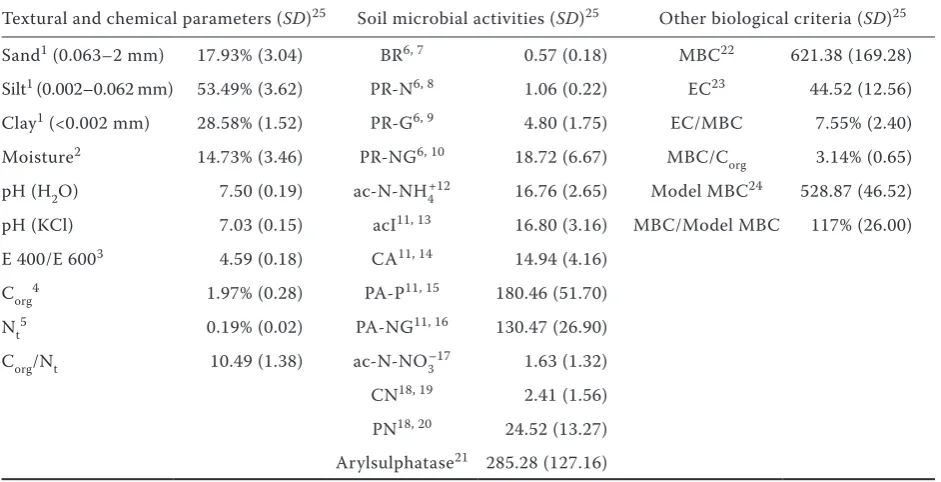
The experimental field (luvic chernozem, altitude 281 m, average precipitation 472 mm per year, aver-age yearly temperature 9.3°C) is situated in Prague University campus area. Basic characteristics are presented in Table 1. Experimental field, formerly
used in arable system with usual crop rotation (change in 1996), was divided into experimental plots (10 × 3 m) and was sown with 4 legumes (Trifolium repens L., Medicago lupulina L., Lotus corniculatus L., Medicago media Pers.), 4 grasses (Bromus cathar-ticus Vahl, Arrhenatherum elatius (L.) Presl, Festuca pratensis Huds, Dactylis aschersoniana Graebn.) and with their mixtures. One part was cut three times a year with plant biomass removing and the second part was mulched one or two times a year (Table 5). Soil samples were collected during the years 2002–2004 at eleven sampling sites. In July 2003 and in June 2004 plots were desiccated by the glyphosate herbicide Roundup Biaktiv (5 and 4 l/hectare, re-spectively) and in August 2004 the plots were sown by ryegrass (Lolium multiflorum L.). Sampling was done before desiccation [BD] at November 2002, March 2003, April 2003, May 2003, June 2003 and July 2003 and after desiccation [D] at September 2003, October 2003, November 2003, April 2004 and August 2004.
Soil samples were taken from the profile (0 to
200 mm) using the sampler Eijkelkamp, they were
transported in the cooling box (temperature 6 to 12°C), adjusted, sieved (mesh 2 mm) and stored in the refrigerator (4–6°C). 24 hours before analy-ses the samples were pre-incubated at the room
temperature (22 ±2°C).
The list of tests used for soil samples characteri-sation and microbial activity determination: – texture: sand, silt, clay content (ISO 112 77) was
determined by pipette method
– pH (H2O), pH (0.2 mol/l KCl), 25 ml of reagent and 10 g of air-dried soil sample were shaken (15 minutes) and pH was determined after (over night) sedimentation
– total nitrogen (Nt) – Kjeldahl method
– organic carbon (Corg) – modified colorimetric
determination in 600 nm (Sims and Haby 1971, Růžek et al. 2005)
– microbial biomass carbon (MBC) – re-hydration technique (RHD) with colorimetric determina-tion in 590 nm (Blagodatskiy et al. 1987).
– K2SO4 extractable carbon (EC) – extraction
with 0.5 mol/l K2SO4 (Vance et al. 1987, Růžek et al. 2005).
– respiration: basal (BR), potential with glucose (PR-G), potential with (NH4)2SO4 (PR-N), po-tential with glucose and (NH4)2SO4 (PR-NG)
– interpherometric CO2 detection (Novák and
Apfelthaler 1964).
– actual content of N-NH4+ (ac N-NH
4+)
– actual content of N-NH4+ with 8 days
– control ammonification with 3 ml distilled wa-ter (CA)
– potential ammonification with 3 ml (33%) pep-tone (PA-P)
– potential ammonification with 3 ml 50% glucose solution) and 9.4% (NH4)2SO4 solution) in ratio 1:1 (PA-NG) (Pokorná-Kozová et al. 1964) – actual content of N-NO3– (ac-N-NO
3–) (Löbl and Novák 1964)
– control nitrification with distilled water (CN), 8 days incubation
– potential nitrification (PN) with (NH4)2SO4, 8 days incubation (Löbl and Novák 1964) – arylsulphatase activity (three repetition and
control): 1 g fresh soil was incubated with 4 ml
acetate buffer and with 1 ml p
-nitrophenylsul-phate for 1 hour in 37°C (control without 1 ml
p-nitrophenylsulphate); before filtration 1 ml
p-nitrophenylsulphate was added to the control
and 25 ml distilled water were added to both vari-ants; 6 ml filtrate were taken and mixtured with 4 ml 0.5 mol/l NaOH; colorimetric determination in 420 nm (Tabatabai and Bremner 1970)
Following ratios were calculated:
– (MBC/Corg) × 100
– (EC/MBC) × 100
Results (110 soil samples before and 55 soil sam-ples after desiccation) were statistically evaluated using analyses of variance (multiple range tests)
including Fisher LSD method.
RESULTS AND DISCUSSION
Basic soil characteristics are presented in Table 1.
Effect of desiccation on soil organic carbon pool – Corg, MBC, EC (Tables 2 and 3)
Soil organic carbon (Corg): Chernozems are characterised by1.41% of Corg, in our experiment (Table 1) the average of all tested plots is higher (1.97%, SD 0.28). This result was influenced espe-cially with high Corg level after desiccation (2.11%,
[image:3.595.63.534.80.321.2]SD 0.28) whereas before desiccation the average
Table 1. Basic soil parameters (grassed luvic chernozem)
Textural and chemical parameters (SD)25 Soil microbial activities (SD)25 Other biological criteria (SD)25 Sand1 (0.063–2 mm) 17.93% (3.04) BR6, 7 0.57 (0.18) MBC22 621.38 (169.28) Silt1 (0.002–0.062 mm) 53.49% (3.62) PR-N6, 8 1.06 (0.22) EC23 44.52 (12.56) Clay1 (<0.002 mm) 28.58% (1.52) PR-G6, 9 4.80 (1.75) EC/MBC 7.55% (2.40) Moisture2 14.73% (3.46) PR-NG6, 10 18.72 (6.67) MBC/C
org 3.14% (0.65) pH (H2O) 7.50 (0.19) ac-N-NH4+12 16.76 (2.65) Model MBC24 528.87 (46.52) pH (KCl) 7.03 (0.15) acI11, 13 16.80 (3.16) MBC/Model MBC 117% (26.00) E 400/E 6003 4.59 (0.18) CA11, 14 14.94 (4.16)
Corg4 1.97% (0.28) PA-P11, 15 180.46 (51.70) Nt5 0.19% (0.02) PA-NG11, 16 130.47 (26.90) Corg/Nt 10.49 (1.38) ac-N-NO3–17 1.63 (1.32) CN18, 19 2.41 (1.56) PN18, 20 24.52 (13.27) Arylsulphatase21 285.28 (127.16)
1ISO 11277, 2gravimetrically, 3quality of humus substances, 4colorimetrically, 5Kjeldahl, 6respiration, mg CO
2/h/100 g
dry soil (Novák et Apfelthaler 1964), 7basal, 8potential with (NH
4)2SO4,9potential with glucose, 10potential with (NH4)2SO4
and glucose, 11mg N-NH
4
+/24 h/100 g dry soil (Pokorná-Kozová et al. 1964), 12actual content mg N-NH
4
+/100 g dry soil, 13actual content with pre-incubation (8 days), 14control ammonification, 15potential ammonification with peptone, 16potential ammonification with (NH
4)2SO4and glucose, 17actual content: mg N-NO3–/100 g dry soil, 18nitrification,
mg N-NO3–/8 days/100 g dry soil (Löbl et Novák, 1964), 19control, 20potential with (NH
4)2SO4, 21mg p
-nitro-phenol/kg/h (Tabatabai et Bremner 1970), 22microbial biomass carbon, mg/kg (Blagodatskiy et al. 1987), 230.5 mol/l
from all plots was 1.83% (SD 0.28); the difference (Table 3) was significant (P < 0.01).
Soil microbial biomass carbon (MBC): Microbial biomass is the most active part of soil organic
matter and ratio MBC/Corg was stressed (Insam
and Domsch 1988) as a very important indicator of soil microbial status. According to our former experience the range of this ratio is 2.5–4.5% at arable and grassed soils, for chernozems (mollisols) the average is 2.97%. Determination of MBC is a widely used test for evaluation of environmental and antropogenic influences on living part of soils (Filip 2001, etc.). Expected level of MBC in luvic
chernozem is 473.7 mg/kg dry soil (SD 44.0). In
our experiment the average was 621.38 mg/kg
dry soil (SD 169), this level was composed from
510.64 mg/kg dry soil before and 732.13 mg/kg dry soil after desiccation; the difference was sig-nificant (P < 0.01).
K2SO4 extractable carbon (EC):EC is a trophi-cally easily usable organic carbon of microbial origin and so its low content is a sign of active mi-crobial metabolism (Škoda et al. 1997). Chernozems (Voříšek et al. 2002) were slightly more active in the use of EC (45 mg/kg dry soil) than for example cambisols (48 mg/kg dry soil), in contrast luvisols
(Růžek et al. 2004) were significantly more active (40 mg/kg dry soil). There was no significant dif-ference before and after desiccation in EC.
Ratio MBC/Corg: The ratio gives the informa-tion about the level of metabolic active carbon in the total soil organic matter; usual level of luvic
chernozem is 3.47% (SD 0.27). The ratio of our
tested plots (Table 3) was significantly different (P < 0.01) before (2.79%) and after (3.48%) desic-cation.
Effect of desiccation on Corg mineralization (CO2 respiration)
The average level of basal (control) respiration (Novák et Apfeltaler 1964) of top-soil (0–200 mm) was 0.50 ±0.26mg CO2/h/100 g dry soil, potential respiration with ammonium sulphate was slightly higher (110% of basal respiration) in the soils where nitrogen was not a limiting factor. According to our experience potential respiration with glucose in the microbial active soils reaches approximately 700% of basal respiration.
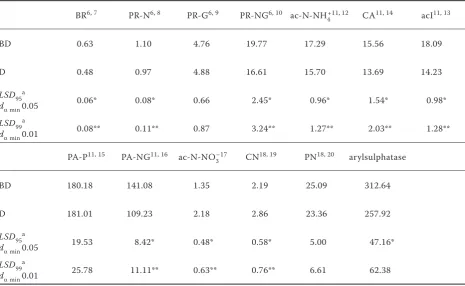
[image:4.595.65.531.78.364.2]There was a statistically significant difference (P < 0.01) in control respiration before (0.63 mg
Table 2. Biological criteria before and after desiccation
BR6, 7 PR-N6, 8 PR-G6, 9 PR-NG6, 10 ac-N-NH
4+11, 12 CA11, 14 acI11, 13
BD 0.63 1.10 4.76 19.77 17.29 15.56 18.09
D 0.48 0.97 4.88 16.61 15.70 13.69 14.23
LSD95a
dα min 0.05 0.06* 0.08* 0.66 2.45* 0.96* 1.54* 0.98*
LSD99a
dα min 0.01 0.08** 0.11** 0.87 3.24** 1.27** 2.03** 1.28**
PA-P11, 15 PA-NG11, 16 ac-N-NO 3
–17 CN18, 19 PN18, 20 arylsulphatase
BD 180.18 141.08 1.35 2.19 25.09 312.64
D 181.01 109.23 2.18 2.86 23.36 257.92
LSD95a
dα min 0.05 19.53 8.42* 0.48* 0.58* 5.00 47.16*
LSD99a
dα min 0.01 25.78 11.11** 0.63** 0.76** 6.61 62.38
6, 7, 8, 9, 10, 11, 12, 13, 14, 15, 16, 17, 18, 19, 20 see Table 1; aFisher’s Least Significant Difference; **P < 0.01, *P < 0.05; BD before
CO2/h/100 g dry soil) and after desiccation (0.48 mg CO2/h/100 g dry soil), as shown in Table 2. There was a significant difference (P < 0.01) between
soils before (1.10 mg CO2/h/100 g dry soil) and
after (0.97 mg CO2/h/100 g dry soil) desiccation in potential respiration with (NH4)2SO4 (Table 2). Potential respiration (Table 2) with glucose was
determined at the level 4.80 mg CO2/h/100 g dry
soil (SD 1.75); it was higher than the usual level of 3.79 mg CO2/h/100 g dry soil (SD 0.25). As for this criterion there was not a significant
differ-ence before (4.76 mg CO2/h/100 g dry soil) and
after (4.88 mg CO2/h/100 g dry soil) desiccation (Table 2). It could be expected because of the increasing available C content in the soil from the plants decay.
In the potential respiration with (NH4)2SO4 and glucose there was a significant difference (P < 0.01) before and after desiccation (19.77 and 16.61 mg CO2/h/100 g dry soil, respectively).
Effect of desiccation on Norg mineralization (ammonification) and nitrification
Actual content of N-NH4+ without (ac-N-NH
4+)
and with pre-incubation (acI): The usual level
19.19 mg N-NH4+/100 g dry soil (SD 1.30) was
not assessed in our experiment, it was lover
than normal (16.76 mg N-NH4+/100 g dry soil,
SD 2.65) (Table 2). There was a significant decrease (P < 0.01) of ac-N-NH4+ before (17.29 mg N-NH
4+/ 100 g dry soil) and after (15.70 mg N-NH4+/100 g
dry soil) desiccation. In acI there was a significant difference in soils before and after desiccation (P < 0.01).
Control ammonification: There was a significant difference (P < 0.01) before and after desiccation (Table 2).
[image:5.595.65.537.77.259.2]Potential ammonification with peptone (PA-P), with (NH4)2SO4 and glucose (PA-NG): There were no significant differences in PA-P between soils
Table 3. Other criteria before and after desiccation
M
oi
st
ur
e
2
(%
)
E
40
0/
E
60
0
3
Cor
g
4
Nt
5
Cor
g
/Nt
M
BC
22
EC
/M
BC
(%
)
M
od
el
M
BC
24
M
BC
/M
od
el
M
BC
(%
)
EC
23
M
BC
/Cor
g
(%
)
BD 15.29 4.51 1.83 0.13 10.14 510.64 8.53 509.70 99.88 42.50 2.79
D 13.61 4.67 2.11 0.20 10.85 732.13 6.57 548.04 133.26 46.54 3.48
LSD95a
dα min 0.05 1.27* 0.07* 0.11* 0.01* 0.57* 54.35* 0.94* 18.06* 8.65* 5.28 0.24* LSD99a
dα min 0.01 1.68** 0.09** 0.14** 0.01 0.75 72.02** 1.24** 23.92** 11.46** 7.00 0.31**
2, 3, 4, 5, 22, 23, 24 see Table 1; aFisher’s Least Significant Difference; **P < 0.01,*P < 0.05; BD before desiccation by
Roundup Biaktiv (tests averages), D after desiccation by Roundup Biaktiv (tests averages)
Table 4. Correlation coefficients between arylsulphatase activity and other tests
BR PR-N6, 8 PR-G6, 9 PR-NG6, 10 ac-N-NH 4
+11, 12 CA11, 14 PA-P11, 15 PA-NG11, 16N-NO
3– (ac)17 CN18, 19
0.6313*** 0.4824*** 0.3071** 0.2882** 0.4319*** 0.2444* 0.1084 0.2178* 0.0380 –0.0152
PN18, 20 E 400/
E 6003 Corg4 Nt5 Corg/Nt MBC22 EC/MBC MBCModel 24 MBC/Model MBC EC23
0.4514*** 0.0960 –0.0157 0.0896 0.0698 –0.0505 0.2579* 0.0565 –0.0724 0.1729
[image:5.595.65.533.614.743.2]before and after desiccation (180.18 and 181.1 mg N-NH4+/24 h/100 g dry soil, respectively). Our data
also confirmed that in soils with neutral pH there is a close relation between high microbial biomass C content and middle potential ammonification. There was a significant difference in PA-NG before and after desiccation (P < 0.01) (Table 2).
Actual content of NO3– (ac-N-NO3–):According to our experience the usual level in chernozem is 2.63 mg N-NO3–/100 g dry soil (SD 4.07). In
our experiment we found a lover content than normal (1.63 mg N-NO3–/100 g dry soil, SD 1.32);
ac-N-NO3– significantly increased in the soil after
desiccation because of decreased immobilization by the plants (Table 2).
Control nitrification: In this parameter we as-sessed a significant difference (P < 0.01) before and after desiccation.
Potential nitrification with (NH4)2SO4 (PN):
This test is very often used as an indicator of soil microbial activity. There was no difference in PN before and after desiccation because available N was not immobilized by plants (Table 2). The usual level in chernozem is 12.11 mg N-NO3–/8 days/100 g
dry soil (SD 2.93) but in our tests we measured
24.52 mg N-NO3–/8 days/100 g dry soil (SD 13.27)
(Table 2). A similar tendency (high activity) was
in glucose mineralization tested by PR-G. These positive changes in microbial metabolism are surely connected with neutral pH KCl (7.3).
Desiccation and arylsulphatase activity
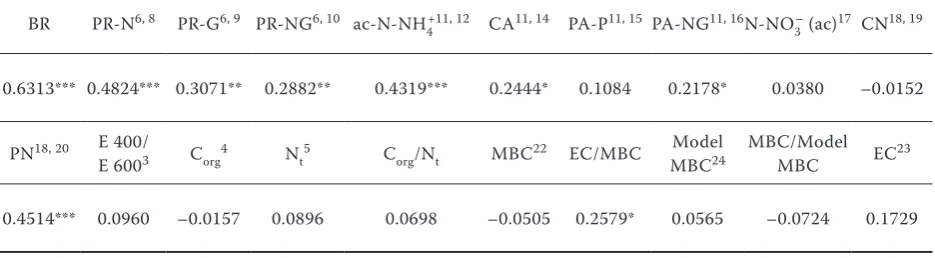
Before desiccation we determined higher (P < 0.05) soil arylsulphatase activity than after it (312.64 and 257.92 mg p-nitrophenol/kg/h, respectively). The correlation coefficients between arylsulfatase activ-ity and other tests are given in Table 4.Lu-Qin et al. (2003) presented a significant correlation between arylsulphatase activity and Corg; in our results this was not confirmed (r = –0.0157). Dedourge et al. (2004) also informed about a significant correla-tion between arylsulphatase activity and MBC. Neither this correlation was confirmed in our tests (r = –0.0505).
Biological status before and after desiccation; ranking based on 16 biological criteria
Sixteen biological criteria (MBC, BR, PR-N,
PR-G, PR-NG, ac-N-NH4+, acI, CA, PA-P, PA-NG,
[image:6.595.67.532.78.370.2]ac-N-NO3–, CN, PN, arylsuphatase activity and
Table 5. Ranking based on sixteen biological criteria1 before and after desiccation
Management Plants numberPlot BD Management Plants numberPlot D
Two mulching per year legumes 9 1 One mulching per year legumes 7 1 One mulching per year legumes 7 2 Two mulching per year legumes 9 2 Two mulching per year mixtures 12 3 One mulching per year grasses 6 3 One mulching per year mixtures 11 4 One mulching per year mixtures 11 4 One mulching per year grasses 6 5 Two mulching per year mixtures 12 5
Two mulching per year grasses 8 6 Spontaneous fallow 5 6
Spontaneous fallow 5 7 Two mulching per year grasses 8 7
Three cutting per year mixtures 10 8 Three cutting per year legumes 3 8 Three cutting per year legumes 3 9 Three cutting per year mixtures 10 9 Three cutting per year grasses 2 10 Three cutting per year grasses 2 10
Black fallow 1 11 Black fallow 1 11
1sixteen biological criteria:
1 BR 5 ac-N-NH4+ 9 PA-NG 13 arylsulphatase
2 PR-N 6 acI 10 ac- N-NO3– 14 MBC
3 PR-G 7 CA 11 CN 15 EC/MBC
4 PR-NG 8 PA-P 12 PN 16 MBC/Corg
two ratios: MBC/Corg; EC/MBC) were used for soil biological status evaluation before and after desiccation (Table 5). 11 plots with different man-agement and plant cover were evaluated and their ranking based on the above-mentioned criteria was determined both before and after desiccation. The black fallow ranked the worst both before and after desiccation. One or two mulching variants were the best also before and after desiccation. The cut plots ranked on the 8–10 positions. The spontaneous fallow reached the middle position. Similar results were published by Voříšek et al. (2002).
REFERENCES
Blagodatskiy S.A., Blagodatskaya E.V., Gorbenko A.Y., Panikov N.S. (1987): A rehydration method of deter-mining the biomass of micro-organisms in soil. Sov. Soil Sci., 19: 119–126.
Dedourge O., Vong P.C., Lasserre-Joulin F., Benizri E., Guckert A. (2004): Effects of glucose and rhizodepos-its (with or without cysteine-S) on immobilized-S-35, microbial biomass-S-35 and arylsulphatase activity in a calcareous and an acid brown soil. Eur. J. Soil. Sci., 55: 649–656.
Dušek L., Škoda M., Růžek L., Sixta J. (1997): Mining evaluation of stressed soils: stochastic aspects of empirical modelling approach. In: Strakoš V., Kebo V., Farana R., Smutný L. (eds.): Mine planning and equip-ment selection. A.A. Balkema, Rotterdam: 847–54. Filip Z. (2001): Ecological, legal and methodical
ap-proaches to biological indication of soil quality. In: Proc. 50th Annivers. Conf. Crop science on the verge
of the 21st century – opportunities and challenges.
RICP Prague: 136–140.
Insam H., Domsch K.H. (1988): Relationship between soil organic carbon and microbial biomass on chronose- quences of reclaimed sites. Microbial Ecol., 15: 177–188.
ISO 11277 (1998): Soil quality – determination of parti-cle size distribution in mineral soil material. Method by sieving and sedimentation following removal of soluble salt organic matter and carbonates. Int. Or-ganiz. Standard., Geneve, Switzerland.
Löbl F., Novák B. (1964): Beitrag zur Methodik der Nit-rifikationsbestimmung. Zbl. Bakt. II, 118: 374–378. Lu-Qin, Wang-XiaoChang, Yan-WeiDong, An-Zhi-
Zhuang, Shi-WeiMing, Cao-ZhiHong, Lu Q., Wang-X.C., Yan W.D., An Z.Z , Shi W.M., Cao Z.H. (2003): Arylsulphatase activity of paddy soils in the Taihu Lake Region. Acta-Pedol.-Sin., 40: 386–392.
Novák B., Apfelthaler R. (1964): Příspěvek ke stanovení respirace jako indikátoru mikrobiologických procesů v půdě. Rostl. Výr., 2: 145–150.
Nowak J., Nowak A., Klodka D., Turos-Biernacka M. (2000): Influence of different herbicide dosages on the phosphatase and dehydrogenase activity in soil. Z. Pfl.-Krankh. Pfl.-Schutz, J. Plant Dis. Protec.: 769–774. Okito A., Alves B.J.R., Urquiaga S., Boddey R.M. (2004):
Nitrogen fixation by groundnut and velvet bean and residual benefit to a subsequent maize crop. Pesqui. Agropecu. Bras., 39: 1183–1190.
Pokorná-Kozová J., Löbl F., Apfelthaler R., Novák B. (1964): Zur Methodik der Feststellung der Am-monifizierung in Bodenproben. Zbl. Bakt. II, 118: 368–373.
Reinecke A.J., Helling B., Louw K., Fourie J., Reinecke S.A. (2002): The impact of different herbicides and cover crops on soil biological activity in vineyards in the Western Cape, South Africa. Pedobiologia,
46: 475–484.
Růžek L., Nováková M., Voříšek K., Skořepová I., Vorte-lová L., Kalfařová Z., Černý J., Částka T., Barabasz W. (2005): Microbial biomass-C determination using CaCl2 and K2SO4 as extraction reagents. Plant Soil Environ., 51: 439–446.
Růžek L., Voříšek K., Sixta J. (2001): Microbial biomass C in reclaimed soil of the Rhineland (Germany) and the North Bohemian lignite mining areas (Czech Repub-lic): measured and predicted values. Restor. Ecol., 9: 370–377.
Růžek L., Voříšek K., Strnadová S., Nováková M., Bara-basz W. (2004): Microbial characteristics, carbon and nitrogen content in cambisols and luvisols. Plant Soil Environ., 50: 196–204.
Růžek L., Voříšek K., Vráblíková J., Strnadová S., Vráblík P. (2003):Chemical and biological charac-teristics of reclaimed soils in the Most region (Czech Republic). Plant Soil Environ., 49: 346–351.
Sims J.R., Haby V.A. (1971): Simplified colorimetric determination of soil organic matter. Soil Sci., 112: 137–141.
Šantrůček J., Svobodová M., Brant V. (2002): Changes of botanical composition of grass stands under different types of management. Rostl. Výr., 48: 499–504. Škoda M., Růžek L., Dušek L., Hofman J., Sixta J. (1997):
Mineralization activity of microbial biomass in re-claimed soils in comparison with empirical math-ematical model. Rostl. Výr., 43: 179–186.
Tabatabai M.A., Bremner J.M. (1970): Arylsulfatase activity of soils. Soil Sci. Soc. Am. J., 34: 225–229. Vance E.D., Brookes P.C., Jenkinson D.S. (1987): An
extraction method for measuring soil microbial bio-mass C. Soil Biol. Biochem., 19: 703–707
Voříšek K., Růžek L., Svobodová M., Šantrůček J., Strnadová S., Popelářová E. (2002): The influence of grassing and harvest management on microbial parameters after arable land setting – aside. Rostl. Výr., 48: 382–388.
Wojewoda D., Russel S. (2003): The impact of a shelter belts on soil properties and microbial activity in an adjacent crop field. Pol. J. Ecol., 51: 291–307. Zaman M., Cameron K.C., Di H.J., Inubushi K. (2002):
Changes in mineral N, microbial biomass and enzyme activities in different soil depths after surface applica-tions of dairy shed effluent and chemical fertilizer. Nutr. Cycl. Agroecosyst., 63: 275–290.
Received on September 19, 2005
Corresponding author: