For Peer Review
On the quasi-yield surface concept in plasticity theory
Journal: Zeitschrift für Angewandte Mathematik und Mechanik
Manuscript ID zamm.201600133.R2
Wiley - Manuscript type: Original Manuscript
Date Submitted by the Author: 12-Jan-2017
Complete List of Authors: Soldatos, Dimitris; Demokritos University of Thrace, Department of Civil Engineering
Triantafyllou, Savvas; University of Nottingham,
Keywords: Rate-independent plasticity, quasi-yield surface, integrability conditions, holonomy, large plastic deformations
For Peer Review
On the quasi-yield surface concept in plasticity theory
1
2
Dimitris Soldatos1 and Savvas P. Triantafyllou2
3
1
Department of Civil Engineering, Demokritos University of Thrace, 12 Vasilissis Sofias
4
Street, Xanthi 67100, GREECE 5
2
Centre for Structural Engineering and Informatics, Faculty of Engineering, The University of
6
Nottingham, University Park, Nottingham, NG72RD, UK
7
8
Key words Rate-independent plasticity, quasi-yield surface, integrability conditions, holonomy,
9
large plastic deformations
10
11
In this paper we provide deeper insights into the concept of the quasi-yield surface in plasticity
12
theory. More specifically, in this work, unlike the traditional treatments of plasticity where
13
special emphasis is placed on an unambiguous definition of a yield criterion and the
14
corresponding loading-unloading conditions, we place emphasis on the study of a general rate
15
equation which is able to enforce elastic-plastic behavior. By means of this equation we discuss
16
the fundamental concepts of the elastic range and the elastic domain. The particular case in which
17
the elastic domain degenerates into its boundary leads to the quasi-yield surface concept. We
18
exploit this concept further by discussing several theoretical issues related to it and by introducing
19
a simple material model. The ability of the model in predicting several patterns of the real
20
behavior of metals is assessed by representative numerical examples.
21
22
23
24
For Peer Review
1. Introduction
26
27
In a very recent paper, Xiao et al. [38] posed the question of whether one can construct 28
rate equations which describe rate-independent elastic-plastic behavior, so that it’s 29
essential features, namely the yield criterion and the loading-unloading irreversibility, 30
would not be introduced as extrinsic restrictive conditions, but instead will be derived 31
directly by these equations. In the course of their analysis, Xiao et al. [38], derived a 32
material model which had the ability of simulating several patterns of the real behavior 33
of metals. These patterns comprised - but were not limited to - the prediction of plastic 34
(irreversible) deformations at any stress level no matter how small the latter may be, and 35
a continuous stress-deformation curve at the point of elastic-plastic transition. (For an 36
alternative way of predicting a continuous stress-deformation curve where emphasis is 37
placed in rate-dependent response see the recent works by Hollenstein et al. [11] and 38
Jabareen [12]). 39
Our motivation for this paper is to provide deeper insights into the answer of the 40
question posed by Xiao et al. in [38]. More specifically, in this work, on the basis of 41
some ideas which go back to the classic paper by Lubliner [16] - see also Lubliner in 42
[17,18] - we discuss a purely mathematical approach to elastic-plastic behavior, in 43
which the basic ingredients of plasticity theory follow upon studying the properties of a 44
suitably formulated differential equation. Within this context we pay special attention to 45
a rather old concept, which has passed largely unnoticed within the literature of 46
For Peer Review
The basic steps of this study are as follows: In Section 2, we consider a general 48
differential equation which aims to model rate-independent irreversible response and by 49
means of it and an additional assumption underlying the loading-unloading behavior, 50
we introduce the central concept of advanced plasticity theories, namely the elastic
51
range (see Pipkin and Rivlin [30]; see also Lubliner [19,20]; Luchessi and Podio- 52
Guidugli [24]; Bertram and Kraska [5]; Bertram [4]; Panoskaltsis et al. [27]). Several 53
basic concepts of plasticity such as the loading rate, the elastic domain and the yield 54
surface are also discussed within this framework. In Section 3, we deal with the 55
particular case in which the basic equation is formulated in a way such as the elastic 56
domain is degenerated to its boundary to form a surface; this surface is the 57
aforementioned quasi-yield surface (Lubliner [18,19]). In Section 4, we provide 58
additional insights to the quasi-yield surface concept upon introducing a material model. 59
Finally, in Section 5, we demonstrate the ability of the model in predicting several 60
patterns of the elastic-plastic behavior of metals by means of representative numerical 61
examples. 62
63
64
2. Elastic and plastic processes; elastic range and domain
65
66
As a starting point we assume a homogeneous body undergoing finite deformation whose 67
reference configuration - with points labeled by X - occupies a region B in the ambient 68
space Ω. We define a motion of B in Ω as an one-parameter family of 69
For Peer Review
( ) ( , ), , .
t =
ϕ
t =ϕ
t ∈B ∈ Ωx X X X x (1)
71
Then, the deformation gradient is the two-point tensor F, defined as the tangent map of 72
(1), that is 73
: , i.e. i ( , )
iI I
T T B T t
X
ϕ
ϕ ∂
= → Ω =
∂
X x
F F X (2)
74
where T BX and TxΩ stand for the tangent spaces at X∈Band x∈Ω, respectively. 75
If one assumes a referential description of the dynamical processes, the local 76
mechanical state over the material point X can be determined by the second Piola-77
Kirchhoff stress tensor S and the internal variable vector Q. We assume that the state 78
(configuration) space S over the point X forms a local (6+Q)-dimensional manifold - 79
where Q is the number of independent components of Q - with points denoted by ( , ).S Q
80
A local process (at X) is defined as a curve in S, that is as a mapping 81
: I S t, ( ( ), ( )),t t
Ψ ∈ → → S Q
82
where I is the time interval of interest. The direction and the speed of the process are 83
determined by the tangent vector Ψ& :S→T ,S with Ψ&( )t =( ( ), ( )),S& t Q& t where TS is the 84
tangent space of S. Since the stress rate (S& =S&( ))t is always known, the component 85
(= ( ))t
Q& Q& of Ψ& has to be determined. The latter may be assumed to be a function of the
86
present values of the state variables and the stress rate, that is 87
( , , ),
=
Q& A S Q S& (3)
88
where A:S×TS →T ,S is a vector field in ,S which may be interpreted as a tensorial 89
function of the state variables. In general, Eq. (3) introduces Q non-holonomic constraints 90
For Peer Review
deal with elastic-plastic (irreversible) response is desirable. However, from a 92
mathematical stand point it may result in integrability problems. In order to surpass this, 93
we further assume that the dependence of Aon S& is linear, that is 94
( , ) : ,
=
Q& L S Q S& (4)
95
where L is a tensor field in .S Motivated by the classical formulations of plasticity - see, 96
e.g. [21, pp. 107,108] - we assume that the function L can be further decomposed as a 97
tensor product as 98
( , )= ( , )⊗ ( , ),
L S Q A S Q ΛΛΛΛ S Q
99
where A is a tensor field and ΛΛΛΛ:S→T S∗ is a one-form, so that Eq. (4) can be expressed 100
as 101
( , )[ ( , ) : ]
=
Q& A S Q ΛΛΛΛ S Q S& (5)
102
We note that Eq. (5) is invariant under a replacement of t by −t and accordingly 103
enforces reversible response (see [29] for further details). On the other hand, plastic
104
behavior is an irreversible one, a fact which calls for an appropriate modification of the
105
rate equation (5). In order to accomplish this goal, we further assume this equation is able 106
of simulating two different types of possible material processes, namely quasi-static and 107
dynamic ones. More precisely, a material process Ψ may be defined as quasi-static if
108
,
=
Q& 0 that is, if it lies entirely in a (6-dimensional) submanifold of S, defined by
109
.;
const
=
Q a non quasi-static process is one which results in a change of the internal 110
variable vector (Q& ≠0) and may be defined as a dynamic process. Herein, the terms
111
quasi-static and quasi-dynamic are being used in complete analogy with classical
112
thermodynamics, see, e.g., [40]. The concept of a quasi-static process leads to the concept 113
of a quasi-static range which is defined at every material state of the material manifold Q
For Peer Review
which comprises all material states (S Q∗, ∗) that can be reached from the current material 115
state ( , )S Q by a quasi-static process, that is 116
{( , ) / , },
Q= S Q∗ ∗ ∈S S∗ = +S dS Q∗ =Q
117
where dS is an infinitesimal stress increment which can be interpreted as a one-form in 118
S. In view of this definition, the quasi-static range can be determined as the union of the 119
submanifolds Q1 and Q2 of S, which are defined as 120
1 {( , ) / ( , ) or ( , ) },
Q = S Q∗ ∗ ∈S A S Q∗ ∗ =0 ΛΛΛΛ S Q∗ ∗ =0 (6) 121
where it is implied that the point (S Q∗, ∗) is attainable from ( , ),S Q and 122
2 {( , ) , where ( , ) : 0}
Q = S Q∗ ∗ ∈S S Q∗ ∗ can be attained by a process withΛΛΛΛ S& = (7)
123
As a first step, we disregard the (trivial) cases A S Q( ∗, ∗)=0 and ΛΛΛΛ(S Q∗, ∗)=0 i.e. we 124
assume that A S Q( ∗, ∗)≠0 and ΛΛΛΛ(S Q∗, ∗)≠0,and we focus on the solutions of the 125
equation 126
( , ) :ΛΛΛΛ S Q S& =0 (8) 127
which upon defining the Pfaffian form (see, e.g. [1, pp. 439-444]) 128
:d ,
ω=ΛΛΛΛ S (9)
129
results in the following Pfaffian equation 130
0.
ω= (10)
131
Then if the Pfaffian (one-form) (10) is completely integrable, there exists at the 132
neighborhood of the current material state a scalar function (integrating factor) 133
: S
µ → and a five-dimensional submanifold of S, defined by F( , )S Q =const. - see 134
For Peer Review
( , )=µ( , )∂F.
∂
S Q S Q
S
Λ Λ Λ
Λ (11)
136
The submanifold F( , )E Q =const. is defined - see Eisenberg and Phillips [10]; see also 137
[17,18] - as the loading surface (at Q). Clearly, a process which lies entirely on the 138
loading surface, that is one in which ∂F : =0
∂S S& is a quasi-static one while processes with
139
: 0
F
∂ ≠
∂S S
& are dynamic ones.
140
Rate-independent plasticity - see, e.g., [16] - is closely tied to the concepts of loading 141
and unloading. In order to involve these concepts in the analysis we make the further
142
assumption that a process with ∂F : <0,
∂S S
& results in quasi-static response (Q& =0) and
143
may be defined as elastic unloading, while a (dynamic) process with ∂F : >0,
∂S S
& which
144
results in Q& ≠0, may be defined as plastic loading. The limiting case ∂F : =0,
∂S S
& may be
145
defined as neutral loading. These concepts can be put together upon replacing the 146
Pfaffian form
ω
in Eq. (5) by a fundamental concept in plasticity theory, namely that of 147the loading rate -R see, e.g., [16] - which may be defined as
148
: .
F
R=∂
∂S S &
149
Then Eq. (5) can be replaced by
150
( , ) R , =
Q& A S Q (12)
151
where ⋅ stands for the Macauley bracket defined as
2
x x
x = + and it has been 152
For Peer Review
We note that Eq. (12) is invariant under a replacement of t by ( ),ϕ t where ( )ϕ t is any 154
monotonically increasing, continuously differentiable function and accordingly enforces 155
rate-independent response. Moreover, Eq. (12) constitutes the underlying equation of a 156
general model of rate-independent elastic-plastic behavior called generalized plasticity
157
(see Lubliner [20]; see also the later works given in [22,23,26,27,35]). 158
By means of Eq. (12) and by assuming that ∂F( , )≠
∂S S Q 0 in S we can define another
159
fundamental concept, that of the elastic range E - see, e.g., [30,19,20,24] - as the 160
submanifold of S which contains the points which can be reached from the current stress 161
point as 162
.
{( , ) / ( , ) or 0}.
const
E= S Q ∈S A S Q Q= =0 R≤
163
164
REMARK 1: The present approach, which is based upon postulating a differential
165
equation for the evolution of the internal variable vector and the subsequent derivation of
166
the elastic range by involving the concept of loading-unloading, differs vastly from the
167
standard approaches to the elastic range concept (see, e.g., [20,22,26,27]; see also [3,4]), 168
where the elastic range is considered as a primary concept and the rate-equations are 169
specified afterwards by imposing some regularity requirements and the rate-170
independence property. In this sense, the present approach resembles the general internal 171
variable approach to material irreversible behavior discussed in Lubliner [16]. 172
173
REMARK 2: It is stressed that Eq. (5), although is adequate to define the quasi-static
174
For Peer Review
process with ∂F : <0,
∂S S
& is an (elastic) unloading process, that is in such a process the
176
equality Q& =0 holds; as a matter of fact, this assumption introduces the concept of 177
loading-unloading irreversibility in rate-independent plasticity. 178
179
REMARK 3: Since the present approach involves the stress tensor S and the stress-space
180
loading rate R=∂F : ,
∂S S
& presupposes stability under stress control and accordingly is
181
limited to work-hardening materials. Nevertheless, an equivalent approach which does 182
not suffer from this limitation can be developed within the context of a strain 183
(deformation) space formulation - see, e.g., [21, pp. 120-124]) - if S is replaced 184
throughout by the right Cauchy-Green tensor C, which is defined in terms of the 185
deformation gradient and the spatial metric : g TxΩ × Ω →Tx as 186
.
= T C F gF
187
It is also noted that the strain-space approach has been proven especially useful- see [27] 188
- for a covariant formulation of the theory of rate-independent plasticity. 189
190
The submanifold D of S
191
{( , ) / ( , ) }
D= S Q ∈S A S Q =0
192
which comprises only elastic processes may be defined as the elastic domain D and its 193
boundary as the yield hypersurface. The intersection of the elastic domain with the 194
submanifold of ,S defined by Q=const., is defined as the elastic domain DQ (at Q), 195
while its boundary is defined to be the yield surface. Note that unlike the elastic range, 196
For Peer Review
non-connected manifold. Accordingly, the yield surface in this case can be composed of 198
several different independent submanifolds of S, which can be either disjoint, or intersect. 199
We note also that the submanifold of Q1 defined if ΛΛΛΛ(S Q∗, ∗)≠0 - recall Eq. (6) - is by 200
construction a submanifold of DQ, but the converse is not necessarily true; this case may 201
appear if the elastic domain is non-connected or contains isolated points which cannot be 202
attained from the current material state. 203
Classical plasticity corresponds to the particular case when an additional constraint, 204
namely the invariance of theelastic domain under a plastic process - see, e.g., [26,27]is 205
introduced in the rate equation (12). If this is the case, the boundary of the elastic domain, 206
i.e. the yield (hyper)surface, coincides with a unique loading (hyper)surface - say defined 207
by F( , )S Q =0 - while the invariance condition (see, e.g., [1, pp. 256-257]) reads 208
0.
GRADF
Ψ ⋅& ≤ (13)
209
where ( )⋅ stands for the inner product in S, and the gradient operator is defined as 210
( ) ( ) ( ) [ , ].
GRAD ⋅ = ∂ ⋅ ∂ ⋅
∂S ∂Q
211
Then, the basic equations of classical rate-independent plasticity - see further [26,27] - 212
can be derived upon assuming that the function Ais of the form 213
( , ) F ( , )
F
=
A S Q B S Q
214
and determining the limit 215
0 0
limF ( , ) limF F ( , ) ,R F
→ A S Q = → B S Q
216
by means of the limiting case of Eq. (13) where the equality holds, that is 217
:GRADF F( , ) 0
Ψ& = & S Q = (14)
For Peer Review
which constitutes the consistency condition of classical plasticity. 219
An equivalent assessment of the theory in the spatial description can be derived upon 220
performing a push-forward operation (see, e.g., [1, p. 355]; [36]) in Eq. (12). The 221
resulting equation reads 222
( , , ) ,
Lvq=a
ττττ
q F r (15)223
where , q aare the push-forwards of Qand A in the spatial configuration respectively, 224
ττττ
is the Kirchhoff stress, i.e. = T,FSF
ττττ and r is the (scalar invariant) loading rate in the 225
spatial configuration r= ∂f :L
∂ vττττ
ττττ where f = f( , , )ττττ q F is the (spatial) expression for the
226
loading surface. In component form, the push-forward operation for the arbitrary tensor 227
Q reads 228
1 1
1 1
1 1 1 1
... ...
... ... ... ... .
n m
n n
m n m m
i J
i J
i i I I
j j I I j j J J
x x X X
q Q
X X x x
∂ ∂ ∂ ∂
=
∂ ∂ ∂ ∂
229
Finally, Lv( )⋅ stands for the (convected) Lie derivative (see further [1, pp. 359-369]; 230
[36]) which is obtained by pullingback q to the reference configuration, taking its time 231
derivative by keeping X fixed and pushing forward the result to the spatial configuration, 232
that is: 233
( )
const.L ( ) ,
t
ϕ ϕ∗
∗ =
∂
=
∂
v q q X
234
where ϕ∗( )⋅ and ϕ∗( )⋅ =ϕ∗−1( )⋅ stand for the push-forward and the pull-back operations 235
respectively.
236
For Peer Review
241 242
3. The quasi-yield surface concept
243
244
An important particular case of the rate-equation (12) arises if the function A S Q( , ) is 245
non-vanishing in its arguments, so that the elastic domain D vanishes. In this case, there 246
is no non-vanishing volume in S such as R=∂F( , ) : =0.
∂S S Q S
& Nevertheless, as it is
247
pointed out by Lubliner in [18] - see also [19] - since loading can proceed in both the
248
positive (R>0) and the negative (R<0) directions, S& has to take on both positive and
249
negative values. As a result, since S& ≠0, there exists a surface on which ∂F = ;
∂S 0
250
accordingly, the elastic domain degenerates to its boundary to form this surface, which 251
may be defined as a quasi-yield surface (see further [18, 19]). 252
One may further assume that the function A is defined as 253
( , )=λ( , ) ( , ),
A S Q S Q M S Q (16)
254
where λ is a non-vanishing scalar function of the state variables and M:S→TSis a 255
another (non-vanishing) tensorial function which accounts for the direction of plastic 256
flow. Upon substitution of Eq. (16) into Eq. (12) we derive a rather general expression for 257
the rate equations for a material possessing a quasi-yield surface as 258
( , ) ( , ) R , ( , ) (0, ) for all ( , ) S.
λ
λ
= ≠ ∈
Q& S Q M S Q M 0 S Q (17)
259
From a physical point of view, for a material which possesses a quasi-yield surface any 260
process with R>0 will result in a plastic process, irrespectively of the value of stress in 261
the state in question; accordingly plastic deformation appears upon loading at any stress
262
level no matter how small it may be. This response constitutes the very essence of the real
For Peer Review
elastic-plastic behavior of metals, especially at high rates of loading. Characteristic here 264
is the following comment stated by J.F Bell in [2]: “It was impossible to determine an
265
elastic limit in the sense that all deformation was completely reversible … given sufficient
266
accurate instrumentations one could always find permanent deformation associated with
267
each elastic deformation.”. A similar like response is reported in the very recent paper by
268
Chen et al. [8], who upon performing hundreds of high-precision loading-unloading-269
reloading tests conclude as: “There is no significant linear elastic region, that is, the
270
proportional limit is 0 Mpa. While the first increment of deformation shows a
stress-271
strain slope equal to Young’s modulus, progressive deviations of slope start
272
immediately.”.
273
Another case of interest which is closely tied to the quasi-yield surface concept arises in 274
metals at extremely high rates of loading - see, e.g., [21, pp. 108-109], [28] - where, 275
during the various rate processes, different mechanisms within the same material respond 276
in different characteristic times. These characteristic times may be very short and of the 277
same order compared to a typical loading process. The first type of these mechanisms 278
gives rise to instantaneous plastic strains and the second type to creep strains, which 279
develop slowly. Such a response can be predicted upon combining a quasi-yield surface 280
model with a rate-dependent (viscoplastic) model. In this case the basic rate equation (17) 281
can be extended as 282
( , ) ( , ) R ( , ),
λ
= +
Q& S Q M S Q L S Q (18)
283
where L:S →TS is another (non-vanishing) tensorial function of the internal variables 284
which enforces the rate-dependent characteristics of the material. In general, the function 285
For Peer Review
is determined solely by the rate-dependent part of the model, while for dynamic ones the 287
response is dominated by its dynamic (rate-independent) part. More information on this 288
issue can be found in Panoskaltsis et al. [28]. 289
To this end it is instructive to examine the integrability of the rate equation (17). By 290
inspection we realize that the later is equivalent to the following Pfaffian system - see, 291
e.g., [1, p. 443] - in S
292
( , ) ( , )( F : ).
d =λ ∂ d
∂
Q S Q M S Q S
S (19)
293
By assuming the general case, where the independent components of Q, are tensors of 294
type ( ,N M), with components 1 1 ... ... N M I I J J
Q the system (19) reads 295 1 1 ... ... 0, N M I I J J
ω
= (20)296
where 1 1 ... ... N M I I J J
ω
stands for the differential form 2971 1 1 1 1
1 1 1 1 1
... ... ... ... ...
... ... ( , ... ) ... ( , ... ) .
N N N N N
M M M M M
I I I I AB A A I I AB A A IJ
J J J J B B J J B B IJ
F
dQ S Q M S Q dS
S
ω = −λ ∂
∂ (21)
298
By having Eqs. (20), (21) at hand, there are sufficient conditions for the application of 299
the Frobenius theorem - see, e.g., [1, p. 443] - which states that (20) is completely 300
integrable if and only if 301 1 1 ... ... 0, N M I I J J IJKL
C = (22)
302
where 1 1 ... ... N M I I J J IJKL
C are functions of the state variables which are given as 303 304 1 1 1 1 1 1 1 1 1 1 1 1 ... ... ... ... ... ... ... ... ... ... ... ... [ ] [ ] [ ] + N N M M N M N M N M N M
I I I I
J J IJ J J IJ KL
I I
J J IJKL KL IJ
I I
J J IJ
K K
L L KL K K
L L F F M M S S C S S F M F S M M S Q λ λ λ λ λ ∂ ∂ ∂ ∂ ∂ ∂ = − + ∂ ∂ ∂ ∂ ∂ ∂ − ∂ ∂ 1 1 1 1 1 1 ... ... ... ... ... ... [ ] . N M N M N M I I
J J KL
K K
L L IJ K K
For Peer Review
which constitute the desired integrability conditions. 306
307
REMARK4: The Pfaffian system (20) may be written equivalently - see further [1, p. 443]
308
- as 309
1
1 1 1 1
1 1 1
...
... ... ... ...
... ... ...
( , ) ( , ) .
N
M N N N
M M M
I I
J J AB A A I I AB A A
B B J J B B
IJ IJ
Q F
S Q M S Q
S
λ
S∂ ∂
=
∂ ∂ (24)
310
This form has the advantage of allowing us a geometrical interpretation of the solutions. 311
More precisely, if (24) is completely integrable, there exists a 6-dimensional submanifold 312
P of S, with equation Q=G S( ), such that the vectors
313
1 1 1
1 1 1
... ... ...
... ... ...
( , N ) N ( , N ) .
M M M
A A I I A A
AB AB
B B J J B B IJ
F
S Q M S Q
S
λ ∂
∂
314
are tangent to P, at every point ( , ),S Q with (local) coordinates 1 1 ...
...
( , N ).
M A A AB B B S Q 315 316
REMARK 5: Wherever the integrability conditions (22) hold, the constraints imposed in S
317
by (20) are holonomic and accordingly the (dynamical) system whose evolution is 318
underlined by Eq. (17) is a holonomic one. Such a consequence plays a prominent role 319
when one deals with stability postulates and/or invariance concepts within a Hamiltonian 320
formulation of plasticity. For instance, the dissipation function D) : S TS× → of the 321
system, that is 322
( , , )D = −∂E : = −∂E : ( , )(∂F : ),
∂ ∂ ∂
Q S S Q M S Q S
Q Q S
) & & &
323
where E is the internal energy density function, can be associated with a Lagrangian L in 324
S, which can be expressed solely in terms of Sand ,S& that is 325
( , , ) ( ( ), , ).
D Q S S& =L G S S S&
For Peer Review
327
REMARK 6: Another important consequence of the integrability of Eq. (17) appears if
328
one considers the general case of combined models of rate-independent and rate 329
dependent behavior discussed above (recall Eq. (18)). Then if the integrability conditions 330
(22) hold, there exists a (local) transformation of the state space R: S →S, R=R S Q( , ) 331
- see [16] - such as the rate Eq. (18) can be written in the form 332
( , ),
=
R& P S R
333
where Rstands for the new (transformed) internal variable vector. This rate equation 334
constitutes the basic state equation of a general class of models of highly non-linear rate-335
dependent response, which are usually termed within the literature as “unified” 336
viscoplasticity models (see, e.g., [21, pp. 109, 110]). These models, besides being 337
consistent with dislocation dynamics - see Bodner [6] - are extremely useful in the 338
analysis of rate-sensitive materials, especially in cases of dynamic loadings. Models of 339
this type have been proposed, among others, by Bodner and Partom [7] and Rubin 340
[31,32]. 341
342
343
4. A model problem
344
345
Up to now our formulation has been discussed largely in an abstract manner, by leaving 346
the kinematics of the problem and the kind and the number of the internal variables 347
entirely unspecified. In this section we present a material model to clarify the application 348
For Peer Review
As a basic kinematic assumption we consider a local multiplicative decomposition of 350
the deformation gradient (see, e.g., [25,14,13]; see also [19,20,33]) into elastic Fe and 351
plastic parts Fp parts, i.e. 352
.
= e p F F F
353
Consistently, with the developments given in section 2 - see also [33], [34, pp. 302-311] - 354
the formulation of the model may, in principle, be given equivalently with respect to the 355
reference or the spatial configuration. Since we deal with large scale plastic flow, 356
kinematical arguments together with the concept of spatial covariance - see e.g. [33,27] - 357
suggest that, a formulation of the model in the spatial configuration is more fundamental. 358
Thus, by following Simo in [33] we define the left elastic Cauchy-Green tensor be as 359
.
= T
e e e
b F F
360
Since beis symmetric and positive-definite, it can serve as a primary measure (metric) 361
of plastic deformation and accordingly a flow rule can be formulated in terms of its 362
Lie derivative (see further [33]; see also the recent developments given in [11,12]). 363
The internal variable vector q is assumed to be composed by be, a scalar internal 364
variable κ which serves as a measure of the isotropic hardening of the loading surfaces 365
and a deviatoric tensorial internal variable a (back-stress), which serves as a measure 366
of their directional hardening. In component form the internal variable vector reads 367
.
ij e
ij
b
a
κ
= q
368
Motivated by classical metal plasticity we introduce a von-Mises type expression for 369
For Peer Review
2
( , , , ) ( )( ) .,
3
ij ij kl kl
ik jl
f ττττ g
κ
a =τ
′ −aτ
′ −a g g − Kκ
=const371
where gjlare components of the spatial metric, τ′ijare the components of the deviatoric 372
Kirchhoff stress tensor, i.e. 373
1
1
( )( ) , 3
ij ij kl ij
kl
g g
τ′ =τ − τ −
374
and K is a model parameter designating (isotropic) hardening. 375
The evolution of plastic flow is considered to be normal to the loading surfaces as per 376
1 1
( , , , ) ( ) , i.e.,
( )ij ( ab, , , ab) ki lj ,
e ab kl
f
L r
f
L b g a g g r
λ
κ
λ τ
κ
τ
− −
∂
= ⊗
∂
∂ =
∂ v e
v
b
ττττ
g a g gττττ
(25)377
where the function λ is assumed to be an isotropic function in all its arguments, so that 378
the principle of material frame-indifference - see, e.g., [33, p. 272], [35] - is satisfied. 379
In accordance with the infinitesimal theory - see, e.g., [33, pp. 90-91; 310-311] - we 380
adopt the following evolution equations for the remaining internal variables 381
2
( , , , ) ,
3 r
κ
&=λ
ττττ
gκ
a (26)382
2
= ,
3
Lva HLvbe (27)
383
where H is the (linear kinematic) hardening modulus. 384
Finally, the stress response is assumed to be hyperelastic, governed by an isotropic 385
strain energy function in terms of the first ( )i1 and the third ( )i3 invariants of be- see 386
e.g. [34, pp. 258,259] which reads 387
1 3 3 3 1
( , ) ( 1) ( ) ln ( 3),
4 2 2
e i i
λ
iλ
iµ
iρ
= ′ − − ′+µ
′ + ′ −For Peer Review
where
ρ
is the density in the spatial configuration andλ µ
′, ′ are the (elastic) material 389parameters to be the Lame′ parameters, which are related to the standard elastic 390
constants E and
ν
by 391, .
(1 )(1 2 ) 2(1 )
E E
ν
λ
µ
ν
ν
ν
′= ′=
+ − +
392
Then, the Cauchy-stress tensor σσσσ is determined by the Doyle-Ericksen formula 393
2
ρ
∂e= ∂g σ
σ σ
σ - see, e.g., [36,27,29] - which yields 394
1 1
3
( 1) ( ).
2 i
λ
′ −µ
′ −= − g + be−g σ
σ σ
σ (28)
395
In order to close the model equations it remains to determine the form of the function 396
λ but before we address this issue, we present several ideas underlying its importance. 397
398
REMARK 7: We consider the particular case where the ambient space is Euclidean so
399
that the spatial metric coincides with the Euclidean one i and the material is elastic-400
perfectly plastic. In this case, the von-Mises loading surface is expressed in the 401
following remarkably simple form 402
( ) .,
f ττττ = ττττ′ =const
403
with normal vector ∂f = ′ , ′ ∂
ττττ
τ τ
τ τ
τ τ
τ τ where ⋅ stands for the Euclidean norm. Then the flow
404
rule (25) reads 405
2
( , )
( ) ( )
( )
ab ecd
e ij ij kl kl
mn nm
b
L b
λ τ
τ τ
Lτ
τ τ
′ ′=
′ ′
v v (29)
For Peer Review
Upon noting that the Lie derivative operator Lv( )⋅ shares the same properties with the 407
standard differential operator ( ),d ⋅ the solutions of Eq. (29) will be identical with those 408
of following differential equation 409
2
( , )
( )
eij ab cd
ij kl
kl mn nm
db b
d
λ τ
τ τ
τ
=τ τ
′ ′ ′ ′e
410
which means that, in this case, the function λ controls directly the shape of the stress
-411
(plastic) deformation curve.
412
413
REMARK 8: Several choices of the function
λ
, may be made if one starts by414
postulating that the quasi-yield (hyper)surface is invariant under a plastic process, with 415
the invariance condition (recall section 2) being f& =0, that is 416
: : 0.
f f f
L
κ
Lκ
∂ +∂ +∂ =
∂ v ∂ ∂ va
a &
ττττ
ττττ
(30)417
Upon substituting from Eqs. (25) to (27) and defining 2 2 : ,
3 3
f f f
h H
κ
∂ ∂ ∂
= − −
∂ ∂a ∂ττττ Eq.
418
(30) reads 419
(1 ) 0,
r −h
λ
=420
which, for a plastic process (r>0), yields 1,
h
λ
= so that the flow rule (25) takes the 421form 422
1
.
f
L r
h
∂ =
∂ vbe
ττττ (31)
For Peer Review
By means of the flow rule (31), one can derive a large class of models upon scaling it
424
by a non-vanishing function (e.g. exponential, hyperbolic) y= y( , , ),ττττ
κ
a as far as the 425integrability conditions (23) hold. The resulting flow rule reads 426
1
( , , ) f .
L y r
h
κ
∂=
∂ vbe ττττ a
ττττ (32)
427
Note that the scaling function y determines the relative placing of the material state 428
with respect to the quasi-yield (hyper)surface, in the course of plastic deformation. 429
430
REMARK 9: The idea discussed in Remark 6 is the one appearing within a somewhat
431
different kinematic context in Xiao et al [38]; see also example 3.4 in [35]. More 432
specifically these authors determine the function y upon making a shift of emphasis 433
from the quasi-yield (hyper)surface to a particular loading surface - termed therein as 434
the “bounding surface” - which is defined as 435
( , , ) ( , ) ( ) 0,
f ττττ
κ
a =g ττττ a − jκ
=436
where 437
0
2
( , ) , ( ) ( ),
3
g ττττ a = ττττ′−a j
κ
= Kκ
+c438
and c0 is identified as a model parameter. Then, the function y can be specified upon 439
demanding that this loading surface plays the role of a yield-like (hyper)surface, so that 440
for large scale plastic flow defined by f >0, the material state remains close to it; 441
accordingly the authors suggest an exponential type of function which fulfills this 442
requirement, that is 443
exp[ (1 )],
g g
y m
j j
= − − −
For Peer Review
where m is an additional model parameter. 445
446
In this work, for the function λ we assume an expression discussed within the 447
context of the infinitesimal theory in [23], which within the present (large deformation) 448
formulation is expressed in in the following somewhat surprising format 449
1
,
2 ( ) ( )
f
H K R f
λ
β
β
= −
+ + −
450
in which
β
and R (from now on) are two model parameters. 451452
453
5. One-component loadings
454
455
In this section we implement the proposed model numerically - see, e.g., [34, pp. 311-456
320, 26] for computational details - in order to show its ability in predicting several 457
patterns of some complex phenomena which appear in metallic alloys. In particular, we 458
consider two cases of one-component loadings: one of a simple shear and another one 459
of uniaxial tension. 460
461
5.1 Simple shear
462
463
The simple shear problem constitutes a standard test within the context of large 464
deformation plasticity - see, e.g. [2,15,9,35] - and is defined (recall Eq. (1)) - as: 465
1 1 2 2 2 3 3
, , ,
x = X +
γ
X x = X x =XFor Peer Review
where
γ γ
= ( )t is the applied shear. Our purpose in this example is to present the 467monotonic curves predicted by the model for different values of the parameter .
β
The 468remaining model parameters are set equal to 469
300.00, =0.3, R=30.00, Perfect plasticity 0.
E=
ν
K =H =470
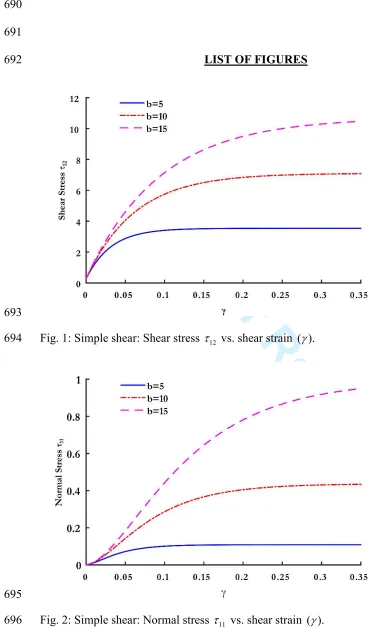
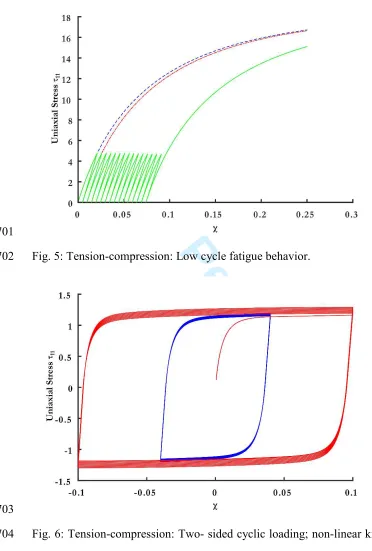
The results are shown in Fig. 1 and Fig. 2 for the shear
τ
12 and the normalτ
11stress 471components, respectively. By referring to Fig.1, we observe that the model predicts 472
continuous stress-deformation curves, with a non-unambiguously specified elastic portion
473
and a non-well defined yield stress, which as the deformation increases converge to a
474
(constant) stress which may be defined as the material ultimate strength; we note that the 475
higher the value of ,
β
the higher is the predicted ultimate strength. Such a response is in 476absolute accordance with the one exhibited by almost all advanced metallic alloys; 477
compare for instance the predicted behavior with the ones reported by Chen et al. in [8]. 478
479
480
5.2 Tension-compression tests
481
482
As a second example we discuss the predictions of the model for some tension-483
compression tests. These tests, in general, are defined as 484
1 (1 ) 1, 2 (1 ) 2, 3 (1 ) 3,
x = +
χ
X x = +ψ
X x = +ψ
X485
where 1+
χ
( )t and 1+ψ
( )t are the principal stretches along the longitudinal and the 486transverse directions respectively. By means of this example we’ll demonstrate the ability 487
of the model in predicting several patterns of the real response of metals which cannot be 488
For Peer Review
As a first simulation we consider a loading history comprising loading-unloading-490
reloading. The results for two different values of the parameter R and a constant value of 491
( =5),
β β
are shown in Fig. 3. In this case we verify the ability of the model to predict 492the real response of metals - recall section 3 - according to which, the reloading, 493
following (plastic) loading and subsequent (elastic) unloading, results at plastic 494
deformation at any stress level. Moreover, depending on the value of R, the reloading 495
curve may or may not converge (asymptotically) to the monotonic loading curve. The 496
later pattern of response corresponds to the so-called long-term or permanent softening
497
effect (see, e.g., [39,37]), which plays an important role in the numerical simulation and
498
design of metal sheets in forming processes. This phenomenon appears alike in a (two-499
sided) tension-compression test (see Fig. 4). 500
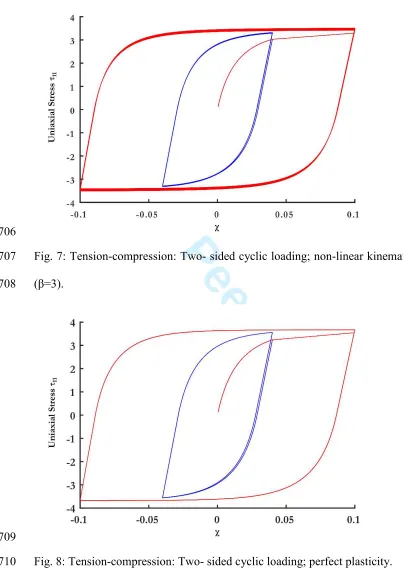
As a second simulation we study the (low cycle) fatigue behavior at low stress levels 501
(see Fig. 5). For this purpose we perform a loading-unloading-reloading test at a small 502
stress level, by selecting a value for R (R=30), such as the reloading curve convergences 503
to the corresponding loading curve. Next, we perform a loading-unloading test, but now 504
the specimen is subjected to a cyclic loading with stress amplitude equal to the stress 505
level where the (first) unloading began. Upon referring to the results of Fig. 5, we note 506
the ability of the model in predicting (real) material behavior, which consists of the 507
appearance of residual strains - apparently plastic - and accumulation of plastic work. 508
Moreover, due to the material fatigue, permanent softening phenomena appear in a rather 509
For Peer Review
As a final simulation, we consider the case where the material is subjected to (two-511
sided) cyclic loading. For this problem we consider that the kinematic hardening law (27) 512
may be replaced by the standard (non-linear) Armstrong-Frederic hardening law, i.e. 513
2
= ,
3
Lva HLvbe−La
κ
&514
where L is the non-linear (kinematic) hardening modulus. The remaining model 515
parameters are set equal to 516
300.00, =0.3, R=30.00, 0.10, 0.3, 30.
E=
ν
K = H = L=517
The results of this test, for two different values of the parameter
β
are shown in Figs. 6 518and 7. The model predicts stresses which are increasing as the number of cycles increases 519
and eventually stabilize at a constant value after a few cycles. This response constitutes 520
the very essence of the cyclic behavior of mild steels (see, e.g., Fig. 6a in [39]). The 521
predictions of the model in the absence of hardening mechanisms (K =H = =L 0) are 522
also presented in Fig. 8 ( =3).
β
In this case, the model has the ability to predict almost 523stabilized stress-deformation curves from the first cyclic of strain. This response is 524
identical to the one exhibited by dual-phase high strength steel specimens (see, e.g., 525
figure 6b in [39]) 526
527
528
6. Concluding remarks
529
530
The basic impact of this paper relies crucially in providing deeper insights into the 531
For Peer Review
i. Motivated by a question posed in a very recent paper by Xiao et al. [37], we 533
have shown how the basic concepts in plasticity theory can be introduced in a 534
purely mathematical manner, upon studying the properties of a suitably 535
formulated differential equation and involving the basic concepts of loading and 536
unloading. The proposed formulation is rather general and includes classical 537
plasticity as a special case. 538
ii. We have revisited the quasi-yield surface concept by clarifying some basic 539
theoretical issues related to it. 540
iii. We have shown how the concept can be applied in the constitutive modeling of 541
solid materials and in particular in metals, upon developing a rather simple 542
material model. 543
Moreover, we have implemented the model numerically and we have demonstrated its 544
ability in predicting several patterns of the complex response of metals which cannot be 545
predicted by the conventional plasticity models. 546
547
548
References
549
[1] R. Abraham, J. E. Marsden and T. Ratiu. Manifolds, tensor analysis and 550
applications, 2nd edition. Springer-Verlag, New York Inc. (1988). 551
552
[2] S. N. Atluri. On the constitutive relations at finite strain. Hypo-elasticity and elasto- 553
plasity with isotropic or kinematic hardening. Computer Methods Appl. Mech. Engrg. 554
43, 137-171 (1984). 555
556
[3] J. E. Bell. The Experimental Foundations of Solid Mechanics. In: Handbuch der 557
Physik, BandVIa/1, ed. C. Trusesdell, Springer, Berlin (1973). 558
559
[4] A. Bertram. An alternative approach to finite plasticity based on material 560
For Peer Review
562
[5] A. Bertram and M. Kraska. Description of finite plastic deformations in single 563
crystals by material isomorphisms. In: Proceedings of IUTAM & ISIMM Symposium 564
on “Anisotropy, Inhomogeneity and Nonlinearity in Solid Mechanics”, 30.8.-3.9.94 565
Nottingham, eds. D. F. Parker, A. H. England, KLUWER Academic Publ. 39, 77-90 566
(1995). 567
568
[6] S. S. Bodner. Constitutive equations for dynamic material behavior. In: Mechanical 569
Behavior of Materials under Dynamic Loads, Symp. San Antonio, ed. U. S. Lidholm, 570
Springer-Verlag, New York 176-190 (1968). 571
572
[7] S. R. Bodner and Y. Partom. Constitutive equations for elastic-viscoplastic strain 573
hardening materials. J. Appl. Mech. 39, 385-389 (1975). 574
575
[8] Z. Chen, H. J. Bong, D. Li and R. H. Wagoner. The elastic–plastic transition of 576
metals. Int. J. Plast. 83, 178-201 (2016). 577
578
[9] A. F. Cheviakov, J. F. Ganghoffer and R. Rahouadj. Finite strain plasticity models 579
revealed by symmetries and integrating factors: The case of Dafalias spin model. Int. 580
J. Plast. 44, 47-67 (2013). 581
582
[10] M. A. Eisenberg and A. Phillips. A theory of plasticity with non-coincident yield and 583
loading surfaces. Acta Mech. 11, 247-260 (1971). 584
585
[11] M. Hollenstein, M. Jabareen and M. B. Rubin. Modeling a smooth elastic-inelastic 586
transition with a strongly objective numerical integrator needing no iteration. Comp. 587
Mech. 52, 649-667 (2013). 588
589
[12] M. Jabareen. Strongly objective numerical implementation and generalization of a 590
unified large inelastic deformation model with a smooth elastic-inelastic transition. 591
Int. J. Eng. Sci. 96 46-67 (2015) 592
593
[13] E. Kroner and C. Theodosiu. Lattice defect approach to plasticity and viscoplasticity. 594
In: Problems of Plasticity, ed. A. Swaczuk, Noordoff, Leyden, 45-88 (1972). 595
596
[14] E. H. Lee. Elastic-plastic deformations at finite strains. J. Appl. Mech. 36, 1-6 597
(1969). 598
599
[15] C.-S. Liu and H.-K.Hong. Using comparison theorems to compare corrotational rates 600
in the model of perfect elastoplasticity. Int. J. Solids Struct. 38, 2969-2987 (2001). 601
602
[16] J. Lubliner. On the structure of the rate equations of material with internal variables. 603
Acta Mech. 17, 109–119 (1973). 604
605
[17] J. Lubliner. A simple theory of plasticity. Int. J. Solids Struct. 10: 313-319 (1974). 606
For Peer Review
[18] J. Lubliner. On loading, yield and quasi-yield surfaces in plasticity theory. Int. J. 608
Solids Struct. 11: 1011-1016 (1975). 609
610
[19] J. Lubliner. An axiomatic model of rate-independent plasticity. Int. J. Solids Struct. 611
16: 709-713 (1980). 612
613
[20] J. Lubliner. A maximum-dissipation principle in generalized plasticity Acta 614
Mech. 52: 225-237 (1984). 615
616
[21] J. Lubliner. Plasticity Theory. Macmillan, New York (1990). 617
618
[22] J. Lubliner. A simple model of generalized plasticity Int J. Solids Struct. 28: 769- 619
778 (1991). 620
621
[23] J. Lubliner, R. L. Taylor and F. Auricchio. A new model of generalized plasticity 622
and its numerical implementation. Int J. Solids Struct. 30: 3171-3184 (1993). 623
624
[24] M. Lucchesi and P. Podio-Guidugli. Materials with elastic range: a theory with a 625
view toward applications. Part II. Arch. Rat. Mech. Anal. 110, 9-42 (1992). 626
627
[25] J. Mandel. Plasticite′classique et viscoplasticite .′ Courses and Lectures, No 97. 628
International Center for Mechanical Sciences, Udine, Springer, New York (1971). 629
630
[26] V. P. Panoskaltsis VP, L. C. Polymenakos and D. Soldatos. Eulerian structure of 631
generalized plasticity: Theoretical and Computational Aspects. J. Engng. Mech. 632
ASCE 134, 354-361 (2008). 633
634
[27] V. P. Panoskaltsis, D. Soldatos and S. P. Triantafyllou. The concept of physical 635
metric in rate-independent generalized plasticity. Acta Mech. 221, 49-64 (2011). 636
637
[28] V. P. Panoskaltsis VP, L. C. Polymenakos and D. Soldatos. A finite strain model 638
of combined viscoplasticity and rate-independent plasticity without a yield surface. 639
Acta Mech. 224, 2107-2125 (2013). 640
641
[29] V. P. Panoskaltsis and D. Soldatos. A phenomenological constitutive model of non 642
-conventional elastic response. Int. J. Appl. Mech. 5 DOI: 643
10.1142/S1758825113500361 (2013). 644
645
[30] A. C. Pipkin and R. S. Rivlin. Mechanics of rate-independent materials. Z. Angew. 646
Math. Phys. 16, 313-327 (1965). 647
648
[31] M. B. Rubin. An elastic-viscoplastic model for large deformation. Int. J. Engng. 649
Sci., 24, 1083-1095 (1986). 650
651
[32] M. B. Rubin. An elastic-viscoplastic model exhibiting continuity of solid and fluid 652
For Peer Review
654
[33] J. C. Simo. A framework for finite strain elastoplasticity based on maximum plastic 655
dissipation and the multiplicative decomposition: Part I. Continuum Formulation. 656
Computer Methods Appl. Mech. Engrg. 66, 199-219 (1988). 657
658
[34] J. C. Simo and T. J. R. Hughes. Computational inelasticity. Springer-Verlag New 659
York, Inc. (1997). 660
661
[35] D. Soldatos and S. P. Triantafyllou. Logarithmic spin, Logarithmic rate and material 662
frame-indifferent generalized plasticity. Int. J. Appl. Mech. 08, 1650060 (2016). 663
664
[36] H. Stumpf and U. Hoppe. The application of tensor algebra on manifolds to non- 665
linear continuum mechanics. Invited survey article. Z. Angew. Math. Mech. 77, 327- 666
339 (1997). 667
668
[37] L. Sun and R. H. Wagoner. Proportional and non-proportional hardening behavior 669
of dual-phase steels. Int. J. Plast. 45, 174-187 (2013). 670
671
[38] H. Xiao, O. T. Bruhns and A. Meyers. Free rate-independent elastoplastic equations. 672
Z. Angew. Math. Mech. 94, 461-476 (2014). 673
674
[39] F. Yoshida, T. Uemori and K. Fujiwara. Elastic-plastic behavior of sheet steels under 675
in-plane cyclic tension-compression at large strain. Int. J. Plast. 18, 633-659 (2002). 676
677
[40] Kubo, R., Some aspects of the statistical-mechanical theory of irreversible processes. 678
Lectures in theoretical physics, 1, pp.120-203 (1959). 679
680
681
682
683
684
685
686
687
688
For Peer Review
690
691
LIST OF FIGURES
692
[image:31.612.50.426.75.711.2]693
Fig. 1: Simple shear: Shear stress
τ
12 vs. shear strain ( ).γ 694695
For Peer Review
697
Fig. 3: Tension-compression: Loading-unloading-reloading (one-sided). 698
699
For Peer Review
[image:33.612.58.430.73.624.2]701
Fig. 5: Tension-compression: Low cycle fatigue behavior.
702
[image:33.612.103.419.87.317.2]703
Fig. 6: Tension-compression: Two- sided cyclic loading; non-linear kinematic hardening 704
For Peer Review
706
Fig. 7: Tension-compression: Two- sided cyclic loading; non-linear kinematic hardening 707
(β=3). 708
[image:34.612.56.459.73.643.2]709