For Review Only
Task-dependent evaluative processing of moral and emotional content during comprehension: An ERP study
Journal: Cognitive, Affective, and Behavioral Neuroscience Manuscript ID CABN-RA-17-061.R2
Manuscript Type: Research Article Date Submitted by the Author: n/a
Complete List of Authors: Kunkel, Angelika; Eberhard Karls Universitat Tubingen Psychologisches Institut, Psychology
Filik, Ruth; The University of Nottingham, Psychology
Mackenzie, Ian; University of Tübingen, Psychological Institute Leuthold, Hartmut; University of Tuebingen, Psychology
For Review Only
Running head: Evaluative processing of moral and emotional content
Task-dependent evaluative processing of moral and emotional content during
comprehension: An ERP study
Angelika Kunkel
Department of Psychology, University of Tübingen, Germany
Ruth Filik
School of Psychology, University of Nottingham, United Kingdom
Ian Grant Mackenzie & Hartmut Leuthold
Department of Psychology, University of Tübingen, Germany
Address correspondence to: Angelika Kunkel
Department of Psychology
Eberhard Karls University of Tübingen Schleichstrasse 4
72076 Tübingen Germany
Email: [email protected] Phone: +49 (0)7071 29-75590
For Review Only
Abstract
Recently, we showed that when participants passively read about moral transgressions (e.g.,
adultery) they implicitly engage in the evaluative (good–bad) categorization of incoming
information, as indicated by a larger event-related brain potential (ERP) positivity to immoral
than moral scenarios (Leuthold, Kunkel, Mackenzie, & Filik, 2015). Behavioral and
neuroimaging studies indicated that explicit moral tasks prioritize the semantic-cognitive
analysis of incoming information but that implicit tasks, as used in Leuthold et al. (2015),
favor their affective processing. Therefore, it is unclear whether an affective categorization
process is also involved when participants perform explicit moral judgments. Thus, in two
experiments, we used similarly constructed morality and emotion materials for which their
moral and emotional content had to be inferred from the context. Target sentences from
negative vs. neutral emotional scenarios and from moral vs. immoral scenarios were
presented using rapid serial visual presentation. In Experiment 1, participants made moral
judgments for moral materials and emotional judgments for emotion materials. Negative
compared to neutral emotional scenarios elicited a larger posterior ERP positivity (LPP)
about 200 ms after critical word onset, whereas immoral compared to moral scenarios elicited
a larger anterior negativity (500-700 ms). In Experiment 2, where the same emotional
judgment to both types of materials was required, a larger LPP was triggered for both types
of materials. These results accord with the view that morality scenarios trigger a
semantic-cognitive analysis when participants explicitly judge the moral content of incoming linguistic
information but an affective evaluation when judging their emotional content.
Keywords: Moral judgment, emotion judgment, affective evaluation, LPP, anterior negativity
For Review Only
We often find ourselves in situations in which a person is violating a prevailing social norm
or moral value. For instance, if we find out that someone cheats in an exam or is telling a lie,
we tend to spontaneously judge such behavior as bad or immoral. This reflects a fundamental
aspect of human moral cognition and it has been proposed that such judgments are based on
affective or intuitive processes (Greene, Sommerville, Nystrom, Darley, & Cohen, 2001;
Haidt, 2001). In line with this view, a recent event-related brain potential (ERP) study
demonstrated that when participants passively read about everyday moral transgressions, they
implicitly categorize the described behaviors as good or bad as early as about 320 ms after
the presentation of the critical word (cf. Leuthold, Kunkel, Mackenzie, & Filik, 2015), which
was argued to be reflected by a late posterior positivity (LPP). However, there is also
evidence in the literature suggesting that the semantic-cognitive analysis of incoming
information dominates when explicit morality judgments are required, whereas the affective
analysis is prioritized when emotion judgments are demanded (cf. Lai, Hagoort, & Casasanto,
2012; Sevinc & Spreng, 2014). Therefore, it remains unclear whether such a rapid evaluation
process, as indicated by the LPP during a passive reading task, indeed would be found for
explicit moral judgments as well. In addition, we aim to provide further support for the
proposal that the LPP reflects affective processing of incoming information by also
investigating whether an LPP is elicited by similarly constructed everyday emotional
scenarios without a moral component. To this end, we will record ERPs that are elicited by
scenarios describing moral transgressions and emotional events, to see whether, and to what
extent, cognitive and affective processes are involved during discourse comprehension when
explicit moral or emotional judgments are required.
Van Berkum, Holleman, Nieuwland, Otten, and Murre (2009) are to our knowledge
the first to use a text comprehension approach to reveal the ERP correlates of moral
cognition. Specifically, they investigated whether and how rapidly an individual’s values
For Review Only
influence the online linguistic meaning analysis of moral statements when explicit judgments
were required. Male participants with two opposing value systems (members of a Dutch
strict-Christian party vs. voters of parties with opposite moral-ethical programs, referred to
here as non-Christians) were asked to rate their agreement with critical statements such as, "If
my child were homosexual, I’d find this hard/easy to accept". The individual words forming
these statements were presented using rapid serial visual presentation (RSVP), affording the
measurement of immediate ERP responses to the critical word. They found that
value-inconsistent compared to value-consistent critical words (e.g., easy vs. hard for
strict-Christians and hard vs. easy for non-strict-Christians, respectively) initially elicited a larger
broadly distributed positivity between 200 and 250 ms (P200), followed by a larger
centroparietal negativity between 375 and 425 ms (N400), and finally a larger LPP between
500 and 650 ms.
N400 amplitude has been shown to respond to the predictability of a word within a
given context (e.g., Kutas & Hillyard, 1984), to semantic anomalies at the discourse level
(Van Berkum, Hagoort, & Brown, 1999), as well as to violations of world knowledge (e.g.,
Filik & Leuthold, 2008; Hagoort, Hald, Bastiaansen, & Petersson, 2004), reflecting the
demands of meaning construction (for a review, see Kutas & Federmeier, 2011). Thus, Van
Berkum et al. (2009) interpreted, their N400 findings as indicating that readers immediately
and automatically evaluate incoming information with respect to their personally held values,
giving rise to a rapid value-based influence on meaning construction. They further speculated
that this N400 effect overlaps with that of a single sustained ERP positivity that has an earlier
onset than the (overlapping) N400, therefore emerging as a larger P200 and LPP for
value-inconsistent than value-consistent statements. Van Berkum and colleagues ruled out a
cognitive, decision-related account of this LPP effect for two reasons. Firstly, it has been
demonstrated that self-referential (true vs. false) statements that are unrelated to a person's
For Review Only
value system do not elicit such an effect (Fischler, Bloom, Childers, Arroyo, & Perry, 1984).
Secondly, negative compared to positive and neutral stimuli tend to elicit a larger LPP -
reflecting a negativity bias in affective processing (e.g., Ito, Larsen, Smith, & Cacioppo,
1998) - even in language studies where participants either merely read for comprehension or
made explicit decisions to critical emotion words (e.g., Holt, Lynn, & Kuperberg, 2009).
Therefore, Van Berkum et al. took their LPP effect to reflect the automatic activation of the
affect system, in accord with the view that the LPP relates to the implicit evaluative
processing of motivationally salient stimuli (cf. Hajcak, MacNamara, & Olvet, 2010).
However, in Van Berkum et al.'s (2009) study, the values held by the participants
may have constrained their (implicit) expectations regarding the likely sentence endings. For
instance, when persons holding strict Christian values read a statement (taken from their
Table 1) beginning with "In a bad marriage, divorce is an ...", based on their personal beliefs,
they would not expect it to be continued with the word "acceptable". Hence, similar to N400
effects driven by discourse- or world-knowledge-based expectations (e.g., Filik & Leuthold,
2008; Hagoort et al., 2004; Van Berkum et al., 1999), it is conceivable that the larger N400
elicited by value-inconsistent than value-consistent statements reflects an (implicit) emotional
congruity effect that depends on the relation between the emotional features of the preceding
context and the critical word.1 Crucially, a larger N400 to emotion words that were
incongruent rather than congruent with the preceding context has been shown not only in
studies using sequential prime-target tasks (e.g., Eder, Leuthold, Rothermund, &
Schweinberger, 2012; Morris, Squires, Taber, & Lodge, 2003; Zhang, Lawson, Guo, & Jiang,
2006; but see Herring, Taylor, White, & Crites, 2011) but also in discourse comprehension
studies using strongly constraining emotional contexts, for instance, when someone is
described as being happy in a context which outlines either a positive or a negative event
(e.g., León, Díaz, de Vega, & Hernández, 2010; Leuthold, Filik, Mackenzie, & Murphy,
For Review Only
2012). Accordingly, the N400 effect might reflect the more intense lexical or semantic
processing for incongruent than congruent moral statements, that is, a morality-unspecific
language-related effect. If this conjecture would hold true, Van Berkum and colleagues'
interpretation of the P200 and LPP effect in terms of an affective evaluation of statements
could be challenged as well. That is, the P200 effect reported might be attributed to the
enhanced visual processing of incongruent or very unexpected linguistic inputs (e.g., Bohan,
Leuthold, Hijikata, & Sanford, 2012; Ferretti, Singer, & Patterson, 2008; Leuthold et al.,
2015), and the larger LPP following incongruent statements might reflect a P600-like
semantic effect that is found in response to various types of semantic anomalies (for a review,
see Kuperberg, 2007) and has been related to a continued reanalysis of linguistic input
following a semantic processing conflict (cf. Kuperberg, 2007; Van de Meerendonk, Kolk,
Chwilla, & Vissers, 2009).
A recent text comprehension study by Leuthold et al. (2015) used a different
approach to examine the implicit rather than explicit evaluative processing of everyday
(fictional) scenarios that involved descriptions of moral transgressions (e.g., cheating on one's
partner). Specifically, participants read the scenario context followed by the RSVP of the
target sentence containing the critical word (cf. Table 1). The context determined whether the
target sentence described a moral or an immoral event. As a control, participants read
materials in which the target sentence was either consistent or inconsistent with their
knowledge of the world, to assess the ERP correlates elicited by the linguistic processing of
moral-neutral world knowledge violations (e.g., a target sentence of “She receives as a dish a
plate full of snails and white bread.”, following a context that would make this statement
either consistent with the participants’ knowledge of the world, e.g., “During a France
exchange Mrs. Lehmann eats a famous French specialty.” or inconsistent, e.g., “Mrs.
For Review Only
Lehmann goes to a Schwabian restaurant and orders a local specialty.”). Morality and world
knowledge materials were randomly interleaved and no explicit judgments were required.
Crucially, a larger P200 amplitude was found both for moral transgressions and for
world knowledge violations, indicating domain-unspecific, enhanced attentive processing of
materials conflicting with the discourse context. Subsequently, a large posterior N400 was
found for general world knowledge violations only. In accord with previous studies from our
lab (e.g., Filik & Leuthold, 2008; 2013) and with the N400 literature in general (cf. Kutas &
Federmeier, 2011), this was taken to reflect the increased semantic memory demands
involved in retrieving and integrating conceptual information during meaning construction
when knowledge-based expectations are violated (e.g., Filik & Leuthold, 2008; Hagoort et
al., 2004). By contrast, moral transgressions did not trigger a larger N400 but only a larger
central-maximal ERP positivity after about 320 ms. Leuthold and colleagues took this finding
to reflect an LPP effect, proposing that incoming socio-normative information is, during a
first step, implicitly evaluated and categorized as good or bad (see also Cunningham &
Zelazo, 2007). This is in line with theoretical views that assume a central role of
emotional-intuitive processes for moral judgment (Greene et al., 2001; Haidt, 2001).
More generally, the ERP study of Leuthold et al. (2015) demonstrates the
practicality of approaching the (implicit) mechanisms contributing to moral cognition by
having participants read fictional scenarios with moral content. In contrast to Van Berkum et
al. (2009), a passive reading task was used in which the moral versus immoral nature of the
(identical) target sentences had to be inferred depending on the discourse context. That is, the
materials did not involve incongruent moral statements but instead described scenarios that
participants in a pre-test had judged as either clearly morally good versus bad, which would
explain the absence of an N400 (congruity) effect. Also, since no explicit moral judgments
were required, we consider it more likely that the LPP effect reported by Leuthold et al.
For Review Only
reflects the implicit (affective) evaluation of morality-related materials. Emotion effects on
the ERP waveform are known to depend on the emotional features of the critical item (e.g.,
valence, arousal), with emotional stimuli such as positive or negative words, pleasant and
unpleasant pictures, and arousing stimuli reliably eliciting larger LPP amplitudes than neutral
or less arousing stimuli, and this effect is more pronounced when participants judge the
emotional content (e.g., in an affective judgment task) rather than an emotion-irrelevant
stimulus dimension (e.g., in a semantic classification or passive reading task) (for reviews,
see Citron, 2012; Fischler & Bradley, 2006; Hajcak, Weinberg, MacNamara, & Foti, 2012).
Hence, it seems reasonable to assume that the LPP elicited in the Leuthold et al. study reflects
an emotion effect.
As stated above, the study conducted by Leuthold et al. (2015) did not involve any
explicit judgment task. However, there is behavioral evidence suggesting that task demands
influence whether an affective versus semantic-cognitive analysis is prioritized (e.g., Lai et
al., 2012). Importantly, for the present purposes, evidence from functional magnetic
resonance imaging (fMRI) studies corroborates this conjecture for the processing of moral
content. That is, fMRI studies consistently indicate that brain areas concerned with both
cognitive and emotional processing are activated during moral judgment tasks using dilemma
scenarios (e.g., Greene et al., 2001) and socio-normative scenarios (e.g., Moll, de
Oliveira-Souza, Bramati, & Grafman, 2002). Crucially, in a meta-analysis of a total of 40 fMRI
studies (Sevinc & Spreng, 2014), brain areas concerned with cognitive processing were more
strongly activated than areas linked to emotional processing in studies using explicit moral
judgment tasks, whereas the reverse pattern of brain activation was found in studies using
implicit (e.g., reading) tasks. In line with these findings, evidence from social cognition
research suggests that the impact of automatic evaluations is reduced when participants
deliberately rather than implicitly process incoming information (e.g., Bargh, Chaiken,
For Review Only
Raymond, & Hymes, 1996). Of course, given the limited temporal resolution of fMRI, the
precise time course of task-dependent emotional versus cognitive influences on moral
judgments is not yet completely understood (Avramova & Inbar, 2013). Thus, it is essential
to investigate this issue using a combined behavioral and ERP approach in order to test
whether an explicit moral judgment task would enforce a semantic-cognitive analysis of
morality materials as indicated by the N400. We will address this issue by conducting an
experiment in which participants read the materials used by Leuthold et al., but in the context
of an explicit morality judgment task.
If one assumes that moral acceptability is inferred from the context and involves the
affective evaluation of linguistic input, it is important to assess whether similarly constructed
emotional materials without moral content also elicit an LPP effect. At present, we are not
aware of any published ERP studies investigating the processing of materials where target
sentences are identical across conditions, and the emotional meaning of the target needs to be
inferred from the context in which it appears. Specifically, previous ERP studies examining
discourse-based emotion effects used contexts that were strongly constraining (e.g., León et
al., 2010; Leuthold et al., 2012) or employed materials for which the critical words differed
across emotion conditions (e.g., Delaney-Busch & Kuperberg, 2013; Holt et al., 2009; León
et al., 2010). For example, Delaney-Busch and Kuperberg found a larger N400 (300-500 ms)
for incongruent than congruent neutral words following a neutral context, and this congruity
effect was larger over anterior than posterior midline electrodes. Crucially, when an
emotional discourse context preceded valence congruent or incongruent emotion words, no
congruity effect was observed in N400 amplitude. Rather, a larger LPP (500-700 ms) to
pleasant and unpleasant emotion words was elicited irrespective of the valence of the
preceding emotional discourse context. In accordance with the affective primacy hypothesis
(Storbeck & Clore, 2007), these findings led Delaney-Busch and Kuperberg to suggest that
For Review Only
for emotional contexts, the processing of incoming information is dominated by the analysis
of their motivational (e.g., approach vs. avoidance) rather than semantic significance. It is
therefore unclear whether emotion materials for which the target sentences and the critical
(emotion) words are identical across conditions, and hence the emotional meaning has to be
inferred from the discourse context, elicit an LPP effect as well. Thus, it is also a major aim
of the current work is to close this research gap concerning our understanding of emotional
language processing, and this is suited to strengthen the interpretation of the LPP as reflecting
the affective evaluation of linguistic input during discourse comprehension.
Objectives of the present study
In summary, it remains to be investigated first whether the rapid affective
evaluation of descriptions of moral transgressions during text comprehension (i.e., when there
is no explicit judgment task), as inferred from the LPP effect by Leuthold et al. (2015), is also
observed when participants perform explicit moral judgments. If such an LPP effect but no
N400 effect would be present, this outcome would lend support to the view that incoming
linguistic information undergoes an implicit (or task-independent) affective evaluation. By
contrast, if these task conditions enforce a semantic-cognitive analysis of morality materials,
a larger N400 to immoral than moral items should be triggered. Second, it is crucial to
investigate the electrophysiological correlates of discourse-based emotion comprehension,
specifically, whether an LPP effect is also elicited when the emotional meaning is inferred
from the discourse context. The assumption that the LPP indicates the discourse-dependent
affective processing of linguistic input, as assumed in the moral ERP study of Leuthold et al.
(2015), would be corroborated by showing that for the same participants,
discourse-dependent negative compared to neutral (or positive) items elicit a similar LPP effect to
discourse-dependent immoral compared to moral items. Therefore, we created novel emotion
For Review Only
materials that were similar to the morality materials with regard to critical dimensions such as
the cloze probability of the critical words, their semantic relatedness to the discourse context,
critical word frequency, as well as their emotionality in terms of valence and arousal (cf.
Methods). Of course, since morality and emotion materials differ with regard to the wording
of the critical sentences and hence are not matched regarding all potentially relevant
word-level or discourse-word-level dimensions, this allows only an indirect comparison of the ERP
effects triggered by these materials.
We recorded ERPs in two experiments to investigate task-related influences on the
online processing of scenarios describing everyday moral compared to emotional situations
and the nature of the underlying, potentially affective, processes. Thus, our setup was
identical to that of Leuthold et al. (2015) except that (a) instead of world knowledge
violations, we used emotional scenarios without moral content as a control condition, and (b)
that participants performed explicit judgments of the materials. More specifically, we used
prototypical scenarios for which the protagonists and situations were introduced by the
context sentences (for an example, see Table 1).
For morality materials, the target sentence either described a morally acceptable or
unacceptable (that is, moral vs. immoral) action, and for emotion materials, the target
sentence described either a relatively neutral versus a negative event, which was determined
by the context for both materials.
--- Table 1 about here ---
We used RSVP for the final critical sentence, with participants performing their judgment
response (yes/no) after the presentation of the final word. We chose a binary judgment task in
line with recent moral dilemma and moral judgment studies (e.g., Greene et al., 2001). In
Experiment 1 participants made moral judgments for morality materials (i.e., “Is the behavior
For Review Only
morally acceptable?”) and emotional judgments for emotion materials (i.e., “Are you
emotionally moved by the text?”). Experiment 2 required emotional judgments for both types
of material.
Generally, we hypothesized that linguistic input is affectively evaluated, that is,
independently of the specific content of the materials (cf. Bargh et al., 1996; Cunningham &
Zelazo, 2007). It is then reasonable to assume that moral actions and neutral (or mildly
positive) events are evaluated as potentially "good" and immoral and negative events as
potentially "bad". Since such differential affective evaluations are taken to be reflected by the
LPP component (cf. Fischler & Bradley, 2006; Hajcak et al., 2012), LPP amplitude should be
larger for both immoral and negative compared to moral and neutral (or mildly positive)
scenarios. We further reasoned that if these evaluations are automatic in the sense that they
are produced by a fast-operating process that is independent from task goals, qualitatively the
same LPP effects should be observed in the two experiments for immoral versus moral
scenarios. However, if the requirement to judge the moral content prioritizes the
semantic-cognitive processing of linguistic input in Experiment 1, a larger N400 rather than a larger
LPP might be elicited for immoral than moral items.
Experiment 1
Participants were presented with morality and emotional scenarios in separate blocks of trials.
In the case of a morality scenario, they judged whether someone’s behavior was acceptable or
not. Here, we predicted that immoral compared to moral scenarios would be judged as less
acceptable, hence producing fewer yes-responses. For emotion materials, participants judged
whether they were emotionally moved by the text or not. We predicted that negative
compared to neutral scenarios are more moving and therefore would produce more
yes-responses.
For Review Only
It is important to note that we performed rating studies (see method section for
details) to assess the moral acceptability of morality items as well their plausibility, valence,
and arousal value and that the same dimensions were assessed for emotion materials (except
their moral acceptability). Based on these results, the morality items were classified as either
moral or immoral while the emotion items were classified as either neutral or negative. This
procedure guarantees that the respective materials are neatly matched across conditions. To
examine whether item-specific arousal and valence characteristics, as obtained from the
rating studies, contribute to present binary emotion and morality judgments in addition to
condition-specific effects, a logistic regression approach was used.2
Moreover, since binary morality and emotion judgments (yes- versus no-response)
are required in the present experiments, it is conceivable that participants may apply decision
criteria that lead, at least sometimes, to judgments that are inconsistent with the rating-based
morality or emotion classification of the materials. That is, some items pre-classified as moral
might be judged as morally unacceptable, or some items pre-classified as negative might be
judged as neutral and vice versa. Therefore, we performed additional ERP amplitude analyses
in waveforms averaged for moral items that were judged as appropriate (yes-response) and
for immoral items judged as inappropriate (no-response). Likewise, such judgment-dependent
ERP analyses were also conducted for neutral items that were judged as not moving
(no-response) and negative items judged as moving (yes-(no-response).
Method
Participants. Thirty-two native German speakers from the University of Tübingen
received course credits or payment for participating. Data from four participants were
excluded due to excessive alpha activity. For all analyses, we used the dataset from the
remaining 28 participants (M = 24.5 years, 19 females).
For Review Only
Materials and design. Morality materials were taken from and modified.3 These
materials consisted of a total of 160 items, resulting from the combination of 80 identical
target sentences each with two different discourse contexts, thereby creating 80 moral and 80
immoral items. The 160 emotion materials were newly generated and analogously
constructed (see Table 1 for examples; the full set is available from the first author). Both
morality and emotion materials were pre-tested (see below).
All scenarios consisted of two parts. The first part consisted of two or three
sentences describing the context, and the second part was the target sentence containing the
critical word. In order to eliminate possible sentence-level and word-based effects, the same
target sentence was used for moral and immoral conditions and the same held true for neutral
and negative emotional conditions (with the context varying across conditions, see Table 1).
The critical word was always presented towards the end of the target sentence, most
frequently as the sentence-final word (84.4%). Critical words were predominantly verbs
describing a certain behavior (e.g., to borrow, to report, to mention, to swap) and nouns (e.g.,
acceptance, alibi, verdict, tumor).
Morality materials described actions that would be perceived as either moral or
immoral, whereas emotion materials would describe a neutral or a negative event. Finally, 40
neutral filler items were constructed which contained no moral or emotional content as well
as no inconsistencies, and were similar in length to the experimental items (e.g., Context
sentence: "Herr Krüger hat kein aktuelles Telefonbuch. Er braucht die Nummer seines
Hausarztes." Target sentence: "Er ruft bei der Auskunft an, um an die Nummer zu gelangen."
[Context sentence: Mr. Krüger does not possess an up-to-date phone book. He needs the
telephone number of his general practitioner. Target sentence: He calls the directory enquiries
service to find out the number.]). Following the presentation of the final word, for the
morality blocks, the following question was displayed on the screen: “Ist das Verhalten
For Review Only
moralisch akzeptabel?” [“Is the behavior morally acceptable?”], and for the emotion blocks:
“Berührt dich das Gelesene?” [“Are you emotionally moved by the text?”].4 Participants
indicated their response (“Ja” [“Yes”] versus “Nein” [“No”]) by pressing the left or right
arrow key on the computer keyboard.
The randomization of items and conditions across participants was performed in the
following way. The two different types of scenario (morality vs. emotion) were presented in
the first versus second half of the experiment, and their order was counter-balanced across
participants. For two consecutive participants, two lists were randomly generated such that
each morality scenario appeared across the two lists either in the moral or the immoral
condition, and each emotion scenario appeared either in the neutral or the negative condition.
That is, the two participants received the same target sentence but with a different context in
order to manipulate either the morality condition (moral vs. immoral) or the emotion
condition (neutral vs. negative). Thus, for each participant, the 200-item list consisted of 40
moral and 40 immoral items, 40 neutral and 40 negative items, as well as 40 neutral filler
items. The fillers were included in order to keep the procedure as similar as possible to the
study of Leuthold et al. (2015) and to reduce a potential influence of extended local runs of
immoral and negative items on ERPs. For instance, after the description of several immoral
behaviors, participants might relax their judgment criteria and view immoral acts as more
acceptable, which could potentially reduce the N400 effect (cf. Baetens, Van der Cruyssen,
Achtziger, Vendekerckhove, & Van Overwalle, 2011).
Pre-test of materials. For the newly created emotion scenarios, we used a
web-based questionnaire to assess the plausibility, valence, and arousal ratings of the materials.
Altogether, we recruited 293 undergraduate students from the University of Tübingen (M =
23.6 years, 204 females). The 160 scenarios (80 items each with two conditions
neutral/negative) were arranged in four lists each containing 40 randomly arranged scenarios
For Review Only
plus the target sentence; each list was rated by no less than 66 participants. Participants were
asked to rate on scales from 1-8 (a) how plausible they found the scenario (“Die beschriebene
Situation ist ...” [The scenario described is ...]: 1 = sehr unrealistisch [very unrealistic] to 8 =
sehr realistisch [very realistic]), (b) their “Erregungszustand” [arousal] in terms of how much
they were emotionally moved by the scenario (1 = nicht ergreifend [not moved at all] to 8 =
stark ergreifend [strongly moved]), and (c) the valence of the materials (1 = sehr negativ
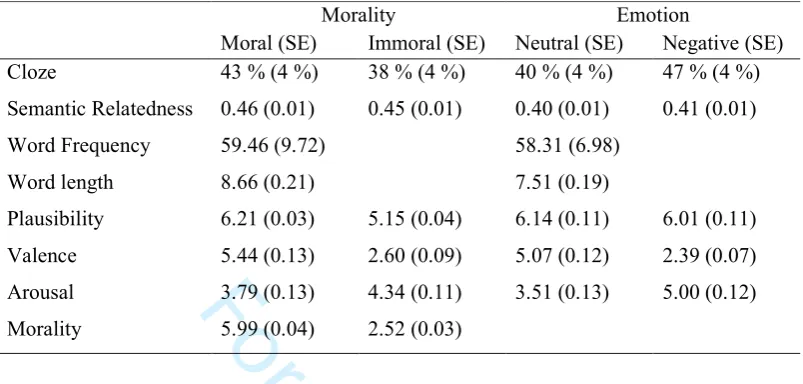
[very negative] to 8 = sehr positiv [very positive]). Two-tailed t-tests (cf. Table 2) showed
that neutral and negative items were rated as being equally plausible (M = 6.01 vs. 6.14),
t(79) = 0.98, p = .33. Furthermore, negative items were rated as being more negative (M =
2.39 vs. 5.07), t(79) = 20.02, p < .001, and more moving than neutral items (M = 5.00 vs.
3.51), t(79) = 9.70, p < .001.
--- Table 2 about here ---
For the morality materials, pre-tests for plausibility and morality were carried out
using a web-based questionnaire (N = 55 participants). On a scale from 1 (sehr unmoralisch;
sehr unrealistisch [very immoral; very unrealistic]) to 8 (sehr moralisch; sehr realistisch [very
moral; very realistic]), moral items were rated as being morally more acceptable than
immoral items (M = 5.99 vs. 2.52), t(79) = 25.93, p < .001, and also as being slightly more
plausible (M = 6.21 vs. 5.15), t(79) = 3.88, p < .001. Additionally, valence and arousal ratings
for the morality materials were collected from a fresh group of participants (N = 40). On a
scale from 1 (sehr negativ; nicht ergreifend [very negative; not emotionally moving]) to 8
(sehr positiv; ergreifend [very positive; emotionally moving]), moral items were rated as
more positive (M = 5.44 vs. 2.60), t(79) = 16.35, p < .001, and less moving (M = 3.79 vs.
4.34), t(79) = 3.20, p < .01, than immoral items.
For Review Only
To compare valence, arousal, and plausibility scores across the two sets of
materials, these rating scores were separately analyzed using ANOVAs with factors material
and condition. Given the above-reported analysis of condition effects, significant results will
only be reported for the main effect of material and the interaction of material and condition.
For plausibility, the main effect of material, F(1, 316) = 15.05, p < .001, and the Material x
Condition interaction were significant, F(1, 316) = 23.88, p < .05, as both neutral and
negative emotion items were more plausible than immoral items, all ps < .001, but were not
more plausible than moral items, all ps > .21. For arousal ratings, the Material x Condition
interaction was significant as well, F(1, 316) = 14.34, p < .001, indicating a stronger
condition effect for emotion than morality materials. Finally, for valence ratings, the main
effect of material was significant, F(1, 316) = 7.48, p < .01, due to a lower valence score for
emotion compared to morality items.
Moreover, all materials were analyzed with regard to critical word frequency, cloze
probability, and semantic relatedness. For calculating word frequencies, we chose the
SUBTLEX-DE corpus (Brysbaert et al., 2011). Two words were not listed in the corpus. The
frequencies (per million) of the remaining critical words did not differ between materials
(morality vs. emotion: M = 59.46 vs. 58.31), t(314) = 0.10, p = .92.
To determine cloze probability, participants were presented with both the context
and the target sentence without the critical word, which they were asked to fill in. Due to an
error, no cloze probability scores were obtained for two moral items and one immoral item.
Cloze probability did not reliably differ between the moral (M = 0.43) and the immoral
condition (M = 0.38), t(155) = 1.04, p = .30, and also not between the neutral (M = .40) and
the negative condition (M = 0.47), t(158) = 1.36, p = .18. There were also no significant
differences in cloze probability for the critical words of morality materials (M = .40) and of
emotion materials (M = 0.43), t(315) = 0.73, p = .46.
For Review Only
Finally, we calculated semantic relatedness as the cosine similarity between the
context and the critical word with the LSAfun package in R and the German dewak100k_lsa
corpus as semantic space (Günther, Dudschig, & Kaup, 2015) based on Latent Semantic
Analysis (LSA) (Landauer, Foltz, & Laham, 1998). Seven critical words of the morality
materials and five critical words of the emotion materials were not listed in the corpus. In a
separate analysis of semantic relatedness scores for the two sets of materials, there was no
significant difference between moral (M = 0.46) versus immoral (M = 0.45) sentences, t(144)
= 0.09, p = .93, and also not between neutral (M = 0.40) versus negative (M = 0.41)
sentences, t(148) = 0.83, p = .41. However, the comparison between materials revealed a
higher semantic relatedness score for morality than emotion materials (M = 0.45 vs. 0.40),
t(294) = 3.44, p < .001.
Procedure. After electrode application, participants were seated in an electrically
shielded booth in front of a 21-in. computer monitor (60 Hz) at a viewing distance of 65 cm
(maintained by a chin rest). Experimental materials (context, words) were presented at the
center of the screen in white 16-point Helvetica font on a black background using the
Psychophysics Toolbox extensions (Brainard, 1997; Kleiner et al., 2007; Pelli, 1997) running
under MATLAB (2012b), on an Apple Mac Mini (OS 10.7.). Participants were instructed to
avoid any eye, head, and jaw movements and to maintain fixation at the center of the screen
during word-by-word presentation. Furthermore, they were instructed to read the stories
attentively, and to perform the respective judgments by pressing the appropriate response
key.
For each of the morality and emotion materials, a practice block containing three
trials preceded the experimental items that were presented in a total of four blocks of 25 items
each. Blocks were separated by a short break that was controlled in its duration by the
participant. Participants started a trial block by pressing the space bar. Then, the context was
For Review Only
displayed for a minimum duration of 1,500 ms. When participants had read the context
sentences, they initiated the word-by-word presentation of the target sentence by pressing the
space bar, which started with the presentation of a fixation point for 1000 ms. Then, each
word was displayed centrally for 300 ms, with a 200-ms blank interval between successive
word presentations. After the offset of the final word and a blank interval of 1,100 ms, the
presentation of the decision screen followed, stating the mapping of judgments (yes-no) to
response keys. This mapping was constant within a given participant but counterbalanced
across participants.
Electrophysiological measures. Electroencephalographic (EEG) activity was
recorded continuously without online low-pass filtering from 72 Ag-AgCl electrodes using a
BIOSEMI Active-Two DC-amplifier system with a sampling rate of 512 Hz for EEG and
electrooculogram (EOG). All EEG/ERP analyses were performed using available MATLAB
toolboxes (EEGLAB: Delorme & Makeig, 2004; FieldTrip: Oostenveld, Fries, Maris, &
Schoffelen, 2011) and custom MATLAB scripts (for details, see Dudschig, Mackenzie,
Strozyk, Kaup, & Leuthold, 2016). The analysis epoch started 200 ms prior to the onset of the
critical word and lasted for 1,700 ms. For preprocessing purposes, signals from all EEG
channels were off-line recalculated to an average reference and high-pass filtered
(Butterworth filter, 0.1 Hz, 12 dB/oct). (Ocular) artifacts were then removed and EEG data
were corrected (for a similar procedure, see Nolan, Whelan, & Reilly, 2010). As in Dudschig
et al., a predefined z-score threshold of ±3 was used to identify outliers relating to channels,
epochs, independent components, and single-channels in single-epochs. Firstly, epochs
containing extreme values in single electrodes (e.g., amplifier blockings, values larger ±1000
µV in any electrode) were removed, as were trials containing values exceeding ±75 µV in
multiple electrodes that were unrelated to eye movements. Secondly, z-scored variance
measures were calculated for all electrodes, and noisy EEG electrodes (z-score > ±3) were
For Review Only
removed if their activity was uncorrelated to EOG activity. Thirdly, a spatial independent
components analysis (ICA) based on the infomax algorithm (Bell & Sejnowski, 1995) was
performed on the "cleaned" EEG data set and ICA components reflecting ocular activity
(blinks and horizontal eye movements) were removed from this data set (M[removed
components] = 3.4). Fourthly, previously removed noisy channels (M = 2.35, range = 0 to 5)
were interpolated in the ICA-cleaned EEG data set using the average EEG activity of
adjacent uncontaminated channels within a specified distance (4 cm, ~ 3-4 neighbours per
electrode) in order to ensure a full electrode array for each participant. The mean number of
trials remaining (M = 36.75 out of 40; range = 21-40, median = 38.0) per condition was not
reliably different across conditions, all ps > .40.
Data analysis. For artifact-free trials, the signal at each electrode site was averaged
separately for each experimental condition, time-locked to the onset of the critical word, and
low-pass filtered (Butterworth filter, 30 Hz, 36 dB/oct). In addition, all EEG channels were
recalculated to an average mastoid reference as in Leuthold et al. (2015) and aligned to a
200-ms baseline prior to the onset of the critical word. To facilitate comparison across studies,
similar to previous moral and emotion comprehension studies, mean ERP amplitudes were
determined for the following time ranges: 200 to 250 ms (P200; as in Leuthold et al, 2015;
Van Berkum et al., 2009), 300 to 500 ms (N400; as in Delaney-Busch & Kuperberg, 2013;
Leuthold et al,, 2015), and 500 to 700 ms (LPP, as in Delaney-Busch & Kuperberg, 2013;
Holt et al., 2009; and similar to Van Berkum et al., 2009). Since P200 effects are typically
larger over anterior midline electrodes (e.g., Bohan et al., 2012; Leuthold et al., 2015),
whereas N400 and LPP effects usually show a more pronounced centroparietal distribution
(e.g., Delaney-Busch & Kuperberg, 2013; Holt et al., 2009; Leuthold et al., 2015; Van
Berkum et al., 2009), midline electrodes were pooled to form an anterior (AFz, Fz, FCz) and
a posterior region-of-interest (ROI; CPz, Pz, POz).
For Review Only
Statistical analyses of reaction times and ERP amplitudes were performed by means
of repeated measures analyses of variance (ANOVA). The analysis of the binary yes-no
judgments were analyzed using a logit model as recommended by Jaeger (2008),
implemented via the glmer function within the lme4 R-package (Bates, Maechler, Bolker, &
Walker, 2014). Separate glmer model fitting procedures were implemented for morality and
emotion materials. The model was specified with fixed effects of condition, valence, and
arousal with random intercepts for participants and items (i.e., answer ~ condition + valence
+ arousal + (1|participants) + (1|items)). For all statistical analyses, the significance level was
set to alpha = .05.
Complementing the standard, condition-dependent ERP analysis,
judgment-dependent ERP analyses were conducted as mentioned in the introduction. That is, we
measured ERP amplitudes in waveforms averaged for moral items that were judged as
acceptable (yes-response) and for immoral items judged as unacceptable (no-response) as
well as for neutral items that were judged as not moving (no-response) and negative items
judged as moving (yes-response). It is worth mentioning that a possible limitation of this
judgment-dependent analysis relates to the fact that, in contrast to the standard analysis, items
might not be perfectly matched (i.e., in terms of contexts and critical words presented) across
the respective experimental conditions. The ANOVA performed on these ERP amplitude data
will be reported after the standard ERP analysis.
Results
Behavioral measures
Separate logistic regression analyses were performed for the emotion and morality materials
to determine the impact of condition, valence, and arousal for the respective binary
judgments. Moral items were more often judged as acceptable than immoral items (84.91 vs.
For Review Only
17.77%, p <.001), and negative items were judged more often as being emotionally moving than neutral items (68.03 vs. 34.29%, p <.001). For moral materials, there was a significant effect of condition (β = -3.23, SE = 0.28, Wald Z = -11.53, p < .001) and valence (β = 0.38,
SE = 0.08, Wald Z = 4.69, p < .001). These results suggest that the likelihood of yes-responses ("acceptable") decreased for immoral items, and increased for more positively
rated items.
For emotion materials, there was a significant effect of condition (β = -0.48, SE = 0.23, Wald Z = -2.06, p < .05), valence (β = -0.30, SE = 0.07, Wald Z = -4.19, p < .001) and arousal (β = 1.15, SE = 0.07, Wald Z = 17.15, p < .001), indicating that the likelihood of yes-responses ("moving") decreased for neutral items and for more positively rated items but
mainly increased for more arousing items.
The separate ANOVAs performed on reaction time (RT) data yielded faster
responses to immoral than moral items (1370 vs. 1603 ms), F(1, 27) = 6.43, p < .05, ηp2 = .19
for the morality materials. For emotion materials, there was a trend for faster responses to
negative than neutral items (1010 vs. 1127 ms), F(1, 27) = 3.80, p = .06, ηp2 = .12.
Electrophysiological measures - condition-dependent ERP results.
ERP waveforms averaged according to the rating-based item classification (as
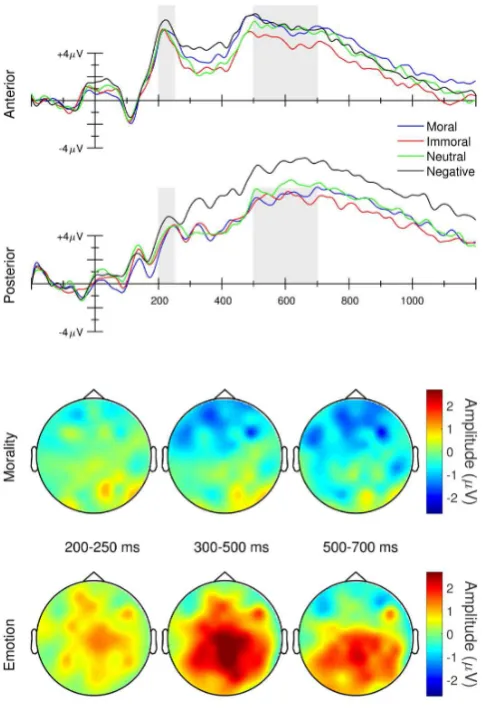
determined by the pre-tests discussed above) are shown in Figure 1. For the ERP data, we
performed separate ANOVAs for morality and emotion materials on mean ERP amplitudes at
midline electrodes with factors condition (moral vs. immoral or emotional-neutral vs.
negative) and ant-post (anterior vs. posterior) ROI.
For both types of materials, analyses of mean ERP amplitudes coincided with an
overall main effect of ant-post, indicating an anterior positivity for the early P200 time
window (200-250 ms), and a posterior positivity for the subsequent time windows (300-500
For Review Only
ms, 500-700 ms). For the sake of brevity, we refrain from reporting the respective main
effects of ant-post (all Fs(1, 27) < 5.77, all ps < .05) in the following.
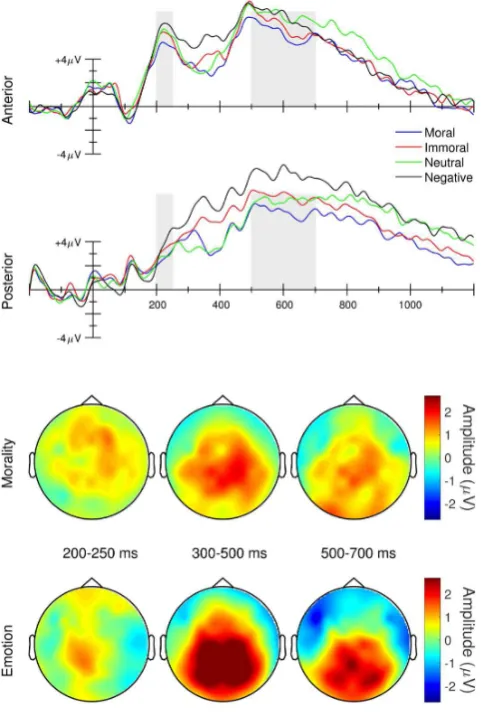
--- Figure 1 about here ---
200-250 ms (P200). In this time window, there were no reliable condition effects neither for
morality materials, all Fs < 1.07, ps > .31, nor for emotion materials, all Fs(1, 27) < 2.39, ps > .13.
300-500 ms (N400). Mean ERP amplitudes for morality materials yielded a
Condition x Ant-Post interaction, F(1, 27) = 5.51, p < .05, ηp2 = .17, reflecting a trend for a
more negative-going ERP waveform for immoral than moral items over anterior electrodes
(3.43 vs. 4.54 µV), F(1, 27) = 3.87, p = .06, but not over posterior electrodes (4.93 vs. 4.90
µV), F(1, 27) = 0.01, p = .94.
For emotion materials ERP amplitudes were more positive-going for negative than
neutral items (6.33 vs. 4.17 µV), F(1, 27) = 13.30, p < .001, ηp2 = .33, but the Condition x
Ant-Post interaction was not significant, F(1, 27) = 2.84, p = .10.
500-700 ms (LPP). In this time window, the reliable Condition x Ant-Post
interaction for morality materials, F(1, 27) = 6.46, p < .05, indicated a more negative-going
waveform for immoral versus moral items for the anterior ROI (4.97 vs. 6.19 µV), F(1, 27) =
4.61, p < .05, but not for the posterior ROI (7.20 vs. 7.30 µV), F = 0.03, p = .86.
Finally, mean ERP amplitudes for emotion materials yielded a significant Condition
x Ant-Post interaction, F(1, 27) = 5.71, p < .05, ηp2 = .17. Further testing indicated a larger
positivity for negative than neutral items for the posterior ROI (10.04 vs. 8.11 µV), F(1, 27) =
7.26, p < .05, but not for the anterior ROI (6.36 vs. 6.12 µV), F = 0.09, p = .77.
Judgment-dependent ERP results.
For Review Only
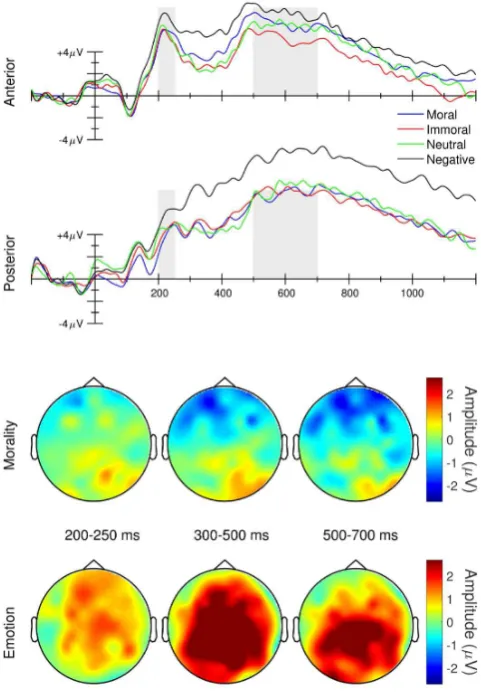
ERP waveforms averaged corresponding to the judgment-dependent analysis are
shown in Figure 2. Again, for both types of materials, the analyses of mean ERP amplitudes
showed main effects of ant-post (all Fs(1, 27) < 6.36, all ps < .05), indicating an anterior positivity for the early P200 time window, and a posterior positivity for the later time
windows.
--- Figure 2 about here ---
200-250 ms. For morality materials, the ANOVA of mean judgment-dependent ERP
amplitudes with variables answer (yes vs. no) and ant-post (anterior vs. posterior) produced
no significant effects, all Fs(1, 27) < 1.53, ps > .22.
The ANOVA for emotion materials showed a trend for the main effect of answer,
F(1, 27) = 3.91, p = .058, ηp2 = .13, but no interaction effect, F < 0.01, p > .97, due to a more
positive-going ERP waveform for no-responses than yes-responses (6.44 vs. 5.19 µV).
300-500 ms. For morality materials, the Condition x Ant-Post interaction was
significant, F(1, 27) = 7.06, p < .05, ηp2 = .21, indicating a trend towards a more
negative-going ERP waveform for no-responses than yes-responses for the anterior ROI (3.55 vs. 4.72
µV), F(1, 27) = 3.55, p = .07, but not for the posterior ROI (5.13 vs. 5.48 µV), F = 0.04, p =
.84.
For emotion materials, the ERP positivity was larger for yes-responses than
no-responses (7.63 vs. 4.17 µV), F(1, 27) = 14.30, p < .001, ηp2 = .35. The answer effect tended
to be stronger over posterior than anterior electrodes as indicated by the trend for the
Condition x Ant-Post interaction, F(1, 27) = 3.73, p = .064, ηp2 = .12 (cf. Figure 2).
500-700 ms. For morality materials, the Condition x Ant-Post interaction was
significant, F(1, 27) = 8.32, p < .01, ηp2 = .24, indicating a trend for a more negative-going
ERP waveform for no-responses than yes-responses for the anterior ROI (5.22 vs. 6.53 µV),
For Review Only
F(1, 27) = 3.96, p = .057, but not for the posterior ROI (7.91 vs. 7.71 µV), F(1, 27) = 0.11, p
= .73.
For emotion materials, the Answer x Ant-Post interaction was significant, F(1, 27)
= 6.85, p < .05, ηp2 = .20, due to a reliably larger positivity for yes-responses than
no-responses for the posterior ROI (10.73 vs. 7.61 µV), F(1, 27) = 9.19, p < .01, but not for the
anterior ROI (6.05 vs. 5.10 µV), F(1, 27) = 1.44, p = .24.
Discussion
In Experiment 1 participants performed different judgments depending on material type,
either focusing on the moral acceptability of someone’s behavior for morality scenarios or
whether they were emotionally moved by the described emotion scenarios. In line with our
expectations, behavioral data showed that moral items were very frequently judged as
acceptable and immoral items as unacceptable, with less than 18 % of the items being judged
by participants in a way that was inconsistent with the classifications that were based on the
results of the pre-test (e.g., judging an item of the immoral condition as morally acceptable).
Crucially, the logistic regression analysis indicated that, in addition to the pre-classified
condition variable, also valence influences morality judgments, in line with views that
emotional aspects of the scenarios contribute to moral decision making (e.g., Greene et al.,
2001; Haidt, 2001). For emotion items, subjective judgments of items did accord slightly less
well with the pre-classified neutral vs. negative item classification (about 67%). A possible
reason for this lower consistency is suggested by the logistic regression analysis results,
which indicated that mainly rating-based arousal scores and to a lesser extent valence scores
for each item were influencing the affective yes-no judgments in addition to the pre-classified
condition variable. This is also plausible given the rating results for emotion materials,
indicating that some neutral scenarios received positive valence ratings. There was also a
For Review Only
moderately positive correlation indicating increasing arousal ratings with positive valence for
these neutral items (r = .32). Finally, another reason could be that some of the sentence final
emotional words were valenced, and thus yes-responses to neutral items might also reflect a
word-based valence effect.
The finding of shorter RTs for immoral and negative items indicates that these
items were more salient than moral and neutral items, as also suggested by the rating study
results. In addition, we observed faster responses for emotional than moral materials,
suggesting that moral judgments involve a more time-consuming decision process. However,
based on this result alone, we cannot exclude the possibility that affect-related processes
contribute to moral judgments. In summary, the behavioral data clearly indicate that
participants performed the different judgment tasks appropriately.
In terms of the ERP results, a first key finding relates to the ERP analysis for
emotion materials, which showed a larger posterior than anterior ERP positivity from
300-700 ms, as expected. Given its topographic distribution and time-course, and the fact that its
amplitude was larger for negative than neutral materials, we take this positivity to reflect the
LPP. It is worth noting that the judgment-dependent analysis of ERP amplitudes produced the
same results as the standard analysis of ERP amplitudes. Hence, we take the larger LPP to
negative than neutral items to reflect an emotion effect. This inference seems justified given
the pre-test results for emotion materials. That is, negative and neutral emotion items differed
with respect to their valence and arousal but not regarding their linguistic features (cloze
probability, semantic relatedness, critical word frequency). Similar to Van Berkum et al.
(2009), we view it as unlikely that the present LPP emotion effect reflects a decision-related
P300 effect; we return to this issue in the General Discussion. Together, and in line with
similar reports in the literature (e.g., Delaney-Busch & Kuperberg, 2013; Holt et al., 2009),
For Review Only
we therefore take the present LPP findings as reflecting stronger affective processing of
negative than neutral items during discourse comprehension.
Crucially, and in contrast to our hypothesis that morality items undergo an implicit
affective evaluation as indicated by an LPP effect (cf. Leuthold et al., 2015), no reliably
enhanced ERP positivity was observed for immoral as compared to moral items. Rather, a
more negative-going ERP amplitude for immoral than moral scenarios appeared from
500-700 ms (cf. Figure 1). Although the direction of this amplitude effect is in line with the
centroparietal N400 effect reported by Van Berkum et al. (2009), its topographic distribution
is not. That is, the present morality effect in the 500-700 ms time window showed an anterior
rather than the classic centroparietal N400 distribution, it occurred later, and was also more
sustained. In the General Discussion, we will evaluate possible explanations for this anterior
ERP negativity effect.
In summary, the ERP findings from Experiment 1 indicate that evaluative
processing of immoral items elicited a larger anterior ERP negativity than moral items,
whereas negative emotional items triggered a larger LPP than neutral items, suggesting that
the different materials differ with regard to their cognitive versus affective processing. This
difference in processing might be attributed to the fact that participants performed different
tasks to the two types of materials. In the following experiment, we will therefore test
whether the evaluation of moral content, as indicated by the anterior negativity, is
task-dependent by asking participants to perform emotional judgments for morality materials as
well.
Experiment 2
In Experiment 2, participants saw the same morality and emotional scenarios as in
Experiment 1, but in this case judged all materials as to whether they were emotionally
moved by them. We reasoned that focusing on the evaluation of the emotional content of
For Review Only
morality materials might change their online processing in such a way that their affective
analysis is prioritized (e.g., Lai et al., 2012; see also Holt et al., 2009). Like in Experiment 1,
we analyzed the binary yes-no judgments using logistic regression analyses. This also
allowed us to examine whether task demands influence the processing of morality materials
and whether emotion judgments for both morality and emotion materials take into account
the same affective item dimensions. In this case, a larger LPP should be elicited by both
immoral and negative emotional items compared to moral and neutral emotional items. That
is, the larger anterior negativity observed for morality materials in Experiment 1 should be
absent.
Methods
Participants. Thirty right-handed native German speakers from the University of
Tübingen participated for course credits or payment. Data from one participant were
excluded from the analyses due to less than 30% of trials per condition remaining after
artifact rejection and from one participant due to excessive alpha activity. Because one
behavioral data set was lost due to a technical problem, 27 participants entered the behavioral
data analysis and 28 participants (M = 23.0 years, 20 females) contributed data to the ERP
analysis.
Materials, procedure, and design. Experiment 1 was identical to Experiment 2
concerning all methodological aspects except that participants now performed yes-no
responses to both moral and emotion materials with regard to the question: “Berührt Sie das
Gelesene?” [“Are you emotionally moved by the presented text?”].
Data analysis. During EEG preprocessing, the number of ICA components removed
for cleaning the EEG data set was M = 3.9, and the number of previously removed noisy
channels that were interpolated in the ICA-cleaned EEG data set was M = 1.7 (range = 0 to
5). Following artifact rejection, the mean number of trials remaining per condition (M =
For Review Only
37.50 trials out of 40; range = 27-40, median = 39.0) was not reliably different across
conditions, all ps > .29.
Binary yes-no judgments were analyzed using a logistic regression analysis
identical to Experiment 1. Also, in addition to the standard ERP analysis, we measured ERP
amplitudes in waveforms averaged for moral and neutral items that were judged as not
emotionally moving and for immoral and negative items judged as moving. These
judgment-dependent ERP results are reported at the end of the results section.
Results
Behavioral measures
As in Experiment 1, separate logistic regression analyses were performed for the binary
emotion judgments to emotion and morality materials. For morality materials, immoral items
were more often judged as emotionally moving than moral items (71.85 vs. 44.30 %, p
<.001). There were significant effects of condition (β = 0.83, SE = 0.22, Wald Z = 3.71, p < .001), valence (β = -0.15, SE = 0.06, Wald Z = -2.28, p < .05) and arousal (β = 0.94, SE = 0.08, Wald Z = 11.13, p < .001). These results suggest that the likelihood of yes-responses ("moving") increased for immoral items and for more arousing items but slightly decreased
for more positively rated items.
For emotion materials, negative items were more frequently judged as moving
compared to neutral items (72.69 vs. 35.13 %, p <.001). There was a significant effect of valence (β = -0.18, SE = 0.08, Wald Z = -2.17, p < .05) and arousal (β = 1.34, SE = 0.08,
Wald Z = 16.77, p < .001), indicating that the likelihood of yes-responses ("moving") slightly decreased for more positively rated items but mainly increased for more arousing items.
The ANOVA performed on RT yielded no reliably faster responses to immoral than
moral items (1044 vs. 1157 ms), F(1, 26) = 2.82, p = .11, ηp2 = .10. For emotion materials, 2
For Review Only
RT was faster for negative than neutral items (953 vs. 1054 ms), F(1, 26) = 6.15, p < .05, ηp2
= .19.
Electrophysiological measures - condition-dependent ERP results.
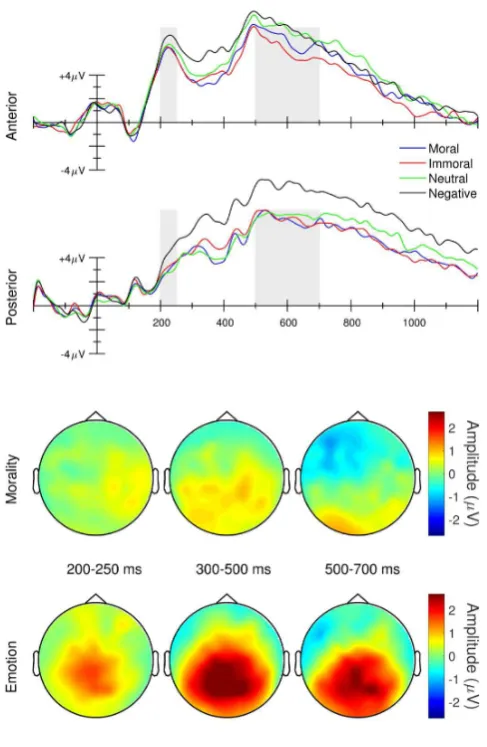
ERP waveforms averaged according to the rating-based item classification are
shown in Figure 3. For both types of materials, the waveform was characterized by an
anterior P200 (200-250 ms), and a broadly distributed positivity between 300-500 ms that
tended to be posteriorly distributed in the late LPP time window (500-700 ms). As before,
main effects of topography will not be discussed in the following.
--- Figure 3 about here ---
200-250 ms (P200). Mean ERP amplitudes for morality materials in this time
interval were not reliably influenced by experimental conditions, all Fs < 0.31, ps > .58.
For emotion materials, the Condition x Ant-Post interaction was significant, F(1,
27) = 4.81, p < .05, ηp2 = .15, indicating a larger positivity for negative than neutral items for
the posterior ROI (4.32 vs. 2.75 µV), F(1, 27) = 13.87, p < .001, and as a trend for the
anterior ROI (7.03 vs. 6.28 µV), F(1, 27) = 3.33, p = .08.
300-500 ms (N400). Mean ERP amplitudes for morality materials yielded a
Condition x Ant-Post interaction, F(1, 27) = 5.88, p < .05, ηp2 = .18. Further testing indicated
a trend for a more positive-going ERP waveform for immoral than moral items for posterior
ROIs (5.63 vs. 4.91 µV), F(1, 27) = 3.73, p = .06, but no reliable effect for anterior ROIs
(4.85 vs. 4.46 µV), F < 0.01, p = .98.
For emotion materials, the significant Condition x Ant-Post interaction, F(1, 27) =
20.17, p < .001, ηp2 = .43, indicated that the condition effect was more pronounced for the
posterior ROI. However, the ERP positivity was reliably larger for negative than neutral
For Review Only
items over both anterior (6.69 vs. 5.67 µV) and posterior midline electrodes (7.84 vs. 4.88
µV), all Fs(1, 27) > 6.57, p < .05.
500-700 ms (LPP). For the morality materials, in this time window only the
interaction of Condition x Ant-Post was significant, F(1, 27) = 5.72, p < .05, ηp2 = .17, but
further testing revealed no reliable effects, all Fs(1, 27) < 2.93, ps ≥ .10.
Finally, analyses of emotion materials showed a significant Condition x Ant-Post
interaction, F(1, 27) = 26.32, p < .001, ηp2 = .49, due to a larger positivity for negative than
neutral items for the posterior ROI (10.09 vs. 7.57 µV), F(1, 27) = 35.50, p < .001, but not for
the anterior ROI (7.98 vs. 7.80 µV), F(1, 27) = 0.20, p = .66.
Judgment-dependent ERP results.
ERP waveforms averaged according to the judgment-dependent classification are shown in
Figure 4.
--- Figure 4 about here ---
200-250 ms. The ANOVA for judgment-dependent ERPs of morality materials
revealed no reliable condition effects, all Fs(1, 27) < 1.69, ps > .20.
For emotion materials, there was a trend for a larger positivity for yes-responses vs.
no-responses (5.25 vs. 4.43 µV), F(1, 27) = 3.09, p = .09.
300-500 ms. In this time window, ERP amplitudes of morality materials yielded a
larger positivity for yes-responses than no-responses (5.68 vs. 4.45 µV), F(1, 27) = 4.66, p <
.05, ηp2 = .15.
For emotion materials, the Answer x Ant-Post interaction was significant, F(1, 27)
= 11.79, p < .01, ηp2 = .30, due to an enlarged positivity for yes-responses than no-responses
for the posterior ROI (7.65 vs. 4.27 µV), F(1, 27) = 38.38, p < .001, compared to the anterior
µ 2
For Review Only
500-700 ms. ERP amplitudes in this subsequent time window were not influenced
by experimental condition for morality materials, all Fs(1, 27) < 2.35, ps > .13.
For emotion materials, the Answer x Ant-Post interaction was significant, F(1, 27)
= 13.75, p < .001, ηp2 = .34; further testing an enlarged positivity for yes-responses than
no-responses for the posterior ROI (9.74 vs. 7.49 µV), F(1, 27) = 7.75, p < .01, but not for the
anterior ROI (7.66 vs. 7.53 µV), F = 0.04, p = .85.
Discussion
The behavioral data analysis showed that as in Experiment 1, responses were faster
for negative than neutral items, again lending support to the conclusion that the former items
are emotionally more salient. In addition, the RT analysis indicated that moral and immoral
items did not reliably differ with regard to the speed of emotion judgments, whereas they did
for morality judgments in Experiment 1. Importantly, response behavior differed with regard
to the pre-classified item category for morality and emotion materials. Therefore, as in
Experiment 1, ERP amplitudes were analyzed dependent on the pre-classified item categories
(standard analysis) and dependent on the actual judgments.
First, however, it is important to note that the logistic regression analysis results for
morality materials indicated that affective judgments were influenced not only by condition
but mainly by rating-based arousal scores and to a smaller extent by valence scores for each
item. Thus, in conjunction with the logistic regression analyses results for emotion materials,
it appears that emotion judgments are strongly influenced by arousal and less so by valence.
It is hence understandable that moral as compared to neutral items were judged more
frequently as moving (44.30 vs. 35.13 %; p < .001). This finding is plausible given the fact that arousal rating results for morality materials indicated a smaller difference between moral
For Review Only
and immoral items than neutral and negative items, which might also account for the absence
of a reliable RT effect for the morality materials.
In the standard ERP analysis, replicating the LPP findings from Experiment 1, there
was a larger posterior positivity for negative than neutral items from 300-700 ms, which we
again take to reflect the LPP. This finding is consistent with the earlier conclusion that the
LPP effect reflects the (affective) evaluation of motivationally significant stimuli (e.g.,
Hajcak et al, 2012). Moreover, rather than an anterior negativity (500-700 ms) as observed in
Experiment 1, immoral compared to moral items tended to elicit a larger ERP positivity in the
300-500 ms time window over posterior midline electrodes. Importantly, corroborating this
LPP effect, the judgment-dependent ERP analysis revealed a larger posterior positivity in the
300-500 ms time window for both immoral and negative items judged as moving as
compared to moral and neutral items judged as non-moving. Thus, LPP findings from
Experiment 2 indicate that the affective evaluation of incoming linguistic information occurs
not only for emotion materials but also morality materials.
General discussion
In two ERP experiments we investigated the nature and time course of evaluative processing
of short morality (moral vs. immoral) and emotion (neutral vs. negative) scenarios using a
discourse comprehension paradigm. Participants judged whether they found the described
moral situation either morally acceptable or not and the emotional situation as moving or not
(Experiment 1), or made emotional judgments to both types of scenarios (Experiment 2).
Assuming that affective evaluations are triggered by both morality and emotion materials, we
expected that critical words would trigger an early enhanced LPP (starting at ~300 ms) for
immoral compared to moral scenarios and for negative compared to neutral emotion
materials, irrespective of the judgment task. However, if performing moral judgments