Automatic Knowledge Extraction from EHRs
Ieva Vasiljeva
and
Ognjen Arandjelovi´c
University of St Andrews, St Andrews KY16 9SX, United Kingdom
Corresponding author email:[email protected]Abstract
Increasing efforts in the collection, standardization, and maintenance of large scale longitudinal elec-tronic health care records (EHRs) across the world provide a promising source of real world medical data with the potential of providing major novel insights of benefit both to specific individuals in the context of personalized medicine, as well as on the level of population-wide health care and pol-icy. The present paper builds upon the existing and intensifying efforts at using machine learning to provide predictions on future diagnoses likely to be experienced by a particular individual based on the person’s existing diagnostic history. The specific model adopted as the baseline predictive framework is based on the concept of a binary di-agnostic history vector representation of a patient’s diagnostic medical record. The technical novelty introduced herein concerns the manner in which transitions between diagnostic history vectors are learnt. We demonstrate that the proposed change prima fasciae enables greater learning specificity. We present a series of experiments which demon-strate the effectiveness of the proposed techniques, and which reveal novel insights regarding the most promising future research directions.
1
Introduction
Recent years have witnessed a remarkable convergence of two broad trends. The first of these concerns information i.e. data. Rapid technological advances coupled with an in-creased presence of computing in nearly every aspect of daily life, have for the first time made it possible to acquire and store massive amounts of highly diverse types of information. Concurrently and in no small part propelled by the described environment, research in artificial intelligence – in machine learning, data mining, and pattern recognition, in particular – has reached a sufficient level of methodological sophistica-tion and maturity to process and analyse the collected data, with the aim of extracting novel and useful knowledge.
Considering the growing appreciation of the financial bur-den of health care and the associated human cost, it is un-surprising that application domains pertaining to health care
have attracted a significant amount of attention. For exam-ple, the diverse information content shared across social me-dia platforms [Abelet al., 2011; Agarwalet al., 2011; Bau-comet al., 2013; Beykikhoshket al., 2014, 2015c,b; Bollen et al., 2011] is increasingly recognized as a source of valu-able insight into the behaviour of individuals, spread of epi-demics, and the adoption of health related recommendations and advice. The analysis of medical literature itself is another potential target for data mining algorithms and knowledge extraction [Andrei and Arandjelovi´c, 2016a,b; Beykikhoshk et al., 2015a]. In this paper we are specifically interested in the rich source of heterogeneous health data, collected and stored in the form of large scale longitudinal electronic health records (EHRs) [Arandjelovi´c, 2015a; Christensen and Ellingsen, 2016; Xuet al., 2016].
2
Previous work
Most existing methods constrain their prediction to a nar-row specific context, e.g. to admissions to the emergency de-partment [Li and Guo, 2009], to heart failure related admis-sions [Hammillet al., 2011], to the veteran population [Hol-lowayet al., 1990] etc. In addition to their inherently limited scope the applicability of these methods is further impaired by their frequent reliance on a substantial amount of expert knowledge in the choice of variables used for prediction [Lee-gonet al., 2005]. Notwithstanding these efforts, the perfor-mance of the methods described in the literature has largely been disappointing [Kansagaraet al., 2011]. Better results have been reported in prediction attempts which simplify the task even further by looking at short-term (usually of approx-imately 30 days) predictions only [Holmanet al., 2005].
One of the possible reasons for the poor performance of the existing methods in the literature lies in their virtually univer-sally overly simplistic inference models. In particular, unlike in the present work, they fail to capture sequential informa-tion on historical admissions and diagnoses; rather, they base their predictions on a single cumulative snapshot of a patient’s record [Bottleet al., 2006].
additional insights regarding the structure of the underlying model, which have led to its further refinements [Vasiljeva and Arandjelovi´c, 2016b].
For completeness and for the sake of clarifying the specific limitations of the original method which the present work ad-dresses, we next summarize the main ideas behind the base-line algorithm we build upon; for full technical detail and ad-ditional discussion the reader is referred to the original publi-cations [Arandjelovi´c, 2015a, 2016].
2.1
Original diagnostic history based method
Consider a patient’s hospital diagnosis historyHwhich com-prises a sequence of diagnosesdi:
H =d1→d2→. . .→dn, (1)
where each di is a discrete variable whose value is a spe-cific diagnostic code. Examples of diagnosis coding schemes include that provided by the International Statistical Clas-sification of Diseases and Related Health Problems (ICD-10) World Health Organization [2004] and the related Aus-tralian Refined Diagnosis-Related Groups (AR-DRGs). The algorithm proposed by Arandjelovi´c [2015a] predicts the most likely next diagnosisd∗n+1by learning the probabilities of transitions fromHto all other possible histories which can result from a single follow-up diagnosisd:
d∗n+1= arg max d∈DICD
p(H →d|H), (2)
whereDICDis the set of diagnostic codes. To make the esti-mation of the probabilityp(H → d|H)tractable and learn-able from limited data, a patient’s diagnostic historyHis rep-resented using a fixed length binary vectorv(H). This rep-resentation bears resemblance to the bag of words represen-tation frequently used in text analysis and which has since been successfully adapted to various other application do-mains too [Sivic and Zisserman, 2003; Arandjelovi´c, 2012]. Each element inv(H)encodes the presence (value 1) or lack thereof (value 0) of a specific salient diagnosis (i.e. the cor-responding code) inH, save for the last element which cap-tures jointly all non-salient diagnoses. Saliency is determined by the frequency of the corresponding diagnosis in the en-tire data corpus (n.b. different saliency criteria can be readily used instead). The probabilityp(H → d|H)in (2) is then estimated by superimposing a Markovian model [Sukkar et al., 2012; Jacksonet al., 2003] on the space of history vec-tors which leads toH → dbeing interpreted as a transition from the state represented by v(H)to the state represented byv(H →d). As usual the probabilities parameterizing the Markov model are learnt from a training data corpus. A con-ceptual illustration of the method is shown in Figure 1.
The key idea behind the described model, supported by a breadth of empirical evidence, is that in a vast number of cases it is the presence of past complications which most strongly predicts future ailments [Mudgeet al., 2011;
Fried-manet al., 2008 2009; Dharmarajanet al., 2013; Butler and
Kalogeropoulos, 2012], which allows for the space of states over which learning is performed to be reduced dramatically; in particular, this is achieved by employing a fixed length state representation and through binarization of its elements.
0 1 1 0 1
…
0 1 0 0 1
…
1 1 0 0 1
…
History vector transi1ons (directed graph)
[image:2.612.316.556.54.212.2]History vector
Figure 1: Conceptual illustration of the method proposed by Arandjelovi´c [2015a] which superimposes a Markovian model over a space of history vectors used to represent the medical state of a patient. The inherent ‘forgetfulness’ of the Markovian assumption, which is a major limitation in its use in the application domain of interest in this paper, is overcome by incorporating memory in the state space itself.
3
Technical contributions
In this section we introduce our main technical contribution. A further contribution in the form of novel analyses and em-pirical results which highlight important and promising future research directions is presented in Section 4.
3.1
Improving the learning model
The first major contribution of the present work goes to the very heart of the learning framework underlying the diagnos-tic progression model, and concerns the issue of the space over which learning is performed. In other words we propose a paradigm change in terms of what is explicitly learnt.
(a) Original (b) Proposed
Figure 2: Illustration of the learning paradigm change proposed in the present paper. (a) The original diagnostic history based method of Arandjelovi´c [2015a] learns transition probabilities between different compatible patient histories (histories which correspond to history vectors differing in at most one binary entry). (b) In contrast herein we learn directly the probabilities of all possible diagnostic codes given a specific patient history. This change does not increase the complexity of the learning task at hand whileprima fasciaeproviding greater specificity in prediction.
previous section this means that a repeated diagnostic code effects a transition from a history vector to itself.
The method introduced in the present paper solves the aforementioned problem by changing the space over which learning is performed. In particular, rather than learning the probabilities of transitions between history vectors them-selves, we learn the probabilities of follow up diagnoses di-rectly. In other words, rather than learning probabilities of the type:
p(v(H)→d|v(H)), (3)
we propose to learn:
p(d|v(H)). (4)
It can be readily seen that this is a stronger learning task in the sense that knowing the follow-up diagnosisdallows for the computation of the next Markov chain stateH0=H →d
without ambiguity whereas the opposite is not the case, as described previously.
What makes the proposed learning methodology particu-larly sensible is that it does not carry the burden of either greater computational complexity nor learning challenge – the dimensionality of the space over which learning is per-formed stays exactly the same (it is governed by the choice of the number of salient diagnoses), which remains as densely populated as before. Hence this learning paradigm change is unambiguously superior to that described originally.
4
Evaluation and analysis
In this section we summarize some of the experiments we conducted to evaluate the proposed framework and to garner additional useful insight into the structure of its prediction which would help illuminate the most promising avenues for further improvement and future work.
4.1
EHR data
In an effort to reduce the possibility of introducing variability due to confounding variables, we sought to align our eval-uation protocol as much as possible with that adopted by previous work. Hence we conducted our experiments using the large collection of EHRs (over 40,000 individuals and over 400,000 diagnostic events) described in Arandjelovi´c [2015b]. For completeness here we summarize the key fea-tures of this data set.
The EHRs adopted for evaluation were collected by a large private hospital. The distribution of patient age in the database is73±15years, the youngest and oldest patients be-ing 17 months and 102 years old respectively, with the male to female ratio56 : 44. Approximately 23% of the patients in the database have a date of death associated with their EHR, which means that they are deceased and thus have a record of a terminal diagnosis. The entire EHR collection spans a period of 10 years, with the average number of diagnoses per patient of10.1±62.2. Standard ethical procedures in the stor-age and use of data were followed, and an appropriate insti-tutional ethical approval obtained before the commencement of research.
4.2
A note on performance assessment
Before proceeding with a description the experiments we con-ducted, we would like to turn our attention briefly to the ques-tion of how performance of a method addressing the problem at hand should be measured. It is little short of a truism to note that this issue is crucial in ensuring that the choice be-tween different competing models is made on meaningful ba-sis. [Arandjelovi´c, 2015a] touched upon this discussion but herein we would like to add some further insight.
diagnos-tic history based method on two different prediction tasks, namely (i) the first follow-up diagnosis prediction, and (ii) long term prediction of the most likely diagnosis sequence. In both scenarios prediction was made on the basis of the pa-tient’s current diagnostic history.
The accuracy of the first follow-up diagnosis prediction was made initially by examining the proportion of the pre-dictions which were correct (i.e. which correctly matched the actual follow-up diagnosis in the data) and was anal-ysed in further detail using cumulative match characteris-tic (CMC) curves which capture the prediction accuracy at rank-N for different values ofN. In the present paper we would like to put forward an argument that rank-1 accuracy is not a good performance assessment measure for the prob-lem at hand. Our argument is based on a simple observa-tion which we will support further with empirical evidence in Section 4.3. Specifically, we observed that in practice, seri-ous chronic conditions with multiple possible comorbidities which exhibit predictable longitudinal patterns, are interlaced with sporadic diagnoses of more common ailments which are often at most weakly related to the former conditions. This means that by their very nature these sporadic episodes are virtually unpredictable and the failure of a model to predict them should not weigh as heavily as an error in the prediction of chronic conditions. Therefore we would argue that predic-tion accuracy not at rank-1 level but rather at rank-2 to rank-4, is more insightful and reflects a method’s performance better. To assess long term prediction accuracy in his original work Arandjelovi´c [2015a] used model likelihood computed using the actual diagnostic progression observed to compare different competing models. This manner of performance as-sessment can be seen to be less sensitive to the confounding aspects described in the context of follow-up diagnosis pre-diction. The primary reason is that by its very nature this measure necessitates a comparison between two alternatives (i.e. two model) – the likelihood value itself is not particu-larly meaningful in answering the question of how good a method is. Rather, it is the comparison of the likelihoods (ra-tio thereof) of two different models that informs the decision on which of the two should be preferred. In this context, the effects of spurious and ‘unpredictable’ diagnoses cancel out.
4.3
Results and discussion
Using the collection of EHRs described in Section 4.1, we conducted a series of experiments to evaluate the perfor-mance of the modified diagnostic history based method pro-posed in this paper, and validate the different hypotheses that underlie the model. To make our method readily compara-ble with those already described in the existing literature and the results interpretable in the context of previous findings, we followed the standard cross-validation framework used in previous work.
Experiment 1: Follow-up diagnosis prediction
Following previous work, in our first experiment we sought to examine the performance of the proposed method on the task of follow-up diagnosis prediction. For each possible par-tial patient history in our data set we compared the prediction made by our algorithm and compared it with the ground truth
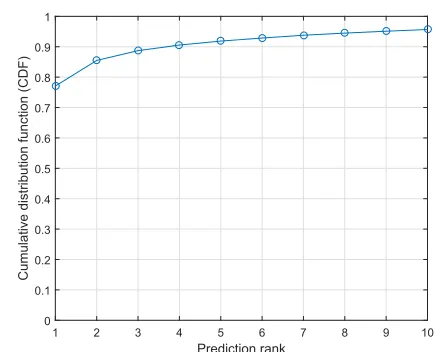
i.e. the actual follow-up diagnosis. Our findings are sum-marized using the standard cumulative match characteristic curve shown in Figure 3.
It can be readily seen that the proposed method achieves impressive accuracy of approximately 78% already for rank-1 prediction. Moreover, from this already high baseline rank-N
accuracy increases rather rapidly withN, achieving approx-imately 89% for rank-3 and 92% for rank-5 prediction. As argued in Section 4.2 these values are more meaningful mea-sures of performance in the context of the problem at hand.
It is interesting to compare the plot in Figure 3 with the analogous plot in [Arandjelovi´c, 2015a]. While these are not directly comparable, given that we directly predict the follow-up diagnosis whereas Arandjelovi´c [2015a] predicts the follow-up history, it is insightful to analyse the magnitude and the nature of the difference between the two CMCs. As expected, rank-1 accuracy in Figure 3 is lower than that in [Arandjelovi´c, 2015a]. However, the difference diminishes for prediction at higher ranks, effectively vanishing by rank-10.
Experiment 2: Coarse diagnosis type prediction
As already noted in in the past by Arandjelovi´c [2016] amongst others (also see [RGI-CGHR Collaborators, 2009]), the hierarchical structure of most commonly used diagnosis coding schemes encodes important information which has received little attention to date [Vasiljeva and Arandjelovi´c, 2016b]. Hence, in order to illuminate possible directions for future work in our second set of experiments we sought to garner additional insight into the nature of errors of our al-gorithm on a coarser coding level. We did this by examin-ing each erroneous prediction in turn and checkexamin-ing whether the prediction concerns the same category of diagnoses as the correct one, as readily inferred from the aforementioned hierarchy [Arandjelovi´c, 2016]. For example, an erroneous prediction of a specific circulatory system diagnosis which predicted a different circulatory system diagnosis can be rea-sonably considered as being less serious than an erroneous prediction which predicted, say, a disease of the skin and sub-cutaneous tissue.
Our results are highly insightful. Already at rank-1 the obtained accuracy was 94% which by rank-4 reached 100% thereby corroborating the hypothesis put forward in Sec-tion 4.2.
Prediction rank
1 2 3 4 5 6 7 8 9 10
Cumulative distribution function (CDF)
[image:5.612.59.282.60.236.2]0 0.1 0.2 0.3 0.4 0.5 0.6 0.7 0.8 0.9 1
Figure 3: The cumulative match characteristic of the first follow-up diagnosis prediction obtained by our method. As argued in Section 4.2 we consider the performance across the rank range of approximately 3–5 to be most relevant in prac-tice. From the plot it can be seen that the corresponding pre-diction accuracy is 89–92%.
rather than sequential prediction.
5
Summary and future work
In this paper we introduced a novel algorithm that uses ma-chine learning on EHR collections for the discovery of lon-gitudinal patterns in the diagnoses of diseases. The key tech-nical novelty concerned a learning paradigm change which enables greater learning specificity. A series of experiments were presented to demonstrate the effectiveness of the pro-posed technique. Novel insights resulting from our experi-mental findings were also discussed and highlighted.
As regards possible future work directions, a number of possibilities were proposed by the author of the original his-tory vector based approach that the present method was partly inspired by. While we agree with most of these in broad terms, our contributions, experiments, and results suggest what we believe to be more promising immediate alternatives. In particular while we agree with the authors of the original method that the presence of a particular episode of care is a predictive factor not much weaker than the exact number of episodes (which would require prohibitively large amount of training data to learn), we believe that history vector binariza-tion is an overly harsh step for the reducbinariza-tion of the learning space. Following the spirit of the method introduced in the present paper we intend to explore the possibility of auto-matically detecting chronic types of episodes of care (such as dialysis, for example) and then using a binary representation for non-chronic, and a more graded representation for chronic conditions.
References
F. Abel, Q. Gao, G. J. Houben, and K. Tao. Analyzing user modeling on Twitter for personalized news
recommenda-tions. In Proc. International Conference User Modeling,
Adaptation and Personalization, pages 1–12, 2011.
A. Agarwal, B. Xie, I Vovsha, O. Rambow, and R. Passon-neau. Sentiment analysis of Twitter data. In Proc.
Work-shop on Language in Social Media, pages 30–38, 2011.
V. Andrei and O. Arandjelovi´c. Identification of promising research directions using machine learning aided medical literature analysis.In Proc. International Conference of the
IEEE Engineering in Medicine and Biology Society, 2016.
V. Andrei and O. Arandjelovi´c. Temporal quasi-semantic vi-sualization and exploration of large scientific publication corpora. In Proc. International Joint Conference on
Artifi-cial Intelligence Workshop on Big Scholarly Data, 2016.
O. Arandjelovi´c. Object matching using boundary descrip-tors. In Proc. British Machine Vision Conference, 2012. DOI: 10.5244/C.26.85.
O. Arandjelovi´c. Discovering hospital admission patterns us-ing models learnt from electronic hospital records.
Bioin-formatics, 31(24):3970–3976, 2015.
O. Arandjelovi´c. Prediction of health outcomes using big (health) data. In Proc. International Conference of the
IEEE Engineering in Medicine and Biology Society, pages
2543–2546, August 2015.
O. Arandjelovi´c. On the discovery of hospital admis-sion patterns – a clarification. Bioinformatics, 2016. DOI: 10.1093/bioinformatics/btw049.
E. Baucom, A. Sanjari, X. Liu, and M. Chen. Mirroring the real world in social media: Twitter, geolocation, and senti-ment analysis. In Proc. International Workshop on Mining Unstructured Big Data Using Natural Language Process-ing, pages 61–68, 2013.
A. Beykikhoshk, O. Arandjelovi´c, D. Phung, S. Venkatesh, and T. Caelli. Data-mining Twitter and the autism spec-trum disorder: a pilot study. In Proc. IEEE/ACM Interna-tional Conference on Advances in Social Network Analysis
and Mining, pages 349–356, 2014.
A. Beykikhoshk, O. Arandjelovi´c, D. Phung, and S. Venkatesh. Hierarchical Dirichlet process for tracking complex topical structure evolution and its application to autism research literature. In Proc. Pacific-Asia
Conference on Knowledge Discovery and Data Mining,
1:550–562, 2015.
A. Beykikhoshk, O. Arandjelovi´c, D. Phung, and S. Venkatesh. Overcoming data scarcity of Twitter: using tweets as bootstrap with application to autism-related topic content analysis. In Proc. IEEE/ACM International Conference on Advances in Social Network
Analysis and Mining, pages 1354–1361, August 2015.
J. Bollen, H. Mao, and A. Pepe. Modeling public mood and emotion: Twitter sentiment and socio-economic phenom-ena. In Proc.
International Conference on Weblogs and Social Media,
pages 450–453, 2011.
A. Bottle, P. Aylin, and A. Majeed. Identifying patients at high risk of emergency hospital admissions: a logistic re-gression analysis. J R Soc Med, 99(8):406–414, 2006.
J. Butler and A. Kalogeropoulos. Hospital strategies to reduce heart failure readmissions. J Am Coll Cardiol, 60(7):615– 617, 2012.
B. Christensen and G. Ellingsen. Evaluating model-driven development for large-scale EHRs through the openEHR approach.Int J Med Inform, 89:43–54, 2016.
K. Dharmarajan, A. F. Hsieh, Z. Lin, H. Bueno, J. S. Ross, I. Horwitz, J. A. Barreto-Filho, N. Kim, S. M. Bernheim, L. G. Suter, E. E. Drye, and H. M. Krumholz. Diagnoses and timing of 30-day readmissions after hospitalization for heart failure, acute myocardial infarction, or pneumonia. JAMA, 309(4):355–363, 2013.
B. Friedman, H. J. Jiang, and A. Elixhauser. Costly hos-pital readmissions and complex chronic illness. Inquiry, 45(4):408–421, 2008–2009.
B. G. Hammill, L. H. Curtis, and G. C. et al. Fonarow. In-cremental value of clinical data beyond claims data in pre-dicting 30-day outcomes after heart failure hospitalization.
Circ Cardiovasc Qual Outcome, 4(1):60–67, 2011.
J. J. Holloway, S. V. Medendorp, and J. Bromberg. Risk fac-tors for early readmission among veterans. Health Serv Res, 25(1):213–237, 1990.
C. D. A. J. Holman, D. B. Preen, N. J. Baynham, J. C. Finn, and J. B. Semmens. A multipurpose comorbidity scoring system performed better than the charlson index. J Clin
Epidemiol, 58(10):1006–1014, 2005.
C. H. Jackson, L. D. Sharples, S. G. Thompson, S. W. Duffy, and E. Couto. Multistate Markov models for disease pro-gression with classification error.Journal of the Royal Sta-tistical Society, Series D, 52(2):193–209, 2003.
D. Kansagara, H. Englander, A. Salanitro, D. Kagen, C. Theobald, M. Freeman, and S. Kripalani. Risk
predic-tion models for hospital readmission: a systematic review. JAMA, 306(15):1688–1698, 2011.
J. Leegon, I. Jones, K. Lanaghan, and D. Aronsky. Predict-ing hospital admission for emergency department patients using a bayesian network. AMIA Annu Symp Proc, page 1022, 2005.
J. Li and L. Guo. Hospital admission prediction using pre-hospital variables.BIBM Conf Proc, pages 283–286, 2009.
A. M. Mudge, K. Kasper, A. Clair, H. Redfern, J. J. Bell, M. A. Barras, G. Dip, and N. A. Pachana. Recurrent read-missions in medical patients: a prospective study. J Hosp Med, 6(2):61–67, 2011.
RGI-CGHR Collaborators. Report on the causes of death in India: 2001–2003.Office of the Registrar General of India, 2009.
J. Sivic and A. Zisserman. Video Google: A text retrieval approach to object matching in videos. In Proc. IEEE
In-ternational Conference on Computer Vision, 2:1470–1477,
2003.
R. Sukkar, E. Katz, Y. Zhang, D. Raunig, and B. T. Wyman. Disease progression modeling using hidden Markov
mod-els. In Proc. IEEE International Conference on
Engineer-ing in Medicine and Biology Society, pages 2845–2848,
2012.
I. Vasiljeva and O. Arandjelovi´c. Prediction of future hospital admissions – what is the tradeoff between specificity and accuracy? In Proc. International Conference on
Bioinfor-matics and Computational Biology, 2016.
I. Vasiljeva and O. Arandjelovi´c. Towards sophisticated learning from EHRs: increasing prediction specificity and accuracy using clinically meaningful risk criteria. In Proc. International Conference of the IEEE Engineering in Medicine and Biology Society, 2016.
World Health Organization. International statistical classifi-cation of diseases and related health problems., volume 1. World Health Organization, 2004.
L. Xu, D. Wen, X. Zhang, and J. Lei. Assessing and com-paring the usability of Chinese EHRs used in two Peking University hospitals to EHRs used in the US: A method of
![Figure 1: Conceptual illustration of the method proposedby Arandjelovi´c [2015a] which superimposes a Markovianmodel over a space of history vectors used to represent themedical state of a patient](https://thumb-us.123doks.com/thumbv2/123dok_us/8566048.367081/2.612.316.556.54.212/conceptual-illustration-proposedby-arandjelovi-superimposes-markovianmodel-represent-themedical.webp)
![Figure 2: Illustration of the learning paradigm change proposed in the present paper. (a) The original diagnostic history basedmethod of Arandjelovi´c [2015a] learns transition probabilities between different compatible patient histories (histories whichco](https://thumb-us.123doks.com/thumbv2/123dok_us/8566048.367081/3.612.113.498.53.216/illustration-diagnostic-basedmethod-arandjelovi-transition-probabilities-compatible-histories.webp)