
Sizing Guidelines for Grid-Connected Decentralised Energy
Storage Systems: Single House Application
K. Panagiotou*, C. Klumpner
┼, M. Sumner
Power Electronics, Machines and Control (PEMC) Research Group, Department of Electrical and Electronic Engineering, University of Nottingham, UK
*[email protected], ┼[email protected]
Keywords: PV Decentralised Systems, Energy Management, Energy Storage Systems, Energy Storage Sizing.
Abstract
Nowadays, the existing hierarchical, centrally controlled power grid faces new challenges due to the increase penetration of renewable sources, the need of implementing demand side management and the 2020 and 2050 environmental targets. A promising concept which can successfully contribute to addressing the environmental concerns and energy challenges of the 21st century is the
grid-connected decentralised energy systems that embed significant amount of renewable generation and allow reverse power flow from distribution grids into the transmission network. Despite their benefits, decentralised energy storage systems are not yet widely spread due to several implementation and designing barriers. The design obstacle which is being addressed in this study includes the determination of the optimal size of the energy storage system components in terms of battery size and rating of the power converter for a single house application. In order to generalise the findings, 9 different real houses were considered. Thus, the most financially beneficial battery and power converter combination for 9 existing UK houses with installed PV roof-top system were identified in this study.
1 Introduction
The increasing penetration of renewable sources integrated into the power generation mixture causes instability, power quality and feeder capacity problems to the system operators as the current centralised distribution system is not designed to handle reverse power flow. Additionally, the introduction of energy consumers’ participation and engagement with their consumption profile (demand side management) adds a need of changing the network operation and wide installation of smart meters. Lastly, the need of satisfying the environmental targets for 2020 and 2050 creates a new challenge for the existing power generation mixture. The three aforementioned newly introduced concepts have presented new challenges for the existing hierarchical, centrally controlled power grid [1]-[3]. One promising network topology which can potentially undertake the 21st century energy challenges is the
decentralised energy storage systems (ESS) [4], [5].
Distributed generation, also distributed energy, on-site generation or district/decentralised energy refers to the
generation which is generated or stored or both by one or a variety of small to medium, stand-alone or grid-connected devices at the point of or close to energy consumption. Decentralised generation, in contrast to centralised, has the capability to reduce power distribution costs and losses as generation will be significantly closer to the consumer, to lower carbon emissions as more renewable energy sources could be integrated into the power generation mixture through the maximisation of the local generation, and lastly, to increase the national supply security as customers will not rely on relatively few large remote power stations supplies and on oil price [4]-[7]. Furthermore, in current distribution systems, the existing technology does not allow reverse power flow from distribution grids to the transmission networks and hence, the amount of generation that can be integrated is very limited. Decentralised energy storage systems can fit the missing piece of the puzzle for integrating more renewables into the power generation mixture, as they can potentially reduce the electricity cost by offsetting high tariffs electricity, support during black outs and integrate more renewable generation into the existing network.
The main design barrier for the wider spread of the decentralised energy storage systems is the sizing of the energy system components, as it is among of the most challenging and important calculations of the energy system design [9]-[11]. An essential sizing is the battery capacity, since if the battery is oversized, there is a risk of not be able to be fully utilised, whereas if it is undersized, it may not be able to supply the intended loads for as long as it is needed. Additionally, to the battery, the power converter needs to be appropriated sized in order to convert the power generated and the generated energy to be stored into useful battery energy. The power converter rating limits the power which will be exchanged between the battery, the house and the power grid and it strongly affects the charging pattern of the battery and the energy flow between the system’s components. Therefore, a cost-effective sizing design requires building in an appropriate designing analysis rather than simply oversizing the ESS components [12].
This paper is structured as follows: section 2 describes the examined energy system, section 3 defines the system model used, section 4 discusses the main results and section 5 summarises the conclusions.
2 The examined energy system
The decentralised energy storage system which was used for this work can be found in [12]. The examined system is designed to investigate different configurations/sizes of single residential dwellings with installed PV on their roof that limits its size and a battery that is grid-connected via a power converter, both components need to be viably sized. Real power profiles (consumption loads and generation power according to each house) were imported to the simulated model for the decentralised energy system in order i) to identify the power and energy flow between the various components of the system, ii) to capture the charging/discharging patterns of the battery and iii) to estimate the electricity cost for different ESS sizes.
2.1 Specifications and requirements
The specifications of the system are the following: the system is a grid-connected system and the battery can be charged from the excess PV generated power and also from the power grid during the off-peak electricity tariff. The main requirement of the examined energy system is to supply the residential power demand with the cheapest available energy. By assuming that all the examined houses have installed the maximum PV possible (depending on the surface of the roof which is different depending on the house type: detached, semi-detached, terrace) to maximise the local renewable generation, the goal is to identify the most suitable combination of battery and converter size which maximises the financial benefits of the ESS installation. As for the inhabitants, the cheapest energy source is the PV, followed by the battery and lastly the power grid, the energy utilisation priority for the purchased energy during peak price is: 1) instantly usage of the PV generated power, 2) if the PV generation cannot fulfil demand, discharge the battery and 3) only if the battery is empty, purchasing energy from the power grid. Vice versa, the utilisation priority of the PV generated power is: 1) fulfil internal consumption, 2) any PV power excess is used for battery charging and 3) if battery is fully charged or PV excess exceeds the power limitation of the battery charger, export the PV excess to the power grid.
2.2 Power flow
The power flow of the system developed can also be found in [12]. In summary, the examined ESS consists of a battery connected to the power grid and to the dwelling via a power converter. The pricing scheme which was considered is Economy7 pricing scheme as it is currently the most popular time-of-use tariff in UK [13], and thus, the battery can be charged between 00:00 and 07:00 every day until it reaches a predefined state-of-charge (SOC) level. The SOC overnight charging level is defined by the overnight charging control algorithm used. As proved in [12], an advance control
algorithm does not provide significant financial benefits to the householders. Therefore, a simpler control algorithm that uses a constant SOC overnight charging level was used for this study. In order to ensure that the ESS operates within its safety limits (SOC and current), it was assumed that these functions will be provided by a battery management system. Additionally, the power in and out of the battery is limited by the power converter rating.
2.3 Power profiles
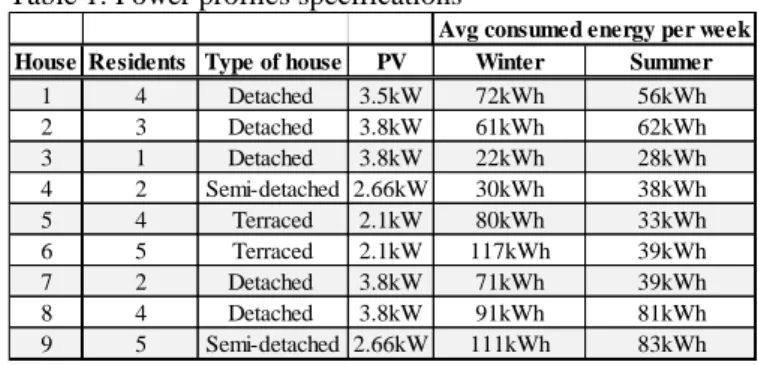
In order to generalise the findings and draw conclusions for different types of power profiles, 9 real houses were investigated. The main specifications of each examined house (number of residents, type of house, installed PV capacity and average consumed energy per week for winter and summer) can be found in Table 1.
Table 1: Power profiles specifications
House Residents Type of house PV Winter Summer
1 4 Detached 3.5kW 72kWh 56kWh
2 3 Detached 3.8kW 61kWh 62kWh
3 1 Detached 3.8kW 22kWh 28kWh
4 2 Semi-detached 2.66kW 30kWh 38kWh
5 4 Terraced 2.1kW 80kWh 33kWh
6 5 Terraced 2.1kW 117kWh 39kWh
7 2 Detached 3.8kW 71kWh 39kWh
8 4 Detached 3.8kW 91kWh 81kWh
9 5 Semi-detached 2.66kW 111kWh 83kWh
Avg consumed energy per week
3 Model used
In order to provide sizing guidelines for decentralised energy systems, adequacy representation of the system is necessary. Through the proper representation and modelling of the system components, the energy system behaviour can be captured and analysed. The same model was run for the nine different real power profiles (nine house configurations). For the sake of simplicity, the model outcomes were illustrated for selected power profiles, whereas the main results were summarised in a table (Table 2).
3.1 Model building
The model which was used in this study for the battery can be found in [14] and the power converter model in [15]. Briefly, the battery model used is an advanced Rin model: a voltage
source which varies with the battery SOC, in series with a resistance which dependents (inverse proportional) on the battery capacity. The power converter model used limits the power in and out of the battery to its rated power and the converter loses consist of two terms: a constant term in Watts which represents the standby losses and one proportional to the instantaneous power flowing through the energy storage system.
3.2 Model validation
charging pattern, along with the battery current, voltage and power were monitored. An example of an imported power profile (House 1) for 1 week during winter (first week of December) can be seen in Fig.1. Fig.2 illustrates the charging pattern for the corresponding week for the same house (House 1) for a 7.9kWh battery and an ‘infinite’ and a 1.5kW power converter. Fig.3 presents the power in and out for the same battery size, week and house for the two different converter ratings. As it can be seen from the Fig.3, the power limits to 1.5kW for the model which includes the non-ideal power converter. As a consequence, for some periods, the charging pattern is slightly lower (lower SOC) than the one for the ideal converter.
Fig.1: Power profile of House 1 for one week during winter (1st week of December) – Green: generation, Red: loads
Fig.2: Charging pattern (7.9kWh battery) for different converter ratings (House 1, 1st week of December)
Fig.3: ESS power (7.9kWh battery) for House 1
4 Results and discussion
In order to draw conclusions for the examined energy system, the results of each operated simulation were processed. The examined energy system run for different ESS components sizes and the electricity cost for each case was captured and analysed.
4.1 Process simulations
To quantify the most suitable ESS component values for the examined energy storage system, the examined system was solved numerically. More specifically, for each operated simulation, three quantities were imported; sizing values, design parameters and the corresponding power profile. After the operation of N iterative runs, the outcomes were collected, and the ESS values (battery and converter size combination) which maximising the financial benefits for householders were provided.
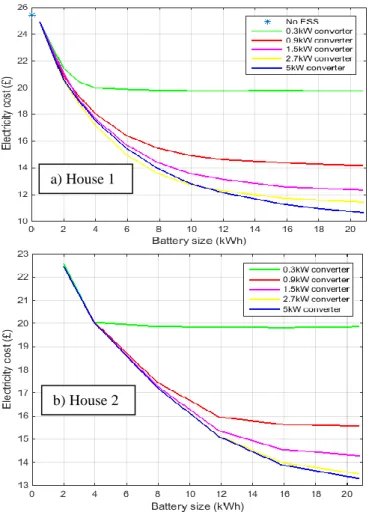
Indicatively, the electricity cost in respect to the battery and converter sizes for two examined power profiles/houses are demonstated in Fig.4. More specifically, the electricity cost (Y axis) for the total of 4 weeks (one week of each season) versus the battery size (X axis) is depicted for different power converter ratings for House 1 and 2. The actual financial gains due to installing storage can be seen with reference to the electricity cost when there is no battery. As it can be seen from both figures, the relationship between the electricity cost and the battery size is a non-linear decay and the level at which the cost settles depends on the converter rating. For the smallest power converter (0.3kW rating – the installed ESS cover mainly the refrigarator power needs), the benefits of increasing the battery size are negligible after 4kWh battery size. Moreover, from the same pair of figures it can be seen that, for the 2.7kW and 5kW converters, there is no significant difference in the electricity cost, as the imported load power profiles rarely exceeds 2.7kW but this may be due to the sampling time limitation that tends to level very short and powerfull power peaks. This is the reason why the 5kW converter is not included in the following result set.
Fig.4: Electricity cost versus battery size for different converter sizes for a) House 1 (electricity cost for no storage: £25.6) and b) House 2 (electricity cost for no storage: £24.3)
Having a larger battery and converter may contribute to reducting the electricity cost/maximise the gains of having PV energy. However, the increase of the ESS size also increases the expenditure associated with the installation and purchase cost of the components. For this reason, it may not be financially feasible to increase the battery capacity and/or the converter rating above a certain level where the rate at which the benefits increase with the size does not cover the rate at which equipement cost raises with size.
In order to identify the most financially beneficial combination of battery and converter size for each house, the benefit of the electricity cost after and before the overall energy system installation (PV system and ESS) were assesed. By calculating the financial benefits on the electricity cost over a 10-year operational period and by subtracting the installation and the purchased cost of the system, the actual financial benefits of the PV and ESS installation were estimated.
The following assumptions for the installation and component’s cost have been considered:
o Overall system installation cost: £300 o Battery cost: £0.05/£0.1/£0.2/Wh o ESS converter cost: £0.3/0.5/W o PV cost: £0.7/W
Fig.5a and Fig.5b illustrate the financial benefits of the overall energy system installation over a 10-year period for House 1 and House 6 respectively, for the different battery and converter sizes and purchased costs. It should be noted that in order to calculate the financial benefits over a 10-year period, it was assumed that the power profile (PV generation and consumption profile) and electricity prices (off-peak, peak and export tariffs) remained unchanged for the whole examined operational duration.
From the figures, it can be seen that for very few sizes the financial benefits are positive, and hence, the installation provides revenues to the householders. It should be noted that for the largest considered power converter (5kW), the energy installation did not provide any financial benefit for all the examined houses and battery size, and thus, it did not included in Fig.5a and Fig.5b. Similarly for the large battery sizes, the financial benefits are negative for all the power converter ratings. Thus, despite the lowest electricity cost that a large power converter and a battery provide, their high cost cannot be compensated with the revenues on the electricity cost.
4.2 Size guidelines
For each house and hence, for each imported power profile, a pair of battery and power converter size provides the highest financial benefit to a particular household. From Fig.5a it can be seen that the highest financial benefits (£400) for House 1 is achieved at 8kWh battery size at 5pence/Wh and a converter size of 0.9kW at 30pence/W over a 10-year operational period. Similarly, from Fig.5b, it can be concluded that 2 pairs of battery and converter provide the highest financial benefit (£700) for House 6: 8kWh battery and 0.9kW converter and 12kWh battery and 1.5kW
converter.
Table 2 summarises the specifications of the nine examined houses and quantifies the most suitable battery and converter combination along with its maximum financial returns, by considering a 5pence/Wh for battery purchased cost, 30pence/W for converter, 70pence/W for PV and a flat installation cost of £300. For Houses 6 and 9, two battery and converter pairs offer the exact same financial incomes. a) House 1
Fig. 5a: Financial benefits of a 10-year operational period for House 1 for a) 0.3kW converter, b) 0.9kW converter, c) 1.5kW converter, and d) 2.7kW converter (black curves: £0.3/W converter cost, coloured curves: £0.5/W)
Fig. 5b: Financial benefits of a 10-year operational period for House 6 (*: most financially beneficial solution)
Table 2: Financial revenues for a 10-year operational period for the most financially beneficial ESS component sizes (battery and power converter pair)
From Table 2, it can be concluded that the financial returns depend on the number of residents in the house, as a higher occupancy results in a larger consumption of the power. Hence, depending on the power profile, the most financially beneficial battery and converter combination varies, and there is no universal ESS components size which fits all houses and maximises the revenues for all cases.
For the case where there is only one resident in the house (House 3), the financial returns of the energy system installation are negative due to the small amount of energy consumption that forces most of the PV energy to be exported at an insignificant financial benefit. The case of House 3 is illustrative for justifying that installation of energy storage is not a universal solution for maximising the benefits of PV installation. In houses where the PV generation significantly
b) 0.9kW ESS converter
c) 1.5kW ESS converter d) 2.7kW ESS converter a) 0.3kW ESS converter
a) 0.3kW conv b) 0.9kW conv
c) 1.5kW conv d) 2.7kW conv
*
*
*
*
*
*
*
exceeds the amount of the consumed energy, adding energy storage may not produce any financial benefits as a significant proportion of the PV energy generated has to be exported and storage potential can be utilised at very small battery sizes where the flat installation cost of the system cancels any potential long-term financial benefits.
5 Conclusions
The increase penetration of renewable sources into the power generation mixture, the need of implement demand side management and the European environmental targets which are due to 2020 and 2050 are pushing the current centrally control power grid to go through challenges which did not originally designed for. A promising network topology which potentially could address the energy challenges of the 21st
century is the decentralised grid-connected energy storage systems. Despite their benefits, decentralised energy systems are not yet widely spread due to plethora of operational and design obstacles. A barrier which this study aims to address is the energy storage system components sizing for residential houses.
Nine real houses in UK with installed PV system according to their type and hence, on their available roof space were examined. It was considered that each house has a grid-connected energy storage system (a battery in series with a power converter). By using an iterative method, the electricity cost for different battery and power converter sizes were quantified for each house. Then, by assuming a 10-year operational period and by considering the installation and the system purchased cost (PV, battery and power converter), the most financially beneficial battery and converter combination size, along with the maximum financial benefit for each house were identified.
The financial returns depend on the number of residents in the house, as a higher occupancy results in a larger consumption of the power. The most financially beneficial battery and converter combination varies according to the power profile and there is no universal ESS components size which fits all houses and maximises the ESS installation revenues. Three pairs of battery and converter provided the highest financial return to the examined houses: 4kWh-0.3kW, 8kWh-0.9kW and 12kWh-1.5kW. Despite the fact that the largest battery and converter sizes provide the lower electricity cost, when the installation and purchased costs are taken into consideration, the returns were negative. This is due to the high purchased cost which does not compensated with the decrease of the electricity cost. Lastly, the houses with the most residents and the lower installed PV power received the highest financial returns from the energy system installation. This is due to the noticeable electricity difference after the energy storage system installation (because of the internal use of the PV generated power) and the lower PV installation cost (because of the lower PV installed due to the available roof space).
References
[1] C. K. Gan, M. Aunedi, V. Stanojevic, G. Strbac, and D. Openshaw,“Investigation of the impact of electrifying transport and heat sectors on the UK distribution networks,” in Proc. CIRED, Frankfurt, Germany, (2011) [2] P. D. Danny Pudjianto, Marko Aunedi and G. Strbac,
“Whole-Systems Assessment of the Value of Energy Storage in Low-Carbon Electricity Systems. Smart Grid,” IEEE Trans. Smart Grid, 5, pp. 729-752, (2014). [3] G. Strbac, “Demand side management: Benefits and
challenges”, ELSEVIER, 36, pp. 4419–4426, (2008). [4] D. Keles, P. Jochem, R. McKenna, M. Ruppert, W.
Fichtner, “Meeting the modeling needs of future energy systems”, Energy Technology, 5, pp. 1007-1025, (2017). [5] R. B. Hirematha, S. Shikhab, and N.H. Ravindranathb, “Decentralized energy planning; modelling and application—a review,” Renewable and Sustainable Energy Reviews ELSEVIER, 11, pp. 729–752, (2007). [6] D. P. Kaundinya, P. Balachandra, and N. H.
Ravindranath, “Grid-connected versus stand-alone energy systems for decentralized power—A review of literature,” Renewable and Sustainable Energy Reviews ELSEVIER, 13, pp. 2041–2050, (2009).
[7] F.F Yanine, E.E. Sauma, “Review of grid-tie micro-generation system s without energy storage: Towards a new approach to sustainable hybrid energy systems linked to energy efficiency”, Renewable and Sustainable Energy Reviews ELSEVIER, 26, pp. 60–95, (2013). [8] G. Kopanos, P. Liu, and M. Georgiadis, Advances in
Energy Systems Engineering. Springer, (2017).
[9] G. Carpinelli, F. Mottola, and D. Proto, “Probabilistic sizing of battery energy storage when time-of-use pricing is applied,” ELSEVIER 141, pp. 73–83, (2016). [10] I. Buchmann, “Battery University.” [Available Online]. [11] S. Chakraborty, B. Kramer, and B. Kroposki, “A review
of power electronics interfaces for distributed energy systems towards achieving low-cost modular design,” Renewable and Sustainable Energy Reviews ELSEVIER, 13, pp. 2323–2335, (2009).
[12] K. Panagiotou, C. Klumpner, and M. Sumner, “The effect of including power converter losses when modelling energy storage systems: a UK Domestic Study.,” in 18th European Conference on Power Electronics and Applications (ECCE Europe), (2016). [13] M. Fell, M. Nicolson, G. Huebner, and D. Shipworth,
“Is it time? Trialling the effect of tariff design and marketing on consumer demand for demand-side response tariffs. Consumers and time of use tariffs,” [Available Online].
[14] K. Panagiotou, C. Klumpner, and M. Sumner, “Being a Member of an Energy Community: Assessing the Financial Benefits for End-Users and Management Authority,” in IEEE Proc. of International Symposium on Industrial Electronics (ISIE), (2017).

![Mapping Host Plant Resistance Qtls against Three Virulent Isolates of Downy Mildew PathogenIn Pearl Millet (Pennisetum glaucum [L.] R. Br.)](data:image/gif;base64,R0lGODlhAQABAIAAAP///wAAACH5BAEAAAAALAAAAAABAAEAAAICRAEAOw==)