Investigation of Iterative Algorithms for
Evaluation of Capital Structure and Cost
Minasyan, Vigen
Russian Presidential Academy of National Economy and Public
Administration
2013
Pages: 50 - 76
Investigation of Iterative Algorithms For Evaluation of Capital Structure
and Cost
Vigen Minasyan1
Determination of structure and correct calculation of a company’s capital value is an
essential; theoretical and practical problem for corporate finance. The proportion between the
company’s equity and borrowed capital determines the risk and profitability of the company
and, consequently, the welfare of its owners. The most common recommendation is to
evaluate the stricture of capital based on market proportions between indebtedness and equity.
However, market proportions most often deviate from values obtained through analytical
calculations. This means that weak efficiency of the market brings about inconsistency
between the input data and the results, which are calculated from them. Second, not all
companies have a representative market quotation. There is a question, then: how can we
correctly evaluate capital and its market structure for individual projects and companies in
general? The work presented below is dedicated to the iterative method for evaluation of fair
structure of capital as suggested in (Limitovsky M.A., Minasyan V.B. 2010), and to the
proving of consistency of this method for a very large number of companies.
Keywords:company’s value, structure of capital, free cash flow, iterative method, principle of contracting mappings, fixed point of mapping, duration of cash flows, convergence of
recurrent process.
1
Professor, PhD, Head of Corporate Finance, Investment Decisions and Valuation Chair
Russian Presidential Academy of National Economy and Public Administration, Certified
Investigation of iterative algorithms for evaluation of capital structure and cost
1. Relation between the company’s value and the structure of its capital
By definition, structure of capital is essentially share of each type of capital in the total
capital of a company or an investment project. In particular, the most well-known method for
evaluating a company or a project is the WACC (weighted average cost of capital) technique,
in which, to evaluate a company or a project, free cash flows (FCF) are discounted by the
moment of evaluation using the WACC value as the discount rate:
n n WACC FCF WACC
FCF WACC
FCF WACC
FCF V
) 1
( )
1 ( ) 1
(
1 3
3 2
2 1
(1)
where n = projected period;
FCFo, FCF1, FCF2, … FCFn = free cash flows or flows from assets as calculated for the
projected period. The last flow includes the present value of all future cash flows of the
post-projected period;
V = value of the company’s assets. To evaluate equity of the company (i.e. shareholders’
equity), we must deduce the borrowed capital from this value:
V = D + E, or E = V – D (2)
WACC is found from the well-known formula:
WACC = kd(1T)wd kewe, (3)
Where: kd = value of the borrowed capital (average);
wd= share of the debt in the corporate capital structure;
T = profit tax rate;
ke= average cost of the corporate equity;
we= equity share in the corporate capital structure.
It is clear that the shares weandwd, which essentially characterize the capital structure,
determine the WACC, the company’s value (V), and evaluation of its equity (Е).
Along with influence on the WACC in general, capital structure also affects the cost of
equity. Cost of equityke, i.e. rate of return, which share investors take into account, depends
on their risk. And the finance risk, in turn, is determined by the ratio between the creditors’
Formally this can be presented as follows: If we assume the well-known Capital Asset
Pricing Model (САРМ) as a basis for determining equity value, then kewill be found from the
following formula:
)
( m f
f
e R R R
k , or (4)
R R
ke f , where
Rf = risk-free investment rate (rate of return on state discount securities in stable economies),
% per annum;
Rm = average returns on the market portfolio (average annual growth of the market index,
such as S&P500 in the USA, FTSE in England etc.), % per annum;
R = Rm– Rf = market premium for risk of investment into shares, % per annum;
= indicator of systematic risk on shares of a specific company. It is calculated in a
centralized manner by such agencies and institutions as Barra International, Meryll Lynch etc.
It is determined as a coefficient of regression in the equation of connection between returns on
a specific share and the market in general (the market index).
If we use the famous formula by Robert Hamada (Hamada R. 1972), coefficient may be
presented as a product of two coefficients:
= 01 , where:
0
= “unlevered” coefficient reflecting the degree of business risk of a corporation;
1
= corrective coefficient reflecting the extent of the financial risk, because a company,
which uses borrowed funds, creates an additional risk for its shareholders. According to the
well-known formula:
1
= 1 + D/E (1 - T), where (5)
D/E = ratio between borrowed funds and the equity (the financial leverage);
Т = profit tax rate (fraction of a unit). In particular, in famous papers, such as (Damodaran A.,
2004; Peterson D., Peterson P. 1996), this is the technique recommended for adjustment of
systematic risk.
The problem is that it would be incorrect to use Hamada’s equation for real-world conditions, since the equation is the direct consequence from the second Modigliani-Miller
law including the taxation and the introduction, as a mandatory condition, of a non-risk nature
where debt is not of a non-risk nature, use of the Hamada equation may bring about errors and
incorrect idea of changes in the value of the company depending on changes in leverage.
Authors are more correct (in particular, (Lumby S., Jones C. 2004)) when they use a different
relation between coefficient ß and financial leverage, namely:
d d e
e W
W
0 , (6)
where:
e
W =
E T D
E ) 1
( ; (7)
d
W =
E T D
T D
) 1 (
) 1 (
; (8)
e d
, 0, = systematic risk of corporate debt, the company’s assets, and its equity.
Use of these equations, as in the case with the Hamada equation, on the one hand, is
based on ignoring the transaction/agency expenditures and bankruptcy expenditures. On the
other hand, such equations are much more adequate than reality, since they assume that the
creditor did not take the risk-free position, and the debt involves its systematic risk. When
such equations are used, as the creditor assumes part of the risk, the owner’s risk decreases
accordingly, whereas the weighted average capital cost does not change as a result of the
re-distribution of risk between the creditor and the owner, and instead remains a constant value,
independent from the specific percentage rate:
WACC =k0(1wd T) (9),
Wherek0 Rf 0R
Thus, capital structure management is an integral part of the company value based
management. It determines cost of the company’s equity, weighted average capital cost, and,
finally, value of the company.
2. Single-step methods for calculating a company’s capital structure and cost
In practice, in simplified calculations for determining capital structure and cost, shares of
each type of capital are used, which are expressed as follows:
In balance valuation;
As shares of capital invested in a project or a company;
However, all these methods are theoretically not quite correct, whereas in practice they
can bring about errors and distortions in valuation analyses.
1). The first solution, which is attractive as a result of its simplicity, consists in using the
appropriate balance proportions between the debt and the equity. Further, because structure
of the capital changes every year (or even every month), both capital structure and its average
weighted value should be changed. For example, as a debt is repaid, its share in the total
capital decreases. Therefore, it would be logical to discount free cash flows at changing
discount rates, which is actually suggested by some authors (Guidelines. 2000; Holden C.W.,
2004).
Why, strictly speaking, may we not use the balance structure of capital in evaluation
analyses? Any evaluation is fair solely as of the date of such evaluation, and only in
connection with objectives, for which such evaluation is done. This means that non-current
(mostly historical) balance data do not reflect the current situation, because such data, at best,
were correct as of the date of the respective transaction. We say “at best”, because not all of
the assets are reflected in the balance sheet, and, accordingly, not all of the capital is taken
into account in determination of its structure. Market prospects, any non-trivial commercial
idea or an access to limited resources are actually the most valuable assets, which are present
within the project. However, such assets are not placed on the balance; still, they are valued
by the market. Presence – or, rather, absence – of unaccounted assets in the balance sheet considerably distorts the computation results. When we make a calculation based on balance
sheet data, we can obtain huge financial leverage, with the borrowed capital exceeding the
equity several times (or even dozens of times). If, in addition to it, we use the Hamada
equation to adjust the coefficient ß, we can get a huge (and totally unrealistic) cost of equity.
All this means that we should avoid using balance sheet data in calculating the capital
structure.
A reasonable and correctly evaluated cost of capital should reflect the idea of the company
as of the moment of valuation – but not some time ago, when the balance calculations were
made. When we evaluate new projects, we should base on the cost of new capital, i.e. the cost
of capital, which should be covered by the returns of the current project in future – but not on
the rates, at which the capital was obtained by the company in the past.
2). In some cases, calculations of the capital structure for a project are based on shares of
that earnings received from a project and capitalized at its future stages should be viewed as
equity investments. And, again we may encounter the problem of change of the financial
leverage. The matter is that a company’s equity as of the date of involvement in project with a
positive net present value (NPV) becomes increased by the size of the NPV. It happens
exactly at the moment when the company makes the decision to launch the project or to take
part in it. Thus, the company’s equity at the moment must be increased by the NPV, and the
structure of the capital for the project will not correspond to the structure of material
investments in the project. The calculation algorithm will feature an inconsistency between
the initial data and the calculation results.
The principal methodological difficulty of evaluation in accordance with the WACC
technique consists in the fact that one should know WACC to determine NPV, whereas for
calculation of WACC, NPV should already be present within the structure of the capital
(Refer to the example in (Limitovsky M.A., Minasyan V.B. 2010)).
3). In basic manuals on corporate finance, the most common recommendation is to use
market valuations of equity and borrowed capital in WACC calculations. Market valuation
of equity is essentially capitalization of the company’s shares; whereas market valuation of
the borrowed capital is essentially capitalization of its bonds.
However, there are three “contras” against this technique. First, not all of the companies,
which need valuation, quote their shares and bonds (here we mean only shares and bonds).
Second, the real market may reflect the value of assets not quite adequately because of the
non-representative nature of quotations of an individual issuer and/or non-efficiency of the
stock market itself. Third, this method contains an intrinsic contradiction. In fact, the main
purpose of evaluating a company, which is quoted at the market, is to find out underestimated
assets. Consequently, market valuation is deemed imperfect and not quite correct; and the
valuator, supposedly, provides his, more correct, valuation. However, to reach such valuation,
he should base his calculations on “incorrect” market proportions. As a result of such inconsistency, what we have is a lack of matching between the input data and the calculation
results. (Refer to the example in (Limitovsky M.A., Minasyan V.B., 2010])
A correctly valuated capital structure should not feature such inconsistencies, and its
valuation should be based on conditions of a market without price-related irrationalities.
Many authors believe that capital structure should be purpose-oriented rather than factual.
must be used for the following reasons: Assume that at a certain period of time the company
formed an optimum (for itself) structure of the capital. When the company repays an old debt,
its share of borrowed capital is reduced, and it acquires an opportunity to renew borrowings.
Therefore, in future it will be able to reproduce a capital structure, which is optimum for
itself. If the management of the company fails to do so, this will be their problem, which
should not affect the valuation results, provided that the opportunity to build up the debt does
exist. Speaking again of projects – if we did not take into account that the project created new
assets, and such assets allowed creating new debts up to the optimum level of leverage, it
would mean that we were underestimating the role of such projects. Instead, we would be
funding new projects and overestimating them. All this testifies to the fact that if the
company’s credit rating does not change as a result of implementation of a project, the
structure of its capital should be deemed constant.
However, postulating that structure of capital should be purpose-oriented is not
enough. If we take it “off the mark”, without basing on calculations of the factual structure of the capital, it would mean that such “purpose-oriented” structure is unreasonably arbitrary.
Therefore, before deciding whether the existing structure of the company’s capital is an
optimal and purpose-oriented one, the factual structure of such capital shall be calculated
correctly.
Thus, each of the above-listed single-step methods for determining capital structure
has several drawbacks. They create a distorted impression of the real capital structure of a
company or a project, and are inconsistent and not quite correct.
In respect of a single project, it may be said that to evaluate the NPV one should know the
weighted average cost of capital (WACC). However, to obtain such value, one should know
the ratio between equity and borrowed capital. And the equity includes the NPV, i.e. the final
result of the calculations.
In respect of the company as a whole, it may be said that value of a company (V) is
essentially a sum of borrowed capital and equity (2), and is calculated by discounting its cash
flows at the WACC rate (1). This rate is determined based on the capital structure; to evaluate
it, one should know the ratio between equity and borrowed capital. This means that, with
3. Iterative (multi-step) algorithms for evaluating capital structure and cost as suggested by other authors
Thus, the algorithm features a cyclic nature: the final valuation result cannot be
obtained without knowing the capital structure, whereas, to determine the capital structure, the
final valuation result should be known. We may conclude that calculation of capital structure
for a company, which has no market quotation, should be done in several iterations in
accordance with a multi-step algorithm. Literature provides us with two most famous
algorithms of the type, the Evans-Bishop method and the Pratt-Martin method. Both of them
relate to valuation of companies generating cash flows.
The algorithm suggested by Frank Evans and David Bishop (Evans F. Ch., Bishop
D.M. 2004) can be briefly described as follows: At stage 1, to calculated WACC, debt/equity
ratio as per balance sheet is used. It is assumed that the carrying value of the debt corresponds
to its market value (which assumption, in many cases, for closed companies, is true, because
borrowed capital for such companies is available at a market interest rate, which is affordable
for the company. However, it is not always true.
Then the calculation of value of the invested capital is carried out by the discounted
cash flow (DCF) method (or by the capitalization method), and the value of the debt (D) is
deduced from the resulting value .The obtained equity market value is then compared to the
debt value (i.e. D/E ratio is found). This ratio usually differs from the initial ratio (D/E),
which was assumed for WACC calculation. The new ratio (D/E) is used for the new WACC
calculation and for re-calculating the market value of the invested capital of the company.
Such re-calculation is done until the resulting ratio between the debt and the market value of
the company’s equity (the D/E value) is stabilized and becomes equal to the D/E value
assumed for WACC calculation.
The weakness of the Evans-Bishop algorithm consists in the fact that for iterative
calculations the cost of equity (ke) is assumed to be constant. In our opinion, this is not
correct, because iterations each time change the structure of the company’s capital. It is
known that growth of the share of debt in the capital structure increases the risk for
shareholders and, accordingly, the cost of equity. This relationship is expressed, for example,
by the above-specified equations (6, 7, and 8). The algorithm is heuristic in the sense that the
The algorithm described by Pratt and Martin (Pratt Sh., 2006) includes the following
steps:
Balance-sheet valuations of equity and borrowed capital are introduced, and the
balance structure of the capital and the financial leverage are calculated. Also,
unlevered coefficient ß and the cost of borrowed capital are provided;
From the Hamada equation, (5) levered ß is calculated using the financial leverage
found at the first step;
Equity cost is calculated using the САРМ;
From the already known cost of borrowed capital and cost of equity, WACC is
calculated;
Using the Gordon formula (the capitalization method), the company is evaluated
taking into account the obtained WACC:
g WACC
FCF V
1 ;
1
FCF = expected free cash flow of the subsequent period;
g = mean average rate of long-term growth of the cash flow.
From this figure, value of borrowed capital is deduced. Equity figure E is obtained, which
is compared to the equity, which was assumed at the first step of the calculation. If these
figures are equal, the calculation is complete. If the figures are not equal, the initial equity
valuation is replaced by the calculation result, and the calculation is repeated until equal
figures are obtained.
However, the algorithm has several drawbacks. First, the authors fail to prove that it
always has a solution (and, furthermore, only one solution). Second, to adjust the systematic
risk coefficient, the Hamada equation is used, which, as we have already mentioned, is not
correct for companies, where the creditor’s risk is different from zero. However, in such
companies the debt, by definition, cannot be risk-free, and, consequently, usage of the
Hamada equation is an unreasonable simplification. Third, the authors of the algorithm
suggest using the capitalization method to assess the business in cycle. To use this method,
the company should be stable and generate infinitely growing cash flows with a constant rate
of growth, which is a very rare case in reality. At each step of the Pratt and Martin algorithm,
initially selected, does not grow – thought it is possible that the credit rating of the company does change. Furthermore, by using the Gordon formula, we separate the task of determining
the capital cost from the next task of valuation of the company; and the valuation results as
obtained at the next step using the DCF method become inconsistent with the structure of the
capital, which was calculated in accordance with the above-presented algorithm using the
capitalization method.
4. Algorithm for calculation of capital structure of a company generating cash flows
As can be seen from the above, iterative algorithms for calculation of structure and
cost of the capital eliminate the inconsistencies between the initial data and the calculation
results. Furthermore, such algorithms are more reasonable in terms of theory. However, the
approaches described above contain considerable methodological drawbacks. Such
approaches are suitable not for all possible types of value generators; and it has not been
proven that they have a single solution.
In the work by (Limitovsky M.A., Minasyan V.B. 2010) an algorithm for evaluating a
company generating cash flows was suggested as shown in Figure 1.
As opposed to the closest (in its principle) Pratt-Martin algorithm, this technique:
Does not use the Hamada equation, i.e. does not assume that the creditor is 100% protected and grants the borrowed capital to the company at a risk-free rate. On the
contrary, our algorithm utilizes the assumption that the borrowed capital has its own
systematic risk, i.e. coefficient, which is different from zero;
Uses rather the DCF method than the capitalization method for cyclic evaluation of the
business; and the task of evaluating the capital structure is not separated from the
subsequent task of business valuation;
Offers a calculation, which is in no way connected to balance proportions in the capital structure;
Suggests a slightly different condition for termination of the cycle: In our algorithm this is the criterion of equality of the initial capital structure and the capital structure
obtained as a result of the calculation, whereas in Pratt’s algorithm it is the equality of the appropriate value of equity. This last condition is not essential; however, the
logical. Besides, it allows introducing rather market value and cost of debt than the
carrying value in the algorithm.
Calculation of the free cash flow (FCF) for the company being valuated based on its projected accounting statements or using
straight-line method
Setting the initial debt/equity ratio
d e e e w w w w 1 ; 0
Further iterative calculation:
V E w D V E FCF PV V T w K WACC R Rf K j e WACC d e e / ) ( ) 1 ( 0 j e e w w
Setting d e
j e e w w w w 1 ;
Calculation results: Company value (V), equity value (Е), equity cost (Ke)
END
No
Yes
Finding e
d d e d e d d d e d W W W W T E D T E D W R Rf K R Rf Ko w w E D ) ( 1 1 ) 1 ( / ) 1 ( / / ) ( ; / / 0 0
Input of parameters:
D = Total corporate debt as per market valuation
Т = Efficient profit tax rate Kd = Market cost of the debt
САРМ parameters: unlevered
ß, market premium ∆R, and
5. Sufficient condition for existence and uniqueness of a reasonable capital structure for a company or a project
In this section, we will prove the existence and uniqueness of a reasonable capital
structure using the example of a company generating cash flows. In the beginning, as an
example, we will take the case when the expected cash flows of the company are positive.
Using m (m=1, 2 …), we will mark the number of each subsequent step in the iterative
process for valuation of the market structure of capital and cost of capital as specified above.
Accordingly, to all figures as calculated at the mth step we will assign the index m. In
particular, as (m)
e
w and (m)
d
w we will mark, accordingly, the share of equity and debt in the
corporate capital structure as calculated at the mth step of iterations; as Vm we will mark the
value of the company’s assets, and as WACCm we will mark the weighed average capital cost
as calculated at the mth step of the iterative process.
It is clear that
) ( ) ( 1 m e m d w
w .
Hence, the assumption of convergence of (m)
e
w values with the growth of number of
iterations, i.e.:
const w
we(m) eo , equivalent to convergence of (m)
d
w values with the growth of number of
iterations, i.e.:w wd const
m
d
0 ) (
Our objective is to prove the convergence.
It is clear that:
. ) ( m m d V D w
Using equation (1), we find that:
. ) 1 ( 1 1 ) (
n t t m t m d WACC FCF D wThen, using equation (9), we find that:
n t t m d t m d T w k FCF D w1 0 ( 1)
Note that we have obtained a recurrent formula expressing the share of the company’s debt as calculated at the mth step of iterations through its same value, but calculated at the
previous (m-1)th step of the iterative -process. Thus, we have:
)
( ( 1)
)
( m
d m
d f w
w (16)
Where the function f(wd)is found from the equation:
n
t
t d t d
T w k
FCF D w
f
1(1 0(1 ))
)
( (17)
We must prove the convergence of this iterative process, i.e. that ( ) 0
d m
d w
w with the
growth of the number of iterations m. It is obvious that within the limit at m, from
equality (16) we obtain that
0 0
)
(wd wd
f ,
i.e. the limit value of the company’s assets should here be the fixed point of
mapping:y f(wd).Thus, we must prove that the recurrent process (16) converges to the
fixed point of this mapping.
For this purpose, the well-known principle of contracting mappings is suitable
(Kolmogorov A.N., Fomin S.V. 1972), according to which, if functiony f(x), which is
determined at the interval [a, b], meets the condition of :
| |
| ) ( ) (
| f x2 f x1 x2x1 ,
with constant 1, and maps the interval [a,b] into itself, then function y f(x)has a single
fixed point x0, f(x0) x0; with any sequence of numbers of the type:
),... (
),..., ( ),
(
, 2 1 3 2 1
1 x f x x f x xm f xm
x converging to this fixed point, xmx0.
In particular, the condition of contraction is met, if the function has, at interval [a,b], derived
function f(x), with | f(x)| 1.
Based on the above, we will now investigate the derivative of our function f(wd).
. )) 1 ( 1 ( )) 1 ( 1 ( )) 1 ( 1 ( ) )) 1 ( 1 ( ( ) ( 1 0 0 2 0 1 1 0 0 1 2 0
n t t d t d n t t d t n t t d t d T w k tFCF T w k V T Dk T w k T k tFCF T w k FCF D w fThe, using (9), we have:
, 1 ) 1 ( ) 1 ( 1 )) 1 ( 1 ( | ) ( | 0 0 1 0 0 Dur WACC T k w Dur WACC V T Dk WACC tFCF V T w k V T Dk w f d n t t t d d
(18) where
n t t t WACC tFCF V Dur1(1 )
1
,
is essentially duration of free cash flows in the project.
But then, inequality | f(wd)| 1 is equivalent to inequality:
, 1 1
0
WACC Dur T
k wd
(19)
Which should be true at a certain <1.
This inequality may be presented in the following form:
1 1
0
Dur WACC WACC k .
The latter inequality is equivalent to inequality
, 1 0 Dur WACC k WACC
Which can be presented as:
. 1 1 0 Dur WACC k WACC WACC (20)
It should be noted that duration of an arbitrary perpetuitous cash flow (regardless of payments
on perpetuity) is calculated from the equation:
. 1 WACC WACC Durper
Thus, the latter inequality is equivalent to the following inequality:
. 1
0
Dur
WACC k Durper
(22)
The inequality (22) constitutes a sufficient condition for convergence of our recurrent
process.
Thus, if inequality (22) is true in accordance with the principle of contracting
mappings, the iterative procedure converges to the single fixed point of the function
. ),
( 0
d d w w f
And this will mean the existence and uniqueness of the reasonable capital structure for
this company/project.
The investigation of realizability of this sufficient condition for the case of a
project/company generating only positive cash flow was carried out in the work by
(Limitovsky M.A., Minasyan V.B. 2010).
Now let us check the realizability of the sufficient condition for convergence of our iterative
process for a project which will generate positive cash flows in future.
Let's consider possible values T=0.20, k0 0.25 и wd 0.5. Then, according to formula (9):
. 225 . 0 ) 20 . 0 5 . 0 1 ( 25 .
0
WACC Using formula (21), we obtain:
44 . 5 225 . 0
225 . 0
1
per
Dur years; 1 0.11.
225 . 0
25 . 0 1
0
WACC k
If the company generates only positive cash flows, then, as we know, Durn; inequality
(22) will be true for such companies if inequality ,
11 . 0
44 . 5
n
or n49.5,is true, where
= any figure less than 1 but arbitrarily close to it. This means that if the forecast period n for
the project under the specified conditions is equal to approximately 49.5 years or less, then the
condition (22) will be met, and the algorithm will provide a single and unique solution.
Now let us carry out an analysis of sensitivity of the approximate life of a project generating
positive cash flows depending on parameters k0 and wd at typical (for the Russian
Federation) tax rate of 20%.
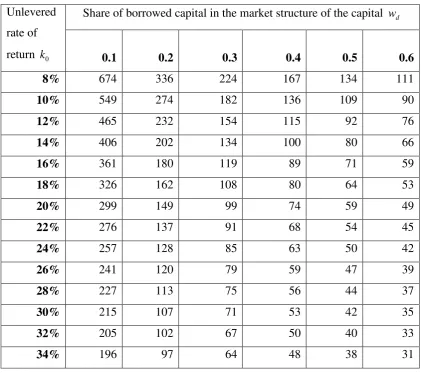
Table 1 - Analysis of sensitivity of the maximum time of an investment project, during which
the convergence of the algorithm is guaranteed, depending on parameters k0 and wd
Unlevered
rate of
return k0
Share of borrowed capital in the market structure of the capital wd
0.1 0.2 0.3 0.4 0.5 0.6
8% 674 336 224 167 134 111
10% 549 274 182 136 109 90
12% 465 232 154 115 92 76
14% 406 202 134 100 80 66
16% 361 180 119 89 71 59
18% 326 162 108 80 64 53
20% 299 149 99 74 59 49
22% 276 137 91 68 54 45
24% 257 128 85 63 50 42
26% 241 120 79 59 47 39
28% 227 113 75 56 44 37
30% 215 107 71 53 42 35
32% 205 102 67 50 40 33
34% 196 97 64 48 38 31
The table above provides a rough estimate of the limit life (years) of the forecasted
period for an investment project or a company generating positive cash flows, during which
the algorithm guarantees a uniqueness solution.
The unlevered rate k0 for companies generating cash flows exceeds 25% extremely
seldom; and the share of debt in the market structure of capital of such companies exceeds
50% on equivalently rare occasions.
This means that for a vast majority of actually existing companies generating only
positive cash flows the algorithm is characterized by convergence, since in most cases
forecasted periods for evaluation of companies generating cash flows do not exceed the
companies, for which cash flow duration does not exceed the maximum time of the project
(company).
However, for companies, which generate not only positive cash flows, this statement
is not true. Duration for such companies may exceed the maximum time (n) of the project
(company). In the work by (Limitovsky M.A., Minasyan V.B. 2010) we did not obtain the
sufficient condition for convergence of the iterative algorithm for companies generating not
only positive cash flows, because the authors failed to get estimates from a higher level (or
find another such valuation in literature) for the duration of a cash flow with other than
positive components of such cash flow. To overcome this difficulty, the following assertion
was proved in the work:
Assertion:
The following inequality is true for the duration of a cash flow which includes other
than positive components:
V V n n Dur
( 1) ,
(23)
Where n = full time of existence of the cash flow; V = present (zero-moment) sum total of
values of modules of negative elements of the cash flow.
Proof
Let's assume that in k periods from n periods of existence of the cash flow, the cash
flows are negative, and in the rest (n – k) periods, they are positive. Periods with negative cash flows we will mark as i1,i2,...,ik ; whereas periods with positive cash flows, accordingly,
we will mark as ik1,ik2,...,in.
Then, the formula for determining duration will look as follows:
n k j i i j k j i i j j j j j WACC FCF i V WACC FCF i V Dur 11 (1 )
1 ) 1 ( | | 1 .
Now we will introduce the designations:
j j j i i i WACC FCF V w ) 1 ( | | 1
j j j i i i WACC FCF V w ) 1 ( 1
for j = 1, 2,…, k.
Then, it is clear that the following equalities are true:
... ... 1
2 1 2
1
k n
k
k i i i
i i
i w w w w w
w
(24)
Duri1wi1 i2wi2 ...ikwik ik1wik1 ik2wik2 ...inwin
(25)
From the equation (25), it obviously follows that:
... ( ... ) 2 1 2 1 n k k
k i i i
i i
i w w n w w w
w
Dur .
Then, using simple conversions and (25) several times, we will get:
k n
k
k i i i
i i
i w w w w w
w
Dur ... ...
2 1 2
1
... ) )( 1 ( 2
1 k n
k i i
i w w
w n
=1( 1)( ... )
2
1 k n
k i i
i w w
w n
1 ... ( 1)( ... )
2 1 2
1 i ik ik ik in
i w w n w w w
w
k
i i
i w w
w ... 2 1 = ... ) )( 2 ( 2 2
1 k n
k i i
i w w
w
n
k
i i
i w w
w ... 2 1 = ... ) )( 2 ( ... 2 2 1 2
1 i ik ik ik in
i w w n w w w
w 2( ... )
2
1 i ik
i w w
w
3( 3)( ... )
2
1 k n
k i i
i w w
w
n 2( ... )
2
1 i ik
i w w
w ….=
n ( 1)( ... ).
2 1 k i i
i w w
w n
Recalling the expressions for wij, we will get:
( 1) .
) 1 ( | | 1 ) 1 ( 1 V V n n WACC FCF V n n Dur k j i i j j
The assertion is thus proven.
If we use (22) and the proven assertion, it will be clear that trueness of inequality (22) for
such companies will be guaranteed if the following inequality is true:
. ) 1 ( 1 0 V V n n WACC k Durper
) ) 1 ( ( 1 1 0 V V WACC k Dur V V n per
(26)
Inequality (26) constitutes a sufficient condition for convergence of our recurrent process. If
we substitute expressions for Durper and WACC into this inequality, this sufficient condition
for convergence (and, accordingly, for existence and uniqueness of the optimum
purpose-oriented capital structure) may be re-formulated as follows:
( 1 (1 ) ).
1 1 0 0 V V T w k T w k V V n d d (27)
Now let us check the realizability of the sufficient condition for convergence of our iterative
process for companies which will, in future, generate not only positive cash flows.
Let us consider the following values: T=0.20, k0 0.25 , wd 0.5. Also, let us assume that
5 . 0 V V .
Let us mark, asV, the sum of values of positive components of the cash flow as
of the present moment (moment zero). The latter equality is equivalent to 0.5
V V V , or V 3 1
V- , which looks rather realistic.
By substituting the selected parameter values into inequality (27), we will obtain:
). 5 . 0 20 . 0 5 . 0 25 . 0 ) 20 . 0 5 . 0 1 ( 25 . 0 1 ( 5 . 0 1 1 n
or n0.666(490.5)where = any figure less than 1 but arbitrarily close to it. This
means that if the forecast period n for the project under the specified conditions is equal to
approximately 33 years or less, then the condition (27) will be met, and the algorithm will
provide a single and unique solution.
Now let us investigate the behavior of the right-hand portion of inequality (27) at all possible
realistic values of parameters k0 , wd and V
V
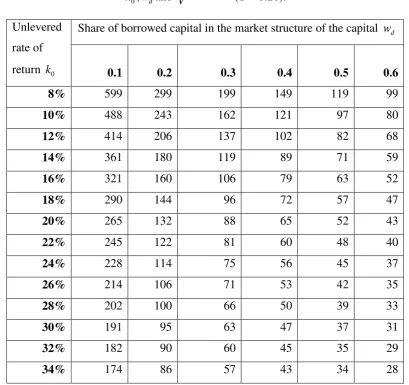
Table 2 - Analysis of sensitivity of the maximum time of an investment project, during which
the convergence of the algorithm is guaranteed, depending on parameters
0
k ,wdand
125 . 0
V V
(T = 0.20).
Unlevered
rate of
return k0
Share of borrowed capital in the market structure of the capital wd
0.1 0.2 0.3 0.4 0.5 0.6
8% 599 299 199 149 119 99
10% 488 243 162 121 97 80
12% 414 206 137 102 82 68
14% 361 180 119 89 71 59
16% 321 160 106 79 63 52
18% 290 144 96 72 57 47
20% 265 132 88 65 52 43
22% 245 122 81 60 48 40
24% 228 114 75 56 45 37
26% 214 106 71 53 42 35
28% 202 100 66 50 39 33
30% 191 95 63 47 37 31
32% 182 90 60 45 35 29
34% 174 86 57 43 34 28
Table 3 - Analysis of sensitivity of the maximum time of an investment project, during which the convergence of the algorithm is guaranteed, depending on parameters
0
k ,wdand
25 , 0
V V
(T = 0.20).
Unlevered
rate of
return k0
Share of borrowed capital in the market structure of the capital wd
0.1 0.2 0.3 0.4 0.5 0.6
[image:22.595.82.508.671.769.2]10% 439 219 146 109 87 72
12% 372 186 123 92 74 61
14% 325 162 107 80 64 53
16% 289 144 96 71 57 47
18% 261 130 86 64 51 43
20% 239 119 79 59 47 39
22% 221 110 73 54 43 36
24% 206 102 68 51 40 33
26% 193 96 64 47 38 31
28% 182 90 60 45 35 29
30% 172 86 57 42 34 28
32% 164 81 54 40 32 26
[image:23.595.82.518.482.774.2]34% 157 78 51 38 30 25
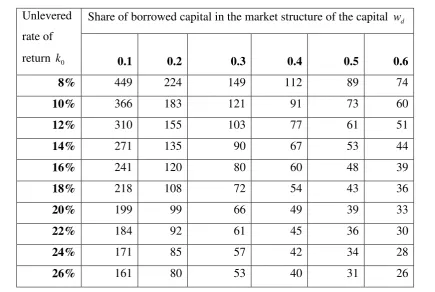
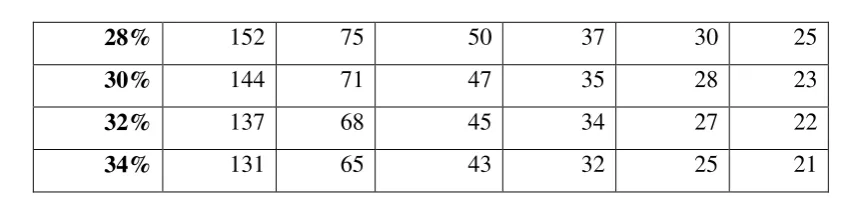
Table 4 - Analysis of sensitivity of the maximum time of an investment project, during which the convergence of the algorithm is guaranteed, depending on parameters
0
k ,wdand
5 . 0
V V
(T = 0.20).
Unlevered
rate of
return k0
Share of borrowed capital in the market structure of the capital wd
0.1 0.2 0.3 0.4 0.5 0.6
8% 449 224 149 112 89 74
10% 366 183 121 91 73 60
12% 310 155 103 77 61 51
14% 271 135 90 67 53 44
16% 241 120 80 60 48 39
18% 218 108 72 54 43 36
20% 199 99 66 49 39 33
22% 184 92 61 45 36 30
24% 171 85 57 42 34 28
28% 152 75 50 37 30 25
30% 144 71 47 35 28 23
32% 137 68 45 34 27 22
[image:24.595.82.508.94.193.2]34% 131 65 43 32 25 21
Table 5 - Analysis of sensitivity of the maximum time of an investment project, during which the convergence of the algorithm is guaranteed, depending on parameters
0
k ,wdand
1
V V
(T = 0.20).
Unlevered
rate of
return k0
Share of borrowed capital in the market structure of the capital wd
0.1 0.2 0.3 0.4 0.5 0.6
8% 337 168 112 84 67 56
10% 275 137 91 68 55 45
12% 233 116 77 58 46 38
14% 203 101 67 50 40 33
16% 181 90 60 45 36 30
18% 163 81 54 40 32 27
20% 150 75 50 37 30 25
22% 138 69 46 34 27 23
24% 129 64 43 32 25 21
26% 121 60 40 30 24 20
28% 114 57 38 28 22 19
30% 108 54 36 27 21 18
32% 103 51 34 25 20 17
34% 98 49 32 24 19 16
Table 6 - Analysis of sensitivity of the maximum time of an investment project, during which the convergence of the algorithm is guaranteed, depending on parameters
0
k ,wdand
2
V V
Unlevered
rate of
return k0
Share of borrowed capital in the market structure of the capital wd
0.1 0.2 0.3 0.4 0.5 0.6
8% 225 112 75 56 45 37
10% 183 92 61 46 37 30
12% 155 78 52 39 31 26
14% 136 68 45 34 27 22
16% 121 60 40 30 24 20
18% 109 54 36 27 22 18
20% 100 50 33 25 20 17
22% 92 46 31 23 18 15
24% 86 43 29 21 17 14
26% 81 40 27 20 16 13
28% 76 38 25 19 15 13
30% 72 36 24 18 14 12
32% 69 34 23 17 14 11
[image:25.595.65.476.584.777.2]34% 66 33 22 16 13 11
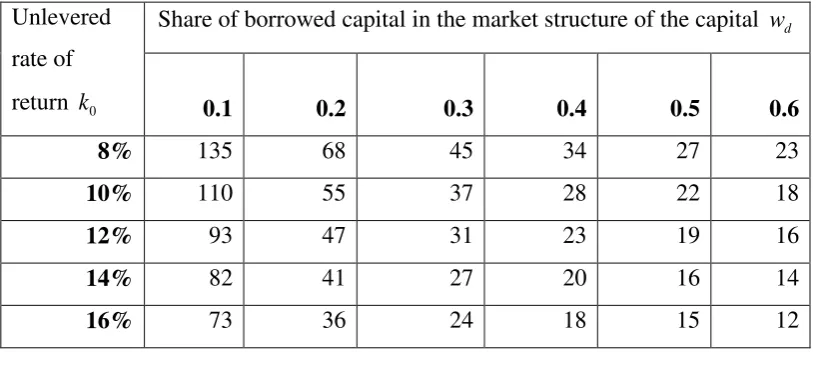
Table 7 - Analysis of sensitivity of the maximum time of an investment project, during which
the convergence of the algorithm is guaranteed, depending on parameters в
0
k ,wdand
4
V V
(T = 0.20).
Unlevered
rate of
return k0
Share of borrowed capital in the market structure of the capital wd
0.1 0.2 0.3 0.4 0.5 0.6
8% 135 68 45 34 27 23
10% 110 55 37 28 22 18
12% 93 47 31 23 19 16
14% 82 41 27 20 16 14
18% 66 33 22 16 13 11
20% 60 30 20 15 12 10
22% 56 28 19 14 11 9
24% 52 26 17 13 10 9
26% 49 24 16 12 10 8
28% 46 23 15 12 9 8
30% 43 22 15 11 9 7
32% 41 21 14 10 8 7
34% 40 20 13 10 8 7
The unlevered rate k0 for companies generating exceeds 25% extremely seldom; and
the share of debt in the market structure of capital of such companies exceeds 50% on
equivalently rare occasions.
The valuation practice shows that the share of the discounted absolute value of the
negative portion of cash flows of such companies in their total discounted cash flows V
V
seldom goes beyond the limits of 0.125 thru 4. We can see that for projects (businesses) with
forecasted periods of 599 thru 7 years, convergence of the iterative process to the single
solution is guaranteed. Projects with the minimum guaranteed forecasted period of
convergence correspond to the maximum (from those considered) unlevered rate k0= 34%,
the maximum (from those considered) debt share of 0.6, and the maximum (of those
considered) discounted value of negative cash flow in their total discounted cash flows
4
V V
. Such combination has extremely low probability; but even in such a case,
convergence of the iteration process is guaranteed for forecasted periods of up to 7 years.
This means that for a vast majority of really existing companies, convergence of the
iteration algorithm is guaranteed by this criterion.
Convergence may be basically proven for other types of projects/companies (e.g. for a
company, which is an actual option or an economically separate project, etc). And though this
has not been done at this stage of the investigation, our multifarious applications of the
suggested algorithms in real projects testify to the fact that they almost always provide the
Conclusion
The difficulties in calculation of the capital structure, financial leverage, and weighted
average capital cost consist in the fact that to evaluate a project or a company one should
know the market structure of its capital; whereas, to obtain a reasonable market structure of
the capital, valuation results shall be available ((NPV or value of the company). To settle this
problem, in article suggest using iterative algorithms for calculating the structure and
weighted average capital cost for a company generating cash flows. These algorithms are
easily implementable using the popular EXCEL software. The article specifies advantages of
such algorithms in comparison with the famous Evans-Bishop and Pratt-Martin iterative
techniques. It is proven the suggested algorithms, in the vast majority of real situations, have a
single and unique solution for valuation calculations.
The general character of the proven criterion should be noted. In this work, the final
numerical test of convergence of the iterative process to a single solution is proven based on
notions of the reasonable area of measuring the key parameters which affect the convergence
of iterations in the Russian practice (e.g. the chosen tax rate is T = 0.20 etc.). However, using
this criterion and notions of the reasonable area of measuring the respective parameters in any
other countries, one can also verify, for which companies this algorithm will guarantee
convergence to the single solution determining the reasonable structure of capital of each
specific company.
References:
Damodaran A. (2004), Investment evaluation: Tools and methods for valuation of any assets,
Alpina Business Books, Moscow, Russia.
F.Ch. Evans, D.M. Bishop (2004), Valuation of companies during mergers and acquisitions.
Creation of cost in private companies, Alpina Publisher, Moscow, Russia.
Guidelines for evaluation of efficiency of investment projects. (2000), Economics, Moscow,
Russia.
Hamada R. (1972), «The effect of the firm’s capital structure on the systematic risk of
Holden C.W. (2004), Spreadsheet modeling in corporate finance, Prentice Hall, New Jercey.
Kolmogorov A.N., Fomin S.V. (1972), Elements of theory of functions and functional
analysis, Nauka, Moscow, Russia.
Limitovsky M.A. (2004), Investment projects and real options at emerging markets, Delo,
Moscow, Russia.
Limitovsky M.A., Minasyan V.B. (2010), «Development and implementation of iteration
algorithms for determining capital structure and valuation of capital cost», Management accounting and finance, 3, pp. 162-183.
Lumby S., Jones C. (2004), Corporate finance. Theory & practice, Thomson learning,
London.
Pratt Sh. (2006), Cost of capital, Quinto Consulting, Moscow, Russia.
Lumby S., Jones C. (2004), Corporate finance. Theory & practice, Thomson learning,
London.
Peterson D. and Peterson P. (1996), Company Performance and Measures of Value Added,
The Research Foundation of the Institute of Chartered Financial Analysts,