ISSN Online: 1945-3124 ISSN Print: 1945-3116
An Augmented Framework for Formal
Analysis of Safety Critical Systems
Monika Singh, V. K. Jain
College of Engineering & Technology (FET), Mody University of Science & Technology, Laxmangarh, India
Abstract
This paper presents an augmented framework for analyzing Safety Critical Systems (SCSs) formally. Due to high risk of failure, development process of SCSs is required more attention. Model driven approaches are the one of ways to develop SCSs for accomplishing critical and complex function what SCSs are supposed to do. Two model driven approaches: Unified Modeling Lan-guage (UML) and Formal Methods are combined in proposed framework which enables the analysis, designing and testing safety properties of SCSs more rigorously in order to reduce the ambiguities and enhance the correct-ness and completecorrect-ness of SCSs. A real time case study has been discussed in order to validate the proposed framework.
Keywords
Unified Modeling Language, Formal Methods, Z Notation, Safety Critical System
1. Introduction
Embedded softwares are found in almost every field of human life such as in medical equipment, air traffic control systems, car airbag, braking systems, nuc-lear reactor control and cooling systems, aerospace on-board systems, etc. From last decades, these systems are supposed to do and control more complex func-tions. A minor fault in such systems may cause severe consequences such as loss of human lives, environmental damage or high economic losses. Such systems whose focus is kept on safety are known as Safety Critical Systems [1]. The deed of complex function of safety critical system spiked the growth of model based techniques for development of such system. These techniques are preferred to apply at early stage of software development process [2]. The idea behind these techniques is to develop and analyze a model of the system instead of the as-sessment of the final system implementation. The model-driven techniques How to cite this paper: Singh, M. and Jain,
V.K. (2017) An Augmented Framework for Formal Analysis of Safety Critical Systems. Journal of Software Engineering and Ap-plications, 10, 721-733.
https://doi.org/10.4236/jsea.2017.108039
Received: May 15, 2017 Accepted: July 8, 2017 Published: July 11, 2017
Copyright © 2017 by authors and Scientific Research Publishing Inc. This work is licensed under the Creative Commons Attribution International License (CC BY 4.0).
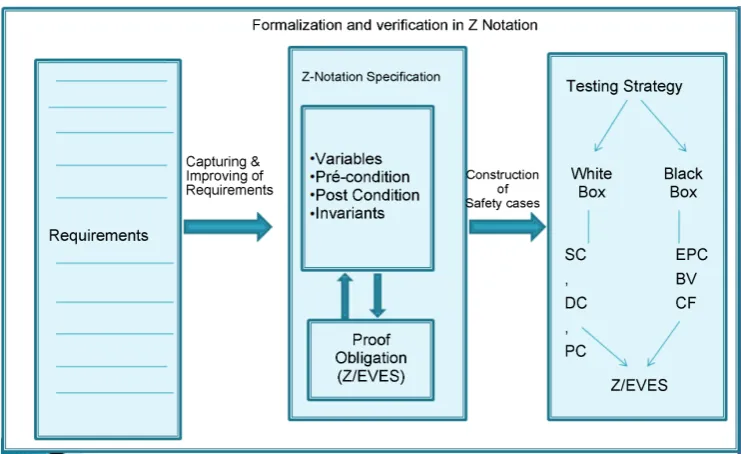
(MDT) [3] vary in the degree of mathematics used. For example, there is MDT which emphasizes on the graphical representation instead of defining semantics formally such as Unified Modeling Language [4]. On the other hand, there are techniques such as Formal Methods [5] that use rigorous mathematics for de-fining the semantics. The formal methods are used to develop the system with a high degree of confidence to prevent the failures and enhance the correctness of system behaviour. Generally, the model-driven development (MDD) techniques are used to capture the main features of the system. Moreover, in order to achieve the safety of system, we need to make sure that, even the occurrence of fault in some system components or some unfavorable conditions in the envi-ronment, the system will not be put into an unsafe state. This will increase the complexity of system by using the fault tolerance and failure detection mechan-isms. Therefore, we require an integrated approach to develop system rigorously which will consider the system integrity along with handling the abstraction, complexity and provide verification by proof. In this thesis, we rely on Z Nota-tion [6] formalism. Since Z notation is an orphan of model-oriented formal me-thods empire that will start from abstract model and consecutive refinements towards the final model via revised or updated schema for correctness. Revise or updated schema allows us to assure the system safety requirements by stepwise enhancing their representation in the system model along with providing the proof for system properties at various level of abstraction. Figure 1 presents the augmented framework which is wrapping safety properties along with safety analysis is required which includes safety properties, incorporating as the results of safety analysis, transformed into formal models for verification, facilitates formal development and verification of safety-critical systems via pre-defined patterns.
[image:2.595.168.539.487.714.2]Rest of the paper is organized as follow: Section 2 presents the methodology and
components of augmented framework. Section 3 presents the Formal Model of SCSs. Section 4 represents the simulation and section 5 presents the conclusion.
2. Methodology and Components
The components of this holistic approach are: Unified Modeling Language and Z Notation [5]; a Formal Method and described briefly as follow.
2.1. Unified Modeling Language (UML)
UML [6] is a modeling technique that combines object oriented methods and concepts. It enhances the analysis and design of software system by allowing more cohesive relationships b/w objects. It has been observed that graphical re-presentation of model is easily accessible and understandable to the user. The primary gap between the developer and the user has been easily fulfilled by the graphical description.UML composed of nine diagrams: Use case diagram, class diagram, sequence diagram, state diagram, activity diagram, interaction dia-gram, component diadia-gram, deployment diagram and package diagram. Graphi-cal representation always gives a better understanding of proposed system.
2.2. Z Notation
Z notation [5] is the oldest formal specification language introduced in late 1970’s and developed through the 1080’s with the collaboration of two leading brand names; Oxford University with industrial partner IBM and Inmos. The next milestone in the journey of z notation came as a Reference manual in 1989 given by Mile specy. Z uses the standard such as American National Standards Institute (ANSI), British Standard Institute (BSI) and International Organization for standardization (ISO) for writing any draft in Z notation for formal seman-tics. The Z notation is a model oriented approach based on first order predicate logic and Zermelo-Fraenkel (ZF) set theory used for specifying behavior of ab-stract data types and sequential programs.
The proposed framework is presented in Figure 1 which helps in:
1) Capturing and improving the readability of requirements of Safety Critical Systems.
2) Model and verify the correctness of Safety Critical Systems. 3) Construct and test the Safety Critical Cases.
2.3. Methodology
that the test specifications are complete and consistent.
Figure 1 presents an overview of the proposed approach. The following steps are associated with this approach: 1) capturing and improving readability of in-formally defined requirements of safety critical systems, 2) formalization of var-ious aspects of critical systems and formal verification of correctness—by con-struction as well as 3) validate the required safety properties are met.
3. Formal Analysis of Safety Critical Systems (SCSs)
This section is divided into three segments.3.1. Capturing and Improving the Readability of Requirements of
Safety Critical Systems
The requirements are usually written in natural language. To get a better under-standing of system functionality, graphical languages such a Unified Modeling Language (UML) are used. Graphical representation always gives a better under-standing of proposed system. The UML—use case diagram defines the beha-viour of a system i.e. the functionality of the system. Therefore one can get better understanding of system behaviour by making use case diagram of the system which further forms the root of Software Requirement Specification (SRS). Al-though UML has numerous good attributes yet not accepted for designing the safety critical system alone. One of the reasons is lack of preciousness in seman-tic used in graphical model. To improve the readability of requirements, Exten-sion Mechanism [7] such as Stereotype, Tagged values and Constraints are used. The UML Extension Mechanisms are used to extend UML by:
1) Adding new model elements, 2) Creating new properties and 3) specifying new semantics.
Extensive Mechanism: Stereotype
Tagged Value Constraint
In the context of this paper, Stereotype is used to sever the purpose. A stereo-type is a model element that denotes additional values, additional constraint and optionally a new graphical representation. Moreover, a stereotype allows us to attach a new semantic meaning to a model element. The two type of sterotypes are used in this paper:
• “Include”—Include is used to extract use case fragments that are duplicated
in multiple use cases. The included use case cannot stand alone and the orig-inal use case is not complete without the included one.
• “Extend”—Extend is used when a use case adds steps to another first class
use case.
phase. The class diagram forms the root for system structure and sequence dia-gram forms the basis for system behaviour respectively. According to propose approach, the system development begins with an abstract system model that is further elaborated gradually by providing implementation details in a number of model transformation steps. This approach provides us support to handle the system complexity and to develop the system correct-by-construction. In addi-tion, refinement processes are iterative in nature and feedback is provided by ve-rification. Thus, contradicting, inconsistent and incomplete requirements speci-fications, design specification can be discovered.
Since class diagram is the basis for system structure and helps in designing modules of a system, but due to component of UML family, lack preciousness in semantic. To address this problem, we construct formal model for class diagram and sequence diagram in order to capture static and dynamic aspect of the sys-tem respectively. It guides the developer starting from the informal representa-tion of class and sequence diagram (with UML) to building the corresponding parts of system module via formal modeling and verification in Z Notation and accompany toolsets. In the scope of this approach, we propose the automated Theorem Prover for demonstrating that formal system models are themselves are well defined. Moreover, in order to assure that there is no logical inconsis-tency and no model element contains any infeasible mathematical definition, simulation of Z specification has been done with Z/EVES [8] tool.
3.3. Construct and Test the Safety Critical Cases
purpose of simulation in automated environment. Moreover, formal methods are rich in mathematics axioms, supporting the argument that all the model elements definitions are consistent and feasible.
4. Simulation Results
This section is divided into two parts: section 4.1 presents the formal model for safety Critical systems and section 4.2 represents the verification of results with automated Theorem Prover.
[image:6.595.200.541.339.713.2]4.1. Formal Model
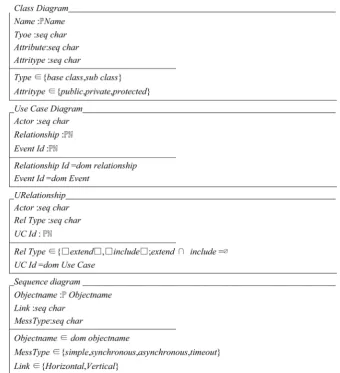
Figure 2 shows the formal model for requirements and design of SCSs by formal transforming the use case, class diagram, and sequence diagram into Z notation element; Schema—a notion for structuring the formal specification written in Z notation. Moreover the formal model for testing specification is depicted in
Figure 3.
The testing strategies are broadly divided into two categories: White box test-ing and Black box testtest-ing. White box testtest-ing focuses on internal structure of
software artifact. One of the ways to test internal structure is to use either of fol-lowing scenarios: Statement coverage (SC), decision coverage (DC) or path cov-erage (PC). Black box testing focuses on the input and output irrespective of in-ternal structure. The famous black box testing criteria’s are: Equivalence parti-tions class (EPC), Boundary Value Analysis (BV), Cause & Effect (C&E). The formal model for all these testing criteria’s are formed with Z notation.
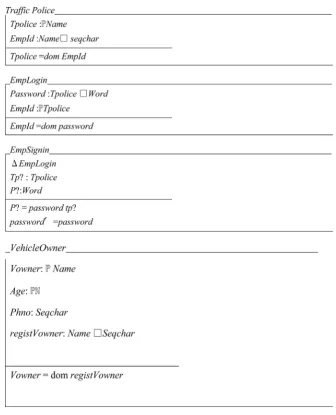
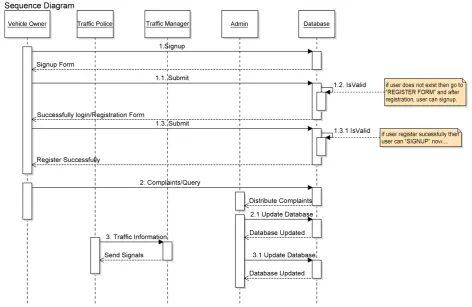
To validate the proposed framework, case study of Road Traffic Management System has been discussed and formal model is shown in Figure 4. RTMS make use of real-time data acquired from the road network in order to reduce traffic congestion and accidents, and to save energy and preserve the environment. The Road Traffic management System (RTMS) has three active actors i.e. Admin, Vehicle Owner, Traffic police. Traffic police maintains the information which is provided by the users (Admin, vehicle owners).
[image:8.595.204.541.307.723.2]The UML model of RTMS consists of Use Case diagram, Class Diagram and Sequence Diagram in Figure 5.
Figure 5. UML model for RTMS.
4.2. Simulation
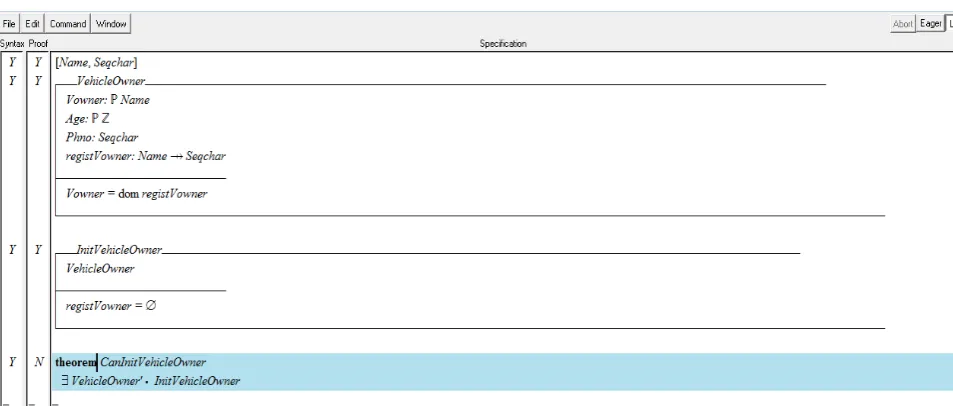
To ensure the correctness and completeness of specification, design draft and test specification; the formal model is further verified on automated Theorem Prover i.e. Z/EVES in Figure 6.
The testing criteria’s for construction of safety test case is formally verified in
Figure 7 and Figure 8.
The RTMS elements are further verified on Z/EVES in order to enrich the va-lidation of proposed framework which is shown in Figure 9.
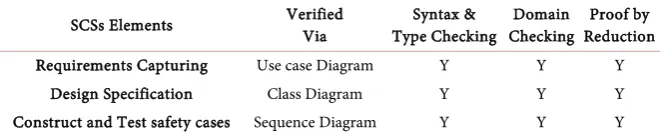
The Table 1 presents the overall model analysis results on automated Theo-rem Prover and the parameters are: Syntax & Type checking, Domain checking and Proof by Reduction.
5. Conclusions
The proposed framework is a complete, formal, frameworkwhich can be used to develop the safety-critical system, with a combination of graphical modeling language. This framework poses the following characteristics:
• Complete—The proposed method covers all the phases of the software
de-velopment process i.e. starting from specification to design followed by veri-fication and validation.
• Formal—This method uses rigorous mathematics for specification,
Figure 6. Verification of Z specification on Z/EVES.
Figure 7. Z/EVES result for Statement Coverage (SC).
[image:11.595.59.536.363.488.2]Figure 8. Z/EVES result for Equivalence Partition Class (EPC).
[image:11.595.59.536.514.717.2]Table 1. Overall model analysis results on automated theorem prover.
SCSs Elements Verified Via Type Checking Syntax & Checking Domain Reduction Proof by
Requirements Capturing Use case Diagram Y Y Y
Design Specification Class Diagram Y Y Y
Construct and Test safety cases Sequence Diagram Y Y Y
• Framework—Framework presents a 2-step verification and validation
ap-proach, helps in detecting errors in early phases of development process.
• User-friendly—Using graphical modeling languages initially to formal
transformation, this methodology assists various level of abstraction, which helps different users to understand the system behaviour with ease.
• Scalable—The approach is proficient in verifying the system (safety
proper-ties) of industrial size by allowing inductive reasoning and model checking together.
• Facilitate the safety assurance process of formally developed safety-critical
systems, by an established link between formal specification and safety cas-es.
• Enhance the processes of Requirements Elicitation, Formal modeling and
Verification.
• Facilitate the system certification by showing how to incorporate safety
re-quirements into Formal model.
• Allows using the verification results of formal models as the evidence for
construction of safety cases.
References
[1] Gowen, L.D. (1994) Specifying and Verifying Safety-Critical Software Systems. IEEE Seventh Symposium on Computer-Based Medical Systems, 235-240.
https://doi.org/10.1109/cbms.1994.316018
[2] Dunn, W.R. (2002) Practical Design of Safety-Critical Computer Systems. Reliabili-ty Press, Solvang, USA.
[3] Hebig, R. (2014) On the Need to Study the Impact of Model Driven Engineering on Software Processes. In Proceedings of 2014 International Conference on Software and System Process, Nanjing, 26-28 May 2014, 164-168.
https://doi.org/10.1145/2600821.2600846
[4] Booch, G., Rumbaugh, J. and Jacobson, I. (1999) The Unified Modeling Language User Guide. Addison-Wesley, Boston.
[5] Monin, J.-F. (2003) Understanding Formal Methods, Springer, Berlin.
https://doi.org/10.1007/978-1-4471-0043-0
[6] Spivey, J.M. (2001) The Z Notation: A Reference Manual. 2nd Edition, Prentice Hall, Upper Saddle River.
[7] Rosenblum, D.S. (2005) Lightweight Extension Mechanisms for UML. Lecture Notes Advanced Analysis and Design (GS02/4022), London.
http://www0.cs.ucl.ac.uk/teaching/syllabi/2006-07/ug/4022.htm
CANADA.
[9] Myers, G.J. (2004) The Art of Software Testing. 2nd Edition, John Wiley & Sons, New York.
[10] Jorgensen, P.C. (2013) Software Testing: A Craftsman’s Approach. 4th Edition, Auerbach Publications, Boca Raton.
Submit or recommend next manuscript to SCIRP and we will provide best service for you:
Accepting pre-submission inquiries through Email, Facebook, LinkedIn, Twitter, etc. A wide selection of journals (inclusive of 9 subjects, more than 200 journals)
Providing 24-hour high-quality service User-friendly online submission system Fair and swift peer-review system
Efficient typesetting and proofreading procedure
Display of the result of downloads and visits, as well as the number of cited articles Maximum dissemination of your research work