Self Compacting Concrete under Local Conditions
Abderahmane Seddik1, Ahmed Beroual2, Abdesselam Zergua2, Mohamed Nacer Guetteche2 1
Department of Civil Engineering, Ferhat Abbas University, Setif, Algeria 2
Department of Civil Engineering, Constantine 1 University, Constantine, Algeria Email: [email protected]
Received April 7, 2013; revised May 10, 2013; accepted May 17,2013
Copyright © 2013 Abderahmane Seddik et al. This is an open access article distributed under the Creative Commons Attribution License, which permits unrestricted use, distribution, and reproduction in any medium, provided the original work is properly cited.
ABSTRACT
This paper presents the results of experimental investigations on mechanical properties of self compacting concrete made with local materials. The used materials were cement, aggregate and super plasticizer. Limestone powder, silica fume and blast furnace slag have been used as adjuvant in self compacting concrete (SCC). Self compacting concrete properties in fresh and hardened state are characterized and analyzed. The test results indicate the possibility to manu-facture SCC with good rheological and mechanical properties using local materials.
Keywords: Self Compacting Concrete (SCC); Mineral Additions; Super Plasticizer; Workability; Compressive Strength and Tensile Strength
1. Introduction
In recent years, there has been an important increase in the use of self-compacting concrete (SCC) [1-6]. Since its emergence, SCC is widely used all over the world. SCC was developed in Japan to improve the uniformity and reliability of concrete [7]; it doesn’t require any consolidation work at site. The characterization and for- mulation of this material have been the subject of nu- merous investigations [8-11].
Using SCC in structures would result in both technical and economical advantages. One of the most important differences between SCC and conventional concrete is the incorporation of a mineral admixture. This concrete is characterized by a high amount of fines, an amount of water, a relatively low use of super plasticizers, a high deformability and good uniformity in such a way that it can flow under its own weight to completely fill the formwork and passes through the congested reinforce- ment without any mechanical vibration. Many studies show the advantage of mineral admixture usage in SCC; and it enables to improve the workability with a reduc- tion of cement content [12-14]. The mineral admixtures enable to improve particle packing, to decrease the per- meability and to increase the durability of concrete [15]. The waste materials such as limestone powder, fly ash and granulated blast furnace slag are generally used as mineral admixtures in SCC [16-19] These add a positive impact on the timeliness and quality of concrete [7], at the same time the environmental pollution will be re-
duced [20].
The aim of the present work is to highlight the influ- ence of local constituents in the composition of a SCC from the viewpoint of fresh and hardened state behavior and therefore to develop optimized formulations with good rheological and mechanical properties.
This paper deals with the investigation of the effect of LP, BFS and SF as mineral admixtures on the fresh and hardened properties of SCC. Therefore, the saturation point with the cone Marsh, the slump flow, the compres- sive strength, the ultrasonic pulse velocity (UPV) and the dynamic elastic modulus tests were conducted to achieve this objective and determine the appropriateness of using these different material admixtures in SCC.
The experimental work began with the characteriza- tion of various local materials from Algeria.
2. Experimental Program
2.1. Materials
The materials used in this study were locally sourced and they satisfied the requirements of Algerian Standards.
2.1.1. Cements
2.1.2. Aggregates
The coarse aggregates are from a deposit of limestone (Kef-Erendira region, Eastern of Algeria). Its Los Ange- les coefficient and absolute density are respectively 20% to 28%, and the value of absolute density is equal to 2.7. Natural sand, (fine aggregates) was procured from a near- by river source. It has a sand equivalent, fineness module and absolute density equal to 78%, 2.0 and 2.60 respec- tively.
2.1.3. Minerals Addition
The addition included minerals are Silica fume with blain specific surface of 200,000 cm2/g, local limestone fillers (type Alcal15), blast furnace slag (Blaine specific surface of 4200 cm2/g).
2.1.4. Super Plasticizers
Super plasticizer by trade name MEDAFLOW 30 was used as high water reducing agent, third generation, to achieve the required workability.
2.2. Principles of Mix Proportioning
The portioning of the mix is extremely important in de- veloping an effective SCC. The effect of mixture propor- tion, in terms of ratios between cement to solids and coarse and fine aggregates has been the subject of many investigations [21].
The incorporation of fine mineral remains empirical. There is no universally agreement on the effect of these factors due to the complexity of combined action.
Assuming that fresh concrete behaves as a material in two phases namely a viscous phase, consisting of the paste (cement + fines + water) and a granular phase con- taining all the aggregates. Preliminary concrete mixture (Table 1), was adopted as a control mix test; and the two phases are analyzed.
2.3. Specimen Preparation
The concrete was mixed using a mixer with a capacity of 100 l. The mixture sequence was as follows: all the solid components (natural aggregates, cement, silica fume, blast furnace slag and calcareous filler) were mixed for 30 s. It was followed by the introduction of the effective water and one third of the super plasticizer. After 90 s of mixing, the remaining additives (the rest of the super plasticizer and the viscosity agent) were added and mixed with the other components for 210 s. Then the slump flow tests were carried out. Depending on the ob- tained test results, additives and/or water were adjusted. Specimens were cast in various moulds of different shapes according to the test requirements. Due to the flowing ability of fresh SCC, the materials were successfully poured directly into the moulds without vibration.
Table 1. Preliminary concrete mixture.
ConstituentsSand 0/5
Aggregates
3/8 Cement Water W/C
Super plasticizer
Volume (l/m3) 300 285 161.3 / / 7
Mass (kg/m3) 780 770 500 175 0.35 7.5
2.4. Characterization of Fresh Concrete
2.4.1. Optimization of the Paste
Optimization of the bonding paste is obtained using the Marsh cone test. The study focuses on the variation of flow time of different grout depending on the dosage of super plasticizers. Four grout mixtures were investigated. First mix don’t contain any added mineral, the second one contains 10% of silica fume, the third mix contains 30% of limestone filler and the last mix contains 30% of blast furnace slag.
Figure 1 shows the variation of flow time for different mixes. It decreases with the increasing of super plasti- cizer dosage until reaching a certain point called the saturation point. After that, it remains nearly constant or with a slightly increase.
The flow time of the mix without mineral addition is 0.9% by weight of dry cement (Figure 1(a)). It is 1% for the mix with silica fume (Figure 1(b)), while it is 1.1% in the cases of the two others mixes (Figures 1(c) and
(d)).
2.4.2. Optimization of the Granular Skeleton
The development of an effective SCC involves either modifying the cement paste, or tuning the aggregates, or both of them [20].
The interlocking of coarse aggregates is integral to the strength of the concrete [22].
With coarse aggregates, changing inter-particle spac- ing most practically changes the flow ability of concrete. Coarse aggregates tend to settle with the introduction of super plasticizer, which causes segregation.
Two proportions were studied in fresh state of SCC. The first mix contains 67% of gravel (3/8) and 33% of coarse aggregates (large gravel) (8/15) while the second one contains 33% of gravel (3/8) and 67% of coarse ag- gregates (8/15).
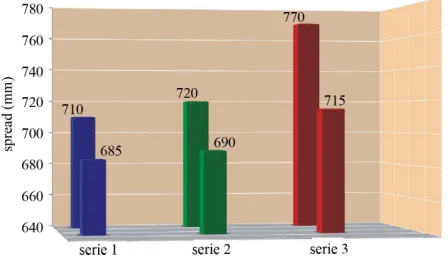
The mixtures of three sets of concrete for three differ- ent sand/paste ratios were manufactured with two mixes for each series. Only the quantities of fine aggregates and coarse aggregate were varied, while the other constitu- ents were kept constant for the entire investigation. The water to binder ratio was also kept constant. The details of different series are given in Table 2.
(a) (b)
[image:3.595.58.284.87.374.2](c) (d)
Figure 1. Flow time vs. super plasticizer dosage for different grouts.
Figure 2. Coarse aggregates effect on the flow slump di-ameter (with w/b = 0.4).
It was found that the composition scc11, scc21, scc31 with the gravel proportion of 67% gives a better deform- ability and flexibility compared to other admixtures.
For series 1 with a sand/paste ratio equal to 0.81, the improvement is averaging 3.6% between scc11 and scc12. This improvement in diameter is inversely propor- tional to the sand/paste ratio. This is a consequence of the reduction in the volume of large coarse aggregates and so reducing the braking phenomenon. These results are in accordance with those reported in [23].
The workability improvement of concrete is mainly due to the reduction of the content of large aggregates of class (8/15), because the increase in the gravel diameter
Table 2. Coarse aggregates effect on the flow slump diame-ter (with w/b = 0.4).
Series 1 Series 2 Series 3
Scc11 A1
Scc21 A2 Scc21
Scc22 B2
Scc31 C1
Scc32 C2
Sand 0/5 780 780 780 780 780 780
Gravel 3/8 516 254 516 254 516 254
Coarse aggregates
8/15 254 516 254 516 254 516
Cement 500 500 500 500 500 500
Water 200 200 210 210 220 220
Super plasticizer 7.5 7.5 7.5 7.5 7.5 7.5
Silica fume / / 25 25 50 50
w/b 0.4 0.4 0.4 0.4 0.4 0.4
Spread diameter
(mm) 710 685 720 690 770 715
causes a braking action (especially in the case of crushed aggregates) and the frictions between particles which limit the material motion.
2.4.3. Effect of Super Plasticizers Content on the Workability of SCC
The purpose in using super plasticizers is to achieve highly flow able concrete while maintaining low water and high fines content.
In the slump flow testa standard slump cone is used and SCC is typically poured in without consolidation efforts. The flow diameter is the mean diameter meas- ured in two perpendicular directions. Some researchers recommend a slump flow value between 500 to 700 mm. Slump flow exceeding 700 mm could lead to segregation of the mix.
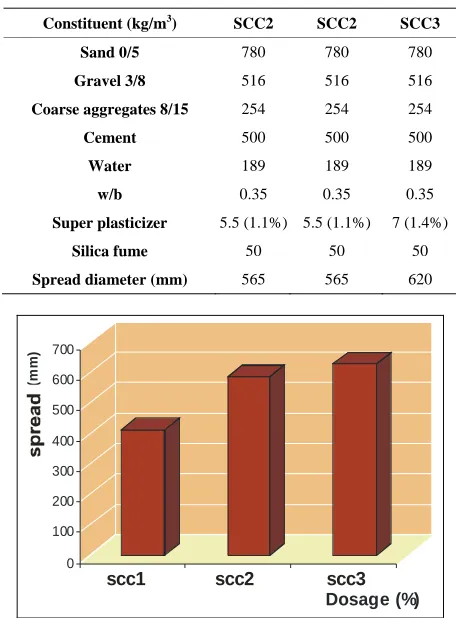
[image:3.595.307.538.110.296.2]The analysis was carried out in concrete mixtures with three percentages of super plasticizer (respectively 0.8%, 1.1% and 1.4% of cement weight). The specimens were tested to study the workability of concrete with local materials(Table 3).
Figure 3 shows that concrete workability increased with the increasing of the super plasticizers content. Note that for 0.8% of additional substance and with w/b = 0.35, the self compacting concrete is not possible to manufac-ture.
2.4.4. Effect of the Colloidal Agent Content on the Stability of SCC
Stability is the characteristic of SCC to resist to the seg- regation. It is often quantified with the Visual Stability Index which ranges from 0 to 3 in increments of 0.5 [24].
[image:3.595.62.286.416.544.2]Table 3. The super plasticizer effect on the flow spread di-ameter.
Constituent (kg/m3) SCC2 SCC2 SCC3
Sand 0/5 780 780 780
Gravel 3/8 516 516 516
Coarse aggregates 8/15 254 254 254
Cement 500 500 500
Water 189 189 189
w/b 0.35 0.35 0.35
Super plasticizer 5.5 (1.1%) 5.5 (1.1%) 7 (1.4%)
Silica fume 50 50 50
Spread diameter (mm) 565 565 620
0 100 200 300 400 500 600 700
E
tal
e
m
e
n
t(m
m
)
BAP1 BAP2
D
BAP3
osage (%)
[image:4.595.309.538.110.310.2]scc1 scc2 scc3
Figure 3. Super plasticizers content effect on spread diame-ter of a SCC.
given in Table 4 and Figures 4 and 5.
The interest of introducing a colloidal agent, is to guarantee a particular viscosity, good concrete stability and ensuring a better cohesion of the paste with main- taining a distance between the aggregates and then re- ducing their interaction and friction during collision. It is seen from Figures 6 and 7 that the increase of the vis- cosity agent leads to a decrease in segregation and spread diameter of concrete. The reduction of segregation and spread diameter is nearly linear.
2.5. Specimen Preparation
After testing the SCC in fresh state the concrete was poured in moulds of cubes and cylinders. The tests were conducted using a universal compression testing machine. The load was applied and increased continuously until the specimen breaks.
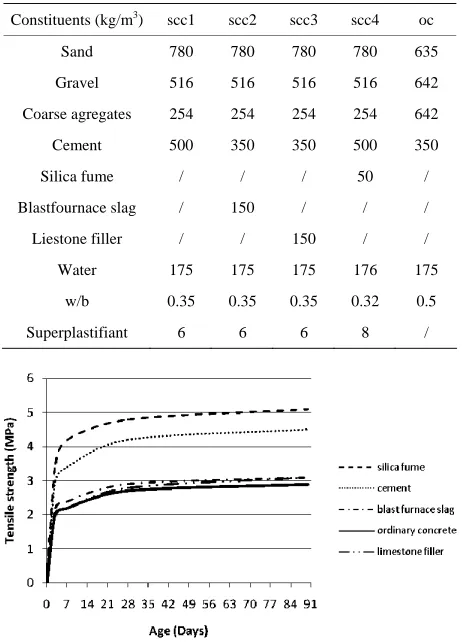
Compressive strength tests were carried out on cubes of 150 mm size. Split tensile strength tests were carried out on cylinders of 160 mm diameter and 320 mm height. Five concrete mixes were designed with a water/blinder ratio of 0.35. In the first mixture the specimens were cast with only Portland cement while the others one a part of
Table 4. Spread diameter and segregation rate for different percentage of colloidal agent content on the fresh SCC.
Colloidal agent content (%)/water
0 0.01 0.02 0.03 0.04
Spread (mm) 670 650 635 615 590
[image:4.595.56.287.110.423.2]Segregation rate (%) 1.63 1.29 1.13 0.96 0.62
[image:4.595.312.536.346.474.2]Figure 4. Spread diameter for different colloidal agent con-tent.
Figure 5. Segregation rate for different colloidal agent con-tent.
Figure 6. Compressive strength of concrete mixes.
[image:4.595.310.540.510.651.2]Table 5. Formulations of different SCC mixture.
Constituents (kg/m3) scc1 scc2 scc3 scc4 oc
Sand 780 780 780 780 635
Gravel 516 516 516 516 642
Coarse agregates 254 254 254 254 642
Cement 500 350 350 500 350
Silica fume / / / 50 /
Blastfournace slag / 150 / / /
Liestone filler / / 150 / /
Water 175 175 175 176 175
w/b 0.35 0.35 0.35 0.32 0.5
[image:5.595.59.287.101.426.2]Superplastifiant 6 6 6 8 /
Figure 7. Splitting tensile strength of concrete mixes.
2.6. Ultrasonic Pulse Velocity (UPV) and Dynamic Elastic Modulus
Values of the ultrasonic pulse in (m/s) and the dynamic modulus of elasticity by ultrasound at the age of 28 days are presented in Table 6.
3. Results and Discussion
The slump-flow values for SCC with LP, BFS and SF are presented in Figure 1. All mixtures exhibited good workability with flow values of at least 580 mm. Slump flows of 685 mm to 770 mm are typically required for SCC [25], and all the tested mixtures are in this interval. It appears that the flow time of a cement grout in the Marsh cone decreases with the increase of the super plas- ticizer content until a certain dosage then remains nearly constant. The saturation point is defined as the intersec- tion of two linear parts of the curve. It is the limit be- tween the decreasing part and the constant one. After this point the increase of super plasticizer content has no im- portant impact on the grout rheology.
[image:5.595.307.538.111.169.2]It is observed that the saturation points are respectively 0.9%, 1% and 1.1% by weight of cement for the mixtures without addition, with silica fume addition and with
Table 6. Ultrasonic pulse velocity (UPV) and dynamic mo- dulus of elasticity by ultrasound.
SCC1 SCC2 SCC3 SCC4 OC
UPV (m /s ) 4409 4359 4232 4438 4255
Dynamic
modulus (GPa) 40.99 39.20 37.34 43.65 38.18
limestone filler and blast furnace slag. Generally, the flow time of grout without fine minerals is lower than those with additional ones.
Table 2 shows that the first formulation with the pro- portions (67% of gavel (3/8) and 33% of aggregates (8/16)), gives a better deformability and workability compared to the other composition. For a volume of sand to a volume of pulp (S/P = 0.81), an improvement of 5.1% of spread diameter is observed in the case of the second formulation. However, for an S/P = 0.74, the in- crease of the first combination is about 4.3% than the other ones and is about 2.1% for the S/P = 0.69 compar- ing with the second formulation. The observed improve- ment in values of spread diameters is due to the reduced volume of coarse aggregate. These results are in a good accordance with those reported in [23].
Figures 2 and 3 show that reduction of w/l affects the behavior of fresh SCC based silica fume. The SCC with w/l equal to 0.32 shows a decrease in the spread diameter of respectively about 11.53% and 22.61% compared to those with w/l equal to 0.35 and 0.4. It is obvious that the SCC determined to 1.4% by weight of cement has been an improvement in spread diameter of respectively 9.7% and 51.2% compared to those of SCC with an adjuvant dosage of 1.1% and 1.8% weight cement.
Figures 4 and 5 present a reducing in spread diameter when increasing the content of the aggregates. This in- crease is beneficial to the stability of the segregation rate. For a content of 0.04% in colloidal agent, the spread di- ameter and the rate of segregation are reduced respec- tively for 3.12% and 61.8% compared with those of SCC without colloidal agent.
3.1. Compressive and Tensile Strengths
Figures 6 and 7 show the plot of the average compres- sive and splitting tensile strength of different concrete mixtures. It can be noted that the incorporation of min- eral additives in to the SCC mixes, increased the com- pressive and split tensile strength.
The compressive strengths of all the mixes have shown strength above 28 MPa which is the required strength. There is a significant increase in the compres- sive strength of the concrete (scc4) with silica fume be- cause of the high pozzolanic nature of the silica fume and its void filling ability.
scc4 with silica fume was 56 MPa and of scc1, scc2, and scc3 was respectively 47MPa, 31MPa and 28 MPa.
It is clear that the role of silica fume seems to be more effective in strength compared to other mixes. The mix with silica fume has shown an improvement in compres- sive strength by about 90% and in tensile strength by about 70% compared to control test concrete at 28 days.
Generally all the strengths were increased gradually up to a maximum values corresponding to 28 days concrete after that no significant increase was observed.
3.2. Ultrasonic Pulse Velocity
Table 6 presents the relationship between the compres- sive strength and the ultrasonic pulse velocity of the SCC mixtures. The UPV values ranged from 4255 m/s to 4438 m/s. The ordinary concrete mixture had the highest UPV value while the lowest UPV value was measured for the scc4 mixture. All measured UPV values are good values according to Whitehurst classification since they are greater than 3500 m/s. The increase in UPV was accom- panied by an increase in the compressive strength. Simi- lar results have been obtained by other researchers [19].
4. Conclusions
The obtained results show the effects of local materials on the properties of fresh and hardened concrete. It is shown that a good SCC could be obtained using appro- priate materials contents. It could be concluded that all the mixtures had satisfactory self-compacting properties in the fresh state. The addition of limestone, silica fume and blast furnace slag had positive effects on the worka- bility. The optimization of the bonding paste is obtained by using tests to Marsh cone. These tests are considered as a criterion to determine the best mineral admixture among LP, SF and BFS. Thus, one can say that SF is the most suitable for improving all of them.
The results for hardened properties of the SCC mix- tures containing different mineral admixtures we inves- tigated showed significant performances; and the highest compressive strength has been obtained for the SF mix- tures.
There was a good correlation between the compression strength of self compacting concrete and pozzolanic na- ture (reactivity) of each mineral adjuvant.
We clearly demonstrated the possible manufacturing of self compacting concrete with fresh and hardened good rheological and mechanical properties using local materials. The improvement of mechanical and rheologi- cal properties has been obtained by reducing the water binding and using a super plasticizers and mineral addi- tions. The mineral additions, namely silica fume, have shown an improvement in compressive and tensile strengths.
REFERENCES
[1] M. Liu, “Self-Compacting Concrete with Different Levels of Pulverized Fuel Ash,” Construction and Building Ma- terials, Vol. 24, No. 7, 2010, pp. 1245-1252.
doi:10.1016/j.conbuildmat.2009.12.012
[2] A. Leemann, R. Loser and B. Münch, “Influence of Ce- ment Type on ITZ Porosity and Chloride Resistance of Self-Compacting Concrete,” Cement & Concrete Compo- sites, Vol. 32, No. 2, 2010, pp. 116-120.
doi:10.1016/j.cemconcomp.2009.11.007
[3] S. C. Kou and C. S. Poon, “Properties of Self-Compact- ing Concrete Prepared with Coarse and Fine Recycled Concrete Aggregates,” Cement & Concrete Composites, Vol. 31, No. 9, 2009, pp. 622-627.
doi:10.1016/j.cemconcomp.2009.06.005
[4] F. M. A. Filho, B. E. Barragán, J. R. Casas and A. L. H. C. El Debs, “Hardened Properties of Self-Compacting Con- crete—A Statistical Approach,” Construction and Build- ing Materials, Vol. 24, No. 9, 2010, pp. 1608-1615. doi:10.1016/j.conbuildmat.2010.02.032
[5] O. Boukendakdji, S. Kenai, E. H. Kadri and F. Rouis, “Effect of Slag on the Rheology of Fresh Self-Compacted Concrete,” Construction and Building Materials, Vol. 23, No. 7, 2009, pp. 2593-2598.
doi:10.1016/j.conbuildmat.2009.02.029
[6] B. Craeye, G. De Schutter, B. Desmet, J. Vantomme, G. Heirman, L. Vandewalle, O. Cizer, S. Aggoun and E. H. Kadri, “Effect of Mineral Filler Type on Autogenous Shrinkage of Self-Compacting Concrete,” Cement and Concrete Research, Vol. 40, No. 6, 2010, pp. 908-913. doi:10.1016/j.cemconres.2010.01.014
[7] H. Okamura and M. Ouchi, “Self-Compacting Concrete. Development, Present Use and Future,” First Interna- tional RILEM Symposium on Self-Compacting Concrete, Rilem Publications SARL, 1999, pp. 3-14.
[8] A. Neville, “Proprietés des Bétons,” Centre de Recherche International du Béton, Editions Eyrolles, 2000.
[9] S. Assie, “Durabilité des Bétons Autoplacants,” Ph.D. Thesis, INSA de Toulouse, France, No. 747, 2004. [10] European Committee for Standardization, “Cement: Com-
position, Specifications and Conformity Criteria,” Com- mon Cements, 2000.
[11] B. Felekoglu, S. Turkel and B. Baradan, “Effect of Water/ Cement Ratio on the Fresh and Hardened Properties of Self-Compacting Concrete,” Build Environment, Vol. 42, No. 4, 2007, pp. 1795-802.
doi:10.1016/j.buildenv.2006.01.012
[12] G. Ye, X. Liu, G. De Schutter, A. M. Poppe and L. Ta- erwe, “Influence of Limestone Powder Used as Filler in SCC on Hydration and Microstructure of Cement Pastes,”
Cement and Concrete Composites, Vol. 29, No. 2, 2007, pp. 94-102. doi:10.1016/j.cemconcomp.2006.09.003 [13] A. M. Poppe and G. D. Schutter, “Cement Hydration in
the Presence of High Filler Contents,” Cement and Con- crete Research, Vol. 35, No. 12, 2005, pp. 2290-2299. doi:10.1016/j.cemconres.2005.03.008
pacting Concrete,” Construction and Building Materials, Vol. 23, No. 5, 2009, pp. 1947-1953.
doi:10.1016/j.conbuildmat.2008.09.007
[15] S. Assie, G. Escadeillas and V. Waller, “Estimates of Self- Compacting Concrete ‘Potential’ Durability,” Construc- tion and Building Materials, Vol. 21, No. 10, 2007, pp. 1909-1917. doi:10.1016/j.conbuildmat.2006.06.034 [16] O. Unal, I. B. Topcu and T. Uygunoglu, “Use of Marble
Dust in Self Compacting Concrete,” Proceedings of V Symposium MERSEM0 2006 on Marble and Natural Stone, Afyon, 2006, pp. 413-420.
[17] B. Felekoglu, K. Tosun, B. Baradan, A. Altun and B. Uyulgan, “The Effect of Fly Ash and Limestone Fillers on the Viscosity and Compressive Strength of Selfcom- pacting Repair Mortars,” Construction and Building Ma- terials, Vol. 36, No. 9, 2006, pp. 1719-1726.
[18] I. Turkmen, “Influence of Different Curing Conditions on the Physical and Mechanical Properties of Concretes with Admixtures of Silica Fume and Blast Furnace Slag,” Ma- terials Letters, Vol. 57, No. 29, 2003, pp. 4560-4569. doi:10.1016/S0167-577X(03)00362-8
[19] M. Sahmaran, H. A. Christianto and I. O. Yaman, “The Effect of Chemical Admixtures and Mineral Additives on the Properties of Self-Compacting Mortars,” Cement and
Concrete Composites, Vol. 28, No. 5, 2006, pp. 432-440. doi:10.1016/j.cemconcomp.2005.12.003
[20] V. B. Bosiljkov, “SCC Mixes with Poorly Graded Aggre- gate and High Volume of Limestone Filler,” Cement and Concrete Research, Vol. 33, No. 9, 2003, pp. 1279-1286. doi:10.1016/S0008-8846(03)00013-9
[21] W. S. Aaron, M. J. Hamlin and P. S. Surenda, “New Me- thodology for Designing Self-Compacting Concrete,” ACI Materials Journal, Vol. 98, No. 6, 2001.
[22] K. B. Van, A. Yilmaz and P. S. Surendra, “Rheology Mo- del for Self-Consolidating Concrete,” ACI Materials Jour- nal, 2002.
[23] L. J. O’Flannery and M. M. O’Mahony, “Precise Shape Grading of Coarse Aggregate,” Magazine of Concrete Re- search, Vol. 51, No. 5, 1999, pp. 319-324.
doi:10.1680/macr.1999.51.5.319
[24] K. Khayat, “Colloques sur les Bétons Autonivelants,” Cen- tre de Recherche Interuniversitaire sur le Béton (CRIB), Université de Sherbrooke, Laval University, Québec, 1996. [25] J. Nasvik, “The ABCs of SCC,” Concrete Construction,