Factors affecting the implementation of communicative
language teaching in Libyan secondary schools
HUSSEIN, Suad
Available from Sheffield Hallam University Research Archive (SHURA) at: http://shura.shu.ac.uk/23409/
This document is the author deposited version. You are advised to consult the publisher's version if you wish to cite from it.
Published version
HUSSEIN, Suad (2018). Factors affecting the implementation of communicative language teaching in Libyan secondary schools. Doctoral, Sheffield Hallam University.
Copyright and re-use policy
See http://shura.shu.ac.uk/information.html
Factors affecting the implementation of
Communicative Language Teaching in Libyan
secondary schools
Suad Hussein
A thesis submitted in partial fulfilment of the requirements of
Sheffield Hallam University for the degree of Doctor of
Philosophy
April, 2018
i
Table of Contents
TABLE OF CONTENTS ... I
LIST OF TABLE... VI
LIST OF FIGURES ... VII
DEDICATION ... VIII
ACKNOWLEDGEMENT ... IX
GLOSSARY OF TERMS AND ABBREVIATIONS ... X
ABSTRACT ... XI
CHAPTER 1 INTRODUCTION TO THE RESEARCH ... 1
1.1INTRODUCTION ... 1
1.2BACKGROUND TO THE STUDY ... 1
1.3RATIONALE FOR THE STUDY ... 4
1.4RESEARCH QUESTIONS ... 6
1.5SIGNIFICANCE OF THE STUDY ... 6
1.6ORGANISATION OF THE THESIS ... 8
CHAPTER 2 LIBYAN CONTEXT ...10
2.1INTRODUCTION ... 10
2.2THE STATE OF LIBYA:GENERAL BACKGROUND... 10
2.3THE INFLUENCE OF RELIGIOUS AND CULTURAL FACTORS IN THE LIBYAN CONTEXT ... 13
2.4HISTORICAL BACKGROUND OF LIBYA’S EDUCATION SYSTEM ... 14
2.5MODERN EDUCATION SYSTEM IN LIBYA ... 17
2.5.1 The structure of Libya’s education system ... 19
2.6ELT IN THE LIBYAN CONTEXT ... 24
2.7CONCEPTIONS OF THE CURRICULUM ... 27
2.7.1 The history of the English curriculum in Libya ... 29
2.8CONCLUSION ... 35
CHAPTER 3 LITERATURE REVIEW ...36
3.1INTRODUCTION ... 36
3.2THE MEANING OF THE CONTEXTUAL AND SOCIAL-CULTURAL FACTORS OF CLT ... 38
3.3DEFINITION OF CLT AND ITS PRINCIPLES ... 40
ii
3.4.1 Second language learning theories (SLL) and the associated teaching methodologies ... 43
3.4.2 Communicative Competence (CC) ... 48
3.4.3 Reasons for CLT's emergence: a summary ... 50
3.4.4 Classroom methods for CLT ... 51
3.4.5 Critique of CLT ... 52
3.5TEACHERS' PERCEPTIONS OF CLT WITHIN DIFFERENT CONTEXTS ... 54
3.6ADOPTION OF CLT IN EFL CONTEXTS ... 58
3.6.1 Gaps and challenges in CLT adoption ... 60
3.7CONCLUSION ... 69
CHAPTER 4 METHODOLOGY ...71
4.1INTRODUCTION ... 71
4.2PHILOSOPHICAL PERSPECTIVES ... 71
4.2.1 Research paradigm ... 75
4.3RESEARCH METHODOLOGY ... 78
4.3.1 Rationale for choosing qualitative research ... 81
4.4DATA COLLECTION METHODS ... 82
4.4.1 Observation... 83
4.4.2 Interviews ... 88
4.5RESEARCH CONTEXT ... 94
4.5.1 Research site ... 94
4.5.2 Research participants ... 96
4.6RESEARCH ETHICS ... 97
4.6.1 The first phase of the data collection ... 97
4.6.2 Ethical Considerations... 98
4.7THE PILOT STUDY ... 103
4.8PROCEDURE OF THE DATA COLLECTION ... 104
4.9DATA ANALYSIS ... 107
4.9.1 Data analysis process... 108
4.10CRITERIA FOR TRUSTWORTHINESS IN QUALITATIVE RESEARCH ... 113
4.10.1 Credibility ... 113
4.10.2 Confirmability ... 115
4.10.3 Dependability ... 116
4.10.4 Transferability ... 116
4.11CHALLENGES OF THE FIELDWORK ... 116
4.11.1 Limitations of the research instruments ... 117
4.12CONCLUSION ... 119
iii
5.1INTRODUCTION ... 120
5.2CONCEPTUAL FACTORS ... 120
5.2.1 The conceptual ambiguity of CLT ... 120
5.3TEACHERS' UNDERSTANDING AND PERCEPTIONS OF CLT ... 122
5.3.1 Teachers’ understanding of CLT ... 123
5.3.2 Teachers’ perceptions of CLT ... 130
5.4THE IMPLEMENTATION OF A COMMUNICATIVE APPROACH IN THE CLASSROOM ... 138
5.4.1 Classroom practice ... 138
5.4.2 Teacher practice and the curriculum content (CLT principles) ... 139
5.4.3 Adopting the traditional method of teaching ... 146
5.4.4 The Use of the L1 (Arabic) in the classroom and translation ... 150
5.4.5 Students’ participation in the classroom: ... 158
5.4.6 Reading aloud ... 161
5.4.7 The use of pair and group work: ... 164
5.4.8 The students’ perceptions of the teachers’ practices in the classroom: ... 168
5.5CONCLUSION ... 172
CHAPTER 6 THE CHALLENGING FACTORS RELATED TO CLT IMPLEMENTATION ... 174
6.1INTRODUCTION ... 174
6.2TEACHERS’ FACTORS ... 174
6.2.1 Teachers’ English proficiency level ... 174
6.2.2 Teachers’ lack of pedagogical knowledge ... 176
6.2.3 Teachers' heavy workload ... 177
6.2.4 Teachers’ low salaries ... 179
6.2.5 Teachers' beliefs... 180
6.2.6 Non-experienced teachers are assigned to teach the first stages of learning English ... 182
6.3STUDENTS' FACTORS ... 185
6.3.1 Students’ levels and background in English ... 186
6.3.2 Students’ attitudes towards English ... 189
6.3.3 Anxiety ... 192
6.4CONTEXTUAL FACTORS ... 199
6.4.1 Teaching aids and facilities ... 199
6.4.2 Class management ... 201
6.4.3 Time constraints ... 203
6.4.4 Large classes ... 204
6.4.5 Examination system ... 206
6.4.6 Teacher training ... 208
6.4.7 Teachers' consultation ... 209
6.5SOCIO-CULTURAL FACTORS ... 210
iv
6.6CONCLUSION ... 215
CHAPTER 7 THE APPROPRIATENESS OF THE ELT CURRICULUM... 216
7.1INTRODUCTION ... 216
7.2THE IMPORTANCE OF A COMMUNICATIVE CURRICULUM FOR MEETING LIBYAN STUDENTS’ NEEDS ... 216
7.3THE APPROPRIATENESS OF THE CURRICULUM AND LIBYAN STUDENTS’ NEEDS AND LEVEL ... 217
7.4THE APPROPRIATENESS OF THE CURRICULUM AND THE TEACHERS ... 222
7.4.1 Teachers' lack of English oral proficiency ... 224
7.4.2 Teachers’ lack of pedagogical knowledge ... 224
7.4.3 Teachers’ lack of training services ... 225
7.5LIBYAN SCHOOL CONTEXT ... 226
7.6CONCLUSION ... 227
CHAPTER 8 CONCLUSIONS AND RECOMMENDATIONS ... 229
8.1INTRODUCTION ... 229
8.2GENERAL SUMMARY ... 229
8.2.1 Research findings and their implications ... 230
8.3CONTRIBUTION TO THE KNOWLEDGE... 237
8.4RECOMMENDATIONS ... 239
8.5LIMITATIONS AND CHALLENGES OF THE RESEARCH ... 241
8.5.1 Limitations of the research ... 241
8.5.2 Challenges of the research ... 242
8.6SUGGESTIONS FOR FURTHER RESEARCH ... 243
8.7AUTOBIOGRAPHICAL REFLECTION ... 244
8.8FINAL REMARKS ... 245
REFERENCES ... 247
APPENDICES ... 273
APPENDIX 1: SHEFFIELD HALLAM ETHICAL APPROVAL ... 274
APPENDIX 2: LIBYAN EMBASSY ETHICAL APPROVAL ... 275
APPENDIX 3: A WRITTEN REQUEST FOR AN ETHICAL APPROVAL TO EDUCATIONAL DEPARTMENT .... 276
APPENDIX 4: MINISTRY OF EDUCATION ETHICAL APPROVAL (ARABIC VERSION) ... 277
APPENDIX 5: MINISTRY OF EDUCATION ETHICAL APPROVAL (ENGLISH VERSION) ... 278
APPENDIX 6: THE OFFICE OF EDUCATION SERVICES ETHICAL APPROVAL (ARABIC VERSION) ... 279
APPENDIX 7: THE OFFICE OF EDUCATIONAL SERVICES ETHICAL APPROVAL (ENGLISH VERSION) ... 280
APPENDIX 8: INFORMATION SHEET FOR SCHOOL PRINCIPALS, TEACHERS AND INSPECTORS ... 281
v
APPENDIX 10: CONSENT FORM FOR TEACHERS ... 283
APPENDIX 11: REQUEST FOR INTERVIEW PERMISSION WITH THE STUDENTS ... 284
APPENDIX 12: CONSENT FORM FOR THE STUDENTS ... 285
APPENDIX 13: REQUEST FOR INTERVIEW PERMISSION WITH THE INSPECTORS OF ENGLISH ... 286
APPENDIX 14: CONSENT FORM FOR THE ENGLISH INSPECTORS ... 287
APPENDIX 15: THE INITIAL FRAMEWORK FOR THE TEACHERS’ SEMI-STRUCTURED INTERVIEW QUESTIONS ... 288
APPENDIX 16: THE INITIAL FRAMEWORK OF TEACHERS STIMULATED- RECALL INTERVIEW QUESTIONS ... 289
APPENDIX 17: THE INITIAL FRAMEWORK FOR THE STUDENTS’ SEMI-STRUCTURED INTERVIEW QUESTIONS ... 291
APPENDIX 18: THE INITIAL FRAMEWORK FOR THE ENGLISH INSPECTORS SEMI-STRUCTURED INTERVIEW QUESTIONS ... 292
APPENDIX 19: PARTICIPATING SCHOOLS, TEACHERS AND STUDENTS’ SAMPLE ... 293
APPENDIX 20: THE PARTICIPATING INSPECTORS OF ENGLISH SAMPLE ... 294
vi
LIST OF TABLES
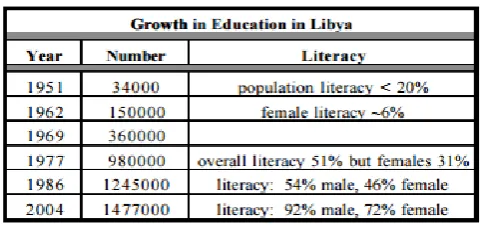
Table 2-1 Growth in literacy in Libya. ... 18
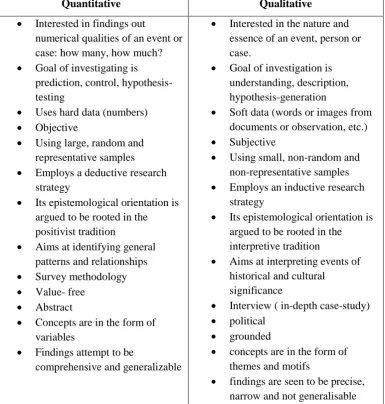
Table 4-1. The differences between quantitative and qualitative research ... 80
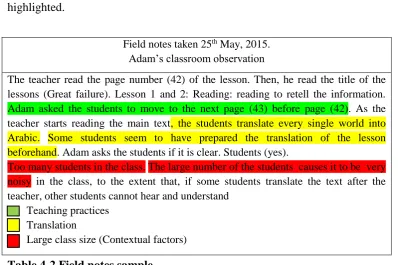
Table 4-2 Field notes sample ... 109
Table 4-3 The main categories and sub-categories of the observation ... 110
Table 4-4 A sample of the initial coding of the interview data ... 111
Table 4-5 The coding of similar topics from different interviews ... 112
Table 4-6 Primary and sub-categories derived from the participant interviews ... 112
Table 5-1Teachers’ understanding and perceptions of CLT ... 123
Table 5-2 Observation categories of CLT implementation ... 138
Table 5-3 Observational transcript and summary of the Great Failures lesson ... 140
Table 5-4 Observational transcript of the vocabulary lesson (phrasal verbs)... 144
Table 5-5 Observational transcript and summary of the telephone lesson ... 147
Table 5-6 Observational transcript and summary of Heba’s class ... 151
Table 5-7 Observational transcript and summary of the literature lesson ... 158
vii
LIST OF FIGURES
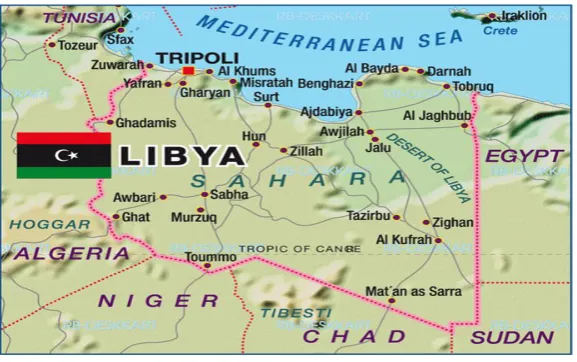
Figure 2-1 Map of Libya . ... 11
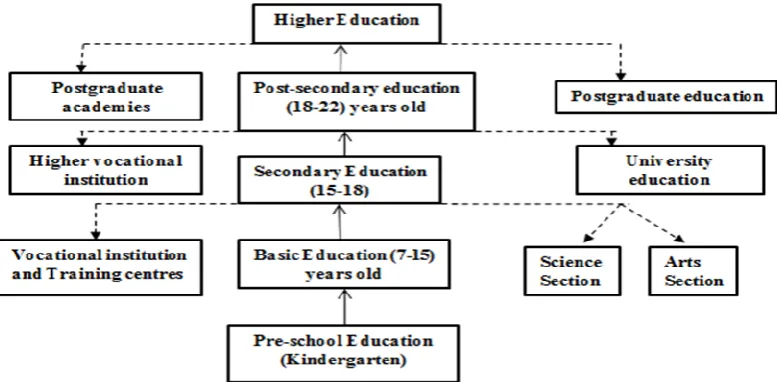
Figure 2-2 The sequence of Libya’s education system. ... 20
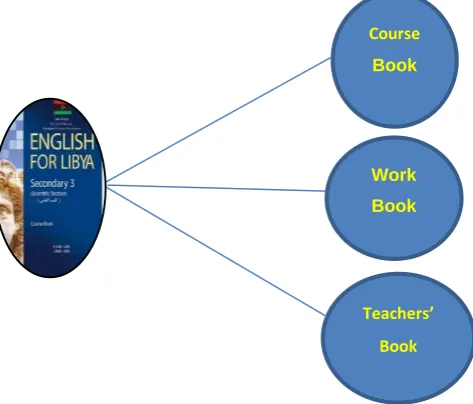
Figure 2-3. The components of the English for Libya curriculum ... 32
Figure2-4 The English for Libya Curriculum ... 34
Figure 3-1 Components of communicative competence... 50
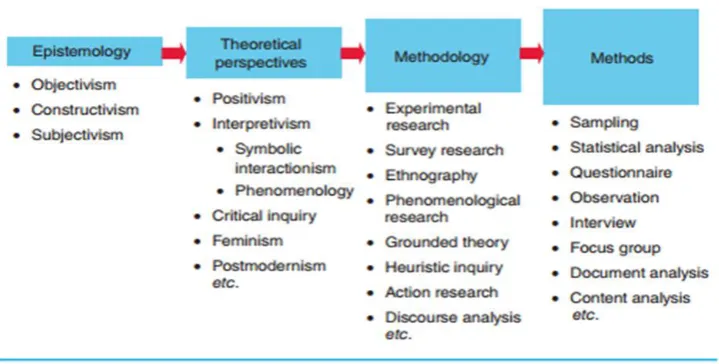
Figure 4-1 The interrelationship between the basic components of research ... 73
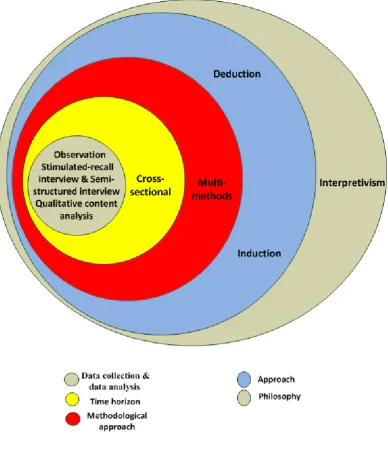
Figure 4-2 The visual components of the onion layers model of this research ... 77
viii
Dedication
I dedicate this thesis to my husband and children. Without the love and support of my
husband, Esam, and my children, Ameera and Almutasim, it would not have been
ix
ACKNOWLEDGEMENT
Following my grateful thanks to Almighty and Gracious Allah (God), the most Merciful
and the most Compassionate, for his endless blessings he has bestowed upon me, I
would like to express my deep gratitude to my supervisor, Dr Diana Ridley, for her
support, encouragement, commitment and patience in teaching me throughout every
stage of my study. I am sincerely grateful for her constructive insightful feedback, and
meticulous (line-by-line) reading of my numerous drafts.
My sincere gratitude also goes to my second supervisor, Dr Anna Sidorovitch, who
profoundly influenced my work by providing me with invaluable comments and notes.
The emotional support and understanding of my supervisors were invaluable when I
experienced difficult circumstances during the course of my study. Indeed, words are
insufficient to express my deep gratitude towards them both.
I am grateful to a person who never hesitated to provide me with endless help and
support whenever I needed it. Great thanks to Joanne Webster (“Jo”). I have learnt a
great deal from you.
My gratitude and appreciation go to all the participants of the study (teachers, students,
inspectors of English and school principals) who were hugely cooperative and
welcoming during my fieldwork. This study could not have been completed without
their participation.
My thanks go to the administrative staff for their continuous support and advice, as well
as to all of my friends and colleagues at Unit 9 of the Science Park for sharing their
experiences and opinions and discussing ideas.
My immense gratitude to my husband, Esam El-Sahli, is immeasurable, for his
unconditional encouragement, support, and unwavering patience throughout my studies.
Special thanks must also go to my beloved children, Ameera and Almutasim. I am also
deeply grateful to all of my sisters, who constantly supported me, prayed for me and
wished me success in my studies. Thanks for always being there.
Finally, I acknowledge my great thanks to my country “Libya”, for providing me with
this opportunity to pursue my postgraduate studies. This is a great country, which I hope
x
Glossary of Terms and Abbreviations
CC Communicative Competence
CLT Communicative language teaching
EFL English as foreign language
EL English Language
EL English Language
ELF English as a lingua franca
ELT English Language Teaching
ESL English as second language
FLL Foreign Language Learning
GNA The Government of National Accord
GPCE The General People Committee for Education
GTM Grammar Translation Method
ICE International Conference on Education
L1 First Language
L2 Second Language
LBSC Libyan Bureau of Statistics and Census
LEC Libyan English curriculum
NTC The National Transitional Council
PCK Pedagogical Content Knowledge
QCA Qualitative Content Analysis
SCT Socio-Cultural Theory
SLL Second Language Learners
SLL Second Language Learning
SRI Stimulated Recall Interviews
xi
ABSTRACT
Because English is considered and taught as a foreign language in Libya, where the
classroom is the only environment offering exposure to English, an effective teaching
method is required to underpin the quality of teaching English in such a context. This
study was undertaken to investigate the implementation of communicative language
teaching (CLT) in Libyan secondary schools by exploring the implementation of the
Libyan English language curriculum in which the CLT principles are incorporated. The
study examines the teachers’ perceptions and understanding of CLT. It investigates
whether and how CLT is implemented, and identifies the challenges faced by both
teachers and students, highlighting the socio-cultural and contextual factors that
facilitate or hamper its implementation. It also explores how appropriate the curriculum
is for use in the Libyan secondary school context.
For this study, an interpretive research paradigm was chosen, and the qualitative
research approach was adopted. Three kinds of participants, including 20 teachers, three
inspectors of English and 10 secondary school students, were involved. The qualitative
data were gathered by undertaking audio- and video-recorded classroom observations of teachers’ practice and stimulated-recall interviews. Finally, I conducted semi-structured
interviews with all of the participants: the teachers, the inspectors, and the students.
Qualitative content analysis of the observation and interview transcripts, plus field
notes, was used for the data analysis.
The findings showed (1): an inconsistency between the theoretical principles of the
curriculum and its practical implementation in the majority of the teachers’ practices;
(2) that the majority of the teachers’ practices were characterised as traditionally
oriented, adopting traditional teaching methods, such as the teacher-centred approach,
the grammar translation method, reading aloud, and an over reliance on the mother
tongue ,and translation between Arabic and English; (3) a lack of student participation
in the classroom with the rare implementation of pair and group work, combined with
some degree of misunderstanding of its purpose; (4) that exams dominated and shaped
the teaching of the curriculum, affecting the teachers’ practices and students’
expectations regarding English teaching and learning; (5) the students’ dissatisfaction
with the majority of the teachers’ practices, such as the overuse of the mother tongue in
the classroom, the omission of pair and group work activities, and the neglect of the
teaching of productive skills; and (6) that the students were aware of the international
xii
communicative language contrasted with the teachers’ outlook, as the students were
critical of the exam, which neglected the communicative side of English language.
These findings, along with the challenges related to contextual and socio-cultural factors
such as the lack of teaching aids, large class sizes, and (Libyan) parents with no
knowledge of English, were found to impact negatively on teaching using CLT.
The study concludes by offering pedagogical recommendations about how CLT
implementation in the Libyan secondary school context might be improved. In addition,
the study identifies several important areas for further research: the implementation of
CLT in the Libyan primary school context, given its significance as a foundation for the
secondary stage, an investigation of the teaching of productive skills, and improved
teacher training.
The study offers fresh insights by attempting: (a) to bridge the gap existing in the
previous literature and give Libyan students an opportunity to have their voices heard;
(b) to use stimulated-recall interviews as a research tool, which facilitated effective data
collection, and is a method that has not been used in the Libyan context hitherto; (c) to
identify key socio-cultural factors related to CLT implementation, which have
restricted the teachers’ practices; and (d) to offer recommendations, as this study sheds
light on the importance of primary schooling as a key stage for improving secondary
school attainment and promoting more effective CLT implementation.
1
Chapter 1
Introduction to the research
1.1 Introduction
This qualitative research presents an interpretive investigation of the implementation of
communicative language teaching (CLT) in Libyan secondary schools (the
pre-university phase). The study aims to explore the teachers’ understanding and
perceptions of CLT and how their knowledge impacts on their classroom practices. This
study opens up fresh angles for implementing CLT not only by investigating teachers’
views and practices regarding this phenomenon, but also by examining the different
experiences and views of students and inspectors of English. This research aims to
investigate whether and how CLT is implemented, identifying the challenges that
teachers and students face. It also explores how appropriate this curriculum is in relation
to the Libyan secondary school context.
This research identifies the different patterns whereby the communicative curriculum is
implemented by teachers within their teaching context. In addition, the study reveals the
contextual and socio-cultural factors of the context in which the participants’ interaction
take place and their influence on CLT implementation. The nature of this investigation
requires the interpretive paradigm as its philosophical basis and a qualitative approach
design is adopted using different research methods in sequential stages. The research
data include classroom observations, stimulated-recall interviews, field notes and
semi-structured interviews.
1.2 Background to the study
The place of English as a global language is undeniable, and, importantly for this study,
it is gaining momentum in developing countries such as Libya. The significance and
place of the English language, as a global language that provides a means of
communication between people as a lingua franca (ELF) when individuals do not share
a first language or even a second language, are widely acknowledged. Therefore, many
people possess the ability to communicate effectively with other speakers (native or
non-native speakers of English) and know how to use and speak English as a lingua
franca in real situations (Churches 2015). As Seidlhofer (2005:339) points out “as a
non-2
native speakers as by its native speakers”. The significance of English is underpinned
by its rapid growth worldwide, as well as its widespread use in every scientific field.
Learning English is essential, as an ability to speak English is considered a benchmark
for understanding and knowing the outside world.
In the context of this research, it is very important for all citizens in Libya to learn
English in order to meet the demand for involvement in the international world as an
industrial oil country. There is growing interest in learning English across the economic
and educational sectors in the country. This has consequently created an urgent need to
learn English in the way that will help Libyans to communicate efficiently. This strong
awareness of the need to learn English arose from the Libyan government’s changing of
its foreign policy and nurturing of a new, friendly relationship with the international
community in 1990. This opened up the door to foreign investment. Thus, learning
English offers an opportunity to establish a channel of communication which matches
these requirements.
In 2000, this interest in learning English became clear from the fact that many language
centres were established in which English was taught for general and academic purposes
at all levels. More importantly, the education system witnessed a reform of the
curriculum with the introduction of a new, communicative curriculum based on CLT
principles. To promote this innovation and enable Libyan students to use English as a
lingua franca, therefore, many factors are involved. One of the most important factors is
the methodologies or techniques employed to teach the language, as many English
language learners, whether foreign or even second language learners, can only learn the
target language within a school or university environment. Similarly, in the current
research context, the classroom is the only environment in which students may gain
exposure to the English language. As Hedge (2001) notes, the methodology for teaching
the language will have an obvious impact on the learners and on improving their ability
to use the language.
In Libyan secondary schools, the students are currently exposed to the CLT curriculum.
There is no doubt that the communicative approach provides a valuable tool, from
which Libyan students can benefit in order to communicate effectively by using English
language in a number of situations. As Farrell and Jacobs (2010:3) point out, “the
purpose is to enable second language learners (SLL) to be able to use language functionally, meaningfully and appropriately”. Additionally, the majority of Libyan
3
communicate their meaning or the content of English language in real-life situations.
Thus, the communicative approach opens up a variety of opportunities to interact in
different situations (Mitchell 1994). It is striking that the communicative approach is
leading teachers to alter their views or techniques regarding language teaching. The
process of learning a language is not just a matter of learning its structures (grammar
and vocabulary) but, as Widdowson (1990:159) states, “It concentrates on getting learners to do things with language”. Learning a language is, in fact, a creative act.
However, a number of research studies have also pointed to the issue of transferring
teaching methods from one part of the world to another (Pennycock, 1989; Holliday,
1994; Kramsch and Sullivan, 1996, quoted in Hiep 2007). Regarding this point, it could
be argued that the CLT approach may be miss-implemented within certain foreign
language contexts. In other words, the context of language teaching, upon which the
theoretical tenets of CLT were established, is completely different and does not coincide
with the criteria of foreign contexts for teaching English. Consequently, such an
inequality between the contexts creates gaps and causes difficulties regarding CLT
implementation.
English Language Teaching (ELT) in the Libyan context was dominated by grammar and comprehension teaching in the 1980’s, using oral drills, reading aloud, and
memorisation strategies, and depending largely on Arabic to translate between
languages (Orafi and Borg 2009). Also worth noting is the ten year gap, during which
English was banned from being taught at universities and colleges as a result of the
constrained Libyan-Western relations. Even though this was rectified by the
introduction of a new English curriculum in 2000, the state of English language
teaching remained underdeveloped and based on highly traditional methods, such as
grammar teaching and translation.
Thus, this study seeks to investigate the factors which help or hinder the implementation
of CLT in Libyan secondary schools located in a city in the east of the country. The
sample, which included 20 teachers from eight secondary schools who had been
teaching the new curriculum for at least five years, were subjected to classroom
observations, followed by stimulated-recall interviews and semi-structured interviews.
The study was a comprehensive investigation that included 20 teachers, ten students and
4
1.3 Rationale for the study
Since I was a child, I have always been interested in learning English in a way that will
enable me to speak the language in a communicative way. I started learning English in
my first year of preparatory school, then continued learning it at secondary school,
where I studied it for six years, both in the preparatory and secondary stage. During the
preparatory stage, I had to memorise a list of vocabulary every day and was tested by
writing the words on the blackboard the following day in front of the teacher.
Additionally, learning English was characterised by reading a comprehension text and
answering questions about it. A similar technique was employed at my secondary
school, with the focus on the teaching of grammar rules. I did not have any opportunity
to speak English. I majored English at university in a hope of obtaining a chance to
practise and improve my English proficiency. I recall that this experience was also
frustrating as the only spoken English practice I engaged in involved memorising a
dialogue and performing it with my friend in front of a lecturer to pass the oral exam.
Learning English was limited to memorising vocabulary lists and grammar rules, which
did not give me a strong sense of English as a language, since I was aware that the only
way to learn English was to practise it. The focus led to the neglect of the practical side
of teaching English.
Consequently, my choice of topic was inspired by Libyan students’ needs and my
sympathetic attitude towards these. The main focus of these needs is on the
development of their English language oral skills via the implementation of
communicative language teaching in Libya. Although a new curriculum, based on the
communicative approach, was introduced in 2000, Libyan students still do not appear to
be able to communicate in English confidently and effectively. Libyan students spend a
great deal of their time learning English language, but it may be argued that they still
face a number of issues when it comes to communicating and interacting in natural
settings. In other words, the implementation of the communicative approach in the
learning process appears to have limited potential. This communicative approach is
based on the idea that communicative ability is the goal of foreign language learning,
which appears to be what Libyan students have lost. They have not been presented with
any opportunity to use the language themselves for any communicative purpose. The
most important aspect of the learning process remains how to pass the exam. As Harmer
(1998) explains, it seems that there is no real interest or enjoyment in terms of learning
5
wanting. Learning a language has become an absolute requirement for many people in
the world today, but the creative side of learning is yet to be concretised or experienced
in the Libyan learning context; consequently, students have started to lose interest and
motivation with regard to English language learning.
As mentioned above, this research was inspired by a desire to explore students’ needs
and attitudes regarding learning English. As a researcher, I am not isolated from the
social context which I study. This choice of topic was motivated by my own previous
experience both of learning English as a student, who devoted a great deal of time to
this without developing an ability to communicate effectively, and as a Libyan English
teacher, who believes that CLT provides an appropriate approach for promoting
communication in the classroom.
My experience as a secondary English teacher in Libya has equipped me with
sympathetic and inspiring insights into the challenges that Libyan teachers and students
face with regard to English teaching and learning. Currently, my role is that of a
researcher who is interested in the area of teaching a language from a communicative
perspective. Added to this, the literature review of the Libyan context suggested that
there remains a gap and a lack of investigation into the students’ perceptions, attitudes
and experiences with regard to learning English in secondary school. This influenced
me to develop a number of questions, which helped to define the current research focus.
This influenced the way in which I conducted the research and impacted upon my
interpretation and analysis of the data. I should acknowledge that my positionality could
influence and affect my views and decisions with regard to the data collection, the
research findings and their interpretation. According to Sword (1999:277 quoted in
Berger 2015:229), “no research is free of the biases, assumptions, and personality of the
researcher and we cannot separate self from those activities in which we are intimately involved”.
However, to ensure that the influence of my positionality is transparent to the reader,
trustworthiness measures were taken before and while conducting the fieldwork, as
explained in the methodology chapter (see section 4.9). My insider positionality as a
Libyan individual who shares the same background as my participants helped me to
obtain more truthful and actual data and descriptions.
Because of this situation, it may be argued that there is an obvious problem associated
6
identify the reasons or factors underlying these issues or difficulties faced by Libyan
teachers and students. Thus, this research has the following aims:
To investigate the teachers’ understanding and perceptions of CLT and the
socio-cultural and contextual factors which may either facilitate or hamper CLT
implementation in the Libyan secondary school context.
To identify the factors underlying the difficulty of implementing the
communicative approach in Libya and investigate whether these are
teacher-related.
To investigate the Libyan students’ expectations and learning experiences, many of whom are unaccustomed to communicating in a classroom environment and
so will lack familiarity with this methodology.
To examine the degree of appropriateness of this curriculum within the Libyan
secondary school context.
1.4 Research questions
Based on these aims, four research questions were designed to guide the process of data
collection for the current study:
1. How do the teachers understand and perceive the communicative approach?
2. Is the communicative approach used in the classroom? And, if so, how?
3. What are the problems and challenges which Libyan teachers and students face
with regard to CLT implementation?
4. Is the curriculum appropriate for the Libyan secondary context, the students’
needs and their level of EL proficiency?
1.5 Significance of the study
Teaching a language is mainly influenced by the method of teaching, which is
considered a significant aspect for effective teaching. Consequently, any limitations in
teaching methods will have a critical influence on the process of teaching and on the
achievement of the outcomes of the educational programme, so it is important to review
and observe the approach to teaching to examine its impact and effectiveness with
regard to how language is taught. More importantly, teachers should not be left behind,
struggling and trying to implement an innovative teaching approach, without being
7
important role in assessing all of these aspects. Thus, the significance of this study is as
follows.
This research arises from the need to investigate both the implementation and
non-implementation of CLT when teaching the Libyan English curriculum (LEC). The
research emerged from both the students’ need to improve their English proficiency and
the problems that the teachers encounter with regard to teaching the curriculum which
has been introduced, based as it is on CLT principles. In addition, this research is the
first comprehensive investigation to address the phenomenon from different
perspectives, including those of the teachers, students and inspectors of English. More
importantly, it marks the first attempt to identify and open up opportunities to hear the students’ voices and examine their expectations and experience of learning English.
The theoretical framework and methodology add a unique feature to this research. For
example, previous research on CLT implementation conducted by Shihiba (2011) used
a questionnaire containing several open-ended items to investigate this approach. However, in this study, the participants’ views are investigated in a more detailed way
by employing a variety of different methods, such as classroom observation, followed
by stimulated-recall interviews (SRI) with some of the teachers and semi-structured
interviews with all three groups of participants (the teachers, inspectors and students).
SRI is applied in Libyan secondary schools for the first time, where the teachers who
were observed were given an opportunity to review their teaching practices in the
classroom by making responses about certain aspects of their teaching. Moreover, this
study adopted the interpretivist approach/social constructivism as the theoretical
paradigm which, to some extent, is difficult to implement in the Libyan school context
because of the cultural limitation, as teachers are usually viewed as the source of
knowledge, of which the students are the recipients.
It is hoped that the findings of this research will serve the students’ needs and pay
special attention to their requirements and desire to improve their proficiency in
learning English. The findings may enable me, as the researcher, to make
recommendations regarding the more successful implementation and adaptation of the
CLT approach in Libyan secondary schools. This study may contribute to the field of
English teaching by filling the gap that exists in the literature review. In other words,
the previous literature (Altaieb 2013, Elabbar 2011, Omar 2014, Orafi 2008, Shihiba
8
important participants in the process of teaching English using CLT in the Libyan
context; namely, the students. This study makes a significant contribution to the
literature and paves the way to hear the voices of Libyan students. In this research, the students’ voices are taken into account.
1.6 Organisation of the thesis
This chapter (Introduction chapter) provides the initial background to the research
study. It presents the rationale for the study, identifying its aims, research questions and
the significance of the study.
Chapter two (the Libyan Context) aims to equip the reader with detailed information
about the Libyan context in which the study is undertaken. This contains a general
background and the influence of the historical and the recent political events and its
effect on the education system, followed by the structure of the modern education
system and its objectives. Additionally, the different stages of English language
teaching in the Libyan context are explained, after which the different conceptions of
the curriculum are explained, followed by a discussion of the history of different types
of English curriculum in Libya.
Chapter three (Literature Review) represents the literature review linked to CLT and
its implementation. It defines the communicative approach, with an explanation of the
contextual and socio-cultural factors. The first section discusses the development and
implementation of CLT, shedding light on the second language learning theories and
associated teaching methodologies, followed by an exploration of the theoretical
underpinning of communicative competence in CLT, the reasons for CLT’s emergence,
its classrooms methods for ELT and its critique. The second section then examines the
perceptions of CLT, its adoption in English foreign language (EFL) contexts before
outlining the various challenges associated with this adoption. This study seeks to
investigate CLT implementation by filling the gap in the literature review and examining students’ attitudes, perceptions of learning English using CLT and learning experience in the classrooms as well as the inspectors of English’s views.
Chapter four (Methodology) outlines the methodology of the research. It starts with
the underlying ontological and epistemological assumptions behind the current research
and explores its interrelationships with the interpretive paradigm, methodology and
methods of this research. It provides a detailed description of the data collection
9
encompassing the research context, participants, stages of the data collection, ethical
considerations, pilot study, and procedure and process of the data analysis. The chapter
also discusses the criteria for reliable qualitative research, ending with the challenges
and limitations of the fieldwork.
Chapter five (Data Analysis Phases 1&2) presents and discusses the findings in two
sections. The first section presents and answers the first research question about the teachers’ understanding and perceptions of CLT, while the second part of the chapter
outlines all of the findings related to teaching CLT and the teachers’ practices in the
classroom (RQ2).
Chapter six (Challenges to CLT Implementation) displays all of the findings and
factors which emerged during the second stage of the data collection with all the
participants. This chapter discusses all of the contextual and socio-cultural factors which
hinder or help CLT implementation (RQ3).
Chapter seven (Appropriateness of the ELT Curriculum) offers a critical analysis of
the appropriateness of the curriculum in the Libyan secondary school context in light of
the teachers and students’ views and practices (RQ4).
Chapter eight (Conclusion) provides a general summary of this research by
highlighting the major findings of the study and linking them with its aims and research
questions to present the conclusion and suggest recommendations for improving the
situation regarding CLT teaching in the Libyan secondary school context. The chapter
also points forwards to the significance of the research and its contribution to
10
Chapter 2
Libyan context
2.1 Introduction
In this chapter, the essential and contextual issues of this study are presented by
introducing the background of Libya, the context in which the study is undertaken, as
this influences the process of CLT implementation. The first section provides an
overview of the Libyan context, including its geographical status, recent political
changes, and religious and historical background. The second section provides a general
background to the Libyan education system, its structure and general objectives, with
special reference to ELT in the Libyan context. The third section discusses the
curriculum’s definition and presents the various concepts related to it. Moreover, the
section discusses the history of the different types of English curricula in Libya. The
various aspects outlined above have a bearing on the research and the interpretation of
the research findings.
2.2 The state of Libya: General background
Libya is an Islamic Arabic country located in the Maghreb region of North Africa. It is
the fourth largest country on the African continent, with an area of 1.77 million sq. km
(685,524 sq. miles) and a population 5,173,062, with 2,608,030 males and 2,565,032
females (Libyan Bureau of Statistics and Census LBSC 2012). Libya is surrounded by
four Arabic countries: Egypt in the east, Tunisia and Algeria in the west, Niger and
Chad in the south, and the Mediterranean coastline borders Libya in the north for about
2000 km (approx. 1250 miles). The majority of the population is settled in the north of
Libya, near the coastal line of the Mediterranean Sea, whereas the Sahara Desert covers
a vast part of the Southern part of Libya (Elabbar 2011, Ying et al. 2013). Libya’s
geographical position is the closest to Europe, which has given it an important strategic
position politically. As Mainwaring (2012) argues, Libya occupies an important
geographical position, close to European nations such as Greece and Italy. Although the
majority of inhabitants (90%) are of Arab ethnicity, the Libyan population also contains
multi-ethnic groups, including 10% Amazigh, who speak Berber as their first language
(L1) and Arabic as a second language (L2), and other citizens comprising Egyptians,
11
Arabic is the official language of Libya, and Islam is the main religion in the country.
Although Libya has been subjected to colonisation by various foreign powers,
particularly Italy from 1911 to 1942, this does not appear to have influenced the social
and cultural structure of Libyan society to any great extent, and only a few elderly
people now speak Italian. Generally, English is the most widely-spoken foreign
[image:25.595.183.472.189.370.2]language in Libya.
Figure 2-1 Map of Libya (https://www.welt-atlas.de/map_of_libya_2-635).
Libya’s name originally derived from the ancient tribe recognised as Rebu or Ribu. Due
to the political events which have occurred since the mid-twentieth century, the country’s official name has been changed several times. On 24 December 1951, the
independence of Libya was proclaimed under a constitutional and hereditary monarchy
system, where Libya was called “the Libyan Kingdom”. On 1 September 1969, Colonel
Muammar Al-Gaddafi staged a bloodless coup against King Idris Al-Sanusi, which led
to the downfall of the monarchy. Libya was officially renamed the “Great Socialist People’s Libyan Arab Jamahiriya” in 1977. With effect from the uprising of 17 February 2011, the name of the country was changed officially to “Libya” by the
International Organization for Standardisation.
During Al-Gaddafi’s regime, it was almost impossible for Libyans to engage in
demonstrations. On 17 February 2011, due to the revolutionary wave which spread
through many Arab countries (Tunisia and Egypt), a violent demonstration arose in
Benghazi (the second biggest city in the eastern part of Libya). The revolution started
with a small group of young people, who rose up, demanding change and the overthrow
of the Al-Gaddafi regime. The security forces quelled this demonstration by gunfire,
12
erupted across the majority of Libyan cities, with many citizens making similar
demands. Armed forces loyal to Al-Gaddafi entered into armed battle with the
protesters. More importantly, several army units withdrew their allegiance to
Al-Gaddafi and joined the revolution, refusing to follow Al-Al-Gaddafi’s orders to fire on the
protesters. As the violent protests and disorder increased across Benghazi, Al-Gaddafi
loyalists were expelled from the majority of the eastern cities. The demonstrations and
fighting continued for about eight months, during which the National Transitional
Council (NTC) was established as a temporary government (Gritten 2011), which was
legitimised and recognised internationally.
During that time, both Arabic and international interventions were launched.
Consequently, to protect civilians and reply to the demands of the Libyan people, the
Security Council approved the imposition of a no-fly zone over Libya on 17 March
2011, which helped to topple AL-Gaddafi. Revolutionaries from across Libya marched
on the presidential palace in Tripoli, which led to the overthrow of the Al-Gaddafi
regime on 20 August 2011. After a violent conflict, NTC declared that Al-Gaddafi’s
rule had ended in October 2011. The NTC faced various challenges related to
containing the situation, and filling the vacuum caused by this political transition, and
setting out a national reform programme for Libya (Chami, et al. 2012). Another
challenge was meeting the revolutionaries’ demand to focus “on capacity building,
infrastructure renewal, private-sector development, improving education, job creation,
and putting in place an effective social safety net, within a framework of transparent and accountable governance” (Chami, et al. 2012:1). More significantly, the spread of arms
created a challenge throughout Libya, and there remains a need to disarm the armed
groups who continued to threaten the stability of the country.
Although Al-Gaddafi implemented his political, social and economic ideology based on
a dictatorship and ruled Libya with an iron fist for more than 40 years, Libya was one of
the most stable countries in the region during that period. Libya has witnessed various
civil and political conflicts since 2011. In 2016, a new government, namely the
Government of National Accord (GNA), under the leadership of Mr. Fayaz Seraj, was
nominated under the auspices of the United Nations, facing two competitor
13
The recent political events have critically influenced Libya’s education system. For
example, on several occasions, the schools were closed due to internal fighting, which
led to continuous interruptions and suspensions during the school year (See section 2.5).
2.3 The influence of religious and cultural factors in the
Libyan context
Culture and religion significantly influence people’s views about the pursuit of
knowledge. Libya is an Islamic country, so the majority of Libyans have been
influenced by the Islamic characteristic of valuing and emphasising education and
knowledge. Islam is not simply a religion, but also a comprehensive system regarding how to live one’s life. Muslims are invited to seek and gain knowledge as an important
aspect of life. The first verse dictated to the prophet Muhammad revealed the
significance of reading and investigation for human beings. As Allah said:
“Read in the name of your Lord who created” “Created man, out of a (mere) clot of congealed blood”
“Read, and your Lord is the most Generous” “Who taught by the pen”
“Taught man that which he knew not.”
(Surah Al Alaq 96:1-5, Holy Qur’an)
The prophet Muhammad encouraged people to search for knowledge which will enable
them to live nobly and ethically, and avoid useless knowledge. As he said, “My Lord, save me from the useless knowledge”. Seeking education or knowledge is essential in
Islam. As Muhammad said, “It is an obligation for every Muslim to seek knowledge”.
Thus, the importance of education is widely emphasised in Islamic religion, as
mentioned in various places in the Quran: “O my Lord! Increase me in knowledge”
(Quran 20:114). Firstly, an interest in knowledge and learning is stated in the majority
of the Quran’s Surah (chapters). Secondly, knowledgeable people should be held in
high esteem and be appreciated and differentiated from other people. The Surah
Az-zumar asks (Quran 39:9), “Are those who know equal to those who do not know?” “Allah rises of those who believe and those who have been given knowledge at many levels” (Quran 58:11). Thirdly, seeking knowledge is considered an endless process and
is required everywhere and at any time; as the prophet Muhammad mentioned, “Seek
14
of worship under Islam, which can be interpreted as both sacred and secular, as one who
seeks knowledge is under Allah’s protection.
These religious principles have influenced the beliefs of Libyans and strongly
influenced their lives. Libyan parents send their children to Mosques to be taught about
the Quran. Children learn how to read and write Quranic verses from an early age. The
technique for teaching the Quran involves an Imam (teacher) sitting at the front of the
class. The students sit in circles, where they read and repeat Quranic verses aloud after
their teacher, in order to memorise and be able to recite them. The Imam plays an
essential role in teaching and strengthening the religious views of the students, as he is
considered a reliable source of knowledge and the students should show respect towards
and appreciation of him. This Islamic culture or principles have clearly reflected and
influenced the teaching methods employed in Libyan schools. These beliefs regarding
education and learning have shaped both the teachers and students’ expectations in the
classroom. More specifically, a sacred rapport links teachers and students. Politeness
and respect form the basis of the teacher-student relationship. For example, students are
not supposed to argue with their teachers because their teachers are the source of
knowledge and the students should show politeness and respect towards them at all
times. Such a relationship restricts the method of communication between teachers and
students, as students must raise their hand in order to speak in class, and must obtain
their teacher’s permission to do so. Consequently, CLT, which is the focus of the
current research, may contradict the students and teachers’ expectations. The students
may be unfamiliar with talking, taking part in activities, such as pair or group work, or
speaking in front of the class. Teachers tend to deliver their lessons in a highly
controlled manner. Therefore, the majority of Libyan classroom teaching can be
characterised as adopting a teacher-centred approach. Apart from the cultural and
religious impact on the nature of the education, Libya has passed through different
historical periods which have had a major influence on the education system, as will be
explained in the next section.
2.4 Historical background of Libya’s education system
Due to its distinctive geographical features, Libya has been a target for occupation and
colonialism by various foreign powers through history. Thus, Libya has witnessed
various stages within its educational system (Pargeter 2012). Because education was
15
education has undergone various historical stages throughout the different imperialistic
periods, including the Ottoman (Turkish) period (1551-1911), the Italian occupation
(1911-1943), the British and French administrations (1943-1951), and the period of
Monarchy (Obeidi 2001). It is important to review the history of Libyan education, as it
has had a clear effect on the current education system. Education originated in 642AD,
when Arabs entered Libya under the leadership of Amr Ibn-al-AS and Islam spread
across the country. At that time, education was based on the teaching of religion and
literacy. Education consisted of two main stages, and was the sole preserve of boys,
who could attend and pursue religious studies. Girls lacked the opportunity to gain an
education, due to social and cultural reasons. In the initial stage, children aged 7-8
attended religious teaching sessions in mosques, called “Katatib”, to read and memorise
verses of the Quran. The children read and practised writing the Quran using wooden
scrolls. In the second stage, the children were required to learn about different, more
advanced aspects, such as religious rulings and Islamic jurisprudence. After completing
these two main stages, the students were allowed to teach and engage in teaching
religious lessons in mosques. Thus, the education was of a strongly religious nature,
which relied on memorisation (Wright 2012) .
Under Ottoman rule (1551-1911), the education system continued to prioritise the
teaching of religious sciences. Quranic centres were the sole institutions that provided
the teaching of Arabic literacy and religion. The Ottoman Empire attached little
importance to the education sector in the country. In other words, the lack of a
curriculum and gender discrimination in learning was clear within the Ottoman
education system (Obeidi 2013).
However, at the end of the nineteenth century, and to serve its regime and provide
employees for its bureaucracy, a few modern changes began to emerge in the education
system. For example, primary schools were established mainly in Benghazi and Tripoli,
offering education in Arabic, Turkish, religious principles, Turkish history and
geography (Obeidi 2001). Moreover, education was offered to mature students who had
finished their primary schooling through the establishment of five schools in five
Libyan cities, including Benghazi, Tripoli, Al-khummas, Derna and Fezzan. More
importantly, a school for girls was opened in Tripoli.
Although there were improvements to the field of education, higher education was not
16
neighbouring countries, such as Egypt or Tunisia. Additionally, only an elite group was
able to attend these educational institutions because of their economic advantage
(Obeidi 2013).
Another stage of the Libyan education system was the Italian occupation, which lasted
over three decades (1911-1943). To implant and expand both Italian culture and
education, different procedures were adopted in order to remove all traces of the Ottoman educational regime. “The first measure taken by the Italian invaders was
closing down all existing learning centres and burning down what was left of libraries
and publishing houses” (GPCE General People’s Committee of Education 2008b:3).
Additionally, Italian education started to spread through the school curriculum, as a
main agent for penetrating and influencing the Libyan people. For example, 12 Italian
schools were established in Tripoli and Benghazi in 1911 (Obeidi 2001), where the
main focus was on teaching and disseminating Italian language and culture among
students, as part of the Italian colonial system. For example, the school curriculum
described Italy in the following way:
Italy offers you a great deal; it protects men, property and religion…. Rome ruled the world in the old ages, Libya flourished under Roman rule… God give me increasing love to Italy, my second home. (Obeidi 2001:34).
This policy of erasing the identity of the Libyans caused Libyan citizens to fight the
Italians, and the country was in a state of combat for a long time.
Although Italy was interested in education and the number of schools increased
nationwide (in accordance with the Italian colonial plan), “only 5% of Libyans were
allowed to attend Italian schools” (GPCE General People’s Committee of Education
2008a:3) . Additionally, even those who attended Italian schools were not permitted to
pursue their education after the fourth year of primary school. Consequently, the
majority of Libyans were illiterate and lacked a basic learning foundation (Gulinao
2013).
Libyan education entered a new era when the allied forces occupied the country during
the period 1943-1951, dividing Libya between the British and the French. Britain
located its military administration in both Tripolitania and Cyrenaica in the north, while
the French entered and took Fezzan as their military territory in the south. Britain
sought to decrease the national illiteracy rate in Libya. Different curricula were adopted
17
since “The British influence on Arab education in Palestine was very strong, and the
Arab school system was controlled by the department of Education whose director was always British” (Gibb 1954:912). This was later replaced by the Egyptian education
system, as a result of Libyans’ calls to unite the education system nationwide. Cyrenaica
also adopted the Egyptian education system, whereas Fezzan was largely neglected by
the French administration. The building of schools increased in the majority of cities
and an awareness of the importance of education spread among Libyan parents, leading
them to send their children to be educated. Moreover, girls were given more
opportunities to attend school and be educated than before, which resulted in the
establishment of the first women’s training centre in Tripoli in 1950 (Obeidi 2001).
Although Libyan education witnessed some improvement under the British
administration, the system was characterised by instability because of the continual
changes in the teaching methods and curriculum content. For example, the curriculum
employed in Cyrenaica was different from that in Tripolitania (Obeidi 2001). The above
events had a major effect on Libya’s current education system, as will be explained in
the next section.
2.5 Modern education system in Libya
After Libya obtained independence and under the monarchy (1951-1969), the right to
free education was guaranteed to all Libyans (Clark 2004). Education institutions were
established and the Koranic schools reopened, where Libyan education was heavily
dependent on the religious schools. The government sought to improve literacy among
the populace and increase the literacy rate (Najeeb 2013). School enrolment escalated
rapidly. As Clark (2004:1) points out, “Total school enrolment rose to 34,000 on the eve
of independence in 1951”. Additionally, a major achievement was the establishment of
the first significant Libyan university in Benghazi (Garyounis University, now Benghazi
University) at the beginning of the kingdom era. The Faculty of Arts was opened and
became a source for all Libyan universities, followed by the establishment of different
faculties in both Tripoli and Benghazi.
UNESCO visited Libya in 1951, and offered major recommendations regarding the
education system. The first demand was to increase the number of schools and improve
the quality of Libyan teachers. There were only 29 primary schools in Tripoli. It was also proposed to establish secondary schools and increase women’s training centres,
18
In September 1969, when Al-Gaddafi came to power, the Libyan education system
witnessed a fundamental change alongside other sectors (Alhmali 2007, Clark 2004,
Orafi and Borg 2009) . For example, the first positive step is summed up in the
following statement:
Education is a right and a duty for all Libyan citizens, it is free and compulsory until the end of the preparatory level, and the State is responsible for building and establishing schools, institutes, universities and educational and cultural foundations (World Data on Education 2007:1)
Thus, the percentage of students’ enrolment increased to 360,000 (Clark 2004). There
was an increase in the number of primary schools, and secondary schools were
established and located throughout the nation. According to Hamdy (2007:2), “The
policy is to reach out even to the nomadic hard-to-reach areas, and mobile classrooms were introduced to cover all of Libya”. Moreover, in 1970, a training centre for Libyan
teachers was established in an attempt to improve the quality of Libyan teachers and
replace the Egyptian teachers and teachers of other nationalities who dominated the
teaching sector. The number of educated Libyan women also increased rapidly, with
more than 70% of women being literate by 2004 (Tamtam et al. 2011). As Hamdy
(2007:2) stated, in the Libyan Country Report:
[image:32.595.204.447.502.615.2]Libya boasts the highest literacy rate in the Arab world, and the UN’s Human Development Index, which ranks standard of living, social security, health care and other factors for development, places Libya at the top of all African countries.
Table 2-1 Growth in literacy in Libya.
Quoted from Alhmali, (2007:76)
Nevertheless, since 2011, and 7 years after the overthrow of the Al-Gaddafi regime,
Libya is still struggling to regain its stability. Libya has witnessed different internal
conflicts which have had negative effects on every sector of society. Thus, it is
unsurprising that the education system is also facing many challenges in meeting the
19
occasions since, teaching stopped in many local and international institutions
(Wedeman 2011) .The majority of educational institutions have been closed due to
shelling and sniper fire (which also delayed the conducting of my fieldwork in Libya in
2015). Education is regularly disrupted, which causes delays in learning. Many schools
have been badly damaged and exploited for military purposes. For example, during an
interview conducted by Adamson and Kilani (2016) with a head teacher (Fauzia
Mukhtar) in Benghazi, published in BBC News Magazine, she commented:
“The first shell landed near one boy and another boy ran over to help. Then a second
shell came in and blew his leg off. The first child also lost a leg. It was absolutely
terrifying”.
As a result, parents stopped sending their children to school. The majority of children
have been sitting at home for almost two years because of the fighting and some
teachers refuse to resume teaching in schools, due to concerns about their personal
safety. As reported by Turner (2014:1) in the EL-gazette newspaper, “the roadblocks and armed skirmishes are part of life”. This was also stated clearly in the United
Nations General Assembly (2015)
The challenges facing the country in the current phase have cast a shadow over the teaching process. Education has been significantly affected by the recent conflict, and some educational institutions have been targeted by armed groups. (National report of the annex to Human Rights Council resolution 16/21, 2015: 6) (United Nations General Assembly 2015)
2.5.1
The structure of Libya’s education system
Like other education systems, Libyan students pass through different educational stages
to complete their learning. In Libya, education is the primary responsibility of the
government, and they plan and provide financial support through the Ministry of
Education. According to the United Nations General Assembly (2015:6), “Libya has
kept education compulsory and free for boys and girls alike until the end of basic education”. Basic education is the first main stage, which children attend from the ages
of six to 15 years old. The current education system consists of five main stages:
kindergarten, primary, preparatory (basic education), secondary and university
education. Students learn at the expense of the state in each of these stages. Diagram 2.1
20
Figure 2-2 The sequence of Libya’s education system.
Adapted from Asker (2012)
Pre-school education (kindergarten)
This stage starts from age 4-5 and continues for two years. It is optional and aims to
prepare children for school and strengthen their skills. English is taught at this stage
because the majority of kindergartens are private schools, which offer English courses.
Basic Education
Basic education is free and compulsory. This stage lasts nine years, including six years
in primary schooling and three years of preparatory school. Children attend primary
school from the age of six to 12 years old and then they move to the preparatory stage
(year 7-9) to complete their basic education. This stage is compulsory because it enables
students who have not completed secondary school to register at vocational institutions.
Students are required to study different subjects, such as Islamic education, Arabic
language with its branches, Mathematics, Science, English, History, Geography,
Physical Education and Arts (Gulinao 2013). Students are equipped with a basic
knowledge of different subjects, which prepares them for the next secondary stage.
Students in the final year sit a national examination in all of these subjects to obtain
their Basic Education Certificate. The teaching of English in this stage starts from the
21 Secondary Education
Upon completing their basic education, students move on to their secondary education,
which is divided into two types: vocational and secondary education. This stage is
optional and funded by the government for all students. In both kinds of education,
students take three years to finish their learning. Vocational education is provided by
special training and teaching institutions, where students tend to be trained and
equipped with practical skills in subjects such as IT, Mechanics, Engineering and
Business. At the end of these three years of education, students are awarded a Diploma (GPCE General People’s Committee of Education 2008a).
Secondary education is the second type of this education. Students can also attend three
years of secondary school education, during which they must choose either science or
arts. Based on the students’ choice of secondary education type (Science or Arts), they
will