Effect of Sintering Temperature on Structural and
Magnetic Properties of Ni
0.55
Zn
0.45
Fe
2
O
4
Ferrites
Robiul Islam1*, Md Obaidur Rahman1, M. Abdul Hakim2, Dilip Kumar Saha2, Saiduzzaman1,
Saroaut Noor3, Md Al-Mamun2
1The Department of Physics, Jahangirnagar University, Dhaka, Bangladesh; 2Materials Science Division, Atomic Energy Centre,
Dhaka, Bangladesh; 3Department of Physics, Khulna University of Engineering & Technology, Khulna, Bangladesh.
Email: *[email protected]
Received December 23rd,2011; revised February 17th, 2012; accepted March 18th, 2012
ABSTRACT
The effect of frequency and sintering temperature on initial permeability of Ni0.55Zn0.45Fe2O4 ferrites have been studied by using an impedance analyzer. The samples were prepared by conventional double sintering ceramic technique using oxide nanoparticles of grain size 30 - 50 nm. Single phase spinal structure has been confirmed for the prepared samples by X-ray diffraction. As the sintering temperatures increase from 1160˚C to 1300˚C, the permeability gradually in- creases. The increase of permeability is ascribed to the increase of density and grain size. Grain size is expected to grow with the increase of sintering temperature. Ferrites with large average grain size posses higher initial permeability. The Curie temperatures determined from temperature dependence of permeability of the samples sintered at different tem- peratures are found to be Tc = (321 ± 1)˚C and independent of sintering temperature. At Ts = 1300˚C, Tc is found to in- crease substantially which can be explained by the fact that Zn has evaporated from the surface layer.
Keywords: Nanoparticle; Sintering Temperature; Curie Temperature; Microstructure; Grain Size
1. Introduction
The Ni-Zn ferrites are one of the most versatile, reason- able cost magnetic materials for general use in both low and high frequency devices because of their high resis-tivity, low dielectric losses, high Curie temperature and chemical stability [1-4]. The magnetic properties of Ni-Zn ferrites are strongly dependent on their chemical composition, density, grain size, etc. [5-7]. The perme- ability increases with the substitution of Zn for Ni in Ni-Zn ferrites [8], but the Curie temperature slightly de- creases at sufficiently high temperature due to Zn evapo- ration. It is observed that the permeability falls sharply at the ferri-paramagnetic phase transition i.e. the paramag- netic character. The sharp vertical drop of the permeabi- lity at Curie point indicates the degree of good homoge- neity in the sample composition. Due to the remarkable behavior of magnetic and electric properties they are subjects of intense theoretical and experimental investi- gation for application purpose [9,10]. The X-ray diffract- tion patterns for the composition at different sintering temperatures clearly indicate their single phase and for- mation of spinal crystal structure [11]. This papers fo- cuses on the effect of sintering temperature on the initial
and complex permeability of Ni-Zn ferrites. A possible correlation between sintering temperature, grain size and density is also discussed.
2. Experimental
nally sintered at 1160˚C, 1200˚C, 1250˚C and 1300˚C. Initial permeability were measured by an impedance ana- lyzer at different sintering temperature 1160˚C, 1200˚C, 1250˚C and 1300˚C. The density was calculated by measuring the volume and weight of the cylindrical sam- ples. X-ray diffraction (XRD) pattern of all the samples, recorded at room temperature with CuK radiation of
wavelength = 1.54178 Å using Philips X’ Pert PRO X-ray diffractometer. X-ray patterns confirmed the spinal phase for the samples.
3. Results and Discussion
The XRD patterns of the sample Ni0.55Zn0.45Fe2O4 at dif-ferent sintering temperatures are shown in Figure 1. The
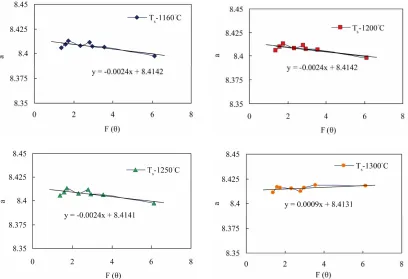
main reflection were from plane (111), (220), (311), (222), (400), (422), (511) and (440) which are character- istic of spinel structure with a single phase [12]. The lat- tice parameter was determined by using the Nelson-Riley (N.R) extrapolation method. In this experiment we ob- served that, the lattice parameter remains constant with different sintering temperature [13], Figure 2.
Initial permeability as dependent on frequency and temperature of a magnetic material is an important pa- rameter. Figures 3 and 4 show the real part and imagi-
nary part of permeability for different sintering tempera- ture [14]. Here the real part of permeability µ' remains constant in a certain frequency range (1 KHz - 13 MHz), while at higher frequencies, after a small rise, it begins to
drop due to resonance. We have found that the perme- ability increases with increasing sintering temperature. It is seen from Table 1 that the grain size increases with
increasing sintering temperature [15,16] because the density increases with increasing sintering temperature.
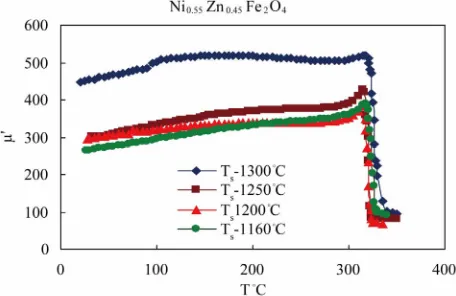
From Figures 5 and 6 show the real and imaginary
[image:2.595.95.503.438.717.2]part of the complex permeability with variation of tem- perature [17]. It is observed that, µ' increases gradually with increase of temperature attaining a peak value just before Tc known as Hopkinson peak. The Curie tem- perature determined from temperature dependence of
Figure 1. XRD pattern of Ni-Zn ferrites at different sinter-ing temperature.
Figure 3. Real part of permeability vs frequency at various Ts.
[image:3.595.57.289.89.232.2]Figure 4. Imaginary part of permeability vs frequency at various Ts.
Table 1. Variation of Curie temperature and Lattice pa- rameter with different sintering temperature.
Composition
Sintering temperature
(Ts) ˚C
Curie temperature
(Tc) ˚C
Lattice parameter a (Å)
1160 321 8.414
1200 320 8.414
1250 321 8.414
Ni0.55Zn0.45Fe2O4
1300 323 8.414
Table 2. Variation of density and porosity with sintering temperature.
Sintering temperature (Ts) ˚C
th
(kg/m3) (kg/mB 3) Porosity P (%)
1160 0.005287 0.0049985 5.4567
1200 0.005287 0.0050637 4.2235
1250 0.005287 0.005074 4.0287
1300 0.005287 0.0048564 8.1445
[image:3.595.56.288.272.421.2]Figure 5. Real part of permeability vs temperature at vari-ous Ts.
Figure 6. Imaginary part of permeability vs temperature at various Ts.
permeability of the samples sintered at different tem- peratures are found to be Tc = (321 ± 1)˚C.The Tc value is almost independent of Ts except for the sample sintered at 1300˚C where a substantial increase of Tc is found.
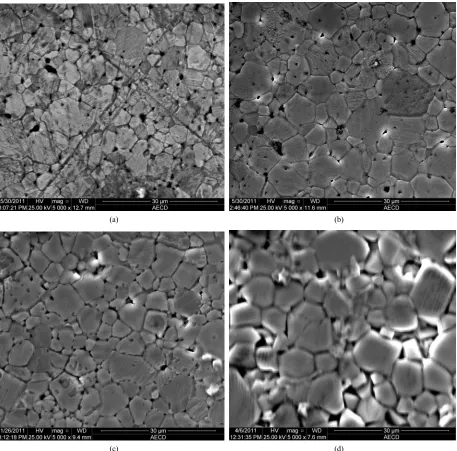
The Scanning Electron Microscope (SEM) of Ni0.55 Zn0.45Fe2O4 samples sintered at 1160˚C, 1200˚C, 1250˚C and 1300˚C are shows in Figures 7(a)-(d) respectively.
The sintering temperature has a great influence on the microstructure. It was observed that the average grain size of the samples increased with increase sintering tem- perature [18].
The density and porosity of the composition are changed with different sintering temperature [8]. The density of Ni0.55Zn0.45Fe2O4 samples increases from 1160˚C to 1250˚C and above 1250˚C the density begins to decrease as shown in Figure 8. On the other hand, porosity (P) of the
sam-ples decrease as increasing sintering temperature up to 1250˚C, and above 1250˚C the porosity increases which is also shown in Table 2.
[image:3.595.310.536.279.419.2] [image:3.595.59.287.487.597.2] [image:3.595.58.286.636.734.2](a) (b)
[image:4.595.71.528.84.535.2](c) (d)
Figure 7. Microstructure of the samples at different sintering temperature. (a) 1160˚C; (b) 1200˚C; (c) 1250˚C; (d) 1300˚C.
1150 1200 1250 1300 4.920
4.935 4.950 4.965 4.980 4.995
5.0 5.5 6.0 6.5 7.0
Po
ro
s
it
y
,(
P
%
)
Ni0.65Zn0.35Fe2O4
de
n
s
it
y
,(
dB
) g
m
.c
m
-3
Sintering Temp. (Ts)0
C density porosity
(Ts) ˚C
Figure 8. Variation of density and porosity with Ts for
Ni0.55Zn0.45Fe2O4.
sity is decreased because the intragranular porosity is increased resulting from discontinuous grain growth.
According to sintering mechanism, we can explained the grain growth of the spinel ferrites. During the sinter- ing process, a shrinkage of up to approximately 20% can occur and the samples produced an entirely dense mate- rial. But a product having a certain porosity. At higher sintering temperatures, the density is increased and the porosity is decreased (Figure 8). But at Ts = 1300˚C, the porosity is increased slightly.
[image:4.595.71.276.567.710.2]density is decreased because the intragranular porosity is increased. The crystal grain growth depends on grain boundaries migrating and larger crystal grains swallow- ing the small ones. During the growth the more different in size of crystal grains, the more beneficial for larger crystal grains to swallow smaller ones, so some pores inside the sintered ferrites are eliminated and the crystal growth improves.
When the grain growth rate is very high, pores may be left behind by rapidly moving boundaries. As a result in pores that are trapped inside the grains. This discontinu-ous grains growth rise with high temperature and the bulk density is reduced [10].
It is well known that the permeability of nanocrystal- line ferrite is related to two different magnetizing me- chanisms: spin rotation and domain wall motion, which can be described as, μi = 1 + χW + χSPIN, where χW is the domain wall susceptibility, χSPIN is intrinsic rotational susceptibility. We also written, 2π 2 4
W MS
and
2
2π
SPIN M D KS u
with Ms saturation magnetization, Ku is the total anisotropy, D the grain diameter and the domain wall energy. Thus, the domain wall motion is affected by the grain size and enhanced with the increase of grain size [19].
4. Conclusion
The X-ray diffraction confirmed the single phase cubic spinel structure of the samples. The initial permeability increases with increasing sintering temperature. Also the density is increased with increasing sintering tempera- tures. The Curie temperatures determined from tempera- ture dependence of permeability of the samples sintered at different temperatures are found to be Tc = 321˚C ± 1˚C and independent of sintering temperature. But, at 1300˚C the Curie temperature is found to increase sub- stantially which can be explained by the fact that Zn has evaporated from the surface layer. At higher sintering temperatures the density is decreased because the intra- granular porosity is increased resulting from discontinue- ous grain growth. The lattice parameter is 8.414 Å and which is also independent of sintering temperatures.
5. Acknowledgements
The authors express gratefulness to the Chairman, Bang- ladesh Atomic Energy Commission and Director, Atomic Energy Centre, Dhaka for allowing me to use the labora- tory facilities in the Materials Science Division, Atomic Energy Centre, Dhaka. The authors are also thankful to the chairman of the Department of Physics, Jahangirna- gar University for their encouragement in this work. Fi- nancial support from International program in Physical Science (IPPS), Uppsala University, Sweden for this work is highly acknowledged.
REFERENCES
[1] Y. Li, J. P. Zhao and J. C. Han, “Self-Propagation High Temperature Synthesis and Magnetic Properties of Ni0.35
Zn0.65Fe2O4 Powder,” Bulletin of Materials Science, Vol.
25, No. 4, 2002, pp. 263-266. doi:10.1007/BF02704117 [2] J. Smith and H. P. J. Wijn, “Ferrites,” John Wiley and
Sons, New York, 1995.
[3] B. D. Cullity and C. D. Graham, “Introduction to Magnetic Materials,” John Wiley and Sons, Hoboken, 2009. [4] E. Olsen and J. Thonstad, “Nickel Ferrites as Inert Anodes
in Aluminium Electrolysis: Part I Material Fabrication and Perliminary Testing,” Journal of Applied Electrochemistry, Vol. 29, No. 3, 1999, pp. 293-299.
doi:10.1023/A:1003460220418
[5] M. M. Barakat, M. A. Henaish, S. A. Olofa and A.Tawfik, “Sintering Behaviour of the Spinel Ferrites System Ni0.65
Zn0.35Fe2-xCuxO4,” Journal of Thermal Analysis and Ca-
lorimetry, Vol. 37, No. 2, 1991, pp. 241-248. doi:10.1007/BF02055926
[6] O. F. Caltun, L. Spinu and Al Staneu, “Structural and Magnetic Properties of Ni-Zn-Cu Ferrites Sintered at Dif- ferent Temperatures,” Journal of Optoelectronics and Advanced Materials, Vol. 4, No. 2, 2002, pp. 337-340. [7] A. M. Kumar, M. C. Verma, C. L. Dube, K. H. Rao and S.
C. Kashyap, “Development of Ni-Zn Nano Ferrite Core Material with Improved Saturation Magnitizition and DC Resistivity,” Journal of Magnetism and Magnetic Ma- terials, Vol. 320, No. 14, 2008, pp. 1995-2000.
doi:10.1016/j.jmmm.2008.02.129
[8] S. T. Mahmud, A. K. M. Akther Hossain, A. K. M. A. Hakim, M. Seki, T. Kawai and H. Tabata, “Influence of Microstructure on the Complex Permeability of Spinel Type Ni-Zn Ferrites,” Journal of Magnetism and Magnetic Materials, Vol. 305, No. 1, 2006, pp. 269-274.
doi:10.1016/j.jmmm.2006.01.012
[9] G. F. Dionne and R. G. West, “Magnetic and Dielectric Properties of the Spinel Ferrite System Ni0.65Zn0.35Fe2-x
MnxO4,” Journal of Applied Physics, Vol. 61, No. 8, 1987,
pp. 3838-3910. doi:10.1063/1.338623
[10] A. K. M. A. Hossain, S. T. Mahmud, M. Seki, T. Kawai and H. Tabata, “Structural, Electric Transport and Mag- netic Properties of Ni1-xZnxFe2O4,” Journal of Magnetism
and Magnetic Materials, Vol. 312, No. 1, 2007, pp. 210- 219. doi:10.1016/j.jmmm.2006.09.030
[11] B. P. Rao, A. M. Kumar, K. H. Rao, Y. L. N. Murthy, O. F. Caltun, I. Dumitru and L. Spinu, “Synthesis and Mag- netic Studies of Ni-Zn Ferrite Nanoparticles,” Journal of Optoelectronics and Advanced Materials, Vol. 8, No. 5, 2006, pp. 1703-1705.
[12] S. Zahi, “Synthesis, Permeability and Microstructure of the Optimal Nickel-Zinc Ferrites by Sol-Gel Route,” Jour- nal of Electromagnetic Analysis and Applications, Vol. 2, No. 1, 2010, pp. 56-62.
doi:10.4236/jemaa.2010.21009
[13] S. Akhter, D. P. Paul, Md. A. Hakim, D. K. Saha, Md. Al-Mamun and A. Parveen, “Synthesis, Structural and Physical Properties of Cu1-xZnxFe2O4 Ferrites,” Materials
doi:10.4236/msa.2011.211223
[14] A. Verma, T. C. Goel and R. G. Mendiratta, “Frequency Variation of Initial Permeability of Ni-Zn Ferrites Prepared by the Citrate Precursor Method,” Journal of Magnetism and Magnetic Materials, Vol. 210, No. 1-3, 2000, pp. 274-278.
[15] M. Sorescu, L. Diamandescu, R. Peelamedu, R. Roy and P. Yadoji, “Structural and Magnetic Properties of Ni-Zn Ferrites Prepared by Microwave Sintering,” Journal of Magnetism and Magnetic Materials, Vol. 279, No. 2-3, 2004, pp. 195-201. doi:10.1016/j.jmmm.2004.01.079 [16] S. R. Murthy, “A Study of Ultrasonic Velocity and At-
tenuation on Polycrystalline Ni-Zn Ferrites,” Bulletin of Materials Science, Vol. 24, No. 6, 2001, pp. 611-616. doi:10.1007/BF02704009
[17] J. L. Snoek, “Dispersion and Absorption in Magnetic Ferrites at Frequencies above one Mc/s,” Physica, Vol. 14, No. 4, 1948, pp. 207-217.
doi:10.1016/0031-8914(48)90038-X
[18] Z.-H. Yang, Z.-Q. Gong, H.-X. Li, Y.-T. Ma and Y.-F. Yang, “Synthesis of Ni-Zn Ferrites and Its Microstructure and Magnetic Properties,” Journal of Central South University of Technology, Vol. 13, No. 6, 2006, pp. 618- 623. doi:10.1007/s11771-006-0004-x
[19] M. Jalaly, M. H. Enayati, P. Kameli and F. Karimzadeh, “Effect of Composition on Structural and Magnetic Pro- perties of Nanocrystalline Ball Milled Ni1-xZnxFe2O4 Fer-