© 2019, IRJET | Impact Factor value: 7.34 | ISO 9001:2008 Certified Journal
| Page 2300
Strength and Durability Studies on Concrete made using Treated
Recycled Coarse and Fine Aggregate
D. Durga Prasad
1, Kiran T
2, Vinay M
3, Kishore Ravande
41
Research Scholar, Department of Civil Engg. Osmania University, Hyderabad-07
2Associate Professor, Department of Civil Engg. UVCE, Bengaluru-56
3
M.E Student, Department of Civil Engg. UVCE, Bengaluru-56
4Professor, Department of Civil Engg. Osmania University, Hyderabad-07
---*****---Abstract: The fast development of human civilization has resulted in fast depletion of natural resources and accretion of manmade waste. Whereas in construction Industry for the fast decades it witnessed a fast depletion of Natural available materials like Coarse aggregate and fine aggregate, whereas in regards the fine aggregate i.e. sand, which has become a scarce resource and key to economic development in the 21st
century. As a measure of conversation of these valuable resources, studies have been conducted on recycled demolished concrete aggregates for its complete usage in concrete. The method adopted for its usage in concrete is mainly consists of improving the structure, mechanical and physical properties of aggregate. The structure has been improved by crushing the aggregate in Impact Jaw crusher and also through the ball mill method were the surface defects of coarse aggregate were removed and also the cement hydrated product adhered on the aggregates were densified and strengthened by using various Chemicals such as Sodium Silicate, Lithium Silicate, Colloidal Silica dioxide, Silane Siloxane, Stearic Acid and Kaolin + PVOH. In each chemical treatment we have imparted certain modification of aggregate characteristics and finally a combination has been arrived were the aggregated combination i.e. coarse aggregate treated with lithium silicate and fine aggregate treated with colloidal silica dioxide has given at par result with Natural aggregates both from strength and durability point of view specialise in its usage in Cement mortar and in Concrete.
Key Words: Strength, Durability, Recycled aggregates, Treated aggregates, Concrete.
1. INTRODUCTION
1.1 General
Since, the usage of these natural stones and sand is at the tune of 90% in concrete production, which intern being the third maximum consuming material on earth after water and air. Thus, an alternative material usage in places of these aggregates will be boon to the environment and to life of human civilization. The introduction of usage of Industrial waste like construction demolished old concrete
in place of coarse and fine aggregate in concrete could resulted in a sustaining reduction of our dependency of natural material. Many researches have been done in these areas; which resulted in limited contribution, as their recommendation portions to limited usage of these material in concrete industry.
Our research emphases on cent percentage utilization of recycled fine and coarse aggregate in construction industry. Which involves an improvement technique and surface treatment on improving the physical and mechanical properties of recycled demolished concrete aggregates. Since, the main scope of research work is on exploring the improvement techniques & surface modification methods which can results in 100% utilization of demolished recycled fine and coarse aggregate as an alternative material to natural aggregate in its use in construction industry.
1.2 Objectives of the work
To evaluate the reasons for weak zone in recycled aggregate and the reasons for its restricted usage in concrete industry.
To arrive at a best surface treatment methodology were the internal and external surface of the recycled aggregate can be improved.
on recycled coarse and fine aggregate that can be used as percentage replacement of Natural aggregates in Cement Mortar and in Concrete without compromising on strength and durability aspects.
1.3 Scope of the work
To find a treatment methodology for coarse and fine aggregate where there is significant improvement in properties of aggregate.
To study the strength parameters on Recycled Fine aggregate as a complete replacement material for Sand in Cement Mortar.
To find the strength related parameters on hardened concrete made of treated aggregates which mainly comprises of Compressive strength, Split Tensile Strength and Flexural strength.
To study the durability aspects on hardened concrete which mainly consists of assessing the strength of the concrete which are exposed to sulphate, acid and chloride attack.
1.4 Literature Review
The present investigation work is identified as the investigation of properties of concrete made using variable materials and its possible enhancement. To evaluate the reasons for weak zone in recycled aggregate and the reasons for its restricted usage in concrete industry. To arrive at a best surface treatment methodology were the internal and external surface of the recycled aggregate can be improved. To obtain a combination of treatment methodology on recycled coarse and fine aggregate that can be used as percentage replacement of Natural aggregates in Cement Mortar and in Concrete without compromising on strength and durability aspects and some main investigations are observed.
T. Parluy and M. Sefflova: conducted studies on strength development of fine aggregate concrete with recycled cement powder, the study mainly deals with possibility of use of cement powder of recycled concrete aggregates as partial replacement of cement in concrete mixture. The
mechanical properties of the fine aggregates concrete with partial cement replacement by recycled concrete powder in time. The compressive strength, tensile strength in bending and dynamic modulus of elasticity were tested at the age 7, 14 & 28 days. The fine recycled concrete which was used as partial replacement of cement had the same grain size as cement. The replacement rate was 5%, 10% and 15%. Mechanical properties were investigated by using cubic and prismatic specimens.
Amnon Katz: Amnon Katz conducted experimental studies on treatment methods to be adopted for the improvement of recycled aggregate, the microstructure of recycled aggregate prepared from the crushing of old concrete was studied. It was found that the recycled aggregate is covered with lose particles that may prevent good bonding between the new cement matrix and the recycled aggregate. The old cement paste that remained on the natural aggregate was porous and cracked, leading to weak mechanical properties of the recycled aggregate. Treatment of the recycled aggregate by impregnation of silica fume solution and by ultrasonic cleaning was studied with the objective of overcoming the above-mentioned limitations. An increase of ~30 and ~15% in the compressive strength at ages 7 and 28 days was observed after the silica fume treatment.
2. MATERIALS and METHODOLOGY
2.1 Material Used
In the present study material used are Water, Cement, Super plasticizer, Sand, M-Sand, Recycled Fine aggregate, Recycled Coarse aggregate.
2.1.1 Cement
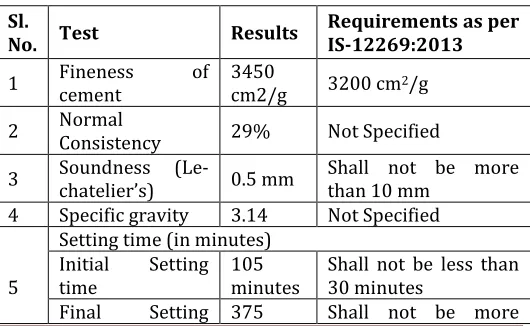
[image:2.612.316.581.575.738.2]Cement used is ordinary Portland Cement of 53 Grade. The specific gravity of cement is 3.14 The test conducted on cement for different properties are presented in Table 2.1. The Cement used is as per IS: 256.
Table 2.1: Physical Properties of 53 grade Cement
Sl.
No. Test Results Requirements as per IS-12269:2013 1 Fineness cement of 3450 cm2/g 3200 cm2/g
2 Normal Consistency 29% Not Specified
3 Soundness (Le- chatelier’s) 0.5 mm Shall not be more than 10 mm 4 Specific gravity 3.14 Not Specified
5
Setting time (in minutes) Initial Setting
© 2019, IRJET | Impact Factor value: 7.34 | ISO 9001:2008 Certified Journal
| Page 2302
Time minutes than 600 minutes
6
Compressive Strength (MPa) (70.5 x 70.5 x 70.5 mm cubes)
3 Days Strength. 38.7 MPa Shall not be less than 27.0 MPa
7 Days Strength 48.2 MPa Shall not be less than 37.0 MPa
28 Days Strength 56.8 MPa Shall not be less than 53.0 MPa
2.1.2 Superplasticizer
Readily available Superplasticizer of FOSROC make Conplast 450 has been used for the present work.
2.1.3 Fine Aggregate
2.1.3.1 Natural Fine Aggregate (NFA)
In the present study, the river sand from Chitoor confirming to Zone-II gradation has been Used. The physical Properties of the river sand are tabulated at Table 2.2. The sand used is as per IS :383
2.1.3.2 M-sand
M-sand confirming to Zone –II has been used which has been procured from nearly M-Sand Suppliers, M-sand used is as per IS:383 and are tabulated at Table 2.2
2.1.3.3 Recycled Fine Aggregate (RFA)
[image:3.612.29.302.56.199.2]Recycled Fine aggregates were obtained from C&D waste Processing Unit in Bangalore Outskirts at Chik Jala i.e. from Rock Crystals. In these Unit the construction and other demolished waste are crushed through Impact jaw crushers and through cylindrical sieves the aggregates are processed into Coarse and fine aggregate of Different sizes. The recycled fine aggregates obtained from the above unit was confirming to Zone –II. The physical properties of the recycled fine aggregate are tabulated at Table 2.2
Table 2.1: Physical Characteristics of Fine Aggregates
2.1.4 Coarse Aggregate
2.1.4.1 Natural Coarse Aggregate (NCA)
The granite metal jelly 20 and down size were obtained from stone crusher near Bangalore. Coarse aggregate crushed granite of 20mm maximum size and retained on IS480 sieves is been used. The sieve analysis of coarse aggregate conforms to the Specifications of IS 383:1970 for graded aggregates and specific gravity. The test results of tests are tabulated in Table 2.3
2.1.4.2 Recycled Coarse Aggregate (RCA)
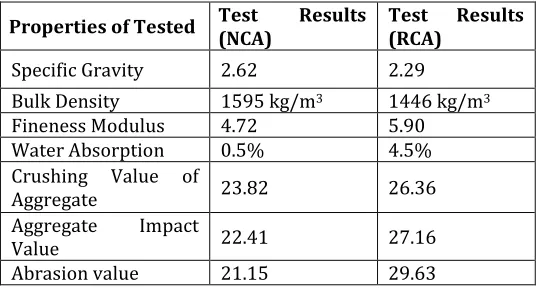
[image:3.612.314.582.381.525.2]Recycled coarse aggregates were obtained from C&D waste Processing Unit in Bangalore Outskirts at Chik Jala i.e. from Rock Crystals. In these Unit the construction and other demolished waste are crushed through Impact jaw crushers and through cylindrical sieves the aggregates are processed into Coarse and fine aggregate of Different sizes. The recycled coarse aggregates obtained from the above unit was confirming to Zone –II. The physical properties of the recycled coarse aggregate are tabulated at Table 2.3
Table 2.3: Physical Properties of Coarse Aggregate
Properties of Tested Test (NCA) Results Test (RCA) Results
Specific Gravity 2.62 2.29 Bulk Density 1595 kg/m3 1446 kg/m3 Fineness Modulus 4.72 5.90 Water Absorption 0.5% 4.5% Crushing Value of
Aggregate 23.82 26.36
Aggregate Impact
Value 22.41 27.16
Abrasion value 21.15 29.63
2.1.5 Water
Clean potable water is used for mixing and curing of concrete.
2.1.6 Chemicals Used for the Surface Treatment of Aggregate
Sodium Silicate
Lithium Silicate
Colloidal Silicon dioxide Silane Siloxane
Polyvinyl alcohol (PVOH or PVA)
Kaolin
Stearic acid Physical
Properties NFA M-sand RFA
Size 4.75mm 4.75mm 4.75mm Specific Gravity 2.65 2.60 2.13 Fineness
Modulus 3.70 2.73 1.69 Bulk density 1680 kg/m3 1445 kg/m3 1340 kg/m3 Water
3. EXPERIMENTAL INVESTIGATION
3.1 Compressive Strength
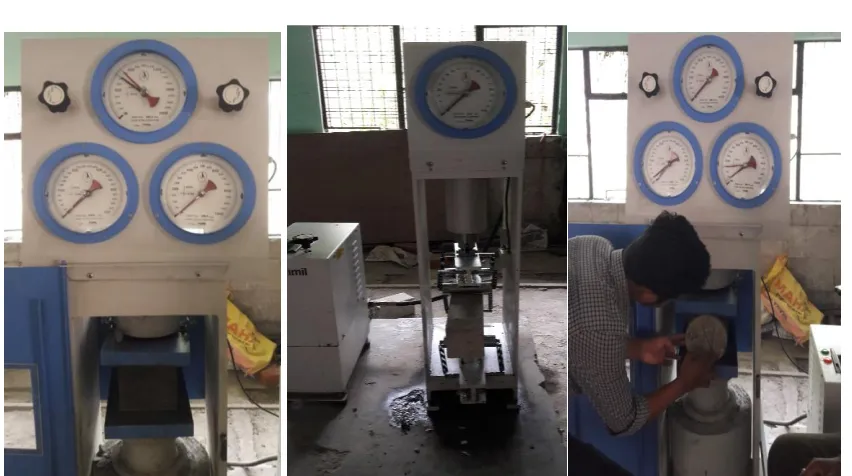
The compressive strength of concrete i.e. ultimate strength of concrete is defined as the load which causes failure of the specimen divided by the area of the cross section in uniaxial compression, under a given rate of loading. (Fig 3.1)
The compression strength is calculated using the formula,
f = N/mm2
Where, f = is compressive strength of concrete in N/mm2
P = ultimate load resisted by concrete in N
A = area of specimen in mm2
3.2 Flexural Strength
When concrete is subjected to bending, Tensile, compressive stresses and in many cases direct shearing stresses occur. The most common example of concrete structure subjected to flexure are highway pavements and the strength of concrete for pavements is commonly evaluated by means of bending tests on 100x100x500mm beam specimens. Flexural strength is expressed in terms of “Modulus rupture” which is the maximum tensile (or compressive) stress at rupture. (Fig 3.2)
fb =
Where,
fb= modulus of rupture, N/mm2
b = measured width in mm of the specimen
d = measured depth in mm of the specimen at the point of failure
l = length in mm of the span on which specimen was supported
p = max. Load in N applied to the specimen
3.3 Split Tensile Strength
The tensile strength of concrete is one of the basic and important properties which greatly affect the extent and size of cracking in structures. Moreover, the concrete is very weak in tension due to its brittle nature. Hence, it is not expected to resist the direct tension. Therefore, it is necessary to determine the tensile strength of concrete to determine the load at which the concrete members may
The cylinders were tested in compression testing machine in 2000kN capacity. The test specimen was loaded at constant rate of loading at 1.2N/cm2/min to 2.40N/cm2/min as per the standard procedure explained in IS 5816:1999
T =
Where,
T = splitting tensile strength in MPa
P = max. applied load indicated by the testing machine in N
D = diameter of specimen in mm
L = length of the specimen in mm
4. RESULTS AND DISCUSSION
4.1 General
From the test results it can be inferred that each treatment technique has its own impact on the surface modification and in improving the properties of the aggregates. It was studied on recycled coarse and fine aggregate by treating the aggregates with above mentioned chemicals solution in certain dilution ratios shown in below tables i.e. the aggregates were soaked for 24 hours in the diluted chemicals and after 7 days of curing. where tested for physical properties of the aggregates i.e. mainly Water absorption, Specific Gravity and Fineness modulus. From the test results were tabulated in following tables and the same procedure is followed for all chemicals.
4.2 Sodium Silicate Treatment
It can be observed that increasing the dosing content of lithium silicate has increased the specific gravity and density up to 5% of dosage of lithium silicate, beyond the above the values are reduced. But for water absorption the value got decreased up to 5% of dosing (table 4.1)
Table 4.1: Properties of RCA with Sodium Silicate (Na2Sio3)
Properties of RCA+Na2Sio3
Tested
2.5% of Na2Sio3
5% of Na2Sio3
7.5% of Na2Sio3
10% of Na2Sio3
Specific
Gravity 2.59 3.00 3.05 3.28 Bulk Density 1320 1335 1330 1335 Fineness
Modulus 4.72 4.72 4.72 4.72 Water
© 2019, IRJET | Impact Factor value: 7.34 | ISO 9001:2008 Certified Journal
| Page 2304
In case of fine aggregates, the treatment of lithium silicate has quite opposite effects as it was shown on coarse aggregate. From the results as tabulated at table 4.2 it can be inferred that Same proportion of dilution ratio has resulted increase in Specific gravity with increase in dosing content whereas the water absorption decreased with increase in dosing which was quite reverse to that seen with treatment with sodium silicate.
Table 4.2: Properties of RFA with Sodium Silicate (Na2Sio3)
Properties of RFA+Na2Sio3
Tested
2.5% of Na2Sio3
5% of Na2Sio3
7.5% of Na2Sio3
10% of Na2Sio3
Specific
Gravity 2.51 2.40 2.39 2.30 Bulk Density 1450 1390 1380 1380 Fineness
Modulus 3.70 3.70 3.70 3.70 Water
absorption 3.6% 6.6% 7.7% 9.64%
[image:5.612.95.521.260.498.2]
Fig 3.1: Compressive testing Fig 3.2: Flexure strength testing Fig 3.3: Split tensile testing
machine machine machine
4.3 Lithium Silicate Treatment
It can be observed that increasing the dosing content of lithium silicate has increased the specific gravity and density up to 5% of dosage of lithium silicate, beyond the above the values are reduced. But for water absorption the value got decreased up to 5% of dosing. The optimum dosage where there is increase in Specific Gravity and decrease in Water absorption when compared with that of Natural coarse aggregate is 5% of Lithium silicate treatment on Coarse Aggregate. (table 4.3)
Table 4.3: Properties of RCA with Lithium Silicate (Li2Sio3)
Properties of RCA+Li2Sio3
Tested
2.5% of Li2Sio3
5% of Li2Sio3
7.5% of Li2Sio3
10% of Li2Sio3
Specific Gravity 2.86 2.90 2.81 2.84 Bulk Density 1420 1440 1480 1465 Fineness
Modulus 4.72 4.72 4.72 4.72 Water
In case of fine aggregates, the treatment of lithium silicate has quite opposite effects as it was shown on coarse aggregate. From the results as tabulated at table 4.4 it can be inferred that Same proportion of dilution ratio has resulted increase in Specific gravity with increase in dosing content whereas the water absorption decreased with increase in dosing which was quite reverse to that seen with treatment with lithium silicate.
Table 4.4: Properties of RFA with Lithium Silicate (Li2Sio3)
Properties of
RFA+Li2Sio3
Tested
2.5% of Li2Sio3
5% of Li2Sio3
7.5% of Li2Sio3
10% of Li2Sio3
Specific
Gravity 2.46 2.43 2.43 2.49 Bulk Density 1430 1400 1410 1450 Fineness
Modulus 3.70 3.70 3.70 3.70 Water
absorption 3.51% 3.09% 3.73% 2.66%
4.4Colloidal Silica Dioxide Treatment
It can be observed that increasing the dosing content of silica dioxide it has increased the specific gravity and density up to 5% of dosage of Silica Dioxide, beyond the above the value reduced. But for water absorption the value got decreased up to 2.5% of dosing and thereafter the water absorption value got increased with increase in dosing content. (table 4.5)
Table 4.5: Properties of RCA with Colloidal Silica Dioxide (Sio2)
Properties of RCA+Sio2
Tested
1% of Sio2
2.5% of Sio2
5% of Sio2
7.5% of Sio2
Specific Gravity 2.82 2.81 2.68 2.71 Bulk Density 1450 1410 1380 1360 Fineness
Modulus 4.72 4.72 4.72. 4.72 Water
absorption 2.02% 2.43% 3.34% 3.16%
In case of fine aggregates, the treatment of Colloidal silica dioxide has quite opposite effect as it was shown on coarse aggregate. From the results as tabulated at table 4.6 it can be inferred that same proportion of ratio has resulted in decrease in Specific gravity with increase in dosing content and, whereas the water absorption increased with increase in dosing.
Table 4.6: Properties of RFA with Colloidal Silica Dioxide (Sio2)
Properties of RFA+Sio2
Tested
1% of Sio2
2.5% of Sio2
5% of Sio2
7.5% of Sio2
Specific
Gravity 2.53 2.56 2.57 2.35 Bulk Density 1400 1430 1450 1380 Fineness
Modulus 3.70 3.70 3.70 3.70 Water
absorption 1.62% 1.62% 2.04% 2.66%
4.5 Silane Siloxane Treatment
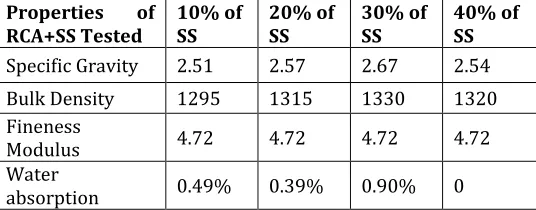
[image:6.612.317.585.377.482.2]From the test results as tabulated at table 4.7 it can be observed that increasing the dosing content of Silane Siloxane it has decreased the specific gravity and density. But for water absorption the values are varied with the dosing content and are compared with the natural aggregate values.
Table 4.7: Properties of RCA with Silane Siloxane
Properties of
RCA+SS Tested 10% of SS 20% of SS 30% of SS 40% of SS Specific Gravity 2.51 2.57 2.67 2.54 Bulk Density 1295 1315 1330 1320 Fineness
Modulus 4.72 4.72 4.72 4.72 Water
absorption 0.49% 0.39% 0.90% 0
[image:6.612.323.581.594.715.2]In case of fine aggregates, the treatment of stearic acid has similar effects as shown on coarse aggregate. From the results are tabulated at table 4.8 it can be inferred that same proportion of dilution ratio has resulted in decrease in Specific gravity with increase in dosing content and, whereas the water absorption varying with dosing.
Table 4.8: Properties of RFA with Silane Siloxane
Properties of RFA+SS Tested
10% of
SS 20% of SS 30% of SS 40% of SS Specific Gravity 2.20 1.81 1.78 1.75 Bulk Density 1280 1265 1255 1240 Fineness
Modulus 3.70 3.70 3.70 3.70 Water
© 2019, IRJET | Impact Factor value: 7.34 | ISO 9001:2008 Certified Journal
| Page 2306
4.6 Polyvinyl Alcohol with Kaolin Treatment
From the test results as tabulated at table 4.9 it can be observed that increasing the dosing content there is decrease in the specific gravity and density. But for water absorption the value got increased with increase in dosing content. The optimum dosage 1% and 1.5% and are compared with natural coarse aggregate.
Table 4.9: Properties of RCA with Polyvinyl alcohol + Kaolin (PVOH+KAOLIN)
Properties of RCA+PVOH+KAO LIN Tested
10% PVOH+ 1%KAOL IN
10% PVOH+ 1.5%KAOL IN
10% PVOH+ 2%KAOL IN Specific Gravity 2.34 2.52 2.53 Bulk Density 1295 1315 1340 Fineness Modulus 4.72 4.72 4.72 Water absorption 1.62 1.72 2.33
In case of fine aggregates, the treatment of Kaolin has similar effects as it was shown on coarse aggregate. From the results as tabulated at table 4.10 it can be inferred that same proportion of dilution ratio has resulted in decrease in Specific gravity with increase in dosing content and the water absorption is constant.
Table 4.10: Properties of RFA with Polyvinyl alcohol + Kaolin (PVOH+KAOLIN)
Properties of RFA+PVOH+KAO LIN Tested
10% PVOH+ 1%KAOL IN
10% PVOH+ 1.5%KAOL IN
10% PVOH+ 2%KAOL IN Specific Gravity 2.42 2.23 2.27 Bulk Density 1340 1325 1365 Fineness Modulus 3.70 3.70 3.70 Water absorption 1.21% 1.21% 1.21%
4.7 Stearic Acid Treatment (SA)
From the test results as tabulated at table 4.11 it can be observed that increasing the dosing content of Steric acid it has decreased the specific gravity and density. But for water absorption the value got increased with increasing in dosing content. The optimum dosage where there is increase in Specific Gravity is 1% and decrease in Water absorption is 1% when compared with that of Natural coarse aggregate.
Table 4.11: Properties of RCA with Stearic Acid (CH3(CH2)16COO−)
Properties of
RCA+SA 1% SA 2.5% SA 5% SA 7.5% SA Specific
Gravity 2.61 2.56 2.53 2.50 Bulk Density 1295 1275 1280 1250 Fineness
Modulus 4.72 4.72 4.72 4.72 Water
absorption 1.71% 2.0% 2.33% 2.26%
In case of fine aggregates, the treatment of stearic acid has similar effects as it was shown on coarse aggregate. From the results as tabulated at table 4.12 it can be inferred that same proportion of dilution ratio has resulted in decrease in Specific gravity with increase in dosing content and the water absorption increased with increase in dosing.
Table 4.12: Properties of RFA with Stearic Acid (CH3(CH2)16COO−)
Properties of RFA+SA
1%
SA 2.5% SA 5% SA 7.5% SA
Specific Gravity 2.43 2.07 2.04 2.06 Bulk Density 1380 1320 1310 1315 Fineness Modulus 3.70 3.70 3.70 3.70
Water absorption 2.24% 3.51% 4.82% 4.60%
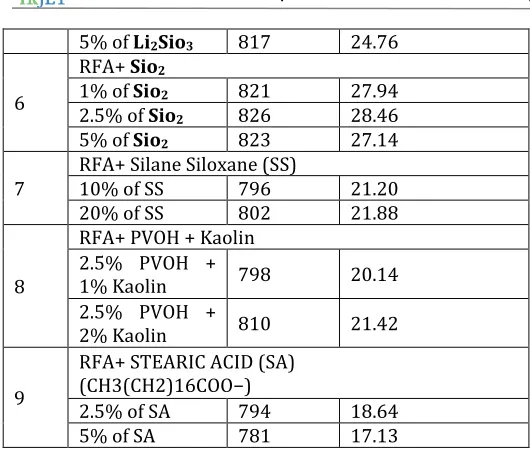
Based on the above test results it can be concluded that lithium silicate and colloidal silica dioxide and Silane siloxane treatment is effective on Coarse aggregate and Colloidal Silica dioxide treatment for fine aggregate. Therefore, its suitability in concrete application combination of treatment has been arrived and same has been compared with the concrete prepared with Natural aggregates and with recycled aggregates.
Table 4.13: Compressive Strength Mortar cube treated with different chemicals
Sl.
No Cube type Weight (grams) Compressive Strength (MPa) 1 NATURAL (N) 836 30.12
2 M-SAND (M) 821 24.42 `3 RECYCLED (R) 815 21.08
4 RFA+ Na
2Sio3
2.5% of Na2Sio3 828 25.24
5% of Na2Sio3 824 24.84
5 RFA+ 2.5% of Li2LiSio3
5% of Li2Sio3 817 24.76
6
RFA+ Sio2
1% of Sio2 821 27.94
2.5% of Sio2 826 28.46
5% of Sio2 823 27.14
7
RFA+ Silane Siloxane (SS)
10% of SS 796 21.20 20% of SS 802 21.88
8
RFA+ PVOH + Kaolin 2.5% PVOH +
1% Kaolin 798 20.14 2.5% PVOH +
2% Kaolin 810 21.42
9
RFA+ STEARIC ACID (SA) (CH3(CH2)16COO−)
2.5% of SA 794 18.64 5% of SA 781 17.13
Initially to find the best combination the concrete cubes were cured for testing its compressive strength and the results of the cubes prepared with Natural and recycled aggregates are tabulated at table 4.14 and the same has been used as reference for arriving a best combination of treated aggregates in concrete mix and the combination has been listed below.
Table 4.14: Compressive Strength of chemical combinations
Sl.no Combinations Weight (kg)
Compressive Strength (MPa)
3-Days 7-Days 1 2.5%LS(CA)+2.5%SiO2(FA) 8.010 13.20 23.20 2 5%LS(CA)+2.5%SiO2(FA) 7.940 11.10 20.20 3 2.5%LS(CA)+1%SiO2(FA) 8.100 15.55 24.10 4 1%SiO2(CA)+1%SiO2(FA) 8.040 15.11 22.10 5 20%SS(CA)+1%SiO2(FA) 7.800 11.55 20.65
From the above a final combination of 2.5% Lithium Silicate treatment on coarse aggregate and 1% Silica dioxide treatment on Fine aggregate found to be the best treatment.
And important thing is we have used the chemical admixture (super plasticizer) for the combinations.
[image:8.612.29.294.73.299.2] The table 4.15 shows the compressive strength results without chemical admixture at two w/c ratio.
Table 4.15: Compressive Strength of chemical combination without chemical admixture
Combinations Weight (kg) Compressive Strength (MPa) 3-Days 7-Days 2.5%LS(CA)+1%SiO2(FA)
@ W/C=0.55 8.010 16.00 26.10 2.5%LS(CA)+1%SiO2(FA)
@ W/C=0.50 8.150 20.44 30.22
FINAL COMBINATIONS FOR CA (2.5% LITHIUM SILICATE) FA (1% SILICON DIOXIDE)
From the above a final combination of 2.5% Lithium Silicate treatment on coarse aggregate and 1% Silica dioxide treatment on Fine aggregate without chemical admixture at w/c is 0.5 found to be the best treatment. For its usage in concrete and on the same to test it mechanical properties of concrete cubes, cylinders and prisms were casted and test for Compressive strength, Split tensile strength, Flexural strength, and the same were compared with that cubes casted with Natural Coarse and fine aggregates and one with Recycled Coarse and fine aggregate. The results on the same are discussed in detail as below.
From the obtained results compared with that of aggregates prepared with natural aggregates i.e. the value is nearly higher than natural aggregate and up to 13 to 15% than compressive strength of cubes prepared with untreated aggregates.
From the obtained results compared with that of cylinders prepared with natural aggregates i.e. the value is nearly higher than natural aggregate and up to 12 to 14% than Split tensile strength of Cylinders prepared with untreated aggregates.
© 2019, IRJET | Impact Factor value: 7.34 | ISO 9001:2008 Certified Journal
| Page 2308
Table 4.16: Mechanical properties of concrete cubes
Cubes Type Compressive Strength (MPa)
Split Tensile
Strength (MPa) Flexural Strength (MPa)
3-Days 7-Days 28-Days 28-Days 28-Days
Natural Aggregate (N) 24.44 33.33 40.44 3.30 8.08
M-Sand (M) 24.00 30.00 39.20 3.10 7.50
Recycled Aggregate
(R) 17.77 29.80 34.28 3.03 7.33
[image:9.612.29.587.239.324.2]Treated (T) 20.44 30.22 40.12 3.54 8.25
Table 4.17: Water absorption of concrete cubes
Cubes Type Initial weight(kg) Final weight (kg) Water Absorption (%age)
Natural Aggregate 8.550 8.560 0.117
M-Sand 8.340 8.350 0.119
Recycled Aggregate 8.050 8.080 0.372
Treated 8.120 8.130 0.123
4.8 Durability Study
Durability studies are done on concrete cubes by testing its resistance to acid, sulphate and chloride attacks of the concrete cubes.
Table 4.18: Compressive strength of cubes after 28 days of Chemical curing
Type of mix Normal Na2SO4
% Strength
decrease NaCl
% Strength decrease H
2SO4
% Strength decrease HCl
% Strength decrease Natural 41.64 40.16 3.55 40.74 2.16 33.14 20.41 32.96 20.85 M-Sand 39.20 37.74 3.72 38.26 2.40 0.56 22.04 29.86 23.83 Recycled 34.28 32.86 4.14 33.14 3.33 25.64 25.20 25.45 5.76 Treated 40.12 38.64 3.69 39.12 2.49 31.10 224.48 31.56 21.34
Table 4.19: Compressive strength of cubes after 56 days of Chemical curing
Type of mix Normal Na2SO4
% Strength
decrease NaCl
% Strength
decrease H2SO4
% Strength decrease HCl
% Strength decrease Natural 41.64 39.54 5.04 39.84 4.32 30.84 25.94 31.56 24.21 M-Sand 39.20 37.16 5.20 37.45 4.46 29.12 25.71 29.36 25.10 Recycled 34.28 31.89 6.97 32.54 5.08 24.89 27.39 24.74 27.83 Treated 40.12 38.12 4.99 38.34 4.44 29.94 25.37 30.01 25.20
5. CONCLUSIONS
This chapter summarizes the assessment and finding of this dissertation work. The conclusions pertaining to comparison of mechanical properties i.e. compressive strength, flexural strength and split tensile strength of
[image:9.612.28.586.410.512.2] [image:9.612.32.584.543.645.2] Recycled fine aggregate treated with 1% colloidal silica dioxide can be used as a complete replacement material for sand in cement mortar and in concrete. Similarly Recycled Coarse aggregate treated with 2.5% lithium silicate can be used as a complete replacement material for Natural Coarse aggregate in Concrete.
Concrete made of treated aggregates has shown very good resistance to acid attacks, Sulphate attacks and chloride attacks, whereas the concrete made of recycled aggregate comparatively failed to resist the above attacks and behaviour of the concrete made of treated aggregates are at par with that of concrete made of conventional aggregates.
At the time of combinations of chemicals for recycled coarse and fine aggregate it is found that compressive strength of concrete cubes made with treated aggregate with super plasticizers have less compression strength values compared to concrete cubes of treated aggregate without super plasticizer.
The compressive strength of concrete cube made of treated aggregate shows increase in strength of 13 to 15% when compared with concrete cube made of untreated aggregate and the strength values are nearly equal to natural aggregates.
The Split tensile strength of concrete cylinders made of treated aggregate shows increase in strength of 12 to 14% when compared with concrete cylinders made of untreated aggregate and the strength values are nearly equal to natural aggregates.
The Flexural strength of concrete prisms made of treated aggregate shows increase in strength of 10 to 12% when compared with concrete prims made of untreated aggregate and the strength are nearly equal to natural aggregates.
ACKNOWLEDGEMENT
I would like to thank my guide Kiran T, Associate Professor, Dept. of Civil Engg. UVCE, Kishore Ravande, Professor, Dept. of Civil Engg. Osmania University and D. Durga PrasadResearch Scholar, for their valuable advice and technical assistance.
REFERENCES
[1] “Improvement of recycled concrete aggregate properties by polymer treatments”–by Valerie Spaeth, AssiaDjerbiTegguer– International Journal of Sustainable Built Environment (2013)2.
[2] “Durability of concrete mixed with recycle aggregates”-by Saloman Levy and Paulo Helene–Exacta, Sao Paulo, V.5, n.1.Jan/Jun 2007.
[3] “Influence of partial replacement of fine natural aggregate by fine recycled aggregate on properties of fine aggregate”-by MS efflova and T Pavlu:-53rd Conference on Experimental Stress Analysis, June1-4, 2015.
[4] “Experimental study on the workability of Recycled Fine Aggregate concrete cement mortar” - Faming liu, Lisha Zhao, Bin Yang-ISSN: 1473-8031.
[5] “Evaluation on the surface Modification of Recycled aggregate in aqueous H2SiF6 solution” – by Hwa–SungRyu, Deuckmokim, sang-Heonshin, seung– Minlim&wan–Jun park:-International Journal of Concrete Structure sand Materials 2018.
[6] “Treatment methods to be adopted for the improvement of recycled aggregate”-by AmnonKatz: Journal of Materials in Civil Engineering/November/Deecember2004.
[7] “Micro-structural analysis of recycled aggregate concrete produced from two stage mixing approach” -by Vivian W.Y Tam, X.F. Gaoand C.M.Tam.
[8] “Experimental investigation on the effects of Different Fine Recycled concrete aggregates on the properties of mortar”–By Cheng-ChihFan, Ram Huang, Howard Hwangand Sao-Jeng Chao :Materials 2015 ISSN1996-1944.
[9] “Preparation technique and performance study of construction waste recycled coarse and fine aggregate concrete “–by Shaomn Songand Lin Wang.
[10] “Studies on concrete made of recycled materials for sustainability-By Kirtikanta Sahootomrads fulfilment of Ph.D.