FORMULATION AND OPTIMIZATION OF FUNCTIONAL BREAD
SURFACE METHODOLOGY
Shemi George and Nazni, P
Department of Food Science, PeriyarARTICLE INFO ABSTRACT
Bread is considered to be one of the oldest ‘processed’ foods by the humanity. It is one of the major products of baked foods and is
nutrient content of the seed. Sprouted grains are seen in a number of baked goods at natural health food stores.
seed flour and butter with respect to bread
the following variables of protein, weight loss, porosity and specific volume of the bread. Models developed adequately described the relationship
wheat flour showed the greatest effect on models, which effect impaired weight loss and specific volume of germinated pumpkin seed bread.
obtained graphica
germinated pumpkin seed flour and 8g for butter.
with 90g of refined wheat flour; 10g germinated pumpkin seed and 8 g of butter score for overall acceptability among the variations in the germinated pumpkin seed bread.
INTRODUCTION
Bread is an important ready-to-eat product which is becoming increasingly popular in hotels, restaurants, canteens and in households. The bread is a fast and convenient food based on wheat. Bread is one of the major products of baked foods and is consumed worldwide (Bakke and Vickers, 2007). The bread is an ideal product that can serve as a functional food, since it is daily used by a large population throughout the world. (Martin, 2004; Sluimer, 2005). Bread products are well accepted worldwide because of the low cost, ease of preparation, versatility, sensory attributes and nutritional properties. Bread in human nutrition is not only a source of energy, but also a supplier of irreplaceable nutrients for t human body. It provides little fat, but high quantities of starch and dietary fiber as well as cereal protein. Apart from that, bread contains the B group vitamins and minerals which are mostly magnesium, calcium and iron. The sensory scores for appearance, texture and flavour of breads have been reported to decrease by the incorporation of non wheat flours in wheat flours (Gülçin, 2006).
Incorporation of pumpkin seed powder in bread increase the protein content of the product. The pumpkin is an angiosp belonging to the cucurbitaceae family that is characterized by prostrate or climbing herbaceous vines with tendrils and large, fleshy fruits containing numerous seeds (Acquaah, 2004). Pumpkin of the genus C. maxima is also called squash guard. Pumpkin of the genus C. maxima is also called squash guard.
*Corresponding author: [email protected]; [email protected];
ISSN: 0975-833X
International Journal of Current Research Vol.
Article History: Received 25th
March, 2012 Received in revised form 10th
April, 2012 Accepted 25th
May, 2012 Published online 30th
June, 2012
Key words: Bread,
Germinated pumpkin seed, Response surface Methodology, Optimization.
RESEARCH ARTICLE
FORMULATION AND OPTIMIZATION OF FUNCTIONAL BREAD BY EMPLOYING
SURFACE METHODOLOGY
Shemi George and Nazni, P
Department of Food Science, Periyar University, Salem.11, Tamil Nadu, India
ABSTRACT
Bread is considered to be one of the oldest ‘processed’ foods by the humanity. It is one of the major products of baked foods and is consumed worldwide. Sprouting of pumpkin seed help to increase the nutrient content of the seed. Sprouted grains are seen in a number of baked goods at natural health food stores.The objective of this study was to optimize the refined wheat flour, germina
seed flour and butter with respect to bread-making quality. The optimal Design was employed with the following variables of protein, weight loss, porosity and specific volume of the bread. Models developed adequately described the relationships and were confirmed by validation studies. Refined wheat flour showed the greatest effect on models, which effect impaired weight loss and specific volume of germinated pumpkin seed bread. The optimum set of the independent variables was obtained graphically in order to obtain the desired levels of 90g for refined wheat flour, 10g for germinated pumpkin seed flour and 8g for butter.Organoleptic evaluation showed th
with 90g of refined wheat flour; 10g germinated pumpkin seed and 8 g of butter score for overall acceptability among the variations in the germinated pumpkin seed bread.
Copy Right, IJCR, 2012, Academic Journals
eat product which is becoming increasingly popular in hotels, restaurants, canteens and in households. The bread is a fast and convenient food based on the major products of baked foods and is consumed worldwide (Bakke and Vickers, 2007). The bread is an ideal product that can serve as a functional food, since it is daily used by a large population throughout the world.
ead products are well accepted worldwide because of the low cost, ease of preparation, versatility, sensory attributes and nutritional properties. Bread in human nutrition is not only a source of energy, but also a supplier of irreplaceable nutrients for the human body. It provides little fat, but high quantities of starch and dietary fiber as well as cereal protein. Apart from that, bread contains the B group vitamins and minerals which are mostly magnesium, calcium and iron. The sensory scores for nce, texture and flavour of breads have been reported to decrease by the incorporation of non wheat flours in wheat
Incorporation of pumpkin seed powder in bread increase the protein content of the product. The pumpkin is an angiosperm family that is characterized by prostrate or climbing herbaceous vines with tendrils and large, fleshy fruits containing numerous seeds (Acquaah, 2004). is also called squash guard. is also called squash guard.
[email protected]; [email protected];
The pumpkin seeds contained 39.25% crude protein, 27.83% crude oil, 4.59% ash, and 16.84% crude fi
corresponding values for the kernels were 39.22, 43.69, 5.14, and 2.13%, respectively. The saturated fatty acid content was 27.73% and comprises of 16.41% palmitic acid and 11.14% stearic acid. The unsaturated fatty acid value was 73.03% and consisting mainly of 18.14% oleic acid and 52.69% linoleic acid. The oil obtained from the pumpkin seed kernels had a refractive index of 1.4656, specific gravity of 0.913, iodine value of 105.12 (g I2/100g oil), saponification value of 185.20 (mg KOH/g oil), acid value of 0.53 (mg KOH/g oil), and peroxide value of 0.85 (meq peroxide/kg oil) (
Alfawaz.2004). Considering the lipid and protein content in the kernels, and their fatty and amino acid compositions, the pumpkin seed kernels appear to be quit
commercial exploitation. Sprouted grains are seen in a number of baked goods at natural health food stores.
Sprouting is the practice of soaking, draining and leaving seeds or grains until they germinate or begin to sprout. The concept behind the use of such grains and legumes is that the enzymes produced during sprouting convert starch into more digestible maltose and the vitamins and mineral content available for digestion increases. In effect the sprouting process ‘predigests’ grains (Misty, 2004). It is known that germination induces increase in free limiting amino acid and available vitamins with modified functional properties of seed components (Hallén et al., 2004). Germination also decreases anti-nutritional factors such as trypsin
et al., 2000).
ternational Journal of Current Research
Vol. 4, Issue, 06, pp.008-014, June,2012
INTERNATIONAL
OF CURRENT RESEARCH
BY EMPLOYING RESPONSE
University, Salem.11, Tamil Nadu, India
Bread is considered to be one of the oldest ‘processed’ foods by the humanity. It is one of the major consumed worldwide. Sprouting of pumpkin seed help to increase the nutrient content of the seed. Sprouted grains are seen in a number of baked goods at natural health The objective of this study was to optimize the refined wheat flour, germinated pumpkin making quality. The optimal Design was employed with the following variables of protein, weight loss, porosity and specific volume of the bread. Models s and were confirmed by validation studies. Refined wheat flour showed the greatest effect on models, which effect impaired weight loss and specific The optimum set of the independent variables was lly in order to obtain the desired levels of 90g for refined wheat flour, 10g for Organoleptic evaluation showed that variation7 with 90g of refined wheat flour; 10g germinated pumpkin seed and 8 g of butter had scored high score for overall acceptability among the variations in the germinated pumpkin seed bread.
, Academic Journals. All rights reserved.
The pumpkin seeds contained 39.25% crude protein, 27.83% crude oil, 4.59% ash, and 16.84% crude fiber; The corresponding values for the kernels were 39.22, 43.69, 5.14, and 2.13%, respectively. The saturated fatty acid content was 27.73% and comprises of 16.41% palmitic acid and 11.14% stearic acid. The unsaturated fatty acid value was 73.03% and sting mainly of 18.14% oleic acid and 52.69% linoleic acid. The oil obtained from the pumpkin seed kernels had a refractive index of 1.4656, specific gravity of 0.913, iodine value of 105.12 (g I2/100g oil), saponification value of 185.20 cid value of 0.53 (mg KOH/g oil), and peroxide value of 0.85 (meq peroxide/kg oil) (Mohammed A. ). Considering the lipid and protein content in the kernels, and their fatty and amino acid compositions, the pumpkin seed kernels appear to be quite promising for commercial exploitation. Sprouted grains are seen in a number of baked goods at natural health food stores.
Sprouting is the practice of soaking, draining and leaving seeds or grains until they germinate or begin to sprout. The hind the use of such grains and legumes is that the enzymes produced during sprouting convert starch into more digestible maltose and the vitamins and mineral content available for digestion increases. In effect the sprouting isty, 2004). It is known that germination induces increase in free limiting amino acid and available vitamins with modified functional properties of seed 2004). Germination also decreases nutritional factors such as trypsin-inhibitor (Uwaegbute
Sprouting of pumpkin seed help to increase the nutrient content of the bread. Sprouted grains are seen in a number of baked goods at natural health food stores. Spouting is the practice of soaking, draining, and leavening seeds or grains until they germinate or being to sprout. The concept behind the use of such grains is that the enzymes produced during the sprouting convert starch into more digestible maltose and the vitamins and minerals available for digestion increases. Germination induces increasing in free limiting amino acid and available vitamins with modified functional properties of seed components (Hallen et al., 2004). The nutrients released in the spouted pumpkin seeds will play an important role in baked products. Therefore, the objective of this study was to determine the optimized germinated pumpkin seed powder bread, in order to maximize the protein and good baking properties by using RSM.
MATERIALS AND METHODS
The ingredient like refined wheat flour, yeast, butter and sugar were obtained from the local market, Salem, Tamil Nadu, India. The pumpkin seed was collected from matured pumpkin fruit.
Production of Spouted pumpkin seed flour
Pumpkin seeds were soaked in tap water at 1:3 seeds water ratio for overnight in distilled water at room temperature. The seeds were placed on muslin cloth and continuous watering was done for 48 h for the seed to germinate. The sprouted seeds were then dried at 60°C; after hull separation, the material was milled to obtain the germinated seed flour.
Experimental design
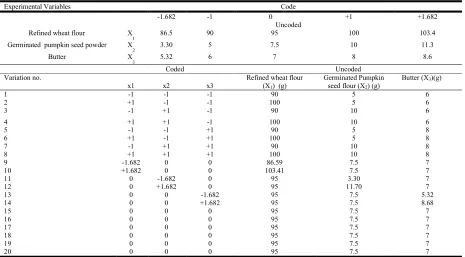
Response surface methodology was applied to the experimental data using a commercial statistical package (Design expert, Trail version 7.0, State Ease Inc., Minneapolis, IN statistical software) for the generation of response surface plot and optimization of process variables. The experiments were conducted according to Central Composite Rotatable Design (CCRD) (Khuri, AI and Cornell. JA, 2007. A central composite rotatable design (CCRD) with augmented points in three variables refined wheat flour(X1),
pumpkin seed powder (X2) and butter(X3). Each design point
consists of the replicates. For the statistical analysis the numerical levels are standardized to-1.682, -1, 0, +1 and +1.682. The experiments were carried out in randomized order (Gacula and Singh, 1984).
Where, Y is response variable,
₀
- Constant and coefficient,−
Linear coefficient ,αii – quadratic coefficient,αij – cross product coefficient ,Xi, Xj – levels of the independent variables, k – Number of the factors tested (k = 3), Xi and Xj are coded independent variables, i.e,The second order polynomial equation was fitted to the experimental data of each dependent variable as given. The
model proposed to each response of Y, (Quality Measurements of bread) weight loss (Y1) porosity (Y2) and specific volume (cm3/g) (Y3).
The analysis of variance (ANOVA) table is generated and the regression coefficients of the individual linear, quadratic, and interaction terms are determined. The significances of all terms in polynomial are judged statistically by computing the F-value at a probability level (P) of 0.01 or 0.05. The model is then submitted to statistical analysis to neglect all terms that are statistically insignificant (P > 0.05). Regression coefficients are used to generate a contour map for the regression model. The model permitted evaluation of quadratic terms of the independent variables on the dependent variable. The response surface and contour plot were generated for different interactions of any two independent variables, where holding the value of third variables as constant at central level. The optimization of the process was aimed at finding the optimum values of independent variables (Agrawal S.R. 2000).
Preparation of Bread Samples
All the dry ingredients (flour, sugar, salt, and butter) were mixed for 1 min by a mixer at 58 rev/min. Then, yeast dissolved in 30ºC water, which is the optimum temperature for the yeast cells to be activated, and melted margarine was added to the dry ingredients. All the ingredients were again mixed for 2.5 min by the help of the same mixer at 85 rev/min and during mixing, water was added to the mixture. After mixing, the dough was fermented in an incubator at 30ºC with 85% relative humidity.
The total fermentation time was 105 min. After the first 70 min, the dough was punched to remove the carbon dioxide and again placed into the incubator. The second punch took place after 35 min. Then, the dough was divided into 50 g pieces and shaped. The shaped samples were placed in greased glass baking pans and again placed into the incubator for 20 min in order to maintain the proofing step, which is defined as the last fermentation. Then, the samples were ready for baking.
Quality Measurements of bread
After baking the breads, in order to determine the optimum baking point, the quality measurements were performed. The quality parameters were the weight loss, specific volume, and porosity of the breads.
Weight Loss
The weight loss of the breads was calculated by measuring the weight of the dough before and bread after the baking process. The following equation was used to express the weight loss:
Weight loss (%) = Wi- Wf ×100
Wi
Where, Wi: weight of the dough before baking, Wf: weight of the bread just after baking.
Specific Volume (Measurement Loaf bread volume)
n
i i ii n
i j
j i i n
i
n
i i
iX X X X
Y
1 2
1 3
1
1
1
0
The loaf volume expressed in cubic centimeters was determined by the seed displacement method according to Pyler (1973). The loaf was placed in a container of known volume into which millet seeds were run until the container is full. The volume of a seed displaced by the loaf was considered as the loaf volume Loaf bread specific volume: The specific volume of the loaf was calculated according to the AACC (1991) by dividing volume of the loaf (cm3.) by its weight (g). Triplicate measurements were taken.
W seeds = W total – W bread – W container, V seeds = W seeds / ρ seeds
V bread = V container – V seeds
Where, W represents ‘weight (g)’, V is ‘volume (cm3), and ρ is density (g/cm3)’.
The specific volume was calculated by dividing the volume of the bread by its weight;
SV bread = V bread / W bread
Porosity
Porosity was measured by using the method of (Sluimer, 2005). Porosity can be defined as the ratio of the volume of the pores to the total volume of the product:
ε = (VT - Vnp)/ Vt
Where, Vt = total volume of the sample,
Vnp = volume of the non-porous material in the sample.
An apparatus having a constant basement area was designed, which allowed pores to be removed from the bread samples, to measure porosity.
Optimization and verification
Optimum levels of wheat flour, germinated pumpkin seed flour and butter were determined by superimposing the plots for all response variables (Floros and Chinnan, 2008; Henika, 2002; Henika 1972). The optimum levels of ingredients were selected and used for calculating the predicted properties of germinated pumpkin seed bread using the prediction equations derived by RSM. The germinated pumpkin seed bread obtained was experimentally analyzed and the results statistically compared to those predicted by the mathematical model.
Sensory Evaluation
Bread samples were evaluated on a scale of 1 - 5 for five quality parameters: crust colour, crumb colour, external appearance and shape, taste and aroma, and mouth feel and texture. A ballot sheet was prepared to evaluate sensory attributes of breads after modifying parameters and scores of various flat breads to Lavash (Qarooni et al., 1987; Williams, 1988). Consistency of the panel was checked by subjecting data for the indicated attributes from three replicate rating of bread samples to principal component analysis (Khan MN et al., 2005).
Statistical Analysis
Experimental data was analyzed by multiple regressions to fit the quadratic equation to all independent variables. Analysis
of variance (ANOVA) was performed to evaluate significant differences between independent variables. To visualize the relationships between the responses and the independent variables, surface response and contour plots of the fitted quadratic regression equations were generated using Design-Expert software version 8.0.
RESULTS AND DISCUSSION
Results of bread quality characteristics used in the optimization procedure are as shown in Table 2 corresponding to the different runs. Bread sample produced with different proportion of refined wheat flour, germinated pumpkin seed flour and butter shows differences exist among the samples in Weight Loss, porosity and specific volume. Weight loss come the range from 10.00 to 11.81 (%), porosity 40.5 to 46 and Specific Volume 1.88 to 2.63(cm3/g). The independent and dependent variables were fitted to the second order model equation and examined for the goodness of fit. In general, exploration and optimization of a fitted response surface may produce poor or misleading results, unless the model exhibits a good fit which makes checking of the model adequacy (Liyana- Pathirana and Shahidi, 2005). Several indicators were used to evaluate the adequacy of the fitted model. A test for the lack of fit was used wherein a low F-value indicates that the model equation is an adequate approximation to the data. The R2 values, Coefficients of Variation (CV) and model significance (F-value) were also used to judge the adequacy of the model. The significance of the F-value depends on the number of Degrees of Freedom (DF) in the model (Cai et al., 2008; Qiao et al., 2009).
Effect of variables on Weight loss
The statistical significance of the model was also determined by test for analysis of variance (ANOVA) .The Model F-value of 20.42 for weight loss implies the model is significant. For weight loss the "Lack of Fit F-value" of 17.53 implies the Lack of Fit is significant. There is only a 0.35% chance that a "Lack of Fit F-value" this large could occur due to noise. Significant lack of fit is bad. Ratio greater than 4 is desirable for Adeq Precision. The ratio of 15.979 indicates an adequate signal. The "Pred R-Squared" of 0.5960 is not as close to the "Adj R-Squared" of 0.9020 as one might normally expect. This model can be used to navigate the design space
Effect of variables on Porosity
There had not significant variation due to refined wheat flour and germinated pumpkin seed flour and butter in the bread. But maximum porosity showed in maximum amount of the three ingredients (Table 3). The Model F-value of 3.14 for porosity implies the model is significant.There is only a 4.45% chance that a "Model F-Value" this large could occur due to noise.The "Lack of Fit F-value" of 15.33 implies the Lack of Fit is significant. A negative "Pred R-Squared" implies that the overall mean is a better predictor of the response than the current model."Adeq Precision" measures the signal to noise ratio. A ratio greater than 4 is desirable. for porosity the ratio of 6.116 indicates an adequate signal. This model can be used to navigate thedesignspace.
Effect of variables on Specific volume
Table 1. The range and the levels of the experimental variables used in the coded and uncoded form for the centre, factorial and augmented point of design
Experimental Variables Code
-1.682 -1 0 +1 +1.682
Uncoded
Refined wheat flour X
1 86.5 90 95 100 103.4
Germinated pumpkin seed powder X
2 3.30 5 7.5 10 11.3
Butter X
3 5.32 6 7 8 8.6
Coded Uncoded
Variation no.
x1 x2 x3
Refined wheat flour
(X1) (g)
Germinated Pumpkin
seed flour (X2) (g)
Butter (X3)(g)
1 -1 -1 -1 90 5 6
2 +1 -1 -1 100 5 6
3 -1 +1 -1 90 10 6
4 +1 +1 -1 100 10 6
5 -1 -1 +1 90 5 8
6 +1 -1 +1 100 5 8
7 -1 +1 +1 90 10 8
8 +1 +1 +1 100 10 8
9 -1.682 0 0 86.59 7.5 7
10 +1.682 0 0 103.41 7.5 7
11 0 -1.682 0 95 3.30 7
12 0 +1.682 0 95 11.70 7
13 0 0 -1.682 95 7.5 5.32
14 0 0 +1.682 95 7.5 8.68
15 0 0 0 95 7.5 7
16 0 0 0 95 7.5 7
17 0 0 0 95 7.5 7
18 0 0 0 95 7.5 7
19 0 0 0 95 7.5 7
20 0 0 0 95 7.5 7
[image:4.612.85.546.367.556.2]x1,x2,x3- coded form of Refined wheat flour, Germinated Pumpkin seed flour and butter
Table 2. Results of responses obtained from the quality properties of germinated pumpkin seed bread
S.No X1 X2 X3 Weight loss (%) Porosity Sp.Volume (cm3/g)
1 90.00 5.00 6.00 10.2 42.6 2
2 100.00 5.00 6.00 11.21 40.7 2.01
3 90.00 10.00 6.00 10.7 43.0 2.9
4 100.00 10.00 6.00 11.71 43.4 2.03
5 90.00 5.00 8.00 10.4 41.8 1.91
6 100.00 5.00 8.00 11.41 42 2.07
7 90.00 10.00 8.00 10 41 3
8 100.00 10.00 8.00 11.91 46 2.1
9 86.59 7.50 7.00 10.2 40.5 2.02
10 103.41 7.50 7.00 11.81 43 1.98
11 95.00 3.30 7.00 10.64 40.9 2.04
12 95.00 11.70 7.00 11.43 42.2 1.99
13 95.00 7.50 5.32 10.98 41.2 2.00
14 95.00 7.50 8.68 11.22 42.4 1.88
15 95.00 7.50 7.00 10.9 42 2.03
16 95.00 7.50 7.00 10.8 43.5 2.04
17 95.00 7.50 7.00 10.9 43.8 2.04
18 95.00 7.50 7.00 10.8 43.4 2.08
19 95.00 7.50 7.00 10.9 43 2.04
20 95.00 7.50 7.00 10.8 43 2.02
Refined wheat flour (X1), Germinated Pumpkin seed flour (X2), Butter (X3)
Table 3. Analysis of Variance (ANOVA) of Second Order Polynomial Model quality properties of germinated pumpkin seed bread
Source Weight loss Porosity Specific volume
Sum of Square
F value P- value Sum of Square
F value P- value Sum of Square
F value P- value
Model 15.11 20.42* <0.001** 10.22 1.19 0.3940 1.02 1.86NS
0.1742 X1 4.28 154.11 <0.001** 6.471 0.31 0.5881 0.20 3.34 0.0974 X2 0.431 15.54 0.0028** 0.025 0.025 0.2959 0.281 4.60 0.0575 X3 6.751 0.24 0.6327 0.024 0.0241 0.3100 2.798 4.598 0.9473 X1
2
0.013 0.48 0.5059 5.729 0.028 0.8711 0.026 0.43 0.5284
X22 0.24 0.87 0.3735 1.942 0.094 0.7655 0.033 0.54 0.4794
X32 0.059 2.12 0,1764 3.203 0.15 0.7021 6.495 0.11 0.4794
X1X2 0.10 3.64 0.0854 0.041 1.97 0.1912 0.47 7.73 0.0194*
X1X3 0.10 3.64 0.0854 0.034 1.15 0.2383 1.80 0.030 0.8669
X2X3 0.10 3.64 0.0854 0.086 4.17 0.0685 5.000E 0.082 0.7802
Lack of fit 17.53* 98.20* 291.09 *
Adj R2
0.9020 0.0814 0.2888
Pre R2
0.5960 -2.9408 -1.8323
Adeq precision
15.979 4.690 4.709
[image:4.612.89.543.584.749.2]germinated pumpkin seed bread (table 3). Refined wheat flour increased specific volume increased. The "Model F-value" of 1.19 for specific volume implies the model is not significant. The "Lack of Fit F-value" of 98.20 implies the Lack of Fit is significant . for Adeq Precision ,the ratio of 4.690 for sp.volume indicates an adequate signal. This model can be used to navigate the design space.
Adequacy of the model
The analysis of variance of the effect of germinated pumpkin seed bread as a linear term, quadratic term and interaction on the response variables is shown in Table 4. The results indicated that the model is highly adequate because responses have satisfactory levels of R2 model significance. The weight
loss and specific volume, however, showed a rather high CV and could be due to the experimental region covered in the study. However, the model was highly significant and possesses 94.84 of R2 for weight loss and 73.87% for specific volume. Considering the high value of R2, the model for weight loss and specific volume can be accepted. The R2 of porosity was less (51.65) compared to other dependent variables.
Predicative models
Weight loss (%) (Y1) =+32.97-0.343X1-0.56X2-2.67X3+
1.21X12+6.54X22+0.063X32 +9.00X1X2+0.022X1X3-0.045X2X3 . (1)
[image:5.612.108.509.74.228.2]In Equation 1 are represented the uncoded value, for the predicative model for weight loss. Two ingredients (refined
Table 4. Estimated regression coefficients of predicted quadratic model
Predictors
Regression Coefficient
Weight loss (%) porosity Sp.Volume (cm3 /g)
Constant 10.85** 43.29* 2.03
Linear
x1 0.56** -0.99** -0.12
x2 0.18** 0.27 0.14
x3 0.022 0.024 -4.526
Quadratic
x1 2
0.030 0.40 0.042
x22 0.041 0.49 0.048
x3 2
0.064 0.31 0.021
Interaction
x1x2 0.11 0.53 -0.24*
x1x3 0.11 0.38 0.015
x2x3 0.11 0.20 0.025
R2
(%) 94.84 73.87 62.57
[image:5.612.95.517.261.345.2]x1, x2, x3 are the coded form of Refined wheat flour (x1), Germinated Pumpkin seed flour (x2), Butter (x3)
Table 5. Criteria of optimum value for the responses
Optimum values of parameters
and responses Target Experimental range
Optimum value Uncoded coded Refined wheat flour (X1) is in range 86.5 103.4 90 -1
Germinated Pumpkin Seed (X2) is in range 3.30 11.70 10 +1
Butter (X3) is in range 5.32 8.68 8 +1
Weight Loss (%) (Y1) minimum 10.00 11.91 Predicted value 10.284
Porosity (Y2) maximum 40.5 43.8 44.484
specific volume (cm3/g) (Y3) maximum 1.88 3.00 2.657
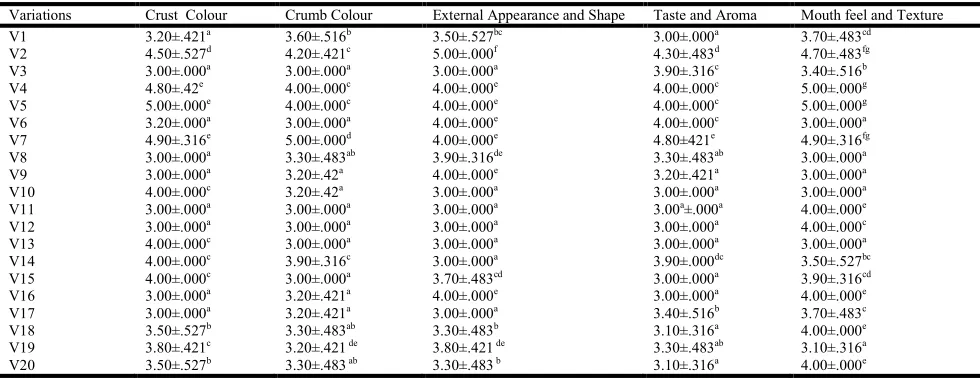
Table 6. Organoleptic evaluation of germinated pumpkin seed bread
Variations Crust Colour Crumb Colour External Appearance and Shape Taste and Aroma Mouth feel and Texture
V1 3.20±.421a
3.60±.516b
3.50±.527bc
3.00±.000a
3.70±.483cd
V2 4.50±.527d
4.20±.421c
5.00±.000f
4.30±.483d
4.70±.483fg
V3 3.00±.000a
3.00±.000a
3.00±.000a
3.90±.316c
3.40±.516b
V4 4.80±.42e
4.00±.000c
4.00±.000e
4.00±.000c
5.00±.000g
V5 5.00±.000e
4.00±.000c
4.00±.000e
4.00±.000c
5.00±.000g
V6 3.20±.000a
3.00±.000a
4.00±.000e
4.00±.000c
3.00±.000a
V7 4.90±.316e
5.00±.000d
4.00±.000e
4.80±421e
4.90±.316fg
V8 3.00±.000a
3.30±.483ab
3.90±.316de
3.30±.483ab
3.00±.000a
V9 3.00±.000a
3.20±.42a
4.00±.000e
3.20±.421a
3.00±.000a
V10 4.00±.000c
3.20±.42a
3.00±.000a
3.00±.000a
3.00±.000a V11 3.00±.000a
3.00±.000a
3.00±.000a
3.00a ±.000a
4.00±.000e
V12 3.00±.000a
3.00±.000a
3.00±.000a
3.00±.000a
4.00±.000c
V13 4.00±.000c
3.00±.000a
3.00±.000a
3.00±.000a
3.00±.000a
V14 4.00±.000c
3.90±.316c
3.00±.000a
3.90±.000dc
3.50±.527bc
V15 4.00±.000c
3.00±.000a
3.70±.483cd
3.00±.000a
3.90±.316cd
V16 3.00±.000a
3.20±.421a
4.00±.000e
3.00±.000a
4.00±.000e
V17 3.00±.000a
3.20±.421a
3.00±.000a
3.40±.516b
3.70±.483c
V18 3.50±.527b
3.30±.483ab
3.30±.483b
3.10±.316a
4.00±.000e
V19 3.80±.421c 3.20±.421 de 3.80±.421 de 3.30±.483ab 3.10±.316a
V20 3.50±.527b
3.30±.483 ab
3.30±.483 b
3.10±.316a
4.00±.000e
[image:5.612.62.552.370.559.2]Fig. 1. Response surface plot: effect of refined wheat flour and germinated pumpkin seed powder on weight loss of autoclave
pumpkin seed bread
Fig. 2. Response surface plot: Effect of refined wheat flour and Germinated pumpkin seed powder on porosity of germinated pumpkin
seed bread
Fig. 3. Response surface plot: Effect of refined wheat flour and germinated pumpkin seed powder on specific volume of
germinated pumpkin seed bread
wheat flour and germinated pumpkin seed flour) showed significant negative linear effect on weight loss. No ingredients showed a quadratic effect, but which was positive. Interactive effects between refined wheatflour and germinated pumpkin seed and, flour refined wheatflour and butter were not significant and had a positive effect and on germinated
pumpkin seed and butter had a negative effect on weight loss of the bread.
Porosity (Y2)= 177.15+3.65X1+4.703X2+10.86X3-0.015X1
2
-0.07X22-0.30X32-0.042X1X2 -0.075X1X3 +0.080 X2X3 …..…(2)
In Equation 2, represented the uncoded value for the predicative model for porosity showed the three variables hadn’t linear effects, but which was positive. All the three variables showed not significant quadratic negative effects on porosity. The Interactive effect of refined wheat flour and germinated pumpkin seed and, flour refined wheat flour and butter were negative and germinated pumpkin seed and butter had a positive effect on porosity of the bread.
Sp.Volume (%) (Y3) = +13.78088-0.27098 X1+0.87695X2 -
0.63674X3+1.69772X1 2
+1.909X2 2
+0.0212X3 2
- 9.700X1X2
+3.000X1X3+5.000X2X3………..…….(3)
The relationship between X1, X2, X3 ( the uncoded value for the predicative model )and specific volume is shown by equation 3 and resulted in significant linear negative effect in refined wheatflour and butter. The two variables like refined wheatflour and germinated pumpkin seed showed significant on quadratic and all had a positive effect on specific volume. The Interactive effect of X1X2, X1X3 and X2X3 had a positive effect on specific volume of the bread.
Response Surface Plots
A helpful tool for a better understanding of the link between each factor and response is given by the response surface plots, in which the effect of two factors on one specific response is displayed in 3-D view, keeping the other ones on fixed values. Some selected surfaces are presented in Figs. 1
Optimization of germinated pumpkin seed bread
Design expert software was adopted to determine the workable optimum conditions for the germinated pumpkin seed bread. The contour plots for all the responses were superimposed and regions that best satisfy all the constraints were selected as optimum conditions. The main criteria for constraints optimization were maximum specific volume, porosity and minimum weight loss. These constraints resulted in “feasible zone” of the optimum conditions. The optimum range of process parameters obtained for germinated pumpkin seed bread were 86.5 to 103.4 g of refined wheat flour, 3.30 to 11.70 g of germinated pumpkin seed powder, 5.32 to 8.68g of butter. The optimum operating point for refined wheat flour germinated pumpkin seed and butter were, 90, 10 and 8 respectively. Corresponding to these values of process variables, the value of weight loss 10.284, porosity 44.484 and specific volume 2.657 (cm3/g).
Organoleptic evaluation of germinated pumpkin seed bread
The mean organoleptic evaluation of germinated pumpkin seed bread using Duncan multiple range tests was shown in the table 6. Among the 20 variations, V7 have scored highest mean value (5.00±.000 e) in Crust Colour. In Crumb Colour, V7 obtained of highest score 5.00±.000 d than other variables.
Design-Expert® Software Weight Loss
Design points above predicted value
Design points below predicted value
11.91
10
X1 = A: Refined Wheat Flour X2 = B: Germinated Pumpkin Seed Flour Actual Factor C: Butter = 8.00
90.00 92.00
94.00 96.00
98.00 100.00
5.00 6.00 7.00 8.00 9.00 10.00
10 10.5 11 11.5 12
W
e
ig
h
t
L
o
ss
A: Refined Wheat Flour B: Germinated Pumpkin Seed Flour
10.2841 10.2841
Design-Expert® Software Porosity
46
40.5
X1 = A: Refined Wheat Flour X2 = B: Germinated Pumpkin Seed Flour Actual Factor C: Butter = 7.94
90.00 92.00
94.00 96.00
98.00 100.00
5.00 6.00 7.00 8.00 9.00 10.00
40 41 42 43 44 45
P
o
ro
s
it
y
A: Refined Wheat Flour B: Germinated Pumpkin Seed Flour
44.4845 44.4845
Design-Expert® Software Specific Volume
Design points above predicted value
Design points below predicted value
3
1.88
X1 = A: Refined Wheat Flour X2 = B: Germinated Pumpkin Seed Powder Actual Factor C: Butter = 8.00
90.00 92.00
94.00 96.00
98.00 100.00
5.00 7.00 9.00 11.00 13.00 15.00
1.8 2 2.2 2.4 2.6 2.8 3
Sp
e
cif
ic
Vo
lu
m
e
A: Refined Wheat Flour B: Germinated Pumpkin Seed Powder
Regarding External Appearance and Shape, the highest score 5.00f±.000 is obtained by the variation V2. In Taste and Aroma, V7 scored highest of 4.80e±421 than V2 which the nearest score of 4.30±.483d. Regarding Mouth feel and
Texture, the highest score of 5.00±.000g scored by the variations of V4 and V5 and is followed by the V7 with score of 4.90±.316 fg. Results of the Duncan’s test revealed that there was significant difference for all the variations and the high score acquired by V7 which included, 90g refined wheat flour; 10g germinated pumpkin seed and 8 g of butter. Organoleptic evaluation of germinated pumpkin seed bread shows that variation 6 shows (90g refined wheat flour; 10g germinated pumpkin seed and 8 g of butter) high score for Germinated Pumpkin Seed bread. Erkan et al. [2006] had shown that instrumental measurement of baked products’ color is an inevitable quality check that could be used in determines the effects of ingredient or product formulation, process variable and storage conditions on baked products. It is shown crumb color characteristics are liable to differ significantly in higher sweet potato paste adding samples. Hardness is commonly used as an index to determine bread quality, as change in hardness is frequently accompanied with loss of resilience during storage (Spices, R., 2000).Bread baking quality is determined by the physical properties of dough, its oxidative potential, flour water absorption, bread volume, and color of crumb and crust (Menkovska et al., 2002). As far as affect of germination on tannins is concerned, germination could make tannins move in the same way as that soaking and cooking do, and the fact that these compounds are heat and light sensitive make them more prone to destruction. As the germination period increased to six days, TIA and the PA contents decreased to a large extend, while amounts of tannins and catechins increased in two lentil cultivars (Vidal-Valverde et al., 1994). Moreover, germination was considered as an effective treatment for destroying trypsin enzyme inhibitors than either phytates or polyphenols in L. sativus (Srivastava and Khokhar, 1999).
CONCLUSION
The refined wheat flour and germinated pumpkin seed have a significant effect on the weight loss and refined wheat flour has significant effect of specific volume of germinated pumpkin seed bread. Use of the contour and surface plots in RSM was effective for estimating the effect of three independent variables (Refined wheat flour, Germinated Pumpkin Seed and butter).The optimum set of the independent variables was obtained graphically in order to obtain the desired levels of 90g for refined wheat flour,10g for germinated pumpkin seed and 8g for butter.
REFERENCES
AACC, 1991. Approved Methods of the American Association of Cereal Chemists. St. Paul, Minnesota: Academic Press, 1, p: 149-150.
Acquaah, G 2004. Horticulture: principles and Practices 3rd
edition Upper saddle River:New Jersey, Pearson Education Inc.
Agrawal S.R. 2000. Prospects for small-scale biscuit industry in
the nineties. Indian Food Industry 9:19–21
Association Of Official Analysis Chemists(AOAC),1990. Official
Methods Of Analysis Chemists, 15th edn. (AOAC Arlington)
Virginia, UAS.
Bakke and Vickers. 2007. Department of Food Science and Nutrition, College of Food Sciences and Agriculture King Saud University, P.O. Box 2460, Riyadh, 11451, Saudi Arabia .Bread diets containing several sources of hulls or bran. J Food Sic 48: 1151.
Cai, W.R., X.H. Gu and J. Tang, 2008. Extraction, purification and characterization of the polysaccharides from Opuntia milpa alta. Carbohyd.Polym. 71: 403-410.
Erkan, H., Celik, S., Bilgi, B., and Koskel, H., 2006. “A new approach for the utilization of barley in food products: barley
tarhana,” Food Chemistry, Vol. 97, pp. 12-18.
Floros, J.D. and M.S. Chinnan, 1988. Computer graphics assisted optimization for product and process development. Food Technol., 42: 71-78.
Gülçin I. 2006. Antioxidant activity of caffeic acid (3, 4-dihydroxycinnamic acid). Toxicology 217 (2-3): 213-220 Hallen E, Ibanoglu S, Ainsworth P. 2004.effect of germinated/
fermented cowpea flour addition on the rheological and baking properties of wheat flour, J Food Eng. 63:177-184. Henika, R.G., 1982. Use of response surface methodology in
sensory evaluation. Food Technol., 36: 96-101.
Henika, R.G., 1972. Simple and effective system for use with response surface methodology. Cereal Sci.Today, 17: 309-334.
Khan MN, Rhee K.C, Rooney L.W, Cater C.M. 2005. Bread baking properties of aqueous Properties of several oilseed flours. J Food Sci 37: 15–19.
Kwan WO, Kowalski B.R .1980, Data analysis of sensory score J. Food Sci. 45: 213-26.
Liyana-Pathirana, C.M. and F. Shahidi, 2005. Optimization of extraction of phenolic compounds from wheat using response surface methodology. Food Chem., 93: 47-56. Martin P.2004. Controlling the bread making process: the role of
bubbles in bread. Cereal Foods World 49: 72-75.
Menkovska, M.; Knezevic, D.; Ivanoski, M. 2002. Protein allelic composition, dough rheology, and baking characteristics of flour mill streams from wheat cultivars with known and
varied baking qualities. Cereal Chemistry 79, 720-725.
Misty O (2004). The live grain difference, www.food forlife. com Mohammed A. Alfawaz,2004. Chemical Composition and Oil
Characteristics of Pumpkin (Cucurbita maxima) Seed
Kernels, Res. Bult., No. (129), Food Sci. & Agric. Res. Center, p. 5-18 . King Saud Univ .
Pyler, E. J. 1973. Physical and chemical testing methods. In
Baking Science and Technology. P 834-897.Chicago: Siebel
Publishing Company.
Qarooni J Orth RA, Wootton M. 1987, A test baking technique for Arabic bread quality. J. Cereal Sci.6: 81-90.
Qiao, D.L., C.L. Kea, B. Hua, J.G. Luo, H. Ye and Y. Sun, 2009. Antioxidant activities of polysaccharides from Hyriopsis cumingii. Carbohyd. Polym., 78: 199-204.
Spices, R., 1990. “Application of Rheology in the bread
industry,” Dough Rheology and Baked Product Texture,
New York, Van Nostrand Reinhold, pp. 343-361.
Sluimer P .2005. Principles of bread making: Functionality of raw materials and process steps. American Association of Cereal Chemists, St. Paul.
Uwaegbute AC, Iroegbu CU, Eke O (2000). Chemical and
sensory evaluation of germinated cowpeas (Vigna
unguiculata) and their products. Food Chem. 68: 141-146.
Vidal-Valverde, C., J. Frias, I. Estrella, M.J. Gorospe, R. Ruiz and J. Bacon. 1994. Effect of processing on some antinutritional factors of lentils. J. Agric. Food Chem. 42:2291-2295.