© 2019, IRJET | Impact Factor value: 7.34 | ISO 9001:2008 Certified Journal
| Page 1530
Features Extraction OCR Algorithm in Indian License Plates
Priya Sahu
1, Silky Pareyani
21Department of Electronics and Communication Engineering, Gyan Ganga College of Technology, Jabalpur
---***---
Abstract -
Automated Number Plate Recognition (ANPR)is an Image Processing Technology, used to recognize the Characters of License Plate (LP) of vehicle using optical character recognition (OCR). The modern technologies of OCR achieve good performances on modern License Plate produced with uniform layout and known fonts. However, for old License Plate, OCR results are of lower quality. The OCR quality assessment is a real challenge for the ANPR. The objective is to design an efficient algorithm using the features extraction in the OCR. The developed system first detects the vehicle and then catches the image of the vehicle. The Vehicle Number Plate area is extracted using image splitting on the image. Now OCR is used for character recognition. The resultant data is then used to compare the records on the database so that specific information such as the owner of the vehicle, the place of registration, the address etc. can be revealed. The algorithm is implemented and simulated in MATLAB, and it performance is tested on numeric digits from 0-9 and alphabets from A-Z. It was observed from the simulation that the proposed algorithm successfully detects and recognize 32 characters among 36. Therefore in order to recognize remaining two characters (M & W) one other field has been introduced.
Key Words
:
OCR, ANPR, MATLAB.1.
INTRODUCTION
The escalating increase of contemporary urban and national road networks over the last three decades emerged the need of efficient monitoring and management of road traffic. Conventional techniques for traffic measurements, such as inductive loops, sensors or EM microwave detectors, suffer from serious shortcomings, expensive to install, they demand traffic disruption during installation or maintenance, they are bulky and they are unable to detect slow or temporary stop vehicles. On the contrary, systems that are based on video are easy to install, use the existing infrastructure of traffic surveillance. Furthermore, they can be easily upgraded and they offer the flexibility to redesign the system and its functionality by simply changing the system algorithms. Those systems allow measurement of vehicle's speed, counting the number of vehicles, classification of vehicles, and the identification of traffic incidents (such as accidents or heavy congestion) [13].There is a wide variety of systems based on video and image processing employing different methodologies to detect vehicles and objects.
2.
LITERATURE SURVEY
A typical ANPR system consists of a traffic camera network, which processes captured traffic video on-site and transmits the extracted parameters in real time. Here our focus is on the study of algorithmic part of such a system. In this thesis, we present full-featured vehicle detection, tracking and license plate recognition system framework, particularly designed to work on video footage [8, 9]. This system consists of four modules:-
i. Video Acquisition
ii. Vehicle detection and tracking
iii. License plate extraction
iv. Character recognition
Automatic Number Plate Recognition
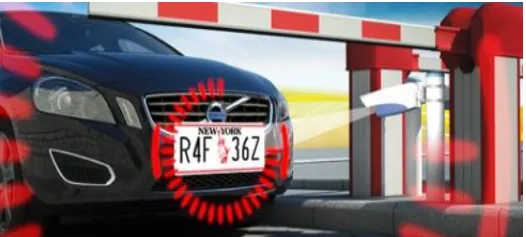
Automatic number plate recognition (ANPR) is a mass surveillance and cataloguing the movements of traffic or individuals and also for traffic law enforcement. ANPR can be used to store the images captured by the cameras as well as the text from the license plate. ANPR technology tends to be region specific, owing to plate variation from place to place. Concerns about these systems have centered on privacy fears of government tracking citizens' movements, misidentification, high error rates and increased government spending [12, 9]. The system is designed for real time videos where a camera is used for continuous recording of videos. The view of camera or the area covered by camera is fixed between entry zones and exit zone. Each frame is continuously processed to check the presence of a vehicle. A defined connected component area is taken as threshold; if the detected area is above that threshold value then it will be recognized as a vehicle and will be tracked [5].
[image:1.596.303.566.627.746.2]© 2019, IRJET | Impact Factor value: 7.34 | ISO 9001:2008 Certified Journal
| Page 1531
A distance is defined between the vehicle and the cameraand when the vehicle comes within that range i.e. vehicle’s connected component area is maximum, these frames of video are passed to license plate recognition algorithm. After that recognition of character takes place and data is stored and compare with data base.
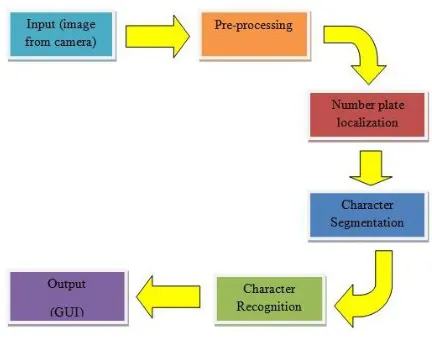
Fig -2: Flow chart of the system
ANPR System has mainly four modules:
• Video Acquisition– In this module videos are taken by the static camera situated at traffic scenario. A camera network that has the ability to transmit images in real time to a central operational centre. The processing of the images can be carried out on-site saving valuable network bandwidth as it transmits only the outcome of the calculations. The whole process can also be performed either in real time video streaming from an operational centre or in already stored video material.
• Vehicle Detection and Tracking– In vehicle detection we have simulated various background subtraction techniques available in the literature. The background subtraction technique should overcome the problems of varying illumination condition, background clutter, camouflage and shadow. Motion segmentation of foreground object has been done in real time. It’s hard to get this entire problem solved in one background subtraction technique. So the idea was to simulate and evaluate their performance on various video data taken in different situations [1, 3].
• License Plate Extraction- License plates are first located in current frame then they are extracted using various available techniques in the literature based on Hough Transform method, Template matching technique, Region growing algorithm, Histogram Approach and Edge Detection Approach [5, 12].
• Character Extraction– Images of the extracted plates are the input to this module. Here first license plate image is cropped in lines, and then characters are segmented and
recognized.
In the article presented by Kartikeya Jain, Tanupriya Choudhury and Nirbhay Kashyap et al they describe the application of OCR technology in the identification of the number plate of the vehicle and allotting parking space for the vehicle [1]. The vehicle is identified by the image of number plate and the image is processed. The mechanism of the OCR system consists of the Number Plate Localization, Processing of Image, Character Segmentation and Recognition. The final output is stored in the database [1].
3.
PROPOSED METHODOLOGY
In this paper he overviewed the problem of Vehicle Number Plate recognition with various types of Number Plates. The system has been tested on MATLAB environment with satisfactory results. Most of the time the input image is taken from low-resolution mobile camera which does not have very good quality image output [5, 10]. Given a better device the result should increase in accuracy significantly. Edges in an image are calculated by either horizontal or vertical edge detection methods [3]. It is necessary for the Localization algorithm to yield high accuracy as the Character Recognition Technique would be ineffective if the Number Plate is not localized correctly. Then by using deskewing, the LP is rotate and fit along longitudinal axis [4].
Optical Character Recognition using Feature
Extraction
This algorithm uses the fact that every character has unique set of features such as corners, ending and bifurcations. Inheriting these features makes the algorithm fast and less complicated. The input character is converted to edge image and the features are extracted from it in iterative process. Every character has unique lines or slopes when observed from the boundary of the segmented character image. This methodology uses this feature to recognize the characters. After the character is segmented out, it is resized in such a way that the character touches from all sides to the boundary. Features are extracted here by Optical Character Recognition (OCR) method. There are three features in each of the characters.
X1=Numbers of Triangle
X2=Numbers of Square
X3=Numbers of Corner
X4=Numbers of Pore
X5=Numbers of End
[image:2.596.55.271.174.345.2]© 2019, IRJET | Impact Factor value: 7.34 | ISO 9001:2008 Certified Journal
| Page 1532
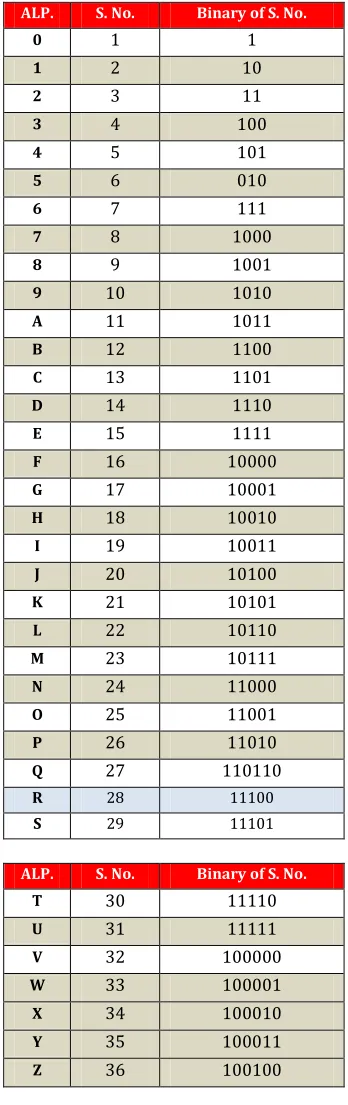
Table -1: Recognition of alphabets or numeric digits from [image:3.596.364.538.152.705.2]image
Conversion of alphabets or numeric digits into
binary
Table -2: Conversion of Characters into binary format
ALP. X1 X2 X3 X4 X5 X6
0 0 0 0 1 0 0
1 1 0 1 0 3 113
2 0 0 1 0 2 13
3 1 0 0 0 3 111
4 0 1 2 1 2 34
5 0 0 2 0 2 13
6 0 0 0 1 1 3
7 0 0 1 0 2 14
8 0 1 0 2 0 0
9 0 0 0 1 1 1
ALP. X1 X2 X3 X4 X5 X6
A 2 0 1 1 2 44
B 2 0 2 2 0 0
C 0 0 0 0 2 33
D 0 0 2 1 0 0
E 1 0 2 0 3 333
F 1 0 1 0 3 334
G 0 0 2 0 2 134
H 2 0 0 0 4 2244
I 2 0 0 0 4 1133
J 0 0 1 0 2 11
K 0 1 0 0 4 2244
L 0 0 1 0 2 23
M 0 0 3 0 2 44
N 0 0 2 0 2 24
O 0 0 0 1 0 0
P 1 0 1 1 1 4
Q 1 0 0 1 1 4
R 2 0 1 1 2 34
S 0 0 0 0 2 13
T 1 0 0 0 3 134
U 0 0 0 0 2 22
V 0 0 1 0 2 22
W 0 0 3 0 2 22
X 0 1 0 0 4 2244
Y 1 0 0 0 3 224
Z 0 0 2 0 2 13
ALP. S. No. Binary of S. No.
0 1 1
1 2 10
2 3 11
3 4 100
4 5 101
5 6 010
6 7 111
7 8 1000
8 9 1001
9 10 1010
A 11 1011
B 12 1100
C 13 1101
D 14 1110
E 15 1111
F 16 10000
G 17 10001
H 18 10010
I 19 10011
J 20 10100
K 21 10101
L 22 10110
M 23 10111
N 24 11000
O 25 11001
P 26 11010
Q 27 110110
R 28 11100
S 29 11101
ALP. S. No. Binary of S. No.
T 30 11110
U 31 11111
V 32 100000
W 33 100001
X 34 100010
Y 35 100011
© 2019, IRJET | Impact Factor value: 7.34 | ISO 9001:2008 Certified Journal
| Page 1533
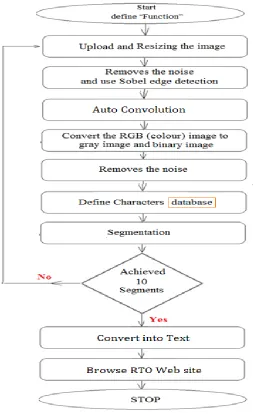
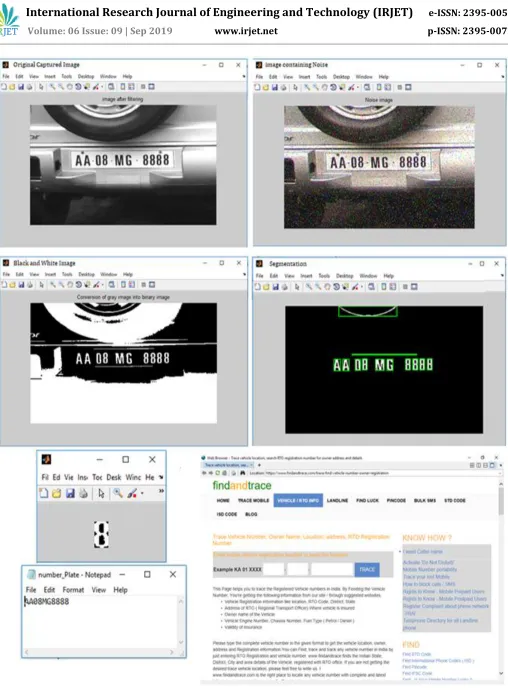
If the Character is not found it means the number plate is not following the rules of Traffic or there is no number in the plate or there is no plate.Fig -3: Flow chart of the Proposed Method
4.
RESULTS
[image:4.596.172.425.130.545.2]© 2019, IRJET | Impact Factor value: 7.34 | ISO 9001:2008 Certified Journal
| Page 1535
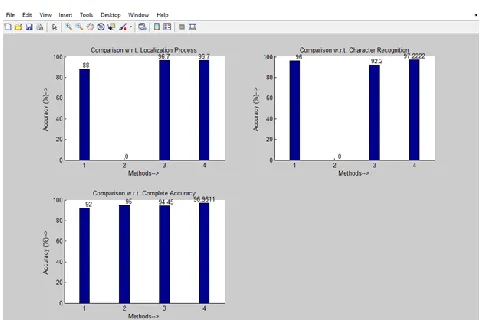
The result of the localization process in the article given inIEEE paper by Kartikeya Jain, Tanupriya Choudhury and Nirbhay Kashyap [1] gave Accuracy of 88% whereas the character recognition technique is 96% Accuracy. The complete Automatic Number Plate Recognition System Gives the Accuracy given by-
=
92 %.
The result of the localization process in the article given in IEEE paper by Bhavin V Kakani [3] gave Accuracy of 96.7% whereas the character recognition technique gave 92.2% Accuracy. The complete Automatic Number Plate Recognition System Gives the Accuracy given by-
=
94.45 %.
In the proposed technique the localization process is kept same as given by Bhavin V Kakani [3]. Here the problem is that the 6 fields of Digit ‘0 (Zero)’ and alphabet ‘o’ are identical. Hence this method gives 97.2% Accuracy, but it is not a severe problem because according to Indian License Plate System 1st two characters are Alphabets, 2nd two are numeric digits 3rd two are Alphabets again and last 4 digits are Numeric digits [15].
So that Zero and Alphabet o may be clearly separated out. The localization process given by Bhavin V. Kakani et al [3] is 96.7% which is actually better. On the other hand the Proposed Method gives 97.2% accuracy observed from simulation in MATLAB which is more than that of in previous methods. There is now the complete Automatic Number Plate Recognition System Gives the Accuracy given by-
[image:6.596.311.559.91.251.2]=
94.45 %.
Table -3: Comparison of the Methods
The comparative results are comparison in between proposed method with the available methods. The observe Results are given in figure 6.
Fig -4: Comparison of the Methods
5.
CONCLUSION
In the Proposed work, the Feature Extraction Algorithm is employed in Optical Character Recognition (OCR) for Recognition. Different algorithms that are given in literature survey are studied. For raising the performance of OCR the features of each of the characters is studied. Therefore the system would be able to extract characters in real time. Furthermore, the algorithm will be utilized in the existing Traffic Police ANPR while not any modification or standardization is required. Overall, in traditional traffic conditions the algorithm will respond well. In future we will try to increase the accuracy of Character Recognition for all the font style.
REFERENCES
[1] Kartikeya Jain, Tanupriya Choudhury and Nirbhay Kashyap, “Smart Vehicle Identification System Using Ocr”, 3rd IEEE International Conference on "Computational Intelligence and Communication Technology", IEEE-CICT 2017.
[2] R Shreyas, Pradeep Kumar B V, Adithya H B, Padmaja B and Sunil M P, “Dynamic Traffic Rule Violation Monitoring System Using Automatic Number Plate Recognition with SMS Feedback”, 2017 2nd International Conference on Telecommunication and Networks , TEL-NET 2017. [3] Mr. Bhavin V Kakani, Divyang Gandhi and Sagar Jani,
“Improved OCR based Automatic Vehicle Number Plate Recognition using Features Trained Neural Network”, 8th ICCCNT 2017, IIT Delhi, India, July 3-5, 2017.
[4] Anisha goyal and Rekha Bhatia, “Automated Car Number Plate Detection System to detect far number plates”, IOSR Journal of Computer Engineering (IOSR-JCE) e-ISSN: 2278-0661, p-ISSN: 2278-8727, Volume 18, Issue 4, Ver. III (Jul.-Aug. 2016), PP 34-40.
[5] Manoj D. Chaudhary and Jitendra B. Chinchore, “Towards Multiple License Plate Localization in S Authors Year Localization
Process Character Recogniti on Complete Accuracy
1 Kartikeya Jain, Tanupriya Choudhury and Nirbhay
Kashyap (1) 2017 88 % 96 % 92 %
2
R Shreyas, Pradeep Kumar B V, Adithya H B, Padmaja B and Sunil M P (2)
2017 ……… ……… 95 %
3 Bhavin V Kakani (3) 2017 96.7 % 92.2 % 94.45 %
© 2019, IRJET | Impact Factor value: 7.34 | ISO 9001:2008 Certified Journal
| Page 1536
Indian Conditions: An Edge Density BasedApproach”, 2014, International Conference on Control, Instrumentation, Communication and Computational Technologies (ICCICCT), Kanyakumari, 2014.
[6] Shan Du, Member, IEEE, Mahmoud Ibrahim, Mohamed Shehata, Senior Member, IEEE, and Wael Badawy, Senior Member, IEEE, “Automatic License Plate Recognition (ALPR): A State-of-the-Art Review”, IEEE transactions on circuits and systems for video technology, vol. 23, no. 2, february 2013.
[7] Jin Chong, Chen Tianhua and Ji Linhao, ” License Plate Recognition Based on Edge Detection Algorithm”, Ninth International Conference on Intelligent Information Hiding and Multimedia Signal Processing, 2013.
[8] Chirag Patel, Dipti Shah and Atul Patel, “Automatic Number Plate Recognition System (ANPR): A Survey”, International Journal of Computer Applications (0975 – 8887) Volume 69– No.9, May 2013.
[9] Sukhpreet Singh Optical Character Recognition Techniques: A Survey, Journal of Emerging Trends in Computing and Information Sciences, Vol. 4, No. 6 June 2013.
[10]Ms. Sushama H. Bailmare, Prof. A.B.Gadicha, “A Review paper on Vehicle Number Plate Recognition (VNPR) Using Improved Character Segmentation Method”, International Journal of Scientific and Research Publications, Volume 3, Issue 12, December 2013 ISSN 2250-3153.
[11]Sushruth Shastry, Gunasheela G, Thejus Dutt, Vinay D S and Sudhir Rao Rupanagudi, i - A novel algorithm for Optical Character Recognition (OCR), IEEE 2013.
[12]W. Badawy, “Automatic License Plate Recognition (ALPR): A State of the Art Review”, 2012.
[13]Amr Badr, Mohamed M. Abdelwahab, Ahmed M. Thabet, and Ahmed M. Abdelsadek, “Automatic Number Plate Recognition System”, Annals of the University of Craiova, Mathematics and Computer Science Series Volume 38(1), 2011, ISSN: 1223-6934.
[14]Mr. Dipankar Bhattacharya and Anjan Bikash Maity, “A Study on Vehicle Number Plate Identification by Morphological Edge Detection and Template Matching”, International Journal of Information and Education Technology, Vol. 1, No. 3, August 2011.