
Subtitles in Interactive Virtual Reality: Using Gaze to Address Depth
Conflicts
Ludwig Sidenmark* Lancaster University
United Kingdom
Nicolas Kiefer† University College London
United Kingdom
Hans Gellersen‡ Lancaster University
United Kingdom
ABSTRACT
Subtitles are a research area of growing importance in interactive virtual reality (VR), for localisation and hearing aid as the medium becomes more accessible to the public. Currently, there are no established guidelines for implementing subtitles in VR. Depth is a particular issue for subtitles in VR as it can result in occlusion or strain on users due to conflicting depth cues between the environment and subtitles. We present an analysis of contemporary interactive VR applications that support subtitles, to provide insight into current practices and design issues. Based on this, we propose three subtitle techniques that leverage eye tracking to address depth related issues, and reflect on the design space of supporting subtitles with gaze.
Keywords: Virtual reality, Subtitles, Gaze interaction, Eye track-ing.
Index Terms: Human-centered computing—Human computer interaction (HCI)—Interaction paradigms—Virtual reality; Human-centered computing—Accessibility—Accessibility technologies
1 INTRODUCTION
Subtitles are well established in television (TV) and cinema, as a tool for language localisation and inclusion of viewers who are deaf or hard of hearing [3]. Subtitles have a significant role also in interactive media such as videogames and virtual reality (VR), including for storytelling and interaction with avatars. However, unlike in TV and film, there are no agreed practices for subtitle support in interactive media [27].
Subtitle support for interactive VR is challenging for a number of reasons. First, the interactive nature of VR leads to more dynamic user behaviour and less predictable viewing and reading patterns compared to TV and film. Second, VR applications offer a full 360° field of regard (FOR) with environments that surround the user and encourage significant body movement. As such, nothing in the environment, including the subtitles, is guaranteed to be visible to the user [10, 34]. Third, the addition of depth in VR applications is particularly problematic as subtitles can be occluded. This can result in discomfort as a result of subtitles being rendered over other objects that are perceived to be closer [29], loss of readability due to subtitles being occluded by nearer objects, or strain due to significantly different depths between the subtitles and regions of interest (ROIs) in a scene [24, 45].
In this work we consider subtitle techniques that address depth conflicts on the basis of gaze-awareness. Gaze is attractive for subtitles as we naturally look at objects that we are interested in. Eye tracking is therefore able to give information on if the user is reading the subtitles, and where in the environment they are looking. Previously, gaze has been used to evaluate how reading
*e-mail: [email protected] †e-mail: [email protected] ‡e-mail: [email protected]
subtitles on displays affect our attention [7, 8, 21, 22], and how the information provided by gaze can be post-processed and used to augment subtitles to create a better user experience compared to traditional static subtitles [2]. Eye tracking technologies have recently been integrated within head-mounted displays (HMDs), enabling real-time gaze analysis [40]. The ability to process gaze in real-time affords subtitles that can dynamically change based on the users ROI without explicit user input.
To ground our work, we surveyed current subtitle practice based on 20 contemporary interactive VR titles that were selected based on popularity and inclusion of subtitle support. The analysis provides insight into the design space, the variation in subtitle presentation and behaviour, and depth problems exposed. The outcome is a classification that served to contextualise the design and evaluation of novel subtitle techniques.
As a first step to the topic of leveraging gaze for subtitles in inter-active VR, we developed three new subtitle techniques that leverage eye gaze. InBackdrop Blur, subtitles are highlighted when gazed on by blurring the area behind the subtitles.Depth Shiftaims to maximise comfort and readability by adjusting the depth of the sub-titles to match the current gazed on object.Backdrop Blur + Depth Shiftcombines the two techniques to adjust the depth of the subtitles and trigger the highlighting when gazed upon. All three techniques have been implemented in a head-mounted VR environment. The contributions of this work, in sum, are (1) an evaluation of subtitles in contemporary VR applications and identification of current trends within the design space of subtitles in interactive VR; (2) three VR subtitle techniques that demonstrate the concept of using eye gaze to create dynamic subtitle behaviour to solve depth issues of subtitles in VR; (3) a discussion of the design space of VR subtitles and using gaze for addressing these issues.
2 RELATEDWORK
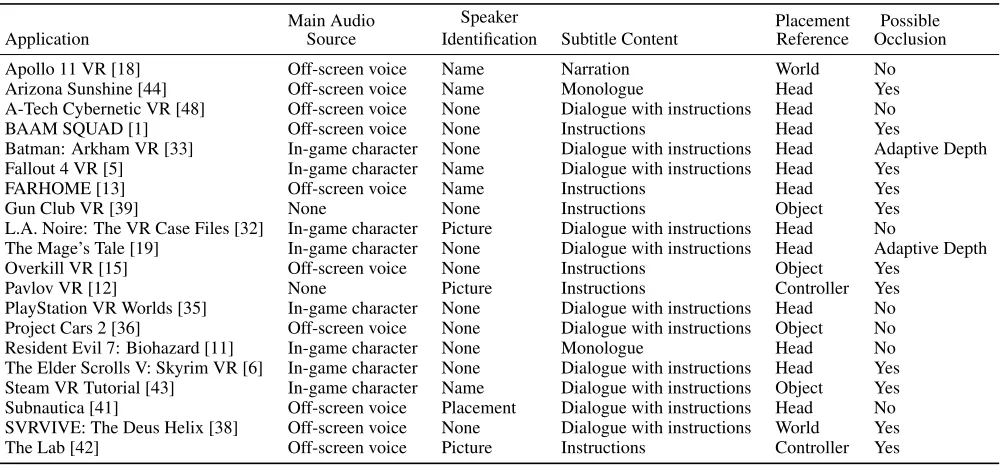
Table 1: Applications investigated during the survey and main characteristics of their respective subtitles.
Application
Main Audio Source
Speaker
Identification Subtitle Content
Placement Reference
Possible Occlusion
Apollo 11 VR [18] Off-screen voice Name Narration World No
Arizona Sunshine [44] Off-screen voice Name Monologue Head Yes
A-Tech Cybernetic VR [48] Off-screen voice None Dialogue with instructions Head No
BAAM SQUAD [1] Off-screen voice None Instructions Head Yes
Batman: Arkham VR [33] In-game character None Dialogue with instructions Head Adaptive Depth Fallout 4 VR [5] In-game character Name Dialogue with instructions Head Yes
FARHOME [13] Off-screen voice Name Instructions Head Yes
Gun Club VR [39] None None Instructions Object Yes
L.A. Noire: The VR Case Files [32] In-game character Picture Dialogue with instructions Head No
The Mage’s Tale [19] In-game character None Dialogue with instructions Head Adaptive Depth
Overkill VR [15] Off-screen voice None Instructions Object Yes
Pavlov VR [12] None Picture Instructions Controller Yes
PlayStation VR Worlds [35] In-game character None Dialogue with instructions Head No Project Cars 2 [36] Off-screen voice None Dialogue with instructions Object No Resident Evil 7: Biohazard [11] In-game character None Monologue Head No The Elder Scrolls V: Skyrim VR [6] In-game character None Dialogue with instructions Head Yes Steam VR Tutorial [43] In-game character Name Dialogue with instructions Object Yes Subnautica [41] Off-screen voice Placement Dialogue with instructions Head No SVRVIVE: The Deus Helix [38] Off-screen voice None Dialogue with instructions World Yes The Lab [42] Off-screen voice Picture Instructions Controller Yes
This behaviour may disrupt the viewing experience and cause un-necessary eye strain which becomes extra apparent in VR where the FOV of modern HMDs are∼100° horizontally and vertically. Users may then have to continuously perform significantly large gaze shifts between the ROIs and subtitles depending on the subtitle placement. Subtitles in interactive VR has to take all of these factors into account while being easily accessible and readable by users, while also not disrupting immersion or causing cybersickness [31]. Research has mainly focussed on subtitles for watching 360° videos with HMDs. Brown et al. investigated different subtitles for 360° video that either followed the user’s head or were placed in the environment [10] and found that the most critical attributes for VR subtitles were that they should be easy to locate and allow the viewer freedom to explore [9]. Rothe et al. compared dynamic subtitles positioned close to the speaker with static subtitles fixed to the view-port and found that static subtitles make it easier to look around but more difficult to absorb the content [34].
The added depth to VR can have a significant impact on both the user’s ability to find the subtitles and their freedom of movement. Occlusion, where objects that are closer to the user obstruct the subtitles may not only make the subtitles partially unreadable but even unfindable if wholly occluded. The risk of occlusion becomes even more prevalent in interactive VR where users are encouraged to move around in the environment. Occlusion may also lead to restricted freedom of movement imposed on users as they are not able to move freely without losing sight of the subtitles. Occlusion may be avoided by placing the subtitles very close to the user, ren-dering the subtitles over closer objects, or placing environmental objects exclusively at large distances. However, prolonged expo-sure to close objects in VR can be uncomfortable [20, 25] and the other approaches may lead to depth conflicts which may cause strain on the user. Previous research has highlighted potential depth cue conflicts in VR that may cause strain:
• Vergence-accomodation conflict:occurs when the eyes con-verge on an object that is seen in two spatially offset views provided to each eye but the eyes’ lenses accommodate at a different depth (screen depth) [23].
• Occlusion/stereopsis conflict: occurs when objects are not
occluded by objects that are perceived to be physically closer [29].
• Near/far conflict:occurs when the user has to frequently shift their attention between objects at very different depths [29].
• Pictoral conflict:happens when textures around or behind an object are seen differently between the two eyes resulting in binocular rivalry [29].
Nguyen et al. investigated techniques that address depth issues for subtitles and other user interface elements in 360° video by adjusting the subtitle rendering based on the video content [29]. Research has also been made in augmented reality, for example, view management techniques that place textual labels at depths to avoid occlusion [4] or on x-ray vision that retain objects’ depth information [26]. While knowledge gained from augmented reality and 360° videos can be used in the design process of subtitle techniques, interactive VR offers additional factors to consider. Our work is first to consider the design area of subtitles and their depth issues in interactive VR.
3 SURVEY OFSUBTITLES ININTERACTIVEVR
The large variety of applications available in interactive VR together with the lack of agreed on practice for subtitles lead to significantly different implementations of subtitles (Fig. 1). We classified 20 VR applications (Table 1) based on their subtitle characteristics to get an understanding of the current usage of VR subtitles in order to effectively adress depth issues. The applications were selected via the top-selling category in the Steam Store or PlayStation Store and contained subtitle support during the time of the survey (May 2018). Applications which did not contain subtitles were not considered for the survey. The applications ranged from VR experiences to adven-ture and role-playing games. From analysing the VR applications, we were able to gain knowledge of the current practices of subtitles.
3.1 Appearance
The appearance of subtitles include visual factors such as the font, font borders and shadows, the subtitle canvas and the number of lines and can be used to increase readability and immersion. However, it may also lead to a decreased user experience. We found that 19 of the 20 reviewed applications used a white sans-serif font inspired by traditional subtitle appearance from TV. However,SVRVIVE: The Deus Helixdisplayed the subtitles on interactive panels closely aligned to the design language of the game [38]. Eight applications used a text border or shadow to make the text stand out. The re-maining applications used no additional text border or shadow. Ten applications did not use a canvas to display the subtitles on while seven applications used a black canvas to display the subtitles on. Finally, three applications used a coloured canvas. The maximum amount of lines displayed also varied between applications; ten applications displayed subtitles on at most two lines, while nine dis-played subtitles on more than two lines. One application disdis-played subtitles on only one line at a time.
3.2 Placement
VR allows more freedom for the placement of subtitles compared to TV. Subtitles may be attached to objects in the scene, the user’s FOV, or in the scene as a stand-alone object. The placement of the subtitles may have a significant impact on how users read the subtitles. Eleven applications placed the subtitles at the bottom of the user’s FOV, inspired by TV subtitle placement. The approach is simple and familiar to users. Two of these applications,The Elder Scrolls V: Skyrim VRandFallout 4 VRcontained subtitles that were horizontally stationary until enough head rotation had been performed so that the subtitles would be outside the FOV [5, 6]. The subtitles would then follow the head rotation while only being partially visible on the edge of the FOV. This technique leads to less obstructive subtitles but requires the user to shift their head in the opposite direction to fully read the subtitles again.
The large FOV of contemporary HMDs means users are likely to perform large gaze shift between the subtitles and ROIs if the subtitles are placed at an edge of the FOV. These constant shifts may be straining for the eyes during long-term usage and users may perform unnatural head movement to move the subtitles closer to the ROI. To mitigate this effect,PlayStation VR Worldsallowed the user to manually configure the placement of the subtitles in the FOV [35]. Alternatively, subtitles could be attached to other objects than the head. Two applications placed the subtitles as a self-contained object in the environment. The remaining six applications placed the subtitles on existing objects or speakers in the scene.
3.3 Visibility
[image:3.612.317.559.54.610.2]The 360° FOR in VR may lead to objects not always being visible. This is also the case for subtitles, where they may not be visible and readable to the user even if they are present in the application. The placement of the subtitles has a direct effect on the subtitles’ visibility. The subtitles would always be visible if attached to FOV.
Meanwhile, placing the subtitles in the environment means that the subtitles are only available if the user is looking at that part of the environment. Additionally, allowing users to interact with the subtitles may have an effect on visibility.
Subtitles attached to the head was the most common type (12 of 20) and were in general always visible. However, dynamic subtitles such as inThe Elder Scrolls V: Skyrim VRorFallout 4 VRwould at times be partly outside the FOV making the full subtitles unreadable. Six applications contained subtitles which were placed in the virtual environment and were only visible if the object was within the FOV. Therefore, users are not able to explore the environment freely if they wish to read the subtitles. The LabandPavlov VRattached the subtitles on the user’s controller, enabling users to move the subtitles into their FOV freely [12, 42].SVRVIVE: The Deus Helix even enabled players to actively invoke and dismiss the subtitles by pressing a button on the controller [38].
3.4 Context
VR allows users to explore environments freely, which may lead to users not looking at the audio source of the subtitles. Thus, there is no guarantee that it is clear to the user who the subtitles belong to. The user may therefore need additional information to understand the subtitles’ context. Twelve applications did not provide any addi-tional information to the subtitles. Five applications such asBatman: Arkham VRused the speaker’s name as an identification [33]. Ad-ditionally, three applications such asOverkill VRused a picture to identify the speaker next to the subtitles [15].Steam VR Tutorialwas the only application that used the subtitle placement as a speaker identification by attaching the subtitles to the speaker [43].
3.5 Depth Conflicts
Subtitles placed on the player’s FOV or in the environment may be obstructed by objects that are closer to the user, which can lead to significant occlusion of the subtitles. Nevertheless, eleven reviewed applications contained subtitles that could be wholly or partially occluded by objects that were closer to the user. Seven applica-tions contained subtitles that were visible through closer objects to fully avoid the occlusion problem. However, this technique suffers from the occlusion/stereopsis conflict. All subtitles placed at fixed depths from the user suffered from the near/far conflict when shifting between the subtitles and objects at different depths.
The Mage’s TaleandBatman: Arkham VRwere the only applica-tions that offered subtitles that dynamically adapted its depth [19,33]. The subtitles avoids occlusion by adapting their distance to be closer to the user than objects that would occlude the subtitles. This mech-anism offered a novel subtitle experience, but could feel jittery since the subtitles did not always transition smoothly between different depths. Additionally, the subtitles would move when reading which would at times cause a poor reading experience and the subtitles could also suffer from the near/far conflict.
Overall, the survey showed a large variety in not only their pur-pose but also in terms of presentation and placement. While most subtitles were mainly inspired by traditional TV subtitles, some took advantage of the 3D environment or the interactivity of interactive VR applications.
4 GAZE AUGMENTEDSUBTITLES
[image:4.612.318.560.53.167.2]Through our evaluation, we gained knowledge about the current practice of VR subtitles. The results showed that depth conflicts for subtitles in VR applications is a pressing issue that can make subtitles unreadable and cause strain on the user. Eye tracking gives us additional information of if the user is reading the subtitles or where in the virtual environment they are looking and allows for the implementation of novel dynamic subtitle techniques that may increase the user experience. We present three subtitle techniques that use eye tracking in real time to address subtitle depth issues.
Figure 2: Background Blur blurs the background behind the subtitles when the user is gazing on the subtitles.
The subtitles for all three techniques are grounded in the subtitle properties most commonly found in the survey. The subtitles are attached to the bottom of the FOV, following the head movements and the appearance is based on existing TV subtitle standards [3].
4.1 Backdrop Blur
Backdrop Blur is a gaze aware subtitle technique that blurs the scene in a rectangular area behind the subtitles when the subtitles are gazed upon (Fig. 2). Blurring the scene behind the text creates a canvas where edges become less distinct and colours blend into each other on which the subtitles stand out for better readability. Also, the technique aims to reduce binocular rivalry by creating a canvas that weakens potentially conflicting depth cues. The blur is only rendered when the user is gazing on the subtitles. As such, the subtitles becomes less pronounced and distracting for the user when in the periphery compared to if the blur would always be rendered. In addition, since the blur is only rendered when the subtitles are gazed upon, users are able to gaze on objects next to the subtitles without being affected by the blur. In contrast, a constant blur would force users to perform extra head movements to move the subtitles away from their object of interest.
4.2 Depth Shift
Inspired by previous work on adaptive depth interfaces [19, 29, 33], Depth Shift is an alternative subtitle technique that adapts the depth of the subtitles to match the depth of the current gazed on object (Fig. 3). Occlusion and other depth conflicts are thus avoided by placing the subtitles slightly closer to the user compared to the gazed on object. In addition, matching the subtitle depth to the current gazed on object limits the effect of the near/far conflict as users do not have to alternate their eye vergence while switching their gaze between the world and subtitles.
The subtitle movement speed has to be carefully considered. Mov-ing the text too quickly can lead to reduced readability while movMov-ing the subtitles too slowly renders them unable to resolve depth con-flicts in time. As such, the movement speed towards the user is
[image:4.612.317.560.603.689.2]higher to quickly avoid depth conflicts while the speed away from the user is lower. A lower speed away from the user is chosen since there is no need for quick movement when there is no depth conflict. Additionally, a lower speed away from the user results in a shorter distance for the subtitles to travel if the movement direction changes towards the user. The subtitles remain stationary when gazed upon to minimise unnecessary subtitle movement and maximise readabil-ity. The only exception to this rule is if an object is in front of the subtitles when gazed upon, the subtitles would then move towards the user to avoid depth conflicts.
A possible issue in matching the subtitle depth to the current gaze point is if an object in front of the subtitles is closer to the user than the current gaze point. This situation will lead to the subtitles being behind the object when the user switches their gaze to the subtitles. The subtitles will thus have to move towards the user while the user is reading. The technique filters gaze data to adapt the subtitle movement speed with a speed up factor when a saccade is detected. The subtitles are thus able to quickly move to their new position and avoid depth conflicts without users noticing any significant changes due to thesaccadic maskingphenomenon during a saccade.
4.3 Depth Shift & Backdrop Blur
We also introduce a technique that combines both previous gaze-aware techniques. The subtitles adapts its depth to the the gazed on object and blurs its background when gazed upon. This com-bined technique showcase how two techniques can be comcom-bined and possibly interact with each other to create a better user experience.
5 DISCUSSION
The application survey showed a significant variety of subtitle imple-mentations. The different subtitles highlights both the large design space for subtitles in interactive VR but also the significant chal-lenges in creating a good subtitle experience for users. As such, multiple areas should be considered when designing subtitles for VR applications. Factors such as appearance, context and placement may affect immersion as subtitles can be designed to blend into the environment. However, increased immersion may affect readability as alternate subtitle designs may not follow the best subtitle prac-tices for optimised reading. As such, there is a balancing act of making the subtitles immersive and part of the environment while also allowing good readability. From the results of the survey, we found that applications mainly took inspiration from established subtitle standards from TV and cinema. However, we found that applications generally only followed subtitle standards to a certain extent. Thus, the subtitles found did not commit to be immersive or to be optimised for readability, but rather somewhere in between, which could result in sub-optimal subtitle experiences which are neither immersive nor readable.
In addition, designers have to take into account factors that are unique for 3D environments. VR allows significant freedom in terms of subtitle placement and may be placed in relation to the user, the world, or a specific object within the world, and subtitles may even fluidly switch between different positions. However, the extra freedom may also be detrimental to the subtitle experience. Each subtitle placement comes with their own visibility problems; subtitles placed in the world are not guaranteed to be visible and subtitles placed relative to the user’s viewpoint may be distracting and hinder immersion. In addition, depth issues may cause visibility issues due to occlusion and causes strain on users. The survey showed some approaches to tackle visibility and depth issues such as on-demand subtitle invocation, adaptive depths or manual subtitle configuration. However, a majority of applications in the survey contained subtitles that were static in relation to their placement reference and did not react to any additional input. As such, there is significant room for exploration on subtitles that leverage novel input modalities to improve the subtitle experience.
This work focussed on gaze as an input modality for subtitles, focussing on addressing depth issues which we from our survey deemed as the most pressing issue as depth issues can affect readabil-ity and cause strain on users. The techniques presented showcases different possible approaches on how to use gaze to increase the user experience of subtitles by reducing depth issues. Background Blur leverages the information of whether a user is reading the subtitles while Depth Shift use the information of where in the environment the user is looking. These two and other possible approaches may also be combined in the hope of finding a positive interaction be-tween them, as we exemplified with the Background Blur + Depth Shift technique. Subtitle techniques can also be differentiated on whether they adjust the subtitles or the surrounding environment. Background Blur adjusts the surrounding environment by blurring, while Depth Shift adjusts the subtitle position to adhere to the en-vironment. There may be additional ways to use gaze to combat depth issues. We will continue our work by evaluating the presented techniques and to consider alternative approaches using gaze.
While the techniques in this paper focus on depth issues, gaze may also be used to address other areas within the design space identified in our survey. For example, gaze patterns may be used to change the subtitle appearance, affect subtitle placement, or show additional contextual information. Further work has to be conducted to develop and evaluate new techniques using gaze or other modal-ities to address design issues within subtitles to make VR a more inclusive medium. Our work is an initial step in exploring subtitles in interactive VR and showcases how novel input devices can be used to enhance the subtitle experience.
6 CONCLUSION
In this paper, We address depth issues for subtitles in interactive VR. We reviewed the subtitles of 20 contemporary interactive VR appli-cations to ground our work and gain an understanding of current usage of subtitles in interactive VR and their depth problems. We developed three novel subtitle techniques using eye tracking based on our findings that attempts to solve depth conflicts for subtitles in interactive VR. Further work is needed to further develop and evalu-ate novel subtitle techniques that increase the usability of subtitles and opens up VR for a broader demographic of users.
REFERENCES
[1] 5minlab Co., Ltd. BAAM SQUAD, 2018. [Online]. Available:https: //bs.5minlab.com, [Accessed: Nov. 29, 2018].
[2] W. Akahori, T. Hirai, S. Kawamura, and S. Morishima. Region-of-Interest-Based Subtitle Placement Using Eye-Tracking Data of Mul-tiple Viewers.Proceedings of the ACM International Conference on Interactive Experiences for TV and Online Video - TVX ’16, pp. 123– 128, 2016. doi: 10.1145/2932206.2933558
[3] BBC. BBC Subtitle Guidelines, 2018. [Online]. Available: http: //bbc.github.io/subtitle-guidelines, [Accessed: Nov. 29, 2018].
[4] B. Bell, S. Feiner, and T. H¨ollerer. View management for virtual and augmented reality. InProceedings of the 14th Annual ACM Symposium on User Interface Software and Technology, UIST ’01, pp. 101–110. ACM, New York, NY, USA, 2001. doi: 10.1145/502348.502363 [5] Bethesda Studios. Fallout 4 VR, 2017. [Online]. Available:https:
//bethesda.net/en/article/53ztTpcdK8CKSmG8migYsU/ fallout-4-vr-launch-details, [Accessed: Nov. 29, 2018]. [6] Bethesda Studios. The Elder Scrolls V: Skyrim VR, 2017.
[Online]. Available: https://bethesda.net/en/article/ 4YSRrlXtpuKeWIK6EMiG84/skyrim-vr-comes-to-steamvr, [Accessed: Nov. 29, 2018].
[7] M.-J. Bisson, W. J. B. van Heuven, K. Conklin, and R. J. Tunney. Processing of native and foreign language subtitles in films: An eye tracking study.Applied Psycholinguistics, 35(2):399418, 2014. doi: 10 .1017/S0142716412000434
the ACM International Conference on Interactive Experiences for TV and Online Video, TVX ’15, pp. 103–112. ACM, New York, NY, USA, 2015. doi: 10.1145/2745197.2745204
[9] A. Brown, J. Turner, P. Jake, A. Schmitz, M. Armstrong, and G. Maxine. Exploring Subtitle Behaviour for 360◦Video. White Paper, British Broadcasting Company, 2018.
[10] A. Brown, J. Turner, J. Patterson, A. Schmitz, M. Armstrong, and M. Glancy. Subtitles in 360-degree Video. Adjunct Publication of the 2017 ACM International Conference on Interactive Experiences for TV and Online Video - TVX ’17 Adjunct, pp. 3–8, 2017. doi: 10. 1145/3084289.3089915
[11] Capcom Co., Ltd. Resident Evil 7: Biohazard, 2017. [Online]. Avail-able:http://residentevil7.com, [Accessed: Nov. 29, 2018]. [12] davevillz Studios Ltd. Pavlov VR, 2017. [Online]. Available:http:
//www.davevillz.com, [Accessed: Nov. 29, 2018].
[13] DEVCUBE STUDIO. FARHOME, 2018. [Online]. Available:http: //farhomevr.com, [Accessed: Nov. 29, 2018].
[14] A. T. Duchowski. A breadth-first survey of eye-tracking applications. Behavior Research Methods, Instruments, & Computers, 34(4):455– 470, 2002. doi: 10.3758/BF03195475
[15] Game Troopers SL. Overkill VR, 2016. [Online]. Available:http: //www.overkillvr.com, [Accessed: Nov. 29, 2018].
[16] R. Hong, M. Wang, X.-T. Yuan, M. Xu, J. Jiang, S. Yan, and T.-S. Chua. Video accessibility enhancement for hearing-impaired users. ACM Transactions on Multimedia Computing, Communications, and Applications, 7S(1):1–19, 2011. doi: 10.1145/2037676.2037681 [17] Y. Hu, J. Kautz, Y. Yu, and W. Wang. Speaker-following video subtitles.
ACM Trans. Multimedia Comput. Commun. Appl., 11(2):32:1–32:17, Jan. 2015. doi: 10.1145/2632111
[18] Immersive VR Education Ltd. Apollo 11 VR, 2016. http://immersivevreducation.com/apollo-11-vr/ (Date last accessed 29-Novemeber-2018).
[19] InXile Entertainment. The Mage’s Tale, 2017. [Online]. Avail-able: https://magestale.inxile-entertainment.com, [Ac-cessed: Nov. 29, 2018].
[20] G. Kramida and A. Varshney. Resolving the Vergence-Accommodation Conflict in Head Mounted Displays.IEEE Transactions on Visualiza-tion and Computer Graphics, 22(7):1–16, 2015. doi: 10.1109/TVCG. 2015.2473855
[21] J.-L. Kruger, E. Hefer, and G. Matthew. Measuring the impact of subtitles on cognitive load: Eye tracking and dynamic audiovisual texts. InProceedings of the 2013 Conference on Eye Tracking South Africa, ETSA ’13, pp. 62–66. ACM, New York, NY, USA, 2013. doi: 10. 1145/2509315.2509331
[22] J.-L. Kruger and F. Steyn. Subtitles and eye tracking: Reading and performance.Reading Research Quarterly, 49(1):105–120, 2013. doi: 10.1002/rrq.59
[23] E. Kruijff, J. E. Swan, and S. Feiner. Perceptual issues in augmented reality revisited. In2010 IEEE International Symposium on Mixed and Augmented Reality, pp. 3–12, Oct 2010. doi: 10.1109/ISMAR.2010. 5643530
[24] J. Lacoche, M. L. Chnchal, S. Chalm, J. Royan, T. Duval, V. Gouranton, E. Maisel, and B. Arnaldi. Dealing with frame cancellation for stereo-scopic displays in 3d user interfaces. In2015 IEEE Symposium on 3D User Interfaces (3DUI), pp. 73–80, March 2015. doi: 10.1109/3DUI. 2015.7131729
[25] M. T. M. Lambooij, W. A. IJsselsteijn, and I. Heynderickx. Visual discomfort in stereoscopic displays: a review.Proc.SPIE, 6490:6490 – 6490 – 13, 2007. doi: 10.1117/12.705527
[26] M. A. Livingston, J. E. Swan, J. L. Gabbard, T. H. Hollerer, D. Hix, S. J. Julier, Y. Baillot, and D. Brown. Resolving multiple occluded layers in augmented reality. InThe Second IEEE and ACM International Symposium on Mixed and Augmented Reality, 2003. Proceedings., pp. 56–65, Oct 2003. doi: 10.1109/ISMAR.2003.1240688
[27] C. Mangiron. Subtitling in game localisation: a descriptive study. Perspectives: Studies in Translatology, 21(1):42–56, 2013. doi: 10. 1080/0907676X.2012.722653
[28] C. Mangiron. Reception of game subtitles: An empirical study. Trans-lator, 22(1):72–93, 2016. doi: 10.1080/13556509.2015.1110000
[29] C. Nguyen, S. DiVerdi, A. Hertzmann, and F. Liu. Depth conflict reduction for stereo vr video interfaces. InProceedings of the 2018 CHI Conference on Human Factors in Computing Systems, CHI ’18, pp. 64:1–64:9. ACM, New York, NY, USA, 2018. doi: 10.1145/3173574. 3173638
[30] A. Patney, M. Salvi, J. Kim, A. Kaplanyan, C. Wyman, N. Benty, D. Luebke, and A. Lefohn. Towards foveated rendering for gaze-tracked virtual reality.ACM Trans. Graph., 35(6):179:1–179:12, Nov. 2016. doi: 10.1145/2980179.2980246
[31] L. Rebenitsch and C. Owen. Review on cybersickness in applications and visual displays.Virtual Reality, 20(2):101–125, Jun 2016. doi: 10. 1007/s10055-016-0285-9
[32] Rockstar Games. L.A. Noire: The VR Case Files, 2017. [Online]. Avail-able: https://www.rockstargames.com/lanoire, [Accessed: Nov. 29, 2018].
[33] Rocksteady Studios Limited. Batman: Arkham VR, 2016. [Online]. Available:http://rocksteadyltd.com/#arkham-vr, [Accessed: Nov. 29, 2018].
[34] S. Rothe, K. Tran, and H. Hußmann. Dynamic subtitles in cinematic virtual reality. InProceedings of the 2018 ACM International Confer-ence on Interactive ExperiConfer-ences for TV and Online Video, TVX ’18, pp. 209–214. ACM, New York, NY, USA, 2018. doi: 10.1145/3210825. 3213556
[35] SIE London Studio. Playstation VR Worlds, 2016. [On-line]. Available:https://www.playstation.com/en-gb/games/ vr-worlds-ps4, [Accessed: Nov. 29, 2018].
[36] Slightly Mad Studios. Project CARS 2, 2017. [Online]. Available:
https://www.projectcarsgame.com, [Accessed: Nov. 29, 2018]. [37] I. Starker and R. A. Bolt. A gaze-responsive self-disclosing display.
InProceedings of the SIGCHI Conference on Human Factors in Com-puting Systems, CHI ’90, pp. 3–10. ACM, New York, NY, USA, 1990. doi: 10.1145/97243.97245
[38] SVRVIVE Studios. SVRVIVE: The Deus Helix, 2017. [Online]. Avail-able: http://www.svrvive.com/games/the-deus-helix, [Ac-cessed: Nov. 29, 2018].
[39] The Binary Mill. Gun Club VR, 2018. [Online]. Available:https:// www.thebinarymill.com/gunclub_vr.php, [Accessed: Nov. 29, 2018].
[40] Tobii. Tobii pro vr integration, 2018. [Online]. Available:https: //www.tobiipro.com/product-listing/vr-integration, [Accessed: Nov. 29, 2018].
[41] Unknown Worlds Entertainment. Subnautica, 2018. [Online]. Avail-able:https://unknownworlds.com/subnautica, [Accessed: Nov. 29, 2018].
[42] Valve Corporation. The Lab, 2016. [Online]. Available: https: //store.steampowered.com/app/450390/The_Lab/, [Accessed: Nov. 29, 2018].
[43] Valve Corporation. SteamVR Tutorial, 2018. [Online]. Available:
https://store.steampowered.com/steamvr, [Accessed: Nov. 29, 2018].
[44] Vertigo Games and Jaywalkers Interactive. Arizona Sunshine, 2016. [Online]. Available: http://arizona-sunshine.com, [Accessed: Nov. 29, 2018].
[45] C. Ware. Dynamic stereo displays. InProceedings of the SIGCHI Conference on Human Factors in Computing Systems, CHI ’95, pp. 310–316. ACM Press/Addison-Wesley Publishing Co., New York, NY, USA, 1995. doi: 10.1145/223904.223944
[46] M. Weier, T. Roth, A. Hinkenjann, and P. Slusallek. Predicting the gaze depth in head-mounted displays using multiple feature regression. In Proceedings of the 2018 ACM Symposium on Eye Tracking Research & Applications, ETRA ’18, pp. 19:1–19:9. ACM, New York, NY, USA, 2018. doi: 10.1145/3204493.3204547
[47] World Health Organisation. Deafness and hearing loss, 2018. [Online]. Available: http://www.who.int/news-room/fact-sheets/ detail/deafness-and-hearing-loss, [Accessed: Nov. 29, 2018].
![Figure 1: Subtitles can look significantly different between VR appli-cations. A - Batman: Arkham VR: subtitles displayed on the bottomof the FOV, inspired by traditional TV subtitles [33]](https://thumb-us.123doks.com/thumbv2/123dok_us/9307376.432345/3.612.317.559.54.610/subtitles-signicantly-different-subtitles-displayed-bottomof-traditional-subtitles.webp)

