RESEARCH ARTICLE
PRODUCTION OF MICROBIAL
α
- AMYLASE BY SOLID STATE FERMENTATION-AN OVERVIEW
*Bhisma Narayan Swargiari and Pradip Kumar Baruah
Department of Botany, Cotton College, Guwahati, Assam, India, 781001
ARTICLE INFO ABSTRACT
α- amylases are most important industrial enzyme and hold maximum market share of enzyme sales having lots of potential application in food processing industries such as sugar, baking, brewing and
many starch based industries. The α- amylases hydrolyse α-1,4-glycosidic linkages in starch and
related substrates. The conventional Submerged Fermentation method of α- amylase production is
being replaced by Solid State Fermentation during recent years due to manifold advantages over Submerged Fermentation such as use cheap substrate, higher yield, avoids substrate inhibition etc.
The commercial source of α- amylases are usually bacteria and filamentous fungi. This study reviews
the microbial sources, fermentation characteristics and potentiality of α- amylase production through
Solid State Fermentation.
Copy Right, IJCR, 2012, Academic Journals. All rights reserved.
INTRODUCTION
α- amylases (1,4-α-D-glucan glucanohydrolase ; E.C. 3.2.1.1.)
are endo-acting enzymes which randomly hydrolyse α-1,
4-glycosidic bonds between adjacent glucose units in a starch polymer leading to the formation of linear and branched oligosaccharides such as glucose, maltose and maltotriose. Amylases contribute about 30% to the world’s overall enzyme
production (van der Maarel et al., 2002). α-amylases have
been extensively used in sugar, textile, alcohol, detergent and
paper industries (Bruins et al., 2001 ; Gupta et al., 2003 ;
Sivaramakrishnan et al., 2006). They have also been used in
various processed food industries like baking, brewing, preparation of digestive aids, production of cakes, fruit juices and starch syrups (Aiyer, 2005 ; de Souza and e Magalhaes,
2010 ; Gupta et al., 2003; Rosell et al., 2001). Moreover, due
to advances in biotechnology, amylases find application in
clinical, medicinal and analytical chemistry as well (Das et al.,
2011; de Souza and e Magalhaes, 2010; Gupta et al., 2003).
α-amylases are ubiquitous enzymes occurring in plant, animal
and microbial kingdoms. However, microbial sources, especially thermophilic bacteria and mesophilic molds provide
industrial need of α- amylases (de Souza and e Magalhaes,
2010; Sivaramakrishnan et al., 2006). Microbial production of
α-amylases provides certain advantages over the other sources
such as commercial bulk production capacity and easy to
manipulate to obtain enzyme of desired characteristics. (de
Souza and e Magalhaes, 2010; Gupta et al., 2003). Though a
numbers of species are reported to produce α- amylase, only a
few species of Bacillus and Aspergillus and their improved
strains have dominated application for the production of α-
amylases. Although, conventionally α- amylases have been
obtained from
*Corresponding author: [email protected]
Submerged Fermentation (SmF), Solid State Fermentation
(SSF) holds remarkable prospective for the production of α-
amylases. SSF system offers numerous advantages over SmF system, including high volumetric productivity, higher concentration of the products, less effluent generation, requirement for simple fermentation equipments and low cost
substrates etc. (Pandey et al., 1999 ; Pandey et al., 2000a, b ;
Robinson et al, 2001; Sivaramakrishnan et al., 2006).
Moreover, SSF is like a natural microbiological process such as composting and its controlled utilization can generate desirable industrial products (Couto and Sanroman, 2006;
Sivaramakrishnan et al., 2006). The increasing demand for
amylases in various industries have generated enormous interest for the development of enzymes with better properties suitable for industrial applications such as in raw starch degradation along with the development of cost effective
production techniques (Sivaramakrishnan et al., 2006).
Further, through protein engineering and improvement of strains by mutagenesis, ribosome engineering, genetic
recombination etc., it has been trying to get suitable α-
amylases for various industrial purposes (Das et al., 2011). In
this review, it is tried to present various aspects of SSF for the
production of microbial α- amylases.
Why SSF is preferred for the production of α- amylases
Submerged Fermentation (SmF) technique is employed to produce most of the industrially important enzymes. However, in the last few decades, there has been a rising tendency towards the exploitation of Solid State Fermentation (SSF) techniques to produce industrially important enzymes
including α- amylases (Fadel, 2000 ; Lonsane and Ramesh,
1990; Sodhi et al., 2005). The transformed attention for α
-amylase production by SSF is due to several economic and engineering advantages over SmF (Carrizales and Jaffe, 1986;
ISSN: 0975-833X
International Journal of Current Research
Vol. 4, Issue, 11, pp. 350-356, December,2012
INTERNATIONAL JOURNAL OF CURRENT RESEARCH
Article History:
Received 18th
September, 2012 Received in revised form 25th October, 2012
Accepted 19th November, 2012 Published online 18th December, 2012 xxxxxxxxxxxxxxx
Key words:
Α- amylase,
Pandey et al., 2000a, b and c ; Regulapati et al., 2007). The special importance of SSF lies in that the crude fermented product can be directly used as enzyme source (Tengerdy, 1998). The chief advantages of SSF over the conventional SmF are - higher yields in a shorter time period, better oxygen circulation, resemblance to the natural habitat for filamentous fungi, high volumetric productivity, relatively higher concentration of the products, less effluent generation, requirement for simple fermentation equipment, much simpler and cheaper downstream process and use of low cost
substrates (Nigam and Singh,1995; Pandey et al., 2000a,b ;
Regulapati et al., 2007; Sivaramakrishnan et al., 2006). On the
contrary, production of amylase using SmF system is known
to cause potential problems (Regulapati et al., 2007) such as
presence of product in low concentration, handling and disposal of large volumes of water during downstream processing. Moreover, SmF operation is cost demanding and poorly understood (Datar, 1986).
These problems can be efficiently overcome by using SSF system as the yield is several times higher, cost effective
(Ghildyal et al., 1985) and the product is recovered from the
fermentation unit in lower volume of solvent (Regulapati et
al., 2007), thus attaining much simpler and cheaper
downstream process. The catabolite repression shown by SmF
system in the production of α-amylase can be significantly
overcome by SSF (Ramesh and Lonsane, 1991) which leads to
overall economy of the production process eliminating the need to use low substrate concentrations and costly operation
strategies (Regulapati et al., 2007). In addition, in SSF system
for α- amylase production uses very low cost substrates such
as solid organic wastes, agro-industrial residues etc. (Couto
and Sanroman, 2006 ; Gupta et al., 2003; Pandey et al., 1999;
Sivaramakrishnan et al., 2006). Thus, the utilization of the
organic wastes not only provides an alternative substrate, but also contributes to solid waste management.
Sources of microbial α- amylases
α- amylases are found universally in plants, animals and
microbes, where they play a central role in carbohydrate
metabolism. In spite of the wide distribution of α- amylases,
microbial sources, namely bacteria and fungi are preferred for the industrial production due to advantages such as cost effectiveness, consistency, less time and space required for production, ease of process modification and optimization as well as easy manipulation and modification of microbial characteristics to get desired quantity and quality of the
enzyme (Gupta et al., 2003 ; Sivaramakrishnan et al., 2006). A
large number of microorganisms have been reported to
produce α- amylase in both SmF and SSF cultures. Usually,
bacteria are the source of thermostable α- amylases. Although,
a good number of bacterial species are being exploited for α-
amylase production in SSF, only a few species of Bacillus and
their improved strains such as B. licheniformis, B. subtilis, B.
amyloliquefaciens and B. stearothermophilus have the ability
to produce α- amylase in commercial scale (de Souza and e
Magalhaes, 2010; Gupta et al., 2003; Regulapati et al., 2007;
Sivaramakrishnan et al., 2006). Some other species of bacteria
producing α- amylase under SSF are Aeromonas caviae
(Pandey et al., 1999), B. coagulans (Babu and Satyanarayana,
1995), B. megaterium (Ramesh and Lonsane, 1987),
Streptomyces megasporus (Dey and Agrawal., 1999),
Thermomyces lanuginosus (Kunamneni et al., 2005b) etc. Similarly, several mold species along with some yeast have
shown to produce α- amylase. However, only some species of
Aspergillus (e.g., A. oryzae and A. niger)and Penicillum (e.g.,
P. expansum) have gained the status as commercial producer (de Souza and e Magalhaes, 2010; Erdal and Taskin, 2010 ; Kalaiarasu and Vivekananthan, 2010). Some other species of
fungi being exploited for the production of α- amylase through
SSF are A. kawachii (Sudo et al., 1994), Saccharomyces
capsularis (Soni et al., 1996), Rhizopus sp. (Soccol et al,
1994), Beauveria feline (Agrawal et al., 2005), Penicillium
janthinellum(NCIM 4960) (Sindhu et al., 2009), Penicillium decumbens (Sun et al., 2005) etc. The fungal α- amylases are preferred over other microbial sources due to their more
accepted GRAS (generally recognized as safe) status (Gupta et
al., 2003).
Substrates used for α- amylase production in SSF
Studies on selection of suitable substrates for SSF is concentrated on agro-industrial residues due to their promising advantages for filamentous fungi, which can penetrate and colonize into the hardest of the solid substrates, assisted by the presence of turgor pressure at the tip of the mycelium (de
Souza and e Magalhaes, 2010; Sivaramakrishnan et al., 2006).
Thus, SSF is confined to the processes involving fungi in general. However, latest findings have shown successful
growth and production of enzymes e.g., α- amylase from
bacteria in SSF (Babu and Satyanarayana, 1995; Lonsane and
Ramesh, 1990; Sodhi et al., 2005). Various organic residues
studied as substrate for SSF are - sunflower meal, rice husk, cottonseed meal, soybean meal, pearl millet, rice bran, wheat bran, black gram bran, banana waste, wheat straw, corncob leaf, rye straw, loquat kernel, mustard oil cake, coconut oil
cake, cassava flour etc. ( Baysal et al., 2003, Erdal and Taskin,
2010; Ikram-ul-Haq et al., 2003 ; Kalaiarasu and
Vivekananthan, 2010 ; Kunamneni et al., 2005b). Reports on
the use of different substrates for the production of α-amylases
in SSF have shown that wheat bran is the most promising one
(Regulapati et al., 2007; Sivaramakrishnan et al., 2006; Sodhi
et al., 2005). A summary of various agro-industrial residues
reported for α-amylase production is given in Table-I.
Factors affecting α- amylase production in SSF systems
The major factors that affect microbial α- amylase synthesis in
a SSF system are - a suitable substrate and microorganism, pretreatment of the substrate, particle size (inter particle space and surface area) of the substrate, initial moisture content and relative humidity of the substrate, pH, incubation temperature, additional nutrients, aeration, inoculums size, incubation period and the control of contamination during fermentation
(Couto and Sanroman, 2006; Das et al., 2011). The results
obtained from the optimization of process parameters have
clearly revealed their impact on the gross yield of α- amylase
as well as their independent nature in influencing the organism’s ability to synthesize the enzyme. Determination of particle size corresponding to optimal growth and enzyme production is important because adherence and penetration of microorganisms as well as enzyme action on substrate clearly depend upon the physical properties of the substrate such as the crystalline or amorphous nature, the accessible area,
1991). Therefore, selection of appropriate particle size is
crucial for optimum production of α-amylase. The suitable
particle size depends upon the organism and the substrate used in the media. One report states that wheat bran having a
particle size between 500-1000µ gave better yields by Bacillus
subtilis (Baysal et al., 2003). Sindhu et al. (2009) observed that the particle size of 450-500µ favoured maximum
production of α-amylase when the substrate was wheat bran.
Krishna and Chandrasekaran (1996) reported that banana fruit
stalk particles of 400µ favoured maximal α-amylase
production by B. subtilis CBTK106. However, most of the
studies have shown that particle size of 400-1000µ is very
suitable for the production of α-amylase.
The optimum temperature depends on whether the culture is mesophilic or thermophilic. The fungi being mesophilic have
shown a temperature range of 25-370C (de Souza and e
Magalhaes, 2010, Francis et al., 2003). Thermophilic fungi
such as Thermomyces lanuginosus requires optimum
temperature of 50-55 0C (Kunamneni et al., 2005b;
Sivaramakrishnan et al., 2006). Bacterial α- amylases are
produced at a much wider range of temperature. Most
common bacterial species such as B. amyloliquefaciens, B.
subtilis, B. licheniformis and B. stearothermophilus are
reported to produce α- amylase at temperatures 37-600C
(Mielenz, 1983 ; Syu and Chen, 1997). Certain
hyperthermophiles such as Thermococcus profundus and
Thermotoga maritime have been reported to produce α-
amylase at 800C (Vieille and Zeikus, 2001). A cold active α-
amylase from Antarctic psychrophile Alteromonas
haloplanktis was reported to exhibit maximum α- amylase
production at 40C (Feller et al., 1998).
pH is an important factor which affects the growth and
enzyme production during SSF (Kunamneni et al., 2005a).
The growth and production of α-amylases occur at slightly
acidic pH for fungi and bacterial species require nearly neutral
pH for α-amylase production both in case of SSF and SmF.
The optimum pH range for fungi in SSF have been reported to
be 5-7(Sindhu et al., 2009; Kalaiarasu and Vivekananthan,
2010). Bacterial species generally require an optimum pH
range of 6-8 (Sivaramakrishnan et al., 2006; Regulapati et al.,
2007). Normally, pH of the media changes during fermentation due to the production of organic acids. However, it has been reported that agro-industrial substrates posses
exceptional buffering action and consequently have
advantages for enzyme production (Erdal and Taskin, 2010). Only 0.1 decrease in medium pH was observed after 5 days
during α-amylase production by Penicillium expansum at
initial pH 6.0 (Erdal and Taskin, 2010). Several comparative studies have demonstrated that in SSF, media supplemented with certain simple carbon, nitrogen and mineral sources give
enhanced production of α-amylase. The α-amylase is an
inducible enzyme and is generally induced by starch or its
hydrolytic product maltose (Sindhu et al., 2009; Kunamneni et
al., 2005a). Glucose, fructose, sucrose etc. generally have
inhibitory effect on the production. Presence of glucose and
other sugars act as catabolite repressor (Morkeberg et al., 1995
; Alva et al., 2007 ; Nandakumar et al., 1999). In one report,
Erdal and Taskin (2010) showed that addition of soluble starch in the medium resulted 20% increase in the enzyme
production. Balkan et al. (2011) reported that wheat bran
medium supplemented with 1% lactose increase enzyme
production when Trichothecium roseum was used as
inoculums. There are other reports as well which showed that
lactose and maltose induce α-amylase production
(Ramachandran et al., 2004b; Eratt et al., 1984). Both organic
and inorganic nitrogen sources are used to supplement the
production media for α-amylase. Balkan et al. (2011) reported
that among the nitrogen sources urea increased α-amylase
production to 870 U/g. Presence of organic nitrogen sources,
urea and peptone have been reported to enhance α-amylase
production by A. niger in Wheat Bran medium (Anto et al.,
2006). Niaz et al. (2010) reported that corn steep liquor in
wheat bran accelerated α-amylase production (1338 U/ml) by
B. licheniformis. Ammonium nitrate (1%) showed highest enzyme production as compared to other inorganic and
organic nitrogen sources by A. oryzae IFO-30103 in a medium
containing oil cakes (Ramachandran et al., 2004a) 1% peptone
and starch in the medium gave enhanced production of α
-amylase by A. niger JGI24 (Kunamneni et al., 2005a).
Literatures for the production of α-amylase through SSF
reveal that the production media consisting of various agro-industrial wastes such as wheat bran, rice husk, sunflower meal, cottonseed meal, soybean meal, rice bran, black gram bran, banana waste, etc. are supplemented with some mineral
salts which are necessary for the enhanced secretion of α
-amylase. This is because the fermentation medium containing organic wastes may not provide all the essential nutrients for proper growth and production. They may also regulate the buffering activity of the medium. Among the minerals used in the preparation of fermentation media are KCl, NaCl,
KH2PO4, MgSO4, FeSO4, Na2HPO4, NaH2PO4, CaCl2, ZnSO4,
etc. (Sindhu et al., 2009; Erdal and Taskin, 2010; Balkan et al.
(2011); Ramachandran et al., 2004b; Varalakshmi et al., 2009
; Ahmed, 2011 ; Saxena and Singh, 2011). The incubation time is mainly governed by the characteristics of the culture organism and the enzyme production pattern. Prolonged incubation is not favourable because it may cause loss of moisture especially when the microorganism is thermophilic. Most reports reveal that the optimum period of incubation
ranges between 48-96 hrs for α- amylase production (Patel et
al., 2005; Regulapati et al., 2007; Sindhu et al., 2009;
Sivaramakrishnan et al., 2006). However, some fungi such as
Penicillium expansum MT-1 (Erdal and Taskin, 2010),
Aspergillus sp. JGI12 require 6-7 days of incubation for optimum production.
Moisture is one of the most important parameters in SSF that influence the growth of the microorganism and thereby enzyme production. For the fungi the optimum moisture content of the substrate varies from 55-70% (Balkan and Etran, 2006 ; Erdal and Taskin, 2010; Kalaiarasu and
Vivekananthan, 2010 ; Sindhu et al., 2009). Normally bacteria
are reported to require initial moisture content of 70-80%
(Sivaramakrishnan et al., 2006). 65% of moisture content was
required by B. coagulansfor optimum α- amylase production
on wheat bran (Nandakumar et al., 1996). A thermotolerant B.
subtilis required initial moisture content of 30% for its growth
and maximum enzyme production (Baysal et al., 2003).
Moreover, the nature of the moistening agent also determines
the enzyme production. Bacillus sp. PS-7 gave optimum α-
amylase production when moistening agent was tap water
distilled water (Soni et al., 2003), salt solution (Babu and
Satyanarayana, 1995; Sindhu et al., 2009), phosphate buffer
(Ramesh and Lonsane, 1991), acetate buffer (Balkan and Etran, 2006), etc. Surfactants such as Sodium Dodecyl Sulphate (SDS), Cholic acid, Tweens, etc. in fermentable medium were reported to increase cell permeability, thereby, enhancing enzyme yield (Rao and Satyanarayana, 2003;
Sindhu et al., 2009). Addition of Tween-80 (1.3%) to the
fermentation medium increased α- amylase production by
2-fold in Thermomyces lanuginosus (Arnesen et al., 1998).
Downstream studies
It has been found that in most applications, α-amylases do not
require them to be of high purity and the crude or partially purified enzyme preparations are quite effective and popular
(Regulapati et al., 2007; Gupta et al., 2003). However, α
-amylases applied in pharmaceutical and clinical sectors require high purity. Furthermore, high purity of the enzyme is also required in the studies of structural, functional and
biochemical properties (Gupta et al., 2003). In majority of the
cases, the application of α-amylase from microbial sources
involves classical purification methods for both SmF and SSF. These methods involve several steps including separation of the culture from the media, selective precipitation using ammonium sulphate or organic solvents such as chilled acetone followed by membrane separation (Sivaramakrishnan
et al., 2006; Gupta et al., 2003). This is followed by chromatography, usually affinity, ion exchange and/or gel filtration. Gel electrophoresis (SDS-PAGE) may constitute the
final step in the series (Nouadri et al., 2010 ; Patel et al., 2005;
Regulapati et al., 2007; Sodhi et al., 2005; Tengerdy, 1998).
In a study, 12.7 fold partial purification of α-amylases from
Bacillus sp. PS-7 under SSF was obtained by subjecting the cell free supernatant to ammonium sulphate precipitation, gel filtration on Sephadex G-75 followed by Phenyl Agarose
Hydrophobic interaction chromatography (Sodhi et al., 2005).
Applications of α- amylases
α - Amylases are the most significant hydrolytic enzyme for
all starch based industries. About 30% of the world’s enzyme
production is shared by these enzymes (van der Maarel et al.,
2002). The global annual sale of α- amylases is estimated to be
$11 million (Sivaramakrishnan et al., 2006). The present
projected value of world market is about US$ 2.7 billion and is estimated to increase by 4% annually through 2012. The key industries which utilize about 75% of industrially produced enzymes are Detergents (37%), textiles (12%), starch (11%), baking (8%) and animal feed (6%). Lee, (1996) reported that
the world production of α- amylases from B. licheniformis and
Aspergillus sp. was about 300 tones of enzyme protein per
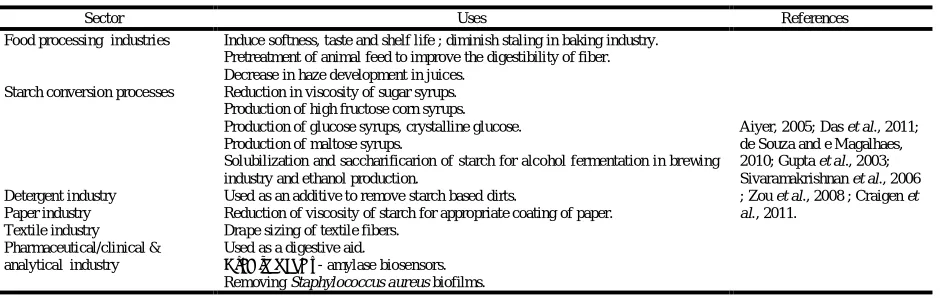
year. Table-II depicts various uses of α- amylases in Industry.
Conclusion
The analysis of the literatures has revealed that the production
of α- amylases in SSF is an ideal method which is the most
economic and provide manifold advantages in all respects
[image:4.612.109.501.73.219.2]over SmF. Due to increasing demand of α- amylases in
Table I: Various agro-residual substrates having high potentiality for α- amylase production
Substrate Organism Activity(U/g) Reference Amaranthus grain A. flavus 1 920 Viswanthan and Surlikar, 2001 Banana waste(fruit stalk & peel) Aspergillus oryzae 690 (mg/ml) Kalaiarasu and Vivekananthan, 2010 Coconut oil cake A.oryzae 3 388 Ramachandran et al., 2004a Corn bran Bacillus sp. PS-7 97 600 Sodhi et al., 2005
Gram bran B. coagulans 8 984 Babu and Satyanarayana, 1995 Groundnut oil cake Aspergillus oryzae 6547 Ramachandran et al., 2004b Loquat kernels P. expansum MT-1 1012 Erdal & Taskin, 2010 Maize bran B. coagulans 22 956 Babu and Satyanarayana, 1995 Mustard oil cake B. coagulans 5 953 Babu and Satyanarayana, 1995 Mustard Oil seed cake Bacillus sp. 5400 Saxena and Singh, 2011 Rice bran Bacillus sp. PS-7 145 000 Sodhi et al., 2005 Rice husk B. subtilis 21 760 Baysal et al., 2003 Spent brewing grain A. oryzae NRRL 6270 6 583 Francis et al., 2003 Wheat bran Penicillium janthinellum 300 Sindhu et al., 2009 Wheat bran Bacillus sp. PS-7 464 000 Sodhi et al., 2005
Table II: Applications of α- amylases in various industries
Sector Uses References
Food processing industries Induce softness, taste and shelf life ; diminish staling in baking industry. Pretreatment of animal feed to improve the digestibility of fiber. Decrease in haze development in juices.
Aiyer, 2005; Das et al., 2011; de Souza and e Magalhaes, 2010; Gupta et al., 2003; Sivaramakrishnan et al., 2006 ; Zou et al., 2008 ; Craigen et al., 2011.
Starch conversion processes Reduction in viscosity of sugar syrups. Production of high fructose corn syrups. Production of glucose syrups, crystalline glucose. Production of maltose syrups.
Solubilization and saccharificarion of starch for alcohol fermentation in brewing industry and ethanol production.
Detergent industry Used as an additive to remove starch based dirts.
Paper industry Reduction of viscosity of starch for appropriate coating of paper. Textile industry Drape sizing of textile fibers.
Pharmaceutical/clinical & analytical industry
Used as a digestive aid.
[image:4.612.74.548.250.399.2]various industries like food processing, textile, detergent, biotechnology etc., there is immense potential to develop suitable production technology for large scale yield through SSF in future.
Acknowledgement
I acknowledge UGC for providing me the Rajiv Gandhi National Fellowship (RGNF) for pursuing research work on
alpha amylase production by Penicillium spp.
REFERENCES
1. Agrawal, D., Patidar, P., Banerjee T. and Patil, S., 2005.
Alkaline protease production by a soil isolate of
Beauveria feline under SSF condition: Parameter optimization and application to soy protein hydrolysis. Process Biochem., 40: 1131-1136.
2. Ahmed, S.A., 2011. Alpha amylase production by
Aspergillus oryzae using solid state fermentation. Eng. Technol. J., 29: 2954-2960.
3. Aiyer, P.V. 2005. Amylases and their applications. Afr. J.
Biotechnol., 4(13), 1525-1529.
4. Alva, S., Anupama, J., Savla, J., Chiu, Y.Y., Vyshali, P.,
Shruti, M., Yogeetha, B. S., Bhavya, D., Purvi, J., Ruchi, K., Kumudini, B. S. and Varalakshmi, K. N., 2007. Production and characterization of fungal amylase
enzyme isolated from Aspergillus sp. JGI 12 in solid state
culture. Afr. J. Biotechnol., 6 (5) : 576-581.
5. Anto, H., Trivedi, U. and Patel, K. 2006. Alpha amylase
production by Bacillus cereus MTCC 1305 using solid
state fermentation. Food Technol. Biotechnol., 2: 241-245.
6. Arnesen, S., Eriksen, S.H., Olsen, J.O. and Jensen, B.,
1998. Increased production of alpha-amylase from
Thermomyces lanuginosus by the addition of Tween-80. Enzyme Microb. Technol., 23: 249-252.
7. Babu, K.R. and Satyanarayana, T., 1995. alpha-Amylase
production by thermophilic Bacillus coagulans in solid
state fermentation.Process Biochem., 30: 305-309.
8. Balkan, B. and Ertan, F., 2006. Production of alpha
amylase from Penicillium chrysogenum under solid state
fermentation by using some agricultural byproducts. Food Technol. Biotechnol., 45(4) : 439-442.
9. Balkan, B., Balkan, S., and Ertan, F., 2011. Optimization
of parameters for α-amylase production under solid state
fermentation by Trichothecium roseum. Rom. Biotechnol.
Lett., 16: 6591-6600.
10. Baysal, Z., Uyar, F. and Aytekin, C., 2003. Solid state
fermentation for production of alpha amylase by a
thermotolerant Bacillus subtilis from hot-spring water.
Process Biochem.,38: 1665-1668.
11. Bruins, M.E., Janssen, A.E.M. and Boom, R.M., 2001.
Thermozymes and their applications: A review of recent literature and patents. Applied Biochem. Biotechnol., 90: 155-186.
12. Carrizales, V. and Jaffe, W., 1986. Solid state
fermentation : An appropriate biotechnology for developing countries. Interscience, 11: 9-15.
13. Couto, S.R. and Sanroman, M.A., 2006. Application of
solid state fermentation to food industry : A review. J. Food Eng., 76: 291-302.
14. Craigen, B., Dashiff, A. and Kadouri, D.E., 2011. The
use of commercially available alpha-amylase compounds
to inhibit and remove Staphylococcus aureus biofilms.
The Open Microbiology Journal, 5 : 21-31.
15. Das, S., Singh, S., Sharma, V. and Soni, M.L., 2011.
Biotechnological applications of industrially important amylase enzyme. Int. J. Pharm. Bio Sci., 2: 486-496.
16. Datar, R., 1986. Economics of primary separation steps in
relation to fermentation and genetic engineering. Process Biochem., 21, 19-26.
17. de Souza, P.M. and Magalhaes, P.O., 2010. Application
of microbial alpha amylases in industry : A review. Braz. J. Microbiol., 41: 850-861.
18. Dey, S. and Agrawal, S.O., 1999. Characterization of a
thermostable alpha amylase from a thermophilic
Streptomyces megasporus strain SD12. Indian J. Biochem. Biophys., 36: 150-157.
19. Eratt, J.A., Douglas, P.E., Moranelli, F. and Seligy, V.L.,
1984. The induction of alpha amylase by starch in
Aspergillus oryzae : evidence for controlled mRNA expression. Can. J. Biochem. Cell Biol., 62: 678-690.
20. Erdal, S. and Taskin, M., 2010. Production of α-amylase
by Penicillium expansum MT-1 in solid-state
fermentation using waste Loquat (Eriobotrya japonica
Lindley) kernels as substrate. Rom. Biotechnol. Lett., 15: 5342-5350.
21. Fadel, M., 2000. Production of Thermostable amylolytic
enzyme by Aspergillus niger F-909 under solid state
fermentation. Egyptian J. Microbial., 35: 487-505.
22. Feller, G., Bussy, O.L. and Gerday, C., 1998. Expression
of psychrophilic genes in mesophilic hosts: Assessment of
the folding state of a recombinant alpha-amylase. Appl.
Environ. Microbiol., 64: 1163-1165.
23. Francis, F., Sabu, A., Nampoothiri, K.M., Ramachandran,
S., Ghosh, S., Szakacs, G. and Pandey, A., 2003. Use of response surface methodology for optimizing process parameters for the production of alpha-amylase by
Aspergillus oryzae.Biochem. Eng. J.,15: 107-115.
24. Ghildyal, N.P., Lonsane, B.K., Sreekantiah, K.R. and
Murthy, V.S., 1985. Economics of submerged and solid
state fermentations for the production of
amyloglucosidase. J. Food Sci. Technol., 22: 171-176.
25. Gupta, R., Gigras, P., Mohapatra, H., Goswami V.K. and
Chauhan, B., 2003. Microbial alpha amylases : a biotechnological perspective. Process Biochem., 38: 1599-1616.
26. Ikram-ul-Haq, Ashraf, H., Iqbal, J. and Qadeer, M.A.,
2003. Production of alpha amylase by Bacillus
licheniformis using an economical medium. Bioresour. Technol., 87: 57-61.
27. Kalaiarasu, S. and Vivekananthan, S., 2010. Development
of low cost fermentation technology for the amylase production. Int. J. Curr. Res., 3: 1-5.
28. Krishna, C. and Chandrasekaran, M., 1996. Banana waste
as substrate for α-amylase production by Bacillus subtilis
(CBTK 106) under solid-state fermentation. Applied
Microbiol. Biotecnol., 46: 106-111.
29. Kunamneni, A., Kumar, K.S. and Singh, S., 2005a.
Response surface methodological approach to optimize the nutritional parameters for enhanced production of
alpha-amylase in solid-state fermentation by
30. Kunamneni, A., Permaul, K. and Singh, S., 2005b. Amylase production in solid state fermentation by the
thermophilic fungus Thermomyces lanuginosus. J. Biosci.
Bıoeng., 100, 168- 171.
31. Lee, B.H., 1996. Other Microorganism based Products. In
: Fundamentals of Food Biotechnology, Hui, Y.H. (Ed.). Wiley-VCH Inc., New York, USA., pp: 291-352.
32. Lonsane, B.K. and Ramesh, M.V., 1990. Production of
bacterial thermostable alpha-amylase by solid state fermentation : A potential tool for achieving economy in
enzyme production and starch hydrolysis. Adv. Appl.
Microbiol., 35: 1-56.
33. Mielenz, J.R., 1983. Bacillus stearothermophilus contains
a plasmid-borne gene for alpha amylase. Proc. Natl. Acad.
Sci.,80: 5975-5979.
34. Morkeberg, R., Carlsen, M. and Nielsen, J., 1995.
Induction and repression of α-amylase production in batch
and continuous cultures of Aspergillusoryzae. Microbiol.,
141: 2449-2454.
35. Nandakumar, M.P., Thakur, M.S., Raghavarao, K.S.M.S.
and Ghildyal, P.N., 1996. Substrate particle size reduction by Bacillus coagulans in solid state fermentation.Enzyme Microb. Technol., 18: 121-125.
36. Nandakumar, M.P., Thakur, M.S., Raghavarao, K.S.M.S.
and Ghildyal, N.P., 1999. Studies on catabolite repression in solid state fermentation for biosynthesis of fungal amylases. Lett. Appl Microbiol., 29: 380-384.
37. Niaz, M., Iftikhar, T., Tabassum, R., Zia, M.A., Saleem,
H., Abbas, S.Q. and Haq, I.U., 2010. α-amylase
production by Bacillus licheniformis under solid state
fermentation conditions and its cross linking with metalosalts to confer thermostability. Int. J. Agric. Biol., 12: 793-795.
38. Nigam, P. and Singh, D., 1995. Enzymes and microbial
system involved in starch processing enzyme. Enz.
Microbial Technol., 17: 770-778.
39. Nouadri, T., Meriahi, Z., Shahrazed, D.D. and Leila, B.,
2010. Purification and characterization of the α-amylase
isolated from Penicillium camemberti PL21. Afr. J.
Biochem. Res., 4: 155-162.
40. Pandey, A., 1991. Effect of particle size of substrate on
enzyme production in solid-state fermentation.Bioresour.
Technol., 37: 169-172.
41. Pandey, A., Nigam, P., Soccol, C.R., Soccol, V.T., Singh,
D. and Mohan, R., 2000a. Advances in microbial amylases. Biotechnol. Applied Biochem., 31: 135-152.
42. Pandey, A., Selvakumar, P., Soccol, C.R. and Nigam, P.,
1999. Solid state fermentation for the production of
industrial enzymes.Curr. Sci., 77: 149-162.
43. Pandey, A., Soccol, C.R. and Mitchell, D., 2000b. New
developments in solid state fermentation. Process Biochem., 35: 1153-1169.
44. Pandey, A., Soccol, C.R., Nigam, P., Soccol, V.T.,
Vandenberghe, L.P.S. and Mohan, R., 2000c.
Biotechnological potential of agro-industrial residues. II: Cassava bagasse. Biores. Technol., 74: 81-87.
45. Patel, A.K., Nampoothiri, K.M., Ramachandran, S.,
Szakacs, G. and Pandey, A., 2005. Partial purification and characterization of & alpha amylase produced by
Aspergillus oryzae using spent-brewing grains. Indian J. Biotechnol., 4: 336-341.
46. Ramachandran, S., Patel, A.K., Nampoothiri, K.M.,
Francis, F., Nagy, V., Szakacs, G. and Pandey, A., 2004a.
Coconut oil cake - A potential raw material for the
production of alpha-amylase. Bioresour. Technol., 93:
169-174.
47. Ramachandran, S., Patel. A.K., Nampoothiri, K.M.,
Chandran, S., Szakacs, G., Soccol, C.R. and Pandey, A., 2004b. Alpha amylase from a fungal culture grown on oil cakes and its properties. Braz. Arch. Biol.Technol., 47(2) : 309-317.
48. Ramesh, M.V. and Lonsane, B.K., 1987. Solid state
fermentation for the production of alpha amylase by
Bacillus megaterium 16M. Biotechnol. Lett., 9: 505-508.
49. Ramesh, M.V. and Lonsane, B.K., 1991. Ability of a solid
state fermentation technique to significantly minimize
catabolic repression of α-amylase production by Bacillus
licheniformis M27. Applied Microbiol. Biotechnol., 35: 591-593.
50. Rao, J.L.U.M. and Satyanarayana, T., 2003. Enhanced
secretion and low temperature stabilization of a
hyperthermostable and Ca2+ independent alpha-amylase
of Geobacillus thermoleovorans by surfactants. Lett.
Appl. Microbiol.,36: 191-196.
51. Regulapati, R., Malav, P.N. and Gummadi, S.N., 2007.
Production of thermostable alpha amylases by solid state fermentation-a review. Am. J. Technol., 2(1): 1-11.
52. Robinson, T., Singh, D. and Nigam, P., 2001. Solid state
fermentation: a promising microbial technology for secondary metabolite production. Appl. Microbiol. Biotechnol., 55: 284-289.
53. Rosell, C.M., Haros, M., Escriva, C. and
Benedito-De-Barber, C., 2001. Experimental approach to optimize the
use of alpha amylases in bread making. J. Agric. Food
Chem., 49: 2973-2977.
54. Saxena, R. and Singh, R., 2011. Amylase production by
solid-state fermentation of agro-industrial wastes using
Bacillus sp. Braz. J. Microbiol., 42: 1334-1342.
55. Sindhu, R., Suprabha, G.N. and Shashidhar, S., 2009.
Optimization of process parameters for the production of
alpha amylase from Penicillium janthinellum(NCIM
4960) under solid state fermentation. Afr. J. Microbiol. Res., 3(9): 498-503.
56. Sivaramakrishnan, S., Gangadharan, D., Nampoothiri,
K.M., Soccol, C.R. and Pandey, A., 2006. Alpha amylases
from microbial sources-an overview on recent
developments. Food Technol. Biotechnol., 44(2):
173-184.
57. Soccol, C., Marin, B., Raimbault, M. and Lebeault, J.M.,
1994. Breeding and growth of Rhizopus in raw cassava by
solid state fermentation. Applied Microbiol. Biotechnol., 41: 330-336.
58. Sodhi, H.K., Sharma, Gupta, J.K. and Soni, S.K., 2005.
Production of a thermostable α-amylase from Bacillus sp.
PS-7 by solid state fermentation and its synergistic use in the hydrolysis of malt starch for alcohol production. Process Biochem., 40(2): 525-534.
59. Soni, S.K., Bath, K.S. and Soni, R., 1996. Production of
amylase by Saccharomycopsis capsularis in solid state
fermentation. Indian J. Microbiol., 36: 157-159.
60. Soni, S.K., Kaur, A. and Gupta, J.K., 2003. A solid state
fermentation based bacterial amylase and fungal glucoamylase system and its suitability for the hydrolysis
of wheat starch. Process Biochem.,39: 185-192.
61. Sudo, S., Ishikawa, T., Sato, K. and Oba, T., 1994.
Aspergillus kawachii in solid-state and submerged
cultures.J. Ferment. Bioeng., 77(5): 483-489.
62. Sun, X., Liu, Z., Qu, Y. and Li, X., 2005. The Effects of
wheat bran composition on the production of
biomass-hydrolyzing enzymes by Penicilliumdecumbens. Applied
Biochem. Biotechnol., 146: 119-128.
63. Syu, M.J. and Chen, Y.H., 1997. A study on the
alpha-amylase fermentation performed by Bacillus
amyloliquefaciens. Chem. Eng. J., 65: 237-247.
64. Tengerdy, R.P., 1998. Solid Substrate Fermentation for
Enzyme Production. In: Pandey, A. (ed). Advances in Biotechnology. Educational Publishers and Distributors, New Delhi, pp. 13-16.
65. Van der Maarel, M.J.E.C., van der Veen, B., Uitdehaag,
J.C.M., Leemhuis, H. and Dijkhuizen, L., 2002. Properties and applications of starch-converting enzymes
of the alpha-amylase family.J. Biotechnol., 94: 137-155.
66. Varalakshmi, K.N., Kumudini, B.S., Nandini, B.N.,
Solomon, J., Suhas, R., Mahesh, B. and Kavitha, A.P.,
2009. Production and characterization of α-amylase from
Aspergillus niger JGI 24 isolated in Bangalore. Pol. J.
Microbiol., 58: 29-36.
67. Vieille, K. and Zeikus, G.J., 2001. Hyperthermophilic
enzymes: Sources, uses and molecular mechanisms for thermostability. Microbiol. Mol. Biol. Rev., 65: 1-43.
68. Viswanthan, P. and Surlikar, N.R., 2001. Production of
alpha-amylase with Aspergillus flavus on Amaranthus
grains by solid-state fermentation. J. Basic Microbiol., 41: 57-64.
69. Zou, C., Zhou, M., Xie, G., Luo, P., Xiong, X., Xu,
H. and Zheng, J., 2008. Preparation of Disposable
Saliva α-Amylase Biosensor. Chinese J. Analyt. Chem.,
36(9) : 1217-1220.