EVALUATION OF LEARNING AND MEMORY ENHANCING
ACTIVITY OF
COMMIPHORA CAUDATA
LEAVES IN RATS
Meera Sumanth* and Yashashwini Y. C.
Department of Pharmacology, Visveswarapura Institute of Pharmaceutical Sciences 24th main, 22nd cross, Banashankari 2nd stage Bangalore 560070, Karnataka, India.
ABSTRACT
Objectives: To assess the learning and memory enhancing activity of the Commiphora caudata leaves in rats using Elevated plus maze
(EPM), Hebb-William maze (HWM) and Morris water maze (MWM )
and to evaluate brain Acetylcholine esterase activity, lipid
peroxidation, Superoxide dismutase, Catalase, Glutathione. Materials and methods: Wistar rats (100-150 gm) of either sex, were divided into 5 groups (n=6). Group-I (control) animals received vehicle,
Group-II animals received scopolamine (0.4 mg/kg i.p), Groups III ,IV
and V animals received Commiphora caudata- 200 mg/kg p.o, 400
mg/kg p.o and Piracetam (400 mg/kg i.p) respectively for 27 days,
followed by scopolamine (0.4 mg/kg i.p) single dose on 19th and 27th day. Assessment of transfer latency (TL), time taken to reach reward
chamber (TRC) and swim latency (SL) was done on 16th, 17th, 18th, 19th and 27th day using EPM, HWM and MWM respectively. Rats were sacrificed on 28th day, brain acetylcholine esterase activity, lipid peroxidation, superoxide dismutase, glutathione and catalase levels were estimated. The data was analysed
by one way ANOVA followed by Dunnett’s test. P ≤ 0.05 was considered significant.Result:
Commiphora caudata decreased TL, TRC and SL in comparison to scopolamine treated rats,
decreased acetylcholine esterase activity and lipid peroxidation, and increased superoxide
dismutase, glutathione and catalase in brain. Conclusion: The Commiphora caudata
enhanced learning and memory activity. This nootropic effect can be attributed to their
antioxidant and neuroprotective property.
KEYWORDS: Memory, EPM, HWM, MWM, Piracetam, Scopolamine.
Volume 5, Issue 5, 1223-1236. Research Article ISSN 2277– 7105
*Corresponding Author
Meera Sumanth
Department of
Pharmacology,
Visveswarapura Institute
of Pharmaceutical
Sciences 24th main, 22nd
cross, Banashankari 2nd
stage Bangalore 560070,
Karnataka, India. Article Received on 09 March 2016,
Revised on 28 March 2016, Accepted on 18 April 2016
INTRODUCTION
The brain is the center of the nervous system which controls memory, thought, reason
judgment, consciousness and emotion.[1] The hippocampus is the major component of the brain of humans. It plays an important role in the spatial navigation and long term memory.[2] Memory is the ability of an individual to record sensory stimuli, events, information etc,
retain them over a short or long period of time and recall the same at later date when needed.
Learning is the process of acquiring knowledge about the world and memory could be
considered as the retention of the acquired knowledge which can be recalled as and when
needed.[2]
Nootropic agents such as piracetam, pramiracetam, aniracetam and choline esterase inhibitors
like donepezil are being primarily used to improve memory. However, the resulting adverse
effects associated with these agents have limited their use and it is worthwhile to explore the
utility of traditional medicines in the treatment of various cognitive disorders.[3]
Many herbal remedies are used to improve memory and learning. The plant Commiphora
caudata is commonly known as “hill mango” belonging to family Burseraceae commonly
found throughout south india and Srilanka.[4] It possesses astringent, sweet, cooling, aphrodisiac, diuretic and antidiabetic activities. It is used for fever, strangury, vitiated
conditions of vata and pitta in siddha system of medicines. Its bark and leaves has been used
in folk medicine for treating in low back pain, sciatica, fever, arthritis and urinary retension.[5] Several studies indicated that Commiphora caudata has analgesic and anti-inflammatory
activity[6], anti-arthritic activity[7], antihyperlipidemic activity[8], antioxidant activity.[9] Extensive literature search revelead that Commiphora caudata possess learning and memory
enhancing activity but failed to get the scientific, documentary evidence. Hence present study
was taken up to investigate learning and memory enhancing activity of Commiphora caudata.
MATERIALS AND METHODS
Plant material: Commiphora caudata leaves were collected from Mandya, Karnataka in
july- Aug 2015 and were identified and authenticated by Dr.Siddamalaiya at National
Ayurveda Diabetics Research Institute, (RRCBI-4932) Bangalore 560011. The same was
processed at Green chem Herbal extract and Formulations, Bangalore, India. And the
ethanolic extract procured was used for the study. Preliminary, phytochemical analysis of the
Chemicals and drugs: Scopolamine was taken from BUSCOPAN injection, (CADILLA HEALTH CARE). Piracetam was taken from NEUROCETAM injections MICRO LABS
LIMITED, Bangalore.
Experimental Animals: Inbred, young Wistar rats (weighing around 100-150 g) were used in the current study. The animals were maintained under standard laboratory conditions of
room temperature 24 ± 5˚ C, relative humidity 45-55% and natural day and night cycle. The
animals had free access to food (standard rat pellet from Sri Venkateshwara traders,
Bangalore), with water supplied ad libitum. All the experiments were conducted in
compliance to ethical principles and guidelines provided by Committee for the Purpose of
Control and Supervision of Experiments on Animals (CPCSEA). Permission was taken from
IAEC of Visveswarapura Institute of Pharmaceutical Sciences, Bangalore (CPCSEA 152/99,
renewed for the three years i.e. 09-05-2012 to May 2015) before starting the experiments on
animal.
Experimental protocol: Wistar albino rats were divided into five groups of six rats each for all the three models (EPM, HWM, MWM). Group-I animals served as control, received
vehicle i.e, distilled water. Group-II, Group-III and IV animals, received scopolamine 0.4
mg/kg i.p.[10] ethanolic leaves extract of Commiphora caudata, 200 and 400 mg/kg p.o.[6, 11] respectively. Group-V animals, received piracetam 400 mg/kg i.p.[12] The rats of group III, IV and V received the respective treatment for 15 days, followed by training session on 16th,
17th, and 18th day. On 19th day, single dose of scopolamine was administered to all the
animals except group I animals, 30 min after the respective treatment. TL, TRC, and SL were
assessed 45 min thereafter respectively. The respective treatments continued for one week
and on 27thday, scopolamine was administered to all the animals except group I animals, 30
min after the respective treatment. TL, TRC, and SL were assessed 45 min thereafter
respectively.
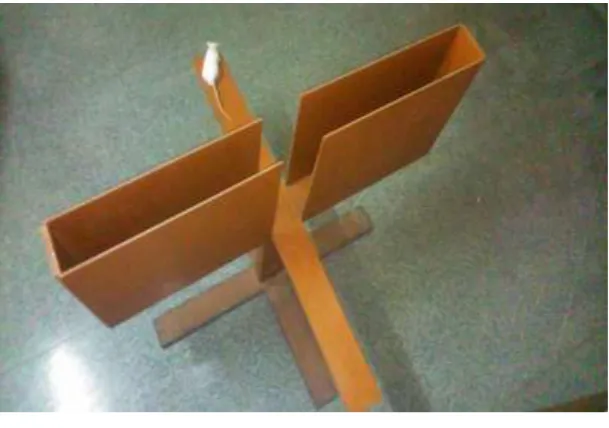
Elevated plus maze (EPM): Elevated plus-maze was described as the tool for exteroceptive
behavioural model to evaluate memory in rats. On the first day each rat was placed at the end
of an open arm, facing away from the central platform. Transfer latency (TL) is the time
taken (in sec) by the animal to move from the open arm into any one of the enclosed arms
with all its four legs. TL was recorded on the first day (training session) for each animal. The
rat were allowed to explore the maze for another 10sec and then returned to its home cage.
day of the treatment. Significant reduction in TL value of retention indicated improvement in
[image:4.595.146.451.126.340.2]memory.[13]
Fig. 1 Elevated plus maze
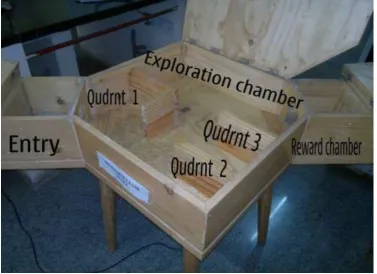
Hebb-Williams maze (HWM): Hebb-Williams maze was taken as the tool for incentive-based exteroceptive behavioural model, useful for measuring spatial working memory of rats.
In this model changes in time taken by the animal to reach reward chamber from start box
(TRC) were taken as learning and memory enhancing activity. The rat was placed in the
animal chamber or start box and the door were opened to facilitate the entry of the animal
into the next chamber.
The door of the start box was closed immediately after the animal moves into the next
chamber to prevent back-entry. The time taken by the animal to reach the reward chamber
from the start box was recorded on the first day (training session) for each animal. Each
animal was allowed to explore the maze for 3 min with all the doors opened before returning
to its home cage. Retention of this learned task (memory) was examined 24 h after the first
Fig. 2: Hebb’s William maze
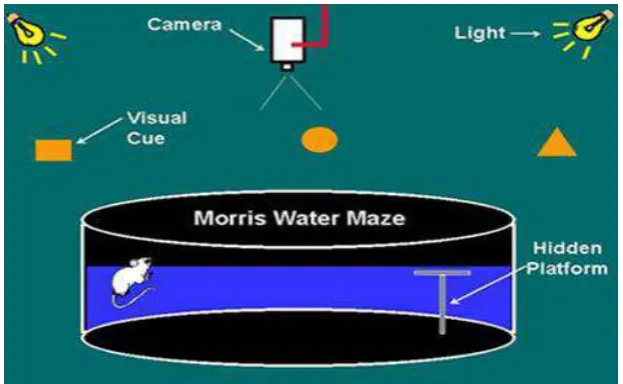
Morris water maze (MWM): A task was developed where rats learn to swim in a water tank to find an escape platform hidden under the water (Morris 1984). As there are no proximal
cues to mark the position of the platform, the ability to locate it efficiently will depend on the
use of a configuration of the cues outside the tank.The water maze consists of a circular tank
with 100 cm diameter and a wall 20 cm above the water level.
A circular platform (9 cm diameter, covered with white linen material for grip) is hidden 2
cm below the water level. The water was made opaque using titanium dioxide suspension and
is kept at about 23°C during the experiment.
Training takes place on three consecutive days, with the rats receiving 4 consecutive trials per
day with an inter-trial interval of 6–10 min. Each trial was started from one of four assigned
polar positions with a different sequence each day. The latency to find the platform was
measured as the time of placement of the rat in the water to the time it finds the platform. If
Fig. 3: Morris water maze
BIOCHEMICAL ESTIMATION
Sampling of brain tissue: The animals were sacrificed after the treatment i.e., on 28th day; whole brain was carefully removed from the skull. For preparation of brain homogenate, the
fresh whole brain was weighed and transferred to a glass homogenizer and homogenized in
an ice bath after adding 10 volumes of 0.9% w/v sodium chloride solution. The homogenate
was centrifuged at 3000 rpm for 10 min and the resultant cloudy supernatant liquid was used
for estimation of brain acetylcholinesterase activity, lipid peroxidation, superoxide dismutase,
catalase and glutathione activity.[13]
Assay of acetylcholinesterase activity in the brain
The method of AChE activity estimation is popularly known as Ellman’s method named after
George Ellman who developed this method in 1961. The esterase activity is measured by
providing an artificial substrate, acetylthiocholine (ATC). Thiocholine released because of
the cleavage of ATC by AChE is allowed to react with the -SH reagent
5,5’-dithiobis-(2-nitrobenzoic acid) (DTNB), which is reduced to thio5,5’-dithiobis-(2-nitrobenzoic acid, a yellow coloured
anion with an absorption maxima at 412 nm. The extinction coefficient of the thionitro
benzoic acid is 1.36 × 10⁻⁴/molar/centimetre. The concentration of thionitrobenzoic acid detected using a UV spectrophotometer is then taken as a direct estimate of the AChE
activity. [14]
Free radical scavenging potential
with two molecules of 2-thiobarbituric acid (TBA) at pH 3.5 .The pink chromogen was
measured spectrophotometrically at 532 nm with extinction coefficient of 156 mM-1 cm-1 [14] SOD: Superoxide dismutase activity in brain homogenate was determined spectrophotometrically. In superoxide dismutase assay, ions are generated from the
conversion of xanthine touric acid and hydrogen peroxide in presence of xanthine oxidase
(XOD), these ions converts NBT to NBTdiformazan.[14]
CATALASE: Catalase activity was determined spectrophotometrically by the method of Aebi et al (1984). Catalase catalyzes the decomposition of hydrogen peroxide according to
the above equation. The decrease in absorbance at 240 nm was followed for one min.[14]
GLUTATHIONE ASSAY: Ellman (1959).was used to measure the Glutathione in brain tissue homogenate. SH group of glutathione reduce 5, 5 -dithiobis-(2-nitrobenzoic acid)
(DTNB) to form 2-nitro-S-mercaptobenzoic acid per mole of glutathione. The reduction
product is measured spectrophotometrically at 412 nm using the extinction coefficient of 13.6
mM-1 cm-1.[14]
Statistical analysis: All the values are expressed as mean ± SEM. The data was analyzed by one-way ANOVA, followed by Dunnett’s test. P ≤ 0.05 was considered significant.
RESULTS
Preliminary phytochemical analysis of the Commiphora caudata leaves confirms presence of
reducing sugars, flavanoids, streroids/terpenes, alkaloids, terpinoids, tannins and phenolic
compounds
EPM: Effect of Commiphora caudata on transfer latency (TL).
As shown in Table 1, scopolamine increases the time taken by rat to reach the closed arms as
compared to control group, (i.e. induces amnesia). Pretreatment with Commiphora caudata
(200 & 400 mg/kg) for 27 days, resulted in decrease in TL, in a dose dependent manner,
which was comparable with Piracetam (400 mg/kg). Commiphora caudata decreased TL
significantly (P<0.01) on day 27th as compared to day 16, 17, 18 and 19th.
HWM: Effect of Commiphora caudata on time taken to reach reward chamber (TRC).
As shown in Table 2, scopolamine increases the TRC as compared to control group, (i.e.
induces amnesia). Pretreatment with Commiphora caudata, for 27 days, resulted in decrease
Commiphora caudata decreased TRC significantly (P<0.01) on day 27th as compared to day
16, 17, 18 and 19th.
MWM: Effect of Commiphora caudata on Swim latency (SL).
As shown in Table 3, scopolamine increases SL compared to control group, (i.e. induces
amnesia). Pretreatment with Commiphora caudata, for 27 days, resulted in decrease in SL, in
a dose dependent manner, which was comparable with Piracetam (400 mg/kg). Commiphora
caudata decreased SL significantly (P<0.01) on day 27th as compared to day 16, 17, 18 and
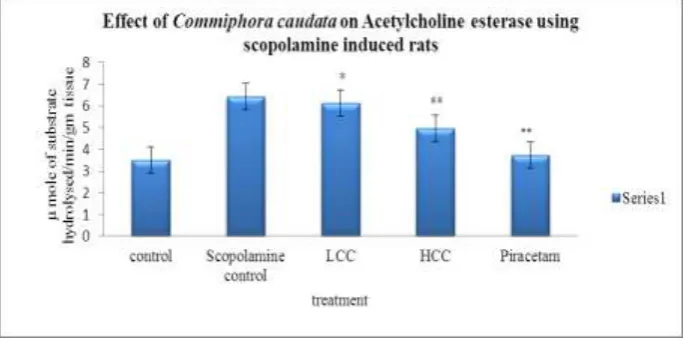
19th. As shown in “Fig. 4”, scopolamine increases the acetylcholine esterase activity compared to control group, (i.e. induces amnesia). Pretreatment with Commiphora caudata
for 27 days, resulted in a significant (P<0.01) decrease in acetylcholine esterase activity in a
dose dependent manner, which was comparable with Piracetam (400 mg/kg).
Effect of Commiphora caudata free radical scavenging potential.
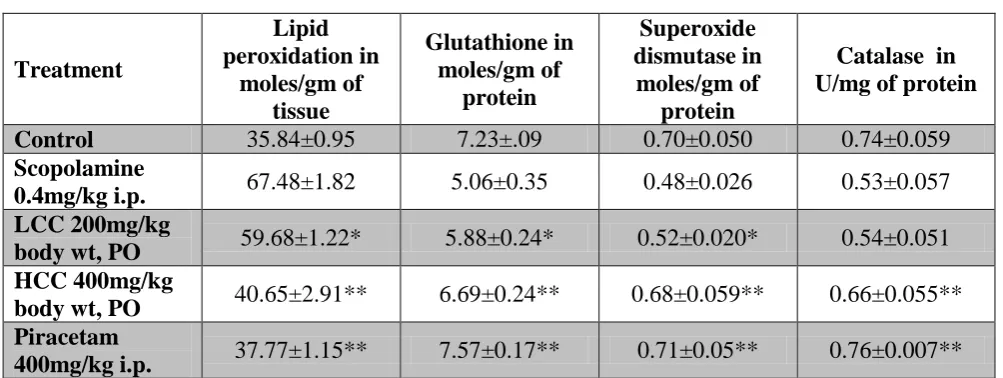
As shown in Table 4, scopolamine increases LPO activity and decreases the SOD, Catalase
and Glutathione activity. Pretreatment with Commiphora caudata, for 27 days, resulted in,
significant (P<0.01) decrease in LPO and increase in SOD, Catalase, Glutathione activity, in
a dose dependent manner, which was comparable with Piracetam (400 mg/kg).
Table 1: Effect of Commiphora caudata leaves on transfer latency (TL) in Scopolamine induced rats.
n=6. Values are expressed as mean ± SEM, one way ANOVA followed by Dunnett’s test.
*P<0.05, **P<0.01 v/s scopolamine control.
Treatment TL on 1
st
day(sec)
TL on 2nd day(sec)
TL on 16th day
(sec)
TL on 17th day
(sec)
TL on 18th day (sec)
TL on 19th day (sec)
TL on 27th day (sec)
Control 58.33±0.6 52.83±1.2 56.67±2.3 51.17±0.8 45±1.3 39.17±1.4 31.33±1.0
Scopolamine
0.4mg/kg i.p. 58.67±1.0 52.33±1.1 53.5±1.9 49±2.7 49.17±1.0 45.67±1.3 54.33±1.7
LCC 200mg/kg body wt, PO.
58.5±1.7 53±1.1 52.67±1.8 45.33±1.9 39.33±1.7 34.83±1.0 29.67±0.9
HCC 400mg/kg body wt, PO.
58.83±1.4 51.5±0.8 51.83±2.0 42.83±1.2 36.5±0.7** 30.5±1.7** 22±1.3**
Piracetam
Table 2: Effect of Commiphora caudata leaves on transfer latency (TRC) in Scopolamine induced rats.
[image:9.595.21.583.337.483.2]n=6. Values are expressed as mean ± SEM, one way ANOVA followed by Dunnett’s test. **P<0.01 v/s scopolamine control.
Table 3: Effect of Commiphora caudata on Swim latency (SL) in scopolamine induced rats.
Treatment SL on 1
st
day (sec)
SL on 2nd day (sec)
SL on 16th day (sec)
SL on 17th day (sec)
SL on 18th day (sec)
SL on 19th day (sec)
SL on 27th day (sec) Contr 158.7±1.8 168.2±1.7 167.7±1.5 155.2±1.1 139.7±1.3 116.8±2.5 114.7±2.3
Scopolamine
0.4mg/kg i.p. 159.2±1.6 170.2±1.4 172±1.9 162.5±1.5 156.2±1.8 154.2±2.0 156.5±1.6 LCC 200mg/kg
body wt, PO 162.8±2.6 166.5±2.6 164.7±3.0 146.2±1.8 135.7±1.9 124.3±1.5 95.67±1.9 HCC 400mg/kg
body wt, PO 159.8±3.7 159±1.6 159.3±1.8 125.3±1.6* 108.3±2.5** 86.5±1.9** 48.67±1.4** Piracetam
400mg/kg i.p. 161.7±3.3 161.5±1.5 160.3±1.6 125.8±1.4* 93.5±1.8** 61.67±1.3** 44.67±1.8**
n=6. Values are expressed as mean ± SEM, one way ANOVA followed by Dunnett’s test. *P<0.05, **P<0.01 v/s scopolamine control.
Fig. 4: Effect of Commiphora caudata on Acetylcholine esterase activity using scopolamine induced rats, n=6. Values are expressed as mean ± SEM, one way ANOVA
followed by Dunnett’s test. *P<0.05, **P<0.01 v/s scopolamine control.
Treatment TRC on 1
st
day (sec)
TRC on 2nd day
(sec)
TRC on 16th day (sec)
TRC on 17th day (sec)
TRC on 18th day (sec)
TRC on 19th day (sec)
TRC on 27 th day (sec) Control 155.7±1.4 135.5±1.3 137±1.6 107±1.6 92±1.3 80.5±1.8 56.5±1.6
Scopolamine
0.4mg/kg i.p. 157.7±2.0 135.3±1.6 137.8±1.3 118±3.7 118.7±1.6 117.2±2.3 96.83±3.2 LCC 200mg/kg
body wt, PO 156.8±0.8 132.2±1.2 135.2±1.4 92.5±2.1 80.5±1.4 60.33±0.9 34.17±2.5** HCC 400mg/kg
body wt, PO 154.7±1.3 130.5±1.2 130.3±1.5 81.67±1.7** 70.67±1.4** 49.33±2.2** 21.33±1.0** Piracetam
[image:9.595.127.471.525.695.2]Table 4: Effect of Commiphora caudata free radical scavenging potential in scopolamine induced rats using Elevated plus maze.
Treatment
Lipid peroxidation in
moles/gm of tissue
Glutathione in moles/gm of
protein
Superoxide dismutase in
moles/gm of protein
Catalase in U/mg of protein
Control 35.84±0.95 7.23±.09 0.70±0.050 0.74±0.059
Scopolamine
0.4mg/kg i.p. 67.48±1.82 5.06±0.35 0.48±0.026 0.53±0.057
LCC 200mg/kg
body wt, PO 59.68±1.22* 5.88±0.24* 0.52±0.020* 0.54±0.051
HCC 400mg/kg
body wt, PO 40.65±2.91** 6.69±0.24** 0.68±0.059** 0.66±0.055**
Piracetam
400mg/kg i.p. 37.77±1.15** 7.57±0.17** 0.71±0.05** 0.76±0.007**
n=6. Values are expressed as mean ± SEM, one way ANOVA followed by Dunnett’s test.
*P<0.05, **P<0.01v/s scopolamine control
DISCUSSION
Memory is the ability of an individual to record sensory stimuli, events, information etc,
retain them over a short or long period of time and recall the same at later date when needed.
Learning is the process of acquiring knowledge about the world and memory could be
considered as the retention of the acquired knowledge, which can be recalled as and when
needed.[2]
Dementia is generally defined as the loss of intellectual abilities. In dementia, memory
capacity to solve problems of day-to-day living, performance of learned motor, social skills
and control of emotions are primarily affected.[15]
Herbal drugs have shown the promising effect in the treatment of memory loss.[16] Nootropics popularly referred as smart drugs, boost human cognition ability. Nootropic agents such as
piracetam, pramicacetam, amiracetam and choline esterase inhibitors like donepezil are being
used to improve memory. However, the resulting adverse effects associated with these agents
makes it necessary explore the utility of traditional medicine in the treatment of various
cognition disorders.[17] The present study was undertaken to evaluate the learning and memory enhancing activity of Commiphora caudata in amnestic rats.
In the present study, scopolamine induced amnesia in rats. Commiphora caudata 200 and 400
evaluated in exceroceptive behavior model of Elevated plus maze, Hebb’s William maze and
Morris water maze. Learning and memory enhancing activity of test drugs were effective
dose dependently. In our study we found that Commiphora caudata reduced transfer latency,
time taken to reach reward chamber and swim latency in scopolamine induced amnesic rats
using EPM, HWM, MWM, reduction in acetylcholine esterase activity, reduction in LPO
level and increase in SOD, GSH, catalase level, in a dose dependent manner respectively.
This can be interpreted as the learning and memory enhancing activity of Commiphora
caudata which may be due to its antioxidant properties. The preliminary phytochemical
analysis of Commiphora caudata reveals presence of flavonoids, tannins, polyphenols,
alkaloids, terpinoids[18] which shows antioxidant activity according to earlier studies. Hence this antioxidant activity of Commiphora caudata may be responsible for enhancing learning
and memory in rats.
Scopolamine interfers with memory and cognitive function in human beings and
experimental animals by blocking the muscarinic receptors (M1) and inhibits the action of
acetylcholine at the receptors. The animal models have been extensively used in research to
screen drugs with potential therapeutic value in dementia. The Elevated plus maze, Hebb’s
William maze and Morris water maze were used in order to deduce the effectiveness of test
drugs. It was found that dose 200mg/kg and 400 mg/kg body wt for Commiphora caudata
administered orally for 27 days attenuated the scopolamine induced learning and memory
from amnesia. Test drugs also prevented scopolamine induced memory impairment when
evaluated in all the three models. The Elevated plus maze, Hebb’s William maze and Morris
water maze, investigated spatial learning and memory. It is especially sensitive to impair
cholinergic hippocampal function, hence suggesting attenuation of scopolamine induced
spatial learning and memory deficit in rats by Commiphora caudata.
Acetylcholine in cholinergic nerve system considered as the most important neurotransmitter
involved in the regulation of cognitive functions.[12] The regulation of memory function depends upon the level of neurotransmitters such as acetylcholine, serotonin, catecholamine,
GABA and glutamate. The inhibitory effects of choline esterase results in memory
enhancement by increasing the acetylcholine level and decreasing dopamine level.[19] Cholinergic neuronal loss in hippocampal area is the major feature of Alzheimer’s disease
and enhancement of central cholinergic activity by use of anticholinesterase is presently the
muscuranic antagonist scopolamine, the drug most widely used to induce amnesia in
experiment model was used. Anticholinesterase which enhances the availability of
acetylcholine in synaptic cleft and is able to reverse the scopolamine induced deficit indicate
a neurotransmitter role of acetylcholine in learning and memory. The role of central
cholinergic system is fairly well established and its deficiency being implicated in memory
deficits. In the present study, with the administration of Commiphora caudata extracts for 27
days, there was a significant reduction of brain acetylcholine esterase activity against
scopolamine induced amnesia. Hence, a combination of neuroprotective, anticholinesterase
and nootropic effects exhibited by Commiphora caudata may all be eventually responsible
for the memory improving effect observed in the present study.[20]
Age, oxidative stress, harmful free radicals and inflammation are the key components in the
development of memory impairment, including the conditions such as dementia,
schizophrenia and Alzheimer’s disease.[2]
The oxidative stress, generation of free radicals,
harmful byproducts of oxidative metabolism are known to cause organic damage to the living
system. It is hypothesized that increasing antioxidant levels in the organism might retard or
reverse the damaging effects of free radicals on neurons. Oxidative stress in brain generates
oxygen radicals like superoxide anion, hydroxyl radical, and hydrogen peroxide, which act on
polyunsaturated fatty acids in brain. The major antioxidant and oxidative free radical
scavenging enzymes like peroxidase, glutathione, SOD and catalase play an important role to
reduce oxidative stress in brain. In the present study after scopolamine (27th day) treatment
rats showed a significant increase in the brain levels of lipid peroxidation. At the same time
there was a significant reduction in levels of glutathione, a tripeptide found in all cells, which
reacts with free radicals to protect cells from superoxide radical, hydroxyl radical and singlet
oxygen. Pre-treatment of Commiphora caudata reduced the lipid peroxidation levels and
increased GSH content in brain after scopolamine treatment. Scopolamine reduced the SOD
activity in brain. SOD is the only enzyme that uses the superoxide anions as the substrate and
produces hydrogen peroxide as a metabolite. Super oxide anion is more toxic than H2O2 and
has to be removed[21]. Pre-treatment with Commiphora caudata significantly prevented the reduction of SOD activity in brain. The results also suggest that the Commiphora caudata
reduced oxidative stress by reducing lipid peroxidation and increasing the endogenous
antioxidant enzymes in brain. Thus the present study demonstrates that Commiphora caudata
inhibiting lipid peroxidation, augmenting endogenous antioxidant enzymes and decreasing
acetylcholinestrase (AChE) activity in brain.
CONCLUSION
Thus it is concluded that Commiphora caudata improves learning and memory. This may be
due to antioxidant property present in it, which may be attributed to Flavonoids, tannins and
polyphenols.
ACKONWLEGDEMENT
The authors are thankful to Green Chem. Herbal extract and formulations, Bangalore, India
for providing the Commiphora caudata leaves ethanolic extract.
REFERENCE
1. Joshi PC. A review of natural memory enhancers (nootropics). Unique J Engg Adv Sci.,
2013; 1(1): 8-18.
2. Kosuri K, Chakravarthi, Ramakrishna A. Beneficial effect of aqueous root extract of
Glycyrrhiza glabra on learning and memory using different behavioural modes:
experimental study. J Nat Sci Bio Med., 2013; 4(2): 420-25.
3. Sexena V, Ahmad H, Gupta R. Memory enhancing effects of Ficus carica leaves in
hexane extract on interoceptive behavioural models. Asian J Pharm Clin Res., 2013; 6(3):
109-13.
4. Sudarshan DV, Suresh KP, Latha S, Selvamani P, Srinivasan S. Antioxidant studies on
the ethanolic extract of Commiphora spp. African J Biotech., 2009; 8(8): 1631-37.
5. Nisha P, Jyoti H. Invitro hepatoprotective activity of ethanolic extract of Commiphora
caudata (wight&arn) Engl on the BRL3A cell line. Indo American J Pharm Res., 2014;
4(3): 1631-37.
6. Mohan CG, Savinay G, Viswanatha GL, Shylaja H, Nandakumar K. Analgesic and
anti-inflammatory activity of leaf extracts of Commiphora caudata in rodents. Pharmacology
online2., 2009; 2: 991-98.
7. Girija P, Umasankar K, Venkateawar RJ, Sharvana BBS, Venkateswaralu E. Antiarthritic
activity of ethanolic extract from the leaves of Commiphora caudata (Linn) in complete
freund’s adjuvant induced arthritic rats. Nig J Expt Clin Biosci., 2014; 2(1): 42-48.
8. Geetha K, Ganapaty S. Antihyperlipidemic activity of Commiphora caudata leaves in
9. Latha S, Selvamani P, Thirunavukkarasu C, Kadambavadani R, Rathi K. Comparative
evaluation of antioxidant activity of crude extracts of Commiphora spp and formulated
polyherbal tablets. J Med Plants Res., 2012; 6(43): 5532-45.
10.Rachna Gupta, Lalit KG, Pramod KM, Swapan KB. Effect of resveratrol on
scopolamine-induced cognitive impairement in mice. Pharmacol Reports., 2012; 64: 438-44.
11.Girija P, Umasankar K, Venkateswar RJ, Sharvana BBS, Venkateswaralu E.
Anti-arthritic activity of ethanolic extract from the leaves of Commiphora caudata (Linn.) in
complete Freund’s adjuvant-induced arthritic rats. Nigerian J Expt Clinc Biosci., 2014;
2(1): 42-48.
12.Vijay CJ, Babasaheb SS. Memory enhancing activity of Taverniera cuneifolia (Roth)
Arn: A substitute for commercial Liquorice. Int J Pharma Bio Sci., 2013; 4(2): 277-85.
13.Meera S. Mamatha K. Assessement of learning and memory enhancing activity of
Phoenix dactylifera (date) in rats. World J Pharma Res., 2014; 3(10): 1215-25.
14.Talpate KA, Bhosale UA, Zambare MR, Somani RS. Neuroprotective and nootropic
activity of Clitorea ternatea Linn. (Fabaceae) leaves on diabetes induced cognitive
decline in experimental animals. J Pharm Bioallied Sci., 2014; 6(1): 48-55.
15.Shivakumar L, Shivaraj GT, Rao VN, Shalam, Richa V. Evaluation of memory enhancing
activity of SR-105 in experimental animals. Int J Res Ayur Pharm., 2011; 2(3): 973-77.
16.Shibnath K, Nookala VNM, Chandra NS. Screening of novel polyphytoformulations,
natural remedies for learning and memory enhancing properties in rat. Int J Nutr
Pharmacol Neuro Dis., 2015; 5(1): 13-19.
17.Nilofar SN, Somnath NM, Rahul SA, Chandrakant SM. Memory enhancing activity of
Rose Alba in mice. Int J Green Pharma., 2009; 239-42.
18.Annu W, Latha PG, Shaji J, Anuja GI, Suja SR, Shyamal S, et al. Anti-inflammatory,
analgesic and anti-lipid peroxidation studies on leaves of Commiphora caudata(Wight &
Arn)Engl. Ind J Nat Pro Res., 2010; 1: 44-48.
19.Himanshu BS, Pravat KM, Subrat KB, Amrita B, Rakesh S. A new weapon for memory
power: Elephantopus scaber (Linn.). Int J Nutri Pharmacol Neuro Diseases., 2014; 4(1):
64-68.
20.Rajiv G, Hemant KS. Nootropic potential of Alternanthera sessilis and Clerodendrum
infortunatum leaves on mice. Asian Pacific J Tropic Dis., 2013; 4(4): 1591-97.
21.Chandan R. A nootropic effect of Moringa oleifera on Ach and ChAT activity in
Colchicine induced experimental rat model of alzheimer’s disease: Possible involvement