warwick.ac.uk/lib-publications
Manuscript version: Author’s Accepted ManuscriptThe version presented in WRAP is the author’s accepted manuscript and may differ from the published version or Version of Record.
Persistent WRAP URL:
http://wrap.warwick.ac.uk/101702 How to cite:
Please refer to published version for the most recent bibliographic citation information. If a published version is known of, the repository item page linked to above, will contain details on accessing it.
Copyright and reuse:
The Warwick Research Archive Portal (WRAP) makes this work by researchers of the University of Warwick available open access under the following conditions.
Copyright © and all moral rights to the version of the paper presented here belong to the individual author(s) and/or other copyright owners. To the extent reasonable and
practicable the material made available in WRAP has been checked for eligibility before being made available.
Copies of full items can be used for personal research or study, educational, or not-for-profit purposes without prior permission or charge. Provided that the authors, title and full
bibliographic details are credited, a hyperlink and/or URL is given for the original metadata page and the content is not changed in any way.
Publisher’s statement:
Please refer to the repository item page, publisher’s statement section, for further information.
Navigating panethnic categorisation in the workplace: a study of British Sri Lankan employees
Abstract
A wide range of ethnic groups make up labour markets in most advanced economies. However, we lack a nuanced understanding of how specific groups experience minority ethnic identity within the workplace. This article addresses how an underrepresented minority ethnic group, British Sri Lankans, experience being assigned a broad Asian panethnic identity in their workplace, which is both positively and negatively stereotyped. Drawing on theories of social identity-based impression management and self-stereotyping we highlight how individuals responded to panethnic stereotypes imposed on them by both claiming and rejecting a broader Asian identity, and at the same time attempting to carve out a more distinctive British Sri Lankan identity. We advance knowledge of the multi-level nature of ethnic identity, demonstrating ways in which movement between superordinate and subordinate levels of ethnic identity can occur. Counter intuitively we suggest that individuals’ positive self-stereotyping efforts may, over time, contribute to a more constricted career path that may leave them less prepared for senior management positions.
Practitioner points
To help facilitate the development of genuinely inclusive organisations and maximise
the use of available talent, practitioners need to be vigilant about the prevalence of
ethnic group stereotypes in contemporary work-settings.
Practitioners should not discourage conversations around ethnicity and culture at
of group stereotypes. Proliferation of group stereotypes may contribute to
unconscious bias.
Keywords: ethnicity, panethnicity, identity, stereotypes, impression management, model minority, career
Introduction
Ethnicity, defined in terms of socially constructed shared perceptions of common cultural
heritage (Smith and Silva, 2011) frames an individual’s identity, influencing how she is
perceived within the organisation and how she conceptualises herself (Kenny and Briner,
2007). Ethnic identity becomes salient when individuals feel assigned to a particular ethnic
group by others and/or when they experience awareness of a specific cultural heritage
themselves (Kenny and Briner, 2013). Feeling ‘ethnically assigned’ and considered only in
relation to one’s ethnic group membership can be problematic. Individuals may worry about
being seen as conforming to negative group stereotypes (Steele, 2010; Steele et al. 2002) and
losing claims to their professional identity on the basis of this (Clair et al. 2012) and therefore
experience a significant threat to their sense of self (Petriglieri, 2011).
A limited but emerging number of studies address how individuals respond to experiencing
ethnic assignation at work. Whilst these studies provide valuable insights into how people
mobilise various social identity-based impression management (SIM) strategies in response
to negative ethnic stereotypes (Kenny and Briner, 2013; Roberts et al. 2008; Roberts et al.
2014), a limitation they share is their lack of attention to the effects of ‘panethnic’ assignation.
panethnic categories such as Asian and Black rather than to their distinct ethnic group
(Trytten et al. 2012). However, we have a limited understanding of how individuals from
minority groups experience being ethnically assigned to a panethnic category that they may
not wholly identify with, and one which also has positive stereotypes attached to it.
We address these significant theoretical and empirical lacunae by examining how a group of
British Sri Lankan employees experience being ethnically assigned at work to a panethnic
Asian identity that is both positively and negatively stereotyped. British Sri Lankans are an
underrepresented minority ethnic group in the United Kingdom in contrast to better known
Asian counterparts such as British Indians and British Pakistanis
We draw on ideas of social identity-based impression management (Roberts, 2005) and
positive self-stereotyping (Latrofa et al. 2009) to gain a conceptual understanding of
individuals’ responses to ethnic identity assignation and understand the career implications
of their responses. Given that organisational psychology as a discipline aims to improve the
occupational and organisational experience of all workers (Kenny and Briner, 2007;
Lukazewski and Stone, 2012), organisational psychologists must increase understanding of
the distinct ways in which ethnic identity plays out at the workplace for different minority
groups.
In what follows we will first review four literatures that we draw on to frame our study. We
will then explain our use of social identity-based impression management and positive
self-stereotyping and introduce our methodology and the ethnic group we study. Our findings
struggle to position themselves in relation to the panethnic identity assigned to them. We
make three key contributions. First, we advance knowledge of the multi-level nature of ethnic
identity, demonstrating ways in which movement between superordinate and subordinate
levels of ethnic identity can occur. Second, we extend the model minority literature (Niwa et
al. 2014; Rosenbloom and Way 2004; Fiske et al. 2002; Shen et al. 2011) by considering how
individuals from a privileged minority group draw on intersecting social locations of ethnicity
and social class (Cole, 2009; Holivino, 2010) to strategically construct themselves. Third, we
develop existing understandings of minority ethnic careers by showing the potential of
individuals’ positive self-stereotyping efforts to lead to paradoxical career consequences for
them. We conclude by highlighting the implications of our work.
Minority ethnic identity in organisations
In the UK the term minority ethnicity is often used to refer to people from non-European
backgrounds (Mason, 2000) who possess a ‘visible’ difference to the majority due to skin
colour. Ethnic identity refers to the extent to which someone feels they belong to a particular
ethnic group (Smith and Silva, 2011). It is a pervasive social identity (Jenkins, 2008) and one
through which judgements about ‘in-groups’ and ‘out-groups’ are often made (Tajfel and
Turner, 1979).
Minority ethnicity in organisations was traditionally examined through inter-group relations
approaches (Proudfoot and Nkomo, 2006) which explored how individuals judge, categorise
and relate to each other as in-group and out-group members (Shore et al., 2009), and how
people from lower status groups attempt to align themselves to higher status groups (Hogg
tended to be quantitative (Cox and Nkomo, 1990), more recent research adopts a qualitative
approach to examine the experiences of a broader range of ethnic groups (Lui, 2016;
Proudfoot and Nkomo, 2006). Scholars have explored how composite ‘black and minority
ethnic’ (BME) groups (e.g. Atewologun and Sealey, 2014; Johnson and Kyricaou, 2011;
Tomlinson et al., 2013) and employees from specific ethnic groups (e.g. Collins and Fakoussa,
2015; Lui, 2016; Rogers, 2013) experience minority ethnicity in the workplace.
A more limited number of scholars go further to provide a conceptual understanding of how
ethnic identity plays out in work settings. As previously noted, Kenny and Briner (2013) argue
that one way in which ethnic identity becomes salient is when individuals experience ethnic
assignation and feel considered by others only as a member of a particular ethnic group.
Ethnic assignation suggests to individuals that others may view them through a more limited
and stereotypical ethnic lens that may contradict their own understanding of their strengths
and capabilities (Kenny and Briner, 2013). It may even present a challenge to their sense of
belonging in an occupation or particular profession (see Clair et al. 2012). Ethnic assignation
can be a problematic experience and lead to identity threat i.e. - ‘experiences appraised as
indicating potential harm to the value, meanings or enactment of an identity’ (Petriglieri,
2011: 644).
Scholars address how particular minority ethnic groups draw on various social identity- based
impression management techniques to respond to negative stereotypes that often influence
how they are perceived (Roberts et al. 2014; Roberts et al. 2008). Often people try to improve
the way in which their group is regarded (e.g. Kenny and Briner, 2013). A significant limitation
belonging to broad ethnic categories such as Asian and Black rather than to their distinct
ethnic group (Trytten et al. 2012). Arguably, these broad categories may be built around
assumptions about the numerically dominant minority groups rather than underrepresented
minority groups, and therefore people may not feel reflected within the meta categories that
they are classified under (see Waters 1994, 1999; Fraga et al. 2012). However we have limited
understanding of how minority group members experience ethnic assignation when they feel
it is to a meta category that they do not wholly identify with. In what follows we review the
literature on panethnic identity which addresses meta ethnic processes of how people are
classed and how they identify.
Panethnic identity
Coined by Espiritu (1992), panethnicity is a concept used to group together related ethnic
minority groups perceived to share similar values, experiences (Louie, 2012) and/or a
common regional origin. Local contexts characterised by ethnicity based exclusion are argued
to influence panethnic identification (Portes and Rumbaut, 2001), encouraging individuals
and groups to coalesce with others who experience similar treatment (Massey and Sanchez,
2010). Furthermore, second generation minority ethnic individuals who are more
incorporated into life in their new contexts, are seen as more likely to identify panethnically
as a way of belonging than their first generation predecessors (Masuoka 2006). Some scholars
argue that residential proximity to similar minority groups leads to heightened panethnic
identification (Kim and White, 2010). However this view is challenged by others who suggest
that frequent interactions between similar ethnic groups serves to highlight differences,
discouraging panethnic identification (Schachter, 2014; Bhatia, 2007; Brettell and
Panethnic identities are also imposed on people. Waters (1994; 1999) shows how West Indian
migrants in the USA experience being assigned to the black American meta category. These
individuals had highlighted their original ethnic heritage (e.g. Haitian or Jamaican) to try to
shield themselves from the negative stereotypes associated with black people in America.
Similarly Cuban Americans were found to be more likely to reject assigned Hispanic or Latino
panethnic identities than Mexican Americans and Puerto Ricans.
Notwithstanding the important insights offered in this literature, we identify two key
limitations. First, the majority of scholarly work focuses on unravelling the factors that lead
to people wholly identifying with or altogether rejecting panethnic labels, implying that this
happens in a dichotomous manner. Indeed we have limited understanding of how people
make sense of their ethnic identity with reference to their distinct heritage and the panethnic
identities made available to them. Second, we have little understanding about the experience
of feeling assigned to a panethnic identity which is underpinned by positive stereotypes.
Certain minority groups are positioned as possessing a significant number of positive
characteristics. However the literature on panethnicity has been slow to recognise the effects
of positive stereotypes on processes of panethnic identification and assignation. In what
follows we will review the literature on the model minorities which provides useful insights
into the dynamics of minority groups who are positively stereotyped.
Model minorities
A model minority is a demographic group perceived to have attained a higher degree of
States where Asian Americans are seen as a model minority group who achieved success due
to their perseverance, work ethic, determination to succeed and family centrality (Kiang,
2002). Although being portrayed as a model minority is arguably advantageous, scholars have
argued that it elicits negative treatment from peers (Niwa et al. 2014; Rosenbloom and Way
2004), envy and social rejection (Fiske et al. 2002), and puts pressure on incumbents to live
up to high standards (Shen et al. 2011). Furthermore this stereotype has the effect of
homogenising the experiences of many minority ethnic individuals who may not necessarily
share the same benefits as their more privileged counterparts (Wong and Halgin, 2006) and
therefore disguising the problems that they experience. For example, South East Asian
Americans have some of the lowest levels of education and household income of any ethnic
group in the US but are often included in the model minority stereotype (Ngo and Lee, 2007).
It is important to recognise that model minority stereotypes are also underpinned by negative
assumptions. For instance, Asian Americans are stereotyped as passive, lacking creative
expression and social skills (Fiske et al. 2002) and showing a general unwillingness to take
risks (Kiang et al. 2016). They therefore continue to be seen as ‘foreigners’ who are unsuitable
for higher-level leadership roles (Susuki, 2002). Fiske et al. (2002) argues that the need to
build cohesion with colleagues is especially salient to Asian Americans because they know
that they are negatively stereotyped in ways that cast doubt on their social skills.
Nevertheless most Asian Americans view the model minority image as advantageous
(Thompson and Kiang, 2010; Whaley and Noel, 2013).
Stereotypes, whether positive or negative, means that perceivers are viewing incumbents as
2014). Some studies suggest that ethnic minorities experience higher levels of negative
emotions even when others endorse positive stereotypes about their groups (Siy and
Cheryan, 2013). The literature on model minorities usefully illuminates the paradoxical
experiences of meta ethnic groups that are associated with positive stereotypes. However
our knowledge of how distinct ethnic groups outside the US experience being perceived as a
model minority is limited.
Minority ethnicity and career
In the previous sections we reviewed literature on minority ethnic identity in organisations,
panethnic identity and model minority communities. In this section we address the literature
on minority ethnicity and career. A plethora of studies indicate that ethnic minorities in the
UK are disadvantaged in their careers in terms of access to jobs (Kline, 2013; McGinnity and
Lunn, 2011), pay structures (Zimdars, 2010), entry into prestigious areas of work and
progression to senior posts (Jaques, 2013). As a numerical minority, black and minority ethnic
(BME) employees often occupy a token status, experiencing heightened visibility, intense
scrutiny and greater pressure to perform in their work (Kenny, 2018). Furthermore they are
seen as receiving less organisational and peer support (Taylor, 2010) and having little access
to mentoring (Law society, 2010) and challenging work tasks (Ross, 2004). Studies also
indicate that BME employees struggle to enter powerful organisational networks dominated
by the white majority (Tomlinson et al. 2012; Ross, 2004) and this acts as a significant career
constraint. In part because they are often excluded from the spaces in which such career
advancing relationship building takes place such as sporting events, exclusive clubs and
A significant obstacle encountered by minority ethnic professionals is the cultural bias
underpinning understandings of the ideal professional, the prototype for which is usually
white Anglo Saxon (Alvesson and Billing, 2009). Although minority ethnic groups are
stereotyped in different ways, organisational decision makers often view ethnic minority
candidates as less competent and capable of leading organisations compared to white men
(Rosette et al. 2008). Notwithstanding a few notable exceptions (e.g. Kenny and Briner, 2013;
Lui, 2016), many studies do not address how specific minority ethnic groups account for
interplay between their minority ethnic identity and their professional identity, and how they
manage potential tensions between these. Indeed, studies tend to report on minority
communities as a homogenous whole (Tomlinson et al. 2012; Ross, 2004) and fail to draw out
the distinctive nature of various ethnic group’s career experiences. We aim to further develop
knowledge of the interplay between minority ethnic identity and career by using theories of
social identity-based impression management and positive self-stereotyping to examine how
a group of British Sri Lankan employees experience their minority ethnic identity within the
Finance and IT sectors in the UK.
Social identity-based impression management
Social identity-based impression management (SIM) is the process of strategically influencing
the perception others have of one’s own social identity in order to construct and project a
desired identity (Roberts, 2005). SIM may be used to enhance one’s professional image by
increasing the likelihood of being associated with positively stereotyped social identity groups
and decreasing the likelihood of being associated with negative stereotypes about one’s social
identity groups. SIM is based on social identity theory (SIT) which addresses how individuals
belongs to, or is perceived to belong to, is at risk of denigration, this may be processed as an
‘identity threat’ (Roberts, 2005) triggering social identity-based impression management.
Roberts (2005) discusses SIM by distinguishing between two approaches: a) social
re-categorisation and b) positive distinctiveness. Social re-re-categorisation involves
decategorisation (trying to avoid categorisation by de-emphasising social identity and
stressing uniqueness) or assimilation (highlighting similarity to the majority group and
difference to one’s own ethnic group). Positive distinctiveness strategies focus on increasing
the status of one’s own group through integration and/or confirmation. Integration involves
“…attempts to incorporate a given social identity into one’s professional identity by
communicating the favourable aspects of the identity and challenging others’ simplistic and
negative stereotypes of that group” (Roberts, 2005: 696). Confirmation involves taking
advantage of existing stereotypes about your group and using them to further your aims.
Robert’s framework is useful to understand how individuals manage a minority ethnic identity
within diverse organisational settings responding to stereotypes and identity threats. These
ideas recognise that the process of identity construction does not happen in a social vacuum,
enabling us to take a contextually sensitive approach to gain a conceptual understanding of
how a minority group constructs and communicates a distinct ethnic identity at their
workplace.
Scholars have drawn on these ideas to examine the professional image construction activities
of employees with various social identities (Little et al. 2015; Ward and Ravlin, 2017). Our
focus is on the SIM strategies of employees from minority ethnic backgrounds. Roberts et al.
centrality (gender and racial identity respectively) were more likely to exercise positive
distinctiveness strategies. They also found that the black medical students high in centrality
of an alternative and socially valued identity (in this case the medical profession) were more
likely to use social re-categorisation. This research suggests SIM strategies are shaped by the
importance of particular identities to an individual’s sense of self. While the focus of SIM is
largely on inter-personal aspects of identity management, some of this research addresses
the influence of intra-personal constructs. Kenny and Briner (2013) examined how British
Black Caribbean professionals respond to ethnic assignation and some of their use of SIM.
They suggest some participants tried to de-emphasise their ‘blackness’ and increase their
professional behaviour in a bid to improve the way they felt their ethnic group was perceived.
Kenny and Briner (2013) argued that this approach may have combined elements of
decategorisation with social identity integration.
In contrast to the studies above, Roberts et al (2014) examined racial identity impression
management (RIM) strategies of a more positively stereotyped minority group: Asian
Americans. They highlight affiliation and racial humour as strategies more likely to be used by
their respondents who were negatively stereotyped as having poor social skills and were seen
as ‘foreign’ (Susuki, 2002). The scholars argue these strategies aimed to increase cohesion
with other ethnic groups.
In addition to demonstrating the distinct impression management strategies of different
ethnic groups, Roberts’ work demonstrates that social identity-based impression
management techniques may have different outcomes for different ethnic groups. Their
distinctiveness strategies is related to higher levels of career commitment and a lower
intention to quit medical school (Roberts et al, 2008). Yet there appeared to be no link
between the use of racial identity management strategies and job satisfaction for Asian
American journalists (Robert et al, 2014). Because black medics encounter more negative
stereotypes, the use of enhancement strategies is perceived to have more impact for them.
Furthermore it is suggested that Asian Americans’ use of avoidance tactics to de-emphasise
their racial identity may be disadvantageous for them in terms of the loss of positive
stereotypes (Roberts et al, 2014). These studies highlight the importance of gaining insights
into the specific ways in which particular minority groups are stereotyped, the distinct
strategies they choose to navigate these dynamics and the implications of these strategies.
For groups who are also positively stereotyped, self-stereotyping may play a role in how they
navigate organisations as a minority ethnic employee. We explore self-stereotyping below.
Self-stereotyping
Self-stereotyping refers to the process of defining prototypical characteristics of a group one
belongs to. It is drawn from self-categorization theory (SCT) which originates from social
identity theory (Turner and Onorato, 1999) and recognizes that the way we categorise
ourselves varies with in-group and out-group comparisons (Guimond et al., 2006).
Comparisons between the self and outgroup are to seen as more likely to contain prototypical
features of one’s group and thus more likely to lead to self-stereotyping (Guimond et al.,
2006). SIT and self-categorization theory (SCT) research has found that people from ‘low
status’ groups (Latrofa et al., 2012) and people who identify with stigmatised groups (Latrofa
Self-stereotyping also occurs when one’s identity becomes salient (Cadinu et al., 2013) or is under
threat (Latrofa et al., 2009).
Self-stereotypes can be positive or negative. Negative self-stereotypes can lead to
unintentional fulfilment of the stereotype by targeted members, setting off a dangerous cycle
of reinforcement and self-perpetuation (Ambady et al., 2004). Positive stereotypes (Czopp et
al., 2015) are linked to group identification and a positive effect on well-being (Latrofa et al.,
2009). However, positive stereotypes can also be depersonalizing, increasing pressure to
perform well in the stereotyped domain and steering the individual away from opportunities
that seem discordant to their group stereotype (Czopp et al., 2015). Self-stereotyping is
associated with viewing success and failure as the result of individual dispositions rather than
circumstances (Proudfoot and Kay, 2014), and therefore leading to individuals overlooking
possible bias underpinning social structures and perceiving them as largely reasonable and
just (Jost and Banaji, 1994). With respect to Asian minority groups, self-stereotypes that stress
inherent competencies that are not always associated with management and leadership
positions (such as technical competence rather than leadership skills) (Trytten et al., 2012)
may lead to people accepting the status quo which sees Asians under-represented in
leadership and management positions in Western organisations, and militate against change.
We expect self-stereotyping to be useful to understanding how a minority group construct
and communicate their ethnic identity because it recognises that individuals are not only
assigned prototypical group characteristics but can also impose both positive and negative
prototypical group characteristics on themselves, which may shape subsequently shape their
British Sri Lankans
In the UK, people of Asian descent make up 7% of the population (Office for National
Statistics, 2013). The Sri Lankan-born community in the England and Wales is only around
127,000 people (ONS, 2014). This is in contrast to other migrant Asian communities such as
British Indians (1.45 million) and British Pakistanis (1.2 million) in the UK (ONS, 2013). The first
main wave of immigration from Sri Lanka occurred between the 1950s to the 1980s. In the
1960s, a large community of Sri Lankans migrated to the UK for employment opportunities.
Understaffing in the National Health Service opened up the opportunity for many Sri Lankan
doctors to find employment in the UK. The second wave of immigration happened in the
1980s with the start of the Sri Lankan civil war which resulted in many individuals from the
Tamil minority seeking asylum in the UK. The third wave of immigration is still ongoing with
professionals coming to the UK on highly skilled migrant visas. The Sri Lankan community is
relatively skilled and educated (Anitha and Pearson, 2013).
As with other South Asian cultures, Sri Lankan culture is largely collective, prioritising strong
community bonds (Kailasipathy and Metz, 2012) and respect towards elders (Herath, 2015).
Buddhism is a key social institution in Sri Lanka, forming a core part of the national identity of
the Sinhalese, the major ethnic group in Sri Lanka. Despite these conventional characteristics,
Sri Lanka distinguishes itself from other South Asian countries in terms of the relative social
status of women in the country. For instance, the population had an adult literacy rate of
92.63% in 2015 (Department of Census and Statistics, 2015) and there is no significant gender
disparity in the country’s literacy rates. Within the UK, the Sri Lankan diaspora attempts to
maintain a distinctive identity. People get together at the numerous networks of Sri Lankan
teaching their children about traditions and customs. However, the scholarly community
knows very little about Sri Lankans as a group. Indeed, they are often subsumed within ‘Asian
other’ in official categorisation. Our interest in this community is their experience of minority
ethnicity as a distinct community. We develop this interest by answering the following
research question:
How do British Sri Lankan employees construct and communicate their ethnic identity at the workplace as an under-represented minority ethnic group, and what are the implications for their careers?
Research design
Our study is based on one-to-one interviews conducted with 30 British Sri Lankan early career
employees who worked in Information Technology, Auditing, Accountancy, and Investment
Banking. Respondents worked for FTSE 100 organisations as analysts and engineers. Snowball
sampling was used to identify participants. We were interested in accessing a group of British
Sri Lankans and, as this was such an under-represented ethnic group, the first author, who
was born and raised in Sri Lanka, mobilized her personal contacts in the Sri Lankan diaspora
to access Sri Lankan British professionals in the IT and finance sectors. Employees from South
Asian backgrounds are over-represented in the UK tech industry making up 9% of its
workforce (Tech Partnership, 2016). They are also over-represented in the financial and
insurance service industries making up 10% of employees in that sector (Department for Work
and Pensions, 2015). In these occupational sectors where Asian employees are
well-represented, we might expect a higher propensity on the part of individual employees to
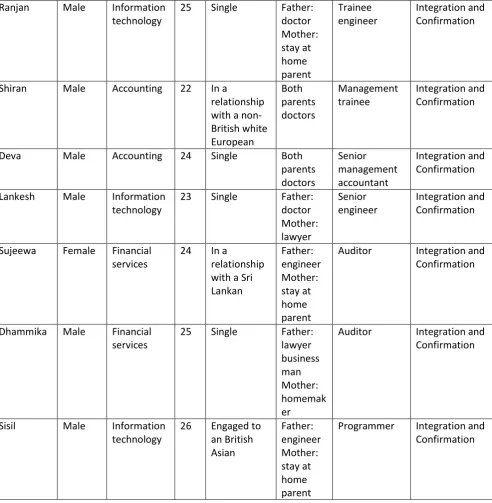
The respondents we recruited were aged 21-26 years. None of them were in people
management roles (see Table 1 for more demographic details about respondents). All
respondents were born in England and their parents were professionals. Most respondents’
parents had migrated in the 1980’s to work for the NHS as doctors. They were educated in
well-regarded comprehensive, grammar and independent schools and had studied at leading
(i.e. ‘research intensive’) universities within the UK. They belonged to the dominant ethnic
group in Sri Lanka – the Sinhalese and identified themselves as Buddhists. None of them were
married. More demographic details of respondents are available in Table 1.
INSERT TABLE 1 HERE
The first author conducted the interviews. These were held at restaurants and coffee shops
close to respondents’ workplaces and lasted for an hour. In the course of their interview
respondents were asked to reflect on their ethnic identity, explaining how they perceived
themselves and how others perceived them. We then asked them about their perceptions of
prevailing stereotypes and the extent to which they saw themselves as confirming to them.
In turn, respondents provided insights into identities that they claimed, identities they
rejected and those they attempted to reconstruct. The interviews were digitally recorded
and transcribed verbatim. The main data analysis technique was template analysis. This
involves organising and analysing textual data according to themes. We chose template
analysis because it is an effective method of reducing large amounts of interview text to a
The first level of coding was descriptive. We examined the data, looking for emergent themes,
and for key differences and similarities between them (Gioia et al. 2012). We gave these
‘codes’ descriptive labels, and assigned data extracts to them. As we worked through the
transcripts, we reviewed these descriptors and the data within them, amending them
accordingly, to ensure both consistency and manageability. From these descriptive codes we
developed more generic, more conceptual second order themes (Silverman, 2015). See Table
2 for the coding template.
INSERT TABLE 2 HERE
Our analysis further developed as we considered our respondents’ use of second order
conceptual codes. To cite an example, we found that people drew on positive Asian
stereotypes to position themselves as technical experts, and drew on their Sri Lankan heritage
to reject stereotypes of backwardness (i.e. unprogressiveness). When we noted such
dynamics we further explored them across all the transcripts. Respondents were given
pseudonyms to maintain confidentiality.
Findings
All of our respondents experienced ethnic assignation (Kenny and Briner, 2013) in terms of
feeling assigned to a panethnic Asian identity. In addition they were often assumed to be
Indian or Pakistani as opposed to Sri Lankan. In what follows we first address how participants
made sense of the panethnic identity imposed on them and the associated stereotypes. We
then draw on SIM and self-stereotyping to explore participants’ responses to ethnic
Panethnic assignation in the British IT and Finance sectors
The panethnic identity assigned to our respondents had both positive and negative
stereotypes. Participants felt positioned as ultra-conservative, backward (Fiske et al. 2002)
and clannish (showing preference for in-group members over out-group members), while also
seen as technically competent and hardworking (Kiang et al. 2016). Female respondents in
particular felt that they were often stereotyped as ultra-conservative by colleagues and
clients who did not know them on a personal basis:
There have been so many times that so many people at work have asked me ‘do you drink’ and I am like yeah why are you just asking me and not anybody else. Some people have asked ‘is it okay with your religion’ and I am like yeah I don’t even have a religion. It’s disturbing on a personal level you know – you feel like a stranger (Diane)
Financial analyst Diane highlights how, as a person of Asian heritage, she is stereotyped as
religious and backward in line with dominant perceptions of Asian Muslim communities
(Allen, 2012). Diane worked in an audit firm so it was essential to her progression that she
was perceived as being able to build relationships with clients and bring money to the firm
(Whiting et al, 2015). From this perspective, being seen as religious and backward could act
as a barrier to being recommended for leadership positions (Susuki, 2002). Furthermore the
stereotyping she experienced made Diane feel like an outsider. She and many others were
concerned about the career implications of such stereotyping and specifically what it meant
I always think – will I ever be able to be partner of our prestigious firm if they think that I am backward like most south Asian migrants out there. It’s worrying you know (Warna)
Warna worked as an auditor for a prestigious firm. He described senior partners as highly
social individuals. Therefore, he worried about how perceptions of backwardness would
influence his chances of progressing to partnership in the future (Steele, 2010; Steele et al.
2002).
Respondents from the IT sector in particular, talked about being perceived as clannish or
highly likely to favour one’s own ethnic community over others. Network engineer Pula
explains:
I was talking about a job to one of my friends at work – a job at another division which I was interested in applying to and he was sure that I will get it just because the manager was an Asian guy and they prefer their own people (Pula).
Pula’s colleague thought that he would get the job due to his ethnicity rather than
competence. Pula highlights how Asian people are perceived as being likely to disregard
meritocracy and award jobs to members of their own community. A number of male
respondents in particular expressed their disgust at this perception:
Systems architect Madura was annoyed by stereotypes of nepotism. Indeed such
un-meritocratic representation is disadvantageous to progress to senior positions. Significantly,
this perception appeared to be more prominent in the IT field in which large numbers of
Indian migrants worked.
Notably there were also positive aspects to the stereotypical Asian identity. Asian people
were seen as hardworking, competent and as possessing exceptional analytical skills, echoing
existing stereotypes of model minorities (Kiang et al. 2016).
I can remember my manager looking at one my work one day and saying ‘you are brilliant with the numbers, how do you do it’. ‘The Indian community can do wonders with numbers. He was also saying that Asian people are very hardworking in general, they get what they want somehow or the other regardless (Amrita)
In the FTSE 100 company that financial analyst Amrita worked for, she was mistaken for being
Indian. Many other respondents had similar experiences. However they did not experience
negative emotions when others endorsed positive stereotypes about their groups (see
Cheryan and Bodenhausen, 2000). Rather they felt that stereotypes of technical competence
and hard work were advantageous from a career point of view (Thompson and Kiang, 2010;
Whaley and Noel, 2013) because they increased the likelihood of being assigned to critical
projects and/or being given challenging tasks. However, as Amrita’s excerpt highlights, there
could sometimes be the insinuation of instrumentality tied to praise for hard work - implying
that people who work hard place profound emphasis on reaching their own personal goals
Navigating panethnic stereotypes
In contrast to previous findings (Kenny and Briner, 2013; Roberts et al. 2014), in our data,
decategorisation (and assimilation) were not popular SIM strategies. Notwithstanding four
notable exceptions, 26 out of 30 respondents engaged in both integration and confirmation.
In what follows, we examine this.
Integrating and confirming
Integration involves “…attempts to incorporate a given social identity into one’s professional
identity by communicating the favourable aspects of the identity and challenging others
simplistic and negative stereotypes of that group.” (Roberts, 2005: 696). Respondents
integrated by drawing on their Asian identity and/or Sri Lankan identity to claim positive
aspects of panethnic stereotypes while highlighting their distinct Sri Lankan heritage to reject
negative panethnic aspects.
Network administrator Lucky integrated by drawing on his Sri Lankan heritage to reject
stereotypes of clannishness, highlighting instead his ‘collective orientation’ (Niles, 1998)
which he attributed to being Asian:
colleagues are from different ethnic backgrounds. I have developed very strong relationships with them. It becomes easy to work if you have strong relationships with people (Lucky)
Lucky not only stereotyped the Asian community as collective (Adya, 2008) but he also applied
the stereotype to himself implying that collectiveness enables him to build meaningful
relationships at the workplace. He thus highlighted the consistency between his Asian identity
and his professional identity, especially in terms of potential to provide support to others
(House et al. 1988). However, he distinguished between collectiveness and clannishness. He
drew on his Sri Lankan identity to make the point that as a Sri Lankan he is not clannish as
other Asians might be. In other words, he attempted to distinguish individuals of Sri Lankan
heritage from other Asian communities in Britain by positively stereotyping the former (Czopp
et al. 2015).
Fana, trainee systems engineer, drew on her Sri Lankan heritage to reject stereotypes of
self-centeredness, while claiming the hardworking and ambitious aspects of the Asian identity
assigned to her:
Although Fana drew on an Asian identity to position herself as hardworking and ambitious
and therefore well placed to progress a career in investment banking, she highlighted that
she is not instrumental or self-centred in line with her Sri Lankan Buddhist identity.
A number of other respondents similarly drew on their identity as Buddhists to reject the
primacy of individual achievement, while highlighting their ‘Asian work ethic’ (Kiang et al.
2016). Carefully positioning Buddhism as a philosophy practiced by many westerners
(Nyanatiloka, 2010), they made the point that they would never negatively impact another
person, although they would work hard to achieve their goals:
I am a very hard worker – I give anything my best shot, that’s a defining characteristic of us Asians I think. But I would never use anyone as a means to end to get what I want or stop caring about people in the process. That’s not consistent with Buddhism which is the grandest philosophy on earth practiced by many westerners (Anishya)
Anishya’s statement highlights how minority ethnic employees can use other group identities
(in this case religion) to attenuate the effect of negative stereotypes within the workplace. In
attempting to integrate an Asian work ethic to her professional identity, Anishya drew on her
identity as a Buddhist to reject stereotypes of achievement at any price. Furthermore, by
highlighting the adoption of Buddhism by ‘Westerners’, she aligned herself to the British.
As we noted before, respondents who integrated also engaged in confirmation, taking
advantage of existing stereotypes about their meta group and using them to further their
themselves as exceptionally competent. Computer architect Marga explains how he is best
placed to achieve accelerated career progression:
I am very strong analytically. Most Asian people are very strong analytically. In IT, all the difficult programming is done by Indian migrants. Our technical skills are untouchable. My ambition is to reach the highest possible level in my career. I think I have what it takes. I have been consistently ranked above target (Marga).
Marga not only positively stereotypes the technical skills of the Asian community but also
claims that identity to position himself. On one hand Marga and many others believed that
exceptional technical skills guaranteed one’s career progression. On the other hand, they
suggested that perceived technical expertise might have a paradoxical effect on promotion.
While respondents were optimistic about their prospects, almost half of them talked about
being asked to ‘look at the big picture’ and not get too tangled up in details. Senior analyst
Danuka explains:
My feedback has been excellent, my analysis is really good. But I have to work on moving from analysis to look at the big picture which apparently should come through experience. I am confident of my career prospects. My boss always says that I can do wonders with numbers (Danuka).
Notably many of our respondents mentioned that they needed to look at the ‘big picture’.
process of trying hard to live up to their identity as technical specialists or whether their
technical expert identity had led bosses to believe that they over-focus on analysis.
It is also notable that three respondents from the IT sector and one from finance felt that they
were rather slow to be nominated for promotion even though their performance reviews are
excellent:
My reviews have been excellent so far but I have been slow to be promoted. I don’t know why this is (Warna)
Warna was adamant that he satisfied all the criteria to progress to senior auditor. While he
admitted that promotion is generally slow in his organisation for all employees, his technical
expert identity appeared to make him feel that he deserves to get promoted sooner than
others.
Programmer Shantha similarly talked about his stagnant progression:
I should have been promoted a year ago. I very much deserve it I think. But it hasn’t been happening. I am an expert, everybody knows this. I deserve to be recognised (Shantha).
Shantha firmly believed that he deserved some form of recognition from the company for his
technical expertise. While our research focuses on the perceptions of respondents as opposed
progression is an effect of the technical expertise identity which positions incumbents as
excellent for their existing job, but less suitable for roles further down the pipeline which
require a broader range of skills, especially the ability to ‘think outside the box’. Or else,
internalising a technical expert identity may have led to incumbents feeling entitled to an
accelerated rate of progress than others.
Notably, a number of respondents drew on social class to strategically manage their ethnic
identity by simultaneously claiming positive stereotypes and rejecting negative ones. Echoing
existing understandings of socially privileged individuals (Black and Stone, 2005; Diemer and
Ali, 2008; Lapour and Heppner, 2009), our respondents spoke about their high aspirations for
career which were significantly shaped by their professional parents’ expectations.
Furthermore, they also talked about how they learned to manage their careers from a young
age, doing what was needed to achieve their goals. In Chethiya’s words:
I obviously want to climb up to the top – my parents expect that from me too. My father is a consultant doctor. He did very well. Since I was small, I learned that you have to work hard, understand where you are and what you need to do to get to where you want to go (Chethiya).
Similarly Warna notes:
an Asian family achievement is expected. And I can’t do anything less because I have to keep up with the rest of my family members (Warna).
In this insightful excerpt, Warna makes the point that Asian families place high emphasis on
achievement. Furthermore he also states that his family taught him to work hard to achieve
his goals and that he feels the need to keep up with the career achievements of his privileged
family members. Warna drew on the intersecting social locations of ethnicity and social class
(Holivino, 2010) to explain his career aspirations and his general approach towards career. He
desired progression and was ready to do what was necessary to achieve his career goals and
fulfil his family’s expectations in the process. Many other respondents echoed Warna’s
sentiments. Based on this data, we argue that individuals’ strategic approach to managing
their ethnic identity through integration and confirmation, may be shaped by their privileged
social status.
Assimilation
Three female respondents in our sample talked about assimilating, highlighting their similarity
to British culture and difference to Asians. All three individuals were new entrants to their
organisations. Thus we might expect them to feel a greater need to fit in. Furthermore, in
contrast to other respondents, they were in relationships with white British men. On this
basis, we might expect them to feel a sense of closeness to British culture. These women
positioned themselves as ‘die-hard drinkers’ and ‘partygoers’ in line with what they saw as
stereotypical representations of British youth, and attempted to overcome stereotypes of
I drink like a horse – that’s my typical Britishness. I hail from an island after all. In a tourist island drinks and parties are common occurrences. It is completely different to the ultra-conservative Indian Pakistani culture although it is a south Asian country. I am quite tight with the office crowd. Whenever we need to do entertaining at work, I do it, because I quite like socializing. It helps in this field because we have to keep internal customers happy and build relationships with them. You have to liaise with people from logistics, financial accounting all sorts of areas (Janaki).
Senior analyst Janaki’s assimilation effects involved reference to her Sri Lankan heritage. She
aligned her British partygoer identity to her Sri Lankan heritage – emphasizing the
entertainment culture in a tourist island and its impact on people’s open-mindedness.
Furthermore in contrast to previous findings of minority ethnic individuals’ assimilation
efforts (see Roberts et al. 2014), Janaki draw distinctions between her own distinct ethnic
heritage and other Asian communities, reinforcing negative stereotypes of the latter.
Financial accountant Maya adopted a similar approach:
I party like four days a week. Alcohol swims in Sri Lankan circles – we are party people. It is probably the island effect which is very similar to British culture (Maya).
Maya similarly attempted to create a British Sri Lankan identity for herself. From a career
point of view, it is notable that constructing oneself as a heavy drinker and partygoer might
not be particularly helpful, as it may suggest a level of irresponsibility incompatible with senior
It is important to consider why respondents drew on their Sri Lankan heritage to explain their
similarity to British culture. On one hand, this may reflect incumbents’ strong identification
with their Sri Lankan roots. Or else, these individuals may not have fully identified with the
panethnic identity they felt was assigned to them, leading to their propensity to distinguish
themselves from what they saw as negative stereotypes more applicable to Indian and
Pakistani communities (Waters, 1999). Furthermore as a relatively unknown group, British Sri
Lankans had leverage to construct Sri Lankan culture in the way that they wished. This could
have also influenced respondents’ propensity to draw on their Sri Lankan heritage to
construct themselves.
It is also important to reflect on the gendered nature of assimilation. As noted before, all
three respondents who assimilated in our sample were women. People with intersecting
identities (Cole, 2009) may be seen as non-prototypical members of their identity group.
Therefore minority ethnic women located at the intersection of ethnicity and gender may be
more likely to escape the stereotypes targeted at prototypical members - to at least some
extent (Purdie-Vaughns and Eibach, 2008). From this perspective, women may be better able
to assimilate into the majority group than men who are marked as prototypical members
(Purdie-Vaughns and Eibach, 2008).
Decategorisation
Only one respondent talked about attempting to avoid categorisation altogether. He was a
For some reason or the other they think that I spend all my time with my community just because I happen to know a lot of people around who happen to be brown – it’s pure coincidental. They just assume that I like to spend time with other Asian people. I have never thought of my ethnicity. I focus on the person. I am curious, learning oriented, I read a lot. I travel – and I seek people who have similar interests. I believe that we need to broaden our horizons. This is important for any professional– broadening your horizon involves thinking of the different ways people can do things. In the IT field it is constantly about innovation and you need to think differently all the time (Akila)
By portraying himself as a well-read individual who travels the world to further enhance his
cultural knowledge, Akila constructed an intellectual identity for himself which he positioned
as congruent with professional work in the IT sector. Furthermore he rejected stereotypes of
clannishness by making the point that he sought friends with similar intellectual interests. As
a man, Akash may have considered himself as too ‘ethnically marked’ to engage in
assimilation, and therefore may have resorted to decategorisation as a way of fitting in to his
new organisation. As a new entrant, we might also expect to him to have less awareness and
experience of ethnicity based stereotyping in the organisational context, to engage in more
sophisticated SIM strategies such as integration and/or confirmation strategies.
The SIM strategies adopted by British Sri Lankan employees to navigate panethnic assignation
in the British Finance and IT sectors is summarised in Table 3.
Theoretical implications
We drew on ideas of social identity-based impression management (Roberts, 2005) and
self-stereotyping (Guimond et al., 2006) to examine how a group of British Sri Lankan employees
experience ethnic assignation (Kenny and Briner, 2013) in the IT and Finance sectors in the
UK. Based on our findings we make three key theoretical contributions. First, we advance
knowledge of the multi-level nature of ethnic identity and demonstrate ways in which
movement between superordinate and subordinate levels of ethnic identity can occur.
Through confirmation strategies (Roberts, 2005) our respondents claimed positive Asian
panethnic stereotypes complementary to their career aims. Simultaneously, they used
integration strategies by drawing on an Asian panethnic identity and/or a Sri Lankan ethnic
identity to claim positive aspects of panethnic stereotypes and highlighting their distinct Sri
Lankan heritage to reject negative aspects. Respondents identified both similarities
(Masuoka 2006; Portes and Rumbaut, 2001) and differences (Waters, 1999) between their Sri
Lankan heritage and their Asian identity. Close proximity to other Asians in the ethnically
diverse IT and Finance sectors may have served to heighten sense of difference (Bhatia, 2007;
Brettell, 2005; Schachter, 2014), although they also identified commonalities with them. The
simultaneous sense of similarity and difference may have led to individuals’ social identity
-based impression management (SIM) strategies being characterised by movement between
superordinate and subordinate levels of ethnic identity (e.g. Asian and Sri Lankan). By
considering panethnic identity (by Espiritu, 1992) as a significant variable in our study, we
were able to illuminate how people are stereotyped at the superordinate level, and how they
move down to a subordinate level to reject negative stereotypes (Walters, 1994; 1999). We
subordinate level to claim positive aspects. Thus the construction of an ethnic identity
involved dynamic movement between a superordinate Asian panethnic identity and a
subordinate Sri Lankan ethnic identity.
While studies have addressed how SIM strategies are used by individuals to claim and reject
aspects of ethnic identity (Kenny and Briner, 2013; Roberts, 2008; Roberts et al. 2014) they
have depicted this as a single level phenomena. We extend prevailing understandings by
providing insights into the multi-level use of integration and confirmation strategies in ethnic
identity construction. Psychological studies of ethnic identity recognize that ethnic group
labels are not always fixed and can occur at different levels of specificity (Phinney and Ong,
2007). By considering panethnic identity as a significant variable in our study, we were able
to illuminate the multilevel nature of ethnic identity, answering calls for deeper
understandings of how minority ethnic employees make sense of their ethnic identity in the
world of work (Kenny and Briner, 2007). As cross border movement continues to rise and
labour markets become more diverse with the entrance of second and third generation
minorities, we might expect more complexity and nuance around how people deal with ethnic
identities.
Our second contribution is to the model minority literature (Niwa et al. 2014; Rosenbloom
and Way 2004; Fiske et al. 2002; Shen et al. 2011), considering how privileged minority ethnic
individuals draw on intersecting social locations of ethnicity and social class (Cole, 2009;
Holivino, 2010) to strategically construct themselves. Drawing on their ethnic background and
privileged social class status, our respondents explained their desire to progress in career and
orientation reflects in the way individuals strategically managed their ethnic identity in the
workplace, moving up to a superordinate level to claim positive panethnic stereotypes, while
drawing on their distinct ethnic heritage (which they saw as occupying a relatively better
and/or rather unknown position) to reject negative aspects.
Examining minority ethnicity at the intersection of social class privilege, in a notable study
Atewologun and Sealy (2014) suggest that socially privileged minority ethnic professionals
experience heightened pride and self-confidence and they work actively to thrive in the
intersecting social locations that they occupy. Other research studies similarly indicate that
socially privileged individuals are generally more aspirational and motivated (Black and Stone,
2005; Diemer and Ali, 2008; Lapour and Heppner, 2009) than their socially disadvantaged
counterparts (Archer et al. 2007), and that individuals from Asian backgrounds place high
emphasis on career achievement (Shen et al. 2011). Our findings resonate with these
arguments, providing specific insights into how socially privileged minority ethnic individuals
draw on intersecting ethnic and social class identities (Holivino, 2010) to strategically
construct themselves in the workplace.
Striking here is individuals’ use of positive distinctiveness strategies (Roberts, 2005) as
opposed to avoiding categorisation altogether or attempting to into assimilate the majority.
The prominence of positive distinctiveness strategies in this sample may reflect the significant
positive stereotypes attached to model minority communities (Thompson and Kiang, 2010;
Whaley and Noel, 2013; Shen et al. 2011) and individuals’ reluctance to completely detach
themselves from these aspects (Lui, 2016). Furthermore, because people were stereotyped
as prototypical members (Purdie-Vaughns and Eibach, 2008). While the model minority
literature provides useful insights into paradoxical experiences of minority ethnic individuals
who are stereotyped both positively and negatively (Fiske et al. 2002; Kiang, 2002), it does
not explicitly consider how minority ethnic individuals draw on intersecting ethnic and social
class identities to construct themselves. Considering how a model minority group’s ethnic
identity construction may be shaped by intersecting ethnic and social class locations (Cole,
2009; Holivino, 2010), we make a significant contribution to this literature.
Third, we show the potential of individuals’ positive self-stereotyping efforts (Czopp et al.
2015) to lead to paradoxical career consequences for them. Our respondents attempted to
reinforce the belief that they, as Asians, are inherently technical and hardworking (Kiang et
al. 2016). They embraced these ‘positive’ stereotypes as they confirmed that they possess
valuable strengths that should assist the development of their careers. While it is extremely
important to demonstrate technical competency and an appetite for hard work in their
occupational fields, if individuals subscribe to the trope of inherent Asian strengths lying in
technical competence and capacity for hard work, their other strengths may not be nurtured
in the process of trying to live up to their technical expert identity. From a different
perspective, aligning hard work and technical competency to their Asian ethnicity, may result
in individuals unwittingly feeding into a larger trope about their lack of eventual suitability for
more senior roles which require a broader range of skills (Susuki, 2002; Post, 2009).
Stereotypes serve a purpose, including system justification (Cichocka et al. 2015). If British
Sri Lankan employees can be deposited into quality jobs that match their technical expertise,
it may suit decision makers to make use of these stereotypes to not promote them to into
than managers, we argue that people who position themselves as technical experts may be
less likely to be seen as natural contenders for roles that rely on a broader array of strengths.
While scholars provide insights into negative (Rosette et al. 2008) and positive stereotypes
(Kiang et al. 2016) associated with various minority ethnic identities, and recognise the
incompatibility between minority ethnic identity and professional image (Roberts et al. 2005),
there has been less focus on the career implications of individuals’ attempts to navigate these
tensions. In the case of more positively stereotyped minority groups, scholars have argued
that Asian Americans’ use of avoidance tactics to de-emphasise their racial identity is
disadvantageous for their careers in terms of the loss of positive stereotypes (Roberts et al,
2014). We extend these understandings by suggesting that individuals’ attempts to draw on
positive stereotypes to positively self-stereotype themselves (Guimond et al. 2006) are also
paradoxically disadvantageous because it can steer them away from opportunities that seem
discordant to their group stereotype (Czopp et al., 2015) and lead to them unwittingly
restricting themselves to a specialized niche.
These findings contribute to the broader efforts of organisational psychology to address social
issues such as workplace diversity, inclusion, and the career progression of minority ethnic
employees. We advance knowledge on how ethnic stereotypes are claimed and rejected and
how identities are positioned and projected by a particular group of professionals.
Furthermore we also draw attention to the potentially damaging effects of even positive
sounding stereotypes in the organisational sphere. We expect this knowledge to provide
insights into how to better support minority ethnic employees, including those whom the
organisation may view as being relatively advantaged by being considered to have specific
Practical implications
Our findings have important implications for ethnic minority careerists and practitioners.
Ethnic minority careerists should be wary of internalising positive stereotypes associated with
the model minority myth (Shen et al. 2011; Yoo et al. 2010). As a result of stereotype
internalization, people may assume that they should behave in ways consistent with the
general stereotypes and thereby end up camouflaging their individual distinctiveness in the
process. In other words, people may draw attention away from important individual
attributes such as personality and team working skills that are crucial to build solid
relationships in the workplace and to demonstrate potential for leadership.
By drawing on ethnic stereotypes to position themselves as specialists, respondents arguably
enhanced their professional identity (Roberts, 2005). However by claiming, this particular
ethnic identity, they risk reinforcing the idea that they belong in a particular ethnic niche and
they are less suitable for roles that demand a broader range of skills such as senior
management. The data shows that these young careerists are very concerned about their
progression. This is in line with their status as middle class careerists and with research which
indicates that, in the STEM fields at least, South Asian (migrant) employees may have higher
levels of management aspiration than their Caucasian counterparts (Post, 2009). Thus by
colluding with the technical expert stereotype there is a risk of negative consequences for all
parties in terms of unrealised career aims, higher turnover and under-utilised talent.
We recognise the general difficulties and some of the challenges inherent in both not wishing
However we advise caution in this respect as for some individuals, although such
reinforcement might facilitate career success in certain niches, they can shut down
opportunities in others. Organisations also risk missing out on talented senior managers.
Practitioners should raise awareness of ethnicity based stereotyping within workplaces and
its detrimental effects. This is important because it is psychologically healthier for people to
view their cultural and professional identities as compatible than oppositional (Bell and
Nkomo, 2001). While conversations around ethnicity and culture at work should not be
discouraged, it should be made clear that the aim is not to encourage the proliferation of
group stereotypes. Proliferation is dangerous because it may contribute to unconscious bias.
Limitations and directions for further research
Our findings are based on a small sample of highly skilled early career British Sri Lankans and
we realise that our respondents’ experiences may not reflect the experiences of all other
under-represented minority ethnic groups. Having said that, the purpose of our study was not
to yield generalisable understandings but rather to provide conceptual insights into how an
under-represented group makes sense of how they are perceived as an ethnic minority and
how they wish to be perceived without their identity being subsumed by their membership
of the larger minority group they belong to.
With regard to future research, scholars should examine the experiences of other
under-represented minority groups to further theoretical understandings ethnic identity. It is
important to uncover the nature of panethnic stereotypes apportioned to other
under-represented groups, the extent to which incumbents claim and reject these, and whether