Manuscript version: Author’s Accepted Manuscript
The version presented in WRAP is the author’s accepted manuscript and may differ from the published version or Version of Record.
Persistent WRAP URL:
http://wrap.warwick.ac.uk/127306
How to cite:
Please refer to published version for the most recent bibliographic citation information. If a published version is known of, the repository item page linked to above, will contain details on accessing it.
Copyright and reuse:
The Warwick Research Archive Portal (WRAP) makes this work by researchers of the University of Warwick available open access under the following conditions.
Copyright © and all moral rights to the version of the paper presented here belong to the individual author(s) and/or other copyright owners. To the extent reasonable and
practicable the material made available in WRAP has been checked for eligibility before being made available.
Copies of full items can be used for personal research or study, educational, or not-for-profit purposes without prior permission or charge. Provided that the authors, title and full
bibliographic details are credited, a hyperlink and/or URL is given for the original metadata page and the content is not changed in any way.
Publisher’s statement:
Please refer to the repository item page, publisher’s statement section, for further information.
arXiv:1505.00939v2 [math.GR] 30 Sep 2016
Complete Reducibility in Good Characteristic
Alastair J. Litterick and Adam R. Thomas
July 27, 2018
Abstract
Let G be a simple algebraic group of exceptional type, over an algebraically closed field of characteristic p≥ 0. A closed subgroup H of G is called G-completely reducible (G-cr) if wheneverH is contained in a parabolic subgroupP ofG, it is contained in a Levi subgroup of
P. In this paper we determine theG-conjugacy classes of non-G-cr simple connected subgroups of Gwhen pis good for G. For each such subgroupX, we determine the action of X on the adjoint moduleL(G) and the connected centraliser ofX inG. As a consequence we classify all non-G-cr connected reductive subgroups ofG, and determine their connected centralisers. We also classify the subgroups ofGwhich are maximal among connected reductive subgroups, but not maximal among all connected subgroups.
Contents
1 Introduction 3
2 Notation 8
3 Preliminary Results 10
3.1 Exhibiting non-G-cr subgroups . . . 10
3.2 Complements and non-abelian cohomology . . . 14
3.3 Representations and abelian cohomology . . . 17
3.4 Explicit cohomology calculations for A1 . . . 19
3.5 From Q-conjugacy to G-conjugacy . . . 22
4 Proof of Theorem 1: G=E6, p= 5 24 4.1 L′ =D 5 . . . 25
4.2 L′ =D 4 . . . 26
4.3 L′ =A1A3 . . . 28
4.4 L′ =A2
1A2 . . . 29
5 Proof of Theorem 2: G=E7, p= 5 30
5.1 L′ =E
6 . . . 31
5.2 L′ =A1D5 . . . 31
5.3 L′ =A1A2A3 . . . 32
5.4 L′ =D
5 . . . 32
5.5 L′ =A1D4 . . . 34
5.6 L′ =A2A3 . . . 34
5.7 L′ =A2
1A3 . . . 36
5.8 L′ =A3
1A2 . . . 37
5.9 L′ =D4 . . . 38
5.10 L′ =A1A3 . . . 40
5.11 L′ =A2
1A2 . . . 42
6 Proof of Theorem 2: G=E7, p= 7 42
6.1 L′ =E
6 . . . 43
6.2 L′ =A1A2A3 . . . 44
7 Proof of Theorem 3: G=E8, p= 7 44
7.1 L′ =D
7 . . . 45
7.2 L′ =A1E6 . . . 45
7.3 L′ =A
2D5 . . . 46
7.4 L′ =A
3A4 . . . 46
7.5 L′ =E6 . . . 47
7.6 L′ =D6 . . . 48
7.7 L′ =A
1A5 . . . 49
7.8 L′ =A
2D4 . . . 50
7.9 L′ =A21A4 . . . 52
7.10 L′ =A
1A2A3 . . . 53
9 Restrictions of G-modules to non-G-cr subgroups 56
10 Tables for Theorems 1–4 58
11 Further module decompositions 62
12 Acknowledgements 64
1
Introduction
LetGbe a connected reductive algebraic group defined over an algebraically closed fieldK. Follow-ing Serre [28], a closed subgroupX of Gis said to be G-completely reducible (G-cr) if wheneverX is contained in a parabolic subgroupP ofG, it is contained in a Levi subgroup ofP. IfG=GL(V), a subgroupX is G-cr if and only ifV is a completely reducible KX-module, and thusG-complete reducibility is a generalisation of the standard notion in representation theory. Similarly,Xis called
G-irreducible if X is not contained in any proper parabolic subgroup of G, andG-indecomposable
if X lies in no proper Levi subgroup ofG. TheG-cr subgroups ofGare precisely theL-irreducible subgroups of L, where L ranges over the Levi subgroups of G [3, Corollary 3.5]; the case L= G yields theG-irreducible subgroups.
By a theorem of Borel and Tits [6, Th´eor`eme 2.5], aG-cr subgroup is necessarily reductive. The converse is true provided that the characteristic of K is zero or large relative to the root system of G (cf. [15, 24, 18] and [30, Theorem 4.4]); thus non-G-cr reductive subgroups are inherently a low positive characteristic phenomenon. In this paper we consider a weak restriction on the characteristic. Recall that Char(K) is called bad for G if it is prime and divides some coefficient when the highest root in the root system of Gis expressed as a sum of simple roots, and good for
G otherwise. A number of useful subgroup structure results hold precisely when p = Char(K) is good forG. For instance, a result of Bate, Martin and R¨ohrle (Lemma 3.2) states that if pis good for G then a closed subgroup of a subsystem subgroup H is G-cr if and only if it is H-cr. Good characteristic is therefore a natural first scenario to consider when studying non-G-cr subgroups.
Now let G be simple. When G has classical type, understanding reductive subgroups of G amounts to understanding the finite-dimensional representation theory of reductive groups. In this paper we consider G of exceptional type, where much more explicit results can be expected. The bad primes here are 2 and 3 for all exceptional types, as well as 5 forE8. A result of Liebeck and
Seitz [18, Theorem 1] states that ifp >7, then every closed connected reductive subgroup ofG is G-cr. In fact, ifGis of type G2 or F4, thenp >3 suffices, and hence for these types all connected
reductive subgroups are G-completely reducible in good characteristic. This fails for G of type E6, E7 or E8. Indeed, it is shown in [33, Corollary 2] that ifp is good for G then there exists a
non-G-cr simple subgroupX of Gif and only if either X is of type A1 withp= 5 or 7, or X is of
type G2 with p= 7 andG=E7 or E8. In this paper we classify all non-G-cr simple subgroups in
Theorem 1. Let G be a simple algebraic group of type E6 in good characteristic p, and let X be
a non-G-cr simple subgroup of G. Then p = 5, X is of type A1, and X is Aut(G)-conjugate to
exactly one subgroup listed in Table 11, all of which are non-G-cr.
Theorem 2. LetG be a simple algebraic group of type E7 in good characteristicp, and letX be a
non-G-cr simple subgroup of G. Then eitherp= 5, X is of typeA1, and X is conjugate to exactly
one subgroup listed in Table 12; orp= 7, X is of type A1 or G2, andX is conjugate to exactly one
subgroup listed in Table 13 or 14. The subgroups in these tables are all non-G-cr.
Theorem 3. LetG be a simple algebraic group of type E8 in good characteristicp, and letX be a
non-G-cr simple subgroup of G. Then p= 7, X is of type A1 or G2, and X is conjugate to exactly
one subgroup listed in Table 15 or 16, all of which are non-G-cr.
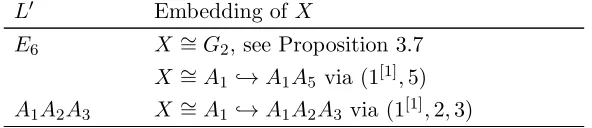
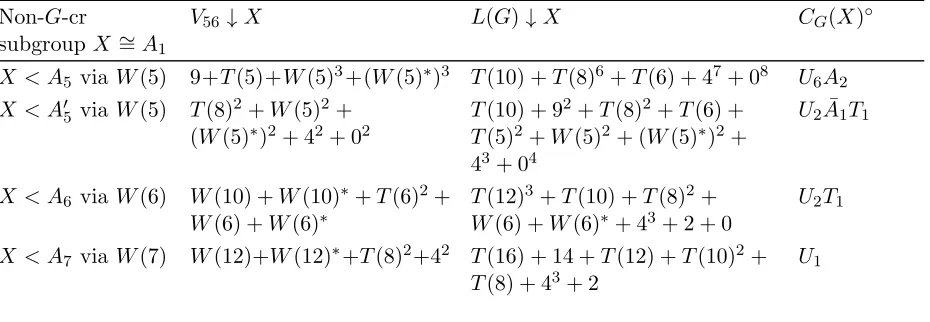
The tables in Section 10 contain additional information on the non-G-cr simple subgroups in question. For each such subgroup X, we determine the X-module structure of the adjoint module L(G) and of a non-trivial module of least dimension when G=E6 or E7. We also determine the
connected centraliser of each non-G-cr simple subgroup, which allows us to extend our results to a classification of all non-G-cr connected reductive subgroups ofG. In the subsequent corollaries, we are therefore able to make a number of observations concerning general reductive subgroups of G. Theorem 4. Let G be an exceptional simple algebraic group in good characteristic, and let X be a
non-G-cr connected reductive subgroup of G. Then one of the following holds:
(i) X is simple,
(ii) X isAut(G)-conjugate to a semisimple subgroup in Table 17,
(iii) Z(X)◦ 6= 1 and X is Aut(G)-conjugate to a subgroup in Table 18.
Each subgroup X in Tables 17 and 18 denotes a unique Aut(G)-conjugacy class unless stated
otherwise, and all such subgroups are non-G-cr.
The proof of Theorems 1–3 generalises the strategy developed in [35], which classifies non-G-cr connected reductive subgroups whenG has typeF4 with p= 2 or 3. An outline is as follows. For
each proper parabolic subgroup P of G, with unipotent radical Q and Levi factor L, we find all L-irreducible simple subgroups of typeA1or G2. This uses standard representation theory whenL
has classical simple factors, and results of the second author [36, 37] whenLhas exceptional simple factors. For each such L-irreducible subgroup X, we then study the cohomology set H1(X, Q), which parametrises theQ-conjugacy classes of complements toQinQX. This is the most technical part, and is discussed in detail in Section 3. In each case, we either describe H1(X, Q) explicitly,
or we determine sufficient information to limit the number of conjugacy classes of subgroups ofP which are isomorphic to X and not conjugate to a subgroup of L. Finally we construct explicit representatives of each class of subgroups, for instance through known embeddings into a proper reductive subgroup as in Corollary 6 below.
Theorems 1–4 to bad characteristic presents considerable technical difficulties which do not arise here; we intend to explore this in future work.
We now present a series of consequences of Theorems 1–4. We begin with an observation on how simple subgroups ofGact on certainG-modules of small dimension. Recall that a module for a reductive algebraic group is called tilting if it has a filtration by Weyl modules and a filtration by dual Weyl modules. As defined in Section 2, the notation V[e]denotes a twist of the module V
by a pe-power Frobenius morphism. Our first corollary extends Theorems 3 and 4 of [19], which treat the case whereX is G-cr:
Corollary 5. LetG be an exceptional simple algebraic group in good characteristicp, and letX be
a simple subgroup of G. Then L(G)↓X is a direct sum of modules of the form V1[r1]⊗ · · · ⊗V[rk]
k ,
and exactly one of the following holds:
(i) Each Vi is a Weyl module, a dual Weyl module or a tilting module,
(ii) p= 7 and X=G2 is a maximal subgroup of G=F4,
(iii) p= 7 andX=G2 is a non-G-cr subgroup ofG=E8 contained in a maximal subgroupG2F4
(see Theorem 3).
The subgroups in (ii) and (iii) are genuine exceptions, unique up to conjugacy in G, and both are listed in [19, Theorem 4], although the subgroup in (iii) was not shown to be non-G-cr at that time.
Remark 1.1. In [19, Theorem 4], the tensor factors in the direct summands of L(G) ↓ X arise from a factorisation X→X×X×. . .×X→Gof the inclusion of X into G. Inspecting the first and second columns of Tables 11–16 shows that in good characteristic, the same holds for non-G-cr subgroups X; if L(G)↓X has a summand which is a tensor productV1[r]⊗V2[s], then X=A1 lies
in a subgroupA1A1 of G, such that Vi is a Weyl module, dual Weyl module or tilting module for thei-th factor of this subgroup.
Remark 1.2. Inspection of Tables 11–14 also shows that ifG=E6 orE7 andX is non-G-cr then
VG(λ1)↓X (resp. VG(λ7)↓X) also satisfies part (i) of the above corollary.
Next, we consider overgroups of the non-G-cr subgroups arising. In the following, asubsystem
subgroup ofG is a semisimple subgroup which is normalised by a maximal torus of G.
Corollary 6. Let G be an exceptional simple algebraic group in good characteristic p, and let X
be a non-G-cr connected reductive subgroup of G. Then exactly one of the following holds:
(i) The semisimple subgroup X′ is properly contained in a proper subsystem subgroup of G,
(ii) p= 7 and X=A1 lies in a maximal subgroupA1G2 of G=E7,
(iii) p= 7 and X=G2 is maximal among proper connected reductive subgroups of G=E7,
Therefore a connected subgroup of G which is maximal among connected reductive subgroups, is
either a maximal connected subgroup of G, a Levi factor of a maximal parabolic subgroup of G, or
is conjugate to the group X in (iii).
The subgroups X in (ii), (iii) and (iv)are each unique up to conjugacy in G, and their
embed-dings are described in Table 13, 14 and 16, respectively.
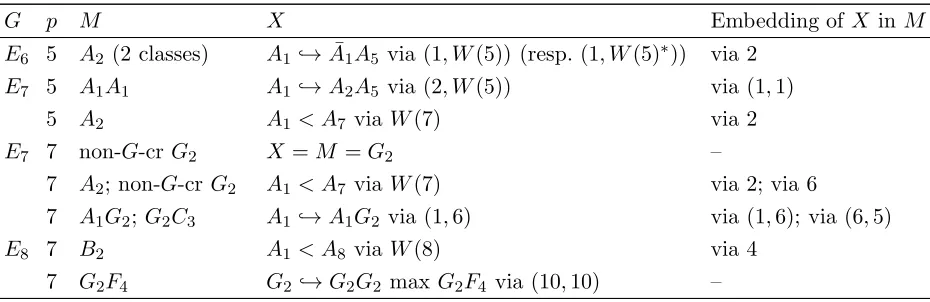
Our next result describes certain chains X ≤M < Gwhere X and M are reductive and X is G-indecomposable andM-irreducible but notG-irreducible. This contrasts with Lemma 3.2, which tells us that M cannot be a subsystem subgroup of G. The notation for embeddings in Table 1 is defined in Section 2.
Corollary 7. Let G be an exceptional simple algebraic group in good characteristic p. Let X≤M
be connected subgroups of G such that M is maximal among proper connected reductive subgroups
of G, andX isM-irr and non-G-cr. ThenG, p, X and M appear in Table 1, and all such chains
[image:7.612.75.540.323.474.2]X≤M < G satisfy the given hypotheses.
Table 1: Chains X≤M < Gwhere X is non-G-cr
G p M X Embedding of X inM
E6 5 A2 (2 classes) A1 ֒→A¯1A5 via (1, W(5)) (resp. (1, W(5)∗)) via 2
E7 5 A1A1 A1 ֒→A2A5 via (2, W(5)) via (1,1)
5 A2 A1 < A7 via W(7) via 2
E7 7 non-G-cr G2 X=M =G2 –
7 A2; non-G-crG2 A1 < A7 via W(7) via 2; via 6
7 A1G2;G2C3 A1 ֒→A1G2 via (1,6) via (1,6); via (6,5)
E8 7 B2 A1 < A8 via W(8) via 4
7 G2F4 G2 ֒→G2G2 max G2F4 via (10,10) –
Recall from [19] that a simple subgroupX of an exceptional simple algebraic group Gis called
restricted if either X =A1 and each high weight of a composition factor ofL(G) ↓ X is at most
2p−2, orX 6=A1 and whenever a high weight of a composition factor ofL(G)↓X is expressed as
a sum of fundamental dominant weights, each coefficient is at mostp−1. A semisimple subgroup is then called restricted if each of its simple factors is restricted. Our next corollary complements Theorem 1.1 of [27], which tells us that a restricted subgroup of typeA1 (called a “goodA1” there)
isG-completely reducible.
Corollary 8. Let G be an exceptional simple algebraic group in good characteristic p, and let X
be a restricted semisimple subgroup of G. Then either X isG-cr, or p= 7 and X has type G2 or
A1G2. In the latter cases, every such non-G-cr subgroup X is restricted.
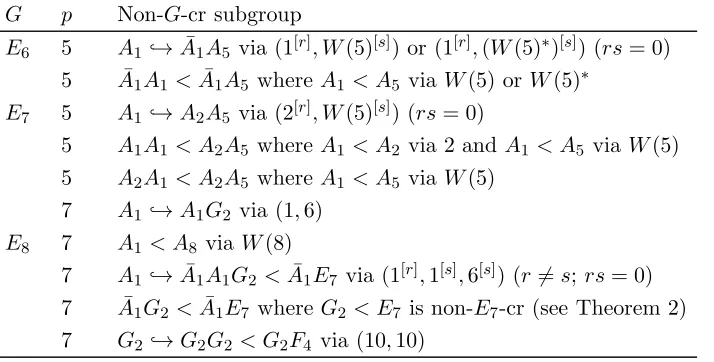
Corollary 9. LetG be an exceptional simple algebraic group in good characteristicp, and letX be
a semisimple subgroup ofG. ThenCG(X)◦ = 1 if and only ifX is either G-irreducible or conjugate
[image:8.612.133.490.162.343.2]to one of the non-G-cr subgroups in Table 2.
Table 2: Non-G-cr semisimple X with CG(X)◦ = 1. G p Non-G-cr subgroup
E6 5 A1֒→A¯1A5 via (1[r], W(5)[s]) or (1[r],(W(5)∗)[s]) (rs= 0)
5 A¯1A1 <A¯1A5 where A1 < A5 viaW(5) or W(5)∗
E7 5 A1֒→A2A5 via (2[r], W(5)[s]) (rs= 0)
5 A1A1 < A2A5 where A1 < A2 via 2 andA1 < A5 via W(5)
5 A2A1 < A2A5 where A1 < A5 viaW(5)
7 A1֒→A1G2 via (1,6)
E8 7 A1< A8 viaW(8)
7 A1֒→A¯1A1G2<A¯1E7 via (1[r],1[s],6[s]) (r 6=s;rs= 0)
7 A¯1G2<A¯1E7 whereG2< E7 is non-E7-cr (see Theorem 2)
7 G2 ֒→G2G2 < G2F4 via (10,10)
Remark 1.3. Theorems 1–4 in fact classify all non-G-cr connected subgroups in good characteristic with reductive centraliser. In particular, in good characteristic every connected reductive subgroup of G=E6 has a reductive centraliser, but this is not true forG=E7 and E8.
Remark 1.4. For a reductive subgroup X of G, let S be a maximal torus of CG(X) and let H =CG(S). Then H is minimal among Levi subgroups of GcontainingX (possiblyH =G). We observe that for each non-G-cr subgroup X appearing in Theorems 1–4, the reductive subgroup CG(H′) is a complement to the unipotent radical ofCG(X)◦. We are not aware of a general reason for this phenomenon. Note that S is also a maximal torus ofCG(H′), henceCG(X)◦/Ru(CG(X)◦) and CG(H′) necessarily have the same rank.
Remark 1.5. In the corresponding scenario with Gof classical type, we do not expect to be able to classify non-G-cr subgroupsX withCG(X)◦ = 1. For instance, if V is a non-trivial irreducible X-module with H1(X, V) 6= 0, then X occurs as a non-G-cr subgroup in a maximal parabolic subgroup of G = SL(V ⊕K). The corresponding unipotent radical is isomorphic to V as an algebraic X-group, hence CG(X)◦ contains no unipotent elements, and is therefore a torus. Since X does not lie in a proper Levi subgroup of G, it cannot centralise a non-trivial torus, and so CG(X)◦ = 1.
parametrising conjugacy classes of complements to Q in QX. We observe that this phenomenon does not occur for exceptional groups in good characteristic:
Corollary 10. Let G be an exceptional simple algebraic group in good characteristic p, let P be a
parabolic subgroup ofGwith Levi decomposition P =QL, and letX≤Lbe anL-irreducible simple
subgroup. Then complements to Qin QX fall into finitely many G-conjugacy classes of subgroups.
As a consequence of [22, Theorem 3], every Levi subgroup L of G has either finitely many L-irreducible simple subgroups of a given isomorphism type, up to L-conjugacy, or a countably infinite number, depending on a choice of a finite number of field twists. The following is thus immediate from Corollary 10.
Corollary 11. Let G be an exceptional simple algebraic group, over an algebraically closed fieldK
of characteristic pwhich is good forG. Then Ghas countably many conjugacy classes of connected
reductive subgroups.
In particular, the classes of non-G-cr simple subgroups occurring are as follows: Countably
infinitely many classes of subgroups A1 when (G, p) = (E6,5), (E7,5) or (E8,7); two classes of
subgroups A1 and one class of subgroups G2 when (G, p) = (E7,7); and two classes of subgroups
G2 when (G, p) = (E8,7).
Note that the corresponding result does not hold for exceptional groups in bad characteristic, for instance if K has characteristic 2 or 3 then by [35, Theorem 1(B)] the group F4(K) has a
series of pairwise non-conjugate non-G-cr subgroups of typeA1, parametrised by closed points of
a positive-dimensional variety overK.
2
Notation
Throughout,Gdenotes a simple algebraic group over an algebraically closed fieldKof characteristic p > 0, where p is good for G. Subgroups of G are taken to be closed, and homomorphisms are taken to be morphisms of varieties. For us, “simple” and “semisimple” subgroups ofGwill always refer to connected subgroups. In addition, conjugation will always be a left action.
Let Φ be set of roots of G, with respect to a fixed maximal torusT ≤G. Let Π = {α1, . . . , αl} be a base of simple roots corresponding to a choice of Borel subgroup containingT, and letW(G) = NG(T)/T be the Weyl group ofG. Let{λ1, . . . , λl}be the set of fundamental dominant weight of G. We use the Bourbaki ordering on nodes of the Dynkin diagram, cf. [8, Ch. VI, Planches I-IX]. We sometimes usea1a2. . . al to denote either a roota1α1+a2α2+. . .+alαl or a dominant weight a1λ1+a2λ2+. . .+alλl; context will prevent ambiguity.
For a root α, we make the following definitions. The Weyl group W(G) acts on the left on
ZΦ⊗R, and we let sα denote the reflection in the hyperplane perpendicular to α. We let Uα =
For a dominant weight λ, we denote by VG(λ) (or just λ) the irreducibleG-module of highest weightλ. Similarly, the Weyl module of highest weightλis denotedW(λ) =WG(λ), and the tilting module of highest weightλ is denoted byT(λ). The dual of aG-moduleV is V∗ = HomK(V, K). If Y = Y1Y2. . . Yk is a commuting product of simple algebraic groups, then (V1, . . . , Vk) denotes theY-moduleV1⊗ · · · ⊗Vk where Vi is a Yi-module for each i. Let F : G→ Gbe the Frobenius endomorphism of G which acts by sending the root element xα(c) to xα(cp), and let V be a G-module afforded by a representation ρ : G → GL(V). Then V[r] denotes the module afforded
by the representation ρ[r] def= ρ◦Fr. Let M
1, . . . , Mk be X-modules and m1, . . . , mk be positive integers. Then M1m1/ . . . /Mmk
k denotes an X-module having the same composition factors as M1m1 ⊕. . .⊕Mmk
k . Furthermore, V = M1|. . .|Mk denotes an X-module with a series V =V1 > V2 > . . . > Vk+1= 0 of submodules such that soc(V /Vi+1) =Vi/Vi+1 ∼=Mi for 1≤i≤k. Finally, we let L(G) denote the adjoint module for G, which is always irreducible for G of exceptional type when p is good for G. For G of type E6 we set V27 = VG(λ1), and for G of type E7 we set
V56=VG(λ7).
The notation ¯A1 denotes a subgroup A1 of G which is generated by long root subgroups; we
use this to help keep track of simple factors in semisimple groups. If the root system ofGcontains short roots, then ˜A1 and ˜A2 are used to denote subgroups generated by short root subgroups.
LetJ ={αj1, αj2, . . . , αjr} ⊆Π and define ΦJ = Φ∩ZJ. Then the standard parabolic subgroup
corresponding to J is P =Pj1j2...jr =hT, Uα : α∈ΦJ ∪Φ+i. The Levi decomposition ofP isP =
QL where Q = Qj1j2...jr = Ru(P) = hUα : α∈Φ
+\Φ
Ji, and L = Lj1j2...jr = hT, Uα : α ∈ΦJi
is the standard Levi complement. If the semisimple subgroup L′ has Lie type X, for brevity we refer to P as an “X-parabolic subgroup of G”, so for instance the parabolic subgroup of G =E6
corresponding to the roots {α2, α3, α4, α5} is aD4-parabolic subgroup.
For a standard Levi subgroup L, we use the following notation. If L0 is a simple component
of L then the simple roots forL0 are a subset of Π, say Ψ ={α′1, . . . , α′m}. Order Π according to αi < αj if i < j. IfL0 has Lie type Am, the embedding is chosen such thatα′1 is the least simple
root of G contained in Ψ. IfL0 has type E6 or E7, then α′i =αi for all i. IfL0 has type D4 then
(α′
1, α′2, α′3, α′4) = (α2, α4, α3, α5). IfL0has typeD5then (α′1, α′2, α′3, α′4, α5′) = (α1, α3, α4, α5, α2) or
(α6, α5, α4, α3, α2). IfL0 has typeD6 then (α′1, α′2, α′3, α′4, α′5, α′6) = (α7, α6, α5, α4, α3, α2). Finally,
ifLhas multiple components of the same type, then these components are ordered according to the position of their least simple root “α′
1” as an element of Π. For instance, ifG=E7 andL=L12567
is a Levi subgroup of type A1A1A3, then the firstA1 factor corresponds to α1, and the second to
α2.
For i≥1 we define the subgroups
Q(i) =
*
Uγ : γ =
X
α∈Π
cαα,
X
α∈Π\J cα≥i
+
.
The i-th level of Qis Vi def= Q(i)/Q(i+ 1), which is central in Q/Q(i+ 1). By [2, Theorem 2] each
level ofQhas the structure of a completely reducibleL-module. Thelevel of a rootγ =P
α∈Πcαα is the sumP
α∈Π\Jcα, and theheight ofγ is Pα∈Πcα.
When G has type E7 or E8, we will need to distinguish between certain isomorphic
representatives A5 = L24567 and A′5 = L34567, where our notation follows that of [18, Table 8.2].
These subgroups have connected centralisers CG(A5)◦ = A2 and CG(A′5)◦ = A1T1 where T1 is a
1-dimensional torus. FurthermoreA′5 is contained in a subgroupE6 whereasA5 is not. InE8 there
are two conjugacy classes of subgroupsA7, with representatives the Levi subgroupL1345678, which
we denote byA7, and a subgroupA′7 which is a subsystem subgroup of a Levi subgroupE7. Then
CG(A7)◦ is a 1-dimensional torus, andCG(A′7)◦=A1.
Next, suppose that G is of classical type or of type G2, and that X has type A1 or G2. Then
the notation “X < G via M” denotes an embedding X → G such that VG(λ1) ↓ X ∼= M. Since
p 6= 2 throughout, this determines the image of X up to G-conjugacy, unless G has type Dn, in which case there are potentially two G-conjugacy classes with this action and we use this notation to refer to both simultaneously, specifying additional information when appropriate.
Now let Y =H1H2. . . Hk be a commuting product of simple subgroupsHi all having the same type,A1 or G2. Then the simply-connected cover of Y is ˆY ∼=H×H . . .×H (k terms), whereH
is simply-connected of typeA1 or G2. We have a natural isogeny ˆY →Y, and adiagonal subgroup
of Y is the image in Y of a subgroup of the form {(φ1(h), . . . , φk(h)) : h ∈ H}, where each φi is an endomorphism of H. By [31, Chapter 12], an endomorphism of H is a product of an inner, graph and field morphism. Since A1 and G2 have no non-trivial graph automorphisms, to specify
a diagonal subgroup of Y up to Y-conjugacy it suffices to specify non-negative integers r1, . . . , rk, and we then take φi = Fri for each i. A diagonal subgroup X of Y is thus denoted by “X ֒→ Y via (λ[1r1], λ[1r2], . . . , λ[rk]
1 )”.
Taking this further, letX have typeA1 orG2, and letY =H1H2. . . Hk(k >1) be semisimple, where each simple factor Hi is classical or of type G2. Then “X ֒→ Y via (M1[r1], . . . , M
[rk] k )” denotes a diagonal subgroup ofX1. . . Xk, with field twists r1, . . . , rk, where each Xi has the same type as X, and Xi < Hi via Mi.
When discussing the centraliser of a subgroup X of G, we will use the notation Ui to denote ani-dimensional unipotent group, andTj to denote aj-dimensional torus. For instance CG(X)◦ = U5T1 means that CG(X)◦ has a 5-dimensional unipotent radical, with corresponding quotient a 1-dimensional torus.
3
Preliminary Results
3.1 Exhibiting non-G-cr subgroups
In this section we present preliminary results required for the proofs of Theorems 1–3 and their corollaries. The first of these limits the isomorphism types of non-G-cr simple subgroups occurring. Lemma 3.1. Let G be an exceptional algebraic group in good characteristic p, and suppose G
has a non-G-cr simple subgroup of type X. Then (G, X, p) is one of (E6, A1,5), (E7, A1,5 or 7),
(E7, G2,7) or (E8, A1 or G2,7).
Proof. This follows immediately from [18, Theorem 1] and [33, Theorem 1], the latter result ruling
Recall that our basic strategy for finding non-G-cr subgroups of G is to iterate through the parabolic subgroups P = QL of G, letting X be an L-irreducible subgroup A1 or G2 of L, and
then studying complements to Q in the semidirect product QX. We derive an upper bound for the number of such complements (up to G-conjugacy), and it then remains to exhibit an explicit representative of each conjugacy class of subgroups. The next result allows us to quickly find such representatives.
Recall that a simple group H of classical type is related by isogenies to a special linear, or-thogonal or symplectic group, say Cl(V). For p 6= 2, a subgroup X of Cl(V) is Cl(V)-cr if and only if V is a completely reducible X-module (cf. Lemma 3.4 below). Since complete reducibility is well-behaved with respect to isogenies [3, Lemma 2.12], a subgroup of a simple algebraic group H of classical type is H-completely reducible if and only if the corresponding subgroup of Cl(V) acts completely reducibly onV. We now appeal to the following:
Lemma 3.2 ([3, Theorem 3.26]). Let G be a simple algebraic group in good characteristic and let
M be a subsystem subgroup of G. Then a subgroup H of M isG-cr if and only if it is M-cr.
Thus a non-completely reducible X-moduleV gives rise to an embedding of X into a classical groupH with non-H-cr image. IfH is a subsystem subgroup ofGthis then gives rise to a non-G-cr subgroup of G.
In employing Lemma 3.2, we will often refer to maximal connected subgroups of G, that is, subgroups which are maximal among connected subgroups of G. The following result determines all reductive such subgroups up to G-conjugacy.
Lemma 3.3 ([20, Corollary 2]). Let G be a simple exceptional algebraic group in characteristic
p = 5 or 7. Let M be a reductive, maximal connected subgroup of G. Then M is G-conjugate to
a subgroup in the following table, where each isomorphism type X denotes a unique G-conjugacy
class of subgroups.
G X
G2 A2, A1A˜1, A1 (p= 7)
F4 B4, A1C3, A1G2, A2A˜2, G2 (p= 7)
E6 A1A5,A32, F4, C4, A2G2, G2 (p= 5, two classes), A2 (two classes)
E7 A1D6, A7, A2A5, G2C3, A1F4, A1G2, A1A1, A2
E8 D8, A8, A1E7, A2E6, A24, G2F4, B2, A1A2
For L a Levi subgroup of an exceptional algebraic group, the following results yield all L-irreducible subgroups of typeA1 or G2.
Lemma 3.4 ([22, Lemma 2.2]). Let G = Cl(V) be a classical simple algebraic group in
charac-teristic p6= 2, and let X be a G-irreducible semisimple subgroup of G. Then one of the following
holds:
(i) G=An and X is irreducible on V.
(ii) G = Bn, Cn or Dn and V ↓ X = V1 ⊥ . . . ⊥ Vk with the Vi all non-degenerate, irreducible
Lemma 3.5. Let p >2 and let X be simple of type A1. Let V =VX(n) be a restricted irreducible
X-module (so n < p). Then X preserves a non-degenerate symplectic form on V if n is odd, and
X preserves a non-degenerate orthogonal form onV if n is even.
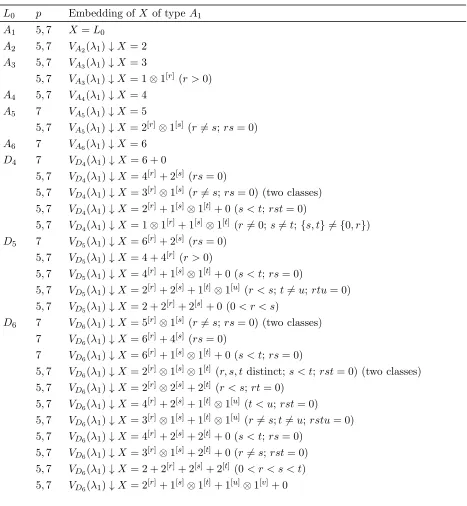
Proposition 3.6. Let L0 be a simple factor of a proper Levi subgroup ofG=E6 or E7 withp= 5,
or of G=E7 or E8 with p= 7. The table below lists all simpleL0-irreducible subgroups X of type
[image:13.612.74.541.199.705.2]A1, up to L0-conjugacy.
Table 4: L0-irreducible subgroups of typeA1
L0 p Embedding ofX of type A1
A1 5,7 X=L0
A2 5,7 VA2(λ1)↓X = 2
A3 5,7 VA3(λ1)↓X = 3
5,7 VA3(λ1)↓X = 1⊗1[r] (r >0)
A4 5,7 VA4(λ1)↓X = 4
A5 7 VA5(λ1)↓X = 5
5,7 VA5(λ1)↓X = 2[r]⊗1[s](r6=s;rs= 0)
A6 7 VA6(λ1)↓X = 6
D4 7 VD4(λ1)↓X = 6 + 0
5,7 VD4(λ1)↓X = 4[r]+ 2[s](rs= 0)
5,7 VD4(λ1)↓X = 3[r]⊗1[s](r6=s;rs= 0) (two classes)
5,7 VD4(λ1)↓X = 2[r]+ 1[s]⊗1[t]+ 0 (s < t;rst= 0)
5,7 VD4(λ1)↓X = 1⊗1[r]+ 1[s]⊗1[t] (r 6= 0;s=6 t;{s, t} 6={0, r})
D5 7 VD5(λ1)↓X = 6[r]+ 2[s](rs= 0)
5,7 VD5(λ1)↓X = 4 + 4[r] (r >0)
5,7 VD5(λ1)↓X = 4[r]+ 1[s]⊗1[t]+ 0 (s < t;rs= 0)
5,7 VD5(λ1)↓X = 2[r]+ 2[s]+ 1[t]⊗1[u](r < s;t6=u;rtu= 0)
5,7 VD5(λ1)↓X = 2 + 2[r]+ 2[s]+ 0 (0< r < s)
D6 7 VD6(λ1)↓X = 5[r]⊗1[s](r6=s;rs= 0) (two classes)
7 VD6(λ1)↓X = 6[r]+ 4[s](rs= 0)
7 VD6(λ1)↓X = 6[r]+ 1[s]⊗1[t]+ 0 (s < t;rs= 0)
5,7 VD6(λ1)↓X = 2[r]⊗1[s]⊗1[t] (r, s, t distinct; s < t;rst= 0) (two classes)
5,7 VD6(λ1)↓X = 2[r]⊗2[s]+ 2[t] (r < s;rt= 0)
5,7 VD6(λ1)↓X = 4[r]+ 2[s]+ 1[t]⊗1[u](t < u;rst= 0)
5,7 VD6(λ1)↓X = 3[r]⊗1[s]+ 1[t]⊗1[u](r6=s;t6=u;rstu= 0)
5,7 VD6(λ1)↓X = 4[r]+ 2[s]+ 2[t]+ 0 (s < t;rs= 0)
5,7 VD6(λ1)↓X = 3[r]⊗1[s]+ 2[t]+ 0 (r 6=s;rst= 0)
5,7 VD6(λ1)↓X = 2 + 2[r]+ 2[s]+ 2[t] (0< r < s < t)
(s < t;u < v;s≤u; if s=u thent < v;rs= 0) 5,7 VD6(λ1)↓X = 1⊗1[r]+ 1[s]⊗1[t]+ 1[u]⊗1[v]
(r 6= 0;s6=t,u6=v;s≤min{t, u, v}; {0, r},{s, t},{u, v}pairwise distinct.) D7 7 VD7(λ1)↓X = 6 + 6[r] (r >0)
7 VD7(λ1)↓X = 6[r]+ 2[s]+ 2[t]+ 0 (s < t;rs= 0)
7 VD7(λ1)↓X = 6[r]+ 2[s]+ 1[t]⊗1[u](t < u;rst= 0)
7 VD7(λ1)↓X = 4[r]+ 4[s]+ 1[t]⊗1[u](r < s;t < u;rt= 0)
7 VD7(λ1)↓X = 4[r]+ 4[s]+ 2[t]+ 0 (r < s;rt= 0)
7 VD7(λ1)↓X = 4[r]+ 3[s]⊗1[t]+ 0 (s6=t;rst= 0)
7 VD7(λ1)↓X = 4[r]+ 2[s]+ 2[t]+ 2[u](s < t < u;rs= 0)
7 VD7(λ1)↓X = 3[r]⊗1[s]+ 2[t]+ 2[u](r6=s;t < u;rst= 0)
7 VD7(λ1)↓X = 4[r]+ 1[s]⊗1[t]+ 1[u]⊗1[v]+ 0
(s < t;u < v;s≤u; ifs=uthen t < v;rsu= 0)
7 VD7(λ1)↓X = 2[r]+ 2[s]+ 2[t]+ 1[u]⊗1[v]+ 0 (r < s < t;u < v;ru= 0)
7 VD7(λ1)↓X = 2[r]+ 2[s]+ 1[t]⊗1[u]+ 1[v]⊗1[w]
(r < s;t < u;v < w;t≤v; ift=v thenu < w; rtv= 0) E6 7 X ֒→A¯1A5 via (1[r],5[s]) (rs= 0)
7 X ֒→A2G2 via (2[r],6[s]) (r 6=s;rs= 0)
5,7 X ֒→A¯1A5 via (1[r],2[s]⊗1[t]) (s6=t;rst= 0)
5,7 X ֒→A3
2 via (2,2[r],2[s]) (0< r < s)
E7 7 X <A¯1D6 see [37, Theorem 4] for explicit classes
7 X < A1A1 via (1[r],1[s]) (r6=s;rs= 0)
7 X < A1G2 via (1[r],6[s]) (r6=s;rs= 0)
7 X < G2C3 via (6[r],5[s]) (r6=s;rs= 0)
7 X < G2C3 via (6[r],2[s]⊗1[t]) (s /∈ {r, t};rst= 0)
Proof. ForL0 =E6andE7, this follows from [37, Theorems 3 and 4]. ForL0of typeAn, this follows
from Lemmas 3.4 and 3.5. For L0 of typeDn, Lemmas 3.4 and 3.5 imply that the given subgroups of type A1 are distinct and unique up to conjugacy as a subgroup of GO2n(K) = SO2n(K)hτi, where τ induces a graph automorphism on SO2n(K). It remains to determine whether such a conjugacy class of subgroups splits into two classes of subgroups of SO2n(K). This is equivalent to determining whether NGO2n(K)(X) ≤SO2n(K). Since X =A1 has no non-trivial outer algebraic
automorphisms, there are precisely two possibilities: EitherXlies in the centraliser of some element ofGO2n(K)\SO2n(K), which by [14, Table 4.3.1] is the stabiliserBkBn−k−1 (n/2≤k≤n−1) of
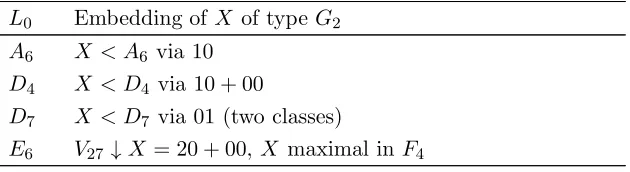
Proposition 3.7. Let L0 be a simple factor of a proper Levi subgroup ofG=E7 or E8 withp= 7.
[image:15.612.150.465.143.229.2]The table below lists all simple L0-irreducible subgroups X of type G2, up toL0-conjugacy.
Table 5: L0-irreducible subgroups of type G2
L0 Embedding of X of typeG2
A6 X < A6 via 10
D4 X < D4 via 10 + 00
D7 X < D7 via 01 (two classes)
E6 V27↓X= 20 + 00, X maximal in F4
Proof. For L0 exceptional, the result follows from [36, Theorems 2 and 3]. For L0 classical, this is
similar to the previous proposition, using Lemma 3.4 and [23], and easier since G2 has far fewer
modules of low dimension.
3.2 Complements and non-abelian cohomology
In this section, we describe a method for classifying complements in parabolic subgroups by ap-proximating certain non-abelian cohomology sets. The technique was pioneered by D. Stewart in his Ph. D. thesis, and our definitions and strategy are taken from [35, Section 3.2].
Recall that if X and Q are algebraic groups over K, with a morphism X×Q →Q giving an action of X on Q, then complements to Q in the semidirect product QX correspond bijectively with rational1-cocycles, which are variety morphismsφ : X→Q such thatφ(xy) =φ(x)(x.φ(y)) for allx, y∈X. Here, a complementX′ toQis a closed subgroup ofQX satisfying (i)QX′=QX, (ii) Q∩X′ = 1, and (iii) L(Q)∩L(X′) ={0} (cf. [25, 4.3.1]). By [34, Lemma 3.6.1], a subgroup satisfying (i) and (ii) automatically satisfies (iii) when X is connected reductive, Q is unipotent and p6= 2.
Two cocycles φ, ψ are cohomologous if there exists q ∈ Q such that φ(x) = q−1ψ(x)(x.q) for all x ∈ X. This defines an equivalence relation on the set Z1(X, Q) of 1-cocycles, and the
corresponding quotient is called thecohomology set H1(X, Q), which parametrises complements up to Q-conjugacy. The set H1(X, Q) has a distinguished element, denoted [0], which is the class of the map sending every element ofX to the identity of Q. In general, H1(X, Q) is only a pointed
set, but ifQis a KX-module, thenH1(X, Q) is aK-vector space in a natural way.
In our calculations X will always be simple, and Q will always be connected and unipotent, with a filtration byX-stable connected subgroupsQ=Q(1)⊲Q(2)⊲. . .⊲Q(r+ 1) = 1 such that each section Vi def= Q(i)/Q(i+ 1) is a rational KX-module which is central in Q/Q(i+ 1). This allows us to study H1(X, Q) in terms of the vector-space direct sum
V=VX,Qdef=
r
M
i=1
H1(X, Vi)
We first recall some results from non-abelian cohomology, using [29,§I.5] as a standard reference. IfR is an X-stable central subgroup of Q, then the short exact sequence
0→R→Q→Q/R →0 gives rise to a long exact sequence of pointed sets:
0→RX →QX →(Q/R)X →H1(X, R)→H1(X, Q)→H1(X, Q/R)→H2(X, R)
where −X denotes a fixed-point subgroup, and where H2(X, R) is the usual second abelian coho-mology group, defined for example in [16,§II.4.2]. SinceRis central inQ, the groupH1(X, R) acts on H1(X, Q) on the left; for [φ]∈H1(X, R) and [ψ]∈ H1(X, Q) we have [φ].[ψ] = [φ·ψ], where
φ·ψ(x)def= φ(x)ψ(x) for all x∈X. Since we shall use this in Lemma 3.10 below, we note that the condition for a group action becomes [φ].([φ′].[ψ]) = [φ+φ′].[ψ] ifH1(X, R) is written additively.
Lemma 3.8 ([29,§I.5.7, Proposition 42]). With X, Q and R as above, two elements of H1(X, Q)
have the same image in H1(X, Q/R) if and only if they lie in the same H1(X, R)-orbit.
Definition 3.9 (cf. [35, Definition 3.2.5]). For i = 1, . . . , r we define a partial map ρi : V → H1(X, Q/Q(i+ 1)) as follows. Fori= 1, setρ1([γ1], . . . ,[γr]) = [γ1]. Fori >1, ifρi−1([γ1], . . . ,[γr]) is defined and lifts to some element [Γ] under the natural mapH1(X, Q/Q(i+1))→H1(X, Q/Q(i)), then set ρi([γ1], . . . ,[γr]) = [γi].[Γ], otherwise declare ρi undefined at ([γ1], . . . ,[γr]).
We setρ=ρr. Note thatρi([γ1], . . . ,[γr]) depends only on the firsticoordinates of its argument, but does depend on the choice of lifts made. We pick lifts to be consistent with the convention that ρi([0],[0], . . . ,[0]) = [0] for alli.
Lemma 3.10 (cf. [35, Proposition 3.2.6]). Each partial map ρi : V → H1(X, Q/Q(i+ 1)) is
surjective.
Proof. Proceed by induction on i. The result is trivial for i = 1. If i > 1, then a class [φ] ∈
H1(X, Q/Q(i+ 1)) gives a class [φ′]∈H1(X, Q/Q(i)) under the natural map. By induction, there existsv= ([γ1],[γ2], . . . ,[γr])∈Vsuch thatρi−1(v) = [φ′]. Since [φ′] has a lift inH1(X, Q/Q(i+1)),
namely [φ], the class ρi(v) is defined. Now, ρi(v) and [φ] have the same image inH1(X, Q/Q(i)), hence by Lemma 3.8 there exists [δ]∈H1(X, Vi) such that [φ] = [δ].ρi(v). But by definition ofρi, the right-hand side is equal to [δ].([γi].[Γ]) = [δ +γi].[Γ], where [Γ] is the chosen fixed lift of [φ′] to H1(X, Q/Q(i+ 1)). Then we have [δ+γ
i].[Γ] =ρi([γ1],[γ2], . . . ,[γi−1],[δ +γi],[γi+1], . . . ,[γr]), hence [φ] lies in the image ofρi.
As an immediate consequence, we obtain the following. Corollary 3.11. If H1(X, V
i) = 0 for each i, then H1(X, Q) = 0. In this case, every complement
to Q in QX is Q-conjugate to X.
Since the mapρis a surjection from a subset ofVtoH1(X, Q), choosing a basis ofVallows us to
parametrise conjugacy classes of complements toQinQXby certain orderedm-tuples (k1, . . . , km) of elements of K, for some m ≥ 0. We denote by X[k1,k2,...,km] a fixed complement to Q in QX
We now consider the question of when ρ(v) = ρ(w) for v, w ∈ V. If Q = Ru(P) for a
parabolic subgroupP ofG, the Chevalley commutator relations give us precise information about theX-group structure of Q, which in turn lets us derive information about the setH1(X, Q).
For each iandj, we have the containment [Q(i), Q(j)]⊆Q(i+j), whereQ(i) = 1 for alli > r. Thus for eachv∈Vj, we get a mapQ(i)→Q(i+j), sendingq∈Q(i) to [ˆv, q], where ˆvis a fixed lift of v to Q(j). Composition with the quotient Q(i+j) →Vi+j gives a mapcv =cv,i : Q(i) →Vi+j which is independent of the choice of lift ˆv. From standard properties of commutators,
cv(uw) = [ˆv, uw]Q(i+j+ 1)
= [ˆv, u] (u[ˆv, w])Q(i+j+ 1)
and since Vi+j is central in Q/Q(i+j + 1), the above is equal to cv(u)cv(w), so cv is a group homomorphism. In addition, if v∈Vj is fixed by X, then we claimcv is X-equivariant. Indeed, if u∈Q(i), then for all x∈X we have
cv(xu) = [ˆv,xu]Q(i+j+ 1) = [(xˆv)v′,xu]Q(i+j+ 1)
for some v′ ∈ Q(j+ 1). Since v′ commutes with Q(i) modulo Q(i+j+ 1), the above equals x[ˆv, u]Q(i+j+ 1) = xc
v(u). Moreover, since Q(i+ 1) lies in the kernel of cv,i, this descends to a homomorphism Vi →Vi+j ofX-modules.
Our next proposition is rather technical, so we take a moment to discuss its use in proving our main theorems. Informally, it states that if U and W are summands occurring in levels ofQ, with H1(X, U) ∼= H1(X, W) =∼ K, and if x ∈ QX induces an isomorphism U → W, then the partial maps ρi are surjective on the subset of V which gives a cocycle on at least one of U or W. If elements ofV=H1(X, U)⊕H1(X, W)⊕. . .are given by tuples (k1, k2, . . .), then this allows us to
assume that k1k2 = 0.
Proposition 3.12. With X and Q as above, suppose that v ∈ VX
j for some j < r, and let n
be minimal such that cv,n : Vn → Vn+j is non-zero. Suppose that the subspace hvi lifts to a 1
-dimensional subgroup of (Q/Q(n+j+ 1))X. Let U and W be direct summands of V
n and Vn+j,
respectively, such that cv,n : Vn → Vn+j restricts to an isomorphism U → W. Suppose also that
H1(X, U)∼=K.
Pick a basis {el : l= 1, . . . , m} of V, where each vector el lies in the image of some inclusion
H1(X, Vi) → V, and where e1 and e2 respectively lie in the images of H1(X, U) and H1(X, W).
Finally, define
V0= ( m
X
l=1
tlel : tl∈K, t1t2= 0
)
.
Then for each i≥n+j, the restricted partial map ρi : V0 →H1(X, Q/Q(i+ 1)) is surjective.
Proof. Note first that by our choice of basis, ifi6=n, n+jthen the image ofH1(X, Vi) is spanned
By Lemma 3.10, if 1 < i≤r then every element of H1(X, Q/Q(i+ 1)) is of the form ρi(v) = [φ].ρ′
i−1(v) for some [φ]∈H1(X, Vi) and somev ∈V, where ρ′i−1(v) ∈ H1(X, Q/Q(i+ 1)) is the
fixed lift ofρi−1(v)∈H1(X, Q/Q(i)).
For an induction on i, suppose that r > i −1 ≥ n +j, and suppose that the restriction ρi−1 : V0 → H1(X, Q/Q(i)) is surjective. Let ρi(v) ∈ H1(X, Q/Q(i+ 1)), and write ρi−1(v) =
ρi−1(w) for some w ∈ V0. Then ρ′i−1(v) = ρ′i−1(w) since the choice of lift is fixed, and thus
ρi(v) = [φ].ρ′i−1(v) = [φ].ρ′i−1(w) for some [φ]∈H1(X, Vi). Moreover, by definition of ρi we have [φ].ρ′
i−1(w) =ρi([φ] +w), where on the right-hand side we have identified [φ] with its image under the natural inclusion H1(X, Vi) → V. By the observation in the first paragraph above, we have [φ] +w∈V0, and the restriction of ρi to V0 is surjective, as required.
It remains to prove thatρn+j : V0 →H1(X, Q/Q(n+j+ 1)) is surjective. For ease of notation
we may replaceQwith Q/Q(n+j+ 1) without loss of generality, so that ρ=ρr =ρn+j. Suppose thatρ(v) is defined, wherev=Pm
l=1tlelandt1t2 6= 0. By minimality ofn, conjugation
by a lift ˆv ∈QX of v∈VX
j sends a complement corresponding to [φ]∈H1(X, Q) to a complement corresponding to [cv,n◦φ].[φ], where [cv,n◦φ] ∈ H1(X, Q(n+j)). Therefore these cohomology classes correspond to the sameQ-conjugacy class of complements toQinQX, and hence are equal. SinceW is anX-module direct summand ofQ(n+j), there is a natural projectionQ(n+j)→W, and the image of [cv,n◦φ] under the induced mapH1(X, Q(n+j))→H1(X, W) is a multiple ofe2.
Moreover this multiple must be non-zero, since by hypothesis the mapcv,ninduces an isomorphism U →W and therefore induces an isomorphism H1(X, U)→ H1(X, V). Scaling e2 if necessary, we
can assume that that this image is−t2e2. So if [φ] =ρ(v), then [φ] = [cv,n◦φ].[φ] = [−t2e2].ρ(v) =
ρ(v−t2e2), and the vectorv−t2e2 lies inV0, which proves the desired result.
As a special case, we obtain the following.
Corollary 3.13. With X and Q as above, suppose that V=H1(X, U)⊕H1(X, W), where U and
W are direct summands in levels ofQwithH1(X, U)=∼H1(X, W)∼=K. Fix a basis ofVconsisting
of non-zero elements from H1(X, U) and H1(X, W).
Suppose that QX contains a1-dimensional subgroup inducing isomorphisms U →W. Then the
restriction ρ : {(k1, k2)∈V : k1k2 = 0} →H1(X, Q) is surjective.
3.3 Representations and abelian cohomology
In light of the preceding section, we now wish to describeH1(X, V) for variousX-modulesV, when Xis simple of typeA1 orG2. It will also be useful to understandH2(X, V) in some cases, since ifX
lies in a parabolic subgroupP =QLand H2(X, Vi) = 0 for some level Vi, then it follows from the long exact sequence that every element ofH1(X, Q/Q(i)) lifts to an element ofH1(X, Q/Q(i+ 1)). Lemma 3.14 ([1, Corollary 3.9]). Let X be simple of type A1 and let M be an irreducible X
-module. Then H1(X, M) 6= 0 if and only if M is a Frobenius twist of (p−2)⊗1[1]; in this case
H1(X, M)∼=K.
Lemma 3.15([32, Theorem 1]). Let Xbe simple of typeA1 and letM be an irreducibleX-module.
The next result is a special case of results due to Cline, Parshall, Scott and van der Kallen [11, Corollaries 3.9, 3.10]. Recall that WX(λ) denotes the Weyl module forX of highest weight λ, and additionally letM(λ) denote the unique maximal submodule ofWX(λ).
Lemma 3.16. Let X be a simple algebraic group. Then for any dominant weight λ there are
isomorphisms H2(X, V
X(λ))∼=H1(X, M(λ)∗) andH1(X, VX(λ))∼=H0(X, M(λ)∗).
It follows that H2(X, VX(λi)) = 0 for any simple algebraic group X and every fundamental dominant weightλi. We now give a description of certain Weyl modules and tilting modules forX of typeG2, to which we will refer later on.
Lemma 3.17. Let X be simple of type G2 in characteristic 7, and let λ be one of 10, 20, 11, 01,
30. Then the Weyl modules W(λ) and tilting modules T(λ) have the following structure:
(i) W(10) =T(10) = 10,
(ii) W(01) =T(01) = 01,
(iii) W(20) = 20|00, T(20) = 00|20|00,
(iv) W(11) = 11|20, T(11) = 20|(11 + 00)|20,
(v) W(30) =T(30) = 30.
Proof. The composition factors of the Weyl modules are well-known, see for instance [23]. The
submodule structure of these, as well as the composition factors and submodule structure of each T(λ), follows easily from the fact thatW(λ)/soc(W(λ))∼=VX(λ) for eachλ, and thatT(λ) admits both a filtration by Weyl modules and a filtration by duals of Weyl modules.
In Sections 4–7 we will make implicit use of the following results on tilting modules: Lemma 3.18. Let X be an algebraic group and λbe a dominant weight for X. Then:
(i) A direct summand of a tilting module is tilting,
(ii) The tensor product of two tilting modules is tilting,
(iii) If p > r then ther-th symmetric and alternating powers of a tilting module are tilting,
(iv) H1(X, T(λ)) = 0.
Proof. Parts (i), (ii) and (iv) are well-known, see for instance [16, §E.1, E.2, E.7]. For part (iii),
if p > r then the symmetric power Sr(V) and alternating power Vr(V) can each be realised as the image of a projection operator V⊗r → V⊗r (see for instance [13, §11.5, Proposition 40]), and therefore as a direct summand ofV⊗r. Now apply parts (i) and (ii).
Lemma 3.19. LetXbe a simple algebraic group of typeA1, and letV =T(n)be a tilting module for
X, wheren >0. ThenV supports a non-degenerate X-invariant bilinear form, which is symmetric
Proof. The result holds forn= 1 sinceT(1) is the natural 2-dimensional module forX=SL2(K) =
Sp2(K). Now let n > 1, and for an induction, assume that the result holds for all integers
1 ≤ m < n. If n is even then let W = T(n/2)⊗T(n/2), otherwise let W = T(n−21)⊗T(n+12 ). Then W supports the non-degenerate tensor product form, which is symmetric in the first case and skew-symmetric in the second. Moreover, T(n) occurs as a direct summand of W, and is the unique indecomposable summand containing a vector of weight n. Hence the natural isomorphism W/T(n)⊥ →T(n)∗, and the fact that T(n)∼=T(n)∗, shows thatT(n)⊥∩T(n) = 0. Thus T(n) is a non-degenerate subspace ofW, and the result follows.
Lemma 3.20. Let X be a simple algebraic group of typeA1 or G2 with an indecomposable
orthog-onal module V of dimension 2n. Then there are precisely two conjugacy classes of subgroups of
D2n isomorphic to X acting on VD2n(λ1) via V.
Proof. Since neither A1 nor G2 have any non-trivial outer algebraic automorphisms, the result
follows from the discussion in the proof of Proposition 3.6.
3.4 Explicit cohomology calculations for A1
When X has type A1, we sometimes adopt a computational approach to studying H1(X, Q).
Lemma 3.21 below lets us verify that a given subset of QX indeed generates a subgroup of type A1. Lemma 3.22 gives us an explicit formula for a cocycle X → V = 1[1]⊗(p−2) when p > 2,
which restricts the possibilities for a cocycle X→Q/[Q, Q].
Lemma 3.21 ([9, 12.1.1 and Remark p.198]). Let K be any field and let X be a group generated by {x+(t), x−(t) : t∈K}, with relations
(i) x±(t1)x±(t2) =x±(t1+t2),
(ii) h(t)h(u) =h(tu),
(iii) n(t)x+(t1)n(t)−1 =x−(−t−2t1),
for all t1,t2 ∈K and all t, u∈K∗, where n(t) =x+(t)x−(−t−1)x+(t) andh(t) =n(t)n(−1).
Then X is abstractly isomorphic toSL2(K) or P SL2(K).
Now let X be as in Lemma 3.21, where K has characteristic p > 2. Let T ={h(t) : t∈ K∗} be a maximal torus ofX, with corresponding root subgroupsU±={x±(t) : t∈K}. LetK[v1, v2]
be a polynomial algebra in two variables, with X acting as algebra automorphisms induced via: x+(t).v1 = v1, x+(t).v2 = v2+tv1,
x−(t).v1 = v1+tv2, x−(t).v2 = v2.
View (p−2) as the KX-submodule of all homogeneous polynomials of degree p−2 inv1 and v2,
and view 1[1] as the submodule spanned byf1def= v1p and f−1 def= vp2. Then the basis
n
v1r−1vp−r−2 1⊗f±1 : 0< r≤p−1
of V = (p−2)⊗1[1] consists of weight vectors. For each 0< r ≤p−1 let e2r denote the vector v1r−1v2p−r−1⊗f1 and let e−2r denotev1p−r−1vr−2 1⊗f−1. Clearly eache±2r has weight ±2r, and the elements x±(t) act as follows:
x+(t).(v1av2p−2−a) =v
a
1(tv1+v2)p−2−a=
p−2−a
X
j=0
p−2−a j
tp−2−a−jv1p−2−jvj2
x−(t).(v1av2p−2−a) = (v1+tv2)av2p−2−a=
a X j=0 a j
ta−jvj1vp−j−2 2
and from this, for any r >1 it follows that
x+(t).e2r =
p−r−1 X j=0
p−r−1 j
tp−r−1−jv1p−2−jvj2
⊗f1
= p−1
X
m=r
p−r−1 m−r
tm−re2m.
Similarly, we find that
x+(t).e−2r =
r−1 X j=0
r−1 j
tr−1−jvp−j−1 2v2j
⊗(f−1+tpf1)
= r
X
s=1
r−1 s−1
tr−se−2s
!
+ p−1
X
s=p−r
r−1 s+r−p
tr+se2s
!
with similar expressions forx−(t).e±2r. As expected, it also follows that n(t).e±2r= (−t∓2)re∓2r,
h(t).e±2r=t±2re±2r.
Lemma 3.22. Let X be simple of type A1 and V = (p−2)⊗1[1]. With the notation above, for
each k∈K defineγk : U+→V by
γk(x+(t)) =k
p−1
X
r=1
p−1 r
tre2r.
Then eachγk extends to a rational cocycleX→V, with
γk(x−(t)) =k p−1
X
r=1
p−1 r
tre−2r
for all t∈K. Furthermore, two such cocycles γk andγl are cohomologous if and only ifk=l, and
Proof. It is clear that k 7→ γk is a linear map between K and the vector space Z1(U+, V) of
1-cocycles U+ → V. Therefore, once we have shown that each γk extends to a cocycle X → V, and that γk and γl are cohomologous if and only if k = l, it follows that this map induces an isomorphism K → H1(X, V), so that every cocycle X → V is cohomologous to exactly one such γk.
Clearly, γkis a rational map onU+. To prove thatγkextends to a cocycle onX, we check firstly that the cocycle condition holds onU+, and thatγkis a coboundary if and only ifk= 0, so thatγk and γl are cohomologous if and only if k= l. We then check that h(u).γk(x+(t)) =γk(h(u)x+(t))
for all t ∈ K and u ∈ K∗, so that [γk] ∈ H1(U+, V)T. By [11, Lemma 1.1 and Theorem 2.1],
we have vector-space isomorphisms H1(U+, V)T →H1(U+T, V)←H1(X, V), and we deduce that
each γk extends to a cocycle X → V, again with [γk] = [γl] if and only if k = l. Finally, since x−(−t) =n(−1)x+(t) andn(−1) sends each vector e2r to (−1)re−2r, it follows immediately that γk has the stated form on U−.
So consider γk(x+(t1)) +x+(t1).γk(x+(t2)). Substituting the expression above for x+(t1).e2s, this becomes k p−1 X r=1
p−1 r
tr1e2r
! + p−1 X s=1
p−1 s
p−1 X
r=s
p−s−1 r−s
tr−s1 ts2e2r
!! =k p−1 X r=1
p−1 r
tr1e2r
! + p−1 X r=1 r X s=1
p−1 s
p−s−1 r−s
tr−s1 ts2e2r
!! =k p−1 X r=1
p−1 r
tr1e2r
! + p−1 X r=1 r X s=1
p−1 r
r s
tr−s1 ts2e2r
!! =k p−1 X r=1
p−1 r
(t1+t2)r
e2r
!
=γk(x+(t1+t2))
and so γk : U+ → V is a cocycle. Here we have used the following identity, which holds for all
1≤s≤r ≤p−1:
p−1 s
p−s−1 r−s
=
p−1 r r s .
Next, fix 06=k∈K and suppose thatγk is a coboundary onU+, soγk(x+(t)) = (x+(t).v)−v
for some v ∈ V. Express v = Pp−1
r=1(cre2r+dre−2r). It is easily shown that if dr 6= 0 for some r >1, thene−2(r−1) has non-zero coefficient in (x+(t).v)−v, contradicting the definition ofγk. So dr = 0 for r >1. It then follows that the coefficient of e2 in (x+(t).v)−v is identically zero for all
It remains to show that h(u).γk(x+(t)) =γk(h(u)x+(t)). This is straightforward:
h(u).γk(x+(t)) =k
p−1
X
r=1
p−1 r
trh(u).e2r
=k p−1
X
r=1
p−1 r
(u2t)re2r =γk(x+(u2t))
=γk(h(u)x+(t))
as required.
An entirely similar proof to the above yields the following.
Corollary 3.23. If X is simple of type A1, with root elements x±(t) and if V[s] denotes the
Frobenius twist of V = (p−2)⊗1[1], then V[s] has a basis{e
2−2p, e4−2p, . . . , e−2, e2, e4, . . . , e2p−2},
where e2i has weight 2i(ps)for each i, such that every cocycle X →V[s] is cohomologous to exactly
one cocycle γk, where
γk(x+(t)) =k
p−1
X
r=1
p−1 r
trpse2r,
γk(x−(t)) =k p−1
X
r=1
p−1 r
trpse−2r.
Remark 3.24. We will apply the above results in the context of a simple group X of type A1
acting on a group U, where X and U are generated by products of root elements in a simple algebraic groupG. We therefore perform a number of intricate calculations involving products and commutators of root elements of the simple algebraic groupG. These calculations can in principle be carried out by hand, however we have made use of the computational algebra packageMagma [7] for both speed and accuracy. We have therefore taken our structure constants for computing commutators in Gto be consistent with those found in Magma.
3.5 From Q-conjugacy to G-conjugacy
IfP =QLis a parabolic subgroup ofGandXis a connected subgroup of the Levi factorL, then we now have the necessary tools to studyH1(X, Q), but it remains to consider how the corresponding conjugacy classes of subgroups fuse in G, and also to consider conjugacy between subgroups in non-conjugate parabolic subgroups ofG.
Consider first the non-trivial torusZ(L). This centralisesX and normalises each root subgroup ofG. Moreover the action ofZ(L) on each such root subgroup inQis non-trivial sinceCG(Z(L)) = L. This fuses together various classes of complements to Q inQX:
Lemma 3.25. Let G be a simple algebraic group over an algebraically closed fieldK and let P be
a parabolic subgroup of G with Levi decomposition P = QL. Let V = Lr
levels of Q, letX be a subgroup of L, and suppose thatV = (Lm
i=1Mi)⊕(Lni=1Wi) asX-modules,
where each Mi and eachWi is indecomposable, and H1(X, Mi)∼=K, H1(X, Wi) = 0.
If for each i, the action of CZ(L)
L
j6=iMj
on Mi is non-trivial, then complements to Q in
QX fall into at most2m classes of subgroups in G.
Proof. Recall that V = VX,Q = Pr
i=1H1(X, Vi), and fix a basis of V consisting of a non-zero element from each of the m spaces H1(X, Mi) (i = 1, . . . , m). Recall also the surjective map ρ : V → H1(X, Q) from Definition 3.9. If ρ(k1, k2, . . . , km) ∈ H1(X, Q), then the hypotheses
imply that whenever ki 6= 0 for somei, we may assume thatki= 1 by replacing the corresponding complement with aZ(L)-conjugate, without changing the other kj. Hence we may take each kj to be either 0 or 1.
Next, let w be an element of the Weyl group W(G) and let ˙w be a fixed preimage of w in NG(T). Let I and J be subsets of the simple roots Π of G, and let PI = QILI and PJ =QJLJ be standard parabolic subgroups ofG, whereLI andLJ are standard Levi subgroups. LetX be a subgroup of LI and suppose that:
(i) w(I) =J,
(ii) For some subgroupRI ofQI generated by root subgroups ofG, the inclusionRI →QI induces a bijectionH1(X, R
I)→H1(X, QI),
(iii) For each root subgroupUα ≤RI we have Uw(α)≤QJ. Then from (i) it follows thatw˙X is a subgroup of L
J. By (ii), every complement to QI in QIX is QI-conjugate to a subgroup of RIX, and by (iii) these are therefore G-conjugate to a subgroup of QJ(w˙X)≤PJ.
Conjugation by elements of W(G) can also fuse different subgroup classes within a single parabolic. Suppose that ˙w ∈ NG(T) normalises X, and suppose also that w stabilises a certain set of roots, such that the corresponding root subgroups generate an X-stable normal subgroupR of Q. Then if φis a cocycle X → R and Xφ is the corresponding complement to R in RX, then conjugation by ˙w sends Xφ to another complement to R inRX.
Rephrasing this in terms ofV, if elements are represented bym-tuples (k1, . . . , km) with respect
to an appropriate basis, then conjugation by ˙w induces a permutation on the indices. We will encounter our first instance of this, and the first non-trivial application of Lemma 3.25, in Section 4.2.
Two parabolic subgroups of G are called associated if their Levi subgroups are G-conjugate to one another. The following lemma shows that up to association, there is a unique minimal parabolic subgroup of Gcontaining a given non-G-cr subgroup X. This prevents double-counting of subgroups during our classification in Sections 4–7.
Lemma 3.26. Let X be a closed subgroup of G, and let P1 and P2 be minimal among parabolic
subgroups of G containing X. Then P1 and P2 are associated.
Proof. LetI andJ be subsets of the simple roots ofGsuch that the standard parabolic subgroups
2.8.3] that P1 ∩P2 is contained in a conjugate of the standard parabolic subgroup PI∩w(J), for
some elementw of the Weyl group. From the minimality of P1 it follows thatI∩w(J) =I, hence
w(J)⊇I. By symmetry, there exists an elementw′ of the Weyl group such that w′(I)⊇J. Hence I and J have the same size, so w(J) =I, and if ˙w∈NG(T) is a lift of w to an element of NG(T), thenw˙L
J =LI.
4
Proof of Theorem 1:
G
=
E
6,
p
= 5
In this section, we show that when p= 5, each non-G-cr subgroup ofGis conjugate to a subgroup listed in Table 11. Since every subgroup in Table 11 is indeed non-G-cr by Lemma 3.2, this proves Theorem 1.
Let P = QL be a parabolic subgroup of G, such that P contains a non-G-cr subgroup X necessarily of type A1, and further assume that P is minimal among parabolic subgroups of G
containing X. Then the image of X in L is an L′-irreducible subgroup of L′. Moreover, by Corollary 3.11, there is some level M of Q such that H1(X, M ↓ X) 6= 0. The following lemma
classifies the possible occurrences of this scenario.
Lemma 4.1. Let L be a Levi subgroup of G containing an L-irreducible subgroup X of type A1.
If there exists a parabolic subgroup P of G with Levi factor L and unipotent radical Q, such that
[image:25.612.128.492.406.508.2]H1(X, M ↓X)6= 0 for some levelM of Q, then X and the type ofL′ appear in Table 6.
Table 6: L′-irreducible X withH1(X, M ↓X)6= 0
L′ Embedding of X
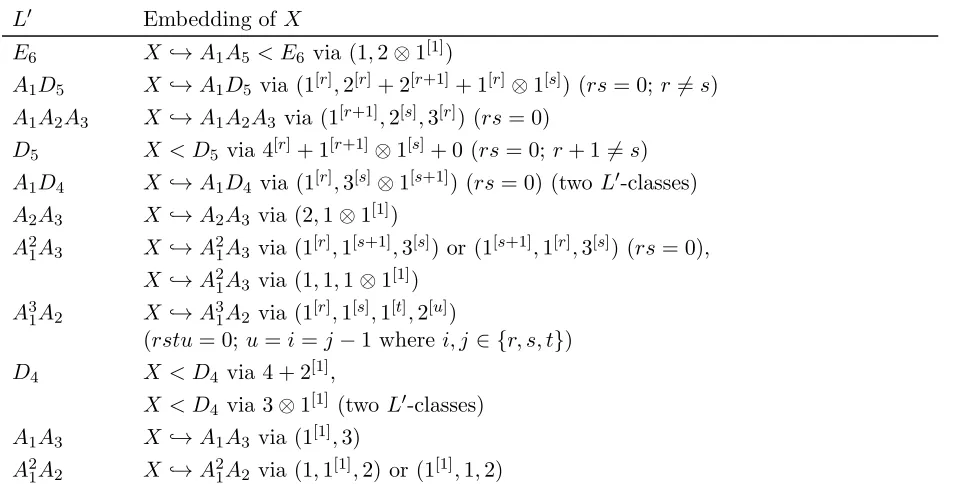
D5 X < D5 via 4[r]+ 1[r+1]⊗1[s]+ 0 (rs= 0; r+ 16=s)
D4 X < D4 via 4 + 2[1],
X < D4 via 3⊗1[1] (twoL′-classes)
A1A3 X ֒→A1A3 via (1[1],3)
A21A2 X ֒→A21A2 via (1,1[1],2) or (1[1],1,2)
Proof. Let P =QL be a parabolic subgroup of G. The action ofL′ on the levels of Q is
straight-forward to determine, as described in [2]. Now Proposition 3.6 gives allL′-irreducible subgroups of typeA1, and it is straightforward to determine the action of each such subgroupX on the levels of
Q, for instance using the tables of Section 11. Checking each level M against Lemma 3.14 tells us whether or notH1(X, M ↓X) = 0. Whenever we find a moduleM such thatH1(X, M ↓X)6= 0, the full description of the action of X on the levels of Qis given in the relevant section below. So let us illustrate the process with an example whereH1(X, M ↓X) = 0 for all levelsM of Q.
Let L be the unique standard Levi subgroup of G such that L′ = A5. Since p = 5, the only
L′-irreducible subgroup X of type A1 acts on the natural module as 2[r]⊗1[s] where rs = 0 and
r 6= s. In Q, there are two levels. As an L′-module, Q/Q(2) is irreducible with high weight λ
3,
0, and is generated byU122321. Using Table 19 and the fact thatVA5(λ3) =V3(VA5(λ1)), it follows
that VA5(λ3) ↓ X = (4[r]⊗1[s]) + (2[r]⊗1[s]) + 3[s]. Lemma 3.14 shows that no indecomposable
summand of such a module has a nonvanishing first cohomology group.
The remainder of this section is as follows. There is a subsection for each Lie type of L′ in Table 6. For each type, we enumerate the standard parabolics with Levi factor of that type and let X vary over theL′-irreducible subgroups in Table 6. Using the tools from Section 3, we bound the number of possible classes of complements to Q in QX, as Q varies over unipotent radicals of these parabolics, and we thus determine a global bound on the number of non-G-cr subgroups arising from such a parabolic. Finally, we exhibit representatives of each possible conjugacy class and calculate their connected centralisers. Lemma 3.26 shows that two such subgroups lying in non-associated parabolics cannot beG-conjugate. Table 11 contains precisely these representatives.
4.1 L′ =D5
The two standard D5-parabolic subgroups of G are P12345 and P23456. By Lemma 4.1, the only
embeddings of A1 intoD5 that we need to consider are X = A1 < D5 via 4[r]+ 1[r+1]⊗1[s]+ 0,
wherers= 0 and r+ 16=s.
Consider firstP =P12345=QL. ThenQhas a single level, and is a 16-dimensional irreducible
module for L′ of high weight λ
4. From the action of X on the natural D5-module, we see that X
lies in a subgroup A21B2 ofL′, via (1[s],1[r+1],4[r]). In turn, this subgroup lies in a subgroupA21A3
of L′. Now, the restriction of a spin module for Dn (n ≥ 4) to a subgroup Bn−1, or from Bn or Dn to a proper Levi subgroup of the same type, is itself a sum of spin modules [18, Prop. 2.7]. It follows that VD5(λ4) ↓ A21A3 = (1,0, λ1) + (0,1, λ3), hence VD5(λ4) ↓ A21B2 =VD5(λ5) ↓ A21B2 =
(1,0, λ2) + (0,1, λ2), and soVD5(λ4)↓X=VD5(λ5)↓X= (3[r]⊗1[r+1]) + (3[r]⊗1[s]). By Lemma
3.14,V∼=K, sincer+ 16=s. The 1-dimensional torusZ(L) acts non-trivially on each summand of
Q, hence by Lemma 3.25 there is at most one G-conjugacy class of non-G-cr complements toQin QX. An entirely similar argument applies to the parabolic subgroup P23456, yielding at most one
G-conjugacy class of non-G-cr complements to Q23456 inQ23456X.
Let Y and Z be subgroups of the subsystem subgroup A1A5 of G, respectively embedding via
(1[s], W(5)[r]) and (1[s],(W(5)[r])∗) (rs= 0; r+ 16=s). Note that Y and Z are Aut(G)-conjugate, since a graph automorphism ofE6 induces a graph automorphism ofA1A5. BothY andZ are
non-A1A5-cr, hence by Lemma 3.2 they are non-G-cr. We claim thatY andZ each lie in aD5-parabolic
subgroup ofG, with irreducible image in a Levi factor. Their actions on the naturalA1A5-modules
imply thatY andZ are each contained in anA21A3-parabolic subgroup ofA1A5, and it follows that
Y andZ each lie in a parabolic subgroup ofGwhose Levi factor contains a subgroup of typeA2 1A3.
The only such subgroups areD5-parabolic subgroups, henceY and Z each lie in aD5-parabolic.
The action ofY on V27 is given in Table 11, and this determines the action ofZ since the outer
automorphism ofGswaps theG-modulesV27andV27∗, and swaps the subgroup classes ofY andZ.
Now, if Y and Z were G-conjugate, then the submodule latties of V27 ↓ Y and V27 ↓Z would be
identical. But this is not the case, sinceY has an 8-dimensional submodule 1[r]⊗3[s]⊂1[r]⊗W(5)[s],