warwick.ac.uk/lib-publications
Manuscript version: Author’s Accepted Manuscript
The version presented in WRAP is the author’s accepted manuscript and may differ from the published version or Version of Record.
Persistent WRAP URL:
http://wrap.warwick.ac.uk/130726
How to cite:
Please refer to published version for the most recent bibliographic citation information. If a published version is known of, the repository item page linked to above, will contain details on accessing it.
Copyright and reuse:
The Warwick Research Archive Portal (WRAP) makes this work by researchers of the University of Warwick available open access under the following conditions.
Copyright © and all moral rights to the version of the paper presented here belong to the individual author(s) and/or other copyright owners. To the extent reasonable and
practicable the material made available in WRAP has been checked for eligibility before being made available.
Copies of full items can be used for personal research or study, educational, or not-for-profit purposes without prior permission or charge. Provided that the authors, title and full
bibliographic details are credited, a hyperlink and/or URL is given for the original metadata page and the content is not changed in any way.
Publisher’s statement:
Please refer to the repository item page, publisher’s statement section, for further information.
Spatial Isolation Implies Zero Knowledge
Even in a Quantum World
†Alessandro Chiesa [email protected]
UC Berkeley
Michael A. Forbes [email protected]
University of Illinois at Urbana–Champaign
Tom Gur
University of Warwick
Nicholas Spooner [email protected]
UC Berkeley
Abstract
Zero knowledge plays a central role in cryptography and complexity. The seminal work of Ben-Or et al. (STOC 1988) shows that zero knowledge can be achieved unconditionally for any language inNEXP, as long as one is willing to make a suitablephysical assumption: if the provers are spatially isolated, then they can be assumed to be playing independent strategies.
Quantum mechanics, however, tells us that this assumption is unrealistic, because spatially-isolated provers could share a quantum entangled state and realize a non-local correlated strategy. The MIP* model captures this setting.
In this work we study the following question: does spatial isolation still suffice to unconditionally achieve zero knowledge even in the presence of quantum entanglement?
We answer this question in the affirmative: we prove that every language inNEXPhas a2-prover
zero knowledgeinteractive proof that is sound against entangled provers; that is,NEXP⊆ZK-MIP*.
Our proof consists of constructing a zero knowledge interactive PCP with a strong algebraic structure, and then lifting it to the MIP*model. This lifting relies on a new framework that builds on recent advances
in low-degree testing against entangled strategies, and clearly separates classical and quantum tools. Our main technical contribution is the development of new algebraic techniques for obtaining uncon-ditional zero knowledge; this includes a zero knowledge variant of the celebrated sumcheck protocol, a key building block in many probabilistic proof systems. A core component of our sumcheck protocol is a new algebraic commitment scheme, whose analysis relies on algebraic complexity theory.
Keywords: zero knowledge; multi-prover interactive proofs; quantum entangled strategies; interactive PCPs; sumcheck protocol; algebraic complexity
Contents
1 Introduction 3
1.1 Our results . . . 4
1.2 Other notions of quantum zero knowledge . . . 4
2 Techniques 5 2.1 The challenge . . . 5
2.2 High-level overview . . . 5
2.3 Part I: lifting classical proof systems to MIP* . . . . 6
2.4 Part II: new algebraic techniques for zero knowledge . . . 9
3 Discussion and open problems 14 4 Roadmap 15 5 Preliminaries 16 5.1 Notation . . . 16
5.2 Low-degree interactive PCPs . . . 17
I Low-degree IPCP to MIP* 19 6 Preliminaries: proof systems with entangled provers 19 7 Low individual-degree testing against entangled quantum strategies 22 8 Lifting from low-degree IPCP to MIP*while preserving zero knowledge 26 8.1 Classical preprocessing . . . 26
8.2 The transformation . . . 27
8.3 Soundness analysis . . . 29
8.4 Preserving zero knowledge . . . 31
9 Zero knowledge MIP*for nondeterministic exponential time 32 II Low-degree IPCP with zero knowledge 33 10 Algebraic query complexity of polynomial summation 33 11 Zero knowledge sumcheck from algebraic query lower bounds 37 11.1 Sampling partial sums of random low-degree polynomials . . . 38
11.2 Strong zero knowledge sumcheck . . . 38
11.3 Analysis of the protocol . . . 39
12 Zero knowledge low-degree IPCP forNEXP 43 A Reducing query complexity while preserving zero knowledge 47 B From PCP to MIP*via a black box transformation 48 C Algebraic query complexity upper bounds 49 C.1 Multilinear polynomials . . . 49
C.2 Subsets with group structure . . . 50
Acknowledgments 52
1
Introduction
Zero knowledge, the ability to demonstrate the validity of a claim without revealing any information about it, is a central notion in cryptography and complexity that has received much attention in the last few decades. Introduced in the seminal work of Goldwasser, Micali, and Rackoff [GMR89], zero knowledge was first demonstrated in the model of interactive proofs, in which a resource-unbounded prover interacts with a probabilistic polynomial-time verifier to the end of convincing it of the validity of a statement.
Goldreich, Micali, and Wigderson [GMW91] showed that every language inNPhas acomputational
zero knowledge interactive proof, under the cryptographic assumption that (non-uniform) one-way functions exist. Ostrovsky and Wigderson [OW93] proved that this assumption is necessary.
Unfortunately, the stronger notion ofstatisticalzero knowledge interactive proofs, where both soundness and zero knowledge hold unconditionally, is limited. For example, ifNPhad such proofs then the polynomial hierarchy would collapse to its second level [BHZ87; For87; AH91].
The celebrated work of Ben-Or et al. [BGKW88] demonstrated that the situation is markedly different when the verifier interacts withmultipleprovers, in aclassical worldwhere by spatially isolating the provers we ensure that they are playing independent strategies — this is the model of multi-prover interactive proofs (MIPs). They proved that every language having an MIP (i.e., every language inNEXP[BFL91]) also has a
perfectzero knowledge MIP. This result tells us thatspatial isolation implies zero knowledge.
In light of quantum mechanics, however, we know that spatial isolationdoes notimply independence, because the provers could share an entangled state and realize a strategy that is beyond that of independently acting provers. For example, it is possible for entangled provers to win a game (e.g., the magic square game) with probability1, whereas independent provers can only win with probability at most8/9[CHTW04].
Non-local correlations arising from local measurements on entangled particles play a fundamental role in physics, and their study goes back at least to Bell’s work on the Einstein–Podolsky–Rosen paradox [Bel64]. Recent years have seen a surge of interest in MIPs withentangled provers, which correspond to the setting in which multiple non-communicating provers share an entangled state and wish to convince a classical verifier of some statement. This notion is captured by MIP*protocols, introduced by Cleve et al. [CHTW04]. A priori it is unclear whether these systems should be less powerful than standard MIPs, because of the richer class ofmaliciousprover strategies, or more powerful, because of the richer class ofhonestprover strategies.
Investigating proof systems with entangled adversaries not only sharpens our understanding of entangle-ment as a computational resource, but also contributes insights to hardness of approximation and cryptography in a post-quantum world. However, while the last three decades saw the development of powerful ideas and tools for designing and analyzing proof systems with classical adversaries, despite much effort, there are only a handful of tools available for dealing with quantum entangled adversaries, and many fundamental questions remain open.
MIP*protocols were studied in a long line of work, culminating in a breakthrough result of Ito and Vidick [IV12], who in a technical tour-de-force showed thatNEXP⊆MIP∗;1this result was further improved in [Vid16; NV18]. However, it is unknown whether these MIP protocols can achieve zero knowledge, which is the original motivation behind the classical MIP model. In sum, in this paper we pose the following question:
To what extent does spatial isolation imply unconditional zero knowledge in a quantum world?
1
1.1 Our results
Our main result is a strong positive answer to the foregoing question, namely, we show that theNEXP⊆
MIP∗result of Ito and Vidick [IV12] continues to hold even when we require zero knowledge.
Theorem 1. Every language inNEXPhas a perfect zero knowledge2-prover MIP*. In more detail,
NEXP⊆PZK-MIP*
" number of provers: 2
round complexity: poly(n)
communication complexity: poly(n)
soundness error: 1/2
#
.
We stress that the MIP*protocols of Theorem 1 enjoy both unconditional soundness against entangled provers as well as unconditional (perfect) zero knowledge againstany(possibly malicious) verifier.
1.2 Other notions of quantum zero knowledge
To the best of our knowledge, this work is the first to study the notion of zero knowledge with entangled provers, as captured by the MIP*model. Nevertheless, zero knowledge has been studied in other settings in the quantum information and computation literature; we now briefly recall these.
Watrous [Wat02] introducedhonest-verifierzero knowledge for quantum interactive proofs (interactive proofs in which the prover and verifier are quantum machines), and studied the resulting complexity class QSZKHV. Kobayashi [Kob03] studied a non-interactive variant of this notion. Damg˚ard, Fehr, and Salvail [DFS04] achieve zero knowledge forNPagainst malicious quantum verifiers, but only viaarguments(i.e., computationally sound proofs) in the common reference string model. Subsequently, Watrous [Wat09] constructed quantum interactive proofs that remain zero knowledge against malicious quantum verifiers.
Zero knowledge for quantum interactive proofs has since then remained an active area of research, and several aspects and variants of it were studied in recent works, including the power of public-coin interaction [Kob08], quantum proofs of knowledge [Unr12], zero knowledge in the quantum random oracle model [Unr15], zero knowledge proof systems forQMA[BJSW16], and oracle separations for quantum statistical zero knowledge [MW18].
All the above works consider protocols between asinglequantum prover and a quantum verifier. In particular, they do not study entanglement as a shared resource between two (or more) provers.
2
Techniques
We begin by discussing the challenge that arises when trying to prove thatNEXP ⊆ PZK-MIP*, by outlining a natural approach to obtaining zero knowledge MIP*protocols, and considering why it fails.
2.1 The challenge
We know that every language in NEXP has a (perfect) zero knowledge MIP protocol, namely, that NEXP ⊆ PZK-MIP [BGKW88]. We also know that every language in NEXP has an MIP* pro-tocol, namely, thatNEXP⊆MIP∗[IV12]. Is it then not possible to simply combine these two facts and deduce that every language inNEXPhas a (perfect) zero knowledge MIP*?
The challenge is that the standard techniques used to construct zero knowledge MIP protocols do not seem compatible with those used to construct MIP*protocols for large classes. In fact, the former are precisely the type of techniques that prove to be very limited for obtaining soundness against entangled provers.
In more detail, while constructions of MIP (and PCP) protocols typically capitalize on analgebraic
structure, known constructions ofzero knowledgeMIPs are of acombinatorialnature. For example, the zero knowledge MIP in [BGKW88] is based on a multi-prover information-theoretic commitment scheme, which can be thought of as a CHSH-like game. The zero knowledge MIP in [DFKNS92] is obtained via the standard transformation from zero knowledge PCPs, which is a form of consistency game. Unfortunately, these types of constructions do not appear resistant to entangled provers, nor is it clear how one can modify them to obtain this resistance without leveraging some algebraic structure.
Indeed, initial attempts to show thatNEXP⊆MIP∗(e.g., [IKPSY08; IKM09; KKMTV11]) tried to apply some black box transformation to an arbitrarily structured (classical) MIP protocol to force the provers to behave as if they are not entangled, and then appeal to standard MIP soundness. These works were only able to obtain limited protocols (e.g., with very large soundness error).
In their breakthrough paper, Ito and Vidick [IV12] overcame this hurdle and showed thatNEXP ⊆
MIP∗by taking a different route: rather than a black box transformation, they modified and reanalyzed a particular proof system, namely the MIP protocol forNEXPin [BFL91], while leveraging and crucially using its algebraic structure. (Subsequent works [Vid16; NV18] improved this result by reducing the number of provers and rounds to a minimum, showing MIP*protocols forNEXPwith two provers and one round.) In sum, the challenge lies in the apparent incompatibility between techniques used for zero knowledge and those used for soundness against entangled provers.
2.2 High-level overview
Our strategy for proving our main result is to bridge the aforementioned gap by isolating the role of algebra in granting soundness against entangled provers, and developing new algebraic techniques for zero knowledge. Our proof of Theorem 1 thus consists of two parts.
(I) Lifting lemma: a black box transformation from algebraically-structured classical protocols into corresponding MIP*protocols, which preserves zero knowledge.
(II) Algebraic zero knowledge:a new construction of zero knowledge algebraically-structured protocols for any language inNEXP.
background in quantum information). We briefly discuss each of the parts, and then provide an overview of the first part in Section 2.3 and of the second part in Section 2.4.
In the first part of the proof, we build on recent advances in low-degree testing against entangled provers, and provide an abstraction of techniques in [IV12; Vid16; NV18]. We prove alifting lemma(Lemma 8.1) that transforms a class of algebraically-structured classical protocols into MIP*protocols, while preserving zero knowledge. This provides a generic framework for constructing MIP*protocols, while decoupling the mechanisms responsible for soundness against entangled provers from other classical components.
In the second part of the proof, we construct an algebraically-structured zero knowledge classical protocol, which we refer to as alow-degree interactive PCP, to which we apply the lifting lemma, completing the proof. At the heart of our techniques is a strong zero knowledge variant of the sumcheck protocol [LFKN92] (a fundamental subroutine in many probabilistic proof systems), which we deem of independent interest. In turn, a key component in our zero knowledge sumcheck is a new algebraic commitment scheme, whose hiding property is guaranteed by algebraic query complexity lower bounds [AW09; JKRS09]. These shed more light on the connection of zero knowledge to algebraic complexity theory.
We summarize the roadmap towards proving Theorem 1 in Section 4.
2.3 Part I: lifting classical proof systems to MIP*
The first step towards obtaining a generic framework for transforming classical protocols into corresponding MIP*protocols is making a simple, yet crucial, observation. Namely, while the result in [IV12] is stated as a white box modification of the MIP protocol in [BFL91], we observe that the techniques used there can in fact be applied more generally. That is, we observe thatany“low-degree interactive PCP”, a type of algebraically structured proof system that underlies (implicitly and explicitly) many constructions in the probabilistic proof systems literature, can be transformed into a corresponding MIP*protocol.
The first part of the proof of Theorem 1 formalizes this idea, identifying sufficient conditions to apply the techniques of [IV12; Vid16], and showing a lifting lemma that transforms protocols satisfying these conditions into MIP*protocols. We relate features of the original protocol to those of the resulting MIP* protocols, such as round complexity and, crucially, zero knowledge.
To make this discussion more accurate, we next define and discuss low-degree interactive PCPs.
2.3.1 Low-degree interactive PCPs
AnInteractive PCP(IPCP), a proof system whose systematic study was initiated by Kalai and Raz [KR08], naturally extends the notions of a probabilistically checkable proof (PCP) and an interactive proof (IP). An
r-round IPCP is a two-phase protocol in which a computationally unboundedproverP tries to convince a polynomial-timeverifierV that an inputx, given to both parties, is in a languageL. First, the prover sends to the verifier a PCP oracle (a purported proof thatx∈L), which the verifier can query at any time. Second, the prover and verifier engage in anr-round IP, at the end of which the verifier either accepts or rejects.2 Completeness and soundness are defined in the usual way.
In this work we consider a type of algebraically-structured IPCP, which we call alow-degree IPCPs. This notion implicitly (and semi-explicitly) underlies many probabilistic proof systems in the literature. Informally, a low-degree IPCP is an IPCP satisfying the following: (1)low-degree completeness, which states that the PCP oracle sent by the (honest) prover is a polynomial of low (individual) degree; (2)low-degree soundness, which relaxes soundness to hold only against provers that send PCP oracles that are low-degree polynomials.
2
Low-degree completeness and soundness can be viewed as a promise that the PCP oracle is a low-degree polynomial. Indeed, these conditions are designed to capture “compatibility” with low-degree testing: only protocols with low-degree completeness will pass a low-degree test with probability1; moreover, adding a low-degree test to an IPCP with low-degree soundness results (roughly) in an IPCP with standard soundness.
2.3.2 From low-degree IPCP to MIP*
We show that any low-degree IPCP can be transformed into a corresponding MIP*protocol, in a way that preserves zero knowledge (for a sufficiently strong notion of zero knowledge IPCP). To this end, we use an entanglement-resistant low degree test, which allows us to essentially restrict the provers usage of the entangled state to strategies that can be approximately implemented via randomness shared among the provers. Informally, the idea is that by carefully invoking such a test, we can let one prover take on the role of the PCP oracle, and the other to take the role of the IPCP prover, and then emulate the entire IPCP protocol.
In more detail, we show a zero-knowledge-preserving transformation of low-degree IPCPs to MIP* protocols, which is captured by the following lifting lemma.
Lemma 2.1 (informally stated, see Lemma 8.1). There exists a transformationT that takes anr-round low-degree IPCP(P0, V0)for a languageL, and outputs a2-prover(r∗+ 2)-round MIP*(P1, P2, V) :=
T(P0, V0)forL, wherer∗ = max{r,1}. Moreover, this transformation preserves zero knowledge.3
We stress that the simplicity of the lifting lemma is a key feature since, as we describe below, it requires us to only make small structural changes to the IPCP protocol. This facilitates the preservation of various complexity measures and properties, such as zero knowledge.
To prove this lemma, a key tool that we use is a new low-degree test by Natarajan and Vidick [NV18],4 which adapts the celebrated plane-vs-point test of Raz and Safra [RS97] to the MIP*model. Alow-degree testis a procedure used to determine if a given functionf:Fm →Fis close to a low-degree polynomial or if,
instead, it is far from all low-degree polynomials, by examiningf at very few locations. In the plane-vs-point test, the verifier specifies a random2-dimensional plane inFmto one prover and a random point on this plane
to the other prover; each prover replies with the purported value off on the received plane or point; then the verifier checks that these values are consistent.
Informally, the analysis in [NV18] asserts that every entangled strategy that passes this test with high probably must satisfy an algebraic structure; more specifically, to pass this test the provers can only use their shared entangled state to (approximately) agree on a low-degree polynomial according to which they answer. We use the following soundness analysis of the this protocol. (See Section 6 for the standard quantum notation used in the theorem below.)
Theorem 2.2 ([NV18, Theorem 2], informally stated). There exists an absolute constantc ∈ (0,1)such that, for every soundness parameterε > 0, number of variablesm ∈ N, degreed ∈ N, and finite field
F, there exists a low-degree testT for which the following holds. For everysymmetricentangled prover strategy and measurements{Azα}z∈F,α∈Fmthat are accepted byT with probability at least1−ε, there exists
a measurement{LQ}Q, whereQis anm-variate polynomial of degreed, such that:
1. Approximate consistency with{Azα}:Eα∈FmPQPz6=Q(α)hΨ|Azα⊗LQ|Ψi ≤εc. 2. Self-consistency of{LQ}:P
QhΨ|LQ⊗(Id−LQ)|Ψi ≤εc.
3More accurately, we require the given IPCP to be zero knowledge with query bound that is roughly quadratic in the degree of the PCP oracle. See Section 8.2 for details.
4
In fact, we actually use a more refined version, which tests a polynomial’sindividualdegree rather than its
totaldegree. In the classical setting, such a test is implicit in [GS06] via a reduction from individual-degree to total-degree testing. Informally, this reduction first invokes the test for low total degree, then performs univariate low-degree testing with respect to a random axis-parallel line in each axis. We extend this reduction and its analysis to the setting of MIP*. (See Section 7 for details.) The analysis of the low individual degree test was communicated to us by Thomas Vidick, to whom we are grateful for allowing us to include it here. With the foregoing low-degree test at our disposal, we are ready to outline the simple transformation from low-degree IPCPs to MIP*protocols. We begin with a preprocessing step. Note that the low individual degree test provides us with means to assert that the provers can (approximately) only use their entangled state to choose a low-degree polynomialQ, and answer the verifier with the evaluation ofQon asingle, uniformly distributed point (or plane). Thus, it is important that the IPCP verifier (which we start from) only makes a single uniform query to its oracle. By adapting techniques from [KR08], we can leverage the algebraic structure of the low-degree IPCP and capitalize on the interaction to ensure the IPCP verifier has this property, at essentially the cost of increasing the round complexity by1.5
Thus we have a low-degree IPCP, with prover P and verifierV, in which the verification takes place as follows. BothP andV receive an explicit inputxthat is allegedly in the languageL. In addition,V is granted oracle access to a purported low-degree polynomialR, whose full description is known toP. The parties engage in anr-round interaction, at the end of whichV is allowed to make a single uniform query to Rand decide whetherx∈L (with high probability).
We transform this IPCP into a2-prover MIP*by considering the following protocol. First, the verifier chooses uniformly at random whether to (1) invoke a low-degree test, in which it asks one prover to evaluate Ron a random plane or axis-parallel line and the other prover to evaluateRon a random point on this plane or line, or (2) emulate the IPCP protocol, in which one prover plays the role of the IPCP prover and the other acts as lookup forR.
We use the approximate consistency condition of Theorem 2.2 to assert that the lookup prover approxi-mately answers according to a low-degree polynomial, and use the self-consistency condition to ensure that both provers are consistently answering according to thesamelow-degree polynomial.6
We remark that preserving zero knowledge introduces some subtle technicalities (which we resolve), the main of which is that because the analysis of the entanglement-resistant low individual degree test requires that the provers employsymmetricstrategies, we need to perform a non-standard symmetrization (since standard symmetrization turns out to break zero knowledge in our case). See Section 8.2 for details.
2.3.3 Towards zero knowledge MIP*for nondeterministic exponential time
Equipped with the lifting lemma, we are left with the task of constructing classical zero knowledge low-degree IPCPs for all languages inNEXP. We first explain why current constructions donotsuffice for this purpose.
The first thing to observe is that the classical protocol for theNEXP-complete languageOracle 3SAT
by Babai, Fortnow, and Lund [BFL91] (neglecting the multilinearity test) can be viewed as low-degree IPCP. Indeed, in [BFL91] the protocol is stated as an “oracle protocol”, which is equivalent to an IPCP. The oracle is encoded as a low-degree polynomial, and so low-degree completeness is satisfied. Alas, the foregoing protocol isnotzero knowledge. We remark that since the MIP*protocol in [IV12] relies on the protocol in [BFL91], the former inherits the lack of zero knowledge from the latter.
5Indeed, if the original IPCP verifier makes a single uniform query to its oracle, then we can save a round in Lemma 2.1; that is, we obtain an MIP*with round complexityr∗+ 1, rather thanr∗+ 2.
Proceeding to consider classicalzero knowledgeproof systems, for example the protocols in [DFKNS92; KPT97; GIMS10], we observe that while some of these proof systems can be viewed as IPCPs, they are notlow-degreeIPCPs. This is because they achieve zero knowledge via combinatorial techniques that do
notadmit the algebraic structure that we require. We stress that the natural way of endowing an IPCP with algebraic structure by taking the low-degree extension of the PCP oracle doesnotnecessarily preserve zero knowledge.7 Correspondingly, the MIP*protocols in [Vid16; NV18], which rely on applying the low-degree extension code to a PCP, do not preserve zero knowledge for this reason.
Finally, we observe that recent advances in algebraic zero knowledge [BCFGRS17] (building on tech-niques from [BCGV16]) already provide us with a classical proof system that is compatible with our framework, and can thus be used to derive a zero knowledge MIP*protocol, albeit only for languages in#P.
To strengthen the aforementioned result and show thatNEXP⊆PZK-MIP*(matching theNEXP⊆
MIP∗containment, and showing that zero knowledge can, in a sense, be obtained for “free” in the setting of MIP*protocols), we need to construct amuch strongerzero knowledge low-degree IPCP. The second part of Theorem 1, which is our main technical contribution, provides exactly that. We proceed to provide an overview of the techniques that we use to construct such protocols.
2.4 Part II: new algebraic techniques for zero knowledge
The techniques discussed thus far tell us that, if we wish to obtain a zero knowledge MIP*forNEXP, it suffices to obtain a zero knowledgelow-degreeIPCP forNEXP(an IPCP wherein the oracle is a low-degree polynomial). Doing so is the second part of our proof of Theorem 1, and for this we develop new algebraic techniques for obtaining zero knowledge protocols. Our techniques, which build on recent developments [BCGV16; BCFGRS17], stand in stark contrast to other known constructions of zero knowledge PCPs and interactive PCPs (such as [DFKNS92; KPT97; GIMS10]). We remind the reader that this part of our work only deals with classical protocols, and does not require any knowledge of quantum information.
2.4.1 A zero knowledge low-degree IPCP forNEXP
Our starting point is the protocol of Babai, Fortnow, and Lund [BFL91] (the “BFL protocol”). We first recall how the BFL protocol works, in order to explain its sources of information leakage and how one could prevent them via algebraic techniques. These are the ideas that underlie our algebraic construction of an unconditional (perfect) zero knowledge low-degree IPCP forNEXP.
The BFL protocol, and why it leaks. Oracle 3SAT (O3SAT) is the followingNEXP-complete problem: given a boolean formulaB, does there exist a boolean functionA(a witness) such that
B(z, b1, b2, b3, A(b1), A(b2), A(b3)) = 0 for allz∈ {0,1}r, b1, b2, b3 ∈ {0,1}s ?
The BFL protocol is an IPCP forO3SATthat is then (generically) converted to an MIP. In the BFL protocol, the honest prover first sends a PCP oracleAˆ:Fs→Fthat is the unique multilinear extension (in some finite
fieldF) of a valid witnessA:{0,1}s→ {0,1}. The verifier must check that (a)Aˆis a boolean function on {0,1}s, and (b)A’s restriction toˆ {0,1}sis a valid witness forB. To do these checks, the verifier arithmetizes
the formulaBinto an arithmetic circuitB, and reduces the checks to conditions that involveˆ A,ˆ Bˆ, and other low-degree polynomials. A technique in [BFLS91] allows the verifier to “bundle” all of these conditions into a single low-degree polynomialf such that (with high probability over the choice off) the conditions hold if
and only iffsums to0on{0,1}r+3s+3. The verifier checks that this is the case by engaging in a sumcheck
protocol with the prover.8
We observe that the BFL protocol isnotzero knowledge for two reasons: (i) the verifier has oracle access toAˆand, in particular, to the witnessA; (ii) the prover’s messages during the sumcheck protocol leak further information aboutA(namely, hard-to-compute partial sums off, which itself depends onA).
A blueprint for zero knowledge. We now describe the “blueprint” for an approach to achieve zero knowledge in the BFL protocol. The prover does not sendAˆdirectly, but instead acommitmentto it. After this, the prover and verifier engage in a sumcheck protocol with suitable zero knowledge guarantees; at the end of this protocol, the verifier needs to evaluatef at a point of its choice, which involves evaluatingAˆ at three points. Now the prover reveals the requested values ofA, without leaking any information beyondˆ these, so that the verifier can perform its check. We explain how these ideas motivate the need for certain algebraic tools, which we later develop and use to instantiate our approach.
(1) Randomized low-degree extension. Even if the prover reveals only three values ofA, these may stillˆ leak information aboutA. We address this problem via arandomized low-degree extension. Indeed, while the prover in the BFL protocol sends theuniquemultilinear extension ofA, one can verify thatanyextension of Aof sufficiently low degree also works. We exploit this flexibility as follows: the prover randomly samples
ˆ
Ain such a way that any three evaluations ofAˆdo not reveal any information aboutA. Of course, if any of these evaluations is within the systematic part{0,1}s, then no extension ofAhas this property. Nevertheless,
during the sumcheck protocol, the prover can ensure that the verifier chooses only evaluations outside of
{0,1}s (by aborting if the verifier deviates), which incurs only a small increase in the soundness error.9 With this modification in place, it suffices for the prover to letAˆbe a random degree-4extension ofA: by a dimensionality argument, any3evaluations outside of{0,1}sare now independent and uniformly random in
F. We are thus able to reduce a claim aboutAto a claim which containsno informationaboutA.
(2) Algebraic commitments. As is typical in zero knowledge protocols, the prover will send acommitment
toA, and then selectively reveal a limited set of evaluations ofˆ A. The challenge in our setting is that thisˆ commitment mustalsobe a low-degree polynomial, since we require a low-degree oracle. For this, we devise a new algebraic commitment scheme based on the sumcheck protocol; we discuss this in Section 2.4.2. (3) Sumcheck in zero knowledge. We need a sumcheck protocol where the prover’s messages leak little information aboutf. The prior work in [BCFGRS17] achieves an IPCP for sumcheck that is “weakly” zero knowledge: any verifier learns at most one evaluation off for each query it makes to the PCP oracle. If the verifier could evaluatef by itself, as was the case in that paper, this guarantee would suffice for zero knowledge. In our setting, however, the verifiercannotevaluatefby itself becausef is (necessarily) hidden behind the algebraic commitment.
One approach to compensate would be to further randomizeAˆby lettingAˆbe a random extension ofA of some well-chosen degreed. Unfortunately, this technique is incompatible with our low-degree IPCP to MIP*transformation: such a low-degree extension is at mostd-wise independent, whereas our lifting lemma (Lemma 8.1), and more generally low-degree testing, requires zero knowledge against anyΩ(d2)queries.
We resolve this by relying on more algebraic techniques, achieving an IPCP for sumcheck with a much stronger zero knowledge guarantee: any malicious verifier that makes polynomially-many queries to the PCP oracle learns only asingleevaluation off. This suffices for zero knowledge in our setting: learning one evaluation off implies learning only three evaluations ofA, which can be made “safe” ifˆ Aˆis chosen to be a random extension ofAof sufficiently high degree. Our sumcheck protocol uses as building blocks both our
8
The soundness of the sumcheck protocol depends on the PCP oracle being the evaluation of a low-degree polynomial, and so the verifier in [BFL91] checks this using a low-degree test. In our setting oflow-degreeIPCPs a low-degree test is not necessary.
9
The honest verifier will be defined so that it always chooses evaluationsoutsideof{0,1}s
algebraic commitment scheme and the “weak” zero knowledge sumcheck in [BCFGRS17]; we summarize its construction in Section 2.4.3.
2.4.2 Algebraic commitments from algebraic query complexity lower bounds
We provide a high-level description of an information-theoretic commitment scheme in the low-degree IPCP model (i.e., a low-degreeinteractive locking scheme[GIMS10]). See Section 10 for the full details.10
In this scheme, the prover commits to a message by sending to the verifier a PCP oracle that perfectly hides the message; subsequently, the prover can reveal positions of the message by engaging with the verifier in an interactive proof, whose soundness guarantees statistical binding.
Committing to an element. We first consider the simple case of committing to a single elementainF.
Letkbe a security parameter, and setN := 2k. Suppose that the prover samples a randomB in
FN such
thatPN
i=1Bi =a, and sendsBto the verifier as a commitment. Observe that anyN −1entries ofBdo not
reveal any information abouta, and so any verifier with oracle access toBthat makes fewer thanN queries cannot learn any information abouta. However, asB is unstructured it is not clear how the prover can later convince the verifier thatPN
i=1Bi =a.
Instead, we can consider imbuing B with additional algebraic structure. Namely, the prover views B as a function from{0,1}kto
F, and sends its unique multilinear extensionBˆ:Fk → Fto the verifier.
Subsequently, the prover can revealato the verifier, and then engage in a sumcheck protocol for the claim “P
~
β∈{0,1}kBˆ(β~) =a” to establish the correctness ofa. The soundness of the sumcheck protocol protects the verifier against cheating provers and hence guarantees that this scheme is binding.
However, givingB additional structure calls into question the hiding property of the scheme. Indeed, surprisingly, a result of Juma et al. [JKRS09] shows that this new scheme is in factnothiding (in fields of odd characteristic): it holds thatBˆ(2−1, . . . ,2−1) =a·2−kfor any choice ofB, so the verifier can learna with only a single query toBˆ!
Sending an extension ofB has created a new problem: querying the extension outside of{0,1}k, the
verifier can learn information that may require many queries toB to compute. Indeed, this additional power is precisely what underlies the soundness of the sumcheck protocol. To resolve this, we need to understand what the verifier can learn about B given some low-degree extensionB. This is precisely the setting ofˆ
algebraic query complexity[AW09].11
Indeed the foregoing theory suggests a natural approach for overcoming the problem created by the extension ofB: instead of considering the multilinear extension, we can letBˆbe chosen uniformly at random from the set of degree-dextensions ofB, for somed >1. It is not hard to see that ifdis very large (say,
|F|) then2kqueries are required to determine the summation ofBˆ on{0,1}k. However, we needdto be
small to achieve soundness. Fortunately, a result of [JKRS09] shows thatd= 2suffices: given a random multiquadratic extensionBˆofB, one needs2kqueries toBˆto determineP
~
β∈{0,1}kBˆ(β~).12
Committing to a polynomial. The prover in our zero knowledge protocols needs to commit not just to a single element but rather to the evaluation of anm-variate polynomialQoverFof degreed >1. We extend
our ideas to this setting. We follow a similar general approach, however, arguing the hiding property now
10
We use the commitment scheme perspective to illustrate the key ideas in our construction. In the technical sections, we prove the zero knowledge property directly using algebraic query complexity lower bounds, without explicitly using any commitment scheme.
11
Interestingly, in [AW09] a connection between algebra and zero knowledge is also exhibited. Namely, to show that the result
NP ⊆CZK[GMW91] algebrizes, it is necessary to exploit the algebraic structure of the oracle to design a zero knowledge protocol for verifying the existence of certain sets of query answers.
12
requires astrongeralgebraic query complexity lower bound than the one proved in [JKRS09]. Not only do we need to know that the verifier cannot determineQ(~α)for a particular~α∈Fm, but we need to know that
the verifier cannot determineQ(~α)forany~α∈Fm, or evenany linear combination of any such values. We
prove that this stronger guarantee holds in the same parameter regime: ifd > 1then2kqueries are both necessary and sufficient. See the discussion at the beginning of Section 10 for a more detailed overview. Decommitting in zero knowledge. To use our commitment scheme in zero knowledge protocols, we must ensure that, in the decommitment phase, the verifier cannot learn any information beyond the value a:=Q(α~), for a chosen~α. To decommit, the prover sends the valueaand has to convince the verifier that the claim “P
~
β∈{0,1}kBˆ(α, ~~ β) = a” is true. However, if the prover and verifier simply run the sumcheck protocol on this claim, the prover leaks partial sums P
~
β∈{0,1}k−iBˆ(α, c~ 1, . . . , ci, ~β), for c1, . . . , ci ∈ F chosen by the verifier, which could reveal additional information aboutQ. Instead, the prover and verifier run on this claim the IPCP for sumcheck of [BCFGRS17], whose “weak” zero knowledge guarantee ensures that this cannot happen. (Thus, in addition to the commitment, the honest prover also sends the evaluation of a random low-degree polynomial as required by the IPCP for sumcheck of [BCFGRS17].)
2.4.3 A zero knowledge sumcheck protocol
We describe the “strong” zero knowledge variant of the sumcheck protocol that we use in our construction. The protocol relies on the algebraic commitment scheme described in the previous section. We first cover some necessary background, and then describe our protocol.
Previous sumcheck protocols. The sumcheck protocol [LFKN92] is an IP for claims of the form “P
~
α∈HmF(~α) = 0”, where H is a subset of a finite fieldF andF is an m-variate polynomial overF of small individual degree. The protocol hasmrounds: in roundi, the prover sends the univariate polynomial gi(Xi) :=Pα~∈Hm−iF(c1, . . . , ci−1, Xi, ~α), wherec1, . . . , ci−1 ∈Fwere sent by the verifier in previous
rounds; the verifier checks thatP
αi∈Hgi(αi) =gi−1(ci−1)and replies with a uniformly random challenge ci ∈ F. After roundm, the verifier outputs the claim “F(c1, . . . , cm) =gm(c1, . . . , cm)”. IfF is of
suffi-ciently low degree and does not sum toaover the space, then the output claim is false with high probability. Note that the verifier does not need access toF.
The “weak” zero knowledge IPCP for sumcheck in [BCFGRS17] modifies the above protocol as follows. The prover first sends a PCP oracle that (allegedly) equals the evaluation of a random “masking” polynomial R; the verifier checks thatRis (close to) low degree. Subsequently, the prover and verifier conduct the following interactive proof. The prover sendsz ∈Fthat allegedly equalsP~α∈HmR(~α), and the verifier responds with a uniformly random challengeρ∈F∗. The prover and verifier now run the (standard) sumcheck protocol to reduce the claim “P
~
α∈HmρF(~α)+R(~α) =ρa+z” to a claim “ρF(~c)+R(~c) =b”, for a random ~c∈Fm. The verifier queriesRat~cand then outputs the claim “F(~c) = b−Rρ(~c)”. IfP~α∈HmF(~α)6=a, then with high probability overρand the verifier’s messages in the sumcheck protocol, this claim is false.
A key observation is that if the verifier makes no queries toR, then the prover’s messages are identically distributed to the sumcheck protocol applied to a random polynomialQ. When the verifier does make queries toR, simulating the resulting conditional distribution involves techniques from Algebraic Complexity Theory, as shown in [BCFGRS17]. GivenQ, the verifier’s queries toR(α~), forα~ ∈Fm, are identically distributed to
Q(α~)−ρF(~α). Thus, the simulator need only make at most one query toF for every query toR; that is, any verifier makingqqueries toRlearns no more than it would learn by makingqqueries toF alone.
Our sumcheck protocol. The “strong” zero knowledge guarantee that we aim for is the following: any polynomial-time verifier learns no more than it would by makingonequery toF, regardless of its number of queries to the PCP oracle.
The main idea to achieve this guarantee is the following. The prover sends a PCP oracle that is an
algebraic commitmentZ to the aforementioned masking polynomialR. Then, as before, the prover and verifier run the sumcheck protocol to reduce the claim “P
~
α∈HmρF(α~) +R(α~) = ρa+z” to a claim “ρF(~c) +R(~c) =b” for random~c∈Fm.
We now face two problems. First, the verifier cannot simply query Rat~cand then output the claim “F(~c) = b−Rρ(c~)”, since the verifier only has oracle access to the commitmentZ ofR. Second, the prover could cheat the verifier by havingZ be a commitment to anRthat is far from low degree, which allows cheating in the sumcheck protocol.
The first problem is addressed by the fact that our algebraic commitment scheme has a decommitment sub-protocol that is zero knowledge: the prover can revealR(~c)in such a way that no other values about Rare also revealed as a side-effect. As discussed, this relies on the protocol of [BCFGRS17], used as a subroutine.
The second problem is addressed by the fact that our algebraic commitment scheme is “transparent” to low-degree structure; that is, the algebraic structure of the scheme implies that if the commitmentZ is a low-degree polynomial (as in alow-degreeIPCPs), thenRmust also be low degree (and vice versa).
Overall, the only value that a malicious verifier can learn isF(~c), for~c∈Im of its choice (whereI is some sufficiently large subset ofF, fixed in advance). More precisely, we prove the following theorem, which
shows a strong zero knowledge sumcheck protocol.
Theorem 2.3(Informally stated, see Theorem 11.1). There exists a low-degree IPCP for sumcheck, with respect to a low-degree polynomialF, that satisfies the following zero knowledge guarantee: the view of any probabilistic polynomial-time verifier in the protocol can be perfectly and efficiently simulated by a simulator that makes only a single query toF.
Our sumcheck protocol leaks a single evaluation ofF. We stress that this limitation isinherent: the honest verifier always outputs a true claim about one evaluation ofF, which it cannot do without learning that evaluation. Nevertheless, this guarantee is strong enough for our application, as we can ensure that learning a single evaluation ofF does not harm zero knowledge.
3
Discussion and open problems
The framework that we use to prove that NEXP ⊆ PZK-MIP*elucidates the role that algebra plays in the design of proofs systems with entangled provers. Namely, we show that a large class of algebraic protocols (low-degree IPCPs) can be transformed in a black box manner to MIPs with entangled provers. This abstraction decouples the mechanisms responsible for soundness against entangled adversaries from other classical components in the proof system. In turn, this allows us to focus our attention on designing proof systems with desirable properties (zero knowledge, in this work), without having to deal with the complications that arise from entanglement, and then derive MIP*protocols from these classical protocols.
These ideas also enable us to re-interpret prior constructions of MIP* protocols at a higher level of abstraction. For example, the protocol in [IV12] can be viewed as applying our lifting lemma to the (low-degree) IPCP in [BFL91]. As another example, one can start withanyPCP for some languageL, low-degree extend the PCP, and then apply our lifting lemma to obtain a corresponding MIP*protocol forL; in fact, the protocol in [Vid16] can be viewed in this perspective.
In more detail, we say that a transformation from IPCP to MIP*isblack boxif it maps an IPCP protocol into an MIP*protocol whose verifier can be expressed as an algorithm that only accesses the queries and messages of the IPCP verifier, but does not access its input (apart from its length). The following corollary shows that any IPCP protocol can be transformed into an MIP* protocol via a black box transformation. While a proof of this fact is implicit in [Vid16; NV18], the framework developed in this paper allows us to crystallize its structure and give a compellingly short proof of it. (See, also, Fig. 1.)
Corollary 3.1. There is a black box transformation that maps anyr-round IPCP protocol for a languageL to a2-prover(r+ 1)-round MIP*forL
The round complexity ofr+ 1in Corollary 3.1 is less than in our lifting lemma (r+ 2), because now we do not require that zero knowledge is preserved. We make the foregoing discussion precise in Appendix B.
We conclude this section by discussing several open problems.
In this work we show that there exist perfect zero knowledge MIP*protocols for all languages inNEXP, withpolynomially-manyrounds. Since round complexity is a crucial resource in any interactive proof system, it is essential to understand whether zero knowledge MIP*protocols with low round complexity exist. (After all, without the requirement of zero knowledge, every language inNEXPhas a MIP*protocol with justone round[Vid16; NV18].) We remark that the “oracularization” technique of Ito et al. [IKM09] reduces the round complexity of any MIP*to one round, but this technique doesnotpreserve zero knowledge.
Open Problem 1. Do there exist constant-round zero knowledge MIP*protocols forNEXP?
At the beginning of this section, we reflected on the fact that known results that establish the power of MIP*protocols rely onalgebraicstructure, which enables classical-to-quantum black box transformations of protocols. But is algebraic structure inherently required, or does some combinatorial structure suffice?
Open Problem 2. Is there a richer class of classical protocols (beyond low-degree IPCPs) that can be black-box transformed into MIP*protocols?
For instance, could we replace low-degree polynomials with, say, error correcting codes with suitable local testability and decodability properties? One place to start would be to understand whether local testers for tensor product codes [BS06] are sound against entangled provers.
4
Roadmap
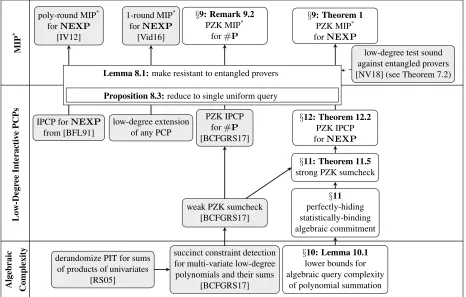
In Section 5 we provide definitions needed for the technical sections, including that for alow-degree IPCP, which is central to our work. In Part I we prove that any low-degree IPCP can be transformed into an MIP* protocol, while preserving zero knowledge; see Lemma 8.1. In Part II we prove that every language in NEXPhas a perfect zero knowledge low-degree IPCP; see Theorem 12.2. Combining the results proved in Parts I and II enables us to derive our main result, Theorem 1, which shows that every language inNEXP has a perfect zero knowledge2-prover MIP*. Fig. 1 summarizes the roadmap towards proving Theorem 1.
Lo
w-Degr
ee
Interacti
v
e
PCPs
Algebraic Complexity
MIP
*
derandomize PIT for sums of products of univariates
[RS05]
[image:16.612.74.540.190.487.2]succinct constraint detection for multi-variate low-degree polynomials and their sums
[BCFGRS17]
§10: Lemma 10.1 lower bounds for algebraic query complexity
of polynomial summation weak PZK sumcheck
[BCFGRS17]
§11 perfectly-hiding statistically-binding algebraic commitment
§11: Theorem 11.5 strong PZK sumcheck IPCP forNEXP
from [BFL91]
low-degree extension of any PCP
PZK IPCP for#P
[BCFGRS17]
§12: Theorem 12.2 PZK IPCP forNEXP
poly-round MIP* forNEXP
[IV12]
1-round MIP* forNEXP
[Vid16]
§9: Remark 9.2 PZK MIP*
for#P
§9: Theorem 1 PZK MIP* forNEXP
low-degree test sound against entangled provers [NV18] (see Theorem 7.2)
Proposition 8.3:reduce to single uniform query Lemma 8.1:make resistant to entangled provers
Figure 1: Diagram of the roadmap for proving Theorem 1. White blocks correspond to our new contributions, while grey blocks correspond to previous works. Building on techniques in algebraic complexity from [RS05; BCFGRS17], we prove lower bounds on algebraic query complexity of polynomial summation (Lemma 10.1). This allows us to construct the perfectly-hiding statistically-binding algebraic commitment scheme that underlies our strong perfect zero knowledge sumcheck protocol (Theorem 11.5, which also relies on the weak zero knowledge sumcheck protocol in [BCFGRS17]), and in turn, prove that there exists a perfect zero knowledge low-degree IPCP for any language in
5
Preliminaries
We cover the notation and basic definitions that are shared by both parts of this paper.
5.1 Notation
Forn∈Nwe denote by[n]the set{1, . . . , n}. Form, n∈Nwe denote bym+[n]the set{m+1, . . . , m+n}.
For a setX,n ∈ N,I ⊆ [n], and~x ∈ Xn, we denote by~xI the vector xi
i∈I that is~xrestricted to the
coordinates inI.
Integrality. All (relevant) integers stated as real numbers are implicitly rounded to the closest integer.
Distance. Therelative Hamming distance(or justdistance), over alphabetΣ, between two stringsx, y∈Σn
is∆(x, y) := |{i ∈ [n]s.t.xi 6= yi}|/n. If∆(x, y) ≤, we say thatxis-closetoy; otherwise we say
thatxis-farfromy. Similarly, therelative distanceofxfrom a non-empty setS ⊆ Σnis∆(x, S) :=
miny∈S∆(x, y). If∆(x, S)≤, we say thatxis-closetoS; otherwise we say thatxis-farfromS.
Functions, distributions, fields. We usef:D → R to denote a function with domainDand rangeR; given a subsetD˜ ofD, we usef|D˜ to denote the restriction off toD. Given a distribution˜ D, we write
x← Dto denote thatxis sampled according toD. We denote byFa finite field and byFqthe field of sizeq.
Arithmetic operations overFqtake timepolylogqand spaceO(logq).
Polynomials. We denote by F[X1,...,m]the ring of m-variable polynomials over the fieldF. Given a
polynomialP inF[X1,...,m],degXi(P)is the degree ofP in the variableXi. Theindividual degreeof a polynomial is its maximum degree in any variable,deg(P) := max1≤i≤mdegXi(P). Throughout, unless explicitly specified otherwise, we will exclusively work withindividualdegree and often refer to it simply as degree. We denote byF[X1≤,...,md ]the subspace of all polynomialsP ∈F[X1,...,m]such thatdeg(P)≤d.
Low-degree extensions. Given a finite fieldF, subset H ⊆ F, and number of variables m ∈ N, the low-degree extension(LDE) of a functionf:Hm→Fis theuniquepolynomial of individual degree|H| −1
that agrees withf onHm, i.e., fˆ∈ F[X1≤|,...,mH|−1]such thatfˆ(~h) = f(~h)for all~h ∈ Hm. In particular,
ˆ
f:Fm→Fis defined as follows:
ˆ
f(X~) := X
~ β∈Hm
IHm(X, ~~ β)·f(β~) ,
whereIHm(X, ~~ Y) :=Qmi=1Pω∈HQγ∈H\{ω} (Xi−γ)(Yi−γ)
(ω−γ)2 is the unique polynomial inF[X ≤|H|−1 1,...,m ]such
that, for all (~α, ~β) ∈ Hm×Hm, IHm(α, ~~ β) equals1 when ~α = β~ and equals0 otherwise. Note that IHm(X, ~~ Y)can be generated and evaluated in timepoly(|H|, m,log|F|)and spaceO(log|F|+ logm), so
ˆ
f(α~)can be evaluated in time|H|m·poly(|H|, m,log|
F|)and spaceO(m·log|F|).
Languages and relations. We denote byL a language consisting ofinstances x, and by R a (binary ordered) relation consisting of pairs(x, w), where xis theinstanceandw is thewitness. We denote by
Lan(R)the language corresponding toR, and byR|x the set of witnesses inR for x(ifx 6∈ Lan(R)
thenR|x :=∅). We assume that|w|is bounded by some computable function ofn:=|x|; in fact, we are mainly interested in relations arising from nondeterministic languages:R∈NTIME(T)if there exists a T(n)-time machineMsuch thatM(x, w)outputs1if and only if(x, w)∈R. We assume thatT(n)≥n.
A’s internal randomness (in addition to other randomness beyond it). The algorithm is said to beb-queryif it makesstrictly less thanbqueries to its oracle. Given two interactive algorithms (protocols)AandB, we denote by(AR(x), BR(y))(z)the output ofAR(x)when interacting withBR(y)on common inputz.
5.2 Low-degree interactive PCPs
Aninteractive PCP(IPCP) [KR08] is a probabilistically checkable proof (PCP) verifiable via an interactive proof (IP). In more detail, an IPCP protocol for a languageL is a pair of probabilistic interactive algorithms
(P, V), where the prover P is computationally unbounded and the verifier V runs in polynomial time. Both parties receive an (explicit) inputx ∈ {0,1}n, allegedly in the languageL, and engage in a
two-phase protocol as follows. First, P sends toV an oracle proof string π ∈ {0,1}∗. Second, P andVπ (i.e., V with oracle access toπ) engage in an interactive protocol, at the end of whichV either accepts or rejects. The completeness property requires that, if x ∈ L, then there exists a prover P such that
Pr[(P, V)(x) = 1] = 1. The soundness property requires that, ifx6∈L, then for any proverP˜it holds that
Pr[( ˜P , V)(x) = 1]≤ε(n), whereεis called thesoundness error. Unless specified otherwise, we define our IPCP protocols with respect to a small constant soundness error, say,ε= 1/2.
A round of interaction consists of one message from each of the parties. We say that an IPCP hasround complexityrif the second step of the interaction (the standard IP) consists ofrrounds. ThePCP lengthof an IPCP is the length ofπ. Thecommunication complexityis the total number of bits exchanged between the partiesexceptfor the message that containsπ. Thequery complexityis the number of queries thatV makes to the PCPπ. We write
L ∈IPCP
round complexity: r
PCP length: l
communication complexity: c
query complexity: q
soundness error: ε
to indicate that a languageL has an IPCP with the specified parameters.
Low-degree IPCPs. A key tool that we use islow-degree IPCPs, a class of algebraically-structured IPCPs. Informally, these are IPCPs in which the PCP oracle ispromisedto be a low-degree polynomial. In more detail, given a fieldF, number of variablesm, and degreed, we say that an IPCP protocol(P, V) is an
(F, d, m)-low-degree IPCP if the following conditions hold.
• Low-degree completeness: The PCP oracle that the (honest) proverPsends is a polynomialQinF[X1≤,...,md ].
• Low-degree soundness: soundness is merely required to hold against proversP˜that send PCP oracles that are polynomialsQ˜inF[X1≤,...,md ].
We remark that the notion of low-degree IPCPs is closely related toholographicIPCPs and IPs [RRR16; GR17]. However, whereas in holographic proof systems theinputis guaranteed to be encoded as a low-degree polynomial, in low-degree IPCPs the oracle may not be related to the input in any way.
Public-coin interaction. Our protocols and transformations refer topublic-coinproof systems. We remark that the only part wherein we rely on public-coin interaction is in the transformation of IPCPs to low-degree IPCPs in Appendix A. In fact, for this transformation it suffices to rely on a weaker condition that is implied by public-coin interaction; namely, all we require is that the verifier queries the PCP oracleafterthe communication with the prover terminates.
Adaptivity. For simplicity, we assume that all (public-coin) IPCP verifiers make non-adaptive queries to their oracle. However, all of our results can be extended, in a straightforward way, to hold with respect to verifiers that make adaptive queries, at the cost of an increase in round complexity. (See Remark 8.5.)
in an IPCP protocol withB(y), i.e., the random variable(x, r, s1, . . . , sn, t1, . . . , tm)wherexisA’s input,r
isA’s randomness,s1, . . . , snareB’s messages, andt1, . . . , tmare the answers toA’s queries to the proof
oracle sent byB.
An IPCP protocol(P, V)for a languageL is(perfect) zero knowledge against query boundbif there exists a polynomial-time simulator algorithmSsuch that for everyb-query algorithmV˜ and inputx∈L it holds thatSV˜(x)andViewhP(x),V˜(x)iare identically distributed. We write
L ∈PZK-IPCP
round complexity: r
PCP length: l
communication complexity: c
query complexity: q
query bound: b
soundness error: ε
to indicate that a languageL has a perfect zero knowledge IPCP with the specified parameters.
Part I
Low-degree IPCP to MIP
*
In this part we build on recent advances in low-degree testing against entangled provers [IV12; Vid16; NV18] to prove alifting lemmathat transforms a class of algebraically-structured classical protocols, namely low-degree interactive PCPs, into MIP*protocols, whilecrucially, preserving zero knowledge.
Organization. We begin in Section 6 by covering the necessary preliminaries regarding quantum information and proof systems with entangled provers. In Section 7 we discuss the main technical tool that we need: a low-degree test against entangled provers, which we refine from a total degree to an individual degree test. Then, in Section 8 we state and prove our transformation of low-degree IPCP to MIP*, while preserving zero knowledge. Finally, in Section 9 we prove our main result (Theorem 1) by applying the foregoing transformation to a zero knowledge low-degree IPCP forNEXP, which we construct in Part II.
6
Preliminaries: proof systems with entangled provers
We begin with standard preliminaries in quantum information. LetHbe a finite-dimensional Hilbert space, and letr ∈N.
States and operators. We defineentangled quantum states, which for brevity, we will refer to simply as entangled states. Anr-register entangled state|Ψiis a unit vector inH⊗r. We say that|Ψiis
permutation-invariantif σ|Ψi = |Ψi for every linear operator that permutes the r registers ofH⊗r. We denote by
ρ=ρ(|Ψi)the reduced density of|Ψion a number of registers that will be always clear from the context, so that for an operatorAwe have
Trρ(A) := Tr(Aρ) =hΨ|A⊗Id⊗ · · · ⊗Id|Ψi .
LetL(H)be the set of linear operators overH. Denote byIdthe identity operator inL(H). Forr≥2, the entangled state|Ψiinduces a bilinear form onL(H)× L(H), given by
hA, BiΨ=hΨ|A⊗B⊗Id⊗(r−2)|Ψi ∈C ,
as well as a semi-norm, given by
kAkΨ=
q
hΨ|AA†⊗Id⊗(r−1)|Ψi .
Measurements. All measurement in this work are POVMs (Positive Operator Valued Measures). A
measurementonHis a finite setA ={Ai}i∈S whereSis the set of measurement outcomes and theAi’s
are non-negative definite operators onHsuch thatP
i∈SAi = Id. Asub-measurementonHrelaxes the
aforementioned condition by only requiring thatP
i∈SAi ≤Id. The following standard claim provides a
quantitive bound on the distance between two measurements as a function of their correlation.
Claim 6.1(Approximate consistency to trace distance [Vid11; Vid16]). Let|Ψibe a permutation-invariant entangled state onr≥2registers, and let{Az},{Bz}be single-register measurements with outcomes in the same set. Then,
X
z
kAz−Bzk2Ψ ≤O max
(
1−X
z
hAz, BziΨ,1−
X
z
hAz, AziΨ
)!
We shall also need a specific variant of Winter’s gentle measurement lemma [Win99], due to Ogawa and Nagaoka [ON07], which formalizes the intuition that measurements that with high probability output a particular outcome on a certain quantum state imply that the post-measurement state is close to the original state.
Lemma 6.2([ON07]). Letρbe a density operator on a Hilbert spaceH, and letA, B∈ L(H)be such that
A†A, B†B ≤Id. Then,
AρA
†−BρB†
1
≤2
q
Tr ((A−B)ρ(A−B)†) .
MIPs with entangled provers. Amulti-prover interactive proof with entangled provers(MIP*) [CHTW04] is a multi-prover interactive proof (MIP) in which the spatially-isolated (honest and malicious) provers are allowed to use entangled strategies, i.e., any strategy obtained by measuring a shared entangled state.
In more detail, ak-proverr-round MIP*for a languageL is a tuple of probabilistic interactive algorithms
(P1, . . . , Pk, V), where theproversP1, . . . , Pk are computationally unbounded and theverifier V runs in
polynomial time. All parties receive an inputx ∈ {0,1}n, and the k provers share an entangled state
|Ψi ∈ H⊗k (which may depend on|Ψi), for a Hilbert spaceH. The parties engage in a protocol of the
following type. In each of therrounds, each proverPi receives a (classical) message from the verifier in a
message register, performs a quantum operation on this register together with its share of the entangled state
|Ψi, measures the message register, and sends back the (classical) outcome to the verifier.
We require perfect completeness and soundness with a given errorε. Ifx∈L then(P1, . . . , Pk)make
V accept with probability1; ifx6∈L thenV rejectseveryprover strategy with probability at least1−ε(n), whereεis called thesoundness error. We stress that the latter condition, soundness, makes no assumptions on the computational power of the provers, nor regarding the number of entangled qubits they share. Unless specified otherwise, we define an MIP*with respect to a small constant soundness error, say,ε= 1/2.13
We indicate that a languageL has ak-proverr-round MIP*with soundness errorεand with communica-tion complexityc(the total number of bits exchanged between the verifier and the provers) as follows:
L ∈MIP∗
" number of provers: k
round complexity: r
communication complexity: c
soundness error: ε
#
.
Zero knowledge. We extend the standard definition of perfect zero knowledge MIPs [BGKW88] to the setting of MIP*in the natural way. Denote byViewhP1, . . . , Pk,V˜i(x)theviewof a (possibly malicious)
verifierV˜ in ak-prover MIP*with proversP1, . . . , Pkand inputx; that is, the verifier’s view is the random
variable consisting of the inputx, the verifier’s random string, and the provers’ messages to the verifier. An MIP* (P1, . . . , Pk, V) for a language L isperfect zero knowledge if there exists a probabilistic
polynomial-time simulator algorithmSsuch that for every probabilistic polynomial-time algorithmV˜ and inputx∈L it holds thatSV˜(x)andViewhP1, . . . , Pk,V˜i(x)are identically distributed. All simulators for
MIP*protocols in this work achieve the stronger notion of universalstraightline simulators[FS89; DS98], in which the simulator donotrewind the verifier. We write
L ∈PZK-MIP*
" number of provers: k
round complexity: r
communication complexity: c
soundness error: ε
#
to indicate that a languageL has an perfect zero knowledge MIP*with the specified parameters.
13
Quantum malicious verifiers. The MIP*model requires quantum entangled provers andclassicalverifiers (in contrast to the QMIP*model, in which both the provers and the verifier are quantum), and so our notion of zero knowledge is with respect to classical verifiers. Nevertheless, we remark that our results extend to hold againstquantummalicious verifiers. This is because: (1) the honest verifier is classical, and so the provers can enforce classical communication by systematically measuring the verifier’s answers in the computational basis, and (2) all of our simulators arestraightline(i.e., they donotrewind the verifier), and so they avoid the key hurdle for simulators of quantum verifiers, which is that quantum algorithms cannot be rewinded (as quantum information cannot be copied, and measurements are irreversible processes).
Symmetric strategies. Symmetry plays an important simplifying role in the analysis of MIP*protocols. Using the technique of Kempe et al. [KKMTV11], we can symmetrize an MIP*as follows.
Definition 6.3. Let (P1, . . . , Pk, V)be a k-prover MIP* protocol with an entangled state|Ψi. The
sym-metrized prover strategy(P10, . . . , Pk0) =Symm(P1, . . . , Pk)with apermutation-invariantentangled state
|Ψ0iis defined as follows. LetSkbe the set of all permutations of[k], and assume (via padding) that the
registers of |Ψi are of the same dimension. Set |Ψ0i := P
σ∈Sk|σ(1)i · · · |σ(k)i ⊗ |Ψ
σi, where the the
register containing|σ(i)iis given to thei-th prover, and|Ψσiis obtained by permuting|Ψiaccording toσ. For everyi∈[k], the proverPimeasures the register containing|σ(i)iand appliesPσ(i).
The following claim states that if the verifier treats provers symmetrically, then we can assume, without loss of generality, that each prover strategy is accepted with the same probability as its symmetrized strategy.
Claim 6.4([KKMTV11], restated). Let(P1, . . . , Pk, V)be ak-prover MIP*for a languageL. If the verifier
V treats the provers symmetrically, then the probability thatSymm(P1, . . . , Pk)makesV accept is equal to
7
Low individual-degree testing against entangled quantum strategies
Alow-degree testis a procedure used to determine if a given functionf:Fm →Fis close to a low-degree
polynomial inF[X1,...,m]or if, instead, it is far from all low-degree polynomials, by examiningf at very few
locations. A test typically consists of examiningf at random restrictions, such as a point, line, or plane. Low-degree tests can also be phrased in the setting of multiple non-communicating provers, where each prover is (allegedly) answering queries about the same functionf that is being tested. For example, the celebrated line-vs-point test of Rubinfeld and Sudan [RS96] can be viewed as a 2-prover1-round MIP protocol. The verifier specifies a random line inFmto one prover and a random point on this line to the other
prover; each prover replies with the purported value off on the received line or point; then the verifier checks that these values are consistent.
Loosely speaking, the classical analysis of this test asserts the following conditions: (1)approximate consistency with a low-degree polynomial, i.e., each player acts as a lookup for a function that is (close to) a low-degree polynomial; and (2)self-consistency between the provers, i.e., both players answer according to thesamefunction.
In this paper we rely on a similar low-degree test, the plane-vs-point test [RS97], adapted to the setting of MIP*, whose analysis asserts the quantum analogue of the conditions above. In fact, we use a more refined version, which tests a polynomial’sindividualdegree rather than itstotaldegree. In the classical setting, such a test is implicit in [GS06, Section 5.4.2] via a reduction from individual-degree to total-degree testing. Informally, this reduction first invokes the test for low total degree, then performs univariate low-degree testing with respect to a random axis-parallel line in each axis. The extension of this reduction to the quantum setting yields an MIP*for individual-degree testing.
Low individual degree test. Let Planes(U) be the set of allplanes in a vector space U (every s ∈
Planes(U)is a2-dimensional affine subspace of U). The plane-vs-point test, with respect to individual degree, for MIP*is the following2-prover1-round protocol.
Construction 7.1. LetFbe a finite field,m∈Nthe number of variables, andd∈Ntheindividualdegree.
The quantum plane-vs-point(F, d, m)-low-individual-degree test is an MIP* (P1, P2, V)in whichP1, P2
claim that a certain functionQ:Fm→Fis a polynomial of individual degreed, and the (honest) interaction
is as follows.
First the verifierV symmetrizes the protocol: with probability1/2it assigns the rolesPlookupto the first prover andPplaneto the second prover, and with probability1/2it assignsPplaneto the first prover andPlookup
to the second prover. ThenV chooses uniformly at random one of the following tests.
• (F, md, m)-total-degree test:
1. The verifierV samples a random planes∈Planes(Fm)and a random pointα∈son that plane.
2. V sends the planestoPplane, and the lineαtoPlookup.
3. Pplanereplies withg:=Q◦s(the bivariate polynomial obtained by restrictingQtos). 4. Plookupreplies withz:=Q(α)(the value ofQatα).
5. V checks thatgis a polynomial of total degreemdand accepts if and only ifg(α) =z.
• Axis-parallel univariate(F, d)-degree test:
1. The verifierV samples a random planes∈Planes(Fm), a random pointα ∈son that plane, and a
random axis-parallel line`passing through the pointα. 2. V sends the planestoPplane, and the line`toPlookup.